
Washington State has its own law banning 80% receivers, but in this article The Firearms Blog talks about the recent ruling (June 30, 2023) where a court in the Northern District of Texas determined that the ATF, in its 80% receiver rule, had exceeded its statutory authority and vacated the Final Rule. Because the court relied on statutory authority, the court did not make any Constitutional determination on the law as related to the Second Amendment.
The hits just keep on coming in the lawsuits against the Bureau of Alcohol, Tobacco, Firearms, and Explosives. ATF took their most recent L on June 30th in the case VanDerStok v. Garland in the Northern District of Texas (case number 4:22-cv-00691-O). Let’s go through this decision, what it means, and what it may signal for other issues.
Background
If you are reading articles like this, you probably know the backstory, but here is a short refresher. Homemade guns have always been legal in the United States. The frame or received of a firearm is, according to US law, the regulated part. That is why it bears the serial number.
Over the last dozen years or so there has been an expanding world of people who want to make their own guns. Rather than buying a complete, serialized receiver from an FFL, enthusiasts started converting so-called 80% receivers into complete receivers. Enterprising companies began selling 80% receivers with parts and jigs which made it easy to create a 100% receiver. Now, the ATF hates it when anything is easy, so it was only a matter of time until additional regulations arrived.
ATF Rule 2021R-05F purported to redefine “frame or receiver” by expanding that definition. Most importantly, it changed the definition to “make[] clear that the “frame” or “receiver” includes a partially complete frame or receiver, including a parts kit, that is designed to or may readily be completed, assembled, restored, or otherwise converted to function as a frame or receiver[.]” This Rule was challenged in the courts, and (spoiler alert) it did not go well for ATF.
The Decision
Judge Reed O’Connor of the Northern District of Texas heard the case and issued this decision. One of the first battles was over a preliminary injunction, which would prevent ATF from enforcing this rule during the lawsuit. The ATF lost that round. More plaintiffs joined in the fight and the scope of the preliminary injunction kept growing.
Eventually, both sides filed motions for summary judgment. This motion says to the court “Even if you take all of the facts that the other side says are true, we would win, so you might as well just call it now and not have a trial.” Unsurprisingly, this went very badly indeed for the ATF.
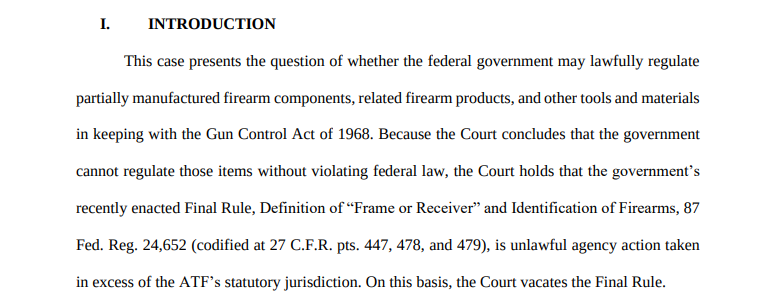
The Court’s logic was pretty simple; a part cannot be both a receiver, and not yet a receiver at the same time. ATF’s entire premise of regulating an 80% lower when it is sold with jigs or tools as a completed receiver makes no sense because it is (by ATF’s own admission) still not actually a receiver.
“As the Court previously explained, the issue in this case is whether ATF may properly regulate a component as a “frame or receiver” even after ATF determines that the component in question is not a frame or receiver. It may not. Logic dictates that a part cannot be both not yet a receiver and receiver at the same time. Defendants’ reliance on that logical contradiction is fatal to their argument.”
This decision did not need to reach other Constitutional issues presented. Courts must dispose of cases on grounds other than Constitutional ones when they can do so. In this particular case, the Court found ATF’s position so clearly wrong that no other Constitutional grounds needed to be addressed.
“Because the Court concludes that the ATF has clearly and without question acted in excess of its statutory authority and that this claim is dispositive, the Court declines to address the constitutional questions presented.”
 Lower Valley Assembly