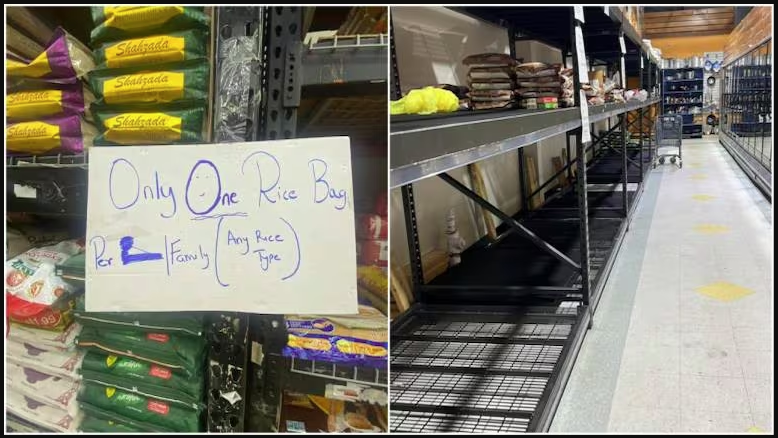
On July 20th the government of India banned the export of non-basmati white rice to “ensure adequate domestic availability at reasonable prices”. India is the world’s largest exporter of rice, accounting for around 40% of global rice trade. Approximately half of that trade is non-basmati rice. Rice is a very popular preparedness staple for food storage. It is then perhaps no surprise that the ban had led to rising pricing, stockpiling, and empty store shelves.
India’s decision to ban the export of non-basmati rice has led to consumers panic-buying and stockpiling Indian rice around the world, driving up prices in the process.
In Canada, the U.S. and abroad, reports of panic-buying are flourishing on social media, with stores that cater to South Asian communities implementing caps on the amount that any customer can buy, and adjusting prices.
Sriram Ramamurthy, the manager of Iqbal Halal Foods in Toronto, told CBC News in an interview Monday that he saw an immediate increase in demand for rice once word of the ban spread on Thursday of last week.
“They started coming in here and they wanted to buy more and more,” he said. He soon implemented a limit of one bag per customer, but that quickly proved futile as customers would come back with more family members, “each one trying to pick two or three at a time.”
Some customers would even approach other customers in line who were not buying rice, trying to get them to purchase it on their behalf, he said.
In order to stave off a food shortage at home, India has banned the export of all rice except for the export-focused basmati variety, which has led some to worry about skyrocketing prices and the potential for further bans in the future.
Ramamurthy says he carries more than 40 different brands of rice in his store, mostly from India, but the majority of what he sells is basmati rice, a premium grade of rice that isn’t even included in the export ban.
But that hasn’t stopped customers from trying to buy up every grain they can, of basmati and varieties included in the ban, just in case, he said.
raj Mohammed said he heard about the ban, so decided to come “down to the grocery store expecting that this is not gonna be the case in Canada. But I guess the worst happened,” he said. He prefers one specific type of basmati rice, one that the store doesn’t have any more of right now. “Now I’m not going to be able to get my hands on it, I guess.”
Ramamurthy says he hasn’t raised his prices yet, but he’s expecting his suppliers to soon. Stores that cater to the South Asian market elsewhere in Canada are reporting similar scenes, including Savor Supermarket in Saskatoon, where purchases are being limited.
Stores in the U.S., Australia and elsewhere are also seeing unprecedented demand, Bloomberg and others reported Tuesday, although CBC News has not been able to independently verify the authenticity of videos showing hoarding and panic buying.
Prices up sharply
India has taken the extraordinary step in order to ensure domestic supply, and bring down prices, which have soared due to excess rains and drought in rice-producing regions.
According to government data, the domestic price of non-basmati rice has increased by almost 10 per cent this month. In September of last year, a metric tonne of non-basmati rice in India would cost about $330 US. Today it tops $450, according to pricing in the most-traded Indian rice futures contract.
Sophia Murphy, executive director for the Minneapolis-based Institute for Agriculture and Trade Policy, says rice is such a staple for India and its 1.2 billion people that the government manages supply closely. Unlike other food commodities, she says the global rice market is very domestically oriented, as less than 10 per cent of all the rice in the world ever crosses a border.
While India is far and away the world’s largest exporter of rice, with more than 40 per cent of international trade in it, their primary concern is maintaining domestic supply, which is why they have had export bans in the past, she says.
“If they ban or someway limit the exports, it should keep more production in the country and it should reduce the inflation pressure that is there on food prices,” she said.
Canada imported about $650 million worth of rice last year, according to government data. Within that, about $140 million came from India — and only a tiny percentage of that is of the small- and medium-grain varieties of non-basmati rice that the ban applies to.
Murphy says while supply of basmati may also be strained, the government did not move to ban exports since it is a more premium product. Local concern is on the other staple varieties, which is why the government used the dramatic step of halting exports.
“Bans are easy to explain to the public,” she said, “we’re not selling food abroad, we’re looking after people at home. It’s often a pretty blunt — not necessarily very effective — instrument but it has domestic political capital associated with it.”
India’s move to ensure domestic supply is the second major announcement from a major exporter this year, as in May Vietnam announced plans to limit its own exports to four million tonnes a year by 2030. That’s down from more than seven million tonnes a year right now, and it’s aimed at “ensuring domestic food security, protecting the environment and adapting to climate change,” the government said in a release.
This article at The Survivalist Blog caught my eye because I’ve been adding rice variety to my food storage. Previously I mostly just stored jasmine rice as it was our go to staple for regular (non-emergency) cooking. Jasmine rice can be purchased rather inexpensively from various local and remote sources. Recently I’ve been exploring more Japanese cooking and was impressed with the flavor of some short-grain rice varieties and, because we now use it more day-to-day than the Jasmine rice, have added some to storage. Here’s Rice Storage: How to Store Large Amounts.
As the saying goes… Rice is nice!
The world uses rice. The world needs rice. In some parts of the world, the majority of a person’s calories come from rice. This is their main food and they use extensively. Or it’s their only food.
In times of need, rice is the first food brought by aid workers. They do this because it is calorically dense, good for delicate diets, and it stores and transports well.
Preppers love rice. It’s one of the perfect prepper storage foods. Put simply it’s cheap, it stores, and it’s an absolute chameleon in the kitchen. For these reasons, rice is one of the first bulk foods preppers add first to their kitchen cupboards. Then to their deep pantry. Then to their long-term storage.
It seems that the most difficult thing about rice is taking that first step into storing large quantities of it. As you will see in this article there’s nothing to fear about taking that step!
At the risk of over-glamorizing rice, we first need to understand why rice. What makes it such a great survival food? Why should it form the foundation of your long-term food storage?
Rice (Oryza sativa) was domesticated by humans around 10,000 years ago. Rice was such an important grain; humans began the process of understanding ways to control its growth rather than leave the valuable harvest up to chance and mother nature.
Today the world produces over 700 million tons annually. With it, we feed our ever-growing population. Many cultures depend on it as a staple of their diet.
Nutritionally, rice is approximately 80% carbohydrates by weight. The grains are mostly starch and are flush with calories. The result is that 1 cup of uncooked rice has 700 calories. At 6.5 ounces per cup of uncooked rice that equates to 1600 calories per pound of uncooked rice.
1 cup of uncooked makes between 3 and 4 cups of cooked rice. That’s a pretty big serving. From this, it’s easy to see how a bag of rice keeps bellies full.
It’s not just the calorie count that makes rice attractive to preppers, although it helps. The second benefit is how long it stores. Properly packaged, white rice has a shelf life exceeding 30 years.
Next, is rice’s price. Pound for pound, calorie for calorie, it doesn’t get much cheaper than rice. At about $0.06 per ounce or $0.96 per pound, rice is affordable on any budget.
Adding a 5-pound bag to the grocery cart each week is obtainable to any prepper. That 5-pounds adds up quickly over the months. Especially considering at that rate you’re adding 32,000 calories per month (16 – 2,000 calorie days) to your panty.
Finally, you must consider the flexibility of rice. Breakfast, lunch, and dinner all have a spot on the plate for rice. We all know it as the traditional side dish. A little salt and butter and there it sits. It gets more exciting than that though.
How about rice porridge aka congee? Boiled low and slow with extra water until silky smooth is the foolproof recipe for Congee. Congee forms the base of a savory side with the addition of chicken or pork. It can be breakfast if you stir in an egg. It can even be dessert if you boil it in sweetened milk or coconut milk.
As rice is normally bland – it absorbs the flavor of whatever it is cooked with. Growing up it was used as a meat extender. My mother added it to chili, meatballs, and several soups.
In my house, we use it as a thickener for chicken soup. A bit of rice allowed to boil for a while transforms soup into a rib-sticking stew.
When more exciting food is at a premium, rice will be the ultimate addition. A large portion of the world lives on it and so can you. With the benefit of a few spices or protein, you can add rice in infinite variety to your prepper meals.
How Much Rice to Stockpile?
So how much should you store? Let’s start with calorie counts. A pound of uncooked rice has about 1600 calories. Note: I prefer to estimate low when working with food. I’d rather be pleasantly surprised than starve. Let’s look at a quick recommendation.
I realize that every person and every case is unique. If you want to get an exact break out, a basal metabolic calculator and fine-tune these estimates.
Assuming a daily requirement of 2,500 calories it is recommended that half of that comes from carbohydrates. This is 1,250 calories from carbs. That equates to about 12.5 ounces of uncooked rice per day. This assumes that rice is your only carb.
Depending on your storage goals we now get the following:
30 days – 25 pounds (rounded up from 23)
6 months – 150 pounds (rounded up from 140)
1 year – 300 pounds (rounded up from 285)
Assuming a 4-person family, that’s 1200 pounds of rice for a year of carbs. Naturally, you will be reducing it based on your other long-term storage items.
Just as a side note wheat berries, pasta, oatmeal, and beans all have about 1600 calories per pound. This makes the math easy. If you have a combined 300 pounds per person of these staples then you have your carbs covered. Next, you must focus on fats and protein. But that’s another article.
Rice Selection
For your bulk storage, you also need to consider the selection of rice for the longest available term. First, let’s look at the rice that should be avoided for long-term storage.
Brown rice for all its flavor, complexity, and nutrition is not a good candidate for long-term storage. The same goes for wild rice. Each of these retains an amount of the natural oils. These oils eventually turn rancid. As a result, their shelf life is measured in months, not decades.
The next option is instant rice. Instant rice is pre-cooked and then dehydrated. Cooking times are greatly reduced (only a few minutes compared to 20-45 with other rice varieties).
The biggest benefit is the fuel needed to cook instant vs normal rice. While you can store it for the long-term there are several disadvantages.
First is the cost. Instant rice can cost up to three times as much as white rice. Shop around, you may find deals. Secondly, instant rice can have fewer nutrients as a result of the cooking process.
Finally, the cooking process can lead to an inferior cooked product. I’m not sure you’ll be judging post-apocalyptic meals based on the number of broken rice kernels, but it is a consideration.
Your attention should therefore turn to good old fashion white rice its variants. Long grain white rice is the prepper staple. It can be found in bulk and cheap. Considering variety, you can also add jasmine, basmati, and sushi rice.
No matter how you treat it, rice can get a little monotonous. The subtle differences in taste and texture of jasmine and basmati can help to avoid food fatigue when relying on your long-term storage goods. It costs very little extra to add 25-30 pounds of each in the name of diversity.
Sourcing Rice in Bulk
Rice, being one of the staple crops of the world, is widely available in bulk. While the biggest package you get from your local grocery store may only be 5-pounds. Don’t fret. There are numerous other places to source this valuable grain.
First are the big box stores. Costco, BJ’s, and Sam’s are the first that come to mind. My local Sam’s carries several varieties of white, basmati, and jasmine, all in 25 and 50-pound bags.
Then check local ethnic stores. Look for Asian and Hispanic specialty stores. Both cultures use rice heavily in their cooking. They are sure to have 50-pound bags as well as a much greater variety.
Asian cuisine is known for its use of specialty rice for dishes. Make use of their variety for adding change up to your own shelves.
The next option is restaurant supply stores. These stores cater to the hospitality community. They carry food mostly in bulk.
If you need 40 pounds of chicken or 50 pounds of cabbage, this is the place for you. They also carry rice. Lots of it and in many different variations. They also tend to be the most economical.
One warning, they may require a membership. Most, however, have open days where anyone can come in and purchase. Keep your eyes open and stock up.
The final option is the ubiquitous Amazon. A quick search yielded several options at good prices.
Enemies of Rice Storage
There are several enemies to look out for when putting up large quantities of rice for the long-term. Namely light, heat, oxygen, moisture, and critters. Let any of these variables into your storage equation and you are bound to lose food.
Light and heat will eventually rob stored food of flavor, nutrients, texture. Oxygen leads to rancidity and associated spoilage. In bad cases, moisture contributes to mold. Finally, insects and rodents can wreak havoc on food stores.
The last thing you want is to open a bucket of rice after 15 years to find if filled with weevils or half-empty from rats. Let’s look at ways to manage these risks.
Light and Heat
First, light is easy to manage. With the proper container (e.g. 5-gallon bucket) then light is kept to a minimum. Heat is straightforwardly overcome if you have a basement or other climate-controlled storage area.
Oxygen
Oxygen can either be removed or displaced. The most common method is removal via oxygen absorbers. These small packets contain iron powder that, during the rusting process, absorbs oxygen out of the atmosphere.
In a sealed container the process also creates a vacuum. They are sold by the volume of oxygen they absorb. We will talk a lot about 5-gallon buckets in the next few sections.
Here’s a little math to help out with your O2 absorber calculations. The volume of a 5-ballon bucket is about 19,000 cubic centimeters (cc). With our air being about 20% oxygen, that means an empty bucket will contain about 3,800 cc of O2 to remove.
By placing O2 absorbers rated at a total of 4,000 cc you will remove all the O2 and have room to spare. That’s two 2,000 cc absorbers per bucket. The fact that your food will take up significant volume also gives you room to spare in your calculations.
The displacement method is a little more complicated but just as effective. To displace oxygen in a container you must push it out, generally with something heavier. This includes Nitrogen and Carbon Dioxide (CO2).
Unless you have a ready supply of Nitrogen, skip right to Carbon Dioxide. The easiest method is to place a few chips of dry ice (solid CO2) into the bottom few inches of your rice. Then fill up the bucket within a few inches of the top and wait.
As a test, you can place a tea light candle on the rice. When the flame goes out ,you know it has been robbed of oxygen and that the bucket is full of CO2. Make sure that the dry ice has fully sublimed before you seal the bucket. Otherwise, you may have an overpressure explosion on your hands.
Moisture
Water promotes mold and mildew growth as well as a host of other nasty outcomes. The good news is that as long as you are not repackaging your food in a very humid environment you are probably OK.
If you have flexibility, pack your food when it is dry. For example, in northern climates, the best time is usually in the winter.
If you don’t have the luxury of time add a few silica gel desiccant packets. The silica in each packet absorbs water vapor out of the air making the environment dry and safe from mold.
The packets linked here are good for approximately 600 cc of volume. For our 5 gallon buckets, we can assume that 90% of the volume is taken up by rice which leaves 1,900 cc of air space. Three to four packets per bucket should be sufficient.
Pests Big and Small
Unless you are sourcing your rice from a pretty sketchy supplier it is doubtful that you will have visible insects in your rice. If so – change suppliers.
More likely you will have eggs within the rice. This is normal, they are everywhere, in everything, and 99% innocuous. Occasionally they will hatch, eat, and make more insects. To be honest, these bugs are more psychological than physical. That being said, I’m not a fan and therefore prevent them.
If you plan on packing with O2 absorbers you are removing the critical component to the insect’s survival. They won’t hatch without air. Problem solved.
If you are not using O2 absorbers you can utilize a second method. Freezing. Storing your grain in the freezer for 5-7 days will kill off all the eggs in your rice. As long as you immediately package them, they will be free from re-infection.
Finally, you can add Diatomaceous Earth to your rice. Diatomaceous Earth is simply the fossilized remains of diatoms. Diatoms are microscopic creatures that died and fossilized a few million years ago. Their fossilized skeletons are murder on insects.
The saying goes something like “death by a thousand paper-cuts.” The Diatomaceous Earth cuts then dehydrate any insects it contacts.
Diatomaceous Earth is a powder and does not affect humans unless you inhale tremendous amounts of it. Mix it in with your rice before packaging. If you wish, you can quickly rinse your rice before cooking.
Diatomaceous Earth is perfectly healthy to eat, and may even help eradicate intestinal parasites. While you do not want to breathe it in, as it may irritate your lungs.
The next concern is vermin outside your containers. This includes ants, mice, and rats. Ant’s are easy to prevent. Seal your package, and if you happen to see ants in the area, wipe any containers down with Clorox wipes. This removes traces of rice as well as the scent trails left by ants leading others to the food source.
Mice and rats are a different matter. Once they get it in their head that they have found food, little will stop them. Rats especially can chew through a plastic bag, bin, or bucket.
The best course of action is prevention. Sealing properly limits scents that attract rodents. Secondly, store your long-term supplies in rodent-free areas. This means to seal up any access points and set ample traps to immediately kill any that get in.
5-Gallon Bucket Primer
I’m talking about your standard 5-gallon utility bucket from your local big box store. Buckets are a modern wonder in the prepper world. They are sturdy. They can have a remarkable seal. They take a substantial amount of abuse.
For rice storage, you want to use clean food-grade buckets. You can tell a food-grade bucket by the recycle symbol on the bottom. The triangular recycle symbol for a food grade bucket has a 2 printed inside the triangle:
Usually, these buckets are High Density Polyethylene, or HDPE and also labeled with HDPE above or below the triangle. These are your best bet!
While you can order these at Amazon, there are much cheaper and readily accessible options.
If you want new buckets, I highly recommend Home Depot. Their buckets are everything a bucket should be: heavy-duty, well made, and orange. For about $4 per bucket and another $2 for a lid, you will be able to store about 30 pounds of rice.
If you are on a tight budget or want a little color variety I recommend heading to your local baker. They receive icing in 5-gallon buckets. A quick wash and rinse, as well as a new lid and they are good as new:
A note about buckets and color selection. I have found that I can take advantage of different colored buckets. White are for bulk goods. Orange are for freeze-dried components. Blue are for complete meals. It makes identification quick if I need to “grab and go.”
I honestly would avoid the lids sold at Lowe’s. Nothing against the company, just their lids. They are too flimsy and don’t have a good lock around the edged for my long-term storage goods.
Regardless of where you source buckets, give them a good wash. If you are not using Mylar (we will touch on that in a few paragraphs) wash the inside with a 10% bleach solution. When you are done packing them place a label on the outside.
Method #1: Storing Rice in Bags and Totes
The first method for storing large amounts of rice is relatively simplistic. Use totes with well-fitting lids. Before packing them away place each bag of rice in the freezer for a week, and then stack the bags in your tote. No need to repackage. Fill the tote, then start on a second.
If you want a little extra protection, place each bag of rice in a giant zip lock bag. Add a few desiccant packs to each bag before you zip them up.
This is a great way to store large amounts of rice, however, you may only get 4-5 years of storage. This is a better solution for periodic rotating. Check your rice each year, and look for failures of the totes, Ziploc bags, and original packaging. Replace or recharge your desiccant packs each year during the inspection.
Method #2: Storing in Buckets with Diatomaceous Earth
Our second long-term storage method for bulk rice is 5-gallon buckets and Diatomaceous Earth. Add Diatomaceous Earth to the rice to destroy eggs and kill any insects that happen to hatch or wander through. You’ll need ½ cup of Diatomaceous Earth for 5-gallons of rice.
First, add a thin layer of Diatomaceous Earth to the bottom of the bucket. Then add 4 inches of rice and another layer of Diatomaceous Earth. Repeat until the bucket is within an inch or two of the top then hammer on your lid and add a label.
It’s best to roll the bucket around about to distribute the Diatomaceous Earth. Alternatively, you can dedicate a bucket to mixing and fill it ½ way with rice and ¼ cup Diatomaceous Earth. Mix thoroughly, then pour into your storage bucket. Remember to wear a mask as Diatomaceous Earth can be irritating to your lungs.
This method is not airtight as a 5-gallon bucket doesn’t form a perfect seal. This type of preparation gives a little more than 5 years of storage.
Rice with oxygen absorbers in Mylar bag
Method #3: Buckets and O2 and Mylar, Oh My
Time for the prepper-approved method for long-term storage of bulk grains. Mylar, O2 absorbers, and 5-gallon buckets. The buckets provide durable storage. Mylar bags provide an airtight seal, and O2 absorbers provide the environment for long-term preservation.
Mylar bags are the perfect prepper accompaniment. They are non-porous, flexible, yet tough. This allows them to when sealed, hold a vacuum for a long time without the risk of failure. The metallic coating also adds additional light blocking above and beyond that provided by your bucket.
Finally, they seal with a little heat. I’ll cover that in a minute.
To prepare your perfect long-term storage bucket put a Mylar bag into your clean 5-gallon bucket. Drop in an O2 absorber and start filling with rice. Add your other absorbers as you fill.
One bucket should hold about 30 pounds of rice. When filled within 2 inches of the top of the bucket, fold over the Mylar and press out as much air as possible.
To seal the Mylar bag, you have two options. The first is to use a food saver or other impulse sealer. You may not be able to cover the entire width at once. In that case make two diagonal seals (one on the left, one on the right).
Then make one last seal bridging the gap between the two. I always make 3 seals in each direction for a little added protection:
3 seals on one Mylar bag
In 20 years of prepping I have yet to lose a bag to this method.
The second option is to lay the bag over a dowel, small square wooden stake, or metal level then run your iron (on low setting) over the bag.
The ideal temperature is about 400 degrees Fahrenheit. You can measure this with a thermometer, or just make a few practice passes on a scrap section of Mylar.
Once you are done packaging add labels both inside and out. Make sure to include the contents (rice), the method (Mylar and O2), and the date.
Given a good seal, you will see the bag collapse and pull into the rice in a day or so. Once the O2 absorber has done its job, the bag will be completely pulled in. If this doesn’t happen after 3-4 days, open the bag, add a new absorber or two, then reseal.
Expect more than 20 years with this method. You may even get many more. Periodically pop the lid and check for seal failures or other damage.
I have used this method for years, and have yet to see a bag fail. Every few years I pick up another 100 pounds of grains or pasta and fill up three new buckets.
Store O2 absorbers in sealed glass jars for later use.
Conclusions
Rice is cheap. Rice is flexible. Rice stores for ages. If there are three better reasons to store large quantities of rice, I can’t think of them. Rice should be the center of your long-term food storage plan. Over the ages, it has earned its place there.
Storing large amounts of rice is not only cheap but it’s easy. Regardless of the best method for your situation, there is little reason not to put up many, many pounds of it.
Even if you just put the bags in totes today and then move to Mylar and orange buckets later, there is no time to start like right now!



 Lower Valley Assembly