Forloveofgodandcountry: School Parents Bill of Rights

Diane Rufino at Forloveofgodandcountry’s Blog has written an article on the education system titled A Parent’s Bill of Rights. In it she discusses some failings in the school system and the loss of parental input and control over education.

Excerpt:

…Back in the day (and I’m not that old), it was always assumed that religion, morality, and knowledge were the legs to a solid public school education. It was always assumed that those in charge of the education of our children were in line with the rightful expectations of parents. And we, as parents, used to believe that we could go into the schools, into our child’s classroom, and see what they are learning and how they are being taught. This was so back in the 70’s when I was a child in the public school system in New Jersey and up until several years ago in North Carolina. What changed?  When did we lose the time-honored notion of a “sound, basic education?” When did we as parents lose our rights to know how our children are being educated? When did we lose control over our children?  When did the school system take control of them and disrupt the parent-child relationship?  When did the school system usurp our parental rights?

And so, I’d like to address a different topic with regard with the education of our children in this article –  a PARENT’S BILL OF RIGHTS…

Parents have a voice and that voice needs to be heard. They have rights and they need to be respected and not ignored. Parents have every right to be involved in the classroom. After I heard Ms. Kelly Mann, the Outreach Director for the John Locke Foundation (Raleigh, NC) mention an article she had written on A Parent’s Bill of Rights for its website, I became energized to help promote it. I wrote to every single North Carolina house member and every single state senator asking them to consider a bill officially recognizing parents’ rights in the education of their children.

A Parent’s Bill of Rights should, at least, include all of the following. I’m sure parents can come up with additional “rights” and I hope they do. The first 10 rights come from Ms. Mann (I want to make sure she gets the credit, which she absolutely deserves) and the rest are ones that I’ve come up with:

  1. Education funds must follow students, not systems.
  2. Parents have the right to engage in the selection and approval of academic standards.
  3. Parents have the right to access educational materials, resources, and syllabi taught to their children in the classroom.
  4. Parents have the right to make medical care decisions on behalf of their children.
  5. Parents will receive timely notification of information related to the health, well-being, and education of their children.
  6. In-person education is a right that should always be available as a choice.
  7. Parents have the right to transparent access to school and school district academic performance.
  8. Parents have the right to access detailed and up-to-date district financial records.
  9. Parents have the right to opt their children out of the classroom for delivery of content listed in the syllabus with which they disagree.
  10. Parents have the right to know of threats to their child’s safety (individually or school-wide).
  11. Parents have the right to determine and choose which education environment will best serve their child’s education needs, without judgement from others or resistance by the school system, even if that environment is at home (home-schooling).
  12. Parents have the fundamental right to make decisions regarding their child’s education, well-being, and access to public school progressive indoctrination. Religion, morality, family and social values are matters to be directed and respected as belonging to parents.
  13. Parents have the right to be able to sit-in on their child’s class, upon making a request to do so.
  14.  Parents have the right to be provided with information, data, and statistics as to the shortcomings or failures (as well as successes) of each school system their child can potentially attend.
  15. Parents have the right to be notified should the school feel the need to have a counselor speak to their child, and to have the right to refuse to have their child “counseled” by the school.
  16. Parents have the absolute right to be notified of and to be involved in the filling out of ANY questionnaire or survey that the school assigns to their child. Likewise, parents have the absolute right to refuse to have their child answer such questionnaires or surveys. Parents have the right to control what information is shared with the school system (ie, government).
  17. For parents of exceptional children:  Parents have the right to have their child’s exceptionalism diagnosed and served by the education system.
FFF: Do We Need the First Amendment?

Do We Need the First Amendment? is a simple article by former trial attorney and professor Jacob Hornberger over at the Future of Freedom Foundation. The topic of where our rights come from, though, is vital and people constantly need to be reminded. There are both conservatives and liberals who think that our rights are from and/or are limited to the Constitution’s Bill of Rights. Some incorrectly believe that if we amend the Constitution to remove one of the listed rights, then we have done away with that right. Others wail and complain if the Supreme Court decides there is a right in existence not listed in the same Bill of Rights.

One must remember that the US Constitution gave form to the government, but perhaps more importantly it listed every power that the federal government was delegated by the people. When some people complained that the proposed Constitution didn’t originally list any protected rights, the framers said “Look, we didn’t give the government to abridge any rights. See? That power isn’t listed anywhere.” But people demanded a Bill of Rights just to be extra sure that it was clear that the government had no power to legislate in those areas. Again, some people said, “But if we write down a list, then some day people might think that only the listed the rights are protected” and people replied “We didn’t give the government that power! But here’s a ninth amendment that says you keep all of those, too.” Unfortunately, people didn’t pay attention, and the government has slowly, at times, and by leaps and bounds, at other times, has encroached everything.

Many years ago, I was giving a lecture on the Constitution and the Bill of Rights to a class at a public high school here in Virginia. During the course of my talk, I made the following statement: “The First Amendment does not give people the right of free speech.”

I asked the students whether my statement was correct or incorrect. Everyone immediately told me that I was wrong. They said the First Amendment did in fact give people the right of free speech.

I held my ground. I said it didn’t, and I pressed the students to figure out why I was maintaining my position. They were just as steadfast in their position, until a girl raised her hand and said, “Mr. Hornberger is right. The First Amendment does not give people rights. It prohibits the government from infringing on rights that preexist the government.”

She was absolutely right.

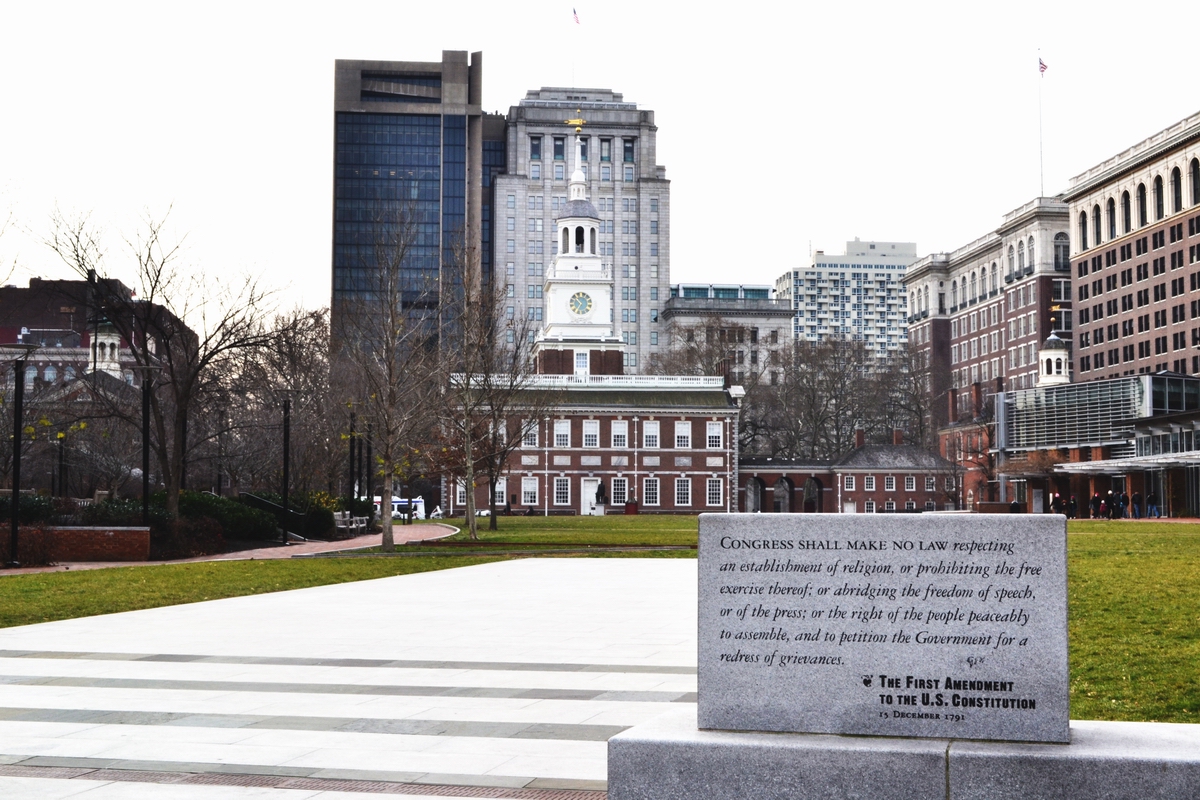
The First Amendment reads:

Congress shall make no law respecting an establishment of religion, or prohibiting the free exercise thereof; or abridging the freedom of speech, or of the press; or the right of the people peaceably to assemble, and to petition the Government for a redress of grievances.

Notice that the Amendment does not give people rights. Instead, it prohibits Congress from enacting laws that abridge people’s rights.

But what is that all about? Why did our ancestors deem it necessary to enact such a prohibition? Isn’t Congress our friend? Isn’t it composed of people who we elect to represent us? We often hear that we should trust the government. It doesn’t sound to me that the people who enacted the First Amendment had much trust in elected representatives.

After all, the only reason for enacting such a prohibition is the concern that in the absence of such a prohibition, Congress would enact laws that abridge freedom of speech and other fundamental rights. That sounds like Americans believed that the members of Congress needed to be told that they were prohibited from doing so.

The First Amendment and the other amendments in the Bill of Rights reflect how leery people were of Congress and the rest of the federal government. They were convinced that if they approved the Constitution, the federal government they were calling into existence with the Constitution would destroy their rights and their freedom.

That was also why Americans opposed enormous, permanently standing military establishments. Given their conviction that the federal government would destroy their rights, they understood that the way governments historically had done that was through their military forces.

After all, how else to enforce a law, say, that prohibits people from criticizing the president or Congress? Sure, it would be possible to arrest, indict, convict, and incarcerate them but what if dissent became widespread among the citizenry? That’s where a massive military establishment would come into play — to use massive military force to put down dissent with round-ups, assassinations, killings, torture, executions, and other things that militaries historically have done to oppress people. That’s why all totalitarian regimes have large, permanent, powerful military establishments.

Thus, there is no possibility that our American ancestors would have approved the national-security state form of governmental structure under which we live today, a structure consisting of the Pentagon, the CIA, the NSA, and a vast empire of domestic and military bases. If the Constitution had proposed that form of governmental structure, Americans would have summarily rejected the deal and simply continued operating under the Articles of Confederation, another type of governmental system, one in which the federal government’s powers were so weak that the federal government wasn’t even given the power to tax.

The Constitution called into existence a limited-government republic, a type of governmental system that gave the federal government very few powers. There was an army, but it was relatively small — large enough to defeat Native American tribes but not large enough to threaten the American people with massive tyranny.

In fact, that’s why our American ancestors enacted the Second Amendment. It was designed to ensure that people would retain their right to keep and bear arms as a way to fight against any federal army or national police force that the Congress or the president might employ to enforce their destruction of free speech and other rights and liberties.

Thus, whenever you hear someone lamenting the lack of trust that many Americans today have in the federal government, it might be worth reminding them that the federal government was called into existence under a cloud of mistrust among our American ancestors. And they were right to have that mistrust!