The Defense Post: Top US General Calls Russia, Ukraine Amid Reported Moscow Troop Buildup

In this article at The Defense Post, Top US General Calls Russia, Ukraine Amid Reported Moscow Troop Buildup. Tensions in the region rise after President Biden condemns Russia’s 2014 takeover of the Crimea peninsula and calls Russian President Putin a “killer.” Many organizations, including leftist ones, have asked the President to cease his “reckless” rhetoric with Russia.

The top Pentagon general called counterparts in Russia and Ukraine Wednesday as the US Defense Department expressed concerns about a reported buildup of Russian troops along Ukraine’s border and in Crimea.

US troops in Europe were on an elevated “watch condition” as Joint Chiefs Chairman General Mark Milley spoke to General Valery Gerasimov, the Russian Armed Forces chief of staff, and Ukraine armed forces Commander in Chief Ruslan Khomchak.

Meanwhile, White House National Security Advisor Jake Sullivan called the head of the Ukraine Presidential Office Andriy Yermak to reiterate Washington’s support for the country.

“We’re concerned about recent escalations of Russian aggression in eastern Ukraine, including violations of the July 2020 ceasefire that led to the deaths of 4 Ukrainian soldiers on the 26th of March, and the wounding of two others,” said Pentagon spokesman John Kirby.

“Russia’s destabilizing actions undermine the de-escalation in tensions that had been achieved through an OSCE-brokered agreement back in July of last year.”

He said the US military was aware of Ukrainian reports concerning Russian troop movements on the country’s borders.

“We’re discussing our concerns about this increase in tensions in ceasefire violations and regional tensions with NATO allies.”

On Tuesday Moscow and Kiev traded accusations of responsibility for an increase in violence between Ukraine government forces and Kremlin-backed separatists in eastern Ukraine, leading to a rise in deaths.

Khomchak denounced the “threat to the military security” of Ukraine by the Russian army, saying that some 28,000 separatist fighters and “more than 2,000 Russian military instructors and advisers” are currently stationed in eastern Ukraine.

Reports online suggested that Russia had located more military forces along the border and also moved more into Crimea, the Ukraine territory that Moscow seized in 2014.

Those reports could not be confirmed, but some observers have tied them to Russian military exercises.

Kirby said Milley’s call to his Russian counterpart was “to gain a little bit more clarity on what exactly is going on.”

“We obviously don’t want to see any more violations of Ukrainian territory,” he said.

In his call with Yermak, Sullivan “affirmed the United States’ unwavering support for Ukraine’s sovereignty, territorial integrity, and Euro-Atlantic aspirations, in the face of continuing aggression,” according to a White House statement.

US forces in Europe were placed on a heightened watch level to “potential imminent crisis” in response to Russian activities, Kirby confirmed. He said that the watch condition “expresses combatant commanders’ concern about a potential threat.”

Mises Institute: The Property-Based Social Order Is Being Destroyed by Central Banks

The Mises Institute has the article The Property-Based Social Order Is Being Destroyed by Central Banks

Readers of the Mises Wire are no doubt familiar with the negative consequences of central banking and the inflationary capacity of fiat currency and how such a system drives malinvestment and leads to boom-bust cycles. Not only does the business cycle lead to the misallocation of resources from their natural ends of the structure of production, but it also drives resources into financialization, rather than the “real” economy. This financialization, which has been taking place since at least the First World War, has served, over time, to structurally undermine the morality of property in the eyes of the general public. As the increased popularity of socialism, at least in rhetorical terms, among the youth indicates this “evaporation” of property may reach a critical mass within the not-too-distant future.

The Social Effects of Financialization

In his book The Present Age, sociologist Robert Nisbet traces the origin of financialization to the First World War and the decision to finance the war via credit, rather than taxation. He argues that the other negative social effects of the war, combined with the flush of cash and credit into the system drastically altered American’s traditional propensity to save and instead to spend. These changed habits led to the “roaring twenties” where instead of acquiring wealth through hard work and thrift and a focus on producing goods and services, Americans turned to financial means of acquiring wealth. 

This began what Nisbet calls the “evaporation of property” where ownership of hard tangible goods has evolved into the “soft” ownership of highly liquid and mobile forms of property such as stocks. This concept of evaporating property originated in the work of Joseph Schumpeter, an economist and contemporary of Mises in Austria (though not a member of the Austrian school) who identified and explained this phenomenon in his classic work Capitalism, Socialism and Democracy.1 Schumpeter criticizes the shareholder mechanism of ownership for separating legal ownership from those responsibilities and actions that are traditionally associated with it. He argues that the owners of publicly traded firms are comprised of three groups of people: the salaried executives and managers, the large shareholders, and the small shareholders, and that “no element of those three groups … takes the attitude” that is generally meant by the word property. The employees, he states, often do not identify with the shareholding interests, and the large shareholders, even if they behave how financial theory predicts, are “at one remove from both the functions and attitudes of an owner.” Schumpeter considers small shareholders to be the least tied to ownership, saying that they often care little and if anything are mobilized by others for “their nuisance value.” He goes on to say that in the end, small shareholders end up feeling ill used and “almost regularly drift into an attitude hostile to ‘their’ corporations, to big business in general and, particularly when things look bad, to the capitalist order as such.”

For Schumpeter, the heart of the problem is that “the capitalist process, by substituting a mere parcel of shares for the walls and machines of a factory, takes the life out of the idea of property” and that “this evaporation of what we may term the material substance of property—affects not only the attitude of the holders but also that of the workmen and the public in general. Dematerialized, defunctionalized and absentee ownership does not impress and call forth the moral allegiance as the vital form of property did.”

Easy Money vs. Private Property 

Nisbet laments that this highly liquid form of property leads to economic perversity where “more and more capitalism tends to ‘exalt the monetary unit’ over the type of property that theoretically alone gives the monetary unit its value.” Nisbet takes especial issue with slick operators who seem to believe “that by raiding a decently run corporation, artificially jacking up its price on the stock market through the use of high-yield credit, including junk bonds, they are in consequence improving the management of the corporation.” 

The sad fate of the once iconic Toys “R” Us is one such example. When Toys “R” Us filed for bankruptcy several years ago, some thirty thousand people lost their jobs. The surface argument is that the brick-and-mortar retailer simply couldn’t keep up with the new online world and was losing out to the Amazons and the Walmarts. However, when examined closer, the case can be made that the company’s doom was sealed when it was purchased by a consortium of private equity firms in the mid-2000s. Thanks to the abundance of credit facilitated by the Fed’s loose monetary policy the firms actually only fronted 20 percent of the buyout, with the rest being borrowed. After the acquisition, the firms then saddled Toys “R” Us with the debt used to purchase them in the first place, adding over $5 billion in debt to the $1.86 billion the company held before the deal. By 2007, 97 percent of the company’s operating profits were being consumed to pay interest expenses. The firms also charged the company hundreds of millions of dollars in fees and The Atlantic reports that “according to one estimate, the money KKR and Bain partners earned from those fees more than covered the firms’ losses in the deal.” Who knows how Toys “R” Us would have fared without being saddled with $5 billion in debt. Perhaps it would have had the flexibility to innovate, or perhaps it would have failed, but in the end it didn’t have a chance to find out.

Were Nisbet alive, he would not have been surprised by such an event in the slightest. Loose money leads to loose morals and loose people who see no problem in such a scheme that demonstrates very little actual economic value being produced. 

Rather than exercising the responsibilities typically associated with property and ownership, these private equity firms treated Toys “R” Us worse than a rented mule and in doing so created loads of anticapitalist sentiment. One can’t help but think of Bruce Springstein’s 2012 song “Death to My Hometown,” in which he attacks such firms by lamenting that even though no “shells ripped the evening sky” or “blood soaked the ground” and “no armies stormed the shores for which we’d die” “marauders raided in the night” and “just as sure as the hand of God they brought death to my hometown.” Springstein concludes with a warning to “be ready for when they come for they’ll be returning sure as the rising sun.”

A people that comes to view the capitalist class as rampaging Huns in suits who “ate the flesh of everything they’ve found” is not a people that will be living under a market system for much longer. And when one looks at what happened to Toys “R” Us and similar firms, how the stock market was booming in the midst of the covid lockdown disaster, or how, as Ryan McMaken recently pointed out, GDP is expected to go through the roof even though the true unemployment rate is dismal, it is not hard to understand why people have such hostile opinions of capitalism.

Similarly, all this financialization has made it much more difficult for people to preserve their wealth against inflation and to save and invest in the traditional manners. Instead, people are driven into the stock market. As Jörg Guido Hülsmann notes in his book The Ethics of Money Production, people “must invest their money into the financial markets, lest its purchasing power evaporate under their noses.” He goes on to note that while such a thing may be good for financial brokers, it is not good for the average citizen who is incentivized into debt due to chronic inflation, pushed into a state of financial dependency, and now at the mercy of the financial winds.

The GameStop saga is example of this idea in action. Flush with cash from government “stimulus,” numerous average joes have taken up day trading and pumped the price of a stock into the stratosphere that is in no way connected to reality. The first wave of “meme investors” soon learned that the financial system is not exactly friendly to their method, as the actions of brokers like Robinhood quickly demonstrated. In the long run the reality is that most day traders will lose money and when that happens there is little doubt that their small foray into “financial capitalism” will leave these small investors with the attitude that Schumpeter predicted: hostile to the company they supposedly own and to the capitalist system in general. 

Misplaced Hostility Toward the Marketplace

Hostility towards capitalism seems to be growing everywhere one looks. It is not surprising that envy fueled leftists despise capitalism, but on the political right more and more populists have taken to bashing capitalism and the “market fundamentalists” who are supposedly running the GOP. Yet, populist conservatives have so far seemingly failed to notice the way in which the Federal Reserve and our inflationary fiat currency have contributed to all of the social problems and ills that they are greatly concerned with. Perhaps such populists can be given a pass for not being familiar with Hülsmann’s work on the cultural consequences of fiat money, but what is perplexing is that midcentury authors who conservative populists are more familiar with, such as Robert Nisbet and Wilhelm Röpke, wrote at length about the scourge of inflation and its negative social consequences and yet the issue still raises nary a peep out of the likes of Tucker Carlson and Sohrab Ahmari.

While such a situation is distressing, those within the Austrian tradition should see an opportunity here to harness the populist energies that seem to be growing larger by the day and to reveal to the aggrieved masses that the true target of their wrath should be the state and central banking system. Had Bruce Springsteen had access to a sound economic education he would have been singing at Ron Paul rallies, rather than at those of Bernie Sanders. The task of ensuring the next Springstein is lambasting the Federal Reserve and not capitalism itself begins now.

1.All quotes from Joseph A. Schumpeter, Capitalism, Socialism and Democracy, 3d ed. (New York: Harper Perennial Modern Thought, 2008), pp. 141–42.

The Smallest Minority: Slowly, at First. Then Very Fast.

In this post, Kevin at The Smallest Minority talks about voting and bill HR1 – Slowly, at First. Then Very Fast.

Roger Kimball brings the Truth: For US, Gradual Ruin Is About to Become Sudden. (Behind a paywall, but Instapundit has the pertinent portion.)

There is the passage in the house of H.R. 1, the so-called “For the People” bill, which would effectively assure that were was never another fair election in this country.

It would do this by all-but-obliterating voter ID requirements—you need an ID to board a plane but not cast a vote—mandating same-day voter registration and at least two weeks of early voting, and by requiring states to provide unsupervised drop boxes to receive completed ballots.

In other words, H.R. 1 would centralize presidential elections, taking responsibility for oversight away from the states, where the Constitution placed it, and arrogating it to the clutches of the federal government and its sprawling bureaucracy.

If, as seems almost certain, H.R. 1 becomes the law of the land, it would be the final nail in the coffin of electoral integrity

The widespread irregularities (that’s polysyllabic periphrasis for “fraud”) that attended the 2020 election would be codified into law assuring that, for as long as anyone could envision, 2016 would have to be counted as the last free, fair, and open presidential election.

It used to be that American was the land of the free and home of the brave. A robust culture of free speech was every American’s birthright.

We had free and fair elections, unlike the banana republics we were always called upon to bail out or police.

We also had borders, and even politicians eager to increase immigration understood the difference between entering the country legally and opening the floodgates to the hordes massing on our Southern border.

That’s all behind us now, or at least those traditions appear to be on life support—no, the patient was on life support, but someone came to euthanize him and pulled the plug.

The signs and portents are many and they are not encouraging.

Perhaps the most disturbing episode last week was Joe Biden’s alarming performance when he announced the elevation of two women to the status of combat generals.

Biden went on to underscore the “intensity of purpose” with which his administration would be pursuing “body armor that fits women properly, tailoring combat uniforms for women, creating maternity flight suits, updating their hairstyle requirements.”

This was not from a Saturday Night Live skit: it was the President of the United States live in front of the cameras.

I’ve been on this planet now 59 years. When I was eighteen, I voted for Ronald Reagan – the first and only candidate I ever voted for. I’ve voted in every national and most state elections since, but since then (and even in 1984), I have since voted against. Against whoever was the worse choice. I even cast my ballot for Perot in 1992, being not particularly enamored of either George H.W. Bush or William Jefferson Clinton. I have since concluded that we’ve voted our way into this, but we won’t be voting our way out.

The 2016 election gave me a glimmer of hope, but 2020 ruthlessly stamped out that ember. The Authoritarian Left and its oligarchs in Washington will make sure that their power is never again threatened by the electorate. As someone put it after November 3, 2020, “We knew we had to win by more than the margin of fraud. We just didn’t realize the margin was infinite.”

H.R. 1 legally codifies power grabbing into the future. No more fear of another Bernie or Trump wrecking their plans. The Left controls both houses of Congress, the White House, most of the bureaucracy, and a whole lot of the Justice Department, not to mention the remainder of The Swamp. They can do whatever they want, and they are. Open the border? Done. Raise taxes on the middle cl… I mean, the rich? No problem. Disarm the dangerous “domestic terrorist” publ… I mean, protect the children? On its way!

And anyone who opposes this is a racist and/or a domestic terrorist. A Public Enemy. A Traitor.

I said a while back that I thought all of this insanity had a basis in reality. The Oligarchs aren’t nuts. Well, they may be, but they’re not irrational. They use the irrationality they deliberately created among the general public as a tool, a lever for greater and greater social division so that the chance of any organized opposition of any size is minimized. Why do you think they’re so freaked out about the Capitol riots January 6? Well, they’re not, really. That’s political theater, at which they’re masters. The conditions were set up by them. The Capitol Police were largely stood down and requests for National Guard were refused due to “optics.” Honestly, I think they’re disappointed in the body count. But never mind, it gave them the excuse to clutch their pearls in front of the cameras and claim fear for their lives, and arrest people publicly – the Roger Stone treatment of SWAT teams and armored vehicles, smashed doors and ransacked houses. “This is what happens when you protest wrong.” Turn the thumbscrews one more turn, tighten the ratchet one more click.

In my July 2020 post Endgame I predicted the election outcome. I also wrote:

The wheels come off the train and the train comes off the track in 2021, one way or the other.

The End of America has been predicted by many people for quite some time.  The Progressive Postmodernists appear to have decided that the time is ripe.  The national debt cannot be ignored forever.  The projected entitlement spending is unsupportable.  All their preparation of the battle space through balkanization has brought us to this point.  Black Lives Matter, itself organized and run by self-proclaimed Marxists, is the hinge on which the lid is swinging, but Pandora’s Box is certainly opening.  I don’t think we’re going to stop the greed, envy, hatred, pain, disease, hunger, poverty, war, and death that will come flooding out of it, and there most likely won’t be much around afterward to put them back in.

BLM is no longer the hinge. Post January 6, “Domestic Terrorism” has taken its place. The Anointed have told their followers to Be Afraid, Be Very Afraid of their neighbors who are Not Like Them™. But the National Debt currently exceeds 28 trillion dollars. Twenty-eight TRILLION dollars. $28,000,000,000,000. Not quite five times what it was in 2000, and spending hasn’t slowed down a bit. It continues to accelerate.

That which cannot go on, won’t. But the Anointed are getting theirs while the getting is good, and the rest of us are on our own.

How much longer before their gravy train derails? I predicted before the end of 2021, but there’s a lot of ruin in a nation. We may yet hang on a bit, but not forever.

We live in the very best period of history humanity has ever experienced, and we’re about to destroy it nonchalantly, like a child with a Christmas ornament. I’m not sure Billy Beck’s “Endarkenment” is sufficiently descriptive.

Medium.com: I Lived Through Collapse. America Is Already There.

A water tower bombed by the Tamil Tigers in the final stages of the Sri Lankan civil war in 2008. Photo: Creative Touch Imaging Ltd./NurPhoto/Getty Images

The following is a post from last year by a person living in Sri Lanka. We’ve posted a few times in the past about the end of empires and slow collapse versus quick. I Lived Through Collapse. America Is Already There. talks about how the very slowness of collapse can go unnoticed.

I lived through the end of a civil war — I moved back to Sri Lanka in my twenties, just as the ceasefire fell apart. Do you know what it was like for me? Quite normal. I went to work, I went out, I dated. This is what Americans don’t understand. They’re waiting to get personally punched in the face while ash falls from the sky. That’s not how it happens.

This is how it happens. Precisely what you’re feeling now. The numbing litany of bad news. The ever rising outrages. People suffering, dying, and protesting all around you, while you think about dinner. If you’re trying to carry on while people around you die, your society is not collapsing. It’s already fallen down.

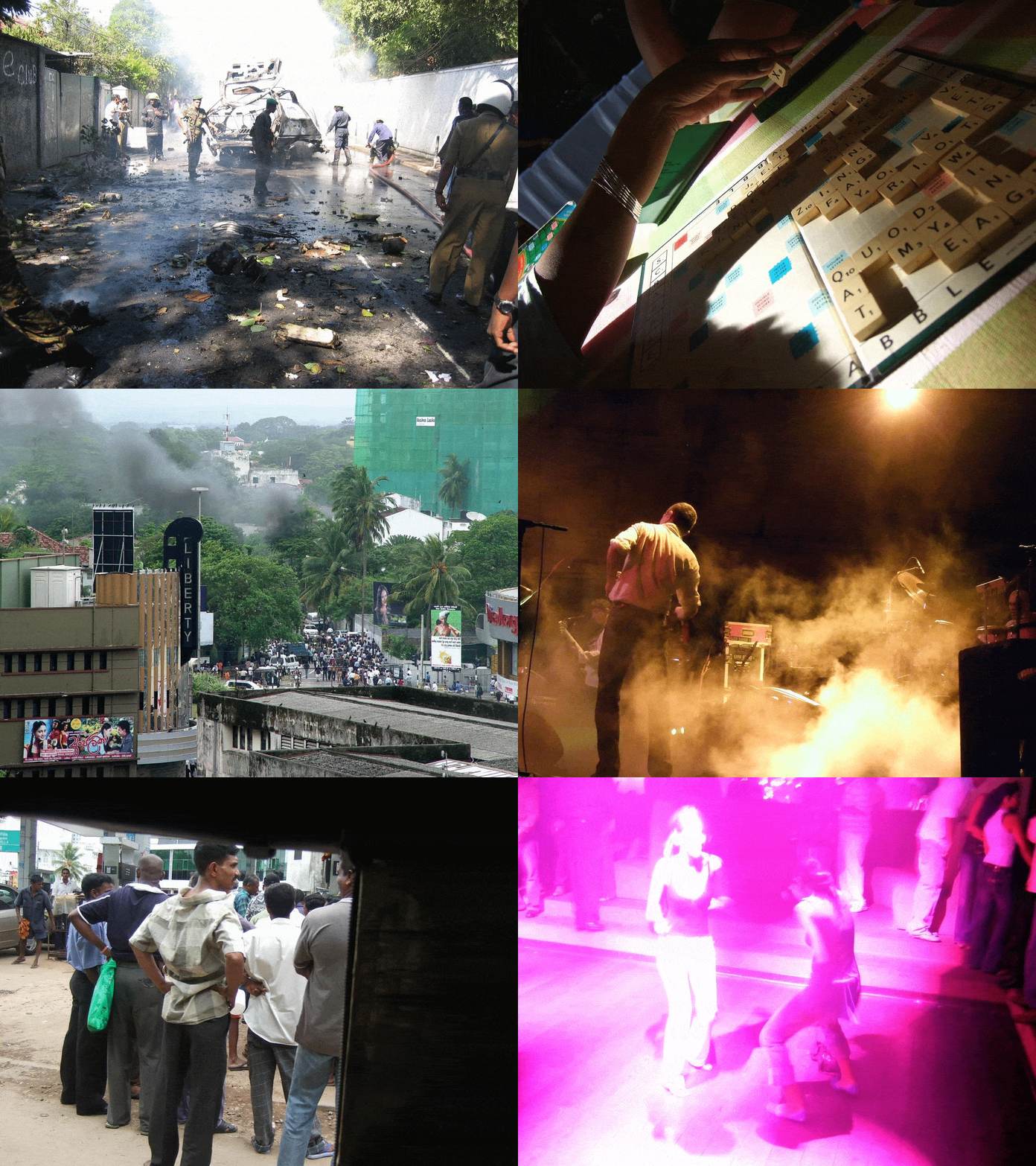
I was looking through some old photos for this article and the mix is shocking to me now. Almost offensive. There’s a burnt body in front of my office. Then I’m playing Scrabble with friends. There’s bomb smoke rising in front of the mall. Then I’m at a concert. There’s a long line for gas. Then I’m at a nightclub. This is all within two weeks.

Photos from two weeks in 2006, courtesy of the author

Today I’m like, “Did we live like this?” But we did. I mean, I did. Was I a rich Colombo fuckboi while poorer people died, especially minorities? Well, yes. I wrote about it, but who cares.

The real question is, who are you? I mean, you’re reading this. You have the leisure to ponder American collapse like it’s even a question. The people really experiencing it already know.

As someone who’s already experienced societal breakdown, here’s the truth: America has already collapsed. What you’re feeling is exactly how it feels. It’s Saturday and you’re thinking about food while the world is on fire. This is normal. This is life during collapse.

Collapse does not mean you’re personally dying right now. It means y’all are dying right now. Death is sometimes close, sometimes far away, but always there. I used to judge those herds of gazelle when the lion eats one of them alive and everyone keeps going — but no, humans are just the same. That’s the real meaning of herd immunity. We’re fundamentally immune to giving a shit.

It honestly becomes mundane (for the privileged). As Colombo kids we used to go out, worry about money, fall in love — life went on. We’d pop the trunk for a bomb check. Turn off our lights for the air raids. I’m not saying that we were untouched. My friend’s dad was killed, suddenly, by a landmine. RIP Uncle Nihal. I know people who were beaten, arrested, and went into exile. But that’s not what my photostream looks like. It was mostly food and parties and normal stuff for a dumb twenty-something.

Collapse is just a series of ordinary days in between extraordinary bullshit, most of it happening to someone else. That’s all it is.

If you’re waiting for a moment where you’re like “this is it,” I’m telling you, it never comes. Nobody comes on TV and says “things are officially bad.” There’s no launch party for decay. It’s just a pileup of outrages and atrocities in between friendships and weddings and perhaps an unusual amount of alcohol.

Perhaps you’re waiting for some moment when the adrenaline kicks in and you’re fighting the virus or fascism all the time, but it’s not like that. Life is not a movie, and if it were, you’re certainly not the star. You’re just an extra. If something good or bad happens to you it’ll be random and no one will care. If you’re unlucky you’re a statistic. If you’re lucky, no one notices you at all.

Collapse is just a series of ordinary days in between extraordinary bullshit, most of it happening to someone else. That’s all it is.

One day, I was at work when someone left a bomb at the NOLIMIT clothing store. It exploded, killing 17 people. When these types of traumatic events take place, no two people experience the same thing. For me, it was seeing the phone lines getting clogged for an hour. For my wife, it was feeling the explosion a half-kilometer from her house. But for the families of the 17 victims, this was the end. And their grief goes on.

As you can see, this is not a uniform experience of chaos. For some people it destroys their bodies, others their hearts, but for most people it’s just a low-level hum at the back of their minds.

What’s that buzzing sound you hear now?

Today I assume you went to work. Bad news was everywhere, clogging up your social media, your conversations. Maybe it struck close to you. I’m sorry. Somewhere in your country, a thousand people died. I’m sorry for each of them. A thousand families are grieving tonight. A thousand more join them every day. The pain doesn’t go away, it just becomes a furniture of bones, in a thousand thousand homes.

As a nation you don’t seem to mourn your dead, but their families do. Their communities do. Jesus, also, weeps. But for most people it’s just another day. You’ve run out of coffee. There’s a funny meme. This can’t be collapse, because nothing’s collapsing for me.

But that’s exactly how collapse feels. This is how I felt. This is how millions of people have felt, including many immigrants in your midst. We’re trying to tell you as loud as we can. You can get out of it, but you have to understand where you are to even turn around. This, I fear, is one of many things Americans do not understand. You tell yourself American collapse is impossible. Meanwhile, look around.

In the last three months America has lost more people than Sri Lanka lost in 30 years of civil war. If this isn’t collapse, then the word has no meaning. You probably still think of Sri Lanka as a shithole, though the war ended over a decade ago and we’re (relatively) fine. Then what does that make you?

America has fallen. You need to look up, at the people you’re used to looking down on. We’re trying to tell you something. I have lived through collapse and you’re already there. Until you understand this, you only have further to fall.

Cato Institute: “Domestic Terrorism Prevention Act” Gains Steam

From the Cato Institute, “Domestic Terrorism Prevention Act” Gains Steam

I’m not aware of a piece of legislation that has ever actually prevented an attack of any kind, but that’s not stopping Rep. Brad Schneider (D-IL), who earlier this Congressional session reintroduced his Domestic Terrorism Prevention Act (H.R. 350). And contrary to a Bloomberg Government story out today suggesting that “lawmakers aren’t likely to pursue expanded powers to fight the domestic threat any time soon”, Schneider’s bill has gained tremendous momentum in the House in the nearly three months since the Capitol Insurrection on January 6.

Just last week, the bill picked up 22 new cosponsors, bringing the total supporting it to 166, including Republicans Fred Upton (MI-6), Don Bacon (NE-2), and Brian Fitzpatrick (PA-1). Of particular note is the number of House Democratic committee chairs on the bill: DeLauro (Appropriations), Pallone (E & C), Meeks (Foreign Affairs), Nadler (Judiciary), Maloney (Oversight & Government Reform), Thompson (Homeland Security), DeFazio (T & I), and Rules (McGovern).

To be fair, Schneider’s legislation is not–at least in its current form–quite the Constitutionally invasive monster the PATRIOT Act has been over the last two decades. Even so, it has the potential to spawn expanded domestic surveillance activities by law enforcement and intelligence elements of the Departments of Justice and Homeland Security.

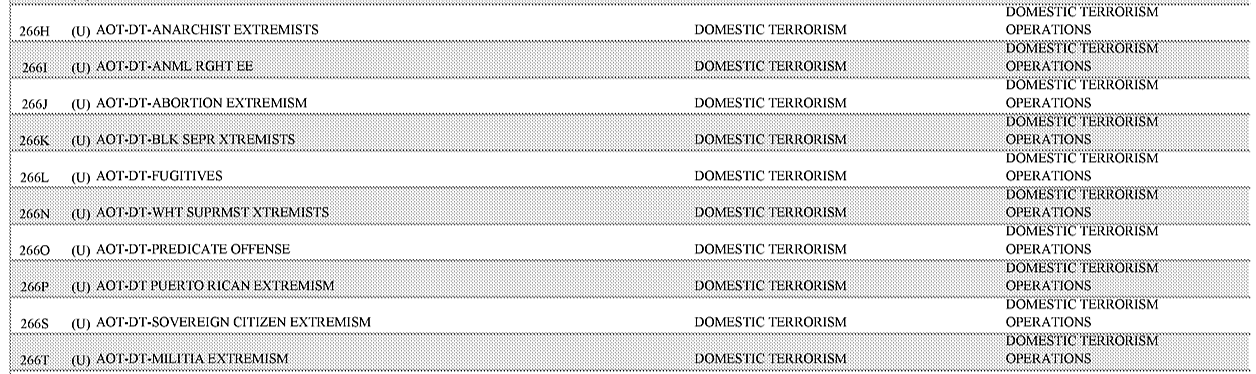
The core of Schneider’s proposal involves expanding bureaucracies inside of DoJ and DHS through the creation of new “Domestic Terrorism Offices” within each. Yet both organizations already focus on potential domestic terrorism threats within their existing organizational structures. Indeed, as the extract below from the FBI’s Investigation Classification list shows (obtained last year by Cato via the Freedom of Information Act), the FBI already has discrete categories of investigations for white supremacists, militias, and “sovereign citizen” extremists:

FBI Investigation Classifications extract

If anything, were Schneider’s bill to become law it would likely make detecting and thwarting domestic terrorist plots harder; the more layers of bureaucracy, the slower government works. The other issue it would likely exacerbate is the question of which department–Justice or Homeland Security–should be the lead on dealing with homegrown threats.

The entire rationale for DHS’s existence–according to its supporters–was to help prevent another 9/​11‐​style (i.e., foreign terrorist‐​originated) attack on the country. There is, of course, no empirical evidence to suggest the creation of DHS actually accomplished that goal–something that should make House and Senate members loathe to give it an expanded role in an area traditionally within the FBI’s purview.

Both the 9/11 Congressional Joint Inquiry and the subsequent 9/11 Commission Report found that it was a failure of federal law enforcement and intelligence agencies to share data, not a lack of data itself, that was the prime reason Al Qaeda’s attacks succeeded. Creating new, competing organizational “domestic terrorism” stovepipes will increase, not reduce, the likelihood of another domestic terrorism intelligence failure.

And there is another reason why the Schneider bill is problematic: it appears to reflect zero lessons learned from the post‐​9/​11 experience vis a vis “countering violent extremism” (CVE) programs.

The other major component of Schneider’s bill is a requirement for “anti‐​terrorism” training for federal, state, tribal, and local law enforcement agencies for the purpose of “understanding, detecting, deterring, and investigating acts of domestic terrorism and White supremacist and neo‐​Nazi infiltration of law enforcement and corrections agencies.”

As I noted earlier this year in The Hill, the Schneider bill contains no reference to the huge problems with the FBI’s CVE programs targeting Arab and Muslim Americans during the previous decade. Simply stated, those CVE programs were little more than racial or religious profiling dressed up as “counterterrorism” measures. Often billed as “community outreach” activities, they were, in fact, intelligence gathering operations.

Schneider’s approach shares the same underlying flaw with prior CVE programs: the assumption that membership in a particular group–be it racial, religious, or political–is indicative of an intent to commit a violent act. Existing published, peer‐​reviewed literature on the topic tells us exactly the opposite; there is no way to predict, on the basis of mass surveillance of a given group, who within that group will make the leap from fiery speech‐​making to pipe bomb throwing.

Congress should avoid a repetition of the PATRIOT Act debacle and not legislate in this area until existing investigations into the Capitol Insurrection have run their course and we have the full facts about how it happened, who was involved, and why the response to the insurrection was so slow and fragmented. A quick, fear‐​driven legislative response will only make things worse.

The Organic Prepper: Ten Ways to Sow Revolution in Your Back Yard

Daisy Luther of The Organic Prepper talks about the increasing government control of seeds and food, why gardening may become a revolutionary act, and why you must go to battle in Garden Rebels: 10 Ways to Sow Revolution in Your Back Yard.

Perhaps the next Revolutionary War will take place in a vegetable garden.

Instead of bullets, there will be seeds.  Instead of chemical warfare, there will be rainwater, carefully collected from the gutters of the house. Instead of soldiers in body armor and helmets, there will be back yard rebels, with bare feet, cut-off jean shorts, and wide-brimmed hats.  Instead of death, there will be life, sustained by a harvest of home-grown produce.  Children will be witness to these battles, but instead of being traumatized, they will be happy, grimy, and healthy, as they learn about the miracles that take place in a little plot of land or pot of dirt.

Every day, the big industries that run our nation take steps towards food totalitarianism.  They do so flying a standard of “sustainability” but what they are actually trying to sustain is NOT our natural resources, but their control.

One of the most inspiring, beautifully written articles that I’ve had the pleasure of reading in a long time is by  Julian Rose, a farmer, actor, activist, and writer. He wrote an article called Civil Disobedience or Death by Design and it is a “must-read” for anyone who believes in the importance of natural food sources:

“From now on, unless we cut free of obeisance to the centralised, totalitarian regimes whose takeover of our planet is almost complete, we will have only ourselves to blame. For we are complicit in allowing ourselves to become slaves of the Corporate State and its cyborg enforcement army. That is, if we continue to remain hypnotized by their antics instead of taking our destinies into our own hands and blocking or refusing to comply with their death warrants. This ‘refusal’ is possible. But it will only have the desired effect when, and if, it is contemporaneous with the birthing of the Divine warrior who sleeps in us all. The warrior who sleeps-on, like the besotted Rip Van Winkle in the Catskill mountains.” (source)

And it isn’t just industrialism that’s causing our issues. A supply chain disruption has been apparent in the US since people first cleared the shelves a year ago and while some things came back in stock, supplies are limited to this day.

Sustained into starvation

Does it sound dramatic to state that if things continue on their current path of “sustainability” that we are all going to die?  If you think I’m overstating this, read on.  It isn’t a stretch of the imagination to think that we are going to soon be “sustained” right into starvation via Agenda 21.

  • The European Union is in the process of criminalizing all seeds that are not “registered”.  This means that the centuries-old practice of saving seeds from one year to the next may soon be illegal.
  • Collecting rainwater is illegal in many states, and regulated in other states.  The United Nations, waving their overworked banner of “sustainability” is scheming to take over control of every drop of water on the globe.  In some countries, people who own wells are now being taxed and billed on the water coming from those sources.  Nestle has admitted that they believe all water should be privatized so that everyone has to pay for the life-giving liquid.
  •  Codex Alimentarius (Latin for “food code”) is a global set of standards created by the CA Commission, a body established by a branch or the United Nations back in 1963. As with all globally stated agendas, however, CA’s darker purpose is shielded by the feel-good words.  As the US begins to fall in line with the “standards” laid out by CA, healthful, nutritious food will be something that can only be purchased via some kind of black market of organically produced food.
  • Regulations abound in the 1200 page Food Safety Modernization Act that has put many small farmers out of business, while leaving us reliant on irradiated, chemically treated, genetically-modified “food”.

In the face of this attack on the agrarian way of life, the single, most meaningful act of resistance that any individual can perform is to use the old methods and grow his or her own food. Big banks are betting AGAINST the consumer and investing large sums of money in Big Agri before predicted shortages raise prices even more dramatically.

It’s time to become a producer instead of a consumer.

I often write about producing instead of merely consuming and in no subject is that more important than food. Growing your own food wields many weapons.

  • You are preserving your intelligence by refusing to ingest food doused in chemicals.  The pesticides that are liberally sprayed on food crops have been proven to lop off IQ points.
  • You are nourishing your body by feeding yourself real food.  Real food, unpasteurized, un-irradiated, with all of the nutrients intact, will provide you with a strong immune system and lower your risk of many chronic diseases.  As well, you won’t be eating the toxic additives that affect your body detrimentally.
  • You are not participating in funding Big Food, Big Agri, and Big Pharma when you grow your own food. Every bite of food that is NOT purchased via the grocery store is representative of money that does NOT go into the pockets of these companies who are interested only in their bottom lines. Those industries would be delighted if everyone was completely reliant on them.
  • You are not susceptible to control mechanisms and threats.  If you are able to provide for yourself, you need to give no quarter to those who would hold the specter of hunger over your head.  You don’t have to rely on anyone else to feed your family.

The ultimate act of rebellion is to feed yourself.

Consider every bite of food that you grow for your family to be an act of rebellion.

  1. If you live in the suburbs, plant every square inch of your yard.  Grow things vertically.  Use square foot gardening methods.  Make lovely beds of vegetables in the front yard.  Extend your growing seasons by using greenhouses and cold frames.  This way you can grow more than one crop per year in a limited amount of space.   Use raised bed gardening techniques like lasagna gardening to create rich soil.  If you have problems with your local government or HOA, go to the alternative media and plead your case in front of millions of readers.  We’ve got your back! Here are some tips for stealth gardening.
  2. If you live in the city or in an apartment, look into ways to adapt to your situation.  Grow a container garden on a sunny balcony, and don’t forget hanging baskets.  Grow herbs and lettuce in a bright window.  Set up a hydroponics system in a spare room (but look out for the SWAT team – they like to come after indoor tomato growers!)  Go even further and look into aquaponics. Create a little greenhouse with a grow light for year-round veggies.  Sprout seeds and legumes for a healthy addition to salads. Don’t forget community gardens either – they’re a great way to grow food and meet others with your interests. Here are some other tips for gardening without a yard.
  3. If you live in the country, go crazy.  Don’t just plant a garden – plant fields!  Grow vegetables and grains. Grow herbs, both culinary and medicinal.  Learn to forage if you have forests nearby.  Learn to use old-fashioned methods of composting, cover crops and natural amendments to create a thriving system.
  4. Raise micro-livestock.  The micro-livestock option may not work for everyone, but if you can, provide for some of your protein needs this way.  Raise chickens, small goats, and rabbits, for meat, eggs, and dairy.  If you are not a vegetarian, this is one of the most humane and ethical ways to provide these things for your family.  Be sure to care well for your animals and allow them freedom and natural food sources – this is far better than the horrible, nightmare-inducing lives that they live on factory farms.
  5. Use only heirloom seeds. We get all our seeds here. With heirloom seeds, you can save your seeds.  Learn the art of saving seeds from one season to the next.  Different seeds have different harvesting and storage requirements.
  6. Go organic.  Learn to use natural soil enhancers and non-toxic methods of getting rid of pests.  Plan it so that your garden is inviting to natural pollinators like bees and butterflies.  If you wouldn’t apply poison to your food while cooking it, don’t apply it to your food while growing it.
  7. Be prepared for some backlash.  The day may come when you face some issues from your municipal government.  Be prepared for this by understanding your local laws and doing your best to work within that framework. If you cannot work within the framework, know what your rights are and refuse to be bullied.  Call upon those in the alternative media who will sound the alarm.  Every single garden that comes under siege is worth defending. A Florida family finally won the right to garden in their front yard after years of harassment.
  8. Learn about permaculture.  Instead of buying pretty flowering plants for your yard, landscape with fruit trees (espaliering is a technique that works well in small spaces), berry bushes, and nut trees.  Permaculture can provide long-term food sources for your family.
  9. For the things you can’t grow yourself, buy local.  Especially if space is limited, you may not be able to grow every bite you eat by yourself.  For everything you can, buy local!  Buy shares in a local CSA (Community Supported Agriculture). Visit your farmer’s market.  Shop at roadside stands.  Join a farming co-op.  Support agriculture in your region to help keep local farms in business.  (One note about farmer’s markets:  Some farmers markets allow people to sell produce that originates at the same wholesalers from which the grocery stores buy their produce.  I always try to develop a relationship with the farmers from whom I buy, and I like to know that what I’m buying actually came from their fields and not a warehouse.)
  10. Learn to preserve your food.  Again, go back to the old ways and learn to save your harvest for the winter.  Water bath canningpressure canning, dehydrating, and root cellaring are all low-tech methods of feeding your family year-round. Not only can you preserve your own harvest, but you can buy bushels of produce at the farmer’s market for a reduced price and preserve that too. Learn how to cook and preserve your fresh in-season produce here.  Learn all about food preservation in this 4-books-in-one guide. (My canning book is included.)

There is a food revolution brewing.

People who are educating themselves about Big Food, Big Agri, and the food safety sell-outs at the FDA are disgusted by what is going on. They are refusing to tolerate these attacks on our health and our lifestyles.

Firing a volley in this war doesn’t have to be bloody.  Resistance can begin as easily a planting one seed in a pot. It’s time to go to battle and declare your independence with a spade in one hand and some seeds in the other.

Mises Institute: Gun Laws and Decentralization: Lessons from “Constitutional Carry”

José Niño at the Mises Institute writes Gun Laws and Decentralization: Lessons from “Constitutional Carry”.

Few political movements can boast of success like the firearms movement in the United States. Often overlooked is how before the 1980s there was no concept of licensed, let alone unlicensed, concealed carry in the overwhelming majority of the country. The sole exception was Vermont, which through an idiosyncratic state supreme court decision in 1903 has had unlicensed carry for over a century. “Vermont Carry,” the concept of unlicensed concealed carry, would be the Holy Grail for Second Amendment advocates for up to a century.

In the intervening decades, in large part motivated by notable transgressions on the right to bear arms during the 1930s and 1960s, activists took to using gradualist methods in their efforts to relax gun control laws at the state level. Starting in the late 1970s, Georgia kicked off the modern licensed carry movement after it joined states like Connecticut, New Hampshire, and Washington in enacting some form of licensed concealed carry. Soon thereafter, states began adopting licensed carry one by one, and by the twenty-first century, most of the nation had some form of licensed concealed carry. 

At first, the idea of unlicensed carry seemed like a quixotic prospect only odd states like Vermont were capable of adopting. However, the dam broke after Alaska ended America’s century-long unlicensed carry dry spell by signing its own constitutional carry bill into law in 2003. An even more pronounced momentum shift took place in 2010 after then Arizona governor Jan Brewer signed SB 1108, Arizona’s constitutional carry bill. From there, a wave of states have followed suit in making constitutional carry the law of the land.

Constitutional carry’s success is not a coincidence. It reflects a concerted effort by many disaffected gun owners who realized the federal government was not responding to their demands to scale back infringements on gun ownership. Rather than engage in the pie-in-the-sky federal campaigns that the average conservative organization would generally be involved in throughout the post–World War II era, many gun owners shifted their political sights toward state legislatures.

Indeed, there is something to be said about Barack Obama’s occupancy of the White House serving as a lightning rod for gun owners at the state level. At the time, many gun owners were thoroughly spooked by Obama’s campaign promises to enact gun control legislation. Their fears became more pronounced when the Obama administration pushed for a far-reaching gun control package in the wake of the 2012 Sandy Hook massacre.

Although Obama’s gun control desires never came to pass, gun owners became sufficiently motivated to not only take action against his gun control attempt at the federal level but to shift their attention toward the state level. Several creative Second Amendment organizations picked up on the grassroots dissatisfaction of the Tea Party and leveraged that energy for state-level projects such as constitutional carry. By the time Obama left office in 2016, there were eleven states with constitutional carry as law.

Constitutional carry’s momentum maintained its course in the Trump era. Five states—New Hampshire, North Dakota, South Dakota, Oklahoma, and Kentucky—passed constitutional carry legislation of their own when Donald Trump was in office, thus showing signs of a movement that has a life of its own and a willingness to press forward regardless of the partisan winds blowing in DC.

Presently, there are eighteen constitutional carry states, following Utah and Montana deciding to quickly pass said legislation in the opening weeks of the Biden administration. Furthermore, states such as Alabama, Louisiana, Tennessee, and Texas are seeking to jump on the legislative bandwagon. From the looks of it, the concept of lawful individuals carrying firearms without a license is not going away any time soon.

Undoubtedly, the level of polarization present in the US can be leveraged in a positive direction. Large swathes of red states are filled with “deplorables” who have no love lost for both Democrats and Republicans in DC. One way they could poke DC in the eye is by passing legislation such as constitutional carry.

Contrary to what the promoters of traditional politics say, political confrontation can yield positive results. When states start taking matters into their own hands and buck prevailing trends emanating from DC, Americans can carve out their own “freedom domains,” if you will, where they can enjoy particular freedoms other states and the federal government would generally deprive them of.

In turn, when enough states adopt niche policies like constitutional carry, lagging states and the federal government alike will get the message that they are out of touch with the policy wants of large portions of America. At the same time, America is witnessing an ever-expanding Second Amendment sanctuary movement, with similar actors using local means to push back against gun control. Dissatisfaction is high and people are beginning to express it in a concrete, political form. As they say, the squeaky wheel gets the grease, and sufficient pressure from below could be the wake-up call federal lawmakers need in order to act on their constituents’ demands.

Pulling a “Mr. Smith Goes to Washington” likely won’t bring about any meaningful political change in a gridlocked Congress. Perhaps real political reforms will be the product of frequent visits to one’s respective state legislatures instead. Getting acquainted with state politics—something many politically active Americans have neglected to do in our federally obsessed political culture—is the first step in casting aside the ossified strategies of yesteryear.

Meaningful reforms will not come from DC but rather state legislatures and lower levels of government that are more prone to yield to grassroots pressure.

Glenn Greenwald: Congress Demands More Internet Censorship

Journalist Glenn Greenwald writes Congress, in a Five-Hour Hearing, Demands Tech CEOs Censor the Internet Even More Aggressively

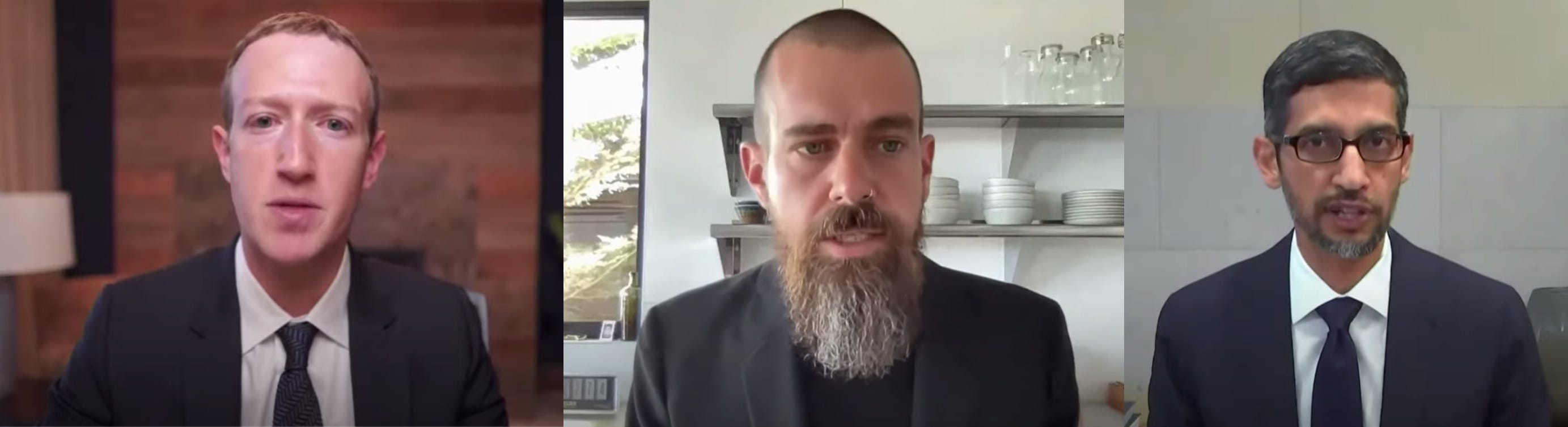
Facebook CEO Mark Zuckerberg, Twitter CEO Jack Dorsey, and Google/Alphabet CEO Sundar Pichai testify before the House Energy and Commerce Committee, Mar. 25, 2021

Over the course of five-plus hours on Thursday, a House Committee along with two subcommittees badgered three tech CEOs, repeatedly demanding that they censor more political content from their platforms and vowing legislative retaliation if they fail to comply. The hearing — convened by the House Energy and Commerce Committee’s Chair Rep. Frank Pallone, Jr. (D-NJ), and the two Chairs of its Subcommittees, Mike Doyle (D-PA) and Jan Schakowsky (D-IL) — was one of the most stunning displays of the growing authoritarian effort in Congress to commandeer the control which these companies wield over political discourse for their own political interests and purposes.

As I noted when I reported last month on the scheduling of this hearing, this was “the third time in less than five months that the U.S. Congress has summoned the CEOs of social media companies to appear before them with the explicit intent to pressure and coerce them to censor more content from their platforms.” The bulk of Thursday’s lengthy hearing consisted of one Democratic member after the next complaining that Facebook CEO Mark Zuckerberg, Google/Alphabet CEO Sundar Pichai and Twitter CEO Jack Dorsey have failed in their duties to censor political voices and ideological content that these elected officials regard as adversarial or harmful, accompanied by threats that legislative punishment (including possible revocation of Section 230 immunity) is imminent in order to force compliance (Section 230 is the provision of the 1996 Communications Decency Act that shields internet companies from liability for content posted by their users).

Republican members largely confined their grievances to the opposite concern: that these social media giants were excessively silencing conservative voices in order to promote a liberal political agenda (that complaint is only partially true: a good amount of online censorship, like growing law enforcement domestic monitoring generally, focuses on all anti-establishment ideologies, not just the right-wing variant). This editorial censoring, many Republicans insisted, rendered the tech companies’ Section 230 immunity obsolete, since they are now acting as publishers rather than mere neutral transmitters of information. Some Republicans did join with Democrats in demanding greater censorship, though typically in the name of protecting children from mental health disorders and predators rather than ideological conformity.

As they have done in prior hearings, both Zuckerberg and Pichai spoke like the super-scripted, programmed automatons that they are, eager to please their Congressional overseers (though they did periodically issue what should have been unnecessary warnings that excessive “content moderation” can cripple free political discourse). Dorsey, by contrast, seemed at the end of his line of patience and tolerance for vapid, moronic censorship demands, and — sitting in a kitchen in front of a pile of plates and glasses — he, refreshingly, barely bothered to hide that indifference. At one point, he flatly stated in response to demands that Twitter do more to remove “disinformation”: “I don’t think we should be the arbiters of truth and I don’t think the government should be either.”

Zuckerberg in particular has minimal capacity to communicate the way human beings naturally do. The Facebook CEO was obviously instructed by a team of public speaking consultants that it is customary to address members of the Committee as “Congressman” or “Congresswoman.” He thus began literally every answer he gave — even in rapid back and forth questions — with that word. He just refused to move his mouth without doing that — for five hours (though, in fairness, the questioning of Zuckerberg was often absurd and unreasonable). His brain permits no discretion to deviate from his script no matter how appropriate. For every question directed to him, he paused for several seconds, had his internal algorithms search for the relevant place in the metaphorical cassette inserted in a hidden box in his back, uttered the word “Congressman” or “Congresswoman,” stopped for several more seconds to search for the next applicable spot in the spine-cassette, and then proceeded unblinkingly to recite the words slowly transmitted into his neurons. One could practically see the gears in his head painfully churning as the cassette rewound or fast-forwarded. This tortuous ritual likely consumed roughly thirty percent of the hearing time. I’ve never seen members of Congress from across the ideological spectrum so united as they were by visceral contempt for Zuckerberg’s non-human comportment:https://www.youtube-nocookie.com/embed/vsA4u7i20_0?rel=0&autoplay=0&showinfo=0

But it is vital not to lose sight of how truly despotic hearings like this are. It is easy to overlook because we have become so accustomed to political leaders successfully demanding that social media companies censor the internet in accordance with their whims. Recall that Parler, at the time it was the most-downloaded app in the country, was removed in January from the Apple and Google Play Stores and then denied internet service by Amazon, only after two very prominent Democratic House members publicly demanded this. At the last pro-censorship hearing convened by Congress, Sen. Ed Markey (D-MA) explicitly declared that the Democrats’ grievance is not that these companies are censoring too much but rather not enough. One Democrat after the next at Thursday’s hearing described all the content on the internet they want gone: or else. Many of them said this explicitly.

At one point toward the end of the hearing, Rep. Lizzie Fletcher (D-TX), in the context of the January 6 riot, actually suggested that the government should create a list of groups they unilaterally deem to be “domestic terror organizations” and then provide it to tech companies as guidance for what discussions they should “track and remove”: in other words, treat these groups the same was as ISIS and Al Qaeda. https://www.youtube-nocookie.com/embed/owN9C1PZgG8?rel=0&autoplay=0&showinfo=0

Words cannot convey how chilling and authoritarian this all is: watching government officials, hour after hour, demand censorship of political speech and threaten punishment for failures to obey. As I detailed last month, the U.S. Supreme Court has repeatedly ruled that the state violates the First Amendment’s free speech guarantee when they coerce private actors to censor for them — exactly the tyrannical goal to which these hearings are singularly devoted.

There are genuine problems posed by Silicon Valley monopoly power. Monopolies are a threat to both political freedom and competition, which is why economists of most ideological persuasions have long urged the need to prevent them. There is some encouraging legislation pending in Congress with bipartisan support (including in the House Antitrust Subcommittee before which I testified several weeks ago) that would make meaningful and productive strides toward diluting the unaccountable and undemocratic power these monopolies wield over our political and cultural lives. If these hearings were about substantively considering those antitrust measures, they would be meritorious.

But that is hard and difficult work and that is not what these hearings are about. They want the worst of all worlds: to maintain Silicon Valley monopoly power but transfer the immense, menacing power to police our discourse from those companies into the hands of the Democratic-controlled Congress and Executive Branch.

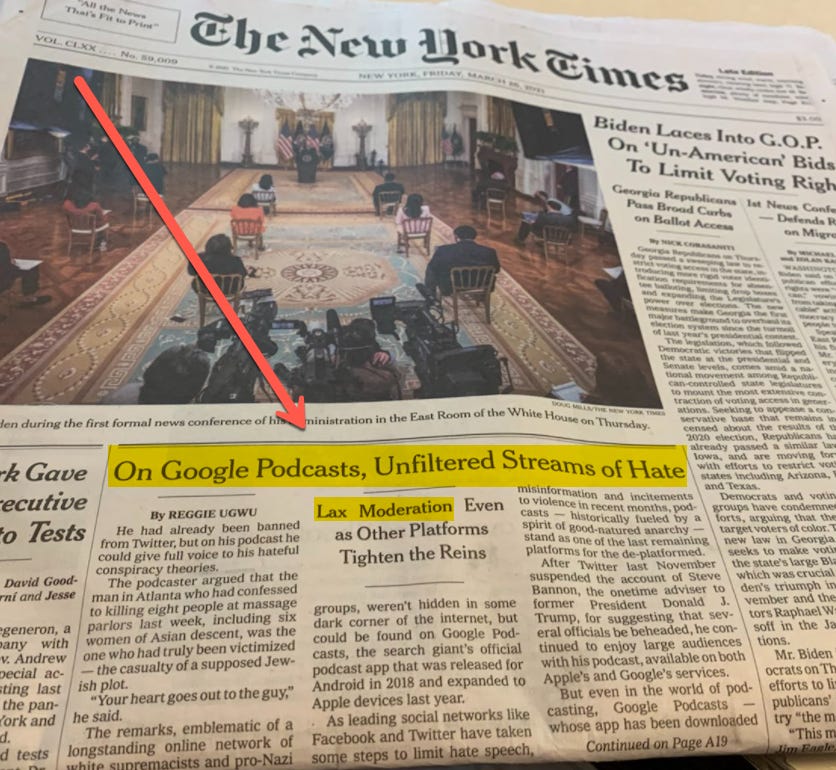
And as I have repeatedly documented, it is not just Democratic politicians agitating for greater political censorship but also their liberal journalistic allies, who cannot tolerate that there may be any places on the internet that they cannot control. That is the petty wannabe-despot mentality that has driven them to police the “unfettered” discussions on the relatively new conversation app Clubhouse, and escalate their attempts to have writers they dislike removed from Substack. Just today, The New York Times warns, on its front page, that there are “unfiltered” discussions taking place on Google-enabled podcasts:

New York Times front page, Mar. 26, 2021

We are taught from childhood that a defining hallmark of repressive regimes is that political officials wield power to silence ideas and people they dislike, and that, conversely, what makes the U.S. a “free” society is the guarantee that American leaders are barred from doing so. It is impossible to reconcile that claim with what happened in that House hearing room over the course of five hours on Thursday.

The Trumpet: Barack Obama’s Radical Gun Control Agenda

Stephen Flurry at The Trumpet talks about the current administration, implementing Barack Obama’s Radical Gun Control Agenda

A deranged gunman entered the parking lot of a King Soopers supermarket in Boulder, Colorado, on Monday and began shooting a Ruger AR-556 pistol at customers trying to buy groceries. Over the course of the next hour, this madman murdered 10 people, including 51-year-old police officer Eric Talley, before he surrendered to local police officers after they shot him in the leg. The motive for this demoniac’s killing spree was not immediately apparent, but that did not stop the propaganda media from speculating.

After seeing a photograph of the murderer, who was clearly Caucasian, actress Rosanna Arquette posted a comment on Twitter, saying, “Call it what it is … white supremacist domestic terrorism.” American lawyer Meena Harris, the niece of Vice President Kamala Harris, posted, “Violent white men are the greatest terrorist threat to our country.” usa Today editor Hemal Jhaveri insisted that only “an angry white man” could have done such a thing. And one self-avowed social media activist stated, “A white Christian terrorist killed ten innocent people with a gun in a grocery store, Colorado, USA.”

These statements reveal how the Democrat media complex is obsessed with race.

Yet authorities have now identified 21-year-old Ahmad al-Aliwi Alissa as the gunman. Alissa is a Muslim immigrant from Syria who has praised the prophet Mohammed and has scouted out churches and Trump rallies as potential jihadi terrorist targets. So, while Ahmad Alissa is technically a Caucasian male, he was not a “a white, Christian terrorist.” He is an Islamic jihadi who murdered 10 white Americans and injured several others in his quest to terrorize the American people.

Prominent American race baiter Tariq Nasheed has doubled down on the white supremacy narrative, insisting that terms like “Arab” and “Islamic” do no change Alissa’s “whiteness.” But most of the progressive media has dropped the white supremacy angle now that we know Alissa is Muslim. They have shifted the narrative away from race to focus on another leftist obsession: gun control.

American activist and writer Amy Siskind perfectly illustrates this pivot. On Monday, she said that the fact that the shooter “was taken into custody” reveals that he “was certainly a white man … if he were black or brown, he would be dead.” On Tuesday, when authorities announced that the killer’s name was Ahmad al-Aliwi Alissa, she said, “Let’s mourn the victims, but not glorify the killer with the attention of having his name widely known.” And on Wednesday, she said, “Obviously we should all be calling and messaging our members of the House and Senate to demand gun control measures now! Keep the pressure on!”

Former United States President Barack Obama has weighed in on the issue. The day after the shooting, he released a statement saying, “It will take time to root out the disaffection, racism and misogyny that fuels so many of these senseless acts of violence. But we can make it harder for those with hate in their hearts to buy weapons of war. We can overcome opposition by cowardly politicians and the pressure of a gun lobby that opposes any limit on the ability of anyone to assemble an arsenal. We can, and we must. A once-in-a-century pandemic cannot be the only thing that slows mass shootings in this country.”

And shortly after Obama released his statement, Joe Biden faithfully repeated his boss’s stance. “I don’t need to wait another minute, let alone an hour to take common sense steps that will save the lives in the future and to urge my colleagues in the House and Senate to act,” Biden said at the White House. “We can ban assault weapons and high-capacity magazines in this country once again. I got that done when I was a senator. It passed. It was law for the longest time, and it brought down these mass killings.”

So, both Obama and Biden are calling on Congress to ban assault weapons and high-capacity magazines like they did when they passed the Federal Assault Weapons Ban of 1994. This 10-year ban expired in 2004 and was not renewed because, contrary to Biden’s assertions, several studies determined that the ban did not have a significant effect on firearm homicides. Plus, the ban is almost certainly a violation of the Second Amendment of the U.S. Constitution, which states, “A well-regulated militia, being necessary to the security of a free state, the right of the people to keep and bear arms, shall not be infringed.”

Since the AR-15 is the most commonly owned rifle in America, it is certainly protected by the “common use” standard established by the U.S. Supreme Court in the case Heller v. District of Columbia (2008).

U.S. Rep. Marjorie Taylor Greene has further noted that “Colorado has everything the left has asked for,” including universal background checks, red flag gun seizure laws, “hi-capacity” magazine bans, and a passing gun control grade from the American advocacy and research organization Giffords. And all that still did not stop a radical Islamist from obtaining a lethal weapon and massacring people.

So, the radical left’s gun control proposal is not really about keeping guns out of the hands of terrorists and criminals, who can buy guns on the black market if they want them. The radical left’s gun control proposals are about keeping guns out of the hands of law-abiding citizens. You do not have to know a lot about history to realize why the Biden-Harris administration’s proposed gun policies are dangerous.

“The Soviet Union left its mark as one of the deadliest political regimes in the history of mankind,” wrote José Niño at the Mises Institute. “However, it could not get away with such atrocities without having a complete monopoly on the use of force. To maintain its iron grip, the Soviet Union had to turn to the most proven form of suppression—gun confiscation. On Dec. 10, 1918, the Council of People’s Commissar mandated that Soviet citizens turn in their firearms. Failure to do so led to criminal prosecution.”

Nazi Germany, Communist Cuba, socialist Venezuela and many other authoritarian dictatorships throughout history have also relied on “the most proven form of suppression” to control people. And the radical left in America today is showing its tendency more and more to force its will on the public.

“Most Republicans don’t realize what they are dealing with: people who are absolutely committed to destroying the government of this land!” my father wrote in his 2018 article “Saving America from the Radical Left—Temporarily.”

The mindset behind the radical Democrats is exposed when you look at their handling of another issue: gun control. Every time there is a school shooting, even before any facts about the situation come out, they immediately begin pushing for gun bans. After the most recent shooting, they funded student groups and encouraged students to revolt against authorities. They don’t just want to raise the buying age or to restrict the sale of a few types of guns; they want to eliminate all guns. They hate the Second Amendment and want to destroy the Constitution. They want a revolution!

This is a perspective you do not get from mainstream sources. Liberals will tell you that we have to ban assault weapons to stop “white supremacists” from going on mass shooting sprees. And conservatives will cite research showing that gun control is ineffective against criminals—since they are willing to break the law anyway. But too few are warning about the dangers of an out-of-control government that wants to confiscate guns so they can transform America into a socialist state without fear of a public uprising!

The murders that happened at King Soopers supermarket are a national tragedy, but don’t expect the Biden-Harris administration to do anything to fight against radical Islam. They will be too busy talking about white supremacy, clamping down on gun ownership, and attacking the U.S. Constitution.

An end-time Bible prophecy about the nations of America, Britain and Israel says, “And if ye shall despise my statutes, or if your soul abhor my judgments, so that ye will not do all my commandments, but that ye break my covenant: I also will do this unto you; I will even appoint over you terror …. And I will break the pride of your power; and I will make your heaven as iron, and your earth as brass” (Leviticus 26:15-16, 19).

Today, Americans have turned away from God’s law, so they are being plagued by terrorists like Ahmad al-Aliwi Alissa and no longer have the willpower to do much of anything about it. That is why so many are willing to surrender to the radical left. They do not trust God to protect them, nor do they even have the pride to defend themselves. So the curses on America will continue to intensify until, as verses 40-43 state, people “shall confess their iniquity” and cause God to “remember [His] covenant” with America’s ancestors!


Ammoland: ATF Ponders Changing Definition of What Is a Firearm To Target Growing Gun Diversity

Ammoland reports: ATF Ponders Changing Definition of What Is a Firearm To Target Growing Gun Diversity

Several large type-7 Federal Firearms Licensed manufacturers, The National Shooting Sports Foundation (NSSF), and Polymer80 met with the Bureau of Alcohol, Tobacco, Firearms, and Explosives (ATF) today.

Although the detailed discussions of the meeting are unknown at this time, AmmoLand News received leaked emails from our sources that show that the ATF is seeking a new definition of a firearm. Joe Biden has targeted so-called “ghost guns” and semi-automatic rifles and recent days. Sources say he is pushing to accelerate those changes by using the ATF as a stop-gap for stalled federal legislation.

The email states: “As you know, under current regulation 27 C.F.R. 478.11, the definition of firearm frame/receiver states that it is that part of a firearm which provides housing for “the hammer, bolt or breechblock, and firing mechanism, and which is usually threaded at its forward portion to receive the barrel.”

The email goes on to state that many frames/receivers do not meet this definition. The meeting was to solicit input and feedback on the new definition to include all current firearm frames/receivers on the market.

The Wallstreet Journal incorrectly reported that the meeting was to be about targeting unfinished (80%) frames. Actual emails received indicate the “listening session” with ATF was more about the growing diversity of new gun styles and how to serialize more gun parts. Including Rifle Chassis Systems but also the long unchanging history of the firearms’ receiver definition and the need for updates to reflect “changes in technology”.

An AR-15 lower receiver houses the hammer and firing mechanism while the upper receiver houses the bolt. In a FAL, the upper receiver is the serialized firearms. The meeting seems to be stepping in the direction to change the discrepancies between different guns.

Recently there have been multiple cases where the ATF has arrested someone for selling an AR-15 lower receiver. The defendant challenges the ATF because an AR-15 lower receiver doesn’t meet the definition of a firearm. The ATF quietly dropped the cases without comment.

One case that stands out is the ATF arrest of Joseph Roh for illegally manufacturing AR-15-style rifles in Los Angeles. He challenged the ATF’s classification of an AR15 lower receiver as a firearm. Instead of fighting the case, the ATF quietly dropped it. Most believe that the ATF was worried a judge would decide in Roh’s favor unending gun control efforts.

The 60 plus person video meeting included multiple firearms industry manufacturers and industry representatives including Larry Keane of the National Shooting Sports Foundation (NSSF) who commented:

“As the firearm industry’s trade association, NSSF is always willing to engage with ATF in a dialogue concerning regulatory matters that impact our industry members businesses so that we can protect their legal and business interests.”

Changing The Definition of What Is A Firearm

Sources inside the ATF tell us that the agency is considering changing a firearm’s definition to encompass the upper instead of the frame. The ATF reasons that anyone can finish an 80% frame or even 3D print one, but most of the general public do not possess the tools to complete a slide.

Safety Harbor Firearms produces a .50 caliber magazine-fed upper for the AR-15 called the SHTF 50. The ATF stepped in and insisted that the upper was a firearm and forced the company to serialize it. This decision made both the upper receiver and lower receiver a gun. The ATF reasoned that the company made the upper too much like a bolt action rifle.

Safety Harbor Firearms SHTF 50 Mag Fed Upper

The proposed changes have made their way into the hands of Everytown for Gun Safety even though it is not currently public. The gun-control group seems to be happy with the proposed changes. It isn’t clear how they managed to get the documents.

Summit News: UK Supreme Court Judge Expects COVID Social Controls For TEN YEARS

In this article from Summit News, a UK Supreme Court judge opines that mask wearing and other social controls for COVID could last for a decade. Would that happen in the US, too? Supreme Court Judge Expects People Will Be Forced To Wear Masks, Stay Home For TEN YEARS

British former Supreme Court judge Lord Sumption has warned that “social controls” brought about by the coronavirus pandemic may be kept in place by governments for up to a decade.

“It’s politically unrealistic to expect the Government to backtrack now,” commented Sumption, who has been highly critical of the government’s ‘totalitarian’ lockdown policies.

The judge compared the reaction to rationing after the Second World War, which went on for nine years, adding that this time “I think it may be even longer.”

“An interesting parallel is the continuation of wartime food rationing after the last war. People were in favour of that because they were in favour of social control,” he said during a ‘Sketch notes on’ podcast.

“In the 1951 general election, the Labour party lost its majority entirely because people with five years more experience of social control got fed up with it. Sooner or later that will happen in this country,” he added.

Sumption’s warning comes in the wake of Public Health England officials stating that restrictions will remain in place for as long as other countries have not vaccinated everyone, a process likely to take years.

England’s chief medical officer also recently asserted that the pandemic restrictions, which have been in place on and off for a year, have “improved life” for some people.

Despite promising an end to restrictions in June, the UK government yesterday extended emergency COVID laws until October, with Health minister Matt Hancock refusing to say how long they will remain in place after that.

Lord Sumption also noted during the podcast that scientists skeptical of lockdown policies have been “subjected to an extraordinarily unpleasant campaign of personal abuse”.

“I know a lot of people that would prefer not to put their head above the parapet,” He continued, adding “From the very moment I started to make these points I began to get emails from politicians who agreed with what I had to say but that they themselves didn’t dare to speak out. That I think is a very serious state of affairs.”

The judge also argued that governments are using the virus politically, noting “They have consistently tried to maintain that the virus is indiscriminate when it is perfectly well-established that it primarily affects people with identifiable vulnerabilities, particularly in the elderly.”

Speaking about the draconian crack down on anti-lockdown protesters, Sumption said “People ought to be entitled to voice their differences (of opinion),” adding “If the only way you can enforce distancing is by beating people over the head with truncheons then it’s not worth it.”

Now that Brits have allowed society to be permanently deformed, with polls routinely showing vehement support for lockdown and other pandemic rules, things are never going to be the same again.

Having allowed the precedent that the government can put the entire population under de facto house arrest on a whim, look for the policy to be repeated over and over again with different justifications that have nothing to do with COVID-19.

As we previously highlighted, one of those justifications will be man-made global warming, with climate lockdowns set to become a regular reality.

The Organic Prepper: Eight Ways to Practice Advanced Situational Awareness

We often talk about situational awareness being one of the most important skills to have to avoid danger. Here is Fabian Ommar at The Organic Prepper with 8 Ways to Practice ADVANCED Situational Awareness.

In one of my recently published articles, I defined situational awareness. I also presented a list of risks and threats commonly found in the urban environment and those posed by large and smaller groups of people and individuals. Selco, who survived in an urban setting, offers excellent examples of the differences between Urban Survival and Rural Survival as well as guidance for survival planning. 

Here I will go over techniques for development and practices to improve situational awareness. Before we move ahead and get practical, let’s see one more aspect of situational awareness theory and psychology. Let’s also look at how it works in our minds to apply it in the most productive manners during training and everyday situations.

The four levels of awareness

I’m talking about awareness levels, which is a “scale” of alertness according to the context in which we find ourselves. There are several versions of this scale out there, all based on Col. Jeff Cooper‘s work. Cooper originally designed it as a practical guide for police and military agents who need to move fast between levels when readying for combat or violent action.

While I personally have some reservations about the way Cooper’s Color Code was adapted (and promoted) in the “situational awareness” concept, the scale’s idea is to provide a simple yet effective reference to ordinary people, and for that, it works. Besides, the levels of awareness help educate us on self-assessment and control. 

It is essential to note the mind can’t operate in constant states of high alertness. Too much stress for too long is detrimental to our performance and even our health. Besides, it’s practically impossible to maintain a high level of awareness for long periods. We must learn to adjust, dial down or up as the context changes, and as our mind/body requires. 

  • Level 1: Relaxed – When (for instance) we’re at home watching a movie, focused on the TV, and tuned out to the rest.
  • Level 2: Relaxed Awareness – There’s no significant threat, but we are aware of the situation around us, usually because we’re performing some task that demands some attention (as when driving and paying attention to what’s going on around, other vehicles and people moving and signaling (or not) their intentions, etc.).
  • Level 3: Focused Awareness –  The situation demands a higher level of focus (for example, when driving in the snow or a heavy storm, at night or through a poorly conditioned road with hazards)
  • Level 4: High Alert – Thing’s have gotten scary. We recognize an actual or imminent threat and become ready to act. It can be fight, hide, or flight. At this level, we’re still able to function. 

Above Level 4, there’s paralysis, panic-induced freeze, and comatose. Our senses get overwhelmed, and the rush is too big to cope, so we “shut down” as an automatic defense mechanism takes over.

Here is a bit of advice for preppers on how not to let anxiety paralyze you.

Know your limits and adapt accordingly

Moving abruptly between levels or jumping stages too quickly is what can cause break-outs. We go from Level 1 to 2, or 3 to 4 without a problem. But moving from, say, Level 1 to Level 4 in a snap can cause a short-circuit. There are techniques and training to deal with quick shifts in mental state, which, as said before, is the original proposition of the Cooper Color Code.

But there are limits, and even trained professionals can become paralyzed in some situations. That’s why we must learn and practice to “enter” the level of awareness best indicated to each situation and move or “flow” between the levels. It can become more natural and automatic once we become more aware. We reduce the chances of getting caught by some unpleasant surprise. (Read more here.)

Even SHTF and other dangerous situations will allow for periods of relaxation. Maybe not “Level 1” total relaxation, but more acceptable or perhaps manageable levels that still provide the awareness required by the situation and the relaxation needed by the mind. 

Cognitive systems of the brain and how it concerns us and situational awareness

Our brain has two systems. One is the “automatic,” responsible for the majority of our daily tasks. It is intuitive, multitasking, and economic (demands less energy/time to decide). The other is the “deliberate” system, which handles analytical decision-making. It can only process one choice at a time (more focus) and is more energy/time-consuming. 

Understanding this is useful for decision-making and also developing new skills. When we start something new, our “analytical” mind gets busy analyzing every individual aspect of the task at hand. In this phase, we’re slow and clunky. Once we repeat enough, the “automatic” mind takes over, and we no longer need to focus on every detail (or any at all) to perform the task. We become fluent, fast, and smooth.

Situational awareness doesn’t mean just becoming aware. It implies running scenarios and analyzing possibilities, arriving at a conclusion, and taking action to achieve the desired outcome. There’s a decision(s) involved. For this entire process to become useful and effective, it must be done fast and efficiently by the “auto” system. To get there, we must practice and repeat the steps necessary individually. 

In short, we must practice focusing on one or two aspects at a time until it becomes internalized and natural. It will then be an acquired ability, and our brain will work automatically in a fast, comprehensive, efficient, and intuitive manner. That should be our final objective. 

Techniques for Situational Awareness Training

Practice and training don’t mean willfully chasing dangerous situations, but rather exposing ourselves to everyday situations and interactions with focus and intent, purposefully working on these aspects and skills as explained above.

Disclaimer: Please note this is from a common-man perspective. I’m not a specialist. These are the techniques I have used myself and with others I have successfully guided. Situational awareness is not rocket science. It is a vast topic, though. If you believe you need advanced or specialized training for some reason, look for professional orientation or enroll in a tactical course. 

1. Stay informed

We begin to become aware by staying connected to our world, tuned to what’s happening in all the different levels of our reality: neighborhood, city, state, country, and international. Like it or not, current events and prepping are inextricably entwined.

  • Locally, it’s best to do your own work and keep in contact with the people in your community. Be casual and generic, rather than intrusive or particular. The aim is to be on top of situations concerning infrastructure, the chain of supply, security, etc. 
  • On the macro level, stay informed about political, geopolitical, social, and economic scenes. Here the idea is to zoom out and have a general picture of developments in the world. It’s OK to focus on topics that have the potential to affect us directly. For this, choose your sources wisely and separate noise from signal (another skill).

2. Head on a swivel

Having “eyes in the back of your head” is a beneficial skill. No one has to turn into an international spy. Still, techniques for “looking around” or specifically spying on someone or somewhere (without giving the impression that we’re focused or too intent on doing so) are essential. 

  • Some people take this as a cue to look around every 10 seconds, searching for danger. Doing so draws unwanted attention and makes us look paranoid or frightened in the eyes of others. Act casual, relaxed, but attentive and decided. Avoid looking worried, scared, or anxious. 
  • Use shadows, mirrors, and glasses in buildings, storefronts, vehicles, bus stops, etc., to casually and discreetly glance around. Our peripheral vision is a powerful ally too. All the time, I pretend to look at something on a store window or whatever to spy on what I actually want with the corner of my eyes.
  • Every once in a while, take a look back and to the sides, calmly but assuredly. Being intentional indicates we are alert and attentive. 
  • A slightly more discreet tactic is to use noises such as other people or passing vehicles to turn my head and look around. This way, I can scan the surroundings or peek at something or someone without staring directly. 
  • Use your phone in a planned, deliberate way. For instance, pull it out while turning your back against a wall or store entrance (to avoid being surprised from behind) and pretend you’re talking to someone or reading, texting, etc., while you scan around or look at people or places more deserving of your attention. 
  • The power of darkness: during the daytime, I’m always wearing sunglasses, even when overcast. Mostly because I feel comfortable, but also to hide the direction of my sight. 

This is a great way to learn how to be more observant.

3. The right attitude

It’s vital to achieve a balance here: not confrontational and not appearing like a victim. Being confident is different from being cocky. Most of the time, people (especially street people) can tell between someone aware, confident, and capable of handling him/her self and someone faking toughness. Never underestimate the capacities and abilities of others, no matter what. 

  • Capable and self-reliant people don’t pick fights, don’t provoke, don’t take offense from random and impersonal provocations and attacks, don’t lock eyes in defiance (or fear), and above all, don’t have anything to prove. On the contrary: if you see a person moving away or calmly trying to avoid confrontation or de-escalate a situation, it’s probably someone with serious self-defense training. Bruce Lee famously said, “The most dangerous person is the one who listens, thinks and observes.”
  • Whatever happens and whoever is on the other side, if we want to survive, we need to avoid danger. Situational awareness is crucial for achieving that. Showing you’re aware and tuned is an excellent way to hold off potential attackers. Criminals will always favor surprise and thus prefer to prey on distracted people. For them, it’s a matter of risk/reward, and the risks are more considerable when someone can anticipate their moves.

4. Entering and exiting

These are common situations that can involve higher risk/vulnerability, depending on the settings. Entering and exiting places require Level 2 or 3 for a few moments to look at routes, hidden risks, potential threats (which can be anything like other people and moving vehicles), and even ongoing works (for instance, around or near construction sites). 

  • Whether driving or walking, we should make a habit of searching the surroundings with attention when leaving or entering garages, buildings, etc. Not only to avoid being robbed or attacked but also to prevent collisions and other accidents.
  • One common situation preferred by thugs and robbers is someone entering or leaving their vehicles. Most people do this in automatic mode, often while searching for the keys, talking on the phone, grabbing a piece of clothing or a purse, or in a hurry. Don’t be like that. Have everything at hand and ready before heading to/from the car and remain focused and aware until safety is reached. 
  • We can also be attacked while stuck in traffic or at a stoplight. Focus on driving, be ready and stay alert for suspicious people or activities at all times in these situations, particularly when going through locations that may present a risk for attacks, accidents, or are known crime/accident spots.

5. Evaluating people

We must know how to analyze strangers from what we can pick, recognize between real and fake threats and non-issues, and adjust and act accordingly. It is essential in the streets. 

  • One common mistake is judging based on looks alone. Some criminals know that people do this and use “reverse grey man tactics,” i.e., they make a deliberate effort to blend in and fool their victims and the authorities. Some are very efficient at blending in; therefore, appearance alone may not cut it.
  • Analyze demeanor, body positioning, stance, how everyone treats personal space (theirs and others), where and whom they lock their eyesight on, things like that. Pay attention to clothing details, how the person scans the surroundings, how they walk, etc. Overall, we should look for “oddities” in other people’s appearance and behavior.
  • Avoid personal judgment or emotional assessments: this should be as impersonal, objective, impartial as possible to have some use.
  • Everyone should be treated with equal respect. But in the streets, there are all kinds of people and everyone is a stranger. Each type of person and interaction demands a specific positioning on our part. I’m talking specifically in regards to reaction. For the most part, we should leave other people alone unless contact is needed for some reason.

6. Rehearse situations

Back in the early 2000s, I took part in the local community safety council. I’ve had a previous experience taking part in the neighborhood watch group while studying in Colorado a few years before and tried to introduce the concept to my local scene. It didn’t work in the end, but the research I did to make that presentation was of great personal value. 

Chuck Remsberg’s seminal The Tactical Edge – Surviving High-Risk Patrol stands today as a reference for tactical evaluation, training, and dealing with life-threatening situations. It’s complex, thorough, and extensive (as are all great works) and was written for police training. But the lessons and information provided are helpful for everyone living in a big city. It has some great insights and valuable knowledge for preppers.

Remsberg uses “mental movies” to describe what he calls “crisis rehearsal.” Business people, negotiators, and salespeople also use this technique. It is essentially conjuring up and visualizing situations, “playing” in our minds what we’d do, how we’d act, and what we’d say to come out on top and achieve the desired outcome (winning). I like to imagine and play out what this person would say or do and what I would say or do in response. Daisy recommends doing just this when watching survival-related movies.

There’s, of course, a physical side to being prepared to deal with a real-life situation, whether it’s some martial arts training or another self-defense discipline (firearms, tactical combat, etc.). One must be prepared and trained to act. But here, we’re specifically dealing with the mental aspect of this preparation, which is related to situational awareness in essence—for that, playing and rehearsing situations while in the streets can be very effective.

7. Practice

“We don’t rise to the level of our expectations. We fall to the level of our training.” This quote, attributed to the ancient Greek poet Archilochus, is one of my favorites. It reminds me of the importance of constant practice. Use it or lose it. In all these years guiding and helping others in street survival training, I’ve seen people improve significantly. Many went from totally tuned-out and oblivious to incredibly sharp and aware. 

The best and most effective way I’ve found to practice the skills listed here is to walk and spend time in the streets, often with the homeless. It may seem obvious, but it’s not something easy when we’re out there: there are too many distractions, and early on, we have difficulty staying focused on the task at hand for even fifteen or thirty minutes. 

But it’s just like working out: as time passes, we naturally become better, stronger, more fit. The same happens with our awareness if we keep at it (walking has the bonus of improving our fitness).

  • The most significant advantage of walking is the speed: it’s the slowest we can travel, which allows for greater attention to the surroundings. When we’re skating or cycling or even running, we must focus a lot on movement around us to avoid obstacles. Walking frees us from a lot of that to focus on whatever we want and practice the skills.
  • One good exercise is to pause from time to time and stay put, paying attention to what’s going on around. Sit down on a bench, bus stop, anywhere with some movement. Do that in different places and areas around town: commercial, corporative and residential regions, parks, train and metro stations, plazas, shopping centers, museums, etc.
  • Situational awareness should also be practiced in everyday situations: when leaving home, driving to places, strolling in the mall, going for lunch or dinner, everywhere. The practical, real-life application of situational awareness is the main objective. Doing so internalizes awareness and turns it into a mental state. Once it becomes natural, we’ll be more apt to move between attentiveness levels and remain in better control of our focus and emotions. 

8. Trust your instincts

Finally, no amount of skill or practice will help if we don’t trust ourselves. Follow your gut and act upon it. Don’t worry about being polite. At the core of any and every kind of training, physical or mental, in every discipline is instinct. Situational awareness is a tool: the more we sharpen it, the more reliant and confident we should be to perform when the situation presents itself. 

Yet, we’re not in this to be right but rather to be safe. For that, we must act. Don’t worry. Acting comes naturally. But stay alert and conscious of this vital aspect from now on, especially during training.

Conclusion

These are the main elements of situational awareness, according to my experience and knowledge. As always, there’s a lot more to be said about it. (I could go on and enter the specifics of urban ‘zoning’ (analyzing the heterogeneity and different aspects of the city to determine dangerous/safe areas and routes), how to develop an information network to collect “street intel”, resource mapping, the importance of educating others about awareness for collective/community safety and more.)

These and other strategies are explained in more detail in my book, but if there’s interest, drop a note in the comments below, and I’ll do another article exclusively on these topics. Perhaps even illustrating with some real stories to explain how these principles work in real-life situations. For now, stay safe and share with the community your tips and experiences on situational awareness. I’d be interested in hearing those too.