The Burning Platform: A Time for New Beginnings and Ending That Which Must End

The Burning Platform has A Time for New Beginnings and Ending That Which Must End which discusses their take on the ending of our republic, the battle for our liberties, and who the enemy is.

Janus is an ancient Roman, a composite god who is associated with doorways, beginnings, and transitions. A usually two-faced god, he looks to both the future and the past at the same time, embodying a binary.

Source


If they can get you asking the wrong questions, they don’t have to worry about answers.

– Thomas Pynchon, “Gravity’s Rainbow” (1973)


Two years ago, also during the month of Janus, I wrote a speculative article on Trump as two faces on the same coin and, specifically, considered the president as the “most interesting man in the world”: an enigmatic “ringleader”, of sorts, who always keeps us guessing between transitional episodes:

In so many ways, Trump is the perfect foil to usher in a new epoch… a forerunner of sorts before another ringleader takes center stage.

To be sure, President Trump is like a flip-sided Obama the way he’s branded upon America’s psyche. And, like Obama, he’s a walking, talking, Rorschach test.

For good? Or bad?

Either way:  We all have our suspicions and are becoming more certain with each passing day.

And here we are today, two years later, still wondering.


In the wake of Russiagate, the Mueller Show, the 2018 Midterms, the Ukraine impeachment debacle, Covid, and, now, a stolen presidential election, it calls to mind the following questions:

What if the innermost circle of The Borg, or, at least, the mid-level components like the Deep State, Orwellian Media, Dems, Rinos, and punditry, were actually caught off guard by Trump’s 2016 win – simply as a result of underestimating the awareness and will of the American voters who overwhelmed The Borg’s systemic election fraud four years ago? What if Trump were real and Spygate, Mueller, Ukrainegate, and Covid, were the means to gaslight the dupes and tie-up the president as much as possible over the previous four years?

In consideration of Occam’s Razor: What if everything we have seen during Trump’s presidency was merely a natural progression of events?

Then, what if the same voter fraud occurred in the 2020 Election except, this time, The Borg was caught red-handed?

Certainly, the Orwellian Media’s anointing of Dementia Joe was, in part, a plan conceived and launched by the “bipartisan” Transition Integrity Project (T.I.P.) under the cover of Covid and using technologies and methodologies defecated straight from the bowels of Langley.

Everything about November 3, 2020, and the ensuing post-election narrative propagated by the Orwellian Media smacks of desperation by those attempting to pull off the coup. Does it not?

Or it could be another show: A really, super-big, gigantic, end-of-America-type media event.

During the holiday break, I listened to attorney Sidney Powell and Congressman Louie Gohmert (R-TX) interviewed by a guest host on the Rush Limbaugh radio program. To hear Powell and Gohmert outline the overt suppression of evidence of fraud in the 2020 Presidential Election was staggering, to say the least. But, that very evening, the nightly news, instead, showed Kamala Harris receiving her Covid vaccine. The “Vice President-Elect”, then, through her mask, and with her trademark nasal whine, implored Americans to follow her lead and get their shots in the arm too.

What is occurring in America now may seem surreal but it is, indeed, actually happening.

In early December, President Trump, by his own admission, gave what may have been the most important speech of his lifetime, and it was not given one iota of coverage on my local nightly news. Instead, we were informed on “President-Elect” Joe Biden’s virtual round-table of small business owners who were impacted by the Covid pandemic as well as the number of new Covid cases in the country that day.

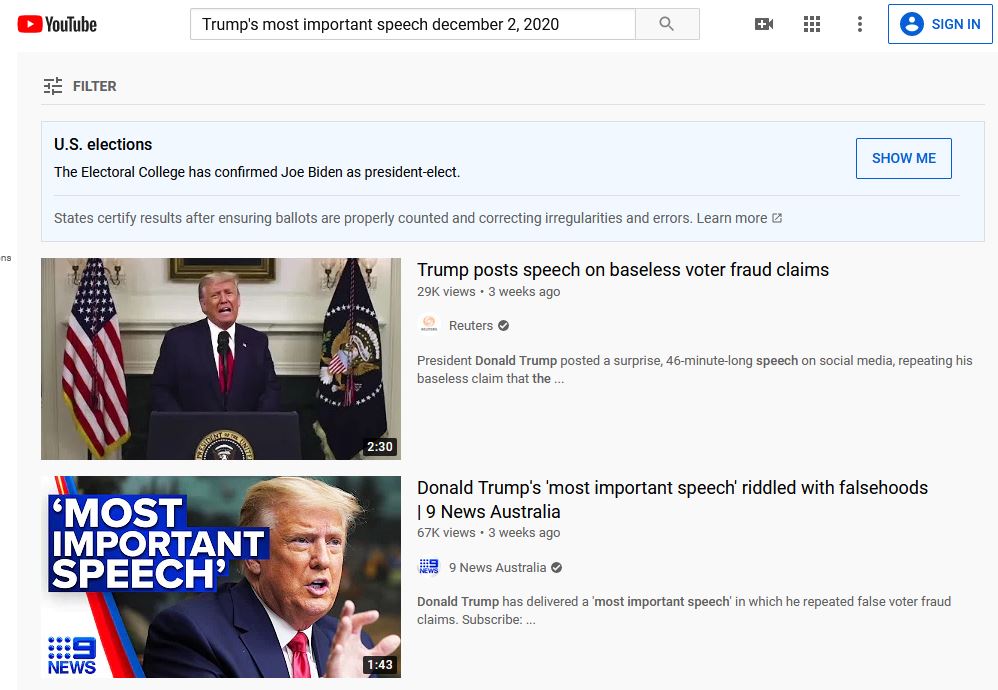
Furthermore, if you go to YouTube and query “Trump’s most important speech december 2, 2020” this is what appears: “Fact-check” videos on Trump’s “baseless voter fraud claims” and “speech riddled with falsehoods”.

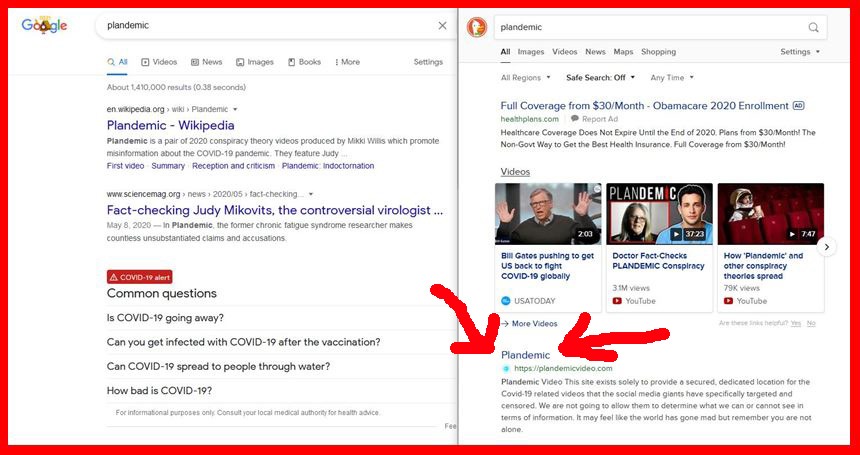
Now try this: Search for the word “Plandemic” on the Duck Duck Go search engine, and you will see the website for PlandemicVideo.com appearing at the top of the results.  But if you search the same term on Google, the Plandemic video website does NOT show.  Instead, you will see a Wikipedia link labeling Plandemic as “misinformation” and a science magazine’s website “fact-checking” “unsubstantiated claims and accusations”.

Consider for a moment the kind of power we are witnessing:  The mainstream media, the FBI, the Justice Department, the CIA, Big Tech, The Drudge Report, most of Fox News, and, now, even the American electoral system and Supreme Court… ALL assimilated by The Borg.

How could this all-inclusive collusion exist?

What follows will provide some of the answers to that question.

Catherine Austin Fitts is a former banker turned whistleblower and served as the Assistant Secretary of Housing and Urban Development in the late nineteen-eighties under Bush the Elder. A few days before Christmas 2020, an interview of Fitts was posted whereby she described five pillars of a Transhumanist Technocracy currently being constructed in plain sight by The Borg.  The five pillars are as follows:


1.)  Tech engineers building “The Cloud” and Intel communications

2.) The military installing satellites in space in conjunction with Operation Warp Speed here on earth

3.) Big Pharma designing vaccines and injection mechanisms

4.) The Mainstream Media’s ever-spinning propaganda machine

5.) The Central bankers creating crypto systems designed to enslave the masses


Fitts claimed these “pillars” are painstakingly being kept separate by the Borg until they can be integrated into our bodies, and our minds, by means of our own blood and DNA – like a trap being sprung at just the right time; and the reason we are not completely caught in the trap yet, is because The Borg has not quite finalized construction of the five pillars.

In her interview, Fitts described our current circumstances as a war between those who consider mankind as “individuals” with rights divinely ordained and against a High Tech Oligarchy (i.e. The Borg) who views the citizens of the world as cattle and chattel…(continues)

FEE: Gym Owners Who Racked Up $1.2 Million in Fines for Defying Lockdowns Go Viral

From the Foundation for Economic Education, Gym Owners Who Racked Up $1.2 Million in Fines for Defying Lockdowns Go Viral

Nearly 100,000 US businesses on Yelp failed to survive the coronavirus pandemic and ensuing government lockdowns. Ian Smith, the co-owner of Atilis Gym, was determined not to be one of them.

The New Jersey entrepreneur has defied Gov. Phil Murphy’s lockdown orders for months now. On a typical day hundreds of people go to the gym to exercise, and Smith estimates 84,000 people have worked out at the facility since the state resumed its lockdown in May.

For gym patrons, Smith’s lockdown defiance has brought benefits. They get to keep body, mind, and soul fit in what has been a stressful and strange year, and Smith claims not a single COVID-19 case has been traced to his facility.

For Smith and co-owner Frank Trumbetti, however, the decision has had consequences.

“Governor Murphy has thrown everything he possibly could to shut us down. He has arrested my partner and I, given us over 60 citations, some of them criminal. He fines us $15,497.76 per day for every day we’re in operation,” Smith recently told Fox News. “Our fines are totaling over $1.2 million, but every single day, Frank and I open our gym.”

The prospect of facing more than a million dollars in fines and criminal charges is enough to cow most business owners into compliance. Not Smith.

Following his interview with Fox, he posted a short video clip to Twitter showing people working out in his facility and had a simple message for Governor Murphy: “No Science. No Shutdown.”

The clip has already been viewed more than 7.7 million times on Twitter alone as of Monday morning.

Smith is hardly the only business owner to defy lockdown orders. As I wrote before Thanksgiving, Americans of all stripes—business owners, religious observers, and even political officials—are embracing the tradition of civil disobedience and peaceful resistance to lockdowns that have been shown to be largely ineffective at slowing transmission of the virus.

From city officials in Beverly Hills, to restaurants in Kentucky, to gym owners in Buffalo, New York, Americans have begun to stand up to lockdown orders that have ravaged small businesses and caused the first rise in extreme global poverty in decades.

The pandemic has been one of the most trying and terrible chapters in American history. More than 300,000 Americans have died of or with the virus, according to official statistics, and attempts to mitigate the spread of the virus have resulted in widespread economic destruction and mental health deterioration.

But a silver lining is that Ameircans are witnessing a renaissance of civil disobedience against government overreach. From seatbelt laws, to compulsory schooling, to smoking bans on a private property and beyond, in recent decades Americans have obediently acquiesced to laws that have violated individual freedom in the pursuit of an alleged collective good.

The lockdowns, however, have reminded Americans of the true nature of government.

“The essence of government is force, and most often that force is used to accomplish evil ends,” the late economist Walter Williams once observed.

By complying with laws that seem reasonable in the pursuit of a common good, Americans had largely forgotten that government is an evil—a necessary one, perhaps, but one that should be limited and shackled at every turn to prevent it from devolving into tyranny.

This is precisely why the American founders created a fractured system of government that decentralized power and was fortified with numerous checks and balances.

“An elective despotism was not the government we fought for; but one in which the powers of government should be so divided and balanced among the several bodies of magistracy as that no one could transcend their legal limits without being effectually checked and restrained by the others,” Thomas Jefferson wrote in Notes on the State of Virginia.

As strange as it may sound to many today, the raison d’être of government isn’t to create “a better world,” but the protection of liberty. Because it’s only through the protection of liberty that a better world will be created.

To be sure, the coronavirus is a serious and deadly threat. But it’s one individuals must manage, not central planners.

“Substituting democratic decision making for what should be private decision-making is nothing less than tyranny dressed up,” Williams once said.

Depriving healthy individuals of the ability to work or do commerce is tyranny—even if it’s wearing a dress.

Ian Smith sees that, and his defiance against Murphy—whose clumsy attempts to slow the virus have only resulted in New Jersey having the highest COVID-19 mortality rate in America—is an act of heroism.

Hopefully his act of civil disobedience will inspire others to remember man’s true nature and natural rights.

“I was not born to be forced,” wrote Henry David Thoreau, the American poet, abolitionist, and essayist. “I will breathe after my own fashion.”

The American Mind: A House Dividing?

The American Mind talks about the widening chasm between liberal and conservative Americans in A House Dividing? The piece includes links to other essays which further discuss the issues.

We do not publish this feature lightly. Nor do we intend to take a firm editorial stance in the debate. But it is past time to bring the discussion Americans are now having in private into public light. The longer it stays underground and forbidden, the more we risk serious and sudden shocks to our political and cultural life together. Only by having this debate out in public can we hope to resolve the current crisis.

When we can’t agree as a people on the purpose of government, or even about what human nature is, the next logical question is: how can we stay together as citizens? What truths, in other words, do we still think self-evident? What is the basis of our shared citizenship? Where is the growing divide in America leading us, and what is the best path forward?

The best book on the topic has been written by our colleague Michael Anton, who explores these questions in The Stakes, which we encourage you to read. Examining the contemporary scene, we find those, like Geoffrey Vaughan, who acknowledge the deepening divide yet hold that the structure of American government stands. In “Madison Wins, Factions Lose,” he argues that “Madison has continued to outwit the ideologues and factionalists.” And, after all, even Democrats who support packing the Supreme Court and adding Puerto Rico as a state are operating within the Constitutional framework. Republicans now eye the Constitution’s requirement that state legislators ultimately choose their state’s electors to the Electoral College.

Yet one must also note that changes to the Constitution’s Electoral College and the apportionment of the U.S. Senate are being openly proposed by mainstream Democrats. Further, while the Constitution at least partially holds, the question is how long it can continue to keep a house divided together. In the midst of the growing divide in America, red counties are growing increasingly eager to leave blue states and reconstitute red ones even as blue states have been saber-rattling for four years about federalism and state prerogatives. This week, we present the visions of two pseudonymous authors pointing toward a national separation in the interest of preserving the union.

It is not only young radicals who are thinking though a potential balkanization and breakup of the nation. Many engaged citizens are talking about such things in private. It is particularly worth noting that many highly competent professionals throughout the country—notably those in finance and tech whose livelihoods are tied to judging reality as it is and not as they’d like it be—quietly believe that America is headed towards an even deeper divide. Many are silent readers of this website, and in private they often offer dark thoughts about the state of our financial system, Big Tech, and our political culture.

In “2020: A Retrospective from 2025,” Professor “Tom Trenchard” provides an account of what might happen if red counties began to act as a unified front against the blue cities that propelled Joe Biden’s vote count. This is not merely a fantasy: red county repartition movements have been picking up steam, and Trenchard’s account identifies the real divide in American political life between rural and urban areas.

Finally, in the essay of the week, “Rebecca” presents an extended argument for the depth of the divide, proposing that the only way to resolve it is a more radical form of federalism. This “proposal for a renewed America” is not an argument for secession, but a peaceful process whereby both sides are allowed some measure of self-governance, with an eye to reunification. As the author says, “The two Americas avow their disagreements. The Separation respects reality and seeks peaceful co-existence.”

Such thoughts are no longer wild-eyed fantasy. Both pseudonymous essays vaguely echo Angelo Codevilla’s thoughts at the end of Revolution 2020 and “Our Revolution’s Logic.” These voices now represent those of many thoughtful Americans concerned about the fate of the nation. We welcome more to the discussion.

Mises Institute: Why Governments Hate Decentralization and “Local Control”

Ryan McMaken at the Mises Institute talks about Why Governments Hate Decentralization and “Local Control”. No one with power wants to have to exercise that power through intermediaries; they want direct control.

In recent decades, many have claimed that advances in communications and transportation would eliminate the different political, economic, and cultural characteristics peculiar to residents of different regions within the United States. It is true the cultural difference between a rural mechanic and an urban barista is smaller today than was the case in 1900. Yet recent national elections suggest that geography is still an important factor in understanding the many differences the prevail across different regions within the US. Urban centers, suburban neighborhoods, and rural towns still are characterized by certain cultural, religious, and economic interests that are hardly uniform across the landscape.

In a country as large as the United States, of course, this has long been a reality of American life. But even in far smaller countries, such as the larger states of Europe, the problem of creating a national regime designed to rule over a large diverse population has long preoccupied political theorists. At the same time, the problem of limiting this state power has especially been of interest to proponents of “classical” liberalism—including its modern variant, “libertarianism”—who are concerned with protecting human rights and property rights from the grasping power of political regimes.

The de facto “answer,” to the this problem, unfortunately, has been to empower national states at the expense of local self-determination and institutions which had long provided barriers between individual persons and powerful national states. Some liberals, such as John Stuart Mill, have even endorsed this, thinking that mass democracy and national legislatures could be employed to protect the rights of regional minorities.

But not all liberals have agreed, and some have understood that decentralization and the maintenance of local institutions and local power centers can offer a critical obstacle to state power.

The Growth of the State and the Decline of Local Powers

Among the best observers and critics of this phenomenon are the great French liberals of the nineteenth century, who watched this process of centralization unfold during the rise of absolutism under the Bourbon monarchy and during the revolution.1

Many of these liberals—Alexis de Tocqueville and Benjamin Constant in particular—understood how historical local autonomy in cities and regions throughout France had offered resistance to these efforts to centralize and consolidate the French state’s power.

Alexis de Tocqueville explains the historical context in Democracy in America:

During the aristocratic ages which preceded the present time, the sovereigns of Europe had been deprived of, or had relinquished, many of the rights inherent in their power. Not a hundred years ago, amongst the greater part of European nations, numerous private persons and corporations were sufficiently independent to administer justice, to raise and maintain troops, to levy taxes, and frequently even to make or interpret the law.

These “secondary powers” provided numerous centers of political power beyond the reach and control of the centralized powers held by the French state. But by the late eighteenth century, they were rapidly disappearing:

At the same period a great number of secondary powers existed in Europe, which represented local interests and administered local affairs. Most of these local authorities have already disappeared; all are speedily tending to disappear, or to fall into the most complete dependence. From one end of Europe to the other the privileges of the nobility, the liberties of cities, and the powers of provincial bodies, are either destroyed or upon the verge of destruction.

This, Tocqueville understood, was no mere accident and did not occur without the approval and encouragement of national sovereigns. Although these trends were accelerated in France by the Revolution, this was not limited to France, and there were larger ideological and sociological trends at work:

The State has everywhere resumed to itself alone these natural attributes of sovereign power; in all matters of government the State tolerates no intermediate agent between itself and the people, and in general business it directs the people by its own immediate influence.

Naturally, powerful states are not enthusiastic about having to work through intermediaries when the central state could instead exercise direct power through its bureaucracy and by employing a centrally controlled machinery of coercion. Thus, if states can dispense with the inconveniences of “local sovereignty” this enables the sovereign power to exercise its own power all the more completely.

The Power of Local Allegiance and Local Customs

When states are dominated by any single political center, other centers of social and economic life often arise in opposition. This is because human society is by nature quite diverse in itself, and especially so across different regions and cities. Different economic realities, different religions, and different demographics (among other factors) tend to produce a wide range of diverse views and interests. Over time, these habits and interests supported in a particular time and place begin form into local “traditions” of various sorts.

Benjamin Constant, a leading French liberal of the nineteenth century, understood these differences could serve as effective barriers to centralized state power. Or, as noted by historian Ralph Raico: “Constant appreciated the importance of voluntary traditions, those generated by the free activity of society itself….Constant emphasized the value of these old ways in the struggle against state power.”

In his book Principles of Politics Applicable to All Governments, Constant complains that many liberals of his time, having been influenced by Montesquieu, embraced the ideal of uniformity in laws and political institutions.

This, Constant warns, is a mistake and tends to create more powerful centralized states, which then proceed to violate the very rights that Montesquieu thought could be preserved through uniformity.

But political uniformity can lead down very dangerous paths, Constant insists, concluding, “It is by sacrificing everything to exaggerated ideas of uniformity that large States have become a scourge for humanity.” This is because large politically uniform states can only reach this level of uniformity by employing the state’s coercive power to force uniformity on the people. The people do not give up their local traditions and institutions easily and therefore, Constant continues,

It is clear that different portions of the same people, placed in circumstances, brought up in customs, living in places, which are all dissimilar, cannot be led to absolutely the same manners, usages, practices, and laws, without a coercion which would cost them more than it is worth.

This may not be “worth it” to the people, but it appears to be worth it to the regime. Thus, states over the past several centuries have expended immense amounts of time and treasure to break down local resistance, impose national languages, and homogenize national institutions. When this process is successful, a nation’s laws end up reflecting the preferences and concerns of those from the dominant region or population at the expense of everyone else. When it comes to these large centralized states, Constant writes:

one must not underestimate their multiple and terrible drawbacks. Their size requires an activism and force at the heart of government which is difficult to contain and degenerates into despotism. The laws come from a point so far from those to whom they are supposed to apply that the inevitable effect of such distance is serious and frequent error. Local injustices never reach the heart of government. Placed in the capital, it takes the views of its surrounding area or at the very most of its place of residence for those of the whole State. A local or passing circumstance thus becomes the reason for a general law, and the inhabitants of the most distant provinces are suddenly surprised by unexpected innovations, unmerited severity, vexatious regulations, undermining the basis of all their calculations, and all the safeguards of their interests, because two hundred leagues away men who are total strangers to them had some inkling of agitation, divined certain needs, or perceived certain dangers.

For Constant, the diversity among communities ought not be seen a problem to solve, but rather as a bulwark against state power. Moreover, it is not enough to speak only of individual freedoms and prerogatives when discussing the limits of state power. Rather, it is important to actively encourage local institutional independence as well:

Local interests and memories contain a principle of resistance which government allows only with regret and which it is keen to uproot. It makes even shorter work of individuals. It rolls its immense mass effortlessly over them, as over sand.

Ultimately, this local institutional strength is key because for Constant state power can be successfully limited when it is possible to “skillfully combine institutions and place within them certain counterweights against the vices and weaknesses of men.”

Unfortunately, it appears even the last few institutional vestiges of localism are under attack from the forces of political centralization. Whether it is attacks on Brexit in Europe, or denunciations of the electoral college in the United States, even limited and weak appeals to local control and self-determination are met with the utmost contempt from countless pundits and intellectuals. Two centuries after Tocqueville and Constant, regimes still recognize decentralization as a threat. Those who seek to limit state power should take the hint.

The Federalist: Your Political Leaders Hate You And Think You’re Stupid

From The Federalist, something you may have already suspected – Your Political Leaders Hate You And Think You’re Stupid

One thing should be abundantly clear by now, after ten months of this pandemic: our political leaders hate us and they think we’re stupid. Nothing else can explain the blatant hypocrisy we’ve seen, mostly from Democrat governors and mayors who are eager to impose harsh lockdowns and strict rules for the public at large but then turn around and do whatever they please with their own families, friends, and cronies.

Examples abound, but this week brought a fresh spectacle of hypocrisy in the form of a nervous, patently disingenuous apology from California Gov. Gavin Newsom, who was caught dining at an opulent birthday dinner for a top California political operative at a fancy French restaurant in Napa earlier this month, in apparent violation of his own COVID-19 protocols.

The timing couldn’t have been worse. On Monday Newsom announced he was “pulling the emergency brake” on reopening his state amid a spike in COVID cases, dealing a crippling blow to shuttered businesses and out-of-work Californians who have been struggling for months under rolling lockdown orders.

Only after Newsom was widely criticized for his rank hypocrisy did he offer an attenuated mea culpa, explaining that upon his arrival he was surprised to find there were “just a few extra people” at the party, but quickly added it was an “outdoor restaurant” in Napa County, which has looser restrictions compared to other areas of the state. Blinking incessantly and smiling tightly, Newsom finally got around to saying, albeit in the passive voice, that “the spirit of what I’m preaching all the time was contradicted.” Indeed it was, governor.

But then we come to find out this week that the dinner wasn’t outdoors at all. Pictures obtained by the Fox News affiliate in Los Angeles show Newsom and a bunch of others dining at the French Laundry restaurant in Yountville, California. They are obviously not outside, not social distancing, and not wearing masks.

The woman who took the photos told the Fox affiliate that Newsom was with a “very large group of people shoulder to shoulder,” and that she was “surprised because it didn’t look like he was uncomfortable being there until the very end, until people were looking at him and staring at him as he was leaving the room.”

But it doesn’t end there! On Wednesday, Politico reported that two top officials with the California Medical Association were among the guests at Newsom’s fancy birthday dinner.

You might think the state’s top medical lobbyists would think twice about flagrantly disregarding COVID guidelines, or even feign an apology like Newsom, but no. A spokesman for the CMA told Politico that “the dinner was held in accordance with state and county guidelines,” which prohibit more than three households from gathering privately—but do allow restaurants to seat people from more than three households together. See?

Apparently this is a pretty common attitude among California politicians and their lobbyist buddies. With much of their state locked down by government fiat, last week a bunch of state lawmakers and corporate lobbyists flew off to Hawaii for a five-day conference and schmooze-fest at an upscale Maui resort. Legislators and their families mingled with representatives of businesses and trade groups that paid thousands of dollars for access to the lawmakers in what has become an annual lobbying tradition—even during a global pandemic!

Dan Howle, chairman and executive director of the Independent Voter Project, which hosts the conference, didn’t apologize. He told the San Francisco Chronicle, “Somebody has to be first to say, ‘OK, we’re going to do a group event safely.’” Yes, Dan, somebody does has to be the first, and why shouldn’t it be a handful of powerful politicians and corporate lobbyists instead of, you know, ordinary people trying to salvage their businesses and visit their loved ones?

Lockdowns For Thee, But Not For Me

On and on it goes. Chicago Mayor Lori Lightfoot, who issued a citywide stay-at-home order last week, defended her recent appearance at a massive street rally celebrating Biden’s apparent victory, where a mask-less Lightfoot addressed the crowd through a bullhorn.

When asked about the obvious double standard on MCNBC last week, Lightfoot was defensive, insisting that, “There are times when we do need to have relief and come together, and I felt like that was one of those times.” She added, as if it excuses her hypocrisy, “That crowd was gathered whether I was there or not.”

Seemingly everywhere you look you find people in positions of power ignoring pandemic restrictions and doing as they please. Often these are the same people who are most outspoken about the need for lockdowns.

Back in September, House Speaker Nancy Pelosi was defiant after being caught on camera (mask-less, of course) at a shuttered San Francisco salon in violation of a citywide lockdown order, calling it a “setup” and refusing to apologize.

Then last week, Pelosi was forced to cancel a dinner for incoming Democratic House members after a viral tweet showing tables being set up for the soiree understandably provoked outrage. “It’s very spaced,” she explained to an NBC News reporter.

The truth is, our elites have been doing this since the pandemic began. Who knows how many ordinary Americans were barred from attending the funerals and burials of their beloved dead these past months? Yet thousands were allowed to gather in July for memorials of Rep. John Lewis, in services that stretched from Alabama to Washington, D.C. Thousands were allowed to gather for George Floyd’s memorial service in June in Minneapolis.

We all saw the way the media treated Trump rallies like COVID super-spreader events yet condoned the hundreds of large-scale protests over the summer and fall in cities all across the country under the idiotic pretense that the protesters were “all wearing masks.” Same with the post-election celebrations that brought out thousands, dancing in the streets cheek-by-jowl and passing around champagne bottles.

Again, there is only one possible conclusion you can reach, based on months and months of appalling hypocrisy from the media and our ruling elite: they think lockdowns are for you, not them. They think pandemic rules are for you, not them. They think suffering hardships and doing as you’re told are for you, not them. Why? Because they hate you and think you’re stupid.

AIER: FedCoin Revisited

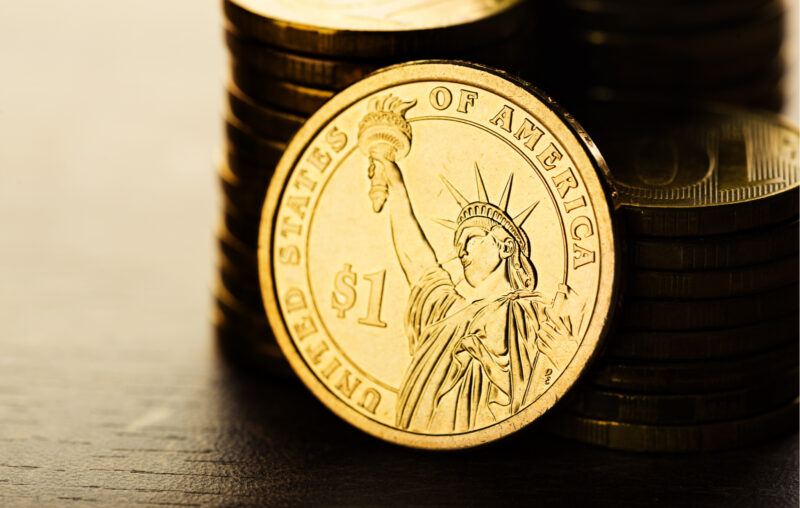
A US physical coin, not a digital currency

This article at the American Institute for Economic Research talks about a new push for government-controlled, central bank digital currency to more easily track the income and tax liabilities of end users – FedCoin Revisited.

The Federal Reserve is thinking about issuing a central bank digital currency (CBDC). The International Business Times reports that the Fed “would be open to collaborating with private business on the creation of a digital currency but emphasized that they were not yet making any commitments.” Talk of a so-called FedCoin appeared to have quelled. But it is now back in full force.

To some, the idea of a FedCoin seems obvious. They see no reason for the Fed to forego adopting 21st century monetary technology. And, certainly, there are a number of benefits, such as lower transaction costs of electronic transfers and helping to execute instant payments (such as in the FedNow project). However, a CBDC also carries risks that must be weighed against the benefits.

One’s view on FedCoin is often related to his or her view on cash. If she thinks cash is good, she is likely to oppose FedCoin. If he thinks cash is bad, he is likely to see FedCoin as an improvement on the status quo. Indeed, some see the introduction of FedCoin as an important step in the direction of a completely cashless economy.

Advocates of moving towards a cashless economy argue that making all payments electronic would help to fight tax evasion and crime. If the move were required, however, it would harm those preferring to use cash for legal transactions as well.

Many people place a high value on anonymity. For some, it’s personal. They don’t want others to know what they are doing. For some, it’s political. They worry about the degradation of institutions, as private information might be used for political ends. The threat of obtaining and revealing private information might silence opposition and undermine the democratic process.

A cashless economy might also lead to policy changes. In order to foster spending during a recession or an economic downturn, the Fed might tax money demand with negative interest rates. If holding cash is an option, then depositors can withdraw their deposits and avoid the negative interest rate. But, if cash is not an option, then consumers are stuck paying interest on their FedCoin holdings. Since they cannot avoid the negative interest rate, consumers would rather spend their money than see their bank balances go down.

In addition to the issues related to one’s view on cash, FedCoin might also undermine financial intermediation. By offering FedCoin, the central bank might crowd out commercial banks.

A checking account at Bank of America is guaranteed by the Federal Deposit Insurance Corporation up to the max of $250,000. An account at the Fed is a liability of the government. If both offer the same payment services, why would one opt for the riskier commercial bank account?

Many will see little cause for concern with depositors having access to safer accounts. But that’s because they don’t think much about banking. Banks attract deposits with payment services and interest payments. They then funnel those funds to productive investment ventures. Financial intermediation makes us more productive, thereby raising the standard of living. As the World Bank reports, private credit to GDP high-income countries is “more than 4 times the average ratio in low-income countries.”

If would-be depositors hold FedCoin instead, the corresponding funds will have to be intermediated by the Fed. At best, the Fed would just auction off funds to private financial institutions. But recent events suggest the Fed might be inclined to allocate credit.

My concerns with FedCoin, and other CBDCs, are admittedly speculative. We don’t know whether the Fed would take steps to eliminate cash or impose negative rates on FedCoin balances. We don’t know how it would go about intermediating funds. But such speculations should make one thing clear: there are risks. At the least, we should develop strong institutional checks before permitting the Fed to plow ahead.

Cato Institute: Government in a Pandemic

From Thomas Firey at the Cato Institute, Government in a Pandemic

When the threat of COVID-19 became apparent, some political commentators began arguing that Americans must accept much greater governmental intervention in their lives if the United States were to respond effectively to the disease. This idea was soon distilled into a pithy slogan: “There are no libertarians in a pandemic.”

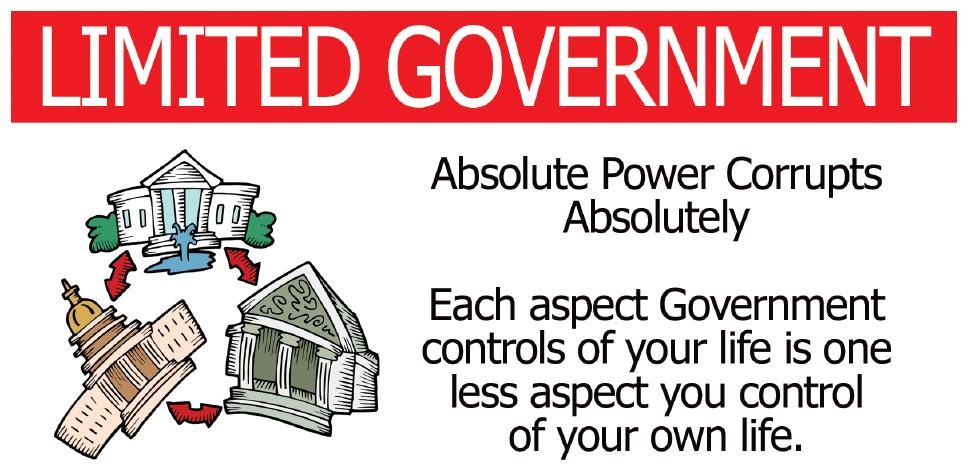
In fact, government can respond effectively to the historic COVID-19 crisis while following the principles of limited government. However, federal, state, and local governments in the United States have done a poor job of identifying and implementing good policies for the pandemic that are compatible with those principles. Instead, policymakers have attempted interventions far beyond the powers of a properly limited government—with poor results.

Americans and their political leaders are understandably worried about COVID-19 and its effects, both on human health and the economy. That worry may indeed lead some people to reflexively demand broad government intervention. But if the United States follows the principles of limited government, those principles will help see us through this crisis.

Introduction

When the threat to the United States from the novel 2019 coronavirus disease (COVID-19) became apparent, political leaders and commentators began calling for large governmental interventions to counter the disease’s health and economic effects. Many of these people added that the political philosophy of limited government—“liberalism” in the classical sense—would handicap the country’s response to the crisis and thus must be rejected. This was soon distilled into a pithy slogan: “There are no libertarians in a pandemic.”

As COVID-19’s grim health toll and economic statistics have accumulated, the criticisms of liberalism have grown louder.

Appropriate to the era, the “no libertarians” slogan was popularized by a Twitter post: Atlantic staff writer Derek Thompson used it to introduce a news item about Republican lawmakers advocating public funding for COVID-19 testing and for treatment of uninsured victims of the disease.1 A week later, his Atlantic colleague Peter Nicholas used a variant of the slogan as the title of a column criticizing President Trump for campaigning on “anti‐​socialism” while his administration pushed a host of extraordinary interventions into the economy in response to the pandemic.2 “Just as there are no atheists in foxholes, in a national emergency, there’s no truly laissez‐​faire government,” Nicholas wrote.

Others quickly picked up the theme. New York Times columnist Farhad Manjoo, noting the same news item as Thompson, concluded, “Everyone’s a socialist in a pandemic.”3 Ryan LaRochelle, a lecturer at the University of Maine, wrote in the Washington Post that a “decades‐​long war on the safety net and the government’s administrative capacity [has] made our society particularly vulnerable to the pandemic’s impact on our economic life. This has seriously hampered the federal government’s response to the coronavirus and shown how dangerously ill‐​suited this ideology is to the crisis.”4

Perhaps the sharpest criticisms came from essayist and novelist George Packer, who bemoaned “a federal government crippled by years of right‐​wing ideological assault” and “politicians and donors who wanted government to do as little as possible for the common good.”5 He described a dystopian America that, without active management from Washington, DC, is nearly powerless against COVID-19:

Every morning in the endless month of March, Americans woke up to find themselves citizens of a failed state. With no national plan—no coherent instructions at all—families, schools, and offices were left to decide on their own whether to shut down and take shelter. When test kits, masks, gowns, and ventilators were found to be in desperately short supply, governors pleaded for them from the White House, which stalled, then called on private enterprise, which couldn’t deliver. States and cities were forced into bidding wars that left them prey to price gouging and corporate profiteering. Civilians took out their sewing machines to try to keep ill‐​equipped hospital workers healthy and their patients alive. Russia, Taiwan, and the United Nations sent humanitarian aid to the world’s richest power—a beggar nation in utter chaos.6

As for the idea that private actors could respond to the virus, Packer asserted simply, “It turns out that ‘nimble’ companies can’t prepare for a catastrophe or distribute lifesaving goods—only a competent federal government can do that.”7

The belief that COVID-19 shows the need for bigger, more interventionist government has not been confined to the left of the U.S. political spectrum. The right, which in previous decades repeatedly declared a commitment to “small government,” began talking about the need to boost “state capacity” to respond to the pandemic and other problems. Two of the right’s up‐​and‐​coming leaders, Sens. Marco Rubio (R–FL) and Josh Hawley (R–MO), pushed large‐​scale government financial assistance programs, with Rubio helping to craft the Paycheck Protection Program that has blossomed into a roughly $650 billion subsidy to businesses.8 Its creation was part of the $2 trillion Coronavirus Aid, Relief, and Economic Security (CARES) Act that provides federal support to businesses, households, and state governments.9 The CARES Act passed with overwhelming support from Republican lawmakers and was signed by President Trump, who had his name prominently stamped on the ensuing household subsidy checks.10

Those efforts are in accordance with the new “national conservative” movement, which endorses government intervention in the economy to promote a host of goals.11 As one of the movement’s intellectual leaders, Henry Olsen of the Ethics and Public Policy Center, told Politico about policymaking in response to COVID-19:

This is going to jump‐​start the already simmering debate over how the right should deal with domestic policy. Clearly there’s going to be demand for many types of stimulus. There’s going to be demand for the view that we’re not going to let this happen again. And a libertarian, hands‐​off policy doesn’t really respond to that.12

These calls for government to intervene in response to COVID-19 are understandable. The disease is often painful and sometimes fatal, and it is produced by a novel virus that spreads through social contact. As yet, there is no known effective vaccine against the virus, and treatment therapies are limited. People naturally want something to “fix” a crisis, and they look for government to be that powerful fixer. It is comforting to envision government scientists in their labs probing the virus, government doctors tending to the infected and uninfected alike, government financing research and development on therapies and vaccines, and government policymakers, counseled by sage experts, directing the public toward safety and away from danger.

That’s the vision; the reality is different. Government leaders and their advisers have been operating with imperfect knowledge about the recently discovered disease, resulting in public recommendations and policies that, especially in the early months of the outbreak, have been wasteful at best and harmful at worst. Though a number of those failures can be attributed to an especially inept Trump administration, they can be found across the political spectrum, at different levels of government, and among both the virtuous and dishonorable.

Government does have important roles to play in a pandemic. However, those roles are consistent with the principles of limited government. This analysis examines some of those interventions—constraining negative externalities and providing public goods—and notes instances where government has performed poorly in those areas when responding to COVID-19. The analysis also discusses interventions that limited government should not undertake—such as manipulating the production and distribution of private goods—but that government has attempted broadly in this crisis, with poor results.

Limited Government and Market Failure

Critics of limited government often equate it with anarchy, the lack of any government activity. That equivalence is false. The philosophy of limited government does place the highest value on individual liberty, including people’s freedom to privately arrange for the satisfaction of their wants. These arrangements often take place in the market, an arena for many forms of voluntary exchange. So, rather than rejecting government altogether, valuing liberty means creating important roles for government in protecting the freedom of exchange and private ordering.

Among the oldest roles of the state is defending its citizens from violent invaders, thereby protecting against a dramatic disruption of the market. This defense is difficult, if not impossible, to provide through purely private agreement. Residents operating individually would be hard‐​pressed to fend off an invading horde, and private mutual aid agreements or contracts employing mercenaries would be weakened by residents who did not join the arrangement or who joined only when a threat was imminent. A defense that protects only parts of a community is a defense penetrated by invaders.

Defense is an example of market failure: a want that cannot be adequately addressed through private exchange. Specifically, defense is an example of market failure known as a public good. Public goods are difficult to limit only to individuals who pay for them; the goods must be provided to everyone in a community if the goods are to have much value. If left to private exchange, residents would be tempted to not purchase the goods but instead free‐​ride on the purchases of others. That would result in only some residents—or perhaps none—purchasing the goods. That, in turn, would reduce the funding and quality of the public goods provided, to the detriment of all residents, including those who do purchase the goods.

Government can provide its citizens public goods via taxation. Government can produce the goods itself (e.g., by employing troops to provide defense) or contract with a private provider to furnish them (e.g., purchasing materiel to equip the troops). The key is that taxation overcomes the market failure by requiring citizens to pay for the goods. Besides defense, examples of public goods include police and fire services (private security and firefighters cannot ignore crimes and fires at noncustomers’ properties without putting their customers at risk), street lights (the lighting’s benefit cannot be limited to customers), and—at least until recently—local roads (before technological advances, it was prohibitively costly to toll local roads).

Other types of market failure exist. Though there is no definitive list, several forms are commonly recognized. One of these is externalities, which are costs or benefits of an exchange that are borne by some party other than the participants who agree to the exchange. Externalities result in less welfare than if all involved parties had voluntarily reached agreement. For instance, a polluting factory inflicts a cost (negative externality) on its neighbors, who may not be part of the voluntary exchange between the factory and its customers. Positive externalities, in which a third party receives a benefit, are less commonly cited as a problem, but they do exist.

Government can intervene to address other market failures.13 Often, such policies take the form of laws, regulations, and enforcement. For instance, environmental law is intended to reduce the negative externality of pollution.

Minimizing Government Failure

From an economic perspective, under a properly limited government, market failure is a necessary but insufficient condition for government intervention. Another necessary condition is that the proposed policy does not violate established liberties. Also, intervention always comes with costs, and those costs must not outweigh the benefits.

Further complicating matters, many of the troublesome dynamics that produce market failures also afflict government policymakers and bureaucrats, producing government failures.14 For instance, policymakers often suffer from imperfect information, resulting in bad policies.15 Also, policymakers and bureaucrats are motivated by private incentives just like everyone else, and those incentives can yield misguided—and even corrupt—outcomes.16 Unlike in the marketplace, where interaction is voluntary and participants can look for the exchanges that best fit their wants, citizens are compelled to abide by and pay for the choices of government policymakers and bureaucrats regardless of how sensible those choices may be. Classical liberal principles help to minimize those problems.

Despite the constraint of limited government, there is much it can do to address COVID-19 by focusing on the market failures associated with the disease. Unfortunately, the U.S. federal government and some state and local governments have struggled to identify and implement such policies. Instead, they have intervened in ways beyond the powers of properly limited government, with poor results. The following sections describe some of those government failures.

Limited Government and COVID-19

Several market failures are present in the COVID-19 crisis. Among them:

  • Negative externality: Infected persons can transmit the virus that causes the disease, severe acute respiratory syndrome coronavirus 2 (SARS‐​CoV‐​2), through common social contact. Transmission involuntarily inflicts costs on others, making it a negative externality. As libertarians often say, “People’s right to swing their fists ends at the tip of another’s nose”; likewise, people’s liberty ends at the point that they put others at involuntary risk.
  • The public goods of medical research: People want to avoid the disease and recover from it quickly if they are infected. That creates market incentives for research into the virus and disease and distribution of the findings. But the benefits from that work are difficult to confine to the individuals who pay for it. Information is easily transmitted, and the academic world rewards the broad distribution of many types of research to accelerate scientific discovery. That makes research into SARS‐​CoV‐​2 and COVID-19, and the resulting knowledge, public goods. Though some people would still pay for that work even if others free‐​ride on the results, private funding would likely be below optimal levels.
  • The public good of acquired immunity: Relatedly, an effective vaccine against the virus has public goods characteristics. A population can become resistant to an infectious disease if only a portion of its members develop resistance to it, a phenomenon known as “herd immunity.” Some diseases require high member immunity rates to produce this resistance—80 percent or more—but others have lower thresholds.17 Currently there is no scientific consensus on a threshold for COVID-19, though early guesses by epidemiologists fall in the 60–70 percent range, and one study argues that it could be as low as 43 percent.18 Those numbers suggest that a third to more than half of the population could free‐​ride on others’ bearing the cost of the vaccine, allowing for a public goods problem.

Some government interventions are justified to address these market failures regarding COVID-19, provided that the interventions’ benefits outweigh the costs and that the interventions do not violate protected rights. The U.S. federal government and state and local governments have made efforts at this sort of policymaking. Below are a few examples…(continues)

The Federalist: If Americans Can No Longer Trust Our Elections, We’re In Big Trouble

From Willis Krumholz at The Federalist, If Americans Can No Longer Trust Our Elections, We’re In Big Trouble

The polls from the major networks and universities promised a blue wave. President Trump was down by at least 10 points nationally, and by nearly that much or more in the major swing states. The few pollsters, including Trafalgar, who got 2016 and 2018 right and called 2020 a close race, were widely ridiculed.

Nate Silver, a leftwing poll analyst, was chief among the critics. Silver gave former Vice President Joe Biden a nearly 70 percent chance of winning Florida.

Immediately on Election Day, turnout looked good for the GOP. Trump won Florida decisively and by 8:30 p.m. Central Time, and made huge inroads in urban areas. While Hillary Clinton won Miami-Dade County by 30 points in 2016, the 2020 Trump ticket was down only single digits in the county.

That’s because Trump made significant gains among nonwhite Americans, and according to exit polls had the second-highest nonwhite share of the vote of any Republican since 1976. Cuban Americans are a big reason for Trump decisively winning Florida, but Trump’s gains with minority voters are a nationwide trend. The flipside was lower black and Hispanic turnout for Democrats—except for several major Democratic cities in contested swing states.

In other words, a significant margin of minority voters who didn’t defect to Trump decided not to vote. Indeed, a Bloomberg article days before the election cited anonymous Biden officials who said the campaign was worried about black and Hispanic turnout due to a lack of a ground game in these traditionally Democratic strongholds. But the warnings had gone unheeded.

Instead, the campaign hoped to make up these lost minority votes with gains in the suburbs, particularly among white women. In the end, Trump gained among white women compared to 2016, and only appeared to marginally lose votes from white men—many of which may have been upper-class suburban white men.

Back to Election Night

On election night, Trump’s decisive win in Florida was a bellwether to punters in the betting markets. The Trump campaign also seemed to outperform Election Day voting in states like Michigan and Pennsylvania, especially given the turnout seen in Florida. A shy Trump vote did exist, especially in the suburbs among women, and the GOP was morphing into a working-class, increasingly multiracial party. Betting odds swung in Trump’s favor, peaking at around 85 percent.

That’s when things went south for the Trump campaign. In a yet unexplained move, states including Pennsylvania, Michigan, and Wisconsin stopped releasing vote counts on election night. Fact-checkers have noted that these states didn’t stop counting—fair enough—but not why they stopped releasing the results of their counting.

Come 4 a.m. the next morning, huge amounts of fresh Biden votes were reported. Trump’s betting odds plummeted, and days later the media declared Biden to be the president-elect.

Except 70 percent of Trump voters, who comprise half the country, are convinced of massive election fraud. Yet corporate media has no intention of investigating claims of fraud. Instead, it has pivoted from saying there is “no evidence” of fraud, to saying that not enough evidence exists to overturn the results.

Contrary to the hope of Trump supporters, the courts will probably be powerless to sort these issues out. This is an incredibly dangerous moment for the country and may be a pivotal point in the future of America’s democratic republic. Did we just cross the Rubicon?

The Morning After

Before all else, we must go to the source of distrust over this election. Whereas Florida finished counting votes on election night, and has a system that knows roughly how many votes are outstanding and will be counted before election night is over, in key states like Pennsylvania, Michigan, and Wisconsin an unknown number of ballots could come in at the last second. And they did.

For that, thank Democrat lawsuits to overturn state voting laws at the last second, using COVID as a pretext. For those who doubt that the suits were nakedly political, note that they looked like a wish list based on a bill Democrat House Speaker Nancy Pelosi authored in 2019 to accomplish nationwide mail-in voting.

Many of the suits were quarterbacked by former Hillary Clinton campaign attorney Marc Elias, who was involved in manufacturing Russiagate’s Christopher Steele “dossier.” Like most things rotten in this country, particular blame should be placed on the courts that decided bureaucrats could unilaterally rewrite state laws to turn absentee voting into mail-in voting.

There was no good reason to remove requirements that absentee ballots arrive before the end of Election Day, nor to allow the fraud-welcoming practice of “ballot-harvesting.” The John Roberts Supreme Court stood idly by and let lower courts rip up longstanding state election law. Democrats and the media complain that the legislatures should have acquiesced and affirmed this judicial tyranny by changing the law to allow ballots to be counted before Election Day. That would have only put the legislature’s seal of approval on a mess that the courts stupidly created.

Mail-In Balloting Is an Easier Fraud Mark

Regardless of the existence or level of fraud in the 2020 election, it is a fact that mail-in balloting opens elections to the likelihood of massive fraud and chaos. First, there’s an easy opportunity for cheating, given the unknown number of ballots that can come in. Because ballots can be accepted after election day, an unscrupulous faction that lags in earlier counting can come up with the votes to make the difference.

Second, there’s less accountability for election officials. In a normal election, it is possible to immediately tell how many votes are cast and from where—once the votes are cast, all that’s left is to count the votes, because officials know by ward and precinct how many votes are in and what type have been cast (are the votes early in-person, absentee, or election day in-person?). Not so for mail-in voting.

One can have a recount, but that will only recount the same bad ballots.

Then, once the counting starts, mail-in voting brings problems of a haphazard chain of custody and reduced controls over voter-eligibility verification. All this is why one can have a recount, but that will only recount the same bad ballots.

The obvious problems with mail-in voting are not a rightwing conspiracy. France banned mail-in voting in the 1970s for these very reasons. In a recent New Jersey mail-in election, about 20 percent of the ballots cast were found to be fraudulent. A local New York election this year saw huge delays in processing ballots. A 2012 article in the New York Times warns that regular old absentee voting could screw up the electoral process, let alone allowing ballots to come in after election day.

Independent left-leaning journalist Glenn Greenwald writes Georgia had an 80 percent chance to go for Trump on election night, ostensibly because of a good Republican turnout. But so many ballots came in for Biden the next morning that the state ostensibly swung to Biden’s favor, due to major Democratic turnout in the Democratic stronghold of Fulton County.

This doesn’t prove fraud, but Greenwald calls this seesaw process in which many areas are counting votes nearly a week after the election a “disgrace.” “Distrust in U.S. outcomes [under such a system] is dangerous but rational,” writes Greenwald.

‘No Evidence’ of Any Fraud?

The media, Democrats, and many establishment Republicans have reflexively repeated that “no evidence” of fraud existed. Yet evidence does exist. The stories coming out of major vote-counting centers are shocking, and only add to the distrust. Dozens upon dozens of witnesses have signed affidavits attesting wrongdoing or highly inappropriate behavior from officials who are supposed to be impartial.

Detroit poll challengers have signed affidavits, under penalty of perjury, that they saw election workers counting ballots for non-eligible voters, and the double counting of voters. These persons say they were harassed constantly, and that election workers and Democratic operatives would get in their faces and start screaming if they raised a concern.

Federal agents threatened one of these whistleblowers, in an effort to get him to recant his story.

Some “election workers” appeared to be AFL-CIO activists. If concerns were raised, GOP poll challengers said, they were ushered from the room by the police and the entire room would cheer. They say election workers’ goal was to get as many GOP poll challengers as possible kicked out of that room.

Poll challengers also allege that they were pushed out of the room when the military ballots came in. Workers were sent to lunch; Democrats ate inside the building and the Republicans ate outside the area where votes were being counted, and the doors were locked so Republicans couldn’t get back in.

Irregularities alleged by these challengers aside from counting ineligible voters include ballots being dropped off by random vehicles, including a Mercedes Benz and a Ferrari, or arriving after the cutoff period. A sworn affidavit claims ballots were being “fraudulently and manually entered” when the person had no information and the birthdate was simply put as “1/1/1900.” Another Detroit GOP poll challenger says she witnessed names on ballots not coming up in the system but being counted nonetheless. When she raised concerns, she says she was kicked out.

Sworn affidavits by several U.S. Postal Service employees, in at least Pennsylvania and Michigan, along with a city employee from Detroit, alleged they were asked to backdate ballots (make ballots appear as if they were sent on election day) by their superiors. It was later revealed that federal agents threatened one of these whistleblowers, in an effort to get him to recant his story. A Clark County Nevada elections department employee says that his coworkers fabricated proof of residence data to allow ineligible voters.

In Philadelphia, GOP poll challengers had to sue to be allowed to observe what election workers were doing. Democratic state officials counter-sued to stop the access. While GOP poll challengers were moved forward in the room, the vote counters were moved further away, a mockery of state law that allows oversight of this process.

Photos of Philly vote counters show several women wearing Biden masks. A Trump campaign lawsuit has a sworn affidavit from a person who says he or she saw USB drives being delivered to the back of the room where voting machines were housed, and where observers were restricted.

In Philadelphia, GOP poll challengers had to sue to be allowed to observe what election workers were doing.

Meanwhile, the Georgia GOP state party chair claims Fulton County election officials told his observers to go home on election night because they were closing up, but then continued to count ballots “in secret.” In Wisconsin, election clerks allegedly altered “thousands” of absentee ballots to make them eligible.

Add to this multiple videos of what appears to be poll workers throwing away Trump ballots, and at least a handful of examples of dead persons voting. A conservative pollster, Richard Baris, claims to have found evidence of 10,000 deceased persons voting in Michigan. Others also claimed to have found thousands of dead voters in that state.

Meanwhile, Pennsylvania far exceeded its record for 90-year-olds registering to vote. In Nevada, multiple witnesses signed sworn affidavits that they saw a “Biden-Harris” van filling out loads of ballots.

Yes, Republicans have at least anecdotal evidence of fraud, although in one sense the media is right: these anecdotes are not evidence enough to overturn the election. That’s because there’s no way to quantify any of this evidence into an actual number of bad votes, even assuming all these claims are well-founded.

Then There Are the Statistical Anomalies

There’s more than anecdotal evidence, however. Observers and experts pointed out plenty of statistical anomalies. Some may turn out to be innocuous, or easily explainable. Others have been less well-explained.

First, Republicans took issue with the massive vote dumps for Biden that occurred overnight, in which Biden was getting nearly 100 percent of the vote. One of these was attributed to an extra zero and human error.

Michigan added almost 150,000 votes in one instance, all of which were for Biden except for about 6,000.

Silver tweeted that around 27,000 votes out of Philadelphia went “all for Biden.” In the face of obvious wonderment of how Biden could get 100 percent of such a large share of votes, Silver was quick to claim that election officials “unintentionally enter vote updates one candidate at a time, rather than entering all candidates together.” Maybe, but when votes stop getting reported and reporting starts coming in early in the morning with nearly 100 percent of votes coming in for Biden that justifiably raised eyebrows.

On a graph, these vote dumps in Michigan, Wisconsin, Georgia, and Pennsylvania resulted in Biden quickly jumping above Trump, and the odds of a Trump win plummeting. Michigan added almost 150,000 votes in one instance, all of which were for Biden except for about 6,000.

On election night, Trump led in Pennsylvania by almost 800,000 votes. The next morning, Trump’s lead shrunk to less than 100,000. Later, ballots found, including those apparently lingering with the U.S. Postal Service, supposedly put Biden over the edge.

Biden received an unbelievable amount of the mail-in share in Pennsylvania and Michigan.

Biden’s advantage in mail-in voting was to be expected, but the magnitude of the spikes for Biden in these select states is worth scrutiny. According to ballot requests across the country, GOP voters voted by mail too, just not with the same intensity as Democratic voters.

But while Trump received a reasonable share of the mail-in or absentee votes in places like Ohio, Biden received an unbelievable amount of the mail-in share in Pennsylvania and Michigan. Biden’s Pennsylvania mail-in total, excluding about 90,000 mail-in votes from libertarians and those with no party affiliation, equates to winning all the Democratic and Independent mail-in votes, and 9 percent of the GOP mail-in votes.

Said differently, Biden is up 60 points in absentee or mail-in ballots in Pennsylvania, and up by almost 40 points in Michigan. That’s not Biden receiving 60 percent of mail-in votes in Pennsylvania. That’s Biden receiving 80 percent of the mail-in vote. Comparably, Biden was only up single digits in absentee voting in most other battleground states. Biden’s mail-in advantage was 15 points in Ohio and 5 points in Minnesota.

There’s no reason to think Pennsylvania and Michigan should be outliers to national mail-in voting trends. Despite several comments by the president, the Trump campaign ground game in these states encouraged mail-in voting. In Michigan and Wisconsin, according to NBC News, Republicans actually led Democrats in mail-in ballots requested and returned. Yet the vast majority of the ballots that were counted after election day in these states were for Biden.

A Weird, Asymmetric Surge in Only Some Cities

No, this Biden surge in cities wasn’t driven by the suburbs abandoning Trump—Trump didn’t lose the suburbs any more than he lost them in 2016, and losses there were more than replaced by gains in working-class areas. These Biden votes were entirely driven by massive turnout in select Democratic strongholds in swing states. As mentioned before, this turnout was not consistent across the country. In parts of these cities, there was more turnout than registered voters.

Biden only had a net gain of 4,000 votes compared to Hillary Clinton in 2016 in Cuyahoga County (Cleveland), Ohio. Yet Biden had a net gain of almost 70,000 in Wayne County (Detroit), Michigan. In Minneapolis, Democrats bragged of 88 percent turnout—extremely high relative to the rest of the country and the state…(continues)

Mises Institute: Talk of “Unity” Is Both Hypocritical and Delusional

Professor Gary Galles at the Mises Institute says political Talk of “Unity” Is Both Hypocritical and Delusional

In Joe Biden’s address after being declared president-elect by news organizations, he promised to be a leader who “seeks not to divide but to unify.” Making that assertion after the campaigns we have seen, not to mention the light-years-apart treatment of the candidates, while Donald Trump is still adamantly disputing the election because of alleged Democrat malfeasance is, at a minimum, ironic. And it would be the height of hypocrisy if only a few of Trump’s claims of cheating are true. But we need to go further and recognize that even the possibility of Joe Biden uniting us is a delusion.

Agreement on the specific ends we want to achieve is unattainable because our desires are mutually inconsistent. Our agreement is very limited on even very broadly defined issues, and once we look further than vague, aspirational language and feel-good generalities, Americans disagree on virtually everything.

All of us want to be fed, clothed, housed, educated, etc. We agree in that sense. But we disagree about virtually every aspect of who, what, when, where, why, and how. We want different types and amounts, in different ways, at different times and places, and for different people. We are vastly different in the tradeoffs we are willing to make among our desires, not to mention who we think should pay our bills. Once we consider any of the myriad actual choices faced, the fact of scarcity necessitates that our specific ends conflict, rather than align.

Consider a mundane example played out daily in our homes—breakfast. Does everyone in your family agree on “the most important meal of the day”? Does everyone even eat breakfast? Does each member have coffee, a cold caffeine drink, or neither? Juice? What kind? Are all agreed on when, where, what, or how much to eat? Do we agree on who should pay for breakfast, cook it, and clean up after it? Do we agree on the “dress code” that should apply, either at breakfast or afterward?

Diverse individuals have diverse preferences. Multiplying this single example by the uncountable decisions that must be reached in society every day makes our fundamental disunity clear. And we are no more unified when we get to public policy. We are not in agreement about people’s rights and government powers that some view as essential but others view as unforgivable. The same is true of many foreign policy choices. We cannot be unified as “one nation under God” when some vehemently reject any reference to God. We cannot be unified about abortion when some view it as murder and others consider it sacred. Policies that take from some to give to others also inherently create disagreement from those whose pockets are involuntarily picked. Reducing what we take from some, entailing giving less to others than they wish, also triggers disagreement. So long as government dictates such choices, political unity is unattainable.

In fact, politics as currently practiced eviscerates the one thing Americans could agree about. This reflects the far-too-little-recognized fact that we have greater agreement on what all of us want to avoid than on what all of us want. None of us wants what John Locke called our “lives, liberties, and estates” violated. That is, each of us wants rights and property defended against invasion. Respecting all of our property rights reduces the risk from predation for each of us. But creating added rights and privileges for some at the expense of others’ equal rights and privileges makes government the most dangerous predator, even when who is selected to do so is determined by majority vote.

Each of us would like the freedom to peacefully pursue our own goals. As Lord Acton put it, “liberty is the only object which benefits all alike, and provokes no sincere opposition,” because freedom to choose for ourselves is always the primary means to our ultimate ends. That is why the traditional functions of government are to protect us from abuse by our neighbors and foreign powers, while its greatest threat is supposed protectors becoming predators against citizens. That is why Acton recognized that liberty requires “the limitation of the public authority.” But we are incredibly far from agreement on that today.

Well-established property rights and the voluntary market arrangements they enable let individuals decide for themselves, limiting each of us to persuasion rather than coercion. Except in the very unusual case where we must all make the same choice, this allows us to better match our choices to our preferences and circumstances. And unlike minority votes in elections, every dollar “vote” matters.

In fact, we should recognize that markets are our primary means to transform our disagreements into mutually beneficial cooperation, while restrictions on markets hobble that essential function.

Say I offer you a widget for sale at $10 and you say yes. That does not mean we agree on its value. We disagreed. I valued it at less than $10 worth of other goods and services, or I wouldn’t have sold it for that. You must have valued it more than $10, or you wouldn’t have bought it for that. Importantly, however, we have transformed our disagreement on values into an exchange that gives both of us benefits we consider to be worth more than the costs.

In contrast, talk of political unity is primarily rhetorical cover for those who are in power to coerce those who disagree with them. They benefit themselves at others’ expense, taking others’ resources and making them acquiesce in what they object to. And unlike markets, in which greater disagreements about value create greater net benefits from voluntary arrangements, “unifying” political initiatives are just ways to control who will be forced to do what for others, driving Americans apart while hamstringing cooperative arrangements and squandering the wealth they would have created.

Grand invocations that “I will unify us” are actually shorthand for “We disagree about many things, but those in this group are unified against others’ preferences, and we mean to get our way, regardless of their well-being and desire,” which is made clear by the demonization of anyone who doesn’t support the supposed “unity” position as divisive. That kind of unity is tyranny. Strengthening our union actually runs along a different path than the unity of 50 percent plus one, unified against the interests of others. It is uniting in a common commitment to honoring one another’s rights and the liberty this makes possible for all of us. Without unity in that, we can never achieve the kind of unity that is actually desirable and achievable. The alternative is the prospect of more of what we have experienced of late, which resembles what Thomas Hobbes called “a war of all against all.” But if we are united only by the ongoing fight to win that war against other Americans, we are selling out the birthright we have from our Declaration of Independence and Constitution.

The Asia Times: First Comes a Rolling Civil War

A Trump supporter argues with counter protesters in St. Paul, Minnesota, November 7, 2020. Photo: Tim Evans/NurPhoto via AFP

Pepe Escobar at The Asia Times writes about the near future in First Comes a Rolling Civil War.

The massive psyop is ongoing. Everyone familiar with the Transition Integrity Project knew how this would imperatively play out. I chose to frame it as a think tank gaming exercise in my Banana Follies column. This is a live exercise. Yet no one knows exactly how it will end.

US intel is very much aware of technology that can abet election fraud. That includes NSA software that can interfere with any network, as detailed by Edward Snowden, and manipulate vote counting; the Hammer supercomputer and its Scorecard app that hacks computers at the transfer points of state election computer systems and outside third party election data vaults; and the Dominion software system, known to have serious security issues since 2000 but still used in 30 states, including every US swing state.

The key actor is the Deep State, which decides what happens next. It has weighed the pros and cons of placing as a candidate a senile, stage 2 dementia neocon warmonger and possible extortionist (along with his son) as “leader of the free world,” campaigning from a basement, incapable of filling a parking lot in his rallies and seconded by someone with so little support in the Democratic primaries that she was the first to drop out.

The optics, especially seen from vast swathes of the imperial-interfered Global South, may be somewhat terrible. Dodgy elections are a prerogative of Bolivia and Belarus. Yet only the Empire is able to legitimize a dodgy election – especially in its own backyard.

Welcome to the New Resistance

The GOP is in a very comfortable position. They hold the Senate and may end up picking up as may as 12 seats in the House. They also know that any attempt by Biden-Harris to legislate via Executive Orders will have…consequences.

The Fox News/ New York Post angle is particularly enticing. Why are they suddenly supporting Biden? Way beyond internal family squabbles worthy of the Successionsaga, Rupert Murdoch made it very clear, via the laptop from hell caper, that he has all sorts of kompromat on the Biden family. So they will do whatever he wants. Murdoch does not need Trump anymore.

Nor, in theory, does the GOP. Former CIA insiders assure of serious backroom shenanigans going on between GOP honchos and the Biden-Harris gang. Trade-offs bypassing Trump – which most of the GOP hates with a vengeance. The most important man in Washington will be in fact GOP Senate majority leader Mitch McConnell.

Still, to clear any lingering doubts, a vote recount would be absolutely necessary in all 6 contested states – WI, MI, PA, GA, NV and AZ. Through hand counting. One by one. The DoJ would need to act on it, immediately. Not gonna happen. Recounts cost a ton of money. There’s no evidence Team Trump – on top of it short of funds and manpower – will be able to convince Daddy Bush asset William Barr to go for it.

While relentlessly demonizing Trump for spreading “a torrent of misinformation” and “trying to undermine the legitimacy of the US election”, mainstream media and Big Tech have declared a winner – a classic case of pre-programming the sheep multitudes.

Yet what really matters is the letter of the law. State legislatures decide whose electors go to the Electoral College to appoint the President.

Here it is – Article II, Section 1, Clause 2: Each state shall appoint electors “in such Manner as the Legislature Thereof May Direct.”

So this has nothing to do with governors, not to mention the media. It’s up to GOP state legislatures to act accordingly. The drama may roll out for weeks. The first step of the Electoral College procedure takes place on December 14. The final determination will only happen in early January.

Meanwhile, talk of a New Resistance is spreading like wildfire.

Trumpism, with 71 million + votes, is firmly established as a mass movement. No one in the GOP commands this kind of popular appeal. By sidelining Trumpism, the GOP may be committing seppuku.

So what will Deplorables do?

The always indispensable Alastair Crooke hits the nail on the head in a powerful essay: Trump is the President of Red America. And depending on how the scripted (s)election tragicomedy develops next, the Deplorables are bound to become The Ungovernables.

Crooke references a crucial parallel evoked by historian Mike Vlahos, who shows how the current American saga mirrors Ancient Rome in the last century of the Republic, pitting the Roman elite against the Populares – which today are represented by Red (Trumpist) America:

“This was a new world, in which the great landowners, with their latifundia [the slave-land source of wealth], who had been the ‘Big Men’ leading the various factions in the civil wars, became the senatorial archons that dominated Roman life for the next five centuries — while the People, the Populares, were ground into a passive — not helpless — but generally dependent and non-participating element of Roman governance: This sapped away at the creative life of Rome, and eventually led to its coming apart.”

So as much as the Dem machine had wanted it, Trump is not yet Imperator Caesar Augustus, whom the Greeks called Autokrator (autocrat), but was a de facto monarch. The American Augustus, Tiberius and most of all Caligula is still further on down the road. He will definitely be a benign, humanitarian imperialist.

In the meantime, what will imperial Big Capital do?

The West, and especially the American Rome, is on the edge of a double precipice: the worst economic depression ever, coupled with imminent, myriad, uncontrollable explosions of social rage.

So the Deep State is reasoning that with Biden – or, sooner rather than later, Supreme shakti and Commander-in-Chief Maa Durga Kamala – the path gets smoother towards the Davos Great Reset. After all, to reset the chess pieces, first the chessboard must be knocked over. This will be one step beyond Dark Winter – which not accidentally was evoked by teleprompter-reading Biden himself on the final presidential debate. The script gets ominously closer to the Rockefelller Foundation’s 2010 Lock Step.

Meanwhile, Plan B is kept in ready, steady, go mode: the lineaments of a global rampage, focused on “malign” Russia’s sphere of influence to satisfy a “revived” NATO and the military-industrial complex, which selected the now media-appointed President-Elect in the first place because he’s no more than a pliant cardboard figure.

The Federalist: 5 Reasons Conservatives Should Have Hope For The Future

The Federalist and Peter Burfeind have 5 Reasons Conservatives Should Have Hope For The Future

If Joe Biden walks away with a presidential victory, conservatives will have many reasons to despair. This would portend some terrifying realities about propaganda and the manipulation of public opinion, the acceptance of potential fraud, and the willingness to accept the curtailment of basic liberties.

But it need not. In fact, conservatives have reason to be quite hopeful. We might be in an Obi-Wan Kenobi moment, wherein striking Trump down will make his movement more powerful than anyone can possibly imagine. Beyond the typical takes on the election that give conservatives hope — we appear to have kept the Senate, and socialism and critical race theory lost — we have five long-term reasons to be hopeful.

1. Final Liberation from Establishment Republicans

At some level, the left has to be jealous. For any chance of defeating Donald Trump, look what they had to settle for: a dementia-addled, 78-year-old fossil who’s spent 47 years in the Senate as a pandering politician straight out of Central Casting. But the Democrat establishment pushed him because he polled best against Trump and, as Democrats are so quick to remind us, “science and data.”

Ah, I remember those days. I remember hearing the smart set tell us how a Herman Cain would be an abject failure as a candidate or president, so we’d better go with a traditional politician, such as John McCain, Mitt Romney, and Jeb Bush.

Then came Trump, dismantling the entire paradigm. One of the most beloved politicians in our history, he showed us how a successful American with a love for his country can do great things, things politicians have been promising for years, such as lowering unemployment for minorities, increasing wages for the working class, sticking it to communist China, creating peace in the Middle East, giving us energy independence, restructuring bad trade deals, withdrawing from foreign entanglements, and revolutionizing the federal judiciary.

Meanwhile, the Democrats get to watch a doddering hack grapple with the wily Sen. Mitch McConnell for four years, while trying to pick up the pieces of an economy they tanked to get Biden elected president and nothing else. Or maybe they’re looking forward to a President Kamala Harris doing her “Excuse me! Excuse me!” routine like that vice principal you mocked in high school.

You almost have to laugh. While they’re locked into “establishment mode” for four years, pantomiming gravitas with their whole “adults in the room” schtick to impress the seven remaining people watching CNN, the right will be having a blast retaking the House, nurturing a new generation of Trump-like candidates, and choosing another unconventional leader for president in 2024 that we actually like and don’t have to hold our noses to select. We’re done with the establishment, and it feels so liberating.

2. Germination of Several Movements

Let’s get into that new generation of conservatives. Trump brought in a significant swath of working-class voters. The Blexit movement continues, with obvious results in the increased turnout of black voters for Trump. With Trump’s Hispanic gains, can we say the whole “demography is destiny” theory officially ran out of juice at, of all places, the Rio Grande and southern Florida?

The last these demographic groups tasted of genuine Trumpism — prior to the Wuhan virus — they were doing outstanding. Now they got Biden to build his case that destroying the energy sector and subsidizing green energy will really get things going again.

Who better than an old, pandering white guy to convince young minority Americans that maybe it’s time for a second exodus from the Democrat plantation? And who will be on the sidelines with a megaphone the whole time saying, “I told you so. Remember what you had under me?”

3. Trump Not Going Anywhere

That of course leads to our third reason for long-term hope: Trump isn’t going anywhere. This is a man who did five to six rallies a day, speaking an hour and a half at each one, for two weeks after recuperating from COVID-19. He’s also a man who hates losing, and his family is completely invested in the movement he started.

Who knows how this will translate. There’s talk of him beginning a right-leaning media outfit to compete with Fox News. Will he continue doing rallies to inspire support for a transformed Republican Party? Will he do a Grover Cleveland number and run for president again?

Whatever it is he chooses to do, he remains the same person uniquely suited to the task at hand, of disrupting the status quo in Washington. He clearly has the support of half the country. Many love him like they’ve never loved any other politician because of how he spoke up for them. That doesn’t end.

4. The Left Not in Charge When We Survive Meltdown

The left displayed a real logic problem this year. I became alert to this problem when I heard Biden and others blame Trump for the COVID-19 deaths. Huh? Do people really fall this easily for the “post hoc ergo propter hoc” fallacy, the logic that “X is president during Y, therefore X caused Y”?

Of course they do. That defines the leftist mind, the hive mind, the belief that agency doesn’t reside in the individual but in collective systems. This is how they think. Consequently, they must run those systems. They must have power.

Their attraction to the swamp comes with an underlying presumption of incredible self-importance. They manage the economy. They keep peace in the world. They take care of us all, good people that they are.

So what do you suppose it means when precisely nothing happens 10 years from now, about the time the world is predicted to implode from climate change? If the left is in charge of things, you know exactly what that will mean: “Thanks to President Ocasio-Cortez’s extreme measures, we’ve saved the world from catastrophe.” We’ll get a preview of this propaganda when a President Biden announces the end of the pandemic due to his wise governance.

This is why they not only needed to win this year but win big, big enough to enact the Green New Deal. That, in turn, could only be sustained with court-packing and a few new states to ensure a friendly Senate for the foreseeable future. With each radical measure, they would use the COVID-19 response as a template. “We came together before to defeat coronavirus; let’s do the same to defeat climate change!”

Alas, this is not going to happen thanks to the GOP’s other 2020 election victories. Without new states and new senators, the midterms will remain seasons of GOP success. It’s difficult to imagine the next presidential election generating excitement for a second Harris or Biden term, at least enough to create coattails for a Democrat takeover of the Senate and House.

2030 will come with glorious weather, and the left will have had nothing to do with it. After a string of exposed lies — Russia, COVID-19 “science,” systemic racism, polls, climate change — how soon before the nation becomes wise to the fact that leftism is synonymous with lying?

5. America Is Still America

The answer to that last question gets to the American DNA. Americans distrust power. The left does well appealing to that distrust, promoting a false narrative blaming the “powers that be” whenever they’re out of power. They milk that “post hoc ergo propter hoc” fallacy for everything it’s worth. It comes more naturally to them than it does to the right.

How often, these past four years, did the leftist mind resort to “Orange Man Bad!” and a primal scream into the cosmos every time their car didn’t start, or they encountered a long line at McDonald’s, or they just felt blue? It’s their psychic makeup.

No more. The left is running their asylum now. They’re great at manufacturing fear about the bogeymen behind “the system,” but in actual governance, they do nothing but lose. Of course, the leftist answer to that conundrum is, “If we all just work together, nothing is impossible.” So they can continue to blame the Senate, disinformation, gridlock, those on “the wrong side of history,” and Trump.

The whole point of leftism is that it can’t succeed without total investment by everyone in its program. That’s why it’s “all hands on deck” from Big Tech, Big Media, Big Business, Hollywood, Wall Street, human resources departments, and the Washington swamp. That’s why cancel culture is integral to their success. Dissent, alternative information, and a muscular minority topples the whole house of cards.

We’re America. We left the tyrannies of the world to come here. We left our cultures and even families. We’re all just a few generations away from incredible risk-takers, fighters, and survivors. Rugged individualism is in our blood.

Add to that the brilliant system set up by the forefathers with its many checks and balances. The newly conservative federal courts, red state governments, and that troublesome right to free speech aren’t going anywhere for now. Meanwhile, the free market is begging for new social media platforms and a FBexit or Twexit movement.

The left tells Americans, “We’re all in this together,” but it won’t be too long before, well, 70 million people say, “Speak for yourself. We’ll speak for ourselves, thank you.” That 70 million isn’t going anywhere. It’s only growing.

The Automatic Earth: Biden IS the Swamp

I can understand why various people don’t like Trump. I don’t understand anyone who thought Biden was actually a good candidate. This Automatic Earth article says it all – Biden IS the Swamp.

Since the US has no official institution to call an election soon after the polls have closed, and people want a result fast, it has befallen on the media to make the announcement. And by and large, this hasn’t been that big a deal. But when those same media have for 4 years relentlessly hounded one of the two candidates, it should be obvious that this “system” should not be applied. If only because it has no legal status whatsoever.

However, people both in the US and abroad don’t appear to be aware of this. So when the New York Times et al declare a winner, this is seen as an “official” announcement. It is not. That won’t come until the Electoral College gathers in December (8-14th?!). And at least until then, Trump will have every right to contest the election in court. Still, “world leaders” are congratulating the “next president”. Do they really not know how this works?

The idea behind it all is obvious, of course: to make Trump look like a sore loser, and Biden the president-elect, a title the media claim they can bestow upon him. Do remember that both Biden’s and Kamala’s campaign were considered dead in the water at one point, before they were magically resurrected by the party machine, which ensured that =two people very unpopular in their own party now lead the ticket. Be careful what you wish for.

In that light. I found this intriguing. Twitter adds a warning to this Trump tweet: “Official sources may not have called the race when this was Tweeted”. I haven’t seen one instance where they attached the same warning to tweets about Biden winning and being President Elect. But wouldn’t that be the same thing?

No, I don’t particularly mind Biden winning, Washington is a shit hole whoever occupies the White House and other posts, but this is not about Biden. It’s about the people behind him. About the people who elected him to be a candidate, and that’s not his voters; it’s the DNC, the FBI and media that made him possible.

Everyone in the MSM is talking about Trump’s alleged lies, as they have for 5 screeching years, main news networks on Thursday even cut off/short a speech by the President of the United States -that must be a first-, but nobody reflects on the 5-year neverending constant lies they have all told ABOUT Trump, on the entire Russiagate episode, the Mueller report based on only lies, the whole shebang.

The DNC that paid for the Steele dossier without which there would never have been a Mueller special counsel, commissioned by Rod Rosenstein when he was Deputy Attorney General, which was based on lies, exclusively, the FBI that used the Dossier to falsify FISA applications, people like Adam Schiff and Jerry Nadler and Nancy Pelosi who kept on lying about having evidence of Russian collusion.

And still these are the people accusing Trump of lying. And they feel they can get away with it, because their media also incessantly repeated their lies, and is still doing that. Forget for a moment about what you think about Donald Trump, and tell me how you feel about an attempt to unseat an elected American president with nothing but lies.

Do you think that will be a one-off? If so, you’re blind. If Joe Biden and his handlers ever get into the White House, respect for the Office of the Presidency will still be gone, and it will be for a long time, decades. That’s the price the American people pay for the attempt to unseat Trump based on lies only. Do you really feel that’s a price worth paying? I suggest you give that some serious thought.

With Biden you don’t get Biden, you get the entire cabal that went after Trump, the Democratic Party, the media, the intelligence agencies. And yes, Biden was and is very much part of that cabal. How people do not find that a whole lot scarier than Donald Trump is beyond me.

If -and no that is not when- Joe Biden is inaugurated on January 20 2021, that cabal will take over the country. And we’ve seen plenty indications that they intend to make it impossible for the Republicans to ever get one of their own elected as president again. Moreover they will not be investigated for what they concocted over the past 4-5 years.

How the Hillary campaign and the DNC leaked things to the FBI, and the FBI to the MSM, how they lied in courtrooms to get FISA applications on Trump campaign people like Carter Page and George Papadopoulos. How they set up Lt.-Gen. Michael Flynn so he wouldn’t be Trump’s National Security Adviser, because Flynn knew too much.

It’s a scheme so full of illegal actions that it will be devastating for the entire American political system if it is never investigated, or even if it isn’t investigated very very thoroughly, by an impartial party. And it won’t be if Biden becomes president.

The cabal wants you to think this is about Trump, and any given way to get rid of him is justifiable no matter what, but that is a very dangerous way of thinking. If crimes have been committed, they must be brought into daylight and before a court.

Problem is, of course, that at least half the nation has no idea of what’s been going on. Because they get their news and information from those media that are in on the whole deal. They won’t know that the DNC paid for the Steele Dossier, or that is was just a bunch of lies, or that the FBI knew this even before Rosenstein appointed Mueller as Special Counsel. All that has been kept away from them.

And yes, 4 years ago Trump said he would fight the swamp, but landed right in the middle of it. Early in his presidency he found himself surrounded by the likes of McMaster, John Kelly, Tillerson, and many other swamp creatures, and today he still has people like Mike Pompeo. But at least Trump is an outsider, and if anything can ever be done to drain the swamp, it will have to come from an outsider. That it may take more than 4 years is something we have to take for granted.

The swamp has fought back, and they may yet win. Joe Biden is the face of that. But people who celebrate that victory should think again, whether they like Trump or not. The swamp is not good for you, and it’s not good for your country, your rights, your freedoms. Its entire MO is to take all these away from you. This is not a partisan thing; the fat ass of the swamp easily fits and sits across the divide.

Joe Biden is not Joe Biden, the man doesn’t stand for anything other than holding on to power while getting richer off that power. He’s done it for 47 years. Term limits are desperately needed in Washington, but the only people who can make that decision are those who profit most from not having term limits. If there’s one area where McConnell and Schumer and Pelosi and Lindsey Graham agree, it’s that.

And meanwhile, Trump, unlike Joe Biden, is just Trump. He doesn’t represent a cabal, or a swamp. Even if he’s surrounded by them. Trump is not the biggest threat to America, that’s just something they’ve been wanting you to think for the past 4 years. Successfully, too, for millions of Americans.

The swamp is the biggest threat, whether their handpuppets come in a Democratic or Republican disguise. But to recognize that, you would have to be able to think for yourself, and if you read or watch the New York Times, Washington Post, CNN, you simply can’t do that. You just think you can.

The Burning Platform: I Am Done

The following is a guest post at The Burning Platform from someone who has tired our two party system and endless stream of awful, hypocritical, dishonest, deceitful of candidates. I Am Done. While I personally feel the same regarding most political candidates, if you ignore the two party binary which the powers that be want you to believe is your only choice (Anyone you hear saying, “If you voted for X, then it’s your fault that Y won!” is someone who drank the kool-aid, a sheep in sheep’s clothing), then sometimes you can actually find a decent person in the third party candidates.
I was born at the end of Gen X and the beginning of the Millennial Generation, and grew up in a middle class town. Life was good. Our home was modest but birthdays and Christmas were always generous, we went on yearly vacations, had 2 cars, and there was enough money for me to take dance classes and art lessons and be in Girl Scouts.

My 1940s born Dad raised me to be patriotic and proud, to love the war bird airplanes of his era as much as he does, and to respect our flag and our country as a sacred thing. I grew up thinking that being an American was the greatest gift a person could have. I grew up thinking that our country was as strong, and honest and true as my Dad. I grew up thinking I was free.

As an adult, I have witnessed the world I grew up in fall to ruin. I have watched as our currency and our economy have been shamelessly corrupted beyond redemption. Since we’ve been married, my husband and I TWICE had our meager investment savings gutted by the market that we were told to invest in, now that pensions no longer exist and we working stiffs are on our own. We will be working until we die, because the Social Security we’ve been forced to pay into has also been robbed from under us.

I have watched as our elected officials enter Congress as ordinary folks and leaves as multi millionaires. I have watched my blue collar husband get up at an ungodly hour every day and come home with an aching back that we pray will hold out long enough to get him to old age in one piece. Outside of shoes, socks and underwear, almost everything my family wears was bought used. We’ve been on one vacation in 12 years.

We don’t have cell phones, or cable, or any sort of streaming services, just a landline and internet. We hardly ever eat out. Our house is 1400 square feet, no air conditioning. I cook from scratch and I can and I garden and I raise chickens for eggs and meat and I moonlight selling things on Etsy. Still it is barely enough to pay the bills that go up every year while service quality and the longevity of goods goes down. What I just described is the life you can live on 60K a year without going into debt.

At last calculation, when you consider all of the federal, state and local taxes plus registration and user fees, Medicare and SS payroll taxes, almost a third of what my family earns is stolen by the govt each year. What’s left doesn’t go far, just enough to cover the basics and save a little for when the wolf howls at the door.

I watched as my family’s health insurance was gutted and destroyed. Our private market insurance, which we had to have because my husband’s employer is too small to have a group plan, was made illegal. We were left with the option of either buying an Obamacare plan with unaffordable deductibles and insanely ridiculous out of pocket maxes, or paying the very gov’t that destroyed our healthcare a fine for not buying the gov’t mandated plan that we cannot afford. We now have short term insurance that isn’t really insurance at all, and I live in fear of one of us getting injured or sick with anything I can’t fix from the medicine cabinet.

I have watched as education, which was already sketchy when I was a kid, became an all out joke of wholly unmathematical math, gold stars for all, and self-loathing anti-Americanism. My family has taken an enormous financial hit as I stay home to home school our child. At least she’ll be able to do old-fashioned math well enough to see how much they are screwing her. A silver lining to every cloud, I guess.

I’ve sat by and held my tongue as I was called deplorable and a bitter clinger and told that I didn’t build that. I’ve been called a racist and a xenophobe and a chump and even an “ugly folk.” I’ve been told that I have privilege, and that I have inherent bias because of my skin color, and that my beloved husband and father are part of a horrible patriarchy. Not one goddamn bit of that is true, but if I dare say anything about it, it will be used as evidence of my racism and white fragility.

Raised to be a Republican, I held my nose and voted for Bush, the Texas-talking blue blood from Connecticut who lied us into 2 wars and gave us the unpatriotic Patriot Act. I voted for McCain, the sociopathic neocon songbird “hero” that torpedoed the attempt to kill the Obamacare that’s killing my family financially. I held it again and voted for Romney, the vulture capitalist skunk that masquerades as a Republican while slithering over to the Democrat camp as often as they’ll tolerate his oily, loathsome presence.

And I voted for Trump, who, if he did nothing else, at least gave a resounding Bronx cheer to the richly deserving smug hypocrites of DC. Thank you for that Mr. President, on behalf of all of us nobodies. God bless you for it.

And now I have watched as people who hate me and mine and call for our destruction blatantly and openly stole the election and then gaslighted us and told us that it was honest and fair. I am watching as the GOP does NOTHING about it. They’re probably relieved that upstart Trump is gone so they can get back to their real jobs of lining their pockets and running interference for their corporate masters. I am watching as the media, in a manner that would make Stalin blush, is silencing anyone who dares question the legitimacy of this farce they call democracy. I know, it’s a republic, but I am so tired of explaining that to people I might as well give in and join them in ignorance.

I will not vote again; they’ve made it abundantly clear that my voice doesn’t matter. Whatever irrational, suicidal lunacy the nanny states thinks is best is what I’ll get. What it decided I need is a geriatric pedophile who shouldn’t be charged with anything more rigorous than choosing between tapioca and rice pudding at the old folks home, and a casting couch skank who rails against racism while being a descendant of slave owners.

I’m free to dismember a baby in my womb and kill it because “my body my choice”, but God help me if I won’t cover my face with a germ laden Linus-worthy security blanket or refuse let them inject genetically altering chemicals into my body or my child’s. I can be doxed, fired, shunned and destroyed for daring to venture that there are only 2 genders as proven by DNA, but a disease with a 99+% survival rate for most humans is a deadly pandemic worth murdering an economy over. Because science. Idiocracy is real, and we are living it. Dr. Lexus would be an improvement over Fauci.

I am done. Don’t ask me to pledge to the flag, or salute the troops, or shoot fireworks on the 4th. It’s a sick, twisted, heartbreaking joke, this bloated, unrecognizable corpse of a republic that once was ours.

I am not alone. Not sure how things continue to function when millions of citizens no longer feel any loyalty to or from the society they live in.

I was raised to be a lady, and ladies don’t curse, but fuck these motherfuckers to hell and back for what they’ve done to me, and mine, and my country. All we Joe Blow Americans ever wanted was a little patch of land to raise a family, a job to pay the bills, and at least some illusion of freedom, and even that was too much for these human parasites. They want it all, mind, body and soul. Damn them. Damn them all.

Of Two Minds: What We Don’t Elect Matters Most – Central Banking and the Permanent Government

Charles Hugh Smith from Of Two Minds talks about the people in government for whom we are not allowed to vote. These bureaucrats in various administrative agencies make much of the law that governs us, but they are not in the legislative branch and they are not representative.

What We Don’t Elect Matters Most: Central Banking and the Permanent Government

We’re Number One in wealth, income and power inequality, yea for the Fed and the Empire!

If we avert our eyes from the electoral battle on the blood-soaked sand of the Coliseum and look behind the screen, we find the powers that matter are not elected: our owned by a few big banks Federal Reserve, run by a handful of technocrats, and the immense National Security State, a.k.a. the Permanent Government. These entities operate the Empire which hosts the electoral games for the entertainment and distraction of the public.

The governance machinery controlled by elected representatives is tightly constrained in what it can and cannot do. It can’t do anything to stop the debasement of the nation’s currency, which is totally controlled by the Politburo of the Fed, nor can it do much to limit the Imperial Project, other than feel-good PR bits here and there.

The president wields vast powers but even the president is powerless to stop the debasement of the nation’s currency and the enrichment of bankers, financiers, corporations, etc., who fund the campaigns of the gladiators, oops I mean politicians.

If we set aside the term Deep State and simply call it the unelected machinery of governance (Permanent Government), we get a clear picture of its scope and power. Presidents, senators and representatives come and go, but the machinery of Empire grinds on, decade after decade.

A great many people and places in America don’t matter to the Fed or the Permanent Government, and so they’ve been abandoned to their fates. The darlings of the Fed and Empire are clustered in Silicon Valley and other urban hubs where the technological and financial machinery of global hegemony are fabricated and maintained.

Those far from these centers of banking, finance and Big Tech have little to no stake as owners of meaningful capital. All they have to sell is their labor, and that’s been losing purchasing power for decades as financialization and globalization have stripmined rural America and enriched the bankers, financiers and speculators who serve the Fed and unelected Permanent Government.

The Fed and the Permanent Government have been very, very good to the few at the expense of the many. Look at the chart below at America’s complete dominance when measured by the soaring wealth of its top 1% power elite: We’re Number One in wealth, income and power inequality, yea for the Fed and the Empire! And we don’t have to elect them–they elect themselves.

Rutherford Institute: America After the Election – A Few Hard Truths About the Things That Won’t Change

Constitutional law attorney John Rutherford makes some commentary about things that won’t be changing soon in America After the Election: A Few Hard Truths About the Things That Won’t Change

“If liberty means anything at all, it means the right to tell people what they do not want to hear.”—George Orwell

The American people remain eager to be persuaded that a new president in the White House can solve the problems that plague us.

Yet no matter who wins this presidential election, you can rest assured that the new boss will be the same as the old boss, and we—the permanent underclass in America—will continue to be forced to march in lockstep with the police state in all matters, public and private.

Indeed, it really doesn’t matter what you call them—the Deep State, the 1%, the elite, the controllers, the masterminds, the shadow government, the police state, the surveillance state, the military industrial complex—so long as you understand that no matter which party occupies the White House in 2021, the unelected bureaucracy that actually calls the shots will continue to do so.

In the interest of liberty and truth, here are a few hard truths about life in the American police state that will persist no matter who wins the 2020 presidential election. Indeed, these issues persisted—and in many cases flourished—under both Republican and Democratic administrations in recent years.

Police militarization will continue. Thanks to federal grant programs allowing the Pentagon to transfer surplus military supplies and weapons to local law enforcement agencies without charge, police forces will continue to be transformed from peace officers to heavily armed extensions of the military, complete with jackboots, helmets, shields, batons, pepper-spray, stun guns, assault rifles, body armor, miniature tanks and weaponized drones. “Today, 17,000 local police forces are equipped with such military equipment as Blackhawk helicopters, machine guns, grenade launchers, battering rams, explosives, chemical sprays, body armor, night vision, rappelling gear and armored vehicles,” stated Paul Craig Roberts, former Assistant Secretary of the Treasury. “Some have tanks.”

Overcriminalization will continue. In the face of a government bureaucracy consumed with churning out laws, statutes, codes and regulations that reinforce its powers and value systems and those of the police state and its corporate allies, we will all continue to be viewed as petty criminals, guilty of violating some minor law. Thanks to an overabundance of 4,500-plus federal crimes and 400,000-plus rules and regulations, it is estimated that the average American actually commits three felonies a day without knowing it. In fact, according to law professor John Baker, “There is no one in the United States over the age of 18 who cannot be indicted for some federal crime.” Consequently, we now find ourselves operating in a strange new world where small farmers who dare to make unpasteurized goat cheese and share it with members of their community are finding their farms raided, while home gardeners face jail time for daring to cultivate their own varieties of orchids without having completed sufficient paperwork. This frightening state of affairs—where a person can actually be arrested and incarcerated for the most innocent and inane activities, including feeding a whale and collecting rainwater on their own property—is due to what law scholars refer to as overcriminalization.

Jailing Americans for profit will continue. At one time, the American penal system operated under the idea that dangerous criminals needed to be put under lock and key in order to protect society. Today, as states attempt to save money by outsourcing prisons to private corporations, imprisoning Americans in private prisons run by mega-corporations has turned into a cash cow for big business. In exchange for corporations buying and managing public prisons across the country at a supposed savings to the states, the states have to agree to maintain a 90% occupancy rate in the privately run prisons for at least 20 years. Such a scheme simply encourages incarceration for the sake of profits, while causing millions of Americans, most of them minor, nonviolent criminals, to be handed over to corporations for lengthy prison sentences which do nothing to protect society or prevent recidivism. Thus, although the number of violent crimes in the country is down substantially, the number of Americans being jailed for nonviolent crimes such as driving with a suspended license is skyrocketing.

Poverty will continue. Despite the fact that we have 46 million Americans living at or below the poverty line, 16 million children living in households without adequate access to food, and at least 900,000 veterans relying on food stamps (mind you, these are pre-COVID numbers, which have only got worse during this pandemic), enormous sums continue to be doled out for presidential excursions (taxpayers have been forced to pay at least $100 million so that Donald Trump could visit his golf clubs and private properties more than 500 times during his four years in office).

Endless wars that enrich the military industrial complex will continue. Having been co-opted by greedy defense contractors, corrupt politicians and incompetent government officials, America’s expanding military empire is bleeding the country dry at a rate of more than $15 billion a month (or $20 million an hour)—and that’s just what the government spends on foreign wars. That does not include the cost of maintaining and staffing the 1000-plus U.S. military bases spread around the globe. Incredibly, although the U.S. constitutes only 5% of the world’s population, America boasts almost 50% of the world’s total military expenditure, spending more on the military than the next 19 biggest spending nations combined. In fact, the Pentagon spends more on war than all 50 states combined spend on health, education, welfare, and safety. Yet what most Americans fail to recognize is that these ongoing wars have little to do with keeping the country safe and everything to do with enriching the military industrial complex at taxpayer expense. Consider that since 2001, Americans have spent $10.5 million every hour for numerous foreign military occupations, including in Iraq and Afghanistan.

Police shootings of unarmed Americans will continue. No matter what our party politics, race, religion, or any other distinction used to divide us, we all suffer when violence becomes the government’s calling card. Remember, in a police state, you’re either the one with your hand on the trigger or you’re staring down the barrel of a loaded gun. At least 400 to 500 innocent people are killed by police officers every year. Indeed, Americans are now eight times more likely to die in a police confrontation than they are to be killed by a terrorist. Americans are 110 times more likely to die of foodborne illness than in a terrorist attack. Police officers are more likely to be struck by lightning than be made financially liable for their wrongdoing. As a result, Americans are largely powerless in the face of militarized police.

SWAT team raids will continue.  More than 80,000 SWAT team raids are carried out every year on unsuspecting Americans for relatively routine police matters. Nationwide, SWAT teams have been employed to address an astonishingly trivial array of criminal activity or mere community nuisances including angry dogs, domestic disputes, improper paperwork filed by an orchid farmer, and misdemeanor marijuana possession, to give a brief sampling. On an average day in America, over 100 Americans have their homes raided by SWAT teams. There has been a notable buildup in recent years of SWAT teams within non-security-related federal agencies such as the Department of Agriculture, the Railroad Retirement Board, the Tennessee Valley Authority, the Office of Personnel Management, the Consumer Product Safety Commission, the U.S. Fish and Wildlife Service, and the Education Department.

The government’s war on the American people will continue.  “We the people” are no longer shielded by the rule of law. While the First Amendment—which gives us a voice—is being muzzled, the Fourth Amendment—which protects us from being bullied, badgered, beaten, broken and spied on by government agents—is being disemboweled. Consequently, you no longer have to be poor, black or guilty to be treated like a criminal in America. All that is required is that you belong to the suspect class—that is, the citizenry—of the American police state. As a de facto member of this so-called criminal class, every U.S. citizen is now guilty until proven innocent. The oppression and injustice—be it in the form of shootings, surveillance, fines, asset forfeiture, prison terms, roadside searches, and so on—will come to all of us eventually unless we do something to stop it now.

Government corruption will continue.  The government is not our friend. Nor does it work for “we the people.” Americans instinctively understand this. When asked to name the greatest problem facing the nation, Americans of all political stripes ranked the government as the number one concern. In fact, almost eight out of ten Americans believe that government corruption is widespread. Our so-called government representatives do not actually represent us, the citizenry. We are now ruled by an oligarchic elite of governmental and corporate interests whose main interest is in perpetuating power and control. Congress is dominated by a majority of millionaires who are, on average, fourteen times wealthier than the average American.

The rise of the surveillance state will continue. Government eyes are watching you. They see your every move: what you read, how much you spend, where you go, with whom you interact, when you wake up in the morning, what you’re watching on television and reading on the internet. Every move you make is being monitored, mined for data, crunched, and tabulated in order to form a picture of who you are, what makes you tick, and how best to control you when and if it becomes necessary to bring you in line. Police have been outfitted with a litany of surveillance gear, from license plate readers and cell phone tracking devices to biometric data recorders. Technology now makes it possible for the police to scan passersby in order to detect the contents of their pockets, purses, briefcases, etc. Full-body scanners, which perform virtual strip-searches of Americans traveling by plane, have gone mobile, with roving police vans that peer into vehicles and buildings alike—including homes. Coupled with the nation’s growing network of real-time surveillance cameras and facial recognition software, soon there really will be nowhere to run and nowhere to hide.

The erection of a suspect society will continue. Due in large part to rapid advances in technology and a heightened surveillance culture, the burden of proof has been shifted so that the right to be considered innocent until proven guilty has been usurped by a new norm in which all citizens are suspects. This is exemplified by police practices of stopping and frisking people who are merely walking down the street and where there is no evidence of wrongdoing. Making matters worse are Terrorism Liaison Officers (firefighters, police officers, and even corporate employees) who have been trained to spy on their fellow citizens and report “suspicious activity,” which includes taking pictures with no apparent aesthetic value, making measurements and drawings, taking notes, conversing in code, espousing radical beliefs and buying items in bulk. TLOs report back to “fusion centers,” which are a driving force behind the government’s quest to collect, analyze, and disseminate information on American citizens.

Government tyranny under the reign of an Imperial President will continue. The Constitution invests the President with very specific, limited powers: to serve as Commander in Chief of the military, grant pardons, make treaties (with the approval of Congress), appoint ambassadors and federal judges (again with Congress’ blessing), and veto legislation. In recent years, however, American presidents have anointed themselves with the power to wage war, unilaterally kill Americans, torture prisoners, strip citizens of their rights, arrest and detain citizens indefinitely, carry out warrantless spying on Americans, and erect their own secretive, shadow government. The powers amassed by each past president and inherited by each successive president—powers which add up to a toolbox of terror for an imperial ruler—empower whomever occupies the Oval Office to act as a dictator, above the law and beyond any real accountability. The grim reality we must come to terms with is the fact that the government does whatever it wants, freedom be damned. More than terrorism, more than domestic extremism, more than gun violence and organized crime, the U.S. government has become a greater menace to the life, liberty and property of its citizens than any of the so-called dangers from which the government claims to protect us. This state of affairs has become the status quo, no matter which party is in power.

The government’s manipulation of national crises in order to expand its powers will continue. “We the people” have been the subjected to an “emergency state” that justifies all manner of government tyranny and power grabs in the so-called name of national security. Whatever the so-called threat to the nation—whether it’s civil unrest, school shootings, alleged acts of terrorism, or the threat of a global pandemic in the case of COVID-19—the government has a tendency to capitalize on the nation’s heightened emotions, confusion and fear as a means of extending the reach of the police state. Indeed, the government’s answer to every problem continues to be more government—at taxpayer expense—and less individual liberty.

The bottom line is this: nothing taking place on Election Day will alleviate the suffering of the American people. Unless we do something more than vote, the government as we have come to know it—corrupt, bloated and controlled by big-money corporations, lobbyists and special interest groups—will remain unchanged. And “we the people”—overtaxed, overpoliced, overburdened by big government, underrepresented by those who should speak for us and blissfully ignorant of the prison walls closing in on us—will continue to trudge along a path of misery.

As I point out in my book Battlefield America: The War on the American People, these problems will continue to plague our nation unless and until Americans wake up to the fact that we’re the only ones who can change things for the better and then do something about it. If there is to be any hope of restoring our freedoms and reclaiming control over our government, it will rest not with the politicians but with the people themselves.

After all, Indeed, the Constitution opens with those three vital words, “We the people.”

What the founders wanted us to understand is that we are the government.

There is no government without us—our sheer numbers, our muscle, our economy, our physical presence in this land. There can also be no police state—no tyranny—no routine violations of our rights without our complicity and collusion—without our turning a blind eye, shrugging our shoulders, allowing ourselves to be distracted and our civic awareness diluted.

No matter which candidate wins this election, the citizenry and those who represent us need to be held accountable to this powerful truth.