ARRL: Amateur Radio Operators Continue Response to Ian

(Update: As of 5:00 pm EDT 9/29/2022, Ian has strengthened back to a category 1 hurricane.) Now tropical storm Ian is already strengthening after its center has passed over Florida to the Atlantic, and Ian is expected to reach hurricane strength again before making landfall again over South Carolina. The ARRL reports on amateur operator assitance:

As Hurricane Ian, now a tropical storm, makes its way across Florida, amateur radio operators continue to provide communications support for weather updates and requests for assistance.

The hurricane made landfall at 3 PM Eastern Time on Wednesday, September 28, 2022, just south of Tampa, Florida, as a Category 4 hurricane with winds of 150 miles per hour. Millions of residents are without power, and damage was reported as extensive along the storm’s initial path.

ARRL Director of Emergency Management Josh Johnston, KE5MHV, has been in regular contact with ARRL Section Managers and Section Emergency Coordinators in Florida and throughout the southeastern US. Johnston said ARRL is also in touch with national-level partners including FEMA and CISA (Cybersecurity & Infrastructure Security Agency) should any requests for direct emergency communications via amateur radio be needed.

Johnston said many ARRL Amateur Radio Emergency Service® (ARES®) volunteers and their groups are involved across Florida, Georgia, and South Carolina. “Many ARES groups throughout Florida have been in a state of readiness since before the weekend,” said Johnston. “These amateur radio volunteers are well-connected with their state and local emergency management partners in government and non-government organizations.” Johnston also said that there are ARES members, at the request of Florida Emergency Management, serving in the state Emergency Operation Center. Many ARES groups are also operating in several shelter locations.

ARRL has previously deployed Ham Aid kits in the region. The kits include amateur radio equipment for disaster response when communications equipment is unavailable.

W1AW, the Maxim Memorial Station at ARRL’s Headquarters in Connecticut, has activated its Winlink station to handle PACTOR III and IV messages and traffic, and its SHARES station NCS310.

“In our (ARRL’s) experience, amateur radio’s response will continue to play out, sometimes even more significantly, after the storm passes and communities enter a period of recovery,” said Johnston. “As needs are assessed, such as disruptions to power and communications, our ARRL Section leaders and ARES groups may receive additional requests for more activations and deployments.”

Bobby Graves, KB5HAV, Net Manager for the Hurricane Watch Net (HWN), said the net is now transitioning from receiving weather data to gathering post-storm reports (read “Hurricane Watch Net Update for Ian,” ARRL News, 9/29/2022).

“These reports include damage and areas that are flooded,” said Graves. “This gives the forecasters additional information they need. Also, since FEMA has an office in the National Hurricane Center (NHC), they look over these reports to get a bigger picture of what has happened which in turn helps them to get help and humanitarian assistance where it is needed.”

Graves added that the HWN will be assisting with emergency, priority, and any Health and Welfare Traffic. The net may continue operations for days. The HWN will issue an after-action report to detail the number of amateur radio operators who participated on the net.

Assistant HWN Net Manager Stan Broadway, N8BHL, said they have been filing reports since September 26, 2022, and over 125 specific reports have been filed to the NHC from stations in the area. “We have handled other reports, not included in the database, for damage and other storm-related situations,” said Broadway.  “One such call involved a relayed report of a woman trapped in her home with a collapsed wall in the Ft. Meyer area. That report was relayed to Lee County Emergency Communications to dispatch a rescue team.”

The VoIP Hurricane Net has been active as well. Rob Macedo, KD1CY, Director of Operations for the VoIP Hurricane Net, and ARRL Eastern Massachusetts ARES Section Emergency Coordinator, said the net will remain active potentially through 11 PM EDT on Thursday evening, supporting WX4NHC, the Amateur Radio Station at the National Hurricane Center in Miami, Florida. WX4NHC will be active through this period for as long as needed.

Use these additional links for more information:

About ARRL and the Amateur Radio Emergency Service®

ARRL is the National Association for Amateur Radio®. Founded in 1914 as The American Radio Relay League, ARRL is a noncommercial organization of radio amateurs. ARRL numbers within its ranks the vast majority of active radio amateurs (or “hams”) in the US, and has a proud history of achievement as the standard-bearer in promoting and protecting amateur radio. For more information about ARRL and amateur radio, visit www.arrl.org.

Amateur radio operators use their training, skills, and equipment to provide communications during emergencies When All Else Fails®. The ARRL Amateur Radio Emergency Service® (ARES®) consists of licensed amateurs who have voluntarily registered their qualifications and equipment, with their local ARES leadership, for communications duty in public service when disaster strikes.

Von Steuben Training & Consulting: Gear Standardization for Prepared Citizen Groups

This article comes from Von Steuben Training & Consulting. Von Steuben offers training in North Carolina and occasionally in other states, inspired by Major General Von Steuben’s training of colonial volunteer troops during the American Revolution. They specialize in team-based tactical training.

Gear Standardization for Prepared Citizen Groups

If you look at a photograph of a squad of US Marines, you will see that everyone has the same uniform, weapons, optics, and load-bearing equipment (excluding special weapons like automatic rifles). This is partly due to logistical simplicity of the military buying a single piece of kit for everyone, and partly due to effectiveness on the battlefield. If you need to use your buddy’s weapon, you can because it’s exactly like yours. If you need to strip ammo and radios off of your buddy so he can be MEDEVAC’d, you know where everything is because your gear is set up the same way.

For the Minuteman/prepared citizen, however, it is not always feasible to achieve this level of uniformity. This does not mean that the concept is discarded, just that we need to take a different approach when working with other volunteers in a team. In this article I will describe the advantages of standardization, how to approach this topic with your team, and a list of goals to strive for.

Why standardize

The first benefit of standardizing a given piece of gear is logistics. Gear breaks, gets lost, or gets used up all the time, so if you need to replace something it is much simpler to have everyone stock up on spares of the same item. This applies to consumable items like ammunition, batteries, water filters, etc.

Another benefit is the ability to use your teammates’ gear. If everyone has the same water filter and yours gets clogged, you can borrow your teammate’s filter and already know how to use it. This applies to items that have a learning curve to operate, such as weapons, optics, radios, etc.

Finally, standardizing how gear is set up allows us to retrieve something from each others’ packs/vest without hunting for it. If you left your packs at the ORP and you get told to grab your buddy’s extra water from his pack, you can retrieve his canteen from his pack without using a flashlight to hunt for it, which would give away your location.

I must note here that there is a point where standardization can go too far. I have been in many a unit where uniformity was enforced purely for uniformity’s sake, with no gain in combat effectiveness. In fact, I have seen cases where it actually detracted from our combat effectiveness, forcing everyone into a cookie-cutter standard that didn’t work well for anyone. If you seek to impose a standard on your group, it had better yield a tangible benefit that you can explain to your people. This brings us to the next topic; getting your people on board.

How to sell standardization to your group

Notice I used the word “sell.” That’s right, in an all-volunteer group of minutemen, you can’t force anyone to do anything. People tend to be resistant to change, especially when you are asking them to fund that change out of their own pocket. This means that you need to practice good leadership and get them to want to make the changes you are proposing.

First, don’t propose a ton of change all at once. You need to approach this gradually, one standard at a time. Start with something simple and cheap, like having everyone’s IFAKs in the same place on their kit. That one’s an easy sell because everyone should already have an IFAK, and the argument of “if you get shot, I need to know how to find your chest seal” is quite compelling. Once everyone agrees to that, you can slowly move on, one “great idea” at a time.

Second, you need to be willing to make changes yourself, not just demand them from others. If all you do is insist that everyone buy the same stuff you already bought, people will start to think that you’re just trying to validate your own purchases (because you are). This is how you lose your group. It helps if you are willing to show your commitment to standardization by replacing something you have with something that one of your teammates has. Lead by example.

Third, have open group discussions on the topic. Allow your people to make suggestions and have friendly debate on what to standardize and how. Don’t ever make a unilateral decision regarding gear unless it is something that risks getting you killed (like a cheap NVG with an always-on IR flood). If your people feel like they have a say in the goings-on of your group, they will stick around. The moment they lose that feeling is the moment you lose your team.

Finally, understand that you will not win every battle. Sometimes people are stubborn, or they can’t afford the fancy gadget you want them to buy. Learn to recognize what battles are not worth fighting, and move on. If you can get some people to your side but not all, that’s okay too. Over time, peer pressure has a silent way of getting the holdouts to make the changes you want without you looking like a jerk.

Realistic goals for a Minuteman/Jäger team

  • Ammunition and Magazines: Standardizing weapons is unrealistic; everybody loves to put their own personal flair on their weapons, and every shooter is different. However, if everyone’s guns take the same bullets, then you can use each others’ ammo stockpiles when you can no longer make a run to the gun store. Magazines are critical as well. If you conclude a gunfight on a patrol and one guy has a single mag left, the team leader needs to be able to redistribute ammo so that everyone has about the same number of rounds. This is especially true if you have an automatic rifleman in your team.
  • Rifleman’s kit contents: You should try to set a minimum amount of gear that everyone has on their kit to ensure that the whole team has at least the rifleman’s essentials. Don’t be too specific, but try to maintain a minimum amount of kit so that nobody shows up for a patrol without something critical like water or a tarp. Don’t try to have everybody get the exact same chest rig/plate carrier, you will lose that battle. Focus instead on the contents of everyone’s rigs.
  • Medical gear location: As I stated earlier, this is probably the most important thing to standardize. Your personal IFAK and tourniquets are for you, not to use on someone else. If you use your tourniquet on your buddy and then you get shot, you are screwed. Make sure everyone has their medical gear in the same place on their kit. Tourniquets (at least 2) should be reachable with both hands, and not buried in an admin pouch. Once you get everyone on the same page here, take it a step further and have everyone get the same exact IFAK with the same contents. While you’re at it, make sure everyone knows how to use everything in your IFAKS.
  • Radios: This is not critical, but it is beneficial. If your designated radio operator goes down, everybody in the team should be able to grab his radio and use it effectively. If you all have different radio models, you can work around this if you train with each others’ radios. However, it is much simpler if everyone uses the same device.
  • Other consumables: Batteries are a big one, especially radio batteries. Same as ammunition, if you run out of AAs for your NVG you can get some from your teammate. If your light, laser, etc. uses some exotic non-rechargeable battery, you’re SOL when you run out. By the way, you should carry enough extra batteries to replace all the batteries in your gear at least once. For example, if you have a PVS-14 (1x AA), a headlamp (2x AA), and a Baofeng with a battery pack (4x AA), you should have at least 7x AAs in a ziploc bag somewhere on your kit.
  • Clothing: I may step on some toes here, so I’ll keep it blunt. If you’re all wearing the same thing, it greatly reduces the chance of a friendly fire incident. However, it also makes it easier for the enemy to positively ID you as targets. Having a uniform technically makes you a “privileged combatant” under the Geneva Conventions if you are captured, but you would be relying on your captors giving a damn about the Geneva Conventions. Consider the threat you face wisely before deciding to throw on military fatigues.

Summary

Hopefully at this point you see the benefits of having some level of standardization in your group. I would like to caveat by saying that these are ideals, and not always possible. At the end of the day, when you step outside the wire to patrol, you take the team that you have, not the team that you want. That said, you have a responsibility now to make yourself as ready as possible for when that day comes.

If you or your friends are just getting started acquiring gear, I wrote a guide for what you should get and in what order so you can make the most of your limited funds. Another great way to figure out if your gear works well is to take it to a class. Get training now while you can still afford to travel. God only knows what will happen in the coming months.

Semper Paratus. Semper Discens.

The Burning Platform: Four Horsemen of the Apocalypse on the March

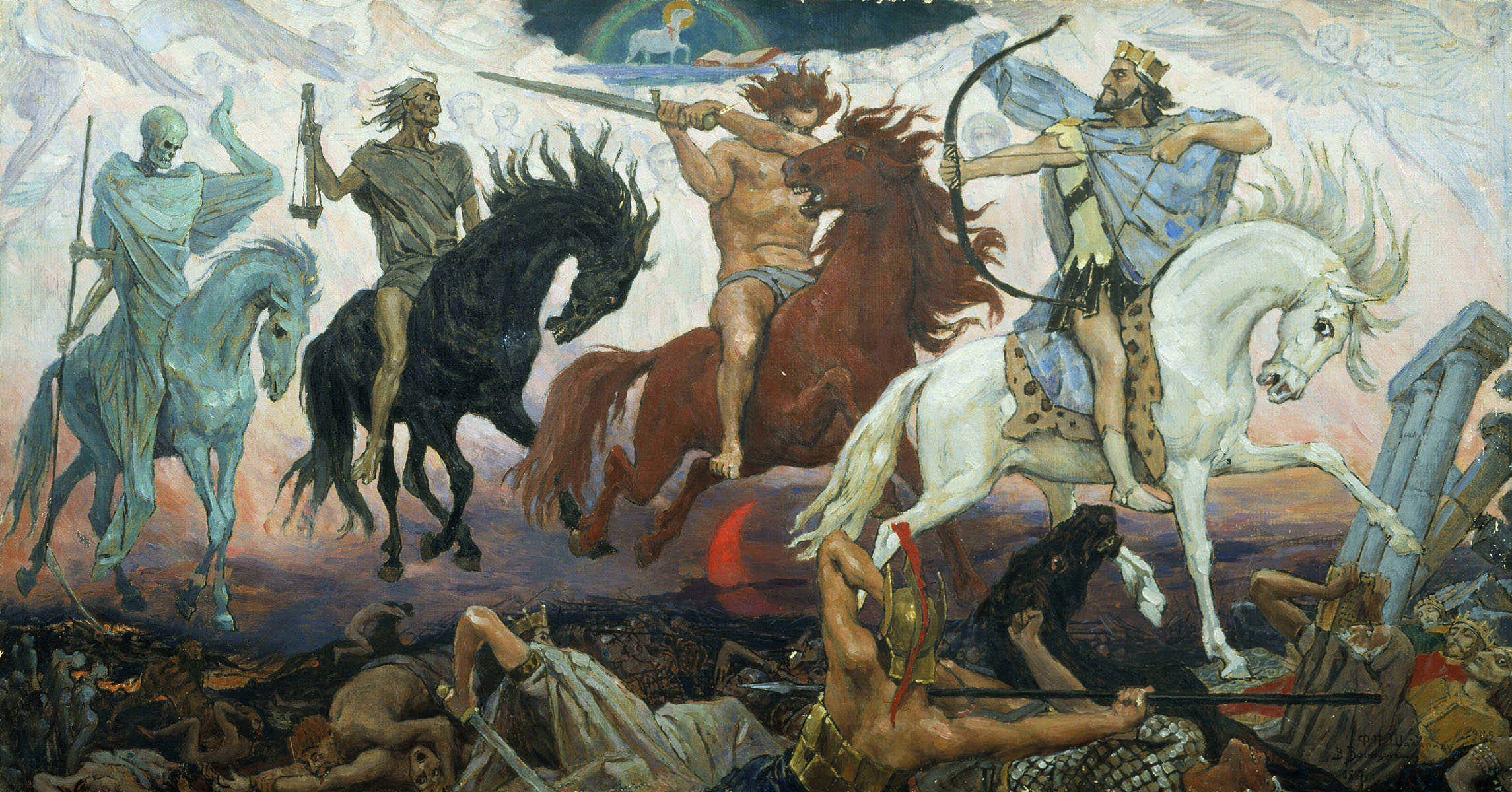
Four Horsemen of the Apocalypse on the March is a bit of a longer article over on The Burning Platform today, discussing the current fourth turning and the battle of good versus evil.

“The least-bad scenario is a hard landing, global recession worse than the 1930s. The worst-case borrows from the Four Horsemen of the Apocalypse: war, famine, pestilence, and death.” – Kenneth S. Deffeyes

Four Horsemen of the Apocalypse - Wikipedia

“When hopes and dreams are loose in the streets, it is well for the timid to lock doors, shutter windows and lie low until the wrath has passed. For there is often a monstrous incongruity between the hopes, however noble and tender, and the action which follows them. It is as if ivied maidens and garlanded youths were to herald the four horsemen of the apocalypse.” – Eric Hoffer

I don’t pretend to be a biblical scholar or have any particular expertise in interpreting scriptures, and certainly not the Book of Revelation, supposedly written by John of Patmos during the reign of Roman emperor Domitian sometime between 81 AD and 96 AD. But I did suffer through twelve years of Catholic school, with plenty of time reading the bible for homework assignments. I know many people take everything in the bible literally. I do not adhere to that understanding. I believe most, if not all, of the bible is parables and symbolism written by men as a means to guide early Christians in how they should live their lives. The wisdom imparted by these writers is vast and deep. The Book of Revelation is the most apocalyptic, mysterious, and prophetic.

I would agree with scholars who say Revelation does not refer to actual people or events but is an allegory of the spiritual path and the ongoing struggle between good and evil. But, as our modern-day world seems to be coming apart at the seams, the battle between good and evil is reaching a zenith, only seen at crucial turning points in history.

The scale of propaganda designed to mislead the public, scope of deceit exhibited by our hand-picked leaders, level of wickedness in the purposeful destruction of economic systems based on climate crisis lies, purposeful infliction of pain and suffering upon the masses through destruction of conventional food and energy structures, implosion of the financial system due to incompetence and/or willfully malicious motivations, and incessant provocations of Russia and China designed to ignite a global conflagration, are all part of one demonic plan.

Knowing we are reaching the most violent phase of this Fourth Turning and this kind of horrendous whirlwind has occurred during the fall of previous empires, does not make it any easier to confront or endure.

As the stock market implodes, draining the retirement savings of working men and women once again, inflation rages out of control, pushing lower and middle class families to the brink, our senile Trojan horse president, implements a country destroying agenda at the behest of his globalist handlers designed to incite a civil war, and the Deep State/Military Industrial Complex attempts to monetize Ukraine and Taiwan to fill their coffers with billions in war profits, the world teeters on the brink of a collapse which will make the Great Depression/World War II era seem like a walk in the park.

And very few people see it coming or are prepared in any way for the consequences. They have spent too much time in government school indoctrination centers, soaked up too much propaganda spewed by the corporate legacy media doing the bidding of those in power, have been misinformed and misled by the left wing Silicon Valley social media conglomerates, and are too distracted by their gadgets, social media likes, fake reality TV, and modern day sports circuses.

I’m certainly not predicting the end times or second coming of Christ, but the parable of the Four Horsemen of the Apocalypse sure seems applicable in this modern-day Crisis – the latest times that try men’s souls. We are in a time of Crisis, just as we were in the 1780’s, 1860’s, and 1940’s, all 80 years apart. The 2020’s will also go down in history as a time of fateful decisions, great battles, heroes, villains, and ultimately a purging of the existing social order – to be replaced by something better or far worse.

It truly is a time where government tyranny at the behest of billionaire globalist elite will need to be overcome by true patriots who value freedom and liberty enough to sacrifice their lives in its pursuit. As evil engulfs the world from all sides, the stalwart few are all that stand between never ending tyranny and the possibility of re-instituting a semblance of the republic we were originally given. We can be heartened by the words of Thomas Paine.

“These are the times that try men’s souls. The summer soldier and the sunshine patriot will, in this crisis, shrink from the service of their country; but he that stands by it now, deserves the love and thanks of man and woman. Tyranny, like hell, is not easily conquered; yet we have this consolation with us, that the harder the conflict, the more glorious the triumph. What we obtain too cheap, we esteem too lightly: it is dearness only that gives everything its value. Heaven knows how to put a proper price upon its goods; and it would be strange indeed if so celestial an article as Freedom should not be highly rated.” – Thomas Paine, The Crisis

The parallels between our current state of affairs and the prophecies foretold in Revelations 6: 1 – 8 certainly seem eerie and disconcerting. The four horsemen seem to symbolically portray four disastrous occurrences that will take place before the second coming of Jesus Christ. Since these books were written during the height of the Roman Empire many historians tie the passages to events taking place during that time. In John’s revelation, the first horseman rides on a white horse, carries a bow, and is given a crown – he rides forward as a figure of Conquest, perhaps invoking Pestilence, Christ, or the Antichrist.

The second carries a sword and rides a red horse and is the creator of Civil War, conflict, and strife. The third, a food-merchant riding upon a black horse, symbolizes Famine. He carries The Scales. The fourth and final horse is pale, and upon it rides Death, accompanied by Hades. The four horses certainly seem well represented today, as global conflict is on the verge of breaking out; our illegitimate president declares half the country as dangerous extremists, attempting to incite a civil war; purposely created food shortages and famine endanger the lives of millions; and death on a large-scale looms across the globe, as the malevolent purveyors of the satanic Great Reset seek to depopulate the planet…(continues here)

FEE: Why Adam Smith Said ‘Virtue Is More to Be Feared Than Vice’FEE:

Today’s article comes from the Foundation for Economic Education, Why Adam Smith Said ‘Virtue Is More to Be Feared Than Vice’. Those who seek to impose their version of virtue on others, will do so viciously and unconstrained by their conscience, because they believe they are morally correct.

The use of force in society is one of the most important issues governments must address. Unfortunately, they often get it wrong—and Smith understood why.

ally, a coworker, walked into my office one day and announced that he’d discovered the answer to the world’s problems. And it was all so simple. People just needed to act with wisdom. If everyone acted with wisdom, then crime, poverty, and war would disappear. I agreed and asked how he would achieve this miracle. I expected some elaborate plan, but it turned out that that “acting with wisdom” was the sum total of Wally’s insight. In response to every question, he only repeated that people should act with wisdom.

Neil deGrasse Tyson is a world-famous astrophysicist, but his plan for solving the world’s problems is neither more scientific nor less threadbare than Wally’s. Tyson proposes the world of “Rationalia,” a virtual utopia in which everyone will act with reason.

Socialists have a similar solution to the world’s problems. In their utopia, people will all act, not with wisdom or reason, but with altruism. Unlike either Wally or Tyson, though, they have proposed various plans for bringing this about—all of which boil down to some variation of: (1) burn it all down and a perfect world will spontaneously arise from society’s ashes, (2) force everyone to act benevolently until so acting becomes natural, or (3) create a fair and equal society in which material goods are distributed uniformly, thus eliminating all greed and envy and, along with them, any motivation for violence and crime.

Each socialist scheme relies on force, or the threat of force, wielded by omniscient, omnipotent, and omnibenevolent dictators. But could such a society, which necessarily sacrifices justice for altruism, survive?

A reading of Adam Smith’s book, The Theory of Moral Sentiments, suggests not.

Smith’s concept of justice was based on securing people from injury by others. That is, protecting people from assaults on their persons, property, and agreements. To Smith, acting justly consisted largely of refraining from injuring others. He believed that a society’s fundamental reason for existence was to provide this level of justice. Further, he argued, any society that fails in this basic duty will itself fail. In his book, Smith wrote: “Society may subsist, though not in the most comfortable state, without beneficence; but the prevalence of injustice must utterly destroy it.”

Unfortunately, securing the peace often requires force. But using force is just when it is done to oppose injustice—that is, when it is used in response to the initiation of force. While governments cannot hope to establish perfect justice, they can provide sufficient security to allow people to live their lives and to flourish.

What no government is competent to do, however, is to ensure that its citizens act wisely, rationally, or altruistically. Doing so would require using force—not to prevent people from harming others, but to compel them to behave in ways that the government determines to be proper. Force so employed leads to socially destructive injustice.

First, someone’s idea of what is altruistic (or wise or rational) must be imposed on everyone. A recent example is Biden’s executive order forgiving hundreds of millions of dollars in federal student loans. Was his action altruistic? It appears so if our focus is fixed on only the students who benefit from the President’s order. It seems less so if we broaden our focus and our time horizon to include those who must pay for the loans and those who will be hurt in the future by the perverse incentives that his order will create. Universities, for example, will be emboldened to hike tuition and even more students will borrow money that they are unlikely to be able to repay.

In short, whatever policy is chosen in the name of morality, some will see it as immoral, and they will bitterly resent being forced to support it.

Second, a policy that the central authority deems altruistic must be implemented and paid for by people who may oppose it or the way it is implemented. They must be compelled—by force if necessary—to comply with the policy and they must be prevented from subverting it. If “subversion” is construed to include “fomenting social discord” by public criticism, then the central authority may limit free speech and freedom of the press. If pastors question the policy’s morality, the central authority might also limit religious freedoms.

Third, the policy may produce unintended consequences that create more injustices. How will the central authority respond? Will it suppress knowledge of the consequences to prevent discord and, potentially, loss of its legitimacy or power? Will it respond with another layer of coercive policies and, if so, how will it enforce them and what will it do if more unintended consequences result?

Finally, as Smith observed, “Virtue is more to be feared than vice, because its excesses are not subject to the regulation of conscience.” Those attempting to impose virtue—or, at least, their idea of it—tend to deal viciously with dissidents who, because they oppose “virtue,” are, by definition, evil.

“Hell,” Michael Novak once said, “is what happens when you pursue heaven-on-earth.”

Force used to prevent or redress assaults on persons and property is legitimate; force used to coerce “benevolence” is not. Force is, ultimately, the only hammer in a government’s toolkit and it should be used only on what is achievable and, even then, only sparingly.

Governments can reasonably aspire to deliver Adam Smith’s formula for prosperity: “Peace, easy taxes, and a tolerable administration of justice.” In attempting to provide what it cannot, government will destroy its ability to provide what it can.

AmRRON Goes to AmCON 2 for Hurricane Ian

From the American Redoubt Radio Operators Network, Sept. 26, 2022:

AmRRON is at a Readiness Condition Level 2 (AmCON-2), for a regional event.  Hurricane Ian is expected to make landfall on the western Florida coast Wednesday afternoon/evening, September 28th.

Click on the NOAA message/image below to visit the source page.

FLORIDA, GEORGIA, and ALABAMA AmRRON OPERATORS, WE ARE PREPARING TO BE THERE FOR YOU.

The Eastern AmRRON SIGCEN (GA/SC border) will be activated beginning early Wednesday morning, and will be monitoring the AmRRON frequencies, ready to help facilitate traffic, coordinate radio operations, and offer assistance and receive reports from operators in the impacted areas in the days following the hurricane, to include welfare traffic.

This will hopefully help relieve congestion on other related nets, such as the Hurricane Watch Net on 14.300 (for example).

All available AmRRON operators are encouraged to monitor the Persistent Presence Net frequencies through at least Sunday, October 2nd.

WHAT TO EXPECT: 

  • Expect to hear nothing (initially) from the impacted area on Wednesday afternoon and evening.  Operators will be grid down and most HF antennas will not survive the hurricane-force winds.  Additionally, lighting threat mitigation will have radio stations off the air.
  • HF antennas and backup power could take many hours, or even days, to reconfigure and make operational.
  • Any HF radio communications will likely increase in tempo beginning Thursday, Friday, and Saturday, and will likely begin to taper off on Sunday onward.
  • Most grid-up coordination will take place on the AmRRON Corps Z-Net Breakout Channel, as that is where the overwhelming majority

OPERATIONS:

FOR STATIONS IN THE IMPACTED AREAS:

  • Let us know you are okay!  Your safety, and that of your family, is first and foremost.  Please report as soon as it is safe and practical, with at least an abbreviated STATREP.
  • As you know, digital modes are the most effective.  Use the mode which gets the most information out the fastest.  If you are running QRP (low power), then JS8Call may be your only way to reach out.  We will keep the frequencies clear to monitor for your traffic.  Please include your county and state, and nearest town/city.
  • Use the @AMRRON group in JS8Call to query Signal Reports (SNR), and determine who is on frequency, and where, and the quality of your path to others.
  • At minimum, please send out an abbreviated STATREP, including your maidenhead grid square, so we can account for our opertors.
  • Voice frequencies will also be monitored, per the AmRRON SOI.  If you have misplaced your SOI, then we will also be monitoring 80m, 40m, and 20m AmRRON Voice frequencies at the top of each hour to give you a better time window.
  • We will send SITREPs (Situation Reports) over HF on the SOI net schedule frequencies so that you can be informed on what might be happening beyond your local VHF/UHF communications, as information is available.
  • If you encounter an emergency, and AmRRON nets are your only source of communications, (we will have operators standing by monitoring persistently), then announce your emergency traffic.  We will coordinate your traffic and route it to the appropriate agencies or entities.

SUPPORTING AmRRON STATIONS OUTSIDE THE IMPACTED ARES: 

  • Most importantly, keep the frequency clear if you do not have traffic to pass.
  • Only stations in the impacted grid-down areas should be beaconing/heartbeating and conducting Signal Report queries (SNR).
  • The AmRRON Corps Z-Net Breakout Channel is the most effective method for coordinating with other AmRRON support stations and getting the most up-to-date information related to the post-hurricane operations.
  • If you receive STATREPs or SITREPs from stations in the affected area, relay to the Eastern SIGCEN or to an NCS station, who will then be able to relay to the SIGCEN (unless you know that an NCS or SIGCEN has also copied the same traffic).
  • NCSs should have a /N after their callsign, and stations working as SIGCEN operations stations will have a /S after their callsigns.

More information and guidance will be added here in the coming hours and days.   Keep checking back.

Radio Contra Ep. 186 Building Preparedness Communities Through the Church

In Radio Contra podcast episode 186, NC Scout talks to John Dyslin, author of Nehemiah Strong about building communities though the Church, from understanding the call to action to why it crosses many of the hurdles preparedness minded folks consider when forming their own groups.

Radio Contra Ep. 186 Building Preparedness Communities Through the Church with John Dyslin

Tensions Rising Over Ukraine War

In the past few days there has been a spate of news describing escalating tensions over Russia’s invasion of Ukraine.

First, NATO announced a new strategic deterrence concept aimed at the Russia-China alliance, while President Biden warned Putin about escalating the Ukraine conflict saying, “Don’t. Don’t. Don’t. You will change the face of war unlike anything since World War II.”

Putin responded to these threatening words, announcing a partial mobilization of Russia.

Calling the moves “urgent, necessary steps to defend the sovereignty, security and territorial integrity of Russia,” Putin said that Russia is fighting the full might of NATO. The US and its allies, he said, are seeking to “destroy” Russia.

Radio Contra Ep. 184. NC Scout breaks down Putin’s speech

Then Russia announced that they could use nuclear weapons to defend the annexed regions of Ukraine. Russia had just the day before moved to formally annex the areas of Ukraine under control of Russia’s soldiers.

“If the territorial integrity of our country is threatened, we will certainly use all the means at our disposal to protect Russia and our people,” said Putin.

Then Russia restricted travel for young men as part of its national mobilization, and called up 300,000 reservists. Russia’s domestic airlines have halted all sales of tickets abroad to men aged 18 to 65 without a waiver from the Ministry of Defense. The BBC reported lines of Russians trying to flee through the Georgia border.

Nearby nations are preparing for escalating conflict. Estonia has decided to confiscate firearms belonging to Russians living in the country. Meanwhile the President of Serbia is warning that there may be a great world conflict in the next few months. Tensions have increased between Turkey and Greece as they have started to revisit territorial disputes since the start of the Ukraine war. The EU also recently called for a war crimes tribunal over mass graves in Ukraine where bodies showed signs of torture after Russian occupation.

How does this or could this affect you? While Ukraine has had political and economic issues for many years, now, it is still an agricultural powerhouse. When it was part of the Soviet Union, Ukraine was responsible for 25% of the entire agricultural output of the USSR. If Russia was able to control the entirety of Ukraine, it would approximately double its wheat and corn and production. Even without controlling the entire country, the eastern and southern parts of Ukraine grow the most wheat. Combining just the exports of wheat by Russian and Ukraine, the two would more than double the amount of the second place exporter – the US.

We’ve seen Europe’s dependence on Russian fuel and how the conflict has caused fuel prices to rise worldwide, but especially in Europe. Should Russia also start controlling the food, it’s hard to predict specific outcomes, but food prices have already risen as a result of uncertainty over Ukrainian wheat exports.

Russia may be seeking a second lever in its geopolitical arsenal, adding food to fuel. Or it may be preparing for a period of imposed international isolation by “stocking up” on its neighbor food and fuel. Either way the effects on food and fuel will be upward moving prices even without the conflict going nuclear or spreading to additional countries.

Putin notices that Ukraine is a little “light on defensive weaponry”

Radio Contra Ep. 183: Propagandizing The War On Conservative Americans

Radio Contra Ep. 183 NC Scout covers the murder case of 18 year old Cayler Ellingson by a 41 year old Leftist, Shannon Brandt, in North Dakota because Ellingson was a conservative and why this is going to continue in America, cheerled on by a complicit White House. Propaganda is in full swing, with books aimed at the traditional RINO Conservatives in America painting real Patriots as enemies, co-authored by a familiar name on the Right.

WMBF News: S.C. joins fight to stop tracking guns purchased with credit cardsWMBF News:

source: WMBF News

WMBF reports on a group of states demanding that banks and credit card processors stop tracking firearms purchases. Why isn’t Washington on the list of states that joined? Hmm…

S.C. joins fight to stop tracking guns purchased with credit cards

South Carolina joined 24 other states demanding banks and credit card companies stop tracking, or monitoring, firearms purchased using credit cards.

The coalition alerted the chief executive officers of three major credit card companies that the recent adoption of the Merchant Category Code for the processing of firearms purchases from gun stores is “potentially a violation of consumer protection and antitrust laws.”

In the letter to the CEOs of American Express, Mastercard, and Visa, the attorneys general say the monitoring and tracking of firearms purchases creates a “list of gun buyers” and creates the obvious risk that law-abiding consumers’ information will be obtained and misused by those who oppose Americans exercising their Second Amendment rights.

“Why would banks and credit card companies need a separate code to process gun purchases, if not to possibly track and monitor people who buy them?” Wilson asked.

The following states joined: Alabama, Alaska, Arkansas, Arizona, Florida, Georgia, Indiana, Kansas, Kentucky, Louisiana, Mississippi, Missouri, Montana, Nebraska, New Hampshire, Ohio, Oklahoma, South Carolina, Tennessee, Texas, Utah, Virginia, Wyoming, West Virginia.

To read the letter, click here.

Mises Institute: Molinari Explains the Difference between Monarchy and Popular Government

Mises Institute senior editor Ryan McMaken writes about Gustave de Molinari’s take on differences between monarchy and popular government. McMaken mentions how the discussion of monarchy has risen recently in the UK after the passing of Queen Elizabeth II, but I’ve known even some American who bemoaned the loss of the monarchy from the US revolution.

With the impending burial of the United Kingdom’s Queen Elizabeth, republicans from London to Sydney have ramped up their efforts to end the British monarchy. The resulting war of words between monarchists and their opponents has highlighted the sheer diversity of opinions over the desirability of monarchy. Indeed, it would be impossible to enumerate all the different criteria on which different groups and individuals judge monarchy as an institution. However, for those of us who favor the ideology known as laissez-faire liberalism—also known as “classical” liberalism or libertarianism—a fundamental question we must ask ourselves in judging monarchies is whether or not they are useful in limiting state power.

This is not a new question and fortunately the question has already been addressed by the nineteenth-century Belgian-born French liberal Gustave de Molinari. Molinari is known today as an early proponent of truly radical laissez-faire, all the way to privatizing the military functions of states.

He favored neither monarchy nor republicanism on principle, and thus was willing to entertain any regime type so long as it could be used to limit the exercise of state power. In exploring this idea, Molinari did note that in cases where a monarchy is genuinely at odds with popular sentiment, the resulting “opposition of interests” can work as a brake on the expansion of state powers. Moreover, he suggested monarchs are also potentially more inclined than elected officials to engage in long-term thinking when it comes to the stewardship of a polity’s resources. These benefits are not due to any additional virtue or self-restraint on the part of monarchs, but are simply by-products of the public recognition that the relationship between ruler and ruled is fundamentally exploitative. 

Molinari on “the Old System”

For Molinari, a chief benefit of monarchy was that monarchs are likely to take a long-term view of the viability of the government institutions under their control. In his 1899 book The Society of Tomorrow, Molinari explains:

Under the old system the political establishment, or the State, was the perpetual property of that association of strong men who had founded, or conquered, it. The members of this association, from the head downwards, succeeded by hereditary prescription to that part of the common territory which had fallen to their share at the original partition, and to the exercise of those functions which were attached to their several holdings. Sentiments of family and property, the strongest incentives known to the human race, combined to influence their action. They desired to leave to their descendants a heritage which should be neither less in extent nor inferior in condition to that which they had received from their fathers, and to maintain this ideal the power and resources of the State must be increased, or at least maintained in all their integrity. 

According to Molinari, this way of thinking imposed a sort of fiscal conservatism on monarchs who feared that imprudent extension of state prerogatives and responsibilities would imperil the economic soundness of his regime. Specifically, policies that brought about the economic ruin of the general population would also spell the ruin of the monarchy itself. Molinari writes:

There was also a fiscal limit to the imposts which they exacted from their subjects, any overstepping of which involved personal loss, often personal danger. If they abused their sovereign power as possessors, whether by exhausting the taxable potentiality of the population or by squandering the product of an impost which had become excessive, their State fell into poverty and decay, and they themselves lay at the mercy of rivals who were only too alert and ready to seize any opportunity of enrichment at the expense of the decadent or defenceless. 

As Molinari notes, economic and financial missteps could lead not only to bankruptcy, but to total destruction of the regime at the hands of rival princes. But foreign rivals were not the only powers that might end a monarch’s dynasty. Should the monarch excessively antagonize “the governed,” they might also apply their own pressure against the monarch through rebellion:

The governed were able to check any abuse of sovereign power on the part of government through the pressure which was exerted on the ruler by his hope of transmitting his power to his children, and by that form of competition which constituted the State of War.

It is important to note that Molinari was no naïve ideologue who entertained flights of fancy about an imagined “good old days” of monarchy. His writings make it clear Molinari was well acquainted with the bloody realities of military conquest, and the means by which monarchs in ages past had consolidated political power. He nonetheless concluded that monarchy theoretically could—by accident—act as a restraint on state power. This was simply by virtue of the fact that in practice those who were subject to the monarch were suspicious of their rulers and did not regard the interests of the people to be synonymous with those of the dynasty. Rather, in this view, “the governed” accepted monarchs simply as a utilitarian instrument of staving off foreign invasion and violent disorder. At the same time, this instrument was to be viewed with substantial alarm whenever it attempted to exert its influence beyond its specific remit. 

The Problem with Popular Government 

Molinari contends that whatever benefit might have been gained from this arrangement between ruler and ruled was abolished by the advent of popular government. 

The embrace of popular government was in conflict with earlier thinking in which coercive government institutions were identified with the monarch’s regime alone, and as such represented a threatening and competing power in opposition to the interests of the governed:

The chief feature which distinguishes the new order and separates it, in theory at least, from that which preceded it, is the transfer of the political establishment, of the State, to the people themselves. With it, naturally, passed that sovereign power which is inseparable from ownership of the domain and the subjects of the State. 

This blurring of the lines between the rulers and ruled meant views changed as to the purposes of the regime and the prerogatives which the regime’s revenues—extracted, of course, from the taxpayers—might be used. Thus, the exercise of regime power was no longer a focus of the public’s suspicion, but now was subject to loud public demands for ever greater spending in accordance with the supposed general will. Molinari explains how this was magnified by competition between political parties which extended their own power by promising the public a share of the revenues:

These associations, or political parties, are actual armies which have been trained to pursue power; their immediate objective is to so increase the number of their adherents as to control an electoral majority. Influential electors are for this purpose promised such or such share in the profits which will follow success, but such promises—generally place or privilege—are redeemable only by a multiplication of “places,” which involves a corresponding increase of national enterprises, whether of war or of peace. It is nothing to a politician that the result is increased charges and heavier drains on the vital energy of the people. The unceasing competition under which they labour, first in their efforts to secure office, and next to maintain their position, compels them to make party interest their sole care, and they are in no position to consider whether this personal and immediate interest is in harmony with the general and permanent good of the nation. 

This state of affairs is also characterized by a shift from long-term interests under the old system—i.e., the interests of a multigenerational dynasty—toward short-term interests. This was due to the fact that “the theorists of the new order” substituted “temporary for permanent attribution of the sovereign power.” 

Ultimately, all this combined to “aggravat[e] the opposition of interests which it was [the elected governments’] pretended purpose to co-ordinate.” These changes also “weakened, if they did not actually destroy, the sole agency which has any real power to restrain governments.”

The Problem with Constitutional Monarchy

Molinari was also careful to show that constitutional monarchy was not to be confused with the older form. Much of Molinari’s career in France had coincided with the constitutional monarchy of Louis Philippe who oversaw substantial growth in the powers of the French state. The experience no doubt also helped solidify Molinari’s recognition of the fact that constitutional monarchies are functionally indistinguishable from constitutional republics. The constitutional monarch, rather, supported the popular elements of the regime be offering additional support for the elected ministers. Molinari explains:

In a constitutional monarchy the chief office in the State remained subject to hereditary transmission, but its occupant was declared irresponsible and his action was limited to the sole function of nominating, as responsible minister, the man chosen by the majority of the national representatives. 

In other words, the constitutional monarch is essentially a mere servant of the popular regime, and as such offers no true counterbalance to the alleged national will. 

What Type of Monarchy Actually Restrains the State?

For Molinari, then, monarchy is only useful when it is seen as remote from the will of the people, and thoroughly distinct from the nonstate portion of the polity the liberals called “society.” Under these conditions, society—from which the monarch extracts resources—is inclined to jealously guard its own liberties and prerogatives in the face of monarchical power. 

Molinari, however, no doubt understood that the possibility of encountering this sort of relationship between ruler and ruled in the nineteenth century was remote at best. Yet, by describing monarchical regimes in these terms, Molinari helps to illustrate the dangers posed by popular government. The ideologies underlying popular ideologies like nationalism, democracy, and republicanism suggested that there was no fundamental difference between state interests and the interests of those from which the state extracts resources. As a trenchant critic of states of all kinds, Molinari knew this was a grave error. With states, there is always a relationship of exploitation between the state and those over whom the state rules. The decline of monarchy has done nothing to abolish this grim reality. 

Of Two Minds: The Fourth Turn, Turn, Turn

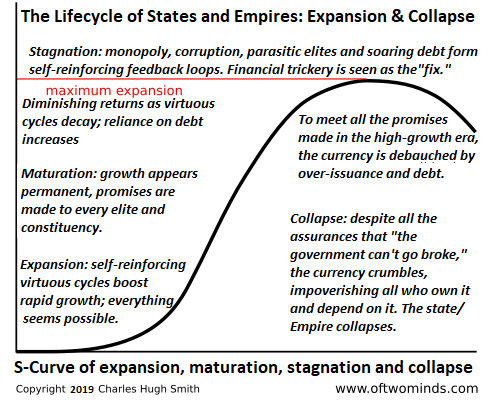
Charles Hugh Smith discusses the fourth turning.

The cycles of The Fourth Turning, Fischer and Turchin are all in alignment at this point in history..

The 1997 book The Fourth Turning: An American Prophecy proposed a cyclical pattern of four 20-year generations which culminate in a national crisis every 80 years. The book identifies these dates as Fourth Turnings: 1781 (Revolutionary War), 1861 (Civil War) and 1941 (global war). add 80 years and voila, 2021.

I use the term Fourth Turning generically to describe an existential crisis that decisively changes the course of national identity and history.

In other words, we don’t have to accept the book’s theory of generational dynamics to accept an 80-year cycle. There are other causal dynamics in play that also tend to cycle: the credit (Kondratieff) cycle, for example.

While each of the previous existential crises were resolved positively, positive outcomes are not guaranteed: dissolution and collapse are also potential outcomes.

David Hackett Fischer’s book The Great Wave: Price Revolutions and the Rhythm of History proposes another cycle: humans expand their numbers and consumption until they’ve exploited and depleted all available resources.

As resources become scarce, societies and economies unravel as humans do not respond well to rising prices generated by scarcities.

The unraveling continues until consumption is realigned with the resources available. In the past this meant either a mass die-off that drastically reduced human numbers and consumption (for example, The Black Plague), a decline in fertility that slowly reduced population to fit resources, mass migration to locales with more resources or the discovery and exploitation of a new scalable energy source that enabled a new cycle of rising consumption.

The 14th century Black Death reduce Europe’s population by roughly 40%, enabling depleted forests to regrow and depleted agricultural land to restore fertility.

Once the human population regained its numbers and consumption in the 17th century, wood was once again under pressure as the key source of energy, shipbuilding, housing, etc.

The development of steam power and the technologies of mining enabled the exploitation of coal, which soon replaced wood as the primary energy source.

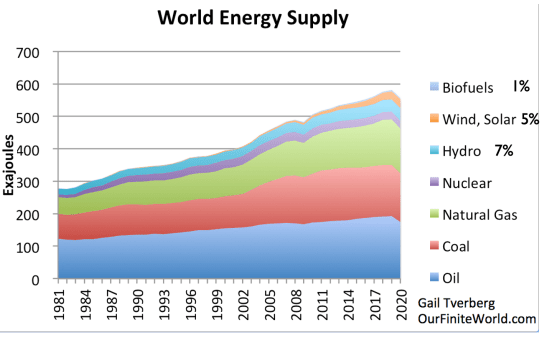
Oil and natural gas added to the energy humans could tap, followed (at a much more modest level) by nuclear power. Despite gargantuan investments, the recent push to develop solar and wind energy has yielded very modest results, as globally these sources provide about 5% of total energy consumption. (See chart below)

It’s self-evident that despite breezy claims of endless expansion of consumption, the global human population has now exceeded the resources available for practical extraction. Energy, fresh water, wild fisheries and fertile soils have all been exploited and the easy/cheap-to-extract resources have been depleted.

(The chart below of global CO2 emissions is a proxy for energy / resource consumption.)

So once again it’s crunch-time: either we proactively reduce consumption to align with available resources, or Nature will do it for us via scarcities.

Peter Turchin proposed another socio-economic cycle of 50 years in his book Ages of Discord: in the integrative stage, people find reasons to cooperate. In the disintegrative stage at the end of the cycle, people no longer find much common ground or reasons to cooperate. Political, social and financial extremes proliferate, culminating in a rolling crisis.

In Turchin’s analysis, the previous 50-year age of discord began around 1970, and the current era of discord began in 2020. Those who lived through the domestic terrorism, urban decay, stagflation and political/social/legal crises of the 1970s recall how inter-related crises dominated the decade.

In my analysis, the last period of discord in the 1970s was “saved” by the supergiant oil fields discovered in the 60s coming online in the late 1970s and early 1980s. That oil enabled a 40-year boom which is now ending, with no new scalable source of energy available to replace oil, much less enable an expansion of consumption.

In other words, the cycles of The Fourth Turning, Fischer and Turchin are all in alignment at this point in history. We have proliferating political, social and financial extremes and a forced transition to lower consumption to align with declining energy.

Turn, turn, turn. Right when we need to cooperate on transforming a high-consumption, bubble-dependent “waste is growth” Landfill Economy to declining consumption / Degrowth, we’re beset by discord and demographic pressures, as the promises made to the elderly back when it was expected that there would always be 5 workers per retiree cannot possibly be kept now that the worker-retiree ratio is 2-to-1 and there are no limits on healthcare spending for the elderly.

Humans are happy to expand their numbers and consumption and much less happy to consume less. They tend to start revolutions and wars in vain attempts to secure enough resources to maintain their profligate consumption and expansion.

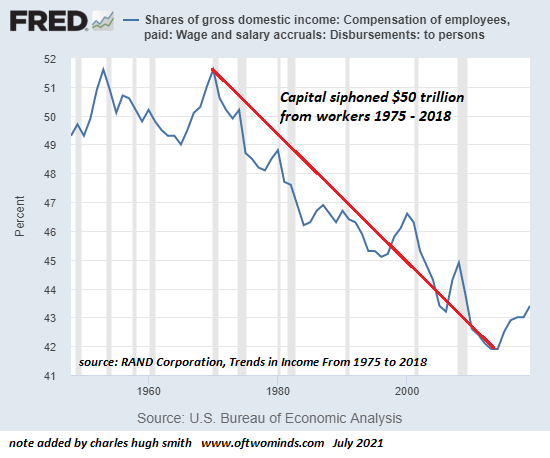
Today’s extremes of wealth and income inequality are optimized to spark political discord and revolts. The wealthiest 20% will be able to pay higher prices, but the bottom 40% will not. The middle 40% will find their disposable income, i.e. their income left over after paying for essentials, will drop to near-zero.

When 80% of the populace are crunched financially, revolutions and the overthrow of governments follow.

As I’ve outlined in previous posts, global inequalities are widening as the Core exploits its built-in advantages at the expense of the vulnerable Periphery.

Core nations will be much better able to maintain their consumption at the expense of the Periphery nations, which will experience sharp declines in purchasing power and consumption.

Previous Fourth Turnings have been resolved one way or another within 5 to 7 years. If this Turning began in 2020, we can expect resolution by 2025 – 2027.

As I explained in my book Global Crisis, National Renewal, those nations that embrace Degrowth will manage the transition, while those that cling to the endless-expansion, bubble-dependent Waste Is Growth model will fail.

This is why I keep talking about making Plans A, B and C to preserve optionality and reduce financial commitments and consumption now rather than passively await crises over which we will have little direct control.

As I’ve endeavored to explain, those anticipating decades of time to adjust are overlooking the systemic fragilities of the current global financial/supply systems. Tightly bound systems of interconnected dependency chains have been optimized to work perfectly in an era of expansion. They’re not optimized to gradually adjust to contraction; they’re optimized to break and trigger domino-like breakdowns in interconnected chains.

We don’t control these macro-trends, we only control our response.

Organic Prepper: Yes, There IS a Domestic Threat in America. It’s Our Own Government

Daisy Luther at The Organic Prepper talks about the disturbing things being said in the halls of government in Yes, There IS a Domestic Threat in America. It’s Our Own Government

The federal government loves labeling folks who think differently from them as domestic terrorists. We’ve seen it multiple times over the years and this name-calling has picked up recently.

The flames are being fanned.

There was Joe Biden’s speech casting Trump supporters as villains.  The attacks on dissent are nearly constant. Celebrities are being praised on outlets beloved by millions of young people for walking away from their own families over politics.

Everything is meant to be divisive, to cause even more internal strife in America before the midterm elections by painting approximately half of the country as the enemy. No longer are differing opinions a constitutionally protected right – they’re practically criminal and seen as a reason for hatred.

And now, there’s a vile comparison to 9/11.

Regardless of what you believe happened on September 11th, I think we can all agree that it wasn’t a bunch of Trump voters hijacking planes.

More recently, the chairman of the Senate Intelligence Committee, Mark Warner, compared those who participated in the events on January 6th to the people responsible for the devastating attacks on September 11th.

On Face the Nation, Warner said:

I remember, as most Americans do, where they were on 9/11. I was in the middle of a political campaign and suddenly, the differences with my opponent seem very small in comparison and our country came together. And in many ways, we defeated the terrorists because of the resilience of the American public because of our intelligence community, and we are safer, better prepared

The stunning thing to me is here we are 20 years later, and the attack on the symbol of our democracy was not coming from terrorists, but it came from literally insurgents attacking the Capitol on January 6th.”

This is deliberately orchestrated to make coming together as a nation impossible.

So who is the real threat?

Who’s actually the threat right now? Is it your neighbor with the lawn sign for an opposing candidate, out there watering her roses in the late summer drought? Is it your obnoxious uncle who makes every family get-together unpleasant by voicing opinions you’d rather not hear?

Or is it someone else? Here’s what Tulsi Gabbard had to say about it.

I think Gabbard is right. The biggest threat to our country right now is the politicians and public figures telling us how much we should hate and fear each other. In this article, Selco talks about being bombarded with fear and hate right before the Balkan War. Are we being any less manipulated by our own media today?

We need to stand up and refuse to be manipulated like this. We need to find common ground with our fellow Americans again, because divided like this, we’re sure to fall.

But what do you think?

Who are the people actually causing our country to stagger under the weight of hatred? Why can’t we all just agree to disagree like we used to? What would it take for us to unite again as a nation?

WPC: Normal Governance to Return to Washington on October 31

The Washington Policy Center reports on Governor Inslee’s announcement that he is ending 900 days of his COVID emergency order.

Governor Inslee announced today that he will finally end governing under an emergency order, after more than 900 days, on October 31. When the legislature next convenes it should ensure that this type of ongoing emergency governance without affirmative legislative approval never happens again. Whether or not you agree or disagree with every decision the Governor has made for the last 900-plus days, the fact remains these decisions with vast impact on individuals and businesses were made behind closed doors in the executive branch.

It is true that in an emergency, governors need broad powers to act fast. Legislative bodies inevitably take longer to assemble and act than a single executive, so they temporarily delegate their power to the executive in emergencies. But these powers are supposed to be transferred for a limited period of time with meaningful legislative oversight of the decisions made.

Earlier this summer, Court of Appeals Judge Bernard Veljacic (appointed by Governor Inslee) wrote this dissent in a case concerning emergency powers:

“Even so, I am not convinced that the legislature, in making the grant of authority, anticipated such a broad and lengthy imposition of emergency health measures when it first enacted chapter 43.06 RCW. It is true that our Supreme Court has recognized that the broad grant of authority ‘evidence[s] a clear intent by the legislature to delegate requisite police power to the governor in times of emergency.’ But this begs the question: ‘for how long’?

Certainly, while initial executive response to emergencies should be robust and unhindered by the burden of administrative or legislative oversight, this should not be the case over a longer period of time. Of course, in the early days of an emergency, Washingtonians would suffer if required to wait on the executive to set a legislative session, assemble the necessary quorum, and oversee a vote on a course of action. But at some point, over the long term, an emergency grows less emergent. After all, time allows for the opportunity to reflect. That same opportunity should include legislative review.

In all instances, we must be careful with such broad grants of authority. We would do well to employ a healthy skepticism of such authority upon objective consideration of who might possibly wield it at some point, or what they might deem an emergency.”

Long-lasting emergency orders should receive the input and affirmative approval of lawmakers following a public process, allowing the perfection of policies through a collaborative weighing of all the options, alternatives and tradeoffs. This is precisely why the people’s legislative branch of government exists – to deliberate and provide guidance to the executive branch on what policies should be in place and how to implement them.

There is a very simple fix the legislature should make next session to restore balance to the state’s emergency powers framework. Harmonizing the existing law so that both waiving of statute and restrictive proclamations expire after 30 days unless the legislature votes to continue should not be controversial. There is no logical reason to treat those emergency actions by the Governor differently.

Requiring affirmative legislative approval after a set point in time removes not a single tool from the Governor’s toolbox. All existing authority remains, the only change is that the closed-door policymaking is required to be justified to the people’s legislative branch of government to continue a policy (i.e., the separations of power and checks and balances envisioned and promised under our republican form of government).

The Governor should not fear being required to make the case to lawmakers why a particular emergency restriction is appropriate to continue, and the legislature should not hide from its constitutional responsibility to debate and adopt policy. At some point the executive branch should be required to receive permission from the legislative branch to continue making far-reaching policies under an emergency order.

Our system of governance is not meant to be the arbitrary rule of one behind closed doors. Judge Veljacic is correct that ‘we must be careful with such broad grants of authority.’ An emergency order should never last more than 900 days unless it has received affirmative authorization for continuation by the legislative branch of government. The legislature must still act to restore the balance of powers for future use of emergency orders.Sign up for the WPC Newsletter

QSO Today Virtual Ham Expo, Sept. 17-18, 2022

The QSO Today Virtual Ham Expo returns to the internet for the fifth time on the weekend of September 17-18, 2022.

There will be:

  • 50+ amateur radio presentations on a wide variety of subjects. Check out the full list at Presentations and download times now to your calendar to plan a full weekend and optimize your time at the Expo.
  • For the first time, anyone can share their latest ham radio project, technology, operating mode, DXpedition, or history in our new Project Gallery. Just submit your presentation article, video, or slideshow at Project Gallery Submission.
  • Meet with ARRL representatives and other exhibitors in state-of-the-art video lounges. Visit the ARRL booth to meet over Live video with ARRL staff to get answers to your specific questions answered. Other exhibitors will answer product questions, provide technical training, etc.

Tickets are only $10 and grant full access to the Expo weekend, presentations, Project Gallery, and Exhibitor video lounges as well as the 30-day post-Expo on-demand period where all presentations and resources are available. For more information and to purchase tickets, go to www.qsotodayhamexpo.com.

AmRRON: T-REX 2022, Sept. 9-11

From AmRRON

The timeline is set, the inject traffic and initiating stations are in place, and hundreds of operators are making final preparations of their gear.

As in years past, this year’s scenario-based nationwide exercise is based on a cyber attack.  But there will be more!

For most participants, this makes the 2nd, 3rd, 4th, 5th, or more T-REX exercises they’ve participated in.  Each time, more is learned, tested, and previous experience applied.  We all grow and become better radio operators for it.  But we take it for granted that this might be the first time for many of the new members who have joined AmRRON over the past year or more.  Apologies!  We will help prepare the newer folks much farther in advance in the future, as we’ve done in the past.

WHAT IS T-REX?

It is a three-day (actually, 48 hours) scenario-based disaster preparedness exercise, from Friday, September 9th, through Sunday at Noon, Pacific time, September 11th (non-stop).   All participants cuts commercial power, internet, cell phone, satellite, and any other conventional communications methods and simulates a nationwide grid-down emergency.

TIME:  Beginning Friday at Noon Pacific time (1pm Mountain; 2pm Central; 3pm Eastern; 1900 Zulu).

It is an opportunity for you as an individual, or family, or preparedness group, church disaster relief ministry, militia, or organization to practice implementing your worst-case emergency preparedness plan.  Cook with your off-grid equipment, power your batteries with your solar panels, test out alternative lighting, play a board game with your family by lantern and no electronics, practice your bugout plan, etc.

But most importantly, it’s an opportunity for you to practice using your emergency communications skills and equipment.  Make mistakes, learn shortcomings, capabilities and limitations, and identify where you need to make improvements (and you will, each time you do an exercise).  Take it seriously, but have fun!

WHAT WILL ACTUALLY HAPPEN DURING THE EXERCISE?

Initially, each SIGCEN (Signals Center) and NCS (Net Control Station) will produce and send an Initial Event Summary.  In a real-world event, radio operators will be taking to the airwaves to find out exactly what has happened, and how widespread are the effects.  They will inherently be looking to Net Control Stations for answers and guidance.  The Initial Event Summary is a tool we use to convey what we know at the moment, at the onset of an event, as well as guidance and instructions such as reminders of when the next scheduled net is to take place, and what frequency and mode, etc.

Also, this year there are 38 pieces of preloaded radio traffic (we call ‘injects’) which was developed and distributed to over twenty volunteer Initiating Stations across the country.  Nine of  those are welfare traffic requests, such as someone requesting a check on a loved one in another state, for example.

Each Inject that was issued included a set of instructions for each Initiating Station, including when to ‘inject’ their radio traffic into the scenario.  This helps enhance the timeline and the scenario with realistic messages, reports, and developments which might occur in logical fashion in a real-world emergency.  Net Control Stations will direct traffic to help keep the nets running smoothly, and will facilitate getting radio traffic to their destinations.  Tuning in to the nets will help you gain an understanding of the size, scope, and impact of the disaster.

Each piece of traffic is assigned a three-digit training exercise control number, or Traffic ID number.  And each Inject Station is assigned a two-digit Station ID number.  This helps us track official exercise traffic so we can understand the effectiveness of the nets, identify shortcomings, and track the successful delivery of the traffic.

Some traffic is for wide distribution, for everyone’s situational awareness.  Some wide distribution traffic pertains to specific communities, or regions, and is not intended for all nationwide participants.  For example, a church setting up a soup kitchen at the American Baptist Church on 123 Merry Lane, Smallville, USA,  would only pertain to the people in that community.  It wouldn’t pertain to someone a thousand miles, and five states away.  On the other hand, foreign military forces landing on the shores of the east coast, the west coast, and crossing the Mexican border would pertain to everyone on the North American continent — when wide distribution means WIDE distribution.

The SIGCENs (Signals Centers) on the east and west coasts will be compiling reports as they are receiving them from NCSs, and others, and compiling consolidated SITREPs (Situation Reports), or Intelligence Briefs, etc.  Those are generally for wide distribution intended for all parties with the ability to receive radio signals.

Keep notes for ideas on how to improve your personal situation.  As you receive information over the air, and you learn of some of the events taking place, use the opportunity to discuss with your family or group, ‘what would we do, or how would we respond, if this were real’?

YOU GET TO TRANSMIT.  One of the first things an NCS is going to try to do is take a ‘pulse check’ to find out who is out there on the air, who else is affected, in what ways, how far reaching the effects are, and what does he not yet know, but should.  We use the STATREP (Status Report) as a tool to provide a formatted method for each radio operator to report the status at their location.  As each station reports his/her Status Report, others will be able to see those reports as well.  The NCS will use the information from these STATREPs to update his Initial Event Summary to fill in any gaps on what he didn’t know beforehand.

Be prepared to submit your STATREP if you are properly licensed to transmit on the Amateur Radio bands.  This pertains to both HF and local VHF/UHF frequencies.  USE THE ABBREVIATED STATREP.  AmRRON operators will find guidance on how to format their STATREPs on Page 37 of the AmRRON Signals Operating Instructions, Section 6.3.1 — the ‘Abbreviated STATREP‘.

YOU ARE GRID DOWN DURING T-REX, and your STATREP should reflect that.   Your STATREP should indicate that, at minimum, you are without commercial power and all conventional communications (phone/internet).

This can be done over voice (aka. phone) or using ham digital modes, such as JS8Call, FSQCall, or fldigi modes such as Contestia 4-250.  Follow the instructions of NCS.  For most AmRRON operators, this is a walk in the park.  We practice this regularly.

What is different about T-REX nets versus regularly-scheduled practice nets?

TRAFFIC.  Ensuring important traffic (especially Priority or Immediate/Emergency traffic) gets passed.  This is the primary difference.

In a real-world emergency, unless there is not business (traffic) to attend to, taking check-ins for the sake of filling a list of callsigns is the lowest priority. Generally, AmRRON nets become ‘Traffic Nets’ for the purpose of moving important, time sensitive, or lifesaving information.

Net Control will likely announce himself, including his name and location, and then announce any traffic he has for the net, including the precedence level of the traffic.  Then:

A.  He will (should) ask for another station to act as an Assitant NCS (ANCS).  The ANCS helps relay traffic to others which may not have a good path to Net Control, and he can step up to take over the net if something happens to NCS (like, if NCS vanishes — it happens — computers crash, generators run out of fuel, dogs chase the neighbor cat, etc.).

B.  First, he will ask if there is any Immediate (or Emergency) traffic for the net.   He may take the traffic directly, if appropriate, or he may facilitate getting the Priority traffic relayed on to its destination.

C.  Then he will send any traffic he has for the net, beginning with Priority traffic.

D.  If a station announces he has directed traffic, NCS will then try to identify a station at, or close to, the destination.  For example.  If NCS is in Missouri and a Station from Texas calls announcing he has traffic that needs to go to Montana, NCS will tell him to stand by and ask if there are any Montana station on frequency.  If nothing heard, he may ask for stations in states surrounding Montana to check in who can relay the traffic.  An Idaho station responds, offering to take the traffic, and who will work with others in the region to get the traffic to its destination.  NCS will then direct the Texas and Idaho stations to move up, or down, three to six kilohertz and exchange traffic.  if they do not have a direct path to each other, then the ANCS can move with them, and relay the traffic between them, clearing the main net frequency as soon as possible.  ANCS will return to the net frequency as soon as the relay is finished.   If there are no stations at or near the destination, the NCS can take the traffic and pass it along using other means after the net closes.

E.  Other NCSs from adjacent regions should announce themselves on a net, so the primary NCS knows they are there, and can relay net traffic to them which is intended for their region.

To help keep the scheduled nets from becoming congested, any stations with directed traffic should try to use the Persistent Presence Net to find other stations who might be able to relay the traffic toward its destination.  All stations should keep a log of who you sent traffic to, and who you received traffic from.  If it gets lost or disappears during the exercise, this will help in tracking it down and learning what happened to it, and why, so we can remedy any shortfalls.

However, since many stations have limited alternate power (perhaps a single RV battery and a small solar panel), it may not be viable for them to be on the air continually.  This is why we have regularly scheduled nets listed in the SOI, creating a time window when as many stations as possible can meet on the air to exchange traffic.  Scheduled nets is also when wide distribution traffic from AmRRON will be sent.

IF YOU HAVE  NO HF CAPABILITIES:

This is a shortcoming you MUST overcome.  Get a shortwave radio receiver with SSB capability, or an SDR dongle, if nothing else.  You must have the ability to receive information from outside your immediate area if repeaters are rendered inoperable.  You must be able to inform your community if there is a radiation cloud, lava, zombies, langoliers, or foreign military convoys bearing down on you from the next state over.

IF YOU HAVE A LOCAL VHF/UHF, GMRS, CH3 COMMUNICATIONS NETWORK BUT NO INJECT TRAFFIC:

Develop your own ‘micro scenarios’ which fit your community, but which go along with the larger nationwide scenario.  You’re already a leader, so organizing some training scenarios which provide opportunities to use your communications networks should be right down your alley!

AmRRON is a patriot-oriented network, not an anti-government network.  So, do not create micro scenarios which project an adversarial relationship between your local group and government officials or political groups.

But share your small group training experiences as well.  What worked, what didn’t, overall impressions and experiences, and areas you’ve identified as needing improvement, and solutions to address the shortcomings revealed during the exercise.

Keep a list of the traffic you receive over the course of the exercise!  There will be a survey that will be used to create several after action reports (something we did not get to complete last year).