Mises Wire: Stop Blaming Classical Liberalism for the Problems of Human Nature

This article from Zachary Yost at the Mises Institute talks about the confusing plethora of definitions in common use for liberalism – Stop Blaming Classical Liberalism for the Problems of Human Nature

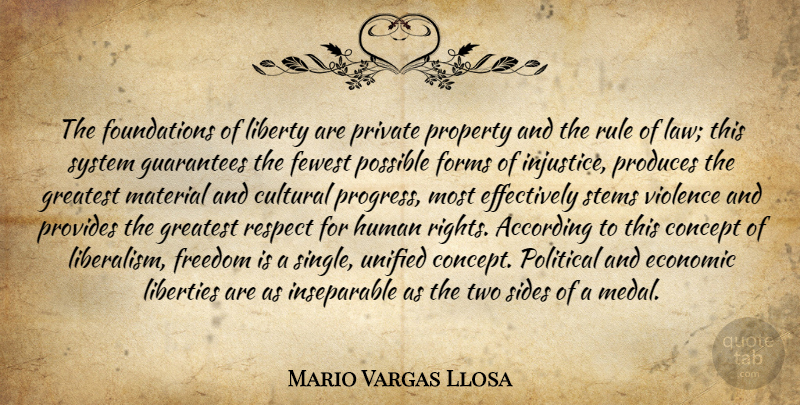
In a recent essay at the new online conservative magazine IM-1776, writer Alex Kaschuta argues that the contemporary world is under “The Heavy Chains of Liberalism” that have, in her mind, destroyed humane life, abolished tradition, and left atomized individuals increasingly “free” from all social and personal restraint. These complaints are nothing new, and some of the problems she points to are all too real, however, her broadside attack against liberalism misses the mark on nearly every front.

For one thing, like many labels in use today, the word liberal has become so broad that its use encompasses many divergent streams of thought and bulldozes over important differences and nuances. Libertarians and classical liberals are intimately familiar with this problem, having adopted those labels as a means to try and deal with the bastardization of the term liberal.

In his most recent book, The Great Delusion, John Mearsheimer divides liberalism into two diverse schools of thought that are often at odds with one another. On the one hand, he identifies modus vivendi liberalism, which is largely focused on individual negative rights and is primarily concerned with state intrusion into life, and on the other hand, he identifies progressive liberalism which is much more concerned with positive rights and social engineering. Most notably, progressive liberalism is intimately connected to crusading schemes to remake the world in its universalist image. Modus vivendi liberalism, which Mearsheimer has identified with F.A. Hayek, lacks this universalist crusading impulse.

However, like many today, Kaschuta paints with a broad brush and conceives of only one liberalism in the mold of John Stuart Mill, who, she argues, “asserted that freedom lies in elevating choice and leaving aside burdensome custom, that the only way to be truly free is to unshackle yourself from the bonds of social mores, into ever freer choice.”

To be sure, there are libertarians who seem to identify maximalized individual choice and therefore control over every aspect of human existence as being the core of libertarianism. For instance, consider this line from Nick Gillespie and Matt Welch’s 2008 Reason essay “The Libertarian Moment“: “We are in fact living at the cusp of what should be called the Libertarian Moment, the dawning not of some fabled, clichéd, and loosey-goosey Age of Aquarius but a time of increasingly hyper-individualized, hyper-expanded choice over every aspect of our lives.”

It is certainly questionable to what extent such a focus on “hyperindividualism” belongs in the modus vivendi camp.

In contrast, a Misesian conception of liberalism is hardly focused on the destruction of social mores and tradition. Rather, in Mises’s words, “the program of liberalism…if condensed into a single word, would have to read property, that is, private ownership of the means of production”. Not only is this a different emphasis than maximum individual choice in every sphere of life, but Mises actually attacks Mill as “the originator of the thoughtless confounding of liberal and socialist ideas that led to the decline of English liberalism and to the undermining of the living standards of the English people…Mill is the great advocate of socialism.”

Hayek’s work is also absent of this Millian impulse, and in fact, directly contradicts it on many occasions by defending the idea of tradition as being the result of an evolutionary process of trial and error that should not just be casually tossed aside by those who “cannot conceive of anything serving a human purpose that has not been consciously designed” and in fact calls such people “almost of necessity enemies of freedom.”

Unlike many illiberals, Kaschuta recognizes that “the market works, and it has been nothing short of miraculous.” However, she proceeds to blame the market for “the despoiling of the planet, the destruction of local communities, and boom and bust cycles of ever-increasing intensity.” Whatever criticisms one might have about a free-market system, these are not very good ones.

There is no shortage of data showing that liberal societies, with their emphasis on property rights, lead to better environmental outcomes. And one need only look at the history of the Soviet Union, which nearly completely eliminated the Aral Sea, and slaughtered tens of thousands of whales for no purpose at all, to see how well a non-market-based economic system cares for the environment.

Similarly, blaming the free market system for the decline of community also misses the mark. There are many reasons why community and civil society have decayed, but as the work of sociologists Frank Tannenbaum and Robert Nisbet demonstrate, one of the primary reasons is the centralizing power of the state that seeks to undermine any rivals for social power. This can hardly be blamed on modus vivendi–style liberalism.

Finally, Kaschuta’s claim that the market naturally leads to boom and bust economic cycles ignores the entirety of Austrian Business Cycle theory that argues that rather than being the natural product of market forces, such business cycles are the result of malinvestment created by central bank monetary policy.

Kaschuta raises many salient points when she complains about modern man being “freed” from all restraint, but she misses the mark in placing all of the blame for this unmooring on the shoulders of liberalism. History is full of similar periods in societies across the globe where there was a collective loss of self-restraint. These epochs are not indicative of the “chains” of liberalism, but the shackles of human nature that no earthly ideology can hope to ever cast off. Human nature is what it is.

Liberalism will not solve human nature, but in the tradition of Mises and Hayek it can help to establish a social system in which humans can live peacefully with material prosperity. That is such a rare accomplishment in human history that its critics should exercise more caution before dispatching it to the dustbin of history.
Six Figures Under: What We Learned from Our Quarantine Food Storage Challenge

Stephanie at Six Figures Under has an article about What We Learned from Our Quarantine Food Storage Challenge during the first few months of the pandemic.

After three months of eating from our pantry, freezer, and long-term food storage, our Quarantine Food Storage Challenge is coming to an end.  Today I’m sharing some of what we learned. Hopefully something will be helpful to you as you plan to be more prepared with your own food.

First we’ll cover the three reasons we decided to end our open-ended challenge now. Then I’ll go over lessons we learned and what we plan to do about it!

For those of you who look forward to these updates, this won’t be the end of talking about food storage!  In the coming weeks, I will take the focus off MY food storage and start talking about YOUR food storage (how to get started, what to store, how much to store, how to keep track, how to use it).

As I’ve started reading through hundreds of responses in the 2020 Six Figures Under Reader Survey, I see that many of you are interested in building up your own food storage and would like some guidance.  (If you haven’t shared your thoughts, I would really love if you would take a couple of minutes to complete the survey).

Why we are ending our food storage challenge

When we started our challenge, we weren’t sure how long it would last.  I know some of you will be surprised or disappointed that we’re concluding it now, and I want to explain why we are deciding to go back to grocery shopping.  Essentially it’s because we accomplished what we set out to do. Let me break that down into specifics.

The primary reason we started the challenge was to keep ourselves and others safe by not going to the grocery store during the pandemic.  At the outset of this, there wasn’t a full understanding of how this novel coronavirus was transmitted.  Now that we have a better understanding, we feel like occasional trips to the grocery store are generally safe. Thankfully the outbreak in our area hasn’t been too terrible.

The secondary reason for undertaking a food storage challenge was to give our food storage a test drive.  While we have stored food for years, we really didn’t have a grasp of how much we would really need and what things we would wish we had more of.  We’ve figured a lot of those details out as we have monitored what we have used during the last three months challenge of not grocery shopping.  Now we have a better idea of what and how much we should store for our family.

The third reason for ending our food storage challenge now, rather than continuing the challenge indefinitely, is so we can make the effort to restock and update our food storage.  The future is uncertain in many ways, including potential continued disruptions in the food supply chain, so while we have the ability to stock up, we want to do so. You will see us implementing changes to our food storage in the near future.

What we learned from eating from our food storage challenge

How much food storage our family needs

As I’ve learned about food storage from a “scholarly” perspective, I learned how many pounds of this or that that you need per person for a certain length of time, but I had no idea how that would play out in real life. The suggested amount of 150 lb of wheat per person age 8+ (and half that for kids under 8) for a year supply doesn’t come with a menu or even a recipe book.

I had no idea if this was a low ball or high ball estimate.  I wasn’t sure if that was a “keep us alive” amount or a “life as usual” amount.  That’s about 12.5 lb per person per month.

Our family has 5 people age 8+ and 2 people under age 8 (I’m not including the baby in this count).  With that estimate, we would use 75 lb of wheat in a month.

I would have to say that estimate is nearly spot on.  We ate about 80 lb of wheat per month during our challenge.  Essentially that was just used for bread, pancakes, waffles, and other baked goods.

I’m still working on recording everything in our spreadsheet so we can calculate our own family’s consumption rate and create a customized food storage plan just for us.

What surprised us

If you followed along with our weekly updates during the challenge, you may remember that in the beginning I was having a little panic attack about some essentials that I thought we were low on like yeast, baking soda, baking powder, cocoa, salt, and oil.

In the beginning we had no idea how long the quarantine/lockdown phase would last and what shortages there would be.  We didn’t know how long we would choose to continue our challenge or if at some point it would no longer be our choice.  Either way, I wanted to be prepared, so I purchased some of these staples online.

As it turned out, I haven’t opened the 5 lb bag of yeast.  We have used only about a pound and a half of yeast in the past 3 months.  That is partly due to reducing the yeast in all of our recipes by half (with no problems).

We also haven’t had to open the 5 lb bags of baking soda or baking powder!

Of the 4 gallons of oil that I bought at the beginning of the challenge (knowing that they were essential for all of the baking I would be doing), I still have 3 left.

What we NEED to stock more of

We are probably good on wheat, powdered milk, beans, applesauce, etc, but there are some areas where our food storage is lacking. We’ll use a one-year supply as a measuring stick because that’s how many food storage recommendations are made. Feel free to divide by four if you want to build up to a 3-month supply or divide by two for a 6-month supply.

Salt– Salt is such a simple ingredient, but it’s essential!  It’s literally the cheapest food storage item out there.  And we didn’t have enough stored.  In fact, we were nearly out!  Right at the beginning of the challenge, I bought a few packages of salt from Walmart. Otherwise we would have been completely out!  That’s embarrassing!  For a year supply, it’s recommended that you store 8 lbs per person (that’s 4 regular salt containers per person).

Oil– We used just under 1 gallon of oil per month.  That means we would need roughly 12 gallons for a year supply.  This is one of those things you don’t just buy and tuck away for a disaster. It’s important to rotate through your stored oil or it will eventually go rancid.

Sugar– It’s recommended to store 60 pounds of sugar (in some form) per person for a year’s supply.  We don’t have anywhere near that, so this is definitely an area for us to work on going forward.

Oats– Oats are a major staple for us, but we haven’t stocked up for a while so we were low when the challenge started.  My MIL gave us a 25 lb bag of oats that she had, which is what we’re currently eating.

Rice– We didn’t run out of rice, but we are low and don’t have anywhere near what we would need for a year supply.

Pasta– We generally eat a lot of pasta. It’s fast, easy, and everyone likes it. We had quite a bit on hand at the beginning of our challenge, but we would have run out during the second month if we weren’t being careful with it. Of course, with an abundance of wheat and eggs, we could decide to make our own pasta, but while that would be delicious, it would no longer be fast and easy.

Peanut butter- We typically buy peanut butter for about two months at a time, but we definitely need to store more.  Peanut butter an jelly sandwiches are a staple in this house!  As long as we rotate through what we have, there won’t be a problem with spoilage or waste.

Jam/Jelly– As an important ingredient in PBJs, we need to store more jam!  In the past when we’ve had easy access to free blackberries, we’ve made loads of our own jam.  It’s been a while since we’ve made jam in large quantities, so we’ve been buying it.  We have both blackberries and raspberries growing on our property now, so hopefully we can get back into making our own jam.

Cocoa Powder– We have around 10 lb, but we need more for a long-term supply. And yes, cocoa powder is an essential storage ingredient for us!

What we WANT to stock more of

Some of the things we want to stock more of in our food storage are:

Cheese– Over the next few months, we’re planning to store more cheese.  We’ll keep a reserve in the freezer and rotate through it.  By no means will it be a year supply, but if we need to live strictly off our food storage again we can ration it.  During this challenge we stretched about 5 lb of cheese to last for two and a half months, which, for a family with cheese habits like us, is impressive.

Butter– Butter is our fat of choice when it comes to baking and cooking, but throughout this challenge we had to rely on alternatives like canola oil and shortening because we only had 5 lbs of butter in the freezer at the outset of this challenge.  We actually still have a pound of butter left because we were being careful to ration it. Like cheese, I plan to store more in the freezer.

Raisins– We eat a lot of oatmeal, cream of wheat, and other hot breakfast cereals and raisins are a favorite add-in.  We should definitely store more of them!

Chocolate Chips– For baking and for mom snacks when there isn’t anything else sweet around.

Salsa– We are fortunate to have hens that keep us well stocked up in eggs (at least in the warm months).  We love having salsa to make fried eggs more exciting.

This obviously doesn’t include the normal everyday staples that we’ll be buying when we go back to the store next week like milk, sour cream, tortillas, chicken, ground beef, or pork (if it’s available and not crazy expensive), lettuce, tomatoes, potatoes, carrots, celery, strawberries, apples, bananas, and other fresh produce.

Other things we learned during the food storage challenge

Understanding  the practical implications of eating from our food storage has been very valuable and will help so much as we go forward.  But a clearer picture of how long our food storage will actually last isn’t the only good thing that came from this challenge.  Here are a few other things we learned (or re-learned).

Eat all leftovers so nothing is wasted

We’ve always been pretty good about eating leftovers and not letting them go to waste, but during this challenge we were especially conscious of not wasting food.  Our food supply felt more finite that it normally does since we weren’t shopping to replenish it.  That made us more aware of not wasting any food.

Don’t overeat just because something tastes good

Another way to waste food is to overeat.  We don’t usually think of overeating as wasting food, but that’s really what it is. Mike and I were careful to stop eating when we were full instead of continuing to eat just because something was tasty.

Try new things

We took advantage of the extra time during quarantine to experiment and try making and eating new things. A lot of you thought it was funny that I had bever made split pea soup before.  Well now we’ve had it several times and really like it!  We’ve made tortillas from scratch.  We learned a few ways to make cheese.  And now that the older kids can make bread by themselves, we’ve been enjoying delicious homemade bread even though I haven’t made any for the last month!

Whew!  That was a lot!  Thanks for sticking with me!

Like I said, next week I will take the focus off MY food storage and start talking about YOUR food storage.  I’m excited to help you get started on or improve your food storage situation.  Let me know if there’s anything specific you want me to make sure to cover!

Zero Hedge: We Live More And More In A World In Which Facts No Longer Matter

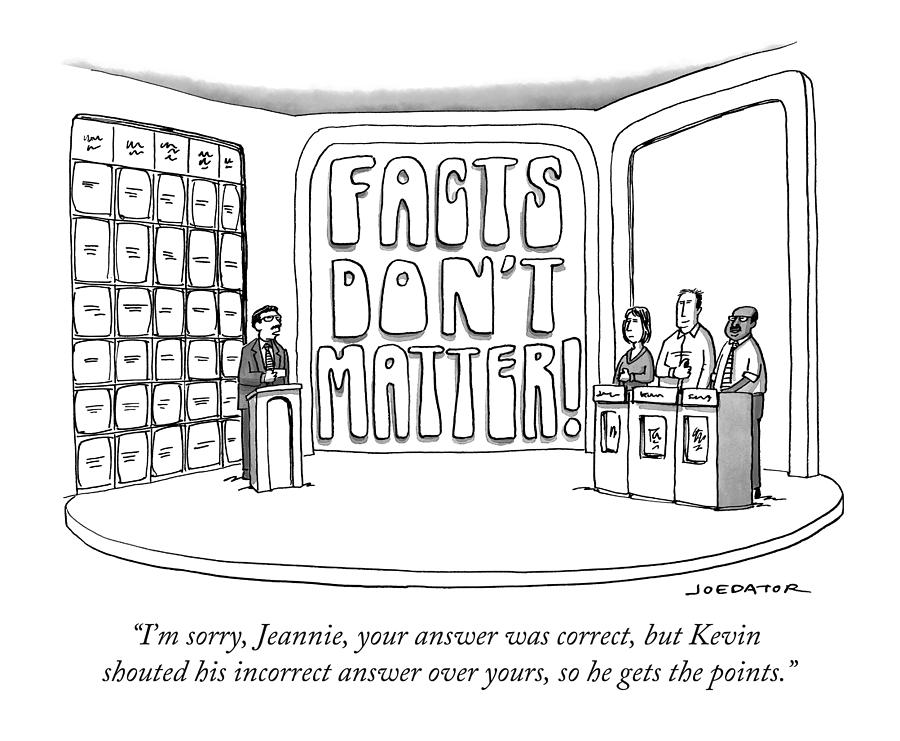
Michael Every of Rabobank writes this short article at Zero Hedge – We Live More And More In A World In Which Facts No Longer Matter. In the article, Every mostly talks about politics, but the concept has farther reaching implications in our society. My spouse and I have discussed it frequently during this pandemic; one of the reasons that people are so divided about various issues, including pandemic responses, is because they can pick their “facts.” We have an education system that has been so bad for so long that few people are capable of understanding even simpler scientific journal articles. Not all journal articles are equal. Some are filled with bad science, bad math, bad statistics, and/or bad methodologies. So when one study says that X is bad, and another says Y is good, people simply choose the answer they prefer.

The same is true for news articles. On the internet, you can find sources espousing just about any position on any issue, so it’s easy for people to take any position and point to those voices as proof that their belief is true. It fuels divisiveness because the different sides of an issue all believe that the facts are on their side and are incapable of objectively evaluating the underlying assumptions and information. Every debate becomes a holy war because every belief is taken on faith rather than reason.

The fix for that problem is broader education (education, not necessarily schooling) which encompasses science, mathematics, statistics, philosophy, etc. That’s a difficult change to make, and, as we know, those in power will not take the difficult road when a superficial attempt which also increases their own power will suffice. Instead of education reform, you get people calling for shutting down all of those different voices so that only the approved messages get through. Those approved messages aren’t necessarily the truthful ones, they’re the ones that support those in power.

Day by day, we live more and more in a world in which facts no longer matter. Social media, a bitterly-bipartisan mainstream media, and socio-economic and cultural polarization all mean we can inhabit the world of facts we find most comfortable and convenient. Indeed, as the economy becomes more Dickensian in terms of income and wealth equality it also becomes more *literally* Dickensian:

It was the best of times, it was the worst of times, it was the age of wisdom, it was the age of foolishness, it was the epoch of belief, it was the epoch of incredulity, it was the season of light, it was the season of darkness, it was the spring of hope, it was the winter of despair, we had everything before us, we had nothing before us, we were all going direct to Heaven, we were all going direct the other way—in short, the period was so far like the present period, that some of its noisiest authorities insisted on its being received, for good or for evil, in the superlative degree of comparison only.

And that’s just the US Vice-Presidential debate from last night, which offered up generous helpings of political pound(ing)s, shillings, and (Mike) Pence. Which for those who don’t know, was the old British Imperial money system until 1971 when, as my late grandmother referred to it, the UK joined the “decimal diddle dum dee club”. And one wonders how people ever wondered how Brexit could happen…

Of course, the VP debate also saw vast quantities of question-dodging over key issues, or answers that seemed to be to entirely different questions – to no response from the moderator-bot, which only seemed to be programmed to worry if people over-ran, rather than running over facts. It was still a vast improvement last week, however, in that there was actually some debate in it.

Who ‘won’? See the various polls from different sides of the political aisle: CNN said Harris 59% – 38%; Telemundo said Pence 76% – 24%. But the key point is that nowadays whomever *you* like won – after all, it is the ‘epoch of belief’. Likewise, whomever *you* like is comfortably winning the election. That is the meme both sides can cling to until 3 November. (And then, political risk analysts fear, it may be time for either loser to embrace a conspiracy theory as to why they didn’t actually lose.) Yet if we wanted to pretend actual facts mattered for a fleeting moment, the key question would be which side’s base feels more enthused after having sat through the VP debate: who got more policy red (or blue) meat thrown their way?

Talking of the (overdone) red meat side of things, the Heavenly side (as shall be explained), the conspiracy-theory side, and the ‘best of times, worst of times’ side, yet again we also see a Tweet from Trump trumping other news. Trump announced he believes the drug he was treated with is a “cure”; more important than the vaccine (which is coming “very, very shortly….right after the election”); and Regeneron will be shortly be freely available *and free* to those who need it. Indeed, Trump said he wants everybody to be given the same treatment he got without payment as “It wasn’t your fault…, it was China’s fault, and China is going to pay a big price.”

Is that related to the Bloomberg story yesterday talking about a possible looming US crackdown on Tencent and Ant Financial to stop China expanding its digital payments platforms? Or is it related to Mike Pompeo busily trying to form an Asian version of NATO? Or is it something else equally world-splitting if carried out in full?

Another good question that wasn’t asked at all at the VP debate that happened after that Trump video: is free Regeneron socialised medicine? The media aren’t asking either, instead running with the Trumpian phrase it was “a blessing from God” he caught Covid-19 (which he instantly qualified to “a blessing in disguise,” which itself is disguised in all those exegesis-esque headlines).

Meanwhile, preceding both the VP debate and the Trump video we had the FOMC minutes, a body which has played as large a role in our drift into all forms of Dickensianism as anyone. As Philip Marey notes, these represent “The quiet before the storm”. In particular, he points out that the minutes revealed quite some disagreement within the FOMC regarding the forward guidance on rates: a Dickensian dichotomy, one might say. As long as we are in a pandemic environment this may not matter very much. However, he believes that “by the time we get closer to the exit, the practice of flexible average inflation targeting may become a cacophony”. There’s something to look forward to.

The minutes also showed that the economic outlook (and thus the FOMC’s projections) assumed additional fiscal support, and that if future fiscal support was significantly smaller or arrived later than expected the FOMC thinks the pace of the recovery could be slower than anticipated. “Send more money now,” in short. This could still happen before the election in one form or another, even if Larry Kudlow isn’t in the loop. After all, if you are giving away Regeneron free now, why not?

Philip concludes that several headwinds are converging in Q4 that could upset the economic recovery, and that the next time the Fed meets will be in the stormy environment after Election Day.  

The Fed, meanwhile, will continue to try to send us the message that ends the book whose long opening line I have already quoted: “It is a far, far better thing that I do, than I have ever done; it is a far, far better rest that I go to than I have ever known.”(**Spoiler alert** – that particular guy gets his head cut off in a revolution.)

Which is what Nicola Sturgeon must be thinking of as she closes down central Scotland’s pubs (and restaurants) for over two weeks(?)

Rutherford Institute: Case of Student Arrested for Disorderly Conduct for Distributing Religious Literature in a Free Speech Zone Goes Before Supreme Court

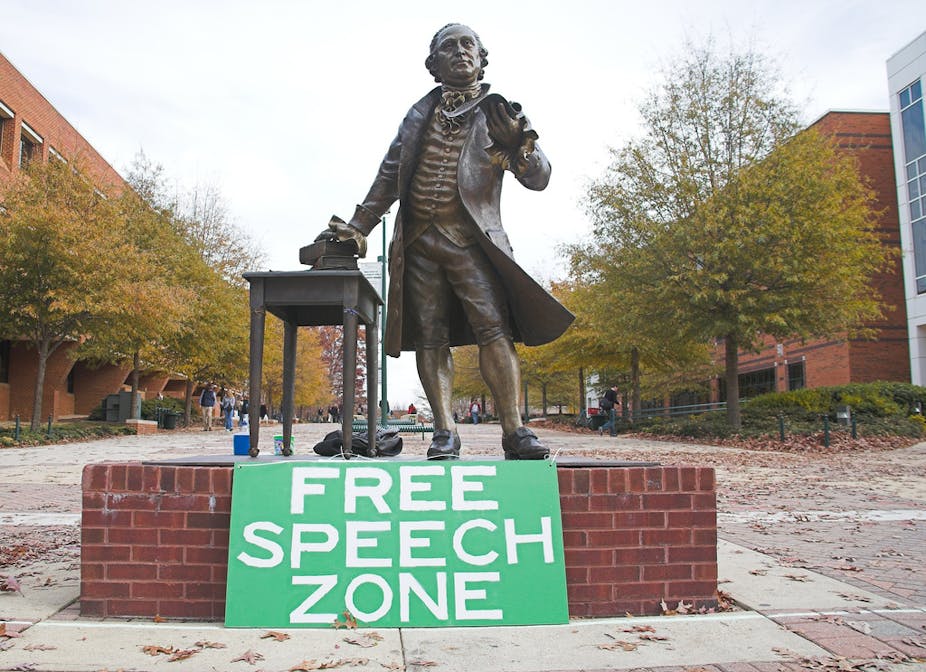
In 2016 a Georgia Gwinett College student was arrested for distributing religious literature from a designated free speech zone because someone had complained about his speech. He sued the university and the case was eventually dismissed because the College said that it had changed its free speech zone rules. The student appealed to the Supreme Court. Here is an update from the Rutherford Institute which recently filed an amicus brief in the case.

The Rutherford Institute has weighed in before the U.S. Supreme Court on a case in which campus police, citing “disorderly conduct,” prevented a college student from speaking about his Christian faith and distributing religious literature from a small free speech zone on a 260-acre campus. In an amicus brief filed in Uzuegbunam v. Preczewski, Rutherford Institute attorneys are asking the Supreme Court to hold officials at Georgia Gwinnett College liable for violating college student Chike Uzuegbunam’s free speech rights and ensure that campus policies adhere to the First Amendment…

“This case reminds us that there is no room for trust in the relationship between the citizenry and the government,” said constitutional attorney John W. Whitehead, president of The Rutherford Institute and author of Battlefield America: The War on the American People. “Trust the government to police itself, and it will sidestep the law at every turn. The only way to ensure that government officials obey the law and respect the rights of the citizenry, as Thomas Jefferson recognized, is to bind them with ‘the chains of the Constitution.’”

Chike Uzuegbunam is a Christian and was a student at Georgia Gwinnett College, which has a 260-acre campus in Lawrenceville, Ga. Chike’s faith requires that he share his religious beliefs with others. He sought to do so in 2016 by passing out literature and speaking to students from a spacious concrete plaza near the college’s library. A campus security officer stopped him and warned that Chike could not distribute written materials there because he was not in one of two “speech zones” the college had established. Under the college’s policies, students were required to reserve times for one of the two “speech zones,” which consisted of one patio and one sidewalk that amounted to 0.0015% of total area of the campus. The policies also required students apply for a reservation at least three days in advance and gave college officials unbridled discretion to decide who could speak, when they could speak, and what materials they could give out. Although Chike properly reserved a time for sharing his faith from one of the zones, he was again stopped from speaking by a campus security officer. The officer told him that because someone had complained about his speech, he was engaged in “disorderly conduct” under college policies. Chike then brought a lawsuit against the college alleging that its policies and their application to prevent him from engaging in religious speech violated the First Amendment. After months of litigation, the college moved to dismiss the case as moot because it had changed its “speech zone” policies and the trial court granted the motion. Chike appealed, arguing his case was not moot because he was entitled to nominal damages for the interference with his First Amendment rights, but the appeals court upheld the dismissal. Chike sought and was granted review by the U.S. Supreme Court. In its amicus brief supporting Chike, The Rutherford Institute argues that dismissal of the lawsuit violates long-established court precedent affirming the right of citizens to obtain an award of nominal damages against the government officials when they violate a person’s constitutional rights. 

The Rutherford Institute, a nonprofit civil liberties organization, defends individuals whose constitutional rights have been violated and educates the public about threats to their freedoms.

American Partisan: Three Avenues Of Approach – Baofeng’s BF-R3

NC Scout at American Partisan has a brief article on the inexpensive Chinese radio Baofeng BF-R3 and its increased utility over the UV5R model. Besides signal intelligence value, having a third band can make a difference operationally as well. In an RTO class that I attended, we found that one of the bands did not work reliability in the terrain and among the structures where we were operating, but switching to the alternate band worked fine.

As I tell students in the the RTO and Signals Intelligence Courses, its not necessarily what can be monitored (everything has the capacity to be monitored) but rather, how your adversary can exploit it. This in turn points to the criticality of the ability to plan and act based on that plan. And often enough, the difficulty lay not just in detecting an adversary to monitor, which can be hard enough, but taking that a step further into implementing tools that are outside his capabilities.

In the last RTO Course out West, a couple of the students had brought in a new model of Baofeng- a triband model called the BF-R3– a tri-band radio that matches all of the functions of the old UV-5R but with an additional spread of transmitting capability on 220-260mHz. This enables users a whole third option for receiving and transmitting in a vastly under-utilized frequency spread.

It is backwards compatible with all of the standard Baofeng UV-5R cables, batteries and accessories, including my favorite, the H-250 dogbone mic. On top of that, its fully Chirp supported for all of you that use that software. At about the same price as the standard two band Baofeng but with expanded capabilities, its hard to see why you wouldn’t want to have a few.

Get ’em while you can and while you’re at it, come get training on using it in a tactical environment. Might be important here soon.

Hurricane Watch Net Activates for Hurricane Delta

Hurricane Delta had been a category 4 storm, but dropped to category 2 as it made landfall in the Yucatan. It is expected to strengthen again as it crosses the Gulf. From Hurricane Watch Net:

Wednesday, October 7, 2020 @ 8:00 AM EDT – 1200 UTC

The Hurricane Watch Net activated Wednesday morning at 8:00 AM EDT (1200 UTC) on 14.325.00 MHz for Hurricane Delta.

Hurricane Delta made landfall around 5:30 AM CDT (1030 UTC) along the northeastern coast of the Yucatan Peninsula near Puerto Morelos with estimated maximum winds of 110 mph, a category two hurricane on the Saffir-Simpson Hurricane Wind Scale.

The reason for our late start is because we did not have any propagation into the affected area overnight on both 20 and 40-meters. We will be in operation most of today before taking a break.

We will resume operations Friday morning at 8:00 AM EDT – 1200 UTC on 14.325.00 MHz. We will begin operations on 7.268.00 MHz that morning at the conclusion of the Waterway Net. Once active, we will remain in full operation through approximately midnight CDT.

Delta is currently forecasted to be a Category 2, possibly a Category 3, Hurricane when it makes landfall somewhere south of Lafayette, LA on Friday afternoon.

Any change to our activation plans will be posted on our website, www.hwn.org.

I want to offer in advance my sincere thanks to everyone who uses 14.325 MHz and 7.268 MHz for various Nets and rag-chews to allow us to use these frequencies. Having a clear frequency certainly makes our job easier, and we know those in the affected area greatly appreciate it as well!

As a reminder, we are always available to provide backup communications to official agencies such as Emergency Operations Centers, Red Cross officials, and Storm Shelters in the affected area. We also collect and forward significant damage assessment data to FEMA officials stationed in the National Hurricane Center.

As always, we are praying and hoping for the best yet preparing for the worst.

Sincerely,
Net Management

Prep School Daily: Basic Food Storage–An In-Depth Discussion of Dry Milk

Here’s an article from last year at Prep School Daily on options for dry milk – Basic Food Storage–An In-Depth Discussion of Dry Milk. When the lockdowns first started, milk was a bit scarce at local stores so we used the dry milk in our food storage to supplement the regular milk we already had. Even if you don’t have the best tasting dry milk, it can be pretty good if you mix it half and half with some regular milk — so you’re using it to stretch your fresh product, rather than completely replacing it.

Is this really what my life has come to?  While I never pictured myself becoming famous (zero desire for that) or rich (security has its advantages) or saving the world, somehow I guess I thought I’d be doing something a little more exciting than writing about dry milk.  Something a little juicier.

But alas, here we are.

Last week I taught a class all about dry milk for about a dozen people at church, and in the process I learned a few things and thought I should share that bit of knowledge with my readers.  And before doing that, I thought I should review what I’d already written.  And to my shock I found that I’d never actually written anything about dry milk!

So without further adieu, let’s delve into the mysterious world of powdered milk.

First off, we have to define each of the kinds of dry milk.

Non-instant nonfat milk is not sold by a lot of companies.  I found one seller on Amazon and non-instant nonfat is also what is sold by the Home Storage Center (HSC). It is processed by drum drying, where the milk is sprayed on a heated drum and then scraped off.  The drum is heated and the resultant dry milk has a cooked flavor to it.  It is generally much less expensive than instant nonfat.  As the name suggests, it does not mix instantly, but takes a bit more stirring.  It has a reputation of being less palatable than instant.

Instant nonfat milk is far more popular, easy to find through all preparedness vendors and at grocery stores.  It is processed by evaporation and spraying into a heated chamber where the milk dries almost immediately.  It is a more expensive process.  There is a wide range in price and palatability.

Instant milk drink is promoted as being the best-tasting.  And it is!  BUT IT’S NOT REAL MILK!  In fact, if you take a look at the list of ingredients, milk is number 3 on that list (at least, for Morning Moos).  It can’t possibly be more than 33% milk.  Kinda disturbing.

There are also instant lowfat and whole milk options.  These are not packaged for long term storage, and even if they were, they don’t have the shelf-life of long-term storage.

In the process of preparing to teach the class last week, I decided to take a look at the nutrition information label for the instant milk drinks to compare with the dry milk powders.   And I discovered that there is quite a range in the vitamin and mineral content of the various products.  Because milk is the primary dietary source of vitamin D for most people in their food storage, it’s something we really need to pay attention to.

However, it doesn’t really matter how much more nutritious one brand is over another if it doesn’t taste good, unless it is only being used in baking and cooking.  If your child refuses to drink it, it won’t matter that it’s got the most vitamins and minerals, right?  And you know you can’t blame them, because you remember pretty well how nasty some dry milk can be.

So doing a taste test is pretty important, especially before forking out a significant chunk of change.  Milk is definitely not cheap.  I’m including the results of three taste tests here. All are for pretty small groups.  One is from a group in Utah that posted their results online.  Another is from a class I taught in Missouri about seven years ago.  And finally, there are the results from my class last week.

For the Utah group, they tested the following milks and milk drinks:  Emergency Essentials, Country Cream, Walton Feed, Augason Farms, HSC, Walmart store brand fresh nonfat milk (control), Honeyville,  and store brands.  All were mixed according to directions and chilled well.  Sugar and vanilla extract were not added to any of their samples.  In their taste test (which was held nine years ago), the HSC milk (from a freshly-opened, freshly-canned can) scored the worst.  Provident Pantry (now Emergency Essentials) was rated the highest.

In my class in Missouri, seven years ago, we had five different samples.  I’m working from memory here, so please bear with me.  We had the Provident Pantry brand (which now carries the Emergency Essentials name), Grandma’s Country Cream, a brand I can’t remember for the life of me, one sample from the Home Storage Center that was mixed according to directions, and another sample from the Home Storage Center to which sugar and vanilla extract were added.  In our small-ish group, choices for the best milk divided pretty evenly between Provident Pantry, Grandma’s Country Cream, and the one I can’t remember.  Everyone put the milk from the Home Storage Center, unadulterated, in last place.  What was surprising to all of us was that everyone picked the milk from the HSC to which we added vanilla and sugar as the second best.

In my class last week we had seven different milk choices. All of the milk products that were acquired years ago have been stored at recommended temperatures since purchase.  The cans from the HSC, Provident Pantry, and Grandma’s Country Cream were all opened last week.  Except for the sample with vanilla and sugar, all were mixed according to package directions.  All were well chilled.  Taste testers ranked the samples from 1 to 5, with 5 being the best and 1 being they’d rather die than drink it again.

I was surprised by some of the results.  I will note that most of the taste testers this week were over the age of 50, and I really think there is some change in the taste buds when we get older.  It’s so important to taste and see what we like best.  We have our ideas of what tastes good, what something is supposed to taste like.  I’m pretty happy to eat store brands of most foods, but my graham crackers better be Honey Maid, and my saltines better be Premium or Krispy.

My cans of Provident Pantry and Country Cream were ten years old.  The cans from the HSC were from 2001 and 2010.  Carnation, Kroger, and WinCo bulk were all fresh purchases.

Coming in at a solid last place was Carnation, with an average of 2.1.  I’d have thought they would have figured out the milk business by now.  Kroger scored 2.9.  Provident Pantry, 3.3.  WinCo bulk bin, 3.4.  Country Cream, 3.9.  HSC without any additives, 3.6.  HSC with sugar and vanilla, 4.1.

For the nutrition analysis:            Vit A   Vit C  Vit D  Calcium      Cost        Servings     Cost/Serving
Carnation                                      10%      2%     25%      30%       $0.99             4                  $0.25
Kroger                                           15         —       15          20             2.31           12                   0.19
WinCo bulk                                      (not noted)
Provident Pantry                            0          2          0          25
Country Cream                              0          0        10          30
HSC (2001, no additives)             10        4          25         35
HSC (2010, sugar and vanilla)     15        4          40         35

For comparison, what’s currently available
HSC                                              10        4          25         35            4.00           29                   0.14
Country Cream                               2        2          10         30          18.99           64                   0.30
Augason Farms                             15        2          10        20           22.99           39                  0.59
Thrive                                             0        0          10         20           10.49          15                   0.70
Emergency Essentials                   10        4          25        30           18.95           45                   0.42
Augason Farms Morning Moo     10        0          15         10           23.99           93                 0.26
(Carnation and Kroger remain the same)


As you can see, the various milk products different dramatically in nutrition and cost per serving.  All servings are eight ounces each.

The clear winner for cost per serving is the HSC milk at 14 cents per serving.  Even factoring in the cost of sugar and vanilla extract (at $4.00 per ounce currently), it’s 22 cents per serving to make a milk that tastes as good as the more expensive brands.  If you look at the nutritional content, the HSC is the winner again, just barely surpassing the Emergency Essentials brand.  The others just don’t even hold a candle, especially when you factor in how important vitamin D is in the diet, and even more so for children.  In case you don’t remember, where else can you get vitamin D in your diet?  Fish, beef liver, eggs, and cod liver oil.  Or supplements.  Keep in mind that 42% of American adults are deficient in vitamin D.  And in the early 1900s, before milk was fortified, 90% of children in Boston and New York had rickets.  Make sure you plan well for the children in your life.

Another method for improving the taste is to add 1/4 to 1/2 cup more milk powder per quart of milk.  We didn’t try this for the class and I have no experience with it.  It’s just something you may wish to try yourself.

For the class last week, we didn’t just taste test milk, though that was a really important part of the class.  I also showed participants how to use the inexpensive HSC dry milk in their everyday cooking.  We taste tested instant oatmeal, cream of tomato soup, survival bars, and chocolate pudding.  Even if people prefer the more expensive milks for drinking, it’s important to see that less expensive milk can successfully be used for cooking and baking.  However, it is very important to note that the measurements of dry milk for baking are not necessarily interchangeable.  It takes anywhere from 2/3 cup to 1 1/3 cups of powdered milk to make a quart of liquid milk.  All recipes on this blog, unless otherwise noted, are made using HSC milk, which uses of a ratio of 3/4 cup dry milk to 3 3/4 cups water.

Forward Observer: This Is a Fourth Generation War

Intelligence analyst Sam Culper of Forward Observer writes This Is a Fourth Generation War.

Earlier this year, I did a re-read of Bill Lind’s 4th Generation Warfare Handbook (4GW) to better understand the framework of our ongoing Low Intensity Conflict.

For those who are new to the term, Low Intensity Conflict is war below the threshold of conventional war (tanks and bombers) but above routine, peaceful competition. America is not at conventional war, but it’s certainty not at peace with itself. This is the gray area of Low Intensity Conflict.

As history shows, technology and human understanding of warfare evolves, so war itself evolves. Not everyone agrees with the “generational” description of warfare, but let’s look quickly at the framework.

According to the theory, Generations 1-3 of warfare focused on the development of conventional warfighting, generally understood as:

1GW: masses of troops meeting on the battlefield in somewhat orderly warfare, such as lines and columns; to

2GW: the inclusion of centralized indirect fire and war by attrition; to

3GW: the inclusion of combined arms (land, air, and sea) and maneuver doctrine.

But something interesting happened in the Fourth Generation: the nation-state lost its monopoly on violence.

War is less and less being fought among conventional militaries and nation-states, and it’s increasingly fought by tribal entities, where both armed and unarmed combatants wage war against an enemy. (Many make the case that this is the original form of warfare, or 0GW, and they’re not wrong.)

Yet, as Lind describes, “All over the world, citizens of states are transferring their primary allegiance away from the state to other entities: to tribes, ethnic groups, religions, gangs, ideologies, and ’causes.’” In 4GW, fighting for one’s “nation” increasingly means fighting for your social tribe, instead of fighting for one’s country.

We’re seeing this right now as the American identity is being redefined and the country becomes more tribal. Small groups, most often based on ideology or race, are trying to reform or replace state power, authority, and legitimacy to benefit their own self-interests. This is the battle between New America and Old America, where “American” is becoming, for many, a secondary or tertiary identity, often behind race and/or ideology.

In 4GW, the military and nation-state has clearly lost the monopoly on warfighting, as 4GW is fought primarily on the Mental (informational) and Moral planes of conflict. The Culture War being fought right now in classrooms, corporations, and media outlets is a great indicator of 4GW, as information operations and high-horse moral pleas have become warfighting techniques to win on the Mental and Moral levels of conflict. (Notice, for instance, the rhetoric re-defining “fundamental American values”.)

Lind makes the case that killing is rarely the preferred way to win a Fourth Generation War, and that winning the Mental and Moral conflict almost always dictates the outcome of the war. In a way, to win in 4GW, you don’t necessarily need to kill your opponent; you need to reshape the information environment and shift the perception of morality so that your opponent (and/or his ideology) becomes unpopular and immoral. Once unpopular and immoral by societal standards, political and social power dries up. At least in theory, that’s how you win at 4GW.

I’ve previously described how 4GW is being fought through community organizing, institution destruction, counter-institution building, economic dislocation, corporate activism, propaganda, terraforming the electorate, and several other ways.

If you’re like me, then you’re pretty far removed from the political and media power centers in D.C. and New York, where much of 4GW originates. But that’s doesn’t mean that 4GW is not being fought in your own area.

My challenge to you is to look locally for ways in which 4GW is being fought.

Are there community organizing efforts in your area to build competing social movements?

Are there subversive political groups trying to destroy local political, cultural, or religious institutions?

Are there subversive political groups trying to build institutions to counter your own political, cultural, or religious institutions?

Is there economic dislocation (targeting income or financial health) against political or cultural opponents?

Are companies or corporations engaging in the cultural and/or political fight?

Are there attempts to expand voting rights to non-citizens, or to shame those who oppose non-citizen voting?

There are a great many more ways that 4GW is being waged, and if we’re completely focused on the national level, then we’re likely to miss 4GW action in our own communities.

Until next time, be well and stay out front.

Of Two Minds: Corruption Is Now Our Way of Life

Charles Hugh Smith at Of Two Minds writes Corruption Is Now Our Way of Life on the collapse of the USA.

Systemic corruption and the implosion of the social contract have consequences: It’s called collapse.

Social and economic decay is so glacial that only those few who remember an earlier set-point are equipped to even notice the decline. That’s the position we find ourselves in today.

Many Americans will discount the systemic corruption that characterizes the American way of life because they’ve known nothing but systemic corruption. They’ve habituated to it because they have no memory of a time when looting wasn’t legalized and maximizing self-enrichment by any means available wasn’t the unwritten law of the land.

If you don’t yet see America as little more than an intertwined collection of skims, scams, frauds, embezzlements, lies, gaming-the-system, obfuscation of risk and exploitation of the masses by insiders, please read How Corruption is Becoming America’s Operating System. (nakedcapitalism.com, via Cheryl A.)

Here on oftwominds.com, you might want to read No Wrongdoing Here, Just 6,300 Corporate Fines and Settlements. (May 2015)

When JP Morgan Chase engaged in fraud and was fined a wrist-slap $1 billion, nobody went to prison because nobody ever goes to prison for corporate fraud and criminal collusion: JPMorgan to pay almost $1 billion fine to resolve U.S. investigation into trading practices.

Simply put, corruption is cost-free in America because most of it is legal. And whatever is still illegal is never applied to the elites and insiders, except (as per Communist regime corruption) for a rare show trial where an example is made of an egregious fall-guy (think Bernie Madoff: whistleblowers’ repeated attempts to expose the fraud to regulators were blown off for years. It was only when Madoff ripped off wealthy and powerful insiders did he go down.)

There are three primary sources for the complete systemic corruption of America. One is the transition from civic responsibility for the social contract and the national interest to winner-take-most legalized looting.

This transition is visible in the history of empires in the final stage of collapse. The assumption underlying the social order slides from a shared duty to the nation and fellow citizens to an obsession with evading civic duties: military service, taxes, and following the rules are all avoided by insiders and elites, and this moral/social rot then corrupts the entire social order as elites and insiders lean ever more heavily on the remaining productive class to pay the taxes and provide the military muscle to defend their wealth.

That corruption is now everywhere in America is obvious to all but those adamantly blinded by denial. The JP Morgans pay fines as a cost of doing corrupt business, while “public servants” game the system to maximize their pensions with a variety of tricks: colluding to boost the overtime of the retiring insider; finding a quack physican to sign off on a fake “heart murmur” so the insider pays no taxes on their “disability” check, and so on in an endless parade of lies, scams, skims and insider tricks.

The excuse is always the same: everybody does it. This is of course the collapse not just of the social contract but of morality in general: anything goes and winners take most. Insiders look the other way lest their own skims and scams be contested, and elites and insiders view those who aren’t skimming and scamming as chumps to be pitied.

The second dynamic is that financialization has completely corrupted the American economy, and that corruption has now spread to the political and social orders. Once the financial sector conquered the real economy, it began siphoning 95% of the economy’s wealth to the top .01% and their toadies, lackeys, apologists, enforcers and technocrats.

As they hollowed out the real economy, distorted incentives and made moral hazard the guiding principle of the American way of life, the recipients of financialization’s domination gained the wealth to buy political power from the pathetically corruptible political class.

The corruption that we call financialization corrupted democracy and undermined the social contract by eviscerating the value of labor and creating a pay-to-play political order that’s a mockery of democracy.

The third factor is the decay of America’s institutions into fronts for personal gain. While Higher Education insiders are masters of self-serving PR, the truth is they’re not concerned about their debt-serf “customers” (students) learning the essential skills needed in the tumultuous decades ahead–they’re worried that the revenues needed to pay their enormous salaries and benefits might dry up.

“Education” is nothing but a front for the corruption of self-enrichment by the elites and insiders at the top.

The same is true of “healthcare.” The concern of insiders isn’t the declining health of America’s populace, it’s the decline in revenues as fewer “customers” come in for the financial scalping of emergency care.

“Healthcare” is nothing but a front for the corruption of self-enrichment by the elites and insiders at the top.

Thanks to the Federal Reserve’s endless free money for financiers and endless federal borrow-and-blow deficits, the unstated belief is since there’s endless “money”, my petty frauds and skims won’t even dent the feeding trough–there’s always another trillion or three to skim and scam, and there will never be any limit to the feeding trough.

There is no limit until the system implodes. Then the collapse becomes limitless.

Ironic, isn’t it? The oh-so convenient belief that America’s wealth and power are eternal and godlike in their glory fosters the crass corruption that has weakened America to the point of no return: systemic fragility and brittleness.

American Exceptionalism has been turned on its head: America is now as perniciously corrupt as any developing-world nation we smugly felt so superior to, and with extremes of wealth and income inequality that surpass even the most rapacious kleptocracies. This destabilizing “exceptionalism” is now the defining characteristic of the American economy, society and political order.

Systemic corruption and the implosion of the social contract have consequences: It’s called collapse, baby, and the rot is now too deep to reverse.

Wilder, Wealthy, and Wise: Civil War 2.0 Weather Report – Oct. 5, 2020

Wilder, Wealthy, and Wise shares their latest Civil War 2.0 Weather Report – Worse Than You Think.

“You were right, Smith. You’re always right. It was inevitable.” – The Matrix: Revolutions

Right now it feels like we’re watching a slow-motion video of a wreck that’s getting ready to happen. We know it’s going to happen, but have no idea how to stop it as physics makes it inevitable.

  1. People actively avoid being near those of opposing ideology. Might move from communities or states just because of ideology.
  2. Common violence. Organized violence is occurring monthly.
  3. Opposing sides develop governing/war structures. Just in case.
  4. Common violence that is generally deemed by governmental authorities as justified based on ideology.
  5. Open War.

We are in the gray zone between step 9. and step 10. I will maintain the clock at 2 minutes to midnight. Violence continues to be commonly justified by local and state authorities, but there are now premeditated, fatal attacks by the Left. As noted in a previous update, the only thing keeping the clock ticking to full midnight is the number of deaths.

In this issue: Front Matter – Being Out In Front – Violence And Censorship Update – Updated Civil War 2.0 Index – You Have No Idea – Links

Welcome to the latest issue of the Civil War II Weather Report. These posts are different than the other posts at Wilder Wealthy and Wise and consist of smaller segments covering multiple topics around the single focus of Civil War 2.0, on the first or second Monday of every month. I’ve created a page (LINK) for links to all of the past issues. Also, feel free to subscribe and you’ll get every post delivered to your inbox, M-W-F at 7:30 Eastern.

Being Out In Front

When I started doing these updates, I wondered if I was being too pessimistic. In part, the original scale was developed based on personal experience – I had visited a “blue” state a few years ago on summer vacation.

A man, apparently looking at birds in a little-used state monument, saw us drive in. He trained his binoculars on our license plate. “Lower-upper Midwestia, eh?” he yelled. “Yes,” I responded.

“Who’d you vote for?” Unusual, but, whatever.

“Well, his name starts with a T,” I replied, grinning.

It puts the donkey in the pit, or a lifetime of communism it will get.

He then proceeded to call me a name for a portion of the anatomy that was the first thing people panicked about when COVID-19 hit and everyone bought all of that toilet paper.

“What did you say?”

“You heard me.” He then repeated the anatomical description and then scurried, rat-like into his SUV.

The Mrs. had gone to the little bathroom at the historical site, and had missed the interaction. I’m glad. She would have broken him like a stick. She always handles my light work.

But this was a significant data point. Never in my life had I been attacked, in public, for no reason other than my ballot. For most of my life, political differences had been a path to amusing conversations among friends. We had considered moving to this state. Why would we, though, when people acted like that? And now, people are moving out of California for the same reason we didn’t move to that blue state.

Once upon a time, we could talk about our political disagreements and still be friends. That worked, because even though there were things we disagreed about, we agreed about most things. Now? Leftists have largely abandoned the things that made us Americans. We have nothing to say to each other.

Seriously, The Mrs. would have broken him in the most embarrassing thirty seconds of his life.

When a stranger will insult you in public over nothing more than your ballot? The time of violence is close.

Violence And Censorship Update

Last month I put forth the criteria (from the literature I could find) that 1,000 was the number of deaths that signified a civil war. There was at least one great comment that made the point that we were already there and the 1,000 death minimum was arbitrary.

It is. But we have to have something, even if it’s arbitrary. The last I could find, there were 50 documented deaths due to the protest as listed by the Washington Post. My bet is that number is too low. It doesn’t, for instance, add in the numbers of dead due to rampant lawlessness in cities where BLM®/Antifa™ have taken root and taken over.

Not all of those “excess” murders are political, but a lot more are than I think are currently being admitted. Although it’s unscientific, I’d put the number of deaths closer to 150 than 50, but no one is tallying them.

On the censorship front, Facebook® has announced that no political ads will be run in the United States the week prior to the election. Facebook© has been removing points that differ from the “official” line about medical opinions, many of which have varied significantly throughout 2020.

Always wondered why the people in Hong Kong are holding American flags and are against censorship, while Antifa© are burning American flags and demanding censorship.

Perhaps the biggest censorship has been elimination of all Facebook™ posts expressing support for Kyle Rittenhouse, who in my opinion was exercising his right of self-defense. The same is true for virtually every major Internet funding service where Kyle’s supporters have tried to get monetary support for him. In the end, at last check they nearly have enough money for his bail. Yet Gofundme® regularly funds people accused of murder. But not witchcraft or self-defense.

They have to have a line somewhere.

Updated Civil War II Index

The Civil War II graphs are an attempt to measure four factors that might make Civil War II more likely, in real-time. They are broken up into Violence, Political Instability, Economic Outlook, and Illegal Alien Crossings. As each of these is difficult to measure, I’ve created for three of the four metrics some leading indicators that lead to the index. On illegal aliens, I’m just using government figures.

Violence:

Up is more violent. The public “perception” of violence keeps dropping over time, in part (my opinion) is that people are now expecting violence, and the sight of burning buildings and riots in the street are just accepted in September of 2020 – I don’t think there’s anyone (besides CNN®) that would say that September was more peaceful than April 2020, but if you look at the graph, we’ve just become used to constant political violence from the Left.

Political Instability:

Up is more unstable. Instability was up in September. I think there’s a really growing feeling among the people on the Left that Trump will win, and that would be the scariest thing that they can imagine. Well, that and getting real jobs.

Economic:

Down indicates worse economic conditions, are up significantly. I wrote last month that I expected a decline through October. Oops. This is why you don’t trust me with your money. But I think the numbers are juiced – I think that the unemployment numbers are artificially low, perhaps significantly so. And I’m expecting the markets to drop off a cliff. Sometime soon.

Illegal Aliens:

Down is good, in theory. This is a statistic showing border apprehensions by the Border Patrol. Numbers of illegals being caught is rising again – it’s at higher than all but one of the last five years. Even if it’s bad here, it’s worse south of the border.

You Have No Idea

. . . how bad it can get.

One thing that history has proven is that the most difficult conflicts are civil wars. They are generally unrestrained in the level of brutality. Why? Unlike war objectives such as wanting Ukraine for extra storage for lawn furniture or wanting Spain to just shut up, already, civil war objectives are personal.

Just saying, you can store a LOT of patio furniture in the Ukraine.

You can see that in Antifa®, especially. I’ve written a lot about them, and I’ve made an effort to really try to understand their mentality. I wrote a post specifically about that, and it’s one of my favorites (Why Would Anyone Become A Leftist?). For Antifa™, it’s personal. Very personal. As Sam Hyde said,

“When we win, do not forget that these people want you broke, dead, your kids raped and brainwashed, and they think it’s funny.”

One thing that was memorable to me was when I was reading Concerned American over at the excellent Western Rifle Shooters Association (LINK) was when he said that he thought that no one over fifty would live through the coming crisis.

A statement that stark took me by surprise. It’s not that he’s wrong – I don’t know that he is. But it brought home to me that the potential for damage in the coming few years dwarfs anything that has ever happened in the United States.

Be aware. Prepare. Be in the safest place you can be…(continues)

The American Mind: The Truth About America

From the editors at The American Mind – The Truth About America.

Trump is right: only patriotic American history can heal our deep wounds.

This week we reprinted a series of speeches given at the White House Conference on American History. As we noted, the conference was the first of its kind. On the one hand, it’s remarkable no one in power ever thought to host such a thing. On the other, it’s possible no one has ever needed one quite so much as we do now.

President Trump and his distinguished guests—among them several affiliates, friends, and one current board member of the Claremont Institute—defended things it would have been laughable to defend during much of our country’s history. Not because those things are indefensible, but because they have not been seriously up for debate except in our worst and most fractious moments. These things were once the core of our national consensus, the context within which we had all our other discussions and debates.

“On this very day in 1787,” said Trump, “our Founding Fathers signed the Constitution at Independence Hall in Philadelphia. It was the fulfillment of a thousand years of Western civilization. Our Constitution was the product of centuries of tradition, wisdom, and experience. No political document has done more to advance the human condition or propel the engine of progress.”

There is no such thing as pride in or love for America without some version of this foundational belief. Either you think the regime described in our Constitution can work, is noble, and represents a serious advance in the history of nationhood, or you think America ought to be transformed beyond recognition.

We at the Claremont Institute are dedicated to proving, emphatically and without qualification, that a full endorsement of our country’s principles is not only a patriotic act but, intellectually and morally, an unimpeachable one. That entails insisting that the history of our country is one of dedicated human striving toward the highest ideals, and the most prudent political enactment of those ideals, possible on this earth.

Our country was not founded in racism—it was in fact conceived as a uniquely ambitious effort to abolish racism and destroy its intellectual foundations in the West once and for all. That project, over time and through much tragic hardship, has been successful beyond even what its architects may have dared to hope. The cost of that success—in patient intellectual effort, in wrenching expenditure of blood and treasure—has been enormous. But it was worth the cost and would have been worth more. America is a wonder of the world.

This is not what many Americans today think, because it is not what they have been taught. The results of a dedicated, decades-long effort to undermine the foundations of America’s faith in itself are now visible. Today that effort is led most visibly by Nikole Hannah-Jones of the New York Times’s 1619 Project, but insidiously supported by Critical Race Theory training sessions in board rooms, small businesses, and until recently the halls of federal government agencies around the country. There is a diabolical genius to the way this effort has proceeded, in that it has involved both brute intimidation—in the form of cancel culture and its attendant threats of unemployment or unpersoning—and psychological subversion—in the form of an attack on our nation’s history.

It is this latter and more serious offensive against American civic life that President Trump has undertaken to countermand with his 1776 Commission for the promotion of patriotic education. Like the Progressives and Marxists who went before her, Hannah-Jones and her co-conspirators seek to erode American confidence in the basic goodness of our regime. If the Times, the Pulitzer Center, the ruling class, and their various minions can persuade us that the founders are not to be trusted—that they were disingenuous about their aims, that their timeless truths were actually self-serving lies, that the Constitution they composed has fallen fatally out of date—then they will convince us to commit national suicide all on our own.

The effectiveness of that approach is visible already in the insurrectionary violence that now routinely convulses American cities. Such violence is, by Hannah-Jones’s own admission, exactly what she wants and knows how to achieve. As many speakers at the White House Conference pointed out, it is the long subversion of American History—from the elementary school level on up to the universities—that has at last born this bitter fruit of civil unrest.

Trump is wise to fight this domestic terrorism on its own terms—to root Critical Race Theory out of federal training sessions at the heroic urging of Claremont alumnus Christopher Rufo, for example, and to insist that Americans be taught the real history of their country once again.

An objection frequently made to such efforts by both useful idiots and partisan hacks is that remaking American education somehow amounts to propagandistic indoctrination or even a breach of the First Amendment. This is a spectacularly puerile response. As Plato and Aristotle taught, all education just is shaping the soul to love some things and avoid others. Those aversions and loves, once engrained in the hearts of the young, find their expression through the political life in which those young grow up to participate.

Our school system already indoctrinates our nation’s youth in a most dishonest and dangerous manner. Since Howard Zinn’s ridiculous People’s History of the United States became standard in American high schools, and the AP U.S. History curriculum took its cue from Zinn’s calumny, we have been teaching children to hate our country by allowing radicals to lie through their teeth about it: they’ve taught for many years now that America is racist and evil at its core.

There is no alternative now or ever but to teach the opposite, that is, the truth: that America’s history is a story of triumph, that the country we live in is the world’s greatest hope even now, that she is worthy of nothing but love and, if it comes to it, the very extremes of self-sacrifice. We commend President Trump and his team for boldly leading after so many others failed to do so. But more remains to be done—much more.

In his Farewell Address, President Ronald Reagan catalogued his successes—and, by his own admission, his one great failure. In his day, he said, “We were taught, very directly, what it means to be an American, and we absorbed almost in the air a love of country and an appreciation of its institutions.” If not from family and neighborhood, “you could get a sense of patriotism from school” or even “from the popular culture.”

But as America was “about to enter the ’90s,” Reagan noted that “Younger parents aren’t sure that an unambivalent appreciation of America is the right thing to teach modern children.” “An informed patriotism,” he said, “is what we want”—but “are we doing a good enough job teaching our children what America is and what she represents in the long history of the world?”

In the aftermath of the “Reagan Revolution,” Reagan himself warned that “our spirit is back, but we haven’t reinstitutionalized it.” He went out of his way to note that “well-grounded patriotism is no longer the style” for the creators of culture.

Reagan then warned: “If we forget what we did, we won’t know who we are. I am warning of an eradication of that—of the American memory that could result, ultimately, in an erosion of the American spirit.” The American spirit is now in crisis precisely for this reason.

In response, as Reagan said, “We’ve got to teach history based not on what’s in fashion but what’s important.”

In every high school classroom, in every boardroom, in every university, we must fight at every level to restore America’s sense of herself. If we lose this fight, we lose America. But we can yet win.

President Trump points us in the right direction.

The Conversation: How 3 Prior Pandemics Triggered Massive Societal Shifts

The Black Death created massive labor shortages

Macalester Professor Andrew Latham writes How 3 prior pandemics triggered massive societal shifts at The Converstation.

Before March of this year, few probably thought disease could be a significant driver of human history.

Not so anymore. People are beginning to understand that the little changes COVID-19 has already ushered in or accelerated – telemedicine, remote work, social distancing, the death of the handshake, online shopping, the virtual disappearance of cash and so on – have begun to change their way of life. They may not be sure whether these changes will outlive the pandemic. And they may be uncertain whether these changes are for good or ill.

Three previous plagues could yield some clues about the way COVID-19 might bend the arc of history. As I teach in my course “Plagues, Pandemics and Politics,” pandemics tend to shape human affairs in three ways.

First, they can profoundly alter a society’s fundamental worldview. Second, they can upend core economic structures. And, finally, they can sway power struggles among nations.
Sickness spurs the rise of the Christian West

The Antonine plague, and its twin, the Cyprian plague – both now widely thought to have been caused by a smallpox strain – ravaged the Roman Empire from A.D. 165 to 262. It’s been estimated that the combined pandemics’ mortality rate was anywhere from one-quarter to one-third of the empire’s population.

While staggering, the number of deaths tells only part of the story. This also triggered a profound transformation in the religious culture of the Roman Empire.

On the eve of the Antonine plague, the empire was pagan. The vast majority of the population worshipped multiple gods and spirits and believed that rivers, trees, fields and buildings each had their own spirit.

Christianity, a monotheistic religion that had little in common with paganism, had only 40,000 adherents, no more than 0.07% of the empire’s population.

Yet within a generation of the end of the Cyprian plague, Christianity had become the dominant religion in the empire.

How did these twin pandemics effect this profound religious transformation?

Rodney Stark, in his seminal work “The Rise of Christianity,” argues that these two pandemics made Christianity a much more attractive belief system.

While the disease was effectively incurable, rudimentary palliative care – the provision of food and water, for example – could spur recovery of those too weak to care for themselves. Motivated by Christian charity and an ethic of care for the sick – and enabled by the thick social and charitable networks around which the early church was organized – the empire’s Christian communities were willing and able to provide this sort of care.

Pagan Romans, on the other hand, opted instead either to flee outbreaks of the plague or to self-isolate in the hope of being spared infection.

This had two effects.

First, Christians survived the ravages of these plagues at higher rates than their pagan neighbors and developed higher levels of immunity more quickly. Seeing that many more of their Christian compatriots were surviving the plague – and attributing this either to divine favor or the benefits of the care being provided by Christians – many pagans were drawn to the Christian community and the belief system that underpinned it. At the same time, tending to sick pagans afforded Christians unprecedented opportunities to evangelize.

Second, Stark argues that, because these two plagues disproportionately affected young and pregnant women, the lower mortality rate among Christians translated into a higher birth rate.

The net effect of all this was that, in roughly the span of a century, an essentially pagan empire found itself well on its way to becoming a majority Christian one.
The plague of Justinian and the fall of Rome

The plague of Justinian, named after the Roman emperor who reigned from A.S. 527 to 565, arrived in the Roman Empire in A.D. 542 and didn’t disappear until A.D. 755. During its two centuries of recurrence, it killed an estimated 25% to 50% of the population – anywhere from 25 million to 100 million people.

This massive loss of lives crippled the economy, triggering a financial crisis that exhausted the state’s coffers and hobbled the empire’s once mighty military.

In the east, Rome’s principal geopolitical rival, Sassanid Persia, was also devastated by the plague and was therefore in no position to exploit the Roman Empire’s weakness. But the forces of the Islamic Rashidun Caliphate in Arabia – which had long been contained by the Romans and Sasanians – were largely unaffected by the plague. The reasons for this are not well understood, but they probably have to do with the caliphate’s relative isolation from major urban centers.

Caliph Abu Bakr didn’t let the opportunity go to waste. Seizing the moment, his forces swiftly conquered the entire Sasanian Empire while stripping the weakened Roman Empire of its territories in the Levant, the Caucasus, Egypt and North Africa.
Troops clash in a 14th-century illustration of the Battle of Yarmouk.
Muslim forces of the Rashidun Caliphate captured the Levant – a region of the Middle East – from the Byzantine Empire in A.D. 636. Wikimedia Commons

Pre-pandemic, the Mediterranean world had been relatively unified by commerce, politics, religion and culture. What emerged was a fractured trio of civilizations jockeying for power and influence: an Islamic one in the eastern and southern Mediterranean basin; a Greek one in the northeastern Mediterranean; and a European one between the western Mediterranean and the North Sea.

This last civilization – what we now call medieval Europe – was defined by a new, distinctive economic system.

Before the plague, the European economy had been based on slavery. After the plague, the significantly diminished supply of slaves forced landowners to begin granting plots to nominally “free” laborers – serfs who worked the lord’s fields and, in return, received military protection and certain legal rights from the lord.

The seeds of feudalism were planted.
The Black Death of the Middle Ages

The Black Death broke out in Europe in 1347 and subsequently killed between one-third and one-half of the total European population of 80 million people. But it killed more than people. By the time the pandemic had burned out by the early 1350s, a distinctly modern world emerged – one defined by free labor, technological innovation and a growing middle class.

Before the Yersinia pestis bacterium arrived in 1347, Western Europe was a feudal society that was overpopulated. Labor was cheap, serfs had little bargaining power, social mobility was stymied and there was little incentive to increase productivity.

But the loss of so much life shook up an ossified society.

Labor shortages gave peasants more bargaining power. In the agrarian economy, they also encouraged the widespread adoption of new and existing technologies – the iron plow, the three-field crop rotation system and fertilization with manure, all of which significantly increased productivity. Beyond the countryside, it resulted in the invention of time and labor-saving devices such as the printing press, water pumps for draining mines and gunpowder weapons.
Townspeople flee the city for the countryside to escape the bubonic plague.
The Black Death created massive labor shortages. Universal History Archive/Universal Images Group via Getty Images

In turn, freedom from feudal obligations and a desire to move up the social ladder encouraged many peasants to move to towns and engage in crafts and trades. The more successful ones became wealthier and constituted a new middle class. They could now afford more of the luxury goods that could be obtained only from beyond Europe’s frontiers, and this stimulated both long-distance trade and the more efficient three-masted ships needed to engage in that trade.

The new middle class’s increasing wealth also stimulated patronage of the arts, science, literature and philosophy. The result was an explosion of cultural and intellectual creativity – what we now call the Renaissance.
Our present future

None of this is to argue that the still-ongoing COVID-19 pandemic will have similarly earth-shattering outcomes. The mortality rate of COVID-19 is nothing like that of the plagues discussed above, and therefore the consequences may not be as seismic.

But there are some indications that they could be.

Will the bumbling efforts of the open societies of the West to come to grips with the virus shattering already-wavering faith in liberal democracy, creating a space for other ideologies to evolve and metastasize?

In a similar fashion, COVID-19 may be accelerating an already ongoing geopolitical shift in the balance of power between the U.S. and China. During the pandemic, China has taken the global lead in providing medical assistance to other countries as part of its “Health Silk Road” initiative. Some argue that the combination of America’s failure to lead and China’s relative success at picking up the slack may well be turbocharging China’s rise to a position of global leadership.

Finally, COVID-19 seems to be accelerating the unraveling of long-established patterns and practices of work, with repercussions that could affet the future of office towers, big cities and mass transit, to name just a few. The implications of this and related economic developments may prove as profoundly transformative as those triggered by the Black Death in 1347.

Ultimately, the longer-term consequences of this pandemic – like all previous pandemics – are simply unknowable to those who must endure them. But just as past plagues made the world we currently inhabit, so too will this plague likely remake the one populated by our grandchildren and great-grandchildren.

The Burning Platform: The Only Thing Systematic Is the Destruction of America

From The Burning Platform, The Only Thing Systematic Is the Destruction of America, Part I and Part II.

“It is difficult to get a man to understand something, when his salary depends upon his not understanding it!” – Upton Sinclair

Image for post

Upton Sinclair was describing willful ignorance based upon who butters your bread. The rampant corruption of our society, as power has been consolidated into fewer and fewer hands, has resulted in our political, financial, cultural and economic systems being captured by a billionaire class who use their wealth to dictate the path we are forced to follow – or lose everything.

The sociopath class include the Silicon Valley social media titans, the billionaires running the six mainstream media companies, the rogue billionaires like Soros and Bloomberg who fund chaos and foment insurrection, the Deep State surveillance agency operatives like Clapper, Brennan, Comey and Mueller doing the bidding of the oligarchy, Wall Street criminals like Dimon, Paulson, and Blankfein doing god’s work, and last but certainly not least – Powell, Yellen, Bernanke and slimy Kashkari priming the pump for the never ending systematic pillaging of the nation’s wealth.

When you witness what passes for legislators at the Federal, State and Local levels, you must weep for our future. These pathetic excuses for leaders display none of the qualities a citizenry would want in those they have elected to manage our governmental affairs. They are bought off hacks, lacking any intellectual honesty, and selling their votes to the highest bidder. They lie, misinform, steal, and do the bidding of the monied interests who selected them because they are pliable dupes without an ounce of courage or forethought about the long-term best interests of the people they are supposed to be representing.

We are far from the republic Franklin and his fellow patriots gave us, and as Franklin foreshadowed, we were unable to keep it. As the fledgling republic devolved into a mob democracy, with the Federal government grabbing more power during the Civil War, the banking cabal seizing control of the nation’s finances in 1913 with the creation from Jekyll Island, the growth of the welfare state with FDR and LBJ doing the most damage, the metastasis of the military industrial complex, the elimination of privacy after the Patriot Act surveillance state execution, and now the final countdown to Armageddon as the state, media conglomerates, Wall Street criminals, mega-corporations, and billionaire oligarchs use this purposefully over-hyped flu pandemic to consolidate their power, wealth and control over a dumbed down, iGadget addicted, fearful, easily manipulated, compliant populace.

There is no Deep State - Econlib

Most people go through life not questioning the motivations of their political, financial, economic and religious leaders. They naively believe they have achieved their positions of power because they have earned it through hard work, intellectual superiority, and moral authority. Most people are not sociopaths. They are just trying to steer around the potholes of life, raising families, earning a living, finding some enjoyment, leaving a positive legacy and trusting those in positions of power are looking out for their best interests.

They are wrapped up in their day to day existence, so are not vigilant in monitoring what political, financial and corporate power players are plotting to further reduce their liberties, freedom, and bank accounts. After decades of government school social indoctrination dumbing down of the masses, relentless propaganda propagated by the corporate media mouthpieces of the Deep State, endless technological and sports distractions, and being lured into crushing levels of debt by Wall Street and Madison Avenue, the masses are incapable of critically assessing how they have been systematically screwed by the ruling class.

Even with the self-imposed economic depression initiated by politicians, at the behest of captured self-proclaimed medical “experts” and college drop-out techno-geek billionaires (Bill Gates), resulting in tens of millions (mostly blue collar and service industry workers) being put out of work, there are still 147 million employed Americans. That’s up 14 million from the April pandemic low, but to provide some perspective, it’s at virtually the same level as late 2007 just before the Wall Street/Fed created financial collapse.

Considering there are 260 million working age Americans in the country, with 26 million employed part time, 9 million self-employed and 21 million government workers paid for by the 91 million full-time wage earners, you understand why wage earners can be intimidated into “not understanding something” because their livelihood depends upon them pretending to not understand the truth.

Current Employment Statistics - CES (National) : U.S. Bureau of Labor Statistics

The propaganda phrase “we’re in this together” is another Orwellian doublespeak example, as there are 10.7 million less private industry workers than a year ago, but the number of government workers is amazingly up by almost 200,000. So much for sharing the pain. The other dichotomy is between college graduate white collar workers who can work from home and the mostly low paid service industry workers who “serve” the white-collar workers. The number of college graduate workers is up by 1 million in the last year versus down 9.3 million for all other workers. These pandemic lockdowns have devastated the job prospects of blacks, teenagers, and anyone working in the hospitality industry. We are not in this together.

Give Me Liberty. | We are NOT in this Together | wearenotinthistogether.com

The Federal Reserve actions have only benefited their Wall Street constituents and the .1% who own most of the financial assets in this country. The poor, blue collar workers, waitresses, bartenders, savers, and senior citizens (who avoided being sentenced to death in nursing homes by Cuomo and his fellow Democrat governors) have been thrown under the bus once again. The rich get richer and the poor are thrown a $600 bone and told to obey and stay like a good dog.

The Sinclair quote is even more apt in relation to the latest narrative being used by the powers that be to divide us and create chaos. The false story line of “systematic racism” is being used as a cudgel to beat us into submission and compliance. The only thing systematic is the organized and well-funded traitorous endeavor by Soros and his ilk to undermine the basic moral tenets of our society in order to institute a Marxist new world order in the U.S., Europe, Australia, New Zealand, and eventually the entire world.

They want to destroy our past by tearing down statues and promoting fake history like the NYT promoted 1619 Project. They publicize and promote division and racial strife by publicizing the few murders of blacks by whites, while ignoring the daily slaughter of blacks by other blacks in Chicago, Baltimore, Philadelphia and the other Democrat run urban ghetto kill zones. The lawlessness and savagery in black inner cities with black on black crime is ignored by the left-wing politicians who run these cities and their media mouthpieces. There is clearly something systematic about what has happened, but it’s not due to systematic racism.

How the 1619 Project slandered America

The term ‘systematic’ has been in vogue lately because the propagandized narrative since a black felon dying of a fentanyl overdose was videotaped being kneeled upon by a white cop with a history of abusing citizens has been “systematic racism” is the single most important problem in America, keeping black people from getting ahead and resulting in them fearing for their lives, as cops and white people target them because they’re black. Once the narrative was unleashed, the leftist mainstream media carried the ball with a misinformation campaign, and the domestic terrorist organizations BLM and ANTIFA were funded with millions of dollars from Soros and other leftist billionaires to riot, loot, burn and destroy cities across America in the name of racial justice.

Corporate America latched onto the narrative, along with sports leagues, Hollywood elites, and every virtue signaling toady in America. Anyone questioning the narrative with facts is cancelled, attacked and destroyed by the mob of willfully ignorant lemmings. A white person’s salary now depends upon them apologizing for being white and kneeling before BLM and begging for mercy because they are systematically racist.

The dictionary definition of systematic is:

done or acting according to a fixed plan or system; methodical in procedure or plan; presented or formulated as a coherent body of ideas or principles.

The “systematic racism” narrative has absolutely no factual basis. Are there racists in our society? Sure. There are white racists, black racists, Latino racists, and Asian racists. Harvard, Yale and other elite Ivy League institutions have been cited by Federal authorities for racist policies against Asians and whites. If systematic racism is keeping blacks from succeeding why are there numerous examples of whites pretending to be minorities (Pocahontas Warren, Jessica Krug, Rachel Dolezal, Shaun King) in order to get an advantage in their career advancement?

Rachel Dolezal, ex-NAACP leader: 'I identify as black' - CNN

Since the implementation of LBJ’s Great Society, trillions of taxpayer funds have been spent to boost the lives of black America, with a phenomenally detrimental impact on their lives. The creation of the welfare state has enslaved the black community in dependence and squalor. Incentivizing out of wedlock children has resulted in over 70% of all black children being raised in fatherless households.

Even though urban school districts spend $12,000 to $16,000 per student, the majority of blacks are matriculated into society unable to add, subtract, spell or speak the English language. Their urban enclaves are drug infested homicide zones, with young fatherless black men killing each other at an astounding rate. Chicago has at least 50 shootings every weekend, with nary a white shooter. It seems black lives don’t matter to other blacks. But, when a black rapist is shot by police while reaching for a knife, the BLM and ANTIFA terrorists use it as an excuse to loot, riot, kill white Trump supporters, kill cops, and generally act like savages.

This entire contrived fairy tale shows all the signs of being systematic, but the methodical plan being implemented has nothing to do with racism or justice. The Davos elitist lords have been emboldened by their success since 9/11, as they have utilized every crisis as an opportunity to further their agenda of consolidating power, wealth, and control over the plebs.

This pandemic “crisis” is being used as an opportunity to reset the world in a manner most beneficial for the Davos billionaires, by exploiting pandemic fear, engineered social chaos, a fake climate crisis and economic anxiety to implement a corporate fascist world order, disguised as a green new deal, MMT, socialist paradise. The apparently incomprehensible actions of left wing politicians, DA’s, the corporate media, surveillance state bad actors, compliant central bankers, and emboldened billionaires over the last few months begin to make sense when you realize it is part of the plan.

As we have learned over the last decade, conspiracy theorists have been proven right, time after time, as a coup against a duly elected president has been revealed through texts and incriminating documents; Snowden and Assange revealed the illegal surveillance program conducted by unaccountable spy agencies; JP Morgan and other criminal banks have admitted to rigging precious metals, bond and stock markets; Soros has funneled tens of millions to elect far left District Attorneys who refuse to enforce the law and prosecute violent criminals; a captured left wing judge attempts to prosecute an innocent man who was setup by Obama’s FBI hacks; and Bloomberg is using his billions to buy the votes of tens of thousands of black and Hispanic ex-convicts in Florida to steal the presidential election…(continues)

Click here for Part II.