Law Enforcement Today: Series of wildfires on the West Coast may be “coordinated and planned” attack

From Law Enforcement Today, Sources: Series of wildfires on the West Coast may be “coordinated and planned” attack

A series of wildfires in Washington, Oregon, and California are now being considered arson – and sources tell Law Enforcement Today that they may be part of a “coordinated attack”.  Law enforcement throughout the west coast is reportedly being put on alert to look out for “opportunists” and those who may have more sinister motives.

A number of arsonists are already in jail, and there a few on the run, we’re told.

Federal law enforcement sources also tell Law Enforcement Today. that some of the people who started the fires may be connected in some way.

On Wednesday, September 10, 2020, Troopers in Puyallup, Washington said they arrested a 36-year-old Puyallup man caught setting a fire in the brush. This was along State Route 167 in Puyallup in the median of SR 167 at Meridian.

The fire started to spread, but the Puyallup Police closed the northbound ramp on the highway. He told troopers he was looking for a camera. They still took the suspect to jail.

https://platform.twitter.com/widgets.js

Another arson suspect was arrested in Spokane after allegedly starting multiple fires.

Christine Comello,36, was arrested after allegedly starting multiple fires in Spokane on Monday. Officer Mohondro arrived on the scene where he witnessed some grass and a palette outside of a commercial business on fire. There was reasonable evidence the fire was started by a human and not lightening or telephone poles.

Mohondro spotted another fire a few blocks away. This was next to an old oil drum under a tree. This could cause the fire to explode into something much larger. The Spokane Fire Department responded and extinguished the fire.

More units arrived in the area and detained Comello. She originally lied about her name, but it was discovered she had a warrant for her arrest.

Witnesses identified her as the arsonist. As a result she was booked for 2nd degree arson, 1st degree arson and burglary.

A federal law enforcement source shared with Law Enforcement Today that the feds are looking into whether the cases are linked together… and warn there could be more “attacks”.

“We are reacting to a coordinated series of attempts to start fires anywhere and everywhere in Oregon. Public and Private lands, incorporated and unincorporated areas.

“By all indications so far in the preliminary stages of these investigations there is a coordinated effort on the part of these individuals to start fires in areas that are the least protected and most vulnerable then slowing working their way into more populated areas and neighborhoods.

“Please take this information as an advisory for you own account and welfare and please act in good faith with due diligence to plan accordingly for your own safety and the well being of your community.”

In Eugene, Oregan, Elias Newton Pendergrass, 44, was arrested on Tuesday. He was suspected of arson in a wildfire that that burned almost 400 acres, and caused evacuations west of Eugene. Pendergrass, a Mapleton resident, is accused of first-degree arson.

He allegedly started the fire in Sweet Creek Milepost 2, which covers 382 acres near Mapleton. He’s being held in the Lane County Jail.

A middle aged man with tattoos was determined to set fire at the state park in Dexter, Oregon.  On Wednesday, September 9,2020 firefighters arrived to someone attempting to start fires at the Dexter State Recreation Area, an Oregon State Park. The park is along Highway 58. This is one of the few places people can travel in Oregon and not deal too heavily with fire.

Dexter Rural Fire, Chief Matt Peterson stated in a social media post:

“I don’t ever do this, but this is ridiculous!!!”

The man with the arm tattoos was seen starting two fires in the bushes towards the dam. Luckily, several people helped extinguish the fire before the firefighters could arrive. The suspect has a black German Shepherd, and he is driving a green Ford or Chevy SUV.

He asked the public to be on the lookout for a man with a black German Shepherd driving a green Ford or Chevy SUV. Anyone with information about the man is asked to contact law enforcement.

In Salinas, California, 37-year-old Anita Esquivel, is in the Monterey County Jail for arson. The California Highway patrol confirms Esquivel was arrested after allegedly starting fires intentionally along Highway 101 near Boronda Road. This occurred after 9 a.m. but the number of fires were not released.

There are current concerns and allegations that many of these people who have started fires may be related to Antifa. However, these allegations have not be confirmed.

Law enforcement sources throughout Oregon and California did confirm for us that investigations are underway to see if a number of these fires are tied together.

9/13 Update: ZeroHedge has an article saying that the FBI in Portland, OR has said that reports of extremists setting fires in Oregon are untrue, and that Facebook has said it will remove such conspiracy posts. Facebook And FBI Wage Infowar On West Coast Wildfire Arson “Conspiracy Theories”

…Facebook and the FBI have unleashed an infowar to make sure no left-leaning groups are blamed for the wildfires in the western US, this allows the liberal media to preserve the narrative that wildfires are a result of “climate damn emergencies” (and not due to La Nina’s cyclical heatwave or environmentalism’s impact on forest management)

Of Two Minds: Intolerance and Authoritarianism Accelerate Disunity and Collapse

From Charles Hugh Smith at the Of Two Minds blog, Intolerance and Authoritarianism Accelerate Disunity and Collapse

Scapegoating dissenters only hastens the disunity and disarray that accelerates the final collapse.
Authoritarianism is imposed on us, but its sibling intolerance is our own doing. Intolerance and authoritarianism are two sides of the same coin: as intolerance becomes the norm, the intolerant start demanding that the state enforce their intolerance by suppressing their enemies via increasingly heavy-handed authoritarian measures.
Intolerance and authoritarianism increase as instability takes hold and living standards decline. In good times, dissent and differences of opinion are not only tolerated but celebrated, as this freedom to hold a variety of beliefs serves to unify society.
In bad times, dissent and differences are viewed as mortal threats to the social order. Perhaps there is a human instinct when times become troubled to insist “we must all row together,” i.e. to seek a unity enforced by a rising intolerance that demands more authoritarian action by the state.
For example, in wartime, pacifist views that were previously tolerated become criminal offenses.
The irony here is this forced conformity doesn’t generate unity–it fractures society into bitterly warring camps as the middle ground vanishes into either/or extremism that sees authoritarianism (in support of our side, of course) as not just justified but essential.
Intolerance and authoritarianism undermine and ultimately destroy the unity that was generated by tolerance and a wide variety of beliefs and dissenting views. As our own insecurities increase, we fall all too willingly to the temptation to see others’ recalcitrant refusal to join our camp without reservations as the source of our insecurity.
In this mindset of insecurity, the “solution” is to force compliance by any means available so everyone is in our camp. And since some might be hiding the insincerity of their devotion to our righteous cause, the need for an Inquisition becomes pressing, so the insincere or closet traitors can be unmasked and punished.
But the Inquisitors themselves inevitably come under suspicion, and an Inquisition of the Inquisitors soon lays waste to those who hubristically held themselves as the arbiters of conformity. There is no way to escape this drive to dissipate insecurity by forcing conformity except the complete collapse of the social, political and economic orders.
This is the path to madness and complete social breakdown. But such is the power of insecurity and uncertainty that history records our self-destructive urgency to abandon the middle ground and a diversity of viewpoints and beliefs for the totalitarian uniformity of forced conformity.
But once rooted, intolerance knows no bounds and the snake of intolerant authoritarianism ends up eating its own tail. In an era of intolerance, ideological purity is a constantly shifting landscape of quicksand. Those at the top passing judgment on others’ ideological purity soon find their own purity is under attack.
Increasingly intolerant, repressive authoritarianism marked the final days of the Roman decline and fall. Rather than face the profound and novel crises directly and unify around the sacrifices needed to resolve the crises favorably, it is so much easier to blame everyone who doesn’t agree with our position as the source of the crises.
This is delusional, of course: crises have real-world sources, and scapegoating dissenters only hastens the disunity and disarray that accelerate the final collapse.

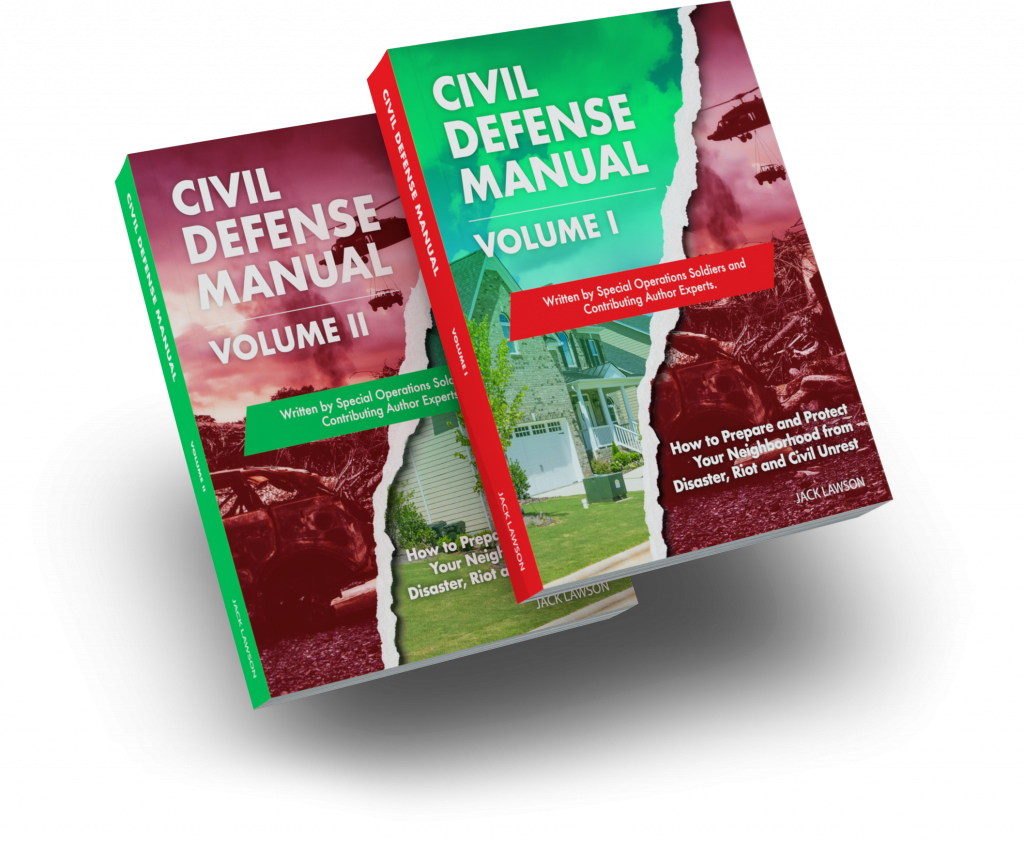
Civil Defense Manual by Jack Lawson on Sale Now

Jack Lawson is one of the co-authors of the now out-of-print but still much sought after book A Failure of Civility. He has now published Civil Defense Manual, Vol. I & II: How to Prepare and Protect Your Neighborhood from Disaster, Riot and Civil Unrest.

What’s in the Civil Defense Manual?

An overview of some subjects…

  • How to protect and secure your neighborhood against riot, civil unrest and fire using the CDM Neighborhood Protection PlanTM concept.
  • How to determine the level of danger from mobs where you live with this simple calculator
  • Checklists of items you must immediately purchase when Extraordinary Catastrophic Events strike in practical check box checklist forms
  • Tips on how to survive a gun battle
  • How to get gas station fuel from underground tanks in a total Grid Down situation
  • How neighbors can make their area a secure fortress by using simple military tactics
  • Night fighting without night vision equipment-written by a Navy SEAL Officer
  • Water sources, where are they and how to make water drinkable
  • Emergency lighting on and off the grid, how to make a torch and lamp, how to make lamp oil from trees, how to make candles and wicks
  • A simple way to store chicken eggs without refrigeration for up to two years
  • What you need for individual/cooperative tools, supplies, equipment needed for survival
  • Improvised security devices, improvised weapons and improvised attack vehicles
  • How to make your own N95 equivalent reusable face mask
  • The most probable catastrophes that are looming and what their characteristics will be
  • How to make a bullet cause a shotgun effect by using the ‘skipping rounds’ technique
  • Where and how to get salt from Mother Nature virtually anywhere
  • The step by step procedure of organizing your neighborhood and how to put it in action
  • What to buy in emergency foods and proper storage
  • Cold weather refuge from freezing without burning fuel
  • How to make Pemmican-the long-term storage food staple that provides everything you need in one food source
  • Marksmanship fundamentals… how to logically and properly choose your firearm
  • Medical information and resources and alternative pain control methods
  • How to make your own hand sanitizer
  • All about short and long-range radio communications
  • Dental care, how to protect your teeth without a dentist and pain control methods
  • How to make your own toothbrush and toothpaste
  • What fuel to store and how to store it.
  • The ABCs of alternative power sources
  • How to survive hypothermia and cold weather when others die
  • How to aggressively defend your neighborhood using strategies and simple military tactics that will defeat far superior forces
  • How to survive biological infectious disease and protective equipment needed
  • Principles of an Area Tactical Proactive Defense, patrolling and house clearing
  • Strategic and tactical principles of thought
  • Tactics… Plain language explanations, that even with no military or Law Enforcement background, you can understand. Tactical and strategic principles, effects and movement:
    • All Around Defense
    • Fields of Fire
    • Interlocking Fields of Fire
    • Supporting Fields of Fire
    • Element of Surprise
    • Force Multiplier Effect
    • Violence of Action
    • Economy of Force
    • Kill Zone maze
    • Defense In Depth
    • Flanking Attack principles
    • L Shaped Ambush
    • Cover and Fire Movement
    • Fall Back Fighting Positions
    • Area Tactical Proactive Defense (aggressive defense employing offensive maneuvers)
    • Serpentine Entry Control
    • Perimeter Defense and the Vauban Star Perimeter Defense principle
    • Indirect Approach Strategy
    • Employment and coordination of Inside Marksmen and OutFlanker Marksmen
    • The Rapid Response Force
    • The third Dimension of the Defensive Perimeter
    • The Castle Concept
  • Setting up long-range marksmen and observation posts
  • How to fortify and defend a suburban neighborhood, high-rise building, ranch, farm or houseboat on a lake or river
  • Where to hunker down in the city
  • How to survive hurricane, earthquake, tornados, electrical power outages
  • Why government can’t assist and why you and your neighbors are on your own.
  • Why natural gas flow will stop with most severe disasters-contrary to popular thought
  • The organizational structure needed for a CDM Neighborhood Protection PlanTM
  • Defense Perimeter principles and how to build fortifications
  • Surviving Nuclear Warfare where you are with what you have
  • The effect of an Electro Magnetic Pulse event (EMP) on you and what it will damage
  • How to build an inexpensive Faraday Cage
  • Sanitation and care for the dead made simple
  • Fire protection procedures
  • What a disaster will really be like and how to mentally prepare yourself for disaster
  • How to create an essential Intelligence Section to know what is happening in your area
  • The A to Z of underground shelters and everything you could possibly want to know
  • Security in Motion, Survival-Escape-Resistance-Evasion (SERE)
  • How to deal with family, friends and those who don’t prepare
  • Bullet proof vest protection level chart and penetration chart of common materials
  • Morse Code chart
  • Emergency Radio Frequency list
  • The Military Phonetic Alphabet
  • Calculation form for food, how many people it will feed and for how long
  • Blood transfusion compatibility chart
  • Chart of Catastrophic Events and Characteristics
  • Numerous engaging and illustrative stories to heighten the learning experience
  • Book features: Large font, written in Layman terms, practical check box checklists and forms, definitions, diagrams, depictions, charts, photographs and stories

Update: Having received a copy of Civil Defense Manual, I can now see that contributing authors include Sam Culper of Forward Observer, NC Scout from Brushbeater blog, former Navy SEAL Matt Bracken, Concerned American from Western Rifle Shooters Assoc., and SELCO among others. All of those names should be familiar to readers of this website, as I’ve posted or linked to all of them previously. Their contributions are mostly in the form of chapters dealing with their specialties, like communications for NC Scout and intelligence by Sam Culper. At least some of those sections may have been previously published by those contributors. The two volumes are letter-sized paper, perfect bound, for a total of 950 pages.

See also Civil Defense Manual Store Food Now!

…The Food Weapon

No folks… not that kind of weapon. Food… or the lack thereof. Food is a weapon that can destroy people, movements, groups, nations… and those with enough power to control food and use it as a weapon… don’t have to lift a finger, fire one bullet or even engage their enemy.

All they have to do is sit back and wait for your emaciated and starved carcass to start rotting. Then what will come true is what Charles Heston said at an NRA Convention… “You can have my rifle… but you’ll have to pry it from my cold, dead hands!” That’s what those who use food as a weapon will do… wait until you’re dead and cold. And as an added bonus… they have that fine firearm you were going to defend your lifestyle with…

Update (2022): You can also read a review of the Civil Defense Manual by Joe Dolio, author of the Tactical Wisdom book series.

It’s been said that the measure of a man’s intelligence is often how much he agrees with you. I felt that way as I read Volume 1 of Jack Lawson’s Civil Defense Manual. I’ll put link down below. Since he agrees almost completely with me, the man is clearly a GENIUS.

You’d think as an author writing books about preparedness and community defense, I’d be some sort of all-knowing expert, but the truth is, I realize that I’m not. I frequently seek other sources like Clay Martin’s outstanding books, Max Velocity’s material, and even some fiction with great tips in them, like Mark Sibley’s Mongol Moon (links to all these on the Recommendations page). The reason I do this comes from the Ultimate Tactical Handbook:

Where there is no guidance the people fall,
But in abundance of counselors there is victory.

Proverbs 11:14

The Civil Defense Manual is a hefty 2-volume set, and while it’s written by Jack Lawson, several experts contributed to the work, including some of my friends and advisors. People like Matt Bracken (EnemiesForeignAndDomestic.com), Mike Shelby of ForwardObserver.com, and NC Scout for radio…

Mises Institute: America’s Private Militias of the Nineteenth Century

Richardson Light Guard of Wakefield, MA

Ryan McMaken at the Mises Institute writes of some little known American history in America’s Private Militias of the Nineteenth Century

Since at least as early as the mid-1990s, the term “militia” has been increasingly used by journalists and scholars on the left in connection with alleged “right-wing extremists.”1

Over time, the term “militia” has been used to describe nearly any group of nonleftist armed men, and has been generally used in close connection with terms like “extremism,” “violence,” and “vigilante.” We have been reminded of this in recent years during riots in places like Ferguson, Missouri (in 2014), and Kenosha, Wisconsin (in 2020). In both cases, armed volunteers attempted to assist private sector business owners with protecting their property from looters and rioters. And in both cases, the volunteers were described with terms such as: “violent,” “militia,” “extreme,” and “white vigilante.”

Historically in the United States, however, the term “militia” had entirely different connotations. Throughout much of the nineteenth century, militias were considered to be common institutions central to civic and community life. They were a common fixture of local festivals and celebrations, and they functioned in some ways as fraternal orders function today.

Although some critics of the militia idea have attempted to claim militias existed primarily to suppress slave rebellions, the fact is militias were common and widespread in Northern states where they had no role whatsoever in maintaining the institution of slavery. In fact, militias often served an important role in providing opportunities and community cohesion for new immigrants.

The Local Militias of the Nineteenth Century

What’s more, many militias were independent of a centralized state militia system and functioned largely as private entities. They elected their own officers, were self-funded, and trained on their own schedules. Although they were ostensibly commanded by the state governors, this system of functionally private militias became an established part of daily life for many Americans. These were local volunteer militias with names like the “Richardson Light Guard,” the “Detroit Light Guard,” or the “Asmonean Guard.”2 They were essentially private clubs composed of gun owners who were expected to assist in keeping law and order within the cities and towns of the United States.

They were separate from the so-called common militias, which developed in the eighteenth and early nineteenth centuries, and which in many cases were staffed with conscripts, were funded with tax dollars, and were commanded by an established state bureaucracy.

But by the Jacksonian period, new volunteer militias began to arise. As noted by Jeffrey Rogers Hummel, the United States by the 1830s had seen “a remarkable growth in the privately organized volunteer militia. The number of volunteer units had been expanding steadily since the American Revolution, but after the war of 1812, it exploded. Three hundred sprang up in California alone between 1849 and 1856.”3

These groups were, in the words of historian Marcus Cunliffe, “volunteer companies existing independently of the statewide system of militia, and they held themselves aloof from the common mass. They provided their own uniforms.”4

They also elected their own officers, did their own fundraising, staffed their own governing boards, and sought out for themselves a secure position within the communities where members lived. In earlier decades, especially the 1830s and 1840s, these groups tended to be “elite” in the sense that they attracted upper middle– and upper-class members of the community. This was in many cases because of the cost of funding these volunteer militias.

As a member of the Detroit Light Guard remembered, “at that time the company got nothing from the State. They had to pay for all they got, uniforms and all.”5

But by the 1850s, firearms and uniforms were becoming more affordable to the middle and working classes. This brought in many new members from outside the local elite circles of established families. Moreover, some militias were able to solicit funding from wealthy members of the community who acted as patrons. The case of the Richardson Light Guard (RLG) is instructive:

The RLG came into being in South Reading, Massachusetts, in 1851, in response to a perceived shortage of militiamen in the years following the Mexican War. At the time, all that was necessary for the militia to be regarded as legally sanctions was for the group to “petition the governor” for what amounted to a nod of approval. This was granted. But at that point, the group still lacked funding. Although members paid dues, historian Barry Stentiford notes that “Dues were not enough [to] cover the expenses of the fledgling company, and committee members had to use their own money to carry out its business.”6

Members came up with a plan to offer “honorary memberships” to wealthy members of the community. The largest donor in this scheme was a man named Richardson, after whom the militia was soon named. Funding from prominent community members also added legitimacy to the group and ensured it would continue to be regarded as a community-sanctioned group of armed men.

Although the RLG enjoyed legal sanction, it was essentially a private organization, and Stentiford notes, “At its inception, the RLG belonged to its members, and to prominent residents of the town of South Reading. The town of South Reading, the Commonwealth of Massachusetts, and the federal government occupied a diminishing hierarchy of influence.”7

In other words, while everyone admitted local, state, and federal officials enjoyed some form of control of the militia, this authority was tentative at best.

Massachusetts wasn’t the only place were militias were privately funded and privately controlled. When Iowa became a US territory in 1838, for example, an “official” territorial militia was formed. On the other hand:

The formation of local militia groups was more relaxed in comparison to the State militia service. To form a local militia group one would simply ask for local men to sign up, name the group, possibly elect officials or form by-laws, and then write to the Iowa Territory legislature to introduce themselves and request weapons….If you received a positive letter back and weapons, you were a militia group in the Territory of Iowa.

Indeed, this sort of local—and even private ownership—was an increasingly common method of organizing militias by midcentury. Hummel concludes that “Because many volunteer units were privately organized, recruited, and equipped, the militia became a partially privatized system as well.”

Because of their local nature, many militias reflected local character as well—and access was hardly limited to national ethnic majorities. By the 1850s, immigrants had come to dominate many volunteer militias, with Irish, Scottish, and German militias becoming especially common. The Scottish militiamen wore kilts as part of their parade uniforms. The Italians created a “Guardia Nazionale Italiana.” Robert Ernst notes that the “significance of the immigrant military companies is evident in the fact that in 1853, more than 4,000 of the 6,000 uniformed militia in New York City were of foreign birth.”8

Nor were militia groups limited to Christians. Jack D. Foner recounts in the American Jewish Archives Journal:

Jews in New York City formed military companies of their own. Troop K, Empire Hussars, was composed entirely of Jews, as was the Young Men’s Lafayette Association. A third unit, the Asmonean Guard, consisted of both Jewish and Christian employees of The Asmonean, one of the earliest Anglo-Jewish weekly newspapers. “Our employees,” commented the newspaper, “have been seized with this military mania, as they have enrolled themselves into an independent corps.”

As militias became more middle class, their names changed as well. Militias began to refer to themselves with names that might be used for sports teams today, including terms like “Invincibles,” “Avengers,” and “Snake Hunters.”

Dress uniforms were often extravagant and modeled on Napoleon’s troops earlier in the century. These groups were even known to impress foreigners. As one Englishman remarked: “They marched in sections, with a splendid band at their head and…it would be impossible to find a more military-looking, well-drilled body of men.”9

These volunteer militias were attractive to potential members, because these groups served many social functions as well. As noted by historian Briton Cooper Busch, “in peacetime, all [volunteer militias] helped their communities celebrate festivals, holidays, and funerals with marches, balls, and banquets, helping out in emergencies, and often building an esprit de corps which established a basis for effective wartime service and even elite reputations.”10

In many cases, membership in a local militia provided opportunities for social advancement, and “it was not uncommon for individual families to have long associations with these institutions.”11 For newcomers to any community, whether or not of foreign origin, “the militia company provided a means for newer residents to embed themselves into the fabric of the community.”12

The volunteer militias played a similar role to that of the volunteer fire brigades of this period, which in many communities came to be dominated by immigrant groups and served as a way to and advance the social and economic lives of newcomers.13

Militias Replaced by Full-Time Government Police and Centralized “National Guard”

Needless to say, this model of American militias is long gone from the imagination of nearly all Americans. Modern-day journalists and scholars have been hard at work attempting to connect militias, past and present, either to slavery or to fringe groups and vigilantism. Moreover, many Americans now regard the idea of privately controlled bands of armed men with trepidation and fear.

As the size and scope of taxpayer-funded bureaucratic agencies grew throughout the nineteenth century, private volunteer militias were deemed increasingly unnecessary and undesirable. The late nineteenth century was a period during which states and the federal government went to great lengths to end the old system of locally controlled militias, and this was topped off by the Militia Act of 1903 which largely ended state autonomy in controlling state military resources as well. By 1945, the National Guard was well on its way to becoming little more than an auxiliary to the federal government’s military establishment, although some remnants of the old decentralized system remained.

When it comes to urban environments, these militia were in many respects replaced by today’s state and local police forces, which unlike the volunteer militias are on the job full-time and enjoy immunity and privileges far beyond what any militia member of old might have ever dreamed of having. Rather than private self-funded militias called out only occasionally to quell riots and uprisings, we have immense, taxpayer-paid police forces with military equipment, SWAT teams, and riot gear to carry out no-knock raids (often getting the address wrong).

The old militia system was by no means flawless, but this switch to a more centralized bureaucratic system is not without costs of its own, both in terms of dollars and the potential for abuse.

Moreover, as has become increasingly apparent in recent years, National Guard troops and local police forces are clearly inadequate to provide safety and security for private homes and businesses. Half of the nation’s violent crimes remain “unsolved” as police focus on petty drug offenses rather than homicides. Meanwhile—as happened in both Ferguson and Kenosha—National Guard troops focus their protection on government buildings while private businesses burn.

The dominant shapers of public opinion would have us believe that volunteer groups of armed men must be regarded with horror. Yet it is increasingly clear that the institutions that have replaced the militias of the past still leave much to be desired.

The Trumpet: Where Will All the Hate End?

From Brad MacDonald at The Trumpet, Where Will All the Hate End? about how hate feeds upon itself.

When you look at this world, you see so much hate. This ought to terrify more people and make us think much more seriously about the next few months and years.

Exhibit one, of course, is Black Lives Matter (blm) and Antifa, and the radical left in general. These people openly confess to harboring a deep hatred for America and Britain, and especially for Donald Trump and his supporters. Led by fanatic politicians, academics and celebrities, and backed by the mainstream media, these people vehemently hate traditional, Judeo-Christian America.

But the surging hate isn’t confined to blm and Antifa. All across the world, hate and all its offspring—harassment, intolerance, abuse, protests and riots, persecution, violence and murder, even genocide—flourish. In his Trumpet Brief yesterday, Joel Hilliker revealed the shocking hate Buddhists in Myanmar have for the Rohingya, a Muslim minority group. Anti-Semitism is rising. Racial and ethnic conflicts are universal. Citizens increasingly despise their leaders and governments. We learned this week that Russian President Vladimir Putin despised his political opponent so much, and no doubt hated the thought of being toppled by him, he had him poisoned. Everywhere you look, hate grows.

Here’s why this is utterly terrifying: It is the nature of hate to stimulate more hate. Hate manifested—whether in heated arguments, the perversion of justice, dishonest journalism, destructive riots, beatings and murders—always encourages more hate. Even when the victim does not initially hate the aggressor, the persistent mistreatment and abuse compel him to frustration, anger and, eventually, hate. Hate is reciprocal.

This cycle of hate was on display last weekend in downtown Portland, Oregon, which continues to be held hostage by Antifa and blm. For three consecutive months these people have hurled vile attacks on America and on President Trump and his supporters. They have violently attacked people and smashed and burned homes, businesses and government buildings, inflicting millions of dollars’ worth of damage. On Saturday, the object of blm’s and Antifa’s hate responded. Hundreds of trucks loaded with Trump supporters traveled in a caravan through downtown Portland; they were expressing their disgust with the rioters.

We saw what happened. There was tension, conflict and violence. Scuffles and fights broke out. Trump supporters shot the rioters with paint balls. A Trump supporter was publicly executed, after which the rioters were heard singing in celebration.

This was inevitable. This is how hate works. It will happen again.

What happened in Portland last Saturday did nothing to soothe the hate of either side. To the contrary, for blm, Antifa and the left, the Trump supporters’ resistance only confirmed their view that they are racists and deserving of hate. Meanwhile, the Trump followers—including the millions who watched it unfold on a screen—undoubtedly came away with a stronger grasp of how much they are hated. It’s impossible that after witnessing this, many Trump supporters will not despise blm, Antifa and those who support these groups even more.

This is how hate works. It rarely fizzles; it only intensifies. This is where America is right now, and there is no turning back. When it reaches a certain point, there’s no way to stop the cycle of hate. It appears America has passed this point.

Trumpet editor in chief Gerald Flurry recently pointed to a quote by Abraham Lincoln, delivered in Springfield, Illinois, in January 1838. Lincoln was only 28 years old. There was a lot of hatred between the abolitionists and pro-slavery advocates at the time. America was sliding into “mob law” and social disorder, and the government’s response was apathetic and slow-footed.

Facing these conditions, Lincoln said, “[G]ood men, men who love tranquility, who desire to abide by the laws, and enjoy their benefits, who would gladly spill their blood in the defense of their country; seeing their property destroyed; their families insulted, and their lives endangered; their persons injured; and seeing nothing in prospect that forebodes a change for the better; become tired of, and disgusted with, a government that offers them no protection; and are not much averse to a change in which they imagine they have nothing to lose” (emphasis added).

Lincoln’s observation is a warning: Even law-abiding, peaceful people will become filled with anger and hatred when “their property [is] destroyed; their families insulted, and their lives endangered; their persons injured.” This is the way human emotions work. Without divine intervention (more on this later), hate reciprocates.

When people are attacked, viciously and personally, when they see their nation and livelihood under threat, their cities burning, and when they see that those in authority are unwilling to defend them, they are compelled to respond. It is human nature to protect one’s self, including your family, your home and livelihood, your community and friends. And your nation. In America, law-abiding citizens who love their country are being forced to choose: Surrender to the radical left and lose everything, or grow angry and fight.

People are being driven to hatred and retaliation because the only alternative is death. But their resistance, which is entirely rational, only entrenches the irrational views and hatred of the attacker. To the aggressor, the victim’s resistance only confirms his belief that he is right, and that the victim must be punished.

This is where we are today. Any person accused of being a racist who denies being a racist, must be despised as a racist. Any person unwilling to support blm must hate blm and what it stands for and is, therefore, the enemy. The more Antifa, blm and the radical left are filled with hate, the more the anger and hate of their victims grow.

How does this cycle of hate end?

Have you ever seen footage of a pile of tires on fire? A tire fire is often impossible to extinguish. It stops only after the tires have burned out. It’s the same with the cycle of hate. It will stop only after the hate has burned itself out. It will stop only when those with the hate are gone.

Sadly, the cycle of hate in America now appears far past simply simmering down. The destructive hate coursing through America’s cities is only growing.

And it’s not just America. Look at its brothers—the United Kingdom, Australia, Canada. While we have yet to witness scenes of hate as dramatic as those in Portland or Kenosha, the same fault lines and emotions are welling in these nations. The radical left thrives in these countries too. And it’s deep, deep hatred of these nations’ traditional Christian heritage is deepening the anger, resentment and hatred of those it seeks to destroy.

Just like the United States, Britain, Australia, New Zealand, Canada and all the other Commonwealth nations are trapped in a devastating cycle of hate!

Bible prophecy tells us how this will end. In Matthew 24:22, Jesus is talking about the end of the age of man and warns, and He says: “And except those days should be shortened, there should no flesh be saved ….” Humanity will be so filled with hatred, which will be demonstrated through mass violence and worldwide war, man will bring himself to the cusp of extinction. The “great tribulation,” as Jesus Christ calls it in verse 21, is one colossal explosion of hate.

And then shall many be offended, and shall betray one another, and shall hate one another,” verse 10 says.

Man does not fully comprehend the destructive power of hate. This is because he doesn’t understand the ultimate source of this powerful emotion. The Bible reveals this source. It is revealed in passages such as 2 Corinthians 4:4, Ephesians 2:2 and Revelation 12. These passages reveal the presence of Satan the devil, a spirit being who embodies hate, whose every thought and action is inspired by hatred toward God, His truth and His plan.

Revelation 12 gives insight into just how much hatred the devil has for God and His plan. In verses 3-4, he’s referred to as a “great red dragon” who tries to “devour” God’s people. Verses 7-8 describe how the devil actually waged a colossal war on God. During this battle, the devil was cast down to Earth, where he is now confined (verse 9). Verse 12 addresses those on Earth today, warning that “the devil is come down unto you, having great wrath, because he knoweth that he hath but a short time.”

All the hatred on the streets of America’s cities and tumbling from the lips of politicians and media pundits on cnn and the like—it all originates from the devil’s bottomless well of “great wrath.”

The Apostle Paul calls Satan the “god of this world” who “blinded the minds” of men, and the “prince of the power of the air.” In Chapter 2 of Mystery of the Ages, the late Herbert W. Armstrong explained these verses in detail and revealed how the devil broadcasts to human beings through our emotions, attitudes and impulses. And when it comes to emotion, Satan’s favorite language is anger and hatred. He is the grandmaster of hatred, and one of his favorite pastimes is teaching humans how to hate.

This is why the Bible cautions us to be careful with our emotions and attitudes, especially with feelings of anger and hatred. Consider Paul’s words in Ephesians 4:25-27: “Therefore, putting away falsehood, let every one speak the truth with his neighbor, for we are members one of another. Be angry but do not sin; do not let the sun go down on your anger, and give no opportunity to the devil” (Revised Standard Version).

In this passage, Paul recognizes that there is a time for righteous indignation, or godly anger. Righteous indignation is an aspect of God’s love. It gets angry at sin. It hates sin, but not the sinner. Sadly, we see very little of this sort of righteous indignation today. The angriest people on Earth are usually the greatest sinners.

But then Paul specifically cautions the people to be careful with their emotions, especially anger and frustration. Never let the “sun go down on your anger,” he warns. We must be extremely careful not to allow anger and hatred to fester and get out of control. And we should never deliberately stir up anger and hatred. Yet this is exactly what blm, Antifa and the radical left does. Their leaders are trained to arouse hate. These groups thrive on hatred!

This is a dangerous game. When people well with hate, Paul says, they “give … opportunity to the devil.” Unbridled anger, hatred, resentment, bitterness—these emotions are invitations to the devil, welcoming him into our minds and lives. Many of those people torching cars and tearing down buildings are under the influence of the devil.

When you look at America (and humanity) collectively, there is no evidence of any movement toward repentance that would reverse the trend toward destruction it is taking—though, if the nation did genuinely repent, God would certainly respond with mercy. Individually, though, the path to repentance is open to you. You can escape the cycle of hate, which will soon end in a massive climax called the Great Tribulation. How?

Ultimately, we escape this future by conquering our human emotions and impulses, our attitudes and human will, the powerful pulls of the carnal mind and flesh, and by surrendering our lives and minds completely to God, His law and His government. This is not an easy task; it cannot be done on human power or talent. It can only be done using the power of God’s Spirit, which we receive upon repentance and faith.

Off Grid: Self-Defense Against Sexual Assault

In Self-Defense Against Sexual Assault, three self-defense experts discuss how to avoidance and prevention techniques.

There are a lot of dangerous misconceptions about sexual assault in this country...

Data collected by the Department of Justice and the FBI over decades show that rape and sexual assault are crimes experienced by 1 in 6 American women and 1 in 33 men. Eight out of 10 rapes are committed by someone known to the victim, usually either an acquaintance or a former/current partner, and over half of all rapes take place in or near the victim’s home. In cases of sexual assault against a juvenile, the percentage of crimes committed against them by someone they know is 93 percent. The use of weapons in sexual assault, apart from the assailant’s own hands and feet, is relatively rare — 11 percent total, and slightly more guns than knives.

The truth is that for most victims, rape and sexual assault aren’t random acts of violence. They’re typically perpetrated by someone the victim knows — the hookup who had some time alone with her drink, the person in a position of authority she doesn’t feel she can say “no” to, such as a prison guard, or maybe the roommate’s boyfriend who keeps hanging out in their dorm room. This degree of familiarity brings a lot of complication with it. It’s easy to visualize violence against a predator you’ve never met before, but much harder when it’s someone you know, someone who your family likes, someone you thought you were friends with, or someone you might have to see and deal with every day…

RECOIL OFFGRID has assembled a panel of experts in the field of women’s self-defense to cover common questions about how to prevent and protect yourself from sexual assault. This panel consists of myself, martial arts trainer Cath Lauria; SIG Sauer Director of Training and Special Events Hana Bilodeau; and Rhonda Lent, who also has a background in law enforcement.

What verbal de-escalation techniques can be used to thwart an attack, and what’s the overall role of psychological self-defense?

CL: The most effective de-escalation techniques start early, and they don’t even have to be verbal to work. Setting and maintaining boundaries is the best thing a person can do to help protect themselves against assault before things get physical. Does that drunk guy at the office holiday party keep coming up to you asking for a hug? Offer a handshake instead. If he insists, tell him you’re just not interested in a hug, thanks. What if he calls you a bitch? Well, who cares what he thinks, as long as you’re safe.

sexual assault defense

If things get to the point where threats are being made, where physical boundaries are being crossed, and where you feel unsafe — this is the time for more forceful de-
escalation techniques. Volume goes up, hands go up — put a physical and a sound barrier between you. You don’t have to curse and threaten in turn, and it’s better if you don’t. Be clear: Tell them to back off, to leave you alone, shout for others to call the cops. Do this loudly. You want people to hear you, to rip away the veil of privacy and secrecy the assailant is trying to create. If they continue into physical assault after this? Then, it’s all systems go, because you know that you’ve done your best to de-escalate the situation by letting them know that attacking you is going to be a big mistake.

HB: Verbal de-escalation is an invaluable skill. As was discussed in the article, despite common misconceptions, most sexual assaults occur by someone known by the victim. Because of this familiarity, most often there’s a grooming phase prior to the actual assault. Due to manipulation on behalf of the suspect, the victim is often left confused and scared and, in many instances, doesn’t verbally or physically resist. Because of the shame that the abuse leaves behind, we find a large majority of victims don’t report the abuse immediately, if at all. It’s the responsibility of modern society to fight the root of the problem if we intend on making a notable difference. We need to breed into our youth body positivity and respect. Teach them to have a voice and how to use it. Whether a stranger or a trusted loved one, implementing “verbal Judo” could potentially be the defense that changes the outcome.

RL: I’ve been accused of “victim blaming” when discussing the development of soft skills. This is what I always say, and I will say it again. If we lived in a perfect world, we wouldn’t have to lock our houses or lock our cars. If everyone had the same moral and ethical compass and 100 percent abided by a set of rules, we wouldn’t have to take measures to protect our personal belongings from theft. The same logic applies here. The purpose of developing hard and soft self-defense skills is to minimize risk.

warning sign at a bar

Verbal De-Escalation Skills

If the threat isn’t imminent, be clear on how you want things to unfold. Self-confidence is key to verbally and nonverbally delivering what your needs are in that moment. This is about creating boundaries and is an excellent way of testing the waters in how logically the other person will respond.

Say “NO!” loud and clear. This will tell the attacker that whatever happens from that point forward isn’t consensual. When a threat is imminent, you’re past the point of verbal de-escalation. This point requires action. Look around for avenues of escape — if you can escape safely, do it! If you cannot safely escape, you must assess whether or not it’s feasible to physically fight off the attacker...

If you get the sense that something isn’t right, listen to your gut. Intuition is a primitive survival mechanism. Don’t allow your brain to convince you that your gut feeling isn’t warranted! Get beyond a possible mentality of “it won’t happen to me.”

CL: If it comes to the point that an attack is unavoidable and you’re fighting back, remember that the best targets are the ones that can’t be strengthened with steroids. The face — the eyes in particular — and the groin are excellent targets, and a strike there doesn’t require a lot of force to be painful. You don’t even have to hit the eyes or the groin square on to get someone to back off — the body’s flinch response is built-in. As for the old saying that you should never hit a guy in the groin because it’ll just make them madder … it’s true, it will make them mad. It will also be really, really painful, so let them be mad and doubled over holding their junk while you get to safety.

The best thing that martial arts and combatives training can bring to a basic skillset is a better understanding of how to deal with and use adrenaline. Your adrenaline is triggered in assault situations — the fight-or-flight response becomes engaged, and when that happens a lot of fine motor skills go out the window. Gross motor movements are your best bet and practicing those skills under the effect of adrenaline is an excellent way to improve your chances of actually remembering how to protect yourself once the fight is on. It’s imperative to have a basic understanding of grappling and ground skills as well, given that all rapes take place at extremely close range. People don’t become rapists because they want to go toe-to-toe with someone — rape is a crime of power, revolving around being able to intimidate and control someone else. The harder it is to control you, the less inclined they’re going to be to try...

Click here to read the entire article at Off Grid.

In our area, there are many martial arts and firearms instructors. You can find women’s self-defense classes at the following locations, though there are probably many others:

Legacy Jiu Jitsu in Richland

Stealth Defense firearms training. Look for the women-only Pistol-Basic classes on the schedule if you are more comfortable learning in a women-only environment.

The Range in Yakima, women’s concealed carry


The Economic Collapse: 50 Million Americans Fighting Hunger by Year End

Michael Snyder of The Economic Collapse blog has a couple of posts up about hunger and food in the US. First up, It Is Being Projected That More Than 50 Million Americans Will Be Fighting Hunger By The End Of This Year

…Because of all the crazy things that have happened so far in 2020, large numbers of people have been forced into dramatic lifestyle changes.  Many Americans have deeply cut their food budgets due to a lack of income, others are now only eating one or two meals a day, and we are seeing more demand at food banks around the country than we ever have before.  It is quite obvious that massive numbers of people are really hurting, and Bloomberg is reporting that it is being projected that the number of Americans that are “fighting hunger” will rise to “more than 50 million” by the end of this calendar year…

The ranks of Americans fighting hunger are projected to swell some 45% this year to more than 50 million.

To me, that is an absolutely staggering figure.

Right now, the U.S. has a total population of about 328 million people, and so that figure that Bloomberg quoted represents a sizable chunk of the country.

And we certainly don’t have to wait until the end of the year for the numbers to get really, really bad.  In fact, it is being reported that one recent survey found that approximately one-tenth of all U.S. households “haven’t had enough food in a given week”

During the pandemic, about a 10th of American households reported they haven’t had enough food in a given week. That’s a shocking figure for the world’s richest country. It’s more than double pre-Covid figures and the highest since comparable government data starts in 1995.

I feel especially bad for the children that are going hungry.

Can you imagine how bad parents must feel when their children tell them that they are hungry and the parents have nothing to provide?

And this is just the beginning.  Food prices are going to continue skyrocketing over the coming year, and that is just going to stretch family budgets even more.

A few days ago, I strongly urged my readers to stockpile food for the chaotic times that are ahead.  Food prices are only going to go higher, and economic conditions are going to continue to deteriorate.

In fact, some more major job cuts were just announced.  For example, Ford just announced that it will be eliminating “1,400 white collar jobs”

Ford is looking to cut 1,400 white collar jobs in a cost-savings move.

The automaker sent out letters to employees Wednesday saying that salaried staff eligible for retirement would be getting early retirement offers next week. Those who take the offer by October 23 would be leaving the company by the end of the year.

And United Airlines just announced that they will be furloughing more than 16,000 workers

With no air travel rebound or new federal help in sight, United Airlines says it will furlough about 20% of its frontline employees in less than a month’s time.

In a new memo to its employees, United (UAL) says that 16,370 employees will be furloughed when payroll restrictions attached to a federal bailout expire October 1.

Because most Americans live paycheck to paycheck, a job loss can plunge a family into dire straits very rapidly.  All over the U.S., we are seeing long lines of people driving very nice vehicles waiting for up to six hours to get food at local food banks.

Over the past 23 weeks, more than 58 million Americans have filed initial claims for unemployment benefits, and many of them have “suddenly” found themselves in need of food.  For a lot of them, it is the first time something like this has ever happened to them.

And so many people that I talk to believe that what we have experienced so far is just the tip of the iceberg and that much worse is coming.  There is such a sense of urgency in the air, and gun sales just keep setting record after record.  In fact, we just learned that gun sales during the month of August were 57 percent higher than last year

And Michael’s advice a few days ago, Buy Lots Of Food And Store It Some Place Safe, Because Very Difficult Times Are Approaching

Things have already gotten quite crazy, but they are going to get even crazier.  Global food supplies have already gotten tight, but they are going to get even tighter.  When even the UN starts using the word “biblical” to describe the famine that the world is facing, that is a sign that the hour is very late.  Thankfully, we are not facing famine in the short-term here in the United States, but “temporary shortages” of certain items have already been popping up, and food prices are aggressively shooting higher.  Earlier today my wife stopped by the grocery store to pick up a couple of things, and one particular item that used to cost about 12 dollars was now 20 dollars instead.  But thanks to the Federal Reserve, this is about as low as food prices are going to get.  The Fed seems absolutely determined to crank up inflation, and that is going to have very serious implications during the times that are ahead.  Right now we have a window of opportunity before the next wave of trouble comes along, and I would greatly encourage you to use this window of opportunity to buy lots of food and store it some place safe.

Some people seem to think that if they have stored up a couple months worth of food that they will be just fine.

Unfortunately, that is not the reality of what we are facing.  The truth is that you should have enough food to feed every single person in your household for an extended period of time, and many of you will need much more than that.  Because when things get really crazy, many of the friends, neighbors and extended family members that neglected to prepare will come knocking on your door asking for help.

There are some people that would turn away those friends, neighbors and extended family members, but I couldn’t do that.  Yes, they are at fault for refusing to get prepared, but I just couldn’t turn them out into the street.

If you also plan to assist those around you that are in need, that just makes your job even bigger.  In the end, there is a limit to what any of us can do, and so we will do what we can with what we have and we will leave the rest to God.

The overwhelming demand that we are witnessing at food banks around the nation right now gives us some clues about what we can expect as economic conditions get even worse.  In Alameda County, vehicles are lining up “as early as seven in the morning” just to get a little bit of food from the local food banks…

“They start lining up as early as seven in the morning and this will run for six straight hours” said Altfest.

Hundreds of cars slowly snake their way through the parking lot across from the Acura dealership on Interstate 880. Folks from all walks of life driving everything from Toyota’s, BMW’s, to Mercedes, all coming to get food. Folks are grateful for the charity.

When I read that quote from a local CBS news report, it struck me that it sounded almost exactly like what Heidi Baker said when she saw people waiting in line to get food…

And I saw all these people and they had beautiful cars, 4 by 4’s and Lexus, Mercedez, BMW’s, Toyotas. There they were with fancy shiny cars, but they were standing in line.

On the east coast we are seeing similar things happen.

In fact, there was a quarter-mile line at the break of dawn at a food bank in Queens on Saturday

The line stretched a quarter-mile before the sun was barely up Saturday, snaking around corners like bread lines in the 1930s. But the hungry in Queens are today’s New Yorkers, left jobless by the coronavirus.

Until the pandemic struck the city, La Jornada food pantry used to hand out groceries to roughly 1,000 families a week. Now, the figure tops 10,000. And volunteers serve lunch every day to 1,000 — many of them kids with growling stomachs. Across the five boroughs, the hungry number in the hundreds of thousands, the Food Bank of New York estimates.

I found it quite interesting that the New York Post is comparing what is happening now to the “bread lines in the 1930s”.

This is the reality of what we are facing people.  So many people are already in desperate need, and this “perfect storm” is just getting started.

In the Richmond, Virginia area things are even worse.  According to one recent report, vehicles have been lining up at one food bank “as early as six hours” before it opens…

Rutherford Institute: Since 9/11, the Government’s Answer to Every Problem Has Been More Government

From Constitutional law attorney John Whitehead at The Rutherford Institute, Since 9/11, the Government’s Answer to Every Problem Has Been More Government

“A government big enough to give you everything you want is a government big enough to take away everything that you have.”—Anonymous

Have you noticed that the government’s answer to every problem is more government—at taxpayer expense—and less individual liberty?

The Great Depression. The World Wars. The 9/11 terror attacks. The COVID-19 pandemic.

Every crisis—manufactured or otherwise—since the nation’s early beginnings has become a make-work opportunity for the government to expand its reach and its power at taxpayer expense while limiting our freedoms at every turn.

Indeed, the history of the United States is a testament to the old adage that liberty decreases as government (and government bureaucracy) grows. To put it another way, as government expands, liberty contracts.

To the police state, this COVID-19 pandemic has been a huge boon, like winning the biggest jackpot in the lottery. Certainly, it will prove to be a windfall for those who profit from government expenditures and expansions.

Given the rate at which the government has been devising new ways to spend our money and establish itself as the “solution” to all of our worldly problems, this current crisis will most likely end up ushering in the largest expansion of government power since the 9/11 terrorist attacks.

This is how the emergency state operates, after all.

From 9/11 to COVID-19, “we the people” have acted the part of the helpless, gullible victims desperately in need of the government to save us from whatever danger threatens. In turn, the government has been all too accommodating and eager while also expanding its power and authority in the so-called name of national security.

As chief correspondent Dan Balz asks for The Washington Post, “Government is everywhere now. Where does it go next?

When it comes to the power players that call the shots, there is no end to their voracious appetite for more: more money, more power, more control.

This expansion of government power is also increasing our federal debt in unprecedented leaps and bounds. Yet the government isn’t just borrowing outrageous amounts of money to keep the country afloat. It’s also borrowing indecent sums to pay for programs it can’t afford.

The government’s primary response to this COVID-19 pandemic—flooding the market with borrowed money in the amount of trillions of dollars for stimulus payments, unemployment insurance expansions, and loans to prop up small businesses and to keep big companies afloat—has pushed the country even deeper in debt.

By “the country,” I really mean the taxpayers. And by “the taxpayers,” it’s really future generations who will be shackled to debt loads they may never be able to pay back.

This is how you impoverish the future.

Democrats and Republicans alike have done this.

Without fail, every president within the last 50 years has expanded the nation’s debt. When President Trump took office on January 20, 2017, the national debt—the amount the federal government has borrowed over the years and must pay back—was a whopping $19.9 trillion. Despite Trump’s pledge to drain the swamp and eliminate the debt, the federal debt is now approaching $27 trillion and is on track to surpass $78 trillion by 2028.

For many years now, economists have warned that economic collapse would be inevitable if the national debt ever surpassed the size of the U.S. economy. The government passed that point in June 2020 and has yet to put the brakes on its spending.

In fact, the Federal Reserve just keeps printing more money in order to prop up the economy and float the debt.

At some point, something’s got to give.

As it now stands, the U.S. is among the most indebted countries in the world.

Almost a third of the $27 trillion national debt is owed to foreign entities such as Japan and China.

Most of the debt, however, is owed to the public.

How is this even possible? Essentially, it’s a case of robbing Peter to pay Paul.

First, the government requires taxpayers to pay a portion of their salaries to the Social Security Trust Fund. The government then turns around and borrows from Social Security to cover its spending needs. Then the government raises taxes or prints more money in order to pay out whatever is needed to the retirees.

It’s a form of convoluted economics that only makes sense to government bureaucrats looking to make a profit off the backs of the taxpayers.

According to the U.S. Debt Clock, each taxpayer’s share of the national debt is $214,000 and growing.

That’s almost five times more than the median income for what Americans earn in a year. That’s also almost five times more than the average American has in savings, across savings accounts, checking accounts, money market accounts, call deposit accounts, and prepaid cards. Almost 60% of Americans are so financially strapped that they don’t have even $500 in savings and nothing whatsoever put away for retirement.

Just the interest that must be paid on the national debt every year is $338 billion and growing. According to the Congressional Budget Office, the fastest growing item in the budget over the next decade will be interest on the debt.

As the Committee for a Responsible Federal Budget reported in 2019, before COVID spending pushed the country over the fiscal cliff, “Interest payments will rise from $325 billion last year to $928 billion by 2029, a nearly threefold increase. If tax cuts and spending increases are extended, interest will exceed $1 trillion and set a new record as a share of the economy. The federal government will spend more on interest than on Medicaid or children by 2020. By 2024, interest will match defense spending.

Bottom line: The U.S. government—and that includes the current administration—is spending money it doesn’t have on programs it can’t afford, and “we the taxpayers” are the ones who will have to pay for it.

As financial analyst Kristin Tate explains, “When the government has its debt bill come due, all of us will be on the hook.”

Despite the tax burden “we the people” are made to bear, we have no real say in how the government runs, or how our taxpayer funds are used, but we’re being forced to pay through the nose, anyhow.

We have no real say, but that doesn’t prevent the government from fleecing us at every turn and forcing us to pay for endless wars that do more to fund the military industrial complex than protect us, pork barrel projects that produce little to nothing, and a police state that serves only to imprison us within its walls.

All the while the government continues to do whatever it wants—levy taxes, rack up debt, spend outrageously and irresponsibly—with little thought for the plight of its citizens.

This brings me to a curious point: what the future will look like ten years from now, when the federal debt is expected to surpass $78 trillion, an unsustainable level of debt that will result in unprecedented economic hardship for anyone that does not belong to the wealthy elite.

Interestingly enough, that timeline coincides with the government’s vision of the future as depicted in a Pentagon training video created by the Army for U.S. Special Operations Command.

According to the video, the government is anticipating trouble (read: civil unrest), which is code for anything that challenges the government’s authority, wealth and power, and is grooming its armed forces (including its heavily armed federal agents) accordingly to solve future domestic political and social problems.

The training video, titled “Megacities: Urban Future, the Emerging Complexity,” is only five minutes long, but it provides a chilling glimpse of what the government expects the world to look like in 2030, a world bedeviled by “criminal networks,” “substandard infrastructure,” “religious and ethnic tensions,” “impoverishment, slums,” “open landfills, over-burdened sewers,” a “growing mass of unemployed,” and an urban landscape in which the prosperous economic elite must be protected from the impoverishment of the have nots.

And then comes the kicker.

Three-and-a-half minutes into the Pentagon’s dystopian vision of “a world of Robert Kaplan-esque urban hellscapes — brutal and anarchic supercities filled with gangs of youth-gone-wild, a restive underclass, criminal syndicates, and bands of malicious hackers,” the ominous voice of the narrator speaks of a need to “drain the swamps.”

Drain the swamps.

Surely, we’ve heard that phrase before?

Ah yes.

Emblazoned on t-shirts and signs, shouted at rallies, and used as a rallying cry among Trump supporters, “drain the swamp” became one of Donald Trump’s most-used campaign slogans.

Far from draining the politically corrupt swamps of Washington DC of lobbyists and special interest groups, however, the Trump Administration has further mired us in a sweltering bog of corruption and self-serving tactics.

Funny how the more things change, the more they stay the same.

Now the government has adopted its own plans for swamp-draining, only it wants to use the military to drain the swamps of futuristic urban American cities of “noncombatants and engage the remaining adversaries in high intensity conflict within.”

And who are these noncombatants, a military term that refers to civilians who are not engaged in fighting during a war?

They are, according to the Pentagon, “adversaries.”

They are “threats.”

They are the “enemy.”

They are people who don’t support the government, people who live in fast-growing urban communities, people who may be less well-off economically than the government and corporate elite, people who engage in protests, people who are unemployed, people who engage in crime (in keeping with the government’s fast-growing, overly broad definition of what constitutes a crime).

In other words, in the eyes of the U.S. military, noncombatants are American citizens a.k.a. domestic extremists a.k.a. enemy combatants who must be identified, targeted, detained, contained and, if necessary, eliminated…(continues)

PrepperNet Live Videocast on Food Shortages, Tonight, SEP 3, 2020

From PrepperNet:

PrepperNet LIVE

Join us Tonight!!!

Food Shortages

at 8:00 PM EST

To Watch LIVE on Thursday Nights

8 PM EST:

https://www.youtube.com/c/PrepperNet

LINE UP
September 10, 2020 @ 8:00 PM EST
Forrest Garvin
Online Privacy & Security
It’s just that important

September 17, 2020 @ 8:00 PM EST
Scott Hunt – Engineer775
Practical Preppers LLC
Sustainable Living Design Engineer

October 1, 2020 @ 8:00 PM EST
Pastor Felix & Forrest Garvin
End Times Bible Prophecy Night
Is the End Near?

To Watch LIVE on Thursday Nights at
8 PM EST go to:
https://www.youtube.com/c/PrepperNet

September Is National Preparedness Month

September is National Preparedness Month. FEMA/DHS has weekly topics this month for enhancing your preparedness.

National Preparedness Month (NPM) is recognized each September to promote family and community disaster planning now and throughout the year. As our nation continues to respond to COVID-19, there is no better time to be involved this September.

The 2020 NPM theme is: Disasters Don’t Wait. Make Your Plan Today.

Week 1

Week 1 September 1-5: Make A Plan

Talk to your friends and family about how you will communicate before, during, and after a disaster. Make sure to update your plan based on the Centers for Disease Control recommendations due to the coronavirus.

Week 2

Week 2 September 6-12: Build A Kit

Gather supplies that will last for several days after a disaster for everyone living in your home.  Don’t forget to consider the unique needs each person or pet may have in case you have to evacuate quickly. Update your kits and supplies based on recommendations by the Centers for Disease Control.

Week 3

Week 3 September 13-19: Prepare for Disasters

Limit the impacts that disasters have on you and your family.  Know the risk of disasters in your area and check your insurance coverage. Learn how to make your home stronger in the face of storms and other common hazards and act fast if you receive a local warning or alert.

week 4

Week 4 September 20-26: Teach Youth About Preparedness

Talk to your kids about preparing for emergencies and what to do in case you are separated. Reassure them by providing information about how they can get involved.


Mises Institute: Why the State Seeks to Abolish Both Tradition and History

From the Mises Institute, Why the State Seeks to Abolish Both Tradition and History

In the opening monologue of the much-beloved musical Fiddler on the Roof, Tevye the milkman compares life for the Jewish inhabitants of the village Anatevka to the balancing act required of a fiddler scratching out a tune on a rooftop. According to Tevya’s famous allegory, the people of Anatevka are able to keep their balance thanks to their traditions. Yet as the story progresses, we see that even with tradition in place, keeping that balance is no easy task—especially when faced with rapid and unprecedented change.

Over the past century, tradition’s imperfections have led to its fade from our collective consciousness. It’s no longer viewed as a useful tool to help keep one’s balance on the roof of life, but rather is seen as a roadblock that must be removed from the path to progress. Thanks to a highly rationalist strain of Enlightenment thought beginning with thinkers such as Hobbes and Descartes, who held that all knowledge should be discovered by conscious reasoning, and culminating with Jean-Jacques Rousseau and the French Revolution, the importance of tradition has been greatly undermined. Thomas Paine summed up the antitraditionalist creed quite nicely when he declared that “we have it in our power to begin the world over again.” Guided by the power of reason, and liberated from the chains of the past, these Enlightenment rationalists promised progress and increased human happiness.

Yet, discarding tradition has not led us to the realm of happiness, as promised by the prophets of progress. Between 1999 and 2014, the Centers for Disease Control and Prevention reports, the suicide rate in the US increased 24 percent. In 2017 the US saw the highest suicide rate in fifty years. Such tragic numbers are the exact opposite of what progressives, radical feminists, and neoconservatives, all the latter-day children of the Enlightenment rationalists, led us to believe would happen if only we cast off the binds of backwards tradition and were made free to pursue our individual self-actualization. By its very nature, tradition is extremely difficult to fully erase in practice, but there is no doubt that its decline has coincided with a decline in the conceptual understanding of tradition in favor of a belief in “progress.” It is no coincidence that the weakening of the mediating institutions of civil society, the transformation of the family, an acceptance of divorce and promiscuity, all have come about during a period in which tradition and custom have come to be viewed as useless chains from the past. Understanding the role of tradition in human life may help to explain why its decline has led to so much human alienation and suffering.

Before we truly may evaluate tradition, we must first rightly define it. To many, tradition is synonymous with backwardness or an inability to embrace change. This view is rooted in the heavy societal influence of French Enlightenment thinker Jean-Jacques Rousseau, who held that society and its institutions perverted man’s natural goodness. Only through liberation from these institutions could man’s innate goodness be emancipated. Yet a proper understanding of tradition is quite different.

Tradition, rightly understood, isn’t an effort to freeze the world in place. Indeed, Edmund Burke, the eighteenth-century British statesman and political thinker widely considered the father of Anglo conservatism, even said that “a state without the means of some change, is without the means of its own conservation.” Similarly, Oxford philologist and traditionalist author J.R.R. Tolkien attacked this static view of the world in Lord of the Rings in the form of his character Denethor. When asked in the midst of a crisis what he wants, Denethor replies, “I would have things as they were in all the days of my life…as in the days of my longfathers before me….But if doom denies this to me, then I will have naught: neither life diminished, nor love halved, nor honour abated.” In the end, Denethor burns himself alive rather than accepting change—hardly a ringing endorsement of the static mentality so often ascribed to tradition. Professor Claes Ryn at the Catholic University of America continues the Burkean tradition, warning of the danger posed by stagnant, unchanging tradition that turns into “a kind of fetish, which has little relevance to a world that will not conform and will not stand still.” Rather, Ryn says, continuing tradition “cannot be the mere imitation or repetition of old patterns. It must be a fresh, vital force in the present.”

So if tradition is not merely a blind clinging to the past in an attempt to stop the future, what is it? A respect for tradition, properly understood, is simply an acknowledgment of the fact, as explained by conservative author Russell Kirk, “that modern people are dwarves on the shoulders of giants, able to see farther than their ancestors only because of the great stature of those who have preceded us in time.” In other words, tradition recognizes that knowledge and wisdom are accumulated through time, and not—in contrast to popular belief—able to be purely rationally derived and developed by one person or generation in time. Society itself, in all its complexity, is the result of this historical process, not the result of a single generation constructing itself on a blank slate.

The best way to think about tradition is to view it like capital accumulation in economics. The contemporary world enjoys unprecedented wealth, because, in the past, our ancestors chose to accumulate capital—or goods used to produce other goods. As the capital stock has grown, so too has the productive capacity of our economy.

Similarly, knowledge and wisdom are accumulated through countless centuries of trial and error. Rejecting the wisdom of the past is just as foolish as each new generation seeking to start industrial society over again from scratch. This analogy is not original, but comes straight from Burke himself, who wrote that “we are afraid to put men to live and trade each on his own private stock of reason; because we suspect that this stock in each man is small, and that the individuals would do better to avail themselves of the general bank and capital of nations and of ages.”

Friedrich Hayek argued that there are two views about the nature of society. There are the rationalist constructivists, who contend “that all the useful human institutions were, and ought to be, deliberate creations of conscious reason.” To them, tradition is irrelevant, since man is capable of structuring all of life without past experience and wisdom. Every generation, then, is capable of formulating and acting on all knowledge independently. In contrast, there are those nonconstructivist rationalists, whom Hayek identifies as “more modest and less ambitious.” This school, in the words of Professor Paul Cliteur at Leiden University, “assumes that, in all our thinking, we are guided by rules of which we are not aware, and that, therefore, our conscious reason can always take account of only some of the circumstances which determine our actions.” Because the power of human understanding is limited, it is impossible for us to account for all of the relevant knowledge when making a decision.

However, Hayek points out that we are not left to wallow completely in ignorance. Rather, our ancestors have passed down abstract rules and guides that “embody the experience of many more trials and errors than any individual mind could acquire.” Hayek, drawing upon Scottish Enlightenment philosopher David Hume, speaks of the benefit derived from a social order in which members obey abstract rules “even without understanding their significance.” This is in contrast to one in which such rules that represent the accumulated experience of the past are discarded in favor of seeking to base conduct on the information only immediately available to a single person or even a group.

It is quite easy to see that—for at least the past century—the rationalist constructivists, or the New Jacobins, as Claes Ryn calls them (after the original Jacobins in the French Revolution, who attempted to replace traditional institutions with their rationally planned society), have been culturally ascendant. The past, if it is considered at all, is often viewed as anachronistic and unenlightened, as something to be forgotten or even purged. But the negative consequences of this Jacobin mentality range from the merely inconvenient to the disastrous.

As Tevye wisely said in Fiddler on the Roof, tradition is a tool that helps people maintain their balance in life. By trying to rely solely on a constructivist form of reason, individuals have abandoned and weakened many traditional institutions, such as family, religion, and community that are an important ingredient to a stable and happy life. In his work The Quest for Community, sociologist Robert Nisbet chronicled the decline of community and the resulting alienation and decay of the social fabric. He directly attributes this loss to the rationalist constructivist perspective. In Nisbet’s words, “the modern release of the individual from traditional ties of class, religion, and kinship has made him free; but on the testimony of innumerable works in our age, this freedom is accompanied not by the sense of creative release but by the sense of disenchantment and alienation.”

The facts validate this claim. A Heritage Foundation report that compiled data from dozens of studies correlated religious practice with numerous positive outcomes. Religious practitioners experienced greater marital and familial stability, a lower risk of suicide, less likelihood of committing crimes, and longer life expectancy. Similarly, as Professor Lauren Hall at the Rochester Institute of Technology documents in her book Family and the Politics of Moderation, the family unit plays an important balancing role in society. It does this by restraining and moderating extreme collectivism and individualism, and by integrating the individual into a community. According to Hall, “a family consisting of a monogamous couple and two or more children” is best able to carry out the social functions of the family that promote both the well-being of the individual and the broader community. However, the Pew Research Center shockingly reports that “if current trends continue, 25 percent of young adults in the most recent cohort (ages 25 to 34 in 2010) will have never married by 2030. That would be the highest share in modern history.”

On a larger scale, a respect for tradition and the limits of human reason precludes attempts at “wiping the slate clean” and building the perfect planned society from scratch. One need only look at the horrifying results of Nazi Germany, the Soviet Union, and Mao’s Great Leap Forward to see what can happen when tradition and humble rationalism are abandoned.

Even if some libertarians are skeptical of the benefits of tradition on a personal level, they should be greatly concerned with its consequences on a societal level. When institutions that provide existential meaning are undermined, such as the family, atomized individuals often turn to the state and totalizing political movements for meaning. Similarly, the extermination of tradition is necessary for the triumph of totalitarian regimes. As Michael Federici of Middle Tennessee State University has argued concerning George Orwell’s 1984, “Oceania is a society governed by a totalitarian authority that aims to create complete obedience to the state. To accomplish this objective, it is necessary to destroy historical consciousness and old ways of life. Most everyone in Oceania has lost memory of historical life.” Winston Smith is able to recognize and resist the tyrannical regime, because he still maintains a shred of historical memory, and with that connection is able to see through the lies and propaganda. “He remembers a time when life was different, when social life was not controlled by the state.”

Today our society is wracked by germinal totalitarians eager to destroy history. Ostensibly this is in the name of justice, but this destruction and historical desecration are little more than a tactic for securing power for themselves. America is supposedly infected on the genetic level with unforgivable sins of racism and oppression and those seeking to destroy history conveniently have the solution: hand over power to them to facilitate our collective reeducation and penance. By failing to recognize the important role that tradition serves by preserving historical consciousness we aid and abet the rise of the forces currently seeking the complete overthrow of our society and the complete annihilation of our traditional rights and liberties.

Again, tradition is not mere stasis. The wisdom and knowledge it hands down to us is not fixed for all times and all places. Like all of society, it adapts and changes over time. According to Ryn, “tradition has to come alive in the here and now through the creativity of individuals who recognize both humanity’s dependence on the best of the past and the needs and opportunities offered by changed circumstances.”

Our task going forward is to both revitalize the decaying and forgotten stock of reason that has been passed down to us, and to forge ahead into the future. Tradition is by no means a perfect tool, and understanding and adapting it is no easy task, but properly understood, it is the best tool we have to face and weather the constantly changing circumstances of life and to preserve our hard-won liberties.

AYWtGS: How to Ensure That You Have Seeds for Next Year!

Kim Deel at A Year Without the Grocery Store gives some ideas for having seeds for next year’s garden in The 2020 US Seed Shortage – How to Ensure That You Have Seeds for Next Year!

Whether we’ve been gardening for years or learning how to Guerilla Garden more recently, we’re at a point in the US where many feel the need to grow at least some of their own food.  For most of us, just the word “shortage” can bring up some powerful emotions, perhaps a bit of fear? anxiety? Or worse, panic?  Do you feel like giving up on gardening because you believe there is nothing you can grow without seeds?  Let’s dig deeper and investigate what the seed shortage of 2020 really means. Let’s explore what we can do about it because this is about getting-food-on-the-table!  I hope you are ready for a FUN challenge!

***There are links in this post.  Some of the links may be affiliate links. My promise to you is that I will only recommend the most economical version of the best quality of items to serve you. Many of these are the items that I have bought for my own family.  If you click on a link, your price will remain the same.  If you make a purchase, we may make a small commission which aids in the cost of running of this website.***

Seed Shortages and What to DO About Them!There are some lies being perpetuated.  But we’re going to speak the truth.

LIE:  There are no seeds available.

TRUTH:  Seed companies have not been able to keep up with the overwhelming demand for seeds this year.

The seed shortage is real, and it is a simple case of supply and demand.  Seed companies, like all other businesses, base their expected future sales on averages of sales from past years to help determine how much inventory they anticipate will be needed for the upcoming season. Since seed companies prepare more than a year ahead, there is no way anyone could have predicted that COVID-19 was going to hit and skyrocket the demand for seeds.   It is important to remember:  This is only a TEMPORARY setback!

New Demands

Now that the demand for seeds is higher, companies and individuals will begin to save more seeds to meet consumer demand.  The bad news is, it might take a year or so to “get back to normal” and adjust to the increased demand.  There **will** be seeds available, it just might be a bit tricky to find a specific variety for a little while.

Getting Creative

So, we have a big question—What are we going to do about it?  Well, we are going to get creative and find seeds!  This is going to be a challenge.  But I hope you will choose to make it fun, like going on a treasure hunt!  I need you to shift gears a bit, I want you to focus on our mission, which is to save seeds for our future.  In the past, we’ve been all about growing the biggest, get-food-on-the-table harvest, but today we will take a step back, and focus on seed saving to prepare for our future, because the tortoise wins in the end, right?

Seed Shortage Challenge#1  Seed Shortages and What to DO About Them!

Learn how to save seeds.  Any time spent on learning how to save seeds will give back more seeds than you can possibly plant in your lifetime.  My favorite, hands-down winner of a reference guide is “Seed to Seed” by Suzanne Ashworth.  My copy was published in 2002 and it has paid for itself many times over.  This book will teach you how to properly gather and prepare seeds for storage. This is an absolute must for your prepping library.

Seed Shortage tip #1

Choose your sacrificial fruit wisely.  For example, tomatoes– choose the most beautifully-perfect tomato from your entire plant, even if a worm has chewed on part of it, it’s still a great choice for saving seeds for next year. You don’t want to save the seeds from a sickly tomato because we don’t need sickly tomato plants in our future gardens.   Seed saving is a savings account and as we invest those beautifully-perfect seeds, you and your family can enjoy many beautifully-perfect tomatoes in the coming years.

(Your future self will thank you!)

Seed Shortage Tip #2

Let your sacrificial fruits stay on the vine until they are over-ripe, past the point that you want to eat it, but not rotten.  Doing so will yield large seeds that are hardy and will give you the best success at growing plants next season.

Saving Problematic Seeds

Start in your own backyard.  Look around and see what you can “pay forward” to your future garden.  Do you have any herbs that have flowered and “gone to seed”, if so, snip those flowery seeds off, stuff into a paper bag, and let dry?  Remember to label them because once they are drying on your dining room table, they all look the same! (Trust me on this: been there, done that.) Transplant something.  Even if you don’t want to, please transplant!  Divide some of your overgrown herbs and place them into pots to bring in the house over the winter.  Share with a friend or pay-it-forward — put out a curb alert on social media and share your bounty with a total stranger!  Got Flowers?  Marigolds, zinnias, cosmos, sunflowers, or hundreds of other varieties?  Even if these always re-seed for you, pick off a few dried flowers anyway and save them to share with someone.

Back to the garden – cucumbers, and tomatoes – these seeds need to be fermented before storing.  Simply put the seeds in a bowl of water to break down the slick coating for a few days until a white film forms at the surface, then rinse well and place on a paper towel until dry and you are ready to store.  I like to store my seeds in snack-size plastic baggies, as paper envelopes can absorb moisture and ruin the seeds.

My Melon Story

Last spring I purchased Kajari melon seeds.  I was super excited, as this was my first time growing them.  I only planted 5 seeds, but they grew quickly and soon began to sprout softball-size melons—they are so good!  Below you will find a picture of the seeds that I was able to harvest from ONE single melon.  Beyond that one melon, one Kajari plant has over a dozen melons on one single plant!    One tiny seed has the potential for thousands of Kajari melon plants!   How cool is that?  Now you understand why I say there isn’t a shortage of seeds, there is a shortage of SAVED SEEDS.  We must band together to collect, save, and share the seeds!!  If every gardener would save their seeds and share with others, we could go from the Seed Shortage to the Seed Abundance in a very short period of time!

What About You?

Have you ever saved seeds before?  Do you know about any good seed exchanges?  Are there any other creative ways of which you are aware that people can obtain seeds?  Share with us in the comments below so that we can all be better prepared!

Together lets Love, Learn, Practice, and Overcome.

Mises Institute: It’s Time for a Geopolitical Reset

In this piece by José Niño at the Mises Institute, Niño argues that it is time for a revamping of US foreign policy – It’s Time for a Geopolitical Reset

Foreign policy seems to have been placed on the back burner in the Trump era. Domestic issues, generic outrage politics, and the present covid-19 pandemic have sucked the oxygen out of American political discourse.

The fact that the media opts to cover more sensationalist material does not make foreign policy a trivial matter. If anything, the lack of foreign policy coverage reveals the dilapidated state of contemporary political debate. When the Fourth Estate does bother to broach foreign policy it does so for the most hysterical reasons.

The ongoing Russian hysteria is the embodiment of the media’s infantile coverage of foreign policy. Although the Cold War has been over for decades, pundits on both the left and right remain convinced that Russia—a country of nearly 145 million and with an economic output smaller than Canada’s—is hell-bent on reenacting its past Cold War aspirations.

Iran has always been on neoconservatives’ minds as well. Suffering from the trauma of the 1979 Iranian hostage crisis, neoconservatives and their establishment liberal counterparts have spent decades slapping on sanctions and trying to push for regime change in Iran. Earlier this year, the neoconservative bloodthirst was partially quenched after the US government assassinated Major General Qasem Soleimani at the Baghdad Airport. In a surprising display of restraint, the Trump administration has not escalated any further in Iran and potentially thrust America into another disastrous intervention. Had Marco Rubio or Jeb Bush been at the helm, God knows where the US would find itself.

The global crusading has been cranked up to another level by provoking the Chinese government in the South China Sea and prodding into China’s internal affairs. From its repression of ethnic Uighurs in the Xinjiang region to its steps to consolidate power over Hong Kong, China’s internal affairs have been subject to scrutiny from the West. Reasonable people can recognize that China, despite making some pragmatic reforms in the 1980s, is still a repressive regime. But does this merit a potential escalation in the South China Sea or worse yet, a full-blown kinetic conflict?

Based on the fact that both China and the US are nuclear powers, cooler heads will likely prevail. But the fact that policymakers are entertaining the idea of risking a catastrophic conflict shows that politicians’ thirst for war and regime change destabilization has not gone away. Such delusions are the province of an empire in an inebriated state that prevents it from making rational judgments.

Why American Foreign Policy Is Due for a Correction

Frankly, it’s time to start talking about a geopolitical reset. A reorientation of American foreign policy priorities is long overdue. There are approximately two hundred thousand American troops in close to eight hundred bases in seventy countries stationed abroad.

According to American University anthropology professor David Vine, it costs taxpayers $85–100 billion per year to operate overseas military bases. Meanwhile, the decades-long war on terror has cost Americans $5.9 trillion and has led to the deaths of 6,951 American troops and at least 244,000–266,000 civilians in the Middle East. As of 2020, US defense spending stands at more than $732 billion—a figure higher than the next ten countries’ military budgets put together.

The Unipolar Moment Is Dead

Thanks to the US’s location and vast nuclear arsenal, it is relatively safe from external threats despite all the fearmongering coming from the interventionist crowd. It’s becoming clear that the missionary model of exporting democracy abroad is a failure.

Nonetheless, foreign policy hawks have remained adamant about pursuing regime change in Iran through stiff sanctions, saber rattling, and drawing first blood. We shouldn’t forget that US government meddling in the region goes deep. This all started when the CIA and British intelligence launched a successful coup against the populist leader Mohammad Mossadegh in 1953, resulting in the installation of the Shah Mohammad Reza Pahlavi.

Following the shah’s deposition in the Islamic Revolution of 1979, the US has seen Iran as one of its primary foes. Increased sanctions starting in the 1980s, combined with additional sanctions imposed in each decade, have only increased tensions. Not to mention the heightened military presence that encircles the country, which has compelled Iran to get crafty in its opposition to US foreign policy. Iran has responded to US regime change attempts not only by filling in the power vacuum that the US left behind after completely decimating Iraq, but also by expanding its operations in Latin America through the establishment of clandestine networks in the region. Though none of the networks pose existential threats to the US, they show the lengths Iran will go to counter US encroachments in its backyard. It is the height of imperial hubris to think that countries will just stand down and let the US steamroll them.

Additionally, increased US hawkishness toward Iran has created the conditions for it to forge alliances with Russia and China—two countries that have also been hit with sanctions and subject to US bullying in the past decade. These ties have only strengthened amid the current covid-19 pandemic. Undoubtedly, Iran won’t go down easily and will seek alliances with countries such as China and Russia, who share similar grievances with the zealous nature of American foreign policy.

It’s a New World out There

The world’s emerging multipolarity allows for countries to band together against a common antagonistic hegemon like the US. As the unipolar era of yore becomes a distant memory, the US can’t go throwing its weight around the world without repercussions. Regime change operations in Syria demonstrated that countries such as Iran and Russia are willing to step in to defend their interests regardless of what DC foreign policy wonks think.

Similarly, subtle machinations in Venezuela have seen countries like China, Iran, Russia, and Turkey respond by propping up the regime of the embattled strongman Nicolás Maduro. Any of the US’s attempts to try to topple governments it doesn’t like will be met with significant pushback. Regime change fanatics in DC can deny this all they want, but it’s part of the global realignment unfolding before our eyes.

It is amazing what governments can get away with when they have a printing press at their disposal. We are not getting rid of central banking any time soon, but the US’s deluded foreign policy ambitions can still be restrained. At the end of the day, it’s a matter of political will.

Policymakers should actually consider the costs of their foreign policy adventures before sending young people off to die in some ill-fated campaign and putting taxpayers—present and future—on the hook for such excursions.

A geopolitical reset that involves scaling back US interventions and its military presence abroad will foster pragmatic foreign policy decisions and the prioritization of actual defense policies. Whether or not American foreign policy leaders will abandon their imperial hubris is another matter.

Canadian Prepper: The 10 Layers of Home Defense

From Canadian Prepper, some comments on home defense. I take a bit of exception to the claim that using a shotgun doesn’t require accuracy like other firearms. At inside-the-home distance, you’re going to need to be just about as accurate as any other firearm, and it also depends on the projectile being used.

What is your score on home defense, watch the video and let us know in the comment section! In this video I discuss in greater depth the concept of layers of home defense a concept I first introduced in previous home defense videos.
Backup Power Supply Ecoflow Delta (1800 Watt) https://amzn.to/2Jle8Rp
Inergy Flex system (NEW) https://glnk.io/p5q/canadian-prepper
Sandbags (Home fortification) https://amzn.to/39oA9JL
Adjustable Security Bar https://amzn.to/3atZO51
Security Cameras (top of the line) https://amzn.to/2w1rSOq
Affordable Surveillance System https://amzn.to/2UpubnO
Imalent Flashlight (supercharged) https://amzn.to/3bAI74a
Nitecore EDC 4400 Lumen light https://amzn.to/2vVRVq3
Nightlock Door Barricade https://amzn.to/2Usv13d
Cold Steel Trench Hawk https://amzn.to/2UNb3Pl
Door stop alarms https://amzn.to/2UIUrsi
Magnetic Door Alarms https://amzn.to/3dE2uza
Window Security Film https://amzn.to/34553WN