
For unto us a child is born, unto us a son is given: and the government shall be upon his shoulder: and his name shall be called Wonderful, Counselor, The mighty God, The everlasting Father, The Prince of Peace. – Isaiah 9:6
For unto us a child is born, unto us a son is given: and the government shall be upon his shoulder: and his name shall be called Wonderful, Counselor, The mighty God, The everlasting Father, The Prince of Peace. – Isaiah 9:6
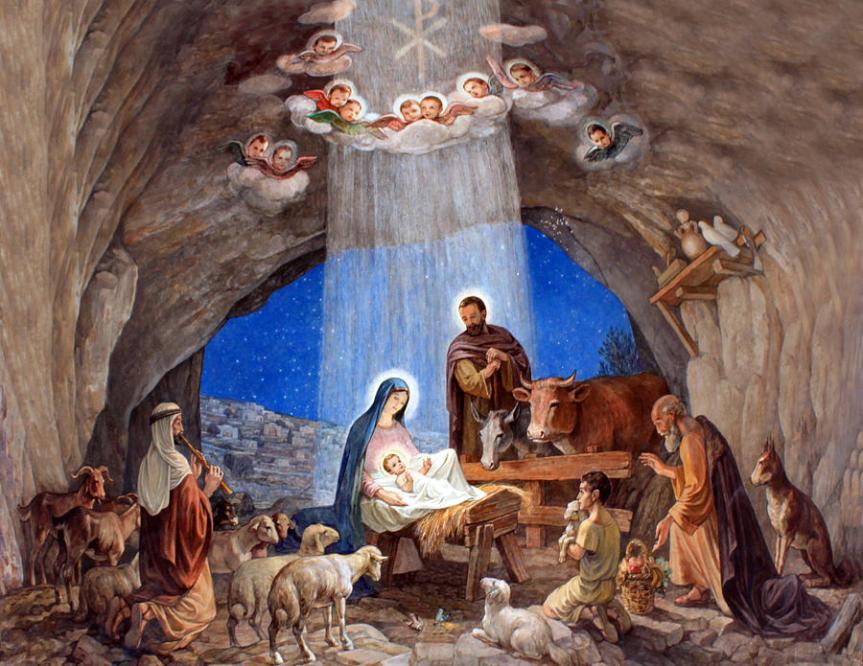 Merry Christmas
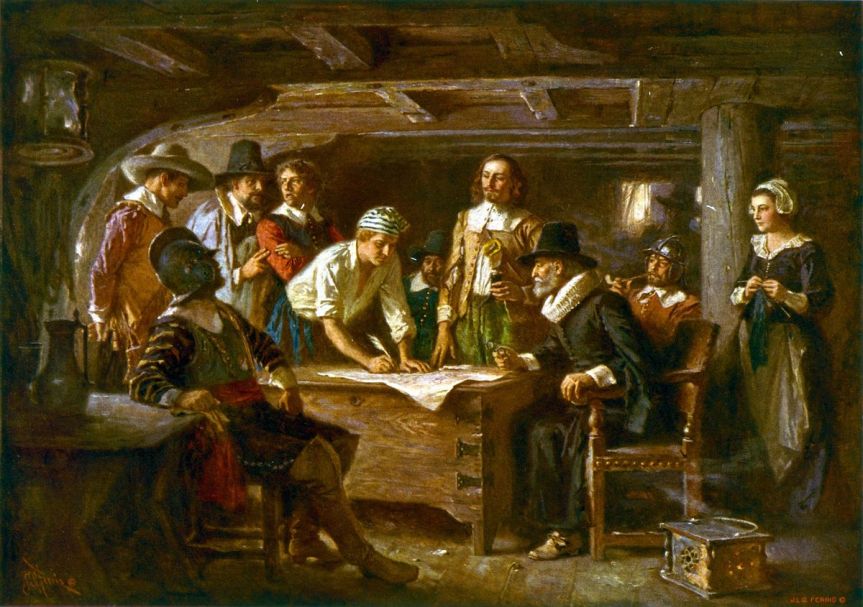 On December 21, 1620 the first Pilgrim landing party arrived in Plymouth Harbor to found the settlement of Plymouth, after failing to secure a site at Provincetown. The Pilgrims were Puritan Separatists, who had fled England because of religious persecution. In the 1500s, the Anglican Church had been created by the English monarch; all citizens were required to belong to this church. Some members desired a simpler Christian faith within this structure, and were called Puritans. They wanted to purify the Anglican Church and return to a Christianity focused on the bible, without the affluent trappings of the Church of England. Some of these Puritans wanted to break away from the Church of England, feeling that it was beyond saving, and were called Separatists. The separatists were persecuted by other Puritans as well as by the Anglican Church and government.
The Pilgrim/Puritan Separatists fled to Holland first, where they were free to practice their religion. However, after a number of years there, they felt that society there was too licentious as well as having poor economic opportunities for themselves and their families. That, combined with the threat of an imminent war between the Dutch and Spanish, caused the Pilgrims to leave Holland to try to make their way in the New World.
Shortly before landing in Plymouth, the Pilgrim colonists drafted and signed the Mayflower Compact, a covenant that they would form a civil body politic and enact such just laws as necessary and agree to be obedient to those same rules and laws.
In the name of God, Amen. We whose names are under-written, the loyal subjects of our dread sovereign Lord, King James, by the grace of God, of Great Britain, France, and Ireland King, Defender of the Faith, etc.
Having undertaken, for the glory of God, and advancement of the Christian faith, and honor of our King and Country, a voyage to plant the first colony in the northern parts of Virginia, do by these presents solemnly and mutually, in the presence of God, and one of another, covenant and combine our selves together into a civil body politic, for our better ordering and preservation and furtherance of the ends aforesaid; and by virtue hereof to enact, constitute, and frame such just and equal laws, ordinances, acts, constitutions and offices, from time to time, as shall be thought most meet and convenient for the general good of the Colony, unto which we promise all due submission and obedience. In witness whereof we have hereunder subscribed our names at Cape Cod, the eleventh of November, in the year of the reign of our sovereign lord, King James, of England, France, and Ireland, the eighteenth, and of Scotland the fifty-fourth. Anno Dom. 1620.
A federal judge has declared a mistrial in the case against Nevada rancher Cliven Bundy, saying U.S. prosecutors willfully withheld critical and “potentially exculpatory” evidence from the defense.
Judge Gloria Navarro dismissed jurors Wednesday, several weeks after the trial began against Bundy, his sons Ammon and Ryan Bundy, and militia member Ryan Payne, who were accused of leading an armed standoff with federal land agents in 2014.
Navarro cited five key pieces of information that prosecutors did not disclose: records about surveillance and snipers at the Bundy Ranch; unredacted FBI logs about activity at the ranch in the days around the standoff; threat assessments about the Bundys dating to 2012; and internal affairs reports about the BLM.
Withheld evidence at issue
Navarro methodically laid out her reasoning for about an hour, citing legal standards and case law, before delivering her ruling.
She said the evidence that was withheld could have been favorable to the accused and could have affected the outcome of the case.
Navarro stopped short of dismissing charges against the four men. It is unclear whether the case will be retried because Navarro did not rule whether the mistrial was with or without prejudice.
She has set another hearing for January and has tentatively scheduled a new trial to begin Feb. 26.
Navarro suspended the trial two weeks ago and warned of a potential mistrial after prosecutors for the first time disclosed several documents that appeared to support defense claims about the government’s use of video surveillance and sniper teams during the standoff.
Prosecutors have long maintained the FBI was not involved in the standoff and that no video surveillance or sniper teams were used. They charged defendants with making false claims about snipers and videos to incite militia in the runup to the standoff.
Lawyers raise self-defense
Documents turned over by the prosecution after the start of the trial indicated the FBI played an active role in the standoff and that surveillance cameras and armed tactical teams were positioned around the Bundy Ranch.
Defense lawyers filed motions to dismiss the case, arguing the new documents provided critical evidence that would have allowed them to challenge the government’s charges, impeach government witnesses and lay the foundation for self-defense claims.
 On December 15, 1791, Virginia became the 10th of 14 states to approve 10 of the 12 amendments, thus giving the Bill of Rights the two-thirds majority of state ratification necessary to make it legal. The Bill of Rights consists of the first ten amendments to the Constitution. They were added at the request of several states who desired greater constitutional protection to individual liberties. Some, mainly Federalists, argued that a bill of rights was not necessary because the people and the states retained any rights and powers not delegated to the federal government. Others, mainly anti-federalists, argued that a list of protected rights was necessary to safeguard individual liberty.
The House of Representatives approved seventeen amendments. Of those, the Senate approved twelve. Those twelve were sent to the states, and the states ratified ten.
The original seventeen amendments as passed by the House (source):
“Congress of the United States.
In the House of Representatives. Monday, August 24, 1789.
Resolved, by the Senate and House of Representatives of the United States of America in Congress assembled, two thirds of both Houses deeming it necessary, that the following articles be proposed to the several states, as amendments to the constitution of the United States; all, or any of which articles, when ratified by three fourths of the said legislatures, to be valid, to all intents and purposes, as part of the constitution.
Articles in addition to, and amendment of the Constitution of the United States of America, proposed by Congress and ratified by the legislatures of the several States, pursuant to the 5th article of the original constitution.
Article I. After the first enumeration required by the first article of the constitution, there shall be one representative for every thirty thousand, until the number shall amount to one hundred, after which the proportion shall be so regulated by Congress, that there shall be not less than one hundred representatives, nor less than one representative for every forty thousand persons, until the number of representatives shall amount to two hundred, after which the proportion shall be so regulated by Congress, that there shall not be less than two hundred representative [sic] [the usual “nor less than one representative” is omitted either by mistake or for brevity’s sake] for every fifty thousand persons.
[First Amendment in the second draft: not ratified.]
Art. 2. No law varying the compensation to the members of Congress shall take effect, until an election of representatives shall have intervened.
[Second Amendment in the second draft: modified version ratified May 7, 1992 as the Twenty-Seventh Amendment.]
Art. 3. Congress shall make no law establishing religion, or prohibiting the free exercise thereof, nor shall the rights of conscience be infringed.
[Part of Third Amendment in the second draft: modified version ratified as part of the First Amendment]
Art, 4. The freedom of speech, and of the press, and the right of the people peaceably to assemble and consult for their common good, and to apply to the government for redress of grievances, shall not be infringed.
[Part of Third Amendment in the second draft: modified version ratified as part of the First Amendment]
Art. 5. A well regulated militia, composed of the body of the people, being the best security of a free state, the right of the people to keep and bear arms shall not be infringed, but no one religiously scrupulous of bearing arms, shall be compelled to render military service in person.
[Modified version is Fourth Amendment in the second draft: modified version ratified as the Second Amendment]
Art. 6. No soldier shall in time of peace be quartered in any house without the consent of the owner, nor in time of war, but in a manner prescribed by law.
[Fifth Amendment in the second draft: modified version ratified as the Third Amendment]
Art. 7. The right of the people to be secure in their persons, houses, papers and effects, against unreasonable searches and seizures, shall not be violated; and no warrants shall issue, but [partly trimmed: upon probable cause supported by oath or affirmation, and par-] ticularly describing the place to be searched, and the persons or things to be seized.
[Sixth Amendment in the second draft: modified version ratified as the Fourth Amendment]
Art. 8. No person shall be subject, except in a case of impeachment, to more than one trial or one punishment for the same offence, nor shall be compelled in any criminal case, to be a witness against himself, nor be deprived of life, liberty or property, without due process of law, nor shall private property be taken for public use, without just compensation.
[Part of Seventh Amendment in the second draft: modified version ratified as part of the Fifth Amendment]
Art. 9. In all criminal prosecutions, the accused shall enjoy the right to a speedy and public trial, to be informed of the nature and cause of the accusation, to be confronted with the witnesses against him, to have compulsory process for obtaining witnesses in his favour, and to have the assistance of counsel for his defence.
[Modified version is Eighth Amendment in the second draft: modified version ratified as part of the Sixth Amendment]
Art. 10. The trial of all crimes (except in cases of impeachment, and in cases arising in the land or naval forces, or in the militia when in actual service in time of war or public danger) shall be by an impartial jury of the vicinage, with the requisite of unanimity for conviction; the right of challenge and other accustomed requisites; and no person shall be held to answer for a capital or otherwise infamous crime, unless on a presentment or indictment by a grand jury; but if a crime be committed in a place in the possession of an enemy, or in which an insurrection may prevail, the indictment and trial may by law be authorized in some other place within the same state.
[Modified version part of Seventh and Eighth Amendments in the second draft: modified version ratified as parts of the Fifth and Sixth Amendment]
Art. 11. No appeal to the Supreme Court of the United States shall be allowed, where the value in controversy shall not amount to one thousand dollars; nor shall any fact triable by a jury according to the course of common law, be otherwise re-examinable, than according to the rules of common law.
[Modified version is Ninth Amendment in the second draft; modified version ratified as part of the Seventh Amendment.]
Art. 12. In suits at common law, the right of trial by jury shall be preserved.
[Modified version part of Ninth Amendment in the second draft; ratified as the Seventh Amendment]
Art. 13. Excessive bail shall not be required, nor excessive fines imposed, nor cruel and unusual punishments inflicted.
[Tenth Amendment in the second draft: ratified as the Eighth Amendment]
Art. 14. No state shall infringe the right of trial by jury in criminal cases, nor the rights of conscience, nor the freedom of speech, or of the press.
[Dropped in the second draft. Modified version passed by Congress on June 13, 1866; ratified July 9, 1868 as part of the fourteenth Amendment]
Art. 15. The enumeration in the constitution of certain rights shall not be construed to deny or disparage others retained by the people.
[Eleventh Amendment in the second draft: ratified as the Ninth Amendment]
Art. 16. The powers delegated by the constitution to the government of the United States, shall be exercised as therein appropriated, so that the legislative shall never exercise the powers vested in the executive or judicial; nor the executive the powers vested in the legislative or judicial; nor the judicial the powers vested in the legislative or executive.
[Dropped in the second draft.]
Art. 17. The powers not delegated by the constitution, nor prohibited by it to the states, are reserved to the states respectively.
[Modified version is Twelfth Amendment in second draft: ratified as the Tenth Amendment]
The next regular assembly of the whole will be held on Thursday, Dec. 14th at 6:45 PM. This meeting starts earlier than usual to conduct our annual election before having our year end potluck dinner celebration.
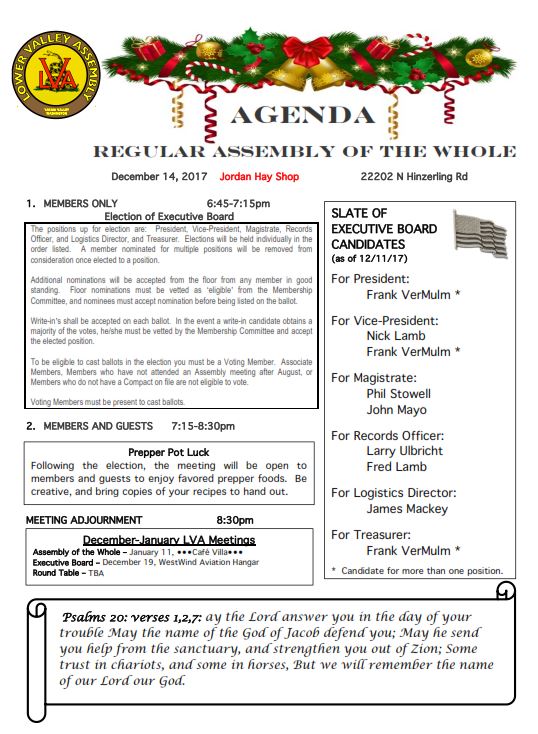
Click here to download a printable PDF agenda
 NC Scout of the Brushbeater blog has written a short article concerning communication protocols for a church security detail.
It’s a sad reality that I have to write this, but I am heartened by the fact that people are asking these questions. We live in an age of Christian persecution, whether some wish to admit it or not, and that persecution has led to our Churches and gatherings becoming easy targets. The paradigm shift from simple castigation and stigma to legal discrimination has slid, predictably, to violence amid a society where nothing is deemed Holy…
That said, I was presented with the following question:
I’m on my Church’s security detail and comms are pretty relaxed and there is no real protocol in place. Can you give me some pointers, etc?
This is a much deeper topic than it appears…
Click here to read the full article at Brushbeater
RELATED:
Force Dynamics: Church Training
Sheepdog Seminars – Church Safety Seminars
 The Center for Self Governance is hosting an online class on the Executive portion of the Washington State Constitution on December 28th, 2017. Tuition is $25.
State Constitution 300: Executive
NOTE: This class is a LEVEL 300 WASHINGTON STATE CONSTITUTION CLASS.
You do not have to be a CSG student to attend. You do not have to take the Constitution classes in sequence.
This is a 4 hour online lecture-style class. Supplies to bring include: paper, pen, a copy of your state constitution and your enthusiasm! This is an interactive class and we look forward to hearing from you.
Co lumbia Safety, LLC, located off N. Kellogg St. in Kennewick offers American Heart Association classes for both healthcare providers and non-healthcare providers, including First Aid, CPR/AED, Wilderness First Aid and more. They are offering the First Aid and CPR classes for non-healthcare providers on two different dates before the end of the year.
Monday, Nov. 20th
AHA HeartSaver CPR and AED class, 8am-10am
AHA HeartSaver First Aid class, 10am-12:30pm
Saturday, Dec. 16th
AHA HeartSaver CPR and AED class, 8am-10am
AHA HeartSaver First Aid class, 10am-12:30pm
The Red Cross recommends that at least one person in every household and place of business receive training in CPR and proper use of an AED. This training can give them the knowledge and confidence to respond during an emergency situation with skills that can help save a life.
Their calendar is also showing an eight hour Wilderness First Aid class on Saturday, February 10th, 2018, but it is not linked to a description, yet. It could be their Basic Wilderness First Aid class, which is an eight hour class or it could be part of a multi-part Wilderness First Aid class — which is usually 16-20 hours in length. Standard first aid classes assume that you may have an ambulance on scene within minutes, whereas wilderness first aid classes assume that you may have to stabilize your patient for hours or more because of remote wilderness locations.
From The Order of the White Rose:
Resistance Matters.
The Order of the White Rose seeks to train individual citizens in areas that will help them engage in resistance activities against an out of control government. Patterned after the original White Rose Resistance that stood up to Nazi Germany, TOWR is a new generation of partisan—training stronger, better communities who want to live free.
TOWR has moved its operations to the dark web. Our older content will remain here, but all new material will be exclusively available on an .onion site accessible using the TOR browser. You can reach the new site here. (If you’re not reading this site in the TOR browser, then right-click and copy the URL into a TOR window. Clicking the link in a normal browser will not work. If you don’t have the TOR browser, look at the links to the right and get it.)
Patriots do a lot of tactical training, and those skills are both critical and perishable. But what about the other critical skills? Intelligence drives the fight, and communications are essential. There are already classes for those trying to learn the basics, but what about those who have already learned the basics and are looking for more advanced training in specialty areas? That’s the gap TOWR seeks to fill.
We have not received any requests for information regarding our mailing lists, class attendees, or donors. We have not been contacted, either individually or as a group, by any local, state, or federal agencies regarding our activities, training, donors, supporters, or class attendees. Pay close attention to any modifications to the previous sentence, and verify any questions via GPG-encrypted email to team@whiterose.us.
Our public GPG key can be found on a keyserver using this ID: 0A5903F4, or click here. You may also send us a message on TorBox at towr@torbox3uiot6wchz.onion.
The annual Horse Heaven Sportsmen Society turkey shoot takes place Saturday, November 18th from 9am – 3pm at the Horse Heaven Sportsman Range. Compete for your chance to win a turkey, ham and other prizes. The competition is for all age groups and fun for the entire family. .22 Long Rifle from off hand standing position. Rifles and ammunition provided. Bring your own .22’s (scoped 50yds only). Prizes awarded after each round. $1 ages 16 & under, $2 for Adults. Hot BBQ Food and drinks served.
Directions: Use Smart Phone, enter Dump Road. Prosser. or take Prosser Exit 82 from I- 82, left on Wine Country Road, left on HW 22, left towards Patterson on HW 221; then right on Dump Road immediately after wrecking yard; follow Dump Road to the range.
Another good blog post from NC Scout over at the Brushbeater blog.
First Call, Americans. Out of your bunks. For a good portion of you out there, a year ago you went to sleep. That attitude driven by a very real fear of government out of control over eight years produced diamonds. For many, it meant getting serious about preparing yourselves, family and neighborhoods for uncertain times. And then, you went to sleep. Your guy got in, and he’d make it all right. Everything would be fixed, time to rejoice and rest on those laurels. He’ll undo all the wrongs and the lever pullers of power would truly yield to vox populi. And then, you went to sleep…
Rekindle that fire you had a year ago. Your five minute breather is over. Pick up your rucks and start walking again. You don’t have enough food or ammo for what’s coming. Prep harder, train harder. Go back to your Churches. And while your at it, seek out training from experienced folks even if you think you know it all- because I promise you, that outside viewpoint or different opinion may make a big difference. You can’t learn it by only reading a blog; you have to go and do. Your enemy is training, and they want you dead. Reveille is sounding, American. Do you hear it?
 The American Red Cross will hold a blood drive at Friendship Baptist Church, 1801 Patterson Rd, Prosser, WA on Friday, November 17th, 2017 from 12:00 noon to 5:00 PM.
You can reserve a donation time online by going to the ARC website and clicking on the Friendship Baptist Church drive. Click here.
Hydrate
Be sure to drink plenty of fluids on the day of your donation.
Wear Something Comfortable
Wear clothing with sleeves that can easily be rolled up above the elbow.
Maintain a Healthy Level of Iron in Your Diet Before Donating
If possible, include iron-rich foods in your diet, especially in the weeks before your donation.
Bring a List of Medications You Are Taking
We will need to know about any prescription and/or over the counter medications that may be in your system.
Bring an ID
Please bring either your donor card, driver’s license or two other forms of identification.
Bring a Friend
Bring along a friend, so that you may both enjoy the benefits of giving blood.
Relax!
Blood donation is a simple and very safe procedure so there is nothing to worry about.
The next regular assembly will be held on Thursday, November 9th, 2017 at 7:15pm in the Jordan Hay Shop at 22202 N Hinzerling Rd.

 The communications team has an amateur radio packet bulletin board system set up for member radio operator use. Operators who want to use the system should contact KW4MP or KC7QHE for help setting up your radio and computers to access the system.


 Lower Valley Assembly