ARRL: Emergency Net Active in Wake of Central Mexico Earthquake 9/20/17

From arrl.org, Amateur Radio Emergency Net Active in Wake of Earthquake in Central Mexico.

The FMRE National Emergency Net has activated on 7.060 MHz following a magnitude 7.1 earthquake in the central Mexico state of Puebla at 1814 UTC on Tuesday. The net also uses 3.690 MHz and 14.120 MHz as well as IRLP reflector 9200, channel 08.

The epicenter was some 75 miles southeast of Mexico City, which felt the temblor. Preliminary reports indicate a lot of collapsed buildings and missing people.

The FMRE net has been handling traffic to make up for the loss of some cellular networks, FMRE President Al Tomez, XE2O, told ARRL. The earthquake came 32 years to the day after a 1985 magnitude 8.0 earthquake struck the Mexico City, killing some 9,500 people in and around the capital city.

Just one week ago, a magnitude 8.1 earthquake struck off Mexico’s southern coast, killing more than 60 people and causing considerable damage.

All Outdoor: Flashlights Are Not a One Size Fits All Solution

Kevin Felts over at All Outdoor has an article, Flashlights Are Not a One Size Fits All Solution, discussing the need for several different types of lighting during a disaster. Citing problems people encountered during recent hurricanes, he advocates selecting lighting based on tasks and not just on maximum light output.

“Most of my flashlights are high intensity Surefire/Streamlight/Pelican tactical lights that I’ve been issued or bought for use on a firearm. What I didn’t think about though, is how useless those lights are for tasks like reading or searching through drawers/closets where the intense light washes out visibility of details. 375 lumens is overkill for reading anything. I also didn’t realize just how fast they would use batteries.

“A two-hour run time is fine for clearing the house in the middle of the night, or running out to the shed for a moment, but getting ready for a hurricane in the dark? Between two lights, we burned through all of our batteries (48) before electricity was restored…”

What is reasonable?

  • Reasonable lumens for reading, cooking, walking around the house… etc.
  • Area light, rather than a focused beam.
  • Rechargeable.
  • No fire hazard.

Read the entire article by clicking here.

Christianity Today: How Churches Can Prepare for Disasters

An article over at Christianity Today, How Churches Can Prepare for Disasters, discusses the importance of emergency preparedness for churches.

Right now, churches across much of Texas are responding to emergencies, while churches across much of Florida are preparing for them. Below are practical steps churches and families can take to prepare for and respond to emergencies, and lessons from churches in New York and New Orleans who suffered through natural and manmade disasters.

What churches have learned

Right after 9/11, Redeemer Presbyterian Church in New York City was flooded with requests for help—and with generous gifts from all over to help meet those needs. Because their church had an organized diaconate with trained leaders, Redeemer was able to distribute assistance much more efficiently than groups arriving after the event. “We saw many other relief efforts spend a great deal of money on hiring new staff and renting office space—very high cost items,” says Tim Keller. This may be a good lesson to support existing churches and ministries when we can, rather than “build our own.”

One lesson Redeemer learned from 9/11 was to watch for burnout among their staff. “We did not recognize the danger as much as we should have,” Keller said…

Keith Collins, pastor of Lakeview Christian Center, realized how important their spiritual preparation was during and after that disaster:

“How helpful it was for the church to be ‘theologically prepared’ for suffering. Scripture presents to us a God who is sovereign over every detail of his creation, including the catastrophes, and that God is working all things for his glory and our good. One of the most encouraging things that I observed as a pastor was that in the midst of our people losing homes, businesses, and having to relocate, they weren’t walking around asking, ‘Why, God?'”

That kind of heart-preparation is vital. It will be even more important if God allows a much more serious disaster on American soil…

How churches can prepare

To begin, churches should encourage their member families to prepare, both for their own well being, and so they will be better able to help others, whether in organized church efforts or in their neighborhoods. As they prepare, churches can encourage members to store food, water, and other items to share with others, which could make an enormous difference if an emergency lasts for weeks or months…

Click here to read the entire article

Related:

Spiritual Preparedness for the Christian Prepper

Small Parish Permaculture

Southern Baptist Convention Church Preparedness document (pdf)

Brushbeater: Better Things – Think Local; Act Local

NC Scout over at Brushbeater blog has this article out on taking action and working locally, Better Things, Or, Doing Versus Talking.  More people are waking to up to the realization that things just aren’t right in the world and feeling that they need to do something about it.

I know it’s all going straight to hell, it’s nothing new and it’s what many have been saying for a long, LONG time. We are a nation under Judgement. Don’t focus on the big picture. You can’t fix it. But you can fix your own situation locally. You can meet the good folks next door. You can meet the good folks raising their own food and selling it at the farmer’s market. You can meet the good folks owning the micro brewery and hosting the beer festivals. You can meet the guys testing the handloads at the range and swapping numbers. You can lane coach the couple struggling to zero that new AR while you’re at that range. You can talk to like-minded people on the radiowaves, like I do with my friends. You can go to church, even if it’s not ‘your’ denomination, just to meet people who live and do in your community. It doesn’t do anyone any good to simply read what they want to hear, channeling some useless venom that doesn’t do anything other than cause more of a problem- thus I stay above it, as do the wise. More often than not the stuff is written by people who can’t do, hence why they complain.

IMG_0410Get out there and do it, whatever it is. Stop making it a hobby and start making it a lifestyle. Take care of home and hearth along with your close ones, and don’t forget those close by. Even if you think they’re a lost cause, people will surprise you, with a lot more folks into this preper thing than you realize- with a lot of folks not calling it that. You can learn from them, and they you. And with every hurricane, earthquake or human disaster, more good people wake up. Those late to the game tend to prep even harder, because they’ve got even stronger motivation. Go drop a deer or two this fall, learn how to skin game, make sausage and fill a freezer without spending a bunch of money. Teach your kids the joy of eating wild. And while you’re at it, start figuring out ways to work independent of a grid- find out how folks did stuff back in the days before consistent power.

Click here to read the entire article

National Preparedness Month, Week 4, 2017


Don’t Wait. Communicate. Make a family emergency plan today. September is National Preparedness Month. Learn more at www.ready.gov/September.

Related:
Channel 3 ProjectCommunication Realities

Understanding Survivalist Communications Needs

FEMA: Create Your Family Emergency Communication Plan (pdf)

Signals Intelligence Resources

Prepper Radio Communication 101

What Should an Emergency Plan Include?

National Preparedness Month, Week 3, 2017

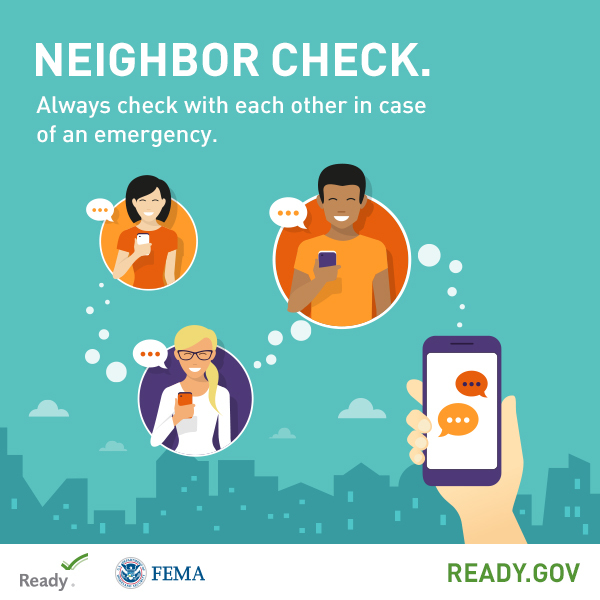
Don’t forget to do a neighbor check! Always check with each other in case of emergency. September is National Preparedness Month. Learn more at www.ready.gov/September.

Related:

Check Your Neighbours (pdf)

Neighborhood Preparedness (pdf)

Five Steps to Neighborhood Preparedness (pdf)

Prepare Your Neighborhood

OK-HELP Signs

Mason Dixon Tactical: Fair Is Fair – Helping Your Community Is Job One

From the Mason Dixon Tactical blog, comes this article Fair Is Fair in which the authors lauds community groups (whether they call themselves a militia, a navy (Cajun navy), a brigade (Monster Truck Brigade) that have turned up to help out in the aftermath of Hurricane Harvey. While he has ridiculed such militia groups in the past, he points out that community support is the real reason such groups should exist. So they better be training for such roles.

Over the last week, we have seen people in Texas, the surrounding states and even other states in the U.S. come together and kick ass to help those who needed it the most. Whether they call themselves the “Cajun Navy”, the “Monster Truck Brigade”, or “Militia” (I don’t know if any group involved in these actual rescue operations called themselves “militia”, but the “militias” out there should take notice of what these guys did and apply it to what they train for), it doesn’t matter, because their deeds have spoken for them.

Fair is Fair post2

If you call yourself a “Militia”, but all you do is play war games in your multicams and plate carriers, you are missing the big picture. You guys actually being able to operate as an effective, offensive military force is slim and none (I’m not talkin’ about your ability to protect your group). Operating as an effective rescue and logistics support group however, is well within your abilities, and has been demonstrated a number of times over the last week.

Fair is Fair post4

Does your group have , or have access to buildings/areas to house victims of a natural disaster? Do you have the means to give them basic bedding while they are in that housing area? What about sanitation?

I have had a number of less than complimentary things to say about a large portion of the people out there that are calling themselves “militia” these days, but in this instance, fair is fair. There are groups that have stepped up in a big way to help with everything that is going on in Texas. Whether they call themselves “militia” or not, they are performing a function that should be the primary focus of those groups that use that title, because the bottom line is that they’re supposed to be there for their community, right?

Continue reading the article by clicking here

ARRL: Emergency Net Activated for Mexico Earthquake. 9/8/2017

From the American Radio Relay League, Emergency Net Activated in Wake of Earthquake in Mexico:

The National Emergency Net of the FMRE — Mexico’s national Amateur Radio association, has activated on 7.060 MHz (the Net also may operate on 3.690 MHz) to handle any emergency traffic after a late evening earthquake occurred off Mexico’s coast. Radio amateurs not involved in the earthquake disaster should avoid those frequencies.

The potent magnitude 8.2 earthquake off Mexico’s Pacific Coast — the strongest in 100 years — has resulted in multiple fatalities so far, including 23 in Oaxaca, seven in Chiapas, and 2 in Tabasco. Rescue and recovery efforts are under way to free victims trapped in the rubble.

The tremor was felt around Central America. At 0500 UTC, Jose Arturo Molina, YS1MS, reported feeling a strong temblor within a few minutes of the earthquake in Chiapas, which is near Mexico’s border with Guatemala. In Honduras, Antonio Handal, HR2DX, located on the North Coast, also reported feeling the quake.

The Central American Network operates at 7.090 kHz, and Guatemala at 7.075 MHz. No reports have been heard yet from Guatemalan radio amateurs. In Southeastern Mexico, FMRE has a link to the WL2K Network with capacity to cover Mexico and Central America. — Thanks to IARU Region 2 Coordinator Cesar Pio Santos, HR2P, for some information

ARRL: Amateur Radio Preparations Ramp Up for Hurricane Irma


From the American Radio Relay League, Amateur Radio Preparations Ramp Up as Irma Strengthens to Category 5:

Hurricane Irma, making its way through the Caribbean with the possibility of affecting South Florida by week’s end, has, in the words of the National Hurricane Center (NHC), become “an extremely dangerous category 5 hurricane.” The NHC urged that hurricane preparations be rushed to completion in areas now under hurricane warnings…

The HWN will activate at 1800 UTC (2 PM EDT) on its primary frequency of 14.325 MHz and will remain in continuous operation until further notice, Graves said. Daytime operation will begin at 1100 UTC each day continuing for as long as propagation allows. Operation on 7.268 MHz will start at 2200 UTC and continue overnight. “If propagation dictates, we will operate both frequencies at the same time,” Graves said. The HWN marks its 52nd anniversary this week.

He noted that HWN operation on 7.268 MHz will pause at 1130 UTC, and, if required, resume at approximately 1230 UTC, to allow the Waterway Net to conducts its daily net…

IARU Region 2 Emergency Coordinator Cesar Pio Santos, HR2P, has compiled a list of emergency frequencies, subject to change, for use in the Caribbean in anticipation of Hurricane Irma.

  • Puerto Rico: 3.803, 3.808, 7.188 MHz. Radio amateurs in Puerto Rico also will cooperate with the HWN on 7.268 and 14.325 MHz.
  • Cuba: Daylight hours, 7.110 MHz (primary) and 7.120 MHz (secondary); Provincial Net — 7.045, 7.080 MHz, and on other lower frequencies as necessary. Nighttime, 3.740 MHz (primary) and 3.720 MHz (secondary) and on other lower frequencies as necessary.
  • Dominican Republic: 3.873 MHz (primary), 3.815 MHz (secondary), 7.182 MHz (primary), 7.255 MHz (secondary); 14.330 MHz (primary), 21.360 MHz (primary), 28.330 MHz (primary).
  • Caribbean Emergency and Weather Net (CEWN): 3.815 MHz and 7.162 MHz (when necessary). NOTE: Net will activate continuously starting this evening until the hurricane has passed through…

The FCC Wireless Telecommunications Bureau (WTB) reminded licensees this week that FCC rules address operation during emergencies. “These rules allow licensees to provide emergency communications during a period of emergency in a manner or configuration not specified in the station authorization or in the rules governing such stations,” the FCC said.

Read the whole article by clicking here

National Preparedness Month, Week 1, 2017

Don’t Wait. Communicate. Make a family emergency plan today. September is National Preparedness Month. Learn more at www.ready.gov/September.

Related:

Long Term Water Storage

Myths and Facts of Water Storage

Pool Shock & Bleach for Water Purification

Granular Calcium Hypochlorite

Only use HTH Pool Shock that does not have any algicides or fungicides.  Ingredients should reads CALCIUM hypochlorite and inert ingredients.  Use a brand with at least 73% Hypochlorite.

For this video I used Poolife Turboshock, but feel free to use any brand you wish as long as it fits the perimeters above.

Before you begin mixing any chemicals in any way, please follow basic safety precautions.  Make sure you do this in a ventilated area.  Have plenty of water to dilute any mistakes.  Wear eye protection for splashes.  Lastly always mix the powder into the water NOT the other way around.

Add and dissolve one heaping teaspoon of high-test granular calcium hypochlorite (HTH) (approximately 1/4 ounce) for each two gallons of water.

The mixture will produce a chlorine solution of approximately 500 mg/L (0.0667632356 oz per US gallon), since the calcium hypochlorite has an available chlorine equal to 70 percent of its weight.

To disinfect water, add the chlorine solution in the ratio of one part of chlorine solution to each 100 parts of water to be treated. This is roughly equal to adding 1 pint (16 oz.) of stock chlorine to each 12.5 gallons of water to be disinfected.

To remove any objectionable chlorine odor, aerate the water by pouring it back and forth into containers to add air.

Chlorine Bleach

Common household bleach (unscented) contains a chlorine compound that will disinfect water. The procedure to be followed is usually written on the label. When the necessary procedure is not given, find the percentage of available chlorine on the label and use the information in the following tabulation as a guide.

Available Chlorine Drops per Quart of Clear Water

  • 1% needs 10 Drops
  • 4-6% needs  2 Drops
  • 7-10% needs 1 Drops

(If strength is unknown, add ten drops per quart of water. Double amount of chlorine for cloudy or colored water)

The treated water should be mixed thoroughly and allowed to stand for 30 minutes. The water should have a slight chlorine odor; if not, repeat the dosage and allow the water to stand for an additional 15 minutes.

Hurricane Harvey: Whole Community Response

From The Christian Science Monitor, In all-hands-on-deck response to Harvey, lessons learned from earlier storms:, discussing the hybrid government/community/individual response to the disaster in Texas.

Ahead of the storm, there were questions about whether Texas-style self-reliance or a centralized, civil-defense-era response from the federal government should govern. But as an all-hands-on-deck response to historic floods has unfolded, the all-of-the-above support exemplifies something new, disaster experts say: a template for what the nation’s top emergency managers call “whole-community” response. It’s a dramatic shift since hurricane Katrina in how the United States prepares for natural disasters, encompassing everything from agency leadership in Washington to Mr. Sherrod and his sturdy compatriots from East Texas.

“I do think we’ve seen a change,” says University of Tennessee law professor Glenn Reynolds, author of “An Army of Davids,” in an email. “But the real difference isn’t citizens getting involved, it’s the willingness of responsible officials to see that involvement as a plus rather than a potential problem. I think the excellent record of civilian volunteer responders in the post-9/11 record is behind that willingness.”…

During Katrina, some rescuers literally had to sneak into the city to help. In Houston, the Cajun Navy has been part of a massive volunteer response, encouraged by officials. Twelve thousand National Guardsman also are being deployed, the government announced Monday.

The Cajun Navy represents both literally and figuratively the importance of neighborhood social networks – what researchers call “social capital” – that has become increasingly part of national response to disaster.

Click here to read the full article

September Is National Preparedness Month, 2017

Once again National Preparedness Month is at hand. This September, FEMA’s National Preparedness Month (NPM) will focus on planning, with an overarching theme “Disasters Don’t Plan Ahead. You Can.”

We should all take action to prepare! We are all able to help first responders in our community by training how to respond during an emergency and what to do when disaster strikes — where we live, work, and visit. The goal of NPM is to increase the overall number of individuals, families, and communities that engage in preparedness actions at home, work, business, school, and place of worship.

2017 Weekly Themes

  • Week 1:  September 1-9                        Make a Plan for Yourself, Family and Friends
  • Week 2:  September 10-16                    Plan to Help Your Neighbor and Community
  • Week 3:  September 17-23                    Practice and Build Out Your Plans
  • Week 4:  September 24-30                    Get Involved! Be a Part of Something Larger

In Washington State, prepare in September because October 19th, 2017 is the Great Shake Out.

Two Weeks Ready: Be Prepared. Build Kits. Help Each Other. Download our new brochure. Our thanks to the Seattle Office of Emergency Management for developing this brochure and offering it to us for statewide customization.

NEW! Download our drop, cover and hold earthquake scenarios map.

Map Your Neighborhood works.

You don’t have to do it all at once. Prepare in a Year!

Sign up for ShakeOut!

shakeoutforweb.jpg

Amateur Radio Prepares for Hurricane Harvey

From the ARRL, Array of Amateur Radio Resources Readying for Hurricane Harvey Response:

Amateur Radio resources are marshaling to assist in the response to Hurricane Harvey, which is expected to make landfall along the Texas coast on Friday (August 25) as a Category 3 storm. It would be the first storm to hit the US coast in more than a decade. The Hurricane Watch Net (HWN) already has swung into action, as the storm, which bears the threat not only of high winds but extensive and life-threatening storm surge flooding. Nearly 3 feet of rain could fall, if, as predicted, Harvey stalls along the Texas shoreline. ARRL Emergency Preparedness Manager Mike Corey, KI1U, said he and his staff are keeping close watch on Hurricane Harvey.

Hurricane Watch Net

The Hurricane Watch Net activated on August 24 at 1500 UTC on 14.325 MHz, subsequently shifting to 7.268 MHz at 2300 UTC. The net planned to operate overnight and will resume daytime operation on 14.325 MHz at 1200 UTC. “Should band conditions dictate, we will operate both frequencies simultaneously,” Net Manager Bobby Graves, KB5HAV, said.

Click here to read the entire story

Click here for ARRL Texas incident plans for Hurricane Harvey, including HF, VHF, and UHF frequencies. There are many frequencies in the plan.

Related:

Harvey Regains Strength, Hurricane Watch Net Plans to Activate

National Hurricane Center – Harvey

Weather.com – Hurricane Harvey