Rep. Bill Jenkin – COVID-19 Information and Resources

The following coronavirus information comes from the office of Representative Bill Jenkin.

Dear Friends and Neighbors,

We are facing uncertain times. The shadow of COVID-19 (coronavirus) continues to threaten our health, lives, economy, and overall finances.

The governor has signed into the law the bill we passed at the conclusion of the 2020 session providing $200 million in emergency funds to immediately equip local and state agencies with funding to help in their response efforts.

I want to ensure you, your families, and your businesses have the most up-to-date information and resources relating to this virus. Below, you’ll find important information and resources to keep you informed and hopefully answer some questions I’m sure you have.

The House Republican Caucus has created a website with local, state, and national resources. Our communications staff keeps this updated daily. It’s another great source for you. I encourage you to bookmark this website.

For other daily resources and the latest headlines, I encourage you to subscribe to my caucus’ daily morning headlines – known as the Capitol Buzz. You can do so by clicking here. I also encourage you to follow our news aggregator The Ledger. You can bookmark the site by clicking here.

If there’s anything I can do to help, please don’t hesitate to contact my office at (509) 492-4648. You can also email me at Bill.Jenkin@leg.wa.gov. My Legislative Assistant, Marge, is also here to assist you with whatever you need. You can email her at Marge.Plumage@leg.wa.gov. I encourage you to reach out. We’re here for you.

I promise, together we’ll get through these uncertain and challenging times.

Sincerely,

Bill

Coronavirus | Information and Resources

Information for you and your family

Recent announcements and news releases from the Governor’s Office and Department of Health

Information for parents from the Office of Superintendent of Public Instruction (OSPI)

Information for employers and employees

Governor’s Office | Partial list of resources to support economic retention and recovery related to COVID-19:

Employment Security Department:

U.S. Small Business Administration:

Centers for Disease Control and Prevention:

Department of Labor:

Department of Financial Institutions:

  • Financial Resources for Washington Residents Impacted by COVID-19
    • Accessing Your Financial Institution.
    • Unemployment Help.
    • Trouble Paying Credit Cards.
    • Trouble Paying Your Mortgage.
    • Trouble Paying Rent.
    • Student Loans Deferment.
    • Short Term and Emergency Loans.
    • Paying Utilities.
    • Insurance Issues.
    • Avoiding Scams.
    • At Home Financial Education Resources for Students.
    • Additional Resources.

Department of Labor & Industries:

  • Workers’ Compensation Coverage and Coronavirus (COVID-19) Common Questions
    • Can COVID-19 ever be allowed as a work-related condition?
    • When to file a claim.
    • When will a claim likely be denied?
    • How can I file a COVID-19 claim?
    • Filing a worker’s compensation claim: Exposure vs. contraction of COVID-19
    • Quarantine.
    • Covered treatment and post-exposure care.
    • Additional information on COVID-19.

Office of the Insurance Commissioner:

  • Coronavirus
    • Health insurance.
    • For insurers and medical providers.
    • Travel insurance.
    • Other types of insurance

It’s an honor to serve you.

Sincerely,

Bill Jenkin

Tenth Amendment Center: Can the government legally set up a quarantine?

Brion MacClanahan at the Tenth Amendment Center has a good, short article up answering Can the government legally set up a quarantine?

Last week I had several people email me asking if the government could legally establish a quarantine. Was this a violation of the Constitution or the Bill of Rights, particularly when church services were being mentioned as large social gatherings?

The morning I decided to respond, Judge Andrew Napolitano wrote a piece on the issue. His answer: a tepid yes, but only if they followed the proper legal procedures for due process.

He is partly correct, and this issue is, in fact, a think locally, act locally teachable moment.

And now that Donald Trump has issued a state of emergency declaration (unconstitutional) so that billions of unconstitutional dollars can flood the private sector, the legal question seems moot, but is it?

Trump has acknowledged that State governors can probably do a better job than he can to stem the COVID-19 outbreak.

Why? Because of the dirty little secret in American politics. The States ALWAYS have more real power than the general government.

If you want to close down domestic travel, have your State governor shut down State, county, or city owned airports, meaning most of the public commercial hubs in the United States. Florida Governor Ron DeSantis has begged the general government to shut down domestic air travel. This is backwards. DeSantis should just shut it down and then tell the Trump administration to stick it.

At the same time, the State governments can also shut down bars, restaurants, or any other public meeting place. The general government cannot.

It’s called federalism. So long as the law in question does not violate the State constitution, the State government has almost unlimited power. That is not the case with the United States Constitution. It is a grant of power from the States, meaning if the power is not delegated to the general government in clear language, the general government is prohibited from exercising that power.

As James Wilson said in the State House Yard speech in October 1787 (and I paraphrase), the State governments have all powers not prohibited by the State constitutions while the general government has only the powers granted by the United States Constitution.

And he was a firm nationalist.

The States could control this outbreak by any means necessary. This is not to say that some of these methods would not be Draconian–expect the worst. But we have to acknowledge the vast powers of the State governments in such a crisis. Each State is a state, meaning a sovereign political entity.

Perhaps this crisis with quicken our interest in federalism and decentralization. Alabama should watch out for Alabama, not California, and if it wants to exceed the directives of the CDC (or not), it should do so. The same holds true for California or any State in the Union.

Don’t look to Trump and the swamp bandits to save you. Take care of yourself and your family first. Do the best you can to practice good hygiene and exercise social distancing if possible. These are things we should all be doing during cold and flu season anyway. COVID-19 has made us more aware, but perhaps next cold and flu season we will do a better job of not slapping hands.

We’re not the Waterboy.

Alt-Market: From Quarantine To Tyranny To Rebellion: Where Is The Line In The Sand?

Brandon Smith at Alt-Market talks about whether the government is competently managing the coronavirus or is manipulating the citizenry so as to better control them when the system breaks in From Quarantine To Tyranny To Rebellion: Where Is The Line In The Sand? 

…As I have noted in previous articles, there is a reason why the establishment refused to inform the citizenry of the instabilities inherent in the pandemic scenario; the more unknowns there are for the public the more panic will set it, chaos ensues, and it is chaos that can be exploited to push forward numerous agendas. These agendas include global centralization as well as the erasure of constitutional liberties.

Now that a national collapse event is slowly being accepted by many as a legitimate possibility, there is a debate rising as to what measures the government should take, or should be allowed to take. Those of us in the prepper and liberty movements always knew this day was coming; a day when the public would start considering trading away an array of freedoms in exchange for promises of security.

Even now, government officials are still trying to tell people that this event will be “short lived”.

“Don’t worry”, they say, “It will only last a couple of weeks.” Oh, and “Don’t concern yourselves with food shortages, that’s not going to happen…” You can look at these lies in two different ways:

1) The government is trying to stave off a “panic” by slowly easing people into the reality that the system is breaking.

2) The government is trying to keep people passive to the danger so that when the system breaks completely they will be unprepared, desperate and easier to manipulate.

I believe the second option is the most likely given the evidence at hand, but in either case the government is crippling the public response time to the disaster. They did this for months and they are still trying to do it now. So, my argument is, why should we suddenly take their advice or take orders from them when the manure hits the fan? They have FAILED in their responsibilities to inform and protect the citizenry, and they are about to violate their prime mandate, which is to protect the personal liberties that make our society worth living in. Without these freedoms, there is no point to keeping our system intact anyway.

The establishment and its defenders will claim that we all “have to make sacrifices” today in order to have freedoms tomorrow, but that’s not how the constitution was designed to work. Our rights are MORE important during times of distress and crisis, for it is in these times that we need to know what we are fighting for, and what we are struggling for. Survival is meaningless if we have to accept tyranny to achieve it.

Once governments see a chance to usurp freedoms from the people, they DO NOT tend to give those freedoms back later unless the people become a viable opponent that could bring the establishment down.

There are some who will say that a forced quarantine is necessary to protect the “greater good” of the greater number. It is true that the Covid-19 virus is a danger, and I think the people who claim it’s “no worse than the flu” are fighting a losing battle as the death rate is clearly much higher than the average flu virus. They will look extremely foolish a few months from now as the virus continues to cycle through the population and the dead continue to increase. That said, I think I understand why they cling to this crumbling argument.

They think that by arguing that the pandemic is “all hype” they can morally justify resistance to the inevitable totalitarian response from governments. They think it has to be one or the other:  Either the virus is hyped and resistance is acceptable, or the virus is real and resistance is unacceptable. I ask – Why can’t it be both? The virus is dangerous to many, but a totalitarian response is still unacceptable.

The virus is in fact more destructive than any flu in recent memory – It’s not a plague on the level of the Black Death, but if it continues to kill at a rate of 3% to 5% at it has been then this puts a large number of human beings at risk. It is not something to be taken lightly, and those people that are actively trying to discourage others from preparing for it are truly narcissistic in their ideology. If you don’t think it’s a threat, then don’t prepare, but don’t scream at others for taking precautions just because you desperately want to be right, and don’t come around demanding food and supplies from those same people when the ceiling comes crashing down on your head.

Also, understand that Covid-19 is only part of the problem. The bigger crisis is in the economy itself; a collapse has been baked into this cake for years now, and the virus has little to do with it.  Leftist kids are going around calling this pandemic the “boomer remover”, almost cheering the assumption that mostly older and conservative Americans will die from this.  I have to break it to them that during the economic collapse that is inevitably coming they will have to wipe the snot from their noses and put on their big-boy diapers otherwise they aren’t going to survive either; most of them have no discernible skills and no preparations to speak of.  They are essentially useless.

If Covid-19 is a “boomer remover”, then the economic crisis is a “snowflake bake”, and they are about to get roasted…

Click here to read the entire article at Alt-Market

AYWtGS: Covid-19 Quarantine Day 1

A Year Without the Grocery Store related their first day of quarantine – Covid-19 Quarantine Day 1 – in which a perhaps surprising number of issues pop up.

I had planned on making one more trip to Costco before going into quarantine.  Did we NEED anything?  Probably not, but there were a few items that I really wanted to get a few more of – mostly dairy type items. I do have other alternatives, but they take preparing, and I’m by nature lazy.  I wanted another package or two of shredded cheese, some more heavy whipping cream and maybe some more eggs.

I messaged my mom to ask her if she wanted me to pick up anything for her.  She asked me not to leave the house.  I was willing to head out, but I understood her hesitancy.  So because I wanted to honor my mother, I stayed home.  It was the right decision.

Bad News from Texas<img class=”alignright size-medium wp-image-17746″ src=”https://i1.wp.com/ayearwithoutthegrocerystore.com/wp-content/uploads/2020/03/benjamin-bousquet-PDVvoXRAmCY-unsplash.jpg?resize=300%2C200&ssl=1″ alt=”” width=”300″ height=”200″ srcset=”https://i1.wp.com/ayearwithoutthegrocerystore.com/wp-content/uploads/2020/03/benjamin-bousquet-PDVvoXRAmCY-unsplash-scaled.jpg?resize=300%2C200&ssl=1 300w, https://i1.wp.com/ayearwithoutthegrocerystore.com/wp-content/uploads/2020/03/benjamin-bousquet-PDVvoXRAmCY-unsplash-scaled.jpg?resize=1024%2C683&ssl=1 1024w, https://i1.wp.com/ayearwithoutthegrocerystore.com/wp-content/uploads/2020/03/benjamin-bousquet-PDVvoXRAmCY-unsplash-scaled.jpg?resize=768%2C512&ssl=1 768w, https://i1.wp.com/ayearwithoutthegrocerystore.com/wp-content/uploads/2020/03/benjamin-bousquet-PDVvoXRAmCY-unsplash-scaled.jpg?resize=1536%2C1024&ssl=1 1536w, https://i1.wp.com/ayearwithoutthegrocerystore.com/wp-content/uploads/2020/03/benjamin-bousquet-PDVvoXRAmCY-unsplash-scaled.jpg?resize=2048%2C1365&ssl=1 2048w, https://i1.wp.com/ayearwithoutthegrocerystore.com/wp-content/uploads/2020/03/benjamin-bousquet-PDVvoXRAmCY-unsplash-scaled.jpg?resize=650%2C433&ssl=1 650w, https://i1.wp.com/ayearwithoutthegrocerystore.com/wp-content/uploads/2020/03/benjamin-bousquet-PDVvoXRAmCY-unsplash-scaled.jpg?resize=600%2C400&ssl=1 600w” sizes=”(max-width: 300px) 100vw, 300px” data-recalc-dims=”1″>

I got a phone call from my father-in-law.  We had asked him to join us up here in Illinois because he really wasn’t ready for this.  But in his phone call, he let me know that one of his friends was presumptive positive for Covid-19.  While he hasn’t been in contact with this friend, he had other friends who have spent time with his presumptive positive friend with whom he has spent time.  So he won’t be coming up, but he needs items to get him through this next bit – where hopefully he doesn’t come down with the virus.

In case he does get sick, we’re sending him “just add water” dry soup mixes to help feed him past these next two weeks (which he only has 1 can of soup per day).  We’re also sending him Xlear to help keep his nasal passages clear and zinc lozenges.  I found a great article on the benefits and problems with zinc, so make sure you read it before you run out and start taking zinc.

The plan is for him to shelter in place for 2 weeks.  If he doesn’t come down with it during the next 2 weeks, then he’ll drive up here.  We’re also sending him PPE (Personal Protective Equipment) so that if he does come up here he will be protected during his trip.

If he does come up here, he will be quarantined for an additional two weeks, so make sure that he doesn’t get sick from his trip up and it gives us an additional two weeks to make sure that he doesn’t have a latent infection from his being exposed in Texas.

<img class=”alignleft size-medium wp-image-17747″ src=”https://i2.wp.com/ayearwithoutthegrocerystore.com/wp-content/uploads/2020/03/hermes-rivera-qbf59TU077Q-unsplash.jpg?resize=300%2C200&ssl=1″ alt=”” width=”300″ height=”200″ srcset=”https://i0.wp.com/ayearwithoutthegrocerystore.com/wp-content/uploads/2020/03/hermes-rivera-qbf59TU077Q-unsplash-scaled.jpg?resize=300%2C200&ssl=1 300w, https://i0.wp.com/ayearwithoutthegrocerystore.com/wp-content/uploads/2020/03/hermes-rivera-qbf59TU077Q-unsplash-scaled.jpg?resize=1024%2C683&ssl=1 1024w, https://i0.wp.com/ayearwithoutthegrocerystore.com/wp-content/uploads/2020/03/hermes-rivera-qbf59TU077Q-unsplash-scaled.jpg?resize=768%2C512&ssl=1 768w, https://i0.wp.com/ayearwithoutthegrocerystore.com/wp-content/uploads/2020/03/hermes-rivera-qbf59TU077Q-unsplash-scaled.jpg?resize=1536%2C1024&ssl=1 1536w, https://i0.wp.com/ayearwithoutthegrocerystore.com/wp-content/uploads/2020/03/hermes-rivera-qbf59TU077Q-unsplash-scaled.jpg?resize=2048%2C1365&ssl=1 2048w, https://i0.wp.com/ayearwithoutthegrocerystore.com/wp-content/uploads/2020/03/hermes-rivera-qbf59TU077Q-unsplash-scaled.jpg?resize=650%2C433&ssl=1 650w, https://i0.wp.com/ayearwithoutthegrocerystore.com/wp-content/uploads/2020/03/hermes-rivera-qbf59TU077Q-unsplash-scaled.jpg?resize=600%2C400&ssl=1 600w” sizes=”(max-width: 300px) 100vw, 300px” data-recalc-dims=”1″>Conflict

I am not putting this out there to throw my husband “under the bus.”  I’m putting this out there so that all of you can understand that the conflicts that you’re experiencing right now are (very unfortunately) a part of this situation… (continues)

Northman Trader: The Lesson

Sven Henrich of Northman Trader has a post up about the fragility of the US economy, the fickleness of politicians, and other lessons –The Lesson.

The lesson of it all? The lesson is that lessons are not being learned. Of course the human species has an ingrained problem: We are all born with a blank sheet and have to learn everything from scratch. It would be helpful though if the elders could pass lessons from past mistakes on to the new generation.

But no. So we keep making the same stupid mistakes.

And here we are. Just four weeks after all time highs in markets America is again turning into bailout nation.

Yes coronavirus is an unforeseen shock. So what?

We’re supposed to handle a shock. We’re supposed to be prepared. We’re supposed to have savings and great balance sheets. After an 11 year recovery and market bull run based on cheap and easy money shouldn’t things be great and shouldn’t we be well prepared for the next downturn?

Is that really too much to ask?

Apparently.

We can’t even go 4 weeks without the Fed going apeshit on cutting rates to zero, launching $700B in QE, making discount windows available and launching $500B, even trillion dollar repos.

We can’t even go 4 weeks without the government launching a proposed $850B stimulus package, tax cuts, free money checks of $1,000 to Americans and suggesting bailouts for $BA and $GE.

That’s how fragile things are. They must be, otherwise the system would be able to handle a temporary shock.

But it can’t. Why?

Well for one our supposed great economy ever has the vast majority of Americans live paycheck to paycheck:

That’s a systemic problem. Sure you can blame people for living beyond their means, but in general most people just don’t have the income power to keep abreast with rising medial costs, home prices and all the other fun inflationary items that the Fed simply doesn’t count as inflation. How ignorant they are. PCE deflator. Please.

And then of course the same lesson again not learned that keeps repeating ahead of every bust: Greed and more greed.

When has it ever been a good idea to chase stocks to 150% market cap to GDP or even higher?

The answer is never. Yet they convinced themselves and others that it’s different this time. New flash: It wasn’t.

A lesson not learned and yet they did it. The chart was screaming unsutainability. And here we are 4 weeks later, yesterday closing at 109.5% market cap to GDP:

Reversion to the mean. And it could eventually get much worse.

I showed this chart in Bull Cliff in February and I stated:

“Investors keep piling money into this historically priced market….Central banks can deny all they want that they are not responsible for asset price inflation, but everybody knows better. The denials are not only hollow they are straight out lies.

And having created the Pavlovian effect we now see in the investment community they are leading investors to abandon all sense of risk when risks are mounting ever more around us as valuations and earnings multiples keep expanding as a result of monetary policy. And hence it may be said that central bankers may be leading investors off the cliff.”

Well done. Did anyone listen? I can’t say, but most haven’t. And now they are all in major pain…(continues)

Click here to read the entire article at Northman Trader.

Colion Noir: Pandemic Exposes Truth about Gun Control

This short video from Colion Noir discusses personal responsibility and how the government admits that they won’t be able to save you.

Related:

Liberty Blitzkrieg: Localism, Part V

It’s impossible to overstate the impact you can have as an individual in times like these. We’ve all seen the federal government response. From statements like “it’s just the flu,” to Trump signing charts of a short-covering rally in the stock market and the CDC’s inability or unwillingness to test Americans in the early days, this entire episode should prove to you once and for all that the centralized cavalry isn’t coming. You are the cavalry.

Gateway Pundit: Panicked Leftists Surprised They Can’t Just Purchase a Gun Online Like They Were Told

Newswars: Coronavirus Update: Liberals Find Out They Can’t Purchase Guns Online

Conservative Treehouse: Empty Shelves? Understanding Supply Chains

The Conservative Treehouse has an article up to help readers understand why so much is out of stock and not appearing again soon – Empty Shelves? – Understanding Supply Chains, Logistics, and Recovery Efforts… (H/t E.S.)

By now everyone is familiar with the abundant pictures on social media of empty shelves in local stores.  Having some familiarity with the supply chain might help people to understand some of the challenges; and possibly help locate product. (Pics from Twitter)

There are essentially two types of distribution centers within the retail supply chain for most chain markets, food stores and supermarkets.  The first type is a third party, or brokered, distribution network.  The second type is a proprietary, company owned, distribution center.  Knowing the type of distribution helps to understand what you can expect.

If your local retail store is being replenished from a third party distribution center, you can expect greater shortages and longer replenishment times; we will see entire days of empty shelves in these stores.  However, if your local retail store owns their own warehouse and distribution network, the replenishment will be faster.  In times of rapid sales, there is a stark difference.

These are general guidelines: An average non-perishable distribution center will replenish approximately 60 stores.   Those 60 stores will generally not extend beyond 100 miles from the distribution center.  The typical company owned warehouse will have approximately 20 tractors (the semis) delivering trailers of goods to those sixty stores.

In this type of network… On a typical day a truck driver will run three loads. Run #1 Delivery-Return; Run #2 Delivery-return, Run #3 Delivery Return. End shift.

If every tractor is operating that’s a maximum capacity of 60 trailers of merchandise per day.  Many stores receiving more than one full trailer.

A typical store, during a non-emergency, will receive 1 full trailer of non-perishable goods three to five times per week.  However, under current volume the purchased amount of product is more than triple normal volume.  It is impossible to ship 180 trailers of merchandise daily to sixty stores with 20 fixed asset tractors.  This is where the supply chains and logistics are simply incapable of keeping up with demand.

Thinking about distribution to a 100 mile radius.  The stores closest to the distribution center will be delivered first, usually overnight or very early morning (run #1). The intermediate stores (50 miles) will be delivered second, mid-morning (run #2).  The stores furthest from the distribution center will be delivered third, late afternoon (run #3).

So if you live close to a distribution center, your best bet is early morning.  If you live in the intermediate zone, late morning to noon.  If you are in the distant zone in the evening.

The current problem is not similar to a holiday, snow event or hurricane. In each of those events typical store sales will double; however, during holidays or traditional emergencies the increase in product(s) sold is very specific: (a) holiday product spikes on specific items are known well in advance and front-loaded; and (b) snow/hurricanes again see very specific types of merchandise spikes, with predictability.

In the current emergency shopping pattern the total business increase is more than triple, that’s approximately 30% more than during peak holiday shopping.  Think of how busy your local store is on December 23rd of every year.  Keep in mind those customers are all purchasing the same or similar products.  Now add another 30%+ to that volume and realize the increases are not specific products, everything is selling wall-to-wall.

Perishable and non perishable products are selling triple normal volume.  This creates a replenishment or recovery cycle that is impossible to keep up with.  The first issue is simply logistics and infrastructure: ie. warehouse (selectors, loaders), and distribution (tractors, trailers, drivers).  The second issue is magnifying the first, totality of volume.

A hurricane event is typically a 4 or 5 day cycle.  A snow event might be 2 days.  The holiday pattern is roughly a week and all the products are well known.  However, the type of purchasing with coronavirus shopping is daily, everything, with no end date…(continued)

Read the entire article at the Conservative Treehouse.

EFF: EARN IT Bill to Scan Every Online Message

From digital civil liberties champion Electronic Frontier Foundation, The EARN IT Bill Is the Government’s Plan to Scan Every Message Online

Imagine an Internet where the law required every message sent to be read by government-approved scanning software. Companies that handle such messages wouldn’t be allowed to securely encrypt them, or they’d lose legal protections that allow them to operate.

That’s what the Senate Judiciary Committee has proposed and hopes to pass into law. The so-called EARN IT bill, sponsored by Senators Lindsay Graham (R-SC) and Richard Blumenthal (D-CT), will strip Section 230 protections away from any website that doesn’t follow a list of “best practices,” meaning those sites can be sued into bankruptcy. The “best practices” list will be created by a government commission, headed by Attorney General Barr, who has made it very clear he would like to ban encryption, and guarantee law enforcement “legal access” to any digital message.

The EARN IT bill had its first hearing today, and its supporters’ strategy is clear. Because they didn’t put the word “encryption” in the bill, they’re going to insist it doesn’t affect encryption.

“This bill says nothing about encryption,” co-sponsor Sen. Blumenthal said at today’s hearing. “Have you found a word in this bill about encryption?” he asked one witness.

It’s true that the bill’s authors avoided using that word. But they did propose legislation that enables an all-out assault on encryption. It would create a 19-person commission that’s completely controlled by the Attorney General and law enforcement agencies. And, at the hearing, a Vice-President at the National Center for Missing and Exploited Children (NCMEC) made it clear [PDF] what he wants the best practices to be. NCMEC believes online services should be made to screen their messages for material that NCMEC considers abusive; use screening technology approved by NCMEC and law enforcement; report what they find in the messages to NCMEC; and be held legally responsible for the content of messages sent by others.

You can’t have an Internet where messages are screened en masse, and also have end-to-end encryption any more than you can create backdoors that can only be used by the good guys. The two are mutually exclusive. Concepts like “client-side scanning” aren’t a clever route around this; such scanning is just another way to break end-to-end encryption. Either the message remains private to everyone but its recipients, or it’s available to others…

Click here to read the entire article at EFF.org.

James Kunstler: Things Have Changed

Author of The Long Emergency James Howard Kunstler has written a blog post Things Have Changed on our immediate plight and what’s ahead.

At least in wartime, the bars stay open. That’s how you know this is a different thing altogether from whatever else you’ve seen in your lifetime. Even those of us who signed up for this trip — that is, who expected a long emergency — may be a little bit in cosmic awe at just how much s#@t is flying into the ol’ fan. I know I am. The gods must have glugged down a mighty draft of Dulcolax.

Did you get the feeling, as I did, watching the Sanders-Biden debate last night — the inadequate versus the irrelevant — that the world they were blathering about possibly doesn’t exist anymore? The world of institutions that actually function? Like, the ones that conjure up whatever sum of money you demand to keep all the wheels spinning? Remember that Hemingway line about the guy who went broke? Slowly, then all at once. That’s us. Medicare for all now? Really? More like, a year from now every physician in America may be the equivalent of the old country doc toting a black bag around to home visits. Unfortunately, there aren’t enough horses left in America, and the few buggies we’ve got are all in the museum.

The mega financial bubble-of-bubbles is deflating with frightful velocity precisely because of the efforts since 2008 to artificially inflate it. The Federal Reserve gave it one final blast Sunday night — while everybody else was counting their rolls of toilet paper — and the effect was like blowing hot air into a shredded Zeppelin. Stock futures are “limit down” as I write, before the Wall Street open. Gold is getting pounded into the ground like a grape stake and silver is so low it looks like the hedge fund managers are down to pawning grandma’s table service. (Hint, the PMs will bounce back hard; the rest, probably not so much.)

Nobody really knows how deep and how harsh this gets (and perhaps the ones who have a clue ain’t sayin’). But the situation presents two salient questions: how much disorder is entailed in this ordeal? And what does the world look like when the convulsion phase of this thing is over?

Americans have never been through anything remotely like this. The disorders of the Civil War were sharp and horrendous military operations conducted mostly in cornfields, pastures, and woods (yes, and some small cities like Richmond, pop. 38,000, and Atlanta, pop. 10,000). When the smoke cleared, battered Dixieland emerged to numb civil order. Up in Yankeedom, the New York draft riots ran for a week around the small patch of Manhattan island, but everybody else went along with Mr. Lincoln’s program. After all that, America got on quickly with the lively business of the 19th century: railroads, mines, factories, and all that. The world wars took place in foreign lands, and the home-front scene of the 1940s now looks nostalgically idyllic.

The stresses mounting on the national scene today reflect the extreme fragilities of the way-of-life we constructed since then, and an awful lot of bad choices we made in the process, like suburbanizing the nation and making everybody a hostage to happy motoring. I won’t belabor that point, except to ask how are those vast regions of the country going to manage daily life as the supply chains wobble? I’d say a shortage of toilet paper may only be the beginning of their problems.

The cities — at least, the few that didn’t already implode from the inside out — made assumptions about how big and tall they could grow which don’t jibe with the new circumstances chugging ferociously down the line. Just think what a lockdown of the global economy will do to all those residential skyscraper projects lately hoisted up in New York, San Francisco and Boston? I’ll tell you: They are assets instantly converted into liabilities. And how will these cities even begin to pay for maintaining their complex infrastructures and services when the money for all that no longer exists and there’s no way to pretend that it will ever come back? Answer: They won’t be able to keep borrowing and they won’t manage. These cities will depopulate and there will be battles over who gets to live in the parts that still may have some value, like riverfronts.

I guess just about everybody can now see the idiocy of concentrating the nation’s commercial life in super-gigantic organisms like Big Box stores. It seemed like a good idea at the time, like so many blunders in history, and now that time is over. Any ecology thrives on redundancy — a lot of players doing similar things at the appropriate scale — and America’s chain retail model for a commercial ecology was an obvious fiasco waiting happen. The people who run that, and other people who run other things in our society, must be wondering whether those supply-chains from China will come back. It’s no different than the cargo cults of the Solomon Islanders circa 1947, after the military airplanes stopped landing with all their magical goodies: time to go back to fishing from the dugout canoe.

The foolish, idiotic identity politics ginned up by the Left and their racially-inflamed, sexually-disturbed scribes in the Thinking Class, have successfully destroyed the last shred of an American common culture that held the country together through earlier vicissitudes. So, one concludes that we’ll be left stewing in poisonous tensions, and perhaps some violent conflicts, before those matters head toward some sort of resolution.

Where does this all lead? Eventually, to a land and a people who operate their society in a very different way at a much more modest scale. The task of reorganizing our national life is immense. (There will be plenty to do, so don’t worry about that.) You can forget about the grandiose techno-narcissistic visions of electrified motoring and a robotic nirvana of perpetual sex-crazed leisure. Everything we do has to be downscaled, from whatever manufacturing we can cobble back together to rebuilding commercial ecosystems at a finer grain from region to region — in other words, what we now call small business, geared locally.

Expect giant AgriBiz to founder on a shortage of capital, especially, and expect smaller farms to organize emergently, worked by more humans working together. That is, if we want to keep eating. Expect the small towns in the well-watered parts of the country to revive while the groaning metroplexes spiral down into entropic sclerosis. Consider the value of our vast inland waterway system and the opportunities to move goods on them, when the trucking industry unravels. Consider lending a hand at rebuilding the railroad system in this country.

There will be economic roles and social roles for all those willing to step up to some responsibility. Young people may see tremendous opportunity replacing the wounded economic dinosaurs wobbling across the landscape. It’ll be all about going local and regional and making yourself useful in exchange for a livelihood and the esteem of others around you — aka, your community. Government has been working tirelessly to make itself superfluous, if not completely ineffectual, impotent, and rather loathsome in the face of this crisis that has been slowly-but-visibly building for half a century. Something old and played-out is limping offstage, and something new is stepping on. Aren’t you glad you watched all those debates?


Practical Self Reliance: 20+ Immune Boosting Herbs

Ashley Adamant at Practical Self Reliance has compiled a list of twenty immune-boosting herbs and mushroom to help stave off illness.

Natural immune-boosting herbs work to support a healthy immune system, ideally preventing illness or speeding recovery.  Staying healthy starts well before flu season, and all of these herbs for the immune system can play a helpful role.

Immune Boosting Herbs

Immune-boosting herbs are a big part of my families’ wellness routine, and we need all the help we can get with a doorknob licking toddler and extra snuggly preschooler in the house.

Even before children, natural immune boosters were a regular part of our lives.  I worked in a hospital, and my husband flew cross country regularly for work.  While handwashing and other preventative measures are obviously the first step, sometimes you need a bit of extra help when you’re surrounded by sick people on a day to day basis.

Just recently, I found myself making a batch of our favorite herbal immune booster…elderberry syrup.  I’d harvested fresh elderberries in our garden that we’d grown from cuttings, and I started looking around for other herbs for the immune system to add into the mix.  A short walk around the garden and nearby woods and I’d picked more than 20 different immune-boosting herbs, flowers, roots, mushrooms, and lichen.

Add in a stop at the spice cabinet for immune-boosting spices like ginger, black pepper and garlic and I had quite the spread to choose from…

(Note: I am not a clinical herbalist or healthcare provider.  This is based on my own experience and research, but I encourage you to verify it with other sources.  Please consult a healthcare provider before beginning any health regimen, herbal or otherwise.) 

Herbs for the Immune System

Herbs for the immune system generally fall into three categories:

  • Immune Stimulants ~ Generally used for a short period of time, immune stimulants are best used on a short term basis.  The best time is right as you’re starting to get sick, or anytime you’ve been exposed to an illness.  Those times when someone coughs right on you, or you’re about to go on a long flight where there may be extra pathogens in the recirculated air.  Examples include Echinacea and usnea lichen.
  • Herbal Immunomodulators (or Immune Tonics) ~ Often used over a long period of time, immunomodulators are tonics for the immune system.  They’re not meant to be overtly healing during acute illness, but rather to help balance your system and promote a healthy immune response.  Examples include tulsi (holy basil) and reishi mushrooms.
  • Anti-Microbial Herbs ~ While they may not directly impact the immune system, they’re helpful in treating illness and maintaining health.  While prescription antibiotics have their place, minor illnesses (or injuries) can be treated with anti-microbial herbs instead.  Some are specifically antifungal (for topical issues) while others are more generally antimicrobial.  These disserve an article in their own right, and I’ll cover them briefly at the end.

While these three classes of herbs are somewhat different from each other, the terminology often gets mixed, even in peer-reviewed scientific journals.  Some, in fact, fall in multiple categories.  The main thing to keep in mind is that not all herbs are for long term use and not all herbs for the immune system will have a direct impact if you’re already sick…(continued)

Click here to read the entire article at Practical Self Reliance.

Organic Prepper: How to Help Your Community Be Better Prepared

Kara Stiff at The Organic Prepper has written How to Help Your Community Be Better Prepared for Covid-19 (and Future Emergencies). It’s worth your time to read.

…Some people can’t get their doctors to prescribe a reasonable stockpile of essential medications, or they need regular access to a hospital for dialysis or some other life-saving service. Some don’t have an extra dollar to spend on food for later because they can’t cover food for today. Others can’t stay home even when they’re contagious because they’ll lose their job. And some are suffering from depression or other mental states that make it literally impossible to think about the future, much less plan for it.

Some of these have been issues for me in the past, and I’m just lucky those periods of my life were short. There are millions of people who live there permanently.

Systemic and personal barriers to other people’s preparedness affect me personally, even though my family is in pretty good shape. We live out in the country but we’re still surrounded by neighbors, and our fortunes will rise and fall with theirs. My family can only be as prepared as our neighborhood, our county, our state. Which is to say, not very prepared at all.

How I’m working on community preparedness

So instead of further addressing our personal preparedness with diminishing returns, I’m working on community preparedness. I’m not an elected official or a leader, just a private citizen, so the things I’m doing are friendly and neighborly things.

Before we got our little cold I did my friend’s monthly livestock feed run for her, saving her a day in the car so she can rest up and take care of things at home. Then, I took my elderly neighbors some extra eggs. I haven’t seen them in a while, and it’s to both of our advantages if they remember who I am. I reintroduced myself to my neighbor who just moved in, so he remembers who I am, too.

Of course, it’s safest to live in a tight network of preparedness-minded people with diverse and complementary skills who unconditionally support each other. But how many of us are actually achieving that right now?

It’s difficult to build and maintain that sort of situation in a nation where most people aren’t interested, and people are always moving. Some of my neighbors form a pretty good support group, but I also have neighbors I’m not close with. Knowing their names and faces is far better than not knowing.

Another thing I’m doing is giving extra money to my local food bank. In these times when all the headlines scream that unemployment is low and the economy is hearty, about 15% of my county is already leaning on the food bank, including lots of elderly people and families with small children. These are the people who can least afford a health problem or a wider financial disruption, and it’s ultimately better for me if they have access to the resources to stock up.

The greater the proportion of the population who can meet some of their needs in any emergency, be it a virus, a weather event or just a personal job loss, the more likely it is that any forthcoming disaster assistance can cover the remaining needs. More needs met equals less unrest (certainly not none, but less) and less unrest equals my family being safer (certainly not safe, but safer).

It’s easy to feel that because I’m all set, all those grasshoppers who won’t see to their own needs can suffer and it doesn’t affect me. But it isn’t true. I am safest when everyone is safest.

This week I’m reaching out gently to friends and family, especially those who are vulnerable because of asthma, pregnancy, age or other preexisting conditions. Because my anxiety about my own family is relatively low, I can speak to them in encouraging, soothing, practical ways, sharing information and urging them to get some extra food so they have the option to stay home, hopefully without stressing them out too much. A few people actually contacted me, and I was able to better answer their questions and listen to their feelings because I’m not panicking myself. They weren’t interested last week when I mentioned the virus offhandedly, but this week, they are.

People become receptive to preparedness on their own timelines.

You might have found in your personal conversations that people are uninterested or even scornful about your preparedness ideas. I’ve certainly found that. My dad was polite but not too excited about my thoughts during last winter’s ice storm. Now he’s been following the Covid-19 news, and all of a sudden he wants to talk more in-depth about water catchment, food storage, and communication if the cell service is ever disrupted.

His change of mind just goes to show that people have to become receptive all on their own. In my experience, all we ordinary private citizens can do is try to gently plant a seed of interest in preparedness topics, and then be there to water it when the circumstances are right. For a lot of previously uninterested people, those circumstances are right now, and they might be looking around for somebody to learn from. Groups you’re already a part of (such as clubs or churches) may also be more receptive now that they used to be.

I’m not suggesting giving them a guided tour of your storage, or anything else that compromises your own security, but something as simple as speaking quietly to group leaders, assisting them to support others…

Click here to continue reading at The Organic Prepper.

Paratus Familia: Actionable Intelligence

Enola Gay at Paratus Familia has an article up on seeing danger and taking refuge in a time of unclear and contradictory public messaging – Actionable Intelligence.

Watching the news is a lesson in frustration.  The media has cried wolf for so long that if this pandemic truly is “the end of the world as we know it”, we’re not going to believe it until it’s too late. There is no truly “actionable intelligence” coming from news reports or social media.  One side says that the sky is falling and the other side says “move along, there’s nothing to see here”.  Wisdom is in short supply.

We have seen (at least according to media outlets) lots of “stocking up” on key quarantine and hygiene essentials.  Many people have been caught unawares, and are worried, even to the point of hysteria, that they don’t have enough to get they and their families through this crisis.  I have a few thoughts on the concept of preparedness and Christianity…..

I absolutely believe that God is the author of life and sustains us from even before our very first breath.  It is His providence that sees us through each day and provides hope for the future.  However, He did give us biblical principles to live by and preparedness is one of many.

When God spoke to Noah, He told him to prepare for judgement.  He gave him very specific instructions about building an ark, loading it with life sustaining food and preparing his family for the trials of the days ahead.  Now, if anybody had a reason to doubt, it was Noah.  For over 100 years, Noah works on the ark.  I have no doubt there were many naysayers and hecklers, but Noah persevered.  Noah built a boat in a world that had never seen rain, never seen a flood, never had even seen an “act of God”.  What faith!  God could have saved Noah and his family by “Divine Intervention”, but instead, He chose to have Noah prepared.

The story of Joseph may be an overused example of preparedness, but it is without a doubt a perfect picture of God’s faithfulness through preparedness.  Once more, God could have chosen not to allow the famine, but instead He readied His servant Joseph to care for His people.  What would have happened to the people Egypt and the surrounding areas had Joseph not heeded God’s voice?

The example of the ten virgins in Matthew, although directly relating to the returning of the bridegroom, is instructive in discerning the wise from the foolish.  The wise virgins brought with them their lamps and their oil, conversely, the foolish virgins brought their lamps, but lacked the foresight to bring oil.  My desire is to be known as wise rather than foolish!!

Another thought is that God always starts with something.  When He made man, He started with dirt. When He made woman, He started with man.  God instructed Elijah to have the widow feed him.  She explained that she had only enough flour and oil for one loaf for she and her son, and then they would die.  Elijah instructed her to feed him first and that her supplies would last.  THEY DID!!  She had something and God multiplied it.  Even Jesus, with His very first miracle, started with something. He didn’t just conjure up wine for the wedding, He started with water.  Later, at the Sermon on the Mount, He started with a few loaves and fishes, and fed 5000 men; not counting women and children.  He used what was available and multiplied it.  Those examples, at the very least, should spur to have SOMETHING.  God, in His sovereignty, will use what we have – but we need to start with something.  We don’t have to panic about not having everything we think we need, but we do need to make an effort to acquire SOMETHING.

And then we get into the Proverbs.  They are a goldmine of preparedness advice:

Proverbs 6:6-8
Go to the any, you sluggard; consider its ways and be wise. It has no commander, no overseer or ruler, yet it stores it provisions in summer and gathers its food at harvest.

Proverbs 21:20
In the house of the wise are stores of choice food and oil, but a foolish man devours all he has.

Proverbs 22:3
A prudent man sees danger and takes refuge, but the simple keep going and suffer for it.

Proverbs 27:12 (this one is even mentioned twice)
The prudent see danger and take refuge, but the simple keep going and suffer for it.

Proverbs 30:25
Ants are creatures of little strength, yet they store up their food in the summer.

Proverbs 31 is one of my favorite chapters.  It is like a job description for a Godly wife.  A couple of verses really speak to me when it comes to preparedness.  31:15 “She gets up while it is still dark; she provides food for her family and portions for her servant girls”.  31:21 “When it snows, she has no fear for her household; for all of them are clothed in Scarlett”.  31:25 “She is clothed with strength and dignity; she can laugh at the days to come”.  The Proverbs 31 woman provided food for her household.  She did not wait for someone else to provide for her.  She was not afraid of the cold, because she had already made sure that her household was well clothed.  She laughed at the days to come.  I think this is my favorite verse.  For a woman, the only way that you can laugh at the days to come is if you feel that you have taken care of what needs to be taken care of.  When you have laid in supplies, a part of you says “bring it on!”.  Then you truly can laugh at the days to come.

As Christians, it is our responsibility to be wise stewards.  How can we be a beacon of hope in a dark world, if we, ourselves are dependent upon the charity of others?  How can we bring glory to God if we are stealing or cheating to survive?  We must be like the prudent man who sees danger and takes refuge rather than the simple man who keeps going and suffers for it.

WA-GOAL Legislative Update 2020-10-Final

From the Washington Gun Owners Action League:

GOAL Post 2020-10-Final
Legislative Update from Olympia 13 March 2020

SESSION OVER – SINE DIE
FIVE BILLS PASS
AG OPINION – SORT OF
ELECTION 2020
YOU ARE THE GUN LOBBY
REMEMBER OUR FEW DEMOCRAT FRIENDS, TOO
LAST GOAL POST TIL NEXT TIME

Per the state constitution, the 2020 regular legislative session ended late last evening (Thursday). At this time there is little likelihood of the need for a special session. With luck, we will be safe (from overreaching state government, anyway) until next January, when the 2021 105-day regular session convenes in early January.

Of the three dozen or so gun bills considered during the session, only five passed both chambers and are headed for Governor Inslee’s desk. The governor has the option to sign a bill into law, veto the entire bill, veto only certain sections leaving the remainder of the bill to take effect, or let the bill become law without his signature. It takes a 2/3 vote of the House AND the Senate to override a gubernatorial veto.

The bills that passed are HB 2467 (centralized firearm background checks), HB 2555 (background checks for receivers), HB 2622 (firearm surrender on court orders), SB 5434 (day care centers gun free zones) and SB 6288 (Office of Firearm Safety and Violence Prevention).

HB 2467 could be good or bad. 17 other states now conduct all or partial firearm background checks, and most seem to work smoothly (ATF calls them “point of contact” states. The biggest issue here is the $18 authorized for every check. The Florida Department of Law Enforcement, which conducts all background checks in that state, does it for $5 – more than today’s free FFL:NICS check but much less than $18. HB 2555 essentially mimics federal law – a receiver/frame is already a firearm under federal law. SB 5434, extending gun free zones to day care centers is overreach, but it does allow licensed carry under certain circumstances. And the Office of Firearm Safety and Violence Prevention is long on “firearm” and likely nonexistent on “safety” or “violence prevention” – unless our side gets active and seeks grants for safety education and criminology studies to identify who and where the violence is being committed (don’t hold your breath on that one – the FBI’s annual Uniform Crime Report has been telling you exactly who the “who” is for decades, and it has been ignored just as long).

For a detailed, plain English explanation of the intent of a bill, look for the lowest (final) “bill report” on a given bill’s page by putting the bill number (four digits only) into the box at https://app.leg.wa.gov/billinfo/.

Stealing from Curtis Bingham and M. J. Muehlhans Facebook posting here, you can still ask the governor to veto bills you oppose, such as the $18 fee to conduct a firearm purchase/transfer through the WSP in HB 2467. Information to contact Governor Inslee may be found at https://www.governor.wa.gov/ The fee is far too excessive to simply cover the cost of the program, which will merely be a satellite of the existing FBI NICS program anyway (with the WSP doing the NICS check instead of the FFL). $18 is just another tax that the governor and his cronies love so much!

Reportedly when HB 2240 (magazine ban) died after Republican House members filed more than 100 amendments to effectively block the bill, Washington Attorney General Bob Ferguson offered the opinion (not a formal “Attorney General Opinion” – an interpretation of existing law, but him just spouting off) that we could “blame the GOP when the next mass shooting occurred.” I hope AG Ferguson is just as quick to give credit to armed citizens who save lives and stop criminals with tools like the AR-15 and “high capacity magazines.” Like the neighbor in Sutherland Springs, Texas, a couple of years ago who grabbed HIS AR-15 and stopped the man shooting up the church next door, or the pregnant woman in Florida who came out of her bedroom, AR-15 in hand, and shot one of the home invaders trying to kill her husband. Guns save lives more frequently than they take them.

(Warning: Waldron political rant follows. If you don’t want to hear it, jump to the next section, “BILL STATUS.”

With the turnover in Congress in the 2018 election, it’s clear many people were unhappy with our president. So they gave full control of the STATE legislature to Democrats. Rural voters and gun owners need to be reminded that the majority of gun control bills that pass, pass at the state level. It’s Democrats IN OLYMPIA that are killing gun owners. Ideally vote Republican to give Republicans control of one or both chambers (and committee chair seats; committee chairs control which bills move and which die in committee) or vote for the small handful of pro-gun Democrat.

You like more taxes? You like “perverts-is-us” taught in your schools? Go ahead and vote liberal Democrat. But please, if you leave Washington because of it’s liberal policies, DO NOT take your liberal attitudes with you.

You think the 2016 presidential election was contentious, you ain’t seen nuthin’ yet. 2020 will be the most hotly contested – and most critical – election in our lifetimes. This is the election that determines what direction the country will take for the next ten or twenty years. Or forever.

Yes, the legislative session is over, but DO NOT take your pack off! There’s a lot of work to be done in the coming eight months. As unhappy as some might be with our president, Donald Trump and the Republican Party offer us as close to “the old days” as we’re likely to see, Whether it’s sleepy, groping Joe Biden or Fidel Castro-praising socialist Bernie Sanders, whatever they promise is nothing but a sharp shift to the left and an end to our republic. It’s the Democrats who are trashing the Constitution with things like “red flag” protection orders and cradle-to-grave welfare – at taxpayer expense.

Political campaigns largely run on volunteer work. Envelope stuffing, door-belling… that’s grassroots politics at its best. Consider having your gun club hold barbecues this summer as the campaign season gets into full swing. Invite candidates to talk face to face, and likely correct many mis-impressions they have about the gun issue. As American humorist and social commentator Will Rogers once observed, “It’s not what we don’t know that gets us in trouble, it’s what we know that isn’t so.” Most candidates learn about guns from the media. It’s your job as a grassroots gun lobbyist to correct that.

We dodged a lot of bullets this session, gun and magazine bans, CPL training, ammunition background checks and ammo excise taxes among them. In large part, that was due to YOUR activism, and to a lesser extent Democrats’ fear of overreaching and paying the price in November. Let’s make them pay that price anyway. You can see by all the anti-gun bills they filed where they want to go – and where they want to drag us with them. Don’t let that happen!

One last point: we DO have some Democrat friends in Olympia. Senators Tim Sheldon, Dean Takko, Steve Hobbs and Kevin Van Dew Wege and Representatives Brian Blake, Mari Leavitt and Dave Paul. They have clearly demonstrated their loyalty to their oath of office despite caucus pressure in the other direction. Remember them in August for the primary and again in November.

THIS IS THE LAST GOAL POST FOR THE 2020 SESSION.

The “BILL STATUS” list below is a complete list of all gun bills considered by the legislature this year. Note I am using the original filed version of the bill number (HB, SB) and not the amended versions (SHB, ESHB, SS< ESSB, etc).

BILL STATUS/GOAL POSITION:
(all bills that received attention during 2020 session)

HB 1010 WSP destruction of firearms Senn (D-41) DIED OPPOSE
HB 1068 Magazine restrictions Valdez (D-43) DIED OPPOSE
HB 1315 CPL training requirement Lovick (D-44) DIED OPPOSE
HB 1374 Repeals state preemption of gun laws Macri (D-43) DIED OPPOSE
HB 1671 Confiscation of firearms Dolan (D-22) DIED NEUTRAL
HB 2196 Raise standard for issue of a “red flag” order Walsh (R-19) DIED SUPPORT
HB 2202 Exempts law enforcement from a/w training Klippert (R-8) DIED OPPOSE
HB 2240 Bans high capacity magazines Valdez (D-43) DIED OPPOSE
HB 2241 Bans assault weapons and magazines Peterson (D-21) DIED OPPOSE
HB 2305 Expands firearm prohibition re: protection orders Doglio (D-22) DIED OPPOSE
HB 2367 Self defense insurance Hoff (R-18) DIED SUPPORT
HB 2467 Centralized firearm background checks Hansen (D-23) TO GOV NEUTRAL
HB 2519 Ammunition background checks Walen (D-48) DIED OPPOSE
HB 2555 Background checks for “other” firearms Goodman (D-45) TO GOV OPPOSE
HB 2569 Pre-trial detention for certain firearm offenses Wylie (D-49) DIED OPPOSE
HB 2622 Court order non-compliance, firearm surrender Kilduff (D-28) TO GOV OPPOSE
HB 2623 Firearm prohibition, certain offenses Walen (D-48) DIED OPPOSE
HB 2767 Recreation shooting areas on public lands Blake (D-19) DIED SUPPORT
HB 2820 Firearms forfeiture/DV court order (correction) Klippert (R-8) DIED NEUTRAL
*HB 2925 Bans firearms on Capitol grounds and buildings Senn (D-41) DIED OPPOSE
HJR 4210 Pretrial detention for certain firearm offenses Wylie (D-49) DIED OPPOSE

SB 5434 Expands gun free zones to day cares Wilson, C (D-30) TO GOV OPPOSE
SB 5782 Spring-blade knives Zeigler (R-25) DIED SUPPORT
SB 6043 Self defense insurance Wilson, L. (R-17) DIED SUPPORT
SB 6076 Bans assault weapons and hi cap magazines Kuderer (D-48) DIED OPPOSE
SB 6077 Bans high capacity magazines Kuderer (D-48) DIED OPPOSE
SB 6161 Excise tax on ammunition Dhingra (D-45) DIED OPPOSE
SB 6163 Unlawful possession BEFORE conviction Dhingra (D-45) DIED OPPOSE
SB 6288 Office of firearm violence prevention Dhingra (D-45) TO GOV OPPOSE
SB 6289 Restoration of firearm rights Dhingra (D-45) DIED OPPOSE
SB 6294 CPL training requirement Saloman (D-32) DIED OPPOSE
SB 6347 CPL validity seven years with training Wagoner (R-39) DIED SUPPORT
SB 6402 Use of a stolen firearm Rivers (R-18) DIED SUPPORT
SB 6406 Concerning firearms Wilson, L (R-17) DIED SUPPORT
SB 6584 Unlawful purchase of a firearm Zeiger (R-25) DIED SUPPORT
SB 6673 Removes many existing firearm restrictions Fortunato (R-31) DIED SUPPORT

PUBLIC HEARINGS SCHEDULED:
It’s over!

LEGISLATIVE HOT LINE: You may reach your Representatives and Senator by calling the Legislative Hotline at 1-800-562-6000. Toll free!!! The hearing impaired may obtain TDD access at 1-800-635-9993. Also toll free!!!

1-800-562-6000 TDD 1-800-635-9993

OTHER DATA: Copies of pending legislation (bills), legislative schedules and other information are available on the legislature’s web site at “http://www.leg.wa.gov“. Bills are available in Acrobat (.pdf) format. You may download a free version of Adobe Acrobat Reader from Adobe’s web site (http://www.adobe.com). You may also obtain hard copy bills, initiatives, etc, in the mail from the Legislative Bill Room FREE OF CHARGE by calling 1-360-786-7573. Copies of bills may also be ordered toll free by calling the Legislative Hotline at (800) 562-6000. You may also hear floor and committee hearing action live at http://www.tvw.org/ (you need “RealAudio” to do this, available free at the TVW web site).

By reading the House and Senate “bill reports” (hbr, sbr) for each bill, you can see how individual committee members voted. By reading the “roll call” for each bill, you can see how the entire House or Senate voted on any bill. The beauty of the web site is that ALL this information is available, on line, to any citizen.

Upcoming WAC gun show(s):
Monroe 28-29 March
Puyallup Pavilion 4-5 April

“The right of the individual citizen to bear arms in defense of himself, or the state, shall not be impaired, but nothing in this section shall be construed as authorizing individuals or corporations to organize, maintain or employ an armed body of men.”

Article 1, Section 24
Constitution of the State of Washington

Sovereign Man: How Bad Will It Get?

Simon Black at Sovereign Man has a few thoughts/prediction on where the pandemic could take us.

We certainly live in extraordinary times.

Even people who have been irrationally dismissive of the Corona pandemic up until this point finally had to wake up and smell reality yesterday. The NBA. Tom Hanks. European travel ban.

Our human brains, while magnificent and inspiring, are also wired in bizarre ways. We’re filled with countless ‘cognitive biases’ which affect our judgment, usually for the worse.

Among them is that human beings often cannot accept the possibility that tomorrow could be radically different than today.

Things that were completely unthinkable just a few days ago have now happened. And pretty much everything is on the table right now.

So I wanted to spend a bit of time today thinking through some potential outcomes that might have seemed inconceivable before this outbreak.

I’m not suggesting these are foregone conclusions. But they’re definitely possible.

1) Supply chains will break down

Nearly everything you buy at the store or online is the result of a ridiculously complex, global system of commerce, finance, and logistics.

This computer that I’m using right now was sourced from hundreds of different materials—plastics, metals, etc. that were mined and produced from dozens of places. The component parts were manufactured by different suppliers, assembled in China, and transported on boats and trucks to wholesalers, retailers, etc.

The whole process involves countless people, dozens of companies, and thousands upon thousands of miles.

This system works great under normal conditions. But it’s not resilient. It’s unable to cope with severe global shocks like we’re seeing now.

I think we could see (and are already seeing) factory workers stop coming to work. Mail delivery could be curtailed. Or just imagine there’s an outbreak at an Amazon Fulfilment Center, and the company goes down to minimal staffing.

All of this will have an impact in the smooth production and delivery of goods around the world.

I don’t think we’ll have any sort of Mad Max shortages. But the virus effect could likely create scarcity, especially for anything that’s manufactured outside of your home country.

2) Rationing and Export Prohibition

Countries will become increasingly protectionist, especially with critical items like masks and medicine. We’ve already seen the German government blocking a shipment of 240,000 face masks to Switzerland.

And demand for several items is going to skyrocket. You might have heard about the toilet paper heists across Asia, or fistfights breaking out in Australia over antibacterial cleansers.

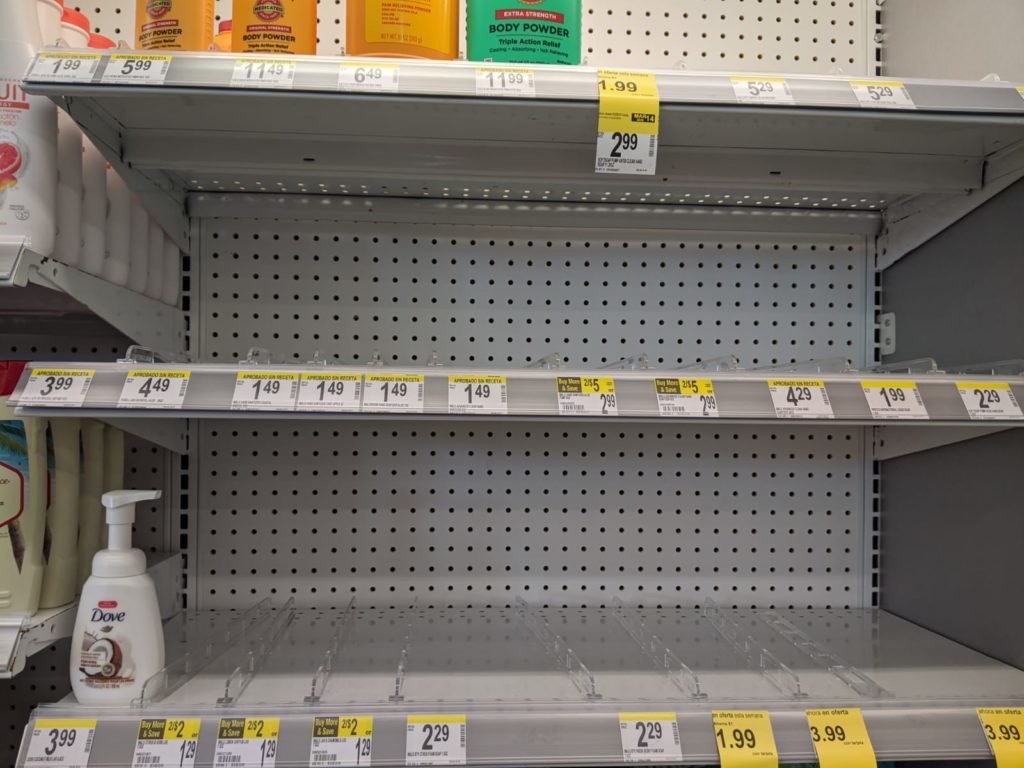
Here’s a photo that a friend sent to me a few hours ago of the hand sanitizer section at Walgreens– almost empty.

This isn’t going to stand for very long before the companies themselves start to limit purchases, or governments impose full-blown rationing. And that leads to…

3) Some people will become totally unglued. Others will be saints.

Let’s be honest— there’s already so much anger in the world. Strikes, riots, protests, Twitter rants… even armed thugs in the streets (Antifa) physically assaulting people with ideological differences.

Introduce a little bit of scarcity into all that anger and a few people will become totally unhinged.

Just think about how violent some shoppers can be on Black Friday, punching each other’s lights out in Wal Mart for the last big screen TV on special.

At the same time, this pandemic also has the potential to bring out the best in people. And countless others will be at their very best: respectful, generous, and responsible…

Click here to continue reading at Sovereign Man.