Tenth Amendment Center: How Our Constitution Was Supposed to Work

Constitutional scholar and co-author of The Origins of the Necessary and Proper Clause  and The Original Constitution Rob Natelson has written an article based on information from newly re-published essays by founder Tench Coxe about some limitations on federal power that were known and spelled out by the founding fathers.

How our Constitution was supposed to work: new evidence comes to light

Judging by the promises of presidential candidates, you might think the federal government is designed to fix whatever ails us: health care, education, crime, infrastructure, the common cold.

But the Constitution doesn’t grant the federal government such unlimited authority. And neither Congress nor the presidency nor the courts were created to exercise it.

The Constitution fashioned the federal government to address a limited number of activities, contained in the document’s “enumerated powers.” The remainder were exclusively the domain of state and local government and the private sector. This system of divided authority is called “federalism.”

…Despite the Constitution’s federal structure, many in the founding generation didn’t think it limited the central government sufficiently. They wanted to be able to govern themselves in their own states and local communities. They didn’t want Congress or federal judges or officials imposing uniform policies on the entire country.

These members of the founding generation had good reasons for fearing centralized power. They knew their history: Concentrated power usually grows into oligarchy or dictatorship. They questioned whether Congress would have the information or judgment necessary to tailor laws for every nook and cranny in the nation. They recognized that when government remained local, citizens enjoyed more say in how it was run. If someone was severely disaffected with state policies, he always could move to a different state.

This option of moving away is a vital safety valve. Without it, there is no practical way to vent anger among persistent political losers. Anger gives rise to hate: Hate fosters divisiveness and repression and, and in extreme cases, civil war.

Indeed, modern federal efforts to impose uniform “solutions” on the entire nation may be a leading cause of today’s toxic political environment.

…Coxe’s essays itemize many of the activities over which the Constitution granted the federal government little or no jurisdiction. Among them were social services (i.e., care for the poor and health care), education, religion, real estate, local businesses, most roads and other infrastructure, nearly all criminal law matters, and most civil court cases.

When people believed government should regulate those areas, the Constitution mandated that they turn to state and local government. No fleeting national coalition would be permitted to dictate to the entire country…

Click here to read the entire article at the Tenth Amendment Center.

Reason: Problems with Expanded Background Checks for Gun Buyers

This article comes from Reason magazine, detailing some of the problems with Attorney General Barr’s proposal to expand background checks for buyers of firearms.

Here Are the Problems With the Attorney General’s Plan To Expand Background Checks for Gun Buyers

Attorney General William Barr is reportedly floating a proposal to expand background checks for gun buyers that is similar to an unsuccessful 2013 bill sponsored by Sens. Joe Manchin (D–W.Va.) and Patrick Toomey (R–Pa.). The proposal would require background checks for “all advertised commercial sales, including gun sales at gun shows.”

Manchin and Toomey’s Public Safety and Second Amendment Protection Act would have required that federally licensed firearm dealers, who are already required to conduct background checks, be involved in all sales at gun shows and all transfers resulting from online or print ads. It explicitly exempted transfers “between spouses, between parents or spouses of parents and their children or spouses of their children, between siblings or spouses of siblings, or between grandparents or spouses of grandparents and their grandchildren or spouses of their grandchildren, or between aunts or uncles or their spouses and their nieces or nephews or their spouses, or between first cousins.”

Barr’s proposal would do pretty much the same thing, but it also would authorize licenses for “transfer agents” to help gun owners comply with the background check requirement. The idea, presumably, is that the new category of licensees would make compliance easier by providing an alternative to firearm dealers.

This proposal is less sweeping than the Bipartisan Background Checks Act of 2019, which the House of Representatives approved last February. That bill, which was supported by 232 Democrats but only eight Republicans, would ban almost all gun transfers by people who are not licensed dealers. It applies to any sale, whether or not it happens at a gun show and whether or not the firearm was advertised.

The House bill makes an exception for “a transfer that is a loan or bona fide gift between spouses, between domestic partners, between parents and their children, including step-parents and their step-children, between siblings, between aunts or uncles and their nieces or nephews, or between grandparents and their grandchildren.” If money changes hands, in other words, a background check would be required even for transfers between relatives.

Both proposals share the same problems as any other effort to expand the reach of background checks. First, the categories of prohibited buyers are irrationally and unfairly broad, encompassing millions of people who have never shown any violent tendencies, including cannabis consumers, unauthorized U.S. residents, people who have been convicted of nonviolent felonies, and anyone who has ever undergone mandatory psychiatric treatment because he was deemed suicidal.

Second, background checks are not an effective way to prevent mass shootings…

Click here to read the entire article at Reason.com.

AmPart: Signals Intelligence – Electronic Isolation Of A Target

NC Scout at American Partisan has written an article on signals intelligence and how to exploit it to disrupt an enemy’s communications. Please note that disrupting someone’s radio communications during peacetime is usually illegal. The FCC can fine you thousands of dollars, revoke any radio licenses you have, and confiscate your radio equipment.

Signals Intelligence: Electronic Isolation Of A Target

Not too long ago I ran a short post over at Brushbeater noting a story from the Marine Corps, pairing signals collection guys with Scout Snipers in a somewhat new small unit strategy. Building on the successes SOF units have had for a long time now in recognizing the rapid value of SIGINT in the field, pairing the two elements only makes sense. The idea is to isolate a target where they’re most vulnerable- electronic communications- in order to end the fight quickly with as few casualties on our side as possible. And working from a prepared citizen’s point of view, those same capabilities can and should be reflected in your own training.

It’s not enough to simply have a scanner, however nice it might be, and call yourself good on signals intelligence. Situational awareness, maybe, maybe, but none of it will do you much good without a means to exploit what ever it is you’ve collected.

The purpose of intelligence is exploitation. 

Recording voice traffic with common items makes exploitation easy

What that means in practical terms is that unless I can do anything with what I’m hearing, its completely useless to me. So what if I hear some traffic on a random frequency. Did I take the time to record it? What did they actually say? What is their level of training or discipline? Who’s the person in charge on the mic?

We can listen to all the traffic we want, but if we have no way of exploiting that, then we’re wasting our time.

Some of the equipment you’ll need for a signals collection package at the small unit level includes a decent scanner capable of decoding P25, a communications receiver, an inexpensive analog radio,  a recording device, a Yagi, and a frequency counter. Most of the higher end scanners on the market have up-gradable firmware that is enabling the decoding of P25 modes in use with public service as well as DMR which is very common today in the US as well as being used in Ukraine and Syria among guerrillas. A communications receiver, while similar to a scanner, will tell us the exact frequency the traffic is on, unlike most digital scanners today. We need to know this in order to have the operating frequency- its not enough to know what they’re saying, but we need to know what frequency they’re on so that if we decide to shut down their communications, we can effectively attack.

Our inexpensive analog radio enables us to not just have additional redundancy in our kit, but it’s also a useful exploitation tool. Depending on what type of gear your opponent has, something like a UV-5R can become our weapon in shutting their communications down. Using a Yagi to first get a bearing on their direction and then focus our signal in their direction, overloading their radios. This is beginning what’s known as isolating the target…

Click here to finish reading the article at American Partisan.

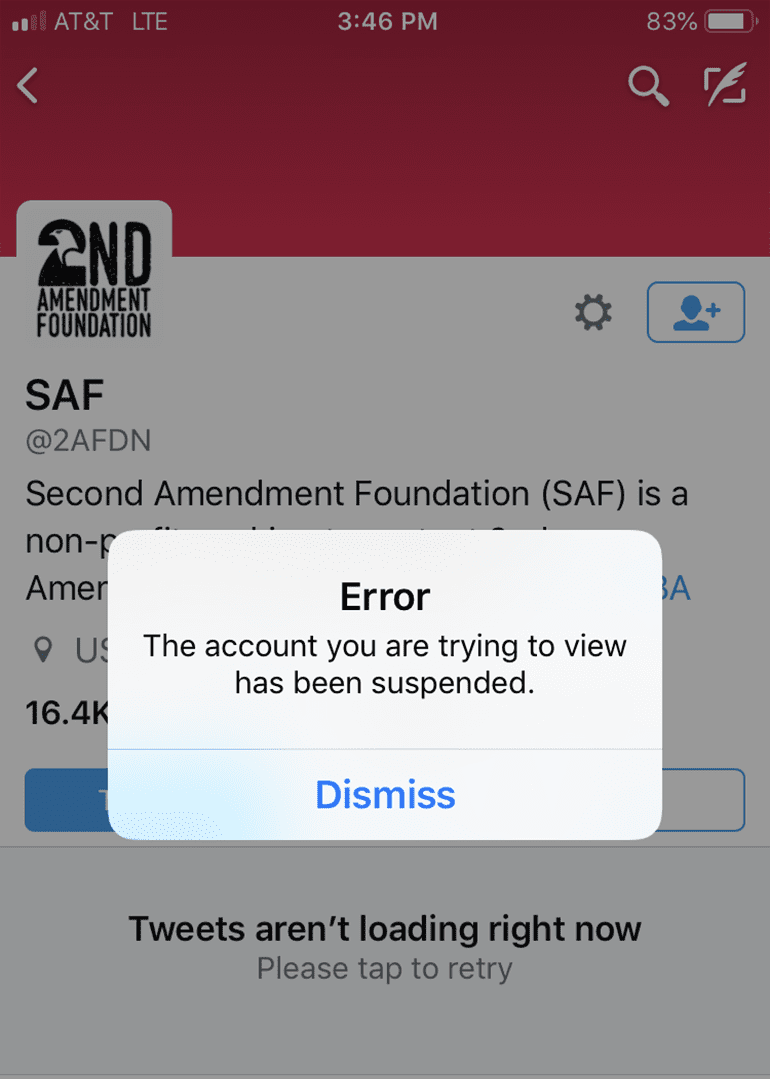
Twitter Suspends Second Amendment Foundation Account

From Truth About Guns:

SAF Twitter account suspended

The Second Amendment Foundation along with the Citizens Committee for the Right to Keep and Bear Arms are holding their annual Gun Rights Policy Conference in Phoenix this weekend (TTAG will be there). So…just in time for the gun rights orgs’ biggest event of the year, the pasty-faced geeks at Twitter have seen fit to suspend SAF’s social media account.

We talked to SAF founder Alan Gottlieb who had this to say:

We’re shocked. In all our years on Twitter, our account has never been suspended and we have no idea what we allegedly did to bring this about. It’s interesting that it’s happened right before the Gun Rights Policy Conference this weekend.

Yes it is. Does that sound paranoid? Maybe. But just because you’re paranoid doesn’t mean they aren’t really out to get you…

Wales Prepares for Brexit

As the Welsh are the most stolid and practical UK citizens, the Welsh government is leading the way in preparing for the UK’s exit from the EU (aka Brexit). The government of Wales recently published a preparedness planning document for the possibility of a no-deal Brexit. While the document is mainly aimed at apprising citizens of the actions the government is taking, it also lays out some probably effects Brexit would have on people so that they can make their own preparations. As some people have wondered just what the dangers are of a Brexit that one would get worked up over, here are some excerpts:

  • Major transport disruption for people and goods at the borders. As additional checks are required once the UK is no longer part of the Single Market and Customs Union. This is particularly significant at the Northern Ireland/Ireland border, the Channel crossings and atsea ports, including in Wales, where the role of Welsh ports is key to trade  with Ireland. There is also potential for delays at airports. Any delays could have significant knock-on impacts on the wider transport network, for example requiring “stack” operations on major highways and roads to ports. A number of the economic and other risks outlined below are linked to the critical issue of ensuring a smooth flow of goods through major ports–any delays could cause issues for the availability of some (fresh) food products and medicines and have a damaging impact on some trade sectors. The recently released Yellowhammer assumptions suggest a reduction to the flow rate to 40% to 60% of current levels of goods moving across borders compared to current levels if there is no mitigation. This could last up to three month safter exit day before it improves to around 50-70%.
  • Welsh Government has secured agreement for a UK-wide table top exercise, to test the co-ordinated response for the disruption to food supply and the potential public response, scheduled for the end of September.
  • Local authorities have been assured they would be able to continue to provide food in schools in the event of a no deal Brexit. But menus may need to be revised, although healthy eating in schools will be maintained
  • Contingency plans are in place to mitigate the risks of disruption to water supply chemicals.
  • Economic turmoil. The potential for major disruption to international trade (particularly, but not only, with the EU) impacting on exporting businesses, import supply chains and inward investment, could risk the sustainability of some businesses and have a negative impact on jobs and wages. This could be compounded by workforce impacts (see below). We are already feeling the consequences of a weaker economy as a result of three years’ of Brexit uncertainty –the Bank of England has estimated households are £1,000 worse off every year as a result of Brexit, compared to before the EU referendum. Some further impacts could happen very quickly after exit day, with some emerging over time. There is likely to be a further fall in the value of the pound relative to other currencies–Sterling has fallen markedly in value since the referendum and as the prospect of a no deal Brexit has intensified. This could, over time, translate into rising inflation on some products and lower economic growth
  • Some of the above factors, individually or in combination, could become too acute to manage locally. In that case, it may be necessary to assess the issue and treat it as a civil contingency

So, only things like food, water, medicine, jobs, and money may be materially affected. Minor stuff. Other information for Welsh preparing for Brexit can be found at the following websites:

https://gov.wales/preparing-wales

https://llyw.cymru/paratoi-cymru


Rural Nova Scotia: Dorian’s Wake Shows Importance of Community, Self-Reliance

A river, laden with debris, flows past a destroyed fishing shed near Halifax on Sept. 8, the day after Dorian’s arrival in the Maritimes. – Reuters

In this opinion piece in The Globe and Mail, author Noah Richler writes about the ineffectiveness of government in the face of tropical storm Dorian and the importance of both community and self-reliance – In rural Nova Scotia, Dorian’s wake shows the importance of community and self-reliance.

…last weekend, came Dorian, which Nova Scotia Power described to me as “the most destructive storm we’ve yet seen.”

…After a couple of hours, the lights flickered and went out. Come evening, as was happening across the province (and does in any disaster-struck Canadian community, I’m sure), several of us checked in on other households, those of seniors especially. We were lucky, the only tree we lost was a lilac. In the Annapolis Valley, the farmers were not – a good part of their apple and corn crops were destroyed – and neither were our immediate neighbours, two enormous maples falling down upon their house. Against what would have been official advice – had we been in a position to receive it – we used a ladder to check the integrity of the roof, walls and windows. In the drenching rain, a neighbour helped me get my generator started before we tried, unsuccessfully, to do the same for a friend down the road and gave him warmth through company instead.

Ours was one of Nova Scotia’s 400,000 households without power (the number of people obviously much greater) – this, a staggering 80 per cent of the population. At dawn the next morning, wondering what else was in store, I lay in my cold bed listening to the CBC, national and local, on our battery-powered radio – a part of the kit advised by government emergency-management co-ordinators – waiting for information about what I should or was able to do in the aftermath.

…Astonishingly, or perhaps not, the CBC was of no practical use. You’d think a public broadcaster would be communicating vital information after an occurrence such as Dorian and quite reasonably expect, by district, information in the event of a medical emergency (Nova Scotia is already disastrously short of services on sunny days); a list of roads safe to travel; of gas stations that are up and running; news about the airport and flights; and regular updates on the restoration of services – for it to be making public service announcements, in other words, and for these to be broadcast on the hour. Instead, the CBC was reporting the hurricane as entertainment… I was told…that if I wanted Hurricane Dorian updates, to go to the network’s Storm Centre online … where the CBC had also posted pictures!

Except that most of us could not. The CBC evidently had no idea that what “no power” means for Nova Scotians is no light, no water, no heat, no landline for those without analog sets – and no internet.

…No power means no contact.

Which is when the community kicks in…

What we have learned from Hurricane Dorian, but also the countless other “natural” disasters that have struck Canada in recent years – the Fort McMurray fires and the flooding of Canmore, Gatineau and High River come to mind – is that when, as will happen more and more, infrastructure fails, communities’ self-reliance is key…

And so, ironically, we have reached a point where the environmentalists of the left and, on the right, libertarians and survivalists, are thinking along the same lines: The state, when it is interested, cannot be depended upon, so get off the grid, create your own…

We’re alone out here, and it’s hard not to see the failings that natural events such as Dorian put on show, as harbingers of worse to come. No, it’s not an entertainment. There’s serious work to be done.

Click here to read the entire piece at The Globe and Mail.

Gatestone Institute: A View of the U.S. from Across the Atlantic

This brief article was written by Andrew Ash of the UK for the Gatestone Institute – A View of the U.S. from Across the Atlantic. Within, Ash reveals his growing interest in American politics; growing because of its apparent corruption and secrecy.

…Compared to the almost polite political rivalry between voters and parties in Britain, the political division in the US began looking distinctly engineered.

My American friends, in an effort to help me try and understand their conclusions, sent a raft of articles from the US mainstream media, which, in their bias, displayed the same lack of integrity as my friends’. Even in the extended echo-chamber of social media, there appeared to be a seemingly pathological fear of anything even remotely resembling a balanced view.

Then, along came the 2016 election and the arrival of presidential candidate Donald J. Trump. Whilst the UK was not looking, war seemed to have broken out. If I was not prepared forthrightly to dismiss Trump as the white supremacist he so obviously and professedly was, it was clear that if I was not careful, I would be tarred by the same brush.

My friends assured me there were terrible, terrible things that would become apparent in the ensuing months. The problem was, they never once articulated any of them. Their suspicions all appeared to be hysterical unfounded inferences.

The evident reluctance by left-wing media outlets to condemn a — by now — extremely guilty-looking Secretary of State Hillary Clinton, now seemed unfair. Much of the media seemed all too happy to turn a blind eye to the Benghazi affair, her “unusual” email practices and other seemingly incriminating pranks. The media also seemed to ignore the treasure-trove of information on the suspect machinations of the DNC and its incumbents and other dubious goings on, including truncated FBI investigations, the “controversial” resignation of Democratic National Committee Chair Debbie Wasserman-Schultz, the sudden departure from CNN of Donna Brazile after having fed questions to Clinton prior to the televised presidential debates, and so on.

The potential skulduggery seemed never ending. How come my friends had never mentioned any of this? Surely, they knew? The echo chamber, it appeared, was hermetically sealed…

Click here to read the entire article at the Gatestone Institute.

2017 FCC Rule Changes for FRS Go into Effect 9/30/19

Back in 2017, the FCC reviewed the personal radio services which include FRS, GMRS, CB, MURS and more and made changes to the rules. Many of those new rules go into effect on Sept. 30, 2019 — or in two weeks from this publication.

Here are the main changes to the rules going into effect:

  • No FRS/GMRS combined radios can be sold after that date
  • No hand held radio capable of operating in both FRS and any other licensed service can be manufactured or imported
  • No voice obscuring radios operating in these services may be manufactured, imported or sold

Here are some additional details

Wilder: Civil War 2 Weather Report, Issue Four

John Wilder at Wilder, Wealthy, and Wise has released the next monthly installment of his Civil War 2 weather report in which he updates the various indices he watches in reference to conflict in the US. An excerpt:

Last month when I wrote the Weather Report, the El Paso and Dayton shootings had just happened.  I believe I predicted in the comments that El Paso would have legs, while Dayton would quickly be forgotten.  It didn’t take Nostradamus to predict that – El Paso was attributed to the Right.  Dayton, where a confirmed Satanist Antifa™ member killed bunch of people?  We can ignore Dayton.  That was just random violence by a good boy who just went a little wrong.

Red Flag laws have been the focus of this month’s activity.  I noted in this post (Red Flag Laws, or, How To Repeal The Second Amendment Soviet-Style Without A Pesky Vote) that they would be used inappropriately.  Again, I didn’t need to have psychic powers to predict this.  I landed on a clickbait story from the Puffington Host (I won’t link to them) about 40 “potential mass shooters” having been arrested since El Paso.  Not Dayton, but El Paso.  Odessa happened this weekend.  Assume if the killer’s ideology doesn’t match the required narrative, it will be forgotten…

…Violence was, sadly, the theme of August. But a secondary theme was censorship. Several large YouTube® channels were deleted without any warning, without having violated any of YouTube’s© rules. I had only heard of one of the deleted channels, and, although the others were reinstated, the one that stayed deleted was the one I watched: James Allsup…

…Allsup will keep pushing a message out – he’s articulate and relatable, but now the message will untethered by rules.  The message will cease to be moderated.

Censorship and alienation is a great way to manufacture radicals.  Radicals are a great way to increase polarization…

…Given our current polarization, and with violence springing up regularly when times are good, I tend to think that the younger generation doesn’t see a way forward, doesn’t see prosperity as an option. They feel that they have nothing left to lose…

Read the entire article at Wilder, Wealthy, and Wise by clicking here.

National Preparedness Month 2019 – Week 3

September is National Preparedness Month.

The theme for week three is Teach Youth to Prepare for Disasters.

Emergencies and disasters can happen at any time, often without warning. Disaster planning, response, and recovery efforts must take into account the unique needs of children, who make up roughly a quarter of the U.S. population.

Starting or getting involved with a youth preparedness program is a great way to enhance a community’s resilience and help develop future generations of prepared adults. The Federal Emergency Management Agency (FEMA) offers numerous resources that can help.

FEMA’s Youth Preparedness Council

FEMA created the Youth Preparedness Council (YPC) in 2012 to bring together young leaders who are interested in supporting disaster preparedness and making a difference in their communities, by completing disaster preparedness projects nationally and locally. The YPC supports FEMA’s commitment to involve America’s youth in preparedness-related activities. It also provides an avenue to engage young people by taking into account their perspectives, feedback, and opinions. YPC members meet with FEMA staff throughout their term to provide input on strategies, initiatives, and projects. YPC members also attend the annual YPC Summit in Washington, DC, meet periodically with FEMA representatives, and work to complete a number of emergency preparedness projects. The YPC members are selected based on their dedication to public service, their efforts in making a difference in their communities, and their potential to expand their impact as national supporters of youth preparedness.

Prepare with Pedro: Disaster Preparedness Activity Book

Prepare with Pedro: Disaster Preparedness Activity Book is a joint product of FEMA and the American Red Cross. Prepare with Pedro is designed to encourage youth and their families to be better prepared for disasters by offering safety advice alongside crosswords, coloring pages, matching games, and more.

Obtain copies of the activity book, now in both English and Spanish!

  1. Download and print by visiting: Prepare with Pedro: Disaster Preparedness Activity Book
  2. Order printed copies for free through the publication warehouse online or by phone at 1-800-480-2520 request publication number #2005 for the English version or publication number #2035 for the Spanish version.

Ready 2 Help

Ready 2 Help is a card game that teaches youth how to stay safe and help in emergency situations. Ready 2 Help can be played by 2-4 players ages 8 and above. Parents, coaches, teachers, and other youth leaders can use the game and companion book to teach kids how to react to emergencies in a fun and friendly way. The game encourages discussion about preparedness using five simple steps: Stay Safe, Stay Calm, Get Help, Give Info, and Give Care. Everyone can play and learn!

Obtain copies of the card game and companion book –

National Strategy for Youth Preparedness Education

Developed by FEMA, the U.S. Department of Education, and the American Red Cross, the National Strategy for Youth Preparedness Education presents nine steps partners can take to help build a Nation of prepared youth. The steps focus on building partnerships to enhance youth preparedness learning programs; connecting young people with their families, communities, first responders, and other youth; and increasing preparedness at school.

9 Priority Steps for Creating a Nation of Prepared Youth

  1. Elevate the importance of youth preparedness learning programs at the national, state, and local levels.
  2. Evaluate the quality and effectiveness of existing and new youth preparedness programs.
  3. Support the implementation of youth preparedness learning programs.
  4. Create positive relationships between youth and the first responder community.
  5. Link youth preparedness to family and community participation, especially in communities where English may not be the first language spoken (or understood) among adults, in other underrepresented communities, and inclusive of individuals with access and functional needs.
  6. Make school preparedness a key component of youth preparedness.
  7. Build and strengthen productive partnerships among stakeholder agencies and organizations.
  8. Identify opportunities to embed youth preparedness in youth culture.
  9. Design a sustaining, locally driven model for developing, designing, and delivering programming.

Join the National Strategy Movement

Help us propel the youth preparedness movement! By aligning your organization’s activities with one or more of the National Strategy’s nine priority steps, you are joining a network of prominent public- and private-sector organizations that are dedicated to promoting youth preparedness and building a more resilient Nation. Find out how to affirm the National Strategy, or email FEMA-Youth-Preparedness@fema.dhs.gov for more information.

Facebook Removes Prepping 2.0 Page

According to a Facebook post from Shelby Gallagher, co-host with Glen Tate of the Prepping 2.0 Show, Facebook has unpublished their Prepping 2.0 Facebook page without giving a reason. The page had approximately 15,000 followers. The two authors have started another Facebook page called Prepping 2.0 Radio Show & Podcast and still have their website at http://prepping2-0.com.

Both Glen Tate and Shelby Gallagher wrote their books (the 299 Days and A Great State series respectively) with the idea of telling a story of a possible collapse and how to prep. Upon reflection, they realized that times are changing quickly. It is an exciting time to prep. Innovation, technology, know-how have advanced in recent years…so has the need to prep. Hence the reason for a new outlook on prepping. The need for Prepping 2.0.

OH8STN: Emergency Power for Communications

Amateur radio enthusiast, blogger and vlogger OH8STN (Julian) has posted the second video in his Grid Down Communications series. In this video he addresses peoples’ concerns with how they will keep their communications online when the grid is down, including batteries, solar generators, solar panels, and other alternative power.

Public Meeting on Cascades Grizzly Bear Introduction – Oct.7, 2019

From the office of Rep. Dan Newhouse:

SAVE THE DATE: Public Meeting on Grizzly Bear Introduction

Image

The introduction of grizzly bears to the North Cascades will directly affect the people and the communities I represent. I oppose this proposal because I believe introducing an apex predator to the area will threaten the families, wildlife, and livestock of North Central Washington. However, I have long advocated that local voices must be heard loud and clear before any Administration moves forward with this plan.

I am pleased to announce I will be joining officials from the National Park Service and U.S. Fish and Wildlife at a public meeting on October 7th at the Okanogan County Fairgrounds, 175 Rodeo Trail Road, Okanogan. Doors will open at 5:00 PM. I strongly encourage the people of Central Washington to attend this meeting in order to voice your opinion and put this proposal to rest, once and for all.

For more details on the meeting, click here.

The draft EIS is currently open for comment through October 24, 2019. The public is invited to view the Draft EIS and make comments online here. Written comments will be accepted in person at the meeting or by mail to: Superintendent’s Office, North Cascades National Park Service Complex, 810 State Route 20, Sedro Woolley, WA 98284. Comments will not be accepted by fax, email, or any other way than those specified above.

Center for Self Governance: Foundational Civics Classes

The Center for Self Governance is holding it’s Foundational Civics class in both online and in person classes in the next couple of months.  The online class will be held on September 21, 2019 – click here for registration information. There are also two in-person classes. The first is September 21st in Republic, WA (click here for registration). The second is October 19th in Ephrata, WA (click here for registration).

Foundational Civics

Basic Systematic Civics – Levels 1 & 2

In this Basic Systematic Civics class, you will first analyze the theoretical concept of government as a system and the maintenance principles related to systems in general. Second, you discover government system philosophy and design tension of layer and marble cake federalism. Finally, you are introduced to the current system structure of U.S. government.

The Center for Self Governance is a non-profit, non-partisan educational organization dedicated to advancing a stable civil society, balanced human government, and a well-educated populace.