Gatestone Institute: The Autocratic Future of the United States?

Dr. Guy Millière, a professor at the University of Paris, at the Gatestone Institute writes about the suppression of information in the US in The Autocratic Future of the United States?

There seems to have been an attempt for the last four years to instill among the population a hatred of America and of the president, to present them both as a criminal and to try to overthrow them. In any event, it is the first time in American history that there has been an attempted coup d’état against a duly elected president.

If institutions of democracy — the state, the judiciary, opposition parties and the free press — suppress verifiable information instead of informing the public about it — as has just taken place for more than two weeks regarding alleged financial corruption and the possible resultant compromise — by China, Russia, and Ukraine among other countries — of an allegedly financially compromised family as possible a national security threat — these institutions of democracy instead become vehicles to sabotage a democracy.

A danger to American democracy in the past years — with threats to undo the Constitution by, for example, abolishing the electoral college, banning guns and, in 2014, eliminating free speech — has therefore become imminent.

In 2016, the FBI, under the leadership at the time of James Comey, used a fraudulent document bought and paid for by the 2016 Hillary Clinton presidential campaign to launch a two year “investigation” in search of a crime against the president. Special Counsel Robert Mueller, at the time of his appointment, on May 17, 2017, knew, or should have known — along with the leadership of the CIA, the FBI, and other key agencies, in extremely dubious, possibly even criminal, actions — that the document on which is investigation was based, the Steele dossier, was fraudulent.

Now we have the later round. After a political experiment in California successfully used late, fraudulent voting to turn Orange County from red to blue, the effort, with the complicity of the Supreme Court, seems to have expanded. There were worries that mail-in voting might rig the election, and if the military might be needed to remove a reluctant incumbent from office. No one, of course, asked what the opposition would do if it lost the election and refused to leave. The only recommendation so far seems to have been threatening more riots.

In a recent article, Abe Greenwald, executive editor of Commentary magazine, described what is happening as “a revolution against the United States of America and all it stands for”.

Roger Kimball has described in his book The Long March how, from the 1960s onwards, members of the radical left gradually took control of the universities, the educational system, culture, media. The takeover of their preferred party followed. The method pursued was defined by the Italian communist Antonio Gramsci, who advocated the infiltration of the existing civil society to destroy it from within and lead it to collapse. The tactics were set out in Saul Alinsky’s 1971 book, Rules for Radicals.

Former US President Barack Obama, a disciple of Saul Alinsky, said, before being elected in 2008, that his followers were “five days away from fundamentally transforming the United States of America”. He did not say into what. Hillary Clinton, another disciple of Alinsky, was expected to win and continue what Obama had started. To these self-appointed elites, whoever seems to have taken their lace seemed to become the enemy –the obstacle that had prevented them from taking what they appear to hope will be irreversible control of the United States.

There has been talk about killing the filibuster, to pass just about anything with a simple majority, and talk about enlarging the Senate by adding more states, presumably to enable one side to hold a permanent majority. Also on the agenda has been adding more members to the Supreme Court to turn it into a branch of legislative government, eliminating America’s historic system of checks and balances. There are also plans to raise taxes on everyone (remember, “You can keep your healthcare“?), abolish fossil fuels and fracking, and establish a Marxist-socialist economy of redistribution to replace a free economy.

These ideas appear to have the support of hundreds of professors, mainstream journalists, and members of the so called “cultural elites“, as well as the leading social networking services, such as Twitter and Facebook, that are practicing with impunity suppression of factual information and censorship of anything that might run counter to their preferred policies, especially if it threatens to reveal national security concerns about issues they would rather keep from public view.

Many if these ideas also have the support of international financiers and entrepreneurs, who are seeking above all, to keep hiring cheap labor, and to gain easy entry into China’s vast market share of 1.5 billion consumers. The long-term threat of China, outspokenly determined to unseat America and control the world, seems less of a threat than a slightly-less-spectacular quarterly report for their shareholders.

Communist China is ruled by leaders who have been stealing information for decades and using a kind of state capitalism to enrich themselves and those close to them, meanwhile ruling over millions of “serfs” who are increasingly deprived of information and freedom.

If the American people do not fight to defend their institutions and democracy, the United States could soon be ruled by an “expert” class, tech oligarchs, and other autocrats, and, although what will happen if the US government changes hands remains to be seen, many Americans could be forced to follow the usual autocratic road to serfdom.

Chairman of the Board of Directors of the Claremont Institute Thomas Klingenstein noted that “We are in a fight for our lives”.

When you see proposals to disrupt elections and plans about destroying a free economy, believe them.

Straight Line Logic: The Corruptocracy

Robert Gore at Straight Line Logic writes about The Corruptocracy that is our nation.

Most political philosophy is just an elaborate justification for theft and fraud.

What’s called the silent majority is really the ignored majority, who for the most part are happy being ignored. Their lives revolve their families, jobs, friends, and community, not the media, publicity, polls, or politics. They’re sick of elections well before they’ve seen their hundredth campaign ad, received their hundredth mailer, or ignored their hundredth telephone call. They know that politicians are phony and corrupt and make jokes about them, but hope that their rulers don’t screw things up too badly, cross their fingers, and vote for the perceived lesser of two evils.

There’s a shortage of blue-ribbon pedigrees, Ivy League degrees, and gold-plated resumés among the ignored majority, but a surfeit of hard-knocks wisdom and common sense. Benjamin Franklin said, “Experience keeps a dear school, but fools will learn in no other.” Everybody does foolish things, but by and large, the ignored majority learns from the dear school and puts its lessons to good use.

The gilded class denigrates those outside it: Hillary Clinton deploring the “deplorables,” Barack Obama saying working-class voters, “cling to guns or religion,” and Obama telling entrepreneurs, “you didn’t build that.” Yet, it consistently, almost invariably, demonstrates a complete lack of the common-sense street smarts found in abundance among those it disparages.

The quotes’ condescending arrogance rankles, but at a deeper level illustrate the real division in American politics—between the productive class and those it supports. At the intellectual level it’s the irreconcilable difference between those who believe that value can and should be conferred by the government, and those who know it must be created and produced. It’s believing or not believing that something can be had for nothing.

Freeloaders’ delusion stems from psychology, not ignorance. Every human faces a choice. They can produce value or they can beg, borrow, defraud, or steal it from someone else. For every advance humanity has made, there’s always been someone claiming their unfair share. Most of what we call history is merely an account of who’s stealing or defrauding from whom.

Because production is necessary for human survival, not producing anything of value creates a gaping psychological fissure, one not generally recognized or acknowledged. What’s generally accepted is that humans grasp at rationales and justifications for their actions, not just for the audience to which they’re playing, but for themselves. Most political philosophy is just an elaborate justification for theft and fraud. Political systems don’t spring from philosophies, the philosophies spring from the systems’ actual or potential beneficiaries.

Governments can take every scrap of what is produced. They can pledge every scrap of future production as repayment for their debts. The legitimization of unlimited current and future plunder leads to ever-increasing plunder and debt—and ever-diminishing production. Present governments are merely repeating a cycle that’s played out countless times throughout history.

You would think that government rapacity would be curbed when taxes, regulatory extortion, and debt disincentivize and begin reducing legitimate production. Unfortunately, that assumption flies in the face of historical fact; countless regimes have killed their golden geese. The only regimes that haven’t are those that are currently in the process of doing so.

One among many of rulers’ delusions is that the ruled are buying their lies.
Over time the victims see through the propaganda and narrative management. The lies fool the rulers more than the ruled and are essential psychological support for this predatory and parasitic class.

Commentators from the alternative media bemoan the lack of intelligence and awareness of the American people, and the supposed dominance of the mainstream media narrative. Yet, any number of alternative media commentators, YouTubers, and sites routinely receive more readers or viewers than touted mouthpiece media “powerhouses.” More people watch dissident Paul Joseph Watson’s videos than Rachel Maddow’s nightly screeds, but Maddow receives an inordinate amount of attention from the alternative and mainstream alike and Watson virtually none.

The alternative media’s thousands of sites have eclipsed the mouthpiece media, which exists in a bubble of its own creation. It’s a hugely underreported trend—without fanfare millions of people rejecting the mainstream, reading, researching, and coming to their own conclusions. There’s 330 million Americans and many of them are neither stupid nor duped. It’s just that nobody pays attention to them.

The media bubble envelopes the government-centered corruptocracy and allows those within to preserve the self-deception of personal worth. Someone who lives off the corporate-lobbyist-political food chain, shuffles paper in a government bureaucracy, enforces tax or regulatory extortion, or is otherwise supported in a something-for-nothing scheme cannot have the self-respect that comes from producing value. Instead, the predatory and parasitic classes cling to psychological crutches: conceit, arrogance, condescension, delusion, and willful ignorance.

The most intense predator and parasite condescension is directed at the producers who provide their sustenance. This may seem paradoxical but it’s not. Honest production is an obvious moral rebuke to those who live by theft and fraud. Acknowledging either the value of producers or their own dependence on them would undermine the fragile edifice of their rickety substitutes for self-worth.

Disaffected veterans were the core of a group that would grow to millions, their “faith” in government and the people who ran it obliterated by its repeated failures and lies. Revolutions dawn when an appreciable number of the ruled realize their rulers are intellectual and moral inferiors. The mainstream media is filled with vituperative, patronizing, and insulting explanations of what’s “behind” the Trump phenomenon. It all boils down to revulsion with the self-anointed, incompetent, pretentious, hypocritical, corrupt, prevaricating elite that presumes to rule this country. It is, in a word, inferior to the populace on the other side of the yawning chasm, the ones they have patronized and insulted for decades, and the other side knows it.

Much More Than Trump,” Robert Gore, SLL, March 3, 2016, reposted November 6, 2016

Nothing has changed over the last four years, except that the ranks of disaffected have swollen. Trump gave voice to them in 2016 and he’ll do it again in 2020. Once more it’s the productive businessman outsider against a government hack insider. After Russiagate, the impeachment, the coronavirus power-grab, leftist and Marxists riots, and endless media-driven tempests in teapots, the somethings in this country are far more contemptuous of the nothings who presume to rule them—and farcically, have designs on the whole world—than they were four years ago. The ultimate farce is the Harris/Biden ticket: a corrupt, doddering, old fool and a nakedly ambitious shrew who even Democrats don’t like, neither with a scintilla of detectable principle, waging the most inept campaign ever in front of face-masked, socially distanced audiences that number in the tens.

If he gets anything approaching an honest vote count Trump will win in a landslide. The “reputable” pollsters have become another arm of the entrenched powers’ narrative management. Like everything else the corruptocrats have tried, this effort will prove inept. The purported double-digit Biden leads will motivate, not discourage, Trump’s voters. By every other indicator—voter registrations, growing black and hispanic support, the crumbling entertainment and sports complex, the crumbling mainstream media, the ascendent alternative media, millions of new gun owners, backlash against the riots, slowly fading coronavirus hysteria, and off-the-charts attendance and enthusiasm at Trump rallies—Trump’s winning by a country mile.

And let’s not forget Hunter Biden’s hard drive, much as the corruptocracy, Twitter, Facebook, and most of the mainstream media would like us to. The revelations are important not because they reveal that the Bidens are a criminal enterprise—we already knew that—but because they further confirm the suspicions of millions of street-smart, disaffected Americans: our country is a corruptocracy.

If Trump wins and quells the Super Tantrum, he’ll have to do more than give voice to the disaffected. He’s forced the corruptocrats from the depths of their swamp, and he may or may not be blackmailing them for his own purposes. But not a drop of swamp has been drained, and if nothing happens the next four years, Trump’s tenure will be nothing more than a feel-good fantasy for his fans.

He’ll have to either blackmail paid up swampsters William Barr and Christopher Wray to do their jobs or get rid of them for people who will. Nothing less than indictments and prosecutions that cuts a wide swath across the corruptocracy— Clapper, Brennan, Comey, Mueller, Page, Strzok, Haspel, the Biden crime family, Obama, the Clintons, many of the listings in Jeffrey Epstein’s black book, and the rest of their insidious ilk—will do. Arresting Hunter and Joe Biden the day after the election would be a good start.

Trump must put up or shut up on draining the swamp before he can proceed to his long list of other unfinished business. The swamp is the inevitable backwash of a government that has arrogated unlimited power to itself, has first claim on everything produced within the United States, issues debt without limit, and maintains a confederated global empire. Power creates corruptocracies. There is a one in a trillion chance that Trump or any other ostensible outsider changes any of this, and a one in a quadrillion chance that the system reforms itself.

Trump or no Trump, the disaffected will get more disaffected, at least until the system collapses, which it will. The failing of all governments is that they can’t produce, only coerce. What they can force their citizens to produce is astonishingly low compared to what those citizens would produce if left to their own devices in free markets. The productive economy is straining under the tax and debt loads it’s being forced to carry. The debt orgy this year is probably the last straw. The shut-down real economy and debt-bloated financial markets will force a reckoning.

That reckoning will be global and governments will get smaller. Not because anyone within them experiences an intellectual conversion towards less government—and consequently less power—but because they are bankrupt and access to credit will be severely limited. Central banks may continue to buy their governments’ debt with their own devalued debt, but that daisy chain will come to an end as well. A bear market in debt of all stripes and a bull market in interest rates loom. The silver lining: long suffering savers (both of them) and creditors will finally be compensated for the credit risks they bear.

With the crumbling of governments will come the crumbling of current political institutions and boundaries. The breakdown of the corrupt and doomed old order presents the opportunity for the establishment of new orders. What seems inconceivable now may occur with astonishing speed. A year ago, who envisioned what’s transpired so far in 2020?

Millions of salt-of-the-earth, common sense Americans have watched in horror as their country has imploded from lockdown insanity and riots. There’s an exodus from urban hellholes to safer and saner locales. The response to those who say breakdown can’t happen is that it’s already begun.

Alasdair Macleod is writing about Europe, but what he says applies to the United States:

The fate of the euro will be shared with the majority — if not all — of other fiat currencies for reasons specific to them. The recovery from the ashes of government incompetence can be swift — a matter of a year or two, so long as successor governments quickly learn that free markets, sound money and minimal interference from government are all required for the restoration of economic progress. Additionally, all socialist policies must be discarded, and the profit motive and individual wealth creation embraced.

The destruction of the euro,” Alasdair Macleod, goldmoney.com, October 22, 2020

There will be jurisdictions, some born out of secession or insurrection, that will institute “free markets, sound money, and minimal interference from government,” along with the concomitant essentials: freedom and the protection of individual rights, because they work and have worked throughout history. They are the quickest way to recover from economic and financial devastation. Most importantly, freedom is the only moral system, the only system compatible with productive survival, and the only system that promotes human happiness.

Freedom, rather than Trump, represents the best hope for the righteously disaffected.

Continue reading “Straight Line Logic: The Corruptocracy”

Kunstler: Biden and Media – Bleeding Out

James Howard Kunstler writes Bleeding Out about the corruption of Biden and associates, and the media that protects the elites at the expense of journalistic integrity and representative government.

“The difference between you and me,” Mr. Trump said to the ever more ghostly Joe Biden, fading mentally late in the action on the debate stage, “is that I’m not a politician and you are, and you’re a crooked politician.” Millions watching this spectacle might not have noticed, due to the media’s near-complete blackout of news detailing the Biden family’s adventures in systematic global moneygrubbing, but the Democratic candidate for president has political Ebola, a hemorrhagic fever of credibility, now gushing out of every pore and orifice.

Twitter and Facebook may try to squelch the story, but the evidence is all over the Internet now, like blood on a crime scene, in verifiable emails, texts, Snapchats, memoranda, and bank records that Ol’ White Joe Biden is at the center of a decades-long influence-peddling spree, selling his personal services to China, Russia, Ukraine, and any other country seeking favors in US government policy, and that this slime-trail of grift disqualifies him from holding high office as much as the irreversible rot of his cognitive abilities.

The “Laptop from Hell” affair has twelve more days to play out before the November 3 vote and the Democratic Party is in a terrible jam. Do they ask Mr. Biden to step aside, or do they keep running with him while the barrage of allegations and hard evidence pours down on them like so many mortar rounds on a besieged bunker? It’s obvious now that one way or another, voters are actually being asked to elect Kamala Harris president — but who asked for her? Only the disgraced and disabled head of the ticket, Joe Biden, desperate for a non-white running mate. Elsewise, she was so disliked by voters that she skulked out of the Iowa caucuses, ending her own run. Is Hillary ironing her purple pantsuit up in Chappaqua, awaiting the emergency call from her DNC?

The early 2020 impeachment gambit has finally blown up in the Democrats’ faces, too, as it’s now obvious the phony furor over Mr. Trump’s phone call to Ukraine President Zelensky was ginned up to smother any inquiry into Hunter Biden’s $83,000-a-month services to the Burisma gas company and its crooked chief, Mykola Zlochevsky, with help from then US Ambassador to Ukraine Marie Yovanovitch and several of her staff, as well as then Secretary of State John Kerry.

Interestingly, figures associated with Mr. Kerry (the 2004 Democratic party nominee), Devon Archer and Christopher Heinz (Mr. Kerry’s stepson) also happened to be business associates of Hunter Biden’s, and therefore the Biden family syndicate. Mr. Archer is currently under conviction, awaiting sentencing, on a federal securities fraud rap. If US attorneys out of the DOJ have any interest in talking to him, they have a lever to incentivize his testimony about many of the transactions involving Burisma in Ukraine and the Chinese companies that were funneling payments to the Bidens for “introductions” to US persons of influence.

The Democrats have a whole lot of bad behavior to defend, ranging far beyond the Bidens to the decades-long activities of the Clintons in their charity frauds, the related Uranium One matter — in which $150-million in Russian money found its way into the Clinton Foundation — and the deal that set up transfers of US secret computer tech to Russia’s Skolkovo project, which eventuated in Russia’s development of hypersonic weapons. Not to mention the RussiaGate coup operation to overthrow the president using false allegations supplied by Mrs. Clinton, the Democratic National Committee, and scores of high officials in a range of executive agencies.

Ironically many of those same schemers are at it again in the recent letter by a long list of former Intel spooks trying to discredit The New York Post’s reporting on Hunter Biden’s laptop as “having all the earmarks” of a Russian disinformation op. At the top of the list of that letter’s signers, you’ll find John Brennan, CIA chief under Obama, and James Clapper, former Director of National Intelligence – both of them progenitors of the RussiaGate coup and liable to prosecution for seditious conspiracy. Can you smell their desperation?

Something else may be turning now, though, on this titanic hairball of corruption and deceit: mainstream media reporters starting to jump into lifeboats to save their reputations by actually reporting honestly on developments in this web of stories. The few early adapters to truth-telling may be the only survivors. The ones who stick with the ship of deception are going down into cold and darkness. And if President Trump wins reelection — a possibility despite polling that, in many cases, is just propaganda — the public will learn exactly how the Democratic Party became the enemy of the people.

See also:

Pat Buchanan: A Biden Family Special Prosecutor in 2021?

Jonathan Turley: Disinformation by Popular Demand – How the Authenticity of Hunter Biden’s Laptop Became Immaterial

Zero Hedge: You’re Gonna Bury All Of Us’: Whistleblower Describes Brazen Biden-China Dealings In Explosive Interview With Tucker Carlson

The National Pulse: Hunter Biden Audio Confesses Partnership With China ‘Spy Chief’… Joe Biden Named as Criminal Case Witness

Zero Hedge: Blockbuster Report Reveals How Biden Family Was Compromised By China

The National Pulse: Biden, Corruption, and Ukraine’s Election Interference AGAINST Trump

Advancing Time: Hunter Biden Is Not The Problem, The Problem Is His Dad


Rutherford Institute: Tyranny at the Hands of a Psychopathic Government

Constitutional law attorney John Whitehead writes at The Rutherford Institute – Don’t Vote for a Psychopath: Tyranny at the Hands of a Psychopathic Government.

Politicians are more likely than people in the general population to be sociopaths. I think you would find no expert in the field of sociopathy/psychopathy/antisocial personality disorder who would dispute this… That a small minority of human beings literally have no conscience was and is a bitter pill for our society to swallow — but it does explain a great many things, shamelessly deceitful political behavior being one.”—Dr. Martha Stout, clinical psychologist and former instructor at Harvard Medical School

Twenty years ago, a newspaper headline asked the question: “What’s the difference between a politician and a psychopath?

The answer, then and now, remains the same: None.

There is no difference between psychopaths and politicians.

Nor is there much of a difference between the havoc wreaked on innocent lives by uncaring, unfeeling, selfish, irresponsible, parasitic criminals and elected officials who lie to their constituents, trade political favors for campaign contributions, turn a blind eye to the wishes of the electorate, cheat taxpayers out of hard-earned dollars, favor the corporate elite, entrench the military industrial complex, and spare little thought for the impact their thoughtless actions and hastily passed legislation might have on defenseless citizens.

Psychopaths and politicians both have a tendency to be selfish, callous, remorseless users of others, irresponsible, pathological liars, glib, con artists, lacking in remorse and shallow.

Charismatic politicians, like criminal psychopaths, exhibit a failure to accept responsibility for their actions, have a high sense of self-worth, are chronically unstable, have socially deviant lifestyles, need constant stimulation, have parasitic lifestyles and possess unrealistic goals.

It doesn’t matter whether you’re talking about Democrats or Republicans.

Political psychopaths are all largely cut from the same pathological cloth, brimming with seemingly easy charm and boasting calculating minds. Such leaders eventually create pathocracies: totalitarian societies bent on power, control, and destruction of both freedom in general and those who exercise their freedoms.

Once psychopaths gain power, the result is usually some form of totalitarian government or a pathocracy. “At that point, the government operates against the interests of its own people except for favoring certain groups,” author James G. Long notes. “We are currently witnessing deliberate polarizations of American citizens, illegal actions, and massive and needless acquisition of debt. This is typical of psychopathic systems, and very similar things happened in the Soviet Union as it overextended and collapsed.”

In other words, electing a psychopath to public office is tantamount to national hara-kiri, the ritualized act of self-annihilation, self-destruction and suicide. It signals the demise of democratic government and lays the groundwork for a totalitarian regime that is legalistic, militaristic, inflexible, intolerant and inhuman.

Incredibly, despite clear evidence of the damage that has already been inflicted on our nation and its citizens by a psychopathic government, voters continue to elect psychopaths to positions of power and influence.

Indeed, a study from Southern Methodist University found that Washington, DC—our nation’s capital and the seat of power for our so-called representatives—ranks highest on the list of regions that are populated by psychopaths.

According to investigative journalist Zack Beauchamp, “In 2012, a group of psychologists evaluated every President from Washington to Bush II using ‘psychopathy trait estimates derived from personality data completed by historical experts on each president.’ They found that presidents tended to have the psychopath’s characteristic fearlessness and low anxiety levels — traits that appear to help Presidents, but also might cause them to make reckless decisions that hurt other people’s lives.”

The willingness to prioritize power above all else, including the welfare of their fellow human beings, ruthlessness, callousness and an utter lack of conscience are among the defining traits of the sociopath.

When our own government no longer sees us as human beings with dignity and worth but as things to be manipulated, maneuvered, mined for data, manhandled by police, conned into believing it has our best interests at heart, mistreated, jailed if we dare step out of line, and then punished unjustly without remorse—all the while refusing to own up to its failings—we are no longer operating under a constitutional republic.

Instead, what we are experiencing is a pathocracy: tyranny at the hands of a psychopathic government, which “operates against the interests of its own people except for favoring certain groups.”

Worse, psychopathology is not confined to those in high positions of government. It can spread like a virus among the populace. As an academic study into pathocracy concluded, “[T]yranny does not flourish because perpetuators are helpless and ignorant of their actions. It flourishes because they actively identify with those who promote vicious acts as virtuous.”

People don’t simply line up and salute. It is through one’s own personal identification with a given leader, party or social order that they become agents of good or evil.

Much depends on how leaders “cultivate a sense of identification with their followers,” says Professor Alex Haslam. “I mean one pretty obvious thing is that leaders talk about ‘we’ rather than ‘I,’ and actually what leadership is about is cultivating this sense of shared identity about ‘we-ness’ and then getting people to want to act in terms of that ‘we-ness,’ to promote our collective interests. . . . [We] is the single word that has increased in the inaugural addresses over the last century . . . and the other one is ‘America.’”

The goal of the modern corporate state is obvious: to promote, cultivate, and embed a sense of shared identification among its citizens. To this end, “we the people” have become “we the police state.”

We are fast becoming slaves in thrall to a faceless, nameless, bureaucratic totalitarian government machine that relentlessly erodes our freedoms through countless laws, statutes, and prohibitions.

Any resistance to such regimes depends on the strength of opinions in the minds of those who choose to fight back. What this means is that we the citizenry must be very careful that we are not manipulated into marching in lockstep with an oppressive regime.

Writing for ThinkProgress, Beauchamp suggests that “one of the best cures to bad leaders may very well be political democracy.”

But what does this really mean in practical terms?

It means holding politicians accountable for their actions and the actions of their staff using every available means at our disposal: through investigative journalism (what used to be referred to as the Fourth Estate) that enlightens and informs, through whistleblower complaints that expose corruption, through lawsuits that challenge misconduct, and through protests and mass political action that remind the powers-that-be that “we the people” are the ones that call the shots.

Remember, education precedes action. Citizens need to the do the hard work of educating themselves about what the government is doing and how to hold it accountable. Don’t allow yourselves to exist exclusively in an echo chamber that is restricted to views with which you agree. Expose yourself to multiple media sources, independent and mainstream, and think for yourself.

For that matter, no matter what your political leanings might be, don’t allow your partisan bias to trump the principles that serve as the basis for our constitutional republic. As Beauchamp notes, “A system that actually holds people accountable to the broader conscience of society may be one of the best ways to keep conscienceless people in check.”

That said, if we allow the ballot box to become our only means of pushing back against the police state, the battle is already lost.

Resistance will require a citizenry willing to be active at the local level.

Yet as I point out in my book Battlefield America: The War on the American People, if you wait to act until the SWAT team is crashing through your door, until your name is placed on a terror watch list, until you are reported for such outlawed activities as collecting rainwater or letting your children play outside unsupervised, then it will be too late.

This much I know: we are not faceless numbers.

We are not cogs in the machine.

We are not slaves.

We are human beings, and for the moment, we have the opportunity to remain free—that is, if we tirelessly advocate for our rights and resist at every turn attempts by the government to place us in chains.

The Founders understood that our freedoms do not flow from the government. They were not given to us only to be taken away by the will of the State. They are inherently ours. In the same way, the government’s appointed purpose is not to threaten or undermine our freedoms, but to safeguard them.

Until we can get back to this way of thinking, until we can remind our fellow Americans what it really means to be free, and until we can stand firm in the face of threats to our freedoms, we will continue to be treated like slaves in thrall to a bureaucratic police state run by political psychopaths.

Mises Institute: America at the Point of No Return (Book Review)

The Mises Institute has published a book review of Michael Anton’s The Stakes: American at the Point of No Return. Some people could learn a bit about their country just from reading the review.

…In one of the best sections of the book, Anton sets forward his understanding of the Constitution. He says, “Our founders sought to establish the weakest possible federal government capable of performing its essential functions, for three fundamental and intertwined reasons. First, government is inherently dangerous, so the less power it has, the better. Second, the states—being closer to the people and more responsive to regional differences and needs—are better equipped to handle most matters than a far-off centralized administration. Third, the states were prior to the federal government; the people, through their states, created the latter to serve them, not the other way around.”

Anton continues: “According to the parchment [the Constitution], the federal government is supposed to field and fund an army and navy, protect the borders, make treaties, regulate foreign trade and interstate commerce, maintain a sound common currency…and that’s about it. But if you haven’t noticed, there is almost nothing today that the federal government doesn’t do—or try to. The fact that it fails embarrassingly at most of the tasks it sets itself never circumscribes its ambitions, which seem to multiply by the year.”

Again sounding like a supporter of the free market, Anton says about the federal budget: “That leaves about a trillion for means-tested welfare—which, like Social Security, Medicare, and Medicaid, are not constitutionally authorized; they are also of dubious and uneven effectiveness at best.”

Anton notes that the founders believed that the American Revolution was grounded in universal truths, “but they did not expect their declaration to revolutionize the world—nor were they under any illusion that it, or they, had the power to do so….America is—in the words of John Quincy Adams—‘the well-wisher to the freedom and independence of all’ but also ‘the champion and vindicator only of her own.’”

Those who wish to restore these principles face a challenge of unprecedented severity. Anton argues that an elite based in certain blue states disdains ordinary Americans. “The core message of the meta-Narrative is that America is fundamentally and inherently racist, sexist, homophobic, xenophobic, Islamophobic, transphobic, and so on. The flaws and sins of America derive directly from those of its founding stock, who are natural predators, inherently racist, and malevolent.”

Elite policy is at its worst in California, now under the near-total domination of the left wing of the Democratic Party. “In modern California, hypocrisy and double-standardism aren’t merely part of the business climate; they’re endemic to the whole society….Sam Francis dubbed this system ‘anarcho-tyranny’: complete freedom—even exemption from the gravest laws—for the favored, maximum vindictive enforcement against the pettiest infractions on the disfavored.” Anton fears that if President Trump isn’t reelected, the Democrats will seek actively to suppress whomever in the red states challenges them, and they will prove very difficult to dislodge from power.

Who are the ordinary Americans the elite disdains, and who are the elite? The ordinary Americans are those whom Hillary Clinton called “deplorables,” i.e., white males who value their family, their religion, and their property, including their guns. “Funny thing, too: a core tenet of modern liberalism is supposed to be the sanctity of ‘one man, one vote.’ Except, you know, not really. The barely concealed presupposition of denouncing Republicans as ‘racists’ simply because whites vote for them is that all votes are not created equal. Votes of color are morally superior to white votes, which are inherently tainted. Which is why the left holds any election won by a Republican to be morally if not (yet) politically illegitimate.”

The elite consists at its core of wealthy financiers and business interests allied with government. It is buttressed by professionals who have attended top universities, especially those of the Ivy League. In a way that readers of Hunter Lewis on “crony capitalism” will recognize, Anton writes: “So-called ‘public-private cooperation’ will increase. This benign-sounding phrase—who could object to ‘cooperation,’ to government and business ‘solving problems together’? —masks a darker reality. What it really describes is the use of state power to serve private ends, at private direction. Hence foreign policy…will be further reoriented around securing trade, tax, and labor ‘migration’ patterns and paradigms that benefit finance and big business.”

If elite dominance continues, Anton predicts that those of us who dissent will be rigidly restricted. “Free speech as we have known it—as our founders insisted was the bedrock of political rights, without which self-government is impossible—will not survive coming leftist rule. The playbook is already being expanded to include banking and credit. Getting on the wrong side of elite-woke opinion is increasingly to find oneself locked out of the financial system: no bank account, no credit card, no ability to get a loan or pay a mortgage. Pay cash? The move to a ‘cashless society’…will obviate that option right quick.”

Anton cites an especially chilling instance of the policy of suppression. “A new regulation in the United Kingdom—which we must assume will be proposed here sooner or later—would allow Britain’s National Health Service to deny non-emergency care to those deemed ‘racist, sexist, or homophobic.’ Government bureaucrats, naturally, will be the ones doing the deeming.” Small wonder that Anton has had enough…

The Trumpet: The Death and Rebirth of America’s Cities

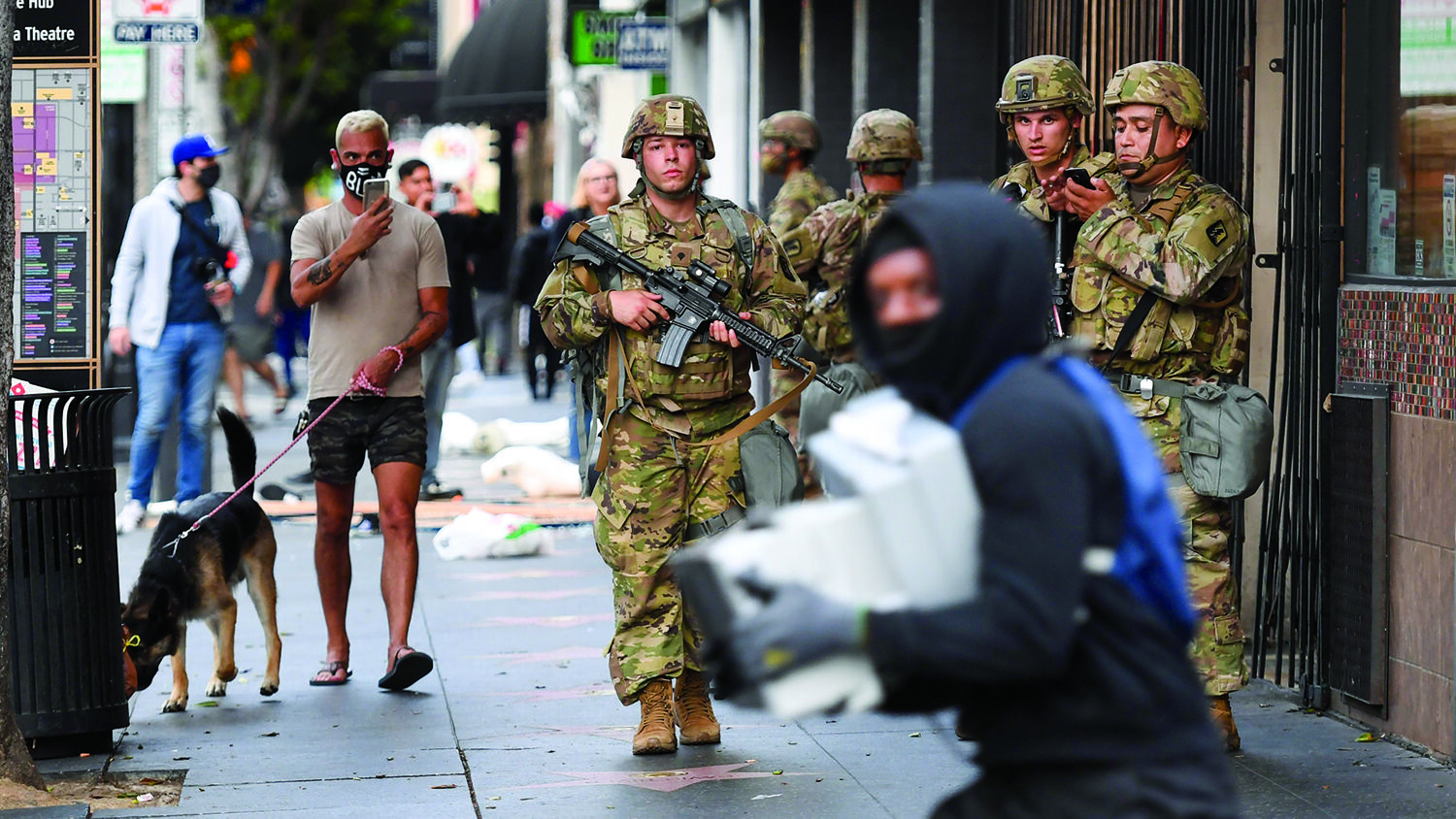
A looter carrying boxes of shoes runs past National Guard soldiers and bystanders in Hollywood on June 1. Anthony Kwan/Getty Images Our celebrated cities are succumbing to decay and violence. But an inspiring resurrection awaits.

From The Trumpet, The Death and Rebirth of America’s Cities

t has been a rough year for America’s cities. Their residents have been locked in their apartments for fear of coronavirus. Their attractions, offices, restaurants and stores have been evacuated. Their wealth has bled out because of ailing economic life, lost jobs and dwindling tax revenue.

Worse, their streets have choked with violent mobs vandalizing monuments, smashing storefronts, looting businesses, burning public buildings. Their law enforcement has been bridled by politicians more sympathetic to criminals than to law-keepers. Their protectors are being disrespected, disparaged and defunded, giving their enemies more license, more space to destroy. Their people are suffering rising rates of violent crime, including murder.

Yet these troubling recent events only aggravated a trend that has been wounding the nation’s crowning cities for years, even decades.

Legacy cities like Detroit, Pittsburgh, Cleveland, St. Louis and Buffalo have fallen from glittering heights of America’s industrial power. Shifts in the nation’s economy have cost hundreds of thousands of jobs and a loss of wealth. This has been exacerbated by race problems, “white flight,” cutbacks in law enforcement, and escalating crime. These factors have hollowed out many an American metropolis, leaving impoverished slums, empty buildings and decaying infrastructure.

In more recent years, failed welfare policies and lax law enforcement have turned cities into sanctuaries for homelessness, makeshift tent cities, drugs on the streets, garbage and filth, illegal immigration and criminality. Investigative reports have detailed how these problems are afflicting San Francisco, Portland, Seattle and other celebrated cities. Citizens are disgusted with their beloved cities being overtaken by trash, overpopulated by wastrels living off government largess, and overwhelmed by problems caused by bad governance.

All these crises have intensified this year. Animated by the twin specters of pandemic and race revolution, they are overtaking more and more of the nation’s urban landscape.

The effects of these trends will be far-reaching and disturbing, affecting not just city-dwellers, but every American.

Changing City Demography

covid-19 has made population density a bad word. In areas where protests have turned destructive, a cascade of aftereffects are pummeling city-dwellers: jobs lost; stores destroyed and shut down; business costs skyrocketing as insurance premiums soar. And in far too many places, mayors and governors are encouraging these curses. They are shuttering companies in the name of public safety. They are permitting, even applauding, marches and mayhem. And in the vacuum left by their failed leadership, revolutionaries are growing more bold, brazen, aggressive and ambitious.

“Urban dwellers are resilient, but these simultaneous events have forced people to face a hard reality,” wrote Daniel Henninger in the Wall Street Journal. “In just three months it has become clear that modern urban progressivism is politically incompetent and intellectually incoherent. … The message being sent is that progressive governance is, at best, ambivalent about maintaining civil order. The net result the past three months has been a sense in many cities of irresolvable chaos, stress and threat.”

At the same time that city life is becoming more unpleasant, virus restrictions are forcing much of life online. Schools nationwide are shifting to distance learning, and businesses are asking people to work from home. Social distancing restrictions and reduced foot traffic mean that costly big-city office space or storefront makes less and less economic sense. Consumers were already buying more and more online; this accelerates the trend. And many analysts are convinced some decentralization in the workforce is likely permanent.

The cost-benefit analysis is convincing many city folk to make a move. If you’re working remotely anyway, why pay big-city rent? And social distancing is far easier in suburbia, or in the country.

In San Francisco and Manhattan, when covid hit, many people left. Vacancies rose; home prices and rental rates dropped. Home sales in the suburbs around New York City soared, with many well-off city residents buying properties sight unseen based off Internet ads. The New York Times reported a 44 percent increase in home sales in nearby suburban counties in July compared to the previous year; 73 percent in a county just over the state line into Connecticut; 112 percent in Westchester, just north of the city. Meanwhile, the number of properties sold in Manhattan plunged 56 percent.

Nationwide, home mortgage applications are up 33 percent compared to last year, and are still rising. FoxBusiness.com credits this to more Americans working remotely, and more families doing school from home and thus needing more space.

The people escaping the cities are people of means. Thus the concentration of impoverished people with no other options is growing. This at the same time that jobs are drying up, businesses are vacating, properties are being destroyed, law enforcement is pulling back, and crime is rising.

This is casting a pall over the future of America’s cities. And illuminating some of the most chilling end-time prophecies of the Bible.

The Bible foretells scenarios about America’s cities so nightmarish, some are difficult to conceive. But these recent destructive trends definitely make these prophecies far easier to imagine.

The Prophesied Fate of Cities

Many of the prophecies in the book of Isaiah are for our day, this period concluding man’s rule on Earth. Of the modern nations descended from ancient Israel—most prominently America—Isaiah foretells this: “[Y]e will revolt more and more …. From the sole of the foot even unto the head there is no soundness in it; but wounds, and bruises, and putrifying sores …. Your country is desolate, your cities are burned with fire: your land, strangers devour it in your presence, and it is desolate, as overthrown by strangers” (Isaiah 1:5-7).

America has witnessed the ghastly fulfillment of this prophecy, scenes of cities burning terribly at the hand of lawless people who seek to dismantle the American system. Crowds of protesters have chanted “Death to America”—echoing Islamists on the streets of Iran!

But this is only the outer edges of the destruction to come. Several prophecies describe a coming time of “great tribulation” worse than any in history (Matthew 24:21). This is God’s terrible punishment for modern-day Israel’s rebellion.

Like Isaiah 1:7, these prophecies describing the coming tribulation place unusual emphasis on what happens in the cities. They show that cities will be hit first—and in some ways hit hardest. And a great many of the problems will be curses we bring on ourselves. This lamentable reality is foreshadowed in the way we are behaving and treating each other in our cities even today…(continues)

Of Two Minds: Corruption Is Now Our Way of Life

Charles Hugh Smith at Of Two Minds writes Corruption Is Now Our Way of Life on the collapse of the USA.

Systemic corruption and the implosion of the social contract have consequences: It’s called collapse.

Social and economic decay is so glacial that only those few who remember an earlier set-point are equipped to even notice the decline. That’s the position we find ourselves in today.

Many Americans will discount the systemic corruption that characterizes the American way of life because they’ve known nothing but systemic corruption. They’ve habituated to it because they have no memory of a time when looting wasn’t legalized and maximizing self-enrichment by any means available wasn’t the unwritten law of the land.

If you don’t yet see America as little more than an intertwined collection of skims, scams, frauds, embezzlements, lies, gaming-the-system, obfuscation of risk and exploitation of the masses by insiders, please read How Corruption is Becoming America’s Operating System. (nakedcapitalism.com, via Cheryl A.)

Here on oftwominds.com, you might want to read No Wrongdoing Here, Just 6,300 Corporate Fines and Settlements. (May 2015)

When JP Morgan Chase engaged in fraud and was fined a wrist-slap $1 billion, nobody went to prison because nobody ever goes to prison for corporate fraud and criminal collusion: JPMorgan to pay almost $1 billion fine to resolve U.S. investigation into trading practices.

Simply put, corruption is cost-free in America because most of it is legal. And whatever is still illegal is never applied to the elites and insiders, except (as per Communist regime corruption) for a rare show trial where an example is made of an egregious fall-guy (think Bernie Madoff: whistleblowers’ repeated attempts to expose the fraud to regulators were blown off for years. It was only when Madoff ripped off wealthy and powerful insiders did he go down.)

There are three primary sources for the complete systemic corruption of America. One is the transition from civic responsibility for the social contract and the national interest to winner-take-most legalized looting.

This transition is visible in the history of empires in the final stage of collapse. The assumption underlying the social order slides from a shared duty to the nation and fellow citizens to an obsession with evading civic duties: military service, taxes, and following the rules are all avoided by insiders and elites, and this moral/social rot then corrupts the entire social order as elites and insiders lean ever more heavily on the remaining productive class to pay the taxes and provide the military muscle to defend their wealth.

That corruption is now everywhere in America is obvious to all but those adamantly blinded by denial. The JP Morgans pay fines as a cost of doing corrupt business, while “public servants” game the system to maximize their pensions with a variety of tricks: colluding to boost the overtime of the retiring insider; finding a quack physican to sign off on a fake “heart murmur” so the insider pays no taxes on their “disability” check, and so on in an endless parade of lies, scams, skims and insider tricks.

The excuse is always the same: everybody does it. This is of course the collapse not just of the social contract but of morality in general: anything goes and winners take most. Insiders look the other way lest their own skims and scams be contested, and elites and insiders view those who aren’t skimming and scamming as chumps to be pitied.

The second dynamic is that financialization has completely corrupted the American economy, and that corruption has now spread to the political and social orders. Once the financial sector conquered the real economy, it began siphoning 95% of the economy’s wealth to the top .01% and their toadies, lackeys, apologists, enforcers and technocrats.

As they hollowed out the real economy, distorted incentives and made moral hazard the guiding principle of the American way of life, the recipients of financialization’s domination gained the wealth to buy political power from the pathetically corruptible political class.

The corruption that we call financialization corrupted democracy and undermined the social contract by eviscerating the value of labor and creating a pay-to-play political order that’s a mockery of democracy.

The third factor is the decay of America’s institutions into fronts for personal gain. While Higher Education insiders are masters of self-serving PR, the truth is they’re not concerned about their debt-serf “customers” (students) learning the essential skills needed in the tumultuous decades ahead–they’re worried that the revenues needed to pay their enormous salaries and benefits might dry up.

“Education” is nothing but a front for the corruption of self-enrichment by the elites and insiders at the top.

The same is true of “healthcare.” The concern of insiders isn’t the declining health of America’s populace, it’s the decline in revenues as fewer “customers” come in for the financial scalping of emergency care.

“Healthcare” is nothing but a front for the corruption of self-enrichment by the elites and insiders at the top.

Thanks to the Federal Reserve’s endless free money for financiers and endless federal borrow-and-blow deficits, the unstated belief is since there’s endless “money”, my petty frauds and skims won’t even dent the feeding trough–there’s always another trillion or three to skim and scam, and there will never be any limit to the feeding trough.

There is no limit until the system implodes. Then the collapse becomes limitless.

Ironic, isn’t it? The oh-so convenient belief that America’s wealth and power are eternal and godlike in their glory fosters the crass corruption that has weakened America to the point of no return: systemic fragility and brittleness.

American Exceptionalism has been turned on its head: America is now as perniciously corrupt as any developing-world nation we smugly felt so superior to, and with extremes of wealth and income inequality that surpass even the most rapacious kleptocracies. This destabilizing “exceptionalism” is now the defining characteristic of the American economy, society and political order.

Systemic corruption and the implosion of the social contract have consequences: It’s called collapse, baby, and the rot is now too deep to reverse.

Charles Carroll Society: Why America Is Coming Apart

The Charles Carroll Society writes about similarities between Breonna Taylor and Gary Willis. I’ve said many times that I wish conservatives and liberals could realize that most of what they both protest against is evil grown from the same root of unrestrained government. It is to the government’s benefit that the two sides blame each other instead. Here is Why America is coming apart | The Story of cops & 0 dark 30 #BreonnaTaylor

It is dark in the early morning.  An American citizen is in bed.  Law enforcement arrives at an American citizen’s home to serve a warrant. They are entering a home they never visited. The encounter in this citizen’s house leads to the police shooting the citizen to death. Later the state found the shooting was justified. Procedures were modified, but the same type of warrants are being served today. Breonna Taylor? No, Gary Willis.

You see, law enforcement was serving a “red flag” warrant on Mr. Willis. The state was seizing all of his guns and kicking him out of his home; a home he had shared with his own family for 20 years. Gary Willis of of Ferndale, Maryland decided he would rather die on his feet, in his home then let the United States Government and the State of Maryland size his guns and take away his home. [Bard Note:  So few people care about Gary Willis, I can not even find a photo of the man.  If anyone has it, please send me a link in the comments below, so  we can at least remember him here on the CCS.]

And this is one reason America is coming apart. Our lack of empathy. Most of the people screaming “say her name” have never heard of Gary Willis.  But I would assume many support Red Flag laws because they do not like firearms or the men who own them.  Many on the Patriot Right who understand the horrible infraction on Natural Rights of Red Flag laws, are not overly sympathetic to the plight of Breonna Taylor and her boyfriend Kenneth Walker.

All of my life, I have felt relatively alone. A black kid from Chicago’s inner-city, the first male in my family to graduate college, live overseas, collect two red cents to his name. Black conservative.  Black Roman Catholic.  I feel the absolute rage of the state breaking into anyone’s home over an absolute useless “war on American drug users.”  Yet “getting rid of all police” is utter nonsense.  As I watch our government fail, once again, I feel like I am the only one who can see the fact that both Breonna Taylor and Gary Willis were killed by the same state, in their homes.  In both cases, it was immoral.

Breonna Taylor was no saint. If you want to know how involved she was take a look at some actual reporting at Tatum Report.  He apparently got a report from a detective which was also given to the grand jury leaked to his site.  Per Tatum’s reporting, Breonna’s car were seen at a “trap house” or drug house numerous times. Photo evidence is in the link.  The police suspected that the trap house would have drugs or money delivered to Breonna Taylor’s home.

The police had the right house [Bard Note:  I got that wrong on social media previously] but they had not charge Breonna Taylor with any crime. They had a No Knock Warrant but allegedly didn’t use it.  They were unaware of Breonna Taylor actually breaking any law, although she was around some unsavory people.  I do not know what Breonna Taylor was doing for money after being fired from being an Emergency Medical Technicians (EMT), but there is every evidence that she was somehow involved with people who were themselves involved in the illegal drug trade.

Kenneth Walker who was her live in boyfriend was a legal gun owner.  He knew that Breonna’s ex-boyfriend was dangerous.  It was 0300 in the morning.  He admits that he heard knocking, but he says he did not hear the police announce themselves.  I believe him, there is a good chance that we would not hear what the hell someone said at the front door either.  Kenneth Walker says he hears banging at the door, and no announcement.  He returns to his bedroom, retrieves his legally owned handgun.  When the door shatters inward, he fires one “warning shot.”   Allegedly he hits an officer.  His attorneys say there is evidence that he did not hit the officer, but that the officers hit each other.  The officers fire 40  – 50 shots into the house, hitting Breonna Taylor six times killing her.  Kenneth Walker is not hit at all. 

There is a lesson here. First there are no warning shots. The minute you decided to pull the trigger, you must keep firing until the “threat is neutralized.”  That is the only way to survive a gun fight. The other lesson is: Kill. Anyone. Who. Forcibly enters. Your. Home.

I am also certain Gary Willis was no saint. His own family had called the police. They claimed that Mr. Willis was an alcoholic and “harassed” the other family members living in the home. There were many arguments over the care of their mother, who also lived in the house. In my opinion, Gary Willis’ family bears the ultimate responsibility for his killing.  If they had figured out how to handle their problems without calling the police, the police would not have killed him.

Republicans will often fall for “destruction of character” argument. Gary Willis was a bad guy because of this. Breonna Taylor was a bad woman because of that. These arguments fall utterly flat. Implying bad people deserve to be killed in their homes.  I think most Americans, and probably a good percentage of Republicans, are thoroughly sick of your lost war on drugs.  “Flushing drugs down the toilet” is not worth people’s lives.

Killing American citizens in their homes is not making us safer.  And no matter if these people are problems, did they deserve to die defending themselves in their homes against the state?  Be careful what you wish for Christian Patriot.  Law Enforcement obey the State.  And when the State is in the hands of President Kamala Harris, whose house do you think they will be breaking in at 0 dark 30?

Even if these people are unsavory, waking them up in their home at 0 dark 30 and killing them if they resist is immoral.  We must find a better way.  And until the Left cares about what happened to Gary Willis, and the Right cares about Breonna Taylor, this nation will continue to break come apart.

AIER: So You Want to Overthrow the State – Ten Questions for Aspiring Revolutionaries

Art Carden, writing for the American Institute for Economic Research, has some questions for those interested in overthrowing the government. These apply whatever your political bent, not just right or left. So You Want to Overthrow the State: Ten Questions for Aspiring Revolutionaries

A professor at Washington and Lee University is offering a writing seminar called “How to Overthrow the State,” which “place(s) each student at the head of a popular revolutionary movement aiming to overthrow a sitting government and forge a better society.” Students are charged with writing their own revolutionary manifesto in light of readings from revolutionaries like Che Guevara. The right-wing outrage machine, as you can imagine, is feasting on it and offering it as an example of the radical takeover of higher education.

I’m intrigued by the class because I tend toward free-market anarchism myself and think that states are neither necessary nor sufficient for prosperity. There’s a burgeoning academic literature on this with books like Peter T. Leeson’s Anarchy Unbound exploring the theory and history of statelessness and AIER’s own Edward Stringham’s Private Governance looking at how institutions and organizations that protect people and property have emerged without coercion. There’s a lively and ongoing debate in these circles about whether or not one would push a button that would allow us to wake up tomorrow morning without governments. WLU’s course represents an excellent opportunity for students to take the revolutionaries’ arguments seriously, and if they do their due diligence, to think really hard about their shortcomings. I offer, therefore, ten questions for the young leaders of these revolutionary movements.

  1. Do I have the facts straight? Karl Marx said that “Philosophers have hitherto only interpreted the world in various ways; the point is to change it.” I doubt very much that you will know which changes you need to make if you don’t have a very good idea about your starting point. In his book Factfulness and in his many excellent online presentations, the late Swedish Professor of International Health Hans Rosling identifies a lot of the ways things have gotten better, especially for the world’s poorest.

    Suppose, for example, that you encounter the name “Milton Friedman,” perhaps in connection with lamented “neoliberalism” and maybe in connection with human rights abuses perpetrated by the brutal Chilean dictator Augusto Pinochet. Friedman has been denounced as the “father of global misery,” and his reputation has taken another beating in the wake of the fiftieth anniversary of his 1970 New York Times Magazine essay “The Social Responsibility of Business is to Increase its Profits,” which I suspect most people haven’t read past its title. But what happened during “The Age of Milton Friedman,” as the economist Andrei Shleifer asked in a 2009 article? Shleifer points out that “Between 1980 and 2005, as the world embraced free market policies, living standards rose sharply, while life expectancy, educational attainment, and democracy improved and absolute poverty declined.” Things have never been so good, and they are getting better, especially for the world’s poor.

    In 2008, there was a bit of controversy over the establishment of the Milton Friedman Institute at the University of Chicago, which operates today as the Becker Friedman Institute (it is also named for Friedman’s fellow Chicago economist Gary Becker). In a blistering reply to a protest letter signed by a group of faculty members at the University of Chicago, the economist John Cochrane wrote, “If you start with the premise that the last 40 or so years, including the fall of communism, and the opening of China and India are ‘negative for much of the world’s population,’ you just don’t have any business being a social scientist. You don’t stand a chance of contributing something serious to the problems that we actually do face.” Nor, might I add, do you stand much of a chance of concocting a revolutionary program that will actually help the people you’re trying to lead.

  1. What makes me so sure I won’t replace the existing regime with something far worse? I might hesitate to push the aforementioned button because while the world we actually inhabit is far from perfect, it’s not at all clear that deleting the state overnight wouldn’t mean civilization’s wholesale and maybe even perpetual collapse. At the very least, I would want to think long and hard about it. The explicit mention of Frantz Fanon and Che Guevara in the course description suggest that students will be approaching revolutionary ideas from the left. They should look at the results of populist revolutions in 20th century Latin America, Africa, and Asia. The blood of many millions starved and slaughtered in efforts to “forge a better society” cries out against socialism and communism, and macroeconomic populism in Latin America has been disastrous. As people have pointed out when told that “democratic socialists” aren’t trying to turn their countries into Venezuela, Venezuelans weren’t trying to turn their country into Venezuela when they embraced Hugo Chavez. I wonder why we should expect WLU’s aspiring revolutionaries to succeed where so many others have failed.
  2. Is my revolutionary program just a bunch of platitudes with which no decent person would disagree? In 2019, Kristian Niemietz of London’s Institute of Economic Affairs published a useful volume titled Socialism: The Failed Idea That Never Dies, which you can download for $0 from IEA. He notes a tendency for socialists and neo-socialists to pitch their programs almost exclusively in terms of their hoped-for results rather than in terms of the operation of concrete social processes they hope to set in motion (on this I paraphrase my intellectual hero Thomas Sowell).

    Apply a test proposed a long time ago by the economist William Easterly: can you imagine anyone seriously objecting to what you’re saying? If not, then you probably aren’t saying anything substantive. Can you imagine someone saying “I hate the idea of the world’s poor having better food, clothing, shelter, and medical care” or “It would be a very bad thing if more people were literate?” If not, then it’s likely that your revolutionary program is a tissue of platitudes and empty promises. That’s not to say it won’t work politically–God knows, nothing sells better on election day than platitudes and empty promises–but you shouldn’t think you’re saying anything profound if all you’re saying is something obvious like “It would be nice if more people had access to clean, drinkable water.”

  1. Is my revolutionary manifesto really any better than the Underpants Gnomes’ business plan from this 1998 episode of South Park?

    In 2011, I wrote that a lot of policy proposals are “‘Underpants Gnomes’ Political Economy” after an episode of South Park in which the Underpants Gnomes’ business plan had three phases. Phase 1 was “collect underpants.” Phase 2 was a question mark. Phase 3 was “profit.” Most revolutionary proposals are like that. Phase 1 is “abolish private property” or “Build That Wall” or something. Phase 2 is a question mark. Phase 3 is “equality and superabundance” (from the left) or “America has been made Great Again” (from the Trumpist right). There are more than a few very important details missing.

  1. In other words, how is this actually going to work? I’m not a socialist not because of antipathy toward poor people or callous selfishness. I’m not a socialist because it doesn’t work in practice and doesn’t even work in theory. Ludwig von Mises and Friedrich Hayek, among many others, have argued that private property, market prices, and market-determined profits and losses are necessary for rational economic calculation. Marx summarized the program of the communists as “abolition of private property.” Mises countered that socialism, or abolition of private property, would mean “abolition of rational economy.” Marx (in)famously never spelled out exactly how socialism would work; he just knew it would. Vladimir Lenin didn’t appreciate the calculation problem and thought that managing an entire economy as if it was just one big factory didn’t require much more than arithmetic and receipts. He was grievously, tragically wrong. I think Mises and Hayek, ultimately, were the ones vindicated by theory and history.
  2. Does my argument for how it will work rely on people discarding self-interest, becoming a lot less horrible, and/or becoming a lot smarter? In a famous cartoon by Sidney Harris, two scientists are standing at a chalkboard. There are equations on the left and right sides of the board with “THEN A MIRACLE OCCURS” between them. One scientist says to the other, “I think you should be more explicit here in step two.” If you’re relying on a change in human nature to make your program work, be prepared for a very long wait. Or be prepared to spill oceans of blood like those who tried to create a “New Socialist Man” in the twentieth century. The socialists and communists wanted to run the economy as if it were one big factory. For the most part, they have also wanted to run the rest of society as if it were one big family. This brings us to a problem that vexed Friedrich Hayek his whole career. The rules, norms, traditions, and other practices that make families or very small communities work well don’t scale. Similarly, if you tried to run your life with family and friends according to a “market logic” in which you try to do everything via literal price-mediated exchanges–charging your kids to rent the TV when they want to watch a movie, for example–it’s probably going to backfire spectacularly. You can’t run your family as if it’s the Chicago Board of Trade. You also can’t run a society of millions of people as if it’s one big happy family.
  3. How has it worked the other times it has been tried? Are you considering “land reform,” whether land expropriation and redistribution, or straight up collectivization? Satellite images of the effects of land reform in Zimbabwe should make you think twice.

    Years before the Russian Revolution, Eugene Richter predicted with eerie prescience what would happen in a socialist society in his short book Pictures of the Socialistic Future (which you can download for $0 here). Bryan Caplan, who wrote the foreword for that edition of Pictures and who put together the online “Museum of Communism,” points out the distressing regularity with which communists go from “bleeding heart” to “mailed fist.” It doesn’t take long for communist regimes to go from establishing a workers’ paradise to shooting people who try to leave. Consider whether or not the brutality and mass murder of communist regimes is a feature of the system rather than a bug. Hugo Chavez and Che Guevara both expressed bleeding hearts with their words but used a mailed fist in practice (I’ve written before that “irony” is denouncing Milton Friedman for the crimes of Augusto Pinochet while wearing a Che Guevara t-shirt. Pinochet was a murderous thug. Guevara was, too). Caplan points to pages 105 and 106 of Four Men: Living the Revolution: An Oral History of Contemporary Cuba. On page 105, Lazaro Benedi Rodriguez’s heart is bleeding for the illiterate. On page 106, he’s “advis(ing) Fidel to have an incinerator dug about 40 or 50 meters deep, and every time one of these obstinate cases came up, to drop the culprit in the incinerator, douse him with gasoline, and set him on fire.”

  1. Are people moving toward or away from the kind of society I want to establish? We get a lot of information from how people “vote with their feet” for different policies. If you’re advocating some version of socialism, you have to deal with the fact that so many people are trying desperately to leave socialist countries. The East German government did not build the Berlin Wall to keep westerners out, and pretty much all of the traffic between Cuba and the United States moves in one direction. It isn’t toward the Castros’ workers’ paradise.
  2. What will I do with people who aren’t willing to go along with my revolution? Walter Williams once said that he doesn’t mind if communists want to be communists. He minds that they want him to be a communist, too. Would you allow people to try capitalist experiments in your socialist paradise? Or socialist experiments in your capitalist paradise (Families, incidentally, are socialist enterprises that run by the principle “from each according to his ability, to each according to his needs.”)? Am I willing to allow dissenters to advocate my overthrow, or do I need to crush dissent and control the minds of the masses in order for my revolution to work? Am I willing to allow people to leave, or will I need to build a wall to keep people in?
  3. Am I letting myself off the hook for questions 1-9 and giving myself too much credit for passion and sincerity? The philosopher David Schmidtz has said that if your best argument is that your heart is in the right place, then your heart is most definitely not in the right place. Consider this quote from Edmund Burke and ask whether or not it leads you to revise your revolutionary plans:

    “A conscientious man would be cautious how he dealt in blood. He would feel some apprehension at being called to a tremendous account for engaging in so deep a play, without any sort of knowledge of the game. It is no excuse for presumptuous ignorance, that it is directed by insolent passion. The poorest being that crawls on earth, contending to save itself from injustice and oppression is an object respectable in the eyes of God and man. But I cannot conceive any existence under heaven (which, in the depths of its wisdom, tolerates all sorts of things) that is more truly odious and disgusting, than an impotent helpless creature, without civil wisdom or military skill, without a consciousness of any other qualification for power but his servility to it, bloated with pride and arrogance, calling for battles which he is not to fight, contending for a violent dominion which he can never exercise, and satisfied to be himself mean and miserable, in order to render others contemptible and wretched.” (Emphasis added).

A lot of colleges and universities have first-year writing seminars that try to teach students to write by exploring a particular set of issues, and as long as the course actually teaches students how to become better writers, we should welcome new experiments. A course that asks students to put themselves in the positions of aspiring revolutionaries and to prepare their own revolutionary manifestoes is extremely creative. I think it’s the kind of course from which students can benefit mightily–if, of course, they ask the right questions.

Of Two Minds: Isn’t It Obvious We Need a New System?

From Charles Hugh Smith at Of Two Minds, Isn’t It Obvious We Need a New System?

Why do we tolerate such a corrupt, undemocratic, exploitive, elite-dominated system? Because we have no other choice? No, we do have a choice.

Isn’t it obvious that we need an alternative economic system that isn’t controlled by corporations, the government and the central bank for the exclusive benefit of insiders and elites? Isn’t it obvious that the current system has failed the majority of participants, and hence the ubiquitous sensations of:

1) being ignored by the insiders / elites who run the current system to their own benefit

2) being trapped in an economy that’s been stripped of social / upward mobility

3) being stripmined / exploited by domestic and globalized elites

4) disgust / frustration with the self-enriching political class that serves corporate/elite/insider interests above all else.

My 50 years of work have given me a ringside seat in how the economy has changed from inclusive to extractive. My jobs have ranged from agricultural field worker to running my own yard service to hospitality to construction to print media (free-lancer) to financial services (quant shop) to non-profit education to political rabble-rousing (unpaid) and my current profession as marginalized, misfit author-blogger (my specialty appears to be getting shadow-banned by Big Tech monopolist extractors).

My colleague Mark Jeftovic explains how systems can be inclusive or extractive. Systems that automatically bail out the greediest, wealthiest socially-useless speculators via the Federal Reserve are not just extractive, they’re exploitive and predatory. The Reversion Will be Mean.

Extractive systems are also intrinsically fragile in crises as the trapped / exploited behind the oars tend to abandon ship at the first chance, and the real-world sinews of the economy have been weakened by the bailouts and financial engineering. In effect, the fragile, brittle shell doesn’t need much of a shock to implode. (If you want to see this process in real time, look around you.)

Yes, finance was extractive in 1970, but it was a much smaller part of the economy. Back then, finance was less than 5% of the economy. Now, by some measures, it’s a third of the economy.

Yes, corporations bought political influence and exploited everything within reach but their reach wasn’t as global and their rapacity not quite as refined. Sociopathic exploitation such as stock buybacks and Big Pharma advertising directly to consumers were illegal.

The economy was not dependent on endless asset bubbles and bailouts of the most venal speculators. The Federal Reserve whines that it has to bail out the greediest scum of the nation again and again and inflate one asset bubble after another because otherwise this sucker’s going down.

Over the past 50 years, the ladders of upward mobility have splintered. Now making all the sacrifices to follow the conventional script (get a college diploma, etc.) don’t lead to secure employment. The fundamental backdrop of the economy is that labor’s share of the economy is in permanent decline: the value of labor has been in a freefall, a freefall masked by bogus “low inflation” and other trickery. (See chart below)

In 1970, costs for essentials were low and regulatory burdens on small business were modest. You could rent an apartment for a week’s pay or less. (Even in expensive Honolulu I could rent a studio apartment for half a week’s pay.)

Even in the mid-1980s, I could get a building permit for an entire house in one day; now the process takes weeks or even months.

Now costs and regulatory burdens have soared to crushing levels. This plays perfectly to government bureaucracies, which have monopolies on the power to raise junk fees, penalties, etc. at will, and Corporate America, whose core drive is eliminate any and all competition so profits can soar on the basis of monopoly, not on superior products or services.

People feel ignored because they are ignored. People feel trapped because they are trapped. People feel stripmined because they are being stripmined. People feel angry at the political Establishment because they no longer live in a democracy.

Can we be honest for a change and admit that ours is an extractive system in which anything goes for the wealthy and powerful and winners take most?

The few pockets of the economy not under the thumb of corporations, government or the central bank– for example, the cash / informal economy–are still dependent on corporations, government and the Fed for their currency, government subsidies and products/services.

Isn’t it obvious that we need an alternative system that isn’t run for the benefit of elites and insiders? What would such a system look like?

One, it would be voluntary / opt-in. Nobody would be forced to participate. All anyone would need to bring is a willingness to be useful and belong to something doing good work on behalf of the community rather than a bunch of parasitic, predatory billionaires.

Two, it would be self-organizing, meaning there is no ruling body that can be corrupted. Bitcoin is a real-world example of a self-organizing system. There is no cabal at the top who can be corrupted; bitcoin is distributed and decentralized. It is self-organizing, as is Nature.

Three, the operations of the system would be automated so human bias would have few opportunities to carve out unearned privileges. Note that most of the systems you interact with are fully automated. (Try reaching a human being in customer service.) The only difference is these systems are secret “black boxes” designed to maximize the profits of cartel-monopoly corporations, not serve the nation or its communities. They only serve the owners, 2/3rds of whom just so happen to be the top 0.1%.

Open-source software runs a great many enterprises and systems and does so without secret “black box” algorithms known only to the exploiters.

Four, it would have its own money, a cryptocurrency that comes into being in only one way: as payment for useful, purposeful labor that benefits the community in some way. All the technology for such a labor-backed cryptocurrency is already in hand.

My 50 years of work in a variety of sectors and jobs has made such a system “obvious” to me, and so I’ve written a book ( A Hacker’s Teleology) to explain how such a system would work and why it’s “obvious.” You can read excerpts of the book in this free PDF and read the story behind the book and the Introduction.

Why do we tolerate such a corrupt, undemocratic, exploitive, elite-dominated system? Because we have no other choice? No, we do have a choice. The first step to outline the values, processes and goals of an alternative system that actually works for everyone and our planet.

I’ve taken a stab at outlining such a system, so why not check it out? If you can come up with a better one, then get it out there for the rest of us to study.

We do have a choice. But we have to take it. If we’re unwilling to make any systemic changes, then we truly are trapped–not by them (whomever they might be) but by our own unwillingness to accept that systemic change is now necessary if we’re to have a future that’s beneficial to all.


Of Two Minds: Intolerance and Authoritarianism Accelerate Disunity and Collapse

From Charles Hugh Smith at the Of Two Minds blog, Intolerance and Authoritarianism Accelerate Disunity and Collapse

Scapegoating dissenters only hastens the disunity and disarray that accelerates the final collapse.
Authoritarianism is imposed on us, but its sibling intolerance is our own doing. Intolerance and authoritarianism are two sides of the same coin: as intolerance becomes the norm, the intolerant start demanding that the state enforce their intolerance by suppressing their enemies via increasingly heavy-handed authoritarian measures.
Intolerance and authoritarianism increase as instability takes hold and living standards decline. In good times, dissent and differences of opinion are not only tolerated but celebrated, as this freedom to hold a variety of beliefs serves to unify society.
In bad times, dissent and differences are viewed as mortal threats to the social order. Perhaps there is a human instinct when times become troubled to insist “we must all row together,” i.e. to seek a unity enforced by a rising intolerance that demands more authoritarian action by the state.
For example, in wartime, pacifist views that were previously tolerated become criminal offenses.
The irony here is this forced conformity doesn’t generate unity–it fractures society into bitterly warring camps as the middle ground vanishes into either/or extremism that sees authoritarianism (in support of our side, of course) as not just justified but essential.
Intolerance and authoritarianism undermine and ultimately destroy the unity that was generated by tolerance and a wide variety of beliefs and dissenting views. As our own insecurities increase, we fall all too willingly to the temptation to see others’ recalcitrant refusal to join our camp without reservations as the source of our insecurity.
In this mindset of insecurity, the “solution” is to force compliance by any means available so everyone is in our camp. And since some might be hiding the insincerity of their devotion to our righteous cause, the need for an Inquisition becomes pressing, so the insincere or closet traitors can be unmasked and punished.
But the Inquisitors themselves inevitably come under suspicion, and an Inquisition of the Inquisitors soon lays waste to those who hubristically held themselves as the arbiters of conformity. There is no way to escape this drive to dissipate insecurity by forcing conformity except the complete collapse of the social, political and economic orders.
This is the path to madness and complete social breakdown. But such is the power of insecurity and uncertainty that history records our self-destructive urgency to abandon the middle ground and a diversity of viewpoints and beliefs for the totalitarian uniformity of forced conformity.
But once rooted, intolerance knows no bounds and the snake of intolerant authoritarianism ends up eating its own tail. In an era of intolerance, ideological purity is a constantly shifting landscape of quicksand. Those at the top passing judgment on others’ ideological purity soon find their own purity is under attack.
Increasingly intolerant, repressive authoritarianism marked the final days of the Roman decline and fall. Rather than face the profound and novel crises directly and unify around the sacrifices needed to resolve the crises favorably, it is so much easier to blame everyone who doesn’t agree with our position as the source of the crises.
This is delusional, of course: crises have real-world sources, and scapegoating dissenters only hastens the disunity and disarray that accelerate the final collapse.

Rutherford Institute: Since 9/11, the Government’s Answer to Every Problem Has Been More Government

From Constitutional law attorney John Whitehead at The Rutherford Institute, Since 9/11, the Government’s Answer to Every Problem Has Been More Government

“A government big enough to give you everything you want is a government big enough to take away everything that you have.”—Anonymous

Have you noticed that the government’s answer to every problem is more government—at taxpayer expense—and less individual liberty?

The Great Depression. The World Wars. The 9/11 terror attacks. The COVID-19 pandemic.

Every crisis—manufactured or otherwise—since the nation’s early beginnings has become a make-work opportunity for the government to expand its reach and its power at taxpayer expense while limiting our freedoms at every turn.

Indeed, the history of the United States is a testament to the old adage that liberty decreases as government (and government bureaucracy) grows. To put it another way, as government expands, liberty contracts.

To the police state, this COVID-19 pandemic has been a huge boon, like winning the biggest jackpot in the lottery. Certainly, it will prove to be a windfall for those who profit from government expenditures and expansions.

Given the rate at which the government has been devising new ways to spend our money and establish itself as the “solution” to all of our worldly problems, this current crisis will most likely end up ushering in the largest expansion of government power since the 9/11 terrorist attacks.

This is how the emergency state operates, after all.

From 9/11 to COVID-19, “we the people” have acted the part of the helpless, gullible victims desperately in need of the government to save us from whatever danger threatens. In turn, the government has been all too accommodating and eager while also expanding its power and authority in the so-called name of national security.

As chief correspondent Dan Balz asks for The Washington Post, “Government is everywhere now. Where does it go next?

When it comes to the power players that call the shots, there is no end to their voracious appetite for more: more money, more power, more control.

This expansion of government power is also increasing our federal debt in unprecedented leaps and bounds. Yet the government isn’t just borrowing outrageous amounts of money to keep the country afloat. It’s also borrowing indecent sums to pay for programs it can’t afford.

The government’s primary response to this COVID-19 pandemic—flooding the market with borrowed money in the amount of trillions of dollars for stimulus payments, unemployment insurance expansions, and loans to prop up small businesses and to keep big companies afloat—has pushed the country even deeper in debt.

By “the country,” I really mean the taxpayers. And by “the taxpayers,” it’s really future generations who will be shackled to debt loads they may never be able to pay back.

This is how you impoverish the future.

Democrats and Republicans alike have done this.

Without fail, every president within the last 50 years has expanded the nation’s debt. When President Trump took office on January 20, 2017, the national debt—the amount the federal government has borrowed over the years and must pay back—was a whopping $19.9 trillion. Despite Trump’s pledge to drain the swamp and eliminate the debt, the federal debt is now approaching $27 trillion and is on track to surpass $78 trillion by 2028.

For many years now, economists have warned that economic collapse would be inevitable if the national debt ever surpassed the size of the U.S. economy. The government passed that point in June 2020 and has yet to put the brakes on its spending.

In fact, the Federal Reserve just keeps printing more money in order to prop up the economy and float the debt.

At some point, something’s got to give.

As it now stands, the U.S. is among the most indebted countries in the world.

Almost a third of the $27 trillion national debt is owed to foreign entities such as Japan and China.

Most of the debt, however, is owed to the public.

How is this even possible? Essentially, it’s a case of robbing Peter to pay Paul.

First, the government requires taxpayers to pay a portion of their salaries to the Social Security Trust Fund. The government then turns around and borrows from Social Security to cover its spending needs. Then the government raises taxes or prints more money in order to pay out whatever is needed to the retirees.

It’s a form of convoluted economics that only makes sense to government bureaucrats looking to make a profit off the backs of the taxpayers.

According to the U.S. Debt Clock, each taxpayer’s share of the national debt is $214,000 and growing.

That’s almost five times more than the median income for what Americans earn in a year. That’s also almost five times more than the average American has in savings, across savings accounts, checking accounts, money market accounts, call deposit accounts, and prepaid cards. Almost 60% of Americans are so financially strapped that they don’t have even $500 in savings and nothing whatsoever put away for retirement.

Just the interest that must be paid on the national debt every year is $338 billion and growing. According to the Congressional Budget Office, the fastest growing item in the budget over the next decade will be interest on the debt.

As the Committee for a Responsible Federal Budget reported in 2019, before COVID spending pushed the country over the fiscal cliff, “Interest payments will rise from $325 billion last year to $928 billion by 2029, a nearly threefold increase. If tax cuts and spending increases are extended, interest will exceed $1 trillion and set a new record as a share of the economy. The federal government will spend more on interest than on Medicaid or children by 2020. By 2024, interest will match defense spending.

Bottom line: The U.S. government—and that includes the current administration—is spending money it doesn’t have on programs it can’t afford, and “we the taxpayers” are the ones who will have to pay for it.

As financial analyst Kristin Tate explains, “When the government has its debt bill come due, all of us will be on the hook.”

Despite the tax burden “we the people” are made to bear, we have no real say in how the government runs, or how our taxpayer funds are used, but we’re being forced to pay through the nose, anyhow.

We have no real say, but that doesn’t prevent the government from fleecing us at every turn and forcing us to pay for endless wars that do more to fund the military industrial complex than protect us, pork barrel projects that produce little to nothing, and a police state that serves only to imprison us within its walls.

All the while the government continues to do whatever it wants—levy taxes, rack up debt, spend outrageously and irresponsibly—with little thought for the plight of its citizens.

This brings me to a curious point: what the future will look like ten years from now, when the federal debt is expected to surpass $78 trillion, an unsustainable level of debt that will result in unprecedented economic hardship for anyone that does not belong to the wealthy elite.

Interestingly enough, that timeline coincides with the government’s vision of the future as depicted in a Pentagon training video created by the Army for U.S. Special Operations Command.

According to the video, the government is anticipating trouble (read: civil unrest), which is code for anything that challenges the government’s authority, wealth and power, and is grooming its armed forces (including its heavily armed federal agents) accordingly to solve future domestic political and social problems.

The training video, titled “Megacities: Urban Future, the Emerging Complexity,” is only five minutes long, but it provides a chilling glimpse of what the government expects the world to look like in 2030, a world bedeviled by “criminal networks,” “substandard infrastructure,” “religious and ethnic tensions,” “impoverishment, slums,” “open landfills, over-burdened sewers,” a “growing mass of unemployed,” and an urban landscape in which the prosperous economic elite must be protected from the impoverishment of the have nots.

And then comes the kicker.

Three-and-a-half minutes into the Pentagon’s dystopian vision of “a world of Robert Kaplan-esque urban hellscapes — brutal and anarchic supercities filled with gangs of youth-gone-wild, a restive underclass, criminal syndicates, and bands of malicious hackers,” the ominous voice of the narrator speaks of a need to “drain the swamps.”

Drain the swamps.

Surely, we’ve heard that phrase before?

Ah yes.

Emblazoned on t-shirts and signs, shouted at rallies, and used as a rallying cry among Trump supporters, “drain the swamp” became one of Donald Trump’s most-used campaign slogans.

Far from draining the politically corrupt swamps of Washington DC of lobbyists and special interest groups, however, the Trump Administration has further mired us in a sweltering bog of corruption and self-serving tactics.

Funny how the more things change, the more they stay the same.

Now the government has adopted its own plans for swamp-draining, only it wants to use the military to drain the swamps of futuristic urban American cities of “noncombatants and engage the remaining adversaries in high intensity conflict within.”

And who are these noncombatants, a military term that refers to civilians who are not engaged in fighting during a war?

They are, according to the Pentagon, “adversaries.”

They are “threats.”

They are the “enemy.”

They are people who don’t support the government, people who live in fast-growing urban communities, people who may be less well-off economically than the government and corporate elite, people who engage in protests, people who are unemployed, people who engage in crime (in keeping with the government’s fast-growing, overly broad definition of what constitutes a crime).

In other words, in the eyes of the U.S. military, noncombatants are American citizens a.k.a. domestic extremists a.k.a. enemy combatants who must be identified, targeted, detained, contained and, if necessary, eliminated…(continues)

Dr. Samuel Langdon Preaches “Government Corrupted by Vice”

This is an excerpt from a sermon from Dr. Samuel Langdon in 1775 after being named president of Harvard College and given before the Congress of the colony of Massachusetts Bay.

And I will restore thy judges as at the first, and thy Counsellors as at the beginning: afterward thou shalt be called the City of Righteousness, the faithful City. – Isaiah 1:26

We have lived to see the time when British Liberty is just ready to expire;—when that constitution of government which has so long been the glory and strength of the English nation, is deeply undermined and ready to tumble into ruins;—when America is threatened with cruel oppression, and the arm of power is stretched out against New-England, and especially against this Colony, to compel us to submit to the arbitrary acts of legislators who are not our representatives, and who will not themselves bear the least part of the burdens which, without mercy, they are laying upon us. The most formal and solemn grants of Kings to our ancestors are deemed by our oppressors as of little value; and they have mutilated the Charter of this Colony in the most essential parts, upon false representations▪ and new invented maxims of policy, without the least regard to any legal process. We are no longer permitted to fix our eyes on the faithful of the land, and trust in the wisdom of their counsels, and the equity of their judgment; but men in whom we can have no confidence,—whose principles are subversive of our liberties,—whose aim is to exercise lordship over us, and share among themselves the public wealth:—men who are ready to serve any master, and execute the most unrighteous decrees for high wages,—whose faces we never saw before, and whose interests and connexions may be far divided from us by the wide atlantick,—are to be set over us as counsellors and judges, at the pleasure of those who have the riches and power of the nation in their hands, and whose noblest plan is to subjugate the Colonies first, and then the whole nation to their will.

That we might not have it in our power to refuse the most absolute submission to their unlimited claims of authority, they have not only endeavored to terrify us with fleets and armies sent to our Capital, and distressed and put an end to our trade, particularly that important branch of it, the fishery; but at length attempted, by a sudden march of a body of troops in the night, to seize and destroy one of our magazines, formed by the people merely for their own security; if, after such formidable military preparations on the other side, matters should be pushed to an extremity. By this, as might well be expected, a skirmish was brought on; and it is most evident, from a variety of concurring circumstances, as well as numerous depositions both of the prisoners taken by us at that time, and our own men then on the spot only as spectators, that the fire began first on the side of the King’s troops. At least five or six of our inhabitants were murderously kill’d by the Regulars at Lexington, before any man attempted to return the fire, and when they were actually complying with the command to disperse: and two more of our brethren were likewise kill’d at Concord-Bridge by a fire from the King’s soldiers, before the engagement began on our side. But whatever credit falsehoods transmited to Great-Britain, from the other side, may gain, the matter may be rested entirely on this,— that he that arms himself to commit a robbery, and demands the traveller’s purse, by the terror of Instant death, is the first aggressor, though the other should take the advantage of discharging his pistol first and killing the robber.

The alarm was sudden; but in a very short time spread far and wide: the nearest neighbours in haste ran together, to assist their brethren, and save their country. Not more than three or four hundred met in season and bravely attacked and repulsed the enemies of liberty, who retreated with great precipitation. But by the help of a strong reinforcement, notwithstanding a close pur|suit, and continual loss on their side, they acted the part of Robbers and Savages, by burning, plundering, and damaging almost every house in their way, to the utmost of their power, murdering the unarmed and helpless, and not regarding the weaknesses of the tender sex▪ until they had secured themselves beyond the reach of our terrifying arms…

We have used our utmost endeavors, by repeated humble petitions and remonstrances,— by a series of unanswerable reasonings published from the Press, in which the dispute has been fairly stated, and the justice of our opposition clearly demonstrated,—and by the mediation of some of the noblest and most faithful friends of the British constitution, who have powerfully plead our cause in Parliament,—to prevent such measures as may soon reduce the body politic to a miserable, dismembred, dying trunk, though lately the terror of all Europe. But our King, as if impelled by some strange fatality, is resolved to reason with us only by the roar of his Cannon, and the pointed arguments of musquets and bayonets. Because we refuse submission to the despotic power of a ministerial Parliament, our own Sovereign, to whom we have been always ready to swear true allegiance,—whose authority we never meant to cast off,—who might have continued happy in the cheerful obedience of as faithful subjects as any in his dominions,—has given us up to the rage of his Ministers, to be seized at sea by the rapacious commanders of every little sloop of war and piratical cutter, and to be plundered and massacred by land by mercenary troops, who know no distinction betwixt an enemy and a brother, between right and wrong; but only, like brutal pursuers, to hunt and seize the prey pointed out by their masters.

We must keep our eyes fixed on the supreme government of the ETERNAL KING, as directing all events, setting up or pulling down the Kings of the earth at his pleasure, suffering the best forms of human government to degenerate and go to ruin by corruption; or restoring the decayed constitutions of kingdoms and states, by reviving public virtue and religion, and granting the favorable interpositions of his providence. To this our text leads us; and though I hope to be excused on this occasion from a formal dis|course on the words in a doctrinal way, yet I must not wholly pass over the religious instruction contained in them.

Let us consider—That for the sins of a people God may suffer the best government to be corrupted, or entirely dissolved; and that nothing but a general reformation can give good ground to hope that the public happiness will be restored, by the recovery of the strength and perfection of the state, and that divine providence will interpose to fill every department with wise and good men.

Isaiah prophesied about the time of the captivity of the ten tribes of Israel, and about a century before the captivity of Judah. The kingdom of Israel was brought to destruction, because its iniquities were full; its counsellors and judges were wholly taken away, because there remained no hope of reformation. But the sceptre did not entirely depart from Judah, nor a lawgiver from between his feet, till the Messiah came: yet greater and greater changes took place in their political affairs; their government degenerated in proportion as their vices increased, till few faithful men were left in any public offices; and at length, when they were delivered up for seventy years into the hands of the king of Babylon, scarce any remains of their original excellent civil polity appeared among them.

The Jewish government, according to the original constitution which was divinely established, if considered merely in a civil view, was a perfect Republic. The heads of their tribes, and elders of their cities, were their counsellors and judges. They called the people together in more general or particular assemblies, took their opinions, gave advice, and managed the public affairs according to the general voice. Counsellors and judges comprehend all the powers of that government; for there was no such thing as legislative authority belonging to it, their complete code of laws being given immediately from God by the hand of Moses. And let them who cry up the divine right of Kings consider, that the only form of government which had a proper claim to a divine establishment was so far from including the idea of a King, that it was a high crime for Israel to ask to be in this respect like other nations; and when they were gratified, it was rather as a just punishment of their folly, that they might feel the burdens of court pageantry, of which they were warned by a very striking description, than as a divine recommendation of kingly authority.

Every nation, when able and agreed, has a right to set up over themselves any form of government which to them may appear most conducive to their common welfare. The civil Polity of Israel is doubtless an excellent general model, allowing for some peculiarities; at least some principal laws and orders of it may be copied, to great advantage, in more modern establishments.

When a government is in it’s prime, the public good engages the attention of the whole; the strictest regard is paid to the qualifications of those who hold the offices of the state; virtue prevails; every thing is managed with justice, prudence, and frugality; the laws are founded on principles of equity rather than mere policy; and all the people are happy. But vice will increase with the riches and glory of an empire; and this gradually tends to corrupt the constitution, and in time bring on it’s dissolution. This may be considered not only as the natural effect of vice, but a righteous judgment of heaven, especially upon a nation which has been favor’d with the blessings of religion and liberty, and is guilty of undervaluing them, and eagerly going into the gratification of every lust.

In this chapter the prophet describes the very corrupt state of Judah in his day, both as to religion and common morality; and looks forward to that increase of wickedness which would bring on their desolation and captivity. They were a sinful nation, a people laden with iniquity, a seed of evil doers, children that were corrupters, who had forsaken the Lord, and provoked the holy One of Israel to anger. The whole body of the nation, from head to foot, was full of moral and political disorders without any remaining soundness. Their religion was all mere ceremony and hypocrisy, and even the laws of common justice and humanity were disregarded in their public courts. They had Counsellors and Judges, but very different from those at the beginning of the common wealth. Their Princes were rebellious against God, and the constitution of their country, and companions of thieves, giving countenance to every artifice for seizing the property of the subjects into their own hands, and robbing the public treasury. Every one loved gifts and followed after rewards; they regarded the perquisites more than the duties of their office; the general aim was at profitable places and pensions; they were influenced in every thing by bribery; and their avarice and luxury were never satisfied, but hurried them on to all kinds of oppression and violence, so that they even justified and encouraged the murder of innocent persons to support their lawless power, and increase their wealth. And God in righteous judgment left them to run into all this excess of vice to their own destruction, because they had forsaken him, and were guilty of wilful inattention to the most essential parts of that religion which had been given them by a well attested Revelation from heaven.

The Jewish nation could not but see and feel the unhappy consequences of so great corruption of the state. Doubtless they complained much of men in power, and very heartily and liberally reproached them for their notorious misconduct. The public greatly suffered and the people groan|ed, and wished for better rulers and better management. But in vain they hoped for a change of men and measures and better times, when the spirit of religion was gone, and the infection of vice was become universal. The whole body being so corrupted, there could be no rational prospect of any great reformation in the state, but rather of its ruin; which accordingly came on in Jeremiah’s time. Yet if a general reformation of religion and morals had taken place, and they had turned to God from all their sins; if they had again re|covered the true spirit of their religion; God, by the gracious interpositions of his providence, would soon have found out methods to restore the former virtue of the state, and again have given them men of wisdom and integrity, according to their utmost wish, to be Counsellors and Judges. This was verified in fact, after the nation had been purged by a long captivity, and returned to their own land humbled, and filled with zeal for God and his law.

By all this we may be led to consider the true cause of the present remarkable troubles which are come upon Great-Britain and these Colonies; and the only effectual remedy.

We have rebelled against God. We have lost the true spirit of christianity, tho’ we retain the outward profession and form of it. We have neglected and let light by the glorious gospel of our Lord Jesus Christ, and his holy commands and institutions. The worship of many is but meer compliment to the Deity, while their hearts are far from him. By many the gospel is corrupted into a superficial system of moral philosophy, little better than ancient Platonism. And after all the pretended refinements of Moderns in the theory of christianity, very little of the pure practice of it is to be found among those who once stood fore|most in the profession of the Gospel. In a gene|ral view of the present moral state of Great Britain it may be said—There is no truth, nor mercy, nor knowledge of God in the land. By swearing, and lying, and killing, and stealing, and commiting adultery, their wickedness breaks out; and one murder after another is committed, under the connivance and encouragement even of that authority by which such crimes ought to be punished, that the purposes of oppression and despotism may be answered. As they have increased, so have they sinned; therefore God is changing their glory into shame. The general prevalence of vice has changed the whole face of things in the British government.

The excellency of the constitution has been the boast of Great-Britain, and the envy of neighbouring nations. In former times the great departments of the state, and the various places of trust and authority, were filled with men of wisdom, honestly, and religion, who employed all their powers, and were ready to risque their for|tunes, and their lives for the public good. They were faithful counsellors to Kings; directed their authority and majesty to the happiness of the nation; and opposed every step by which despotism endeavoured to advance. They were Fathers of the people, and sought the welfare and prosperity of the whole body. They did not exhaust the national wealth by luxury and bribery, or convert it to their own private benefit, or the maintenance of idle useless officers and dependents; but im|proved it faithfully for the proper purposes, for the necessary support of government, and defence of the kingdom. Their laws was dictated by wisdom and equity; and justice was administred with impartiality. Religion discover’d it’s general influence among all ranks, and kept out great corruptions from places of power.

But in what does the British nation now glory?—In a meer shadow of it’s ancient political system?—In titles of dignity without virtue?—In vast public treasures continually lavished in corruption, till every fund is exhausted, notwithstanding the mighty streams perpetually flowing in?—In the many artifices to stretch the prerogatives of the crown beyond all constitutional bounds, and make the king an absolute monarch, while the people are deluded with a meer phantom of liberty? What idea must we entertain of that government, if such an one can be found, which pretends to have made an exact counterbalance of power between the sovereign, the nobles and the commons, so that the three branches shall be an effectual check upon each other, and the united wisdom of the whole shall conspire to promote the national felicity; but which, in reality, is reduced to such a situation that it may be managed at the sole will of one court favorite? What difference is there betwixt one man’s choosing, at his own pleasure, by his single vote, the majority of those who are to represent the people; and his purchasing in such a majority, according to his own nomination, with money out of the public treasury, or other effectual methods of influencing elections?—And what shall we say, if in the same manner, by places, pensions, and other bribes, a minister of state can at any time gain over a nobler majority likewise, to be intirely subservient to his purposes; and moreover persuade his royal master to resign himself up wholly to the direction of his counsels? If this should be the case of any nation from one seven years end to another, the bargain and sale being made sure for such a period, would they still have reason to boast of their excellent constitution?— Ought they not rather to think it high time to restore the corrupted dying state to its original perfection?—I will apply this to the Roman senate under Julius Caesar, which retained all its ancient formalities, but voted always only as Caesar dictated. If the decrees of such a senate were urged on the Romans as fraught with all the blessings of Roman liberty, we must suppose them strangely deluded, if they were persuaded to believe it…

Into what fatal policy has the nation been impelled by its public vices! To wage a cruel war with its own children in these colonies, only to gratify the lust of power, and the demands of extravagance! May God, in his great mercy recover Great Britain from this fatal infatuation; shew them their errors; and give them a spirit of re|formation, before it is too late to avert impending destruction. May the eyes of the King be opened to see the ruinous tendency of the measures into which he has been led, and his heart inclined to treat his American Subjects with justice and clemency, instead of forcing them still farther to the last extremities! God grant some method may be found out to effect a happy reconciliation, so that the colonies may again enjoy the protection of their Sovereign, with perfect security of all their natural rights, and civil and religious liberties.

But, alas! have not the sins of America, and of New-England in particular, had a hand in bringing down upon us the righteous judgments of heaven? Wherefore is all this evil come upon us? Is it not because we have forsaken the Lord?…

Mises Institute: Mises and Rothbard on Democracy and Revolution

In this piece from the Mises Institute, David Gordon examines von Mises’ statement that the only convincing argument for democracy is that it allows for a peaceful change of power. Then he discusses Murray Rothbard’s critique which says that if that is true, then the democratic government that results must exactly resemble the government that would have resulted from a violent revolution and why that doesn’t happen. Another argument comes in when a government like the US is full of un-elected bureaucrats with great power who are protected from change from an election. In that case also, you end up with a government which does not reflect what might have been obtained by violent revolution.

Ludwig von Mises rejects the standard arguments for democracy. Not for him are the alleged virtues of public deliberation. For him, there is only one argument for democracy that is convincing. He says that only democracy allows for a peaceful change of power. Every government, he thinks, rests on popular consent. If a sufficient number of people find the government no longer tolerable, it won’t be able to maintain itself in power. In a democracy, people in this situation can peacefully replace the government with an opposition party more to its liking. Without democracy, there is liable to be a violent revolution, because those in power and their supporters are likely to cling to power, even if their position is in the long run unsustainable.

Mises puts the argument in this way in Liberalism:

Government by a handful of people—and the rulers are always as much in the minority as against those ruled as the producers of shoes are as against the consumers of shoes—depends on the consent of the governed, i.e., on their acceptance of the existing administration. They may see it only as the lesser evil, or as an unavoidable evil, yet they must be of the opinion that a change in the existing, situation would have no purpose. But once the majority of the governed becomes convinced that it is necessary and possible to change the form of government and to replace the old regime and the old personnel with a new regime and new personnel, the days of the former are numbered. The majority will have the power to carry out its wishes by force even against the will of the old regime. In the long run no government can maintain itself in power if it does not have public opinion behind it, i.e., if those governed are not convinced that the government is good. The force to which the government resorts in order to make refractory spirits compliant can be successfully applied only as long as the majority does not stand solidly in opposition.

There is, therefore, in every form of polity a means for making the government at least ultimately dependent on the will of the governed, viz, civil war, revolution, insurrection. But it is just this expedient that liberalism wants to avoid. There can be no lasting economic improvement if the peaceful course of affairs is continually interrupted by internal struggles….

Here is where the social function performed by democracy finds its point of application. Democracy is that form of political constitution which makes possible the adaptation of the government to the wishes of the governed without violent struggles. If in a democratic state the government is no longer being conducted as the majority of the population would have it, no civil war is necessary to put into office those who are willing to work to suit the majority. By means of elections and parliamentary arrangements, the change of government is executed smoothly and without friction, violence, or bloodshed.

There are various points at which you can challenge this argument. For example, what if the majority of people oppose the government, but there isn’t a consensus backing a particular opposition group? (I don’t mean that the party in power won’t let popular opposition groups run. Mises when he talks about democracy assumes that elections are fair.) But even if the argument can be challenged, it seems to have much in its favor.

Murray Rothbard raises a remarkable objection to this argument that hasn’t received the attention it deserves. His book Power and Market contains a profusion of arguments, one right after the other, and this one has escaped much notice.

His argument, in brief, is that if democracy is supposed to be a substitute for violent revolution, then the democratic government must exactly resemble the government that would have won out in a violent revolution. It is most unlikely that this will happen. If so, Mises’s argument fails.

Rothbard explains what he has in mind in this passage:

There is, moreover, another flaw in the “peaceful-change” argument for democracy, this one being a grave self-contradiction that has been universally overlooked. Those who have adopted this argument have simply used it to give a seal of approval to all democracies and have then moved on quickly to other matters. They have not realized that the “peaceful-change” argument establishes a criterion for government before which any given democracy must pass muster. For the argument that ballots are to substitute for bullets must be taken in a precise way: that a democratic election will yield the same result as would have occurred if the majority had had to battle the minority in violent combat. In short, the argument implies that the election results are simply and precisely a substitute for a test of physical combat. Here we have a criterion for democracy: Does it really yield the results that would have been obtained through civil combat? If we find that democracy, or a certain form of democracy, leads systematically to results that are very wide of this “bullet-substitute” mark, then we must either reject democracy or give up the argument.

How, then, does democracy, either generally or in specific countries, fare when we test it against its own criterion? One of the essential attributes of democracy, as we have seen, is that each man has one vote. But the “peaceful-change” argument implies that each man would have counted equally in any combat test. But is this true? In the first place, it is clear that physical power is not equally distributed. In any test of combat, women, old people, sick people, and 4F’s would fare very badly. On the basis of the “peaceful-change” argument, therefore, there is no justification whatever for giving these physically feeble groups the vote. So, barred from voting would be all citizens who could not pass a test, not for literacy (which is largely irrelevant to combat prowess), but for physical fitness. Furthermore, it clearly would be necessary to give plural votes to all men who have been militarily trained (such as soldiers and policemen), for it is obvious that a group of highly trained fighters could easily defeat a far more numerous group of equally robust amateurs.

Could Mises respond to this argument? He might have said that even if Rothbard is right that democracy isn’t a perfect substitute for the results of a violent revolution, it’s close enough to merit our support, given the costs of violence. But I’m sure Rothbard would have had a counter for that as well. Murray had an amazing ability to counter any argument against him, and I’ve never met his match in this.

Medium: Why Trump Is Likely to Win Again

Freelance writer Thomas Greene has written a piece at Medium.com titled Why Trump Is Likely to Win Again. While I believe he gets some things wrong (like a lot of people do believe H. Clinton is a criminal), I agree that voter anger over elected representatives and un-elected bureaucrats who have been captured (and corrupted) by the system is the primary fuel keeping the Trump engine running.

The Bronx of my childhood was a paradise. My street ran parallel to a section of the old Croton Aqueduct, by then long disused, which we kids called the Ackey. Along its banks grew trees and bushes and wild flowers forming a ribbon of thicket in which we played, and through which we “hiked.”

We were always in the street. We learned our games and rhymes by word of mouth, from older to younger. We chose our adventures and settled disputes among ourselves. We played stick ball and ringolevio and skully, red rover and stoop ball, and a deliciously sadistic variety of Johnny on a pony. We raced about on noisy cheap skates with metal wheels.

In this urban sanctuary I grew up safe, loved, happy, and unmistakably working class, yet somehow I slipped away. I was reared to become an ironworker or electrician, but I managed to pass through a posh New England liberal arts college and end up a tech journalist and author. I’ve worked unsupervised, chiefly from home, since the 1990s.

Most of my relatives and old neighborhood friends hate people like me. And I don’t blame them. Most are lifelong Democrats, yet they voted for Donald Trump, and will again, and I can’t blame them for that, either. Let me explain.

My career is the product of an economic revival engineered by the center-right New Democrats of the Clinton era and subsequent administrations. I’ve observed the tech industry for two decades; it’s a job, but it’s hardly work: I’m a nerd; I like science, technology, and medicine. Right now, I couldn’t be more comfortable in lockdown. Amazon supplies my dry goods while a friendly driver brings my groceries. My family and I are safe. No one comes near us without a mask. I control my environment; I choose the people in whose presence I’ll work, if any. I can smoke and drink on the job if I please. So long as I honor my deadlines and file clean copy, no one has anything to say about it. Tech’s been good to me.

But the guy I was expected to become walks beside me like an imaginary friend I never outgrew. I think about him often — daily, if I’m honest. He commutes by bus, encountering irresponsible louts who refuse to mask up. He worries about it, too. His wife, who had earned a second income, is at home supervising their kids. He lives by the lunch buzzer and the punch clock. If there’s music where he works, it’s amplified by cheap, overdriven speakers and the genre will suit him only by chance. The temperature and ambient noise and lighting were calibrated by industrial psychologists. He can’t evade disagreeable co-workers. He’s paid far less than a family wage, but he’s got no health coverage or pension. He endures daily uncertainty about his family’s needs. Why should he not hate me? I would hate me if I were him.

He and millions of others failed to thrive in the tech economy, but that was a feature, not a bug. Blue-collar Americans were never going to adapt, despite the assurances of New Economy cheerleaders, many of whom were in government. Factories closed and data centers opened. Dotcom outfits traded on nothing more than an online presence, which somehow made sense to us. The New Democrats exalted capital both tangible and intellectual, and devalued labor, as if they’d been old-school Establishment Republicans. They fawned over Bill Gates and Eric Schmidt, Steve Jobs and Larry Ellison, Michael Dell and Andy Grove the way one imagines Calvin Coolidge gushing about Rockefellers and Morgans, Vanderbilts and Astors.

A high-tech meritocracy would lead America in a better direction, and the need was urgent. The Old Economy was failing, undeniably. It was time to re-formulate it with a progressive veneer: no more dirty factories or pollution; NAFTA would ship that mess abroad. America would subsist on green energy, outsourcing, financial services, the sacrament of e-commerce, and high-tech gadgets: a middle-class Valhalla governed by upper-middle-class trustees from the best schools. There would be no need for troublesome relics like labor unions; the virtuous nature of technological progress would itself ensure quality jobs and dignity for workers. Plentiful consumer credit would replace the family wage and health-care benefits. Blue-collar America would suffer collateral damage, but too much was at stake; it would be a necessary sacrifice. And of course we’d be gentle; we were Democrats and nerds, after all.

Big Tech was hardly the sole disruptor, but the New Democrats fell for, and amplified, Silicon Valley’s specific flavor of empty promises wrapped in technobabble. “Delivering the ____ of the future,” they said. We got e-this and i-that and smart everything else. It had a wholesome ring and implied that Richard Feynman and Carl Sagan were finally in charge. The progressive, sciency veneer gave cover to other mega-rackets with less compelling legends, enabling them to fleece their workers and consumers too. Soon everyone was delivering the ____ of the future.

The Democratic Party divorced its industrial, unionized base and married its Silicon Valley mistress. It had once believed in collective bargaining. It had once believed that workers were an essential part of a healthy economy and worthy of respect. There was a time when a US president, like Harry Truman, might entertain a labor activist, like Walter Reuther, amiably in the Oval Office. But the Party had fallen hard for its tech darlings and began to dream of a meritocracy based on steadily-increasing knowledge, intelligence, and creativity that would lift us all toward self-realization as we bathed in the restorative glow of our screens. In other words, Democrats put their faith in social vaporware. Old-Economy workers would be “rehabilitated,” language implying that they might be more intellectually challenged than unlucky. “Euthanized” would be a more honest word. The former lower-middle and working classes would listen to two decades of meritocratic cant while their standards of living would fall steadily with no ground floor in sight. They were never a priority.


The candidate Barack Obama spoke to blue-collar America. He campaigned on change that would rejuvenate careers and restore dignity. Working Americans in the swing states doubted that Hillary Clinton even knew they existed. They saw Obama as a last hope and supported him enthusiastically in the 2008 primaries and later in the general election, but he soon proved to be a disappointment. He, too, fell in love with Silicon Valley and Wall Street and neglected the people who needed him most. And they punished him: he won fewer states in 2012 than he had in 2008. People like the alternate me felt cheated by a guy who rocked a Brooks Brothers suit and talked a great game, then gave the Tech and Finance sectors everything they wanted and more. Educated people from the best schools trusted Big Tech outfits because educated people from the best schools ran them. Elites imagine each other to be virtuous because they imagine themselves that way.

Technology giants were understood not as hardy sprouts but would be treated instead with princess-and-the-pea levels of delicacy, thanks to a superstitious fear that it might all be brought to grief by, say, forcing companies with hundreds of billions in share value to tolerate an employees’ union, offer a minimum wage adequate for a decent life, or pay tax proportional to their reliance on public goods.

No one bears greater responsibility for the lack of empathy toward Old-Economy workers that led to Donald Trump’s victory than big-name Tech darlings and the New Democrats who coddled them, then openly ridiculed their own voter base: the people Hillary foolishly nicknamed “Deplorables;” that is, the millions of disappointed Obama voters who would happily have voted blue if they’d had confidence that the party would respect them, welcome them, and acknowledge their needs. But the New Economy is a gated community, shut firmly to them, whose most strenuous boosters have been the Clinton, Bush, and Obama Administrations. Old-school, working-class Democrats are unwelcome in the party they built. No one wants them tracking mud through the salon.

Donald Trump defeated Hillary Clinton in the swing states the same way Barack Obama had: by characterizing her as disdainful toward blue-collar Americans. It was a potent message among those who once had seen decent wages in return for honest work, lately reduced to Walmart greeters and Uber drivers. Humiliated by a labor market in which they had nothing to trade, the former working class understood that they also had nothing to lose. Liberal democracy and its supporting institutions shed their veneer of sanctity when dead-end employees can aspire only to dead-end management gigs. Call them “associates” and “technicians” all you want; they know who they’ve become and what others think of them. They are why Trump won in the swing states; he was propelled to victory by disillusioned Obama voters. They gleefully chanted “lock her up” not because they thought Hillary was an actual criminal, but because they knew what her election would bring them: four or eight more years of economic and social stagnation to top off the twenty they’d already been through.


They elected Donald once and they will try to again. He is scornful and vicious. He despises openly. He snarls and barks. He will make a pig’s breakfast of everything he touches, but here’s the thing everyone misses: educated elites will feel the hardship he causes more acutely than the millions of workers who have already adapted to pittance wages, dead-end careers, and chronic disrespect. They’ve endured two decades of it; they can cope. They’re betting that liberal snowflakes like me can’t.

Trump will not be defeated by educating voters, by exposing his many foibles and inadequacies. Highlighting what’s wrong with him is futile; his supporters didn’t elect him because they mistook him for a competent administrator or a decent man. They’re angry, not stupid. Trump is an agent of disruption — indeed, of revenge. Unfortunately, the coronavirus pandemic has positioned him as a tragic force-multiplier on a scale that few could have predicted, and the result is verging on catastrophic.

Still, that might not be enough to prevent his re-election. Workers now sense that economic justice — a condition in which labor and capital recognize and value each other — is permanently out of reach; the class war is over and it was an absolute rout: insatiable parasites control everything now, and even drain us gratuitously, as if exacting reparations for the money and effort they spent taming us. The economy itself, and the institutions protecting it, must be attacked, and actually crippled, to get the attention of the smug patricians in charge. Two decades of appealing to justice, proportion, and common decency have yielded nothing. I’d rather not see four more years of Donald, but I understand the impulse to use him as a cat’s paw.

Joe Biden is only moderately attractive to swing voters. He’s got longstanding ties to the financial and consumer-credit rackets, and many of his senior campaign people are former lobbyists, industry flacks, and banking alums. He’s a New Democrat at heart: too much like Hillary and too little like the Barack Obama we thought we were voting for in 2008. Elizabeth Warren and Bernie Sanders appeal to the Obama 2008 → Trump 2016 electorate, not Biden, and not the domesticated Obama of 2020 who will be campaigning for him.

I doubt that Obama can draw enough of his old swing voters back to the Democratic Party. They were his constituency once, but he let them go and now his transformation into a New Economy aristocrat is complete. He could even be a liability to Biden, who seems more down to earth than today’s Obama.

The New Democratic Party and the flashy economic colossus controlling it are a seductive pair. We saw this as Obama spoke on 30 July 2020, eulogizing the late US Representative John Lewis. The former president and Columbia University and Harvard Law School graduate promised us that one day, “when we do finish that long journey toward freedom; when we do form a more perfect union — whether it’s years from now, or decades, or even if it takes another two centuries — John Lewis will be a founding father of that fuller, fairer, better America.” Thus did our first black president signal that he might condone two more centuries of racial and social injustice so long as the meritocracy continues to treat him and his family right.

He and other high-minded elites are thinking fine thoughts and beaming positive energy to ordinary Americans from the metaphorical gated community swaddling the rich, progressive class. No uniformed weasel will dare kneel on any of their necks, we can be certain. There will be no eviction notices, no local food pantries, no paltry unemployment checks for them. These people have no clue what’s going on in the workaday neighborhoods of American cities and in our towns and rural communities, and they’ll be pleased to keep it that way.

Why should the victims of the New Economy not despise the system, and the people tending it, so intensely that they would vote Republican again? Why would they not hope that Donald will cause so much damage that America will be forced to make a fresh start? For them, stability equals stagnation while chaos might bring opportunities.

Elections are decided in the swing states. We know how Massachusetts and Mississippi will vote. The battle will take place in Florida, Georgia, North Carolina, Virgina, Pennsylvania, Ohio, Michigan, Iowa, Wisconsin, and Colorado, and it will be decided by Obama-Trump voters. They haven’t forgotten that, during two decades’ time, Democrats exported their jobs and rewarded them with gigs. The question is, will their resentment overcome their reluctance? They might fear Donald’s destructive potential, but they’ll be inclined to vote for someone who has been wrecking the political and economic system that cut them down from working class to working poor with no hope of escape. Donald has a solid chance of winning.

For Democrats, the only path forward is behind: the Party must welcome, and actually represent, employees whose lives and labor and services are valued as essential contributions to society. The former working class won’t be satisfied until they see Bill and Hillary, Barack and Joe enact an auto-da-fé through the streets of Washington accompanied by a dreary huddle of bankers, VCs, bond traders, and Tech CEOs in quest of a genuine catharsis in which the pain of their guilt and self loathing swells and burns and finally grows so unbearable that they literally curse themselves and beg to be forgiven.

If candidates Biden and Harris, and the wider Democratic Party, fail to recognize and renounce the worst elements of the high-tech, financialized New Economy they’re in bondage to, and neglect to reach out to Obama-Trump swing voters with genuine understanding, compassion, and respect — not to mention actual, regulatory solutions — Donald might well be elected again, exactly as he was in 2016: by swing-state Democrats who have had enough.