Organic Prepper: Food Shortages Hit China

Adding to recent warnings about food shortages, here is an article from The Organic Prepper which discusses shortages in China. Food Shortages Hit China: There Is “not…enough fresh food to go around”

Over the past few weeks, I have been writing articles regarding a coming food shortage. I’ve been pointing out that the food shortage is going to hit the United States hard but that it is also going to hit the rest of the world.

A worldwide fit of hysteria over COVID, resulting in the shutdown of the world’s economy, interruption of the supply chain, and the destruction of food products, as well as international trade wars and natural disasters, are going to collide with one another and make this winter one of the toughest on record.

China is publicly acknowledging a coming food shortage.

But while many have dismissed my claims, I’d like to draw your attention to the fact that China is now publicly acknowledging a coming food shortage. (And as noted in this article, when they admit there’s a problem, it’s a BIG problem. ) In fact, China even has an anti-food-wasting campaign going on across the country right this minute encouraging people to eat half portions or at least make sure to finish their plates.

In an October 5, article for the New York Times entitled “China’s mealtime appeal amid food supply worries: Don’t take more than you can eat,” Eva Dou writes,

On the surface, China’s campaign to encourage mealtime thrift has been a cheerful affair, with soldiers, factory workers and schoolchildren shown polishing their plates clean of food.

But behind the drive is a harsh reality. China does not have enough fresh food to go around — and neither does much of the world.

The pandemic and extreme weather have disrupted agricultural supply chains, leaving food prices sharply higher in countries as diverse as YemenSudanMexico and South Korea. The United Nations warned in June that the world is on the brink of its worst food crisis in 50 years.

“It’s scary and it’s overwhelming,” Arif Husain, chief economist of the United Nations World Food Program, said in an interview. “I don’t think we have seen anything like this ever.”

Those are strong words, to say the least.

Right now, the food products in China that are facing the toughest situation are corn and pork. China’s pork industry was hit hard by African Swine Fever (at least we are told) and flooding ruined a large portion of China’s corn crops. But it’s not just those two products that are at risk. Fresh food of every kind is in short supply for the same reasons as the United States, i.e. insane shutdown policies.

China is claiming that it is not in a food crisis currently and it is attempting to reassure the population that it has enough wheat in reserve to feed everyone for a year. But the reality is different from the claims, as China’s pork prices rose 135 percent in February, and floods killed so many vegetable crops.

You may wonder how this shortage in China affects us.

Ironically, China is dependent on the United States to bridge its corn shortfall. Despite the fact that we are allegedly in a trade war with China and the fact that Americans will soon be facing a shortage of food of their own, it’s likely that the good ol’ USA will tell its citizens to take one for the team yet again and help stabilize the brutal Communist dictatorship that Americans built by shipping their jobs overseas with Free Trade.

Political unrest goes hand in hand with food insecurity.

And it’s true that China’s government may not view the food crisis as the biggest concern. Instead, it views political unrest as the biggest threat. Political unrest, unfortunately for the Chinese Communist Party, is a direct result, especially in China, of food insecurity.

Both of its major political disruptions – the 1950s and 1980s – came at a time when food was in scarce supply.

But, for now, China is attempting to convince its population to embrace austerity voluntarily and through social shaming (like America’s masks) in order to stave off the crisis a little longer. Dou describes the “Clean Plate’ push in her article by writing,

Beijing’s solution has been a sunny “Clean Plate Campaign” launched in August, with the aim of curbing food use without prompting public alarm. Like the American Victory Gardens of World War II, the campaign is as much about trying to unite the country around a patriotic mission in a time of hardship as it is about securing the food supply.

Restaurants across the nation are dishing out “half-servings” in line with the drive. Some, such as the upscale Peking duck chain Quanjude, have instructed servers to nag diners not to waste. Other restaurants are fining people for leaving too much on their plates.

At one elementary school in southern China, students must send teachers short videos of their dinner each night to verify they are cleaning their plates, according to the state-run People’s Daily. A number of university canteens are giving away fruit and other small gifts to students who finish their lunches.

Even billionaire Jack Ma, founder of the online retail giant Alibaba, has been filmed trying to save food. A recent viral video shows him asking for his unfinished crab and lobster to be boxed up to go.

“Pack it up, pack it up, pack it up!” he says in the video. “I will eat it on the plane.”

Government officials are, of course, forbidden from holding lavish banquets during this period.

This is a global problem.

World Food Program economists have already estimated that 270 million people globally are suffering from hunger this year. That’s more than twice last year’s amount. That number does not include China, the United States, and Europe as they are all considered food-secure countries.

Given what everyone can see with their own eyes on American shelves and the recent “clean plate” campaign in China, the term “food secure” is being used liberally these days.

While we may get lucky and dodge the bullet, we strongly encourage you to prep while you can.  Even if no major shortages occur, you’ll be hedging your bet against food prices that will almost certainly increase dramatically over the next few years.

Forward Observer: How the Low Intensity Conflict is Developing

Intelligence analyst Sam Culper at Forward Observer has How the Low Intensity Conflict is Developing.

About four years ago when I started this report, I began looking for indications of increasing capabilities among both armed and unarmed Leftist groups. Although it’s rather obvious in hindsight, I hypothesized that as operational support capabilities increased, so would the intensity and volume of their actions.

It was a slow few years, and then boom — George Floyd went viral at the end of May. And Leftist groups have likely made more progress in the past four months than they have in the past four years.

The development is actually impressive. It’s far more than what’s being developed by the Right.

Affinity groups and cellular compartmentalization have long been the preferred method of Leftist organizing, but what’s developed over the summer is far and above what was traditionally included in the doctrine.

One anarchist group in the Pacific Northwest provides the best illustration. In a recent missive, the group outlined how their personnel are organized.

In addition to 4x direct action cells, they had:

  • 1x logistics and transportation cell
  • 2x medical aid cells
  • 1x intelligence cell

This is operational support.

In order to keep direct action cells in the field, some level of support needs to be provided. The direct action cells need food, water, medical supplies, transportation, and information to continue their operations. Absent those, demonstrations become unsustainable and break down.

Historically, direct action cells have been forced into self-funding and self-supply. Over the summer, we’ve seen a concerted effort to develop support classes so that direct action cells can focus on their activities, while being supplied with food and water, medicine, real-time information, and other materials.

In the Army, this is what we called a “tooth to tail ratio”. In other words, how many support personnel are required for every trigger puller? Doctrinally, it’s something like 1:7, or seven support personnel required to field every one combat arms soldier. In Iraq and Afghanistan, it was as high as 1:20 or 1:30 (!).

Our team has observed both armed and unarmed Leftist groups develop their own tooth to tail ratio, which is now greater than 1:1. This signifies a boost in operational capacity because the more active support personnel they have, the higher they can push their operational tempo. Portland’s 100 days of rioting would not have happened without the development of operational support capability.

What we’re seeing happen with Leftist activist groups in metro areas across the country is similar to what the Portland insurgency has developed. These indicators are pointing to even more disruptive protests and additional political violence in many cities between November and January.

I just thought you should be aware.

Until next time, be well and stay out front.


Always Out Front,

Samuel Culper

Imprimis: Facing Up to the China Threat

Imprimis has published an adapted speech by Brian Kennedy, president of the American Strategy Group, titled Facing Up to the China Threat.

We are at risk of losing a war today because too few of us know that we are engaged with an enemy, the Chinese Communist Party (CCP), that means to destroy us. The forces of globalism that have dominated our government (until recently) and our media for the better part of half a century have blinded too many Americans to the threat we face. If we do not wake up to the danger soon, we will find ourselves helpless.

That is a worst-case scenario. I do not think we Americans will let that happen. But the forces arrayed against us are many. We need to understand what we are up against and what steps must be taken to ensure our victory.

Our modern understanding of Communist China begins during the Cold War, with President Nixon’s strategic belief that China could serve as a counterweight to the Soviet Union. This belief seemed to carry with it two great benefits. First, the U.S. wouldn’t have to take on the Soviet Union by itself: Communist China was a populous country that bordered the Soviet Union and shared our interest, or so we thought, in checking its global ambitions. Second, by engaging with China—especially in terms of trade, but also by helping it develop technologically—we would help to end communism as a guiding force in China. This second notion might be called the China dream: economic liberalism would lead to political liberalism, and China’s communist dictatorship would fade away.

At the end of the Cold War, pursuing the China dream appeared a safe course of action, given that the U.S. was then the world’s preeminent military power. The 9/11 Islamic terrorist attacks reinforced the notion that superpower conflict was a thing of the past—that our major enemy was now radical Islam, widely diffused but centered in the Middle East. Later that same year, China was granted “Most Favored Nation” trading status and membership in the World Trade Organization. Little changed when the Bush administration gave way to the Obama administration. The latter’s “pivot to Asia” was mostly rhetorical—a justification to degrade our military capabilities vis-à-vis China, integrate even further the U.S. and Chinese economies, and prioritize the Middle East above all else.

Under both administrations, the U.S. failed to build a military that could challenge Communist China’s aggression in the Pacific—specifically its building of a modern navy and its construction of military installations on artificial islands in the South China Sea—and acquiesced in the export of much of the U.S. manufacturing base to China and elsewhere.

History will record that America’s China policy from the 1970s until recently was very costly because it involved a great deal of self-deception about the nature of the Chinese regime and the men who were running it.

Communist China Today

The People’s Republic of China (PRC) has a population of 1.4 billion. They are governed by the Chinese Communist Party, which has 90 million members, and by an elite class of approximately 300 million additional Chinese who are deeply invested in the regime’s success. Not all of them may believe in every aspect of what the party calls “socialism with Chinese characteristics”—an admixture of Maoist, Marxist, and Leninist communism—but they actively support the regime. The system benefits these elites, whose businesses, mostly state-owned enterprises, are privately run with active participation by the CCP. Once a business reaches a certain size, it will take on board a cadre of party members who serve as a direct liaison between the business and the government.

However inefficient this may sound, understand that the CCP operates a massive global intelligence network through its Ministry of State Security. This network does its part to assist Chinese business and industry through industrial espionage, cyber warfare, and economic coercion. This type of state capitalism or neo-mercantilism has led to the creation of a modern economy that rivals that of the U.S. We might like to believe that communism in China cannot be sustained and will lead to the collapse of the regime. And it well may someday. But the CCP has proven extremely capable in building an empire that can govern 1.4 billion people. This required the conquest of a large number of peoples who were not willingly subjugated, as well as the physical mastery of a territory not easily managed. Doing this in such a short period of time and in such a ruthless and determined way is an achievement unparalleled in the known history of the world.

Today the PRC has a military of two million men, including the world’s largest navy. This military may not be qualitatively on par with the U.S. military, but quantity has a quality of its own. In the last five years of U.S. naval war game simulations, in which the U.S. is pitted against China, the U.S. has failed to come out victorious. We do not have enough ships and munitions to defeat China’s navy absent the use of nuclear weapons. And while it is often said that the Chinese do not have a nuclear arsenal to challenge the U.S., the fact is we don’t know what the Chinese possess. We know they are capable of building nuclear weapons and advanced missiles and rocketry. We know they stole or otherwise obtained advanced U.S. technology involving warhead miniaturization and guidance systems and that they have had the industrial capacity to build these for nearly two decades.

On our side, we know that the U.S. has not tested a nuclear warhead since 1992 and has not built the kind of advanced arsenal that might be required to deter China. And we know that Chinese President and CCP General Secretary Xi Jinping adheres to the beliefs of Mao Tse-tung, who held that the U.S. was a “paper tiger” that possessed nuclear weapons but would not use them. There is also the rather disturbing belief, also a favorite of Mao, that even if we did use our nuclear weapons, we could not kill all of them. Such is the way a nation at war thinks.

As for China’s air force, it possesses and is building today advanced fighter aircraft that rival anything the U.S has built. They may not yet have the quantity, but that will come with time. As for proficiency in war fighting, that is something that likewise can be acquired. For all of our nation’s military superiority, we have not been in combat with a peer competitor for half a century. As good as we may be, history contains many examples of militarily inferior nations developing military superiority. If we think that this is not what Communist China is seeking to do today, we are mistaken.

Unrestricted Warfare

There is a famous book, Unrestricted Warfare, written in 1999 by two People’s Liberation Army colonels. It argues that war between the PRC and the U.S. is inevitable, and that when it occurs China must be prepared to use whatever means are necessary to achieve victory. This includes economic warfare, cyber warfare, information warfare, political warfare, terrorism, and biological warfare, in addition to conventional and nuclear warfare. The book’s purpose was not only to shape Chinese policy, but also to plant the idea in the minds of U.S. policymakers that China will consider nothing out of bounds. The book itself is an act of information warfare. Understanding the lengths to which the PRC is willing to go, might the U.S. prefer some kind of accommodation in lieu of building a military capable of challenging China’s strategic designs?

In thinking about the implications of the word unrestricted, it is useful to look at the CCP’s treatment of its own people.

Estimates put the number of those killed at the hands of the CCP—whether through war, starvation, or execution—at roughly 100 million. The mass murder committed by the party and its Red Guards during the Great Leap Forward (1958-1962) and the Cultural Revolution (1966-1976) alone resulted in some 70 million dead. And these numbers do not even take into account the forced abortions stemming from China’s one-child policy. That number is conservatively estimated to be 500 million—500 million children murdered in the womb.

The Chinese government today is perfecting a system of social credit scoring that relies on constant monitoring of its people using the tools of social media, with the aim of grading each individual based on his or her support of the regime. This exerts a chilling effect on the people, who seem to have decided to go along with their communist masters lest they be excluded from whatever benefits they might enjoy from China’s economic modernization.

Many of us have heard of the CCP’s imprisonment in concentration camps of one to two million Muslim Uyghurs in Xinjiang province. Fewer of us are aware of how the Chinese government facilitates the abduction of Uyghur women for sexual use by Chinese soldiers—or even worse, if that were possible, how the government harvests the organs of the Uyghur population for sale both in China and abroad. This latter atrocity has become a multi-billion dollar industry: the Uyghur organs, since they are uncorrupted by alcohol or pork, are especially desirable to wealthy Muslims in the Middle East and elsewhere.

The ability of Westerners to avert their eyes from such abject horrors is clearly illustrated by the new Disney movie Mulan, parts of which were filmed mere miles from some of these camps. Disney went so far as to thank the Turpan Municipal Bureau of Public Security, responsible for imprisoning the Uyghurs, for its help during filming.

As an indication of the CCP’s treatment of Christianity, Chinese school textbooks are now promoting a false account of Christianity and of Jesus’s life and teaching. In the Chinese version of the story from the Gospel of John about the adulteress threatened with stoning, for example, Jesus explains that he too is a sinner and then stones the woman to death after the crowd disperses. Despite this and the CCP’s long history of persecuting Christians, Pope Francis will be renewing his agreement with the CCP that gives it effective control over how the Catholic Church, or what passes for it, is run in China.

The CCP operates a vast intelligence network in the U.S as well. It is made up not merely of intelligence operatives working for the Ministry of State Security, but also a myriad of business and industry officials, Chinese scholar associations, Confucius Institutes operating on American campuses, and 370,000 Chinese students attending American universities. Every one of these Chinese citizens is subject to Article 7 of the PRC’s National Intelligence Law of 2017, which requires that “any organization or citizen shall support, assist, and cooperate with state intelligence work.” Students and others must report to handlers in Chinese consulates and embassies about who they meet, the research they’re working on, and whatever else is demanded.

It should not be surprising that a combination of the efforts of this network and of China-based cyber criminals yields $500 to $600 billion of intellectual property theft annually. Also aiding the effort is China’s Thousand Talents Program, which seeks to recruit the brightest Chinese and American professionals to support Chinese science and industry. This has proved to be a real problem for the U.S.—consider the recent arrest of Harvard chemist Charles Lieber for not disclosing his ties to the Chinese government and the firing of the Chinese-American CIO of the California Public Employees’ Retirement System, who had invested CalPERS funds in Chinese corporations tied to the People’s Liberation Army.

Perhaps the greatest threat to the U.S. posed by the CCP is its corruption of America’s business and financial elites, who view the economic benefits of dealing with China as more important than America’s national interests. If there is a single group committed to the globalist project and the delusory China dream, it is Wall Street. Our great investment banks are now selling trillions of dollars in debt and equity in Chinese corporations to American investors and retirees. They are literally betting on the success of China at the expense of the U.S.

The People’s War

Over the past decade alone, the PRC has stolen almost $6 trillion of U.S. intellectual property, including tech innovations coming out of Silicon Valley and Seattle, entertainment coming out of Hollywood, and medical research and development coming out of New England and elsewhere. Properly understood, this is China stealing the wealth and future wealth of the American people. It is only recently that our government began trying to combat this theft in a serious way. At the same time, the U.S. has begun a strategic military buildup—including the creation of a new branch of our armed services, the U.S. Space Force, sending a signal that the U.S. would not cede the strategic high ground of space to China, which is already active in militarizing space.

In response, on May 13, 2019, the PRC, through the Xinhua News Agency—which is controlled by the CCP—declared a “People’s War” against the U.S. This was specifically in response to U.S. tariffs on Chinese goods, which themselves were a response to restrictions of access to Chinese markets and China’s failure to negotiate in good faith on the theft of intellectual property.

What was meant by this declaration of a People’s War? Was the phrase essentially rhetorical or did it signal a fundamental shift or escalation in Chinese thinking?

I would not go so far as to say that the COVID-19 virus that originated in the Wuhan Institute of Virology was part of this People’s War. But the virus did set into motion a radical reorientation of American society that had grave economic and political consequences...(continues)

Practical Self Reliance: Storing Fresh Eggs in Limewater (Keeps 12+ Months)

Ashley Adamant at Practical Self Reliance has a good article on preserving fresh eggs – Storing Fresh Eggs in Limewater (Keeps 12+ Months)

The practice of storing eggs in lime water goes back centuries, and it’s still one of the best ways to preserve eggs without refrigeration.

Anyone whose kept chickens knows that egg production doesn’t always line up with demand.

In the spring months, you’ll be buried in fresh eggs, right when you’re excited to be outdoors planting the garden and couldn’t care less about baking.  Production stays strong all summer when it’s too hot to run the oven and you’re too worn out in the evenings to bother anyway.

Then in the fall, right as cozy weather starts, production starts to slip.  By winter, when the days are short and you’re ready for some comfort food baking, they may have stopped laying altogether.

These days, industrial chicken operations turn on banks of lights to keep the ladies cranking out eggs year-round (and just replace the chickens at 2 years old as they wear out from laying nonstop).  That’s a relatively new thing though, and the option of a steady year-round egg supply has only really existed for the past few decades.

Historically, how did people preserve eggs to ensure a steady winter supply?

The answer is, they had literally dozens of methods to preserve eggs.  They stored them in wood ash, wheat bran, and straw, or coated them with butter or lard, or kneaded them into homemade pasta that was hung to dry.

Most of the methods rely on a few simple principles:

  1. Start with clean, fresh eggs.
  2. Don’t wash the eggs at all.  That removes their natural “bloom” that prevents bacteria from entering through pores in the shell.
  3. Keep the eggs cool, but not too cold.  An egg is a living thing, and it’ll stay fresh best unwashed and at around 50 degrees (root cellar cool).
  4. If possible, seal the pores off further to prevent contamination within the egg.  Oil, ash, and lime are the most popular choices.

Simply storing fresh, unwashed eggs in a cool environment (around 50 degrees) will buy you a lot of time.  We’ve taken our fresh eggs and stored them in the basement dependably for up to 4 months, and occasionally as long as 6 months, no treatment required (so long as they’re not washed).

If you’d like to dependably store eggs for longer than 4 months, like if you’re trying to store an overabundance of spring eggs for the next winter’s baking, you’ll need a bit of help to get them to keep that long.

While many different methods work, most have drawbacks.  Storing in ash, for example, makes the eggs taste a bit musty and smokey.  Storing in salt draws water out of the egg, and makes them taste a bit salty.

Storing eggs in sodium silicate, known as “Waterglassing” was really popular for a time.  Incredibly dependable, the eggs didn’t spoil for years…but they changed.

Sodium silicate is used for sealing tile these days, and it softened the shells and penetrated the eggs…changing their flavor, and even their structure.  Waterglassed eggs whites won’t whip, and there’s never really been any testing on the impacts of eating a boatload of sodium silicate for breakfast.

So what does work?  Storing eggs in a food-safe lime solution made with pickling lime (calcium hydroxide).

The calcium solution seals the eggshells and effectively preserves the eggs for a year or more.

Though it’s called “pickling lime” it doesn’t make pickled eggs.  The process keeps the eggs in their same state, and once you pull them out of the solution they can be used just like a fresh egg.  They fry up beautifully, and the white still whip to stiff peaks.

It’s called “pickling lime” because it’s used to firm up veggies before pickling, namely dill pickles, and old fashioned watermelon rind pickles.  It works the same way to firm up the eggshells and seal them at the same time.

Don’t believe me?  Here’s someone cooking with eggs after a full year in lime water:

How to Preserve Eggs in Lime Water

Preserving eggs in lime water starts with making a lime/water solution.  The ratio is one ounce of lime powder (by weight) to one quart of water.

(That’s about 28 grams per quart of water or about 2 heaping tablespoons.)

Lime for Preserving Eggs

I’ll measure out the solution in a quart mason jar, and one quart of the solution is just about right for filling a half-gallon mason jar once the eggs have been added.

Give the jar a shake, and you’ll have a milky white liquid.  Much of the lime will settle out to the bottom over time (that’s normal), but what you’re doing here is making a saturated lime solution.

Some sources say that as little as 1 part lime to 700 parts water creates a saturated solution, but other sources say that the lime may not be completely pure and you need to use a bit more to be sure.  Still, others recommend as much as 1 part lime to 2 parts water.

At a rate of one ounce to a quart, there’s a lot that settles out of solution, and it’s a good middle ground that ensures that the solution is saturated (without wasting a boatload of lime in the process).

lime water solution

Carefully select eggs that are super fresh and clean, without cracks or issues, pulled from clean nesting boxes that day.

Fill a clean jar with the eggs, and then pour the lime-water solution over the eggs.  Be sure that the eggs are completely submerged and then cap up the jar.

Pouring lime solution over fresh eggs

Cap up the jar, and store in a cool place, like a basement, pantry, or cool closet on the north side of the house.

A half-gallon mason jar will hold roughly 14 to 18 eggs, depending on size.  You can also use something like these one-gallon glass jars, which will hold about 3 dozen eggs.

Historically, they would have been stored in wooden barrels or ceramic crocks (like this one that I use to make sauerkraut a gallon at a time).  Alternately, a food-safe plastic bucket will work if you want to store them in bulk.

We keep our jars of eggs in the basement, right next to my home-canned goods and root cellared apples.

Once you’re ready to use the eggs, simply remove them from the solution and give them a rinse before cracking.  Rinsing ensures that the lime solution doesn’t get into the egg as it’s cracked, which will impact the flavor.

Then, just cook with the eggs as you otherwise would…(continues)

See also:

Practical Self Reliance: 30+ Ways to Preserve Eggs

and this video from Homesteading Family

Multiple Calls to Prepare for Food Shortages

Recently there has been a spate of calls to prepare for food shortages from a variety of fronts. These videos are 3-4 weeks old, but the news articles after are all within the last week and don’t include all the news about potential famines in several African nations and N. Korea.

WSOC TV: Local food banks prep as nationwide food shortage looms

Bloomberg: Tesco Chairman Warns Brits May Face Food Shortages After Brexit

Bloomberg: The World Is Bracing for More Pressure on Food Needs

Winnegpeg Free Press: Pandemic Gardens – Fears over food shortages, rising prices lead first-timers to get growing

American Partisan: Surveillance Detection Routes

NC Scout at American Partisan has a post on Surveillance Detection Routes, with his comments on a video from The Kilo 23 Group. Kilo 23 interviews people from the intelligence community, the defense industry and also does gear reviews and some espionage related tradecraft. NC Scout is a former infantry scout in a US Army reconnaissance unit.

https://www.youtube.com/watch?v=Hl6HwYAaKFE

Surveillance Detection Routes (the OTHER SDR) is a critical personal protection skill and a good practice to make a habit of- whether you’re politically active, involved in a covert group or just an average joe looking to enhance your own security, its a good idea to take some notes. A few of my own rules:

  1. Never, ever be in a hurry. When we’re in a hurry, we turn the blinders on to the rest of the world and we make mistakes.
  2. Always be early and back into parking spots. Observation of an area is critical and often enough this begins in the parking lot of a place. Backing in allows us to do two things: observe and make a hasty exit.
  3. Make random stops in open, highly trafficked places while traveling and take mental notes of who’s around. Who belongs and who doesn’t?

Mises Institute: Rand Paul Is Right about the Nazis and Socialism

Rand Paul recently pointed out that the Nazis were socialists in a book released last year. I mean, it’s in the name (National Socialists – Nationalsozialist), but then they’d be leftists, right? Some have taken Rand Paul to task for pointing this out. In this article from Mises Institute, David Gordon says Rand Paul Is Right about the Nazis and Socialism.

In “No, the Nazis Were Not Socialists,” which appeared online in Jacobin, the philosopher Scott Sehon makes a surprising claim. In the course of criticizing some remarks by Senator Rand Paul, Sehon says,

Paul seems to quote the mid-century economist Ludwig von Mises:

Under national socialism there was, as Mises put it, “a superficial system of private ownership…[sic] but the Nazis exerted unlimited, central control of all economic decisions.” With profit and production dictated by the state, industry worked the same as if the government had confiscated all the means of production, making economic prediction and calculation impossible.…

It turns out that Paul’s most clear assertion about Nazi control of the economy was, apparently, just something that the senator made up and falsely attributed to Ludwig von Mises. (blockquote ellipses and brackets in Sehon)

Had Sehon looked into Mises’s views more carefully, he would have found that Mises did indeed believe that Nazism was a form of socialism, marked by state direction of the economy rather than collective ownership. In Omnipotent Government (p. 56), Mises says,

The German and the Russian systems of socialism have in common the fact that the government has full control of the means of production. It decides what shall be produced and how. It allots to each individual a share of consumer’s goods for his consumption….The German pattern differs from the Russian one in that it (seemingly and nominally) maintains private ownership of the means of production and keeps the appearance of ordinary prices, wages, and markets. There are, however, no longer entrepreneurs but only shop managers (Betriebsführer)….The government, not the consumers, directs production. This is socialism in the outward guise of capitalism. Some labels of capitalistic market economy are retained but they mean something entirely different from what they mean in a genuine market economy.

Sehon says that this view is false and cites an article I have not yet been able to gain access to that argues that business under the Nazis retained a large degree of autonomy. But in his well-received book The Wages of Destruction (2007), the historian Adam Tooze says this: “The German economy, like any modern economy, could not do without imports of food and raw materials. To pay for these it needed to export. And if this flow of goods was obstructed by protectionism and beggar-my-neighbour devaluations, this left Germany no option but to resort to ever greater state control of imports and exports, which in turn necessitated a range of other interventions” (p. 113). This is exactly Mises’s point. Interventionist measures in the free market such as price control fail to achieve their purpose. This leads the government to add more interventionist measures in an effort to remedy the situation, and continuing this process can quickly lead to socialism.

This is what happened under the Nazis. Businesses that were reluctant to follow the plans of the new order had to be forced into line. One law allowed the government to impose compulsory cartels. By 1936, the Four Year Plan, headed by Hermann Goering, had changed the nature of the German economy. “On 18 October [1936] Goering was given Hitler’s formal authorization as general plenipotentiary for the Four Year Plan. On the following days he presented decrees empowering him to take responsibility for virtually every aspect of economic policy, including control of the business media” (Tooze 2007, pp. 223–24).

Sehon says that there were socialists in the Nazi party, principally Gregor Strasser and his brother Otto, but that their influence ended when Hitler purged this wing of the party in the Night of the Long Knives in 1934. (By the way, Otto was more of a socialist than his brother Gregor, and the latter repudiated his brother’s views as too radical.) This is not entirely accurate. What it ignores is that Josef Goebbels, the influential minister of propaganda, held strongly socialist views despite his personal enmity for Strasser.

According to George Watson,

On 16 June 1941, five days before Hitler attacked the Soviet Union, Goebbels exulted, in the privacy of his diary, in the victory over Bolshevism that he believed would quickly follow. There would be no restoration of the tsars, he remarked to himself, after Russia had been conquered. But Jewish Bolshevism would be uprooted in Russia and “real socialism” planted in its place – “Der echte Sozialismus“. Goebbels was a liar, to be sure, but no one can explain why he would lie to his diaries. And to the end of his days he believed that socialism was what National Socialism was about.

In his article, Sehon criticizes Watson extensively for relying on a book by Otto Wagener, a Nazi who was removed from his position of authority in 1932, but he does not mention Watson’s quotation from Goebbels’s diary.

Goebbels was by no means alone among the Nazis holding power in his radical opinions. Ferdinand Zimmerman, who worked as an important economic planner for the Nazis, had been before their rise to power a contributor under the pen name Ferdinand Fried to the journal Die Tat, edited by Hans Zehrer, and a leading member of a group of nationalist intellectuals known as the Tatkreis. Fried strongly opposed capitalism, analyzing it in almost Marxist terms.

Wilhelm Roepke wrote a devastating contemporary criticism of Fried, now available in translation in his Against the Tide (Regnery, 1969). One of the best scholarly accounts of Fried’s views, which includes some discussion of his activities under the Nazi regime, is in Walter Struve’s Elites against Democracy: Leadership Ideals in Bourgeois Political Thought in Germany, 1890–1933  (Princeton University Press, 1973).

Sehon makes another misleading point in his article. He says,

Paul’s argument here goes from the undeniable premise that the Nazis had “socialist” as part of their name to the conclusion that the Nazis were, in fact, socialists. For that inference to work, Paul needs an intermediate premise like the following: If an organization has an adjective in their name, then the organization is correctly described by that adjective.

But if Senator Paul really believed this, then he would be forced to conclude that communist East Germany and present-day North Korea count as democracies, for the German Democratic Republic and the Democratic People’s Republic of North Korea both have the adjective “Democratic” as part of their name.

Sehon is right that the word “socialist” does not by itself tell us much, but unfortunately it does not occur to him to investigate what the Nazis meant by this word and why they used it.

American Partisan: Matt Bracken Review of Jack Lawson’s “Civil Defense Manual”

Matt Bracken at American Partisan reviews the recently released Civil Defense Manual by Jack Lawson – the co-author of A Failure of Civility. Matt Bracken was commissioned as a naval officer in 1979. Later in that year he graduated from Basic Underwater Demolition/SEAL training, and in 1983 he led a Naval Special Warfare detachment to Beirut, Lebanon. Since then he’s been a welder, boat builder, charter captain, ocean sailor, essayist and novelist.

A Review of Jack Lawson’s Civil Defense Manual:

How to Prepare and Protect Your Neighborhood from Disaster, Riot and Civil Unrest

If you are reading this, chances are good that you consider yourself a liberty-loving patriotic American. You might also consider yourself, as I certainly do, a “prepper,” that is, an all-around survival and preparedness advocate. As preppers, we’ve long been anticipating crises ranging from financial collapse, to violent insurrection, to natural or even man-made disasters that could extinguish our electrical grid in a flash. Now, deep into 2020, the year of the Chinese Coronavirus pandemic and widespread Marxist-inspired riots, it appears that we may at last be on the doorstep of the long-anticipated SHTF scenario. Revolutionary Communists, (currently wearing the Antifa and BLM brands, and with the tacit support of today’s far-left Democrat Party), have declared that under no circumstances will they accept a Trump election victory. Instead, they promise to take their revolution to the streets, in violent nationwide riots beyond any yet seen in American history.

Across the political spectrum, the number of Americans who believe that a second Civil War is imminent is at an all-time high. This heightened concern is why, for example, it costs three to four times more to rent a truck to move household goods from a liberal to a conservative state than vice versa. This is also why common rifle and pistol ammunition is at unprecedented scarcity, and when it can be found, it can only be purchased at exorbitant cost. A hundred rounds of standard 5.56 or 7.62X39 rifle ammo can easily fit into your jacket pocket, and today they might cost you a hundred dollars — a buck a bullet — if you can find them. The reason for their shortage at this moment in history is that millions of Americans have come to the bitter realization that they might actually need them to defend their lives, families and property.

By comparison to the extra cartridges, what value would you place on obtaining the equivalent of a master’s degree in surviving through a period of violent insurrection, or even civil war? I’d imagine much more than the hundred or so dollars you might spend for a similar number of extra rounds for your rifle or carbine.

So, what is it about Jack Lawson’s Civil Defense Manual that makes it so valuable? First of all, it’s nearly a thousand pages long, making it too big to fit inside one book cover. Instead, it’s broken into two volumes that are sold as a set. And the two volumes are large in size, measuring 11 X 8.5 inches, typeset in a generous 14-point font. In the end, the CDM is meant to be readable even by candlelight, post SHTF. And it’s written so that ordinary people can understand it, completely free of esoteric military or technical jargon, with key sentences bolded to stand out.

The CDM is not just another long list of expensive survival gear and equipment, nor is it advice to move to a remote mountain in Montana. The CDM is much more practical than that. In fact, Lawson’s most essential idea, the Neighborhood Protection Plan, or NPP, can be adapted to any location and situation, from the urban high-rise, to apartment complexes, to single-family homes in the suburbs, and to rural areas. The critical concept behind the NPP is that the inhabitants of an individual home, townhouse or apartment building cannot stand alone and successfully defend themselves against determined attacks by roving gangs of armed predatory thugs. It will be too late to defend your single domicile when your neighbors’ homes are going up in flames.

Neighborhood Protection Plan is not a glorified Neighborhood Watch, which is a passive arrangement whereby neighbors communicate with existing local Law Enforcement. Nor is an NPP a “militia” or any other kind of independent paramilitary force. In the first case, the activation of an NPP is predicated upon the inability or even the unwillingness of local LE to protect a neighborhood or other area during a crisis. In the second case, forming a militia or other paramilitary force implies that this group is planning to undertake proactive operations extending beyond the defense of a neighborhood and its immediate surrounding area. The Civil Defense Manual does cover the entire range of defensive options from existing Neighborhood Watch programs, through Neighborhood Protection Plans, and ultimately to coordination between separate NPPs for the mutual protection of wider regions, with the ultimate goal of restoring pre-SHTF civility, public safety, and restarting any disrupted infrastructure.

Lawson provides a sample command structure for his NPP concept, as well as methods to organize the NPP well in advance of a catastrophic series of events that might require a self-defense force to be stood up in days or even hours, instead of in weeks.

In the author’s vision, the elected Primary Leader of the local NPP is given overall command authority during emergency situations, but tellingly, the Secondary NPP Leader in Lawson’s suggested hierarchy is also the Fire Chief. During a breakdown of civil order, and the collapse of local infrastructure, when existing fire departments might be unable to respond, the protection of homes within the NPP against the risk of fire becomes second in importance only to protection against armed gangs, gangs which might be using Molotov cocktail firebombs as terror weapons to elicit surrender. It should also be recognized that during a period when the normal infrastructure might be disrupted, and running water and electricity are unavailable, the threat to structures from open-flame cooking and heating fires, and even candles, will be extremely high.

Just below the Fire Chief in Lawson’s suggested hierarchy comes the Third Section, the Watch Center Leader, overseeing a constantly manned Watch Center. These are followed by the Communications and Intel Section, the Supply Section and the Medical Section. The roles and responsibilities of each section are covered in detail.

This is not to say that Lawson has designed the perfect one-size-fits-all organizational structure to cover every post-SHTF neighborhood self-defense requirement, but what he has done is to conceptualize and provide a practical template that will serve well during a time of escalating crisis. When your neighborhood is undergoing a period of unprecedented stress, a viable pre-existing Neighborhood Protection Plan will be a Godsend. Your particular organizational structure can later be adapted to your unique local circumstances.

Every neighborhood self-defense force or NPP will require a small cadre of individuals that Lawson refers to as “self-starters.” If you are contemplating the purchase of the Civil Defense Manual, then that initial self-starter is you. For the Neighborhood Protection Plan to move from concept to reality, you will need to find and recruit a small nucleus of interested volunteers. Until someone more suited to the task of primary leader emerges during the formation of your NPP, that initial leader is you. The CDM will guide you through the tricky process of germinating the idea of the NPP within your neighborhood, to organizing its first small meetings, until your NPP’s final culmination as an effective volunteer community defense force.

If you purchase the CDM, I strongly suggest that you read it now, from front to back. Don’t wait, because it will take some time to get an NPP up and running. The two volumes of the CDM blend hard data and information, contributions by subject-matter experts, short fiction and non-fiction survival vignettes, and Jack Lawson’s own African combat experiences and survival philosophy. In this review, I have only touched on a few key concepts found in this truly encyclopedic work. After you have read and digested the complete Civil Defense Manual, you will be miles ahead of the “herd” in the coming survival derby. You will not only learn how to protect your own home, but how to defend your entire neighborhood by pooling all of its combined talents and resources for the common defense through “strength in numbers.” By doing so, you will be maintaining vital pockets of civil society amidst a roiling sea of violence and barbarism.

Just the chapter on post-SHTF radio communication, written by the acknowledged subject-matter expert NC Scout, aka Brushbeater, is worth more than the entire cost of the two-volume CDM. Most folks, even preppers, do not sufficiently appreciate the critical importance of maintaining secure communications across a spread-out community during a prolonged crisis. The immeasurable force-multiplier effect of strength in numbers does not come into effect unless the entire NPP can communicate. (While we’re on the subject, go ahead and buy some inexpensive yet invaluable Baofeng UV-5R handheld VHF-UHF radios — while you can. You can thank me, NC Scout and Jack Lawson for the tip later on.)

So instead of buying yet another box of bullets, I strongly recommend that you invest in Jack Lawson’s Civil Defense Manual, and earn yourself a master’s degree in post-SHTF neighborhood self-defense and community survival. What you learn from the CDM will be worth a thousand times more than another extra hundred cartridges to stack on top of your already existing prepper stockpile.

ARRL: Comment Deadline Set For Proposed FCC Amateur License Fees NPRM

From the ARRL NW Division Director:

In my September 2020 Northwest Division Newsletter we discussed newly
proposed FCC mandated fees for amateur radio licenses and other
transactions.

A refresher: Under the proposed fee structure amateur radio licensees
would pay a $50 fee for each amateur radio license transaction.
Included in the FCC’s fee proposal are applications for new licenses,
renewal and upgrades to existing licenses, vanity call sign requests,
and even for official copies of amateur licenses. Excluded are
applications for administrative updates, such as changes of address. The
FCC proposal is contained in a Notice of Proposed Rulemaking (NPRM) in
MD Docket 20-270, which was adopted to implement portions of the
“Repack Airwaves Yielding Better Access for Users of Modern Services
Act” of 2018 — the so-called “Ray Baum’s Act.”

The Act requires that the FCC switch from a Congressionally-mandated fee
structure to a cost-based system of assessment. In its NPRM, the FCC
proposed application fees for a broad range of services that use the
FCC’s Universal Licensing System (ULS), including the Amateur Radio
Service that had been excluded by an earlier statute. The 2018 statute
excludes the Amateur Service from annual regulatory fees, but not from
application fees.

The ARRL has been notified that the NRPM was formally published in
yesterday morning’s Federal Register (https://tinyurl.com/yyk8f2yp).
The Register notes the deadline for comments on the NPRM is November 16,
and the Reply comment deadline is November 30.

I would highly recommend that all amateurs submit comments to the FCC
regarding this repressive NRPM. Not only our wallets, but the possible
long term viability of this wonderful hobby depends on it!  If you would
like to submit a comment on this proceeding, the official FCC website
address is: https://www.fcc.gov/ecfs/filings.  Where it asks for:
Proceeding(s), type in: 20-270.

ARRL FCC Counsel, David Siddall, K3ZJ has provided us all information
and suggestions that would be very helpful for those submitting
comments:

“Arguments against FCC Fees for Radio Amateurs:

Amateurs contribute to the public good. In many areas they provide an
emergency communications backbone capability at no taxpayer cost.
Consistently we have witnessed storms and natural disasters completely
wipe out internet, cellular, and other means of communication.  Radio
amateurs often fill that void on an unmatched, flexible basis when
needed.  One recent example is the California wildfires.

Unlike operators in other FCC licensed services, Amateur Radio operators
by law – domestic and international — must eschew using their license
for any pecuniary interest.  Amateurs are prohibited from earning or
charging any money for any communications activity.  The expenses for
their equipment and activities come out of their own pockets, with no
opportunity for reimbursement or payment of any kind.

The United States is experiencing a severe lack of RF engineers and
expertise at the very time it is needed by the burgeoning wireless
industries.    Amateur radio is helping to meet the deficit, but much
more is needed and youngsters (High School and College-aged) are least
able to afford licensing fees.  RF knowledge and related digital
expertise is needed to maintain U.S. leadership in wireless industries.
At a minimum, young people (below the age of 26) should be exempt from
the proposed license fees.

Amateur radio is self-regulating.  (a) Amateur examinations are written
and administered by radio amateur volunteers.  (b) Examination results
and paperwork most often are submitted electronically to the FCC.
Electronic submission could be required if there would be a cost savings
to the Commission. (c) Amateur radio educational classes are conducted
by volunteers who by-and-large do not charge fees or tuition for
teaching.  (d) The amateur service, in cooperation with the FCC’s
Enforcement Bureau, has a volunteer corps that monitors the amateur
airwaves, and has programs that try to prevent their misuse before FCC
involvement might be needed.  The amateurs also observe non-amateur
signals both within amateur spectrum and outside it, and report unusual
or suspicious signals.

Amateur radio continues to be a source of significant technological
innovation that should be encouraged, not discouraged.”

More comments from David, K3ZJ:

“I do not recommend arguing that the $50.00 fee every 10 years, which
amounts to $5.00 a year, will “kill” amateur radio, even though as
proposed this is for each covered application, which includes upgrade
applications.  Tech-General-Extra could be $150, if the exams are taken
at different sessions, a substantial amount.  But it “rings” the
wrong way to say the whole service turns on $5.00/year for each
licensee.

The Commission argues that the charges are required by the statute.  The
word used is “shall”, which is mandatory, not optional.  But the
statute does not set the amount, nor does it prohibit reasonable
exceptions – evidenced by the Commission’s proposal to exempt from
fees administrative update applications based on policy grounds.

This is not “aimed at amateur radio to kill it.”  There is a long
history and precedent on charging fees for the licensing service
involved, just as there is for passports, green cards, driver’s
licenses (issued by states), etc.  Better to make pertinent arguments on
why the fees would impair the public benefits of the amateur radio
service than argue that the whole service might die as a result of a fee
that, in fact, is less than the fee many of us paid in the 1960’s and
1970’s, including myself as a struggling high school and college
student (if adjusted for inflation).

For background: this proceeding is being handled by staff unfamiliar
with amateur radio.  It is being handled in the FCC’s Office of
Managing Director (OMD), not in the Wireless Telecommunications Bureau
where the amateur-specific Part 97 matters are handled.  The focus of
OMD is accounting – budgets and the like for the entire Commission.
The fee proposals cover every FCC license and service across the board
and the consideration was directed by Congress.  I recommend keeping
“ham jargon” out of comments, it won’t be understood by the
intended recipients.”

I think that David is right on target here. I recommend, and also urge,
that arguments submitted for this petition are both thoughtful and
respectful.  To do otherwise leaves a very poor light on the hobby we
all love. Take what you see here, re-word as necessary so it comes from
your heart, and let’s get this defeated, (or at the very least,
mitigated)!

DollarCollapse.com: The LEAST Important Election Of Our Lifetimes

John Rubino at Dollar Collapse argues that the election this November is The LEAST Important Election Of Our Lifetimes because nothing important is going to change.

A consensus seems to have formed on both left and right that the upcoming presidential election involves some literally existential questions, making it THE MOST IMPORTANT ELECTION OF OUR LIFETIMES.

In fact, the opposite is true. This election is the least important of the past 30 years and very possibly the least important ever. Because, to put it bluntly, we’re kind of screwed either way.

Let’s consider some of those supposedly existential threats:

A Politicized Supreme Court
As this is written, Senate hearings on the nomination of Trump’s third Supreme Court Justice are in progress. Democrat questioners seem to be mainly concerned that a conservative Court would eliminate Obamacare and Roe v Wade, consigning women and the poor to circa 1915 levels of degradation and neglect.

Leaving aside the question of whether Obamacare and Roe were Constitutional in the first place, let’s consider what would happen if they’re overturned.

Would the elimination of Roe v Wade mean that abortion becomes illegal from coast to coast? Not at all. States containing 70 or so percent of the US population would immediately legalize abortion within their borders while making provisions to ferry in pregnant women from neighboring non-choice states. The result: The issue moves back into the legislative realm where actual voters get to have a say and the procedure remains available for the vast majority of American women. Not ideal for folks on either side of the issue, but par for the course in a Democracy where citizens seldom get all that they want. And certainly not an existential threat.

With Obamacare, the issue is not the whole program, but just its “mandate” provision through which the government orders every American to buy health insurance and penalizes us if we don’t. Striking it down as beyond the scope of Federal power does not mean that Obamacare – or any other healthcare entitlement – goes away. It would continue as before but without the government ordering people to participate. A little bit harder to administer perhaps, but probably not the end of the program and, again, certainly not the end of the world.

In any event, 49% of Democrats want to replace Obamacare with a single-payer system like Medicare For All, and the demise of Obamacare might speed up that process, thus improving the world from a liberal perspective.

Meanwhile, conservatives fear that the Democrats, should they retake control of the White House and Senate, will “pack the Supreme Court” by decreeing that it should have, say, 15 judges instead of the current 9 and then adding 6 liberals, to turn the court into a permanently liberal branch of Congress.

So how big a threat is a politicized Supreme Court? Obviously not too big, since Justices have been “legislating from the bench” for decades (Roe dates from 1973) and activists on both right and left continue to complain that the other side is winning. Sounds like business as usual whoever is the next president.

World War III
This is just filler because the military/industrial complex is obviously in charge either way.  Under Trump, we’re liable to be fighting China or Iran by this time next year while under Biden, WWIII will probably feature Russia. The details differ but our kids are cannon fodder in both scenarios.

Rampant corruption
Let’s just agree that Trump, Biden, Harris, and Pence are each in their own way corrupt and/or unethical. But since two of them will end up running the country come November, from a corruption standpoint does it really matter which two?

The environment
This seems like a legitimate potential difference — until you notice a couple of things. First, Trump has talked about rolling back regulations to “save” coal and boost fracking, but he’s actually accomplished very little. Coal is still dead and fracking is moribund.

Second, solar power is eating the electricity business. Here’s a chart showing how solar installations are soaring even as Trump tries to save coal. As the cost of solar keeps falling, it will eventually dominate the energy economy, and there’s nothing Trump can do to stop it.

Solar power installations least important election

And don’t forget cultured meat and vertical farms, which will, over the next couple of decades, do to factory agriculture what solar is doing to coal and natural gas.

Meanwhile, the Dems’ Green New Deal (which Biden in any event has disavowed) would, even in its most ambitious form, accomplish very little for the environment beyond what solar and other clean technologies will inevitably do via the free market.

The conclusion: Trump isn’t nearly the environmental threat he’s made out to be, and Biden isn’t that much of a savior. Technology and new business models are the big story here, and they don’t care who’s in charge.

Irresponsible borrowing
Each side accuses the other various kinds of financial impropriety. But the truth is that both are operating on an unspoken agreement to spend, borrow, and print whatever it takes to stave off a collapse brought about by past mismanagement.

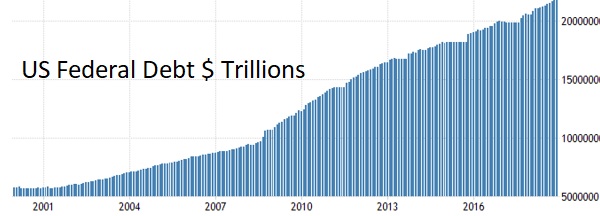
The following chart shows the increase in US government debt over the past three administrations. Note that in the absence of labels you can’t tell by the amounts borrowed whether Democrats or Republicans were in charge in any given year.

US government debt least important election

The conclusion? If Trump wins he’ll continue to run trillion-dollar deficits. If Biden wins, he’ll borrow that much or more. Neither will scale back the military budget or soaring entitlements. And both will encourage, via zero and possibly negative interest rates, the private sector to continue its own borrowing binge. On fiscal policy, these guys are virtually indistinguishable.

Fascist dictator!
It’s amazing how many Democrats literally expect Trump to ignore the coming election and just declare himself dictator.

Please listen, liberals: Trump is trolling you. He’s a narcissistic stand-up comedian who finds himself with a vast audience of emotional children, and he’s doing what any self-respecting comic would do: He’s freaking you out. So pretend you’re at a stage-side Comedy Store table and just roll with it. When his set is over, he’ll drop his mike and amble off to his next gig.

Meanwhile, it’s equally amazing that conservatives look at Court stacking, the Green New Deal and other liberal power grabs as a prelude to an updated version of Orwell’s 1984. This is Joe Biden we’re talking about. He’s been a feckless political hack for longer than most voters have been alive and has never once displayed the ambition required to set up a dictatorship.

As President, he will take corporate donations and follow the orders implicit in those legal bribes. The result will be Clinton/Obama business as usual, not revolution.

Granted, Biden will likely die or lose what’s left of his mind before his first term ends. And yes, Kamala Harris is an instinctive authoritarian. But she has the same moral flexibility as the Bidens, Obamas and Clintons, which just implies a slightly nastier version of the status quo. Again, plenty of run-of-the-mill corruption and brutality, no coup in sight.

So the very real personality defects of this crop of candidates are an annoyance rather than a danger. And as such, they’re easily managed. Just don’t watch Fox or MSNBC and the coming political mess will wash over you like the smell from a passing garbage truck, unpleasant but ephemeral.

What DOES Matter?
The coming financial crisis of course. The pandemic turbocharged a process of hyper-financialization that was already underway, and now whoever is in charge next will have no choice but to keep bailing out everything in sight with tens of trillions of newly created dollars.

This will shift the pressure from bankrupt states and insolvent companies to the currency. Prices will start to rise as the dollar falls. And the fears of today’s voters will seem in retrospect like quaint fantasies from a simpler and embarrassingly naïve time.

And that’s when dictatorship becomes a real possibility. Not Because Trump or Biden are implementing long-held plans but because they are panicked by events spinning out of their control and have literally no idea what to do. This is a legitimately scary prospect. But the coming election will have nothing to do with it one way or the other. Buy gold now.

Sovereign Man: Antifa is real. It’s violent. And you need to plan for it.

From Sovereign Man – Antifa is real. It’s violent. And you need to plan for it.

American diplomat George Messersmith found himself in an awkward situation while attending a luncheon in Kiel, Germany in August of 1933.

As lunch came to a close, the attendees erupted into song with arms outstretched in the Nazi salute.

First they belted out Germany’s national anthem, followed by the anthem of the Stormtroopers– the paramilitary ”Brownshirts” who violently enforced Germany’s new social rules.

Messersmith was the US Consul-General overseeing America’s diplomatic ties with Germany, so he politely stood at attention. But he did not salute or sing along.

Germans were required by law to render the Nazi salute, especially during the anthem; Hitler had been awarded supreme executive authority only a few months before, and he made the mandatory salute law of the land.

Foreigners, however, were explicitly exempt from saluting or singing the anthem.

But that didn’t help Messersmith.

Even though he was legally excused from making the Nazi salute, angry Brownshirts menacingly glared at him for not participating in their rituals.

Messersmith later wrote in his memoirs that he felt threatened, as if the Brownshirts were ready to attack him.

“I felt really quite fortunate that the incident took place within doors. . . For if it had been in a street gathering, or in an outdoor demonstration, no questions would have been asked as to who I was, and that I would have been mishandled is almost unquestionable.”

Messersmith was one of the few US officials who grasped just how dangerous the Nazis were in 1933. Others had to witness it first hand before they understood.

A similar event unfolded when a US radio host and his family found themselves amidst an impromptu Nazi parade in Berlin.

And in order to avoid Hailing Hitler, they turned their backs to the parade and gazed into a store window.

But several Brownshirts quickly surrounded the family and demanded to know why they did not salute.

The family explained that they were from the US and didn’t know the customs in Germany. But the Brownshirts didn’t care. The family was assaulted as police officers watched… and did nothing to stop the violence.

News of these sorts of incidents quickly made their way overseas, and foreigners read the about Americans traveling in Germany being savagely beaten or threatened for not engaging in Nazi rituals.

But more surprising is that many foreigners actually sided with the Nazis.

Even the daughter of the US Ambassador to Germany defended the Nazis and their Brownshirt enforcers.

She said that news reports of these assaults and beatings were “exaggerated by bitter, close-minded people” who ignored the “thrilling rebirth” Hitler had ushered in for Germany.

Of course, we know in retrospect that these early warning signs were not at all an exaggeration. They were a small preview for what would come next.

Today we are obviously in a different time dealing with totally different circumstances.

But it would be foolish to ignore the early warning signs and pretend as if what’s happening now is not a preview for what could come next.

This is perhaps best illustrated by a CNN reporter in Kenosha, Wisconsin back in August who stood in front of burning cars and buildings, with a violent mob all around him, yet declared the protests “fiery but mostly peaceful.”

This willful ignorance of the undercurrent coursing its way through the Western world will not save anyone from the destruction it brings.

For example, just this past Monday, “peaceful protesters” in Portland, Oregon celebrated Columbus Day with an “Indigenous People’s Day of Rage.”

They weren’t even pretending to be peaceful. They called it what it is: RAGE. That’s literally the name they gave to their own actions.

Hundreds of people dressed in all black, covered their faces, and armed themselves with shields and nightsticks. They marched their way through the city, smashed windows, and forced any witnesses to stop filming and delete photographs.

A man who filmed from his apartment’s terrace had lasers shined in his eyes and was doused in some sort of liquid.

The protesters tore down statues of Teddy Roosevelt and Abraham Lincoln. They smashed the windows of the Oregon Historical Society building, and unfurled a banner that said “stop honoring racist colonizer murderers.”

Police did not even attempt to intervene until the rioters had been on the streets for hours and had already caused havoc and destruction.

(Ironically, much of the mainstream media still refuses to acknowledge that this group ‘antifa’– the fascists who call themselves anti-fascists– even exists.)

It’s obvious that a small, fringe, ideological minority has started to take control.

They have squashed civil discourse and free speech. Dissent is met with violence and intimidation. And if you dare to speak out, you become a target.

That could mean being “cancelled” by the Twitter mob. Or being accosted in public and forced to raise your fist. Several people have already been killed in protests across the nation.

When people like the former CEO of Twitter are calling for capitalists to be “lined up against the wall and shot,” it’s time to take the threat seriously.

This is far from the first time in history that a tiny fraction of the population has resorted to violence and extremism to force their agenda on an entire nation.

But you don’t have to watch helplessly as the born-again Brownshirts destroy everything you have worked for.

The first step is to recognize that the radical movement will not simply go away on its own. This has been growing for some time, and history tells us that it could become much worse.

Second, have a rock solid Plan B. This means deciding– in advance, when you’re still calm and rational– what steps to take in order to secure your family’s safety, your prosperity, and your freedom in a worst case scenario.

After all, you don’t want to be thinking about your next move when some antifa thug ‘peacefully’ hurls a molotov cocktail through your window.

Homesteading Family: How to Dry Fresh Herbs (Oven, Dehydrator, or Hanging)

Carolyn Thomas at Homesteading Family has an article on How to Dry Fresh Herbs (Oven, Dehydrator, or Hanging)

Growing and preserving fresh culinary herbs is so much easier than one might think. But there are a few tips to know when learning how to dry herbs for long-term storage and use. We’re sharing all our tips in this post.

We like to plant all sorts of herbs in our cottage garden. We’ve written a post on the top 15 medicinal herbs you can grow yourself. We also love to grow roses and use their dried petals medicinally and in a DIY facewash.

If you’re interested in other preservation methods for herbs, click this link for two more ways to quickly and easily preserve your herbs at home.

Tips for the Best Herbs

There are a few tips you should follow in order to get the best tasting, and highest quality culinary herbs.

  1. Start with freshly harvested herbs. Herbs that were harvested a day or more prior to drying will lose flavor and potency. It’s best to work with herbs that are as fresh as possible.
  2. Know the “enemies” of herbs. Sunlight, air exposure, and moisture are all no-no’s when it comes to getting quality herbs. We’ll discuss each of these more in-depth below.
  3. Enhance the flavor of your herbs!


By following all these tips, you’ll end up with the most flavor, the most potent and the best quality herbs. Not to mention you won’t be paying grocery store pricing as you’ll only have spent a few cents on the price of the seeds!

Fresh Herbs

Starting with fresh herbs ensures the best end product. You don’t want to harvest herbs and allow them to sit and get wilted before dehydrating.

When possible, harvest herbs just before you plan to bundle them and dry them. It’s really best to do this all in one day, even within an hour or so from harvesting.

Dried Herb “Enemies”

As mentioned above, the “enemies” of herbs are sunlight, airflow, and moisture.

Sunlight

When drying and storing herbs, it’s important to choose a section of your home where they’ll be out of direct sunlight.

It’s true herbs need sunlight to grow, but when it’s time for them to be dried, sunlight will degrade the herbs quickly.

Airflow

Choose an area of your home where there is minimal foot traffic.

Herbs that are hanging will collect dust and particles floating around in the air, so the less air movement surrounding them, the better quality you’ll end up with in the end.

Moisture

Storing herbs correctly will prolong the life of your herbs. This is probably the most important one to watch out for.

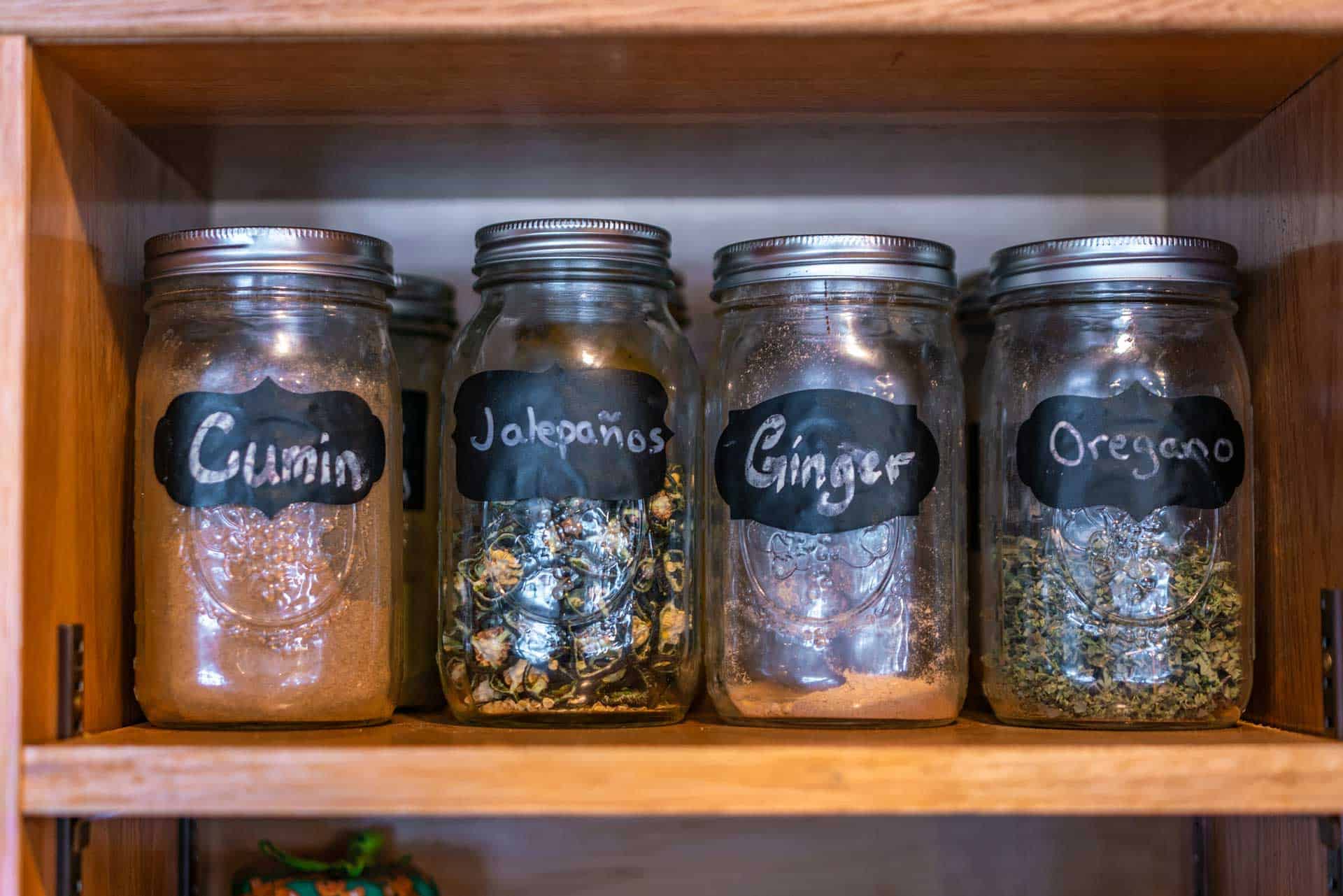
When storing herbs, an airtight container such as a mason jar is a great option.

But it’s imperative your herbs are completely dry before sealing them.

One test you can do is to crumble them and seal them tightly in a mason jar. Watch the jar for 24 hours, if ANY condensation forms on the inside of the jar, the herbs were not completely dry.

If this happens, remove the herbs from the jar and allow them to continue drying.

You can do this test as many times as needed.

Different Methods for Drying Herbs

There are a few different methods for drying herbs. You can use your oven, a dehydrator, or our favorite method is to hang them in bundles.

How to Dry in the Oven

Drying in the oven doesn’t actually mean turning the oven on.

To dry herbs in the oven, arrange your herbs on a cookie sheet and then place them in an oven with only the pilot light lit, or the oven light on.

Drying with a Dehydrator

Using a dehydrator is a great option if you want them done quickly and in a protected area.

Arrange herbs on the dehydrator trays and dehydrate at the lowest possible temperature until completely dry.

Hang Dry in Bundles

Our favorite method for how to dry herbs is to hang them in bundles.

We have a room off of our kitchen that doesn’t get too much foot traffic where we hang them from the ceiling until completely dry.

Keep reading for our tips on how to hang dry herbs.


How to Hang Dry Herbs

The best tip when hanging herbs is to gather the sprigs in bundles that aren’t too dense, nor too sparse.Where you live and the humidity in the area you’re drying the herbs will determine how thick your bunches can be.

In dessert climates, you can bundle together many more herbs than say the humid south.

Hang From Twine

Twine is a great tool to hang herbs with. Tying the twine in a slipknot and then wrapping that around the end of your bundle will allow the twine to tighten down on your herbs as they dry, eliminating the possibility of losing sprigs to the floor.

Once your herbs are completely dry, crumble them with your hands and store in an airtight container.Now you can enjoy your homegrown culinary herbs all year long!

Economic Collapse Blog: More than half “plan to stockpile food and other essentials” for the months ahead

Michael Snyder at The Economic Collapse says that More than half of all Americans “plan to stockpile food and other essentials” for the chaotic months ahead

There was a time when preppers were relentlessly mocked, but nobody is laughing now.  Today, most Americans are thinking about stockpiling food, and this massive shift in our national mindset has been sparked by concern about what is going to happen in the months ahead.  Many Americans believe that another wave of the coronavirus pandemic is coming, others believe that our ongoing economic depression will get even deeper, and yet others are convinced that the upcoming election could produce widespread violence.  Of course there have always been people that have been deeply alarmed about future events, but we have never seen anything quite like this.  In fact, a brand new survey has found that over half of all Americans are currently planning “to stockpile food and other essentials”

Slightly more than half of Americans in a recent poll from Sports and Leisure Research Group say they already have or plan to stockpile food and other essentials. The chief reason: fears of a resurgent pandemic, which could lead to disruptions such as new restrictions on businesses. On Oct. 2, the number of COVID-19 cases in the USA was its highest in almost two months.

People still remember the shortages that we witnessed earlier this year when the coronavirus pandemic first erupted in this country, and those that ended up being stuck at home without enough toilet paper would rather not repeat that experience.

So as the mainstream media continues to hype a new wave of the pandemic, we should expect to see Americans hitting the grocery stores really hard.  And according to data company Envestnet Yodlee, there is evidence that this is already happening

Already, there’s some evidence that grocery sales are rising, according to data from industry sources. The typical bill for a trip to the grocery store rose to $72 for the week ended October 6, or 11% higher from the week before, according to data company Envestnet Yodlee.

“That’s the highest we’ve seen since the first week of June and the second-highest since we started tracking this in January,” said Bill Parsons, group president of data and analytics at Evestnet.

Fortunately, many grocery store chains anticipated a spike in demand in advance and started stocking up ahead of time.  The following comes from CNN

Grocery stores across the United States are stocking up on products to avoid shortages during a second wave of coronavirus.

Household products — including paper towels and Clorox wipes — have been difficult to find at times during the pandemic, and if grocery stores aren’t stocked up and prepared for second wave this winter, runs on products and shortages could happen again.

During a time when other retailers all over the nation are failing at a pace that we have never seen before, many grocery store chains are actually experiencing booming sales.

And of course I have been warning that this would eventually happen for a very long time.  During a time of crisis, demand for food and other essentials tends to go up and demand for non-essential items tends to go down.

Needless to say, this is something that is not just happening in the United States.  All over the world we have seen demand for food on the rise, and this comes at a time when global food production has become increasingly stressed.

As a result, food prices all over the world are starting to escalate quite aggressively

Food prices continue rising during the coronavirus pandemic, jeopardizing food security for tens of millions worldwide.

On Thursday, the Food and Agriculture Organization (FAO) of the United Nations said world food prices rose for the fourth consecutive month in September, led by surging prices for cereals and vegetable oils, reported Reuters.

FAO’s food price index, which tracks the international prices of the top traded food commodities (cereals, oilseeds, dairy products, meat, and sugar), averaged 97.9 in September versus a downwardly revised 95.9 in August.

Sadly, this is just the beginning.

Global food supplies will continue to get even tighter, and global demand for food will just continue to shoot higher.

So I would stock up while you still can, because prices will never be lower than they are right now.

Meanwhile, our society continues to unravel right in front of our eyes.  You would think that the Lakers winning the NBA title would be a time to celebrate for the city of Los Angeles, but instead large crowds of young people used it as an opportunity to riot and attack police officers

A crowd of more than 1,000 revelers descended into the area around Staples Center after the game. Unruly individuals mixed within the crowd began throwing glass bottles, rocks, and other projectiles at officers. That is when an unlawful assembly was declared, and only a limited number of people complied and began to disperse. A larger portion of the group broke off and began vandalizing businesses while continuing to engage in violent behavior, some aimed at responding officers.

In Portland, protesters just toppled statues of Teddy Roosevelt and Abraham Lincoln during a “day of rage”, but the mainstream media didn’t seem to think that this was any sort of a problem.

And in the middle of the country, the violence never seems to stop in the city of Chicago

Five people were killed and 48 others were injured by gunfire this weekend in Chicago. Five of those wounded were teenagers.

Last weekend saw 37 people shot throughout the city, five of them fatally.

Of course things could soon get a whole lot worse.

According to one recent survey, 56 percent of all Americans expect “an increase in violence as a result of the election”.

Isn’t that incredibly sad?

Many are still hoping that such a scenario can be avoided if one of the candidates is able to build an extremely large lead on election night.  A large enough lead could potentially cause the candidate that is behind to concede fairly quickly, and that may ease tensions.

But I wouldn’t count on that.

At this point we are about 500 hours away from the election, and both sides are indicating that they are prepared to fight until the bitter end.

And the side that ultimately ends up losing is likely to throw a massive temper tantrum, and that won’t be good for our country at all.

So it makes sense that so many Americans are making extra preparations for the months that are ahead, because it definitely appears that they could be quite rocky.