Paratus Familia: Actionable Intelligence

Enola Gay at Paratus Familia has an article up on seeing danger and taking refuge in a time of unclear and contradictory public messaging – Actionable Intelligence.

Watching the news is a lesson in frustration.  The media has cried wolf for so long that if this pandemic truly is “the end of the world as we know it”, we’re not going to believe it until it’s too late. There is no truly “actionable intelligence” coming from news reports or social media.  One side says that the sky is falling and the other side says “move along, there’s nothing to see here”.  Wisdom is in short supply.

We have seen (at least according to media outlets) lots of “stocking up” on key quarantine and hygiene essentials.  Many people have been caught unawares, and are worried, even to the point of hysteria, that they don’t have enough to get they and their families through this crisis.  I have a few thoughts on the concept of preparedness and Christianity…..

I absolutely believe that God is the author of life and sustains us from even before our very first breath.  It is His providence that sees us through each day and provides hope for the future.  However, He did give us biblical principles to live by and preparedness is one of many.

When God spoke to Noah, He told him to prepare for judgement.  He gave him very specific instructions about building an ark, loading it with life sustaining food and preparing his family for the trials of the days ahead.  Now, if anybody had a reason to doubt, it was Noah.  For over 100 years, Noah works on the ark.  I have no doubt there were many naysayers and hecklers, but Noah persevered.  Noah built a boat in a world that had never seen rain, never seen a flood, never had even seen an “act of God”.  What faith!  God could have saved Noah and his family by “Divine Intervention”, but instead, He chose to have Noah prepared.

The story of Joseph may be an overused example of preparedness, but it is without a doubt a perfect picture of God’s faithfulness through preparedness.  Once more, God could have chosen not to allow the famine, but instead He readied His servant Joseph to care for His people.  What would have happened to the people Egypt and the surrounding areas had Joseph not heeded God’s voice?

The example of the ten virgins in Matthew, although directly relating to the returning of the bridegroom, is instructive in discerning the wise from the foolish.  The wise virgins brought with them their lamps and their oil, conversely, the foolish virgins brought their lamps, but lacked the foresight to bring oil.  My desire is to be known as wise rather than foolish!!

Another thought is that God always starts with something.  When He made man, He started with dirt. When He made woman, He started with man.  God instructed Elijah to have the widow feed him.  She explained that she had only enough flour and oil for one loaf for she and her son, and then they would die.  Elijah instructed her to feed him first and that her supplies would last.  THEY DID!!  She had something and God multiplied it.  Even Jesus, with His very first miracle, started with something. He didn’t just conjure up wine for the wedding, He started with water.  Later, at the Sermon on the Mount, He started with a few loaves and fishes, and fed 5000 men; not counting women and children.  He used what was available and multiplied it.  Those examples, at the very least, should spur to have SOMETHING.  God, in His sovereignty, will use what we have – but we need to start with something.  We don’t have to panic about not having everything we think we need, but we do need to make an effort to acquire SOMETHING.

And then we get into the Proverbs.  They are a goldmine of preparedness advice:

Proverbs 6:6-8
Go to the any, you sluggard; consider its ways and be wise. It has no commander, no overseer or ruler, yet it stores it provisions in summer and gathers its food at harvest.

Proverbs 21:20
In the house of the wise are stores of choice food and oil, but a foolish man devours all he has.

Proverbs 22:3
A prudent man sees danger and takes refuge, but the simple keep going and suffer for it.

Proverbs 27:12 (this one is even mentioned twice)
The prudent see danger and take refuge, but the simple keep going and suffer for it.

Proverbs 30:25
Ants are creatures of little strength, yet they store up their food in the summer.

Proverbs 31 is one of my favorite chapters.  It is like a job description for a Godly wife.  A couple of verses really speak to me when it comes to preparedness.  31:15 “She gets up while it is still dark; she provides food for her family and portions for her servant girls”.  31:21 “When it snows, she has no fear for her household; for all of them are clothed in Scarlett”.  31:25 “She is clothed with strength and dignity; she can laugh at the days to come”.  The Proverbs 31 woman provided food for her household.  She did not wait for someone else to provide for her.  She was not afraid of the cold, because she had already made sure that her household was well clothed.  She laughed at the days to come.  I think this is my favorite verse.  For a woman, the only way that you can laugh at the days to come is if you feel that you have taken care of what needs to be taken care of.  When you have laid in supplies, a part of you says “bring it on!”.  Then you truly can laugh at the days to come.

As Christians, it is our responsibility to be wise stewards.  How can we be a beacon of hope in a dark world, if we, ourselves are dependent upon the charity of others?  How can we bring glory to God if we are stealing or cheating to survive?  We must be like the prudent man who sees danger and takes refuge rather than the simple man who keeps going and suffers for it.

WA-GOAL Legislative Update 2020-10-Final

From the Washington Gun Owners Action League:

GOAL Post 2020-10-Final
Legislative Update from Olympia 13 March 2020

SESSION OVER – SINE DIE
FIVE BILLS PASS
AG OPINION – SORT OF
ELECTION 2020
YOU ARE THE GUN LOBBY
REMEMBER OUR FEW DEMOCRAT FRIENDS, TOO
LAST GOAL POST TIL NEXT TIME

Per the state constitution, the 2020 regular legislative session ended late last evening (Thursday). At this time there is little likelihood of the need for a special session. With luck, we will be safe (from overreaching state government, anyway) until next January, when the 2021 105-day regular session convenes in early January.

Of the three dozen or so gun bills considered during the session, only five passed both chambers and are headed for Governor Inslee’s desk. The governor has the option to sign a bill into law, veto the entire bill, veto only certain sections leaving the remainder of the bill to take effect, or let the bill become law without his signature. It takes a 2/3 vote of the House AND the Senate to override a gubernatorial veto.

The bills that passed are HB 2467 (centralized firearm background checks), HB 2555 (background checks for receivers), HB 2622 (firearm surrender on court orders), SB 5434 (day care centers gun free zones) and SB 6288 (Office of Firearm Safety and Violence Prevention).

HB 2467 could be good or bad. 17 other states now conduct all or partial firearm background checks, and most seem to work smoothly (ATF calls them “point of contact” states. The biggest issue here is the $18 authorized for every check. The Florida Department of Law Enforcement, which conducts all background checks in that state, does it for $5 – more than today’s free FFL:NICS check but much less than $18. HB 2555 essentially mimics federal law – a receiver/frame is already a firearm under federal law. SB 5434, extending gun free zones to day care centers is overreach, but it does allow licensed carry under certain circumstances. And the Office of Firearm Safety and Violence Prevention is long on “firearm” and likely nonexistent on “safety” or “violence prevention” – unless our side gets active and seeks grants for safety education and criminology studies to identify who and where the violence is being committed (don’t hold your breath on that one – the FBI’s annual Uniform Crime Report has been telling you exactly who the “who” is for decades, and it has been ignored just as long).

For a detailed, plain English explanation of the intent of a bill, look for the lowest (final) “bill report” on a given bill’s page by putting the bill number (four digits only) into the box at https://app.leg.wa.gov/billinfo/.

Stealing from Curtis Bingham and M. J. Muehlhans Facebook posting here, you can still ask the governor to veto bills you oppose, such as the $18 fee to conduct a firearm purchase/transfer through the WSP in HB 2467. Information to contact Governor Inslee may be found at https://www.governor.wa.gov/ The fee is far too excessive to simply cover the cost of the program, which will merely be a satellite of the existing FBI NICS program anyway (with the WSP doing the NICS check instead of the FFL). $18 is just another tax that the governor and his cronies love so much!

Reportedly when HB 2240 (magazine ban) died after Republican House members filed more than 100 amendments to effectively block the bill, Washington Attorney General Bob Ferguson offered the opinion (not a formal “Attorney General Opinion” – an interpretation of existing law, but him just spouting off) that we could “blame the GOP when the next mass shooting occurred.” I hope AG Ferguson is just as quick to give credit to armed citizens who save lives and stop criminals with tools like the AR-15 and “high capacity magazines.” Like the neighbor in Sutherland Springs, Texas, a couple of years ago who grabbed HIS AR-15 and stopped the man shooting up the church next door, or the pregnant woman in Florida who came out of her bedroom, AR-15 in hand, and shot one of the home invaders trying to kill her husband. Guns save lives more frequently than they take them.

(Warning: Waldron political rant follows. If you don’t want to hear it, jump to the next section, “BILL STATUS.”

With the turnover in Congress in the 2018 election, it’s clear many people were unhappy with our president. So they gave full control of the STATE legislature to Democrats. Rural voters and gun owners need to be reminded that the majority of gun control bills that pass, pass at the state level. It’s Democrats IN OLYMPIA that are killing gun owners. Ideally vote Republican to give Republicans control of one or both chambers (and committee chair seats; committee chairs control which bills move and which die in committee) or vote for the small handful of pro-gun Democrat.

You like more taxes? You like “perverts-is-us” taught in your schools? Go ahead and vote liberal Democrat. But please, if you leave Washington because of it’s liberal policies, DO NOT take your liberal attitudes with you.

You think the 2016 presidential election was contentious, you ain’t seen nuthin’ yet. 2020 will be the most hotly contested – and most critical – election in our lifetimes. This is the election that determines what direction the country will take for the next ten or twenty years. Or forever.

Yes, the legislative session is over, but DO NOT take your pack off! There’s a lot of work to be done in the coming eight months. As unhappy as some might be with our president, Donald Trump and the Republican Party offer us as close to “the old days” as we’re likely to see, Whether it’s sleepy, groping Joe Biden or Fidel Castro-praising socialist Bernie Sanders, whatever they promise is nothing but a sharp shift to the left and an end to our republic. It’s the Democrats who are trashing the Constitution with things like “red flag” protection orders and cradle-to-grave welfare – at taxpayer expense.

Political campaigns largely run on volunteer work. Envelope stuffing, door-belling… that’s grassroots politics at its best. Consider having your gun club hold barbecues this summer as the campaign season gets into full swing. Invite candidates to talk face to face, and likely correct many mis-impressions they have about the gun issue. As American humorist and social commentator Will Rogers once observed, “It’s not what we don’t know that gets us in trouble, it’s what we know that isn’t so.” Most candidates learn about guns from the media. It’s your job as a grassroots gun lobbyist to correct that.

We dodged a lot of bullets this session, gun and magazine bans, CPL training, ammunition background checks and ammo excise taxes among them. In large part, that was due to YOUR activism, and to a lesser extent Democrats’ fear of overreaching and paying the price in November. Let’s make them pay that price anyway. You can see by all the anti-gun bills they filed where they want to go – and where they want to drag us with them. Don’t let that happen!

One last point: we DO have some Democrat friends in Olympia. Senators Tim Sheldon, Dean Takko, Steve Hobbs and Kevin Van Dew Wege and Representatives Brian Blake, Mari Leavitt and Dave Paul. They have clearly demonstrated their loyalty to their oath of office despite caucus pressure in the other direction. Remember them in August for the primary and again in November.

THIS IS THE LAST GOAL POST FOR THE 2020 SESSION.

The “BILL STATUS” list below is a complete list of all gun bills considered by the legislature this year. Note I am using the original filed version of the bill number (HB, SB) and not the amended versions (SHB, ESHB, SS< ESSB, etc).

BILL STATUS/GOAL POSITION:
(all bills that received attention during 2020 session)

HB 1010 WSP destruction of firearms Senn (D-41) DIED OPPOSE
HB 1068 Magazine restrictions Valdez (D-43) DIED OPPOSE
HB 1315 CPL training requirement Lovick (D-44) DIED OPPOSE
HB 1374 Repeals state preemption of gun laws Macri (D-43) DIED OPPOSE
HB 1671 Confiscation of firearms Dolan (D-22) DIED NEUTRAL
HB 2196 Raise standard for issue of a “red flag” order Walsh (R-19) DIED SUPPORT
HB 2202 Exempts law enforcement from a/w training Klippert (R-8) DIED OPPOSE
HB 2240 Bans high capacity magazines Valdez (D-43) DIED OPPOSE
HB 2241 Bans assault weapons and magazines Peterson (D-21) DIED OPPOSE
HB 2305 Expands firearm prohibition re: protection orders Doglio (D-22) DIED OPPOSE
HB 2367 Self defense insurance Hoff (R-18) DIED SUPPORT
HB 2467 Centralized firearm background checks Hansen (D-23) TO GOV NEUTRAL
HB 2519 Ammunition background checks Walen (D-48) DIED OPPOSE
HB 2555 Background checks for “other” firearms Goodman (D-45) TO GOV OPPOSE
HB 2569 Pre-trial detention for certain firearm offenses Wylie (D-49) DIED OPPOSE
HB 2622 Court order non-compliance, firearm surrender Kilduff (D-28) TO GOV OPPOSE
HB 2623 Firearm prohibition, certain offenses Walen (D-48) DIED OPPOSE
HB 2767 Recreation shooting areas on public lands Blake (D-19) DIED SUPPORT
HB 2820 Firearms forfeiture/DV court order (correction) Klippert (R-8) DIED NEUTRAL
*HB 2925 Bans firearms on Capitol grounds and buildings Senn (D-41) DIED OPPOSE
HJR 4210 Pretrial detention for certain firearm offenses Wylie (D-49) DIED OPPOSE

SB 5434 Expands gun free zones to day cares Wilson, C (D-30) TO GOV OPPOSE
SB 5782 Spring-blade knives Zeigler (R-25) DIED SUPPORT
SB 6043 Self defense insurance Wilson, L. (R-17) DIED SUPPORT
SB 6076 Bans assault weapons and hi cap magazines Kuderer (D-48) DIED OPPOSE
SB 6077 Bans high capacity magazines Kuderer (D-48) DIED OPPOSE
SB 6161 Excise tax on ammunition Dhingra (D-45) DIED OPPOSE
SB 6163 Unlawful possession BEFORE conviction Dhingra (D-45) DIED OPPOSE
SB 6288 Office of firearm violence prevention Dhingra (D-45) TO GOV OPPOSE
SB 6289 Restoration of firearm rights Dhingra (D-45) DIED OPPOSE
SB 6294 CPL training requirement Saloman (D-32) DIED OPPOSE
SB 6347 CPL validity seven years with training Wagoner (R-39) DIED SUPPORT
SB 6402 Use of a stolen firearm Rivers (R-18) DIED SUPPORT
SB 6406 Concerning firearms Wilson, L (R-17) DIED SUPPORT
SB 6584 Unlawful purchase of a firearm Zeiger (R-25) DIED SUPPORT
SB 6673 Removes many existing firearm restrictions Fortunato (R-31) DIED SUPPORT

PUBLIC HEARINGS SCHEDULED:
It’s over!

LEGISLATIVE HOT LINE: You may reach your Representatives and Senator by calling the Legislative Hotline at 1-800-562-6000. Toll free!!! The hearing impaired may obtain TDD access at 1-800-635-9993. Also toll free!!!

1-800-562-6000 TDD 1-800-635-9993

OTHER DATA: Copies of pending legislation (bills), legislative schedules and other information are available on the legislature’s web site at “http://www.leg.wa.gov“. Bills are available in Acrobat (.pdf) format. You may download a free version of Adobe Acrobat Reader from Adobe’s web site (http://www.adobe.com). You may also obtain hard copy bills, initiatives, etc, in the mail from the Legislative Bill Room FREE OF CHARGE by calling 1-360-786-7573. Copies of bills may also be ordered toll free by calling the Legislative Hotline at (800) 562-6000. You may also hear floor and committee hearing action live at http://www.tvw.org/ (you need “RealAudio” to do this, available free at the TVW web site).

By reading the House and Senate “bill reports” (hbr, sbr) for each bill, you can see how individual committee members voted. By reading the “roll call” for each bill, you can see how the entire House or Senate voted on any bill. The beauty of the web site is that ALL this information is available, on line, to any citizen.

Upcoming WAC gun show(s):
Monroe 28-29 March
Puyallup Pavilion 4-5 April

“The right of the individual citizen to bear arms in defense of himself, or the state, shall not be impaired, but nothing in this section shall be construed as authorizing individuals or corporations to organize, maintain or employ an armed body of men.”

Article 1, Section 24
Constitution of the State of Washington

Sovereign Man: How Bad Will It Get?

Simon Black at Sovereign Man has a few thoughts/prediction on where the pandemic could take us.

We certainly live in extraordinary times.

Even people who have been irrationally dismissive of the Corona pandemic up until this point finally had to wake up and smell reality yesterday. The NBA. Tom Hanks. European travel ban.

Our human brains, while magnificent and inspiring, are also wired in bizarre ways. We’re filled with countless ‘cognitive biases’ which affect our judgment, usually for the worse.

Among them is that human beings often cannot accept the possibility that tomorrow could be radically different than today.

Things that were completely unthinkable just a few days ago have now happened. And pretty much everything is on the table right now.

So I wanted to spend a bit of time today thinking through some potential outcomes that might have seemed inconceivable before this outbreak.

I’m not suggesting these are foregone conclusions. But they’re definitely possible.

1) Supply chains will break down

Nearly everything you buy at the store or online is the result of a ridiculously complex, global system of commerce, finance, and logistics.

This computer that I’m using right now was sourced from hundreds of different materials—plastics, metals, etc. that were mined and produced from dozens of places. The component parts were manufactured by different suppliers, assembled in China, and transported on boats and trucks to wholesalers, retailers, etc.

The whole process involves countless people, dozens of companies, and thousands upon thousands of miles.

This system works great under normal conditions. But it’s not resilient. It’s unable to cope with severe global shocks like we’re seeing now.

I think we could see (and are already seeing) factory workers stop coming to work. Mail delivery could be curtailed. Or just imagine there’s an outbreak at an Amazon Fulfilment Center, and the company goes down to minimal staffing.

All of this will have an impact in the smooth production and delivery of goods around the world.

I don’t think we’ll have any sort of Mad Max shortages. But the virus effect could likely create scarcity, especially for anything that’s manufactured outside of your home country.

2) Rationing and Export Prohibition

Countries will become increasingly protectionist, especially with critical items like masks and medicine. We’ve already seen the German government blocking a shipment of 240,000 face masks to Switzerland.

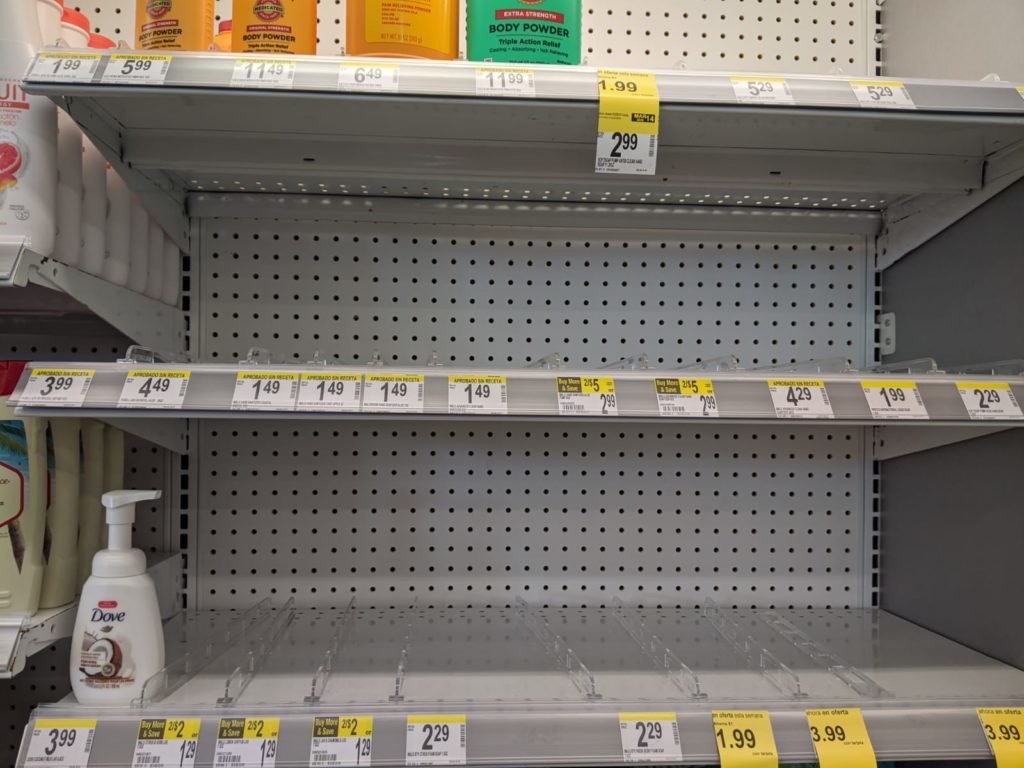
And demand for several items is going to skyrocket. You might have heard about the toilet paper heists across Asia, or fistfights breaking out in Australia over antibacterial cleansers.

Here’s a photo that a friend sent to me a few hours ago of the hand sanitizer section at Walgreens– almost empty.

This isn’t going to stand for very long before the companies themselves start to limit purchases, or governments impose full-blown rationing. And that leads to…

3) Some people will become totally unglued. Others will be saints.

Let’s be honest— there’s already so much anger in the world. Strikes, riots, protests, Twitter rants… even armed thugs in the streets (Antifa) physically assaulting people with ideological differences.

Introduce a little bit of scarcity into all that anger and a few people will become totally unhinged.

Just think about how violent some shoppers can be on Black Friday, punching each other’s lights out in Wal Mart for the last big screen TV on special.

At the same time, this pandemic also has the potential to bring out the best in people. And countless others will be at their very best: respectful, generous, and responsible…

Click here to continue reading at Sovereign Man.

Ranier Redoubt: Are You Two Weeks Ready?

Ranier Redoubt has an article up Are You and Your Family Two Weeks Ready? on getting prepared for two weeks if you’re behind the curve on getting ready.

For the past few years Washington State has advised people to be “Two Weeks Ready” (a change from the old 3-days recommendation). This means having your own food, water and other supplies [i.e. Toilet Paper, Hand Sanitizer, Hygiene and Cleaning Supplies] in sufficient quantity to last for two weeks. People must be ready to act on their own for at least two weeks.
Ready.Gov has said “Being prepared for an emergency isn’t just about staying safe during a storm or a disaster. It’s also about how to stay comfortable, clean, fed, and healthy afterwards.” 

With all of the recent comments and memes about people hoarding toilet paper because of COVID-19 / coronavirus fears, we wonder how many of these people failed to prepare to care for themselves and their families BEFORE these current events.

If you are one of the people who needs to build a preparedness kit, you can still do so. Right now there is not an actual shortage of basic supplies, rather the “just in time” delivery system used by many retailers can’t keep up with demand in the compressed timeframe. Products are still being manufactured and shipped to stores, there is just a gap in delivery times. Stores don’t keep large quantities products stocked in the backroom or at a local warehouse anymore.

Take the current COVID-19 concerns as a sign that maybe having a few preparedness supplies isn’t such a bad idea. Build your preparedness kit a little at a time. There is no need to hoard or try to buy out every store in town. Your kit will depend on your own needs. Once you take a look at the basic items, consider what unique needs your family might have, such as supplies for pets or seniors. Remember, you are not necessarily “bugging out”. In many cases you will be “bugging in” staying home.

If you have to stay home because of a community lockdown or quarantine, in all likelihood your electric power will still be on, clean water will flow from the tap, and your sewer / septic system will still be working. Keep this in mind as you build your kit, but be prepared if any of these systems fail.

The list below is from Ready.Gov. It is a guideline for getting started, but you should make adjustments to meet your specific needs.

Water—at least a gallon per person, per day
Non-perishable food (such as dried fruit, peanut butter, or energy bars)
First aid kit
Cash
Prescription medicines
Extra batteries or an alternative power source
Matches in a waterproof container
Toothbrush, toothpaste, soap
Hygiene and sanitation items (toilet paper, feminine hygiene products)
Paper plates, plastic cups and utensils, paper towels
Battery-powered or hand-cranked radio
Sleeping bag or warm blanket for each person
Flashlights
Whistle to signal for help
Can opener (manual)
Local maps
Pet and service animal supplies
Baby supplies (formula, diapers, wipes etc.)
Extra pair of eyeglasses

Organic Prepper: How to Talk to Creditors When You Can’t Pay

Daisy Luther at The Organic Prepper has an article on How to Talk to Creditors When You Can’t Pay Your Bills. With some businesses closing permanently and others temporarily closed over the coronavirus pandemic, many people are put in an economic bind with no income coming in. While Washington state has announced some coming benefits for workers who are quarantined or laid off because of the coronavirus, we don’t know how long it will take to file, eligibility, or how it affects hourly workers who are not laid off or quarantined, but are not working because they business is closed or slow.

As our economy gets rocked by the coronavirus outbreak, lots of folks are already beginning to have financial problems. For others, they see money trouble on the horizon.

These issues are occurring for several reasons. Some businesses are cutting back staff or hours preemptively so they can survive financially. Other businesses are laying people off because of supply chain shortages – if you can’t get parts to repair furnaces, you can’t pay people to repair furnaces. The travel and shipping industries are already feeling the pain from the global outbreak.

So if you aren’t having money problems now, it’s very possible you will be soon.

What to do when your income slows down

This is something I’ve written about in detail in more than one article. Here’s a detailed article about job loss but the strategies would also work if your hours are cut. The basics are:

  1. Know your rights. You may have some recourse if your hours are cut or if you are laid off. If you have any type of employment contract, now is the time to go over it with a fine-tooth comb. Don’t sign anything until you’ve taken the time to calm down and think things through.
  2. Begin a total spending freeze. Give it a couple of days before you spend a dime. You’ll need to re-assess your budget.
  3. Apply for unemployment. Whether you lost your job completely or your hours were cut, you may qualify for unemployment or other benefits. You’ve been paying taxes for just this reason, so don’t be too proud to accept the help.
  4. Create a budget for necessities. Sit down and create a budget for the absolute bare minimum expenditures.
  5. Slash luxury spending. Now isn’t the time to go on a vacation, join a gym, or eat out at restaurants.
  6. Look for new streams of income. If you can, look for odd jobs, start a small business that doesn’t require an investment, or use your expertise to begin consulting in your field.
  7. Sell stuff. All that stuff you’ve been meaning to go through in the basement just might be the key to keeping a roof over your head.  Sell things online or in person, keeping in mind your personal safety.
  8. Audit your budget. Take the time to see where you can slash your spending. Can you cut your fixed or variable expenses?

Take action right away to stop the bleeding of money. A few dollars may not seem like much right now but it could be a much bigger deal in the future. You may need to make drastic cuts.

Make a list of your creditors.

Once you have created your new emergency budget, it’s time to take a look at those to whom you owe money. Some of these will be necessary expenditures. Keeping a roof over your head, the utilities on, a car in the driveway, and remaining insured. are likely the most important expenses.

Other expenditures are things like unsecured debt: credit cards, student loans, and personal loans. You may have some secured debt on things with which you’re willing to part – second cars, recreational vehicles, etc.

Write down all these expenses, your account numbers, your minimum monthly payments, and contact information for the creditor.

Before anybody jumps in and says, “You shouldn’t have any credit card debt” or “I bought my car in cash,” remember that I’m writing about a change in circumstances here. Sure it’s better to be debt-free, but when you have found yourself in a crunch, it’s all about surviving the rough time, not about beating yourself up for previous decisions.

Contact them one by one.

Next comes the part that may be difficult for some – you need to contact your creditors and see if they can help.

Keep in mind that many people are running into difficulty right now and these companies know it. Some places may have already authorized negotiations with debtors in expectation of the difficulty in which you currently find yourself.

Contact them in order from most essential to least. Below you’ll find some tips to help you guide the conversation.

How to talk to creditors… (continues)

Click here to continue reading at The Organic Prepper.

Weekend Weather Alert for Yakima Valley, Mar 13-14

In case you’ve been distracted by pandemic news and haven’t been paying attention to the weather, there are cold temperatures, wind and snow forecast for this weekend.

From the National Weather Service:

Issued: 8:21 AM Mar. 13, 2020 – National Weather Service

...SIGNIFICANT WINTER WEATHER EXPECTED THIS WEEKEND...

.An arctic cold front will bring much colder air into the region
late today through the weekend. At the same time, an upper level
storm system will bring abundant moisture from north to south,
with low elevation rain and mountain snow changing over to all
snow overnight tonight. Moderate to heavy mountain snow can be
expected over the Cascades and their east slopes and the Blues
and Wallowas of northeast Oregon/southeast Washington. In
addition, strong northeast winds across the Columbia Basin, the
Yakima and Kittitas Valleys will lead to areas of blowing and
drifting snow late tonight into Saturday, leading to treacherous
travel conditions. The snow should gradually become lighter by
Sunday, but unseasonably cold temperatures will linger on.
Yakima Valley-Lower Columbia Basin of Washington-Simcoe Highlands-
Including the cities of Naches, Sunnyside, Toppenish, Yakima,
Connell, Prosser, Tri-Cities, Goldendale, and Bickleton
...WINTER WEATHER ADVISORY REMAINS IN EFFECT FROM 5 PM THIS
AFTERNOON TO 5 PM PDT SATURDAY...

* WHAT...Snow expected. Total snow accumulations of 1 to 3 inches.
Winds gusting as high as 45 mph, leading to blowing and drifting
snow in some areas.

* WHERE...Yakima Valley, Lower Columbia Basin of Washington and
Simcoe Highlands.

* WHEN...From 5 PM this afternoon to 5 PM PDT Saturday.

* IMPACTS...Plan on slippery road conditions. Blowing snow could
significantly reduce visibility. The hazardous conditions
could impact the evening commute.

PRECAUTIONARY/PREPAREDNESS ACTIONS...

Slow down and use caution while traveling.

The latest road conditions for the state you are calling from can
be obtained by calling 5 1 1.

AYWtGS: Handling Quarantine with Kids

Karen at A Year Without the Grocery Store has an article up – Got Kids? How Do You Handle a Coronavirus Quarantine With Them? – with some suggestions on handling quarantine without going crazy.

We all love our children.  But despite that love, want to see parents cringe quickly?  Tell them that they are going to be stuck inside with their children for three months or more.  More than that, they cannot leave their home.

That thought in itself is incredibly overwhelming!  Add to it, getting ready to cut yourselves off from the world, it’s enough to devastate any parent.  How do you handle being cooped up with your kids for months on end?  Don’t stress, there are answers that don’t include 24/7 TV.

Let me start by saying, I’m a mom to five kids ages 8-17.  I don’t take the notion of being stuck inside my home for months with my kids lightly.  While younger kids will have an easier time staying home, older kids are going to feel the isolation much more.

So how do we handle a quarantine with kids?

When I was pregnant with my second set of twins, I was in the hospital every week for a non-stress test.  I had a friend who was pregnant at the same time.  She was hospitalized with placenta previa.  She wasn’t just hospitalized for a week or two.  No, she was hospitalized for more than TWELVE weeks.  And during that time, she was mostly confined to half of a small room.

How in the world did she keep herself sane being remanded to that small room for so long?  Some of her tips and tricks will work for us as we talk about how we’re going to help our kids (and ourselves) through what could be a long quarantine.

(1) Start Your Day Off Healthy

Make sure that you are starting your day off with a multi-vitamin, vitamin C, and a probiotic.  I would also suggest that you spend time in God’s word and prayer at the beginning of your day.  We love to sing together as a family, and this would be a good time to do that as well.

(2) Make sure your kids are learning.

Whether you homeschool or not, make sure that your kids are still learning.   Even if you send your kids to school, make sure that they are bringing their school books home with them as you get closer to keeping them home from school in a quarantine.   Or you could put together a school kit so that you will always have items to help your children learn if they can’t go to school.

For me, it’s really simple.  I have three children still in school.  And since we homeschool, they will all continue doing their school just like normal.  That will go a HUGE way toward helping things still feel normal.

What about older kids who have graduated and are working while still living at home?  Make sure that you have conversations with them now about when you are going to tell them that they can’t continue working for a while.  Have them talk to their employers NOW to manage expectations.

These older children should still be learning!  As I was going through totes today taking stock of everything for our quarantine, I found suture needles and other implements for doing stitches and practice skin.  Find a YouTube video on practice suturing and have them learn how to do sutures.  Or have you or your kids ever made bread or noodles from scratch?  Why not use some of that time to learn how to do a new skill?

(3) Make sure that you and your kids are moving daily.

If you have little kids, it’s obvious why they should do physical activity every day.  But what about older kids who aren’t bouncing off the walls?  Why should they (and you) exercise daily?

Studies have shown that mice were divided into three groups and all infected with the flu.  One group was sedentary.  One group jogged on a wheel for 20-30 minutes (modest activity for mice), and another group of mice was kept on a wheel for 2 1/2 – 3 hours.  Fifty percent of the sedentary group died.  SEVENTY percent of the mice who ran for 2 1/2-3 hours died!  Only 12 percent of the mice who were kept on the wheel for 20-30 minutes died.

Even if you aren’t going to expose yourself to the virus, keeping your body moving a modest amount can help your body better handle whatever is thrown at it.

Now, not everyone has a treadmill or a stationary bike, I get that.  But do you have Amazon Prime?  You can learn (or practice) yoga with your kids using this free video.  Don’t like yoga?  Here’s an exercise video called “Marching Low Impact.”  Or buy a digital copy of “Sweating to the Oldies” and sweat (and laugh and laugh) with your kids.

(4)  Play at least one game a day with your kids. 

This is a great time to spend time playing some of those games that you don’t play regularly either because you haven’t taken the time to learn them or because they take a little more time to play.

Do you have two decks of cards?  All you need is a Hoyle Card book, and you’ll have hours of fun at your hands.

Another thing that might fall into this category is putting together puzzles.

(5) Take a skill that you have to the next level.

Do you have a skill that you enjoy – like knitting?  Take it to the next level.  Maybe you could learn how to do cables or knit in multiple colors.  I’ve learned a bit about spinning, but don’t take a lot of time to actually practice it.  This would be the perfect time to take that skill to the next level.

How Do You Handle a Quarantine with Kids?(6) Schedule time for kids to talk with their friends using Facetime or Skype.
Only one of our kids has a cell phone.  And her cell phone is one for which we purchase minutes.  That means that calls aren’t a regular part of our kids lives.  Even if your kids have cell phones, talking with friends makes so much more of an impact when they can see them.

What if your kids could ‘virtually’ get together with their friends regularly during a quarantine?  They would be able share stories of what’s going on, what they are learning, and the time would pass so much faster.

(7) Enjoy movies and TV shows in moderation.

There are few things that make me feel more claustrophobic than sitting in front of a screen watching mindless TV too long.  I will often feel the need to get up and do something when I’ve got an Amazon or Netflix show going too much.  But that being said, sometimes, we just need to let our minds go to a more fun place and a movie or a TV show can do that for us.

(8) Most Importantly set a routine for your days.  How Do You Handle a Quarantine with Kids?

I say this last because I wanted to give you a lot of options for filling a routine.  Why do you need a routine?

When I was pregnant with my second set of twins, I was in the hospital on a weekly basis for non-stress tests.  I had a friend who was pregnant at the same time, but she was admitted to the hospital because of placenta previa and was at high risk for hemorrhaging.

The thing is that she wasn’t just in the hospital for one or two weeks, she was in the hospital for TWELVE weeks!  She wasn’t just confined to the limits of the hospital.  She was almost exclusively confined to her small hospital room, which she had to share with another person from time to time.

How did she keep from going crazy while she was confined to such a small space?!?

The most important thing that she did (by her own admission) was to set a routine for her day.  She would start it with time in God’s word and prayer.  Then she would spend around two hours scrapbooking.  After that, she would watch TV for about two hours.  Then she would work on a crocheting something for an hour or two.  Her kids and her husband would come and visit her for a couple of hours later in the day.  She would spend some time reading after that.  Then she would spend some time coloring in a coloring book.

Her routine kept her from going completely stir crazy.  So I want you to take 10-15 minutes and using activities from above or others that you come up with on your own to set a schedule for yourself and your children so that you have a routine for when you all are quarantined.

Will the routine change once you get into your quarantine?  Absolutely!  Some things will work.  Some things won’t work as you envisioned them, but you’ll be giving yourself a framework for your family.  Change it around, turn it on its head if need be.  But make sure that you actually have a routine so that everyone doesn’t go completely crazy!

What About You?

What other ideas do you have on how to keep your kids from going crazy during a quarantine?  How long do you anticipate that your family will need to be in quarantine?  Are you concerned about missing any really big events because of the quarantine?  I’d love to hear!  Share with us in the comments so that we can all be better prepared.

Together lets Love, Learn, Practice, and Overcome!

There are links in this post.  Some of the links may be affiliate links.  Some of the links may not be.

Medic Shack: Basics of Herbal Medicine Webinar,

The Medic Shack usually teaches The Basics of Herbal Medicine as a live, in-person class, but because of the pandemic is moving the class on-line. It will tentatively start on March 28th and go for 2 or 3 weekends.

 I have some irons in the fire, and one of them was a local class on the basics of herbal medicine. This was going to be at our house in Summerville SC. We can do up to 6 or so folks at a time. Well with this virus and everything all Topsy turvey, we’re going to do it on line over a few days.

This will be a live webinar, with a study guide and suggested equipment. This is not a herbal certification course like my bud Cat Ellis teaches. This is a get your feet wet on making tinctures, tisanes and  decoctions, What you should treat and what should be left to the pros. Going to do a tentative start date of the weekend of the 28th of March. We can knock this our in 2 or 3 weekends. I’ll take as long as needed to make sure everyone’s questions are answered. We haven’t worked out the cost for the class, but it will be a lot less expensive than the in person one would be. Hope to see you folks there!

This may be the safest way to have classes…

Topics to be covered:images

• Herbal theory
• Introduction to making Tinctures and Herbal teas
• Colloidal silver• Pain control
• Herbal clot accelerators,
• Bites, burns and Skin irritations
• Respiratory and Allergens
• Equipment and safety considerations
• Anti-microbial and Anti-viral

Webinar announcement page

Webinar Signup page

Forward Observer: COVID-19 Update

Intelligence analysis and training company Forward Observer sent out an email this morning with some COVID-19 news/updates.

CORONAVIRUS UPDATE: Confirmed cases in the U.S. reached 1,257 — nearly a 24 percent increase from yesterday. Yesterday’s increase was 28 percent. The truth is that these numbers are way off. First, Chinese officials estimate that the U.S. had over 9,000 cases earlier this month, based on international flight data from Wuhan. Some American health officials are saying there’s likely to already be 20,000 cases nationwide.

A happy-medium estimate of 10,000 cases at a conservative 10 percent daily growth rate would put us over 3,000,000 cases in the next 60 days, by mid-May. While there may be some mitigating factors to exponential growth, we’re facing an incredibly disruptive future.

THE BAD NEWS: Dr. Brian Monahan, the attending physician for the U.S. Senate, warned senators on Tuesday that anywhere from 70 to 150 million Americans will contract COVID-19.

To put this into perspective, according to the American Hospital Association, there are 36 million hospital admissions in the U.S. each year. If 20 percent of all COVID-19 patients require hospitalization, then there could be 14-30 million extra hospital admissions. Now, China reports that about 15 percent of patients require hospitalization, but Italy says that 50 percent of COVID-19 patients have required hospitalization! If we see anywhere near that range, there’s simply not going to be enough room or staff to treat that many people.

THE GOOD NEWS: The University of Maryland School of Medicine announced that the spread of COVID-19 should ease this year as temperatures rise. That’s the first medical institution I’ve seen backing that theory. Officials warned, however, that more northerly latitudes could continue to see outbreaks into summer.

AND THEN: That pretty much confirms that COVID-19 will be back in the fall for another round of outbreaks.

U.S.: President Trump announced a series of policy steps he’s taking to stop the spread of COVID-19. By far, the most disruptive policy is that travel from most European countries will effectively end for 30 days starting on Friday. American citizens and permanent residents will be exempt.

Boeing leads the pack of U.S.-based corporations tapping credit lines, saying they’ll take out a $13.8 billion loan as insurance against a cash flow crunch. Hilton Hotels is in for $1.75 billion. Meanwhile, San Francisco is reporting hotel revenue dropping by 46 percent, 35 percent in Seattle, and 20 percent in New York. With spring break upon us and summer break right around the corner, it’s going to be a tough and sparse few months for the tourism industry. Port activity was also down 20 percent on the West Coast for the month of February. (Although, by looking at the charts, they’re used to it: they saw worse in previous years during the height of the trade war.)

ECONOMIC WARNING: BlackRock, the nation’s largest asset manager with $7 trillion AUM, advised clients that they don’t see the COVID-19 pandemic “as an [economic] expansion-ending event” — just as long as an effective federal response is enacted. Still, they see “a sharp and deep economic slowdown in the near term.” (Analyst Comment: This outlook underscores their faith that massive fiscal stimulus and favorable monetary conditions can blunt any effects leading to a 2008-esque meltdown. Yeah, my fingers are crossed, too.)

Goldman Sachs’ David Kostin advised clients that the 11-year bull market run is over, and painted a bleak picture of economic reality: “Supply chains have been disrupted and final demand has declined for many industries. Travel is contracting sharply as both individuals and businesses restrict movement. Airlines, hotels, cruises, and casinos report plunging demand, lower occupancy, and cancellations. Employees are being furloughed.”

JPMorgan Chase is alerting its clients that “a market sell-off of this magnitude implied a 65-75% chance of recession in the next year,” but a “timely, strong counter-policy response” and “a peak of COVID-19” in the coming weeks should prove the market drop an overreaction. (AC: JPMorgan Chase is expecting a peak in the coming weeks, which is at odds with what epidemiologists are saying when they expect a continuation for months.)

SHORTAGES: Coca-Cola warned of potential shortages of Diet Coke, due to supplier disruption. (The next panic buy?) Consumer goods giant Procter & Gamble is warning of coming shortages, as well, for the same reason. According to one economist, the “worst impact for businesses [will] come in April and May.” (AC: At some point, accusations of “panic buying” will no longer be sufficient to explain empty shelves, and the reality of shortages will set in. Based on what I’m hearing from China, there will be a period of weeks where shortages will persist. Those shortages could be sporadic or regional, based on where your local retailers source their goods. Regardless: it’s coming.) //END

STAY AHEAD OF THE CURVE: https://members.forwardobserver.com

Each and every morning, I’m looking out for my readers. If you sign up and you’re not satisfied, just email me within seven days and I’ll refund your subscription. You literally have nothing to lose and a lot of warning signals to gain. You can sign up here: https://members.forwardobserver.com

Always Out Front,
Samuel Culper

Rutherford Institute: How Will the Constitution Fare During a Nationwide Lockdown?

Constitutional attorney John Whitehead at the Rutherford Institute thinks about rights vs public health during a mandatory quarantine/travel restriction in This Is a Test: How Will the Constitution Fare During a Nationwide Lockdown?

“It takes a remarkable force to keep nearly a million people quietly indoors for an entire day, home from work and school, from neighborhood errands and out-of-town travel. It takes a remarkable force to keep businesses closed and cars off the road, to keep playgrounds empty and porches unused across a densely populated place 125 square miles in size. This happened … not because armed officers went door-to-door, or imposed a curfew, or threatened martial law. All around the region, for 13 hours, people locked up their businesses and ‘sheltered in place’ out of a kind of collective will. The force that kept them there wasn’t external – there was virtually no active enforcement across the city of the governor’s plea that people stay indoors. Rather, the pressure was an internal one – expressed as concern, or helpfulness, or in some cases, fear – felt in thousands of individual homes.”—Journalist Emily Badger, “The Psychology of a Citywide Lockdown”

This is a test.

This is not a test of our commitment to basic hygiene or disaster preparedness or our ability to come together as a nation in times of crisis, although we’re not doing so well on any of those fronts.

No, what is about to unfold over the next few weeks is a test to see how well we have assimilated the government’s lessons in compliance, fear and police state tactics; a test to see how quickly we’ll march in lockstep with the government’s dictates, no questions asked; and a test to see how little resistance we offer up to the government’s power grabs when made in the name of national security.

Most critically of all, this is a test to see whether the Constitution—and our commitment to the principles enshrined in the Bill of Rights—can survive a national crisis and true state of emergency.

Here’s what we know: whatever the so-called threat to the nation—whether it’s civil unrest, school shootings, alleged acts of terrorism, or the threat of a global pandemic in the case of COVID-19—the government has a tendency to capitalize on the nation’s heightened emotions, confusion and fear as a means of extending the reach of the police state.

This coronavirus epidemic, which has brought China’s Orwellian surveillance out of the shadows and caused Italy to declare a nationwide lockdown, threatens to bring the American Police State out into the open on a scale we’ve not seen before.

If and when a nationwide lockdown finally hits—if and when we are forced to shelter in place— if and when militarized police are patrolling the streets— if and when security checkpoints have been established— if and when the media’s ability to broadcast the news has been curtailed by government censors—if and when public systems of communication (phone lines, internet, text messaging, etc.) have been restricted—if and when those FEMA camps the government has been surreptitiously building finally get used as quarantine detention centers for American citizens—if and when military “snatch and grab” teams are deployed on local, state, and federal levels as part of the activated Continuity of Government plans to isolate anyone suspected of being infected with COVID-19—and if and when martial law is enacted with little real outcry or resistance from the public—then we will truly understand the extent to which the government has fully succeeded in recalibrating our general distaste for anything that smacks too overtly of tyranny.

This is how it begins.

The coronavirus epidemic may well be a legitimate health concern, but it’s the government’s response to it that worries me more in the long term.

Based on the government’s track record and its long-anticipated plans for instituting martial law (using armed forces to solve domestic political and social problems) in response to a future crisis, there’s good reason to worry.

This is not a government with a rosy view of the future.

To the contrary, the government’s vision of the future is particularly ominous if a Pentagon training video created by the Army for U.S. Special Operations Command is anything to go by.

Obtained by The Intercept through a FOIA request, the training video titled “Megacities: Urban Future, the Emerging Complexity” provides a chilling glimpse of what the government expects the world to look like in 2030, a world bedeviled by “criminal networks,” “substandard infrastructure,” “religious and ethnic tensions,” “impoverishment, slums,” “open landfills, over-burdened sewers,” a “growing mass of unemployed,” and an urban landscape in which the prosperous economic elite must be protected from the impoverishment of the have nots.

Add health contagions to the mix, and we’re arrived there, ten years ahead of schedule.

The training video is only five minutes long, but it says a lot about the government’s mindset and the way its views the citizenry. Even more troubling, however, is what this military video doesn’t say about the Constitution and the rights of the citizenry: nothing at all…(continues)

Click here to read the entire article at the Rutherford Institute.

BFHD: Social Distancing for High Risk Populations

The Benton Franklin Health District has posted this message on Social Distancing for High Risk Populations in light of the coronavirus outbreak in Washington state.

Benton-Franklin Health District (BFHD) is working tirelessly to limit the spread of novel coronavirus (COVID-19) in our community. At this time, we have no presumed or confirmed cases. We know that people are worried about this new illness. Due to the novelty of the disease, information on which to make recommendations is changing rapidly.

Prevention strategies can make a large impact in slowing the increase in cases in the short run and ultimately reducing the total number of cases.

Our recommendations are based on our best understanding of this new disease and with guidance from the Centers for Disease Control and Prevention, the Washington State Department of Health, and our colleagues at other local health agencies.

We know that COVID-19 spreads among close contacts, and that reducing close contact with others can help reduce the spread of this disease. Social Distancing is a prevention strategy used for many other illnesses.

For social distancing to be most effective, it must be combined with other illness prevention steps.

  • Wash your hands with soap and water frequently, especially after having physical contact with others, being in public places or health care facilities, when leaving work or school and upon returning home.
  • Stay home when you are sick. It is crucial that those who are ill with fever or symptoms like coughing or shortness of breath stay home and away from others.
  • Stay away from other sick people.
  • If someone else at work is sick with a cough or cold, make this known to someone in charge so that person can be asked to leave.
  • Cover your coughs and sneezes with a tissue, throw it away, and then wash your hands.
  • Clean frequently touched objects and surfaces with a disinfectant.

Gatherings: BFHD is recommending additional social distancing for people at higher risk of severe illness from COVID-19. If your event has an intended audience of those that would be considered higher risk, we recommend cancellation of those events.

Those at higher risk include people who:

  • are over 60 years of age
  • have an underlying medical condition, like heart disease, lung disease or diabetes
  • have weakened immune systems
  • are pregnant

If you have questions about whether you or your child is at higher risk from COVID-19, ask your health care provider.

For events where the intended audience is not higher risk, BFHD is advising organizations to follow DOH’s Recommendations for Events and Public Gatherings. Currently, our Health Officer has determined our community is at moderate risk – Threshold 2.

Employers: BFHD is encouraging workplaces and businesses to provide options for their higher risk employees to work from home if possible. If they cannot work from home, employees at higher should minimize their interaction with large groups of people.

Faith Community: BFHD is recommending that our faith community partners practice social distancing during services. Refrain from hugs, handshakes, and any common vessel usage.

What’s Next: BFHD will make decisions about future measures based on active surveillance of all respiratory illness in our community. Surveillance includes monitoring community level data such as emergency department volumes, school absentee rates, respiratory illness rates in long-term care facilities, and data from Washington State’s syndromic surveillance portal.


Empty Shelves Do Not Mean “Panic Buying”

I was thinking that I was going to have to write a post like this myself today, but luckily I ran across this letter to the editor at Inforum from NDSU professor of Emergency Management Dr. Carol Cwiak. I can’t count the number of articles decrying the “panic buying” going on ahead of possible COVID-19 quarantines, telling people to calm down – that they only need a sparse few things. Some government officials have been as foolish and uninformed as to say that people only need 2-3 days of supplies for a disaster, in spite of the fact that FEMA and state emergency management officials have been telling people for years now that two weeks or more are necessary, and the fact that coronavirus quarantines are a minimum of two weeks. What we’re seeing in stores is not panic; Black Friday sales in this country have more in common with panic buying than the calm, but widespread, buying we’re seeing.

There have been many media stories and social media posts over the past couple of weeks about consumers’ shopping behaviors related to the Coronavirus (COVID-19). These stories and posts inevitably feature photos of empty store shelves and shoppers with carts filled with supplies such as water, paper products, cleaning supplies and medication. In these stories and posts, the shopper’s behavior has been characterized as “panic” or “hoarding” related to fears about COVID-19. This is a mischaracterization of what is happening, and the use of these terms is not helpful.

These behaviors are more appropriately framed from a preparedness perspective. Typically, guidance from public officials about citizen preparedness is not widely followed, often to citizens’ detriment. Despite valiant preparedness efforts by community leaders over the years, citizens, on the whole, have not historically been great at recognizing and taking ownership over their own risks in the public health and emergency management space.

In the instance of COVID-19, there seems to be an uptick regarding citizen preparedness. There has been consistent messaging surrounding citizen preparedness about the need for households to have food and water supplies for a minimum of 14 days and prescription medicine supplies for at least 30 days; and, apparently people are listening. To public health and emergency management professionals who have been preaching citizen preparedness for years (myself included), this is an encouraging step in the right direction. As for the reasons regarding why citizens are more actively owning their own risk in this situation as opposed to other situations in which they have not adequately prepared, we must look at the confluence of a number of factors.

First, we have become a just-in-time society that affords us the luxury of ordering things online that can be delivered in a period of hours. There is no need to shop for a few weeks at a time when you can think about what you want to make for dinner in the morning and have the groceries delivered in the afternoon. And if you are ordering in from a local restaurant, the process is further simplified by services that will deliver just about everything right to your door in under an hour. Retailers have aligned their behavior with consumers’ behavior and stock shelves and maintain inventory based on the society’s migration to just-in-time service.

Second, we live in an increasingly interdependent and interconnected society served by a complex global supply chain that is vulnerable to disruption. COVID-19 is already disrupting the global supply chain and the U.S. is beginning to feel that disruption. There has already been recognition on the part of some major retailers that they will experience shortages on a variety of items sought by consumers.

Third, as COVID-19 continues its spread at the community level, the workforce will be impacted by employee illness, employee absence due to caretaking of ill family members, employee absence due to lack of child care, and employer efforts to control the spread of the disease (e.g., social distancing, social isolation, healthy workplace policies, etc.). Workforce shortages and challenges will potentially affect both the way businesses deliver goods and services and their ability to deliver at current levels.

Fourth, due to the global nature of this public health event, the option to receive help from other unaffected communities is greatly diminished. While some communities will be hit harder than others with impacts from the virus, all communities will be impacted. This is different than most events citizens are asked to prepare for; in this event, there will not be the same level of capacity to help the un- or under-prepared.

Fifth, there is an increased potential for death with COVID-19 and health care systems will be taxed by both additional patients and workforce reductions. The strain on health care systems will challenge citizens’ ability to access just-in-time health care services.

These factors taken together illustrate some of the potential reasons citizens may view these risks as more salient and important to prepare for than other, more common calls for citizen preparedness. Hence, preparations taken by citizens to have the suggested food, water and medicine supply to prepare their households consistent with preparedness messaging from local, state and national government officials is not hoarding or being done in a state of panic. These are rational efforts by citizens who understand the risk and are taking seriously their role in managing it.

Eric Peters on Non-consent of the Governed

The Nonconsent of the Governed, written by Eric Peters, uses simple terms to describe the state of the country today.

The urban-rural problem waxes; it is like a bad marriage and the only solution is a divorce. But while the rural “man” would happily leave the marriage on reasonable terms and peaceably, the urban “woman” will never allow the “man” to leave.

It begs the question about consent of the governed – the supposed basis for legitimate government (assuming for the sake of discussion such a thing exists).

The answer to this question pretty much establishes the illegitimacy of the government.

In my home state of Virginia, for example, the rural (and geographic) majority of the state does not consent to being disarmed and criminalized by the government in Richmond – which represents Richmond and Northern Virginia.

90-plus percent of the state’s counties oppose the slew of gun confiscation/criminalization measures proposed and likely to be imposed upon them. The people of these rural counties did not consent to any of this. And they have no say in any of this – because the state government is controlled by the urban population centers, whose concentrated numbers give them a virtual lock on the state’s governing apparatus. The 90-plus percent geographic majority outside the urban hives of Richmond and Northern Virginia can vote but it’s becoming as meaningless a gesture as voting in the old Soviet Union, where there was one candidate on the ballot – and no option to say no.

But Saul Alinsky’s “rules for radicals” can work the other way, too. Use their (stated) principles against them by insisting they abide by them.

We do not consent. Yet you impose. This illegitimizes what you impose. We demand to be represented . . . by people who represent us. We will no longer accept being told what we must accept by you and the people who represent only you.

This applies just as logically – and morally – at the federal as well as the state level.

It is a mockery of the concept of representation to assert that the 15,000 residents of a rural county such as mine are “represented” by two senators elected by the millions who reside in Richmond and Northern Virginia and even more risibly by a president elected by millions of people who reside in other states and thousands of miles away.

Like sausage making, it does not bear examination.

And it all rests on the doublethinkian fiction of consent of the governed.

Have any of you reading this ever been specifically asked whether you consent to anything the government proposes to do to you? That question – if it were ever posed – would have to be based on the possibility of not consenting (without repercussion) else it is a parody of the concept of consent.

Of course, that question is never asked – and our answer is irrelevant. We are told we’ve “consented” – by dint of the fact that other persons claim to represent us – and that we have consented to what is done to us by dint of the having the opportunity to vote for or against these so-called representatives.

But – if words have meaning – representation must be specific, as in proxy power formally and freely given to do a particular agreed-upon thing. To be told you will do the opposite of what you wish to do – or wish not to do – by your “representative” is the oxymoronization of the very concept of representation. The defining essence of the thing is the reverse; the representative does as you command; he does not command you.

At least, not if you have consented to be represented by him.

Which, of course, none of us has consented to. It is implied, assumed – and imposed without our consent.

The fiction of representative government – and of consent – would be more believable if it were more local. If people in rural areas were in fact represented by the people who lived in those areas – and no one else. This goes just the same for those who live in urban areas.

They, too, have every right to be represented by those who represent their interests – freely consented to. If the people of Richmond and Northern Virginia consent to being disarmed, it is their right to disarm themselves.

But they have no right to bully people whom they manifestly do not represent solely by dint of their concentrated numbers. And their effrontery in asserting that the bullied have “consented” to this is a species of lunacy once found only in asylums for the criminally insane.

Who now “govern” us without consent and with contempt for the very idea of representation.

Why do we tolerate it?

That’s another question well worth answering.

KNDU: Prosser Suspends City Programs While Sanitizing Community Center

From KNDU, City of Prosser suspends City programs while it works to sanitize community center because of potential coronavirus exposure.

The City of Prosser has decided to suspend City programs because of a possible exposure to the coronavirus.

On Monday, March 9, the City received information there was a sight chance that a person at the Community Center, located at 1231 Dudley Ave., could have been exposed to COVID-19. According to a news release, the potential exposure comes from a possible transference from a site outside Benton County via a patron of the facility.

According to City Officials, the person who may have been exposed has no symptoms at this time.

Working with the Benton-Franklin Health Department the City of Prosser decided to suspend City programs while it works to sanitize the facility. This is a precautionary measure only, taken to ensure the safety of all citizens. The City has reached out to its facility partners and advised them of the situation and allowed them to determine whether to continue or suspend their programs based on the level of risk.

According to the city, The Senior Citizens Club has posted updates on their program activities on their Facebook page. Meals on Wheels is still operating and will be providing meals. Please check the Prosser Meals on Wheels Facebook page for more information and updates.

The City of Prosser expects to resume programs at the Community Center next week. “We want to stress that this is simply a precaution and thank you for your patience” Steve Zetz, Community Development Director.