In Radio Contra Episode 148, NC Scout of Brushbeater interviews author and preparedness blogger James Wesley, Rawles.
I’m joined by James Wesley Rawles of Survivalblog.com and author of the Patriots series to discuss the danger the Dollar is currently in, investment strategies for precious metals, and how to better prepare yourselves and communities for the potential coming unrest as the result of a economy run amok.
Radio Control Ep. 148: NC Scout Interviews James Wesley, Rawles
In this episode we take a look at decentralized communication strategy using 2 way radio for emergency group communications, tactical communications, spotting, intelligence gathering and getting critical news and information over the radio, to the people.
We will look at HF Radios, hand held walkie talkies, SDR (software defined radio). We will also look at the best survival radio strategies for a civilian emergency response during war or occupation.
Here are a couple of videos from Asymmetrical Preparedness. His channel is about preparing for an uncertain future. He covers topics such as food storage, medical, security/tactical, and others.
What Would It Take To Survive an EMP Attack? at Mind Matters News is written by Forrest Mims III. If you’re an amateur radio or electronics enthusiast, then you may be familiar with Mims. Forrest Mims III has written many electronics and communications introductory texts and project workbooks. I know I have several of his works. In this article he discusses natural CME damage as well as nuclear EMP attack and some steps you can take to survive.
We are increasingly vulnerable to both natural disruptions and military attacks on our power grids. Earlier this month I wrote about electromagnetic pulse impulses (EMPs), which would destroy your electronics, leaving you and your surroundings intact — but without easy means of survival.
Force of nature: Sometimes the sun is to blame for knocking out the power supply
Natural disruptions can give us some idea what to expect. When lightning destroys a transformer atop a power pole, nearby businesses and residence must get by without power until the transformer is replaced but it usually doesn’t last long. Far more damage can occur in the rare event that the sun erupts with a major coronal mass ejection (CME) of plasma and magnetic field directed toward Earth.
The first recorded example occurred on September 1, 1859, while British amateur astronomer Richard Carrington was observing the sun. Carrington made careful drawings of the massive solar flare he observed. Less than a day later, a CME arrived and caused spectacular auroral displays. It even affected telegraph equipment, setting some ablaze. Today, such an event can damage or destroy much electrical equipment connected to a network.
Coronal mass ejection/SPACE WEATHER PREDICTION CENTER NATIONAL OCEANIC AND ATMOSPHERIC ADMINISTRATION
During March 1989, my daughter Vicki detected a string of major solar flares with a Geiger counter she was using for a science fair project. On March 13, one of those flares was associated with a CME that led to powerful electrical transients in transmission lines across Quebec. It tripped circuit breakers and shut down power across the entire province for nine hours. The CME also severely damaged a high-voltage transformer at the Salem New Jersey Nuclear Plant.
Other CME’s have also struck Earth, including a major event in 1921: “Countries such as Australia, Brazil, France, Denmark, Japan, the U.K., New Zealand and the U.S. experienced widespread disruptions in telephone and telegraph communications.” (International Business Times) Here’s how it was experienced at the time:
A telephone station in Sweden burned out, a New York telegraph operator claimed that “he was driven away from his instrument by a flare of flame which enveloped the switchboard and ignited the building”, and telegraph lines in France “seemed possessed by evil spirits”. The event even touched Australia, with the Argus reporting disruptions to telephone services between Melbourne, Sydney and Brisbane.
In 2012, the sun emitted a CME believed to be more powerful than the Carrington event. Fortunately, it was not pointed at Earth.
The key difference between a natural CME and the dreaded EMP attack
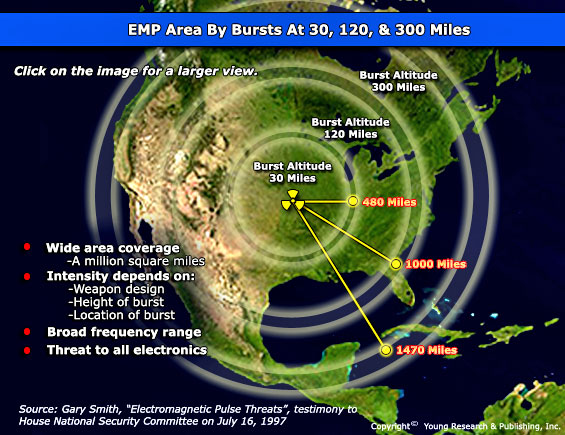
While a massive solar CME could shut down a significant fraction of the world’s electrical grid, electronic devices not connected to the grid would not be damaged. But the electromagnetic pulse emitted by a nuclear explosion is very different because the first of its three phases occurs within billionths of a second. This extremely fast EMP can travel hundreds of miles from an exploding nuke with a voltage potential of 50,000 or more volts per meter. That is far more than enough to permanently damage unshielded semiconductor electronic equipment. The second phase of EMP from a nuke can also damage electronics.
The third phase is much slower and longer. Its target is thousands of miles of high-voltage power lines that serve as EMP antennas. As Russia learned during nuclear experiments in the 1960s, the massive electrical currents absorbed by power lines can critically damage high-voltage transformers and even entire power plants.
A widely speculated scenario is that an enemy might launch an EMP nuke high over the central US in an attempt to shut down the nation’s electrical infrastructure together. Included would be communications networks and the computers and controllers that run everything from traffic lights and emergency vehicles to weather instruments and satellites.
While a nationwide EMP event will not directly injure or kill people, its side effects will. Consider what could happen during critical surgeries or for emergency room patients dependent on working electronic systems, and fast moving vehicles that suddenly lose power while cruising along busy highways.
While this doomsday scenario has been depicted in books and movies, widespread preparation for a nuclear EMP is sorely lacking. Even the US government acknowledges this in various unclassified reports. For example, there’s “Electromagnetic Pulse (EMP): Threat To Critical Infrastructure,” the title of a 2014 hearing before a subcommittee of the Committee on Homeland Security of the House of Representatives. Don’t read any of it before going to bed, for you’ll not be able to sleep. For example,
Another myth is that rogue states or terrorists need a sophisticated intercontinental ballistic missile to make an EMP attack. In fact, any missile, including short-range missiles that can deliver a nuclear warhead to an altitude of 30 kilometers or more, can make a catastrophic EMP attack on the United States, by launching off a ship or freighter. Indeed, Iran has practiced ship-launched EMP attacks using Scud missiles–which are in the possession of scores of nations and even terrorist groups. An EMP attack launched off a ship, since Scuds are common-place and a warhead detonated in outer space would leave no bomb debris for forensic analysis, could enable rogue states or terrorists to destroy U.S. critical infrastructures and kill millions of Americans anonymously.
– From the statement of Peter Pry, Executive Director of the Task Force on National and Homeland Security, May 8, 2014
During the opening of this hearing, Texas representative Michael McCaul began his talk by stating: “We talk a lot about a nuclear bomb in Manhattan, and we talk about a cybersecurity threat, the grid, power grid, in the Northeast, and all these things would actually probably pale in comparison to the devastation that an EMP attack could perpetrate on Americans.”
As I learned after sending an open records request to the city adjacent to my property, most local and national government agencies in the US are unprepared for an EMP attack. Even the US military is not well prepared, for all branches of the military employ off-the-shelf radio gear, computers, mobile phones and other equipment that is highly vulnerable to an EMP event.
Consider what might occur if a relatively small atomic bomb is detonated several hundred miles over Kansas. The EMP from the explosion would cover most of the US within a few billionths of a second. In regions where the EMP created an initial pulse of 30,000 to 50,000 volts per meter, a significant fraction of unprotected electronics would be instantly rendered inoperable. Modern cars and trucks are equipped with EMP-vulnerable microprocessors that control everything from engines to dashboard electronics and entertainment devices. While a vehicle’s metal shielding will provide some protection, it is possible that some vehicles will be rendered inoperable by an EMP. This would not be good for people driving along a packed expressway where only a few inoperable vehicles could cause a massive traffic pileup.
All this assumes a bomb that produces a peak of 50,000 volts/meter EMP, which has long been the standard assumption by the US military. Unfortunately, Russia and China have developed much more powerful super EMP bombs.
Remember that through all this an EMP bomb will not destroy buildings, spread radioactivity, or even make a sound.
What reasonable precautions should we take?
Many personal electronic devices might be rendered inoperable by an EMP, including laptops, radios, and mobile phones. If the initial EMP pulse does not damage the grid, the third phase certainly could. Power plant transformers can cost a million dollars or more and require more than a year to replace, assuming a suitable manufacturer can be found.
While some people can afford to install an expensive EMP-proof solar or propane fueled power supply for their residence, most of us cannot. So what should you try to secure and protect for use after an EMP?
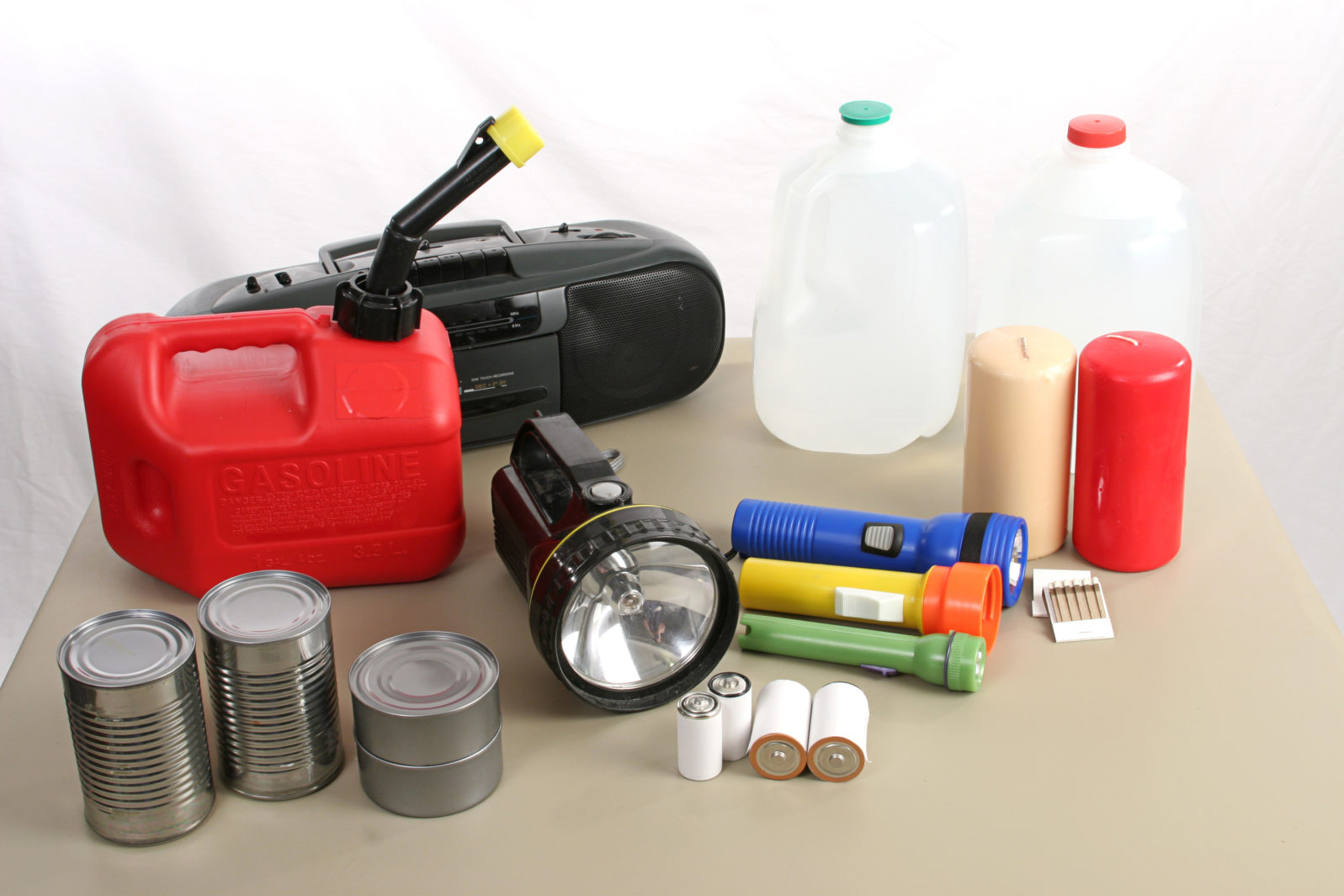
● A compact, battery-powered radio, preferably with shortwave reception, is number one on my list. A second priority is an LED flashlight for every family member. A third priority is a mobile phone loaded with plenty of music and photos of family and important documents. If the cell phone service in your area fails, you’ll be ready when service is restored.
● Other electronic devices you might need include medical devices, a pair of walkie-talkies, and a Geiger counter for use if you are in the fallout pattern downwind from a nuclear attack.
● Be sure to keep spare batteries for most of these devices. Recharging a cell phone is another matter. Unless you possess or have access to a propane or solar generator that can survive an EMP, your best solution is a miniature solar power device. The ones that come with a built-in battery can be charged outdoors and brought indoors to charge your phone. Their main drawback is that rechargeable batteries don’t like heat, and solar-powered battery packs can become very warm.
A small solar panel that charges a phone directly might be a better choice if you keep the phone shaded when it’s being charged. Whichever charging method you select, be sure you have an appropriate cable for connecting it to your phone.
● All these items (except extra batteries) should be stored in EMP-proof containers, sleeves, or bags available online…(continues)
Guerrilla Gunfighter Volume 3: Training Drills for Building Skills
The third volume of John Mosby‘s Guerrilla Gunfighter series became available last fall. You can find it on Lulu.com through the following link Guerrilla Gunfighter 3: Training Drills for Building Skills. As the subtitle states, this volume is mostly shooting drills. Each drill gives you an introduction to the drill, the conditions to start, a list of performance standards, and some coach’s notes. Mosby divides his drills into three sorts: first, micro-drills to perfect one or two particular aspects of a shooting skill; second, macro-drills that exercise multiple aspects of the shooting skill; and, last, evaluation drills which don’t particularly improve any of the aspects trained in the micro- and macro-drills, but rather are used to mark your improvement or decline in shooting skill. This volume also has a foreward written by Pastor Joe Fox of Viking Preparedness.
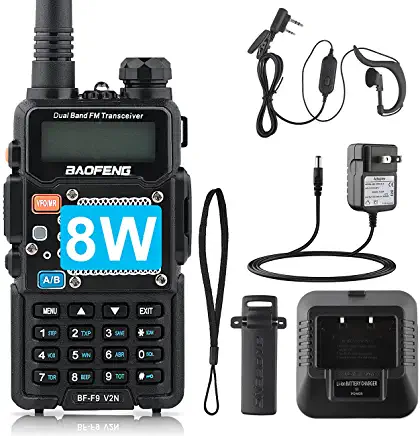
Joe Dolio at Tactical Wisdom has written an article titled Being Honest About WROL Comms(h/t American Partisan) which talks a little about amateur radio experts versus regular joes. Another way of putting that might be high tech hardware versus whatever gets the job done. And yet another way to describe the article is to tell ham radio people to stop intimidating new radio users with an overwhelming discussion of encryption, overspec’d radios, radio spectrum, etc., and just recommend they get a Baofeng.
Being an amateur radio licensee myself as well as having once been someone who knew nothing about radio, I know how easy it is to be overwhelmed. The LVA has a good number of ham radio operators, but mostly because we have taught the license classes ourselves and encouraged everyone who can to get at least a Technician license. That said we’ve only asked people to arm themselves with a Baofeng radio, unless they really want to take the step to higher end radios or long distance communication. With most people in your mutual assistance group using the same radio, you can easily maintain a configuration containing your local repeaters and call frequencies to load on each person’s handheld, further reducing the “know how” each person needs. The Baofengs are also inexpensive enough to buy in bulk, then you can load the configs and give/sell them to your people.
Being Honest About WROL Comms excerpt:
Radios
Let’s get a little housekeeping out of the way…my dear amateur radio friends, please refrain from the hysterical screeching about how wrong I am until the end; I think you’ll admit that what I say here has merit. Also, if you feel the need to discuss the FCC in the comment section, please understand that we are talking about true WROL communications, so understand that I don’t care about the FCC then. Sorry, but if we are TRULY talking about WROL comms, the FCC is not an issue. Agreed? Cool.
Some advice from the Ultimate Tactical Handbook:
Fools find no pleasure in understanding but delight in airing their own opinions.
Proverbs 18:2
The cold hard truth about WROL comms, which I take a lot of heat for, is that not everyone on your team needs to be a top-tier amateur radio guy and not every single person needs to have a $500-$600 handheld and a $1500 vehicle mount/base station radio. Sorry, amateur radio friends, but it’s true. Let me explain before you argue.
The VAST majority of your communication needs will honestly be INTRA-team communications. In other words, short range UHF-VHF comms among members of your team, relatively close to each other. The day-to-day communications will be everyone going about their business with their handheld radio in case they need to call for help or spread the alarm.
For example, the guys at your watch posts will have radios. A couple of people you send down to the local stream for water will need radios. Hunting parties…. radios. An OP 700 meters out, radios. None of these radios need to be a top of the line ultra-cool-guy frequency-hopping radio.
I know, encryption sounds cool. It makes you feel high speed. The truth is, I can achieve the same thing with my own brevity codes and code names for locations (I know, amateur guys – FCC says no codes – see above). Some of the push back I get on this is “but the government” or “them Russkies”; I assure you that you can’t buy any radio as a civilian that a nation-state can’t crack if they want to. The truth is, you aren’t that important and if a nation-state has localized you to the point that they are listening to your short-range comms, you’re done anyway. They’re already within a couple of miles of you and it’s only a matter of time.
I don’t say this to discourage, but to ENCOURAGE you all. Every time I get asked about radios for people just getting started and I recommend something like a Baofeng for new people, a bunch of very helpful, but highly discouraging Hams pile on, overwhelming that new person with a list of every $500 to $800 handset that is the BARE MINIMUM they need, and people get frustrated.
Here’s another tip:
Let us therefore make every effort to do what leads to peace and to mutual edification.
Romans 14:19
Now, having said that (listen up ham guys), you definitely need a licensed and skilled amateur radio operator as your communications chief. This person can make sure that your team has a set of radios that they can use to make long range contacts and gather information from outside sources, scan for others, and coordinate with other like-minded groups, but NOT EVERY PERSON needs this capability. Find a solid radio hobbyist and make them your comms chief. My good friend NC Scout holds a series of great courses on WROL comms (we have one coming up in Michigan), check out his classes at http://www.brushbeater.org.
Yes, Hams, I get it. You are very enthusiastic about your hobby and very helpful. Sometimes, though, in your zeal you intimidate and discourage new people.
So then, what does the average team member need? Some type of handheld VHF/UHF radio for local comms. I personally have had no issues with the Baofeng, and to be fair, those who do are trying to use it for more than what it’s intended for. For basic, point-to-point communications in a local radius, it’s sufficient. No, it won’t go 20 miles, but no handheld will by itself. Any handheld that can accept VHF/UHF programming with 4-8 watts is all you need for each member…(continues)
I hope you are doing well. The 2022 legislative session was a 60-day sprint, but a lot happened before we concluded on March 10. If you would like a recap on everything that occurred, including the good and bad legislation that was passed, this is the perfect opportunity.
I will be joining my seatmates, Rep. Skyler Rude and Sen. Perry Dozier, for a virtual town hall meeting starting at 6:30 p.m. on Tuesday, March 22.
This one-hour event held over Zoom will be a great opportunity to learn more about new legislation and how it will affect you going forward. It’s also the perfect time for you to share your ideas and concerns and ask us any questions you have.
We represent you in the legislative process and love hearing from our constituents. Your input is extremely valuable as we work to improve the lives of all those in Washington.
So, please join us on Tuesday evening, March 22, from 6:30 p.m. – 7:30 p.m. and share what’s on your mind.
You can register for the event by clicking here. We hope to hear from you.
Thank you for your continued support. I appreciate your trust in me and allowing me to serve you. It’s an honor.
In service,
Sincerely,
Mark Klicker
State Representative Mark Klicker 16th Legislative District representativemarkklicker.com 410 John L. O’Brien Building | P.O. Box 40600 | Olympia, WA 98504-0600 mark.klicker@leg.wa.gov 360-786-7836 | Toll-free: (800) 562-6000
If you’ve seen your local grocery store with empty shelves, you’re not alone: Food shortages are still haunting us in 2022. Find out below what food shortages are most common, why there’s a grocery shortage, and why shelves may be empty where you shop.
Food shortages 2022
“Shortages may depend on where you buy your groceries as there are regional differences in supply,” Josh Brazil, VP of Supply Insights at project44, a supply chain visibility solution, says. That means some of you may be lucky enough to not have any food shortages at all!
What’s missing from local grocery shelves may vary depending on where you live, as well as the climate where you live: Winter storms slow down supply chains in the short term (plus everyone rushing to buy bread and milk before a blizzard hits). Different regions may have shortages of different things, especially depending on whether you shop at big box stores or other shops, like local farmer’s markets.
There are a number of variables at play in the grocery shortages we’re seeing this year. “It is a combination of factors: supply chain issues and driver shortages, scarcity of packaging, labor shortages at manufacturing and production plants as the workforce has not returned as facilities restarted from COVID closures,” Keith Daniels of Carl Marks Advisors told us. And, yes, COVID-19 plays a huge role, especially the latest variants.
“Omicron infections impacting employees reporting to work at manufacturing and grocery stores, higher demand from consumers—particularly impacting the last few weeks as consumers revert to eating at home from restaurants out of fears of Omicron,” Daniels said. “The recent, abrupt winter weather is also slowing down distribution.”
Current Food Shortages
Meat shortages, especially beef and poultry, will plague us again in 2022.
Daniels says that meat and poultry are in short supply in many supermarkets. This is due to several factors, with manufacturing plant labor shortages causing most of the issues. Beef will likely see the most shortages because work in beef plants is more labor-intensive, according to Food Business News.
A combination of expensive crops to feed livestock and chickens, combined with high transportation costs and shortages of packaging materials (especially plastics) may cause dairy shortages at your local supermarket. In addition to material shortages, labor shortages may also impact grocery shelves in terms of transportation workers as well as grocery workers to stock the dairy case. As a result, you may have fewer options in terms of your usual purchases of milk, cheese (especially cream cheese), yogurt, and other dairy items.
There may be an egg shortage in 2022.
(iStock)
Similar to other food shortages we’ve encountered, COVID-related supply chain issues have interrupted the business side of commercial egg production. Increased expenses (feed, freight, labor costs), supply shortages, and government regulation have put a strain on the overall bottom line. As a result, producers may be reducing flock sizes, stopping shipping to some states, or selling eggs previously sold to consumers to manufacturers who use them as ingredients in other products, thus reducing the eggs available in supermarkets.
Sorry, vegans: Plant-based proteins may be in short supply this year.
If you thought not eating meat or dairy would spare you from shortages, sorry to burst your bubble! Rick Williams, practice lead—operations and supply chain of JPG Resources, says that plant-based proteins (think tofu, almond milk, soy-based cheeses, etc.) has seen shortages, explaining, “Plant-based saw a huge rise in demand as animal-meat processors were forced to shut down operations.”
We may see shortages of fruits, vegetables, and other goods made with produce…(continues)
What will be the long term term effects of the Ukraine-Russia war for which an American may need to be prepared? In the article excerpted below, Doug Bandow of the Cato Institute writes for 19fortyfive about how The Ukraine Crisis Could Spark A New Cold War (Or A Nuclear War). While much has been written over time on nuclear war survival and preparedness, what are the effects of a cold war? While many of have lived through at least part of the recent cold war between the US and the Soviet Union, would a new cold war even look the same?
Some of the main domestic effects of the last cold war were increased military spending (and attendant rise of the military-industrial complex) and high taxation. Toward the end of the cold war, during the Reagan presidency, the populace had become upset with high taxes and the administration switched from high taxation to high borrowing. High levels of government borrowing has continued to the present. High taxation leads to poor business conditions which leads to a weak economy as seen in the US in the late 1970s. High government borrowing leads to strange market and economic conditions, the result of which has yet to be realized, but in the worst case leads to financial/political crisis.
That said, would a new cold war necessarily be the same? Post World War 2 the US was in an enviable economic situation and was headed into its years of vast economic growth in world trade. The US was entering into its years of world hegemony, powerful and strong. Now, the US is a weakened nation and is coming out of two years of COVID-induced economic weakness with many citizens out of work or having closed businesses. There is little domestic support for a new war, cold or hot. A party that attempts to raise taxes or debt in order to finance a new cold war may not stay in power for long.
I am no expert on these matters, so my conclusions may be incorrect. I don’t know if the US is capable of sustaining a cold war like the continuous military buildup that occurred during the cold war with the Soviets. But it does appear that we entering a time of at least increased hostility and competition with Russia and China.
If China moves to establish control over Taiwan (which may be considered an invasion), will the US defend Taiwan or will we stand by as we have with Ukraine? Some people believe that the US is obligated to defend Taiwan, but there is actually no agreement to do so, and the US has followed a policy of strategic ambiguity in that regard. Failure of the US to defend either Ukraine or Taiwan may lead to further reduced US influence worldwide and reduced trust in US assurances. Reduced trust and influence may result in more rapid de-dollarization, all of which would have their own effects on the US economy for which to prepare.
Its aggression is criminal and unprovoked. The US and its allies contributed to the conflict. But the decision for war—which already is resulting in significant death and destruction—was Russian President Vladimir Putin’s.
If there is one lesson of Moscow’s brutal and unjustified invasion, it is that aggressors should choose their victims carefully. As the Balkan Serbs learned decades ago, it is best not to attack people in Europe, which guarantees heavy media attention in Western capitals. This may be the first conflict in which the public is driving sanctions and boycotts, in this case against all things Russian, including individuals who had nothing to do with their government’s decision for war.
In contrast, Washington has been bombing and invading nations in the Middle East, North Africa, and Central Asia for years. Despite wrecking entire states and ravaging their peoples, US policymakers have never been held accountable. The total number of victims in these wars—killed, wounded, displaced—the number in the millions. Washington typically tires of fighting and either downgrades its role or simply leaves, as in Afghanistan, without even apologizing. But no American has ever faced economic sanctions or been charged with war crimes.
Today Ukrainians and to a lesser degree, Russians are suffering. The long-term consequences for Americans and Europeans will be serious as well. No one knows how the fighting will end, but Washington should begin planning for the aftermath…
Washington’s chief responsibility today is not to save Ukraine but to prevent the US or allied involvement and possible war, especially nuclear war, with Russia. Washington and Moscow avoided such a cataclysm during the Cold War when the stakes were global and civilizational. Moscow’s brutal attack on Ukraine is a moral outrage but does not pose the same level of threat as the Soviet Union. There is no excuse for risking their societies and the planet’s survival today…
Finally, Washington should prepare for the endgame. The world is headed toward another Cold War, with a new Iron Curtain likely to rise wherever the reach of Russian troops ends.
Facing domestic unhappiness over the human cost of the war, deceptive cover-up, and impact of Western sanctions, the Putin regime likely will become even more repressive. Observers indicate that the situation already approaches martial law. Moreover, diplomatic retreats, economic penalties, and cultural bans have dramatically deepened Russia’s isolation. Some countries would make the West’s economic war essentially permanent. Opined Poland’s ambassador to the US, Marek Magierowski: “We have to be ready and determined to uphold the sanctions. Perhaps even for a decade or for 15 years or for 20 years, in order to see the real effects.”
Although Russia is a much-reduced version of the Soviet Union, significant dangers would remain. It likely would respond to a new Cold War by reinforcing its military. Most notably, what has been largely a political struggle would turn into an enduring military confrontation.
If so, Russia might become something akin to a giant North Korea, only better developed and with many more nuclear weapons. With less at stake in the international system and greater resentment toward adversaries turned enemies, Moscow would be more dangerous than today. Frontline European states would be even more insistent on American military protection. Violent competition would intensify in battleground areas elsewhere, such as Syria and Africa…(continues)
Tim O’Brien over at The American Mind writes The Putin Variant. The US, then led by President Obama and VP Biden, and its allies goaded Russia into invading Ukraine back in 2014, when Russia took over the Crimea. Back then not many people took notice of the invasion. When President Biden and the US allies again goaded Russia into invading the Ukraine in 2022, why is it so different? Invading another sovereign country is a bad thing, of course. Putin bad. But the outcome (an invasion) was not only predictable, but already happened once just seven years ago. O’Brien writes that the outrage this time is just smoke and mirrors to rally people behind the Democrat party for the upcoming elections. Excerpt:
The regime is repurposing its Covid-19 propaganda playbook.
The war in Ukraine is deadly real and could have far-reaching impact on the globe in the immediate future and for years to come. The global balance of power is unsteady as the West isolates Russia through sanctions, which seems to be driving China and Russia, the two non-American superpowers, closer together.
The world has seen this before. In 2014, Putin invaded Ukraine and came away with control over Crimea before things settled. President Obama did nothing to intervene militarily, just as President Biden is doing now.
Most Americans not only don’t remember the 2014 invasion, but at the time they were not much aware of it. There were no “Stand with Ukraine” flags, lapel pins, or stickers adorning American vehicles across the country. Social media users weren’t plastering virtue-signaling blue and yellow graphics on their profiles back then.
But the reaction to Russia’s invasion of Ukraine feels strangely familiar, as though we just went through something very similar. It bears a strong resemblance to the way in which the regime engineered mass hysteria around COVID-19 and the Delta and Omicron variants.
Timing is Everything
In fact, as COVID-19 wanes in the population, and masking and testing requirements fade away, Putin mania—strictly from a messaging and propaganda perspective—seems to be well-timed. Polls reveal the Democrats are about to take a beating in the upcoming midterm elections over mismanagement of everything, but especially COVID-19. It seems they may have found a non-COVID variant that allows them to deploy the same old tricks. Call it the Putin Variant.
After all, if Americans have demonstrated anything over the past two years it is they will respond to fear-mongering on a mass scale.
Vladimir Putin decided to invade Ukraine months after he’d seen the Biden Administration’s weakness with its disastrous pullout from Afghanistan, as well as soaring inflation.
The regime’s reaction to its failed domestic and foreign policies and declining favorability numbers is to roll out the Putin Variant. If you can’t beat a foreign adversary back through diplomacy and you don’t have the stomach to confront it through the potential use of military might, you can always fall back on scaring your own populace into keeping you in power.
The Putin Variant
Variant propaganda starts with announcing the threat and making sure every American knows that it will affect them. It continues with using the crisis to at once blame the circumstances themselves, not the cause of those circumstances, for domestic hardships. Americans will need to learn to suck it up without complaint while enduring rising gas and consumer prices because global democracy demands it. To complain or question the regime’s policies will be an act of selfishness and even treason. Questioning the underlying logic of our Ukraine policy will soon become as cancellable and hateful as it was to ask why we all have to wear masks.
Knowing that it has no plans to intervene militarily, and it is highly likely that Russia will take control of Ukraine, the regime makes a lot of noise on how all of its sanctions will work gradually and ultimately defeat Russia. This rhetorical strategy was last deployed through the emphasis on 100 percent masking and vaccination to achieve complete eradication and “zero COVID” status. The regime knew their measures would not deliver on their promises then, just as they know sanctions won’t eradicate Russian troops from Ukraine any time soon.
What they really care about is the midterms. They want to use the Putin Variant to win in November. They will use the threat of risks to global and national security to rally American voters behind anti-Russia Democrat candidates—the same ones who brought us here. They will try this even as they know they have no intentions of going to war. They just want voters to think they have the will.
As with the COVID response, they will attack anyone who questions their pro-war messaging as spreaders of “misinformation” who must be censored, banned, cancelled, and de-platformed.
The Putin Variant fits nicely with this strategy. Putin is, after all, a real person doing actually bad things. What the administration does not want Americans to know is what its own principals have done over the years to create an environment to embolden all that’s happening in Ukraine right now…(continues)
Opens : March 11th, 1800 PST, or March 12th, 0200 UTC Presentations Begin: Saturday, March 12th, 0800 PST, or 1600 UTC Sunday, March 13th, 0800 PDT, or 1500 UTC The Expo platform will remain open until April 10th, 2022 for on demand presentations. Tickets are $10.00 until Expo opens, then $13.50 until April 10th
Amateur radio is like a big circus. It has its main tent with three rings in the center. In those rings could be Contesting, DXing, and Rag Chewing. However, amateur radio now has a “midway of a thousand smaller tents” according to Eric Guth, 4Z1UG, founder of the QSO Today Virtual Ham Expo, and host of the QSO Today Podcast, a interview program featuring the most interesting amateur radio operators. It is exactly this midway that the “Expo” was founded to explore.
The Covid-19 Pandemic closed ham radio conventions, hamfests, and monthly meetings all across the World in 2020. It was because of these closures that Eric, 4Z1UG, got the idea to create an on-line, and virtual convention that has all of the elements of a real ham radio convention, similar to the most notable live conventions.
The First QSO Today Virtual Ham Expo was in August 2020 where over 15,000 amateurs attended on the Expo weekend, attending on their computers over the Internet instead of in-person. Over 80 presentations were made, with live Q&A on Zoom webinar, and attendees could come back over a 30 day on-demand period to view the recorded presentations that they missed.
We discovered something unique in August from surveys that we made following the expo. Sixty percent of the attendees, almost 9000 hams do not go to live expos, preferring to stay at home. The Covid-19 Pandemic has made this all the more important.
The Expo has also become the place to discover more niches in amateur radio through the presentations given at each one. In March 2021, while there was some difficulty with the platforms, over 6000 hams came and viewed almost 100,000 presentations from the over 80 that were offered in March. Our Expo in August 2021 had over 90 presentations in 8 tracks of amazing amateur radio content.
The QSO Today Virtual Ham Expo returns on March 12th, 2022 and has become a twice yearly event. We hope to see you there!
What’s going to happen with the Ukraine-Russia War and how will it affect us here in the USA? Some things are hard to predict, while others can already be seen. Provocations on all sides seem to be increasing. BCA Research, an independent global investment research firm, recently wrote in a strategy report “we would assign an uncomfortably high 10% chance of a civilization-ending global nuclear war in the next 12 months.” So, many unlikely scenarios, recently thought unthinkable, are now being thunk.
…As has been pointed out here at The Organic Prepper before, the United States is going to experience a fertilizer shortage this year, and that is going to be just one factor impacting our food supply. I’ve discussed the other factors HERE.
Yes, I do think that stocking up on seed for your garden is a good prep idea, but I also think that you really need to consider canned goods at the moment. They’re ready to eat, they’re highly portable, and they store well. They make good barter currency, to boot. Canned goods don’t have to worry about radioactive fallout, as does a growing corn crop, either.
I’m a fan of freeze-dried meals, but I sincerely think that cyberattacks against our power grid are highly likely in the near future. You need warm water to make those. With a power outage likely (Cyber Polygon, anyone?), boiling water is just another step between you and eating a meal. If you are forced to shelter in place, inside, without power, this makes for a bit of difficulty with meal preparation.
MREs are another fine food item to consider at the moment. I have no knowledge as to whether or not the heat packs for MREs give off dangerous gasses as they heat up the food. (Let me know in the comments!)
This food supply not only allows you to shelter in place but helps you to avoid probable food riots in the future. Read history. Literally, every single time there is a shortage of food, violence increases.
(For more information on prepping your food, check out our free QUICKSTART Guide on building your 3-layer food storage system.)
Should you prep water?
Life without water sucks (haha, but not for long). You need it to stay alive, for cleaning, for cooking, and more. If you are forced to shelter in place without any access to power, are you going to have water to drink? A gallon jug of water currently sells for around a dollar. Why would you not pick up a few and stow them away?
I would look at solar options for keeping your well running if that is your primary water source as well. If you rely on city water, at the very least, have an EPIC Nano filter. I would highly recommend looking into Berkey filters right now as well. Neither of these is a radiation-reducing option, but instead are used to keep you in clean water should your city no longer have the electricity needed to create pure water.
If you are forced to evacuate, let’s say, from fallout being brought via wind, do you have water filtration that is portable?
Prep your communications.
China is one of the largest sources of electronics to the United States. We’re already seeing problems getting many electronic components because of a shortage of chips.
This is likely to continue in the near future, and should China invade Taiwan, you are going to see worldwide sanctions be leveled against China. The US will be no exception. When this happens, those supply lines are going to dry up overnight.
Your ability to get radios will then vaporize…
Having proper information can be the difference between staying alive and dying. Right now, you need to pick up a copy of Cresson Kearney’s Nuclear War Survival Skills. You do not want to be caught in the same situation as many Hawaiians did years ago when they found themselves at a loss for what to do when they received alerts via text that an ICBM was on the way.
PDF versions are available online for free, but I highly recommend picking up a print copy as well. Then, read it. This is an easy prep to accomplish.
I recommend looking into a shortwave radio as well. Should the grid go down within the US, you are going to want to be able to pick up information from the outside world so that you have some notion of what is going on. Anne Frank wrote about the importance of their radio and the hope it brought in her journals…
Yves discusses the military-industrial complex, finance/insurance/real estate, and the oil, gas and minining complex and how they all benefit from the isolation of Russia. The article discusses some potential fallout or downsides of the situation as well. I would go so far as to say that everything presented is correct, but there is a lot of good information to keep in mind when thinking about the situation.
Excerpt:
…My old boss Herman Kahn, with whom I worked at the Hudson Institute in the 1970s, had a set speech that he would give at public meetings. He said that back in high school in Los Angeles, his teachers would say what most liberals were saying in the 1940s and 50s: “Wars never solved anything.” It was as if they never changed anything – and therefore shouldn’t be fought.
Herman disagreed, and made lists of all sorts of things that wars had solved, in world history or at least changed. He was right, and of course that is the aim of both sides in today’s New Cold War confrontation in Ukraine.
The question to ask is what today’s New Cold War is trying to change or “solve.” To answer this question, it helps to ask who initiates the war. There always are two sides – the attacker and the attacked. The attacker intends certain consequences, and the attacked looks for unintended consequences. In this case, both sides have their dueling sets of intended consequences and special interests.
The active military force since 1991 has been the United States. Rejecting mutual disarmament of the Warsaw Pact countries and NATO, there was no “peace dividend.” Instead, the U.S. policy by the Clinton administration to wage a new military expansion via NATO has paid a 30-year dividend in the form of shifting the foreign policy of Western Europe and other American allies out of their domestic political sphere into their own “national security” blob (the word for special rentier interests that must not be named). NATO has become Europe’s foreign-policy-making body, even to the point of dominating domestic economic interests.
The recent prodding of Russia by expanding Ukrainian anti-Russian ethnic violence by Ukraine’s neo-Nazi post-2014 Maiden regime aims at forcing a showdown. It comes in response to the fear by U.S. interests that they are losing their economic and political hold on their NATO allies and other Dollar Area satellites as these countries have seen their major opportunities for gain to lie in increasing trade and investment with China and Russia.
To understand just what U.S. aims are threatened, it is necessary to understand U.S. politics and “the blob,” that is, the government central planning that cannot be explained by looking at ostensibly democratic politics. This is not the politics of U.S. senators and representatives represent their congressional voting districts or states.
America’s Three Oligarchies in Control of U.S. Foreign Policy
It is more realistic to view U.S. economic and foreign policy in terms of the military-industrial complex, the oil and gas (and mining) complex, and the banking and real estate complex than in terms of political policy of Republicans and Democrats. The key senators and congressional representatives do not represent their states and districts as much as the industrial interests of their major political campaign contributors. A Venn diagram would show that in today’s post-Citizens United world, U.S. politicians represent their campaign contributors, not voters. And these contributors fall basically into three main blocs.
Three main oligarchic groups that have bought control of the Senate and Congress to put their own policy makers in the State Department and Defense Department. First is the Military-Industrial Complex (MIC) – companies such as Raytheon, Boeing and other arms manufacturers, have broadly diversified their factories and employment in nearly every state, and especially in the Congressional districts where key Congressional committee heads are elected. Their economic base is monopoly rent, obtained above all from its arms sales to NATO, to Near Eastern oil exporters and to other countries with a balance-of-payments surplus. Stocks for these companies soared immediately upon news of the Russian attack, leading a two-day stock-market surge as investors recognized that war in a world of cost-plus “Pentagon capitalism” (as Seymour Melman described it) provided a national security umbrella. Senators and Congressional representatives from California and Washington traditionally have represented the MIC, along with the Solid pro-military South. The past week’s military escalation promises soaring arms sales to NATO and other U.S. allies. Germany quickly agreed to raise is arms spending to 2% of GDP.
The second major oligarchic bloc is the rent-extracting oil and gas sector, joined by mining (OGAM) riding America’s special tax favoritism granted to companies emptying natural resources out of the ground and putting them into the atmosphere. Like banking and real estate, the aim of this OGAM sector is to maximize the price of its energy and raw materials so as to maximize its natural-resource rent. Monopolizing the Dollar Area’s oil market and isolating it from Russian oil and gas has been a major U.S. priority for over a year now, as the Nord Stream 2 pipeline threatened to link the Western European and Russian economies together.
If oil, gas and mining operations are not situated in every voting district, at least their investors are. Senators from Texas and other Western oil-producing and mining states are the leading lobbyists, and the State Department has a heavy oil-sector influence providing a national-security umbrella for its special tax breaks. The ancillary political aim is to ignore and reject environmental drives to replace oil, gas and coal with alternative sources of energy. The Biden administration accordingly has backed the expansion of offshore drilling, supported the Canadian pipeline to the world’s dirtiest petroleum source in the Athabasca tar sands, and celebrated the revival of U.S. fracking.
The foreign-policy extension is to prevent foreign countries not leaving control of their oil, gas and mining to U.S. OGAM companies from competing in world markets with U.S. suppliers. Isolating Russia (and Iran) from western markets will reduce the supply of oil and gas, pushing prices and corporate profits up accordingly.
The third major oligarchic group is the symbiotic Finance, Insurance and Real Estate (FIRE) sector is the counterpart to Europe ‘s old post-feudal landed aristocracy living by land rents. With most housing in today’s world having become owner-occupied (with sharply rising rates of absentee ownership rising since 2008 and the wave of Obama evictions, to be sure), land rent is paid largely to the banking sector. About 80 percent of U.S. and British bank loans are to the real estate sector, inflating land prices to create capital gains – which are effectively tax-exempt for absentee owners.
This Wall Street-centered banking and real estate bloc is even more broadly based on a district-by-district basis than MIC. Its New York senator from Wall Street, Chuck Schumer, heads the Senate, long supported by Delaware’s former Senator from the credit-card industry Joe Biden, and Connecticut’s senators from the insurance sector centered in that state. Domestically, the aim of this sector is to maximize land rent and the “capital’ gains resulting from rising land rent. Internationally, the FIRE sector’s aim is to privatize foreign economies, above all to secure the privilege of credit creation in U.S. hands, so as to turn government infrastructure and public utilities into rent-seeking monopolies to providing basic services at maximum prices (health care, education, transportation, communications and information technology) instead of at subsidized prices to voters.
Wall Street always has been closely aligned with the oil and gas industry, back to the days of Standard Oil. These are the three rentier sectors that dominate today’s post-industrial finance capitalism. Their mutual fortunes have soared as MIC and OGAM stocks have increased. And moves to exclude Russia from the Western financial system (and partially now from SWIFT), coupled with the adverse effects of isolating European economies from Russian energy, promise to spur an inflow into dollarized financial securities
It is more helpful to view U.S. economic and foreign policy in terms of the military-industrial complex, the oil and gas (and mining) complex, and the banking and real estate complex than in terms of political policy of Republicans and Democrats. The key senators and congressional representatives do not represent their states and districts as much as the industrial interests of their major political campaign contributors. That is why neither manufacturing nor agriculture play the dominant role in U.S. foreign policy. The convergence of policy aims of America’s three rentiergroups overwhelms that of labor and even of industrial capital. That convergence is the defining characteristic of today’s post-industrial finance capitalism. It is basically a reversion to economic rent-seeking, which is independent of the politics of labor and capital.
The dynamic that needs to be traced today is why this oligarchic blob has found its interest in prodding Russia into what Putin evidently viewed as a do-or-die stance to resist the increasingly violent attacks on Ukraine’s eastern Russian-speaking provinces of Luhansk and Donetsk…(article continues)










 Lower Valley Assembly