Raconteur Report: COVID – Lies, Damned Lies, and Statistics

Healthcare professional Aesop at Raconteur Report talks about the current COVID-19 resurgence in Lies, Damned Lies, and Statistics.

Much has been made by bloggers whom and on sites which I respect, about certain prognostications by Mssr. Briggs, statistician, regarding Kung Flu.
 
I’m not quibbling about his numbers, just what he makes of them, evidently from an utter lack of knowledge about that of which he speaks.
 
Unfortunately, Briggs’ combines his statistical skills with what he doesn’t know about science in general, and epidemiology in particular.
 
1) There are, indeed, “good” flu years, and “bad’ flu years. But it’s not a 1- or 2- variable problem set.
    a) there are always older people, some of whom are more frail, and many of whom are going to die. But surviving flu one year doesn’t, ergo, make you another year older and thus more likely to die the next year. That’s kindergarten math thinking.
 
    b) How many other conditions does any given grandpa or grandma X have?
 
    c) What is their general health condition?
 
    d) Did they get a flu shot that year, or not?
        d1) Did the flu vaccine witch doctors guess the actual flu strain mutations well, and formulate a great shot (a year with a 95% efficacy) or poorly (a year with 15% efficacy). {e.g., in 2018, IIRC, there were 635 individual strains of flu rampant in the US, and that year’s shot had about a 15% effectiveness. This is nigh on to worthless, relatively speaking.}
        d2) Was there even a flu shot at all?
(In, to my best recollection, 2010, there was no flu vaccine available at all. Whichever year it was, it was a record low flu year. Because CDC and FedGov bombarded the airwaves with PSAs telling people to “Wash your goddamned nasty hands! Stay home if you’re sick!” in so many words, and mirabile dictu, old people and parents of young children actually did it. Flu visits to the ER that year were negligible.)
 
That exact level of concern, plus masks, and distancing, is why, by all accounts, this year’s flu season cases will probably be contained in a thimble.
 
Those are just some of the 100-500 variables behind who dies, and why, from flu, Kung Flu, or any other thing, in any given year. Not just whether it was a “good” or “bad” flu year, last year.
 
Yes, it was world-record @$$holian to put known COVID+ cases into convo homes, which are the lowest form of medical care other than anything found in the Turd World, and you get a perfect storm of the most vulnerable patients, and the most execrable level of care not delivered by actual gypsies and witch doctors (and in most convo homes, there’s little difference between them. The fact that they reek of sh*t and piss the moment you walk in is what poker players call a “tell”.) Those deaths were, indeed,  low-hanging fruit.
 
That such deaths may have accounted for nearly half the initial wave is bad.
It does nothing for the next wave, unless you stop doing that. I have yet to hear that it’s no longer policy. And even if it was, that overlooks the obvious problem: Kung Flu presents asymptomatically in up to 50% of cases (which is why checking for fever temperatures at building entries is like looking for elephants in trees: asinine and pointless.)
 
If they really wanted to keep infected people out of convo homes (which are still chock full of vulnerable patients, in 50 states and 7 territories), they’d have to be rapid-testing every patient they admit, before entry, and rapid-testing every staff member, daily, and every single visitor, vendor, etc., and holding them in quarantine outside until they test negative (an hour or two later). We don’t even do that in first-class hospitals.
 
Doing so would cost a large fortune, and bankrupt everyone, everywhere.
 
So the exact same thing is going to happen, over and over and over, because you won’t pay for doing it right. No one will.
 
Own that.
 
It’s the exact asymptomatic Gilligans – the young and “healthy”,  who won’t get really sick nor die from this – who have been and will continue spreading this virus around, until it hits the susceptible victims, and makes a guaranteed percentage of them very sick, and some of them very dead.
 
Some of them, yes, will be the aged, infirm, and those with levels of disease that were killing people at age 66 in 1933. (That’s why FDR had Social Security kick in at age 65; FedGov expected you to be dead within a year. And then medicine, the same bunch that know-nothing idiots bitch about for the cost, went and started increasing everyone’s life expectancies to the 80s. See if you can guess why SS is broke.)
 
And yes, we know a little bit better what to do (and not to do) to care for those hardest hit by Kung Flu. Which will make about a 1-25% difference in fatalities in subsequent waves. Because those in the roughly 3% likely to die, are still going to die. So maybe now the death rate goes down from about 3% to 2.7%. (The death rate for flu, BTW, is about 0.1%, since ever. Don’t you feel better now, knowing this is only 27 times worse than flu, instead of 30 times?)
 
The biggest problem with those prognosticating from ignorance in general is overlooking the fact that most of the population, in this or any country, has yet to be exposed to the virus.
 
E.g. Califrutopia, last I looked, has tested about 10% of our 40M people.
The rate of those infected at some point, is running damned near 10%.
With millions tested now, rather than dozens, those numbers are statistically valid (unlike, say, Biden’s pre-election poll numbers) and thus (unlike Biden’s vote tallies) aren’t going to widely fluctuate. Right up until we throw open the floodgates, eliminate any precautions, and start spreading Kung Flu virus around like it was welfare money in a Blue State. (Or blank mail-in vote bundles at any Democrat HQ building.)
 
Then, the more people you infect, the more people will die.
 
Yes, only at that +/- 3% rate.
We’re pushing 250K dead now, with the infection rate of 10% in certain places (mostly highly populated areas), and probably less than 0.1% in most of the country denigrated as Flyoverland.
 
So, roll the dice, and tell me what happens when the infection rate goes up everywhere.
Especially if the infection rate goes up by leaps and bounds, rapidly.
And for a special bonus, in the exact places where true modern medical care is 1-4 hours away.
On a good day.
 
Then we get to the fun questions:
 
Does infection confer immunity?
I have no godd…d idea. Neither does WHO. Neither does CDC.
Neither does Pfizer, or any-effing-body else.
I have one firsthand example of repeat infection, hospitalized in front of my face.
I have dozens of cases reported anecdotally.
 
I have seen zero literature explaining this.
I have seen or heard of zero literature documenting exactly how widespread this is.
 
No one knows how much, or how widely, the original strain is mutating.
 
Thus any claims of vaccine efficacy are so much bulls…t.
Any claims of herd immunity are so much whistling past the graveyard.
Any extrapolation of how bad this is going to be, with those exact unknowns being so glaringly obvious, are nothing but Bandini Mountain, with a sewage frosting from downstream of the septic plant.
 
Do I want fiat lockdowns again?
 
HELL NO!
 
Make a case, trot out evidence, not SWAG bulls…t, and weigh the benefits and costs.
Medical, scientific, economic, everydamnedthing. Talk it over, and think it through, FIRST.
Then have the legislatures pass laws, or not, and have governors sign or veto them.
 
Y’know, like republican government has worked going back to, oh Magna Carta, or even Rome and Greece. If only for the novelty.
 
I went over a month in a SoCal ER with no likely COVID patients. I tell you, it was heaven. A crappy night with no COVID patients was like old times.
 
That ended last week. Just about 3 weeks behind the spike in cases, we just had, on my shifts alone, 3 slam-dunk sure-as-hell-got-it COVID patients. I had 2 of them personally, and one of them was the re-infection case I wrote about previously. When I left yesterday, we had a guy who literally desatted from 80% to 60% oxygen level in the two minutes it took to get him from the triage tent to an iso room inside. He was in his 50s.
 
The ICU nurse who died from my hospital got it from a patient who was uninfected, then exposed by an asymptomatic patient in a regular ward, brought it to the ICU, and infected 10 nurses there before they knew it was a COVID case. That nurse was in her early 50s, not her late 80s.
 
Times, in 25 years of my career, that happens with flu: never.
Not one godd…d time.
Not even a consideration.
 
So I’m getting pretty damned tired of ignorant @$$holes burping out pure undiluted horses…t quotes like the following:
 
Young (under 65) healthy people are not being killed by the doom—or much of anything else.
Yes, they are. On a regular basis.
Pointing out that they do so at a lesser rate does nothing to remove the lie from the quote above.
And noting that old people die more often is cold comfort to someone whose 30- or 40-year old spouse died because to pointy-headed number crucncher, they were just a rounding error, or “within the margin or error”. If you don’t have to look the survivors in the eye while their loved one’s bodies are still warm but heading for room temperature, kindly STFU about things when you don’t know what the hell you’re talking about.
 
Suppose I told you, with absolute statistical confidence, that if you ran red lights, you only had a 3% chance of getting bashed to hell, killing someone, or going to prison. 
Would you do it?
Suppose I told you that your meatloaf was 97% steak, and only 3% bullsh*t.
Would you eat it?
 
If you answered “yes”, how much shit could I put in your meatloaf before you’d turn it down??
 
You can tell me that driving is hazardous, because of drunks and idiots. I’ll still drive.
Mainly because I don’t drive 100% of the day.
But unlike bar fights, liquor store robberies, or drunk driving deaths, everybody alive on the planet breathes, non-stop, 24/7/365, without any choice in the matter.
 
So unless you can live isolated, or hold your breath for years on end, or live in a spacesuit 24/7, that makes a respiratory ailment in widespread circulation one hell of a lot bigger concern than the other causes of death which, exactly as the CDC and Briggs note, knock off about 50,000 people every year in this country.
 
Which makes statistical prognostications from someone like Briggs sound to me exactly like a fresh hot steaming pile of cows…t smells.
 
I can listen to statistical bulls…t from people who don’t know what they don’t know, or I can believe my lying eyes, backed up by medical evidence, and common sense.
 
You guess where I’ma come down on that one.
 

In one of the comments to the above post, Aesop talks a little about the issue of co-morbidities:

BTW, people don’t die because of the co-morbidities, those just make them more likely.

Just like few, if any, people die from drunk driving because they were drunk. Unless they had a BAL of 900, and fell asleep, and stopped breathing. They die because of that pole they hit at 90MPH while drunk, and because the one leads to the other.

The people who got wrapped around the axle of deaths with COVID (or co-morbidities, like diabetes, hypertension, obesity, etc.) vs. because of. People don’t die from the co-morbidities, they died because those things sapped their body’s ability to deal with things when the COVID pneumonia in both lungs, everywhere, simultaneously, taxed their ability to breathe and survive beyond what it could handle. Generally because they were too frail, fat, old, weak, and sedentary, which is how you get to be fat, diabetic, hypertensive, etc.
But when you walk around for decades fat, sedentary, diabetic, and hypertensive, then get COVID, and die in 3 weeks, it wasn’t those co-morbidities which killed you, it was the Kung Flu.

Just like if you had all those co-morbidities, and got eaten by a lion while on safari. The lion killed you, not the co-morbidities. The co-morbidities just made you easier pickings.

What they died from, in all cases was cardio-respiratory failure caused by COVID pneumonia. Everything else just piled on to decrease their survival prospects, but noting that sick people die more frequently than healthy people isn’t exactly a blazing piece of medical insight.

People who focus on the co-morbidities like it’s an “A HA!” moment are as ignorant as the idiot-savant people that actually think guns just randomly jump up and kill people, all by themselves, and they don’t seem to get that focusing on them just underlines their ignorance on the topic.

There may be some genetic component as well, but absent evidentiary research, that’s just a Hail Mary guess by some people uncomfortable with admitting that they have NFI what causes the Kung Flu to kill 3 people, hospitalize another 7, get 30 sick, and leave 60 completely untouched. I’d rather wait for the answers rather than grunt and squeeze them out of my hindquarters.

And in the meantime, wear a mask and gloves, and wash my hands, which has worked flawlessly for 10 months, to date, in close proximity to rampant cases, to leave me uninfected.

Doom and Bloom: Hypothermia in Austere Settings

The Altons at Doom and Bloom Medical have an article on Hypothermia in Austere Settings.

As we head into the colder part of the year, I thought I’d talk about the dangers of exposure to cold. On or off the grid, if you don’t take environmental conditions into account, you have made Mother Nature your enemy, and she is a formidable one, indeed.

Hypothermia is a condition in which body core temperature drops below the temperature necessary for normal body function and metabolism. The normal body core temperature is defined as between 97.5-99.5 degrees Fahrenheit (36.0-37.5 degrees Celsius). Symptoms related to cold exposure occur once the core temperature dips below 95 degrees (35 degrees Celsius).

HOW THE BODY LOSES HEAT

Besides simply breathing out warm air, the body loses heat in various ways:

Image by JEMS

Evaporation: The body perspires (sweats), which releases heat from the core. Heat loss through evaporation increases in dry, windy weather conditions.

Radiation: While the body makes efforts to maintain normal body temperatures, the body loses heat to the environment when the ambient (surrounding) temperature is lower than about 68 degrees F. Much lower temperatures cause heat loss more quickly.

Conduction: The body loses heat when its surface is in direct contact with cold temperatures, as in the case of someone falling from a boat into frigid water. Water, being denser than air, removes heat from the body much faster.

Convection: Heat loss where, for instance, a cooler object is in motion against the body core. The air next to the skin is heated and then removed, which requires the body to use energy to re-heat. Wind Chill is one example of air convection: If the ambient temperature is 32 degrees F but the wind chill factor is at 5 degrees F, you lose heat from your body as if it were actually 5 degrees F.

A surprising amount of heat is lost from the head area, due to its large surface area and tendency to be uncovered. Direct contact with anything cold, especially over a large area of your body, will cause rapid cooling of your body core temperature. When the Titanic sank in 1912, hundreds of people fell into near-freezing water. Within 15 minutes, they were probably beyond medical help.

GENERAL SYMPTOMS OF HYPOTHERMIA

The body, when it is exposed to cold, kicks into action to produce heat once the core cools down below 95 degrees F. The main mechanism to produce heat is shivering. Muscles shiver to produce heat, and this will be the first symptom you’re likely to see. As hypothermia worsens, more symptoms will become apparent if the patient is not warmed.

The diagnosis of hypothermia may be difficult to make with a standard glass thermometer because it doesn’t register below 94 degrees Fahrenheit. Unless you have a thermometer that can measure low ranges, it may be difficult to know for certain that you’re dealing with this problem.  You should assume that anyone with altered mental status encountered in cold weather is hypothermic until proven otherwise.

Aside from shivering, the most noticeable symptoms of hypothermia will be related to mental status. The victim may appear confused and uncoordinated. As the condition worsens, speech may become slurred. The patient will appear apathetic, lethargic, and uninterested in helping themselves; they may fall asleep. This occurs due to the effect of cooling temperatures on the brain; the colder the body core gets, the slower the brain works. Brain function is supposed to cease at a body temperature of about 68 degrees Fahrenheit, although there have been exceptional cases where people (usually children) survived even lower temperatures.

To learn about hypothermia in dogs, click here.

LEVELS OF HYPOTHERMIA

Some sources differentiate different levels of hypothermia body temperature:

MILD: (93-97 degrees F; 33.9-36.1 degrees C)

A person with mild hypothermia will usually still be awake and alert, but shivering. Hands and feet will be cold, and they may complain of pain or numbness in the extremities. Loss of dexterity is often noted.

MODERATE: (90-93 degrees F; 32.2-33.9 degrees C)

In moderate hypothermia, you’ll see all of the above, but mental status begins to alter and efforts to produce heat by shivering may decrease or even stop.

SEVERE HYPOTHERMIA: (82-90 degrees F; 27.8-32.2 degrees C)

The severely hypothermic person will stop shivering and mental status changes become clearly apparent. Expect to see confusion, lethargy, and memory loss. The victim’s muscles appear less flexible; they will be uncoordinated and speech will be slurred. An unusual apathy or denial regarding the seriousness of the situation is often noted.

CRITICAL HYPOTHERMIA (less than 82 degrees F (27.8° C))

Once less than 82 degrees F, the victim will likely be unconscious. Respirations will be impaired and the pulse slow and difficult to feel. Skin will be cold and cyanotic (blue) and muscles will be rigid. Pupils may be dilated.

Individual cases may vary somewhat.

TREATING HYPOTHERMIA

Immediate action must be taken to 1) prevent further heat loss and 2) reverse the ill effects of hypothermia. Important measures to take are:

Get the person out of the cold. Transport as soon as possible to a warm, dry location. If you’re unable to move the person out of the cold, shield them as much as possible. Be sure to place a barrier between them and the cold ground.

Exercise to produce heat in mild cases: In alert victims who can move without difficulty, mild exercise can help raise body temperature (as long as they stay dry). Avoid exertion in those with moderate hypothermia or worse, however, and in anyone with altered mental status.

Monitor breathing. A person with severe hypothermia may be unconscious. Verify that the patient is breathing and check for a pulse. If none, still assume the patient is revivable and begin CPR. Elevate the feet as you would for anyone in shock.

Take off wet clothing. If the person is wearing wet clothing, remove them gently. Ignore pleas of “leave me alone!” Cover them with layers of dry blankets, including the head, but leave the face clear (see image above).

Share body heat. There may be circumstances when it’s necessary to warm the person’s body by removing your clothing and making skin-to-skin contact. Then, cover both of your bodies with blankets. Some people may cringe at this notion, but it’s important to remember that you are trying to save a life. Gentle massage or rubbing may be helpful, but vigorous movements may cause unnecessary trauma.

Give warm oral fluids. If the affected person is alert and able to swallow, provide a warm, non-caffeinated beverage to help warm the body. Despite the image of St. Bernards saving alpine mountaineers with casks of brandy around their necks, alcohol is a bad idea. Alcohol may give you a “warm” feeling, but it actually causes your blood vessels to expand; this results in more rapid heat loss from the surface of your body and negates the body’s efforts to stay warm. Alcohol and recreational drugs also cause impaired judgment: Those under the influence might clothe inadequately for cold weather.

Use warm, dry compresses. First-aid “shake and break” warm compresses or warm (not hot) water in a plastic bottle will effectively apply heat to the body core if placed on the neck, chest wall or groin. Don’t use hot water, a heating pad or a heating lamp directly on the person. The extreme heat can damage the skin, cause strain on the heart, or even lead to cardiac arrest.

PREVENTION OF HYPOTHERMIA

An ounce of prevention is worth a pound of cure. To prevent hypothermia, you must anticipate the climate that you will be traveling through, including wind conditions and wet weather. Condition yourself physically to be fit for the challenge. Travel with a partner if at all possible, and have enough food and water available for the entire trip.

It may be useful to remember the simple acronym C.O.L.D. This stands for:  Cover, Overexertion, Layering, and Dry.

Cover: Protect your head by wearing a hat. This will prevent body heat from escaping from your head. Instead of using gloves to cover your hands, use mittens. Mittens are more helpful than gloves because they keep your fingers in contact with one another, conserving heat.

Overexertion:  Avoid activities that cause you to sweat a lot. Cold weather causes you to lose body heat quickly; wet, sweaty clothing accelerates the process. Rest when necessary; use rest periods to self-assess for cold-related changes. Pay careful attention to the status of your elderly or juvenile group members. Diabetics are also at high risk.

Layering: Loose-fitting, lightweight clothing in layers do the best job of insulating you against the cold. Use tightly woven, water-repellent material for wind protection. Wool or silk inner layers hold body heat better than cotton does. Some synthetic materials, like Gore-Tex, Primaloft, and Thinsulate, work well also. Especially cover the head, neck, hands and feet.

Dry: Keep as dry as you can. Get out of wet clothing as soon as possible. It’s very easy for snow to get into gloves and boots, so pay particular attention to your hands and feet.

If left untreated, hypothermia leads to complete failure of various organ systems and death.  People who develop hypothermia due to cold exposure are also vulnerable to other cold-related injuries, such as frostbite and immersion foot. We’ll discuss those and some specific clothing strategies in the near future.

Joe Alton MD

Seattle Times: Toilet Paper Shelves Bare, as Shoppers Worry about Washington Restrictions

At the Costco in Seattle on Sunday, shoppers waited in a long line and a whiteboard listed out-of-stock items: toilet paper, paper towels, disinfectant wipes, all Kleenex products. (Paige Cornwell / The Seattle Times)

The Seattle Times has a story about people in the state once again caught unprepared as new COVID-19 restrictions were announced yesterday. Toilet paper shelves again left bare, as grocery store shoppers worry about Washington restrictions

In announcing new statewide restrictions aimed at reducing the spike in COVID-19 cases, Gov. Jay Inslee on Sunday urged people not to hoard “supplies.”

“Buying up everything really hurts everybody,” Inslee said, “and there’s no necessity of it right now.”

But while the man didn’t specifically call out toilet paper, the toilet paper sure did call to shoppers.

At some Seattle stores on Sunday, in a throwback to earlier days of the pandemic, people were already buying up stacks of bathroom tissue, which seems to turn to spun gold when things look grim.

Costco ran out of the stuff over the weekend, and there was none to be found Sunday at the Safeway on Madison Street in Seattle, or the QFC on Rainier Avenue South.

(The Costco on Fourth Avenue was also out of paper towels, disinfectant wipes and all Kleenex products, according to a whiteboard posted outside).

There was still some left at the Safeway just down Rainier — but it was going at a steady clip. Angel Soft, Charmin. Quilted, cotton or mega. Didn’t matter.

“Is there a limit?” asked a woman named Pat.

Pat didn’t want to give her last name, which makes a certain kind of sense. Much as we talk about the stuff — how much we need for how many people and for how long — toilet paper is still a very personal thing.

“There’s only two of us,” Pat said, grabbing a package of 12 rolls of Charmin, then dropping her voice. “But my daughter goes through it quite fast.”

OK. Understood. No judgment.

“When I was growing up, my Dad, his rule was one sheet,” she continued. “We may have to go to Grandpa’s rule.”

She stopped, scanned the semi-bare shelves and grabbed another package.

“Maybe I’ll try for three,” she said. “Put them under my bed.”

Strategic Culture Foundation: When Does a ‘Glitch’ Become a Coup? It’s Time to Regulate America’s Fly-by-Night Voting Machine Monopoly

This article comes from Robert Bridge at the Strategic Culture Foundation – When Does a ‘Glitch’ Become a Coup? It’s Time to Regulate America’s Fly-by-Night Voting Machine Monopoly

It’s a frightening thing to consider, but the ultimate success of democracy in the United States largely hinges on the integrity of just three voting machine companies, which conduct their affairs with almost no government oversight and regulation. Unless that changes, the greatest democracy will start looking like a banana republic in the eyes of the world.

In January 2020, the CEOs of the three companies that produce over 80 percent of voting machines in the U.S. – Election Systems & Software (ES&S), Dominion Voting Systems and Hart InterCivic – were grilled by members of Congress over the question of security at the ballot box. Perhaps it would surprise exactly nobody that the 90-minute discussion focused almost entirely on the possibility of foreign actors, specifically China and Russia, interfering in the U.S. election system. Within such a predictably narrow frame of reference – Russia! Russia! Russia! – it becomes much easier to eliminate the possibility that domestic actors may also be tempted to tamper with the vote. At the same time, Russia provides the perfect smokescreen in the event someone gets caught with their hand in the election cookie jar. But already I digress.

Currently, Dominion Voting Systems, the supplier of voting machines in 28 states, is coming under fierce scrutiny after it was reported that thousands of votes in one Michigan country intended for Donald Trump went to his challenger, Joe Biden. Officials were quick to point out that the ‘glitch’ was due to silly “human error,” as opposed to any mechanical flaws with the voting machines.

According to Michigan state government website, “[T]he erroneous reporting of unofficial results … was a result of accidental error on the part of the Antrim County Clerk (who) accidentally did not update the software used to collect voting machine data and report unofficial results.”

While I am no computer specialist, it is hard to imagine how a software update would have done anything to prevent one candidate from receiving the votes intended for another unless it was originally programmed to behave that way. But again, I am no expert.

Another state that relies heavily on Dominion Voting Systems is Georgia, which received 30,000 new voting machines last year – “the largest rollout of elections equipment in U.S. history,” according to the Government Technology newsletter. Following the announcement of the $107 million contract, the same newsletter foretold of problems down the road, saying the “new voting system is expected to be quickly challenged in court by voters who say it remains vulnerable to hacking and tampering, despite the addition of paper ballots.”

Those fears were quickly realized on the morning of Nov. 3, Election Day, when a technological glitch wreaked havoc on voting in two Georgia counties (a side note to this story is that Georgia officials blamed the abrupt pause in vote counting on a burst pipe at Atlanta’s State Farm Arena. Thus far, however, officials have not been able to produce any evidence that such an incident took place).

While the source of the ‘glitch’ is still under investigation, one state ballot supervisor, Marcia Ridley, initially told POLITICO on Nov. 3 that Dominion, which prepares the poll books for counties before elections, “uploaded something last night, which is not normal, and it caused a glitch.” That reported incident prevented staff from programming the voter smart cards for the voting machines. Ridley continued, “That is something that they don’t ever do. I’ve never seen them update anything the day before the election.”

However, Dominion officials, while admitting there was a problem with the poll books, deny there was any last-minute update made to the poll books after Oct. 31 (a press release by Dominion countered this and other allegations, including that the Pelosi family, the Feinstein family, or the Clinton Global Initiative has any relationship with the company).

And here is where things get interesting.

Ridley went on to say that Dominion assured her that “no system can be updated remotely without the knowledge of [the company],” indicating that an update could not have been made without detection. In other words, there appears to be a backdoor channel for Dominion Voting Systems to connect to the internet, and, as everybody knows, whatever appears on the internet is fair game for hackers.

In fact, it was exactly that concern that helped dissuade the state of Texas from also purchasing the dodgy Dominion system.

In a letter from Brandon Hurley, a voting systems examiner, addressed to Keith Ingram, Director of Elections in Texas, it was determined that “some of the hardware in the Democracy 5.5-A System can be connected to the internet through Ethernet ports.”

Later in the letter, it was emphasized again that “[W]ithout question, one or more of the components of the 5.5-A System can be connected to an external communication network and this can only be avoided if the end-user takes the proper precautions to prevent such a connection.”

On Wednesday, Georgia Secretary of State Brad Raffensperger announced the state would perform a hand-recount of presidential ballots before certifying the results of its election. According to the New York Times, Biden leads the incumbent Trump by 14,000 votes.

Whatever the outcome of the 2020 presidential election, which also had to wrangle with the influx of millions of mail-in ballots amid a pandemic, it will certainly go down in the history books as one of the most chaotic, controversial and fraud-prone contests in U.S. history. The tragedy is that this fiasco, which is making America look ridiculous on the global stage, could have been avoided. There have been numerous attempts to sound the alarm on the vulnerability of voting machines to accurately tabulate the results of an election, and not least of all the ongoing Trump-Biden showdown, which will determine the political, cultural and economic trajectory of the United States long into the future.

It is the opinion here that, judging by everything we know and don’t know about how the 2020 presidential election was organized, the only realistic option is to hold a nationwide recount. It is simply impossible to expect millions of American voters from either side of the political aisle to hold any doubts over an election of such tremendous consequence. Yes, a recount would be a massive undertaking, but the future peace and tranquility of the nation, already partisan to the breaking point, depends upon it. Once the recount is accomplished, the next task should be a congressional task force to examine ways of securing U.S. elections in the future, while holding the voting machine companies to severe government control and regulation. The days of monkey-wrenching U.S. elections must end.


King 5: Gov. Inslee Bans Indoor Gatherings and Further COVID Restrictions

From King 5 News on Nov. 15, 2020 – Governor Inslee announces closures of indoor dining, other restrictions to curb COVID-19

Gov. Jay Inslee has announced new statewide restrictions to help curb the spread of the coronavirus, which includes closing indoor service for restaurants and bars and prohibiting indoor social gatherings.

These rules will mostly go into effect on Monday at 11:59 p.m. and will remain in effect until Dec. 14.

The announcement comes following days of increasing COVID-19 cases.

The impacted industries/areas are:

  • The biggest impact will be the closure of indoor dining at restaurants and bars. Outdoor dining and to-go service is permitted. Outdoor dining must follow the outdoor dining restriction. Table size limited to 5 for outdoor dining. These restaurant restrictions go into effect at 12:01 a.m. Wednesday, Nov. 18.
  • In-store retail limited to 25% indoor occupancy and must close any common/congregate non-food-related seating areas. Food court indoor seating is closed.
  • Indoor social gatherings from people outside your household are prohibited and outdoor social gatherings should be limited to 5 people outside your household.
  • Fitness facilities and gyms are closed for indoor operations. Outdoor fitness classes may still occur but they are limited by the outdoor gathering restriction listed above.
  • Wedding and funerals receptions are prohibited. Ceremonies are limited to no more than 30 people.
  • All retail activities and business meetings are prohibited. Only professional training and testing that cannot be performed remotely is allowed. Occupancy in each meeting room is limited to 25% or 100 people, whichever is fewer.
  • Movie theaters are closed for indoor service. Drive-in movie theaters are still permitted and must follow the current drive-in movie theater guidance.
  • Religious services limited to 25% indoor occupancy no more than 200 people, whichever is fewer. No choir, band, or ensemble shall perform during the service.
  • Museums/Zoos/Aquariums are closed for indoor service.

During an 11 a.m. press conference, Inslee announced $50 million for aid to businesses who have been impacted.

Watch the press conference below or by clicking here.

CSLewisDoodle: Good Infection

Good infection! A third doodle on the Trinity from the pen of C.S. Lewis looking at the Holy Spirit. “God is Love” but this does not mean “Love is God”. It may not mean that all our feelings of love are necessarily godly… This is an illustration of C.S. Lewis’ third talk from his fourth radio series called ‘Beyond Personality: Or First Steps in the Doctrine of the Trinity’. This became Chapter 4 of Book 4 in his book called ‘Mere Christianity’…You can find the book here: http://www.amazon.com/Mere-Christiani…
(0:06) Tuberculosis (also called consumption) is a potentially serious infectious bacterial disease that mainly affects the lungs & caused widespread public concern in the 19th & early 20th centuries as the disease became more common. In 1815 one in four deaths in England was due to “consumption”. In the 1880s the infected poor were “encouraged” to enter sanatoria that resembled prisons.
(4:36) “. . . When people try to get rid of manlike, or, as they are called, ‘anthropomorphic,’ images, they merely succeed in substituting images of some other kinds. ‘I don’t believe in a personal God,’ says one, ‘but I do believe in a great spiritual force.’ What he has not noticed is that the word ‘force’ has let in all sorts of images about winds & tides electricity & gravitation. ‘I don’t believe in a personal God,’ says another, ‘but I do believe we are all parts of one great Being which moves & works through us all’—not noticing that he has merely exchanged the image of a fatherly & royal-looking man for the image of some widely extended gas or fluid. A girl I knew was brought up by ‘higher thinking’ parents to regard God as perfect ‘substance.’ In later life she realized that this had actually led her to think of Him as something like a vast tapioca pudding. (To make matters worse, she disliked tapioca.) We may feel ourselves quite safe from this degree of absurdity, but we are mistaken. If a man watches his own mind, I believe he will find that what profess to be specially advanced or philosophic conceptions of God are, in his thinking, always accompanied by vague images which, if inspected, would turn out to be even more absurd than the manlike images aroused by Christian theology. For man, after all, is the highest of the things we meet in sensuous experience” (Lewis, Time magazine, 1947).
(6:53) “At this point we must remind ourselves that Christian theology does not believe God to be a person. It believes Him to be such that in Him a trinity of persons is consistent with a unity of Deity. In that sense it believes Him to be something very different from a person, just as a cube, in which six squares are consistent with unity of the body, is different from a square. (Flatlanders, attempting to imagine a cube, would either imagine the six squares coinciding, & thus destroy their distinctness, or else imagine them set out side by side, & thus destroy the unity. Our difficulties about the Trinity are of much the same kind.) (The Poison of Subjectivism).
(6:01) There are some instances where love of self, love of a friend, love of a child, love of a king & love of family had to be rebuked in Scripture to some degree, & these rebukes can still apply today.
See scriptural rebukes of love:
-God’s rebuke of friendship love ( https://biblehub.com/2_chronicles/19-… ) -A commanders rebuke of parental love ( https://biblehub.com/2_samuel/19-6.htm ) -God’s rebuke of love for a King ( https://biblehub.com/1_samuel/16-1.htm ) -Christ’s rebuke of his mother Mary & brothers ( https://biblehub.com/matthew/12-48.htm , https://biblehub.com/luke/8-21.htm )
More on this in Lewis’ talk on Agape love: https://youtu.be/gaVaGGpeQKM?t=425 (7m 6sec).
More from Lewis on making a god of romantic love also: Eros https://youtu.be/WReLIE08Dnc?t=1393 (7m 5sec)
(12:04) John 1.1-5 “In the beginning was the Word, & the Word was with God, & the Word was God. He was in the beginning with God. All things were made through Him, & without Him nothing was made that was made. In Him was life, & the life was the light of men. And the light shines in the darkness, & the darkness did not comprehend it.” https://biblehub.com/john/1-1.htm
(12:49) Anyone feel like joining a Greek dance line, smashin’ some plates & yelling ‘Opa!/ώπα!’? Music taken from the soundtrack to the ‘The Guns of Navarone’.
The magazine article shows italics as follows (in capitals): “Instead of being ON the table”; “does not come AFTER the cause”; “as if the Father & Son were two THINGS, rather than two persons”; “Love is what one PERSON has for another PERSON…”; “then before the world was made He was NOT love” ; “is a REAL person”; “How could he NOT die…” : “what CAN he do but wither and die?”

Truth About Guns: ATF Brass Recommended Targeting Braces, 80% Lowers Under a Biden Administration

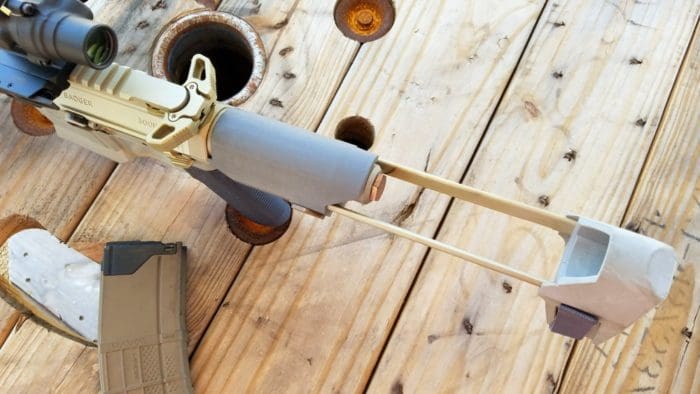
From The Truth About Guns comes this report, Confirmed: ATF Brass Recommended Targeting Braces, 80% Lowers Under a Biden Administration

Yesterday, John Crump published a report at Ammoland.com regarding a recent conference call between the ATF’s top brass and the “Biden transition team.” To be clear, no matter what you may read in the media, Joseph Robinette Biden Jr. is not yet the president-elect. At least not yet. None of the 50 states have certified their election results and the electoral college isn’t due to vote until December 14.

That made the conference call in question both premature and inappropriate. We’ve talked to people with direct knowledge of what was discussed on the call and can confirm Crump’s report that the higher ups at the ATF told the Biden boys they want to target two items should their boss occupy the oval office in January. Number one on the hit list is pistol arm braces and number two is 80% lowers.

The people we’ve spoken to confirm that the push to ban these items is coming from the top two seats at the ATF — acting Director Regina Lombardo and Associate Deputy Marvin Richardson. Also on board with banning these items are three members of the bureau’s general counsel’s office — Chief Counsel Joel Roessner, Deputy Chief Counsel Pamela Hicks and Associate Chief Counsel James Vann.

Both of these items have, of course been legal for manufacture and sale to the public for years. The ATF itself approved the sale of pistol arm braces eight years ago. Since then, millions have been sold and hundreds of people in the industry have jobs that are based on the manufacture and sale of braces.

As for 80% lowers, it’s always been legal for Americans to build their own firearms for their own use. Only a couple of state require serialization and registration of home-built guns now.

An 80% lower is a partially-finished block of aluminum. The buyer is then required to drill and mill the lower to make it functional for use as part of a pistol or rifle. If 80% lowers are banned, would 75% lowers still be legal? How about 70%? Will we have to regulate the sale of all billet aluminum in the country in case someone decides to use it to fashion a gun?

To ban these items, the ATF would have to reverse itself, doing a 180 on scores of opinions and rulings it has been issuing regarding these items for years. Of course, that didn’t stop them when they were ordered by the Trump White House to regulate bump stocks the same way as they do machine guns.

What such a ban would look like is anyone’s guess at this point. They could ban only new sales of the items, letting current owners keep and use them. Or, they could ban their possession, as was done with bump stocks, requiring owners to turn them in or destroy them.

Either way, if Biden is inaugurated and orders the ATF to ban these items, it will touch off a new round of lawsuits from gun rights orgs and owners of the newly-verboten equipment. Thousands of them will soon be sitting on lake beds all across the country.

In the mean time the White House apparently has the detail of what was discussed between the ATF brass and the Bidenbots. The President would be well within his rights to clean house at the ATF, just as he’s recently done at the DOD.

That, of course, would be a calculated risk. If the court challenges and recounts go his way, he’d be able to install replacements that have more respect for the rule of law, not to mention the right to keep and bear arms. But if things don’t go his way and Biden takes office in January, the replacements could well be worse than the asses that are currently in those seats.

It’s a great time to be alive.

Christian Prepper Gal: Is another lockdown coming to America?

Christian Prepper Gal talks about getting ready – Is another lockdown coming to America? Biden’s Covid advisor recently talked about a nationwide 4-6 week lockdown, though it has been denied as being accepted by Biden.

The cases of Covid-19 are rising at a quick rate across America. So are the death rates from it. Just yesterday (11-11-2020) it was reported that our current cases are a higher count than they were when we had the first lockdown. I’m not trying to scare anyone. I’m trying to make sure that we are all ready for what could be our reality.

My thought on the increase in cases is that people have let their guard down. People are getting tired of the virus and are just wanting to get back to what used to be their normal. Therefore, they are ignoring it and carrying on as if it was gone. It doesn’t work like that…it won’t go away if you ignore it, it will only get worse.

If the current trend keeps up there will be no avoiding another lockdown. The upcoming holidays (Thanksgiving and Christmas) are predicted to cause a surge in positive cases. Another lockdown is getting closer to happening with each passing day. One thing that is for sure is if Mr. Biden does turn out to be in fact our president-elect, he has promised another lockdown once he takes office. It is rumored that his lockdown would be longer and stricter than the previous one. Unfortunately, the way things are heading there may be another lockdown before this year even ends.

Are you truly ready for what may happen?

Let’s take a moment to talk about this. I really hate to be the one to have to tell you this, but if you are one of those who has a 72 hour emergency kit (like the one in the pic to the left) and thinks you are ready for any type of emergency, you are wrong! Those may be good for evacuating due to a fire, hurricane, tornado, or earthquake, etc. But, they will not do you much good in a SHTF scenario such as what we are actually in the middle of with this pandemic. We are not at a point to where we would have to evacuate. In fact, as you know, we need to stay hunkered down. And if there is another lockdown, trust me, it will last longer than what’s in those kits will last. It has been estimated that a four to six week lockdown will be necessary.

So what do we need to do?

We need to make sure that we have at the very minimum 30 days worth of food and household essentials for our families. While most preppers who have been preppers since BEFORE the pandemic happened, will have at the minimum a six month supply of food and household essentials. And, then there are those who are long term preppers who have a year plus supply of food and household essentials.

If you haven’t already forgotten, toilet paper was the very first thing to disappear off the shelves, even before the last lockdown began. So, make sure you have enough toilet paper, paper towels, paper plates, etc. to last a couple of months. Then, we had cleaning/sanitizing products, hygeine products, flour, and yeast disappear from the shelves. So you will want to make sure you have enough of those items on hand as well. And, if you’re going to have flour and yeast in your food storage, make sure you have a tried and true recipe for making bread and other foods using them. The same would apply to beans and rice, make sure you have some recipes 🙂.

We also need to ensure that we have shelf stable, non-perishable food items; foods that don’t need to be refrigerated or frozen. What happens if you lose power (for whatever reason) and your refrigerated/frozen food spoils? That’s where the emergency food meals and meals in a bag can come into play. They don’t need to be refrigerated and can be as quick as microwave meals to prepare. Plus, they take up much less space to store than canned and freezer foods. Click on this link for recipes for my meals in a bag. I started making my own emergency food meals when I discovered that most of those that were available for purchase cost way more than they should. In other words, I couldn’t afford them, lol. But, I found that I could make my own, using my own recipes and substituting dehydrated or freeze dried ingredients for fresh or canned ingredients. And, I knew those homemade emergency meals would be meals that my family members would eat.

Ummmm…it seems I kinda got off on a little bunny trail there. What can I say, I just love my meals in a bag!! Anyway, a good idea is to make sure you store foods that your familiy will eat. And, it’s a good idea to have a variety. So, while you have canned foods, pastas, and other non-perishable foods, it’s a good idea to have other choices also, such as the emergeny meals, on hand for those days you need a quick and easy meal.

I’m focusing on food here because that’s the main thing we are going to need in the case of another lock down. If nothing else, learn from the very reccent past with the first lockdown and think about what items were sparce, or not available at all, in your area. Those will be the things you need to make sure you have on hand now, if you have not already done so. Then, you need to try as hard as you can to build up a supply that will last your family at least three months. Minimum.

As I am proof reading this article, I am watching The Nightly News and it is being reported that some grocery stores are putting limits on some food items again. They mentioned the very same products that I mentioned above as having been in short supply during the first lockdown as being those items that are now having limits put on them again. It is my prayer that your eyes will be open to what is happening around you, and that you will listen to what God is telling you that you need to prepare you and your family during this pandemic. Please stay home as much as is possible, and stay safe.

Until next time…happy prepping, and God bless!

James 4:17, Therefore, to one who knows the right thing to do and does not do it,

to him it is sin. (NASB)

As an aside, I just want to say…As Christians, it is hard for some to realize that even though God has promised to be our Protector, He has also told us that we need to be vigilant and look out for ourselves as well. In other words, we know that if we put our hand in the fire and hold it there long enough we are going to get burned. In the same way, during this pandemic, if we carry on our lives ignoring the reality of the Covid-19 virus long enough we are eventually going to come into contact with someone who has the virus but is not yet exhibiting the symptoms, or someone who is asymptomatic. So, we need to protect ourselves by not putting our hand in the fire. In other words, we need to follow the protocols that have been set forth by the CDC. Just because you follow protocol DOES NOT mean that you are not trusting in God. Yes it’s true that if it is our time we are going to go no matter how careful we are. But, what if it is not our time and we act in a way that will accelerate that time?

Deccan Herald: 700-km-long Traffic Jam in Paris Ahead of 2nd Covid-19 Lockdown

According to this article at the Deccan Herald, there were 700km (~435 miles) of traffic jams in Paris on Halloween as people attempted to flee the city ahead of another lockdown. The scene is reminiscent of so much disaster fiction where the protagonist tries to bugout from the city a little late. It’s difficult to know when the right time to bug out is, but if you’re stuck in over 400 miles of traffic jams, then you probably waited too long. Mass departures from cities are nothing new for pandemics. During the 1793 yellow fever epidemic, around 40% of the population of Philadelphia fled the city. But back then, around 10% of the city’s people had died from the disease within a span of three months, whereas the citizens of Paris are fleeing the government’s response to the Covid-19 pandemic which has killed 0.1% of the city’s population.

If you plan to bug out something, it’s important to know how you are going to do it and especially when you are going to go so you don’t end up getting caught in this sort of jam.

An authorisation that needs to be filled out just to take a bit of fresh air. Long traffic jams as Parisians tried to leave the French capital before it was too late. Pressure on supermarket shelves for key goods.
After enduring two months of lockdown last spring in a bid to squeeze out Covid-19, there was a weary sense of deja-vu in France on Friday as people contemplated going through it all again for at least a month — and maybe even to Christmas and beyond.

The new lockdown added to an already grim mood in France after three attacks in recent weeks blamed on Islamic extremists, the latest the killing of three people inside a church in Nice on Thursday.
There are crucial differences with the new lockdown, most crucially that children will be returning to school after the autumn break, rather than staying home.

And while nonessential businesses are to close, some were still open on Friday.

At least four shops — a shoe store, a dry cleaners, a mobile phone store and a Nespresso boutique — welcomed clients at midday on a busy pedestrian street in the Passy neighbourhood of western Paris.

“For me, it’s a normal day, it changes nothing,” said Hedi Lecaude as he headed to work at his insurance office in Paris, flashing an authorisation from his employer to police as he entered the metro.

There was also a steady flow of traffic around central Paris, even if public transport was less clogged than usual by midday, raising concern among medics over whether the public would take this round of the lockdown seriously.

There were fewer bike riders and joggers around than usual but the atmosphere was more of a lazy Sunday afternoon than the first day of strict stay-at-home orders.

Trains from the provinces back to Paris were busy after President Emmanuel Macron made clear that there would be a grace period so families could return home after the autumn break.

But in the other direction, hundreds of kilometres of traffic jams formed in Paris late Thursday as worried residents of the capital sought to flee in the hours before the lockdown took effect.

The Sytadin traffic website said there were over 700 kilometres of traffic jams in the Paris region late Thursday, with electronic signs on the Paris ring road bearing grim warnings for drivers of an hour to go before the next exit.
Yet the reality remained that within a space of months France has gone from “confinement” (lockdown), to “deconfinement” as the measures were relaxed over the summer, to “reconfinement”.

As previously, the basic rules are simple and strict. Essential workers and employees who cannot work from home can obtain passes for their daily commute.

Others will only be allowed to leave home for other essential reasons — for example food shopping or medical visits — or for exercise. These trips should be for no more than one hour and within a one-kilometre radius of their homes, Prime Minister Jean Castex said.
And like in spring, every movement outside needs to be justified by filling out an authorisation form, either by hand or online.

Worried social media users posted pictures of supermarket shelves empty of the essentials, but executives insisted there would be no shortages.

The president of the Intermarche chain, Thierry Cotillard, said his supermarkets had been busier than normal but denied there had been any “hysteria.”

Home entertainment and electrical goods giant Fnac-Darty said it was keeping stores open by benefitting from an exemption that allows people to buy goods for home-working.

According to a poll by Odoxa-Dentsu Consulting for France Info and daily Le Figaro, seven out of 10 in France are in favour of the new lockdown.

“Being able to send the children to school is a big help,” said Josephine Weil, a lawyer, as she walked with her son in central Paris, adding she was “resigned” to the reality of the new lockdown.

But some angry French took to the streets of Paris late Thursday for an unauthorised protest to condemn the new measures as overly drastic.

“We shouldn’t overdo it. From midnight tonight we must all be at home, it’s too much,” said one protester, who gave her name as Laura.

Doom and Bloom: Soft Tissue Infections

The Altons at Doom and Bloom Medical write about Soft Tissue Infections. More pictures are in the original article.

All injuries carry a risk of infection. When the skin is breached, various microbes can invade and cause damage. Inflammation in soft tissues known as “cellulitis” may develop when bacteria enter through a crack or break in your skin. Fortunately, infections from minor wounds are relatively easy to treat today due to the availability of antibiotics. Without them, any bacteria may become life-threatening if it enters the circulation.

If germs invade the soft tissues below the superficial level of the skin (the “epidermis”), they can rapidly infect the main layers of soft tissue below. These include the deep layer of the skin (the “dermis”), the subcutaneous fat, the muscle layers, and various blood vessels and nerves.

image by Cerevisae 

Cellulitis may be easy to deal with in normal times, but it will be an epidemic in the aftermath of a major disaster. This is not because it’s contagious; it isn’t unless you have an open wound yourself or exchange bodily fluids. Expect cases simply because of the sheer number of injuries incurred from performing activities of daily survival in less than sanitary conditions.

Without antibiotics, infections can spread to lymph nodes and the bloodstream, rapidly becoming life-threatening. The end result might affect the entire body, referred to as “sepsis.” Once sepsis develops, inflammation of deep structures like the spinal cord (“meningitis”) or bone marrow (“osteomyelitis”) can further complicate the situation. In the past, sepsis was usually fatal.

The bacteria that can cause cellulitis are on your skin right now. Normal inhabitants of the surface of your skin include Staphylococcus and Group A Streptococcus. They do no harm until the skin is broken and they enter deeper tissues where they don’t belong. In recent years, a resistant bacterium called MRSA (Methicillin-Resistant Staphylococcus Aureus) has arisen which causes cellulitis resistant to the usual antibiotics.

As an aside, Cellulitis has nothing to do with the dimpling on the skin called “cellulite”. The suffix “-itis” simply means “inflammation”, so cellul-itis simply means “inflammation of the cells.”

The signs and symptoms of cellulitis must be recognized as early as possible. They include:

  • Discomfort in the area of infection
  • Fever and Chills
  • Exhaustion (fatigue)
  • General ill feeling (malaise)
  • Muscle aches (myalgia)
  • Heat in the area of the infection compared to non-affected areas
  • Redness, usually spreading towards torso
  • Swelling in the area of infection (often appearing shiny and causing a sensation of tightness)
  • Drainage of pus or cloudy fluid from the area of the infection
  • Foul odor coming from the area of infection
  • Hair loss at the site of infection (less common)
  • Joint stiffness caused by swelling of the tissue over it (less common)

Cellulitis commonly occurs in an extremity, such as a leg. In these cases, it’s helpful to keep the limb elevated. Other strategies include warm or cool compresses or soaks to the affected area, and the use of ibuprofen (Advil) or acetaminophen (Tylenol) to decrease pain, discomfort, and fever.

Although the body can sometimes resolve cellulitis on its own, treatment usually includes the use of antibiotics. These can be topical, oral, or intravenous. Topical therapy helps more to prevent infection than cure it.

As most cases of cellulitis are caused by bacteria, they should improve and disappear during a 7-14-day course of therapy with medications in the Penicillin, Erythromycin, or Cephalosporin (Keflex) families. Amoxicillin and ampicillin are particularly popular. MRSA cellulitis can be treated with clindamycin and the sulfa drug combination of sulfamethoxazole/trimethoprim (SMX-TMP). It’s important to complete the full course of therapy.

Adult dosing:

-Penicillin, amoxicillin, cephalexin, or ampicillin 250-500 mg orally four times a day for 7-14 days (Amoxicillin also comes in 875 mg).

-Clindamycin 150-300 mg orally three times a day for 7-10 days.

-SMX 800 mg-TMX 160 mg orally twice a day for 7-10 days.

Those allergic to penicillins can still take clindamycin or SMX-TMP. It should be noted that not all sources will recommend the same dosage, frequency, and duration of therapy for a particular drug. In resistant infections like MRSA, combination therapy with SMX/TMP and Cephalexin 500 mg orally four times a day for 7-14 days may be necessary.

As with all medications, the longer the therapy and the higher the dose, the more likelihood that adverse reactions may occur. A much more comprehensive discussion of antibiotics can be found in Alton’s Antibiotics and Infectious Disease: The Layman’s Guide, or online at drugs.com and rxlist.com.

All the drugs mentioned above are available in veterinary equivalents (at least at present). In a survival situation, however, antibiotics will be precious commodities. You, as medic, should dispense them only when absolutely necessary. The misuse of antibiotics, along with their excessive use in livestock, is part of the reason that we’re seeing an epidemic of antibiotic resistance in this country.


PrepperNet Moves to MeWe from Facebook

Just as we recently heard that The Organic Prepper had closed their Facebook page over censorship, now PrepperNet has announced that they are moving to MeWe.
PrepperNet has moved to MeWe!

Due to Facebook’s restrictions and censorship on Free Speech, we are moving our primary social media platform to MeWe.  Without warning, Facebook has deleted other pages related to preparedness such as Forward Observer’s and Prepping2.0.  While PrepperNet is not a political group, there are times our preparedness group sometimes discusses and shares information and personal perspectives about current events.

With the recent and ongoing politically motivated censorship actions of many of the social media platforms, PrepperNet sees the handwriting on the wall and we are reevaluating our relationship and use of some of the social media tools.  In the meantime, we are making every effort to comply with Facebook’s policies as we consider it a valuable communication tool. However, to ensure our community will be in a position to continue on, we have developed a new plan to ensure a continuity of operations should we lose access to Facebook.

So here is our plan.

We have different levels

ALL PrepperNet members should all join PrepperNet.Com.  It’s FREE!
If you want to support PrepperNet, please become a Premium Member for $40/year.

PrepperNet 101 is going to be Facebook.  We will not allow any political or controversial topics.  We will only use Facebook to “Catch” new interested preppers looking for PrepperNet.

PrepperNet 102 is MeWe. This is where you can chat and share preparedness topics with everyone. www.mewe.com/join/preppernet

PrepperNet 103 will be the PrepperNet forums. The forums are for learning and sharing information. This is old school and hopefully will not take a big learning curve. This is for people that want to share projects and really learn. We are fine with a small percentage participating on the forums.  The forums link can be found in your basic membership tab on preppernet.com. You can use the app Tapatalk to connect with the forums once your account is setup.

As we move forward, we encourage all members to use MeWe as their primary social media platform when interacting with PrepperNet.

www.mewe.com/join/preppernet

General Assembly of the Whole for November Cancelled

Update: The November 2020 General Assembly has been cancelled. The next General Assembly is currently scheduled for Dec. 10th, but as December is typically dense with local events, please keep an eye on the website for updates.

The November 2020 General Assembly of the Whole, which would normally be held on Thursday, Nov. 12th, has been postponed. We hope to reschedule for Nov. 19th, but watch here or on our mailing list for the final date.

Mises Institute: Talk of “Unity” Is Both Hypocritical and Delusional

Professor Gary Galles at the Mises Institute says political Talk of “Unity” Is Both Hypocritical and Delusional

In Joe Biden’s address after being declared president-elect by news organizations, he promised to be a leader who “seeks not to divide but to unify.” Making that assertion after the campaigns we have seen, not to mention the light-years-apart treatment of the candidates, while Donald Trump is still adamantly disputing the election because of alleged Democrat malfeasance is, at a minimum, ironic. And it would be the height of hypocrisy if only a few of Trump’s claims of cheating are true. But we need to go further and recognize that even the possibility of Joe Biden uniting us is a delusion.

Agreement on the specific ends we want to achieve is unattainable because our desires are mutually inconsistent. Our agreement is very limited on even very broadly defined issues, and once we look further than vague, aspirational language and feel-good generalities, Americans disagree on virtually everything.

All of us want to be fed, clothed, housed, educated, etc. We agree in that sense. But we disagree about virtually every aspect of who, what, when, where, why, and how. We want different types and amounts, in different ways, at different times and places, and for different people. We are vastly different in the tradeoffs we are willing to make among our desires, not to mention who we think should pay our bills. Once we consider any of the myriad actual choices faced, the fact of scarcity necessitates that our specific ends conflict, rather than align.

Consider a mundane example played out daily in our homes—breakfast. Does everyone in your family agree on “the most important meal of the day”? Does everyone even eat breakfast? Does each member have coffee, a cold caffeine drink, or neither? Juice? What kind? Are all agreed on when, where, what, or how much to eat? Do we agree on who should pay for breakfast, cook it, and clean up after it? Do we agree on the “dress code” that should apply, either at breakfast or afterward?

Diverse individuals have diverse preferences. Multiplying this single example by the uncountable decisions that must be reached in society every day makes our fundamental disunity clear. And we are no more unified when we get to public policy. We are not in agreement about people’s rights and government powers that some view as essential but others view as unforgivable. The same is true of many foreign policy choices. We cannot be unified as “one nation under God” when some vehemently reject any reference to God. We cannot be unified about abortion when some view it as murder and others consider it sacred. Policies that take from some to give to others also inherently create disagreement from those whose pockets are involuntarily picked. Reducing what we take from some, entailing giving less to others than they wish, also triggers disagreement. So long as government dictates such choices, political unity is unattainable.

In fact, politics as currently practiced eviscerates the one thing Americans could agree about. This reflects the far-too-little-recognized fact that we have greater agreement on what all of us want to avoid than on what all of us want. None of us wants what John Locke called our “lives, liberties, and estates” violated. That is, each of us wants rights and property defended against invasion. Respecting all of our property rights reduces the risk from predation for each of us. But creating added rights and privileges for some at the expense of others’ equal rights and privileges makes government the most dangerous predator, even when who is selected to do so is determined by majority vote.

Each of us would like the freedom to peacefully pursue our own goals. As Lord Acton put it, “liberty is the only object which benefits all alike, and provokes no sincere opposition,” because freedom to choose for ourselves is always the primary means to our ultimate ends. That is why the traditional functions of government are to protect us from abuse by our neighbors and foreign powers, while its greatest threat is supposed protectors becoming predators against citizens. That is why Acton recognized that liberty requires “the limitation of the public authority.” But we are incredibly far from agreement on that today.

Well-established property rights and the voluntary market arrangements they enable let individuals decide for themselves, limiting each of us to persuasion rather than coercion. Except in the very unusual case where we must all make the same choice, this allows us to better match our choices to our preferences and circumstances. And unlike minority votes in elections, every dollar “vote” matters.

In fact, we should recognize that markets are our primary means to transform our disagreements into mutually beneficial cooperation, while restrictions on markets hobble that essential function.

Say I offer you a widget for sale at $10 and you say yes. That does not mean we agree on its value. We disagreed. I valued it at less than $10 worth of other goods and services, or I wouldn’t have sold it for that. You must have valued it more than $10, or you wouldn’t have bought it for that. Importantly, however, we have transformed our disagreement on values into an exchange that gives both of us benefits we consider to be worth more than the costs.

In contrast, talk of political unity is primarily rhetorical cover for those who are in power to coerce those who disagree with them. They benefit themselves at others’ expense, taking others’ resources and making them acquiesce in what they object to. And unlike markets, in which greater disagreements about value create greater net benefits from voluntary arrangements, “unifying” political initiatives are just ways to control who will be forced to do what for others, driving Americans apart while hamstringing cooperative arrangements and squandering the wealth they would have created.

Grand invocations that “I will unify us” are actually shorthand for “We disagree about many things, but those in this group are unified against others’ preferences, and we mean to get our way, regardless of their well-being and desire,” which is made clear by the demonization of anyone who doesn’t support the supposed “unity” position as divisive. That kind of unity is tyranny. Strengthening our union actually runs along a different path than the unity of 50 percent plus one, unified against the interests of others. It is uniting in a common commitment to honoring one another’s rights and the liberty this makes possible for all of us. Without unity in that, we can never achieve the kind of unity that is actually desirable and achievable. The alternative is the prospect of more of what we have experienced of late, which resembles what Thomas Hobbes called “a war of all against all.” But if we are united only by the ongoing fight to win that war against other Americans, we are selling out the birthright we have from our Declaration of Independence and Constitution.

Sovereign Man: It’s Started Already – “We Have a List”

Simon Black of Sovereign Man writes about the fall of empires in It’s Started Already: “We have a list.”

On September 18 of the year 96 AD, a fairly obscure and elderly politician named Marcus Cocceius Nerva was proclaimed Emperor of Rome by the Senate.

Rome was in chaos at the time; the empire had suffered from years of turmoil, economic decline, and oppression.

Most of the last several emperors– going back before the suicide of Nero in 68 AD– had been extremely destructive… plundering the treasury, waging expensive wars, and dismantling individual liberty.

The government was also extremely unstable; it was not uncommon at that point for emperors to be deposed or even assassinated.

In fact, Nerva’s predecessor– the emperor Domitian– had literally been murdered that morning.

Nerva was seen by many Senators as the ‘safe choice’ to take over the government. He was old, frail, and sick… so he wasn’t expected to last very long.

Most of all, Nerva was completely unremarkable.

He had spent his entire professional life in the service of the Empire, yet his name is barely mentioned in any historical record or associated with any major achievement.

But ‘unremarkable’ was exactly what Romans felt like they needed at the time: Nerva would be a break from the chaos. Or so they thought.

We know now with the benefit of hindsight that Rome would never fully recover.

There would be a few ‘good’ emperors along the way– people like Marcus Aurelius who were able to temporarily hold back the decline.

But the long-term trends were unstoppable.

Rome was slowly going bankrupt, destroying its currency, and rejecting the basic principles of its civilization that made it so powerful and prosperous to begin with.

And no politician was able to put the brakes on those big trends and reverse the inevitable decline.

This is a common theme throughout history: empires rise and fall, not because of a single individual, but from decades of major trends that gradually cause an inevitable decline.

These same trends keep surfacing over and over again across the centuries.

Economic mismanagement is an obvious one: empires in decline almost invariably hold an arrogant belief that they are exempt from the natural laws of finance.

In other words, they believe they can spend as much as they want, accumulate infinite amounts of debt, and debase their currency without limit, and somehow there won’t be any consequences.

Another trend is that the empire abandons its core values. Integrity, civic-mindedness, and hard work give way to corruption and entitlement.

And perhaps the biggest trend of empires in decline is that society frequently turns on itself. Civility ends, and rage takes over.

It goes without saying that these trends are alive and well in the West today, especially in the Land of the Free.

US finances have been in disarray for decades. Just this year alone, the national debt has grown by $4 trillion and the Federal Reserve has conjured another $3 trillion out of thin air.

And even before Covid struck when the economy was firing on all cylinders, the government was still adding more than $1 trillion each year to the debt.

Now there are entire factions of politicians that want to take those numbers to the next level.

In fact, there’s an entire school of economics now called “Modern Monetary Theory” which poses that governments can simply print as much money as they want without consequence.

This is pretty classic empire arrogance.

But, again, the even more powerful trend now is the growing rage that’s so prevalent.

We’ve seen it unfold in front of our very eyes– violence, arson, assault, looting, vandalism, intimidation.

And if the this angry mob isn’t out in the streets causing mayhem, they’re on social media trying to destroy someone’s life who committed the thoughtcrime of intellectual dissent.

The election results last week proved that this angry mob is still a numerical minority.

Unfortunately they are a very powerful minority that has taken over a number of important institutions.

They already control the media. Objective journalism doesn’t exist anymore– it’s just activism and propaganda.

(And if anyone needs any proof, look no further than a prominent CNN ‘reporter’ weeping tears of joy over the weekend on live television. How can these people expect to be taken seriously as objective journalists??)

The mob has also taken over education too.

Schools and universities are now filled with enraged Marxists who spend dozens of hours each week indoctrinating our children with their new woke religion.

They’ve even reinvented science, history, and mathematics to conform to the principles of critical race theory.

The mob also exerts extreme influence over major corporations.

You can’t watch a Disney movie, or an NFL game, or even a commercial for men’s razors anymore, without having identity politics shoved down your throat.

They also hold extreme influence over Big Tech, whose one-sided censorship policies have become so absurd they’re starting to rival the Chinese Communist Party.

Over the weekend, for example, Twitter was ablaze with activists who launched an ‘accountability project’ to create a database archiving every supporter, donor, staffer, etc. who supported the current Presidential administration.

The project’s tagline is “Remember what they did,” and “We must never forget. . .”

And they’re targeting “those who elected him,” and “those who funded him,” referring, of course, to the President and the 70 million people who voted for him.

One reporter from the Washington Post deemed that everyone archived “should never serve in office, join a corporate board, find a faculty position, or be accepted into ‘polite’ society.”

She concluded her thinly-veiled threat by saying, “We have a list.”

Twitter, of course, did not see fit to censor this shining example of objective journalism, which now has 40,000 likes.

It’s a pretty blatant sign of decline when people start keeping ‘lists’ of political opponents they want to punish. And this madness is just getting started.