16th Leg. Dist. Republicans Open Letter to People of Benton County

The Benton County Republicans for the 15th Legislative District have written an open letter to the people of Benton County about the county commissioners and their saying that they have no authority to resist the governor’s stay at home orders. The letter reads, in part:

…Shon Small, Jerome Delvin, and James Beaver made the statement “The Benton County Board of Commissions does not have the legal authority to override the Governor’s ‘Stay Home, Stay Healthy’ proclamation…” The Commissioners’ job is to oversee the county and also, we firmly assert, to protect the citizens from overreach of power by the capital. All three of our Commissioners are either willfully ignorant or just negligent in their role…

It is time to get business’s open and the people back to work. We firmly believe that every
person in Benton County is essential. We know there are veritable public health concerns and
those who ought to stay home, can chose to do so. The working people of Benton County
know what is best for them, not the Governor’s boot-licking Commissioners, whose income
rolls in whether they work or not. It’s time the Commissioners earn their paycheck and protect
the good and hard working people of Benton County from the bureaucratic double speak of
Olympia. The woes of King and Pierce County are not the identical worries of Benton
County; we are a different demographic, climate, economy, and culture. The citizens of this
community possess an undeniable right to make decisions autonomously from our State
government; to tailor our county government to serve the people of this area as is fitting to the
citizenry of this particular locality. Top down, authoritarian mandates from the capital are ‘one
size, fits the capital alone’ decisions – they are made without a thought of us here! We are
calling on the Commissioners to do what is prudent for Benton County; they are elected to a
very well compensated position, as a public servant, and ought to conduct themselves
accordingly…

Click here to download the letter in PDF format.

Liberty Blitzkrieg: Chinagate Is the New Russiagate

Michael Krieger at Liberty Blitzkrieg writes about the current nonsense of blaming China for the US (and other countries’) lack of preparedness and the reasons behind it (dodging responsibility for incompetence by local, state, and federal politicians and bureaucrats, coupled with the need to extend the national security state and the flow of spice money). Who didn’t see China lockdown a few hundred million people and think, “Whoa, this looks serious” — apparently politicians. They must have just thought, “I wish I could do that.” Chinagate Is the New Russiagate.

I’ve become convinced the next major event that’ll be used to further centralize power and escalate domestic authoritarianism will center around U.S.-China tensions. We haven’t witnessed this “event” yet, but there’s a good chance it’ll occur within the next year or two. Currently, the front runner appears to be a major aggressive move by China into Hong Kong, but it could be anything really. Taiwan, the South China Sea, currency, economic or cyber warfare; the flash points are numerous and growing by the day. Something is going to snap and when it does we better be prepared to not act like mindless imbeciles for the fourth time this century.

When that day arrives, and it’s likely not too far off, certain factions will try to sell you on the monstrous idea that we must become more like China to defeat China. We’ll be told we need more centralization, more authoritarianism, and less freedom and civil liberties or China will win. Such talk is nonsense and the wise way to respond is to reject the worst aspects of the Chinese system and head the other way.

– From my 2019 piece: Two Paths Forward with China – The Good and The Bad

As the clownish farce that is Russiagate slinks back into the psyop dumpster from which it emerged, an even more destructive narrative has metastasized following the U.S. government’s incompetent response to covid-19.

It was clear to me from the start that Russiagate was a nonsensical narrative wildly embraced by a variety of powerful people in the wake of Trump’s election merely to serve their own ends. For establishment Democrats, it was a way to pretend Hillary Clinton didn’t actually lose because she was a wretched status quo candidate with a destructive track record, but she lost due to “foreign meddling.” This allowed those involved in her campaign to deflect blame, but it also short-circuited any discussion of the merits of populism and widespread voter dissatisfaction (within both parties) percolating throughout the land. It was a fairytale invented by people intentionally putting their heads in the sand in order to avoid confrontation with political reality and to keep their cushy gravy-train of entrenched corruption going.

Russiagate was likewise embraced by the national security state (imperial apparatus) for similar reasons. Like establishment Democrats, the national security state also wanted to prevent the narrative that the status quo was rejected in the 2016 election from spreading. It was incentivized to pretend Hillary’s loss was the result of gullible Americans being duped by crafty Russians in order to manufacture the idea that U.S. society was healthy and normal if not for some external enemy.

Another primary driver for the national security state was to punish Russia for acting like a sovereign state as opposed to a colony of U.S. empire in recent years. Russia has been an increasingly serious thorn in the side of unipolarism advocates over the past decade by performing acts such as buying gold, providing safe harbor for Edward Snowden, and thwarting the dreams of regime change in Syria. Such acts could not go unpunished.

So Russiagate served its purpose. It wasted our time for much of Trump’s first term and it helped prevent Bernie Sanders from winning the Democratic nomination. Now we get Chinagate.

When the premier empire on the planet starts blaming external enemies for its internal problems, you know it’s almost always an excuse to let your own elites off the hook and further erode civil liberties. While it appears the novel coronavirus covid-19 did in fact come from China, and China tried to discourage other countries from taking decisive action in the early days, our internal political actors blaming China for their own lack of preparation and timely reaction is patently ridiculous.

If Stacy and myself were able to see the situation clearly and respond early, why couldn’t our government? This isn’t rocket science. The Chinese were acting as if the world had ended in cities across the country and we’re supposed to believe U.S. leaders simply listened to what the CCP was saying as opposed to what they were doing? How does that make any sense?

It makes even less sense considering the Trump administration has been in an explicit cold war with China for almost two years. This concept that the American national security state just took China’s word for what was going on in the early days is preposterous. So what’s going on here? Similar to Russiagate, the increased focus on directing our ten minutes of hate at the Chinese provides cover for the elites, but Chinagate is far more dangerous because the narrative will prove far more convincing for many Americans…(continues)

Click here to continue reading at Liberty Blitzkrieg.

Citizens Journal: Boost Your Immune System, Too

In Karen Selick’s article Coronavirus Crisis Reopens 150-Year-Old Controversy at Citizens Journal, she reminds us that there is another side to fighting viruses besides just avoiding the virus itself, i.e. you can boost your body’s ability to fight off viruses by improving your immune system.

…French scientist Louis Pasteur (1822-1895) is widely celebrated as “the father of germ theory”— the idea that we become sick when our bodies are invaded by foreign organisms such as bacteria, molds, fungi, and of course viruses. Although the idea had been circulating long before Pasteur achieved eminence, his laboratory work in the 1860s appeared to provide the scientific proof that had previously been missing.

What’s not widely known is that other French scientists working in the same field in that era held somewhat different beliefs, known as the “terrain theory”. They believed that the most important factor that determines whether or not a person becomes ill is not the presence of a germ, but rather the preparedness of the body’s internal environment (the “soil” or terrain) to repel or destroy the germ…

But regardless of Pasteur’s character, and regardless of whether he recanted at the end or not, what lives on after him is the mindset, clearly visible amongst most of today’s medical professionals and health care bureaucrats, that it is the germ (formally designated SARS-CoV-2) that has to be tracked down, isolated, avoided, and eradicated—and that’s all that matters. The “terrain”, to conventional modern thinkers, is nothing.

For instance, on the Ontario government’s website telling its citizens what to do about COVID-19, its advice consists entirely of measures designed to prevent people from coming in contact with the virus: stay home, wash your hands often, don’t touch your face, maintain physical distancing and wear a mask when you have to go out.

No mention is made of any measures individuals can take to ensure their immune systems are operating at peak efficiency (or as the French scientists would have put it, their terrain is well prepared to mount a defence). It’s almost as though the Ontario government doesn’t believe human beings have immune systems or that they’re of any use whatsoever. The only hope, Ontario seems to believe, is for a pharmaceutical company to patent a vaccine, because that is the only way that human beings can defend themselves against a virus, or acquire immunity.

In fact, Ontario and Canada have gone out of their way to discourage people from looking for methods of helping themselves. Ontario’s website says “there is no specific treatment” for COVID-19. End of story. Canada’s government-owned broadcasting company, the CBC, recently published this article denouncing “bogus cures” including vitamin C, zinc, medicinal mushrooms and oil of oregano.Vitamin D3, Zinc and M…Jeffers, NancyBest Price: nullBuy New $6.98(as of 03:40 EST – Details)

This official attitude is utter nonsense—there is actually an abundance of scientific evidence supporting various nutritional supplements as being instrumental in preparing people’s immune systems to repel or overcome viral infections.

Take zinc, for example. Many COVID-19 patients have mentioned as symptoms the loss of their senses of smell and taste. According to the BBC, these symptoms affects as many as 18 percent of infected patients. This CNN article says that some people  will take days or weeks to recover these senses after having the virus, while others may take months or years.

But the loss of these senses is a well-established symptom of zinc deficiency, a fact not mentioned in either of the two articles cited, and apparently not known to most of the mainstream medical community. Yet here is a PubMed study connecting zinc deficiencies with “smell and taste disturbances”. Here’s one specifically connecting “older patients” with zinc deficiencies and loss of acuity in the senses of taste and smell. Both of these studies also mention that zinc deficiencies lead to impaired immune function or an increased risk of infection. Can medical “experts” and governments not connect the dots?

Vitamin D is another nutrient (a hormone, actually) well recognized by scientists to have antiviral benefits. Google Scholar lists 3,670 research reports published in 2020 alone containing the words “vitamin D” and “virus”…(continues)

Click here to continue reading at Citizens Journal.

John Mosby on Pandemic

John Mosby of Mountain Guerrilla has been writing about Covid-19 for his Patreon subscribers for a few weeks, now. While he acknowledges the uncertainties, he tries to point out the things than you can/should act on regardless of other uncertainties. His articles on the topic are long, and the following is just a small excerpt. The most useful parts are on his Patreon and are worth a read.

…I hinted at it above, but further issues with this virus are coming to light. Among these is the already known/suspected possibility of reinfection, due to inadequate antibody production. In at least one study I’ve seen, of the test results that came back positive for antibody presence, in the NY population, only about 30% actually had adequate antibody presence to indicate even the possibility of immunity. So, despite around 20% of the population of NYC potentially having been exposed to the SARS-CoV-2 already, of that 20%, only about 30% may even have any level of immunity to reinfection.

Second, there are increasing number of otherwise healthy patients (no previous medical history, no relevant comorbities), who have recovered from COVID-19, only to suddenly drop dead from stroke, later, because of blood-clotting caused by the disease. This seems to indicate another potential example of the lasting organ damage that can occur despite “recovery” that aren’t immediately apparent.

Finally, one of the claims that has circulated repeatedly, since the beginning, was the theory that summer time would find a reprieve from the virus, allowing us time to “catch our breath” and get ready for another round of the fight with it, come next autumn and winter. The problem with THAT one is that, well…the southern hemisphere (with the apparent exception of Australia, which is actually kind of an outlier for a number of reasons, mostly because of the level of lockdown they initiated early on) and the equatorial regions seem to be getting hammered pretty fucking hard…and their numbers don’t even account for the shoddiness of what passes as “record keeping” in those shitholes.

So, What?

(1) This isn’t the fucking flu. If you still think it’s anything like the flu, choke yourself. Seriously.

(2) You really don’t want to catch this virus. By all accounts, it’s a fucking miserable experience, even with “mild” symptoms, in fit, athletic young people. Then, there’s the whole possibility of dying from it thing…That doesn’t even account for the possibility of “recovering” and then dying from a stroke a couple of weeks later.

(3) The “lockdowns” are politically and economically impossible to sustain for much longer. So, the numbers are going to increase, both in total case numbers, and in fatalities. Your goal should be (ours certainly is!) to avoid contracting it at all, and if it is unavoidable, to contract it as late as possible, so there has been more time to consider all possible treatment options, come up with viable, working treatments, and get the requisite materials into the supply pipelines to help (which may not happen anyway…).

Interestingly, I’ve noticed that nobody in a position of authority is claiming “we’ll have a vaccine in a few weeks!” anymore. Instead, they’ve switched to the 12-18 months timeline that some of us have been trying to explain to people for the last couple of months. Further, I haven’t done a lot of digging yet, but to the best of my limited research (thus far), there’s NEVER been a viable vaccine for a coronavirus. Not SARS-COV (the first one). Not MERS-COV. Not the Common Cold. None, that I’ve been able to discover. I’d love to see evidence refuting that…

SocioEconomic Impacts

There are a number of very real impacts coming down the pipe, as a result of this pandemic. While it’s becoming increasingly popular, in some circles (mostly on the Right, but I’ve seen some circulating on the Left as well), to blame all of the impacts on the lockdown/quarantine response to the virus, the fact is, most of us have KNOWN the system in place, as it was, wasn’t really sustainable in the long-term. Whether you were concerned about the political issues, the economic issues, the resource issues, or the environmental issues, the reality is, COVID-19 hasn’t “destroyed” anything. The lockdown/quarantine response hasn’t “destroyed” anything. This—whether the pandemic itself, or the response thereof—just gave the system the nudge off the edge of the precipice it was hanging off of.

I’ve seen a number of claims circulating that “the response” is nothing but a political ploy to avert blame for a “controlled collapse” of an unsustainable economic model. To that, I have three responses, which have guided my own response to the situation.

(1) Anyone who has been prepping for any length of time should have considered the impacts of potential pandemics. Especially in light of “Swine Flu” and “Bird Flu” scares in recent years, even those of us that didn’t spend much time considering it, have to have spent SOME time considering it. If you did, you knew—or should have known—that lockdown/quaratine was one of the major planning elements for controlling/containing the spread of pandemic disease. You would also have discovered that medical authorities—even contrarian medical authorities—around the world have warned, repeatedly, of the possibility—actually, the PROBABILITY, even INEVITABILITY—of an international pandemic of this scale. So, none of this is particularly surprising, either the pandemic itself, or the response thereto…

(2) The whole “it’s all a plan by the government to bail out the elites” would seem to have some grounding in possibility, when you look at the way the “Stimulus” has gone. Most citizens got their paltry little $1200/person “Please Don’t Riot Yet” checks, while hundreds of billions of dollars went to the banks, airlines, and corporations…again.

The fact that the Fed “shored up” the markets, with an infusion of newly created “money,” even as they’re predicting record unemployment levels and loss of up to half the US GDP in the coming months, would seem to reinforce that possibility. The markets crashed, but then magically rebounded, despite no real reason, other than the Fed pouring made-up money into them, would seem to give legs to the idea it was done just to give the “elites” the chance to get out from under their portfolios.

The problem I see with that argument—that it was all intentional—is that it would require basically every government in the world to be in on the game. That’s a pretty big stretch of the imagination. I’m not saying it’s impossible, but I AM saying, it’s improbable. I don’t subscribe to that belief (which is not the same thing as saying the political and bureaucratic classes aren’t taking advantage of the situation to leverage things to their favor, as much as possible).

(3) The biggest issue with the whole conspiracy theory though is…”So what?” If that theory IS right, what impact does that have on YOUR ability to deal with the situation? What impact does that have on the ability of YOUR FAMILY, and YOUR COMMUNITY to weather the storm? Because, honestly? That’s all that matters, at this point. Anything larger scale is probably completely outside of your sphere of control anyway.

It certainly doesn’t do any good to bitch and whine about it. You’re not going to change it, by venting to your (probably) like-minded friends on Facebook or Twitter or Instagram. Far better is to use a little mental Judo, and simply refuse to focus on it. When you feel a rant or anger about it coming on, simply find something USEFUL to focus on. It’s not “suppressing” it. It’s acknowledging it exists (“Man, I’m really pissed that I think the elites are taking advantage of this!”) and then acknowledging that there’s fuck-all you can do about it, and moving on to something you CAN control (“Man, it sucks that I’m pissed, but I really don’t want to get my blood pressure all jacked up, so I’m gonna go weed the garden bed!”)…

 

Mark Manson: Nobody Knows What is Going On nor What to Do

NYT bestselling author Mark Manson writes about the confusion, lies and general contentiousness of the current pandemic in Nobody Knows What Is Going On. Occasional strong language ahead. His basic premise is that we’re still learning about this disease and no one really knows how bad (or not bad) it is. Some doctors say it’s just the flu. Other doctors say young, healthy people are dying from stokes caused by the virus. Everyone is contradicting each other, so people are reverting to believing whatever they want to believe or whatever aligns with their political outlook or whatever aligns with their financial interest and so on.

Right now, we have two large, complex systems. The first is a virus sweeping through the global population and our combined efforts to mitigate it. The second is a declining global economy. Both systems are incredibly difficult to measure and understand, much less predict. Both are so large and unruly that we struggle to even comprehend them in their entirety. And so far, pretty much everything we’ve thought about either has been utterly wrong.

Let’s start with the first system: the spread of the virus. Despite months of research and testing, we still know very, very little. For example, we know that the virus is highly contagious, but we still have no clue how contagious. Studies pin its R0 number (how many people each sick person goes on to infect) as high as 6.6 and as low as 1.4. For reference, that’s like saying the virus will infect anywhere from 20% of the population to 80%, a range so broad that you might as well pick a number out of a hat.

What about how many people have been infected? A series of studies came out in the past week showing that infections have likely been vastly undercounted and that there are thousands (perhaps millions) of people out there who have been infected but had no symptoms. This would be big news, because it would suggest that the virus is far less deadly than we thought. A recent Stanford study argued that the real mortality rate could be from 0.12% to 0.2%, making coronavirus hardly more deadly than the seasonal flu (which has a mortality rate of 0.1%). The problem is that these studies relied on inaccurate tests, did not test people randomly, and had other major methodological errors.

Okay, but what about deaths? A recent New York Times investigation found that there are potentially 20 to 30% more people dying from COVID-19-related deaths than are being reported (note: this study has also been widely challenged.) So, while there may be far more people being infected than we’re counting, there’s also likely far more people dying than we’re counting.

This means… well, I don’t know what the fuck this means. And neither does anybody else. Pretty much every projection model, including the ones government officials have relied upon, have been wildly incorrect so far. Lockdowns work! But, then again, they might not. Hydroxychloroquine was supposed to be a successful treatment. Then it turned out it wasn’t. Remdesivir was supposed to be a successful treatment. Then it turned out it wasn’t. Ventilators were supposed to save lives. Then it turned out they probably don’t. The hospitals are going to be overloaded! Until they weren’t. Smokers were all going to die! Wait, no, smokers might be the ones who live.

A few weeks ago, the US government’s estimate of 240,000 deaths seemed so absurd that they revised it down to 60,000. Now that number seems completely absurd and will likely need to be revised much higher again. The cherry on top of the shit sundae, of course, is the US president talking about beaming ultraviolet rays through our bodies as though we live in an episode of Star Trek… and then following that up by suggesting that maybe we inject ourselves with disinfectants.

If there’s one thing we know for certain about this pandemic, it’s that we know almost nothing for certain about this pandemic.

And that’s only the first system we’re wrestling with. The second is our economic system. Within a span of a couple weeks, the travel, hospitality, entertainment, restaurant, and brick and mortar retail industries have practically been annihilated. Just in the United States, 26 million people have lost their jobs in a little more than a month; an unemployment rate that rivals The Great Depression (note: this number is also likely being undercounted). The consensus is that we are certainly entering into a recession with whisperings of the D-word… no, not that D-word… the Depression D-word. The International Monetary Fund has said that we are potentially entering a global depression that will rival the 1930s in its depth and scope.

It’s for this reason that working class people have begun protesting and rioting in the western world, demanding economic relief. Leaders and pundits have come out arguing that lockdowns are a “cure worse than the virus itself.” Others argue that because the virus disproportionately affects the elderly, we should only tell old people to stay home and let the rest of the population build immunity as quickly as possible.

But there are many problems with these arguments. The first is that we don’t even know if herd immunity can exist. We do not know how long immunity lasts for COVID-19. People who contract many of the other coronaviruses only remain immune for a short period of time. Sadly, there have already been a number of reported cases of people contracting COVID-19 twice. If people only remain immune for a few weeks or months, then herd immunity will be impossible.

Second, while the virus is far more dangerous to the elderly, it’s no cakewalk for some of the young as well. There are reports of long-lasting damage to lungs, hearts and potentially even brain stems of those who have been hospitalized. Doctors are seeing strange numbers of infected young patients dying of strokes. On a new subreddit for people who have tested positive to share their experiences, there are horror stories of 25-year-olds on ventilators and people with persisting symptoms over a month later.

Third, re-opening the economy is not a magic bullet. As I wrote a couple weeks ago, nobody is going back out to a crowded public area any time soon, even if they are open. Would you go to a concert next week? I sure as fuck wouldn’t. What about next month? Next year? Lock down or not, tens of millions of people are going to stay home no matter what, guaranteeing that consumer spending remains in the toilet and tens of millions remain unemployed.

Fourth, we don’t even know that the economy was healthy in the first place. Some of the greatest investors in the world such as Ray Dalio have been arguing for years that we were due for a once-in-a-century collapse. For years, many pointed to negative interest rates and high levels of debt as a ticking time bomb waiting to go off. A pandemic may actually not be the cause of our economic woes, but merely the proverbial straw that broke the camel’s back.

Then again, this could all be wrong. Epidemiological projections have been famously wrong for the past month, but economic projections have been consistently wrong for… well, pretty much as long as there’s been economists.

We still don’t know what the COVID-19 does to the body or its long-term repercussions. We don’t know if building herd immunity is even possible, much less worth the cost. We don’t know how many people would die if we opened the economy up sooner rather than later, and we don’t know how stimulative opening up the economy would be anyway.

We just don’t know a damn thing. Nobody does. So, stop acting like you do.

Click here to read the entire article at MarkManson.net.


The Organic Prepper: What We Learned Living on Our Food Storage for a Month

Kara Stiff at The Organic Prepper has used the recent stay at home orders to test living off of her food storage and relays What We Learned Living on Our Food Storage for a Month.

Before the stay-at-home order was even issued in my state, I stopped going to the grocery store. I despise shopping: the fluorescent lights, the spending of money, the inane conversations about children with strangers. It’s easy to convince myself not to go if people might be sick there. Since I have the luxury of doing so, I can leave what’s available for those who haven’t had the ability to stock up.

This is important. Stocking up when items are scarce is hoarding, but stocking up when there is plenty available is the opposite of hoarding. If I’m stocked up, I have the power to remove the pressure of my own consumption from the system just when the system is most stressed, therefore allowing others to get more of what they need.

I had never actually given our food storage and production systems a good test, though. Now I have, and I’ve learned some important things.

To be clear, my kitchen wasn’t perfectly sealed off from the world. A friend gave us some milk before the stay-at-home order, and my mom brought us some baked goods while I gave her beets and eggs. My husband bought cheese once. But other than that, we’ve been eating at home.

Organization really matters

We’ve been keeping a deep pantry for about seven years, ever since my first child was born and money was very tight. Back then it was just a giant Rubbermaid full of canned tomatoes, beans, pasta, and crackers. We called it the Zombie Apocalypse Box. It was easy to move, which mattered a lot because we moved five times in less than five years, first while pregnant, then with one small child, then with two.

Though it was mobile, the ZAB had serious limitations. First, it probably only constituted two weeks’ worth of supplementation to the regular pantry, which isn’t enough. Even worse, it was difficult to maintain because it was not easy to access and organize. I had to haul the heavy thing out and spread it all over the living room floor once a month to check the expiration dates and rotate stock. This was an impossible task when I had a baby who never slept.

As we finished building our house, the delightful prospect of never moving again sank in. I planned out the cabinet space and stocked what I figured was a month to six weeks of olives, tomatoes, pasta, coconut milk, peanut butter, canned mackerel, and other staples. I also packed some rice and beans for longer-term preservation. (More about a layered food storage plan here).

Not only is this organization much easier to maintain and rotate, but it also allows me to put a greater amount of food in an area not much bigger because the shelves make it easy to stack efficiently. Some things, though, are better off less accessible. This month I was able to keep back a bag of potato chips by hiding them from myself, and I greatly appreciated having them later.

Food storage isn’t enough

A stockpile cannot last forever, no matter how large. Humans are biological, and to survive we must have a place in the ecosystem. Modern industrial agriculture denies this. It tries to bend every flow of living energy into our own mouths, replacing resilient forests with vulnerable cornfields, swapping intricate wild networks for simple one-way streams to build ever more human bodies. Wild mammals now account for less than 4% of the mammal biomass on Earth, while humans, pets, and livestock account for the other 96%.

My family chose a parcel of land that was large enough to accommodate different levels of management. We have a sheet-mulch garden where we tightly control which species are welcome, and a fenced pasture and young orchard that are more of a compromise. Rabbits and raccoons are welcome in the orchard but not Bradford pear trees, and everything is welcome in the pasture except raccoons (geese deter them). These areas constitute only a small slice of our land, while the rest is pretty wild.

This spring, here is what’s available from our land: arugula, beets, and chard overwintered in the garden, French sorrel and a small amount of asparagus from our young patch, wild greens and onions, and eggs from the chickens. From last year’s production, we have goat, chicken, okra, and sweet corn still in the freezer, as well as pumpkins, sweet potatoes, flour corn, pickles, and salsa on the shelf. There isn’t any milk for people yet, because the first goat of the season only kidded yesterday…

Dietary deficiencies are no joke. They can have permanent effects on the body, and they sap the will to live. Some people do well for decades on vegetarian or vegan or other specialized diets, while others discover after years that what used to work fine has now ruined their health. Everyone is different, and I know of no sure way to tell ahead of time what is right for whom. Blood tests don’t tell the whole story; my tests looked normal, but my fatigue was crushing. The best I can do is try to feed us a wide variety and listen to all our bodies.

Stocking back up

When I went to stock back up before supply chains deteriorate further, only a few of the shelves at my local grocery store were sparse. Coronavirus has been moving more slowly in my state than others, so there hasn’t been panic in my lightly-populated rural area. It’s part of why we moved here: new developments get to this part of the world last.

There wasn’t much choice of flour, oatmeal, rice, or garlic. I adjusted my buying so as not to take the last thing of any type, and I swapped some generics for name brands because that was what was available, but I was largely able to get what I needed. I’m aware that may not be the case next month. In stocking back up I also leaned on local sources of food, trying to support those businesses and help keep them solvent during a difficult time.

I expected eating from stores to cost a little less, but I was surprised to be able to bring my stock of necessary items back up to full for about 70% of the cost of a typical month’s food. I would not have believed we were eating 30% of our food budget in chips, milk, butter, tortillas, fresh things like avocados and bananas, and cheese. But it’s true…(continues)

Click here to read the entire article at The Organic Prepper.

Christianity Today: Save Your Soul – Start Gardening

From Christianity Today with the tagline “local creation care offers an antidote to cultural chaos” is Save Your Soul: Start Gardening.

Save Your Soul: Start Gardening

We live in a cultural moment defined by divisiveness and chaos. Every day there is something new to be afraid of, something to fix or to save. School shootings, economic instability, and political upheaval all engender feelings of powerlessness and discouragement. If I turn to social media to look for some semblance of comfort or joy, I find infighting and dissension. There’s no perfect antidote for all this pain, but nonetheless, as winter fades and light extends longer into our days, I can’t help but turn with anticipation toward garden season.

Although planting a garden might seem like an insignificant act, it offers us something deep and enduring: a reminder of God’s sovereignty over the earth and a practical, incarnational way to participate in his created order. “The care of the earth is our most ancient and most worthy and, after all, our most pleasing responsibility,” writes Wendell Berry. “To cherish what remains of it, and to foster its renewal, is our only legitimate hope.”

Last year, my husband, John, and I decided to plant a small vegetable garden on our deck. My kids joined in, and throughout the spring and summer, we delighted in every new cucumber and every new pepper. In the process, I discovered the timelessness of gardening and why it matters for our particular moment.

First, in a culture driven by immediacy and instant gratification, gardening forces us to cultivate patience.

Each time I worked my fingers into the dark rich soil and planted a few vegetables, I had to wait. Eventually, when something popped off the vine, my kids and I ran to examine it. Then we’d wait some more and watch for it to ripen.

In Galatians 4, Paul writes about the fullness of time. When vegetables reach their fullness on the vine or in a garden bed and we have to identify the moment when they’re ready to be plucked, we gain a new understanding for what Paul meant when he said, “When the set time had fully come, God sent his Son …” (Gal 4:4). Gardening offers us connection to the seasons of the earth and a pathway to understanding the sacred time of God. As Karen Swallow Prior writes, “Waiting is the fertile soil of our sanctification and one of the hallmarks of Christian practice. And yet what a joy it is to see at last the blessings God enables us to harvest.”

Second, gardening reminds us of our finitude and fallibility.

Several of the plants we were most excited about never grew. Although we expected our large tomato plant to produce dozens of tomatoes, it only gave us one tomato. There was nothing we could do about it. The broccoli, too, flowered and failed. Did we plant it incorrectly? My gardening friend, Christy, assures me her broccoli does the same thing some years.

Not everything we plant comes to fruition on our timetable, but as Ecclesiastes 3 reminds us, God makes everything beautiful in its time. Some seasons appear dormant and fallow, but all the while, God is working his purposes for our greater good. Tending to a garden each year gives us fresh eyes to see his long-term, redemptive work.

Third, in a world that continues to stun us with harsh cruelty and chaos on every side, gardening offers us beauty and simplicity…

Read the entire article at Christianity Today by clicking here.

The Organic Prepper: The Truth About Neighbors in Survival Situations

Daisy Luther at The Organic Prepper has an article on The Truth About Neighbors, Coworkers, & Friends in Survival Situations, detailing some things learned about people during this pandemic. I can think of a few additions to the types listed from my experiences, can you?
…many of us are realizing that there’s also a lot to learn about the folks just outside our inner circles: our neighbors, our co-workers, our extended families, and other communities in which we’re involved like churches or schools.

Behavior outside of the group.

While our connections with these people aren’t as intimate as those within our groups,  in some cases they can still threaten an otherwise solid survival plan. Some of the people described below may sound familiar after weeks of movement restriction.

  • The people you warned for months if not years that they needed to put some food aside, make arrangements for their prescriptions, and buy some extra toilet paper and soap.
  • Folks who know more than you now wish they did about your pantry and who’ve made it clear that they think it’s “greedy” that your family has so much while others have so little
  • People we used to really like boasting on Facebook how they snitched on somebody for some innocuous thing they felt flouted the “rules”
  • Neighbors taking a sudden and noticeable interest in your garden or your chickens
  • People in the neighborhood who are no longer working and now just sit on their porch all day and closely watch what everyone else is doing – including people unloading supplies from their cars into their homes
  • The nosy neighbor who demands that everything be “fair” and wants to take a tally of anything – people, water, supplies, guns, you name it.
  • That guy down the street you never liked in the first place who is becoming even more unlikeable by promoting himself as some kind of neighborhood watch king, handing out unsolicited advice and warnings, or maybe trying to set up “rules” by which he expects everyone else to abide
  • The people who are moving closer and closer to overstepping the boundaries of civil behavior – they’re doing small things dropping their trash in your yard or blatantly looking inside the windows of your car – but it’s an escalation
  • The co-worker who asks way more questions about your preparedness level than is really appropriate
  • The community group (church, social club, volunteer organization) that wants donations or participation in a way that is likely to threaten your OPSEC (operational security – more on that later)

You know the ones. They’re trying to get just a little too close for comfort. We’ve probably all seen somebody over this period of time and thought, “Yeah, I’m going to have to watch that guy.”

If the situation were to worsen, you would indeed have to watch that guy.

Identify “who” your neighbors and coworkers are

The people around you can be beneficial, neutral, or a threat. It’s best to determine which one they are as early as possible in an emergency…(continues)

Click here to read the entire article at The Organic Prepper.

End of the American Dream Blog: Almost Everyone Is Wrong About This Coronavirus Pandemic

Michael Snyder of the End of the American Dream blog shares his thoughts on The Facts That Prove That Almost Everyone Is Wrong About This Coronavirus Pandemic. Mr. Snyder is mostly trying to point out in this piece that both the group saying that Covid-19 is nothing/a hoax/the flu/etc. and those thinking it is a pandemic holocaust are wrong and that the facts show something in between.

When it comes to COVID-19, most Americans seem to be gravitating toward one of two extremes.  Some are treating this pandemic like it is the end of the world, while many others are dismissing it as a “nothingburger”.  But the truth is somewhere in between.  Nobody can deny that lots of people are getting sick and lots of people are dying.  In fact, the U.S. death toll has doubled in a little over a week and it has now shot past the 47,000 mark.  And as this pandemic progresses, a lot more people are going to get sick and a lot more people are going to die, and this is going to be true whether the lockdowns continue or not.  The lockdowns were never going to stop COVID-19, and anyone that believed that was just being delusional.

 The only time a lockdown should be instituted is if a pandemic has gotten so bad in an area that hospitals are being absolutely overwhelmed, because if people can’t get treatment that is a factor that could potentially increase the overall death toll substantially.

In most of the United States that is not happening right now, and so in most of the nation the lockdowns should be immediately ended.

But won’t a lot more people start getting sick if that happens?

Of course, and this is something that the “nothingburger” crowd doesn’t understand.  Lifting the lockdowns is going to cause the virus to cycle through our population at a much faster rate, and the numbers will get pretty ugly.  But as long as the medical system can handle it, lockdowns are not necessary.

What “the end of the world” crowd does not understand is that when you are dealing with a virus that spreads as easily as this one, it is inevitable that most of the population will eventually become infected.  You can “flatten the curve” and delay the inevitable with lockdowns, but that also prolongs the pandemic.  In the end, roughly the same number of people will get sick and roughly the same number of people will die no matter how the pandemic is “managed”.

This week, the “nothingburger” crowd has made a really big deal out of the fact that a study conducted in L.A. county discovered that about 4 percent of all residents had already developed COVID-19 antibodies, and they were trying to use that study to prove that this pandemic is not much of a threat at all.

Actually, it shows just the opposite.

This pandemic is not going to be over until herd immunity is achieved, and according to Johns Hopkins that does not happen until 70 to 90 percent of a population has developed immunity…

When most of a population is immune to an infectious disease, this provides indirect protection—or herd immunity (also called herd protection)—to those who are not immune to the disease.

For example, if 80% of a population is immune to a virus, four out of every five people who encounter someone with the disease won’t get sick (and won’t spread the disease any further). In this way, the spread of infectious diseases is kept under control. Depending how contagious an infection is, usually 70% to 90% of a population needs immunity to achieve herd immunity.

So let’s do some really quick math.

Let’s assume that the study conducted in L.A. County is representative of the nation as a whole and that approximately 4 percent of all Americans have now developed antibodies.

And let’s also assume that herd immunity for COVID-19 will be achieved when 80 percent of the total population has developed antibodies.

If 47,000 Americans have died at the current 4 percent level of exposure, that means that we could potentially be looking at an overall death toll of 940,000 once we hit an 80 percent exposure level.

Does anyone in the “nothingburger” crowd want to try to claim that 940,000 dead Americans is not a big deal?

I keep hearing people say that this virus “is just like the flu”, and that is absolutely absurd…(continues)

Click here to read the entire article at the End of the American Dream blog.

The Prepared Homestead: Victory Gardens

The Mitzels of The Prepared Homestead have a couple of videos on their Youtube channel about victory gardens. Their homestead is a colder zone in Idaho. They give a little history of victory gardens, how supply chains work and why you would have a garden yourself. In the part two video, they get into how to start, what to grow, how to read seed catalogs and so forth. If you aren’t familiar with the Prepared Homestead already, they have a lot of herbal and permaculture knowledge in addition to what they’ve learned homesteading.

Prolonged Field Care: Oxygenation, Ventilation and COVID19

Prolonged Field Care has posted a podcast on Oxygenation, Ventilation and COVID19. This is austere medical management information, so you will hopefully not need it for our current pandemic, but better prepared than scared as we say.

Doug and Dennis talk austere management of COVID19 patients with an emphasis on strategies for oxygenation and ventilatory support. The remainder of the post is an massive amalgamation of resources I have been collecting for over a year for my own respiratory refresher. It’s a lot to take in but if you are looking for something related to airway, oxygenation or ventilation, scroll down and you should have some great rabbit holes to dive down.

We have been trying to get more vent training with the Advanced Special Operations Medical Sergeant Course, Regional Support Medic program and prolonged field care training for a while recognizing that this is a universal weakness for the majority of us SOF Medics.  We just don’t do it enough.  I had the 6 students go through over 7 hours of vent training in 4 blocks over the course of 9 weeks and we were just getting comfortable with the basics.  Most go back to their day jobs and won’t likely touch it again for a long time.

While getting ready for an upcoming class I was invited to take, I wanted to review everything I had found useful for airway and ventilation. There is a lot here but contains all the resources I found most useful…


COVID19 Airway and Vent

Disclaimer: I am not currently taking caring for any COVID19 patients,or any others for that matter, but these resources seem to be helpful to those who are. Recommendations are evolving daily so be sure to check the date on everything in this section…

Infection Control


Use an exhalation filter no matter what airway or vent you are using!
https://vimeo.com/403343413


10th SFG(A) SOCRATES Training:

SOCRATES Syllabus v 1.5

SOCRATES Practical lab v.1


EMCrit always has some great resources like this 4 Apr webinar…

https://emcrit.org/emcrit/avoiding-intubation-and-initial-ventilation-of-covid19-patients/


This deals with other, non-invasive positive pressure solutions such as COVID19 CPAP:  https://emcrit.org/pulmcrit/cpap-covid/


This is the comprehensive PulmCrit/EMCrit Internet Book of Critical Care post if you have the time: https://emcrit.org/ibcc/COVID19/

Bill Cantrell also has some great resources on ResusMed: http://www.resusmed.com/2020/03/30/protected-airway-management/


You could try awake proning

CPAP machines (and some kind of viral exhaust filter) could buy time or  prevent getting them on a vent.  Most of the stuff I have read says that COVID19 Patients on vents have anywhere from a 50% to 90% mortality even with properly trained and equipped ICU teams.  A SOF medic probably shouldn’t intentionally be trying to do any of this without very close oversight or in extremis. Like I said, it would be a bad day for the best of us…(continues)

Click here to read the entire article at Prolonged Field Care.

Yakima Herald: Yakima Has Highest Rate of Covid-19 in WA

From the Yakima Herald, Yakima County has highest rate of COVID-19 cases in Washington, double the state rate:

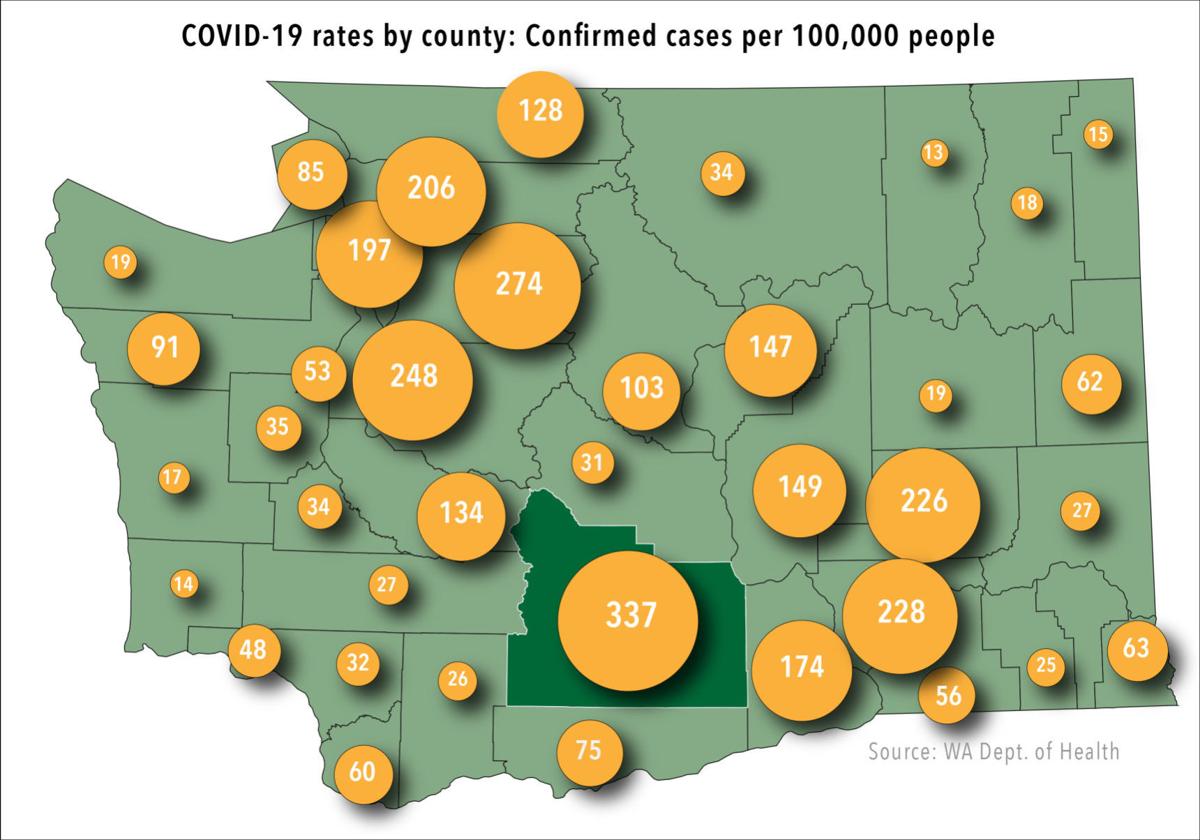
Yakima County has the highest rate of COVID-19 infections in the state by a significant amount, and is double the state average, according to state Department of Health data.

The county had a rate of 337 cases per 100,000 people, according to the latest state data, accounting for the 840 Yakima County cases recorded by the state as of midnight on Monday.

That’s significantly higher than the next highest county rate in the state, Snohomish County, which has 274 cases per 100,000 people. It’s double the state rate of 168 confirmed COVID-19 cases per 100,000 people.

Yakima County also has the second-highest rate of testing for COVID-19 in the state after Snohomish County, according to Yakima Health District spokeswoman Lilian Bravo.

As of Tuesday evening, Yakima County had 886 confirmed cases of COVID-19, including 38 deaths, according to the Yakima Health District. Twenty-five people were hospitalized with the respiratory virus. The health district did not provide updated numbers Wednesday due to technical difficulties.

Map released

On Tuesday, the health district released a map showing the breakdown of confirmed COVID-19 cases among residents in each city and town in Yakima County.

The health district map shows where community members infected with the virus live, not where they contracted the virus, said Bravo. Community members can contract the virus from anywhere in the community, she said — not just areas with higher rates of residents with confirmed cases.

The health district mapping is based on COVID-19 cases per 100,000 population, not actual case numbers in each town or city. Cases in long-term care facilities, which account for about a third of cases in the county, were not included in the map to prevent the data from being skewed. P.O. Box addresses were also excluded.

High densities of cases can be seen in parts of Yakima, Sunnyside, Toppenish, Wapato and Tieton, among others.

The high case rate in the county compared to elsewhere in the state can be attributed to outbreaks in long-term care facilities, as well as the high proportion of essential workers in Yakima County, Bravo said.

Cases at seven Yakima County long-term care facilities make up 25% of the county’s total cases.

Essential workers

About 72,700 of 115,000 Yakima County jobs, or 63%, are in essential industries like agriculture, health care and wholesale trade, according to job figures from the first quarter of 2018 provided by the Yakima County Development Association.

This compares to 54% statewide.

“Context is that over 60% of jobs are still considered essential in Yakima, so we’re not as shut down as some areas in the state,” Bravo said. “Having more individuals still working, not necessarily always being able to work from home, having to show up to work — that’s going to put them at a higher risk of infection.”

Yakima Health District map of infection rates

Liberty Blitzkrieg: The Future Must Be Decentralized and Localized

Michael Krieger at Liberty Blitzkrieg has written The Future Must Be Decentralized and Localized in order to explain the alternative to our current, authoritative, decidedly non-democratic system of government.

…From my perspective, humanity remains stuck within antiquated paradigms that generally function via predatory and authoritarian structures. We’ve been taught — and have largely accepted — that the really important decisions must be handled in a centralized manner by small groups of technocrats and oligarchs. As a result, we basically live within feudal constructs cleverly surrounded by entrenched myths of democracy and self-government. We’d prefer to be lazy rather than take any responsibility for the state of the world.

We’re now at a point where simply recognizing current structures as predatory and authoritarian isn’t good enough. We require a distinct and superior political philosophy that can appeal to others likewise extremely dissatisfied with the status quo. My belief is humanity’s next paradigm should swing heavily in the direction of decentralization and localism.

Decentralization and localism aren’t exactly the same, but can play well together and offer a new path forward. The simplest way to describe decentralization to Americans is to look at the political framework laid out in the U.S. Constitution.

As discussed in the 2018 piece, The Road to 2025 (Part 4) – A Very Bright Future If We Demand It:

At the federal level, a separation of powers between the three branches of government: the legislative, the executive and the judicial was a key component of the Constitution. The specific purpose here was to prevent an accumulation of excessive centralized power within a specific area of government…

Beyond a separation of powers at the federal level, the founding founders made sure that the various states had tremendous independent governance authority in their own right in order to further their objective of decentralized political power.

Localism takes these Constitutional ideas of political decentralization and pushes them further, by viewing the municipality or county as the most ethical and logical seat of self-governance. The basic idea, which I tend to agree with, is that genuine self-government does not scale well. A one-size fits all approach to governance not only ends up making everyone unhappy, it also entrenches a self-serving political and oligarchical class at the top of a superstate which makes big decisions for tens, if not hundreds of millions, with little accountability or oversight. This is pretty much how the world functions today.

While localism implies relative political decentralization, decentralization is not always localism. One of the best examples of this can be found in bitcoin. Unlike traditional monetary policy, which is handled in a topdown manner by a tiny group of unelected technocrats working on behalf of Wall Street, there’s no bitcoin politburo. There’s no CEO, there’s no individual or organization to call or pressure to dramatically change things out of desire or political expediency. The protocol is specifically designed to prevent that. It’s designed to operate in a way that makes all sorts of people uncomfortable because they’re used to someone “being in control.” We’ve been taught that centralization works well, but the reality is political and economic centralization concentrates power, makes the public lazy and ultimately winds up in a state of authoritarian feudalism.

Bitcoin also demonstrates how decentralization and localism, though not quite the same, can complement one another well in an interconnected planet. Imagine a world where governance is largely occurring at a local level, but global trade remains desirable. You’d want a politically neutral, decentralized and permissionless money to conduct such transactions. Similarly, a free and decentralized internet allows the same sort of thing in the realm of communications. Regions that can’t grow coffee will still want coffee, and people in New York will still want to chat with people in Barcelona. Decentralized systems allow for the best of both worlds — localism combined with continued global interconnectedness… (continues)

Click here to read the entire article at Liberty Blitzkrieg.