Daily Chronicle: Gun Owners Still Confused About I-1639

It’s too late to vote on I-1639; it already passed. Although the definition of “assault rifle” in 1639 is ludicrously broad, only the pink rifle in the photo above meets the definition — a kids .22lr rifle.

From The Daily Chronicle, Gun Owners Still Confused About I-1639; Sheriff’s Office Is Buried in Background Checks. Initiative: Local Gun Shop Owners Say Education on Law Is Needed, Say Law Hurts Business

On July 1, 2019, I-1639 took full effect in the state of Washington. Seven months later, Shoni Pannkuk, co-owner of The Man Cave Outfitters in Downtown Centralia, says the news of I-1639 and the new process that comes with obtaining a firearm still catches some of her customers off-guard. 

“The number of, which was astounding to me, the number of customers we have, who are obviously gun enthusiasts, hunters, concealed carry, whatever, that have absolutely no idea what I-1639 was and the impacts that it now has,” Pannkuk said. “We get often (from customers) like, ‘I didn’t have to do this before, what do you mean I have to do this.’ I’m like, ‘Yeah, that passed, it was effective July 1.’” 

According to the Washington Attorney General’s Office’s website, buyers have been required to go through, an “Enhanced background check and waiting period requirements for the purchase or transfer of semiautomatic assault rifles.” In addition, those looking to purchase a firearm after June 30, 2019 are required to have passed a “recognized firearm safety training program” within the last five years. It’s also the dealer’s responsibility to verify that a buyer has completed a course. 

The law also states that the training “must be sponsored by a federal, state, county or municipal law enforcement agency, a college or university, a nationally recognized organization that customarily offers firearms training, or a firearms training school with certified instructors.” Pannkuk still feels that verifying the legitimacy of a customer’s training can be ambiguous for the business.

“I can print up a certificate right at home that says I’ve completed it,” Pannkuk said. “I don’t know if the school on (the certificate) is a valid school, I mean, I don’t know.” 

Pannkuk also said she brought up the question regarding verification of the training course at a public hearing with the Washington Department of Licensing right around the time I-1639 was implemented. She said nobody had any answers.

When the law was implemented, Pannkuk described it as an instant change with “little to no guidance.”

“It was July 1,” Pannkuk said. “Here it is, here’s the law. It was terrible, which is why we went to the Department of Licensing. Like ‘What do you expect? Are we required to manage these training (sessions)? Am I required to authenticate them?’”

From Pannkuk’s perspective, the logistical impact of I-1639 is what has hit businesses the hardest. 

“(I-1639) has completely changed how we do the firearm sales,” Pannkuk said. “So, the mandatory 10-day wait that comes with any purchase of a semi-automatic rifle, requires the business, me, the owner, to monitor that. I have to now, A. figure out what jurisdiction you live in, not everybody knows that, surprisingly, you might think you’re in Lewis County, but maybe you’re in city limits. I don’t know that, there’s no database that tells us that information, but that’s where we have to send (the request for background), to your local jurisdiction. We guess, sometimes, if the customer doesn’t know, right, we’re going on what they say.”

Pannkuk added that beyond figuring out where to send those requests, she’s also in charge of sending each of them individually to the correct local jurisdiction...

“How do we get people to vote,” Hobe Pannkuk said. “That was the big issue, a lot of these people that came in that had no idea what I-1639 was, didn’t vote. That’s why it passed.”

Click here to read the entire article at The Daily Chronicle of Lewis county.

Organic Prepper: Thinking about US Quarantine Effects

In this article at The Organic Prepper, Daisy Luther and Selco Begovic think about what kind of effects a strict quarantine in the US might have if it is as severe as the quarantines currently in effect in China. The WHO has suggested that up to half the world population could be infected if the virus isn’t contained. Early studies suggest that the coronavirus has a fatality rate of around 2.3%. If half the world catches it, that’s approximately 100 million fatalities. If half the US population gets infected, that’s around 5 million US fatalities. There is a lot to think about on how that many fatalities and that number of sick people would affect your work, government services, private services, and everyday life.

How long do you think a pandemic quarantine could go on with power, running water, the internet, and trash pick-up continuing to run as normal?

If Covid-19 (also known as the Wuhan coronavirus or nCoV-2019) were to spread where you live as it has in China, it’s possible that extreme measures could be taken. Possibly even a China-style lockdown, where people are told to stay in their homes and where businesses are closed. I’m referring to something much more extreme than just a handful of us self-isolating. 

While I certainly hope such a situation is unlikely, it’s something we should all consider a possibility and get  prepared for, just in case. Considering whether or not this would be an off-grid scenario would play an extremely important part in your preparations.

Selco and I had a very interesting chat about this after I’d raised the point in a group discussion. I thought you might be interested in our thoughts. Of course, there’s no way to know exactly how this might go down, so it’s pure speculation on our part based on the research of similar situations, knowledge of our systems, and personal experiences.

Would we have utilities and services during a quarantine scenario?

…A lot of things are automated, which makes me believe we could potentially have a month or two of relative normalcy with regard to utilities, even if folks aren’t going to work. Garbage pickup would be another matter.

First things first, electrical power, natural gas, water, and the internet could run a long time automatically or with just a bit of input from someone on a computer. A pandemic isn’t going to fry our circuitry like an EMP would, for example. There’s nothing general-infrastructure-wise that would immediately compromise these utilities.

But this assumes that everything besides the pandemic is smooth sailing – that we won’t have any tornadoes, any hurricanes, any blizzards, any earthquakes, unfortunate bolts of lightning, or accidents. And it also omits manmade problems like riots that damage the infrastructure or even deliberate sabotage.

In a full-on pandemic, there’s likely going to be nobody to go out there and repair potential damage. And it’s possible that even if people were willing, they might not have access to the necessary supplies or equipment if these are items that they get on a “just-in-time” basis.

As for water, it could run for a long time but it might not be safe to drink. We’d need to be alert that there’s nobody there testing the tap water and adding chemicals. I don’t love chemicals like fluoride in my water but I do love essential chemicals better than I like amoebic dysentery and shigellosis and cholera. That being said, even if the water wasn’t drinkable right from the tap, it would certainly make life easier if folks not on septic systems could still flush their toilets, and water could be purified in a multitude of different ways

A good question is what would happen with electric power and all other utilities once the SHTF.

And yes answer is not simple. It is based on type of event and severity of the event, but I think we can have some good guesses about it.

UtilitiesPower, running water, communications (internet, cell phones…) and similar utilities up to waste management in all modern societies are brought to an advanced level of functioning.

All that is so “modernized” in a way that most of us usually do not notice or actually do not care how it is being delivered to us. People don’t care how these things work.

I also do not know in depth how all that works, but I know that most of the utilities today are being brought to us in a very automated and interconnected way.

So, as a result, it works good, until it does not.

I think the price for that is the fact that when ONE thing goes out soon another thing will go out too. Even if something goes out FAR from you, it may still mean it easily may go out at your home.

Maintenance

Do not forget, things (services) no matter how modernized need to be maintained, so, if there are no people around to do maintenance, services will not work.

It depends on how bad the event is, and the control the government has over the event, and the society in which the event happening. It is a question of are people gonna be there to maintain services.

As an example, if some serious event is happening, are people willing to go maintain services or they are more willing to go home and protect their loved ones? They are all just humans, do not forget.

People

Also, if there is still a system functioning, the government or some kind of system, does it have enough power to FORCE people to maintain services? People will want to go home to their families.

The important fact is: if the event happening here is serious enough to bring problems to utility services, it is probably serious enough to make other services like the police force or medical services no longer working. So, as a result, the security situation will be deteriorated, so that is another obvious reason why people would want to be more with their families instead of at their job.

A deteriorating situation with utilities will usually go with a deteriorating situation in behavior between people, so it is not like our only problem will be city services and everything else will be fine at home (and safe)…

Click here to read the entire article at the Organic Prepper.

WA 8th Leg. Dist. Town Hall, Feb. 22, 2020

From Rep. Bill Jenkins:

Dear Friends and Neighbors,

I’ll be co-hosting a town hall event with my fellow colleagues from the 8th Legislative District – Reps. Brad Klippert and Matt Boehnke, and Sen. Sharon Brown – in Richland.

This Saturday, Feb. 22 is your opportunity to discuss with us your opinions, concerns and questions about the legislation being debated in Olympia. We will begin the event with a brief legislative update on the 2020 session and then dive into our Q&A session. There’s a lot going on and we want to hear from you! We hope you will join us.

Details include:

Date: Saturday, Feb. 22
Time: 10:00 – 11:30 a.m.
Location: Richland Community Center
Address: 500 Amon Park Dr., Richland, WA 99352

If you cannot attend the event, or would like to submit a question or comment beforehand, please contact my office.

I look forward to seeing you on Saturday!

Sincerely,

Bill Jenkin

Forward Observer: Coronavirus & the Area Study

Intelligence analyst Sam Culper of Forward Observer has a few thoughts relating to coronavirus and what you might think of related to your area study.

News from China over the weekend shows that 760 million people are on some form of lock down or quarantine as the government tries to contain the spread of Coronavirus. That’s three quarters of a billion people.

In other words, over half the entire country is being told when they can leave their homes and for how long.

Last night, my wife and I started watching a documentary series on Netflix called Pandemic, in which American pathologists repeatedly say that we’re not prepared for a pandemic in America.

Pathologists continually say that it’s not a matter of “if” but a matter of when.

Most striking to me was when a physician warned that a slight mutation that resulted in a novel strain of highly lethal influenza, swine flu, or avian flu could end up killing millions of people.

My thoughts then went to second- and third-order effects:

What happens if a virus affects farm workers?

What happens if food delivery stops?

What happens if large cities or rural areas are quarantined?

What happens if pathologists discover that the virus can be or is being spread through the pipes carrying our drinking water?

And that brings my thoughts to my own level of preparedness, and specifically to my Area Study.

We build an Area Study so we can better understand our neighborhoods, who lives there, what fault lines it has, where we’re vulnerable, and what conditions could develop during an emergency.

For those of you building an Area Study, here are some pandemic considerations:

1. What medical facilities nearest to me will handle patients infected by a pandemic disease or virus?

2. How well staffed and supplied are those hospitals? In other words, how many patients can the facility house and treat, and how long can they respond before they encounter constraints on resources? (One of the limiting factors in China is that some areas have run out of Coronavirus test kits.)

3. Every county in America should have an emergency operations action plan. Have they considered a pandemic and what are their plans to respond to one? (Ask your local county officials where you can find the county’s emergency action plan. Or start with an online search: “[My County] Emergency Action Plan” I found my county’s plan via the web.) What facilities in the area might be used to treat patients that can’t fit in the hospital?

4. What are the second- and third-order effects of a pandemic? How long can my neighborhood/area function if placed under quarantined? If the virus isn’t in my area, how can I know if people are escaping the quarantine in surrounding areas (as has happened in China)? Will an outbreak or quarantine cause a mass migration? If so, how will that affect me?

I’ll be doing some research into how we can add a pandemic annex to our Area Study and what information should go into it.

In the meantime, if you have any specific considerations that you’d like to share, please let me know. You can add a comment to this post and I can include your input when I send out the next email on pandemic preparedness.

Related:

Forward Observer: An Introduction to the Area Study

Forward Observer: Area Study Part II

Presidents Day

From Wallbuilders

Presidents Day

American Exceptionalism — and Our Responsibility to Preserve It

presidents-day-1America is a blessed nation. We enjoy a level of political stability,  creative innovation, and national prosperity unknown by any other country in the world. Our uniqueness has been affirmed by presidents across the generations — as when President Thomas Jefferson said:

[T]he comparison of our government with those of Europe is like a comparison of heaven and hell.

President Calvin Coolidge identified God and His principles as the reason for the difference:

presidents-day-2[T]he authority of law, the right to equality, liberty, and property under American institutions, have for their foundation reverence for God. If we could imagine that to be swept away, these institutions of our American government could not long survive.

President Herbert Hoover acknowledged that the intangibles were the key:

presidents-day-3Th[e] unparalleled rise of the American man and woman was not alone the result of riches in lands or forests or mines; it sprang from ideas and ideals, which liberated the mind and stimulated the exertion of a people.

Our founding documents embodied this “reverence for God” and the “ideas and ideals” that were the product of that respect. Understanding this, President Harry Truman warned:

presidents-day-4The Constitution and the Declaration of Independence can live only as long as they are enshrined in our hearts and minds. If they are not so enshrined, they would be no better than mummies in their glass cases, and they could in time become idols whose worship would be a grim mockery of the true faith. Only as these documents are reflected in the thoughts and acts of Americans can they remain symbols of a power that can move the world.

This year, we have an opportunity to preserve the great God-given ideals articulated in our nation’s founding documents. We can vote for a president (and other leaders) who fully embrace a respect for God and His principles, and the ideas that flow from Him.
presidents-day-5The Scriptures remind us in Proverbs 14:34 that “Righteousness exalts a nation, but sin is a reproach to any people.” Our Founding Fathers often repeated this verse, as did leaders across subsequent generations. Our first concern as a Christian voter is therefore not our pocketbook or the economy but rather whether a candidate will advance policies upholding Biblical standards of righteousness.

Make sure you keep these values foremost as you vote in your state’s primary election, and then again as you vote in November to choose our next President. (If you need more information about voting, including registering to vote, or if you want to see voter guides, please visit Christian Voter Guide.)

On this Presidents Day — and with a presidential election directly in front of us — let’s remember the words of President George Washington and make sure that his concern does not become a reality in our generation:

presidents-day-6No country upon earth ever had it more in its power to attain these blessings than United America. Wondrously strange, then, and much to be regretted indeed would it be, were we to neglect the means and to depart from the road which Providence has pointed us to so plainly; I cannot believe it will ever come to pass.


American Partisan: Using Encryption with Veracrypt

This practical article from American Partisan discusses the use of the program Veracrypt to encrypt data in files and hard drives. While the lead of the title is “Clandestine Communications,” there are many reasons that you might want to use Veracrypt encryption in your day to day life. I have used it in a legal setting in order to encrypt an attorney’s sensitive trial files to take them between the office and the court room. You can use it to safely store a password file. At home, you can use it to securely store photocopies of your credit cards, social security cards, firearm serial numbers, birth certificates, passports, banking information, or any other information that you want to have available, but not just sitting where it can be stolen or hacked. For preppers, you can take that same encrypted file of your important information and put it on a USB drive and toss it in your bug out bag or a vehicle Go-bag so that if you have to leave home because of a fire you’ve got all of that vital information gathered already.

Clandestine Communications Part Four: File and Hard Drive Encryption with Veracrypt is a pretty simple overview of getting started with using Veracrypt software. Veracrypt is a free (free as in no cost), open-source (free as in liberty) software program. Because it is open source, the source programming code is freely available for viewing so that the software can be audited for security holes and backdoors. You can use Veracrypt to encrypt an entire drive, or you can create a volume which looks like a file to your computer which you can then mount as its own drive. There are also other more advanced features.

Today’s article is going to talk a little bit about how to use Veracrypt in order to encrypt both a file volume and a flash drive. Veracrypt can be downloaded from here.

Once you install the program, let’s take a look at what it looks like.

I recommend you spend some time in the Help menu – particularly in the ‘User’s guide” and “Beginner’s Tutorial”.

Veracrypt can encrypt your files in a few different ways. The first way is creating a volume. The volume is almost like a file itself – it can be copied, pasted, etc. It acts, in a way, like a super secure .zip file (without the file compression). The second way you can encrypt your files is by encrypting an entire hard drive or flash drive. This method in particular could be useful if you were using a dead drop system to pass a One Time Pad as you could buy a lot of inexpensive flash drives, encrypt them, and then use them in your drops.

Veracrypt also has a really cool future that I may touch on in a later article called Hidden Volumes. Basically, this creates a volume within a volume, and each volume has a separate password. This could be useful if you are forced to open the volume at gun point. The idea is that in the outer volume you have some sensitive looking documents but not the actual files you want to encrypt. If you were forced at gunpoint to open the volume, your actual files would be safe (since they use a different password). This may be something that many of you are interested in.

Volumes

To create a Volume, click on the “Create Volume” button in the lower left of Veracrypt. Here, a menu gives you some options. For now, we are going to stick with the default option of “Create an encrypted file container”. The second option is used for encrypting flash drives or external hard drives, and the third option is for encrypting the hard drive that runs your Operating System. Click Next.

Here, we have the option of creating a Standard Volume or a Hidden Volume. Since we are just starting out, make sure Standard Veracrypt volume is checked and hit Next. Now it is time to decide where we want the Volume to be. Click “Select File”. To make it easy, navigate to your desktop. In the “File Name” line, name your file. Click Save and then Next.

The next screen is where you can chose what type of encryption you want to use. I will leave it up to all of you to figure out which one is best (to be honest, I don’t really understand the differences so I am not going to give you a recommendation – if you do, throw it in the comments). Once you do, click Next.

The next screen is where you get to decide how big you want the file to be. For this example, I am going to go with 1 GB but you can choose whatever you want (think about what you are wanting to store in it and use that as a guide). Once you decide, click Next.

This screen is where you create your password. I have two rules for you to follow: 1) use numbers, letters, and symbols, and 2) use capital letters and, if you want, spaces. A great way to get a strong password is to use a password manager like KeePassXC. I actually don’t have one set up yet, so I will be doing a future article on how to do that as well. You can also use keyfiles, which is like selecting a few different files you already have to use them as the password. It is not my favorite way of doing it, but YMMV. Once you have your password entered, click Next.

The next screen is very important. You are choosing both the filesystem you want and generating the random pool to make your encryption stronger. I generally tend to use an NTFS system because FAT filesystems don’t like files over 4 GB, but again do your research and choose the filesystem you want. Then, move your mouse as random as possible inside the window. You will see tons and tons of characters in the “Random Pool area. Do this for at least 60 seconds, but the longer the better. Once you are done, click Format.

Once the formatting is done, it is time to mount your file. Go back to the first window that appeared when you started Veracrypt. Now, click on Select File on the bottom right. Navigate to your file and select it, and then select Mount. Enter your password, and select OK. Once the file mounts, you can go into Windows Explorer. You will notice in your hard drive list under “Computer” on the left hand side, there will be a new hard drive. In my case, it is Local Disk (J:) as we can see the size is 0.99GB. You can now click on that and copy your files in! In order to dismount the volume, just select it again on the main screen of Veracrypt and click “Dismount”.

Flash Drive / External HDDs

To encrypt a flash drive, begin once again by clicking “Create Volume”. This time, select the middle option of “Encrypt a non-system partition/drive”. Click Next, and you see that once more we have the option of creating a Hidden or Standard volume. For this, I am creating a Standard Veracrypt Volume. Click Next.

Now, instead of creating a file, you are selecting the flash drive or hard drive you want to encrypt. Once you select your drive, click OK. You are given two options for the Volume Creation Mode. The first one is for when you have no files on the drive and want to encrypt it more quickly. If you choose this option AND you have files on the drive, they WILL be overwritten and lost. If you have files on the drive and you cannot or do not want to take them off, chose the second option, “Encrypt partition in place”. I have never used that second option because I am terrified something will go wrong and I will lose my files, but YMMV. Make your selection and click Next.

Just like creating the volume, select your encryption algorithm and click Next. Verify that the size on the screen is really close to the size of the drive you want to encrypt (in this case, my flash drive is 4 GB in theory and in the above picture we see it is 3.7 GB, which matches closely below which says 3.65 GB). If it is really off, go back and make sure you selected the right drive to encrypt – this is really important. Once you verify it is correct, click Next.

Once again, create your password (DIFFERENT FROM YOUR FIRST ONE – NEVER REPEAT) and click Next. The same rules from the Volume section apply to the password. Now choose your file type and click next (again, I personally use NTFS). Move your mouse around in the box again to random the Heading Pool and, once you are done with that, click Format.

In order to Mount the drive, you can select what letter drive you want to mount the volume in and either 1) Click “Auto-Mount Devices”, type in the password, and click OK, or 2) Click “Select Device” and choose the device on the screen. Then, access the drive just like the volume and copy your files in!

References

https://securityinabox.org/en/guide/veracrypt/windows/

https://www.veracrypt.fr/en/Beginner%27s%20Tutorial.html

https://www.veracrypt.fr/en/Plausible%20Deniability.html

Rainier Redoubt: WA State Search and Rescue Competency Criteria

Rainier Redoubt has posted some summary information on the core competency criteria for volunteers who work search and rescue (SAR) teams throughout the state.

Click here to download the state document on the core competency criteria. (pdf)

Washington State has established Search and Rescue (SAR) Emergency Worker Core Competency Criteria for personnel who volunteer to work with SAR Teams throughout the state. The skills required of a SAR volunteer include both classroom knowledge and Field Performance Criteria.

The Field Performance Criteria required of SAR Team personnel are also an excellent skill set for anyone who hikes, camps, hunts, or otherwise spends time in remote areas. Below are some of the Field Performance Criteria from the WA State SARVAC Document.

Do you have these skills?

Survival Skills

1. Build a fire using materials found in the field and carried in a mission ready pack/kit. The fire must be constructed in a manner that will provide personal warmth; or team warmth; or warmth for a found subject for 8 to 12 hours (fire or stove – local regulations will be the guidance factor).
2. Indentify fuel for fire to provide heat and location identification for 12 to 24 hours, fuel sources must be from the field.
3. Heat and provide warm fluids to a team member and/or the found subject (fire or stove – local regulations will be the guidance factor).
4. Use any three (3) emergency signaling methods, plus one (1) emergency aircraft signaling method.
5  Deploy and erect a shelter that is well marked and visible to nearby searchers, durable enough to protect from wind, rain, or snow, using materials carried in a mission ready pack/kit and/or found in the field. Shelter must be sustainable for 12 to 18 hours for the SAR member, members, or subject.
6. Locate or identify alternate shelter (natural or other field sources of shelter).
7. The equipment needed for emergency pack/kit and describe their use (county specific list of equipment), the trainee will be asked to remove certain specified items and describe their use. (Reference county SAR field operations guide or county SAR specific protocol for equipment).
8. Tie three (3) basic knots of the five listed in the training.

Radio Communications

1. Identify the Push-to-Talk switch.
2. Identify the Channel/Frequency selector.
3. Change the radio’s batteries.
4. Turn the radio on select radio frequency as identified in the communications briefing (ICS 205).
5. Select the channel as requested by search command (frequency change).
6. Change radio channel or frequency to a predefined frequency.
7. Select state SAR frequency and a command and control frequency (either a county specific or state-wide incident command and control frequency – {i.e. OSCCR –V-TAC – V-CALL}).

Land Navigation

1. Orient a map, compensating for declination.
2. Use a scale to measure distance on a map.
3. Identify five elements of the legend on a topographic map.
4. Read contour lines on a topographic map and identify their relationship to physical objects on the ground.
5. Plot a bearing on a map.
6. Plot their location using a map and compass
7. Determine the bearing between two points and the back azimuth on a map.
8. Adjust for declination (compass).
9. Demonstrate the ability to take a bearing on a selected object, expressing it in both true and magnetic degrees (compass).
10. Plot a coordinate using the primary coordinate system in your area of operation (lat/long, UTM, National Grid).
11. Demonstrate the ability to navigate between four (4) selected points in your primary search area for a minimum distance of .5 mile (or 1/2 mile) with no more than four (4) degrees of deviation (using the appropriate tools, i.e. compass, map, GPS).
12. Demonstrate the ability to navigate around an obstacle blocking your selected path while staying on course (compass).

GPS Operation

1. Mark, edit, and delete a waypoint in a GPS receiver.
2. Change the batteries of a GPS receiver.
3. Change coordinate systems and datum with in a GPS unit.
4. Turn on a GPS and acquire a coordinate that accurately represents your location.
5. Set their GPS for True North

First Aid

1. Properly assess patient’s medical status within the scope of training.
2. Demonstrate 2 methods to control bleeding.
3. Demonstrate the method to immobilize a fracture of the upper and lower arm.
4. Demonstrate the method to immobilize a fracture of the ankle.
5. Demonstrate method to prepare a subject for litter evacuation.

Additional First Aid and Medical Accreditation Programs

First Aid / Emergency Medical – Programs Recognized – If the county chooses to use and implement these programs –  The list below is not inclusive, it is simply for reference.

  • First Aid American Red Cross (First Aid, CPR, BBP)
  • First Aid American Heart Association (First Aid, CPR, BBP)
  • American Red Cross – Wilderness First Aid
  • MOFA – American Red Cross Mountaineering Oriented First Aid
  • NOLS –  Advanced First Aid
  • NOLS –  Wilderness EMT
  • Wilderness First Responder (Approved Provider)
  • Wilderness EMT (Approved Provider)
  • Outdoor Emergency Care – National Ski Patrol

State Certified EMS Providers

First Responder / Emergency Medical Responder
EMT – B
Paramedic

Note First Aid  (FA), Blood Borne Pathogen (BBP), and Automatic Electronic Defibulator (AED)  classes need to be from a Washington State recognized, certified, and credentialed organization and/or provider.

Fr. John Peck: The World Is on Fire – Power of Ideology

The World is on Fire over at Fr. John Peck is in some ways specific to Orthodox beliefs, but addresses problems being seen in many Christian communities as the author points out. There is great pressure for people and institutions to conform to whatever the ideology of the day is. The author discusses what he sees as the negative consequences and the difficulty of even discussing, let along fixing, the problems.

I’m at a conference this weekend, with a bunch of academics. I spent a couple of rich hours tonight talking with old friends who teach at Christian colleges. I wish — do I ever wish! — that most of you could have been sitting in on this. These are professors who are on the front lines, and what they report ought to blast to smithereens the complacent piety of most older American Christians.

Pornography is destroying a generation. It really is. One of the profs told me that his female students can’t get dates. Young men aren’t interested in relationships. Those who do ask women out tell them at the outset that they (the women) have to be cool with their pornography habits. From what I gathered, we are dealing with a generation of males who are failing to become men. Slavery to sensory input from screens — porn and video games — is keeping them stuck at around age 14. These are young males who attend conservative Christian colleges. This is a problem so far beyond our usual categories that we can scarcely comprehend it.

We talked also about how wokeness is conquering even conservative Christian colleges. I like to think that I’m well informed about this stuff, but even I am shockable. I said to one Evangelical college prof,

“Most Catholic colleges are already lost. I get the idea that a lot of conservative Evangelical colleges are headed in the same direction.”

Said this man,

“Yes. We’re rushing in that direction.”

Agreement all around the table.

I won’t give details, because I don’t want to risk outing these professors. But trust me, this is everywhere. Pronouns, gender ideology, all of it. Being at a Christian school, even one whose identity is conservative, is no guarantee of anything. I’m serious. One of the professors I talked to had recently seen the Terrence Malick film A Hidden Life, about the anti-Nazi Christian martyr Franz Jägerstätter, which I saw this week, and absolutely adored. He too was blown away by the power of this film. We talked about how it was that Franz was the only one in his Christian village who understood exactly who Hitler was, and what Nazism was, and found the vision to grasp that, and to resist — even paying with his own life.

All of us talked about how difficult it is to read the times, and to resist the pressure to conform. You may be certain that even people who consider themselves devout, as did surely the people of Franz’s village, succumb to ideology. A different professor told me that his college’s senior administrators are good people, and faithful people, but they are blind to the power and the nature of ideology. They want to believe the best about others, a disposition that leaves them completely vulnerable to the attacks on the Christian core of the institution.

We talked further about how pervasive this is in churches too. I mentioned the recent case I highlighted on this blog, about an Orthodox parish priest who published an essay stating his “strong conviction” that the Church ought to bless gay Orthodox committing to each other as couples, and keeping their sex lives within those committed partnerships. This caused a big uproar — I wrote about it herehere, and here — and ended up with his bishop correcting him, and causing him to retract what he wrote.

Since I wrote about this case, I have received some highly critical e-mails from fellow Orthodox Christians who know the priest, and who are upset with me for being too hard on him. I don’t believe at all that I was too hard on this priest. You publish a scandalous opinion about a vital issue in the life of the church in One of the critics, himself a priest, said that the priest I criticized really had gone too far, and was imprudent in publishing. But, he said, a lot of the rhetoric attacking the priest was alarmist and vicious — I got the sense he included my writing in this criticism — and that the laity ought to calm down and trust the hierarchy to handle it.

Surely this priest is correct about the overheated rhetoric you see from Very Online Orthodox. I don’t read Orthodox blogs, because I can’t stand that kind of talk. It never leads anywhere good. It’s real easy for Christians of all kinds to cut loose behind the veil of anonymity with rhetoric they would never say publicly under their own names.

That said, in the main, I strongly disagree with this priest. I think there is a fundamental, and critical, failure on the part of many good-hearted clergy and laity to understand the nature and the seriousness of the crisis…

WA Policy Center: Bills Introduced to Ban Initiatives and Referendums in Odd Years

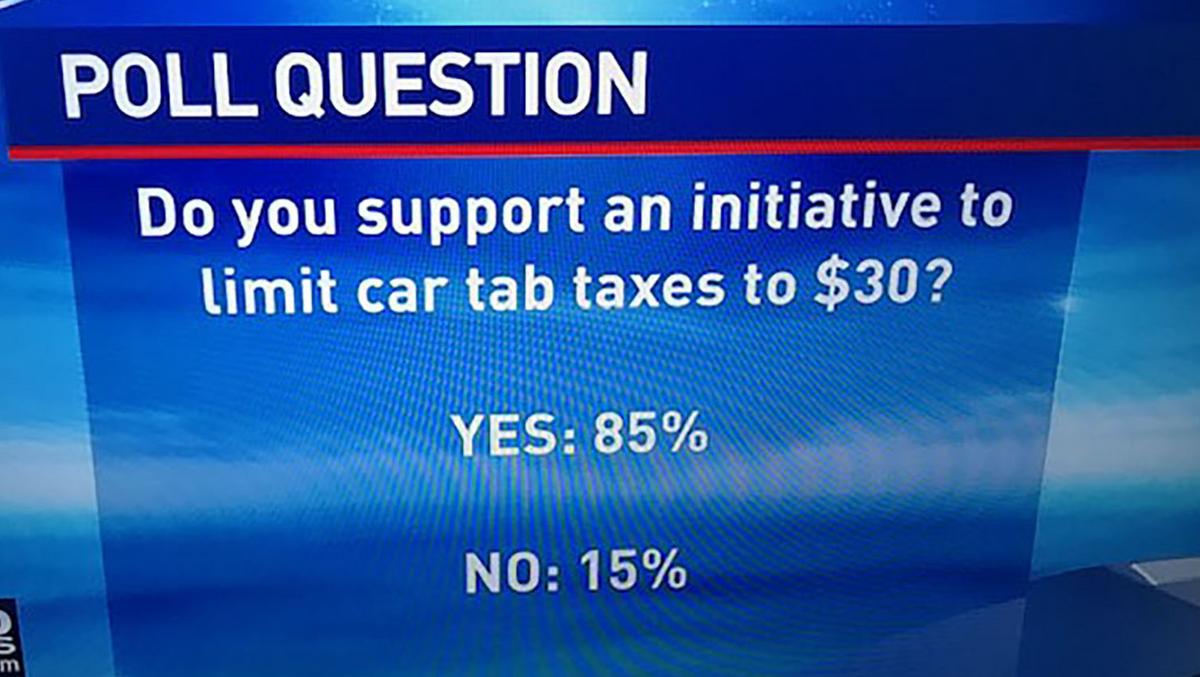
Politicians in Washington State have been so angered by the people’s approval of I-976, limiting one small section of taxation on vehicles, that they have introduced house and senate bills to limit voting on initiatives and referendums to only even numbered years. The bills in question are HB 2529 and SB 6503.

The Washington Policy Center sums up the bills:

Key Findings

  1. House Bill 2529 and Senate Bill 6503 would ban the people’s right to vote on initiatives and referendums in odd-numbered years.
  2. Bill sponsors say they want to ban the people’s right to vote on initiatives and referendums in odd-numbered years because of lower voter turnout.
  3. The bills, however, would still allow local government officials to hold special elections to raise taxes without restriction in all years.
  4. It is difficult to see why it would be acceptable to allow tax increases to appear on the ballot in odd-numbered years while denying Washingtonians their constitutional right to vote on initiatives and referendums in those same years.
  5. Testifying on the proposal, Secretary Wyman noted the bills would limit the people’s right of initiative and referendum and could add to voter fatigue by causing exceedingly long ballots.

Introduction

Two bills have been proposed that would prohibit the right of the people to vote on initiatives and referendums in odd-numbered years. Although House Bill 2529 and Senate Bill 6503 would ban the people’s right to vote on initiatives and referendums in odd-numbered years, they still would allow local government officials to hold special elections to raise taxes without restriction in all years.

Download file Download the full legislative memo here.

Related:

The Lens: Lawmakers propose to limit elections

WA-GOAL Legislative Update 2020-6

From the Washington Gun Owners Action League:

GOAL Post 2020-6
Legislative Update from Olympia 14 February 2020

GOAL POST POSTED ON WEB SITES
H FISCAL COMMITTEE CUT-OFF PASSES
FOCUS ON FLOOR ACTION
BILLS PASS HOUSE, SENATE
CHAMBER CUT-OFF NEXT WEDNESDAY
LIBRARIES OMITTED FROM SB 5434 PROHIBITION
NO GUN BILL HEARINGS NEXT WEEK… MAYBE
REPEAT: SUBMIT COMMENTS ON BILLS TO OLYMPIA

Given my continuing e-mail problems, GOAL Post is being posted on the Gun Owners Action League of Washington Facebook page, and in the legislative activity drop-down link at the top of the Washington Arms Collectors home page.

The fiscal committee cut-off passed earlier this week and three bills (HBs 2467, 2555, and 2622) moved from House Appropriations to House Rules, awaiting a floor vote.

Not quite four weeks left in the session… Next Wednesday (19 Feb) at 5 p.m. is the chamber cut-off – all House bills must pass out of the House or be considered dead for the session. Ditto all Senate bills out of the Senate. Then the policy committee hearing process starts on the other side. The focus between now and Wednesday will be on floor action, including likely weekend floor sessions. Monday is the President’s Day holiday – except in Olympia where all days are workdays.

Three bills passed out of the House (HBs 2305, 2467, and 2622). SB 5434 passed out of the Senate. The bills now shift chambers. Keep in mind there are seven bill EACH in the House and Senate awaiting a floor vote. Most will likely be passed before Wednesday’s cut-off.

Note that libraries have been removed from the original expanded gun free zone bill, SB 5434. Wonder why? Testimony from the public hearing on the bill last year: “Librarians have apprehension regarding the implementation of this legislation. The burden of enforcing this law would fall to librarians who do not have the expertise to enforce this issue and do not want the responsibility. Given statements that many sheriffs have made about I-1639, librarians are concerned that the sheriff would not respond if they asked for police assistance.”

Bottom line? You can’t pass a bunch of unconstitutional laws and expect people who have sworn an oath to uphold the Constitution to enforce them.

Note that Senate Law & Justice has several meetings next week, with bills addressed “to be determined.” These will likely be bills, including gun bills, passed by the other chamber before the chamber cut-off.

Can’t make it to Olympia? You can go to the following web site to submit your comments directly for any given bill. Just add the four-digit bill number (four numerals only, not HB or SB) right after …bill/ I can’t promise the comments will be read, but it’s YOUR opportunity to be heard. Be polite, be brief. And be firm. “Shall not be impaired” means exactly THAT!

https://app.leg.wa.gov/pbc/bill/(four digit bill number)

BILL STATUS/GOAL POSITION:

HB 1010 WSP destruction of firearms Senn (D-41) S. L&J OPPOSE
*HB 1068 Magazine restrictions Valdez (D-43) DIED OPPOSE
HB 1315 CPL training requirement Lovick (D-44) H. Rules OPPOSE
*HB 1374 Repeals state preemption of gun laws Macri (D-43) DIED OPPOSE
HB 1671 Confiscation of firearms Dolan (D-22) H. Rules NEUTRAL
*HB 2196 Raise standard for issue of a “red flag” order Walsh (R-19) DIED SUPPORT
*HB 2202 Exempts law enforcement from a/w training Klippert (R-8) DIED OPPOSE
HB 2240 Bans high capacity magazines Valdez (D-43) H. Rules OPPOSE
*HB 2241 Bans assault weapons and magazines Peterson (D-21) DIED OPPOSE
HB 2305 Expands firearm prohibition re: protection orders Doglio (D-22) PASSED H. OPPOSE
HB 2367 Self defense insurance Hoff (R-18) H. Rules SUPPORT
HB 2467 Centralized firearm background checks Hansen (D-23) PASSED H. NEUTRAL
*HB 2519 Ammunition background checks Walen (D-48) DIED OPPOSE
HB 2555 Background checks for “other” firearms Goodman (D-45) H. Rules OPPOSE
*HB 2569 Pre-trial detention for certain firearm offenses Wylie (D-49) DIED OPPOSE
HB 2622 Court order non-compliance, firearm surrender Kilduff (D-28) PASSED H OPPOSE
HB 2623 Firearm prohibition, certain offenses Walen (D-48) H. Rules OPPOSE
*HB 2767 Recreation shooting areas on public lands Blake (D-19) DIED SUPPORT
HB 2820 Firearms forfeiture/DV court order (correction) Klippert (R-8) H. Rules NEUTRAL
*HB 2925 Bans firearms on Capitol grounds and buildings Senn (D-41) DIED OPPOSE
HJR 4210 Pretrial detention for certain firearm offenses Wylie (D-49) H. Pub Saf OPPOSE

SB 5434 Expands gun free zones to day cares Wilson, C (D-30) PASSED S OPPOSE
*SB 6043 Self defense insurance Wilson, L. (R-17) DIED SUPPORT
*SB 6076 Bans assault weapons and hi cap magazines Kuderer (D-48) DIED OPPOSE
SB 6077 Bans high capacity magazines Kuderer (D-48) S. Rules OPPOSE
*SB 6161 Excise tax on ammunition Dhingra (D-45) DIED OPPOSE
SB 6163 Unlawful possession BEFORE conviction Dhingra (D-45) S.Rules OPPOSE
SB 6288 Office of firearm violence prevention Dhingra (D-45) S. Rules OPPOSE
SB 6289 Restoration of firearm rights Dhingra (D-45) S. Rules OPPOSE
SB 6294 CPL training requirement Saloman (D-32) S. Rules OPPOSE
*SB 6347 CPL validity seven years with training Wagoner (R-39) DIED SUPPORT
SB 6402 Use of a stolen firearm Rivers (R-18) S.Rules SUPPORT
SB 6406 Concerning firearms Wilson, L (R-17) S. Rules SUPPORT
SB 6584 Unlawful purchase of a firearm Zeiger (R-25) S.Rules SUPPORT
*SB 6673 Removes many existing firearm restrictions Fortunato (R-31) DIED SUPPORT

HB = House bill, SB = Senate bill. L&J = Law & Justice, CR&J = Civil Rights & Judiciary, PubSaf = Public Safety, HC = Health Care, H. K-12 = House Early education, Aprop = Appropriations, Fin = Finance, W&M = Ways & Means “S” before a bill number indicates Substitute (amended).

PUBLIC HEARINGS SCHEDULED:
None scheduled, but see note about from Senate Law & Justice about “to be determined.”

LEGISLATIVE HOT LINE: You may reach your Representatives and Senator by calling the Legislative Hotline at 1-800-562-6000. Toll free!!! The hearing impaired may obtain TDD access at 1-800-635-9993. Also toll free!!!

1-800-562-6000 TDD 1-800-635-9993

OTHER DATA: Copies of pending legislation (bills), legislative schedules and other information are available on the legislature’s web site at “www.leg.wa.gov“. Bills are available in Acrobat (.pdf) format. You may download a free version of Adobe Acrobat Reader from Adobe’s web site (http://www.adobe.com). You may also obtain hard copy bills, initiatives, etc, in the mail from the Legislative Bill Room FREE OF CHARGE by calling 1-360-786-7573. Copies of bills may also be ordered toll free by calling the Legislative Hotline at (800) 562-6000. You may also hear floor and committee hearing action live at http://www.tvw.org/ (you need “RealAudio” to do this, available free at the TVW web site).

By reading the House and Senate “bill reports” (hbr, sbr) for each bill, you can see how individual committee members voted. By reading the “roll call” for each bill, you can see how the entire House or Senate voted on any bill. The beauty of the web site is that ALL this information is available, on line, to any citizen.

Upcoming WAC gun show(s):
Monroe 28-29 March
Puyallup Pavilion 4-5 April

“The right of the individual citizen to bear arms in defense of himself, or the state, shall not be impaired, but nothing in this section shall be construed as authorizing individuals or corporations to organize, maintain or employ an armed body of men.”

Article 1, Section 24
Constitution of the State of Washington

Imprimis: The Roots of Our Partisan Divide

The following is a lecture adaptation of author and editor Christopher Caldwell published at Imprimis of Hillsdale College. Christopher Caldwell is a senior fellow at the Claremont Institute, a contributing editor at the Claremont Review of Books, and a contributing opinion writer for The New York Times. A graduate of Harvard College, he has been a senior editor at the Weekly Standard and a columnist for the Financial Times. He is the author of Reflections on the Revolution in Europe: Immigration, Islam, and the West and The Age of Entitlement: America Since the Sixties.

American society today is divided by party and by ideology in a way it has perhaps not been since the Civil War. I have just published a book that, among other things, suggests why this is. It is called The Age of Entitlement: America Since the Sixties. It runs from the assassination of John F. Kennedy to the election of Donald J. Trump. You can get a good idea of the drift of the narrative from its chapter titles: 1963, Race, Sex, War, Debt, Diversity, Winners, and Losers.

I can end part of the suspense right now—Democrats are the winners. Their party won the 1960s—they gained money, power, and prestige. The GOP is the party of the people who lost those things.

One of the strands of this story involves the Vietnam War. The antiquated way the Army was mustered in the 1960s wound up creating a class system. What I’m referring to here is the so-called student deferment. In the old days, university-level education was rare. At the start of the First World War, only one in 30 American men was in a college or university, so student deferments were not culturally significant. By the time of Vietnam, almost half of American men were in a college or university, and student deferment remained in effect until well into the war. So if you were rich enough to study art history, you went to Woodstock and made love. If you worked in a garage, you went to Da Nang and made war. This produced a class division that many of the college-educated mistook for a moral division, particularly once we lost the war. The rich saw themselves as having avoided service in Vietnam not because they were more privileged or—heaven forbid—less brave, but because they were more decent.

Another strand of the story involves women. Today, there are two cultures of American womanhood—the culture of married women and the culture of single women. If you poll them on political issues, they tend to differ diametrically. It was feminism that produced this rupture. For women during the Kennedy administration, by contrast, there was one culture of femininity, and it united women from cradle to grave: Ninety percent of married women and 87 percent of unmarried women believed there was such a thing as “women’s intuition.” Only 16 percent of married women and only 15 percent of unmarried women thought it was excusable in some circumstances to have an extramarital affair. Ninety-nine percent of women, when asked the ideal age for marriage, said it was sometime before age 27. None answered “never.”

But it is a third strand of the story, running all the way down to our day, that is most important for explaining our partisan polarization. It concerns how the civil rights laws of the 1960s, and particularly the Civil Rights Act of 1964, divided the country. They did so by giving birth to what was, in effect, a second constitution, which would eventually cause Americans to peel off into two different and incompatible constitutional cultures. This became obvious only over time. It happened so slowly that many people did not notice.

Because conventional wisdom today holds that the Civil Rights Act brought the country together, my book’s suggestion that it pulled the country apart has been met with outrage. The outrage has been especially pronounced among those who have not read the book. So for their benefit I should make crystal clear that my book is not a defense of segregation or Jim Crow, and that when I criticize the long-term effects of the civil rights laws of the 1960s, I do not criticize the principle of equality in general, or the movement for black equality in particular.

What I am talking about are the emergency mechanisms that, in the name of ending segregation, were established under the Civil Rights Act of 1964. These gave Washington the authority to override what Americans had traditionally thought of as their ordinary democratic institutions. It was widely assumed that the emergency mechanisms would be temporary and narrowly focused. But they soon escaped democratic control altogether, and they have now become the most powerful part of our governing system...

Continue reading at Imprimis by clicking here.

Alt-Market: Lessons Learned from Coronavirus So Far

Brandon Smith at Alt-Market has an article up detailing some of his own take-aways from the 2019 Coronavirus and response so far. This article deals less with the disease and more with government responses and future responses and how those responses may negatively affect liberty and sovereignty.

Every disaster contains a lesson or a message that needs to be examined. Every tragedy, no matter how terrible, should be absorbed into the public consciousness and adopted as a cautionary tale; a part of our mythos. These events should not be cast into the memory hole to make life less stressful, they need to be taken seriously. Otherwise, the damage done and the lives lost are all for nothing.

Refusing to examine the dark side of life and its dangers has become a staple of our society, to the point that it has given birth to a kind of religious cult. Naive optimism has become a virtue, a misplaced form of faith that encourages people to remain oblivious in the face of adversity. And the more precarious our system becomes, the more these people see unicorns and rainbows. It is truly bizarre.

Some of us understand the mechanics of our economic, political and social machine and recognize that they are broken. The system cannot be fixed because it has been corrupted by people with evil intent (globalists); it is designed to fail. The agenda? To crash almost everything and then replace it with a centralized behemoth, a global empire. The intent is to force the masses to accept this “new world order” using a false choice – We can have chaos and death, or “order” through total Orwellian control. Peace, sovereignty and freedom are not offered as choices.

As Richard N. Gardner, former deputy assistant Secretary of State for International Organizations under Kennedy and Johnson, and a member of the Trilateral Commission, wrote in the April, 1974 issue of the Council on Foreign Relation’s (CFR) journal Foreign Affairs (pg. 558) in an article titled ‘Hard Road To World Order’:

In short, the ‘house of world order’ will have to be built from the bottom up rather than from the top down. It will look like a great ‘booming, buzzing confusion,’ to use William James’ famous description of reality, but an end run around national sovereignty, eroding it piece by piece, will accomplish much more than the old-fashioned frontal assault.”

The answer offered to every disaster is always more centralization, even if centralization was part of the problem from the beginning. The coronavirus pandemic event will be no different.

As was hinted at during Event 201, a coronavirus pandemic exercise run by Johns Hopkins, the Bill and Melinda Gates Foundation and the World Economic Forum only three months before a REAL coronavirus outbreak took place in China, the goal will be to use the event to create a central economic authority to distribute resources to “counter the virus”. You see, the elites never let a good crisis go to waste.

But this plan requires complicity and apathy among the public. It requires our consent in order to work. For if we continue to undermine and resist it the globalists will never feel safe and secure. Like a cancer, they will eventually have to be cut out and removed if the system is to ever be truly fixed.

The pandemic might be an opportunity for the elites, but it is also a learning experience for the rest of us, and it might even bring some clarity to issues that have been hotly debated for several years. But what are some of these lessons?

Lesson #1: The Prepper Movement Was Right All Along

Over the past decade I have seen some extremely odd responses to the prepper movement, including a lot of aggression and hostility not to mention numerous hit pieces and hatchet jobs in the media. What is it about individuals being prepared for a potential crisis that sends so many snowflakes into a meltdown? Why do they care?

If you think that survivalism is all “conspiracy” and “doom and gloom” then why not ignore it like you ignore everything else? If preppers were wrong, then nothing happens, and all we did is spend some of our money on supplies that we will use anyway over time. No harm no foul. Yet, the mainstream acts as if the preparedness mindset is a criminal action that damages the rest of society.

Of course, as we can see from the coronavirus event in China, preppers were right all along. Almost every single potential problem we have warned about and written about over the years is now plaguing the Chinese citizenry, and most of these problems could have been solved by prepared citizenry…

Lesson #2: Supply Lines Will Be Damaged Or Restricted

As noted above, preparedness is the first step to solving most problems, because most crisis events tend to result in similar consequences. In China, food and other goods are being rationed and supply lines in some areas are shut down completely. The only option is to have what you need BEFORE a breakdown occurs…

Lesson #3: Never Trust Government

All governments lie. They will claim they do this to “protect us from ourselves” and to “avoid panic”, but politicians and elites do not care about this. They do not lie to protect society, they lie to maintain power and control, and sometimes, they lie because they want to keep the public docile and vulnerable. For, the more inactive and vulnerable we are, the more dependent we will all be on them when disaster strikes.

The viral outbreak in China has thoroughly illustrated why governments cannot be trusted. China has consistently lied about the infection and death rate surrounding the coronavirus. Numerous health officials in China have leaked information indicating the threat is FAR larger than the government admits. Some of these brave people been punished or have died in the process of trying to warn the rest of the world…

Lesson #4: Expect The Virus To Eventually Arrive In Your Country

In the US, the argument from the apathetic crowd is that we only have 12 cases, so what is there to worry about? I would remind those folks that the ONLY people that have actually been tested for coronavirus in the US are people that have arrived specifically from China in the past few weeks, who are showing symptoms and who voluntarily bring up this fact to health officials.

This means that people who come from Singapore, Thailand or any other nation in Asia that has also been exposed to the virus have likely not been tested at all. With a dormancy period of two weeks (and according to some studies up to 24 DAYS), the coronavirus has no symptoms yet it can still be highly contagious…

Lesson #5: Enforced Quarantine Is Not Necessarily For Your Benefit

As I noted in my article ‘How Viral Pandemic Benefits The Globalist Agenda’, there are many times in which the establishment creates crisis events deliberately, or, they exploit natural crisis events to further their agenda. In the midst of a viral outbreak, most people given the proper information and warning would prepare.  They would stock supplies and self isolate (or group isolate if they are organized) until the infection burns out. But this is not what the establishment wants. They do not want people who are independent and self reliant during a disaster; they want people that are completely unprepared and dependent.

This is why they will continue to lie about the extent of the danger until it is too late…

Lesson #6: Expect Martial Law

If a viral outbreak spreads through the west, do not be surprised if martial law measures are implemented. If you live in a major city and you see or hear about checkpoints being set up, get out immediately. As we’ve seen in China, once the walls are put up you will not be able to get out.

Rural areas are less likely to be effectively locked down by authorities because it would require too many personnel to achieve this. Major population centers on the other hand will be easily cut off…

Click here to read the entire article at Alt-Market

WA Policy Center: King County Judge Upholds Most of I-976

From Washington Policy Center on the present fate of I-976 which passed in voting, but which state administration officials are fighting tooth and nail. I-976 put limits on motor vehicle taxes and fees and was supposed to take effect on Dec. 5, 2019, but has been on hold pending legal challenges.

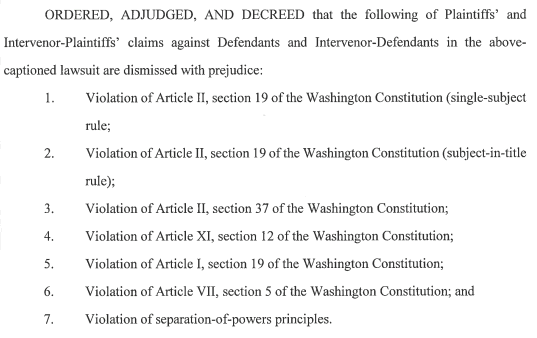
King County Judge Marshall Ferguson dismissed all but two constitutional challenges to Initiative 976 today.

Notably, he declared that the plaintiffs did not satisfy the burden of providing beyond a reasonable doubt that I-976 violates single-subject rule or subject-in-title rule, both in Article II Section 19 of the Washington Constitution.

The court noted the ballot title is “general, not restrictive.” The initiative broadly addresses motor vehicle taxes and fees in the title, and the court agrees that Sections 2-11 and 13 of the initiative directly address motor vehicle excise taxes.

The arguments given by plaintiffs that the initiative violates the subject-in-title rule also failed to establish a violation. The court asserted that per previous case law, an initiative ballot title “need not be an index to the contents, nor must it provide details of the measure.” The initiative’s ballot title provided “sufficient notice that the initiative repealed vehicle-related taxes and fees.”

Other constitutional violation claims that were thrown out include:

The two that remain, and are why the initiative remains on hold, are claims under Article I Section 12 and Article I section 23 of the state Constitution, “regarding [Kelley Blue Book] and Burien bonds.”

The first claim has to do with government using the private company Kelley Blue Book valuations, which are a proprietary product, to determine vehicle-related taxes. Plaintiffs argued that calculating car tabs based on Kelley Blue Book values would require the state to contract with the company and would “grant…special contractual privilege to a corporation,” which would violate Article I Section 12. Whether that is true requires additional discovery.

Interestingly, the state already uses Price Digests, as well as Kelley Blue Book and National Auto Dealers Association values for vehicles and boats to establish if they are worth less than the average fair market value. Surely this doesn’t require a contract between DOL and these various companies?

The second claim regarding the City of Burien pertains to whether I-976 could impair their municipal bond contracts, which may or may not depend on revenue from the city’s Transportation Benefit District vehicle fees. Additional discovery has to be conducted to determine if bond contracts would, in fact, be impaired.

While these two issues remain outstanding, the initiative remains on hold and people will continue to be charged high car tab taxes and fees. We anticipate there will be appeals and will continue to track this issue and its impact on the state transportation budget now being developed at the legislature.

Doom and Bloom: Epidemic Personal Protection Gear

The Altons at Doom and Bloom Medical have up an article discussing the various personal protection gear that a person would need to wear if caring for a highly contagious patient.

Having knowledge of infectious diseases and how to treat them is very important, but you’ll be more effective in preventing their spread by having some supplies. Which supplies? That all depends on the nature of the disease itself and the risk that the healthy population will be exposed to it.

Before you can be a successful caregiver and heal the sick in an epidemic, you must avoid becoming one of its victims. Viruses can be very contagious (like the airborne common cold) and have a low fatality rate. Alternatively, a disease may have a high fatality rate (like Ebola) and be less contagious (it’s not officially thought to be airborne). Rarely, a really infectious agent may be both very contagious and lethal (like The Pneumonic Plague in the Middle Ages).

In a truly virulent outbreak, healthcare providers are at serious risk. During the Ebola epidemic of 2014, being a medical worker was one of the principal ways to get (and die of) the disease. In 2020, the physician who first tried to warn the world of the coronavirus COVID-19 epidemic was, unfortunately, also one of its casualties.

Because of the risk to medical workers, strict protocols regarding what items a caregiver should wear are formulated and constantly modified based on new scientific evidence. A uniform way to to don (put on) and doff (take off) equipment is very important in safeguarding healthcare providers

PROTECTIVE GEAR TO WEAR

Here is what we think you should wear if you are taking care of a highly contagious patient. First, we’ll discuss which armor would give you the most protection. You should have…

•             Coveralls (with head and shoe covers; some come with hoods and booties built-in)

•             Masks (N95 or N100)

•             Goggles or face shields (to be used with, not instead of, masks)

•             Nitrile Gloves

•             Aprons

Shoe covers and built-in attached booties alone do not give you enough protection. Rubber boots should be worn and can be sanitized between patient encounters.

ABOUT FACE MASKS

N95 non-vented mask

Medical masks are evaluated based, partially, on their ability to serve as a barrier to very small particles that might contain bacteria or viruses.  Masks are tested at an air flow rate that approximates human breathing, coughing, and sneezing.  The quality of a mask is determined by its ability to tightly fit the average human face.  The most commonly available face masks use ear loops or ties to fix them in place, and are fabricated of “melt-blown” coated fabric (a significant upgrade over woven cotton or gauze)…

Click here to read the entire article at Doom and Bloom.


The Medic Shack: The N95 HEPA Mask