Wilder, Wealthy & Wise: Civil War 2.0 Weather Report

Here is Wilder’s latest Civil War 2.0 Weather Report at Wilder, Wealthy & Wise.

“If we can stop him, we shall prevent the collapse of Western Civilization.  No pressure.” – Sherlock Holmes:  A Game of Shadows

CLOCK

I liked the ticking of the clock I got from the pawnshop, but in the end it was a second-hand emotion.

  1. People actively avoid being near those of opposing ideology.  Might move from communities or states just because of ideology.
  2. Common violence. Organized violence is occurring monthly.
  3. Opposing sides develop governing/war structures.  Just in case.
  4. Common violence that is generally deemed by governmental authorities as justified based on ideology.
  5. Open War.

In the first issue of the Civil War Weather Report, I put together ten steps to a new civil war.  I did not expect that on the one year anniversary of that first report we’d move from step 6 nearly to step 9.  Step 9. is, of course, two minutes to midnight.

We are very, very close.  I debated internally more than a bit whether we were at an 8. or a 9. this month.  I finally decided to stay at an 8., despite multiple jurisdictions doing everything but arming the rioting faction of the protest movement with automatic firearms and bullhorns that make them all sound like Gilbert Gottfried.  It is clear we are at least an 8., and you will see in the graphs section that our Wilder Violence Index has reached new highs.

In this issue:  Front Matter – You Knew Where This Was Going – Violence and Censorship Update – Updated Civil War 2.0 Index – Balkans or Caesar Might Be The Best Case Scenario – Links

Welcome to Issue 12 of the Civil War II Weather Report.  These posts are different than the other posts at Wilder Wealthy and Wise and consist of smaller segments covering multiple topics around the single focus of Civil War 2.0, on the first or second Monday of every month.  I’ve created a page (Link) for links to all of the past issues.

You Knew Where This Was Going

The most popular posts on this site have been about the political state of the country.  The Civil War Weather Reports aren’t my usual form of post, but have proven to be very popular.  I’m sure it’s not just for graphs featuring bikinis.  Well, at least not only because of the bikinis.

I think the reason these posts are popular is simple:  many people could sense the fragile peak that it seems all of Western Civilization is perched on.  Whether it is a conscious review of the surrounding culture or just a feeling in the pit of the stomach when confronted with an outrageous news article, something’s just not right.  Society has been changing by increments over the years, but those changes are coming faster and faster and faster.

Claire Wolfe, the groundbreaking and iconic Freedom blogger said it very well at her place last week (LINK):

Each day I think I’ve processed the latest craziness enough to blog something coherent. Useful even. But then new waves of craziness wash over the world. I don’t know what to say. I can’t write good sense against the onslaught of the crazy. I don’t know how civilization is holding together under tsunamis of crazy.

But then, of course civilization isn’t holding together — and I’m not just talking about the one-two punch of totalitarian don’tleaveyourhouseism followed without pause by riotandlootallyouwantism.

Chains of rapid-fire events and chaos like this are not generally the friend of those that love freedom.  The Russian Revolution promised:

  • Peace, through ending World War I,
  • Food, because Communists are well known to produce excess food,
  • Land, whereby peasants would get parts of land owned by the wealthy,
  • Minimum wages,
  • Maximum working hours,
  • Running factories by elected worker representatives and
  • Lots of other promises.

In the end, up to 12,000,000 people (mainly civilians) died in the civil war that followed, and the promises that were made were largely ignored.  The Bolsheviks said and promised anything to get a force of disaffected behind them.  Not sure if this sounds familiar to AOC fans?

Hey girl, are you the French Revolution?  Because I keep imagining you sans-culottes.

I get a sense that the Left today is up to the same trick.  They’ve “created” media events and have managed them to get power – political power and power in the street.  Some of the Leftists may even be stupid enough to believe that there are magic economic levers that they can move to keep the promises they’re making.  In reality, they really don’t care:  it’s all about the power.

Lenin’s reintroduction into Russia and subsequent funding from foreign sources bring George Soros to mind.  Soros continually funds groups in the United States that are directly opposed to actual freedom.  The protesters and their associated rioters have a structure that has been funded and provisioned with everything from water and medical supplies to pre-staged bricks and gasoline.  Not saying that George is funding those directly, but . . .

More on that, below.

Violence and Censorship Update

No politician has ever captured the attention of the Left like Donald Trump.  They hated Reagan, and George W. Bush was famous for “stealing” an election.  But something about Trump drives them nearly crazy enough to try to get a job.  The media’s portrayal of Trump as the anti-ChristObama, perhaps?

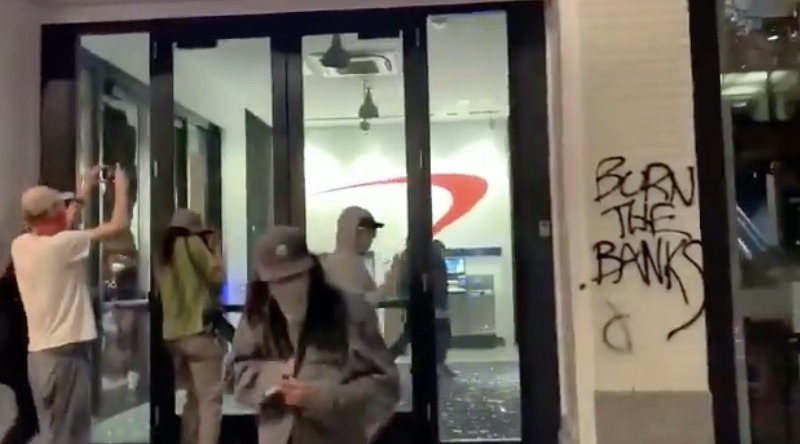
The violence, of course, is plain for anyone reading any news to see.  It’s not in just the United States:  these protests have been coordinated across nearly every Western nation.  If the protests had been confined to Minnesota, I could buy the idea that they were organic.  And to the extent that they are peaceful gatherings to seek political redress?  I celebrate them.

LOOT

It’s not looting, it’s just an involuntary clearance sale.

But to flash across the world with violence and destruction?  That takes amplification and organization and is clearly the seed of revolution against the West.

The amplification of the signal comes from both mainstream and social media.  Whereas the original death that started the protests was (rightly) exposed, the subsequent deaths of protesters, rioters, and innocent civilians hasn’t been mentioned much at all.  How many dead?

I’m not sure.  This should be a fairly easy number to get to, but I’ve seen numbers between 12 and 18.  Absent media tracking, I’m not sure how you’ll count them up.  If we wait long enough, I’m sure they’ll all be counted and attributed to COVID-19.  To add to the butcher’s bill, thousands have been injured.

Regardless, I have seen, at minimum tens of millions of dollars in damage.  I would expect the number to increase to hundreds of millions, at least.  A fire is, as I write this, blazing in downtown Phoenix.  Odds that it’s related to the rest of the violence?  Nearly 100%.

Censorship is on the rise, as well.  I already spouted off on that last week (Free Speech: Endangered Species – WRSA is Down) in response to Western Rifle Shooters Association being shut down (You Can Find Him Here).  I expect to see that it will be on the increase during the next six months – the election is too important to the Left to leave it in Biden’s hands – chances are good he might wander off to try to buy a rotary phone at Montgomery Wards™.

Updated Civil War II Index

The Civil War II graphs are an attempt to measure four factors that might make Civil War II more likely, in real time.  They are broken up into Violence, Political Instability, Economic Outlook, and Illegal Alien Crossings.  As each of these is difficult to measure, I’ve created for three of the four metrics some leading indicators that lead to the index.  On illegal aliens, I’m just using government figures.

May was again a difficult month.  I had to re-scale the graph on violence as this month nearly pegged every meter.  I will assure my faithful readers that I spent extra time this month finding just the right bikini-clad girl, since I want to at least reach the journalistic integrity standards of the Washington Post®.

Violence:…(continues)

The Organic Prepper: Unconventional Warfare in the US

Political warfare location within four implements of power

Daisy Luther of The Organic Prepper writes about the use of unconventional warfare techniques with the US recently in her article There’s an Actual Playbook for Everything Happening Right Now and the US Wrote It. But Who Is Using It Against Us? Some of this echoes themes written of by intelligence analyst Sam Culper of Forward Observer on low intensity conflict in the US, as you may have seen from articles of his that we’ve posted to this site.

While it might seem like everything that is happening is just chaotically bouncing from one shocking event to the next, that assessment couldn’t be further from the truth. There’s a playbook – a literal playbook – and we’re being manipulated toward the endgame that does not benefit the American people.

What’s the endgame?

Spoiler alert.

It’s widespread guerrilla actions and the destabilization of our country.

What’s this playbook?

The playbook I’m referring to in this article is the US Special Forces Unconventional Warfare Manual from 2010. These were methods that the United States military employed against Libya.

The intent of U.S. UW efforts is to exploit a hostile power’s political, military, economic, and psychological vulnerabilities by developing and sustaining resistance forces to accomplish U.S. strategic objectives. Historically, the military concept for the employment of UW was primarily in support of resistance movements during general-war scenarios. While this concept remains valid, the operational environment since the end of World War II has increasingly required U.S. forces to conduct UW in scenarios short of general war (limited war).

Enabling a resistance movement or insurgency entails the development of an underground and guerrilla forces, as well as supporting auxiliaries for each of these elements. Resistance movements or insurgencies always have an underground element. The armed component of these groups is the guerrilla force and is only present if the resistance transitions to conflict. The combined effects of two interrelated lines of effort largely generate the end result of a UW campaign. The efforts are armed conflict and subversion. Forces conduct armed conflict, normally in the form of guerrilla warfare, against the security apparatus of the host nation (HN) or occupying military. Conflict also includes operations that attack and degrade enemy morale, organizational cohesion, and operational effectiveness and separate the enemy from the population. Over time, these attacks degrade the ability of the HN or occupying military to project military power and exert control over the population. Subversion undermines the power of the government or occupying element by portraying it as incapable of effective governance to the population. (source)

And now this guideline is very clearly being used against the United States. It started years back, but recently, we’ve watched things escalate rather dramatically.

Here’s the guideline.

Consider this a pyramid that begins at the bottom and builds to the apex. This all begins with underground activities and the fanning of legitimate flames, like Selco mentioned in his article about defunding the police.

Does that stuff look familiar? It should because we’re more than three-quarters of the way through this escalation.

The causes are not unjust.

The thing that makes this technique so effective is that the causes themselves are not unjust. They are things that would rightly anger any reasonable, compassionate human being.

Most white people don’t want to see people of other races suffer indignities and violence based on the color of their skin. (I say “most” because there are always outliers and extremists.) Most Americans in general do not want to see police brutality. They don’t want to see families split up or people imprisoned for decades for victimless crimes.

Let me be perfectly clear when I say that it is not unreasonable or wrong to be outraged and want things to change. I hate some of the things I’ve seen our government and police officers do and have written about these misdeeds for years.

But this article isn’t about whether or not our anger is justified. It is an assessment of a playbook.

All of this outrage over injustice forms the foundation of something that can be used against us. The agitation has been building up for years – far longer than President Trump has been in office – so as much as people love to hate him, he isn’t the cause of all this. But he’s certainly not making things go any more smoothly.

An early timeline

Everything I’m writing about today is about how our government in the past has encouraged a resistance in other countries, and how a resistance is being nurtured here in the United States right now.

So what does it take to cause people to be angry enough to resist?

Resistance generally begins with the desire of individuals to remove intolerable conditions imposed by an unpopular regime or occupying power. Feelings of opposition toward the governing authority and hatred of existing conditions that conflict with the individual’s values, interests, aspirations, and way of life spread from the individual to his family, close friends, and neighbors. As a result, an entire community may possess an obsessive hatred for the established authority. Initially, this hatred will manifest as sporadic, spontaneous nonviolent and violent acts of resistance by the people toward authority. As the discontent grows, natural leaders, such as former military personnel, clergymen, local office holders, and neighborhood representatives, emerge to channel this discontent into organized resistance that promotes its growth. The population must believe they have nothing to lose, or more to gain. (source)

There can be more than one resistance going on at a time, too. Currently, everything that is in the news is about the resistance that has sprung up over the death of George Floyd. A few months ago, it was about the sanctuary cities in Virginia standing up against state legislators.

Resistance organizations have been around for years: Black Lives Matter, the NRA, Antifa, the Boogaloo movement, the Black Bloc, the Gun Owners of America. I’m just listing off examples of organizations here, not passing judgment whether they’re good or bad. I’ll bet that most people who join do so because of their own deeply held beliefs. They sincerely feel they’re doing the right thing and have the best of intentions.

But then there are the other people who join – the infiltrators – and they take these kinds of organizations to dark places. Much has been written about the involvement of the Communist Party, neo-Nazis, George Soros, and white supremacists in various groups. And while some of it may be the stuff of legends and propaganda, a lot of it is very likely to be true…(continues)

Liberty Blitzkrieg: Resist the Crazy

Michael Krieger at Liberty Blitzkrieg writes about how elites try to divide the people in order to maintain power, and how you must keep your mind guarded to resist such efforts in Resist the Crazy.

Where’s evil? It’s that large part of every man that wants to hate without limit, that wants to hate with God on its side. It’s that part of every man that finds all kinds of ugliness so attractive – it’s that part of an imbecile that punishes and vilifies and makes war gladly.

– Kurt Vonnegut, Mother Night

As things felt like they were spiraling out of control last week, as Americans and people around the world were inundated with endless videos of street violence in addition to reactionary calls to deploy the U.S. military to cities across the country, the temptation to lose control of one’s mental faculties and basic humanity was heightened.

I saw evidence of this all around me. There was a dark and vicious energy in the air, and it felt contagious.

The responses to the tweet above were encouraging and demonstrated many others sensed the same thing and were likewise troubled by it. The overall madness of last week reminded me of the months following Donald Trump’s election. In both cases, the worldview of large numbers of people was shaken to its core. I think the root cause of the breakdown in both instances was that many people’s model of what is “normal” was suddenly shattered.

For example, the idea of Donald Trump being elected president was so incomprehensible and concerning to so many, they completely lost it when he won. Likewise, images of American cities burning amidst widespread looting caused another group to crack. Neither group had fully come to grips with how broken and corrupt the U.S. economy and society had become, and that these sorts of things happen when states begin to fail.

The reaction to Trump being elected from many of those traumatized by it was to try to remove him at all costs, even if this meant spreading an outlandish Russiagate theory for three years straight. Likewise, the knee-jerk reaction from many to the riots was to send in the military to crush them. In both cases, those who had their comfort zones shattered responded by trying to make the uncomfortable situation go away as soon as possible. Nobody wanted to ask why.

Why was Trump elected? People are angry. Why did cities erupt into civil disobedience? People are angry. Lots of people are angry, but why? We should probably try to honestly answer that question sooner rather than later. There are a lot of very good reasons to be angry.

That being said, unless your life is in immediate danger, the best response to an event that shocks you to your core is to step back and take a deep breath.  You don’t have to like what’s happening, but you should consider what a productive or creative response to the situation might look like, as opposed to immediately resorting to an instant-gratification, emotionally charged, reptilian response. The response to a crisis is often worse than the crisis itself.

Someone mentioned to me that he tells all his friends: “you must stand guard at the door of your mind.” Great advice in general, but particularly necessary during times like these. This is also partly what it means to be more conscious, a topic I’ve written about extensively in recent years (see my series on Spiral Dynamics)

It’s never been more important for those who are somewhat conscious to remain that way, because just as consciousness can evolve, it can also devolve. Characteristic of an evolved consciousness is being able to acknowledge one’s own flaws and vulnerabilities. It means being aware of your more base instincts as a human, which means admitting that just as you have the capacity for love, compassion and generosity, you also have the capacity for hate, apathy and selfishness.

Being honest about this and attempting to confront it is key to evolving one’s consciousness, but ego tends to get in the way. The ego has an image it needs to maintain and protect, which ends up acting as a severe roadblock on the path to sustainable self-improvement. It affects and stifles everyone to varying degrees.

An old Cherokee is teaching his grandson about life. “A fight is going on inside me,” he said to the boy.

“It is a terrible fight and it is between two wolves. One is evil – he is anger, envy, sorrow, regret, greed, arrogance, self-pity, guilt, resentment, inferiority, lies, false pride, superiority, and ego.” He continued, “The other is good – he is joy, peace, love, hope, serenity, humility, kindness, benevolence, empathy, generosity, truth, compassion, and faith. The same fight is going on inside you – and inside every other person, too.”

The grandson thought about it for a minute and then asked his grandfather, “Which wolf will win?”

The old Cherokee simply replied, “The one you feed.”

It’s important to understand that virtually everyone considers themselves a good person. That person on the complete opposite side of the political spectrum whom you detest, thinks of themselves as a righteous warrior fighting for all that’s good and just. Everyone sees themselves in this sort of way to a greater or lesser degree, but not everyone can be right. So we divide ourselves into tribes that reinforce our views of how right and great we are, and how bad everyone else is. This prevents us from seeing where other people are coming from, and it prevents us from uniting on the really big issues that affect us all.

Moreover, there are people who understand this about human nature and intentionally use it against us. A perfect summary of how this plays out every day via social media can be found in the following excerpt from a post recently published at The Prepared.

You should also remember that the split-screen effect means media types can tell whatever story they want to tell. As in the Venezuela clip above, there are some outlets who focus on the peaceful and joyful parts of the present protests, and others who focus purely on the violence and chaos.

All of this stuff—the beautiful and the ugly—is really happening and really matters, but you have to be extremely careful in using news reports to develop a sense of how much of what is happening where.

You need to be the guardian of your mind, and you need to recognize that people are constantly trying to push your consciousness into a fight or flight state where you’re malleable and easy to manipulate. There are times in life when fight or flight is appropriate to survive, but it’s not a healthy state of mind to resonate in over the course of an average day.

You can contribute to the crazy, or you can contribute in some other way.  A new world is on the horizon, but we need to be careful about how we go about building it. What the world desperately needs right now is more conscious people. From that well, a brighter future can be born.

Forward Observer: Is This a Revolution?

Intelligence analyst Sam Culper of Forward Observer asks Is this a revolution?

Last night, a veteran friend and I were talking about our takes on the protests and riots.

Is this a civil war? A revolution? A rebellion or insurrection?

My initial assessment is that this actually is a revolution, in the sense of the Maidan or Tahrir Square, where organizers attempt to foment a popular uprising against the government.

Maidan, of course, was Ukraine’s 2014 revolution. Tahrir Square, Egypt’s during the 2011 Arab Spring. In both cases, mass protests and violence eventually succeeded in forcing the resignation of the countries’ leaders. There were other cases, too: Puerto Rico, South Korea, Spain, Iceland, and Finland each had their own bouts of widespread protests that led to political change.

All the way back in 2017, which now seems like 20 years ago, a U.S.-based militant socialist web magazine began promoting the idea of mass protests and small scale direct action as a means to bait President Trump into cracking down on Leftists nationwide.

The anticipated iron fist reaction would rally support for the Leftist cause, the authors explained, and expand the class conflict against capitalism and the state.

Since then, the idea of mass mobilization has become regular fare for both liberal and leftist think-pieces.

Rising to its highest popularity during the impeachment debacle, left wing authors encouraged mass protests where millions of Americans would fill the streets in major cities across the country, demanding an end to the Trump administration. According to this calculus, only mass mobilization could produce enough sustained political, social, and economic pressure to force President Trump’s resignation.

The country’s proponents of class conflict saw this push as a launching pad for socialist revolution. That mass mobilization effort fizzled along with impeachment, but what we’re seeing now is the result of the same organizing.

Riding on top of the protests against police brutality and the death of George Floyd is the socialist class war against law enforcement, capitalism, and the state. This is their revolution — not a singular event but a process.

In response to the protest demands, some municipalities are cutting police budgets. In some cases, there’s serious talk about dissolving police departments altogether. Ostensibly, this is to reduce police violence and redirect budgetary savings to social programs.

For the socialist revolution, without police, there are no evictions. There’s no one to stop looting, theft, and the forced redistribution of goods. Without police, there’s no one to enforce laws that protect the exploitative capitalist class against expropriation and violence from the proletariat, so the theory goes.

Now let’s answer the question: is this an actual revolution? Yes, for a few reasons.

1. These aims are nothing short of revolutionary.
2. The proponents of these political, social, and economic policy changes believe this is a revolution and describe themselves as revolutionaries.
3. We’re seeing some signs of success towards these revolutionary aims.

Success isn’t assured through electoral politics. This is why “dual power” exists. This is the concept of developing both political and social power. Institution-building in oppressed communities, outside of politics, is a form of power that can accomplish what politics often can’t. According to the theory, social power eventually grows larger than the opposition’s political power, and that becomes the basis for socialist revolution.

The bottom line is that the conflict here and it’s going to get much worse as the other side responds. Welcome to the next phase of our low intensity conflict.

Unz Review: The Systemic Collapse of the US Society Has Begun

The Saker has written an article for The Unz Review on the failing state of the USA, The Systemic Collapse of the US Society Has Begun. Other writers who have been featured on this site (such as John Mosby of Mountain Guerrilla) have been writing about the slow collapse of the US for some time. Empires collapse. The decline often takes place over decades with periods of slower or faster decline. Perhaps one day we’ll be saying that the US failed slowly, slowly, then all at once. Only time will tell.

Cops in DC

I have lived in the United States for a total of 24 years and I have witnessed many crises over this long period, but what is taking place today is truly unique and much more serious than any previous crisis I can recall. And to explain my point, I would like to begin by saying what I believe the riots we are seeing taking place in hundreds of US cities are not about. They are not about:

  1. Racism or “White privilege”
  2. Police violence
  3. Social alienation and despair
  4. Poverty
  5. Trump
  6. The liberals pouring fuel on social fires
  7. The infighting of the US elites/deep state

They are not about any of these because they encompass all of these issues, and more.

It is important to always keep in mind the distinction between the concepts of “cause” and “pretext”. And while it is true that all the factors listed above are real (at least to some degree, and without looking at the distinction between cause and effect), none of them are the true cause of what we are witnessing. At most, the above are pretexts, triggers if you want, but the real cause of what is taking place today is the systemic collapse of the US society.

The next thing which we must also keep in mind is that evidence of correlation is not evidence of causality. Take, for example, this article from CNN entitled “US black-white inequality in 6 stark charts” which completely conflates the two concepts and which includes the following sentence (stress added) “Those disparities exist because of a long history of policies that excluded and exploited black Americans, said Valerie Wilson, director of the program on race, ethnicity and the economy at the Economic Policy Institute, a left-leaning group.” The word “because” clearly point to a causality, yet absolutely nothing in the article or data support this. The US media is chock-full of such conflations of correlation and causality, yet it is rarely denounced.

For a society, any society, to function a number of factors that make up the social contract need to be present. The exact list that make up these factors will depend on each individual country, but they would typically include some kind of social consensus, the acceptance by most people of the legitimacy of the government and its institutions, often a unifying ideology or, at least, common values, the presence of a stable middle-class, the reasonable hope for a functioning “social life”, educational institutions etc. Finally, and cynically, it always helps the ruling elites if they can provide enough circuses (TV) and bread (food) to most citizens. This is even true of so-called authoritarian/totalitarian societies which, contrary to the liberal myth, typically do enjoy the support of a large segment of the population (if only because these regimes are often more capable of providing for the basic needs of society).

Right now, I would argue that the US government has almost completely lost its ability to deliver any of those factors, or act to repair the broken social contract. In fact, what we can observe is the exact opposite: the US society is highly divided, as is the US ruling class (which is even more important). Not only that, but ever since the election of Trump, all the vociferous Trump-haters have been undermining the legitimacy not only of Trump himself, but of the political system which made his election possible. I have been saying that for years: by saying “not my President” the Trump-haters have de-legitimized not only Trump personally, but also de-legitimized the Executive branch as such.

This is an absolutely amazing phenomenon: while for almost four years Trump has been destroying the US Empire externally, Trump-haters spent the same four years destroying the US from the inside! If we look past the (largely fictional) differences between the Republicrats and the Demolicans we can see that they operate like a demolition tag-team of sorts and while they hate each other with a passion, they both contribute to bringing down both the Empire and the United States. For anybody who has studied dialectics this would be very predictable but, alas, dialectics are not taught anymore, hence the stunned “deer in the headlights” look on the faces of most people today.

Finally, it is pretty clear that for all its disclaimers about supporting only the “peaceful protestors” and its condemnation of the “out of town looters”, most of the US media (as well as the alt media) is completely unable to give a moral/ethical evaluation of what is taking place. What I mean by this is the following:

By repeating mantras about how “Black anger is legitimate” the US liberal media is basically placing a seal of approval on the violence and looting. After all, if Black “anger” is legitimate, and if “White privilege” is real, then it is quite “understandable” that this “anger” “sometimes” “boils over” and leads to “regrettable” “excesses”. Just take a look at this image of Biden kneeling down before a Black demonstrator:

Of course, Biden and his supporters will claim that Biden was only kneeling before a cute little girl and her peacefully protesting father, but when combined with the attacks against Trump’s “law and order” rhetoric by Biden and his supporters (including four former US Presidents!), I believe that these kinds of photo-ops are sending a very different message: keep “protesting” as we are on your side which, coming from a guy like Biden, the ultimate symbol of the 1%er elites and a perfect example of “White privilege”, just goes to show that the hypocrisy of US politicians really knows no bounds or limits.

I have to note here that these riots also represent a potential danger for both factions of the Uniparty in power: for the Demolicans the riots probably represent the very last chance to prevent a Trump-reelection, but if the Demolicans are too obvious in support of the riots, then it could backfire against them and turn all the frightened “law and order” types against them. But if they do not support the riots, then the Demolicans will alienate their core constituency (a hodgepodge of various “minorities” pushing their narrow identity-politics agenda). Likewise, for Trump this is an opportunity to show his “law and order” credentials and promise the White people and the relatively fewer Blacks of his base that he will protect them. However, if he is too direct about this and if Trump orders what might be seen by many as unfair or excessive force (of which there has been a lot almost everywhere), then he risks pushing many moderate Republicrats over the edge and side with the Demolicans (or, at least, withhold their vote). In other words, both factions of the Uniparty feel that the riots are both an opportunity and a threat and this is why neither faction can come out and speak truthfully about the real causes of the riots.

The exact same message of weakness and even submissive impotence is, I believe, sent every time a cop kneels when confronting even peaceful demonstrators like on this photo. While this might be intended as a message of compassion, and maybe even an apology, the only thing the rioters will see here is a powerful sign of surrender of the local authorities and I find that extremely dangerous.

Yes, there are plenty of racist, violent and otherwise incompetent cops in the USA. And yes, many of my Black friends reported feeling singled out and treated rudely by cops. But having extensively traveled the world, I want to assure you that the US most definitely does not have the worst cops out there. In fact, I believe that most US cops are decent people. Much more importantly, these cops are the “thin blue line” which protects society against criminals. And while I do believe that US policemen ought to be better educated, better trained, better led and better supervised, I also realize that there is also no short term alternative to them. It is all very fine to dream about educated, peaceful and non-racist cops, but if you remove the existing police force from the equation, there are no other alternatives (the national guard or the regular armed forces do not qualify and don’t have the correct training to deal with civilians anyway), especially in those states which have successfully killed the 2nd Amendment by means of what I call “death by a thousand regulatory cuts” (including NY and NJ)…(continues)

Forward Observer: Where Do We Go from Here? Riot Edition

Intelligence analyst Sam Culper at Forward Observer discusses riots and low intensity conflict in Where to we go from here?

Are these protests and riots the beginning of something larger in our country’s low intensity conflict?  I’m going to try to answer that question here in a few points…

First, let’s start with a simple fact: These riots are what we consider “low intensity conflict,” which exists below the threshold of conventional war (tanks and bombers) but above routine, peaceful competition. This is a gray zone between the black and white of war where we see both violent and nonviolent activity that fails to meet the definition of declared war.

The United States is in a low intensity conflict and has been since at least 2016, if not 2008.

Second, these riots are a continuation of a broader conflict. While many were rather pure in their desire to protest the death of George Floyd, there were other elements using the opportunity to take other action.

Those who committed violence over the past several days can be separated into four categories.

1. Opportunistic actors who sought personal gain.

2. Social conflict actors who expressed their anger over the death of George Floyd and used violence as a means to coerce the political class into making desired changes.

3. Class conflict actors who committed acts of violence in their class struggle against the capitalist system. As one professor recently put it, “[L]ooting is an expression of power.”

4. And, yes, I’ve seen plenty of criticism over some of law enforcement’s heavy handed tactics. This violence should not go unnoticed, because police forces are a part of this conflict, too.

(I’ve also seen some claims that “white supremacists” were in some way responsible for the violent rioting, which comes as no surprise when one considers the outlets pushing that narrative. Pressed on that claim, Minnesota Attorney General Keith Ellison said over the weekend that “nobody really knows” the political motivations behind the violence. It didn’t stop him from making that claim prior to the interview. I’ll wager a guess: those responsible for the violence weren’t doing it on behalf of white supremacy.)

Third, it’s important to note the development of soft power. Some on the Right minimize the capability of the Far Left because the Far Left is largely unarmed. This is a mistake.

Aside from hard power — the ability to project force — there’s soft power, which exists on the moral and information plane of conflict.

Over the weekend, we saw much of mainstream media excuse the behavior of the rioters and deflect responsibility for what’s happening.

CNN’s Don Lemon complained on his show that America’s power class weren’t coming to the defense of the protestors and rioters.

“Why aren’t they helping these young people? These young people are out there standing on a platform at the edge of an abyss by themselves… Get on television or do something and help these young people instead of sitting in your mansions and doing nothing. And have some moral courage and stop worrying about your reputation and your brand,” Lemon begged.

That’s soft power. Money and funding, influence, moral support and framing the moral authority — these are the elements that enable hard power. And Don Lemon pleaded with celebrities and the donor class to help develop this soft power.

Finally — let’s look at where we could go from here because the worst might still be ahead for at least two reasons.

First, over the past few days, I’ve seen numerous examples of protestors and rioters saying they want to go to the suburbs next.

With the exception of the one video that was linked to the Drudge Report, the evidence has been on social media, with organizers and influencers putting out these suggestions to those who want to continue the protest outside of urban areas.

I read most of these comments with some skepticism, but I’m completely open to the possibility that protests and violence do migrate in some instances. That would be a mistake, in my opinion.

Today (Sunday), Attorney General Bill Barr published a press release in which he warned that the Department of Justice and the states will “reestablish law and order” through a large scale presence of police and the National Guard.

Barr also threatened that federal law enforcement is out for “violent radical agitators,” and labeled the antifascists as engaging in acts of domestic terrorism. The Department of Justice is working with all 56 regional Joint Terrorism Task Forces (JTTF) to facilitate this action.

The risk in either of these cases is that violence is escalated.

For one, some suburbs might make easy targets in the beginning, but just as we saw militias forming to protect businesses, the suburbs are likely to become harder targets for would-be rioters and looters. If it develops, this scenario obviously brings a likelihood of violence.

And two, law enforcement actions, to include arrests or raids on the homes of “violent radical agitators,” are going to aid the argument that the United States has descended into fascism. That could spark more protests and more unrest.

Mises Institute: Three Ways Lockdowns Paved the Way for Riots

Ryan McMaken at the Mises Institute has an article on Three Ways Lockdowns Paved the Way for These Riots

There were many reasons to oppose the COVID-19 lockdowns.
They cost human lives in terms of deferred medical treatmentThey cost human lives in terms of greater suicide and drug overdoses. Domestic abuse and child abuse have increased. There is also good reason to believe that lockdowns don’t actually work. The lockdown activists capitalized on media-stoked fear to push their authoritarian agenda based not on science, but on the whims of a handful of experts who insisted that they need not present any actual evidence that their bizarre, draconian, and extreme scheme was worth the danger posed to human rights, health, and the economic well-being of billions of human beings.

Those who lacked the obsessive and irresponsible tunnel vision of the prolockdown people warned that there were other dangers as well, in terms of social and political conflict.

It didn’t require an especially clear crystal ball to see that destroying the livelihoods of countless millions while empowering a police state to harass and arrest law-abiding citizens would create a situation that maybe—just maybe—could lead to greater social and political conflict.

Specifically, there are three ways in which the lockdowns laid the groundwork for our current state of unrest.

The Lockdowns Created an Economic Disaster

The COVID-19 stay-at-home orders, business closures, and other forms of coerced social distancing have so far led to job losses for well over 30 million Americans. The unemployment rate has risen to levels not seen since the Great Depression. Food banks are under strain as Americans line up for free food. Thanks to government moratoria on evictions in many areas, it is still unknown to what extent homeowners and renters are unable to pay mortgages and rents, but a wave of delinquencies is almost certainly coming.

To advocates of lockdowns, this is all “worth it” even though these sorts of economic stresses often lead to suicide, stress-induced disease, and death. But impoverishment, unemployment, and financial ruin are all merely “inconvenient,” as described by head lockdown advocate Anthony Fauci.

To someone who isn’t enamored of lockdowns, however, it is clear that millions of job losses are likely to worsen a variety of social ills, sometimes even resulting in violence. Moreover, the current job losses appear to be affecting the young and those who earn lower incomes most.

Lockdown advocates have attempted to avoid responsibility for all this by claiming that it is the pandemic itself that has caused the current economic disaster, and not the lockdowns. This is a baseless assertion. As has been shown, neither the pandemics of 1918 or 1958 led to the sorts of job losses and decline in economic growth that we’re now seeing.

The Lockdowns Destroyed Social Institutions

Another outcome of the lockdowns has been the destruction of American social institutions. These institutions include schools (both public and private), churches, coffee shops, bars, libraries, barbershops, and many others.

Lockdown advocates continue to claim that this is no big deal and insist that people just sit at home and “binge watch” television shows. But researchers have long pointed to the importance of these institutions in preserving peace and as a means of defusing social tensions and problems.

As much as lockdown advocates may wish that human beings could be reduced to creatures that do nothing more than work all day and watch television all night, the fact is that no society can long endure such conditions.

Human beings need what are known as “third places.” In a 2016 report, the Brookings Institution described what these places are:

the most effective ones for building real community seem to be physical places where people can easily and routinely connect with each other: churches, parks, recreation centers, hairdressers, gyms and even fast-food restaurants. A recent newspaper article on McDonald’s found that for lower-income Americans, the twin arches are becoming almost the equivalent of the English “pub,” which after all is short for “public house”: groups of retirees meeting for coffee and talk, they might hold regular Bible study meetings there, and people treat the restaurant as an inexpensive hangout.

Third places have a number of important community-building attributes. Depending on their location, social classes and backgrounds can be “leveled-out” in ways that are unfortunately rare these days, with people feeling they are treated as social equals. Informal conversation is the main activity and most important linking function. One commentator refers to third places as the “living room” of society.

The lockdown advocates, in a matter of a few days, cut people off from their third places and insisted, in many cases, that this would be the “new normal” for a year or more.

Yet, these third places cannot simply be shut down—and the public told to just forget about them indefinitely—without creating the potential for violence and other antisocial behavior.

Indeed, third places act as institutions that provide a type of social control that is key to a well-functioning society. In his trenchant book The Revolt of the Elites and the Betrayal of Democracy, historian and social critic Christopher Lasch described the importance of third places in communicating political and social values and conventions to young people, and in setting the bounds of acceptable behavior within the community. Lasch notes that these institutions are also important in defusing violent impulses among the young. Also of great importance is the fact that third places provide a means of social control that is voluntary and not a form of state coercion.

Writing in the 1990s, Lasch was lamenting the decline of third places, although he emphasized their importance even in their modern reduced form. Thanks to the lockdowns, however, these places have been crippled far beyond what Lasch might ever have imagined.

The Lockdowns Empowered the Police State

The lockdowns have created a situation in which millions of law-abiding citizens have been deemed criminals merely for seeking to make a living, leave their homes, or engage in peaceful trade.

In many areas, violations of the lockdown orders have been—or even still are, in many places—treated as criminal acts by police. This has greatly increased negative interactions between police and citizens who by no moral definition are criminals of any sort.

Many have already seen the stories: police arresting mothers for using playground equipment, police arresting business owners for using their own property, police beating people for the “crime” of standing on a sidewalk.

Complicating the issue is the apparent fact that police have not enforced social distancing edicts “uniformly.” Some have alleged, for example, that the NYPD has lopsidedly targeted nonwhites in enforcement:

of the 40 people arrested [for social distancing violations in Brooklyn between March 17 and May 4], 35 were African American, 4 were Hispanic and 1 was white. The arrests were made in neighborhoods—Brownsville, Bedford-Stuyvesant, Cypress Hills and East New York—which have large concentrations of blacks and Latinos.

This may or may not reflect the reality of the general situation, but the fact is that the lockdowns created the perception among many that this is just yet another case of law enforcement targeting certain populations over small-time violations.

Moreover, it is quite plausible that lower-income populations have more often been on the receiving end of state harassment in the name of social distancing. After all, compliance with lockdowns is something of a luxury reserved for higher-income, white-collar residents who can work from home and remain comfortable for long periods in their roomy houses. Working-class people and those with fewer resources are far more likely to need to find income and venture outside during lockdowns. This attracts the attention of police.

Lockdown advocates, apparently in their usual state of extreme naïvete, perhaps believed that further empowering police to violently enforce government decrees against petty infractions would not lead to any unfortunate side effects down the road. Yet criminalizing millions of Americans and subjecting them to heightened police harassment is not a recipe for social tranquility.

Worsening a Volatile Situation

Of course, my comments here should not be interpreted as making excuses for rioters. Smashing up the property of innocent small business owners—or worse, physically harming innocent people—is reprehensible in all circumstances. But this isn’t about making excuses. We’re talking about avoiding extreme and immoral government policies (i.e., police-enforced lockdowns) that remove those institutions and conditions which are important in helping minimize conflict.

Some may insist that the riots would have occurred no matter what, but it’s easy to see how the lockdowns made a bad situation worse. Yes, some of the rioters are lifelong thugs who are always on the lookout for new opportunities to steal and maim. But experience suggests that the pool of people willing to engage in riots is often larger during periods of mass unemployment than during other periods. In addition, those people who exist on the margins of criminality—the sorts of people for whom third places serve an important role in moderating their more antisocial tendencies—are more likely to be swept up in these events when third places are abolished. And, as we have seen, lockdowns also create more opportunities for police abuse that ignite riots of the sort we’ve seen in recent days.

It’s true the responsibility for the riots lies primarily with the rioters. But we cannot deny that policymakers fuel the flames of conflict when they outlaw jobs and destroy people’s social support systems by cutting them off from their communities. It’s also wise to not provoke people by pushing for widespread human rights violations and additional police harassment. But this is what lockdown advocates have done, and their imprudence should not be forgotten.

James Kunstler: That Change You Requested…?

Author James Howard Kunstler gives his opinion on recent events in That Change You Requested…?

All the previous incidents of white cops killing blacks were just too ambiguous to seal the deal. Michael Brown in Ferguson, Missouri (a murky business); Tamir Rice in Cleveland (waving the BB gun that looked like a .45 automatic); Trayvon Martin (his killer George Zimmerman was not a cop and was not “white”); Eric Garner, Staten Island (black policewoman sergeant on the scene didn’t stop it); Philando Castile, Minneapolis (the cop was Hispanic and the vic had a gun). Even the recent February killing of jogger Ahmaud Arbery in Brunswick, Georgia, had some sketchy elements (did Arbery try to seize the shotgun?) — YouTube has scrubbed the video (?) — and then it took months for the two white suspects (not cops) to be arrested.

The George Floyd killing had none of those weaknesses. Plus, the video presented a pretty much universal image of oppression: a man with his knee on another man’s neck. Didn’t that say it all?  You didn’t need a Bob Dylan song to explain it. The Minneapolis police dithered for four days before charging policeman Derek Chauvin with Murder 3 (unpremeditated, but with reckless disregard for human life). The three other cops on the scene who stupidly stood by doing nothing have yet to be charged. Cut it, print it, and cue the mobs.

The nation was already reeling from the weird twelve-week Covid-19 lockdown of everyday life and the economic havoc it brought to careers, businesses, and incomes. In Minnesota, the stay-at-home order was just lifted on May 17, but bars and restaurants were still closed until June. Memorial Day, May 25, was one of the first really balmy days of mid-spring, 78 degrees. People were out-and-about, perhaps even feeling frisky after weeks of dreary seclusion. So, once the video of George Floyd’s death got out, the script was set: take it to the streets!

Few Americans were unsympathetic to the protest marches that followed. Remorse, censure, and tears flowed from every official portal, from the mouth and eyes of every political figure in the land. The tableau of Officer Chauvin’s knee on Mr. Floyd’s neck was readymade for statuary. Indeed, there are probably dozens of statues extant in the world of just such a scene expressing one people’s oppression over another. And yet the public sentiments early-on after the George Floyd killing had a stale, ceremonial flavor: The people demand change! End systemic racism! No justice, no peace! How many times have we seen this movie?

What is changing — and suddenly — is that now it’s not just black people who struggle to thrive in the USA, but everybody else of any ethnic group who is not a hedge fund veep, an employee of BlackRock Financial, or a K-Street lobbyist — and even those privileged characters may find themselves in reduced circumstances before long. The prospects of young adults look grimmest of all. They face an economy so disordered that hardly anyone can find something to do that pays enough to support the basics of life, on top of being swindled by the false promises of higher education and the money-lending racket that animates it.

So, it’s not surprising that, when night falls, the demons come out. Things get smashed up and burned down. And all that after being cooped up for weeks on end in the name of an illness that mostly kills people in nursing homes. Ugly as the ANTIFA movement is, it’s exactly what you get when young people realize their future has been stolen from them. Or, more literally, when they are idle and broke and see fabulous wealth all around them in the banks’ glass skyscrapers, and the car showrooms, and the pageants of celebrity fame and fortune on the boob tube. They are extras in a new movie called The Fourth Turning Meets the Long Emergency but they may not know it.

Hungry for change? You won’t have to wait long. This society may be unrecognizable in a few months. For one thing, there’s a good chance that the current violence in the streets won’t blow over as it has before. There hasn’t been such sudden, massive unemployment before, not even in the Great Depression — and we’re not even the same country that went through that rough episode. Just about every arrangement in contemporary life is on-the-rocks one way or another. Big business, small business, show business… it’s all cratering. The great big secret behind all that is not that capitalism failed; it’s that the capital in capitalism isn’t really there anymore, at least not in the amounts that mere appearances like stock valuations suggest. We squandered it, and now our institutions are straining mightily to pretend that “printing” money is the same as capital. (It’s just more debt.) Note, the stock markets are up this morning at the open! Go figure….

Change? We’re getting it good and hard, and not at a rate we were prepared for. It’s hugely disorienting. It produces friction, heat, and light, which easily becomes violence. There’s, for sure, plenty we can do to make new arrangements for American life without becoming communists or Nazis, but a lot of activities have to fail before we see how that could work. The overburden of obsolete complexity is crushing us, like Derek Chauvin’s knee on George Floyd’s neck. They were both, in their way, common men, caught in the maelstrom of metaphor. That proverbial long, hot summer we’ve heard about for so long…? It’s here.

Liberty Blitzkrieg: We’re in the Thick of it Now

Michael Krieger of Liberty Blitzkrieg writes about recent rioting and government tyranny in We’re in the Thick of It Now – What Happens Next?

It’s with an extremely heavy heart that I sit down to write today’s post. Although widespread civil unrest was easy to predict, it doesn’t make the situation any less sad and dangerous. We’re in the thick of it now, and how we respond will likely determine the direction of the country for decades to come.

If the combination of peaceful protesting, looting and violence witnessed across American cities over the past few days completely caught you off guard, you’re likely to come to the worst possible conclusion about what to do next. The knee-jerk response I’m already seeing from many is to crush the dissent by all means necessary, but that’s exactly how you give the imperial state and oligarchy more power. Power it will never relinquish.

The pressure cooker situation that erupted over the weekend has been building for five decades, but really accelerated over the past twenty years. After every crisis of the 21st century there’s been this “do whatever it takes mentality,” which resulted in more wealth and power for the national security state and oligarchy, and less resources, opportunities and civil liberties for the many. If anything, it’s surprising it took so long to get here, partly a testament to how skilled a salesman for the power structure Obama was.

The covid-19 pandemic, related societal lockdown and another round of in your face economic looting by Congress and the Federal Reserve merely served as an accelerant, and the only thing missing was some sort of catalyst combined with warmer weather. Now that the eruption has occurred, I hope cooler heads can prevail on all sides.

On the one hand, you can’t pillage the public so blatantly and consistently for decades while telling them voting will change things and not expect violence once people realize it doesn’t. On the other hand, street violence plays perfectly into the hands of those who would take the current moment and use it to advocate for a further loss of civil liberties, more internal militarization, and the emergence of an overt domestic police state that’s been itching to fully manifest since 9/11.

It’s my view we need to take the current moment and admit the unrest is a symptom of a deeply entrenched and corrupt bipartisan imperial oligarchy that cares only about its own wealth and power. If people of goodwill across the ideological spectrum don’t take a step back and point out who the real looters are, nothing’s going to improve and we’ll put another bandaid on a systemic cancer as we continue our longstanding march toward less freedom and more authoritarianism.

While we aren’t going to solve everything at once, something should be done as soon as possible to at least partially address current anger and frustration.

Clearly there’s a major problem when it comes to policing in America, particularly in poor inner-city communities. Let’s start by ending qualified immunity.

Qualified immunity, created by the Supreme Court in the 1970s, shields police and other government officials from liability in civil rights lawsuits when the illegality of their actions was not “clearly established” at the time of the offense.

Attorneys representing the families of Floyd, Ahmaud Arbery, and Breonna Taylor called for policing reforms—including rolling back qualified immunity—at a press conference today…

While it may seem like George Floyd’s right to not be choked to death by a police officer would be rather obvious, the fuzzy phrase “clearly established” has evolved over time to become a pedantic and unforgiving standard. Plaintiffs are often required to go fishing for cases that match their exact circumstances, lest their lawsuit get tossed. Last year, a 9th Circuit Court of Appeals panel granted qualified immunity to an officer who, without warning, shot a 15-year-old holding an airsoft gun. 

Ending qualified immunity may seem like a small thing, but it’s an important step toward adding some accountability to those in positions of power. As it stands, power at all levels in our society largely operates above the law. This applies to politicians, national security state operatives, CEOs, Wall Street, the police, and of course, Jeffrey Epstein. Those in positions to do the most damage to society are simultaneously most immune from the consequences of their actions. This is a core systemic problem in our country, so let’s take a small step and start with qualified immunity for police officers while the opportunity exists. From there we can turn our attention to the bigger fish.

I understand my message will likely fall on deaf ears, and I’m used to things not going the way I want them to. I have no idea where society will go from here, but I know we’re at a key inflection point in our nation’s history. We can begin to turn this thing around, or we can go totally off the deep end. Try to be as creative, constructive and conscious as possible during these trying times.

See also Michael Snyder’s The Horrifying Civil Unrest We Have Been Warning You About Is Here, And America Is Literally Coming Apart At The Seams at TMIN.

For a very long time, many of us have been loudly warning the American people that this was coming.  The mainstream media and many of our national leaders have been fanning the flames of hatred, anger, frustration and division on a daily basis for many years, and it was just a matter of time before we witnessed an eruption of violence of this magnitude.  Over the last week, we have seen protests in at least 145 different U.S. cities, and reports of rioting, looting and violence are coming in so fast that it is literally impossible to keep up with them all.  So far, at least 40 U.S. cities have imposed curfews, the National Guard has been activated in at least 15 states, and at least 4,100 people have been arrested.  On Sunday night, the violence in Washington D.C. became so alarming that President Trump was actually rushed to a secret bunker under the White House

The Organic Prepper: How to Survive Riots and Civil Unrest

Photo courtesy Reuters

Daisy Luther at The Organic prepper writes about How to Survive Riots and Civil Unrest.

As the world seems to be on fire in countries across the planet, the threat of civil unrest and riots certainly feels like it’s increasing. People are responding with rage to perceived injustices, and whether that rage is warranted or not isn’t the point of this article.

Often when I write about surviving events like mass shootings or riots, people scoff and say, “That was a false flag perpetrated by government operatives” or “Those people got paid by [insert evil billionaire here.]” The simple fact you must understand is that it doesn’t matter who started it, who paid for it, who instigated it, or who is taking part in it. If you find your city or town under siege by irate protesters, none of those things matter at the moment. These are things to be sorted out later.

What matters is how to survive and how to keep your loved ones safe. What we witnessed via social media of the riots in Chile should be enough to make anyone want to be prepared.

The idea of an angry mob appearing in your neighborhood is a frightening one but understanding more about the patterns of civil unrest can make it feel a bit more manageable.

It happens fast

It’s extremely important to understand how speedily riots can occur. In his newsletter, Simon Black of Sovereign Man wrote of his ties to Chile. He shared an eyewitness account.

…this past Friday was a particularly beautiful day. By lunchtime, people were out in the parks enjoying the weather. It was calm, peaceful, and joyful.

Within a matter of hours the city had turned into a war zone. Hours.

One of my team members told me on the phone yesterday, “If you had said on Friday afternoon that Santiago would be in chaos by nightfall, I would have laughed… And then it happened.” (source)

Never underestimate the power, rage, and motivation of a mob. Never think it can’t happen where you are.

There’s a distinct pattern to civil unrest.

Civil unrest can be predicted to some degree. Jose shared some of the warning signs he has observed and they all share their part in this pattern.

Here’s how a protest turns into a riot:

  • A perceived outrage occurs.
  • Good people react and protest the outrage.
  • Sometimes there are not-so-good people in the group, those who want to see violence.
  • Those perpetrating the outrage try to quell the protest because they don’t think that the outrage was actually outrageous.
  • Others react to the quelling and join the protest.
  • A mob mentality erupts. Thugs say, “Hey, it’s a free for all. I’m gonna get some Doritos and while I’m at it, beat the crap out of some folks for fun.”
  • All hell breaks loose.
  • The police and military get called in.
  • The city burns, and neighborhoods get destroyed, and no one in the area is safe.
  • Cops act preemptively, out of fear, and for a time, there is no rule of law.
  • If you happen to be stuck there, know this: you’re completely on your own.

Tess Pennington wrote about societal breakdowns in more detail – read her excellent article for more information on these predictable scenarios.

The mob mentality and Freud

Some people are just waiting for the opportunity to behave in this fashion. They’d love to act like that every single day, but they don’t want to spend the rest of their lives in jail. But when a verdict gets rolled out, when a storm takes out the power, when a disaster strikes, they delight in the chance to rob, pillage, loot, and burn.  Who can forget the day before Superstorm Sandy hit the East Coast, when thugs were coordinating looting rampages via Twitter?

I remember learning about “sublimation” in a high school psychology class.

Sublimation is a defense mechanism that allows us to act out unacceptable impulses by converting these behaviors into a more acceptable form. For example, a person experiencing extreme anger might take up kickboxing as a means of venting frustration. Freud believed that sublimation was a sign of maturity that allows people to function normally in socially acceptable ways. (source)

If you believe Freud’s theory, then it’s easy to see that many people look for an excuse to revert to their true natures.  In a situation where “everyone” is doing something, they are able to cast off the normal control of their impulses without much fear of reprisal. The number of looters and thugs far outstrip the number of arrests in most situations, so there’s a very good chance that someone swept up in that mentality can go burn somebody else’s home or business and completely get away with it.

In his course, One Year in Hell, Selco recounts how quickly and shockingly the SHTF in his Bosnian city. He explains that any time a group of people becomes violent, it’s possible for it to turn into a longer-term event than just a few rough days.

Never think “it can’t happen here.”

Remember in 2015 when Baltimore, Maryland was a war zone? It may have given you a sense of deja vu, flashing back to the fall when Ferguson, Missouri was under siege. We’ve seen riots in Sacramento, California; Milwaukee, Wisconsin (which the media lied about); Charlottesville, Virginia; Portland, Oregon; and all over the nation after the presidential election in 2016.

And it didn’t slow down after the election. Portland has been the site of numerous protests that were really just all-out street fights and the police were ordered to stand down.

Some of the following information appears in my book, Be Ready for Anything, which has an entire chapter dedicated to surviving civil unrest.

How to survive a riot or unrest event

When you understand the patterns discussed above, you can make your plan with a bit more authority. But remember that no plan is engraved in stone in the survival world. You’ve got to be ready to pivot to Plan B in the blink of an eye if information arises that makes Plan A no longer the safest.

This article is about the safest ways to survive civil unrest. It’s not about making a stand or teaching those punks a lesson.  There’s always someone who chimes in with a snide remark about how cowardly it is to lockdown with your family in order to stay safe.

Blah, blah, blah. If you want to go get involved in a battle to make a political point, that’s certainly your prerogative. If you want to fight the police enforcing martial law, it’s your call.

However, if your priority is your own safety and the safety of your family, the goal should be to avoid engaging altogether. This article is about surviving, not about How Things Should Be.

Get everyone together

If your area is beginning to devolve, the first thing you’re going to want to do is to get everyone in the family home or to a safer secondary location.)

In a perfect world, we’d all be home, watching the chaos erupt on TV from the safety of our living rooms.  The reality is, family members are likely to be at work or school when things start to break down. You need to have a plan laid out in advance to get everyone together and you need to be flexible enough to know when to move on to Plan B.

  • Devise an efficient route for picking up the kids from school.  Be sure that anyone who might be picking up the children already has permission to do so in the school office.
  • Find multiple routes home. Map out alternative backroad ways to get home as well as directions if you must go home on foot.
  • Find places to lay low along the way.  If you work or go to school a substantial distance from your home, figure out some places to lay low now, before a crisis situation.  Sometimes staying out of sight is the best way to stay safe.
  • Avoid groups of people – it doesn’t take much to turn a peaceful protest into a riot.
  • Keep in mind that in many civil disorder situations the authorities are to be avoided every bit as diligently as the angry mobs of looters. The police won’t stop to ask you questions nicely in a tense situation. You’ll be treated as a threat.

Know when to abandon the plan to get home. Sometimes, you just can’t get there. Going through a war zone is not worth it. Find a different place to shelter. Pay attention to your instincts…(continues)

Bayou Renaissance Man: State Bailouts, Possible Violence

Peter Grant at Bayou Renaissance Man has written an article about states looking for bailouts via coronavirus funding and the exacerbation of the possibilities for violence from dwindling government assistance in Bailing out the states: the momentum – and the prospect for violence – builds

…Essentially, many state and local governments are using the pandemic as an excuse to suspend constitutional rights and liberties, and govern by decree.  They’re now trying to extend that to the federal government as well, by making it dance to their fiscally irresponsible tune.  As the American Spectator points out, “Now that officials have learned they can suspend our civil liberties by edict, expect such “emergency” measures any time there’s another crisis, real or perceived.”  I expect that’ll apply to bailouts as well.

I don’t think those agitating for a federal bailout, using the economic misery generated by the pandemic as a lever to apply pressure, have thought this through.  If their residents find that government largesse is no longer flowing (at least in the amounts they want);  and if they believe (or have been told, loudly and repeatedly, by their politicians) that they’re entitled to such largesse;  then they’re going to get out of control and try to take what they want.  The results are likely to be catastrophic for law and order, and civil society.

I think the ordinary people of America realize this.  After all, that’s why they bought more guns in March than any other month in previous US history.  They’re getting ready to defend what’s theirs – and I believe they’re right in anticipating the need to do so.  Again, bold, underlined text is my emphasis.

“Simply put: I wanted peace of mind when it comes to the safety of my family,” Eaton said.

. . .

“To me, it’s all about protecting my family, and if a gun makes that easier, so be it,” Scott, a California tech worker with a wife and daughter, said.

Many of the new gun owners cited concerns about personal protection as states began emptying jail cells and police departments announced they would no longer enforce certain laws. Jake Wilhelm, a Virginia-based environmental consultant and lacrosse coach, purchased a Sig Sauer P226 after seeing Italy enact a nationwide lockdown on March 9.

“[My fiancée and I] came to the conclusion in early March that if a nation like Italy was going into full lockdown, we in the U.S. were likely on the same path,” Wilhelm said. “Given that, and knowing that police resources would be stretched to the max, I decided to purchase a handgun.”

. . .

“I think a lot of people were afraid of exactly what’s happening now,” Viden said. “They’re afraid if it continues to go on longer, things are going to get worse.

. . .

The fear extended past the disease to how communities would bear the strain of job loss, lockdown orders, and law enforcement policies adopted in the wake of the spread. One Tampa inmate who was released over coronavirus concerns has now been accused of murder, according to the Tampa Bay Times. Brian, a 40-year-old living near Tampa, lost his full-time bartending job in March but was concerned enough about deteriorating public safety that he dipped into his savings to purchase a Smith & Wesson M&P Shield.

“My biggest fear is that our local police force comes down with the virus,” he said. “If the good guys are all out sick, who is going to stop the bad guys? When people have no hope, they get desperate. And we fear the worst is to come.

More at the link.

You want to know why my friends want me to upgrade their rifles?  You want to know why I’ve been warning about COVID-19 as a threat to personal security, and suggesting ways to keep your shooting skills honed, even during the lockdown?  You want to know why I wrote my recent three article series about personal defense rifles?  Look no further.  To quote a sixties trope, “You don’t need a weatherman to know which way the wind blows.”  As I pointed out a few weeks ago, the grasshoppers are already coming after the ants.

I expect that problem to become exponentially worse during the next two to three months.  Other observers are even more pessimistic than I am.  (Try this one as an example:  “The economy is dead on arrival, the pin to the grenade has already been pulled, the majority of Americans simply don’t realize it yet.”)

I don’t think it’s going to be as bad as that, but it’s certainly going to be a very difficult few years ahead.  I can only hope and pray that the worst expectations and predictions are wrong.

Click here to read the entire article at Bayou Renaissance Man.

Organic Prepper: All-Out Civil Unrest to Erupt?

Photo courtesy Newsweek

Daisy Luther at The Organic Prepper has a piece up about widespread unrest because of stay at home orders and economic carnage – Tempers Are Flaring Over Lockdown, Masks, and Money: Is All-Out Civil Unrest About to Erupt?

Across the nation, tempers are flaring over the continued lockdowns in many parts of America, and also on the requirement to wear masks in public. I wrote previously about the possibility of civil unrest over the lockdowns, and unfortunately, it appears that’s where we’re headed.

The longer the lockdowns are continued, the more likely it is that we are going to see violence erupt.

People seem unable or unwilling to respect the opinions of others with regard to COVID19, which has affected every family differently. Some are devastated by the loss of or risk to loved ones, while others are struggling to put food on the table and keep a roof over their heads. Others are rightfully concerned about the losses of liberty that we’re seeing. All of these concerns are valid, and not mutually exclusive.

Some violence has already occurred over mask requirements.

Just over the past couple of days, there were several disturbing incidences of violence when people refused to wear face masks in businesses that required it. Whether or not you think that you should be wearing masks, violence toward employees is not the answer. People working in retail just want to keep their jobs, and unfortunately, that sometimes leaves them in the vulnerable position of having to police customers who don’t want to comply with store policies.

A physical fight erupted at a gas station in Decatur, Illinois when a customer refused to don a mask to pay for his fuel. Sgt. Brian Earles with Decatur Police spoke to the press about the incident. It seems that a 59-year-old customer got into a verbal altercation with a 56-year-old cashier when he was trying to pay for gasoline without a mask, as is mandated by the state of Illinois. The customer allegedly shoved the cashier, who said he felt threatened, and the cashier responded by punching the customer in the face. The customer was arrested and charged with battery over the incident.

In Holly Michigan, a Dollar Tree customer refused to follow the posted store policy of wearing a mask. When a young female employee approached him and let him know of the policy he responded by saying, “Here, I will just use this as a mask,” and wiped his face on her sleeve. The customer continued to behave belligerently until he left. The entire incident was caught on store surveillance.

At a Family Dollar store in Flint, Michigan, the most violent response yet occurred when Calvin Munerlyn, a security guard for the store, was shot and killed after he refused to allow a customer’s daughter to come into the store without a mask.

Genesee County Prosecutor David Leyton said Sharmel Teague “began yelling at Munerlyn and spit at him and Munerlyn told her to leave the store and instructed a cashier not to serve her.”

Sharmel left the store. About 20 minutes later, she returned with two men who officials identified as Larry Teague and Ramonyea Bishop. The two men confronted Munerlyn, and Bishop shot Munerlyn in the back of the head, the prosecutor’s office said.

Bishop is Sharmel Teague’s son, the office said. (source)

Sharmel Teague and both men have been charged in Munerlyn’s death.

Anti-lockdown protests are spreading across the nation.

A lot of people aren’t formally protesting – they’re simply ignoring restrictions. Parks and beaches have been full of people who are sick of being stuck at home. Police officers are fed up with going out to break up crowds and enforce social distancing.

While some states are beginning to lift lockdowns, others are not. Protesters across the United States are demanding that restrictions be lifted. The Hill reports that protests are taking place in California, Colorado, Delaware, Florida, Illinois, New Jersey, New Mexico, New York, Tennessee, and Washington. There are also protests occurring in Massachusetts, Vermont, and Maine, as well as North Carolina.

Protests are scheduled this coming weekend in Oregon, Maine, Massachusetts, Nevada, Louisiana, and Wisconsin…(continues)

Click here to read the entire article at The Organic Prepper.

Zero Hedge: America on the Brink?

An alleged protester in Harrisburg, PA

From Zero Hedge, America On The Brink? Shocking Images Show “Pennsylvania Militia” Rolling Up To “Reopen America” Rally. Early in this pandemic, I noticed that people had stopped talking about civil war, which was rampant talk last year. As the lockdowns progressed, I began to wonder if the economic damage would knock down all the barriers that intelligence analyst Sam Culper of Forward Observer said would prevent widespread violence.

America could be standing on the edge of a revolution. Seriously, well, with National Guard troops deployed across the country, any uprising would likely be squashed.

We noted late last month that a “social bomb” was set to detonate over major Western cities. It was thought that the epicenter of unrest could begin deep within inner cities, such as those in Baltimore and Detroit, but that might not be the case.

It appears tensions are soaring among anti-quarantine protesters and state governments. The lockdown backlash started last Thursday in Lansing, Michigan.

Anti-quarantine rallies sprouted up across the country over the weekend, organized by right-wing groups that held rallies in Texas, Indiana, New Hampshire, Nevada, Maryland, Utah, Wisconsin, Washington, and Colorado.

Attempting to show force, some protesters wielded rifles, handguns, and shotguns, along with American flags, Betsy Ross flags, Trump signs and “Don’t Tread On Me” flags right up to the doorsteps of some state capital buildings.

The sight is absolutely stunning, but before we continue, we must understand the right-wing groups that organized the rallies are fed up with quarantine orders enforced by state governments to mitigate the spread of COVID-19. While it is open for discussion if the strict lockdowns were worth it, several things are evident, and why many of these protesters are angry, is that the economy has crashed into depression, 22 million jobs lost, businesses bankrupted, and hunger crisis unfolding. Combined this all together, and a perfect storm of unrest could be nearing.

While we could show you images of the latest rallies from across the country, that would be a bit too much. So, let’s focus on the “reopen” Pennsylvania demonstration on Monday (April 20). The location was Harrisburg, Pennsylvania, more specifically, at the Pennsylvania State Capitol Complex…(continues)

Click here to read the entire article at Zero Hedge.

Independent: WA Gov. Inslee Says Trump “Fomenting Domestic Rebellion”

In a classic case of the pot calling the kettle black, Washington Governor Jay Inslee on Friday accused President Trump of fomenting domestic rebellion for daring to plan for the reopening of states. This despite Governor Inslee’s own efforts throughout his tenure as governor to destroy the liberties and property enjoyed within his own state, creating an antagonistic divide between Eastern and Western Washington.  Inslee accuses Trump of “anti-democrate rhetoric” while his own actual actions have been dictatorial in nature – executive orders with no representative approval.

Jay Inslee, governor of Washington State, has accused President Donald Trump of “encouraging illegal and dangerous acts.”

In a statement released on Friday afternoon, the governor said the president’s “unhinged rantings” could lead to violence and were “fomenting domestic rebellion”.

He also warned that the president was putting millions at risk of contracting the coronavirus.

The governor was responding to the Mr Trump’s comments earlier on Friday about “liberating” parts of the country from lockdowns put in place to stem the spread of the Covid-19 pandemic.

Mr Inslee says that while on Thursday the president stood alongside White House officials and public health experts, saying that science would guide his plan for easing restrictions, with sensible guidelines to resuming economic activity, “Less than 24 hours later, the president is off the rails.”

“He’s not quoting scientists and doctors but spewing dangerous, anti-democratic rhetoric.”

(continues)

See also We the Governed: A good day for a little rebellion against Washington Governor Inslee

Warnings of Coronavirus Riots/Civil Unrest

A variety of people/outlets are warning of imminent civil unrest because of lockdowns/job loss/lack of food/etc. resulting from the Covid-19 pandemic and government responses.

Express: Coronavirus riots to erupt ‘at any moment’ as Red Cross warns cities face ‘social bomb’

Europe has seen a substantial increase in the number of coronavirus cases and deaths in recent weeks, as the continent accounts for over half of the world’s 601,520 cases. Italy, Spain, Germany and France are Europe’s worst-hit countries, with Italy surpassing China’s total confirmed cases and death toll this week. The shocking figures has prompted one Red Cross official to warn an eruption of social unrest across Europe’s biggest cities is imminent.

Francesco Rocca, head of the International Federation of Red Cross and Red Crescent Societies (IFRC) told a United Nations news briefing: “We have a lot of people who are living very marginalised, in the so-called black hole of society.

“In the most difficult neighbourhoods of the biggest cities I am afraid that in a few weeks we will have social problems.

“This is a social bomb that can explode at any moment, because they don’t have any way to have an income.”

He warned the risk of suicide is increasing among vulnerable people forced to isolate on their own…

The Organic Prepper: It’s Only a Matter of Time Until COVID-19 Lockdowns Lead to Civil Unrest and Violent Crime

The United States of America is basically closed for business, leaving citizens jobless, broke, and without options. We’re facing restrictions on movement the likes of which our nation has never seen. The stores that are open have never fully restocked after the “panic buying” of previous weeks, leading to shelves barren of things like meat, flour, toilet paper, and rice.

It’s only a matter of time before these issues combine to become the flashpoint that leads to an explosion of civil unrest and violent crime.

The financial situation

Unemployment skyrocketed, with 3.3 million claims last week, and the Fed estimates that number to climb to a whopping 47 million due to the virus. Many of these jobs may not come back after the Covid-19 virus has run its course through the nation – businesses small and large are going to be defaulting on their April rent payments, and many simply won’t be able to catch up later.

So far, a lot of people in the area where I’m staying seem to be treating this break of business like a surprise staycation. It’s nice to see families out walking together, playing games, and spending time with the people they love.

But this happiness may be shortlived. Despite generous government-mandated disaster pay, unemployment, and stimulus checks, the money may not arrive in time for former employees, self-employed people, and gig workers to pay their personal bills. And when the money does arrive, for many folks it isn’t going to be the same amount they were earning before the shutdowns. Most people don’t have emergency funds, so things will be dire in short order.

Of course, this affects landlord, mortgage companies, utility companies, retail businesses…the list could go on and on…

Foreign Policy: The Coronavirus Could Topple Governments Around the World

…The consequences will be very different in countries where political institutions are weaker and where the illness or death of a leader has been known to generate the kind of power vacuum that might inspire rival leaders, opposition parties, or the military to launch a power grab. This is a particular problem in countries where checks and balances are weak and political parties don’t have strong decision-making mechanisms, which is true in parts of Africa, Asia, Latin America, and post-communist Europe. According to the researchers Rodger Govea and John Holm, 61 percent of leadership transitions in Africa are “unregulated,” and many of these episodes have resulted in a political crisis.

In countries where politics are more personalized, the death of a leader can trigger damaging succession battles that can split the ruling party and, in the worst cases, encourage a military coup. It is therefore extremely worrying that senior political officials and leaders have also contracted COVID-19, the disease caused by the new coronavirus, in countries such as Burkina Faso, Iran, and Nigeria—countries that are already unstable gerontocracies…

Silver Doctors: Looting, Riots & Civil Unrest Are Coming To The US, Will Be Much Worse Than Asia Or Europe

It’s par for the economic collapse course.

Last week we got some “reports” of riots (protests?) coming out of China:

This week, civil unrest is taking place in Italy, and to think, the United States is just a little bit behind Italy.

In Italy, however, with a more or less disarmed population, the riots have so far have been without major violence, or at least that’s what can be gleaned with a minimal internet search.

That is to say, the Italians are talking about snatching a bag from somebody walking home from the grocery store, but it’s not like the victim is stabbed and left to bleed to death, or worse:

The victims in Italy basically lose their groceries.

It’s unlikely the bag snatching in the US will go over as smoothly as it has in Italy, for reasons we’ll get to in a moment…

Fox 5 NY: Store owners boarding up buildings across Manhattan

…The businesses have taken the unsightly measure in an effort to defend against the potential for civil unrest caused by the coronavirus and a lack of officers on the streets…

Zero Hedge: Lockdown-Backlash Begins: Angry Crowd Surrounds Capitol, Demands Michigan Governor Reopen Economy

WOOD-TV’s Heather Walker provides coverage from within Operation Gridlock as people use their cars to lockdown streets around the Capitol building. Walker interviewed several Michiganders, who are fed up with the public health order and want the economy to reopen. Many said they could make their own health decisions and don’t need the government to tell them what to do.

Some protestors were dressed in body armor, wielding AR-15s.

The Daily Reckoning: Worst Recession in 150 Years

Yet even this three-system analysis I just described (pandemic > economy > politics) does not go far enough. The next phase has been little noticed and less discussed.

It involves social disorder. An economic breakdown is more than just economic. It leads quickly to a social breakdown that involves looting, random violence, fraud and decadent behavior.

The Roaring ’20s in the U.S. (with Al Capone and Champagne baths) and Weimar Germany (with riots and cabaret) are good examples.

Looting, burglary and violence in the midst of a state of emergency are the shape of things to come.

Zero Hedge: America On The Brink? Shocking Images Show “Pennsylvania Militia” Rolling Up To “Reopen America” Rally

America could be standing on the edge of a revolution. Seriously, well, with National Guard troops deployed across the country, any uprising would likely be squashed.

We noted late last month that a “social bomb” was set to detonate over major Western cities. It was thought that the epicenter of unrest could begin deep within inner cities, such as those in Baltimore and Detroit, but that might not be the case.

It appears tensions are soaring among anti-quarantine protesters and state governments. The lockdown backlash started last Thursday in Lansing, Michigan…