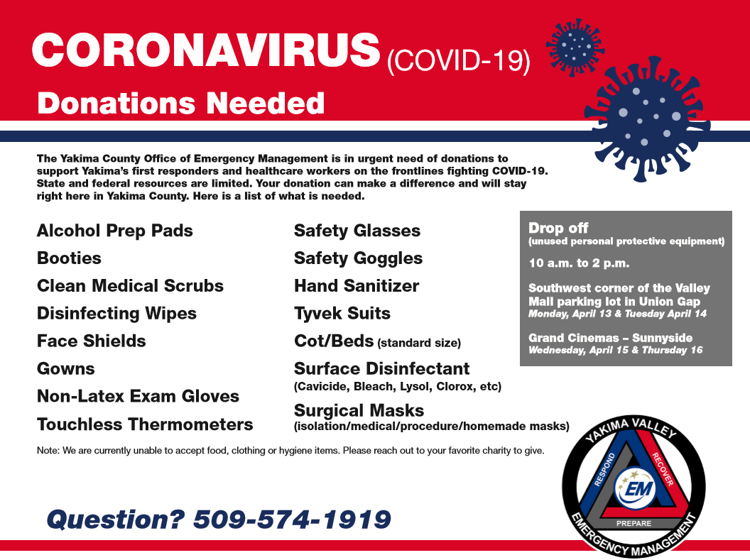
From KNDO/KNDU in support of Yakima first responders and healthcare workers:
Yakima County Office of Emergency Management asking public for donations of protective gear for frontline workers during COVID-19 outbreak
The Yakima County Office of Emergency Management urged the public this week to donate protective gear to frontline workers during the OCIVD-19 outbreak.
The organization stated there continues to be a shortage of supplies and are asking the public to provide homemade gowns, gloves, masks, face shields and more.
People can drop off donations at the following locations:
Valley Mall/2529 Main St, Union Gap, WA 98903 from Monday, April 13th to Wednesday, April 15th.
Grand Cinemas/3400 Picard Pl, Sunnyside, WA 98944 from Thursday, April 16th to Friday, April 17th.
Management stated people donating have to stay in their cars at each donation drop off as a staff member will pick up the items.
“…I think about the Solemn Reproaches a lot these days. A virus that looks like a crown of thorns is multiplying uncontrollably, and our collective anxiety about it has left us alternating between language of reproach and language of pleading.
The pleas have been fairly straightforward, even as they’ve increased in urgency and intensity: Wash your hands. Stay home if you’re sick. Don’t hoard face masks. Cancel all large gatherings. Pass legislation that guarantees paid sick leave. Shut down schools. The reproaches have been more complicated, as we’ve struggled to understand the causes of the pandemic. I’ve heard people blame globalization, secretive governments, unequal access to health care, an unregulated market that made it easy for a virus to jump across the animal-human barrier, the narcissism and denial of world leaders, people who don’t cough into their elbows, climate change, delayed test kits, cruise ships, handshakes, pangolins, political appointments motivated by loyalty instead of competence, overcrowded prisons and detention centers, open work spaces, communion by intinction, and asymptomatic carriers.
Reproaches can be useful—particularly if we direct them toward ourselves, naming our sins and striving to correct our errors as we move forward. But as resources become scarce and panic increases, it can be easy for our reproaches instead to turn outward and morph into violence—whether that means overtly xenophobic mob actions or just the cumulative harm caused by millions of small decisions made out of anxiety.
Christians have responded to past pandemics in a variety of ways. In February 1349, with the plague looming, the municipal authorities of Strasbourg in Alsace rounded up the city’s Jewish people, accused them of poisoning the Christians’ wells, demanded that they convert on the spot, and burned about 1,000 of them alive.
But it’s also true that in the third century, when a plague nearly wiped out the Roman Empire, Christians became known for performing unsolicited acts of compassion and self-sacrifice. Cyprian, who was the bishop of Carthage at the time, wrote these words:
How pertinent, how necessary, that pestilence and plague which seems horrible and deadly, searches out the righteousness of each one, and examines the minds of the human race, to see whether they who are in health tend the sick; whether relations affectionately love their kindred; whether masters pity their languishing servants; whether physicians do not forsake the beseeching patients; whether the fierce suppress their violence. . . . These are trainings for us, not deaths: they give the mind the glory of fortitude; by contempt of death they prepare for the crown.
Being forced to envision our own mortality can strip us bare of all pretenses and reveal who we really are.
That Good Friday morning when Dan and I rehearsed the Solemn Reproaches in the empty church, a complex beauty emerged. The sanctuary, built in a midcentury architectural style that I can only describe as urban stark, was already stripped of all adornment. Everything soft—paraments, linens, cushioned kneelers, flowers, candles, books—had been removed during the Maundy Thursday service the night before. In that somber space, Dan’s voice and mine resonated only with stone, bricks, concrete, and wood.
It was a rehearsal, but it was as real as any act of worship ever is. There were only two of us, and yet we were confessing the sins of all Christians across the centuries. The heaviness of our guilt—as individuals, and as the body of Christ in a world marred with violence and inequity—was palpable. The need for God’s mercy felt thick.
But just as thick was the presumption that God would indeed grant that mercy. We knew even as we were pleading for it that it was already ours. We remembered that we were singing to a God who had jumped across the divine-human barrier in order to be able to bleed and sweat and catch viruses and weep and ache and die. That’s why Dan and I kept singing, hesitant to stop.
But it was Good Friday, and we worked at a church. We had a lot to do. Before too long, we went back to our offices so we could complete all of the Holy Week tasks that still needed to be done.
This year, many churches may be empty on Good Friday because of the pandemic. But I’d like to think that the chanting of prior generations will resonate even in those stark, still sanctuaries: “Holy God, holy and glorious, holy and immortal, have mercy on us.”
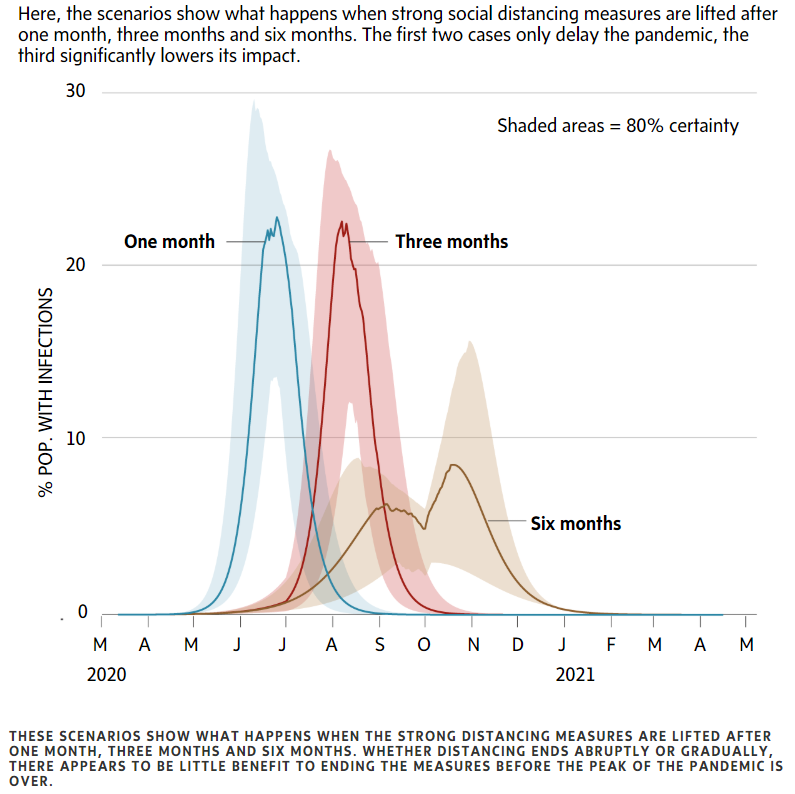
How long with the lock downs last? Hint: X-axis is in months, not weeks.
Brandon Smith at Alt-Market has an article on protecting yourself during what he believes is sure to become a long term pandemic lockdown – How To Protect Yourself From Long Term Pandemic Lockdown. Certainly he is not the only person to express that this will not be over in just a couple of weeks, and there is much to back him up.
It has been only two weeks since widespread pandemic lockdowns were implemented in the US and as expected the public is not handling the idea very well. Within one week there were already frantic demands for the economy to reopen by Easter (spurred on by Donald Trump), and mass delusions have developed that this is still going to happen despite the fact that lockdown guidelines have been extended to at least April 30th. People desperately want to believe that this will all be over in a matter of weeks.
Many governments continue to perpetuate this fantasy by using very carefully worded terminology. For example, the phrase “two weeks of hell” is being consistently repeated by the media after Trump uttered the notion a few days ago. In Italy, a Milan official sees lockdowns now continuing for 2-3 more weeks. In Spain, the public was left with the impression that two solid weeks of quarantine and lockdowns would help stave off infections, yet the government extended the restrictions for…yes, you guessed it…another two weeks.
Why are these announcements always in two week intervals? I suspect it is because this the maximum amount of days before the average person begins to register the passage of time in their minds in a new situation. After two to three weeks of going without certain comforts and habits, people tend to adapt and find different ways of doing things. And, after two to three weeks of crisis, they might wake up and recognize the situation is not going to get better…
Are we just supposed to sit back and become slaves, dependent and clamoring for a meager UBI check every month? I think not.
So, the question is, what can we do about it? As I have been saying for well over a decade, the solution is to decouple from the system and build our own. But what does this mean specifically?
Step 1: Start Providing Your Own Essentials
Essentials include water, food, shelter and security. Without these four things no human can live for very long. If a person can provide these things for himself, then he will never be beholden to anyone, including a domineering government.
I suggest starting small and expanding. Build a water collection source, or drill a well if you own property. Turn your yard into a garden, even if you live in the suburbs. In fact, your entire neighborhood should be growing gardens right now, and anyone who tries to tell you otherwise should be dissuaded from their attempts to control what you do on your own property. This means establishing neighborhood security and no longer relying on local law enforcement.
It’s one thing to store essentials in case of emergency, it’s another to become a producer and ensure your survival for the long term.
Step 2: Organize For Mutual Aid And Defense
Each neighborhood or town should be working together for security as the system continues to collapse, which means establishing radio communications and small patrols to ward off looters. In New York alone, major crimes are up 12% as the lockdowns ramped up. In many municipalities in the US, law enforcement is not responding to most calls involving assaults, break-ins and robberies. Organization at this time is paramount; the more organized you are the more of a deterrent you represent to people who would seek to take what you have. Most predators are cowards; when given the choice between a strong target and a weak target, they will invariably choose the weak target.
The common argument against organization is that the “nail that sticks up will be hammered down”. I would remind people that the nails that are willingly hammered down will be stepped on forever. Nobody wants to step on a nail that sticks up. That hurts.
Predators, including predatory and totalitarian governments are, at bottom, weaklings. And their weakness will become apparent the moment they face an opponent that actually refuses to back down due to fear.
Step 3: Establish Barter Markets And Black Markets
As noted in previous articles, the primary goal behind this pandemic is to use it as a rationale for controlling all commerce. If you do not have the proper “green code” from the government indicating you are “free from infection”, then you are not allowed to participate in the economy. No job, no grocery stores, no public gatherings, etc. This is happening right now in places like China and South Korea and according to elitists like Bill Gates and others it is coming to the US soon, make no mistake.
The only way to counter such control is to not need the mainstream system at all. Localized barter markets need to be established, and if they outlaw those, then you need to set up black markets. Trade and production must continue or humanity as we know it will die. It will be replaced with a centralized socialist hive system that will crush all liberty, and this is unacceptable. Localization is the key to our survival.
This means that the public must make and active effort to save themselves through their own innovation instead of waiting around for government to save the day…(continues)
Lessons Learned in the Time of Coronavirus comes from the Things I Wish I Knew Before blog. The article relates some lessons learned in the earlier phase of the pandemic growth in the US.
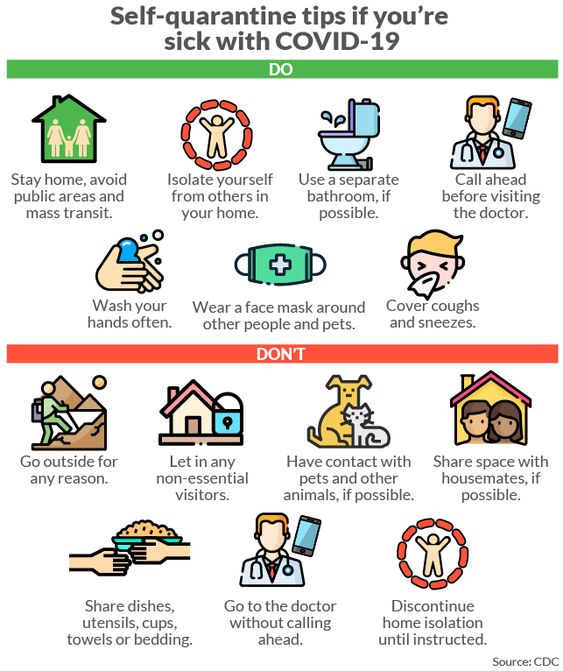
I’m home with my family this morning, following guidelines for self-isolation and social distancing. It is so surreal, but here are the actionable items that I’ve learned so far from living in the time of coronavirus. Most of us will survive the coronavirus, and this is why these learnings are important to me.
Photo credit: forbes.com
#1 Respond at the first hint of trouble, not at panic time
Determining what constitutes as “the first hint of trouble” is open to debate, but I will say that I responded somewhere in the middle between “the first hint of trouble” and “panic time.”
I went to Costco two weeks ago and decided to purchase some stocking supplies. It was more crowded than usual and I could see a number of carts filled with an irregular amount of certain supplies. However, it was still a manageable crowd. I should have thought of precautionary preparation when the first case of coronavirus was diagnosed, rather than when I actually did. After all, there’s no downside to acting earlier.
A few days ago, I went back to Costco for some allergy medicine and it was panic time. The parking lot was almost full before the store even opened. The allergy medicine I wanted was out of stock, as were all of the panic items (paper towels, toilet paper, rice, pasta, disinfecting wipes, rubbing alcohol). Shoppers were elbow to elbow (great for our minimum 6ft social distancing requirement) and I am now hearing online reports from our neighbors of the continual crowds at all the local grocery stores.
#2 Always have 3 months worth on hand
Why 3 months worth? Well, I’m not sure that’s the correct number, but basically you want to be self-sufficient for some period in the event that you become isolated (due to say coronavirus, store closures, insufficient stock, or a major disaster renders everything unavailable to you except for your home (don’t forget to pack your emergency bag for when your home isn’t an option either).
Here’s what I should have had 3 months worth of:
Food (that we would actually eat – not random cheap stuff for emergencies)
Household supplies (paper products, cleaning, and disinfecting supplies)
Toiletries (soap, shampoo, toothpaste, etc.)
Medications (common OTC items like cold and allergy medicines and prescriptions)
I wasn’t able to get some of these items during the current panic time. What I should have done is just gradually amassed 3 months worth of the above items like a regular consumer in the months/years prior and thereafter, just replenish stress-free any items that dipped below the 3-month threshold.
If you don’t have enough room where you live, stockpile whatever amount is realistically maintainable in your available space. If organized purchasing is not your strong suit, use an inventory list – there are many online options to help…(continues)
On March 24, 2020 we asked the question COVID-19, When Will It End? In this blog post we suggested that it pays to start planning for strong social distancing for at least the next six months.
On April 2, 2020 Washington State Governor Jay Inslee extended end date of the state’s “stay-at-home” order from April 6th to May 4th.
On April 6, 2020 the Govenor and the state Superintendent of Public Instruction, Chris Reykdal, announced that both public and private schools in Washington would remain closed for the remainder of the school year. The school year in Washington normally ends in mid-June, so this adds an additional six weeks of school closuers beyond the current end date for the state’s stay-at-home order.
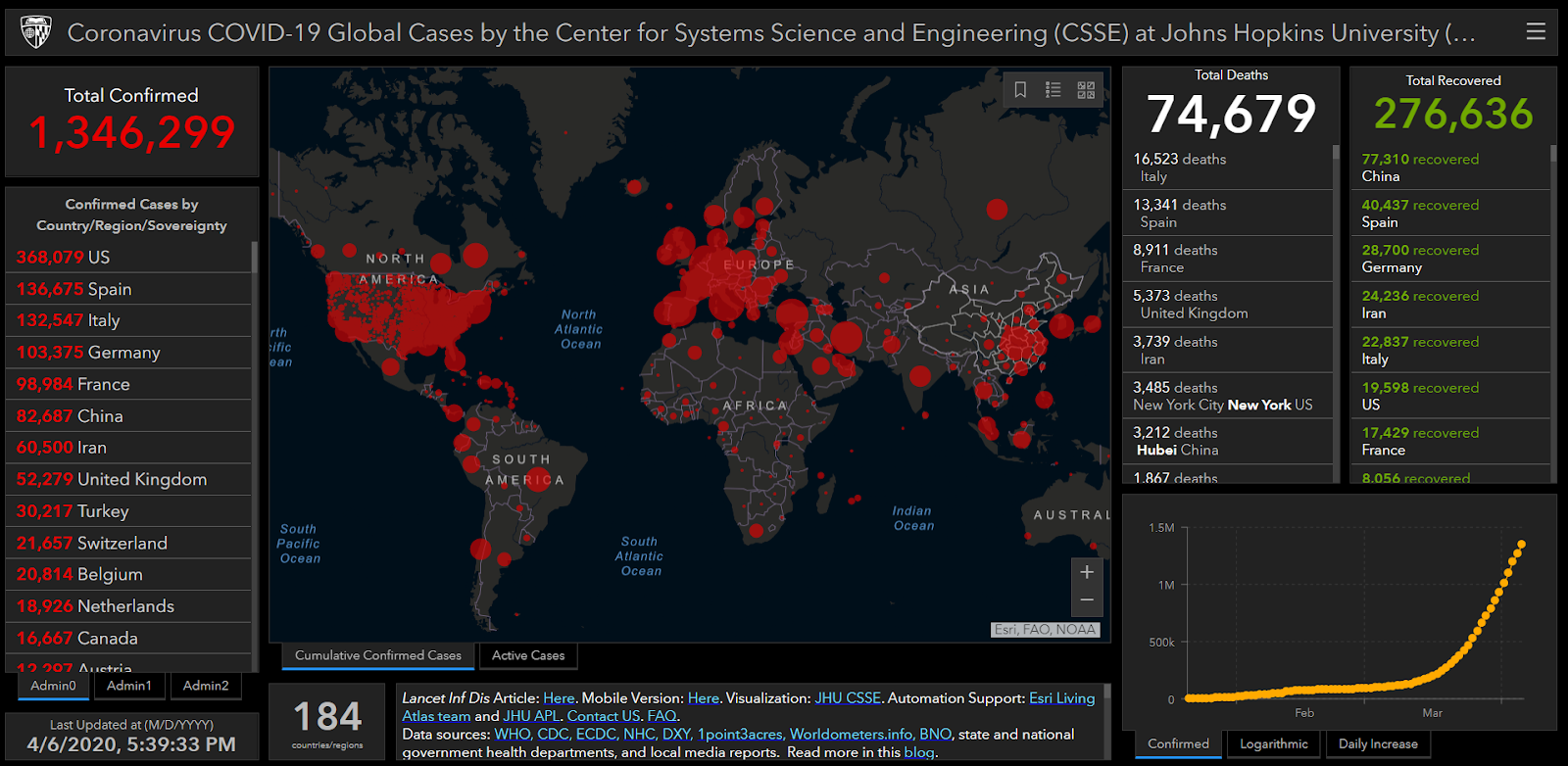
As of April 6, 2020 there were 1,346,299 confirmed cases of COVID-19 world-wide, with at least 368,000 of those cases being in the United States. State and Federal governments must weigh the risks of the spread of the COVID-19 virus and perhaps a million deaths, against a complete collapse of the economy with millions of people out of work and small businesses never being able to recover from the financial loss.
The government must decide at what point it is medically safe to allow businesses to reopen and to lift restrictions on social distancing. Even if the government removes these restrictions prior to October 2020, we still strongly recommend caution in your social interactions through at least the end of the year.
COVID-19 is not going to just suddenly disappear. Until an effective vaccine and treatment are developed and distributed there will be a significant health risk from the virus.
In the absence of a vaccine, cure, or massive testing and quarantine, lockdowns and stay-at-home orders will need to last for months. However, the US faces a unique challenge because only half the states have adopted aggressive intervention, and done so at varying times. Even if these states achieve control or containment, they may be vulnerable to contagion from other states that were late to do so. (SSRN)
According to an article in Business Insider, Ultimately, experts say that social-distancing measures will be necessary until we have a vaccine, and that’s 12 to 18 months. But that doesn’t necessarily mean we’re all in our homes for 18 months, it means maybe we’re avoiding public gatherings for that amount of time or limiting the amount of travel internationally, but it’s not necessarily as restrictive as what we’re seeing now.
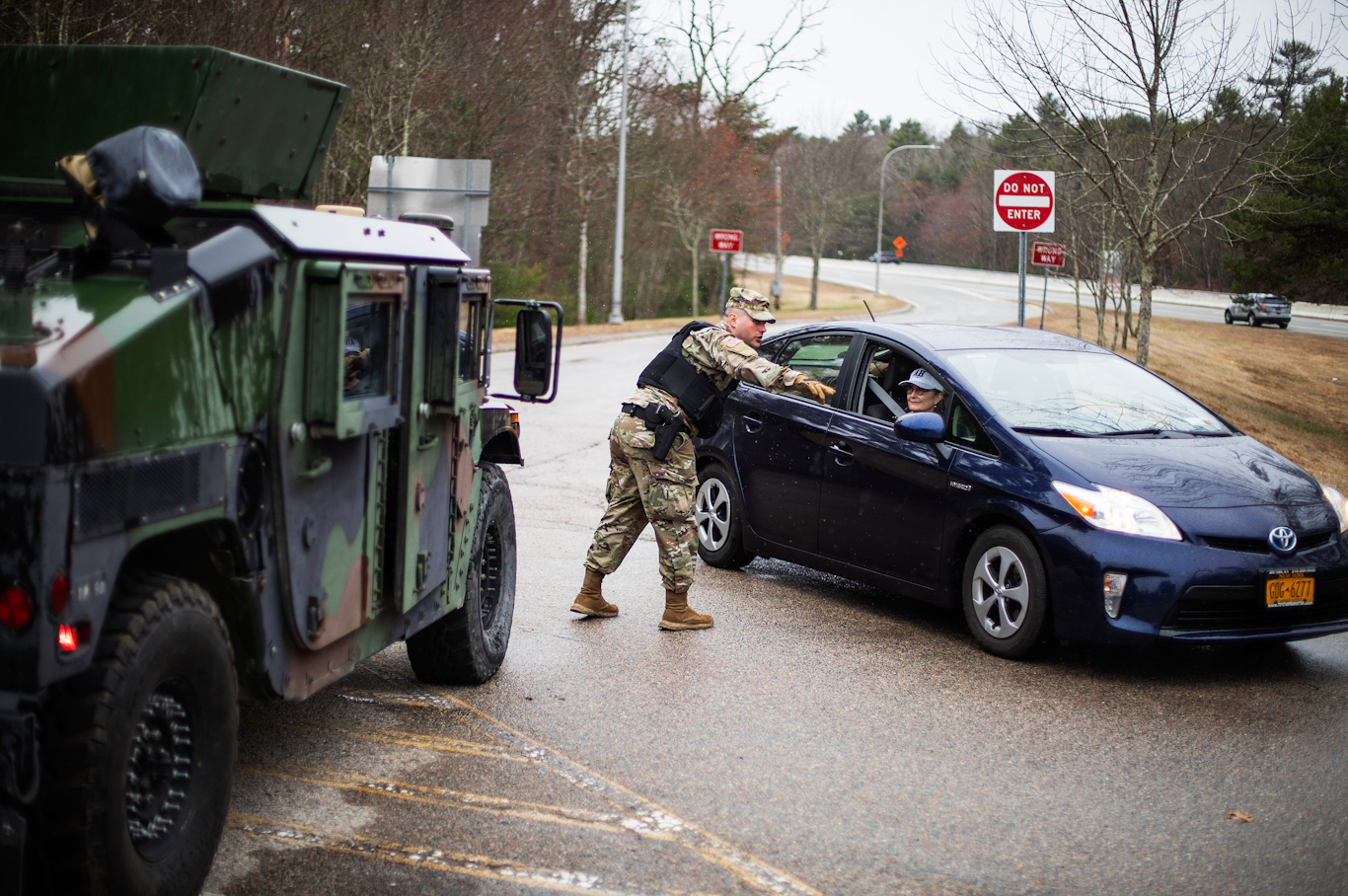
Rhode Island National Guard Military Police direct a motorist with New York license plates to a checkpoint, March 28, 2020, David Goldman | AP
Constitutional attorney John Whitehead writes about The Attack on Civil Liberties in the Age of COVID-19at Mint Press. It is important to reflect upon whether the government is taking actions for which it has the authorized power in perilous times like these. There have been many calls on the federal government to take actions for which it has no Constitutionally delegated authority – like national quarantines. State governments have more power, but still limited by their own constitutions – a reason why Washington State, for example, recently passed a constitutional amendment to provide for broader emergency powers. That being said, during this pandemic, some people have taken the absurd approach that if the government is requiring you to do something, and you believe that requirement is unconstitutional, then you it is your duty to do the opposite. For example, because you believe that a statewide stay at home order is an unconstitutional exercise of power, you may deliberately gather with others to protest. This is akin to shooting yourself in the head because the government makes suicide illegal. Just because a particular exercise of power is not constitutionally sound, the underlying requirement may still be the wise course for people to take, and indeed may be your duty as a responsible citizen to take. Protest the illegality, but not by getting people killed.
You can always count on the government to take advantage of a crisis, legitimate or manufactured.
This coronavirus pandemic is no exception.
Not only are the federal and state governments unraveling the constitutional fabric of the nation with lockdown mandates that are sending the economy into a tailspin and wreaking havoc with our liberties, but they are also rendering the citizenry fully dependent on the government for financial handouts, medical intervention, protection and sustenance.
Unless we find some way to rein in the government’s power grabs, the fall-out will be epic.
Everything I have warned about for years—government overreach, invasive surveillance, martial law, abuse of powers, militarized police, weaponized technology used to track and control the citizenry, and so on—has coalesced into this present moment.
The government’s shameless exploitation of past national emergencies for its own nefarious purposes pales in comparison to what is presently unfolding.
Deploying the same strategy it used with 9/11 to acquire greater powers under the USA Patriot Act, the police state—a.k.a. the shadow government, a.k.a. the Deep State—has been anticipating this moment for years, quietly assembling a wish list of lockdown powers that could be trotted out and approved at a moment’s notice.
It should surprise no one, then, that the Trump Administration has asked Congress to allow it to suspend parts of the Constitution whenever it deems it necessary during this coronavirus pandemic and “other” emergencies.
It’s that “other” emergencies part that should particularly give you pause, if not spur you to immediate action (by action, I mean a loud and vocal, apolitical, nonpartisan outcry and sustained, apolitical, nonpartisan resistance).
In fact, the Department of Justice (DOJ) has been quietly trotting out and testing a long laundry list of terrifying powers that override the Constitution.
We’re talking about lockdown powers (at both the federal and state level): the ability to suspend the Constitution, indefinitely detain American citizens, bypass the courts, quarantine whole communities or segments of the population, override the First Amendment by outlawing religious gatherings and assemblies of more than a few people, shut down entire industries and manipulate the economy, muzzle dissidents, “stop and seize any plane, train or automobile to stymie the spread of contagious disease,” reshape financial markets, create a digital currency (and thus further restrict the use of cash), determine who should live or die…
…”Objection: Assumes facts not in evidence, i.e. that a temporary quarantine will become a decades-long boondoggle.
Reductio ad absurdum Fallacy, 20 yard penalty and loss of possession.
And I observe FTR that people crying about something that’s not yet three weeks old as though it will go on endlessly are children who were never spanked, sent to bed without their supper, or told to wait for any form of gratification…(continues)
A coroner in Indiana wanted to know if the coronavirus had killed a man in early March, but said that her health department denied a test. Paramedics in New York City say that many patients who died at home were never tested for the coronavirus, even if they showed telltale signs of infection.
In Virginia, a funeral director prepared the remains of three people after health workers cautioned her that they each had tested positive for the coronavirus. But only one of the three had the virus noted on the death certificate.
Across the United States, even as coronavirus deaths are being recorded in terrifying numbers — many hundreds each day — the true death toll is likely much higher.
More than 9,400 people with the coronavirus have been reported to have died in this country as of this weekend, but hospital officials, doctors, public health experts and medical examiners say that official counts have failed to capture the true number of Americans dying in this pandemic. The undercount is a result of inconsistent protocols, limited resources and a patchwork of decision making from one state or county to the next.
In many rural areas, coroners say they don’t have the tests they need to detect the disease. Doctors now believe that some deaths in February and early March, before the coronavirus reached epidemic levels in the United States, were likely misidentified as influenza or only described as pneumonia.
With no uniform system for reporting coronavirus-related deaths in the United States, and a continued shortage of tests, some states and counties have improvised, obfuscated and, at times, backtracked in counting the dead.
“We definitely think there are deaths that we have not accounted for,” said Jennifer Nuzzo, a senior scholar at the Johns Hopkins University Center for Health Security, which studies global health threats and is closely tracking the coronavirus pandemic.
Late last week, the Centers for Disease Control and Prevention issued new guidance for how to certify coronavirus deaths, underscoring the need for uniformity and reinforcing the sense by health care workers and others that deaths have not been consistently tracked. In its guidance, the C.D.C. instructed officials to report deaths where the patient has tested positive or, in an absence of testing, “if the circumstances are compelling within a reasonable degree of certainty.”…
Will Oremus has written an article at Medium.com on What Everyone’s Getting Wrong About the Toilet Paper Shortage, pointing out that it has little to do with so-called hoarding. The fact is that people actually are using more toilet paper at home. There are similar problems with dairy products. With everyone staying at home and mostly eating at home, consumption of milk, butter, eggs, etc. is higher at home, now.
Around the world, in countries afflicted with the coronavirus, stores are sold out of toilet paper. There have been shortages in Hong Kong, Australia, the United Kingdom, and the United States. And we all know who to blame: hoarders and panic-buyers.
Well, not so fast.
Story after story explains the toilet paper outages as a sort of fluke of consumer irrationality. Unlike hand sanitizer, N95 masks, or hospital ventilators, they note, toilet paper serves no special function in a pandemic. Toilet paper manufacturers are cranking out the same supply as always. And it’s not like people are using the bathroom more often, right?
U.S. Health Secretary Alex Azar summed up the paradox in a March 13 New York Times story: “Toilet paper is not an effective way to prevent getting the coronavirus, but they’re selling out.” The president of a paper manufacturer offered the consensus explanation: “You are not using more of it. You are just filling up your closet with it.”
Faced with this mystifying phenomenon, media outlets have turned to psychologists to explain why people are cramming their shelves with a household good that has nothing to do with the pandemic. Read the coverage and you’ll encounter all sorts of fascinating concepts, from “zero risk bias” to “anticipatory anxiety.” It’s “driven by fear” and a “herd mentality,” the BBC scolded. The libertarian Mises Institute took the opportunity to blame anti-gouging laws. The Atlantic published a short documentary harking back to the great toilet paper scare of 1973, which was driven by misinformation.
No doubt there’s been some panic-buying, particularly once photos of empty store shelves began circulating on social media. There have also been a handful of documented cases of true hoarding. But you don’t need to assume that most consumers are greedy or irrational to understand how coronavirus would spur a surge in demand. And you can stop wondering where in the world people are storing all that Quilted Northern.
There’s another, entirely logical explanation for why stores have run out of toilet paper — one that has gone oddly overlooked in the vast majority of media coverage. It has nothing to do with psychology and everything to do with supply chains. It helps to explain why stores are still having trouble keeping it in stock, weeks after they started limiting how many a customer could purchase.
In short, the toilet paper industry is split into two, largely separate markets: commercial and consumer. The pandemic has shifted the lion’s share of demand to the latter. People actually do need to buy significantly more toilet paper during the pandemic — not because they’re making more trips to the bathroom, but because they’re making more of them at home. With some 75% of the U.S. population under stay-at-home orders, Americans are no longer using the restrooms at their workplace, in schools, at restaurants, at hotels, or in airports.
Georgia-Pacific, a leading toilet paper manufacturer based in Atlanta, estimates that the average household will use 40% more toilet paper than usual if all of its members are staying home around the clock…(continues)
…Three months ago, we all had dreams, goals for the future, or at least some idea of what the upcoming year would hold for us.
I’ll bet none of us even considered on New Year’s Eve that we’d spend the first half (at least) of the year dealing with a deadly pandemic. Heck, I sat on a balcony in a little seaside village in Montenegro, toasting the new decade with a friend and some Jack Daniels, watching fireworks over the Adriatic Sea, and planning what European destination I’d be heading to next.
How utterly terrifying to know that we’re all likely to lose somebody we love to this virus or to a medical condition that would have been survivable if the local hospital hadn’t been overflowing with COVID patients.
We know there’s nary a roll of toilet paper to be found in a huge swath of the United States. We know that our supply chain, if not broken, is at the least, badly bruised. We know that if a person we love goes into the hospital with COVID-19, there’s a frighteningly large chance they may never come out again unless it’s in a body bag. We know that medical professionals in New York City don’t even have personal protective equipment to keep themselves healthy while they try to keep people alive. We know that yesterday in the state of New York, 23 people died every hour of the day from the coronavirus that has destroyed the world as we know it.
We nearly all know people who have been laid off. Maybe it’s someone in your family. Maybe it’s you. And if you haven’t yet lost your job, are you waiting for that hammer to drop? We all know of businesses that aren’t going to make it through months of this shutdown.
We know people who couldn’t pay their rent this month. We know people who pulled it together this month but won’t be able to pay May’s rent if this lockdown should continue. We know it’s so bad that the government has said landlords can’t evict tenants in many states – which means the landlords may not be able to pay their mortgages.
We may not know much right now, but we know that the economy is a f*cking disaster.
And we have no idea when this current purgatory will end…
We’d all like to think that one day this will suddenly be over. The kids will return to school. We’ll go back to our offices and our commutes. We won’t be struggling over money anymore. Life will return to the pre-COVID days.
But is this the healthiest way to look at the situation?
Spending all your time looking forward to the day when this is over is an exercise in frustration because nobody knows when that will be. And more than that, nobody knows what “normal” is going to look like when all the lockdowns are over. A lot of things will never be the same.
You can help yourself by learning to adapt now to changed circumstances. This will help you learn to live with the new normal, whatever that turns out to be. Major events are bound to cause major and long-lasting changes. This has happened throughout history.
In reality, the things we’re experiencing right now, while not necessarily easy, aren’t so bad. Things will probably get worse before they get better, but eventually, some form of “better” will come.
Your ability to adapt is indicative of your ability to survive. So let’s get through this lockdown and keep our mindsets positive. Let’s get through the part that comes next.
Then, eventually, we’ll come out on the other side, ready to tackle the new normal, whatever that ends up being like…(continues)
Benton-Franklin Health District leaders are now advising people to wear face coverings while in public to help slow the spread of the coronavirus.
Health leaders say medical grade masks should be saved for first responders and medical staff members.
Health officials say something as simple as a scarf would be acceptable to slow the spread of COVID-19.
Experts say the mask, or cloth, can be an added layer of protection for people.
Health leaders say people should also continue to use social distancing guidelines and not leave their homes with the exception for essential activities.
Dairy farmer Jason Leedle felt his stomach churn when he got the call on Tuesday evening.
“We need you to start dumping your milk,” said his contact from Dairy Farmers of America (DFA), the largest U.S. dairy cooperative.
Despite strong demand for basic foods like dairy products amid the coronavirus pandemic, the milk supply chain has seen a host of disruptions that are preventing dairy farmers from getting their products to market.
Mass closures of restaurants and schools have forced a sudden shift from those wholesale food-service markets to retail grocery stores, creating logistical and packaging nightmares for plants processing milk, butter and cheese. Trucking companies that haul dairy products are scrambling to get enough drivers as some who fear the virus have stopped working. And sales to major dairy export markets have dried up as the food-service sector largely shuts down globally.
The dairy industry’s woes signal broader problems in the global food supply chain, according to farmers, agricultural economists and food distributors. The dairy business got hit harder and earlier than other agricultural commodities because the products are highly perishable – milk can’t be frozen, like meat, or stuck in a silo, like grain.
Other food sectors, however, are also seeing disruptions worldwide as travel restrictions are limiting the workforce needed to plant, harvest and distribute fruits and vegetables, and a shortage of refrigerated containers and truck drivers have slowed the shipment of staples such as meat and grains in some places…
Foreign Policy journal asked twelve “global thinkers” to answer the question of How the World Will Look After the Coronavirus Pandemic. Each author’s response is relatively short for Foreign Policy, but there are a dozen so the whole thing isn’t short. The answers are sometimes opposed to each other, so take away what you will.
Like the fall of the Berlin Wall or the collapse of Lehman Brothers, the coronavirus pandemic is a world-shattering event whose far-ranging consequences we can only begin to imagine today.
This much is certain: Just as this disease has shattered lives, disrupted markets and exposed the competence (or lack thereof) of governments, it will lead to permanent shifts in political and economic power in ways that will become apparent only later.
To help us make sense of the ground shifting beneath our feet as this crisis unfolds, Foreign Policy asked 12 leading thinkers from around the world to weigh in with their predictions for the global order after the pandemic…
The pandemic will strengthen the state and reinforce nationalism. Governments of all types will adopt emergency measures to manage the crisis, and many will be loath to relinquish these new powers when the crisis is over…
The coronavirus pandemic could be the straw that breaks the camel’s back of economic globalization...
The COVID-19 pandemic will not fundamentally alter global economic directions. It will only accelerate a change that had already begun: a move away from U.S.-centric globalization to a more China-centric globalization...
The nationalists and anti-globalists, the China hawks, and even the liberal internationalists will all see new evidence for the urgency of their views. Given the economic damage and social collapse that is unfolding, it is hard to see anything other than a reinforcement of the movement toward nationalism, great-power rivalry, strategic decoupling, and the like…
COVID-19 is undermining the basic tenets of global manufacturing. Companies will now rethink and shrink the multistep, multicountry supply chains that dominate production today…
The international system will, in turn, come under great pressure, resulting in instability and widespread conflict within and across countries…
The result could be a dramatic new stage in global capitalism, in which supply chains are brought closer to home and filled with redundancies to protect against future disruption…
I would expect many countries will have difficulty recovering from the crisis, with state weakness and failed states becoming an even more prevalent feature of the world…
Michael Snyder has written an article at The End of the American Dream on how the food distribution system works in normal times and why it is breaking down now – Supplies Are Starting To Get Really Tight Nationwide As Food Distribution Systems Break Down. His message is that times have changed. Don’t blame hoarders for bare grocery shelves; the problem is much bigger.
All across America, store shelves are emptying and people are becoming increasingly frustrated because they can’t get their hands on needed supplies. Most Americans are blaming “hoarders” for the current mess, but it is actually much more complicated than that. Normally, Americans get a lot of their food from restaurants. In fact, during normal times 36 percent of all Americans eat at a fast food restaurant on any given day. But now that approximately 75 percent of the U.S. is under some sort of a “shelter-in-place” order and most of our restaurants have shut down, things have completely changed. Suddenly our grocery stores are being flooded with unexpected traffic, and many people are buying far more than usual in anticipation of a long pandemic. Unfortunately, our food distribution systems were not designed to handle this sort of a surge, and things are really starting to get crazy out there.
I would like to share with you an excerpt from an email that I was sent recently. It describes the chaos that grocery stores in Utah and Idaho have been experiencing…
When this virus became a problem that we as a nation could see as an imminent threat, Utah, because of its culture of food storage and preparing for disaster events seemed to “get the memo” first. The week of March 8th grocery sales more than doubled in Utah, up 218%. Many states stayed the same with increases in some. Idaho seemed to “get the memo” about four days later. We were out of water and TP four days after Utah. Then we were out of food staples about four days later. Next was produce following a pattern set by Utah four days earlier.
The problem for us in Idaho was this. The stores in Utah were emptied out then refilled twice by the warehouses before it hit Idaho. Many of these Utah stores have trucks delivering daily. So when it did hit Idaho the warehouses had been severely taxed. We had a hard time filling our store back up even one time. We missed three scheduled trucks that week alone. Then orders finally came they were first 50% of the order and have dropped to 20%. In normal circumstances we receive 98% of our orders and no canceled trucks. Now three weeks later, the warehouses in the Western United States have all been taxed. In turn, those warehouses have been taxing the food manufacturers. These food companies have emptied their facilities to fill the warehouses of the Western United States. The East Coast hasn’t seemed to “get the memo” yet. When they do what food will be left to fill their warehouses and grocery stores?
Food distribution and resources for the Eastern United States will be at great peril even if no hoarding there takes place. But of course it will.
Additionally the food culture of the East Coast and other urban areas is such that people keep very little food on hand. They often shop several times weekly for items if they cook at home. They don’t have big freezers full of meat, home canned vegetables in their storage rooms, gardens, or beans, wheat, and rice in buckets in the their basements.
With most of the country locked down, normal economic activity has come to a standstill, and it is going to become increasingly difficult for our warehouses to meet the demand that grocery stores are putting on them.
Meanwhile, our farmers are facing severe problems of their own. The following comes from CNBC…
The U.S.-China trade war sent scores of farmers out of business. Record flooding inundated farmland and destroyed harvests. And a blistering heat wave stunted crop growth in the Midwest.
Now, the coronavirus pandemic has dealt another blow to a vulnerable farm economy, sending crop and livestock prices tumbling and raising concerns about sudden labor shortages.
The chaos in the financial markets is likely to continue for the foreseeable future, and it is going to remain difficult for farm laborers to move around as long as “shelter-in-place” orders remain in effect on the state level.
Iowa farmer Robb Ewoldt told reporter Emma Newburger that “we’ve stopped saying it can’t get worse”, and he says that this coronavirus pandemic looks like it could be “the straw that broke the camel’s back”…
“We were already under extreme financial pressure. With the virus sending the prices down — it’s getting to be the straw that broke the camel’s back,” said Iowa farmer Robb Ewoldt.
“We were hoping for something good this year, but this virus has stopped all our markets,” he said.
Of course this comes at a time when millions of Americans are losing their jobs and unemployment is shooting up to unthinkable levels. Without any money coming in, many people are already turning to alternative sources of help in order to feed themselves and their families.
On Monday, hundreds of cars were lined up to get food from a food bank in Duquesne, Pennsylvania. To many, this was eerily reminiscent of the “bread lines” during the Great Depression of the 1930s.
Kazakhstan, for instance, according to a report from Bloomberg, has banned exports of wheat flour, of which it is one of the world’s biggest sources, as well as restrictions on buckwheat and vegetables including onions, carrots and potatoes. Vietnam, the world’s third biggest rice exporter, has temporarily suspended rice export contracts. Russia, the world’s biggest wheat exporter, may also threaten to restrict exports, as it has done before, and the position of the US is in doubt given Donald Trump’s eagerness for a trade war in other commodities.
If this pandemic stretches on for an extended period of time, food supplies are inevitably going to get even tighter.
So what can you do?
Well, perhaps you can start a garden this year if you don’t normally grow one. Apparently this pandemic has sparked a tremendous amount of interest in gardening programs around the country…
Because of the coronavirus pandemic, more people are showing an interest in starting home gardens. Oregon State University‘s (OSU) Master Gardener program took notice of the growing interest.
To help citizens who want to grow their own food, the university kindly made their online vegetable gardening course free until the end of April. OSU’s post on Facebook has been shared over 21,000 times.
Food is only going to get more expensive from here on out, and growing your own food is a way to become more independent of the system.
“It’s the largest volume of orders we have seen,” said Jere Gettle of Baker Creek Heirloom Seeds in Mansfield, Missouri. Peak seed-buying season for home gardeners is January to March, but the normal end-of-season decline in orders isn’t happening.
Customers are gravitating to vegetables high in nutrients, such as kale, spinach and other quick-to-grow leafy greens. “Spinach is off the charts,” said Jo-Anne van den Berg-Ohms of Kitchen Garden Seeds in Bantam, Connecticut.
For years, I have been warning people to get prepared for “the perfect storm” that was coming, but of course most people didn’t listen.
But now it is upon us.
Desperate people have been running out to the grocery stores to stock up on toilet paper only to find that they are limited to one or two packages if it is even available.
And now that “panic buying” of seeds has begun, it is probably only a matter of time before many stores start running out.
We have reached a major turning point in our history, and things are only going to get crazier.
Unfortunately, the vast majority of Americans still have absolutely no idea what is ahead of us…
…A lot of people are blaming “hoarders” and preppers for the shortages seen in stores. Of course, it’s nonsense to blame preppers because we’ve been buying our things over a course of years. And honestly, if it was only “panic buyers” causing problems, wouldn’t the stores be replenished by now? After all, people have hardly been able to shop for two weeks in many states due to social distancing measures.
In reality, there are major issues with the supply chain, a problem many folks aren’t seeing because they’re not at the store. Distribution systems are breaking down.
A source at a Walmart Superstore recently confided that the trucks were only delivering a fraction of the items needed to restock shelves. Imports aren’t arriving in California ports, at least not anywhere close to the degree they were before.
And because more people are eating at home than ever before, the demand on grocery stores has increased dramatically. This also comes at a time after farmers have been driven out of business by the trade war. (source) We have actual shortages here, and it isn’t just due to “panic buying.” That only exposed the dangers of the Just In Time delivery philosophy used by retailers.
The Alton’s at Doom and Bloom Medical has up an article discussing the infectiousness of Covid-19, and they also announce that their new book Alton’s Pandemic Preparedness Guide: Emerging and Current Viral Threats is now on sale.
If you’ve paid any attention to the worldwide pandemic of COVID-19 or watched movies like Contagion, , you’ve heard the term “R-nought”.
Alfred Lotka
The R-nought (or reproduction number) is the 100-year-old brainchild of a public health expert in demographics named Alfred Lotka. A disease’s R-Nought, he said, is the number of cases that will occur in a population if an infected person is placed in the middle of it. Not just any population, however; one that hasn’t been exposed to the infection in the past.
In the 1950s, epidemiologist George MacDonald used it to describe the contagious potential of malaria. He suggested that, if the R-nought is less than 1, the infectious person will transmit to fewer than one other person and an outbreak will eventually peter out. On the other hand, if the R-Nought is greater than 1, the disease will spread. Seasonal flu carries an R-Nought of 1.28, while the current COVID-19 is probably closer to 3.
Probably? Certainly, the R-Nought represents important data regarding an infectious disease. Why, then, probably? Because different sources may report different R-Noughts for the same disease based on a number of factors. It’s not just the nature of the virus itself.
Estimation of the R-nought primarily relates to 3 parameters:
how long a person is contagious
the likelihood that contact with a susceptible person will end in transmission of the disease
the frequency of contact between the infected individual and the susceptible population.
Let’s take them one-by-one. The first is how long a person is contagious. Certainly, you want to quarantine someone during their infectious period, but, with COVID-19, that period is not known for certain.
For SARS, it was about 14 days, so that’s what they’re using for the related SARS-COV2 (the name for the virus that causes COVID-19). There are outliers, however, that range from 20-37 days. With a range that wide, how do they figure out when you’re no longer contagious?
If COVID-19 testing is available, they have determined three criteria for considering release from isolation:
• You no longer have a fever without using fever-reducing drugs.
• Symptoms like cough or shortness of breath have improved significantly.
• you have received two negative tests in a row, 24 hours apart.
• You have had no fever for at least 72 hours without using fever-reducing drugs.
• Symptoms like cough or shortness of breath have improved significantly.
• At least 7 days have passed since your symptoms first appeared (I was surprised at that last one; perhaps 14 days is more prudent).
Pneumonia (circled)
Aside: Recovering COVID-19 patients might be surprised when they feel better but are told that the X-ray still shows signs of pneumonia. This is because the x-ray appearance of pneumonia commonly seems to lag behind the patient’s clinical appearance.
The second parameter is how likely is it that contact with a susceptible person ends up in infection. That depends partially on the characteristics of the virus itself, but It might also depend on a person’s age, general health, lifestyle, or even bad habits.
Older folks may get it as often as younger folks, but seem to do worse across the board. In one study, if you were in your twenties and got COVID-19, your chances of dying was 0.2 percent. If you were in your eighties, it was closer to 22 percent.
What about bad habits? Consider smoking: Most COVID-19 victims are men. in China, 50% of men smoke there as opposed to about 5% of women. Therefore, you can probably conclude that women have healthier lungs, on average, than men.
Cultural differences might also play a role. In Iran and certain other countries, most men work or spend a good amount of time outside. From this, we can infer that they might be exposed more often than women, who probably spend more time at home.
The third parameter is the frequency of contact between the infected individual and the susceptible population. For example, there are people that are known as “super spreaders”. A super-spreader is an individual who is more likely, for one reason or another, to infect others. 20% of infected individuals are responsible for 80% of transmissions to others.
Although South Korea is held out as a model of success in the containment of COVID-19, that wasn’t always the case. In mid-February, confirmed cases of SARS-CoV-2 infection suddenly jumped in that country. The Korean CDC attributed the increase in cases to “Patient 31“, who had participated in a mass religious gathering in the city of Daegu.
In New York, a lawyer contracted the illness and then spread it to at least twenty other individuals in his community in New Rochelle. In the early going, he was thought to account at one point or another for more than half of coronavirus cases in the state
Super-spreaders aren’t confined to viral disease, 100 years ago, a woman named Mary Mallon worked as a cook in New York. She was an asymptomatic carrier of the bacteria Salmonella Typhi, and passed that disease to more than 50 other people, giving her the nickname “Typhoid Mary“.
Terminating Typhoid Mary’s employment and quarantining super-spreaders and their contacts helps, but only if it’s done rapidly. In South Korea, it can be said to be successful. In New York, well, not so much.
There’s more to R-noughts than those 3 parameters, like testing issues, the availability of personal protection equipment to a community, and much more. It’s interesting to think about what the R-Nought of the 1918 Spanish Flu would have been if it occurred today with commercial air travel so common.
More updates on issues relating to the pandemic in the near future.
Oh, and if you were wondering where we’ve been lately, we’ve been personally packing medical kits seven days a week as well as writing our latest book, Alton’s Pandemic Preparedness Guide: Emerging and Current Viral Threats. You can find it on Amazon.com and, soon, at doomandbloom.net.
As the COVID-19 Coronavirus sweeps the globe, different people are reacting in different ways.
For most, fear is a part of that reaction. That’s normal, as we all tend to be afraid of the unknown and there’s still a lot of unknown about this virus. But the truly scary part isn’t the fear that people are having; it’s the fear that governments are having.
Don’t get me wrong; I don’t envy the problems that the president and state governors are facing right now. They are in a no-win situation, where they are having to make decisions based on limited information, with the foreknowledge that there is no right answer. No matter what they decide, there will be others, sitting on the sidelines, telling them how wrong they are.
As it stands right now, if the president or some governor calls for a full quarantine, they will be blasted for overreacting and destroying the economy. If they don’t call for that, they will be blasted for not taking the situation seriously and every death will be laid at their doorstep. Both of these reactions are already happening, it just depends on who is doing the complaining about what the government is doing, and that doesn’t necessarily follow party lines.
Is Quarantine Coming?
The entire state of California, 40 million people, is now under quarantine. New York Governor, Andrew Cuomo is directing non-essential businesses to keep their workers at home. Even in Texas, which has relatively few cases, the governor is calling for voluntary self-isolation for the next two weeks.
Is this an overreaction? Or is it necessary to prevent a massive number of people from dying?
To answer that question, we need to understand why the government is calling for people to self-quarantine, specifically why they’re calling for a 14-day self-quarantine.
There’s no way that a 14-day quarantine is going to put a total stop to the disease. First of all, there are a significant number of cases on record, where the incubation period was longer than 14 days. Secondly, even if all incubation periods fell within the 14-day window, people are still contagious while their bodies are battling the disease. If they are treated at home, there’s still a chance of them infecting their families.
So what’s the 14-day voluntary quarantine about then?
Just like social distancing, the 14-day voluntary self-isolation is about slowing the spread of the disease, rather than stopping it. It is being instituted now, to ensure that everyone who comes down with a serious case of the disease will have a hospital bed to rest in and a respirator to help them breathe. It’s to ensure that our medical community is able to give people the treatment they need, in order to give them the greatest chances of defeating the virus and surviving.
I recently saw some rather interesting computer models, which showed how a viral disease of this type propagates through a population. In a “normal” situation, where there are no safeguards in place, the number of cases of the disease rises rapidly, outpacing the medical community’s ability to deal with it. A full quarantine of those who are infected is hard to institute because you will always have some people who are going to be “leakers” slipping through and spreading the disease. The most effective thing to do is to isolate as many people as possible, reducing the number of people who are moving around and spreading the disease throughout the population.
This is what the government is trying to do. By asking people to shelter in their homes, they are hoping to drastically reduce the number of people who are out and about, with the potential of spreading the disease. We are not being told that we can’t leave our homes at all, but rather being asked to avoid leaving them as much as possible. At the same time, places where people congregate, where one contagious person could easily infect many other people, are being closed for two weeks, with the same goal of slowing the spread of the disease.
I remember reading a few years back about how school desks have more germs on them than the average toilet seat. My reaction at that time was to write a satire about it. But if you think about it, our schools are a breeding ground for disease. They are filled with children, most of whom are not all that concerned about personal hygiene and who all come into close contact with each other. Typically, if one child gets sick, you can count on the whole class catching it within a week or two.
So, what will this quarantine do for us?
Basically, it does two things. The first is that it shows the spread of the disease, spreading it out over a longer period of time. This will level out the workload for our medical professionals so that they can give each patient the treatment that they need…(continues)





 Will Oremus has written an article at Medium.com on


 Michael Snyder has written an article at The End of the American Dream on how the food distribution system works in normal times and why it is breaking down now –


 Lower Valley Assembly