
Tag: second amendment
Black Man with a Gun: The Rights of Gun Owners
Kenn Blanchard of Black Man with a Gun has a short article and video on The Rights of Gun Owners. There is also a longer podcast recording through the link.
What do you do after you buy your firearm, learn, train, share your knowledge and have fun with it? You have to defend your right to it. Politically– gun control is a staple in America. And after the past four years, this country is more divided than it was since 1975.
If you are a new gun owner, I am asking you to consider becoming a gun rights activist. If you belong to a new gun club or group, I am suggesting that someone be designated to be the legislative rep; the one that learns about gun laws, state bills, issues for the rest. The one that will make time to go and sit, talk to, represent us.
With the increase of black, brown and other gun owners from what is called Traditional, there is a need for us to also step up and represent our clubs, associations and rights. As America mends, as the Republic repairs itself, it is going to be slow. Our enemies will take this opportunity to hurt the future of ALL gun owners.
This is my appeal. Uncle Kenn Wants You!
I am asking you to do more than wear black battle fatigues and parade around. I’m asking you to do more that show off your range time “kings and queens” on social media.
Social media has created an environment of fearlessness, carelessness, thoughtlessness, hopelessness, false bravado, misinformation, and racism. Those things have always been but it has upped its game.
When the dust settles, and the battle for gun rights begins again, the sage gun clubs, organizations and cool old white guys will be dismissed like the middle of the road folks have been. They will be compared to and accused of being insurrectionist, racist and nuts 10 x more than before. WHY – because they helped. They made it easy. They fell into the trap.
Friends I am talking to you. We have been pitted against each other; SUCCESSFULLY. Your hot buttons have been pushed. You’ve exercised your rights to speak out and do what you wanted and it hurt us all.
From my optic, law enforcement has less support than since 1968. (Successful campaigns)
Attention whores rule social media and magazines covers.
There will be less interaction between the new gun owner and the old because of the discourse, media and stances folks have taken. (propaganda)
We are caught up in the fantasy. We still want to be crusaders, black panthers, confederates, punishers, tactical spectacular militia and minute-men.
NINJA please!
Support the show. https://patreon.com/blackmanwithagun
https://Buymeacoffee.com/kennblanchard
Thanks
Kenn

Ammoland: HR 127 The Sabika Sheikh Firearm Licensing and Registration Act
From Ammoland, HR 127 The Sabika Sheikh Firearm Licensing and Registration Act
One sad reality of some of the most extreme anti-Second Amendment legislation is that it will come back in Congress after Congress as long as its sponsor is still out there. The Sabika Sheikh Firearm Licensing and Registration Act is one of these bills.
This legislation was introduced last year in the 116th Congress and covered in Ammoland. It was part of a package of three bills introduced by Representative Sheila Jackson-Lee – the other two being the Santa Fe High School Victims Act and the Kimberly Vaughan Firearms Safe Storage Act. This year, it is labeled under HR 127, as opposed to being HR 4801 in the last Congress.
As you can imagine, this Congress’s iteration of the Sabika Sheikh Firearm Licensing and Registration Act is no less onerous and oppressive as its predecessor. If anything, though, some of the provisions now carry new menace given the constant calls for “deprogramming” we hear from pundits and cable “news” outlets of a certain persuasion.
Like its iteration in the last Congress, HR 127 calls for a psychological evaluation of those who wish to exercise their Second Amendment rights. Our past coverage noted that the evaluation could take a lot of time, given the number of interviews that would have to be scheduled. The concern then was the creation of more tragedies along the line of Carol Bowne, who was murdered by an abusive ex.
Now, however, given the desire for “deprogramming,” we could very well see the psychological evaluation used to target those who dissent from anti-Second Amendment extremism, who raise questions about certain issues, or who even supported former President Trump on other issues. After all, we haven’t ever seen government bureaucrats abuse power for political ends before, and even raising that notion might be enough to warrant “deprogramming” these days. After all, to believe some people, Second Amendment advocacy is domestic terrorism.
In addition, the climate of media-fueled hate adds another danger – the registration data is going to be made available to the general public. Someone can look up just how many firearms you own, what types of guns you have. It’s not just a massive planning aid to would-be thieves, but in an era of social stigmatization, it opens the door to discrimination and blacklisting across a number of areas, including employment and housing.
This bill is even more unacceptable now than it was when it was introduced in the last Congress. Second Amendment supporters need to contact their Representative and Senators and politely urge them to oppose this massive infringement that only punishes the law-abiding and to instead support legislation like the School Violence Prevention and Mitigation Act of 2019 and the Protecting Communities and Preserving the Second Amendment Act, which actually address school security and the misuse of firearms and do not infringe on our rights. Second Amendment supporters should also support the NRA’s Institute for Legislative Action and Political Victory Fund to ensure that the current anti-Second Amendment regimes in the House, Senate, and White House are defeated at the ballot box as soon as possible.
Colion Noir also talks about it:
Colion Noir: Bloomberg’s Media Organization Trying to Get Rid of 2A Social Media Influencers
From Colion Noir:

Washington Times: Biden Promises to ‘defeat the NRA’

From the Washington Times, Biden promises to ‘defeat the NRA’ during a speech he gave at the end of last week.
President-elect Joseph R. Biden vowed to defeat the National Rifle Association in a statement marking 10 years since the assassination attempt of former Democratic Rep. Gabby Giffords in Tucson that left six people dead.
“Your perseverance and immeasurable courage continue to inspire me and millions of others,” Mr. Biden tweeted to Ms. Giffords Friday. “I pledge to continue to work with you — and with survivors, families, and advocates across the country — to defeat the NRA and end our epidemic of gun violence.”
In a statement on his transition website, Mr. Biden thanked Ms. Giffords for her anti-gun activism since the 2011 attack, in which the then-congresswoman was shot in the head and left with a traumatic brain injury and paralysis that ended in her eventual resignation…
The NRA responded to Mr. Biden in a tweet Sunday urging gun owners to “stay vigilant” in defending their right to bear arms under the incoming administration.
On Friday, Biden pledged to DEFEAT THE NRA,” the group wrote. “Biden wants to ban our semi-auto rifles, tax our guns/mags & more. He knows the only thing standing in his way to DISMANTLE THE 2ND AMENDMENT is NRA. Gun owners must stay vigilant & be engaged in elections and the legislative process.”As president, Mr. Biden has promised to ban the manufacture and sale of so-called “assault weapons” and high-capacity magazines, as well as institute a national buyback program so owners of existing “weapons of war” can either sell them to the government or register them under the National Firearms Act, according to his campaign website.
Mr. Biden also wants to limit the number of firearms people can buy to one per month in order to prevent the stockpiling of weapons, and he wants to prohibit all online sales of firearms, ammunition, kits, and gun parts. He also said he wants to “put America on the path to ensuring that 100% of firearms sold in America are smart guns” and that he will “issue a call to action for gun manufacturers, dealers, and other public and private entities to take steps to accelerate our transition to smart guns.”
Colion Noir: The Truth About the ATF Pistol Braces Letter
This video comes from Colion Noir on the BATFE letter on pistol braces.
Prince Law: ATF to Institute Rulemaking Regarding Stabilizing Braces and Require Registration of Currently Owned Braces
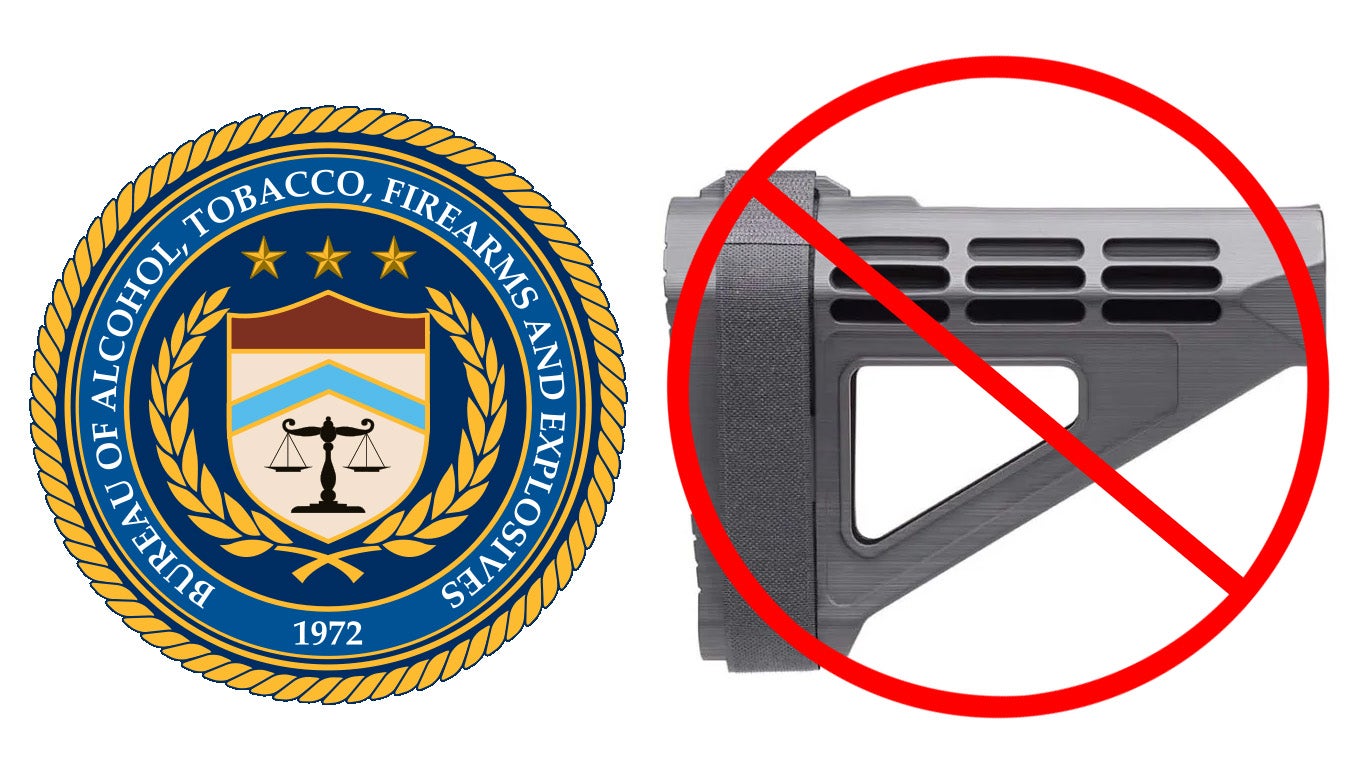
This article comes from the law firm of Prince Law. ATF to Institute Rulemaking Regarding Stabilizing Braces and Require Registration of Currently Owned Braces
In a 16 page draft copy of proposed rulemaking specifying “Objective Factors for Classifying Stablizing Braces”, the Bureau of Alcohol, Tobacco, Firearms and Explosives (ATF) has proposed entering into rulemaking to delineate the objective factors considered when “evaluating firearms with an attached stabilizing brace to determine whether they are considered firearms under the National Firearms Act (‘NFA’) and/or the Gun Control Act (‘GCA)” and the Department of Justice’s plan to “subsequently implement a separate process for current possessors of stabilizer-equipped firearms to choose to register such firearms in compliance with the NFA.”
While the proposed rulemaking has not yet been published in the Federal Register, it is expected to be published in the upcoming weeks and interestingly – seemingly in violation of the law – ATF is only providing a 14 day comment period, at least, pursuant to the draft copy. “Written comments must be postmarked and electronic comments must be submitted on or before [INSERT DATE 14 DAYS AFTER DATE OF PUBLICATION IN THE FEDERAL REGISTER].” It would not surprise me if the proposed rulemaking is published on December 24th, so that most interested individuals and businesses will be distracted by the holidays and unable to respond in the two week response period. To prevent against these types of shenanigans, the Gun Control Act mandates a 90 day comment period.
As more information becomes known, we will update this blog post or publish new ones, depending on the development.
If you or your company wish to file a comment in support or opposition to a notice of proposed rulemaking by a federal administrative agency, contact Firearms Industry Consulting Group today to discuss your rights and legal options.
Colion Noir: Georgia Senate Races WILL Determine The Fate Of The 2nd Amendment
Colion Noir talks about the Georgia senate runoff and possible effect on the Second Amendment.
Mises Institute: Joe Biden Wants a Huge New Tax on Gun Owners

This article from the Mises Institute discusses the gun control policies from Joe Biden’s Presidential platform, including the buyback program and alternative $200/firearm tax and registration in Joe Biden Wants a Huge New Tax on Gun Owners
Joe Biden’s gun policy platform offers support for almost all conceivable forms of government restrictions on the Second Amendment. This includes bans and restrictions on sales, expansion of registration and background checks, expansion of buyback programs and gun-grabbing statutes, and the closing of all sorts of “loopholes.”1
While we are only at the policy platform stage, where proposals are grandiose and imprecise, Biden’s legislative agenda will clearly be anti–Second Amendment and not a program to reduce crime and violence. First, he wants to stop the “gun violence epidemic” with restriction on rifles when it is handgun shootings, not rifles, that are a problem and one that is mostly confined to big cities controlled by leftists. Second, he wants to go after “assault weapons” and “weapons of war” when he should know that rifles like the AK and AR “sporters” are not military-grade fully automatic weapons. Third, he would like to hold gun manufacturers civilly liable for criminal acts committed with guns, a move which would shut down the industry, the true goal.
In support of the government’s buyback program, i.e., the carrot, Biden has added a gun tax for anyone who wishes to keep their rifles and high-capacity magazines. If you want to avoid the buyback and keep your guns and high-capacity (greater than ten rounds) magazine, you would have to register both under the National Firearms Act, which triggers a $200 tax for each rifle and magazine—the stick. The stick behind the stick is a penalty of up to ten years in federal prison and a $10,000 fine. Registration involves filling out a thirteen-page registration form and providing fingerprints and a photograph of yourself.This is certainly bad enough for gun owners and Americans in general, but if history is a teacher the end results could be much worse, potentially catastrophic.
Joe Biden was sold to the American voter in 2020 as a moderate of the Democrat Party. He was not a conservative, but neither was he an AOC progressive or a Sanders socialist. His image as a white moderate male was also used to help sell the voters on Barack Obama.
There was also a time when Biden was actually a pragmatist on Second Amendment rights. As the ranking member on the Judiciary Committee, he helped pass the 1986 Firearm Owners Protection Act, which overturned decades of anti-gun court rulings and regulations to restore most gun owner rights and reexpanded commerce by eliminating restrictions on how and where guns could be sold. The legislation’s passage helped lay the foundation of the modern gun rights movement. According to Biden the pragmatist circa 1985:
During my 12.5 years as a Member of this body, I have never believed that additional gun control or Federal registration of guns would reduce crime. I am convinced that a criminal who wants a firearm can get one through illegal, nontraceable, unregistered sources, with or without gun control. In my opinion a national register or ban of handguns would be impossible to carry out and may not result in reductions in crime.2
Despite his recognition of the futility of using gun control to reduce crime and gun violence, the “pragmatist” turned to the dark side when it became politically expedient to do so. In 1993 he helped pass the Brady Handgun Violence Prevention Act, which required background checks through a new national checking system (the National Instant Criminal Background Check System [NICS]). The next year he helped obtain a ten-year ban on assault weapons and high-capacity magazine sales.
As vice president, he was President Obama’s point man in developing legislative proposals and executive orders to shore up gun control at the national level, and yet even that administration admitted that gun control is almost a futile endeavor and that their efforts amounted to little more than feel-good measures.
While no law or set of laws will end gun violence, it is clear that the American people want action. If even one child’s life can be saved, then we need to act. Now is the time to do the right thing for our children, our communities, and the country we love.3
Indeed, with more than a century of experience we know that gun control does not reduce crime but rather increases it, as John Lott has demonstrated. According to Lott’s evidence and that of independent researchers, no form of gun control has positive effects and most forms have negative effects on crime, murder, and mass shootings. Indeed, the most noteworthy policies that improve these problems are the elimination of gun-free zones and the expansion of concealed carry laws.4
With respect to Biden’s proposed gun tax, what are the expected outcomes? The tax is certainly not designed to raise revenue, as it would raise little and entail a good deal of bureaucratic spending. It would no doubt encourage gun buybacks and reduce gun ownership at the margin, but to what end? It would mostly impact responsible gun owners economically impacted by the lockdowns and unemployment. These are the gun owners who reduce crime rates because of the deterrence factor they provide. The gun tax would also encourage the diversion of guns and high-capacity magazines to the black market.
Most importantly, would the gun tax reduce access to guns and in turn reduce crime and violence? Biden has already admitted that the answer is no: “a criminal who wants a firearm can get one through illegal, nontraceable, unregistered sources, with or without gun control.” Efforts to reduce gun violence through policies of red tape and taxes are doomed to fail and only lead to further inroads of enhanced policies of restrictionism and even outright prohibition.
For example, in order to address the real and imagined problem of narcotics addiction, which was already in decline at the end of the nineteenth century, the Harrison Narcotics Tax Act was passed in 1914 to regulate and tax the production, importation, and distribution of opiates and cocaine products.
However, the courts interpreted the legislation to mean that doctors could prescribe these drugs in the course of normal treatment, as a dental anesthetic or for short-term pain management, for example, but not as a treatment for addiction. This turned regulation into prohibition and quickly turned the imaginary crimes of blacks and Asians into very real crimes all across the country. Desperate addicts were willing to pay high prices and commit crimes to satisfy their addictions, and smugglers and drug dealers quickly developed a black market.
Similar negative consequences resulted from the Marijuana Tax Act of 1937, which started as a tax to reduce imagined crimes by minorities, i.e., Reefer Madness, only to quickly devolve into an outright prohibition. Fortunately, we as a people have recognized this mistake and are moving to legalize cannabis and hemp, i.e., marijuana, in a state-by-state process that works in the face of federal and international law.
As horrific and far-reaching as the consequences of the war on drugs have been, the consequences of “commonsense” gun control laws are potentially much greater in the long run. In a very important contribution, Stephen Holbrook demonstrates that the Nazis used gun registration information instituted and collected by the Weimar Regime to rapidly disarm the Jews and other political adversaries. This in turn greatly facilitated the Holocaust.5 A disarmed American population would similarly be much more vulnerable to political repression.
But putting this possibility aside, Biden’s gun control proposals, including the gun tax, offer no possibility of improved security, while most of them will make us less secure and more prone to crime and violence. Most importantly, they are all an affront and threat to our liberty as enshrined in the Second Amendment to the Constitution.
- 1. “The Biden Plan to End Our Gun Violence Epidemic,” JoeBiden.com, accessed Dec. 1, 2020, https://joebiden.com/gunsafety/.
- 2. 131 Cong. Rec. S18229 (July 9, 1985), https://www.govinfo.gov/content/pkg/GPO-CRECB-1985-pt13/pdf/GPO-CRECB-1985-pt13-4-2.pdf.
- 3. “Now Is the Time to Do Something about Gun Violence,” Obama White House archives, the White House (website), Jan. 16, 2013, https://obamawhitehouse.archives.gov/issues/preventing-gun-violence.
- 4. What Type of Gun Control Will Actually Make Us Safer? Before the Joint Economic Committee of the United States House of Representatives and Senate, 115th Cong. (2019) (statement of John R. Lott Jr., president of the Crime Prevention Research Center), https://www.jec.senate.gov/public/_cache/files/eb963cec-e717-4d0f-aa1a-9e5a46aff789/john-r.-lott-jr.-testimony.pdf.
- 5. Stephen P. Halbrook, Gun Control in the Third Reich: Disarming the Jews and “Enemies of the State” (Oakland, CA: Independent Institute, 2013); Audrey D. Klein, review of Gun Control in the Third Reich: Disarming the Jews and “Enemies of the State,” by Stephen P. Halbrook, Quarterly Journal of Austrian Economics 17, no. 2 (Summer 2014): 264–70, https://cdn.mises.org/qjae17_2_9.pdf.
Truth About Guns: ATF Brass Recommended Targeting Braces, 80% Lowers Under a Biden Administration

From The Truth About Guns comes this report, Confirmed: ATF Brass Recommended Targeting Braces, 80% Lowers Under a Biden Administration
Yesterday, John Crump published a report at Ammoland.com regarding a recent conference call between the ATF’s top brass and the “Biden transition team.” To be clear, no matter what you may read in the media, Joseph Robinette Biden Jr. is not yet the president-elect. At least not yet. None of the 50 states have certified their election results and the electoral college isn’t due to vote until December 14.
That made the conference call in question both premature and inappropriate. We’ve talked to people with direct knowledge of what was discussed on the call and can confirm Crump’s report that the higher ups at the ATF told the Biden boys they want to target two items should their boss occupy the oval office in January. Number one on the hit list is pistol arm braces and number two is 80% lowers.
The people we’ve spoken to confirm that the push to ban these items is coming from the top two seats at the ATF — acting Director Regina Lombardo and Associate Deputy Marvin Richardson. Also on board with banning these items are three members of the bureau’s general counsel’s office — Chief Counsel Joel Roessner, Deputy Chief Counsel Pamela Hicks and Associate Chief Counsel James Vann.
Both of these items have, of course been legal for manufacture and sale to the public for years. The ATF itself approved the sale of pistol arm braces eight years ago. Since then, millions have been sold and hundreds of people in the industry have jobs that are based on the manufacture and sale of braces.
As for 80% lowers, it’s always been legal for Americans to build their own firearms for their own use. Only a couple of state require serialization and registration of home-built guns now.
An 80% lower is a partially-finished block of aluminum. The buyer is then required to drill and mill the lower to make it functional for use as part of a pistol or rifle. If 80% lowers are banned, would 75% lowers still be legal? How about 70%? Will we have to regulate the sale of all billet aluminum in the country in case someone decides to use it to fashion a gun?
To ban these items, the ATF would have to reverse itself, doing a 180 on scores of opinions and rulings it has been issuing regarding these items for years. Of course, that didn’t stop them when they were ordered by the Trump White House to regulate bump stocks the same way as they do machine guns.
What such a ban would look like is anyone’s guess at this point. They could ban only new sales of the items, letting current owners keep and use them. Or, they could ban their possession, as was done with bump stocks, requiring owners to turn them in or destroy them.
Either way, if Biden is inaugurated and orders the ATF to ban these items, it will touch off a new round of lawsuits from gun rights orgs and owners of the newly-verboten equipment. Thousands of them will soon be sitting on lake beds all across the country.
In the mean time the White House apparently has the detail of what was discussed between the ATF brass and the Bidenbots. The President would be well within his rights to clean house at the ATF, just as he’s recently done at the DOD.
That, of course, would be a calculated risk. If the court challenges and recounts go his way, he’d be able to install replacements that have more respect for the rule of law, not to mention the right to keep and bear arms. But if things don’t go his way and Biden takes office in January, the replacements could well be worse than the asses that are currently in those seats.
It’s a great time to be alive.
Colion Noir: Joe Biden Tweets Gun Confiscation Promise and Why You Should Believe Him!
Colion Noir: 5 Reasons Why You Should Buy A Gun Before the 2020 Elections
Mises Institute: Self-Defense and “Taking the Law into Your Own Hands”
From Lew Rockwell at the Mises Institute Self-Defense and “Taking the Law into Your Own Hands” is about defending yourself and property from violence when “the law” will not. When “the law” abandons the people, is it vigilantism to defend yourself? The answer is, of course, no it isn’t, as self defense and defense of your property is legally authorized.
The riots in Louisville are only the latest in a long string of violent, raging mob riots by the criminal Marxist BLM movement, their mostly white “antifa” thuggish allies, and assorted looters. In this case, “Two police officers have been shot in Louisville, Ky., amid riots following the announcement of an indictment in the shooting of Breonna Taylor. Louisville chief of police Robert Schroeder confirmed that the officers were shot and were taken to a local hospital. Schroeder told reporters that one of the officers was undergoing surgery but in stable condition, while the other was alert and stable. Police have arrested one suspect in the shooting…after a grand jury charged just one of the officers involved in the shooting of Taylor in a botched drug bust. Rioters clashed with police throughout Louisville, burning trash cans and calling to defund the city police department.”
Last May, hundreds of businesses in the Twin Cities—Minneapolis and St. Paul—were damaged or looted during four days of unrest. In Los Angeles, “National Guard troops arrived in the nation’s second-largest city overnight after a fourth day of protests Saturday saw demonstrators clash repeatedly with officers, torch police vehicles and pillage businesses. Mayor Eric Garcetti said he asked Gov. Gavin Newsom for 500 to 700 members of the Guard to assist the 10,000 Los Angeles Police Department officers. ‘The California National Guard is being deployed to Los Angeles overnight to support our local response to maintain peace and safety on the streets of our city,’ said the mayor, who ordered a rare citywide curfew until Sunday morning. Firefighters responded to dozens of fires, and scores of businesses were damaged. One of the hardest-hit areas was the area around the Grove, a popular high-end outdoor mall west of downtown where hundreds of protesters swarmed the area, showering police with rocks and other objects and vandalizing shops.” About 3,000 protesters demonstrated in Brooklyn and were pushed back by NYPD officers releasing chemical mace after the protests turned violent. A woman was arrested and charged with attempted murder after she threw a Molotov cocktail into an occupied police car.
Things are likely to get worse. A story in the New York Times, a paper very sympathetic to the BLM hoodlums, admits that rioters plan to assault suburban white areas. They will demand that the white residents, who are often elderly, bow down to them and surrender their homes. “Nearly four months after the killing of George Floyd by the Minneapolis police, some protesters against police brutality are taking a more confrontational—and personal—approach. The marches in Portland are increasingly moving to residential and largely white neighborhoods, where demonstrators with bullhorns shout for people to come ‘out of your house and into the street’ and demonstrate their support. These more aggressive protests target ordinary people going about their lives, especially those who decline to demonstrate allegiance to the cause. That includes a diner in Washington who refused to raise her fist to show support for Black Lives Matter, or, in several cities, confused drivers who happened upon the protests.”
Ordinary Americans cannot rely on the police to protect them. In many cases, left-wing governors and mayors have ordered the police to stand down. For them, solidarity with the rioters is more important than the lives and property of decent citizens. We have seen the absurdity of rioters being called “peaceful protestors” when videos show cities aflame. When the police do their duty and counter the violence of the black thugs, they are vilified as racists, indicted, and even shot at and killed. In these circumstances, they are hardly likely to stay on the job. If the police don’t protect you, you have no legal recourse, and in some places, police won’t even investigate cases of looting. “’Neither the Constitution, nor state law, imposes a general duty upon police officers or other governmental officials to protect individual persons from harm—even when they know the harm will occur,’ said Darren L. Hutchinson, a professor and associate dean at the University of Florida School of Law. ‘Police can watch someone attack you, refuse to intervene and not violate the Constitution.’ The Supreme Court has repeatedly held that the government has only a duty to protect persons who are ‘in custody,’ he pointed out.”
What, then, are we supposed to do? In an interview on the Tucker Carlson Show on September 23, Danny Coulson, a retired deputy assistant director of the FBI, condemned the rioters. But he thought that there was something even worse than the burning and looting, and this was the main reason he condemned them: their actions might lead to “vigilante justice.” People must not take the law into their own hands—that could lead to chaos. Instead, we must unify around support of the police.
His advice is useless, and it rests on a false premise. How can we support the police when they aren’t protecting us? His advice is like urging us to put out a fire with a hose unattached to a hydrant. The false premise is that vigilante justice is bad. Is it? Let’s look at the definition of the term: “Vigilantism is the act of enforcement, investigation or punishment of perceived offenses without legal authority. A vigilante (from Spanish vigilante) is practitioner of vigilantism.”
In other words, you are a vigilante if you exercise your basic right of self-defense without the permission of the predatory state that supports the rioters and looters. In fact, if people defended and protected themselves, the result would not be chaos, but a far better system than we have now. As the great Murray Rothbard explained, people in a free market society would defend themselves by hiring private protection agencies. The agencies would compete to provide the services customers want, rather than cater to the whim of a mob or promote venality and power seeking, as officials of the state do now. As Murray again and again stressed, the free market is always better at supplying goods and services than the state, and protection and defense are no exceptions.
He explains in For A New Liberty, “Free-market police would not only be efficient, they would have a strong incentive to be courteous and to refrain from brutality against either their clients or their clients’ friends or customers. A private Central Park would be guarded efficiently in order to maximize park revenue, rather than have a prohibitive curfew imposed on innocent—and paying—customers. A free market in police would reward efficient and courteous police protection to customers and penalize any falling off from this standard. No longer would there be the current disjunction between service and payment inherent in all government operations, a disjunction which means that police, like all other government agencies, acquire their revenue, not voluntarily and competitively from consumers, but from the taxpayers coercively. In fact, as government police have become increasingly inefficient, consumers have been turning more and more to private forms of protection. We have already mentioned block or neighborhood protection. There are also private guards, insurance companies, private detectives, and such increasingly sophisticated equipment as safes, locks, and closed-circuit TV and burglar alarms….Every reader of detective fiction knows that private insurance detectives are far more efficient than the police in recovering stolen property. Not only is the insurance company impelled by economics to serve the consumer—and thereby try to avoid paying benefits—but the major focus of the insurance company is very different from that of the police. The police, standing as they do for a mythical ‘society,’ are primarily interested in catching and punishing the criminal; restoring the stolen loot to the victim is strictly secondary. To the insurance company and its detectives, on the other hand, the prime concern is recovery of the loot, and apprehension and punishment of the criminal is secondary to the prime purpose of aiding the victim of crime. Here we see again the difference between a private firm impelled to serve the customer-victim of crime and the public police, which is under no such economic compulsion.”
Private law enforcement isn’t just a theoretical idea, as we can see from British and American history. In Britain, “Throughout the period 1674 to 1829 many victims of crime were able to identify and apprehend the culprits before contacting a constable or a justice of the peace to secure their arrest….Londoners continued to help apprehend suspected criminals. As the Proceedings frequently illustrate, cries of ‘stop thief!’ or ‘murder!’ from victims often successfully elicited the assistance of passers-by…[V]ictims frequently paid thief-takers to locate and apprehend suspects. Moreover, the difficulties the authorities had in identifying and apprehending criminals led them to offer rewards to those whose arrests led to the conviction of serious criminals, and pardons to accomplices who were willing to turn in their confederates. Increasingly, ordinary Londoners left the task of securing criminals to people who were motivated to do so by the prospect of financial or other rewards.”
We see the same thing in America. “The development of policing in the United States closely followed the development of policing in England. In the early colonies policing took two forms. It was both informal and communal, which is referred to as the ‘Watch,’ or private-for-profit policing, which is called ‘The Big Stick’….These informal modalities of policing continued well after the American Revolution. It was not until the 1830s that the idea of a centralized municipal police department first emerged in the United States.”
Danny Coulson was horror stricken about people hiring private bodyguards, but what is wrong with that? We should support our basic right to self-defense. This is guaranteed by the Second Amendment, but our rights don’t depend on the state and its constitution. By the way, the recently sainted Ruth Bader Ginsburg wanted to end the individual right to keep and bear arms. Our rights come from natural law, and only the free market can enforce them and protect us.
American Partisan: Armed Citizens Must Defend Their Communities

Former Navy Seal Matt Bracken at American Partisan writes Armed Citizens Must Defend Their Communities from Rioting Mobs If the Politicized Police Will Not.
In societies living under the Rule of Law, sworn Law Enforcement (LE) officers have always been considered fully justified in applying lethal force against violent mobs during arson riots, such as those which have been occurring with regularity in American cities during the terrible summer of 2020. This was the intent and meaning of police officials publicly “Reading the Riot Act,” announcing over a loudspeaker that a violent mob had been declared to be an unlawful assembly, that is to say, a riot. Rioters who lingered on the street after that final warning could be engaged by LE at any level up to and including the use of deadly force, with no further announcement.
This was, in prior more civilized times, a basic understanding of all citizens living under the Rule of Law. This is why a police officer’s standard-issue pump shotgun was traditionally referred to as a “riot gun” long before the development of modern less-than-lethal munitions. This is also why arson riots were uncommon and short-lived. Everyone understood the ground rules. There was no right to burn, loot or murder.
Thomas Sowell put it this way: “If you are not prepared to use force to defend civilization, then be prepared to accept barbarism.” Note that he did not say “the government” or “the police department.” He said YOU.
ABR, my own acronym for the current working coalition of Antifa, BLM and the Revolutionary Communist Party of the U.S., are now routinely using Molotov cocktails (gasoline bombs) and other incendiary/explosive devices as offensive weapons in both an anti-personnel and anti-property (arson) role. As far as the BATFE is concerned, a Molotov cocktail is an illegal explosive device, and so are powerful high-altitude fireworks, when they are deployed at ground level as anti-personnel and anti-property explosive/incendiary grenades.
ABR deliberately uses the anonymity of their black-clad and face-masked mobs to conceal the identity of their individual bomb throwers, in exactly the same way that 19th Century Ku Klux Klan night riders carrying torches on arson missions concealed their identities with white robes and hoods. There is no moral or ethical requirement for either police or ordinary citizens protecting their communities from violent mobs to identify and ferret out the individual bomb throwers, when the rest of the mob is intentionally surrounding them in order to shield them from that identification. Because of the deliberately created synergy of bomb throwers utilizing the anonymity of the mob, the entire ABR mob becomes a legitimate target for police arrest or armed community self-defense.
Furthermore, at this writing in September of 2020, there is no moral or ethical requirement for a law-abiding American citizen to wait for a lit Molotov cocktail or any other incendiary or explosive device to crash through the window of their home or business, while ABR mobs are rampaging through the streets conducting arson attacks. Once the fires begin, morally and ethically, the same Rules for the Use of Force (RUF) should apply that would attach to a lynch mob, or to Ku Klux Klan night riders on their way to burn homes or businesses. Both KKK night riders bearing torches in olden times, and violent mobs of ABR terrorists with Molotov cocktails and other incendiary devices today, can and should be engaged by armed citizens with any necessary level of force required to halt their terroristic depredations.
In numerous recent cases, law enforcement under Leftist political control has repeatedly abdicated its traditional and expected role in breaking up violent riots and preventing arson and other terror attacks. Week by week, the level of ABR violence has been steadily escalating, and it’s logical to assume that it will only worsen as the hotly-contested presidential election draws near.
So let me be very clear: if Democrat Party governors, mayors and DAs have hamstrung their police for political reasons, and won’t allow them to protect the lives and property of their local citizens using all required force, abandoning their primary mission in order to bow to the ABR mob, then it is time for their undefended citizens to apply the clear intent of the Second Amendment. There should be deep regret about the abandonment of the Rule of Law by the Democrat Party political ruling class, but there should be no moral quibbles or hesitation by American citizens concerning the legitimacy of armed community self defense, in the absence of expected law enforcement protection.
Therefore, it is my carefully considered opinion that black-clad and masked ABR mobs, rampaging and terrorizing innocent citizens under the cover of darkness in the style of the KKK of old, may morally and ethically be taken under preemptive fire by armed citizens at any level necessary to drive them out of their peaceful neighborhoods and away from their businesses, before the terrorists can reach their targets and throw their Molotov cocktails and other explosive and incendiary devices.
As an historical note, it should be understood that the National Rifle Association was founded after the last American Civil War by former Union Army officers, (and Republicans at that), in order to empower freed African-American former slaves to defend themselves with firearms against KKK night raids. In the 19th Century, the Democrat Party, then allied with the Klan, (as the Democrats of today are aligned with Antifa and BLM), had favored strict gun control, in the form of narrowly written laws restricting the legal ownership of firearms by free black citizens.
The more things change…the more they stay the same.

The Captain’s Journal has a few comments on Matt’s article.
…You cannot entrust your safety to an assumption. You do not know the intent of the invaders, and maybe they don’t even know their intent.
Third, even if the rioters don’t intend to douse you with gasoline and set you on fire, there can be unintended consequences and collateral damage. It’s extremely dangerous to have rioters and looters rampaging through neighborhoods.
Regardless of intent (which can’t be known anyway), women and children can perish. Men cannot allow that to happen. Men cannot allow increased danger to come to their loved ones if they can stop it.
Having said all of that, be careful. Your enemy isn’t just Antifa/BLM. Your enemy is the state as well, who will prosecute you for self defense. They did with Kyle Rittenhouse, and they did with the McCloskeys. They’ll do it to you too.
Grey Man at American Partisan adds his comments on the above two posts.
…NEVER go anywhere alone. Kyle Rittenhouse defended himself masterfully for his situation, but to my knowledge, he started out with a group of people. He found himself alone at some point. Do not find yourself alone. Don’t leave your group. AntiFa isn’t going to, so you don’t either.
Mises Institute: America’s Private Militias of the Nineteenth Century

Ryan McMaken at the Mises Institute writes of some little known American history in America’s Private Militias of the Nineteenth Century
Since at least as early as the mid-1990s, the term “militia” has been increasingly used by journalists and scholars on the left in connection with alleged “right-wing extremists.”1
Over time, the term “militia” has been used to describe nearly any group of nonleftist armed men, and has been generally used in close connection with terms like “extremism,” “violence,” and “vigilante.” We have been reminded of this in recent years during riots in places like Ferguson, Missouri (in 2014), and Kenosha, Wisconsin (in 2020). In both cases, armed volunteers attempted to assist private sector business owners with protecting their property from looters and rioters. And in both cases, the volunteers were described with terms such as: “violent,” “militia,” “extreme,” and “white vigilante.”
Historically in the United States, however, the term “militia” had entirely different connotations. Throughout much of the nineteenth century, militias were considered to be common institutions central to civic and community life. They were a common fixture of local festivals and celebrations, and they functioned in some ways as fraternal orders function today.
Although some critics of the militia idea have attempted to claim militias existed primarily to suppress slave rebellions, the fact is militias were common and widespread in Northern states where they had no role whatsoever in maintaining the institution of slavery. In fact, militias often served an important role in providing opportunities and community cohesion for new immigrants.
The Local Militias of the Nineteenth Century
What’s more, many militias were independent of a centralized state militia system and functioned largely as private entities. They elected their own officers, were self-funded, and trained on their own schedules. Although they were ostensibly commanded by the state governors, this system of functionally private militias became an established part of daily life for many Americans. These were local volunteer militias with names like the “Richardson Light Guard,” the “Detroit Light Guard,” or the “Asmonean Guard.”2 They were essentially private clubs composed of gun owners who were expected to assist in keeping law and order within the cities and towns of the United States.
They were separate from the so-called common militias, which developed in the eighteenth and early nineteenth centuries, and which in many cases were staffed with conscripts, were funded with tax dollars, and were commanded by an established state bureaucracy.
But by the Jacksonian period, new volunteer militias began to arise. As noted by Jeffrey Rogers Hummel, the United States by the 1830s had seen “a remarkable growth in the privately organized volunteer militia. The number of volunteer units had been expanding steadily since the American Revolution, but after the war of 1812, it exploded. Three hundred sprang up in California alone between 1849 and 1856.”3
These groups were, in the words of historian Marcus Cunliffe, “volunteer companies existing independently of the statewide system of militia, and they held themselves aloof from the common mass. They provided their own uniforms.”4
They also elected their own officers, did their own fundraising, staffed their own governing boards, and sought out for themselves a secure position within the communities where members lived. In earlier decades, especially the 1830s and 1840s, these groups tended to be “elite” in the sense that they attracted upper middle– and upper-class members of the community. This was in many cases because of the cost of funding these volunteer militias.
As a member of the Detroit Light Guard remembered, “at that time the company got nothing from the State. They had to pay for all they got, uniforms and all.”5
But by the 1850s, firearms and uniforms were becoming more affordable to the middle and working classes. This brought in many new members from outside the local elite circles of established families. Moreover, some militias were able to solicit funding from wealthy members of the community who acted as patrons. The case of the Richardson Light Guard (RLG) is instructive:
The RLG came into being in South Reading, Massachusetts, in 1851, in response to a perceived shortage of militiamen in the years following the Mexican War. At the time, all that was necessary for the militia to be regarded as legally sanctions was for the group to “petition the governor” for what amounted to a nod of approval. This was granted. But at that point, the group still lacked funding. Although members paid dues, historian Barry Stentiford notes that “Dues were not enough [to] cover the expenses of the fledgling company, and committee members had to use their own money to carry out its business.”6
Members came up with a plan to offer “honorary memberships” to wealthy members of the community. The largest donor in this scheme was a man named Richardson, after whom the militia was soon named. Funding from prominent community members also added legitimacy to the group and ensured it would continue to be regarded as a community-sanctioned group of armed men.
Although the RLG enjoyed legal sanction, it was essentially a private organization, and Stentiford notes, “At its inception, the RLG belonged to its members, and to prominent residents of the town of South Reading. The town of South Reading, the Commonwealth of Massachusetts, and the federal government occupied a diminishing hierarchy of influence.”7
In other words, while everyone admitted local, state, and federal officials enjoyed some form of control of the militia, this authority was tentative at best.
Massachusetts wasn’t the only place were militias were privately funded and privately controlled. When Iowa became a US territory in 1838, for example, an “official” territorial militia was formed. On the other hand:
The formation of local militia groups was more relaxed in comparison to the State militia service. To form a local militia group one would simply ask for local men to sign up, name the group, possibly elect officials or form by-laws, and then write to the Iowa Territory legislature to introduce themselves and request weapons….If you received a positive letter back and weapons, you were a militia group in the Territory of Iowa.
Indeed, this sort of local—and even private ownership—was an increasingly common method of organizing militias by midcentury. Hummel concludes that “Because many volunteer units were privately organized, recruited, and equipped, the militia became a partially privatized system as well.”
Because of their local nature, many militias reflected local character as well—and access was hardly limited to national ethnic majorities. By the 1850s, immigrants had come to dominate many volunteer militias, with Irish, Scottish, and German militias becoming especially common. The Scottish militiamen wore kilts as part of their parade uniforms. The Italians created a “Guardia Nazionale Italiana.” Robert Ernst notes that the “significance of the immigrant military companies is evident in the fact that in 1853, more than 4,000 of the 6,000 uniformed militia in New York City were of foreign birth.”8
Nor were militia groups limited to Christians. Jack D. Foner recounts in the American Jewish Archives Journal:
Jews in New York City formed military companies of their own. Troop K, Empire Hussars, was composed entirely of Jews, as was the Young Men’s Lafayette Association. A third unit, the Asmonean Guard, consisted of both Jewish and Christian employees of The Asmonean, one of the earliest Anglo-Jewish weekly newspapers. “Our employees,” commented the newspaper, “have been seized with this military mania, as they have enrolled themselves into an independent corps.”
As militias became more middle class, their names changed as well. Militias began to refer to themselves with names that might be used for sports teams today, including terms like “Invincibles,” “Avengers,” and “Snake Hunters.”
Dress uniforms were often extravagant and modeled on Napoleon’s troops earlier in the century. These groups were even known to impress foreigners. As one Englishman remarked: “They marched in sections, with a splendid band at their head and…it would be impossible to find a more military-looking, well-drilled body of men.”9
These volunteer militias were attractive to potential members, because these groups served many social functions as well. As noted by historian Briton Cooper Busch, “in peacetime, all [volunteer militias] helped their communities celebrate festivals, holidays, and funerals with marches, balls, and banquets, helping out in emergencies, and often building an esprit de corps which established a basis for effective wartime service and even elite reputations.”10
In many cases, membership in a local militia provided opportunities for social advancement, and “it was not uncommon for individual families to have long associations with these institutions.”11 For newcomers to any community, whether or not of foreign origin, “the militia company provided a means for newer residents to embed themselves into the fabric of the community.”12
The volunteer militias played a similar role to that of the volunteer fire brigades of this period, which in many communities came to be dominated by immigrant groups and served as a way to and advance the social and economic lives of newcomers.13
Militias Replaced by Full-Time Government Police and Centralized “National Guard”
Needless to say, this model of American militias is long gone from the imagination of nearly all Americans. Modern-day journalists and scholars have been hard at work attempting to connect militias, past and present, either to slavery or to fringe groups and vigilantism. Moreover, many Americans now regard the idea of privately controlled bands of armed men with trepidation and fear.
As the size and scope of taxpayer-funded bureaucratic agencies grew throughout the nineteenth century, private volunteer militias were deemed increasingly unnecessary and undesirable. The late nineteenth century was a period during which states and the federal government went to great lengths to end the old system of locally controlled militias, and this was topped off by the Militia Act of 1903 which largely ended state autonomy in controlling state military resources as well. By 1945, the National Guard was well on its way to becoming little more than an auxiliary to the federal government’s military establishment, although some remnants of the old decentralized system remained.
When it comes to urban environments, these militia were in many respects replaced by today’s state and local police forces, which unlike the volunteer militias are on the job full-time and enjoy immunity and privileges far beyond what any militia member of old might have ever dreamed of having. Rather than private self-funded militias called out only occasionally to quell riots and uprisings, we have immense, taxpayer-paid police forces with military equipment, SWAT teams, and riot gear to carry out no-knock raids (often getting the address wrong).
The old militia system was by no means flawless, but this switch to a more centralized bureaucratic system is not without costs of its own, both in terms of dollars and the potential for abuse.
Moreover, as has become increasingly apparent in recent years, National Guard troops and local police forces are clearly inadequate to provide safety and security for private homes and businesses. Half of the nation’s violent crimes remain “unsolved” as police focus on petty drug offenses rather than homicides. Meanwhile—as happened in both Ferguson and Kenosha—National Guard troops focus their protection on government buildings while private businesses burn.
The dominant shapers of public opinion would have us believe that volunteer groups of armed men must be regarded with horror. Yet it is increasingly clear that the institutions that have replaced the militias of the past still leave much to be desired.
 Lower Valley Assembly