Deccan Herald: 700-km-long Traffic Jam in Paris Ahead of 2nd Covid-19 Lockdown

According to this article at the Deccan Herald, there were 700km (~435 miles) of traffic jams in Paris on Halloween as people attempted to flee the city ahead of another lockdown. The scene is reminiscent of so much disaster fiction where the protagonist tries to bugout from the city a little late. It’s difficult to know when the right time to bug out is, but if you’re stuck in over 400 miles of traffic jams, then you probably waited too long. Mass departures from cities are nothing new for pandemics. During the 1793 yellow fever epidemic, around 40% of the population of Philadelphia fled the city. But back then, around 10% of the city’s people had died from the disease within a span of three months, whereas the citizens of Paris are fleeing the government’s response to the Covid-19 pandemic which has killed 0.1% of the city’s population.

If you plan to bug out something, it’s important to know how you are going to do it and especially when you are going to go so you don’t end up getting caught in this sort of jam.

An authorisation that needs to be filled out just to take a bit of fresh air. Long traffic jams as Parisians tried to leave the French capital before it was too late. Pressure on supermarket shelves for key goods.
After enduring two months of lockdown last spring in a bid to squeeze out Covid-19, there was a weary sense of deja-vu in France on Friday as people contemplated going through it all again for at least a month — and maybe even to Christmas and beyond.

The new lockdown added to an already grim mood in France after three attacks in recent weeks blamed on Islamic extremists, the latest the killing of three people inside a church in Nice on Thursday.
There are crucial differences with the new lockdown, most crucially that children will be returning to school after the autumn break, rather than staying home.

And while nonessential businesses are to close, some were still open on Friday.

At least four shops — a shoe store, a dry cleaners, a mobile phone store and a Nespresso boutique — welcomed clients at midday on a busy pedestrian street in the Passy neighbourhood of western Paris.

“For me, it’s a normal day, it changes nothing,” said Hedi Lecaude as he headed to work at his insurance office in Paris, flashing an authorisation from his employer to police as he entered the metro.

There was also a steady flow of traffic around central Paris, even if public transport was less clogged than usual by midday, raising concern among medics over whether the public would take this round of the lockdown seriously.

There were fewer bike riders and joggers around than usual but the atmosphere was more of a lazy Sunday afternoon than the first day of strict stay-at-home orders.

Trains from the provinces back to Paris were busy after President Emmanuel Macron made clear that there would be a grace period so families could return home after the autumn break.

But in the other direction, hundreds of kilometres of traffic jams formed in Paris late Thursday as worried residents of the capital sought to flee in the hours before the lockdown took effect.

The Sytadin traffic website said there were over 700 kilometres of traffic jams in the Paris region late Thursday, with electronic signs on the Paris ring road bearing grim warnings for drivers of an hour to go before the next exit.
Yet the reality remained that within a space of months France has gone from “confinement” (lockdown), to “deconfinement” as the measures were relaxed over the summer, to “reconfinement”.

As previously, the basic rules are simple and strict. Essential workers and employees who cannot work from home can obtain passes for their daily commute.

Others will only be allowed to leave home for other essential reasons — for example food shopping or medical visits — or for exercise. These trips should be for no more than one hour and within a one-kilometre radius of their homes, Prime Minister Jean Castex said.
And like in spring, every movement outside needs to be justified by filling out an authorisation form, either by hand or online.

Worried social media users posted pictures of supermarket shelves empty of the essentials, but executives insisted there would be no shortages.

The president of the Intermarche chain, Thierry Cotillard, said his supermarkets had been busier than normal but denied there had been any “hysteria.”

Home entertainment and electrical goods giant Fnac-Darty said it was keeping stores open by benefitting from an exemption that allows people to buy goods for home-working.

According to a poll by Odoxa-Dentsu Consulting for France Info and daily Le Figaro, seven out of 10 in France are in favour of the new lockdown.

“Being able to send the children to school is a big help,” said Josephine Weil, a lawyer, as she walked with her son in central Paris, adding she was “resigned” to the reality of the new lockdown.

But some angry French took to the streets of Paris late Thursday for an unauthorised protest to condemn the new measures as overly drastic.

“We shouldn’t overdo it. From midnight tonight we must all be at home, it’s too much,” said one protester, who gave her name as Laura.

Doom and Bloom: Soft Tissue Infections

The Altons at Doom and Bloom Medical write about Soft Tissue Infections. More pictures are in the original article.

All injuries carry a risk of infection. When the skin is breached, various microbes can invade and cause damage. Inflammation in soft tissues known as “cellulitis” may develop when bacteria enter through a crack or break in your skin. Fortunately, infections from minor wounds are relatively easy to treat today due to the availability of antibiotics. Without them, any bacteria may become life-threatening if it enters the circulation.

If germs invade the soft tissues below the superficial level of the skin (the “epidermis”), they can rapidly infect the main layers of soft tissue below. These include the deep layer of the skin (the “dermis”), the subcutaneous fat, the muscle layers, and various blood vessels and nerves.

image by Cerevisae 

Cellulitis may be easy to deal with in normal times, but it will be an epidemic in the aftermath of a major disaster. This is not because it’s contagious; it isn’t unless you have an open wound yourself or exchange bodily fluids. Expect cases simply because of the sheer number of injuries incurred from performing activities of daily survival in less than sanitary conditions.

Without antibiotics, infections can spread to lymph nodes and the bloodstream, rapidly becoming life-threatening. The end result might affect the entire body, referred to as “sepsis.” Once sepsis develops, inflammation of deep structures like the spinal cord (“meningitis”) or bone marrow (“osteomyelitis”) can further complicate the situation. In the past, sepsis was usually fatal.

The bacteria that can cause cellulitis are on your skin right now. Normal inhabitants of the surface of your skin include Staphylococcus and Group A Streptococcus. They do no harm until the skin is broken and they enter deeper tissues where they don’t belong. In recent years, a resistant bacterium called MRSA (Methicillin-Resistant Staphylococcus Aureus) has arisen which causes cellulitis resistant to the usual antibiotics.

As an aside, Cellulitis has nothing to do with the dimpling on the skin called “cellulite”. The suffix “-itis” simply means “inflammation”, so cellul-itis simply means “inflammation of the cells.”

The signs and symptoms of cellulitis must be recognized as early as possible. They include:

  • Discomfort in the area of infection
  • Fever and Chills
  • Exhaustion (fatigue)
  • General ill feeling (malaise)
  • Muscle aches (myalgia)
  • Heat in the area of the infection compared to non-affected areas
  • Redness, usually spreading towards torso
  • Swelling in the area of infection (often appearing shiny and causing a sensation of tightness)
  • Drainage of pus or cloudy fluid from the area of the infection
  • Foul odor coming from the area of infection
  • Hair loss at the site of infection (less common)
  • Joint stiffness caused by swelling of the tissue over it (less common)

Cellulitis commonly occurs in an extremity, such as a leg. In these cases, it’s helpful to keep the limb elevated. Other strategies include warm or cool compresses or soaks to the affected area, and the use of ibuprofen (Advil) or acetaminophen (Tylenol) to decrease pain, discomfort, and fever.

Although the body can sometimes resolve cellulitis on its own, treatment usually includes the use of antibiotics. These can be topical, oral, or intravenous. Topical therapy helps more to prevent infection than cure it.

As most cases of cellulitis are caused by bacteria, they should improve and disappear during a 7-14-day course of therapy with medications in the Penicillin, Erythromycin, or Cephalosporin (Keflex) families. Amoxicillin and ampicillin are particularly popular. MRSA cellulitis can be treated with clindamycin and the sulfa drug combination of sulfamethoxazole/trimethoprim (SMX-TMP). It’s important to complete the full course of therapy.

Adult dosing:

-Penicillin, amoxicillin, cephalexin, or ampicillin 250-500 mg orally four times a day for 7-14 days (Amoxicillin also comes in 875 mg).

-Clindamycin 150-300 mg orally three times a day for 7-10 days.

-SMX 800 mg-TMX 160 mg orally twice a day for 7-10 days.

Those allergic to penicillins can still take clindamycin or SMX-TMP. It should be noted that not all sources will recommend the same dosage, frequency, and duration of therapy for a particular drug. In resistant infections like MRSA, combination therapy with SMX/TMP and Cephalexin 500 mg orally four times a day for 7-14 days may be necessary.

As with all medications, the longer the therapy and the higher the dose, the more likelihood that adverse reactions may occur. A much more comprehensive discussion of antibiotics can be found in Alton’s Antibiotics and Infectious Disease: The Layman’s Guide, or online at drugs.com and rxlist.com.

All the drugs mentioned above are available in veterinary equivalents (at least at present). In a survival situation, however, antibiotics will be precious commodities. You, as medic, should dispense them only when absolutely necessary. The misuse of antibiotics, along with their excessive use in livestock, is part of the reason that we’re seeing an epidemic of antibiotic resistance in this country.


PrepperNet Moves to MeWe from Facebook

Just as we recently heard that The Organic Prepper had closed their Facebook page over censorship, now PrepperNet has announced that they are moving to MeWe.

PrepperNet has moved to MeWe!

Due to Facebook’s restrictions and censorship on Free Speech, we are moving our primary social media platform to MeWe.  Without warning, Facebook has deleted other pages related to preparedness such as Forward Observer’s and Prepping2.0.  While PrepperNet is not a political group, there are times our preparedness group sometimes discusses and shares information and personal perspectives about current events.

With the recent and ongoing politically motivated censorship actions of many of the social media platforms, PrepperNet sees the handwriting on the wall and we are reevaluating our relationship and use of some of the social media tools.  In the meantime, we are making every effort to comply with Facebook’s policies as we consider it a valuable communication tool. However, to ensure our community will be in a position to continue on, we have developed a new plan to ensure a continuity of operations should we lose access to Facebook.

So here is our plan.

We have different levels

ALL PrepperNet members should all join PrepperNet.Com.  It’s FREE!
If you want to support PrepperNet, please become a Premium Member for $40/year.

PrepperNet 101 is going to be Facebook.  We will not allow any political or controversial topics.  We will only use Facebook to “Catch” new interested preppers looking for PrepperNet.

PrepperNet 102 is MeWe. This is where you can chat and share preparedness topics with everyone. www.mewe.com/join/preppernet

PrepperNet 103 will be the PrepperNet forums. The forums are for learning and sharing information. This is old school and hopefully will not take a big learning curve. This is for people that want to share projects and really learn. We are fine with a small percentage participating on the forums.  The forums link can be found in your basic membership tab on preppernet.com. You can use the app Tapatalk to connect with the forums once your account is setup.

As we move forward, we encourage all members to use MeWe as their primary social media platform when interacting with PrepperNet.

www.mewe.com/join/preppernet

Mises Institute: Talk of “Unity” Is Both Hypocritical and Delusional

Professor Gary Galles at the Mises Institute says political Talk of “Unity” Is Both Hypocritical and Delusional

In Joe Biden’s address after being declared president-elect by news organizations, he promised to be a leader who “seeks not to divide but to unify.” Making that assertion after the campaigns we have seen, not to mention the light-years-apart treatment of the candidates, while Donald Trump is still adamantly disputing the election because of alleged Democrat malfeasance is, at a minimum, ironic. And it would be the height of hypocrisy if only a few of Trump’s claims of cheating are true. But we need to go further and recognize that even the possibility of Joe Biden uniting us is a delusion.

Agreement on the specific ends we want to achieve is unattainable because our desires are mutually inconsistent. Our agreement is very limited on even very broadly defined issues, and once we look further than vague, aspirational language and feel-good generalities, Americans disagree on virtually everything.

All of us want to be fed, clothed, housed, educated, etc. We agree in that sense. But we disagree about virtually every aspect of who, what, when, where, why, and how. We want different types and amounts, in different ways, at different times and places, and for different people. We are vastly different in the tradeoffs we are willing to make among our desires, not to mention who we think should pay our bills. Once we consider any of the myriad actual choices faced, the fact of scarcity necessitates that our specific ends conflict, rather than align.

Consider a mundane example played out daily in our homes—breakfast. Does everyone in your family agree on “the most important meal of the day”? Does everyone even eat breakfast? Does each member have coffee, a cold caffeine drink, or neither? Juice? What kind? Are all agreed on when, where, what, or how much to eat? Do we agree on who should pay for breakfast, cook it, and clean up after it? Do we agree on the “dress code” that should apply, either at breakfast or afterward?

Diverse individuals have diverse preferences. Multiplying this single example by the uncountable decisions that must be reached in society every day makes our fundamental disunity clear. And we are no more unified when we get to public policy. We are not in agreement about people’s rights and government powers that some view as essential but others view as unforgivable. The same is true of many foreign policy choices. We cannot be unified as “one nation under God” when some vehemently reject any reference to God. We cannot be unified about abortion when some view it as murder and others consider it sacred. Policies that take from some to give to others also inherently create disagreement from those whose pockets are involuntarily picked. Reducing what we take from some, entailing giving less to others than they wish, also triggers disagreement. So long as government dictates such choices, political unity is unattainable.

In fact, politics as currently practiced eviscerates the one thing Americans could agree about. This reflects the far-too-little-recognized fact that we have greater agreement on what all of us want to avoid than on what all of us want. None of us wants what John Locke called our “lives, liberties, and estates” violated. That is, each of us wants rights and property defended against invasion. Respecting all of our property rights reduces the risk from predation for each of us. But creating added rights and privileges for some at the expense of others’ equal rights and privileges makes government the most dangerous predator, even when who is selected to do so is determined by majority vote.

Each of us would like the freedom to peacefully pursue our own goals. As Lord Acton put it, “liberty is the only object which benefits all alike, and provokes no sincere opposition,” because freedom to choose for ourselves is always the primary means to our ultimate ends. That is why the traditional functions of government are to protect us from abuse by our neighbors and foreign powers, while its greatest threat is supposed protectors becoming predators against citizens. That is why Acton recognized that liberty requires “the limitation of the public authority.” But we are incredibly far from agreement on that today.

Well-established property rights and the voluntary market arrangements they enable let individuals decide for themselves, limiting each of us to persuasion rather than coercion. Except in the very unusual case where we must all make the same choice, this allows us to better match our choices to our preferences and circumstances. And unlike minority votes in elections, every dollar “vote” matters.

In fact, we should recognize that markets are our primary means to transform our disagreements into mutually beneficial cooperation, while restrictions on markets hobble that essential function.

Say I offer you a widget for sale at $10 and you say yes. That does not mean we agree on its value. We disagreed. I valued it at less than $10 worth of other goods and services, or I wouldn’t have sold it for that. You must have valued it more than $10, or you wouldn’t have bought it for that. Importantly, however, we have transformed our disagreement on values into an exchange that gives both of us benefits we consider to be worth more than the costs.

In contrast, talk of political unity is primarily rhetorical cover for those who are in power to coerce those who disagree with them. They benefit themselves at others’ expense, taking others’ resources and making them acquiesce in what they object to. And unlike markets, in which greater disagreements about value create greater net benefits from voluntary arrangements, “unifying” political initiatives are just ways to control who will be forced to do what for others, driving Americans apart while hamstringing cooperative arrangements and squandering the wealth they would have created.

Grand invocations that “I will unify us” are actually shorthand for “We disagree about many things, but those in this group are unified against others’ preferences, and we mean to get our way, regardless of their well-being and desire,” which is made clear by the demonization of anyone who doesn’t support the supposed “unity” position as divisive. That kind of unity is tyranny. Strengthening our union actually runs along a different path than the unity of 50 percent plus one, unified against the interests of others. It is uniting in a common commitment to honoring one another’s rights and the liberty this makes possible for all of us. Without unity in that, we can never achieve the kind of unity that is actually desirable and achievable. The alternative is the prospect of more of what we have experienced of late, which resembles what Thomas Hobbes called “a war of all against all.” But if we are united only by the ongoing fight to win that war against other Americans, we are selling out the birthright we have from our Declaration of Independence and Constitution.

Sovereign Man: It’s Started Already – “We Have a List”

Simon Black of Sovereign Man writes about the fall of empires in It’s Started Already: “We have a list.”

On September 18 of the year 96 AD, a fairly obscure and elderly politician named Marcus Cocceius Nerva was proclaimed Emperor of Rome by the Senate.

Rome was in chaos at the time; the empire had suffered from years of turmoil, economic decline, and oppression.

Most of the last several emperors– going back before the suicide of Nero in 68 AD– had been extremely destructive… plundering the treasury, waging expensive wars, and dismantling individual liberty.

The government was also extremely unstable; it was not uncommon at that point for emperors to be deposed or even assassinated.

In fact, Nerva’s predecessor– the emperor Domitian– had literally been murdered that morning.

Nerva was seen by many Senators as the ‘safe choice’ to take over the government. He was old, frail, and sick… so he wasn’t expected to last very long.

Most of all, Nerva was completely unremarkable.

He had spent his entire professional life in the service of the Empire, yet his name is barely mentioned in any historical record or associated with any major achievement.

But ‘unremarkable’ was exactly what Romans felt like they needed at the time: Nerva would be a break from the chaos. Or so they thought.

We know now with the benefit of hindsight that Rome would never fully recover.

There would be a few ‘good’ emperors along the way– people like Marcus Aurelius who were able to temporarily hold back the decline.

But the long-term trends were unstoppable.

Rome was slowly going bankrupt, destroying its currency, and rejecting the basic principles of its civilization that made it so powerful and prosperous to begin with.

And no politician was able to put the brakes on those big trends and reverse the inevitable decline.

This is a common theme throughout history: empires rise and fall, not because of a single individual, but from decades of major trends that gradually cause an inevitable decline.

These same trends keep surfacing over and over again across the centuries.

Economic mismanagement is an obvious one: empires in decline almost invariably hold an arrogant belief that they are exempt from the natural laws of finance.

In other words, they believe they can spend as much as they want, accumulate infinite amounts of debt, and debase their currency without limit, and somehow there won’t be any consequences.

Another trend is that the empire abandons its core values. Integrity, civic-mindedness, and hard work give way to corruption and entitlement.

And perhaps the biggest trend of empires in decline is that society frequently turns on itself. Civility ends, and rage takes over.

It goes without saying that these trends are alive and well in the West today, especially in the Land of the Free.

US finances have been in disarray for decades. Just this year alone, the national debt has grown by $4 trillion and the Federal Reserve has conjured another $3 trillion out of thin air.

And even before Covid struck when the economy was firing on all cylinders, the government was still adding more than $1 trillion each year to the debt.

Now there are entire factions of politicians that want to take those numbers to the next level.

In fact, there’s an entire school of economics now called “Modern Monetary Theory” which poses that governments can simply print as much money as they want without consequence.

This is pretty classic empire arrogance.

But, again, the even more powerful trend now is the growing rage that’s so prevalent.

We’ve seen it unfold in front of our very eyes– violence, arson, assault, looting, vandalism, intimidation.

And if the this angry mob isn’t out in the streets causing mayhem, they’re on social media trying to destroy someone’s life who committed the thoughtcrime of intellectual dissent.

The election results last week proved that this angry mob is still a numerical minority.

Unfortunately they are a very powerful minority that has taken over a number of important institutions.

They already control the media. Objective journalism doesn’t exist anymore– it’s just activism and propaganda.

(And if anyone needs any proof, look no further than a prominent CNN ‘reporter’ weeping tears of joy over the weekend on live television. How can these people expect to be taken seriously as objective journalists??)

The mob has also taken over education too.

Schools and universities are now filled with enraged Marxists who spend dozens of hours each week indoctrinating our children with their new woke religion.

They’ve even reinvented science, history, and mathematics to conform to the principles of critical race theory.

The mob also exerts extreme influence over major corporations.

You can’t watch a Disney movie, or an NFL game, or even a commercial for men’s razors anymore, without having identity politics shoved down your throat.

They also hold extreme influence over Big Tech, whose one-sided censorship policies have become so absurd they’re starting to rival the Chinese Communist Party.

Over the weekend, for example, Twitter was ablaze with activists who launched an ‘accountability project’ to create a database archiving every supporter, donor, staffer, etc. who supported the current Presidential administration.

The project’s tagline is “Remember what they did,” and “We must never forget. . .”

And they’re targeting “those who elected him,” and “those who funded him,” referring, of course, to the President and the 70 million people who voted for him.

One reporter from the Washington Post deemed that everyone archived “should never serve in office, join a corporate board, find a faculty position, or be accepted into ‘polite’ society.”

She concluded her thinly-veiled threat by saying, “We have a list.”

Twitter, of course, did not see fit to censor this shining example of objective journalism, which now has 40,000 likes.

It’s a pretty blatant sign of decline when people start keeping ‘lists’ of political opponents they want to punish. And this madness is just getting started.

Happy Veterans Day


Veterans Day began as Armistice Day, which was initially a date to celebrate the end of World War I.

The armistice, or resolution, ending the armed conflict of the Great War took place on the eleventh hour of the eleventh day of the eleventh month. And so, each Veterans Day is held on Nov. 11, the date marking the end of “the war to end all wars.”

But after World War II and the Korean War, Congress chose to — under the guidance of crucial veterans service organizations — ditch the word “Armistice” and switched it out with “veterans.”

President Dwight D. Eisenhower made it official by signing a law reflecting the change on June 1, 1954, and it’s been Veterans Day ever since.

What’s the difference between Veterans Day and Memorial Day?

This is a big deal. Civilians who mean well legitimately confuse the two, but the different holidays should not be conflated.

Memorial Day, which is reserved for the last Monday in May, is a date set aside to honor and remember those who have died in service to their nation. That’s why it’s common to see American flags planted on the graves of fallen service members, and also why the phrase “Happy Memorial Day ” should never be uttered. It’s a day of somber reflection.

Veterans Day, on the other hand, is reserved for thanking and celebrating living vets who served in the military, either in time of war or peace.  — Radio.com

Some valley events include:

  • The West Richland Veterans Day parade was moved online this year on Nov. 7th because of COVID-19 restrictions. The West Richland Chamber of Commerce shared a video of the parade on its website and you can watch it there.
  • Prosser Memorial Hospital is serving to-go breakfast to veterans and their families on Wednesday from 7 a.m. to 10 a.m. at their hospital campus, 723 Memorial St. The annual tradition is followed by a procession starting at 11 a.m. in downtown Prosser. This will be followed by a short ceremony at Sylvan Stage in City Park.
  • The Glenn M. Sickels Post 34 of Kennewick-Pasco American Legion at 1029 W. Sylvester St. is holding a Veterans Day Spaghetti Night for $10.
  • Doggie Style Gourmet is raising money for the WSU Tri-Cities Veterans Center. The hot dog cart will be set up at its normal spot at 1415 George Washington Way in Richland.
  • The Yakama Warriors Association plans a flag-raising at 9 a.m. Wednesday at its headquarters, 480 Buster Road, near the intersection with Fort Road.
  • Cabela’s in Union Gap will be hosting the Marine Honor Guard and Remembrance Ceremony at 10 a.m. Wednesday. The store is at 1400 E. Washington Ave. It will be an outdoor event and those attending are asked to follow all local ordinances for face coverings and stand at least 6 feet apart.
  • Veterans groups and local garden clubs will dedicate a Blue Star monument at Tahoma Cemetery honoring those currently serving in the military as well as veterans on Veterans Day. The ceremony begins at 11 a.m. Nov. 11 at the cemetery, and guests are asked to come to the South 24th Avenue entrance, the release said. Social distancing is required.
  • The annual Veterans Day ceremony sponsored by the Marine Corps League is planned at 1 p.m. at the Veterans Memorial wall at Sarg Hubbard Park under the flagpole. The public is invited to attend and should wear the appropriate protective gear.
  • Veterans of Foreign Wars Post 379 will host a spaghetti feed for veterans at 1 p.m. Wednesday at the VFW hall at 118 S. Fifth Ave. Masks are required when people are away from their table, no more than five people are allowed at each table and 50% capacity is allowed, which is about 175 people. It’s open to the public and veterans and others are welcome as long as capacity allows.

Brushbeater: A Challenge of Logistics – Ammo in Guerrilla Groups

NC Scout at Brushbeater has A Challenge of Logistics: Ammo in Guerrilla Groups

Almost as predictable as the rising of the sun is the issues of keeping a guerrilla group supplied. In every historical account I’ve read and personal encounters training and patrolling with the Kurdish Peshmerga and even the Afghan Border Police (which is little more than a government sanctioned militia) the number one issue boils down to logistics. In all cases, its not even having a combat load of ammunition for a patrol- they barely have ammo to even train, much less sustain a firefight for long. Such is life. Today many are finding themselves in a similar situation. Ammo, for the most part, is short and expensive where you can find it. The guns don’t seem to be the problem- 5.56 and 9mm are the new 22 Long from the era of Obama. Taking that into account, how many here in the States actually have a realistic picture of how much equipment it’ll take to remain supplied for any amount of time?

I’ve always had a fascination with Cold War era conflicts- partly because I’ve known many who were involved in them and still look to the ones alive for advice, but also because there’s so many lessons that inherently go overlooked in terms of the realities and challenges a guerrilla force will face. Reality, always, is far different from one’s expectations and a far cry from the fantasies many espouse.

The Cuban Revolution is a great example. Early on, the primary challenge that the various factions faced was not finding motivated people but establishing a standard for arms and ammunition, followed very closely by a coherent training plan to evolve the motivated would-be guerrillas from randomly successful fighters against a far superior military force to a force to be feared using the Escambray mountain range as a natural base of operations.

Such is the interesting story of Frank Sturgis in Cuba. It was Sturgis, a WWII Marine Raider, who was largely responsible for first recognizing these needs then starting his own airlift to supply them with surplus WWII arms and ammunition. The M1 Carbine became a very popular arm for the tight jungle terrain and became the weapon of choice among many. It was light and fast, had decent stopping power within the relatively close distances jungle fighting entails (an opinion shared by Philippine Guerrillas a decade earlier) Sturgis used his lessons learned fighting in the Pacific in WWII to make the guerrilla band a force to be reckoned with, later being instrumental in the training of Assault Brigade 2506 that landed at the Bay of Pigs and then continuing to train the survivors until just before he died in the 1990s. And somewhere in that timeline he found himself breaking into Watergate. But the larger point to be made is that without outside support, the Cuban Revolution would have been crushed- a reality that forced them to work with outside sources that were often cagey at best.

Taking that lesson into account, there’s a few lessons that bear noting, and have repeated themselves over time. The first is having a standard weapon that is both easily supplied, repaired, and simple to teach others to use. Many times, several of us have probably heard the questions “why do you have more than one of those? You can only shoot one…” and while that last bit might be true, it neglects the reality of the need to arm others. We don’t exist in free space, and the notion of ‘I’m just going to bug out to my retreat and they’ll leave me alone!’ is a pipe dream. Further, the ability to arm others infers control and inherent authority. I armed you, you work for me. If there is no authority, there is no cohesion.

You need one standard of ammunition and magazines. Having a multitude of random specialty calibers or proprietary magazines for those weapons means that you’ve added a layer of complications to your logistics plan that will at best cause that weapon to be an expensive club later on down the road. Further, a guerrilla’s personal choice of weapon is more often dictated by what ammo he can source rather than what he would like. Last, and this is one that my personal experience mirrors, is that the so-called ‘battlefield pickup’ is not a reliable plan to resupply your group. That doesn’t mean it won’t be viable in some instances, but the reality of combat is that in fluid and volatile conditions, you don’t always have time to pick up weapons and supplies off your adversaries alone. Despite the popular internet tropes in survival circles, there won’t just be guns laying around everywhere. I’ve operated in two different warzones, and aside from a few inert shells here and there, I didn’t see any weapons laying around and not in the hands of people ready to use them.

Finding yourself as the potential leader of a guerrilla band, one of your principle challenges then becomes keeping a healthy stockpile of munitions to both accomplish your needs in combat while recognizing your training goals. It would be remiss to point out that ammo is currently experiencing a major shortage in the US from the very real looming threat of domestic instability. The two most common calibers in the US, 9mm and 5.56, are nearly non-existent and expensive where found. On the other hand, 7.62×39 can still be found with minimal price gouging. And while AK prices are higher than in years past, the weapon is still not extremely expensive to get into. The learning curve on the AK, at least from my own perspective, is far shorter to build a competent shooter, especially within its intended range and role.

Whatever the future holds, the reality is that no matter how much ammunition you have today, you really don’t have enough for a potential future. The world is changing rapidly and with it, the United States. Look at where we are today compared to just six months ago…let alone four years…and gasp- two decades. Let it be a sober reminder of the urgency of the times.

The Burning Platform: I Am Done

The following is a guest post at The Burning Platform from someone who has tired our two party system and endless stream of awful, hypocritical, dishonest, deceitful of candidates. I Am Done. While I personally feel the same regarding most political candidates, if you ignore the two party binary which the powers that be want you to believe is your only choice (Anyone you hear saying, “If you voted for X, then it’s your fault that Y won!” is someone who drank the kool-aid, a sheep in sheep’s clothing), then sometimes you can actually find a decent person in the third party candidates.

I was born at the end of Gen X and the beginning of the Millennial Generation, and grew up in a middle class town. Life was good. Our home was modest but birthdays and Christmas were always generous, we went on yearly vacations, had 2 cars, and there was enough money for me to take dance classes and art lessons and be in Girl Scouts.

My 1940s born Dad raised me to be patriotic and proud, to love the war bird airplanes of his era as much as he does, and to respect our flag and our country as a sacred thing. I grew up thinking that being an American was the greatest gift a person could have. I grew up thinking that our country was as strong, and honest and true as my Dad. I grew up thinking I was free.

As an adult, I have witnessed the world I grew up in fall to ruin. I have watched as our currency and our economy have been shamelessly corrupted beyond redemption. Since we’ve been married, my husband and I TWICE had our meager investment savings gutted by the market that we were told to invest in, now that pensions no longer exist and we working stiffs are on our own. We will be working until we die, because the Social Security we’ve been forced to pay into has also been robbed from under us.

I have watched as our elected officials enter Congress as ordinary folks and leaves as multi millionaires. I have watched my blue collar husband get up at an ungodly hour every day and come home with an aching back that we pray will hold out long enough to get him to old age in one piece. Outside of shoes, socks and underwear, almost everything my family wears was bought used. We’ve been on one vacation in 12 years.

We don’t have cell phones, or cable, or any sort of streaming services, just a landline and internet. We hardly ever eat out. Our house is 1400 square feet, no air conditioning. I cook from scratch and I can and I garden and I raise chickens for eggs and meat and I moonlight selling things on Etsy. Still it is barely enough to pay the bills that go up every year while service quality and the longevity of goods goes down. What I just described is the life you can live on 60K a year without going into debt.

At last calculation, when you consider all of the federal, state and local taxes plus registration and user fees, Medicare and SS payroll taxes, almost a third of what my family earns is stolen by the govt each year. What’s left doesn’t go far, just enough to cover the basics and save a little for when the wolf howls at the door.

I watched as my family’s health insurance was gutted and destroyed. Our private market insurance, which we had to have because my husband’s employer is too small to have a group plan, was made illegal. We were left with the option of either buying an Obamacare plan with unaffordable deductibles and insanely ridiculous out of pocket maxes, or paying the very gov’t that destroyed our healthcare a fine for not buying the gov’t mandated plan that we cannot afford. We now have short term insurance that isn’t really insurance at all, and I live in fear of one of us getting injured or sick with anything I can’t fix from the medicine cabinet.

I have watched as education, which was already sketchy when I was a kid, became an all out joke of wholly unmathematical math, gold stars for all, and self-loathing anti-Americanism. My family has taken an enormous financial hit as I stay home to home school our child. At least she’ll be able to do old-fashioned math well enough to see how much they are screwing her. A silver lining to every cloud, I guess.

I’ve sat by and held my tongue as I was called deplorable and a bitter clinger and told that I didn’t build that. I’ve been called a racist and a xenophobe and a chump and even an “ugly folk.” I’ve been told that I have privilege, and that I have inherent bias because of my skin color, and that my beloved husband and father are part of a horrible patriarchy. Not one goddamn bit of that is true, but if I dare say anything about it, it will be used as evidence of my racism and white fragility.

Raised to be a Republican, I held my nose and voted for Bush, the Texas-talking blue blood from Connecticut who lied us into 2 wars and gave us the unpatriotic Patriot Act. I voted for McCain, the sociopathic neocon songbird “hero” that torpedoed the attempt to kill the Obamacare that’s killing my family financially. I held it again and voted for Romney, the vulture capitalist skunk that masquerades as a Republican while slithering over to the Democrat camp as often as they’ll tolerate his oily, loathsome presence.

And I voted for Trump, who, if he did nothing else, at least gave a resounding Bronx cheer to the richly deserving smug hypocrites of DC. Thank you for that Mr. President, on behalf of all of us nobodies. God bless you for it.

And now I have watched as people who hate me and mine and call for our destruction blatantly and openly stole the election and then gaslighted us and told us that it was honest and fair. I am watching as the GOP does NOTHING about it. They’re probably relieved that upstart Trump is gone so they can get back to their real jobs of lining their pockets and running interference for their corporate masters. I am watching as the media, in a manner that would make Stalin blush, is silencing anyone who dares question the legitimacy of this farce they call democracy. I know, it’s a republic, but I am so tired of explaining that to people I might as well give in and join them in ignorance.

I will not vote again; they’ve made it abundantly clear that my voice doesn’t matter. Whatever irrational, suicidal lunacy the nanny states thinks is best is what I’ll get. What it decided I need is a geriatric pedophile who shouldn’t be charged with anything more rigorous than choosing between tapioca and rice pudding at the old folks home, and a casting couch skank who rails against racism while being a descendant of slave owners.

I’m free to dismember a baby in my womb and kill it because “my body my choice”, but God help me if I won’t cover my face with a germ laden Linus-worthy security blanket or refuse let them inject genetically altering chemicals into my body or my child’s. I can be doxed, fired, shunned and destroyed for daring to venture that there are only 2 genders as proven by DNA, but a disease with a 99+% survival rate for most humans is a deadly pandemic worth murdering an economy over. Because science. Idiocracy is real, and we are living it. Dr. Lexus would be an improvement over Fauci.

I am done. Don’t ask me to pledge to the flag, or salute the troops, or shoot fireworks on the 4th. It’s a sick, twisted, heartbreaking joke, this bloated, unrecognizable corpse of a republic that once was ours.

I am not alone. Not sure how things continue to function when millions of citizens no longer feel any loyalty to or from the society they live in.

I was raised to be a lady, and ladies don’t curse, but fuck these motherfuckers to hell and back for what they’ve done to me, and mine, and my country. All we Joe Blow Americans ever wanted was a little patch of land to raise a family, a job to pay the bills, and at least some illusion of freedom, and even that was too much for these human parasites. They want it all, mind, body and soul. Damn them. Damn them all.

Organic Prepper Closes Facebook Preparedness Group

Daisy Luther of The Organic Prepper writes about closing her emergency preparedness group on Facebook over Facebook’s arbitrary and capricious “moderation” practices. Here’s Why I Voluntarily Closed My Preparedness Group on Facebook

For several years, I ran a very popular emergency preparedness group on Facebook called Prep Club. A couple thousand members and a great team of moderators kept the group free of hot-button topics, and the core members of the group became extremely close-knit. Today, I voluntarily made the decision to permanently archive all my preparedness groups on Facebook despite the high quality of the content.

The short version is this:

By archiving the group, the years’ worth of high-quality content remains available to members. They can’t interact but they can still go in and search for recipes and tips. If I had waited, Facebook’s moderation team was extremely likely to have deleted the entire group and all that information would be lost forever.

Now, if you have questions, stick around for the longer version.

What is Facebook doing to groups like mine?

Yesterday, I woke up to some messages that appeared to be right out of Orwell’s classic, 1984. I redacted the members’ names and images for privacy purposes. Here are the redacted messages.

So right off the hop, Facebook had decided content in our extremely well-moderated group was composed by “dangerous individuals and organizations.”

What did the removed content say? Well, we have no idea whatsoever because Facebook is “unable to show content that goes against” their community standards. But they want us to manually approve or discard all the posts that person makes for the next month so she doesn’t “re-offend.” Except we have NO IDEA WHAT THE HECK SHE POSTED.

And that’s not all.

They’ve been “fighting false news” in our group since September and never even notified us that they’d removed some of our content. When I clicked on “see details” I got the same message as above. “Y’all posted such bad stuff we can’t even show you what it is.”

In an effort to save the group – which was extremely busy and popular – I turned on moderation for all posts so we could try and keep things running.

But then we learned that Facebook was going to continue to “clean up” groups.

Then this morning, my friend and prolific author, Jim Cobb from Survival Weekly, shared an article explaining how Facebook was going to “clean up” groups like mine. Most worrisome is the highlighted comment:

In addition, group members who had any community standards violations in a group will now require post approval for the next 30 days. That means all their posts will have to be pre-approved by a group admin or moderator. This could help groups deal with those whose behavior is often flagged, but it could also overwhelm groups with a large number of users. And Facebook says if the admins or moderators then approve a post that violates community standards, the group will be removed. (source)

I took a screenshot too because y’all know how things like this have a habit of vanishing into the ether of the internet.

Just so we’re all singing from the same songbook, let me break this down.

  • Facebook wants us to moderate everything a person who has broken any rules posts.
  • But they won’t tell us what the person in trouble did wrong.
  • We are supposed to guess.
  • If we guess incorrectly, then the entire group gets nuked and all that information is gone forever.

Sorry, but the only way to win that game except not to play it. So, I opted not to play it and I archived all of my preparedness groups so that no further content is able to be posted or commented upon. I warmly invite you to join our forum instead, which is on my server and cannot be moderated by outside entities.

We don’t have to like it, but Facebook has every right to do this.

Before anyone starts hollering about free speech, please note that I believe Facebook has every right to make their own rules. I built my group on their platform, not the other way around.  The right to free speech applies to the government – they cannot crack down on you for saying whatever unpopular thing that is on your mind. At this point, it does not apply to private platforms like Facebook, YouTube, and Twitter. It’s important to note that the FTC is debating anti-trust actions against the likes of Google, Facebook, Apple, and Amazon over concerns they’ve become monopolies and hold too much power.

But for right now, these entities have the right to approve or delete whatever they want to on their own platforms.

I think what they’ve done is awful but it isn’t unconstitutional to be awful.

I think it’s censorship, but that is also not unconstitutional if a private platform is doing it.

I joined their club and agreed to their rules. My option, if I don’t like their rules, is to go to a different playground with guidelines that I like more. But keep in mind that Facebook used to allow our posts and conversations and then things changed.

That’s why I will not ever be moving my groups to any other social media outlets. Rules that may be palatable today could change by tomorrow and then I spent all that time and energy again, building a house on borrowed land. That’s why I am building my own playground here in our forum.

I figured this day was coming.

A couple of years ago, Selco and I put our heads together and started a small forum on my server. We focused on privacy, a few rules to keep things civil, and a platform that I own. I knew that the day would come when I needed to have this up, running, and to which we could seamlessly transition.

You can now find us at our forum, where you don’t have to use your real name, prove your identity, or bow to Big Tech. If you have ANY problems getting your account set up, please reach out to us at the email on the image below or use the contact button at the top of the home page. We will be making improvements to our forum over the next few weeks but right now, the most important thing is to get signed up and start talking to each other.

I’ve been covering censorship, technological surveillance, and attempts to control the narrative for more than a decade now. I knew this entire time that while social media was great for helping me build my website, I would not be able to use it forever. In a world where people who approve of censorship hold most of the microphones and most of the power, it is only a matter of time before those with controversial opinions that fly in the face of political correctness no longer have a place on these platforms.

Today was that day for me.

I would rather do it voluntarily and on my own terms than to be unceremoniously booted off because I believe in liberty.

Brushbeater: Antenna Polarization and COMSEC

NC Scout at Brushbeater has an article on Antenna Polarization and COMSEC (communications security).

So you’re out there on a patrol, the commo window is open and you need to make a Cyril Report back to your TOC. Your RTO sets up the yagi getting ready to make contact, checking and rechecking the azimuth. He glosses back over the transmit and receive frequencies to make sure everything is set, double checking the report to make sure nothing was missed, and getting the approval from you, the Team Leader. You notice one small thing- the Yagi is horizontal, not vertical, and a slow grin grows on your face.

You’ve got a good man on the Team who paid attention.

There’s one element to small unit communications that usually gets zero attention- antenna polarization. Let’s take a look at our most common denominator at the basic level- the Baofeng UV-5R. Its a VHF and UHF FM two-way radio. FM nearly always uses vertical polarization, meaning in simple terms, the antenna is straight up and down.

In a conventional environment we do this for two reasons. First, pretty much everyone else is vertically polarized when communicating via FM, and second, there’s 9db of loss between a vertical polarization and horizontal polarization. Wait, what?

Like how we measure light in Lumens, signal strength radiating from an antenna is measured in decibels (db) of gain or loss. With each 3db of gain, we double our effective radiated power (ERP) in terms of signal strength. With each 3db of loss, we cut our strength in half. This is measured in orders of magnitude, meaning that with each 3db, the strength doubles on itself (4w x 2= 8w x 2= 16w, etc). Taking that into account, the difference in strength between horizontal and vertical polarization is 9db- quite a difference. If someone is using a vertically polarized antenna to attempt to intercept my transmission, they’d likely be using vertical polarization. After all, why wouldn’t you? Nearly all FM transmissions are vertically polarized, its common practice. But if I change my operating practice to account for this, now they’re going to have a harder time both intercepting and getting a bearing on me.

Not impossible, mind you. But much harder. And that’s on top of my other operating practices, such as transmitting on one frequency and receiving on another, keeping my transmissions as short as possible, and making sure I’m always using directional antennas. It goes without saying that your intended receiving station should be matched in polarization. Its a basic practice that, when coupled with my other techniques, turns inexpensive equipment into much more formidable gear for clandestine or unconventional forces operating in the field.

Of Two Minds: What We Don’t Elect Matters Most – Central Banking and the Permanent Government

Charles Hugh Smith from Of Two Minds talks about the people in government for whom we are not allowed to vote. These bureaucrats in various administrative agencies make much of the law that governs us, but they are not in the legislative branch and they are not representative.

What We Don’t Elect Matters Most: Central Banking and the Permanent Government

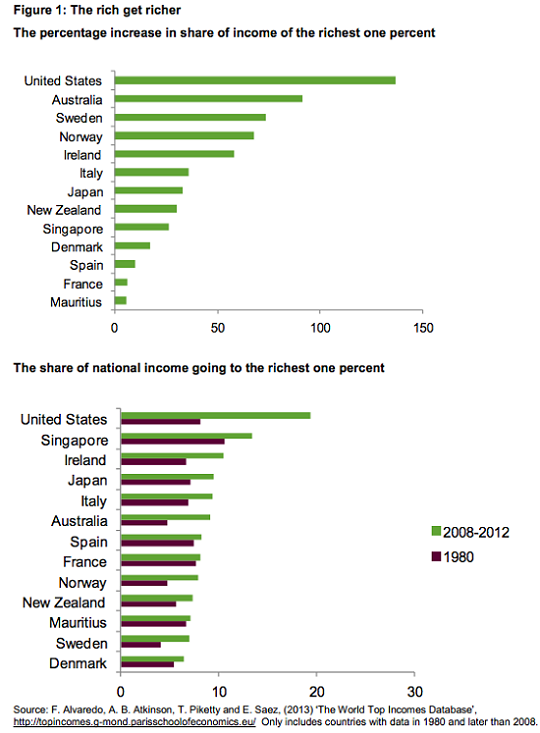
We’re Number One in wealth, income and power inequality, yea for the Fed and the Empire!

If we avert our eyes from the electoral battle on the blood-soaked sand of the Coliseum and look behind the screen, we find the powers that matter are not elected: our owned by a few big banks Federal Reserve, run by a handful of technocrats, and the immense National Security State, a.k.a. the Permanent Government. These entities operate the Empire which hosts the electoral games for the entertainment and distraction of the public.

The governance machinery controlled by elected representatives is tightly constrained in what it can and cannot do. It can’t do anything to stop the debasement of the nation’s currency, which is totally controlled by the Politburo of the Fed, nor can it do much to limit the Imperial Project, other than feel-good PR bits here and there.

The president wields vast powers but even the president is powerless to stop the debasement of the nation’s currency and the enrichment of bankers, financiers, corporations, etc., who fund the campaigns of the gladiators, oops I mean politicians.

If we set aside the term Deep State and simply call it the unelected machinery of governance (Permanent Government), we get a clear picture of its scope and power. Presidents, senators and representatives come and go, but the machinery of Empire grinds on, decade after decade.

A great many people and places in America don’t matter to the Fed or the Permanent Government, and so they’ve been abandoned to their fates. The darlings of the Fed and Empire are clustered in Silicon Valley and other urban hubs where the technological and financial machinery of global hegemony are fabricated and maintained.

Those far from these centers of banking, finance and Big Tech have little to no stake as owners of meaningful capital. All they have to sell is their labor, and that’s been losing purchasing power for decades as financialization and globalization have stripmined rural America and enriched the bankers, financiers and speculators who serve the Fed and unelected Permanent Government.

The Fed and the Permanent Government have been very, very good to the few at the expense of the many. Look at the chart below at America’s complete dominance when measured by the soaring wealth of its top 1% power elite: We’re Number One in wealth, income and power inequality, yea for the Fed and the Empire! And we don’t have to elect them–they elect themselves.

Alt-Market: As Predicted In July, 2020 Election Will Be Contested

Brandon Smith at Alt-Market writes Alt-Market Calls It Again: As Predicted In July, 2020 Election Will Be Contested

Just as I successfully predicted the outcome of the 2016 election months in advance, my predictions on the 2020 election are now coming to pass. In July of this year in my article ‘Election 2020: The Worst Case Scenario Is The Most Likely One’, after I outlined the strange factors surrounding Biden and Trump, I stated that:

“These factors and more lead me to predict that Election 2020 will be a contested election which ends with Trump staying in office but accused of usurping the democratic process. This outcome is the worst possible outcome and also the most advantageous for the globalist establishment.”

I also noted the predictive programming campaign by the media and members of the Council On Foreign Relations like Max Boot to acclimated the public to the idea of a contested election while also “wargaming” (planning) that exact outcome. I stated:

“…Boot is back again, this time writing about how he thinks Donald Trump will try to “hijack” the presidency in 2020.

In an article for the Washington post titled ‘What If Trump Loses But Insists He Won’, Boot outlines a scenario that was “war gamed” by a group called the Transition Integrity Project. The group played out a scenario in which there is a razor thin victory for Joe Biden, followed by actions by Trump to keep control of the presidency through lies and legal wrangling. The group also predicted civil unrest leading to potential “civil war” as the fight over the White House expands.

This article is, I believe, an attempt at predictive programming by the establishment. They are TELLING US exactly what is about to happen. A contested election, civil war, martial law, economic collapse and the US will be destroyed from within.”

The bizarre behavior of vote counters in swing states, including PA where they stopped the count altogether overnight, indicates a program to incite national tensions and rage. The media refusing to call certain states for Trump even though he held clear leads while rushing to call states for Biden even though the count was far from unfinished will only exacerbate people’s suspicions that the election is being rigged or stolen.

Trump has said he will take the results to the Supreme Court and there is no doubt that recounts will be held in states like Michigan and Arizona. I continue to predict that Trump will stay in office despite the close election. I also predict that numerous fake ballots will be discovered during recounts only throwing gasoline on the fire and implicating Democrats in certain districts with fraud. Social justice leftists will surely try to riot in response, and Trump will call for martial law if the current scenario plays out as I expect.

The leftists will NOT accept the results of a Supreme Court decision in favor of Trump. Conservatives WILL NOT accept a Biden presidency. I think it’s clear where this is all headed. Stay tuned to Alt-Market for further analysis on the situation as it develops.

Organic Prepper: How to Be a Producer In a Nation of Consumers

Daisy Luther at The Organic Prepper has written How to Be a Producer In a Nation of Consumers

In this world, there are two kinds of people. You can be a consumer or you can be a producer.

Neither one is inherently good or bad – these are just descriptive terms. You can produce 100% of your own food and have a terrible heart, one that rejoices in the misfortune of others. You can never produce a single thing in your whole life and be kind and generous. This article isn’t meant to demonize consumers or set producers up on a pedestal.

Really, most of us are a combination of each type. But we should strive to tip the balance toward producing whenever possible because when bad things happen to an economy, when long-term disasters strike, and when everything changes, it is the producers who survive.

I talk about consumers and producers a lot, and recently a person in the comments asked me to clarify the concepts and share some ideas on how to become a producer.

So…here’s what it means to be a consumer or a producer.

The Consumer

Consumers are just what they sound like – people who consume. They purchase things they did not make, eat things they did not cook, and use up resources without replacement.

The terrifying thing is that we have become a nation of consumers who produce hardly anything.

Even our workforce these days rarely produces. The workforce cleans up after others, provides services, and spends their days in cubicles behind keyboards. Most of them do not go home after a long day at work having created something of value. They go home exhausted after a day of wrangling people or data, too tired to have a vegetable garden or perform productive tasks.

Many Americans have no productive skills because this is no longer a thing that is prized in our society. Jobs in the trades sit empty. Young people these days choose to go to college to learn about literature or social justice or the theories of business instead of becoming part of the skilled labor force. Unfortunately, jobs matching these educational paths can be hardwon and many people with graduate-level degrees serve fast food to people who don’t have the time or the inclination to cook. Forbes says that 44% of recent college graduates work in jobs that don’t require the degree they just got deeply in debt to obtain.

The Producer

Producers are also just what they sound like: people who produce things. A producer is a person who grows something, raises something, creates something, repairs something, builds something…you get the idea.

Producers may have jobs in the trades. They may work in factories and machine shops. They may work in agriculture. They may work in the medical field. And not all producers have jobs that are productive. But they’ll come home and produce something.

These are the people who have gardens, who homestead, who raise backyard chickens, who can knit a sweater, repair the plumbing, change their own oil, and cook from scratch. Contrary to popular belief, a producer doesn’t have to live rurally and raise every bite of food their family eats. It’s a mindset that no matter where they are, they can be self-reliant and independent people.

Being a producer is about having skills that can be applied to your daily life. It’s about not having to call someone to help every time something requires repair or mending. It’s about being able to solve problems creatively and independently. It’s about being able to meet needs without depending on others.

Unfortunately, we have become a nation of consumers.

It’s a very dangerous tipping point when you can look around and see that the majority of people around you are consumers who produce nothing. And it’s dangerous on a national level.

If most of our food comes from China (whether to be grown or processed), what will we do if that food is no longer available?

If most of our agricultural workers are here only seasonally, what happens if they can no longer come?

If most of the items we work all day long to be able to afford to consume are made someplace else, what are we going to do if we’re suddenly isolated from the rest of the world?

Imagine the difference it would be if the only things that could be purchased had to be made from start to finish right here by people with the skills to do so. And to narrow it even more, what if the items had to be produced locally, within 20 miles due to transport difficulties?

If we could only consume what we produce here in the United States, we’d suddenly be looking at a terrible imbalance. There would not be enough for everyone. Not enough food. Not enough fuel. Not enough heat. Not enough clothing. And all the electronics and gadgets and designer items and cheap sweatshop products people think they have to have would be no more – imagine the rude awakening.

We’re going to be finding out about this the hard way, as our supply chain continues to deteriorate as the economy continues to suffer, and as we receive fewer and fewer imports like the ones on this list that used to come regularly from China.

And to put a finer point on it, a lot of people these days don’t even produce the money it takes to buy the things that others produce.

How can you become a producer in a nation of consumers?

Becoming a producer is easier than you might think. You don’t have to suddenly grow all your own vegetables and raise meat chickens on the patio of your townhouse to do it.

A lot of this is in your head.

Before you go to purchase something, think about it. Is it something you could make yourself? Is it something that will enhance your ability to produce? Or is it just a frivolous consumer item that will add no value to your life after the first couple of days? Don’t get me wrong, it’s fine to buy frivolous things from time to time, but it shouldn’t be the majority of your purchases.

You must switch your mindset from buying to creating. From replacing to repairing. From shopping for entertainment to actually learning to enjoy life for entertainment. Unplug from your devices and get back out there in the real world and do the things that others have done for you in the past.

It will save you money, too.

Another thing about producing instead of consuming is that it’s going to save you a lot of money. For all things, you will spend either time or you will spend money.

Think about the dinner that you put on your table.

  • Will you spend time or money to produce the ingredients?
  • Will you spend time or money to prepare the ingredients and turn them into a meal?
  • Will you spend time or money to serve the food and clean up afterward?

You see? You have three opportunities there for production. Maybe you can grow the greens for the salad if not all the ingredients for the meal.  Maybe you can cook it from scratch instead of using things put together in a box. Maybe you can eat at home instead of going to a restaurant.

If you are spending your money to acquire something, you are paying for someone else’s time. There are no real shortcuts in this world. Someone, somewhere, spent the time to grow, assemble, and/or prepare that food you’re eating.

15 Ways to Produce the Things That Most People Consume

Below you’ll find a list of ways to produce. The list, of course, is not comprehensive. It’s merely a collection of ideas to get you started on your path to tipping the balance in your favor. And don’t think you have to do all these things at once.  Each thing you accomplish from this list can help you to proclaim, “I am a producer!”

  1. Make cleaning products. You don’t have to go buy outrageously expensive all-natural cleaning products when you can make your own out of simple, household basics. (Instructions here.)
  2. Grow food. It doesn’t have to be a huge garden. It can be tomatoes in the summer and microgreens or herbs in the windowsill in the winter. Here’s a huge self-reliance manifesto with links to more than 300 articles and books for doing just this.
  3. Sprout seeds. It’s a great way to add extra nutrients to your meals and so easy anyone can do it. (This website has everything you need to know about sprouting.)
  4. Unclog your sink. You don’t have to call a plumber for every little clog. Learn to unclog sinks with homemade drain cleaner and if that doesn’t work, try a plunger or a wire hanger snake. Last ditch, taking apart the pipe under your sink is far easier than you might expect.
  5. Learn some car maintenance. I’m not saying you have to be able to replace a cracked cylinder head, but you should at least be able to replace your spark plugs. It’s literally as easy as changing a light bulb, although today’s electronics on some newer cars can make things a bit more complicated.
  6. Use natural remedies. Now, I’m not one of those people who think you should never, ever go to the doctor or take medication – but there are many things you can treat at home with simple kitchen remedies. Illnesses like colds and cases of flu can be treated naturally, and so can ailments like vomiting and diarrhea. Here’s a must-have book loaded with remedies.
  7. Brew your own. You can get started brewing your own beer and wine at all sorts of facilities where they sell you the bottles and the ingredients. The staff will walk you through it and show you exactly what to do. After a few rounds of that, you may be ready for home brewing. Or skip all the instructions, grab a book, and DIY it from start to finish. Here are books on making beer, making wine, and making old-fashioned mead.
  8. Learn to mend. Some basic sewing skills are really useful, not so you can make all your own clothes Little House on the Prairie style, but so you can mend and rework items you already own. Learn how to patch a hole, mend a seam, and fix a hem. Once you’ve mastered these, you can move on to darning socks, fixing rips using basic stitches, and doing basic alterations on things that don’t fit.
  9. Cook from scratch. Just like in the example above, if you don’t spend your own time, you’re paying for someone else’s time. Learning to cook from scratch is really easy and you don’t have to create souffles and other fancy dishes. Start out simple with methods like roasting, sauteeing, and steaming then increase your skills from there. Here’s an article on The Lost Art of Scratch Cooking to get you started.
  10. Make your own bath products. From scrubs to moisturizing lotions right down to homemade soap, learning to create these at home gives you a lot of freedom. First of all, you know exactly what’s in them – no toxic ingredients allowed. You can adjust the fragrance to your liking with essential oils and you can learn skills that will be very valuable should we ever face a world where you can no longer buy soap at the store.
  11. Learn to preserve food. Break out the dehydrator and the canners and put back the foods you get on sale. Preserve the bounty in the summer and make delicious meals to last the whole year through. Here’s my own guide to canning and here’s one I recommend for dehydrating.
  12. Raise chickens. If your city allows it and if you have a backyard, you may be able to have a few chickens. Chickens are incredibly entertaining to watch and they can provide you with breakfast on a regular basis. They’re also a very efficient way to get rid of food that would normally be thrown away – all your fruit and vegetable scraps can go right to the girls. Here’s a primer on raising baby chicks and a guide to backyard chickens in the city.
  13. Hunt or forage. Any food that you can acquire can boost your productivity without spending a lot of money. Learning skills like hunting and foraging can be fun now and invaluable later. Recognizing things as edible that most folks would pass on by was literally the difference between life and death during Selco’s SHTF. Look for local books on foraging – the broader books are not as useful, as there will be vegetation that doesn’t grow where you live. To learn hunting skills, I find that the best way is to make friends with some people who already hunt and ask them to include you. Don’t try to pretend you know it all – use the opportunity to soak up their knowledge.
  14. Make things. Learning to craft things like furniture, needlework, garden structures, and other useful household items can really help you to become a producer. And the more you can upcycle from existing materials, the better off you’ll be.
  15. Repair things. We live in a world of planned obsolescence. So often, it is cheaper to replace things than to have them repaired…that is, unless you can repair it yourself. Stock up a library of DIY repair books and the next time something breaks, give fixing it a shot. (Bonus points if you can repair something McGuyver-style by using the things you have on hand.) ….(continues)

Rutherford Institute: America After the Election – A Few Hard Truths About the Things That Won’t Change

Constitutional law attorney John Rutherford makes some commentary about things that won’t be changing soon in America After the Election: A Few Hard Truths About the Things That Won’t Change

“If liberty means anything at all, it means the right to tell people what they do not want to hear.”—George Orwell

The American people remain eager to be persuaded that a new president in the White House can solve the problems that plague us.

Yet no matter who wins this presidential election, you can rest assured that the new boss will be the same as the old boss, and we—the permanent underclass in America—will continue to be forced to march in lockstep with the police state in all matters, public and private.

Indeed, it really doesn’t matter what you call them—the Deep State, the 1%, the elite, the controllers, the masterminds, the shadow government, the police state, the surveillance state, the military industrial complex—so long as you understand that no matter which party occupies the White House in 2021, the unelected bureaucracy that actually calls the shots will continue to do so.

In the interest of liberty and truth, here are a few hard truths about life in the American police state that will persist no matter who wins the 2020 presidential election. Indeed, these issues persisted—and in many cases flourished—under both Republican and Democratic administrations in recent years.

Police militarization will continue. Thanks to federal grant programs allowing the Pentagon to transfer surplus military supplies and weapons to local law enforcement agencies without charge, police forces will continue to be transformed from peace officers to heavily armed extensions of the military, complete with jackboots, helmets, shields, batons, pepper-spray, stun guns, assault rifles, body armor, miniature tanks and weaponized drones. “Today, 17,000 local police forces are equipped with such military equipment as Blackhawk helicopters, machine guns, grenade launchers, battering rams, explosives, chemical sprays, body armor, night vision, rappelling gear and armored vehicles,” stated Paul Craig Roberts, former Assistant Secretary of the Treasury. “Some have tanks.”

Overcriminalization will continue. In the face of a government bureaucracy consumed with churning out laws, statutes, codes and regulations that reinforce its powers and value systems and those of the police state and its corporate allies, we will all continue to be viewed as petty criminals, guilty of violating some minor law. Thanks to an overabundance of 4,500-plus federal crimes and 400,000-plus rules and regulations, it is estimated that the average American actually commits three felonies a day without knowing it. In fact, according to law professor John Baker, “There is no one in the United States over the age of 18 who cannot be indicted for some federal crime.” Consequently, we now find ourselves operating in a strange new world where small farmers who dare to make unpasteurized goat cheese and share it with members of their community are finding their farms raided, while home gardeners face jail time for daring to cultivate their own varieties of orchids without having completed sufficient paperwork. This frightening state of affairs—where a person can actually be arrested and incarcerated for the most innocent and inane activities, including feeding a whale and collecting rainwater on their own property—is due to what law scholars refer to as overcriminalization.

Jailing Americans for profit will continue. At one time, the American penal system operated under the idea that dangerous criminals needed to be put under lock and key in order to protect society. Today, as states attempt to save money by outsourcing prisons to private corporations, imprisoning Americans in private prisons run by mega-corporations has turned into a cash cow for big business. In exchange for corporations buying and managing public prisons across the country at a supposed savings to the states, the states have to agree to maintain a 90% occupancy rate in the privately run prisons for at least 20 years. Such a scheme simply encourages incarceration for the sake of profits, while causing millions of Americans, most of them minor, nonviolent criminals, to be handed over to corporations for lengthy prison sentences which do nothing to protect society or prevent recidivism. Thus, although the number of violent crimes in the country is down substantially, the number of Americans being jailed for nonviolent crimes such as driving with a suspended license is skyrocketing.

Poverty will continue. Despite the fact that we have 46 million Americans living at or below the poverty line, 16 million children living in households without adequate access to food, and at least 900,000 veterans relying on food stamps (mind you, these are pre-COVID numbers, which have only got worse during this pandemic), enormous sums continue to be doled out for presidential excursions (taxpayers have been forced to pay at least $100 million so that Donald Trump could visit his golf clubs and private properties more than 500 times during his four years in office).

Endless wars that enrich the military industrial complex will continue. Having been co-opted by greedy defense contractors, corrupt politicians and incompetent government officials, America’s expanding military empire is bleeding the country dry at a rate of more than $15 billion a month (or $20 million an hour)—and that’s just what the government spends on foreign wars. That does not include the cost of maintaining and staffing the 1000-plus U.S. military bases spread around the globe. Incredibly, although the U.S. constitutes only 5% of the world’s population, America boasts almost 50% of the world’s total military expenditure, spending more on the military than the next 19 biggest spending nations combined. In fact, the Pentagon spends more on war than all 50 states combined spend on health, education, welfare, and safety. Yet what most Americans fail to recognize is that these ongoing wars have little to do with keeping the country safe and everything to do with enriching the military industrial complex at taxpayer expense. Consider that since 2001, Americans have spent $10.5 million every hour for numerous foreign military occupations, including in Iraq and Afghanistan.

Police shootings of unarmed Americans will continue. No matter what our party politics, race, religion, or any other distinction used to divide us, we all suffer when violence becomes the government’s calling card. Remember, in a police state, you’re either the one with your hand on the trigger or you’re staring down the barrel of a loaded gun. At least 400 to 500 innocent people are killed by police officers every year. Indeed, Americans are now eight times more likely to die in a police confrontation than they are to be killed by a terrorist. Americans are 110 times more likely to die of foodborne illness than in a terrorist attack. Police officers are more likely to be struck by lightning than be made financially liable for their wrongdoing. As a result, Americans are largely powerless in the face of militarized police.

SWAT team raids will continue.  More than 80,000 SWAT team raids are carried out every year on unsuspecting Americans for relatively routine police matters. Nationwide, SWAT teams have been employed to address an astonishingly trivial array of criminal activity or mere community nuisances including angry dogs, domestic disputes, improper paperwork filed by an orchid farmer, and misdemeanor marijuana possession, to give a brief sampling. On an average day in America, over 100 Americans have their homes raided by SWAT teams. There has been a notable buildup in recent years of SWAT teams within non-security-related federal agencies such as the Department of Agriculture, the Railroad Retirement Board, the Tennessee Valley Authority, the Office of Personnel Management, the Consumer Product Safety Commission, the U.S. Fish and Wildlife Service, and the Education Department.

The government’s war on the American people will continue.  “We the people” are no longer shielded by the rule of law. While the First Amendment—which gives us a voice—is being muzzled, the Fourth Amendment—which protects us from being bullied, badgered, beaten, broken and spied on by government agents—is being disemboweled. Consequently, you no longer have to be poor, black or guilty to be treated like a criminal in America. All that is required is that you belong to the suspect class—that is, the citizenry—of the American police state. As a de facto member of this so-called criminal class, every U.S. citizen is now guilty until proven innocent. The oppression and injustice—be it in the form of shootings, surveillance, fines, asset forfeiture, prison terms, roadside searches, and so on—will come to all of us eventually unless we do something to stop it now.

Government corruption will continue.  The government is not our friend. Nor does it work for “we the people.” Americans instinctively understand this. When asked to name the greatest problem facing the nation, Americans of all political stripes ranked the government as the number one concern. In fact, almost eight out of ten Americans believe that government corruption is widespread. Our so-called government representatives do not actually represent us, the citizenry. We are now ruled by an oligarchic elite of governmental and corporate interests whose main interest is in perpetuating power and control. Congress is dominated by a majority of millionaires who are, on average, fourteen times wealthier than the average American.

The rise of the surveillance state will continue. Government eyes are watching you. They see your every move: what you read, how much you spend, where you go, with whom you interact, when you wake up in the morning, what you’re watching on television and reading on the internet. Every move you make is being monitored, mined for data, crunched, and tabulated in order to form a picture of who you are, what makes you tick, and how best to control you when and if it becomes necessary to bring you in line. Police have been outfitted with a litany of surveillance gear, from license plate readers and cell phone tracking devices to biometric data recorders. Technology now makes it possible for the police to scan passersby in order to detect the contents of their pockets, purses, briefcases, etc. Full-body scanners, which perform virtual strip-searches of Americans traveling by plane, have gone mobile, with roving police vans that peer into vehicles and buildings alike—including homes. Coupled with the nation’s growing network of real-time surveillance cameras and facial recognition software, soon there really will be nowhere to run and nowhere to hide.

The erection of a suspect society will continue. Due in large part to rapid advances in technology and a heightened surveillance culture, the burden of proof has been shifted so that the right to be considered innocent until proven guilty has been usurped by a new norm in which all citizens are suspects. This is exemplified by police practices of stopping and frisking people who are merely walking down the street and where there is no evidence of wrongdoing. Making matters worse are Terrorism Liaison Officers (firefighters, police officers, and even corporate employees) who have been trained to spy on their fellow citizens and report “suspicious activity,” which includes taking pictures with no apparent aesthetic value, making measurements and drawings, taking notes, conversing in code, espousing radical beliefs and buying items in bulk. TLOs report back to “fusion centers,” which are a driving force behind the government’s quest to collect, analyze, and disseminate information on American citizens.

Government tyranny under the reign of an Imperial President will continue. The Constitution invests the President with very specific, limited powers: to serve as Commander in Chief of the military, grant pardons, make treaties (with the approval of Congress), appoint ambassadors and federal judges (again with Congress’ blessing), and veto legislation. In recent years, however, American presidents have anointed themselves with the power to wage war, unilaterally kill Americans, torture prisoners, strip citizens of their rights, arrest and detain citizens indefinitely, carry out warrantless spying on Americans, and erect their own secretive, shadow government. The powers amassed by each past president and inherited by each successive president—powers which add up to a toolbox of terror for an imperial ruler—empower whomever occupies the Oval Office to act as a dictator, above the law and beyond any real accountability. The grim reality we must come to terms with is the fact that the government does whatever it wants, freedom be damned. More than terrorism, more than domestic extremism, more than gun violence and organized crime, the U.S. government has become a greater menace to the life, liberty and property of its citizens than any of the so-called dangers from which the government claims to protect us. This state of affairs has become the status quo, no matter which party is in power.

The government’s manipulation of national crises in order to expand its powers will continue. “We the people” have been the subjected to an “emergency state” that justifies all manner of government tyranny and power grabs in the so-called name of national security. Whatever the so-called threat to the nation—whether it’s civil unrest, school shootings, alleged acts of terrorism, or the threat of a global pandemic in the case of COVID-19—the government has a tendency to capitalize on the nation’s heightened emotions, confusion and fear as a means of extending the reach of the police state. Indeed, the government’s answer to every problem continues to be more government—at taxpayer expense—and less individual liberty.

The bottom line is this: nothing taking place on Election Day will alleviate the suffering of the American people. Unless we do something more than vote, the government as we have come to know it—corrupt, bloated and controlled by big-money corporations, lobbyists and special interest groups—will remain unchanged. And “we the people”—overtaxed, overpoliced, overburdened by big government, underrepresented by those who should speak for us and blissfully ignorant of the prison walls closing in on us—will continue to trudge along a path of misery.

As I point out in my book Battlefield America: The War on the American People, these problems will continue to plague our nation unless and until Americans wake up to the fact that we’re the only ones who can change things for the better and then do something about it. If there is to be any hope of restoring our freedoms and reclaiming control over our government, it will rest not with the politicians but with the people themselves.

After all, Indeed, the Constitution opens with those three vital words, “We the people.”

What the founders wanted us to understand is that we are the government.

There is no government without us—our sheer numbers, our muscle, our economy, our physical presence in this land. There can also be no police state—no tyranny—no routine violations of our rights without our complicity and collusion—without our turning a blind eye, shrugging our shoulders, allowing ourselves to be distracted and our civic awareness diluted.

No matter which candidate wins this election, the citizenry and those who represent us need to be held accountable to this powerful truth.

Sovereign Man: Don’t Forget to Vote for Yourself

Simon Black of Sovereign Man has few words for you in Don’t Forget to Vote for Yourself

The year 63 BC was an election year in ancient Rome, and an ambitious 37-year old was locked in a heated race for one of Rome’s most powerful offices: pontifex maximus.

The young politician, of course, was Julius Caesar. And he ran a cutthroat campaign against his opponents– two seasoned senators, both of whom Caesar publicly accused of corruption.

Caesar reputedly spent so much money on his campaign that, on election morning, he told his mother that he would either win, or he would have to leave Rome forever to flee his angry creditors.

The Romans didn’t invent elections; there’s evidence of voting that goes back nearly 1,000 years before Rome, to civilizations in ancient India and Mesopotamia.

And the Greeks, of course, developed the concept of democratic elections more than any other ancient culture.

(The Greeks even held ‘negative elections’ where they would vote on which former politicians should be banished for corruption and incompetence.)

But the Romans elevated elections to a full blown commercial enterprise. They were willing to spend big to win– a practice that continues to this day.

The Center for Responsive Politics recently estimated that the 2020 US Presidential election will cost a record $6.6 billion. That’s nearly THREE TIMES as much as the $2.3 billion spent in the 2016 campaign.

It’s not just the Presidency either. Even a ‘lowly’ Congressional seat costs big money these days, with a whopping $7.25 billion spent in the 2020 election. That’s double the amount from 10 years ago.

But the real cost of elections goes far beyond dollars and cents.

The biggest example is the emotional cost; I’m not sure many of us have ever witnessed such drama to the extent that has unfolded in this election.

The constant shouting and screaming, the media and celebrity shrieking, the Twitter rage… it never stops.

Countless people get behind their candidates as if their lives depend on it, with utter devotion and euphoria for their chosen one, and unmitigated hatred for the opposing side.

Things have become so crazy that couples even break up over politics.

A recent study by Wakefield Research found that 11% of couples in the United States have split up over political differences. And among Millennials, that number rises to 22%.

I find it remarkable that we allow extreme emotions for politicians (who we’ll most likely never meet) to cause a breakdown in relationships with some of the actual people who are in our daily lives.

These extreme emotions will be felt even more acutely today, and in the coming days (or weeks) as the results are announced.

Grown adults are going to break down and cry as if their dog just died. Others will hoot and cheer like they’ve just won the lottery.

And this happens every time. Every few years it’s the same cycle… the same drama. We’re told every single time that ‘this is the most important election of our lives.’

Naturally there’s an entire industry counting on us being emotional. The media sells more ads, the politicians get more votes. Billions of dollars at stake depend on us being in a total frenzy.

Look, I’m not being dismissive about elections. Obviously the people who come to power can and do have enormous influence on our lives.

They can wreck havoc and destruction, even when they’re well-meaning.

They can burden future generations with ever-increasing debts, debase the currency, regulate entrepreneurs out of business, embolden extremists, tax people’s prosperity away, and all sorts of other terrible things.

So, yes, to a degree, it’s always important.

But in the midst of all this drama is a central theme that’s almost always lost.

People tend to forget that WE have a much bigger impact on our own lives than any politicians or government.

Elections deceive us into pinning all the hopes and dreams for our future on some political candidate, like he or she is going to walk across the water and sprinkle prosperity everywhere.

But this is an absurd fantasy.

What we do matters far more– the plans we make, the actions we take, the things we do to improve our own lives.

This is like voting for yourself. And we have the opportunity to do this every single day.