Off Grid Ham: The Comedy and Tragedy of Wind Power

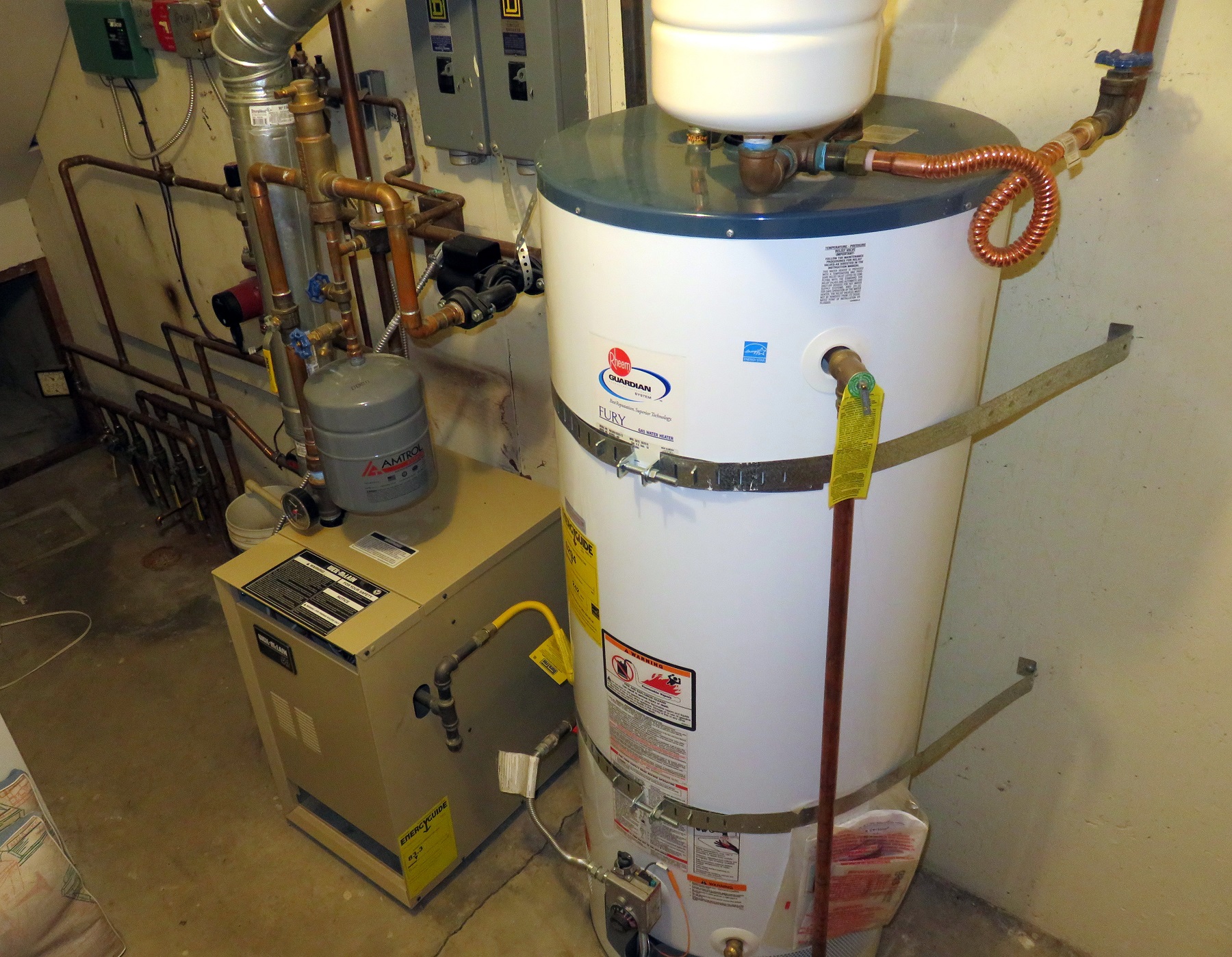
In this post at Off Grid Ham, Chris Warren talks about some power failures in Texas related to wind power. Whatever your power source, it’s good to have backups. As we’ve posted recently, the WA state legislature is entertaining the notion to ban fossil fuel heating, water heating, and possibly other appliances in all new home construction. But once you’ve put all your heating into the electricity basket, what happens when you have power outages like the ones going on in Texas currently, or California’s rolling blackouts, or any other extended winter blackout? You get cold, really cold, perhaps dangerously cold, maybe dead cold. Where I live currently, our heat is primarily electric. That said, we can also heat with a propane fireplace insert. We can cook on our propane stove. Both of those can be and have been used when there is no power.

When our family lived in Seattle, we once endured eleven days without power during a severe ice storm. Because our apartment building was on a relatively isolated spur of the electric system, we were low on the priority list for power restoration. We had a regular/wood fireplace, though, and a propane grill on the balcony, so we were able to keep warm and eat hot food. The balcony also served as refrigerator/freezer. So, having backups is not just for apocalypse preppers. Think about what you would do in an extended, wide-area power outage, in the worst conditions, and make some preparations ahead of time, so you’re not thinking “I wish I had just…” as you freeze to death or suffer heat stroke, depending on your environment.

Now, Texas has failures on multiple levels. Many homes aren’t insulated for the type of cold they are getting. Some natural gas pipelines broke, and the homes were only setup for heating with gas. Some have generators, but can’t get gas to refuel their generators. But that’s all the more reason to think about what you have and how you can supplement it.

It’s not a comedy if you’re living through it.

Bad news out of Texas gives us an opportunity  to look at what can happen when energy policy and weather conspire to pull the grid down. If you live in the upper Midwest USA like me, or New England, or for that matter anywhere north of St. Louis, you might think the winter weather hitting the Southern USA, particularly Texas, is somewhat amusing. Look at them losing their minds over three inches of snow! Where I’m from, we barely notice anything less than five inches.

texas

PUBLIC DOMAIN PHOTO

But there’s nothing amusing about millions of people being left with no power, no heat, no water, business closings, accidents, property damage, injuries and lost lives due to unusual weather (for them) that the region is not prepared to deal with. Yes, I’ve seen the internet jokes and memes, including the one with the helicopter de-icing a wind turbine (which, by the way, is confirmed fake news). Beyond the shallow humor, there is real damage being done.

The stage was set for a mess.

The disaster started when the the weather in Texas turned uncharacteristically cold and snowy. The increased demand for electrical power and stress on the grid from the storm created perfect conditions for grid failure. This failure cascaded to water and gas infrastructure when those facilities lost power. Some politically-biased news sources and personalities are laying the blame on frozen wind turbines, but it’s not that straightforward.

Wind turbines account for 25 million megawatts of power output in Texas. About 12 million megawatts went dark. Everything considered, wind turbine failure accounted for 13% of the lost energy. This is not insignificant, but by itself should not have caused millions of people to lose their juice. The other 87% of the outage was from conventionally-powered plants, mostly gas, going offline. It does not take an energy expert to figure this out. When a large part of the traditional grid is disabled, and then roughly half the wind capacity goes too, there is a huge problem.

The self appointed “experts” are squawking about the failure of wind turbines as if they were the only reason the Texas grid went down. It’s not even a half truth; more like a 13% truth. That’s why I have a problem with their hypothesis. The Electric Reliability Council of Texas (ERCOT), the state agency responsible for making sure this kind of stuff does not happen, has a lot of explaining to do. Right now Texas has only about half of the power capacity it usually needs, and it can’t all be blamed on the wind.

You are the star. And the supporting role.

What happened in Texas is a cautionary tale for every reader of this blog. The best and most expensive systems can fail. If you use solar, the same concept applies. After all, the sun is not reliable all the time. In my locale, we’ve had maybe three or four days of full sun in the last month and I’ve had to plan accordingly.

What are you doing to prevent your own personal version of Texas from happening? Don’t feel embarrassed if you’re not comfortable with the answer to this question. Many if not most off grid amateurs have enough alternative power to run their radio gear and not much else. No one can realistically prepare for every foreseeable disaster, but we can probably do better than we’re doing now. Off grid ham radio is just a small part of being ready. The good news is that you’re probably more prepared, and certainly more aware, than the average person.

If you’re warm and comfortable and the lights are on, take some time to evaluate your situation and identify areas to improve. Off grid radio for survival/preparedness reasons cannot be done in a vacuum. After all, what good is it to have the most awesome & capable off grid radio station ever when the pantry is bare and the house is cold? There is a tendency for people to go all in on one aspect of preparedness, be it radio, guns, stockpiling food, etc., and blow off all the other things one must do to be truly ready. If this sounds like you, break the curse of tunnel vision.

You cannot stop a Texas-style SHTF situation from happening to you. And you cannot change bad energy policy or poor infrastructure. So focus on what you can control and write your own ending, to the extent that you can. Those who are apathetic are auditioning to play the tragic character in a very non-fictional drama.


Real Clear Policy: A New Conservatism Must Emerge

Claremont Institute executive director Arthur Milikh, writing at Real Clear Policy, has some words on what conservatism has lately been and what it needs to be going forward in A New Conservatism Must Emerge

America is currently engaged in a regime-level struggle that will preserve or destroy the purpose that has defined it. On one side stands the American way of life, characterized by republican self-government and the habits of mind and character necessary to sustain it. On the other side stands identity politics, which demands the perpetual punishment and humiliation of so-called oppressor groups combined with the unquestioned rule of the so-called marginalized. These two regimes are in conflict and cannot coexist.

The regime of identity politics has already conquered nearly all of America’s major institutions and dominates the moral high ground. The universities and schools, Fortune 500 companies, much of the media and image-making industries, Big Tech, and the administrative state are put to use waging war on the American way of life. Many of these institutions attack, ban, and slander everything for which America stands, alleging that the rule of law is racist; that freedom of speech is white supremacist; that the family is misogynist and homophobic; and that anything short of open borders is xenophobic. The nation cannot survive this trajectory.

But the conquest of these institutions does not prove that the arc of history bends left. Rather, it has occurred largely because of the weakness of the opposition. Mainstream conservatism today cannot reverse these potentially fatal trends and cannot conserve the American way of life because it lacks clear understanding of its own purpose. In its purposelessness over the last generation, it too often outsourced its thinking to economists, while allowing the Left to define its conscience — and its culture. This mistake will prove disastrous if not corrected.

With some notable exceptions, much of the conservative establishment came to view the pinnacle of human life as private consumption and personal license, defining national health by GDP growth. It did not understand that this perspective led not only to spiritual enervation, the weakening of patriotic sentiment, and the demotion of political liberty but also to the creation of a new oligarchic elite openly hostile to the nation.

The will to fight cannot exist without real purpose, which is why many establishment conservatives simply fear the Left while also secretly craving its prestige and praying to its gods. Many have been shamed into becoming radically feminist, making them incapable of adequately defending the differences between men and women, let alone conjuring the manliness necessary to defend borders. Still others may soon support identity politics, no longer willing to defend either genuine standards of merit or equality under the law, the central principle of our country.

Intellectual and moral confusion on the Right helped accelerate the Left’s fanaticism. Once the party of the working class, the Left now stands for identity politics, which demands the perpetual punishment of, and open hatred and discrimination against, so-called oppressor groups while anointing so-called marginalized groups as pure, blameless, and deserving of unquestioned rule. This ideology requires the destruction of America’s foundations, including freedom of speech and the equal rule of laws. The Left, using its institutional powers, forces Americans to make a choice: Comply and submit to this ideology, or become a hated, persecuted enemy, denied employment and civil rights, deemed worthy of harassment and even violent assault. These doctrines and tactics, unworthy of a great and just nation, cannot but produce hatred and conflict, and will bring economic and scientific decline. They will either lead to tyranny or they will provoke genuine resistance.

In the struggle between these two regimes, institutional power and political momentum currently favor the Left. The Right, at present, is not up to the fight. A new Right is needed, one that understands itself as rooted in the noble cause of the American Revolution — unabashed and zealous in its determination to restore political liberty and politics itself.

A restored Right must take two broad approaches. First, its immediate energies must focus on disrupting and weakening the Left’s institutional centers of power. Only parity of power can moderate the Left’s fanaticism. A new Right needs a tougher, more sober approach to the Left’s assets: the adversarial press and media, Big Tech oligopolies, and corrupt universities. This approach requires new legal strategies on issues that the professionalized Right is too scared to touch; bold new actions in the states to liberate them from the Left’s consolidation of powers; and large-scale activism. New strategies are needed for a new world.

Second, and most important, the Right needs to reclaim its mental and moral toughness, and that can come only from reviving its purpose — the preservation of the American way of life. The Right must be morally unflinching in refuting the Left’s ideologies. It must speak clearly and confidently about the effects of radical feminism, “antiracism,” and globalism. It must be prepared to protect its children, its property, and its standards from encroachments. And it must ground its efforts firmly in America’s central principle: equal protection under the law, without exception. This is the basis for forming a common good that the majority of Americans still desire. But achieving it will require that the Right reinvent its political party. Unless it does so, there will be no future political victories — and no country left to defend. Ultimately, this is much more than the cause of conservatism. It is the cause of America itself.

Raconteur Report on Getting Value from Military Manuals

Any preparedness-minded person who has spent time researching topics on the internet has most likely come across a bevy of people recommending various military manuals — from any one of several Survival manuals to medical handbooks and beyond. Here is Aesop from Raconteur Report with Milking Knowledge From the .Mil’s Cow


In response to “What? Which? Where? How” sorts of questions in response to Saturday’s post, a little guidance from the Information Desk is hereby dispensed.

Why Buy A Cow When Milk Is Free?

Other than the relatively few classified (which I can’t tell you about, unless I kill you afterwards…Oh yeah, right, smartypants. Like what? That’d be things like SERE/POW detailed training instructions on things like escape, resistance to interrogation, etc.; anything whatsoever to do with nuclear weapons and other WMDs, such as any specifications, types, deployment plans, allocation lists, compatible platforms/delivery systems, or even the list of units on the distribution list for same; cryptographic equipment, tank armor details, radar system specs, known weapon system weak points, and any number of other sensitive items and tidbits. Which, even if Ivan or Wang has a copy of already, is still not something we want falling into Pedro or Hadji’s grubby little fingers.) manuals, the vast majority are public information, and available from the US Government Printing Office (with a check and a request). However, their prices are rarely competitive, esp. when a plethora of sites distribute them as e-manuals for the unbeatable price of $0.

So, Rule 1: Get your field manuals for free. Period.

Anyone charging anything over bare materials cost and/or handling is ripping you off, and you’re the sucker. The exceptions are

a) anything you have found to be unobtanium (provided its classification status doesn’t make you a spy liable to prosecution for mere possession), or

b) anything you find that beats the cost of bandwidth plus printing yourself.

I.e., if someone’s selling a manual you want for $2, and printing it out yourself would cost you $5, plus the value of your monthly bandwidth prorated for how many megs/gigs you downloaded, then by all means, scoop it up.

IF:

It’s in good shape.

It’s legible.

It’s complete.

I’ve been burned by reprints done in some Hong Kong whorehouse where all the meticulous 1960s-era line drawings were reproduced on a refurbed drug store copier with 20 years’ accumulation of puke and schmutz on the glass liner, and they look like blobs of indecipherable black ink. Those are fit only for fireplace kindling, or outhouse back-up reserve stock of paper products. Caveat emptor.

Rule 2: Latest does not always equal greatest.

E.g.: I will bet you dollars to donuts that Ranger Training Manuals from before Big Green went all gender-diversity friendly asinine and stupid, and put booster steps in front of the log wall on the o-course, will be a bit more useful than will manuals produced more recently or in the near future, to be useable by all 57 genders in the upcoming Fabulous-Friendly Queer Eye For The Gender-Fluid Rainbow Rump Ranger: Pink Barbie Edition. Just saying.

For another example, I have multiple generations and iterations of FM 5-20, Field Fortifications. I can assure you that the post-nuclear-era Vietnam War version does not cover artillery-proof dugouts, trenches, and bunkers nearly as well as the pre-WWII version does, from before nukes, but after the experience of 4 years of trench warfare all across Europe. In VN, we did not dig shelters nearly as deep, nor bunkers as sturdy, as we had prior to 1945. Our enemy shelled the shit out our bases regularly, while employing tunnel systems to shelter, rest, hide, and regroup. So, how did those plans work out for the two sides, respectively?

This is why you might not want only the most recent edition(s) of any given manual, nor series of them.

Conversely, Rule 3: Latest and greatest can often be a great place to start.

How so? The copy of ST 31-91B Special Forces Medical Handbook most frequently found at gun shows, surplus shops, etc. is great – if you want a 60-year-old medically obsolete piece of shit that belongs in a museum. (At least, unless your only knowledge of wound care is rubbing dog poo on it and sacrificing a chicken.)  Or if you have a table with one leg an inch shorter than the others, and need to level the table. If you want to know the best way to render medical care now, the 2020-era Special Operations Forces Medical Handbook is what you want.

Sure, get both, but only if you download the dinosaur version for free, and only keep it as reference, in case you wonder about how they used to do something when JFK was the president, and neither Motrin nor CT scans had been invented yet.

Rule 4: Download EVERYTHING!!!!!!!

Electrons are damned near free. A Cruzer thumb drive the size of a stack of 3-4 nickels can hold 256 Gigs. That’s room for every military manual ever invented, and your porn stash, plus all the Harry Potter movies, the entire Muppet Show collection, and all the Looney Tunes, all in HiDef, With room to spare. For less than $31.

Rule 5: Dead tree PRINTED copies are immune to EMP degradation.

If you like it, you should have put 3 rings on it, after you printed it out. If you haven’t printed it out, you don’t own it. You’re just holding a digital copy until you smash/erase/lose that copy.

You want to become an information warlord, for yourself, your tribe, or The Future?

1) Get either unlimited, or A Metric F**kton, of bandwidth.

2) Download everything you can get your mitts on.

3) Figure out how much space it takes, and then duplicate 10, 20, 50, 100, eleventy gajillion library copies on some thumb drives or DVDs, to give away to like-minded folks.

4) Print hard copies on archival paper, for your own library usage.

5) Get Adobe Acrobat, so you can create pdfs yourself.

6) Get a scanner, so that if you find an unobtanium manual that’s not a violation of national security to possess, you can scan it in its entirety, and pass it along for free to everyone else.

Rule 6: Learn How Military Manuals Work.

As big and dumb as the giant Green/Blue Weenie of Militardation is, there is a method to their madness, and you can learn it. You don’t know what you want, or should get, or should look for next? No problem.

Say you get a copy of Survival (anyone’s edition, any service, and numbering system – hint: there are now multiple numbering systems for military manuals. Because Pentagon.) Every military manual contains a listing of References. I.e., other manuals with more to say on the topic in general, or some specific aspect. Telling you that a compass is a great thing is a good point in Survival. But way better when you find out there’s a whole other manual on just Map Reading and Land Navigation. And another one on Desert Operations. And another on Cold Weather Operations. And another one on Jungle Operations. Each of which refer to Road Marches. And Field Hygiene And Sanitation. And to the M-16AWhateverversion rifle. Individual Tactics and Patrolling will point you to Fire Team and Squad Tactics, The Rifle Platoon, the Rifle Company, and Battalion Operations. Now you’ve gone from running one person (you) to running 500 people.

Like a YouTube or other internet wormhole, you can follow an idea or topic to the farthest related reaches of the known universe, through any manual’s References.

Do it.

Where do I find all this stuff?

About 100 places on the internet, with a couple of mouseclicks.

Personal recommendations:

Global Security

Go wild.

Archive.org.

Like going to a great old used book store, where the price on everything in the store is $0.

Survival Ebooks

500 free manuals.

Military Field Manuals

468 free manuals.

Federation of American Scientists

The little communist Anti-American bastards put the manuals online, to embarrass the military.

Whatever, commie pigs.

Same manuals, same low price: free.

There are dozens more, but those will keep you busy for quite a good while.

Nota bene for these and any other sites: scan your downloads, beware of malware, and if anything trips your virus scanner, blow it up without opening, just like EOD does.

I’m not responsible if you bring Trojan horse VD into your hard drive, so apply due diligence.

But with a modicum of cyber-savvy and caution, you can amass a library of invaluable information on an enormous range of topics, for nothing, or close to it.

Knowledge is power.

I’ve just given you the keys to the nuclear plant.

Make good use of what you find, and loot until you can’t do it anymore, or you’ve got it all.

Then, be a dandelion: reproduce what you’ve got, and scatter it in all directions.

Forward Observer: Our Gray Zone Future

“Gray Zone warfare is a set of actions that press conflict without starting an actual shooting war.” Intelligence analyst Sam Culper of Forward Observer talks about Our Gray Zone Future.

Gray Zone warfare is a set of actions that press conflict without starting an actual shooting war.

Like our own Low Intensity Conflict, these activities fall below the threshold of conventional war but remain well above peaceful, routine competition.

A book I’m reading outlines some CIA gray zone activities taken against the Soviet Union during the Cold War. In addition to supporting the liberal intellectual class in the Soviet Union, CIA shopped books and films like Dr. Zhivago to Soviet outlets, which would distribute these often-unknowingly subversive materials.

Author Boris Pasternak writes in Dr. Zhivago, “[R]evolutions are made by fanatical men of action with one-track mind… They overturn the old order in a few hours or days, the whole upheaval takes a few weeks or at most years, but the fanatical spirit that inspired the upheavals is worshiped for decades thereafter, for centuries.”

This is a great example of the kind of subversive media the Agency seeded into the Soviet Union in order to foment revolution and topple the Soviet regime. This was Gray Zone warfare aimed at internal disruption.

Now bear with me for a moment…

French President Emmanuel Macron and other French intellectuals are renewing complaints about the dangerous ideas emanating from U.S. college campuses; specifically warning of “ideological excesses” that lead to the “ethnicization of the social question.”

These ideas on race, gender, post-colonialism, multiculturalism, and forced diversity — what Macron described in October 2020 as “certain social science theories entirely imported from the United States” — are undermining French society, according to Macron and other government officials.

Macron went so far as to warn that these ideas are “breaking the [French] republic in two.” France’s education minister last year remarked, “There’s a battle to wage against an intellectual matrix from American universities.” French professor François Cusset summarized what’s happening: “It’s the sign of a small, frightened republic, declining, provincializing… and which thus seeks those responsible for its decline.”

This sounds oddly a lot like similar Gray Zone activities that undermined Soviet society during the Cold War, and which are now being propagated across the West.

I’m not explicitly saying that America’s current Cultural Revolution is the result of Cold War-era Gray Zone tactics come home to roost.

But maybe they are.

As if our own internal disputes weren’t enough, our domestic information environment is made even more complex due to foreign involvement in politics and the manipulation of public opinion through information operations.

The United States today is, virtually by definition, a Gray Zone of subversive ideas and armed belligerent groups. It’s a virtual certainty that foreign governments will become more involved.

Political pundits and casual observers have warned that another American Civil War is coming. They’re wrong. As I’ve been writing since 2016, it’s already started. We’re in the early stage of a Low Intensity Conflict and, regardless of the final form it takes, it’s likely to be waged well into this decade.

Given that Gray Zone warfare exists below conventional war — and it’s being waged by domestic groups if not foreign ones — it would behoove Americans to study gray skills, like intelligence and security.

We at Gray Zone Activity teach these skills for emergency preparedness and community security. I’d like to invite you to sign up for the Gray Zone newsletter to stay aware of our research and training. You can sign up at https://www.grayzoneactivity.com.
Always Out Front,
Samuel Culper

Doom and Bloom: Double Masking

The Altons at Doom and Bloom Medical have a post talking about the most recent recommendation for Double Masking. The mask mandate has been one of the worst handled public health campaigns that I have ever witnessed. The messaging from government health agencies at all levels has ranged from incorrect lies at worst and incompetent at best. Putting aside the deliberate prevarications at the beginning the ongoing failures are manifold:

(1) I have yet to see a campaign at any level on the proper procedure for donning and removing a mask. I should be seeing PSAs as YouTube ads, on TV, and maybe even in regular mail. Medical journal articles on the inefficacies of mask mandates often cite the lay person’s inability to wear a mask correctly, but no one has tried to remedy this.

(2) All masks are not equal. No effort has been made to educate people on this front either. Presumably government health agencies at the beginning of the crisis though something like, “There aren’t enough N95 masks to go around. How do we protect people? We can’t. Let’s just tell them to slap anything over their face.” Like unarmed national guard soldiers at airports are for security theater, we can think of this failure as health theater. Different masks and different materials offer differing levels of protection to different parties. An N95 mask is far superior than a homemade cloth mask. If any air can be sucked in around the edges of your mask, then your mask only serves to protect other people from your breath, and it is not protecting you very much if at all.

(3) Related to taking off and putting on your mask, but different, people need to be taught what to do and not do with their masks while they are on. Sucking on your mask is bad. Wearing your mask below your nose is bad. Touching the front of your mask with your hands is bad. All of those either reduce or negate the effectiveness of your mask or contaminate other body parts.

Luckily private parties before and after the pandemic started have produced videos on proper mask wearing.

Both the CDC and the Mandalorian say “This is the Way

After a year of wearing masks, the Centers for Disease Control and Prevention has decided that wearing two masks on your face is really what you should do if you want to avoid COVID-19.

Recent studies using mechanical devices that simulate breathing and generate “cough droplets” gave the alarming result that you receive only 42% protection wearing a standard surgical mask and 44% wearing a cloth mask. The researchers used 3-ply masks for the experiment. Therefore, they recommend double masking: a disposable medical mask under a cloth mask.

I have been saying all along that I felt cloth masks were not enough to provide the protection needed to avoid getting the virus. I have also said that standard surgical masks are not enough either, at least compared to the well-known N95. Still, I was surprised to see a protection rate in the low forties for both cloth and surgical masks, since the Wake Forest Institute of Regenerative Medicine published data in April 2020 suggesting that these masks gave protection rates in the 62-79 percent range.

N95 masks are supposed to give at least 95% protection against particles 3 microns in size or more. The SARS-CoV2 virus is actually smaller than that, though, so how can I say that wearing an N95 is the way to go? Is it better than the other options? Wouldn’t those tiny particles just go right through even N95s?

Studies were performed using medical workers dealing with the related (and similarly-sized) MERS virus in 2012. Results showed that those who used the N95 had less incidence of infection than those wearing lesser protection. The researchers stated that “policymakers might prefer to err on the side of caution and support recommendations for full protective equipment, including the use of N95 masks for MERS-CoV, an emerging novel respiratory virus.”

Well, in the 2020s, there’s a new novel respiratory virus (not so novel now), but the CDC has given mixed and confusing signals about mask wear since the pandemic began. They said not to buy N95 masks so that medical workers could have them.  This was in the face of a scarce supply of these masks in the Strategic National Stockpile.

Mask production has ramped up since then, but the FDA.gov website still publishes this statement: “The Centers for Disease Control and Prevention (CDC) does not recommend that the general public wear N95 respirators to protect themselves from respiratory diseases, including coronavirus (COVID-19).”

They cite the importance of availability to health workers (certainly true), but then, the CDC endorsed home care for mild-moderate cases of COVID-19, cases that won’t kill you but certainly make you contagious. That made the average family caregiver a “health care worker” at risk too. The unavailability of quality masks, however, led to most people using cloth coverings or standard surgical masks.

The problem with these masks is that it’s hard to get a tight fit. The grand majority of procedure masks are fluid-resistant “melt blown” fabric secured with ear loops. They’re produced according to American Society of Testing and Materials (ASTM International) standards and designed to protect from splashes and prevent aerosol particles from getting into the air. They don’t offer a perfect seal and tend to have openings where microbes can go in or out. Not a good thing, if you’re dealing with a virus that’s airborne.

N95 masks, however, are manufactured according to standards set by another body, NIOSH (The National Institute for Occupational Safety and Health). NIOSH testing considers a “worst-case” scenario as the testing conditions are the most severe likely to be experienced by the wearer.

On top of discouraging N95 usage, the FDA issued an Emergency Use Authorization on April 18th, 2020, allowing for the production of medical face masks without fluid resistance. These may be manufactured from materials other than melt blown fabric, such as cloth. This began the cottage industry in cloth coverings encouraged by the government.

N95 mask with elastic straps

The problem with these masks is that it’s hard to get a tight fit with ear loops.  All N95 “respirator” masks are equipped with elastic straps which hold the mask tightly to the users face. The recently-reported low percentage of protection from cloth coverings and standard procedure masks could possibly be improved with training in proper mask fitting.

standard surgical mask with ear loops tied together and tucked for better fit

A good mask fit forms a seal between the mask and the person’s face, decreasing the chance of infection. One recent recommendation is to tie a knot in each ear loop as close to their attachment to the mask itself as possible, in the hopes of getting a better seal. This involves modifying each mask, and making sure to tie it properly. It’s very important to tuck in material that may represent a hole in your defenses. This method, the government says, is almost as good as wearing two masks.

Poorly tucked, a surgical mask gives poor protection even if ear loops are tied together

Also important is training on how to properly remove masks so as not to contaminate one’s hands. The front of the mask should be considered at risk for contamination and shouldn’t be touched if possible. To learn how to get a proper fit and seal for different masks, and how to properly remove them to avoid contamination, see my video from January of 2020, at the very beginning of the pandemic, where I originally discussed the importance of correct mask techniques. Click below:

Truth is, there is nothing like having the right medical equipment in normal times as well as pandemic times. If you can find N95 masks, you should invest in a supply. If you don’t have the best mask, you end up wearing two or modifying a less protective one. Next month’s CDC recommendations? Use the contact form to let me know what you think.

WA HB1084 Will Ban Natural Gas/Propane in New Home Construction

In Washington state, House Bill 1084 would “eliminate on-site fossil fuel combustion for space heating and water heating” in new construction in order to reduce climate impacts. Lawmakers are seeking to replace other gas appliances as well.

OPB reports in Goodbye, gas heat? Proposals in Washington state seek to phase out fossil fuel heating in buildings

A long goodbye to natural gas furnaces and water heating — and possibly other gas appliances — could begin with action by the Washington Legislature this winter. Separately, the Seattle City Council this week begins consideration of a similar proposal to eliminate fossil fuel-based heating in new commercial buildings.

“Buildings are one of our state’s most significant and fastest growing sources of carbon pollution. We must do better — and we can do better,” testified Michael Furze, head of the state energy office, on behalf of Democratic Gov. Jay Inslee.

Natural gas utilities and major business associations spoke against the state legislative proposal during an initial public hearing on Friday. The opponents said they want to preserve consumer choice and questioned whether the Pacific Northwest electric grid could handle a big increase in winter heating load.

In December, Inslee unveiled a package of measures to reduce greenhouse gas emissions, including this proposal to phase out natural gas for space and water heating. As initially conceived, Washington state would have forbidden use of fossil fuels for heating and hot water in new buildings by 2030. The plan sought to convert existing buildings to electric heat by 2050.

The scope of the measure was revised earlier this month when Inslee’s allies in the state legislature introduced identical proposals in the House and Senate to amend the state energy code. The 2030 date to ban heating with fossil fuels in new construction remains. There is no mandate to convert existing buildings from gas to electric heat, but an expectation that utilities will offer incentives for conversions.

Buildings account for the second biggest share of carbon pollution in Washington, after transportation, largely due to gas furnaces and water heaters such as these.

Tom Banse / NW News Network

“If we don’t start with clean new buildings, we’re going to be bailing water out of a boat while we’re still drilling holes in the bottom of it,” said state Rep. Alex Ramel (D-Bellingham), the prime sponsor in the House. “That’s why we need to accelerate and strengthen our state’s energy code.”

The legislation is silent about use of natural gas for cooking and clothes dryers. In an interview, Ramel said lawmakers want to transition those appliances to clean energy as well. However, the details may be worked out later between natural gas utilities and regulators at the state utilities commission.

During the well-attended virtual public hearing before the state House Environment and Energy Committee, Cascade Natural Gas, Puget Sound Energy and the utility trade group Northwest Gas Association raised objections.

“[This bill] would jeopardize energy reliability, drive up costs to customers and put gas industry employees across Washington out of work,” said Alyn Spector, energy efficiency policy manager for Cascade Natural Gas. “This is not the time to eliminate good paying jobs.”

Business lobbying groups, including the influential Association of Washington Business and the home builders’ Building Industry Association of Washington, also voiced their opposition.

“As we saw this summer in California, we cannot take a healthy grid for granted and losses from even short-lived interruption of power supply can run into the billions,” said Peter Godlewski with AWB. “Shifting consumers and businesses away from natural gas to electricity puts severe pressure on the electric grid as a time when we’re retiring more generating capacity than ever.”

At this juncture it is hard to gauge the prospects for the gas heat phaseout proposal. Inslee, who made combating climate change a central plank of his brief run for the Democratic presidential nomination in 2020, has the benefit of large, supportive Democratic majorities in both chambers of the state legislature. But the capacity of lawmakers to get much done beyond the basics of passing new state budgets and dealing with the coronavirus pandemic while conducting most business virtually remains to be seen.

Meanwhile, an assortment of West Coast cities are tackling carbon pollution from buildings independently. Around 40 climate-conscious California cities and counties have already passed laws or codes to require new buildings to be all-electric.

Later this week, the Seattle City Council begins consideration of an ordinance to ban the use of fossil fuels for heating in new commercial and large apartment buildings. The proposed policy change does not apply to single family homes and duplexes because the city’s energy code that is open for amendment pertains only to commercial buildings. The effective date of Jan. 1, 2022, is much sooner than the state legislature’s proposal in the same vein.

“In Seattle, 35 percent of carbon emissions are from the building sector and they are rising,” Seattle Office of Sustainability and Environment Director Jessica Finn Coven told state legislators in testimony Friday. “Constructing homes and buildings right the first time reduces the likelihood of costly retrofits in the future.”

The Bellingham City Council has also teed up electrification of buildings as part of a broader climate action package. In an email, Bellingham City Council member Michael Lilliquist said the pandemic had slowed down the work, but it is proceeding. He said city staff were running all of the proposed climate measures through a rigorous, multi-step evaluation process.

“We are not yet at the stage to offer specifics that can be incorporated into an ordinance or program,” Lilliquist said.

The American Mind: What Is “Our” Democracy?

Seth Barron at The American Mind writes about a phrase that is being used increasingly frequently as of late in What Is “Our” Democracy?

When the Left claims something is theirs, they mean it.

A curious turn of phrase has slipped into discourse over the last few years. References to “our democracy” turn up all the time lately, and even though a computer search shows that the phrase has popped up now and then since at least the 1920s, its usage has increased a lot recently.

It’s something that many people probably haven’t noticed, and it’s certainly innocuous enough. “Our democracy” hardly seems fraught with controversy. After all, we all have a stake in the political system, and it sounds like a nice way to describe the republic—the “common thing”—we share.

On the other hand, it’s striking to notice who uses the phrase. It is said, almost exclusively, by Democrats. Reflecting on the January 6 riot in The Atlantic, Rep. Ilhan Omar wrote, “As I sat in my Capitol Hill office two weeks ago, watching a violent mob storm the symbol and seat of our democracy, I was reminded of my distant past.”

Omar, of course, was born and grew up in Somalia, and she is comparing the raucous events in Washington that afternoon to a full-scale civil war that killed half a million people, and displaced a million more, over the course of a decade. This hyperbole may just be rhetorical license, but it’s notable that she repeats “our democracy” six times in one short essay. She concludes, “Violent clashes and threats to our democracy are bound to repeat if we do not address the structural inequities underlying them.”

The phrase gained contemporary traction around the time of the 2016 presidential election, when the Hillary Clinton campaign laid the groundwork for contesting Trump’s victory by insisting that Russian meddling with the electoral system had compromised the integrity of the vote. President Obama, in his January 11 “farewell speech,” cautioned his anxious followers, “It falls to each of us to be those anxious, jealous guardians of our democracy.”

The idea that “our democracy” had been hijacked by foreign elements on behalf of their stooge and puppet Donald Trump animated the so-called “Resistance,” which set about undermining Trump’s presidency even before the election. Appeals to protect and defend “our democracy” from the threat of authoritarian, autocratic rule led to years of protest and fury, dominated media coverage, and resulted in legislative paralysis as the government submitted to a lengthy investigation into Trump’s alleged collusion with a plot that turned out never to have existed.

So after all that grousing, it’s hard to hear the words “our democracy” without noticing the stress on the possessive. Democrats seem not to be so worried about American democracy in general so much as their version of it, which is centered around an agenda of “equity”—meaning careful allocation of all society’s plums to favored demographic categories—open borders, the erasure of sex differences, and a globalized economy that subsidizes subsistence-level handouts for the dispossessed.

Consider a recent article in Time magazine that explains how a “shadow campaign saved the 2020 election.” According to the major piece, which was written with the cooperation of the organizers of the shadow campaign, “a loosely organized coalition of operatives scrambled to shore up America’s institutions as they came under simultaneous attack from a remorseless pandemic and an autocratically inclined President.” These plotters, according to reporter Molly Ball, included corporate executives, “non-partisan” civil society groups like Protect Democracy, and Norm Eisen, the former Obama administration official who umpired the first Trump impeachment.

Ball writes,

That’s why the participants want the secret history of the 2020 election told, even though it sounds like a paranoid fever dream–a well-funded cabal of powerful people, ranging across industries and ideologies, working together behind the scenes to influence perceptions, change rules and laws, steer media coverage and control the flow of information. They were not rigging the election; they were fortifying it. And they believe the public needs to understand the system’s fragility in order to ensure that democracy in America endures.

“Democracy,” in this sense, where a handful of extremely wealthy and powerful insiders “change rules and laws,” and “control the flow of information,” may not resemble the democracy that you learned about in civics class but is a term of art reflecting uniparty control from above. “Democracy” is a system owned by the people who run the country’s major institutions—it’s not a playground for outsiders.

When we hear “our democracy,” then, we should hear it as a description of possession. They aren’t saying that it belongs to all of us. It is theirs, and they will do anything they can to defend it.

The Organic Prepper: Facial Recognition – Cashing in on Covid

Robert Wheeler of The Organic Prepper talks about how facial recognition companies are thriving during Covid in Cashing in on Covid: Facial Recognition and Thermal Imaging Techs Are Booming at the Cost of Your Privacy

The COVID-19 pandemic has proven to be the biggest gift possible for tyrants all across the globe. From economic power grabs made by corporations and the incineration of basic civil liberties, the ruling class has introduced itself as the arbiters and dictators of virtually all human interaction.

And the surveillance industry has also benefitted massively from the pandemic.

What’s new in facial recognition?

For instance, facial recognition technology is being rolled out at an alarmingly fast pace. The tech is more and more exact in its capabilities and no longer handicapped by mask wearing or face coverings. In a report by the Department of Homeland Security released in early January 2021, the department admitted to having conducted tests regarding the efficacy of facial recognition technologies in relation to mask wearers.

The test was administered by the DHS Science and Technology Directorate and were conducted as a part of STD’s Biometric Technology Rally, an event held during the fall at the Maryland Test Facility. DHS claims that the success rate for this technology could reduce the need for passengers or travelers to remove their masks at airports or ports of entry.

According to DHS,

The third annual rally evaluated the ability of biometric acquisition systems and matching algorithms to reliably collect and match images of individuals wearing a diverse array of face masks. Previous rallies show biometric systems can excel at rapidly processing high volumes of travelers using face recognition. This year’s focused on using such systems to detect and recognize travelers without asking them to remove their masks, thereby protecting both the public and frontline workers during the COVID-19 era.

The event included 10 days of human testing which involved 60 facial recognition configurations (which used six face and/or iris scanning systems with 10 matching algorithms) and took advantage of 582 “diverse” test volunteers that represented 60 countries. The systems were then evaluated based upon their ability to take images of each volunteer reliably without masks, processing time, and overall satisfaction.

The results? According to the Biometric Rally website:

  • Without masks, the technology had an average 93% identification rate. The best system had a rate of 100%.
  • With masks, the technology had an average of 77% accuracy and the best performing system had a rate of 96%.

So much for the theory that “at least the masks will make it harder for them to use facial rec on us.”

Then there’s thermal imaging, too.

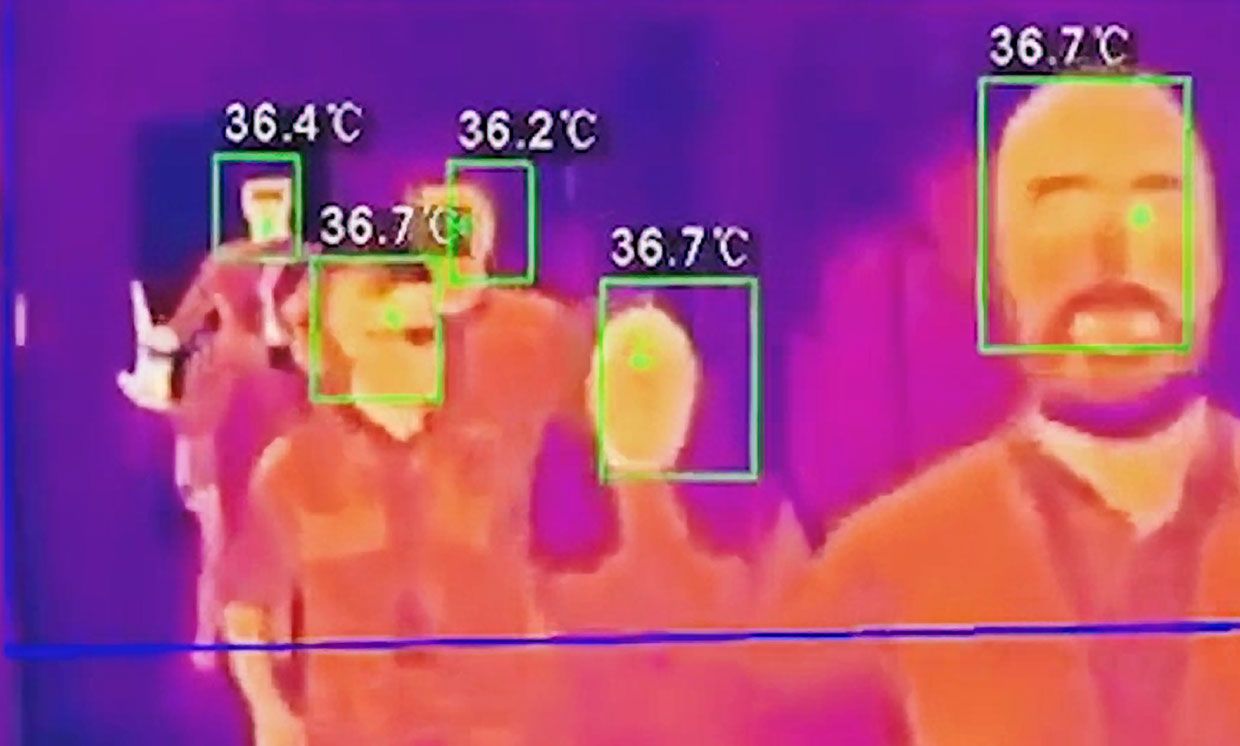
But that’s not the only technology that is booming as a result the meeting between the “pandemic” and the surveillance state. Thermal imaging is also in demand as governments across the world begin deploying the technology at airports, railways, and public gathering spaces. The technology is designed to measure a person’s body temperature. In this instance, it will be used to measure whether or not a person has a fever.

Although, a number of American companies are in on the act – Infrared Cameras, Inc. and Omnisense – Chinese companies are also making lots of money on the new rollout, including a company ironically from Wuhan, Wuhan Guide Infrared Co. In fact, the company is making so many that the Chinese military is having to wait for its orders for other products that the company makes.

And if Americans think their “representatives” are going to do anything to stop the rollout, they’re wrong. As TravelPulse writes,

On Friday, U.S. Senate Committee on Commerce, Science, and Transportation Ranking Member Maria Cantwell of Washington and Senator Rick Scott of Florida introduced a proposal for bipartisan legislation that would require the Transportation Security Administration (TSA) to implement temperature screenings at existing airport checkpoints in order to enhance the safety of passenger air travel amid the COVID-19 pandemic.

The Cantwell-Scott ‘Fly Safe and Healthy Act of 2020’ (S. 4623) would task the TSA with ultimately deploying a uniform temperature-check program across the nation’s airports; but, first, to thoroughly test the technology in various scenarios as part of a pilot program prior to the final rollout.

Airport temperature checks would be conducted using innovative, contactless, thermal-camera technology capable of automatically screening large numbers of passengers passing through existing TSA checkpoints. It’s seamless and non-invasive, and such systems have already proven effective for identifying infected individuals and mitigating COVID-19’s spread in other countries.

Senators like Rick Scott have been advocating heavily for the technology. His argument, like the argument of others, is that the tech is needed to help our economy rebound. Of course, the economic crisis in the United States was not caused by a lack of thermal imaging but by government itself, specifically people like Rick Scott. But that’s another story for another time….

It won’t stop with taking your temperature.

Of course, we all know the surveillance isn’t going to stop merely at temperature checks. Back in 2011, an article was published by the BBC entitled, “New Emotion Detector Can See When We’re Lying.” The system, like the temp checkers, is one of interlocked video cameras connected to a “high-resolution thermal imaging sensor and a suite of algorithms.”

The idea is that, since humans give away their emotions through a variety of unconscious means, the ability to read facial cues enables security to interpret the motives of “potential terrorists.” Of course, the label of “potential terrorist” is one that has been applied to virtually every citizen within and without of a western nations’ borders. Nevertheless, in order to measure “emotions,” the system uses eye movements, dilated pupils, biting, nose wrinkling, pressing lips together, heavy breathing, swallowing, blinking, and other facial movements as well as swelling blood vessels around the eyes.

Keep in mind, this technology existed in 2011 and already took advantage of thermal imaging. We are not in uncharted territory here, we are merely witnessing the unfolding of an agenda that was planned long ago.

Privacy is a thing of the past.

Privacy is a thing of the past and has been for a long time. We’ve warned about how frequently Americans are being surveilled, about Ring doorbells, about Amazon’s servers storing government databases to identify us, and about Smart appliances. We’ve talked about Chinese “mind-reading” technology and their social credit system. The pieces are in place – now they’re just perfecting what already exists.

American Partisan: Signal App Compromised? Not So Fast…

NC Scout at American Partisan talks about the supposed compromise of the secure messaging app Signal in Signal App Compromised? Not So Fast… Remember that encryption works, and because encryption works the people who want your data will do anything they can to convince you to just not take the effort to use it.

Much has been written about the supposed compromise of Signal as a so-called ‘secure messaging app’, with some sources being a bit better than others on the matter. I’ve had a ton of questions about it over the past couple of days, and almost all of it doesn’t revolve around the issues with an app itself, but rather, the tradecraft errors behind using it.

First things first, almost everyone I come into contact with in the Liberty community, absent those with serious .mil backgrounds requiring at least a primer in tradecraft, have no idea what they’re actually doing. That statement is not meant to deride, far from it; its simply the truth. When it comes to communications, most are looking for a replacement: a methadone for a heroin addiction, if you will- to their incessant need for a phone. This is especially true when it comes to the instant gratification of messaging. I’m reminded of Russell Crowe’s line from a movie long since memory-holed, Body of Lies, saying “we just need al Saleem on the phone. Langley’ll do the rest.”

And they did.

Signal, as a software, does what it claims to do. On top of that, the source code for the app is open source and subject to anyone’s audit or modifications, should your skillset include the expertise in that area. And should you have that level of ability, you can even modify it to suit your needs running a code off the beaten path while still utilizing Signal’s network. It is end-to-end encrypted, after all. And what exactly does that mean? It means that the administrators can see that someone is accessing the network, but not what is being passed along it, much the same way that TOR actually works. Even with audio calls, the system does what it claims to do.

So let’s discuss the actual vulnerability in question.

According to documents filed by the Department of Justice and first obtained by Forbes, Signal’s encrypted messages can be intercepted from iPhone devices when those Apple devices are in a mode called  “partial AFU,” which means “after first unlock.”

When phones are in partial AFU mode, Signal messages can be seized by federal authorities and other potentially hostile interests. GrayKey and Cellebrite are the tools typically used by the FBI to gain this sensitive information, an expert has explained.

It uses some very advanced approach using hardware vulnerabilities,” said Vladimir Katalov, who founded the Russian forensics company ElcomSoft, believing that GrayKey was used by federal authorities to crack Signal.

So its not the app after all, but rather the hardware’s setting. A vulnerability which, since its a hardware exploit, likely applies to every messaging app. So tradecraft, or the lack thereof, is the heart. As per the usual. And the hardware in question is the hipster device of choice, an Apple iPhone. Shocker. But I thought Apple prided itself on user security?

Maybe at one point. But clearly no longer. Must be all that CCP money. And the real kick in the groin is that (shocker, again!) the FBI (or any other domestic security agency) can get into your phone without your handy little thumbprint. And just because they didn’t mention Android, don’t think its not every bit as vulnerable. It is.

So let’s talk about how to mitigate it.

First, understand the levels of data collected from cellular devices. I’ve discussed this ad nausem in the past. Your phone is constantly tracking you, no matter what you do absent putting it in an EMP bag, and if you cannot fully comprehend this reality then you’re really, really far behind the power curve. The lone answer is moving to using wi-fi only mobile devices for communications using open source apps. Wifi is common enough even in rural areas and if the technology is beyond you, so is your usefulness in a direct action cell.

Second, understand how to properly message people. The magic blanket of encryption may conceal our message but it neither conceals our presence nor our patterns of life- and in particular, who’s being messaged. This requires first discipline, and second, a pre-arranged (and trained on) code. One Time Pads work quite well, but a pre-configured Trigram or Brevity matrix works as well. On top of that, messages should be set to delete after a short period of time. Signal enables this, and if the message is important (it should be if you’re using Signal to send it), write it down. Clandestine messages are usually one-way as it is, requiring no overt response. Or if a response is necessary, respond through another backchannel (the same way I teach communicating on two different frequencies simultaneously in the RTO Course). Further, group messages of any more than two individuals is an instant non-starter. This violates even the most basic rules of clandestine cell organization and why Liberty groups feel the need to broadcast everything to everyone, I’ll never understand. Maybe you’ll learn one day. Domestic Black Sites are real.

Last, what you’re using as a so-called daily driver, ie your surface phone, is absolutely not used for this role. One of my own personal objections to Signal is and has always been the requirement of a phone number for registration. My Sudo allows us to bypass this by generating another phone number, but alternative apps such as Wire and Threema register via an email account…far, far better. And on that note you did install it on your own, absent Google play, correct?

So with that said, what do I think of this so-called ‘compromise’? It think its a smoke screen for CCP / Apple to keep their own compromise hidden in the details, as well as a smoke screen for disgruntled feminist intersectionalist IT workers behind the scenes at Signal unhappy that anyone other than AntiFa degenerates and washed up Agency Spooks would be using their app. For me, Signal is the C in my PACE plan- the ability to contact those using cell phones from my own wifi device, should the need arise. I don’t hang my hat on its ability outside my control. Neither should you. And the fact that a lot of people in this community do underscores just how behind the curve some of the louder voices really are. No matter what you’re doing, the correct answer is always using open source systems, have a PACE plan, follow the Moscow Rules and if there’s any doubt, there is no doubt.

Townall: Biden Calls for More Gun Control/Bans

From Townhall comes Biden Uses the Parkland Anniversary to Call for Three Major Gun Control Moves.

As predicted, the Democrats are using the third anniversary of the tragic shooting in Parkland, Florida to call for stricter gun control laws. President Joe Biden issued a statement on Sunday calling on Congress to “enact commonsense gun law reforms”

“This Administration will not wait for the next mass shooting to heed that call. We will take action to end our epidemic of gun violence and make our schools and communities safer,” the president said in a statement. “Today, I am calling on Congress to enact commonsense gun law reforms, including requiring background checks on all gun sales, banning assault weapons and high-capacity magazines, and eliminating immunity for gun manufacturers who knowingly put weapons of war on our streets. We owe it to all those we’ve lost and to all those left behind to grieve to make a change. The time to act is now.”

While Biden was on the campaign trail back in 2019, he called for a registry for magazines and so-called “assault weapons” – what the rest of us call AR-15s – that are currently in circulation, in addition to an outright ban on new production. On his campaign website he promised to implement those changes, as well as pushing red flag laws, which allows family, co-workers, teachers and colleagues to petition a court to take away a person’s firearms without due process. Oh, and he wants to make sure all firearms moving forward are “smart guns,” meaning no one can pull the trigger unless their DNA matches the pre-programed information (you can thank James Bond for the idea). Smart guns have not only logistical nightmares but there’s also the privacy concerns surrounding DNA.

When Harris was running for president she threatened to sign an executive order on gun control if Congress didn’t pass “common sense gun laws” within the first 100 days of her being president. Specifically, she called for an Assault Weapons Ban, universal background checks and prosecuting Federal Firearms Licensees (FFLs).

Harris has made gun control one of her top two legislative priorities throughout her time in the Senate. And once she hit the road to campaign for president in parts of flyover, she suddenly became a gun owner (as if 2A advocates wouldn’t notice her aim at the Second Amendment).

It wouldn’t be surprising if these two come out of the woodwork and flat out say Biden will sign yet another executive order if Congress doesn’t pass sweeping gun control laws in the first 100 days. Democrats are so focused on “making history” that they’re willing to do whatever’s necessary for their legacy sake, including signing yet another EO. And you know they’ll word it like “Congress failed to rise to the moment” or “we asked Congress to honor the victims of gun violence by passing much needed reform and they didn’t rise to the occasion.”

Real Investment Advice: Millennials Are Mad As Hell.

Lance Roberts at Real Investment Advice talks about why Millennials Are Mad As Hell while explaining why financial markets don’t work the way the used to. The market is no longer about understanding the value of a company, but rather is a game of bets by major players — which means if you aren’t a major player, you lose.

The Occupy Wall Street movement that emerged in the financial crisis of 2008 was interesting because a general sense of discontent seemed to merge. Also interesting was the lack of consensus as to the causes of dissatisfaction. More recently, the trading mania surrounding Robinhood and Gamestop reflected many of the same dynamics. A broad sense of anger was channeled variously against Wall Street, “suits,” boomers, short-sellers, and a sundry list of other participants deemed to be bad actors.

One thing is clear: Just like in the 1976 movie, “Network,” a lot of people are “mad as hell.” That anger is a symptom of a bigger problem, however. Digging into its root causes reveals insights about society and how it can reshape and defuse anger and become more productive.

Roots Of Anger

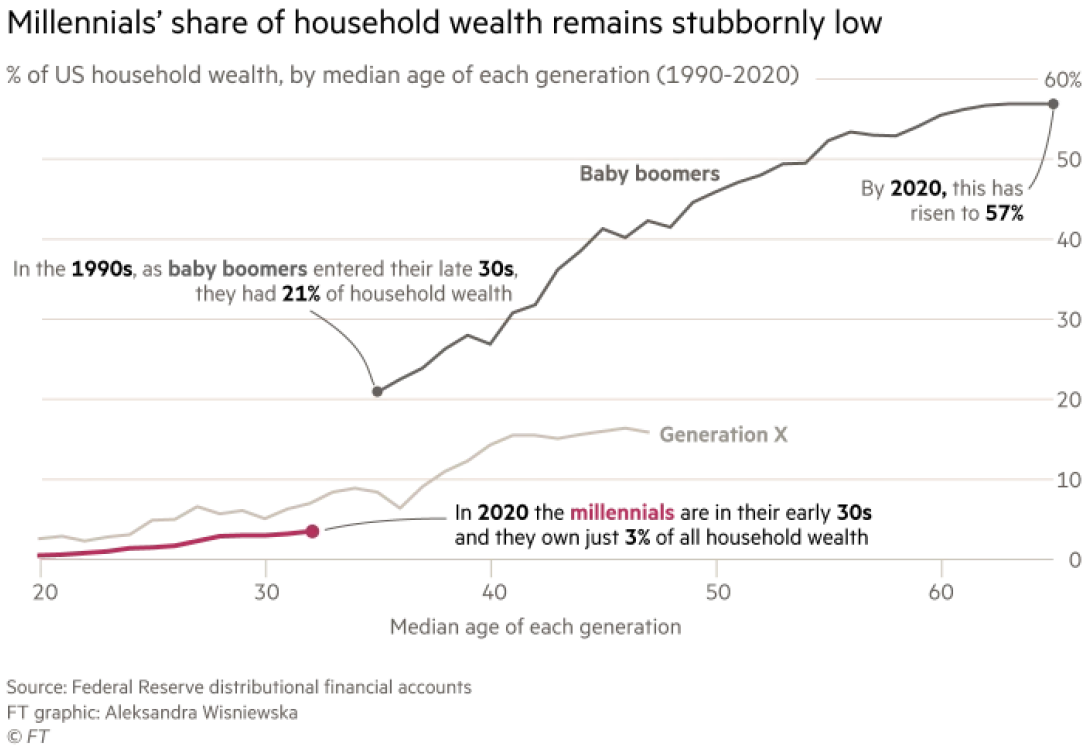
It is not hard to understand some of the sources of anger. Perhaps one of the most revealing single indicators is the variance in wealth distribution over time. In the 1990s, when Baby Boomers were in their late 30s, just slightly older than Millennials’ age in 2020, they owned seven times the share of household wealth (21% vs. 3%). The opportunities for income and wealth accumulation were massively more significant for Baby Boomers than for Millennials.

Mad As Hell, David Robertson: Millennials Are Mad As Hell.

Mad As Hell, David Robertson: Millennials Are Mad As Hell.

Missing The Target

As a result, it isn’t too surprising to observe a fair amount of discontent directed at the Baby Boom generation, and it is clear from a number of the Reddit/wallstreetbets threads that this is happening. Further, any reader of The Fourth Turning by William Strauss and Neil Howe can come away with plenty of material for younger generations to incriminate the Baby Boom generation.

For example, Baby Boomers in the US grew up in an environment of enormous economic growth in one of the world’s wealthiest countries. Yet, those prodigious benefits seemed not to be enough; massive debts got used to boost consumption even further. From a historical perspective (and to younger generations), Baby Boomers’ generation appears rapacious in its consumption, like locusts stripping the country bare.

A Generalization

Of course, such a view is a generalization that belies the existence of countless individual Baby Boomers who act and behave in ways that are utterly antithetical to that characterization. It is not hard to find smart and talented individuals and are generous with their time, financial support, knowledge, and experience. As a result, it is hard to consider the entire generation of Baby Boomers an appropriate target of opprobrium.

There are other targets. For instance, short-sellers have received a great deal of anger following the Gamestop and Robinhood episode. Such too appears unjustified. For one, there are at least two sides to every story, and it is essential to hear both to get closer to the truth. Besides, given the upward bias of stocks, short-sellers must work even harder to make a living. Some of the most accomplished (and humble and generous) investors are short-sellers.

As a result, the targeting of outrage against groups such as Baby Boomers or short sellers is at best misguided. At worst, such efforts are both malicious and counterproductive. It only makes things worse by directing outrage in a general direction, including people sympathetic to the cause.

A Bad Game

Where should anger be directed then? Ben Hunt guides us to a better understanding by completely flipping the perspective. It is not a whodunit where the perpetrator needs catching. Instead, the problem is the economic, political, and financial system has become a destructive “game” for most participants. In other words, the odds stacked against us are such that there is little chance of success over time, regardless of performance.

To see this, we need to reconsider our assumptions and mental models. In his piece, “Hunger Games,” Hunt explains how things have changed in the markets:

“You have been told that you can be a PARTICIPANT in the game of markets, that you can storm the playing field of companies, that you can take matters into your own hands and rescue a promising company under unfair attack.”

In a world of entirely free markets, strong property protection, effective regulation, effective enforcement, and a level playing field, this might be true, as the Robinhood episode revealed. However, many of these assumptions are no longer valid:

“We all saw that the thing that determines whether or not our stock market bets pay off is … other bets. We all saw that there is no ‘game of companies’ taking place independently of our bets. We all saw that our bets, in and of themselves, can win the ‘game’, with absolutely zero input from the ‘team’ that is supposedly out on the ‘field’.”

Such is a very different concept of markets than what most of us have operated on. It boils down to two straightforward tenets:

“Everyone knows that everyone knows that 1) The bets ARE the market. 2) Market makers OWN the market.”

Mad As Hell, David Robertson: Millennials Are Mad As Hell.

Implications

The implications of this are huge. Success in investing in this context is not about researching and applying analytical skills and hanging in when it gets tough. Nope.

Being an investor today is more like being a gladiator. You might win some fights, even in glorious fashion, but the odds currently stacked against your long-term survival. You are mainly just an actor in a game designed to serve the ends of a select few.

“Both of these stories are narratives for our very own Hunger Game, a spectacle that chews up the participants in the arena while delivering enormous profits to the networks (media, financial and political) that put them on.”

The notion of participants getting chewed up in a contest that deliver enormous profits to others does seem to capture much of the environment – and therefore explains much of the anger if it feels like it’s not a fair game that’s because it isn’t.

Another Theory

Interestingly, Noam Chomsky’s presentation, Requiem for the American Dream, dovetails nicely with Hunt’s characterization of the higher-level structure of the social, political, and financial environment. According to Chomsky, the concentration of wealth and power is more than just an unpleasant outcome; instead, it is a distinct objective of the super-rich.

As he explains, the 1960s was an era of much greater wealth equality and was the backdrop for a substantial expansion of civil liberties. Increasingly too, young people were protesting against the government, against corporate leadership, against AUTHORITY, and it scared people in charge.

Mad As Hell, David Robertson: Millennials Are Mad As Hell.

Principles

As Chomsky tells it, “The 10 Principles Of Concentration Of Wealth & Power” (the subtitle of the presentation) were something of playbook devised by the super-rich to stem the tide of egalitarianism and to reverse it. While this hypothesis certainly rings with conspiratorial tones, the “principles” sure explain many things.

One set of principles prescribes reshaping the economy through financialization and offshoring. Together, these two efforts serve to increase the role of asset owners in the economy at the expense of reducing laborers’ role. Both have succeeded spectacularly.

Another principle is, “Marginalize the population.” Such gets accomplished by maintaining the veneer of democracy while at the same time eroding its power to be representative. Chomsky describes how most people do not have a voice that counts:

“In one study, together with another fine political scientist, Benjamin Page, [Martin] Gilens took about 1,700 policy decisions, and compared them with public attitudes and business interests. What they show, I think convincingly, is that policy is uncorrelated with public attitudes, and closely correlated with corporate interests. Elsewhere he showed that about 70 percent of the population has no influence on policy—they might as well be in some other country. And as you go up the income and wealth level, the impact on public policy is greater—the rich essentially get what they want.”

Hypothesis

Based on these principles, the hypothesis seems to fit pretty well, but principle #5, “Attack solidarity,” really stands out as having explanatory power. The idea that the potential of an extensive group of people to collaborate toward a common goal is a terrifying prospect for a small minority of super-rich people with different interests. The energy of the masses, however, also represents a force that can turn on itself:

SOLIDARITY IS quite dangerous. From the point of view of the masters, you’re only supposed to care about yourself, not about other people. This is quite different from the people they claim are their heroes, like Adam Smith, who based his whole approach to the economy on the principle that sympathy is a fundamental human trait—but that has to be driven out of people’s heads. You’ve got to be for yourself and follow the vile maxim—“don’t care about others”—which is okay for the rich and powerful, but devastating for everyone else.”

Wow, that puts a lot of things in a different context! Namely, when people fall prey to the maxim “don’t care about others,” they inadvertently advance the super-rich’s goals by disrupting the solidarity of everyone else. More specifically, when someone puts huge bets on Gamestop to stick it to the short sellers and rages about the boomers, they aren’t soldiers bravely fighting for a better system. They are pawns getting played.

Requiem

Such may get mistaken for a passing phase or a transient cultural phenomenon, but it seems like there is something far more substantive here. Chomsky hints at it with his introduction:

“DURING THE Great Depression, which I’m old enough to remember, it was bad—much worse objectively than today. But there was a sense that we’ll get out of this somehow, an expectation that things were going to get better, ‘maybe we don’t have jobs today, but they’ll be coming back tomorrow, and we can work together to create a brighter future’.”

Such highlights the problem. In the Great Depression, things were terrible, but there was a belief that things would get better. There was hope. Today, most people are far better off in terms of health and wealth, but the idea is that things are getting worse. The hope has faded.

For the first time in the country’s history, a generation has lost hope of things getting better. They have lost the American Dream. In a culture that highly values growth and competition, the fate of having less is an especially tough pill to swallow. It’s enough to make people angry.

Mad As Hell, David Robertson: Millennials Are Mad As Hell.

Actions

What can we do? Diagnosed as a conflict between the super-rich and everyone else, improving the situation will not be a battle to be won by a handful of brave “soldiers.” That effort will require broader participation and more collaboration. As a result, an excellent place to start is to stop attacking each other.

Beyond that, Hunt provides several high-level prescriptions. He recommends pressing for lower leverage in financial institutions at the policy level. He recommends focusing on real-world companies and cash flows at the investment level. At a personal level, he recommends “calling a thing by its proper name.” Collectively, he promotes efforts designed to “diminish Wall Street’s influence over our democracy.” Such is a useful framework from which to make plans.

Conclusion

The bad news is many people are “mad as hell, and they aren’t going to take it anymore.” It is also unfortunate that much of the anger gets channeled in a way that, at best, isn’t helpful, and at worst, is counterproductive. We don’t need to descend into a Hunger Game competition, but it is possible.

The good news is that anger is a form of energy. Further, anger represents a level of energy sufficient to effect change. Perhaps the knowledge that most other people are not part of the problem can harness that energy. Maybe that energy could get used to collaborating to tear down a system that doesn’t work very well for most people and build a new one that does. Perhaps.

OH8STN: Portable Ham Radio Motivation

Julian, OH8STN, has a new video created to try to inspire radio operators to create their own portable/off-grid stations in Portable Ham Radio Motivation. Julian has written and vlogged a lot about off-grid emergency radio communications as well as portable radio operation as their much overlap between the two.

Hello Operators.
These are a series of portable ham radio station clips. Their purpose is inspiring and hopefully motivating ham radio operators, to build & ultimately deploying portable off grid ham radio stations for themselves.

With increasing limitations placed on our ham shacks, freedom of movement, personal liberties, … operating an off grid ham radio station might just be one way to take back our passion for ham radio emergency communications, and communications preparedness.

The Trumpet: How the 2020 Election Was Saved

Stephen Flurry at The Trumpet tells us How the 2020 Election Was Saved by entrenched interests.

Last week Time magazine published a 6,500-word article admitting the existence of “a well-funded cabal of powerful people, ranging across industries and ideologies, working together behind the scenes to influence perceptions, change rules and laws, steer media coverage, and control the flow of information”—all for the purpose of protecting the 2020 election.

And, Time tells you, this was all a good thing.

This is the propaganda media in action. It is a vivid sign of just how wrong the world we live in has become.

Time admitted that it was revealing the “secret history” of a “cabal,” wielding enormous power over a “vast, cross-partisan campaign” and “hundreds of millions of dollars,” committing a “conspiracy unfolding behind the scenes” of “unprecedented scale” that was ready, among other things, to “flood the streets.”

This is not a conspiracy theory blog or even a conservative commentator. This is liberal, mainstream Time magazine. And this is an outright admission that liberals committed a nationwide conspiracy to change the election—including changing laws and changing your perception.

This is an attempt to admit the conspiracy that you suspected (and were scoffed at for suspecting) is real—because the truth is leaking out anyway—but to make you believe this was all a good thing.

The conspirators “were not rigging the election; they were fortifying it.” They were not destroying the Constitution; they were rescuing democracy! They were not destroying your rights; they were “saving” the election.

Just weeks ago they were telling us, “Conspiracy? What conspiracy?” Now they are telling us, “Oh, of course there was a conspiracy—and it was a good thing.”

Read this Time article, and you will better realize how badly America is afflicted.

Here are quotes, in context, straight from the February 4 Time magazine article by Molly Ball titled “The Secret History of the Shadow Campaign That Saved the 2020 Election.” (The context is: Believe that this was all a good thing.)

This is the inside story of the conspiracy to save the 2020 election, based on access to the group’s inner workings, never-before-seen documents and interviews with dozens of those involved from across the political spectrum. …

That’s why the participants want the secret history of the 2020 election told, even though it sounds like a paranoid fever dream—a well-funded cabal of powerful people, ranging across industries and ideologies, working together behind the scenes to influence perceptions, change rules and laws, steer media coverage, and control the flow of information. They were not rigging the election; they were fortifying it.

They were controlling information and changing rules and laws, but even though the average rational person would consider this rigging the election, you had better believe that they were “saving” and “fortifying” the election process!

Who were they? How did they control your information? How did they influence your perception? This article gives shocking detail about some of that, even admitting the threat of violence that the leftists were using to control the election—while constantly reminding you: We will let you confirm that it was a conspiracy, but you must believe it was a good conspiracy.

In a way, Trump was right. There was a conspiracy unfolding behind the scenes, one that both curtailed the protests and coordinated the resistance from ceos. Both surprises were the result of an informal alliance between left-wing activists and business titans. The pact was formalized in a terse, little-noticed joint statement of the U.S. Chamber of Commerce and afl-cio published on Election Day. Both sides would come to see it as a sort of implicit bargain—inspired by the summer’s massive, sometimes destructive racial-justice protests—in which the forces of labor came together with the forces of capital to keep the peace and oppose Trump’s assault on democracy.

If anyone thought the 2020 election was 155 million American voters choosing between the qualifications of two candidates and having their eligible votes counted and added up to determine the winner, the liberals at Time and elsewhere know differently. But remember: It’s good that liberals conducted a massive assault on voters’ perceptions (to say nothing of voters’ ballots) because, remember, Donald Trump was assaulting democracy.

This group, ranging from street rioters to billionaire executives, had an army on standby in case they needed to “save” the election by conducting a massive, violent coup!

The handshake between business and labor was just one component of a vast, cross-partisan campaign to protect the election—an extraordinary shadow effort dedicated not to winning the vote but to ensuring it would be free and fair, credible and uncorrupted.

Time magazine says that protecting the freedom, fairness, credibility and soundness of the election was the job of an “extraordinary shadow effort”—and that the people laboring in these shadows did not care who won. They had no intention to influence the outcome—only to make sure it was “fair.” Is your mind performing all the necessary contortions to believe what Time journalists and executives are telling you?

The article continues:

For more than a year, a loosely organized coalition of operatives scrambled to shore up America’s institutions as they came under simultaneous attack from a remorseless pandemic and an autocratically inclined president. Though much of this activity took place on the left, it was separate from the Biden campaign and crossed ideological lines, with crucial contributions by nonpartisan and conservative actors. The scenario the shadow campaigners were desperate to stop was not a Trump victory. It was an election so calamitous that no result could be discerned at all, a failure of the central act of democratic self-governance that has been a hallmark of America since its founding.

How altruistic! These leftists and conservatives were motivated not by stopping President Trump’s reelection. They just care so much about democratic self-governance! Forget about the fact that many of them have been desecrating and destroying the memories of the Founding Fathers who established democratic self-governance. Believe instead that they spent hundreds of millions to make sure each voter could freely choose whichever candidate he or she thought was best for this country, just as the founders intended. Believe that changing the outcome of the election by manipulating millions of people was the furthest thing from their minds!

Their work touched every aspect of the election. They got states to change voting systems and laws and helped secure hundreds of millions in public and private funding. They fended off voter-suppression lawsuits, recruited armies of poll workers, and got millions of people to vote by mail for the first time. They successfully pressured social media companies to take a harder line against disinformation and used data-driven strategies to fight viral smears. They executed national public-awareness campaigns that helped Americans understand how the vote count would unfold over days or weeks, preventing Trump’s conspiracy theories and false claims of victory from getting more traction.

After every election, the votes are counted and the winners are announced on election night. Except for 2020. This time, they planned for the count to take longer. And they colluded to implement information campaigns to influence Americans to expect the count to take longer. Some of their media assets prepared voters before the election and included social media posts telling people to “relax” because “good things take time.” Time says you must believe that this virtually unprecedented delay—a delay they were planning to have ahead of time—was “protecting the integrity” of the election.

Protecting the election would require an effort of unprecedented scale. As 2020 progressed, it stretched to Congress, Silicon Valley and the nation’s statehouses. It drew energy from the summer’s racial-justice protests, many of whose leaders were a key part of the liberal alliance. And eventually it reached across the aisle, into the world of Trump-skeptical Republicans appalled by his attacks on democracy. … The first task was overhauling America’s balky election infrastructure—in the middle of a pandemic. For the thousands of local, mostly nonpartisan officials who administer elections, the most urgent need was money.

Good thing the liberal super-rich and all the organizations they fund have a lot of money!

Private philanthropy stepped into the breach. An assortment of foundations contributed tens of millions in election-administration funding. The Chan Zuckerberg Initiative chipped in $300 million.

Time says you should view super-rich elites spending hundreds of millions to change the actual administration of the election process—and just in the swing states that would determine the outcome of the election—as philanthropists courageously “stepping into the breach.”

The article also admits that it was this same “loose” liberal cabal—which, you might suspect, is probably not all that loose—that organized and initiated the violent, destructive summer of 2020 Black Lives Matter protests and riots.

The billionaire executives of Facebook and Twitter, for example, Mark Zuckerberg and Jack Dorsey, both met with “civil rights” leaders who were warning them that they had better silence pro-Trump “rumors.”

Time also admits that they coordinated to create online information campaigns to convince Americans that a delay in vote counting was normal. “The Voting Rights Lab and IntoAction created state-specific memes and graphics, spread by e-mail, text, Twitter, Facebook, Instagram and TikTok [which is controlled by China], urging that every vote be counted. … The organization’s tracking polls found the message was being heard: the percentage of the public that didn’t expect to know the winner on election night gradually rose until by late October, it was over 70 percent. A majority also believed that a prolonged count wasn’t a sign of problems.” Time insists it was a good thing the billionaires and radical activists succeeded in changing the beliefs of the average American—otherwise people might think there was a problem with the election.

Finally, Election Day came on Nov. 3, 2020. And there were problems with votes being cast. And there were a lot of problems and delays with counting the vote—especially, for some reason, in the swing states that would determine who won the election.

The article says that following Election Day, the conspirators “monitored every pressure point to ensure that Trump could not overturn the result.”

Who were some of their leaders? Norm Eisen, “a prominent lawyer and former Obama administration official who recruited Republicans and Democrats to the board of the Voter Protection Program” (emphasis added). Did this former Obama official also not care who won the election, but only wanted to guarantee fairness?

Another organizer was a man named Mike Podhorzer, who set up mass teleconference calls to keep everyone coordinated. “The racial-justice uprising sparked by George Floyd’s killing in May was not primarily a political movement. The organizers who helped lead it wanted to harness its momentum for the election without allowing it to be co-opted by politicians. Many of those organizers were part of Podhorzer’s network, from the activists in battleground states who partnered with the Democracy Defense Coalition to organizations with leading roles in the Movement for Black Lives.”

“Democracy Defense,” “Voter Protection,” “Protect the Results,” “Civil Rights.” These sound like groups of people interested in lawful, constitutional, free and fair elections. Right?

Well, it turns out they did have a preferred candidate. And if that preferred candidate did not win on Election Day—or whenever the delayed vote-counting was finally done—they had a massive network of “protesters” ready to be unleashed at any moment.

This was a threat!

The article continues:

But behind the scenes, the business community was engaged in its own anxious discussions about how the election and its aftermath might unfold. The summer’s racial-justice protests had sent a signal to business owners too: the potential for economy-disrupting civil disorder.

This was part of the means of persuading those executives who might not have been quite ideologically liberal enough to participate in this election manipulation: use of force. This is describing a violent, government-overthrowing coup!

Meanwhile, the liberals’ “messaging”—more accurately, deception—was that the nation must live in fear of Trump voters rioting and staging a coup! But in truth, Trump voters reacted to losing a highly unusual, highly suspect election mostly by getting up and going to work the next morning.

The summer uprising had shown that people power could have a massive impact. Activists began preparing to reprise the demonstrations if Trump tried to steal the election. “Americans plan widespread protests if Trump interferes with election,” Reuters reported in October, one of many such stories. More than 150 liberal groups, from the Women’s March to the Sierra Club to Color of Change, from Democrats.com to the Democratic Socialists of America, joined the “Protect the Results” coalition. The group’s now defunct website had a map listing 400 planned postelection demonstrations, to be activated via text message as soon as November 4. To stop the coup they feared, the left was ready to flood the streets.”

This may seem like a lot of different “action committees” and “research groups” and other organizations. But where do they all get their funding and their marching orders? In many cases, it traces back to the same few billionaires. Not quite as “loose” a coalition as it seems.

At 11 p.m. on election night, President Trump’s results were better than anyone expected. (Even after the delayed, largely fraudulent vote-counting, he ended up with an official total of 74 million—an all-time record second only to, somehow, Joe Biden’s 81 million.) In response, this “election integrity”-minded group signed in for an emergency teleconference call.

Hundreds joined; many were freaking out. “It was really important for me and the team in that moment to help ground people in what we had already known was true,” says Angela Peoples, director for the Democracy Defense Coalition. Podhorzer presented data to show the group that victory was in hand.

While he was talking, Fox News surprised everyone by calling Arizona for Biden. The public-awareness campaign had worked: tv anchors were bending over backward to counsel caution and frame the vote count accurately. The question then became what to do next.

The conversation that followed was a difficult one, led by the activists charged with the protest strategy. “We wanted to be mindful of when was the right time to call for moving masses of people into the street,” Peoples says.

They were perhaps minutes away from setting off mass protests and, undoubtedly, riots. But they were afraid that enough Americans might finally react against everything that had been going on, and the liberals on the conference call decided to trust their system.

So the word went out: Stand down. Protect the Results announced that it would “not be activating the entire national mobilization network today, but remains ready to activate if necessary.” …

Activists reoriented the Protect the Results protests toward a weekend of celebration. “Counter their disinfo with our confidence & get ready to celebrate,” read the messaging guidance Shenker-Osorio presented to the liberal alliance on Friday, November 6. “Declare and fortify our win. Vibe: confident, forward-looking, unified—not passive, anxious.” The voters, not the candidates, would be the protagonists of the story.

The planned day of celebration happened to coincide with the election being called on November 7.

This is what the liberal activists and elites were telling their people to think and feel and express for the purpose of locking in their win. And the fact that the planned day of celebration was the same day that the mainstream media, in coordination, called the 2020 presidential election for Democrat Joe Biden was only a “coincidence.”

Remember the celebration? Did you see all the coronavirus-scare-mongering liberal politicians and their followers thronging in the streets without masks—and wonder why they weren’t celebrating in their homes, wearing two masks and sitting at least 6 feet apart?

This is the art of the steal. The swamp is deep! The “deep state” is deep! This is what Donald Trump warned about: powerful, influential elites who are “enemies of the people.” There truly is a conspiracy at work.

And you can take the liberals’ own word for it! Time executives were very deliberate about the words they used to describe this. Conspiracy, cabal, protest strategy, reprising the summer demonstrations—these are not words that accidentally slipped by editors. They want you to know there was a conspiracy—perhaps because you would find out anyway—and they want you to think it’s a good thing.

Read this Time article and come to a stark realization: The world you live in—which seems fine on the surface—is hanging by a thread. And the thread is rotten.

The only answer, the only hope, is not the Republican Party or some new party or even the ideals of conservatism. Your only hope is to see the world and even this once-great nation for what it is and to use this opportunity for what it is: one last chance to repent.

See also The Organic Prepper’s The US Ministry Of Woke Propaganda Wants To Cancel You, Me, Fox, & Anyone Else Who Disagrees

The Survival Mom: Oat Groats & How to Use Them

The Survival Mom talks briefly about Oat Groats & How to Use Them

My family and I love oat groats. When I placed an order for an entire case of oat groats and they arrived at our doorstep, my teenage daughter cheered! They are one of her favorite breakfast foods.

As you know, oats have many excellent nutritional qualities. We hear all the time about oat bran’s ability to help lower our cholesterol and oatmeal is one of my favorite foods to store in my own food storage pantry, but what makes oat groats different?

Oat groats are the untreated, natural, hulled oats with the outermost inedible chaff, or hull, removed. Are these any better for us than rolled oats or quick oats? Yes, they are. When rolled oats, or oatmeal, are made, the process begins with the oat groat which is soaked in water and then pressed. At this point, some of the fiber and nutrition is lost. Even more fiber and nutrition are lost in the process of making quick oats and more still with instant oats.

Okay, we know oat groats are better for us, but how are we supposed to use them? They are at their best when used as is in hot cereal or when ground into flour. They’re sweet and add some moisture to your baking, which is perfect for muffins, pancakes, and quick breads.

What about using these wonderful oat groats on their own for breakfast? I tried out a recipe just for you and am so happy I did. It’s super easy and is very nutritious for you and your family.

Slow-Cooked Oat Groats

1 ½ cups whole oat groats

6 ½ cups water

Pinch of salt

Cinnamon stick

Combine everything in a 3-5 quart crockpot. Cook on low overnight or for about 7-9 hours. You can remove the lid during the last few minutes to thicken it up. Discard the cinnamon stick. Sweeten with brown sugar or raisins if desired. You could also add apples. Serves 6-8.

Grinding oat groats

It’s a very smart idea to have multiple grains in your food storage pantry that can be used in a variety of ways, from grinding them for flour to cooking them whole. This complete guide to food storage grains will be very helpful as you build your own emergency food storage.

The best advice I can give you for grinding groats or any other grain is to verify that the grain mill you own is suitable for that particular grain. Many well-meaning people damage their sometimes-expensive mills by grinding things the burrs were never meant to grind! Check with the manufacturer’s instructions first, to be on the safe side.

As with any other grain, including wheat, there’s no point in grinding a massive amount of flour unless you’ll be using it within 30 days or so. This isn’t a hard and fast rule, but since I don’t love pulling out my grain mill all the time, nor do I care to store several pounds of ground groats with no definite plan to use them, I’ve found the 30-day rule works for me.


How to store oat groats

Once ground into flour, store it in a tightly sealed container. As with any food, it will be affected over time by heat, humidity, oxygen, and light. You can read about those “enemies of food storage” as I call them, in this article.

Whole groats will naturally have a longer shelf life if stored properly because the protective hull is still in place. I prefer storing groats and all other grains in small plastic buckets like this one, with a lid that provides an airtight seal. Since I have smaller amounts of groats, I also like this lighter container that holds a little over a gallon. If you won’t be opening the bucket or other container for more than 6 months, add an appropriate sized oxygen absorber to protect the food from oxygenation.

So, go enjoy those oat groats! Cook them up in a hot breakfast cereal and experiment with different additions. Grind a few cups into flour and try a half-and-half blend with all-purpose flour or freshly ground wheat to bake something amazing for your family!