BFHD: Social Distancing for High Risk Populations

The Benton Franklin Health District has posted this message on Social Distancing for High Risk Populations in light of the coronavirus outbreak in Washington state.

Benton-Franklin Health District (BFHD) is working tirelessly to limit the spread of novel coronavirus (COVID-19) in our community. At this time, we have no presumed or confirmed cases. We know that people are worried about this new illness. Due to the novelty of the disease, information on which to make recommendations is changing rapidly.

Prevention strategies can make a large impact in slowing the increase in cases in the short run and ultimately reducing the total number of cases.

Our recommendations are based on our best understanding of this new disease and with guidance from the Centers for Disease Control and Prevention, the Washington State Department of Health, and our colleagues at other local health agencies.

We know that COVID-19 spreads among close contacts, and that reducing close contact with others can help reduce the spread of this disease. Social Distancing is a prevention strategy used for many other illnesses.

For social distancing to be most effective, it must be combined with other illness prevention steps.

  • Wash your hands with soap and water frequently, especially after having physical contact with others, being in public places or health care facilities, when leaving work or school and upon returning home.
  • Stay home when you are sick. It is crucial that those who are ill with fever or symptoms like coughing or shortness of breath stay home and away from others.
  • Stay away from other sick people.
  • If someone else at work is sick with a cough or cold, make this known to someone in charge so that person can be asked to leave.
  • Cover your coughs and sneezes with a tissue, throw it away, and then wash your hands.
  • Clean frequently touched objects and surfaces with a disinfectant.

Gatherings: BFHD is recommending additional social distancing for people at higher risk of severe illness from COVID-19. If your event has an intended audience of those that would be considered higher risk, we recommend cancellation of those events.

Those at higher risk include people who:

  • are over 60 years of age
  • have an underlying medical condition, like heart disease, lung disease or diabetes
  • have weakened immune systems
  • are pregnant

If you have questions about whether you or your child is at higher risk from COVID-19, ask your health care provider.

For events where the intended audience is not higher risk, BFHD is advising organizations to follow DOH’s Recommendations for Events and Public Gatherings. Currently, our Health Officer has determined our community is at moderate risk – Threshold 2.

Employers: BFHD is encouraging workplaces and businesses to provide options for their higher risk employees to work from home if possible. If they cannot work from home, employees at higher should minimize their interaction with large groups of people.

Faith Community: BFHD is recommending that our faith community partners practice social distancing during services. Refrain from hugs, handshakes, and any common vessel usage.

What’s Next: BFHD will make decisions about future measures based on active surveillance of all respiratory illness in our community. Surveillance includes monitoring community level data such as emergency department volumes, school absentee rates, respiratory illness rates in long-term care facilities, and data from Washington State’s syndromic surveillance portal.


The Medic Shack: COVID-19

Chuck at The Medic Shack shares his thoughts and preparations for the COVID-19 virus sweeping the world.

The Coronavirus, Covid-19 is rampaging around the country. People are dying in America.

Okay. Got your attention now? The above statement is true. It is NOT as bad as it sounds. As of 3-4-2020 11 people have died from Covid-19.  But its the delivery of the sentence that makes it menacing.

The Covid 19 virus is spreading. We are having community acquired illnesses happening We have confirmed deaths in the US from it. We have people panicking over it. People are scared and are grasping at straws of hope from some real unsavory news sources. I do not have the answers people want. Hell I’m no doctor nor epidemiologist. What I am, is a person who has seen disease break out in the 3rd world and here in the US. That has treated people as a US Army Medic, Paramedic and instructor.

So lets get to what we do know.

Coronaviruses are a group of viruses that can cause a range of symptoms including a runny nose, cough, sore throat and fever. Some are mild, such as the common cold, while others are more likely to lead to pneumonia. They’re usually spread through direct contact with an infected person. Other well-known coronaviruses include SARS and MERS

COVID-19 is similar to other respiratory illnesses and symptoms include a fever, dry cough, sore throat and headache. There may also be aches and pains, fatigue and, in some cases, vomiting and diarrhea.

While most cases are mild, some individuals may experience more severe symptoms such as shortness of breath and difficulty breathing, and may experience pneumonia in both lungs. Those with health issues or underlying conditions may also have a harder time recovering. The incubation period is still up in the air. From as little as 2 days to as much as 21. The “happy” medium is about 14 days.

It may 14 days or longer after exposure for symptoms to appear. It also appears to be contagious during the incubation period.

What’s the difference between a cold, a flu and COVID-19?

All three are respiratory illnesses but each is caused by a different virus. The cold is caused by the rhinovirus, the flu is caused by the influenza virus, and COVID-19 is caused by the novel 2019 coronavirus. All three can lead to pneumonia if complicated by other health issues or underlying conditions

The cold, flu and COVID-19 are all spread the same way, from close person-to-person interaction, though the cold and COVID-19 can also spread through airborne particles.

COVID-19 like a bad cold and the flu does it’s worse damage on those that have co-morbidity COPD, Uncontrolled Diabetes. Hypertension. Weakened immune system, overweight with general poor health. This is targeted to some dear friends I know and love. Overworked. Over stressed. Not caring for themselves. Not enough sleep. When you get weakened by health or life, your immune system is taxed.

If you add in ANY co morbidity to that you are at a high risk of getting ANY VIRUS.

Going back to one of my favorite movies, Pop Quiz hot shot You walk into a crowded grocery store. A shopper has coronavirus. What puts you most at risk of getting infected by that person? WHAT DO YOU DO???

Experts agree they have a great deal to learn, but four factors likely play some role: how close you get; how long you are near the person; whether that person projects viral droplets on you; and how much you touch your face. Also age and health are huge factors.

A virus by itself is immobile. It can not move on its own and it is to small to be moved by wind. It needs to catch a lift. A droplet of moisture, Dust. Dander from pets or people. That is why the masks come into play. No mask outside of a Level 3 or 4 suit from Fort Meade can stop a virus. They are on the average .1 to .17 microns. The best N95 can stop only to .3 microns Your surgical mask can stop particles of about 5 microns in size. N95s are in very short supply.

So short that hospitals are having a bit of a tough time to get them. And what new masks come off the line are not heading to Amazon or Home Depot. They are heading to the CDC and your health care facilities. Unless you read our article on the N95 mask, be aware that most people do not know how to properly seal one. N95 HEPA Mask

Am I worried?

To say I am not concerned about this bug would be a lie. But also I am not bouncing like a fork dropped in a garbage disposal. It is something to keep a very close eye on. Today 4 March 2020, CNBC released this headline

Chinese scientists identify two strains of the coronavirus, indicating it’s already mutated at least once.

The headline is eye catching. But when you read into it, it is not as inflammatory as it seems. But it does raise some questions in my tin foil hat covered mind.

What can we do to protect ourselves?

  • Wash your hands often with soap and water.
  • Cover your mouth and nose with your elbow or a tissue when you cough or sneeze.
  • Avoid touching your eyes, nose and mouth if your hands aren’t clean.
  • Avoid close contact with anyone who is sick.
  • Clean surfaces you often touch.
  • Stay home from work, school and public areas if you’re sick.

A lot of people have been comparing this to the flu. With out getting all into Med Speak, they are similar that they are viruses. But it ends there. Look at it this way/ Both a Malamute and a Husky are dogs. They come from the same climate. The look a bit alike. After that they are totally different. They replicate in a similar manner, but the attack the body in the same manner. The Covid-19 can live for a few hours on most surfaces., It is THOUGHT not CONFIRMED that it can last up to a few days under ideal conditions.

Disinfection.

This is where the chink in the armor of COVID-19 shows. Almost any disinfectant, that is applied according to its directions, will kill it. The old Standby of bleach will do it. For surfaces that can’t take bleaching Lysol. We have also found the old fashioned concentrate Lysol in the brown bottle. That stuff will kill ANYTHING!

For those that can’t take the harsh chemicals, embrace your hippy self!

For surface disinfection Essential oil such as Lemongrass, Cinnamon, Clove, Oregano, and Thyme are good choices for their reported antiviral properties . My wife likes to make her own consisting of 10 drops lemongrass oil, 10 drops of tea tree 10 drops peppermint. 4 ounces of 100 proof vodka and 2 ounces of Colloidal Silver. She places this in a sprayer and uses it to spray it on surfaces. No wiping. Let it dry on its own.

Colloidal Silver.

Good stuff. It is NOT the miracle drug that cures warts constipation Ebola freckles bad breath and bad complexions. Used and most importantly MADE correctly it is a good thing to have on hand. We use. And no we’re not blue!

Always use .999 pure silver, DO NOT USE STERLING SILVER! There is also .9999 pure but it is expensive and unnecessary. We use 1/8″ ribbon also called “bezel”.

Make Your Own Colloidal Silver

Fill a quart jar about 1/2″ from the top with distilled water and heat to boiling. The reason for this is because distilled water, not having any minerals in it, is a poor conductor of electricity. After being heated to near boiling, it will allow for the electrolysis to take place. DO NOT USE ANY OTHER TYPE OF WATER! Now make a hook on one end of each strip of silver (like a candy cane) and hang them on the edge of the jar and into the water, about an inch apart. Clip the two wires from the generator to the silver strips making sure that the clips do not touch the water or each other and that the strips do not touch each other!

You can tell when it has begun the process, you can see a what looks like smoke coming off of one the strips. If it doesn’t appear to be doing anything in a minute or so, scoot the wires a little closer together. If that still doesn’t work, sprinkle a few grains of table salt right in between the strips and it will take right off. Will it kill Covid-19? I can not answer that here. FDA rules. But we use it at home. A Damn good write up is on The Medic Shack Colloidal Silver

Hand washing.

Sounds goofy in a way. But a lot of people do not know how to wash their hands. Correctly. Now we’re not talking the surgical scrub I do every day. Just basic hand washing.

  • We Your Hands.
  • Use soap. Antibacterial is not necessary.
  • Scrub your hands while counting to 20. Make sure to get in between your fingers and your nails
  • Rinse completely.
  • Dry with a paper towel. SHTF paper towels will be like gold. Use a clean cloth towel and hang in the sun to dry. Viruses HATE ultraviolet light. Use a separate towel for each person. Seriously.
  • Use that paper towel or towel to turn off the faucet.

There are different schools of thought on using a towel to turn off the water. In the medical field we used to be taught that from day one. Today some say it doesn’t matter. YMMV.

Water temperature. It doesn’t matter. Up until 2 weeks ago, I told one of my best friends to use warm water. ANNNND some studies have been published and they all agree it doesn’t matter. The soap and water combination works either way.

Alcohol and hand washing

Alcohol based scrubs. I mentioned earlier that we use a product called Avagard for surgical scrubs. I also said that we do a real scrub first thing in the morning and after eating or going to the bathroom. What I didn’t mention is why we do those old style washing up. The reason is right above y’all, In hand washing. The scrubs kill bacteria. To a point. They kill viruses. To a point. Hand washing doesn’t kill them. It REMOVES them. And it will remove Covid-19

That is why I cringe when I see a porta potty with that little bottle of hand sanitizer, Yes its better than nothing. It is however a false sense of security. That fecal bacterial that ends up on EVERYONE’S HANDS is still there. They are weakened, but they are not killed. Something to think about.

A friend of mine who is marrying a Marine friend of mine.  I don’t know who to be more concerned about Sigurd getting civilized, or Jessica getting Uncivilized! She wrote this piece on a Facebook group:

Jessica Kozack The Soul Purpose

There is a lot of hype going on about the Novel CoronaVirus known as Covid-19. I wanted to discuss how to protect from viruses like Covid-19 and also the flu which is also going around. I find I always feel better when I am prepared. Aromatherapy can be quite effective in treating and preventing illness along with being supportive and healing while sick. I did have the flu a month ago. It was brought home by my daughter who caught it at a school fair and she proceeded to sneeze directly into my face uncontrollably.

I knew in that moment regardless of what I used or did I would catch it so I used aromatherapy to support us and prevent us from getting any secondary infection.

1) Wash hands thoroughly and often with good old soap and water

2) Make your own hand sanitizer with Vodka, Colloidal Silver, Aloe Vera, and essential oils that are antiviral

3) Make a cleaning and disinfecting spray using vinegar and water with essential oils and cleanse surfaces, etc multiple times a day in your home, work space etc

4)Diffusers are our best weapon for killing airborne viruses and treating respiratory illnesses. I have many diffusers and I recommend using them at this time in your home to kill virus bugs and support the immune system.

Pets and Oils

**Please be mindful of your pets and children when using essential oils. They should always be diluted and diffusers should not be located directly near your pets especially with the super bug killing essential oils as they are harsher. If someone is ill and you are using a diffuser with the super bug killer it is best to keep your pets out of this room. Pets will also walk away from a diffuser if it is to strong for them. Just be mindful.**

A diffuser works best if it turns on every 15mins with a timer and diffuses for a minute. You would need to get a timer for most diffusers.

Here is my list of essential oils.

Super Bug Killer oils a little goes a long way and never use undiluted:

Lemongrass

Cinnamon

Clove

Oregano

Thyme

Expectorant and Antiviral Oils:

Ravensara

Eucalyptus

Tea Tree (multipurpose bug killer)

Oils that soothe an inflamed respiratory tract:

Cedarwood

Frankincense

Pine

Spruce

Balsam Fir

Benzoin

Oils that support secondary bacterial infections and kill bacteria:

Rosemary

Peppermint

Lavender

Lemon

**Eucalyptus, Lavender, Cedarwood, Tea Tree, Lemon , Benzoin are safer less harsh oils to use around small children and Elderly.

If I am going to be dealing with a super bug I will have the harsh oils on hand and will use them safely and responsibly. When used safely

and responsibly they actually work most effectively and typically with no contraindications or negative impact.

Do not ingest essential oils they are 75-100x stronger than the plant, fruit, herb they are derived from. If you take anything internally keep it to herbs and supplements.

Used with permission from Jessica Kozack The Soul Purpose

And in closing:

We have talked about in past blogs on some of the herbs that MAY help fight off the virus TMS Post on Coronavirus 

By staying healthy, eating right and doing your best to avoid crowded places and sick people is one of the best ways to beat this. Do your normal prepper things that we always do. DO NOT GET CAUGHT UP IN THE PANIC. Right now there is not to much to panic about. Other than your 401K taking a massive dump at the market. Right now it is almost impossible to get ibuprofen, Tylenol, basic cold and flu medicines at the local stores. There is  for some reason there is a massive run on toilet paper at Costco.

You already had all that right? If not you have read our posts on cold and flu and other posts we have made on this? Good I thought so! Don’t panic. Do not over work yourself. And don’t get yourself all worked up over something out of your control. Stay out of crowds. If you feel sick STAY HOME. A lot of conferences around the country are being canceled. For good reason. As preppers we play it smart. Don’t forget that. Play it smart

Doom and Bloom: Home Care for COVID-19 Patients – WHO Guidance

The Altons at Doom and Bloom Medical have a video up on the WHO recommendations for home care of a coronavirus infected patient who has been asked to stay at home after medical evaluation.

Coronavirus

In situations when hospitals may be overwhelmed or understaffed the WHO has released guidance for Home Care of patients with mild symptoms. All concerned patients should be first be evaluated in a medical facility before home care is initiated. These measures are meant to decrease public contacts and the spread of disease, and decrease the patient load on hospitals during epidemics and pandemics .

Learn which patients may be asked to stay home during illness and when they should be hospitalized. A link to a medical facility should be established for the entire duration of any home home care until all symptoms have cleared and the facility releases the patient and resolved. This connection will allow family members and the patient to be reassured there is contact with a medical professional for questions and concerns.

Home care takes planning and education about personal hygiene, basic infection prevention and control protocols, and how to safely care for the sick person without spreading it to other household members. Recommendations (from the World Health Organization) are detailed in this video. Also see our How To Build A Sickroom video.

Wishing you the best of health in good times and bad,

Related:

Organic Prepper: How to Prepare for Quarantine

Doom and Bloom: If COVID-19 Isn’t A Pandemic, I Don’t Know What is

From Dr. Alton and Nurse Amy Alton at Doom and Bloom Medical:

The SARS-CoV2 virus, newest member of the coronavirus family has proven to be especially contagious, with over 80,000 cases and 2700 deaths so far. Cases of COVID-19 (the name for the disease) have been reported in more than 30 countries and community-wide outbreaks are confirmed in places like Italy in Europe, Iran in the Middle East, and South Korea (among others).

Although the grand majority of cases are still in mainland China, more cases are being reported outside China than inside these days. South Korea has more than 1,260 cases and one of them is a U.S. soldier. Italy has 320 cases and 12 dead. Iran only claims 139 cases but 19 deaths, much more than the 2 percent fatality rate seen in other countries. Most suspect this means that many tens of thousands are still undetected.

Meanwhile, The Centers for Disease Control and Prevention (CDC) gave an opinion that “the immediate risk of this new virus to the American public is believed to be low at this time,” while also saying:  “It’s not so much a question of if this will happen anymore but rather more a question of exactly when”.

Despite the many cases that are popping out throughout the world, Most U.S. experts and World Health Organization (WHO) officials believe that COVID-19 is not yet at pandemic status. If the COVID-19 outbreaks all over the world aren’t a pandemic, what is?

WHO Regions

The World Health Organization should consider following their own definitions for pandemic disease. The different WHO phase alerts for infectious disease outbreaks are:

Phase 1: The disease is found circulating in animals; no known infections in humans. An example would be an outbreak in 2019 of vesicular stomatitis virus, a disease that affected more than a thousand premises holding horses. No cases were reported among humans, even those who worked daily with the animals.

Phase 2: The disease has caused proven infection in humans. The bird flu affected millions of poultry as well as a number of people who lived and worked in close contact with them.

Phase 3: Small clusters of disease occur in humans but do not affect entire communities. Measles virus may affect a number of non-vaccinated people in an area, but the large number of vaccinated individuals prevents it from running rampant.

Phase 4: The disease affects entire communities. The disease now qualifies as an epidemic, but the risk for a pandemic, although increased, is not certain. With COVID-19 in early 2020, large areas in China were saturated with cases but no major community-wide outbreak had originated anywhere else for a time (outside of a cruise ship). Since then, other countries are reporting spikes in cases, with cases in South Korea doubling over the course of one day. In my opinion, COVID-19 has now passed this stage.

Community-wide Ebola outbreaks stayed in one region

Phase 5: Spread of disease between humans is occurring in more than one country in a region. The Ebola virus outbreak of 2014 is an example of this phase; cases affected communities in several different adjacent West African countries but no community outbreaks occurred outside of the region. In 2020, COVID-19 cases in nearby nations like South Korea and Japan are starting to accumulate, just as Ebola did in West African countries in 2014.

Phase 6: Community-level outbreaks exist in at least one additional country in a different region. With Ebola, cases in North America and Europe didn’t originate there and the infection didn’t take hold locally in any significant manner. Influenza, however, commonly reaches pandemic status on an annual basis.

COVID-19 in 2020 is developing large numbers of cases of human-to-human transmission outside of China. With outbreaks in Italy, Iran, South Korea, and elsewhere predicted to get worse before they get better, it’s clear you’ve got a pandemic on your hands. Right now.

I say this not just because of the cases that have been reported, but because we can only surmise that the number of cases documented is less than what really exist.

That doesn’t necessarily mean that real numbers are being held back. Statistics may be affected by the limitation on lab facilities to test for a disease. In some emerging infectious diseases, no test may be accurate enough to give proven results. In the COVID-19 outbreak, a number of people have tested negative using the current technology and still show symptoms.

Quarantines of entire cities in the face of a dangerous disease may lead those who are mildly ill to stay inside their homes and not seek care in overcrowded hospitals. As a result, many cases may not be counted.

Sometimes, however, a government may put out inaccurate numbers in an effort to avoid panic in its citizens. Certain regimes may limit the dissemination of information to give an unclear picture of the epidemic’s real effect on the country.

For example, we have no idea of how many cases of COVID-19 may exist in North Korea, a nation which borders China and most certainly has been affected. Yet, the government is completely silent about the SARS-COV2 virus.

Face Masks cannot be exported from China

When people are prepared, they can purposefully and rationally act to decrease their chance of infection. But to get prepared, most people look to their government’s health agencies for advice. Those health agencies should alert citizens with enough time to get the supplies they need and prepare.

Epidemics don’t just make people sick; they also disrupt the chain of supply. China, a major producer of face masks, has already mandated that they are no longer for export.  In the U.S., many personal protection gear items are already scarce.

It’s important to know that there’s no need to panic. Hopefully, the CDC opinion is correct in its assessment that the immediate risk to Americans is low . If we are to weather this storm, however, we need to be shown the black clouds on the horizon. Declare a pandemic and let’s work to get our communities ready with a plan of action. Complacency can be hazardous to your health.

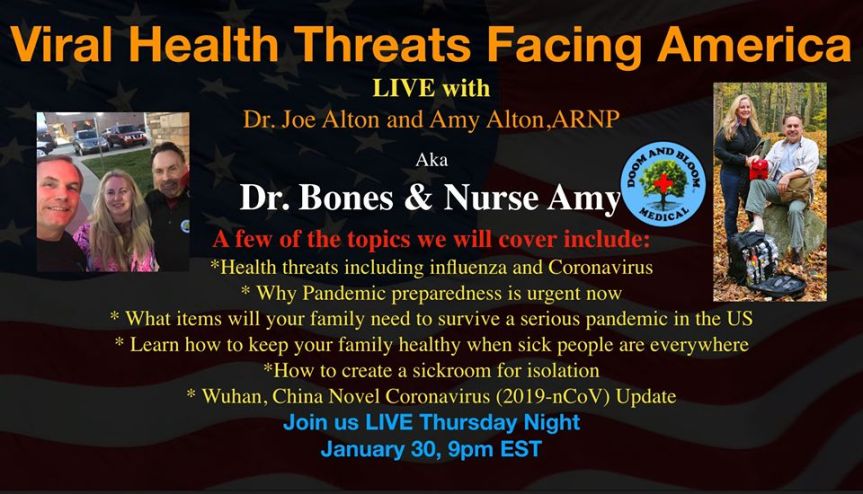
Doom and Bloom Webinar: Viral Health Threats Facing America, Jan. 30

Join us this Thursday, January 30, 2020 at 9 PM EDT

LIVE Webinar

Viral Health Threats Facing America

with
Dr. Joe Alton and Amy Alton, ARNP

Aka. Dr. Bones & Nurse Amy

Signup:
https://preppernet.com/bones/
An email will be sent out on Wednesday with the details

A must listen to podcast on the Coronaviruses!
Prepping Academy’s Podcast
Coronaviruses
https://www.buzzsprout.com/794960/2574682-coronaviruses-alert-alert-alert


You can now view the recorded video on youtube, presentation starts around the twenty minute mark:

Practical Self Reliance: Homemade Elderberry Syrup

Ashley of Practical Self Reliance has a nice, detailed article on making immune-boosting elderberry syrup at home. My family has made and used elderberry at home for a few years now. We’ve used elderberry syrup, elderberry rob, and elderflower syrup. If you don’t have elderberries at home, you can purchase commercial Sambucol – an over the counter elderberry syrup. Our young children like taking the syrups, but not the rob which has a more medicinal taste. Nonetheless I’ll include an elderberry rob recipe after the Practical Self Reliance excerpt.

Elderberry syrup is a common immune-boosting home remedy for colds and flus.  It can be expensive to purchase, but homemade elderberry syrup is easier than you think…

Homemade Elderberry Syrup

Benefits of Elderberry Syrup

While elderberry has been a folk remedy for centuries, modern science is validating these age-old uses.  Studies have found that elderberry syrup can reduce the duration of flus, as well as boost the immune system in both the healthy and sick.

Elderberry Syrup Cold & Flu Treatments

A placebo-controlled study on flu patients found that with a tablespoon (15 ml) of elderberry syrup taken 4x per day,  “Symptoms were relieved on average 4 days earlier and use of rescue medication was significantly less in those receiving elderberry extract compared with placebo. Elderberry extract seems to offer an efficient, safe and cost-effective treatment for influenza.”

Another influenza study cooked elderberry syrup into slow-release lozenges, but administered a similar dosage 4x a day.  The effects were dramatic…

“The extract-treated group showed significant improvement in most of the symptoms except 24 hours after the onset of the treatment, whereas the placebo group showed no improvement or an increase in severity of the symptoms at the same time point. By 48 hours, 9 patients (28%) in the extract-treated group were void of all symptoms, 19 patients (60%) showed relief from some symptoms… In contrast, complete recovery was not achieved by a single patient in the placebo group [during the 48 hour monitoring period].”

They concluded that elderberry extract is safe and highly effective in treating flu‐like symptoms.”

Elderberry Syrup For the Immune System

After several studies confirmed that elderberry syrup can shorten the duration of the flu, another study tried to determine the effects of elderberry syrup on a healthy immune system.  They found that a commercially available elderberry syrup (Sambucol) substantially increased immune activity, even in healthy people.

“We conclude from this study that, in addition to its antiviral properties, Sambucol Elderberry Extract and its formulations activate the healthy immune system by increasing inflammatory cytokine production. Sambucol might, therefore, be beneficial to the immune system activation and in the inflammatory process in healthy individuals or in patients with various diseases. Sambucol could also have an immunoprotective or immunostimulatory effect when administered to cancer or AIDS patients, in conjunction with chemotherapeutic or other treatments.”

Jar of homemade elderberry syrup with raw honey

Click here to read the entire article with recipe at Practical Self Reliance.

Click here to download a pdf of only Ashley’s Elderberry Syrup recipe.

Elderberry Rob

The following elderberry rob recipe comes from The Joys of Jams, Jellies, and Other Sweet Preserves by Linda Ziedrich.

In a saucepan combine equal volumes of elderberry juice and sugar or honey. Heat the contents over medium heat, stirring until the sugar dissolves. Raise the heat to medium-high and boil the mixture to a thick syrup.

Pour the rob into sterilized bottles, and cap or cork them tightly. Store the bottles in a cool, dark, dry place, where the rob should keep for at least a year.

To use, mix a tablespoon or two in a cup of hot water and drink.

We water bath can our rob when we make it. If you use honey, the high heat of both boiling and canning probably does lose some of the health benefit of honey, in which case it is mostly just adding sweetness.

See also The Human Path – Elder

Doom and Bloom: Coronavirus

The Altons at Doom and Bloom medical have a short article up on what is a coronavirus and basic prophylaxis. The article was published on Jan. 22nd, so the numbers of confirmed cases and deaths have risen.

Masks Mandatory in Wuhan

Last week, we reported on a mysterious ailment first reported Dec. 8th, 2019, in Wuhan, China. Wuhan is the seventh most populous city in China with 11 million people. The previously unknown disease is now identified as a type of coronavirus. Medical officials are currently classifying it as a “class B” disease, which puts it in the same category as HIV/AIDS and Sudden Acute Respiratory Syndrome (SARS).

The rapidity and spread of the disease is impressive: When I began writing this article earlier in the day, there were 440 cases and 9 deaths, up from 200 cases last week. Later in the day, 555 cases and 17 deaths have been verified and other provinces in China are beginning to report cases.

(Note: I first reported on Ebola in early 2014, when 86 cases were reported. The epidemic eventually reached a total of 28,000 cases and 11,000 deaths.)

Chinese authorities have taken the drastic measure of placing the entire city of Wuhan under quarantine, including the suspension of train and airline service, a step that suggests that many more cases are still unreported.

(1/23 update: Several U.S. airports are now conducting health screenings)

Although little is known at this point about the virus, it is certain that the disease is respiratory in nature and that human-to-human transmission (including medical personnel) is likely. For most respiratory infections, contagion is usually by airborne particles.

The first U.S. case has just been identified in a 30-year-old man from the state of Washington who recently arrived from China. Similar coronavirus victims have been found in Japan, Thailand, Taiwan, and South Korea, almost all traced to an origin in Wuhan.

ABOUT CORONAVIRUSES

Fever may not be present in all patients including: young, elderly, immunosuppressed or taking fever-reducing medications; many only have respiratory symptoms

The Wuhan virus is from the same family of coronaviruses as SARS, which killed over 800 people worldwide in an outbreak toward the end of 2002. It is also similar to Middle East Respiratory Syndrome (MERS), another epidemic disease. Although not officially named, the new virus is designated 2019-nCOV.

Coronaviruses are viruses made from RNA genetic material. One of the larger RNA viruses, coronavirus is so named from the Latin “corona” (crown or halo), from projections on the virus which give the appearance of a crown.

Coronaviruses are thought to be responsible for a large number of common colds in humans. Coronavirus colds seem to be associated with more major symptoms like fever or sore throat than colds caused by rhinoviruses, another common cause. 2019-nCOV seems to cause even worse respiratory symptoms than the typical coronavirus. Coronaviruses can also lead to pneumonia, either directly or through a secondary bacterial infection due to a weakened immune system.

ABILITY TO CONTAIN THE VIRUS

Coronavirus has crown-like projections

Chinese officials are probably wise to enact quarantine orders, as there is only one lab (called a Biosafety Level 4 lab or BSL-4) in their entire country with the capability of handling severe outbreaks. Luckily for them, it is located in Wuhan. The facility can care for victims of highly contagious diseases like SARS, Ebola, etc.

Personnel in a BSL-4 lab are subject to the strictest protocols: They must change their clothing on entering and shower upon exiting. Full-body hazmat suits must be worn while working in the lab and decontaminated afterwards. The facility is required to be a separate building or a wing properly isolated with separate air filtration systems.

The chances of spread of the new coronavirus is increased by the upcoming Chinese New Year, when it is thought that millions of Chinese citizens will be traveling throughout the world.

(1/22 Update: China has just issued a travel ban for the city of Wuhan; public transportation in the city is also suspended)

Having learned lessons from our experience with Ebola, the United States is better prepared to deal with highly contagious outbreaks of infection.

HISTORY OF RECENT VIRAL OUTBREAKS IN CHINA

masks

The presence of any biosafety 4 lab (BSL-4) inside China at all is due to the 2003 viral SARS outbreak. SARS reached epidemic proportions quickly, with 8000 cases leading to 750 deaths worldwide. Chinese authorities hope to have 7 such units built by 2025, but only the Wuhan lab is operational.

Although the use of face masks is common (and wise) in China, Wuhan has declared their use manadatory while in crowded locations. This requirement is causing a shortage of masks in the area, which could eventually lead to the same worldwide.

WHAT TO DO ABOUT CORONAVIRUS AND OTHER VIRUS OUTBREAKS

As of yet, no cure nor vaccine is available to combat coronavirus. Treatment at present focuses on treating symptoms and supporting a victim through the infection, while protecting the healthy from the disease.

Contagious illnesses like coronavirus, however, may morph into epidemics, or is widely distributed enough, pandemics. If you are preparedness-minded, you might consider a personal protection “pandemic kit” (or several) and plan out how you would care for a person with a contagious disease if the hospitals were full. Have you thought about what goes into putting together an effective epidemic sick room?

The CDC recommends:

  •  Washing your hands with soap and water frequently
  •  Avoid touching your eyes, nose and mouth with dirty hands
  • Avoid close contact with sick people

If you are sick, you can protect others by:

  • Staying home until fully recovered
  •  Avoiding close contact with others
  • Cover your nose and mouth when sneezing or coughing
  • Keep objects and surfaces in your home or workspace clean and disinfected (bleach mixed 1:10 with water will do)

Alhough the CDC isn’t recommending this as of yet, having a supply of N95 face masks isn’t a bad idea.

By the way, while I was writing this, I received a notice sent to all physicians in the state of Florida, warning about….coronoavirus.

Doom and Bloom Medical: Coronavirus: The Next Pandemic?


The Medic Shack: Coronavirus, 2019NcoV. Do We Need to Be Worried?

Organic Prepper: Pandemic Preparedness

Daisy at The Organic Prepper has an article up about the Wuhan Coronavirus and what you can do now to prepare. From what is currently known, this coronavirus has approximately a 2% mortality rate. That is considerably lower than some other viruses that have made the news over the years, but while it is low it is about the same as the Spanish Flu pandemic that killed millions around 1918. Should you be worrying? It’s too early to tell right now. We don’t know if containment will be achieved or how easily it may spread. But if not this one, at some point another pandemic will sweep the world causing mass casualties, so it is good to have some preparation for the event.

…In Wuhan, supermarket shelves were empty and local markets sold out of produce as residents hoarded supplies and isolated themselves at home. Petrol stations were overwhelmed as drivers stocked up on fuel, exacerbated by rumours that reserves had run out. Local residents said pharmacies had sold out of face masks.

“When I saw the news when I woke up, I felt like I was going to go crazy. This is a little too late now. The government’s measures are not enough,” said Xiao, 26, a primary schoolteacher in Wuhan, who asked not to give her full name.

Few pedestrians were out and families cancelled plans to get together for the new year holiday. Special police forces were seen patrolling railway stations. Residents and all government workers are now required to wear face masks while in public spaces. Most outbound flights from the city’s Tianhe airport were cancelled. (source)

Those who wish to be prepared should note the speed at which quarantines were put in place in China. Don’t delay placing orders for supplies, fueling up your vehicle, and adding last-minute preps to your stockpile. You may already have many of the supplies you need, so be sure to do an inventory before panic-buying.

However, if you discover you do need supplies, get them now. If you wait until a quarantine is announced, you’ve waited too long and you’ll be out there fighting for resources with everyone else in your area.

Whatever your plan is, don’t delay taking action. Otherwise, you might find yourself in the same situation as 20 million Chinese people who were suddenly quarantined.

Click here to read the entire article at The Organic Prepper.

Doom and Bloom: Blunt Trauma, Part I

The Altons at Doom and Bloom Medical have an article up on Blunt Trauma. This first part is an overview of the trauma itself and a later post will discuss treatment.

Blunt trauma is damage caused to the body by a blunt object, such as a club or baseball bat. Blunt trauma can cause bruising, scrapes, fractures, or organ ruptures. It can, in some circumstances, break the skin although a projectile that enters the body and stays there or passes through is considered “penetrating trauma”.

How does blunt trauma cause injury? According to the excellent textbook “Trauma” by Mattox, Moore, and Feliciano: The strain on an area due to trauma is related to the amount of deformation caused, factored with the amount (length) of tissue involved.

Types of Strain in Blunt Trauma

Let’s put “Strain” in four categories: Tensile strain, Shear strain, Compressive strain, and Overpressure.

Tensile Strain: Tensile strain occurs as opposing forces are applied to the same point, something like pulling apart a wishbone at Thanksgiving or, perhaps, a tug of war.

Shear Strain: Shear strain also involves two forces applied to a structure, but not at the same point. Think of a circus strong man tearing apart a telephone book.

Compressive Strain: Compressive strain is directly related to the deformation of an area of impact, similar to what would happen if I struck you in the ribs with a baseball bat or the jack collapsed while you were working under your car.

Overpressure: Overpressure is not unlike compressive strain, but applied to a fluid or gas-filled organ, crushing and, perhaps, rupturing it. An example might be sitting down abruptly on a balloon…

Click here to read the entire article at Doom and Bloom.

Doom and Bloom: A New Pneumonia

The Altons at Doom and Bloom Medical report that a previously unknown viral pneumonia has broken out in China, hospitalizing dozens there. They discuss what pneumonia is, treatment and prevention.

Health authorities in China are reporting 60 cases or more of a previously unknown viral pneumonia that has put dozens in the hospital. Officials note that victims exhibit fever up to 105 degrees Fahrenheit, difficulty breathing, and abnormal findings on chest X-rays.

Nothing gets my attention like a mysterious, probably viral, pneumonia showing up in some foreign land. In the last decade or so, killers like Sudden Acute Respiratory Syndrome (SARS) and Middle East Respiratory Syndrome (MERS) have entered the scene. The current infection doesn’t seem to be either of these, and lab studies have already eliminated influenza, avian flu, most bacteria, and other possible culprits. A number of victims were found to have attended a seafood market in the area.

The word “pneumonia” is defined as a lung inflammation usually caused by bacterial or viral infection. Occasionally, fungi or parasites may give rise to it. It’s a very general term and doesn’t identify the specific microbe that’s causing the problem.

It’s important to know that inflammation of the lungs may occur as a result of reasons other than infection, such as inhaling food, drink, or vomit into the lungs. This is called “aspiration pneumonia” and can be life-threatening.

Although pneumonia kills about 50,000 people annually in the United States, most of these cases are in the elderly, the very young, or those with poor immune systems. One infection that is clearly passed from one human to another is influenza. This year’s flu season is becoming one of the worst in recent memory, according to the Centers for Disease Control and Prevention (CDC). The last serious viral influenza outbreak in the U.S.  was 2017…

Read the entire article at Doom and Bloom Medical.


Wilderness Doc: New Guidelines for Spinal Protection

In Spinal Protection in the Wilderness: What We’ve Been Doing Wrong for Decades the Wilderness Doc talks about the new (Dec. 2019) Wilderness Medical Society Guidelines for spinal cord protection and what it means for wilderness/remote care. Reprinted below is an excerpt, be sure to go and read the whole article so that you aren’t misled into doing something dangerous by the sample.

…If you have been a victim of a traumatic injury over the past 50 years, you have been quickly placed in a cervical collar and strapped to a backboard to “protect your spine”. Countless patients have been tortured (ok, maybe a little overly dramatic but…) for hours on end as they waited for their spines to be “cleared”.

This practice guideline simplifies the use of rigid cervical collars and immobilization all the way down to–don’t use them

You and a friend find yourselves in the mountains of Georgia hiking along a moderate to difficult trail with some steep terrain. Your friend turns to look at an interesting bird flying through the forest canopy and loses his footing sliding off and down the steep embankment. You rush to the edge of the trail to watch as he turns over and over, falling head over heels down the 100-foot slope. Quickly, you slide down the embankment and find yourself at your partner’s side. He is awake and alert, cursing vigorously at his misstep.

You ask, “Are you alright?”

Sitting up, he replies, “Yes.” As he carefully bends his neck to the left, right, back, and front with no indication of pain of any type.

Throughout the last half-century, any physician or provider with the slightest knowledge of emergency medicine would have fainted at the thought of letting a patient go through the maneuvers described above. If asked about what should have taken place, they would tell you the patient had to be immobilized. Immediately upon arriving on the scene, the uninjured party should have counseled their companion to remain still, lie completely flat on the ground, and not move their neck.

After all, there could be an unnoticed and unidentified spinal cord injury.

We must protect the spinal cord. 

Given the guidelines as presented in this paper, the patient above has cleared himself. Being alert and able to safely and without pain mobilize the neck in a full range of motion (without distracting injury) rules out a spinal cord injury. In some instances, it may be desired to provide some form of non-rigid cervical spine motion restriction. However, the rigid cervical collar has been shown to cause more harm than good…

Click here to read the entire article at Wilderness Doc.

Doom and Bloom: Stab Wounds

The Altons at Doom and Bloom Medical have another good article up, this one on stab wounds. There are pictures with stab wounds on the page, so that’s a warning if you have a light stomach.

Any disaster puts your people at risk for injury. Wounds caused by sharp objects can be life-threatening, depending on the organs and blood vessels damaged.

Stab wounds are a type of penetrating trauma, which is further divided into perforating and non-perforating injuries.  A perforating wound is one in which the object causing the damage goes into one side of the body and then exits through the other side.  A wound from .223 or NATO .556 would, commonly, be an example of perforating trauma.

Bullets and other high-speed projectiles cause damage not only from the act of penetration, but also the shock wave produced as the bullet passes through the body. Luckily, low speed projectiles such as knives will not do this. Your concerns are related specifically to the area of entry and the structures located directly in the path of the offending instrument.

Stab wounds are an example of a non-perforating wound:  the projectile causing the damage enters the body and either stays there or exits where it entered. Some sharp instruments could possibly do this, say a crossbow bolt or a spearhead, but let’s assume that you’ll be unlikely to see these.

With stab wounds, blood loss and failure of damaged organs will be the major issue. A little about blood: Blood carries oxygen to the tissues and organs and removes waste products. It is made up of several components, including:

  • Red blood cells: These cells carry oxygen to body tissues.
  • White blood cells: These cells work to, among other things, fight infection and disease.
  • Platelets and other clotting factors: These allow blood to coagulate and lessen blood loss.
  • Plasma: A yellowish liquid in which the above are suspended.

Your immediate action upon encountering a victim of a wound with a sharp instrument may save their life. The heart takes less than one minute to pump blood to the entire body; if the circulatory system is breached, blood loss becomes life-threatening very quickly.

180 lb. (about 70 kg.) adult males have approximately 9-10 pints (about 5 liters) of blood in their body. Athletes and those living at very high altitudes may have more. You can’t afford to lose more than 40% of total blood volume without needing major resuscitation.  To get an idea of how much blood this is, empty a 2 liter bottle of fruit punch or cranberry juice on the floor.  You’ll be surprised at how much fluid that represents…

Click here to read the entire article at Doom and Bloom Medical.

Doom and Bloom: Fish Oil as a Survival Supplement

The Altons at Doom and Bloom Medical have an article up on the whether there are benefits of fish oil as a supplement in a survival situation.

If a disaster knocks you off the grid for long enough, the medicines eventually run out no matter how well you’ve prepared. This is especially true for drugs which you can only stockpile in limited quantities, simply because they’re too expensive. One item that isn’t too expensive is fish oil, commonly available in supplements or in FDA-approved prescription items. The scientific data shows that they can reduce triglycerides in your blood, a factor in coronary artery disease, and perhaps help in other ways.

First, what is fish oil? Fish oil is the fat or oil that’s extracted from fish tissue. Squeeze a fish, get some oil. Most of it comes from “oily” fish, such as herring, tuna, anchovies, salmon, and mackerel. It’s sometimes produced from the livers of other fish, an example being the time-honored cod liver oil.

“Oily” fish like salmon have lots of omega-3s

The World Health Organization (WHO) doesn’t recommend fish oil supplements, but it does recommend eating 1–2 portions of fish per week. This is because the omega-3 fatty acids in fish are thought to provide many health benefits, including a level of protection against a number of diseases. The FDA has approved fish oil products like Lovaza and Vascepa as a good way to fight high triglycerides and total cholesterol levels, especially in those who don’t incorporate fish in their diet.

Back to that in a minute. It’s been a long time since I’ve talked about triglycerides and cholesterol, so let’s take a moment to discuss them…

We’ve all heard about bad cholesterol, but cholesterol is made by all animal cells and is an essential structural component of cell membranes. It is also a prerequisite for all steroid hormones, bile, and even vitamin D. That means you can’t produce them without cholesterol as a building block. Cholesterol was first discovered in gallstones in the 18th century, we called it “cholesterine” then…

Bottom line about fish oil in survival scenarios? Instead of squeezing fish to get oil, you’re probably a lot better off just cooking and eating them. Believe me, you could do worse than incorporating fish into your diet. By the way, you can also get your omega-3s from other natural sources, especially ground flaxseed or flaxseed oil. Alternate sources of omega-3s also include chia seeds, walnuts, canola oil, pumpkin seeds, and soy oil. If you’re off the grid, though, and can’t access any other source of omega-3s, fish oil supplements might be useful if you could store them appropriately.

Click here to read the entire article at Doom and Bloom Medical.

Also note that purslane, which is considered a weed in some places because it grows so prolifically, is also high in omega-3 fatty acids.

Purslane – high in omega-3 fatty acids


Doom and Bloom: Clindamycin as Medical Storage Item


The Altons at Doom and Bloom Medical have up an article about the usefulness of the antibiotic clindamycin as a medical storage item.

In any situation where modern medicine is not available, there will be a number of deaths that occur from injury and infection. These may occur as a result of contact with hostile neighbors or from epidemic diseases, but many will happen simply from the performance of activities related to survival. Many minor wounds will become contaminated, leading to infections that could easily have been treated with antibiotics.

Things don’t end well for this family
Years ago, I realized the importance of antibiotics in a family’s medical kit after watching a History Channel program called “After Armageddon”. In it, the Johnson family is caught in a long-term disaster and finds a community that will take them in. The father is a paramedic and has useful medical skills, but simple injuries associated with household chores lead to a soft tissue infection. Without antibiotics, the family is forced to watch their patriarch sicken and die as the infection spreads throughout his body.

In a major disaster, this and many other deaths might be avoided if antibiotics were available. You may be reluctant to treat yourself or family members with these potent drugs. This is understandable: Antibiotics aren’t candy and are best utilized by qualified medical professionals. If there are no trained personnel, however, a layman with a working knowledge of bacterial diseases and their treatments may have no choice but to use antibacterials to save a life.

Note: This is the premise of our book “Alton’s Antibiotics and Infectious Disease: A Layman’s Guide to Available Antibacterials in Austere Settings”.

There are many antibiotics, but which antibiotics accessible to the average person would be good additions to your medical storage? When do you use a particular drug? The wrong antibiotic at the wrong time can be as bad as doing nothing at all. You should have both quantity and variety to be effective as a medic in long-term survival settings.

Today we’ll take the example of a drug that is used in the aquarium industry that is identical to a medication used in humans: Clindamycin, aka “Fish-Cin”. It is also known as “Cleocin”.

Clindamycin is part of the Lincosamide family of drugs. It works by preventing the production of bacterial proteins necessary for growth. This particular medication has been used to treat everything from acne to anthrax.

Cute, ain’t it? Ouch!

Clindamycin works best on bacteria that are anaerobic, which means that they don’t require oxygen to multiply. A deep puncture wound like, for example, a cat bite would give rise to favorable environments for anaerobes. Clindamycin is versatile enough to treat or prevent certain bacterial or protozoal causes of:

  • Acne
  • Dental infections
  • Ear Infections
  • Tonsillitis
  • Soft tissue Infections (skin, etc.)
  • Peritonitis (inflammation of the abdomen seen in appendicitis and other medical issues)
  • Some pneumonias and lung abscesses
  • Uterine infections (such as after miscarriage or childbirth)
  • Blood infections
  • Pelvic infections
  • MRSA (Methicillin-resistant Staph. Aureus infections)
  • Parasitic infections (Malaria, Toxoplasmosis)
  • Bone infections
  • Anthrax

It should be noted that although a certain antibiotic may be effective against a certain infection, that it may not always be the most effective. The drug most in favor at the moment is called the “drug of choice”. The drug of choice may change as new antibiotics are developed or new research becomes available about existing medicines…

Click here to read the entire article at Doom and Bloom Medical.

Doom and Bloom: Chemical Emergencies

The Altons at Doom and Bloom Medical have started a series on Chemical and Biological emergencies. In this article, they discuss various chemical agents and what to do.

In today’s modern world, it’s difficult to avoid exposure to toxic chemicals. Chemical weapons are largely prohibited by the Chemical Weapons Convention (CWC), a treaty that outlaws their production and use. Although almost all nations have signed this treaty, the risk of chemical attacks by terror organizations and industrial accidents still exist…

WHAT TO DO IN CHEMICAL EMERGENCIES

Evacuation may be the best course of action

Chemical accidents or attacks, such as an overturned tanker truck or a terror event, may render an area dangerous. Common sense dictates evacuation as the wisest course of action. This is not only to prevent physical contact but also to avoid noxious fumes that may be carried by the winds. Given the wide range of chemicals, be sure to seek and rapidly act upon the advice of local emergency departments for the specific event.

Evacuation may involve going to an emergency shelter. If so, notify others of your plan of action and take additional supplies and medications that the municipality may not have in sufficient quantities. Know what their policy is regarding pets. The schools your children attend will have their own plan of action for chemical emergencies; be aware of their disaster protocols. It may be more dangerous to try to bring them home.

SHELTER IN PLACE?

Safe rooms for chemical/gas accidents should be in higher floors, not the basement where gas may sink

Some chemical emergencies could make going outdoors risky. Leaving might put you in harm’s way. Sheltering in place is a way to protect yourself until help arrives. Sheltering in a vehicle, however, is a last resort, as vehicles aren’t airtight enough to protect you from noxious fumes.

If you can’t evacuate the area, choose a room with as few windows and doors as possible. A room with a water supply (a connecting bathroom, perhaps) is best. Some gases sink to the floor, so a second-story room is preferable. Notice how different this strategy is from most natural disaster plans, where a basement might be the safest area in the home.

Shut all outside doors and windows as soon as you are aware of the emergency. Locking and taping them will make a better seal against the chemical. Turn off air conditioners, fans, and heaters. Close the fireplace damper, vents, and any place that air can enter from outside.

Go into the designated safe room and shut the door. Turn on the radio and keep a cell phone available. If it is necessary to drink water, drink safely-stored water, not water from the tap. If you run out of water, you can drink from a toilet tank (but not from the bowl)…

Click here to read the entire article at Doom and Bloom Medical.