Raconteur Report: COVID – Lies, Damned Lies, and Statistics

Healthcare professional Aesop at Raconteur Report talks about the current COVID-19 resurgence in Lies, Damned Lies, and Statistics.

Much has been made by bloggers whom and on sites which I respect, about certain prognostications by Mssr. Briggs, statistician, regarding Kung Flu.
 
I’m not quibbling about his numbers, just what he makes of them, evidently from an utter lack of knowledge about that of which he speaks.
 
Unfortunately, Briggs’ combines his statistical skills with what he doesn’t know about science in general, and epidemiology in particular.
 
1) There are, indeed, “good” flu years, and “bad’ flu years. But it’s not a 1- or 2- variable problem set.
    a) there are always older people, some of whom are more frail, and many of whom are going to die. But surviving flu one year doesn’t, ergo, make you another year older and thus more likely to die the next year. That’s kindergarten math thinking.
 
    b) How many other conditions does any given grandpa or grandma X have?
 
    c) What is their general health condition?
 
    d) Did they get a flu shot that year, or not?
        d1) Did the flu vaccine witch doctors guess the actual flu strain mutations well, and formulate a great shot (a year with a 95% efficacy) or poorly (a year with 15% efficacy). {e.g., in 2018, IIRC, there were 635 individual strains of flu rampant in the US, and that year’s shot had about a 15% effectiveness. This is nigh on to worthless, relatively speaking.}
        d2) Was there even a flu shot at all?
(In, to my best recollection, 2010, there was no flu vaccine available at all. Whichever year it was, it was a record low flu year. Because CDC and FedGov bombarded the airwaves with PSAs telling people to “Wash your goddamned nasty hands! Stay home if you’re sick!” in so many words, and mirabile dictu, old people and parents of young children actually did it. Flu visits to the ER that year were negligible.)
 
That exact level of concern, plus masks, and distancing, is why, by all accounts, this year’s flu season cases will probably be contained in a thimble.
 
Those are just some of the 100-500 variables behind who dies, and why, from flu, Kung Flu, or any other thing, in any given year. Not just whether it was a “good” or “bad” flu year, last year.
 
Yes, it was world-record @$$holian to put known COVID+ cases into convo homes, which are the lowest form of medical care other than anything found in the Turd World, and you get a perfect storm of the most vulnerable patients, and the most execrable level of care not delivered by actual gypsies and witch doctors (and in most convo homes, there’s little difference between them. The fact that they reek of sh*t and piss the moment you walk in is what poker players call a “tell”.) Those deaths were, indeed,  low-hanging fruit.
 
That such deaths may have accounted for nearly half the initial wave is bad.
It does nothing for the next wave, unless you stop doing that. I have yet to hear that it’s no longer policy. And even if it was, that overlooks the obvious problem: Kung Flu presents asymptomatically in up to 50% of cases (which is why checking for fever temperatures at building entries is like looking for elephants in trees: asinine and pointless.)
 
If they really wanted to keep infected people out of convo homes (which are still chock full of vulnerable patients, in 50 states and 7 territories), they’d have to be rapid-testing every patient they admit, before entry, and rapid-testing every staff member, daily, and every single visitor, vendor, etc., and holding them in quarantine outside until they test negative (an hour or two later). We don’t even do that in first-class hospitals.
 
Doing so would cost a large fortune, and bankrupt everyone, everywhere.
 
So the exact same thing is going to happen, over and over and over, because you won’t pay for doing it right. No one will.
 
Own that.
 
It’s the exact asymptomatic Gilligans – the young and “healthy”,  who won’t get really sick nor die from this – who have been and will continue spreading this virus around, until it hits the susceptible victims, and makes a guaranteed percentage of them very sick, and some of them very dead.
 
Some of them, yes, will be the aged, infirm, and those with levels of disease that were killing people at age 66 in 1933. (That’s why FDR had Social Security kick in at age 65; FedGov expected you to be dead within a year. And then medicine, the same bunch that know-nothing idiots bitch about for the cost, went and started increasing everyone’s life expectancies to the 80s. See if you can guess why SS is broke.)
 
And yes, we know a little bit better what to do (and not to do) to care for those hardest hit by Kung Flu. Which will make about a 1-25% difference in fatalities in subsequent waves. Because those in the roughly 3% likely to die, are still going to die. So maybe now the death rate goes down from about 3% to 2.7%. (The death rate for flu, BTW, is about 0.1%, since ever. Don’t you feel better now, knowing this is only 27 times worse than flu, instead of 30 times?)
 
The biggest problem with those prognosticating from ignorance in general is overlooking the fact that most of the population, in this or any country, has yet to be exposed to the virus.
 
E.g. Califrutopia, last I looked, has tested about 10% of our 40M people.
The rate of those infected at some point, is running damned near 10%.
With millions tested now, rather than dozens, those numbers are statistically valid (unlike, say, Biden’s pre-election poll numbers) and thus (unlike Biden’s vote tallies) aren’t going to widely fluctuate. Right up until we throw open the floodgates, eliminate any precautions, and start spreading Kung Flu virus around like it was welfare money in a Blue State. (Or blank mail-in vote bundles at any Democrat HQ building.)
 
Then, the more people you infect, the more people will die.
 
Yes, only at that +/- 3% rate.
We’re pushing 250K dead now, with the infection rate of 10% in certain places (mostly highly populated areas), and probably less than 0.1% in most of the country denigrated as Flyoverland.
 
So, roll the dice, and tell me what happens when the infection rate goes up everywhere.
Especially if the infection rate goes up by leaps and bounds, rapidly.
And for a special bonus, in the exact places where true modern medical care is 1-4 hours away.
On a good day.
 
Then we get to the fun questions:
 
Does infection confer immunity?
I have no godd…d idea. Neither does WHO. Neither does CDC.
Neither does Pfizer, or any-effing-body else.
I have one firsthand example of repeat infection, hospitalized in front of my face.
I have dozens of cases reported anecdotally.
 
I have seen zero literature explaining this.
I have seen or heard of zero literature documenting exactly how widespread this is.
 
No one knows how much, or how widely, the original strain is mutating.
 
Thus any claims of vaccine efficacy are so much bulls…t.
Any claims of herd immunity are so much whistling past the graveyard.
Any extrapolation of how bad this is going to be, with those exact unknowns being so glaringly obvious, are nothing but Bandini Mountain, with a sewage frosting from downstream of the septic plant.
 
Do I want fiat lockdowns again?
 
HELL NO!
 
Make a case, trot out evidence, not SWAG bulls…t, and weigh the benefits and costs.
Medical, scientific, economic, everydamnedthing. Talk it over, and think it through, FIRST.
Then have the legislatures pass laws, or not, and have governors sign or veto them.
 
Y’know, like republican government has worked going back to, oh Magna Carta, or even Rome and Greece. If only for the novelty.
 
I went over a month in a SoCal ER with no likely COVID patients. I tell you, it was heaven. A crappy night with no COVID patients was like old times.
 
That ended last week. Just about 3 weeks behind the spike in cases, we just had, on my shifts alone, 3 slam-dunk sure-as-hell-got-it COVID patients. I had 2 of them personally, and one of them was the re-infection case I wrote about previously. When I left yesterday, we had a guy who literally desatted from 80% to 60% oxygen level in the two minutes it took to get him from the triage tent to an iso room inside. He was in his 50s.
 
The ICU nurse who died from my hospital got it from a patient who was uninfected, then exposed by an asymptomatic patient in a regular ward, brought it to the ICU, and infected 10 nurses there before they knew it was a COVID case. That nurse was in her early 50s, not her late 80s.
 
Times, in 25 years of my career, that happens with flu: never.
Not one godd…d time.
Not even a consideration.
 
So I’m getting pretty damned tired of ignorant @$$holes burping out pure undiluted horses…t quotes like the following:
 
Young (under 65) healthy people are not being killed by the doom—or much of anything else.
Yes, they are. On a regular basis.
Pointing out that they do so at a lesser rate does nothing to remove the lie from the quote above.
And noting that old people die more often is cold comfort to someone whose 30- or 40-year old spouse died because to pointy-headed number crucncher, they were just a rounding error, or “within the margin or error”. If you don’t have to look the survivors in the eye while their loved one’s bodies are still warm but heading for room temperature, kindly STFU about things when you don’t know what the hell you’re talking about.
 
Suppose I told you, with absolute statistical confidence, that if you ran red lights, you only had a 3% chance of getting bashed to hell, killing someone, or going to prison. 
Would you do it?
Suppose I told you that your meatloaf was 97% steak, and only 3% bullsh*t.
Would you eat it?
 
If you answered “yes”, how much shit could I put in your meatloaf before you’d turn it down??
 
You can tell me that driving is hazardous, because of drunks and idiots. I’ll still drive.
Mainly because I don’t drive 100% of the day.
But unlike bar fights, liquor store robberies, or drunk driving deaths, everybody alive on the planet breathes, non-stop, 24/7/365, without any choice in the matter.
 
So unless you can live isolated, or hold your breath for years on end, or live in a spacesuit 24/7, that makes a respiratory ailment in widespread circulation one hell of a lot bigger concern than the other causes of death which, exactly as the CDC and Briggs note, knock off about 50,000 people every year in this country.
 
Which makes statistical prognostications from someone like Briggs sound to me exactly like a fresh hot steaming pile of cows…t smells.
 
I can listen to statistical bulls…t from people who don’t know what they don’t know, or I can believe my lying eyes, backed up by medical evidence, and common sense.
 
You guess where I’ma come down on that one.
 

In one of the comments to the above post, Aesop talks a little about the issue of co-morbidities:

BTW, people don’t die because of the co-morbidities, those just make them more likely.

Just like few, if any, people die from drunk driving because they were drunk. Unless they had a BAL of 900, and fell asleep, and stopped breathing. They die because of that pole they hit at 90MPH while drunk, and because the one leads to the other.

The people who got wrapped around the axle of deaths with COVID (or co-morbidities, like diabetes, hypertension, obesity, etc.) vs. because of. People don’t die from the co-morbidities, they died because those things sapped their body’s ability to deal with things when the COVID pneumonia in both lungs, everywhere, simultaneously, taxed their ability to breathe and survive beyond what it could handle. Generally because they were too frail, fat, old, weak, and sedentary, which is how you get to be fat, diabetic, hypertensive, etc.
But when you walk around for decades fat, sedentary, diabetic, and hypertensive, then get COVID, and die in 3 weeks, it wasn’t those co-morbidities which killed you, it was the Kung Flu.

Just like if you had all those co-morbidities, and got eaten by a lion while on safari. The lion killed you, not the co-morbidities. The co-morbidities just made you easier pickings.

What they died from, in all cases was cardio-respiratory failure caused by COVID pneumonia. Everything else just piled on to decrease their survival prospects, but noting that sick people die more frequently than healthy people isn’t exactly a blazing piece of medical insight.

People who focus on the co-morbidities like it’s an “A HA!” moment are as ignorant as the idiot-savant people that actually think guns just randomly jump up and kill people, all by themselves, and they don’t seem to get that focusing on them just underlines their ignorance on the topic.

There may be some genetic component as well, but absent evidentiary research, that’s just a Hail Mary guess by some people uncomfortable with admitting that they have NFI what causes the Kung Flu to kill 3 people, hospitalize another 7, get 30 sick, and leave 60 completely untouched. I’d rather wait for the answers rather than grunt and squeeze them out of my hindquarters.

And in the meantime, wear a mask and gloves, and wash my hands, which has worked flawlessly for 10 months, to date, in close proximity to rampant cases, to leave me uninfected.

Seattle Times: Toilet Paper Shelves Bare, as Shoppers Worry about Washington Restrictions

At the Costco in Seattle on Sunday, shoppers waited in a long line and a whiteboard listed out-of-stock items: toilet paper, paper towels, disinfectant wipes, all Kleenex products. (Paige Cornwell / The Seattle Times)

The Seattle Times has a story about people in the state once again caught unprepared as new COVID-19 restrictions were announced yesterday. Toilet paper shelves again left bare, as grocery store shoppers worry about Washington restrictions

In announcing new statewide restrictions aimed at reducing the spike in COVID-19 cases, Gov. Jay Inslee on Sunday urged people not to hoard “supplies.”

“Buying up everything really hurts everybody,” Inslee said, “and there’s no necessity of it right now.”

But while the man didn’t specifically call out toilet paper, the toilet paper sure did call to shoppers.

At some Seattle stores on Sunday, in a throwback to earlier days of the pandemic, people were already buying up stacks of bathroom tissue, which seems to turn to spun gold when things look grim.

Costco ran out of the stuff over the weekend, and there was none to be found Sunday at the Safeway on Madison Street in Seattle, or the QFC on Rainier Avenue South.

(The Costco on Fourth Avenue was also out of paper towels, disinfectant wipes and all Kleenex products, according to a whiteboard posted outside).

There was still some left at the Safeway just down Rainier — but it was going at a steady clip. Angel Soft, Charmin. Quilted, cotton or mega. Didn’t matter.

“Is there a limit?” asked a woman named Pat.

Pat didn’t want to give her last name, which makes a certain kind of sense. Much as we talk about the stuff — how much we need for how many people and for how long — toilet paper is still a very personal thing.

“There’s only two of us,” Pat said, grabbing a package of 12 rolls of Charmin, then dropping her voice. “But my daughter goes through it quite fast.”

OK. Understood. No judgment.

“When I was growing up, my Dad, his rule was one sheet,” she continued. “We may have to go to Grandpa’s rule.”

She stopped, scanned the semi-bare shelves and grabbed another package.

“Maybe I’ll try for three,” she said. “Put them under my bed.”

King 5: Gov. Inslee Bans Indoor Gatherings and Further COVID Restrictions

From King 5 News on Nov. 15, 2020 – Governor Inslee announces closures of indoor dining, other restrictions to curb COVID-19

Gov. Jay Inslee has announced new statewide restrictions to help curb the spread of the coronavirus, which includes closing indoor service for restaurants and bars and prohibiting indoor social gatherings.

These rules will mostly go into effect on Monday at 11:59 p.m. and will remain in effect until Dec. 14.

The announcement comes following days of increasing COVID-19 cases.

The impacted industries/areas are:

  • The biggest impact will be the closure of indoor dining at restaurants and bars. Outdoor dining and to-go service is permitted. Outdoor dining must follow the outdoor dining restriction. Table size limited to 5 for outdoor dining. These restaurant restrictions go into effect at 12:01 a.m. Wednesday, Nov. 18.
  • In-store retail limited to 25% indoor occupancy and must close any common/congregate non-food-related seating areas. Food court indoor seating is closed.
  • Indoor social gatherings from people outside your household are prohibited and outdoor social gatherings should be limited to 5 people outside your household.
  • Fitness facilities and gyms are closed for indoor operations. Outdoor fitness classes may still occur but they are limited by the outdoor gathering restriction listed above.
  • Wedding and funerals receptions are prohibited. Ceremonies are limited to no more than 30 people.
  • All retail activities and business meetings are prohibited. Only professional training and testing that cannot be performed remotely is allowed. Occupancy in each meeting room is limited to 25% or 100 people, whichever is fewer.
  • Movie theaters are closed for indoor service. Drive-in movie theaters are still permitted and must follow the current drive-in movie theater guidance.
  • Religious services limited to 25% indoor occupancy no more than 200 people, whichever is fewer. No choir, band, or ensemble shall perform during the service.
  • Museums/Zoos/Aquariums are closed for indoor service.

During an 11 a.m. press conference, Inslee announced $50 million for aid to businesses who have been impacted.

Watch the press conference below or by clicking here.

Christian Prepper Gal: Is another lockdown coming to America?

Christian Prepper Gal talks about getting ready – Is another lockdown coming to America? Biden’s Covid advisor recently talked about a nationwide 4-6 week lockdown, though it has been denied as being accepted by Biden.

The cases of Covid-19 are rising at a quick rate across America. So are the death rates from it. Just yesterday (11-11-2020) it was reported that our current cases are a higher count than they were when we had the first lockdown. I’m not trying to scare anyone. I’m trying to make sure that we are all ready for what could be our reality.

My thought on the increase in cases is that people have let their guard down. People are getting tired of the virus and are just wanting to get back to what used to be their normal. Therefore, they are ignoring it and carrying on as if it was gone. It doesn’t work like that…it won’t go away if you ignore it, it will only get worse.

If the current trend keeps up there will be no avoiding another lockdown. The upcoming holidays (Thanksgiving and Christmas) are predicted to cause a surge in positive cases. Another lockdown is getting closer to happening with each passing day. One thing that is for sure is if Mr. Biden does turn out to be in fact our president-elect, he has promised another lockdown once he takes office. It is rumored that his lockdown would be longer and stricter than the previous one. Unfortunately, the way things are heading there may be another lockdown before this year even ends.

Are you truly ready for what may happen?

Let’s take a moment to talk about this. I really hate to be the one to have to tell you this, but if you are one of those who has a 72 hour emergency kit (like the one in the pic to the left) and thinks you are ready for any type of emergency, you are wrong! Those may be good for evacuating due to a fire, hurricane, tornado, or earthquake, etc. But, they will not do you much good in a SHTF scenario such as what we are actually in the middle of with this pandemic. We are not at a point to where we would have to evacuate. In fact, as you know, we need to stay hunkered down. And if there is another lockdown, trust me, it will last longer than what’s in those kits will last. It has been estimated that a four to six week lockdown will be necessary.

So what do we need to do?

We need to make sure that we have at the very minimum 30 days worth of food and household essentials for our families. While most preppers who have been preppers since BEFORE the pandemic happened, will have at the minimum a six month supply of food and household essentials. And, then there are those who are long term preppers who have a year plus supply of food and household essentials.

If you haven’t already forgotten, toilet paper was the very first thing to disappear off the shelves, even before the last lockdown began. So, make sure you have enough toilet paper, paper towels, paper plates, etc. to last a couple of months. Then, we had cleaning/sanitizing products, hygeine products, flour, and yeast disappear from the shelves. So you will want to make sure you have enough of those items on hand as well. And, if you’re going to have flour and yeast in your food storage, make sure you have a tried and true recipe for making bread and other foods using them. The same would apply to beans and rice, make sure you have some recipes 🙂.

We also need to ensure that we have shelf stable, non-perishable food items; foods that don’t need to be refrigerated or frozen. What happens if you lose power (for whatever reason) and your refrigerated/frozen food spoils? That’s where the emergency food meals and meals in a bag can come into play. They don’t need to be refrigerated and can be as quick as microwave meals to prepare. Plus, they take up much less space to store than canned and freezer foods. Click on this link for recipes for my meals in a bag. I started making my own emergency food meals when I discovered that most of those that were available for purchase cost way more than they should. In other words, I couldn’t afford them, lol. But, I found that I could make my own, using my own recipes and substituting dehydrated or freeze dried ingredients for fresh or canned ingredients. And, I knew those homemade emergency meals would be meals that my family members would eat.

Ummmm…it seems I kinda got off on a little bunny trail there. What can I say, I just love my meals in a bag!! Anyway, a good idea is to make sure you store foods that your familiy will eat. And, it’s a good idea to have a variety. So, while you have canned foods, pastas, and other non-perishable foods, it’s a good idea to have other choices also, such as the emergeny meals, on hand for those days you need a quick and easy meal.

I’m focusing on food here because that’s the main thing we are going to need in the case of another lock down. If nothing else, learn from the very reccent past with the first lockdown and think about what items were sparce, or not available at all, in your area. Those will be the things you need to make sure you have on hand now, if you have not already done so. Then, you need to try as hard as you can to build up a supply that will last your family at least three months. Minimum.

As I am proof reading this article, I am watching The Nightly News and it is being reported that some grocery stores are putting limits on some food items again. They mentioned the very same products that I mentioned above as having been in short supply during the first lockdown as being those items that are now having limits put on them again. It is my prayer that your eyes will be open to what is happening around you, and that you will listen to what God is telling you that you need to prepare you and your family during this pandemic. Please stay home as much as is possible, and stay safe.

Until next time…happy prepping, and God bless!

James 4:17, Therefore, to one who knows the right thing to do and does not do it,

to him it is sin. (NASB)

As an aside, I just want to say…As Christians, it is hard for some to realize that even though God has promised to be our Protector, He has also told us that we need to be vigilant and look out for ourselves as well. In other words, we know that if we put our hand in the fire and hold it there long enough we are going to get burned. In the same way, during this pandemic, if we carry on our lives ignoring the reality of the Covid-19 virus long enough we are eventually going to come into contact with someone who has the virus but is not yet exhibiting the symptoms, or someone who is asymptomatic. So, we need to protect ourselves by not putting our hand in the fire. In other words, we need to follow the protocols that have been set forth by the CDC. Just because you follow protocol DOES NOT mean that you are not trusting in God. Yes it’s true that if it is our time we are going to go no matter how careful we are. But, what if it is not our time and we act in a way that will accelerate that time?

Deccan Herald: 700-km-long Traffic Jam in Paris Ahead of 2nd Covid-19 Lockdown

According to this article at the Deccan Herald, there were 700km (~435 miles) of traffic jams in Paris on Halloween as people attempted to flee the city ahead of another lockdown. The scene is reminiscent of so much disaster fiction where the protagonist tries to bugout from the city a little late. It’s difficult to know when the right time to bug out is, but if you’re stuck in over 400 miles of traffic jams, then you probably waited too long. Mass departures from cities are nothing new for pandemics. During the 1793 yellow fever epidemic, around 40% of the population of Philadelphia fled the city. But back then, around 10% of the city’s people had died from the disease within a span of three months, whereas the citizens of Paris are fleeing the government’s response to the Covid-19 pandemic which has killed 0.1% of the city’s population.

If you plan to bug out something, it’s important to know how you are going to do it and especially when you are going to go so you don’t end up getting caught in this sort of jam.

An authorisation that needs to be filled out just to take a bit of fresh air. Long traffic jams as Parisians tried to leave the French capital before it was too late. Pressure on supermarket shelves for key goods.
After enduring two months of lockdown last spring in a bid to squeeze out Covid-19, there was a weary sense of deja-vu in France on Friday as people contemplated going through it all again for at least a month — and maybe even to Christmas and beyond.

The new lockdown added to an already grim mood in France after three attacks in recent weeks blamed on Islamic extremists, the latest the killing of three people inside a church in Nice on Thursday.
There are crucial differences with the new lockdown, most crucially that children will be returning to school after the autumn break, rather than staying home.

And while nonessential businesses are to close, some were still open on Friday.

At least four shops — a shoe store, a dry cleaners, a mobile phone store and a Nespresso boutique — welcomed clients at midday on a busy pedestrian street in the Passy neighbourhood of western Paris.

“For me, it’s a normal day, it changes nothing,” said Hedi Lecaude as he headed to work at his insurance office in Paris, flashing an authorisation from his employer to police as he entered the metro.

There was also a steady flow of traffic around central Paris, even if public transport was less clogged than usual by midday, raising concern among medics over whether the public would take this round of the lockdown seriously.

There were fewer bike riders and joggers around than usual but the atmosphere was more of a lazy Sunday afternoon than the first day of strict stay-at-home orders.

Trains from the provinces back to Paris were busy after President Emmanuel Macron made clear that there would be a grace period so families could return home after the autumn break.

But in the other direction, hundreds of kilometres of traffic jams formed in Paris late Thursday as worried residents of the capital sought to flee in the hours before the lockdown took effect.

The Sytadin traffic website said there were over 700 kilometres of traffic jams in the Paris region late Thursday, with electronic signs on the Paris ring road bearing grim warnings for drivers of an hour to go before the next exit.
Yet the reality remained that within a space of months France has gone from “confinement” (lockdown), to “deconfinement” as the measures were relaxed over the summer, to “reconfinement”.

As previously, the basic rules are simple and strict. Essential workers and employees who cannot work from home can obtain passes for their daily commute.

Others will only be allowed to leave home for other essential reasons — for example food shopping or medical visits — or for exercise. These trips should be for no more than one hour and within a one-kilometre radius of their homes, Prime Minister Jean Castex said.
And like in spring, every movement outside needs to be justified by filling out an authorisation form, either by hand or online.

Worried social media users posted pictures of supermarket shelves empty of the essentials, but executives insisted there would be no shortages.

The president of the Intermarche chain, Thierry Cotillard, said his supermarkets had been busier than normal but denied there had been any “hysteria.”

Home entertainment and electrical goods giant Fnac-Darty said it was keeping stores open by benefitting from an exemption that allows people to buy goods for home-working.

According to a poll by Odoxa-Dentsu Consulting for France Info and daily Le Figaro, seven out of 10 in France are in favour of the new lockdown.

“Being able to send the children to school is a big help,” said Josephine Weil, a lawyer, as she walked with her son in central Paris, adding she was “resigned” to the reality of the new lockdown.

But some angry French took to the streets of Paris late Thursday for an unauthorised protest to condemn the new measures as overly drastic.

“We shouldn’t overdo it. From midnight tonight we must all be at home, it’s too much,” said one protester, who gave her name as Laura.

The Conversation: How 3 Prior Pandemics Triggered Massive Societal Shifts

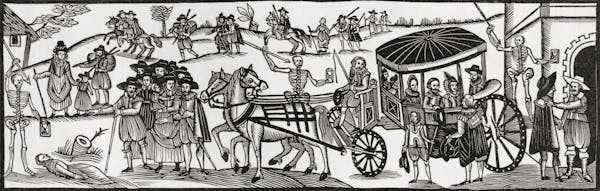
The Black Death created massive labor shortages

Macalester Professor Andrew Latham writes How 3 prior pandemics triggered massive societal shifts at The Converstation.

Before March of this year, few probably thought disease could be a significant driver of human history.

Not so anymore. People are beginning to understand that the little changes COVID-19 has already ushered in or accelerated – telemedicine, remote work, social distancing, the death of the handshake, online shopping, the virtual disappearance of cash and so on – have begun to change their way of life. They may not be sure whether these changes will outlive the pandemic. And they may be uncertain whether these changes are for good or ill.

Three previous plagues could yield some clues about the way COVID-19 might bend the arc of history. As I teach in my course “Plagues, Pandemics and Politics,” pandemics tend to shape human affairs in three ways.

First, they can profoundly alter a society’s fundamental worldview. Second, they can upend core economic structures. And, finally, they can sway power struggles among nations.
Sickness spurs the rise of the Christian West

The Antonine plague, and its twin, the Cyprian plague – both now widely thought to have been caused by a smallpox strain – ravaged the Roman Empire from A.D. 165 to 262. It’s been estimated that the combined pandemics’ mortality rate was anywhere from one-quarter to one-third of the empire’s population.

While staggering, the number of deaths tells only part of the story. This also triggered a profound transformation in the religious culture of the Roman Empire.

On the eve of the Antonine plague, the empire was pagan. The vast majority of the population worshipped multiple gods and spirits and believed that rivers, trees, fields and buildings each had their own spirit.

Christianity, a monotheistic religion that had little in common with paganism, had only 40,000 adherents, no more than 0.07% of the empire’s population.

Yet within a generation of the end of the Cyprian plague, Christianity had become the dominant religion in the empire.

How did these twin pandemics effect this profound religious transformation?

Rodney Stark, in his seminal work “The Rise of Christianity,” argues that these two pandemics made Christianity a much more attractive belief system.

While the disease was effectively incurable, rudimentary palliative care – the provision of food and water, for example – could spur recovery of those too weak to care for themselves. Motivated by Christian charity and an ethic of care for the sick – and enabled by the thick social and charitable networks around which the early church was organized – the empire’s Christian communities were willing and able to provide this sort of care.

Pagan Romans, on the other hand, opted instead either to flee outbreaks of the plague or to self-isolate in the hope of being spared infection.

This had two effects.

First, Christians survived the ravages of these plagues at higher rates than their pagan neighbors and developed higher levels of immunity more quickly. Seeing that many more of their Christian compatriots were surviving the plague – and attributing this either to divine favor or the benefits of the care being provided by Christians – many pagans were drawn to the Christian community and the belief system that underpinned it. At the same time, tending to sick pagans afforded Christians unprecedented opportunities to evangelize.

Second, Stark argues that, because these two plagues disproportionately affected young and pregnant women, the lower mortality rate among Christians translated into a higher birth rate.

The net effect of all this was that, in roughly the span of a century, an essentially pagan empire found itself well on its way to becoming a majority Christian one.
The plague of Justinian and the fall of Rome

The plague of Justinian, named after the Roman emperor who reigned from A.S. 527 to 565, arrived in the Roman Empire in A.D. 542 and didn’t disappear until A.D. 755. During its two centuries of recurrence, it killed an estimated 25% to 50% of the population – anywhere from 25 million to 100 million people.

This massive loss of lives crippled the economy, triggering a financial crisis that exhausted the state’s coffers and hobbled the empire’s once mighty military.

In the east, Rome’s principal geopolitical rival, Sassanid Persia, was also devastated by the plague and was therefore in no position to exploit the Roman Empire’s weakness. But the forces of the Islamic Rashidun Caliphate in Arabia – which had long been contained by the Romans and Sasanians – were largely unaffected by the plague. The reasons for this are not well understood, but they probably have to do with the caliphate’s relative isolation from major urban centers.

Caliph Abu Bakr didn’t let the opportunity go to waste. Seizing the moment, his forces swiftly conquered the entire Sasanian Empire while stripping the weakened Roman Empire of its territories in the Levant, the Caucasus, Egypt and North Africa.
Troops clash in a 14th-century illustration of the Battle of Yarmouk.
Muslim forces of the Rashidun Caliphate captured the Levant – a region of the Middle East – from the Byzantine Empire in A.D. 636. Wikimedia Commons

Pre-pandemic, the Mediterranean world had been relatively unified by commerce, politics, religion and culture. What emerged was a fractured trio of civilizations jockeying for power and influence: an Islamic one in the eastern and southern Mediterranean basin; a Greek one in the northeastern Mediterranean; and a European one between the western Mediterranean and the North Sea.

This last civilization – what we now call medieval Europe – was defined by a new, distinctive economic system.

Before the plague, the European economy had been based on slavery. After the plague, the significantly diminished supply of slaves forced landowners to begin granting plots to nominally “free” laborers – serfs who worked the lord’s fields and, in return, received military protection and certain legal rights from the lord.

The seeds of feudalism were planted.
The Black Death of the Middle Ages

The Black Death broke out in Europe in 1347 and subsequently killed between one-third and one-half of the total European population of 80 million people. But it killed more than people. By the time the pandemic had burned out by the early 1350s, a distinctly modern world emerged – one defined by free labor, technological innovation and a growing middle class.

Before the Yersinia pestis bacterium arrived in 1347, Western Europe was a feudal society that was overpopulated. Labor was cheap, serfs had little bargaining power, social mobility was stymied and there was little incentive to increase productivity.

But the loss of so much life shook up an ossified society.

Labor shortages gave peasants more bargaining power. In the agrarian economy, they also encouraged the widespread adoption of new and existing technologies – the iron plow, the three-field crop rotation system and fertilization with manure, all of which significantly increased productivity. Beyond the countryside, it resulted in the invention of time and labor-saving devices such as the printing press, water pumps for draining mines and gunpowder weapons.
Townspeople flee the city for the countryside to escape the bubonic plague.
The Black Death created massive labor shortages. Universal History Archive/Universal Images Group via Getty Images

In turn, freedom from feudal obligations and a desire to move up the social ladder encouraged many peasants to move to towns and engage in crafts and trades. The more successful ones became wealthier and constituted a new middle class. They could now afford more of the luxury goods that could be obtained only from beyond Europe’s frontiers, and this stimulated both long-distance trade and the more efficient three-masted ships needed to engage in that trade.

The new middle class’s increasing wealth also stimulated patronage of the arts, science, literature and philosophy. The result was an explosion of cultural and intellectual creativity – what we now call the Renaissance.
Our present future

None of this is to argue that the still-ongoing COVID-19 pandemic will have similarly earth-shattering outcomes. The mortality rate of COVID-19 is nothing like that of the plagues discussed above, and therefore the consequences may not be as seismic.

But there are some indications that they could be.

Will the bumbling efforts of the open societies of the West to come to grips with the virus shattering already-wavering faith in liberal democracy, creating a space for other ideologies to evolve and metastasize?

In a similar fashion, COVID-19 may be accelerating an already ongoing geopolitical shift in the balance of power between the U.S. and China. During the pandemic, China has taken the global lead in providing medical assistance to other countries as part of its “Health Silk Road” initiative. Some argue that the combination of America’s failure to lead and China’s relative success at picking up the slack may well be turbocharging China’s rise to a position of global leadership.

Finally, COVID-19 seems to be accelerating the unraveling of long-established patterns and practices of work, with repercussions that could affet the future of office towers, big cities and mass transit, to name just a few. The implications of this and related economic developments may prove as profoundly transformative as those triggered by the Black Death in 1347.

Ultimately, the longer-term consequences of this pandemic – like all previous pandemics – are simply unknowable to those who must endure them. But just as past plagues made the world we currently inhabit, so too will this plague likely remake the one populated by our grandchildren and great-grandchildren.

Organic Prepper: A Personal Letter to Stressed Out Preppers

Daisy Luther at The Organic Prepper writes A Personal Letter to Stressed Out Preppers Who Are TIRED of This Apocalypse

Dear Friends:

2020 has certainly been quite a year so far, and a defining one for the preparedness movement. No longer are our stockpiles of rice, beans, and hand sanitizer objects that make us strange. Our stashes of TP would make us the envy of the neighborhood if, of course, anybody knew we had it.

So many of the things and beliefs that made us figures of mockery in the past are now proving their value. We’re learning, with a mixture of relief and perhaps dismay, that we weren’t so crazy after all.

When the first lockdown began, we weren’t out there emptying the shelves in the frenzied throng (even though we’re the ones who got blamed for it.) We were watchful but for the most part, comfortable with our preparations. We understood before things went sideways that extended events can result in civil unrest, crime sprees, and chaos. We realized that we could be facing shortages.

And then time went on.

And on.

And on.

This has been a year in which so many things have occurred that proved preppers have things right that it’s positively exhausting. We’ve had a pandemic, civil unrest, food shortages, increases in crime, exorbitant unemployment, and we’re facing an economic collapse, or at the very least, an economic crisis.

And we’re tired.

Maybe everyone doesn’t feel this way. Maybe you’re perfectly fine and you live on your back 40 and have been completely untouched by any of the above-mentioned crises. Maybe your finances are just fine, you never got out much anyway, and you’ve still got 8 years’ worth of food socked away to supplement the things you grow. Maybe you’re reading this as you spin goat hair into yarn from which you’ll make this year’s mittens. Maybe you have no relatives, friends, or loved ones in the path of danger. Maybe your area isn’t prone to a single natural disaster.

If this is the case, I salute you. I really do. Good for you.

But for most of us, this is not the case. A lot of us are tired.

And I mean tired.

I’m sure there will be plenty of folks in the comments who say, “Daisy Luther is such a whiner” but whatever. I’m just going to come right out and tell you how I feel about this.

This year has been difficult.

My life changed completely. The lives of people I love changed completely. I lost some people I cared for deeply to the virus. I watched people in my family frolic around blithely ignoring the virus for which they’re in a peak risk group for death. I watched my country get torn asunder by everything from the pandemic response to racial injustice to perceived insults or losses of rights. I have a family member who lives in a riot zone but due to work and finances, can’t just relocate. (Although those folks on the internet always make it sound so damned easy to just quit your job then up and move to the boondocks to raise sheep.)

I have friends who have developed such extreme political views on either side that I don’t even know what to say to them anymore. I still love them. I still know they’re good people or we wouldn’t have been friends in the first place. But what the heck, y’all?

Then we’ve got hurricanes and the worst wildfires ever in history and floods and droughts and snow in September and murder hornets and the Olympics got canceled and there was some radiation leak in Russia and police brutality, which you will say is alleged or real, depending on your personal perspective. Oh yeah, and the US Postal Service has gone to heck, a lot of kids can’t go back to school so they’re surfing the net while they’re supposed to be “distance learning” online, and Netflix is playing a child porn movie to prove that kids are getting sexually exploited. Our system is going downhill on a greasy slide.

Our presidential candidates are (in my humble opinion) like a choice between your favorite sexually transmitted infection, syphillis or gonhorrhea. And regardless of whether syphilis or gonorrhea wins, all hell’s going to break loose (or break looser because it’s already pretty freakin’ bad in a lot of places) before and after the election that may not even happen the regular way because of the pandemic.

And we preppers who were ready for an emergency are sitting here scratching our heads thinking, “Heck fire, I wasn’t actually prepared for ALL OF THE EMERGENCIES AT ONCE.”

And it’s going on and on and on.

And that’s the other thing.

This stuff is going on and on and on forever. Ad infinitum. We are still in the middle of a global viral outbreak that we don’t completely understand and lots of places are still under major restrictions. A lot of folks don’t have their jobs back and a lot never will. We have been dealing with this particular disaster since at least February and the mental toll of dealing with the restrictions, the loss of income, the isolation, and the loss of freedom has been harsh for many people. There are folks who are just plain mad that they didn’t get the apocalypse they signed up for and they haven’t gotten to shoot any marauders and quite frankly, lockdown is boring as heck.

Lots of us have family members and people in our inner circles who are chomping at the bit to get back to “normal” when things simply are not normal. We’ve got loved ones who want to head out to parties and who want to throw caution to the wind and who flat don’t give a hoot what they bring home to Grandma. We’ve got loved ones who are using this entire scenario to say how we’ve overreacted. We’ve got loved ones who still get aggravated when we bring home more toilet paper.

When we were prepping for all this stuff most of us never expected that our families who were also prepping for this stuff might not be on board with this specific scenario. We never thought we’d have to argue with children and spouses and friends and lovers about things like quarantines and masks and not eating all five years’ worth of the good snacks like Oreos in the first 6 months. We didn’t consider that we might not be able to replace our Bluetooth headsets or that we’d need them for work or that we’d have to have our offices in our homes or that our kids’ teachers might see their BB guns in their bedrooms and send the SWAT teams after us.

We can’t go to church but we can go to riots. We aren’t supposed to travel yet mysterious busloads full of “protesters” show up in other states and that’s just hunky-dory. The borders are closed except they’re not really and the restaurants can’t serve you except they can sort of and we can’t go to the beach but we can line up for a vaccine once the promised injection, untested for long-term side effects, is ready.

This is the worst apocalypse ever because it’s so dad-gum boring and it’s going on for-freaking-ever. That’s the thing that nobody warned us about. This monotony just goes on and on and on. It would be one thing if we were out there fighting for resources but in reality, we’re all just standin’ in line at Wal-Mart with our masks on waiting for our turn to get zapped with a thermometer to see if we are allowed to go inside. If it weren’t for wifi we’d all be crazy by now. Or – let’s be real for a moment – maybe it’s because of wifi so many people are crazy right now. Social media is a jungle – an outright vicious and bloody jungle – and may the most audacious mofo win because those of us who still retain our human decency are not going to be able to hang with the people out there flinging wild ungrounded insults like poop in the monkey cages at the zoo.

And folks – I hate to say it but we’re still on Round One.

We’re going to be dealing with this bizarre altered reality for quite some time. This virus ain’t over yet or if you don’t believe in the virus, then consider that this government response isn’t over yet. We’re never “getting back to normal” and we’re going to have to adapt. We’re going to have to hope our children who are going to school in personal bubbles aren’t going to have OCD and chronic anxiety for the rest of their lives. We’re going to have to learn to make do without all the imports that no longer seem to be populating stores.

We never really expected that a huge part of survival would just be waiting and adapting to the new world around us. Not this new world anyway. This isn’t one we can shoot our way out of or buy our way out of or wait our way out of.  We have to adapt to the new economy, the new precautions, and the new suspicions. We have to adapt to a different type of supply chain.  We have to move into survival mode as we watch civil unrest and riots break out in the most unlikely places, although it’s not really the survival mode we ever expected. We have to adjust to the nearly constant state of offense and unrest. We’re going to have to teach our children to be bold and fearless despite a system that wants them to be afraid. We’re going to have to forge a path through a labyrinth that is nothing like the one we expected when we began prepping for serious events because this event was so wildly unpredictable that nobody could have seen it happening the way it did.

But this is what we do.

We’re preppers. Preparing for the unexpected is our thing. Even when the unexpected is long-lasting, monotonous, boring, and stifling. Even when our family thinks we’re overreacting. Even when everything changes and things don’t get back to “normal.” Even when we’re just sitting there right on the edge of chaos wondering if today is the day that things will erupt in our neck of the woods.

Every.

Single.

Day.

For.

Months.

The way this unfolded isn’t the disaster any of us expected but it’s the hand we’ve been dealt. How well we’re able to handle it will tell us a lot about how mentally prepared we actually are. How we manage our friends, families, and expectations will help us determine how things might go in a future, more Mad-Max variety of apocalypse.

Take this as the learning experience that it is. And don’t be lulled by the boredom into a false sense of security.

Because this is not over. Not by a long shot.

Hang in there, my friends. Whether we have to pull our loved ones along by their collars, whether we have to buy our supplies and stash them away on the sly, whether we have to prepare all on our own, we have to deal with the apocalypse we’ve been given, emotionally and physically.

It’s going to be a long haul, but we’ve got this. I don’t know if you’re feeling the same way that I am, but just in case you are, I wanted you to know – you’re not alone.

Daisy

Stars and Stripes: Hunger Is Threatening to Kill More People than COVID this Year

Volunteers distribute food packets people in need after a week-long restrictions were imposed by district officials to contain the spread of the Covid-19 coronavirus, in Kathmandu on August 31, 2020. PRAKASH MATHEMA/AFP VIA GETTY IMAGES/TNS

Via Stars and Stripes, Hunger is threatening to kill more people than COVID this year details global hunger concerns because of supply chain problems and lockdowns.

The world is hurtling toward an unprecedented hunger crisis.

As many as 132 million more people than previously projected could go hungry in 2020, and this year’s gain may be more than triple any increase this century. The pandemic is upending food supply chains, crippling economies and eroding consumer purchasing power. Some projections show that by the end of the year, COVID-19 will cause more people to die each day from hunger than from virus infections.

What makes the situation unmatched: The massive spike is happening at a time of enormous global food surpluses. And it’s happening in every part of the world, with new levels of food insecurity forecast for countries that used to have relative stability.

In Queens, New York, the lines snaking around a food bank are eight hours long as people wait for a box of supplies that might last them a week, while farmers in California are plowing over lettuce and fruit is rotting on trees in Washington. In Uganda, bananas and tomatoes are piling up in open-air markets, and even nearly give-away prices aren’t low enough for out-of-work buyers. Supplies of rice and meat were left floating at ports earlier this year after logistical jams in the Philippines, China and Nigeria. And in South America, Venezuela is teetering on the brink of famine.

“We’ll see the scars of this crisis for generations,” said Mariana Chilton, director of the Center for Hunger-Free Communities at Drexel University. “In 2120, we’ll still be talking about this crisis.”

COVID-19 has exposed some of the world’s deepest inequalities. It’s also a determining force in who gets to eat and who doesn’t, underscoring global social divides as the richest keep enjoying a breakneck pace of wealth accumulation. Millions of people have been thrown out of work and don’t have enough money to feed their families, despite the trillions in government stimulus that’s helped send global equities to all-time highs.

On top of the economic malaise, lockdowns and broken supply chains have also created a serious problem for food distribution. The sudden shift away from restaurant eating, which in places like the U.S. used to account for more than half of dining, means farmers have been dumping milk and smashing eggs, with no easy means to redirect their production to either grocery stores or those in need.

Don Cameron of Terranova Ranch in California took a hit of about $55,000 this year on his cabbage crop. Almost half the loss – $24,000 – came because Cameron decided to donate to local food banks after demand from his usual customers dried up. He had to pay for the labor needed to do the harvesting and truck loading. He even needed to cover the cost of some bins and pallets to get supplies moved. It would’ve been a lot cheaper to just let the crops rot in the field.

“We know other parts of the country need what we have here. But the infrastructure has not been set up, as far as I’m aware, to allow that. There are times when there is food available and it’s because of logistics that it doesn’t find a home,” said Cameron, who still ended up destroying about 50,000 tons of the crop since nearby food banks “can only take so much cabbage.”

Initial United Nations forecasts show that in a worst-case scenario, about a tenth of the world’s population won’t have enough to eat this year. The impact will go beyond just hunger as millions more are also likely to experience other forms of food insecurity, including not being able to afford healthy diets, which can lead to malnutrition and obesity.

The effects will be long lasting. Even in its best-case projections, the UN predicts that hunger will be greater over the next decade than forecast before the pandemic. By 2030, the number of undernourished people could reach as high as 909 million, compared with a pre-COVID scenario of about 841 million.

The current crisis is one of the “rarest of times” with both physical and economic limitations to access food, said Arif Husain, chief economist with the UN’s World Food Programme.

By the end of the year, as many as 12,000 people could die a day from hunger linked to COVID-19, potentially more than those perishing from the virus itself, charity Oxfam International estimates. That’s calculated based on a more than 80% jump for those facing crisis-level hunger.

Projections for increased malnutrition also have a profound human toll. It can weaken the immune system, limit mobility and even impair brain functioning. Children who experience malnutrition early in life can see its impact well into adulthood.

“Even the mildest forms of food insecurity have lifelong consequences,” said Chilton of the Center for Hunger-Free Communities. Problems with physical and cognitive development in children and adolescents can hamper the chances of staying in school or getting a job, continuing a cycle of poverty.

Government programs, food charities and aid organizations have mobilized across the globe, but the need far outstrips their reach. The UN’s WFP aid group alone needs a record $13 billion for the year to deliver food in 83 countries, and at the start of the second half faced a shortfall of $4.9 billion to meet the goal.

Hunger can spark seismic shifts in the political landscape. Going back to the days of the French Revolution, food insecurity has sent people into the streets demanding better conditions. Surging food prices were part of the economic crisis that helped fuel recent protests in Lebanon and demonstrations over shortages erupted in Chile earlier this year.

Deep-seated inequalities along gender and racial lines also correspond to disproportionate impacts from hunger. In the U.S., for example, Black Americans are two-and-a half times as likely as their White counterparts to have low or very low access to enough food for an active and healthy life. Globally, women are 10% more likely to be food insecure than men.

“We have to make sure that we’re addressing gender inequality – if the international community is not doing that, we will fail to avoid the worst of the hunger crisis,” said Tonya Rawe, a director at hunger relief and advocacy group Care.

Data from the UN show that throughout the world, there are more than enough calories available to meet every individual’s needs. But even in the U.S., the richest country in the world, almost 2% of the population, or more than 5 million people, can’t afford a healthy diet (one that protects against all forms of malnutrition). More than 3 million Americans can’t afford to even meet basic energy needs. In India, 78% of people can’t afford healthy diets – that’s more than 1 billion people. Those figures don’t even take into account the pandemic and its lasting effects.

Costs and logistics prevent food surpluses from being easily shifted to areas without. That’s the dilemma faced by potato farmers in Belgium. When freezers filled during the pandemic, most of their spuds weren’t fit for food banks or grocers. The main variety that’s grown to meet demand from places like the country’s famous fry shops get black and blue spots after just a few days, said Romain Cools of industry group Belgapom. Sales to supermarkets quickly stopped after complaints, and a bulk of the region’s 750,000-ton surplus was instead used for animal feed or biogas.

“It’s hard to take surplus milk in Wisconsin and get it to people in Malawi – it’s just not realistic or practical,” said William Moseley, a geography professor at Macalester College who serves on a global food-security panel.

Despite the abundant supplies, food is growing more expensive because of bungled supply chains and currency devaluations. Costs are up in parts of Africa and the Middle East and they’re also rising in developed countries, with Europeans and Americans paying extra to stock their fridges.

Even within major food-producing countries, being able to afford groceries is never a given.

Latin America, an agriculturally rich region that exports food to the world, is leading this year’s surge in hunger, according to the UN’s WFP.

In Brazil, a huge cash-distribution program has helped millions and driven poverty rates to historic lows. But that hasn’t met all the need. In the country’s northeast, Eder Saulo de Melo worked as a guard at parties until the virus arrived. With events suspended, he hasn’t been paid in months. He’s been locked out of the emergency cash program and the 130 reais ($25) he gets in regular monthly aid goes to energy, water and gas bills, leaving little to feed his three children. Baskets of non-perishables, vegetables, bread and eggs from a non-governmental organization are the family’s main sustenance.

“I needed to stop buying fruit and meat,” he said. “Instead of a slice of chicken, I buy offal to make a soup.”

The hunger estimates for this year have a “high degree of uncertainty,” and the disease’s devastation is largely unknown, the UN cautioned about its figures.

The UN’s Food and Agriculture Organization began tracking global hunger in the mid-1970s. Current data can’t be compared past 2000 given revisions in methodology, said Carlo Cafiero, team leader for food security statistics. But general trends can be observed, and they show that hunger moved lower over the past several decades until a recent reversal started in 2015, spurred by by climate change and conflicts.

The increases in the last few years are nothing like what is forecast now – even the best-case of the UN’s tentative scenarios would see hunger surge in 2020 more than the past five years combined. And when looking at other notable periods of need in the world, such as the Great Depression, the level of food surplus that exists today is without comparison thanks to the advent of modern agriculture, which has seen crop yields explode.

“It’s impossible to look at the situation and not think we have a problem,” said Nate Mook, chief executive officer of food-relief group World Central Kitchen. “This pandemic has really exposed the cracks in the system and where it starts to break down.”

Of Two Minds: Pandemic Accelerating Trends That Disrupt Foundations of Economy

From Charles Hugh Smith at the Of Two Minds blog, The Pandemic Is Accelerating Trends That Are Disrupting the Foundations of the Economy

The problem is the economy that’s left has no means of creating tens of millions of jobs to replace those lost as the 1959 economic model collapses.

Fundamentally, the economy of 2019 was not very different from the economy of 1959: people went shopping at retail stores, were educated at sprawling college campuses, went to work downtown, drove to the doctor’s office or hospital, caught a flight at the airport, and so on.

The daily routine of the vast majority of the workforce was no different from 1959. In 2019, the commutes were longer, white-collar workers stared at screens rather than typewriters, factory workers tended robots and so on, but the fundamentals of everyday life and the nature of work were pretty much the same.

Beneath the surface, the fundamental change in the economy was financialization, the commodification of everything into a financial asset or income stream that could then be leveraged, bundled and sold globally at an immense profit by Wall Street financiers.

This layer of speculative asset-income mining had no relation to the actual work being done; it existed in its own derealized realm.

For decades, these two realmsthe structure of everyday life (to borrow Braudel’s apt term) and the abstract, derealized but oh so profitable realm of financialization–co-existed in an uneasy state of loosely bound systems.

If you squinted hard enough and repeated the mantras often enough, you could persuade yourself there was still some connection between the everyday-life economy and the realm of financialization.

The two realms have now disconnected, and the real-world economy has been ripped from its moorings, as patterns of work and every-day life that stretch back 70 years to the emergence of the postwar era unravel and dissolve.

The trends that are currently fatally disrupting retail, education, office work and healthcare have been in place for years. When I wrote my 2013 book about the digitized future of higher education in a low-cost union of high-touch and low-touch learning, The Nearly Free University, all these trends were already clearly visible to those willing to look beyond the models embedded in the economy for decades or even centuries.

Visionaries like Peter Drucker foresaw the complete disruption of the education and healthcare sectors as far back as 1994. Post-Capitalist Society.

The problem with this disruption is it eliminates tens of millions of jobs–not just the low-paying jobs in retail and dining-out, but high-paying jobs in university administration, healthcare, and other core service sectors.

The last real-world connection between everyday life and financialization was the over-supply of everything that could be financialized: the way to reap the big profits was expand whatever could be leveraged and sold. So retail and commercial space ballooned, colleges proliferated, cafes sprang up on every corner, etc.

Meanwhile, financialization’s unquenchable thirst for higher profits stripped everything of the redundancy and buffers required to stabilize the system in times of crisis. So hospitals no longer kept inventory because by the logic of financialization, all that mattered was maximizing the return on capital–nothing else could possibly matter in the derealized realm of speculative profiteering.

Now healthcare finds itself trapped between the pincers of financialization’s stripmining and the collapse of retail in-person demand–the financial foundation of the entire system. Under the relentless pressure of financialization’s stripmining and profteering, healthcare only survives if it can bill somebody somewhere a staggering amount for everything from office visits to procedures to hospital stays to medications.

Once that avalanche of billing dries up, the entire sector implodes: a sector that accounts for almost 20% of the U.S. economy.

Higher education is also imploding, and for the same reason: its output no longer justified its enormous cost structure. The same can be said of overbuilt retail and commercial space: the financial justification for sky-high rents have imploded and will never come back. The over-supply is so monumental and the collapse of demand so permanent, the gigantic pyramid of debt and speculative excess piled on all these excesses is collapsing.

A bailout by the Federal Reserve won’t change the fundamentals of the collapse of financialization; all the Fed can do is reserve scarce lifeboat seats for its billionaire banker-financier pals. (Warren, you know Bill, have you met Jamie, Jeff, Tim and the rest of the Zillionaire Rat-Pack?)

Despite the record highs in the stock market–the ultimate expression of financialization disconnected from the real-world economy–financialization is also imploding. Financialization still claimed a connection to the real world of income streams and the value of the collateral underlying all the speculative profiteering: the high rents paid by the restaurants on the ground floor and the businesses for office space above justified the high value of the collateral, the commercial building.

Foundational swaths of the real-world economy have been swept away, and so the collateral is largely worthless. Lots of people want their employer to start paying for business-class airline seats again so they can jet around the country on somebody else’s dime, staying in pricey hotels and attending conferences, but these activities no longer have any financial justification.

The economy of 1959 is finally expiring. The enormous time and money sinks of transporting humans hither and yon no longer have any financial justification.

The problem is the economy that’s left has no means of creating tens of millions of jobs to replace those lost as the 1959 economic model collapses. We all know that automation is replacing human labor, but the real change is the collapse of the financial justification for the enormously costly systems we now depend on to generate jobs: healthcare, retail, tourism, dining out, education, working downtown, and all the professions dependent on managing all this complexity.

While the elimination of low-skill jobs–a longstanding trend–is attracting attention, the implosion of the 1959 economic model and financialization will soon sweep away millions of high-paying professional jobs that no longer have any financial justification.

As the 1959 economy implodes, so does the tax system based on payroll taxes and property taxes. This article sketches out the perverse incentives for employers to invest in automation rather than hire workers: Covid-19 Is Dividing the American Worker (WSJ.com)

There are alternatives, but they require accepting the implosion of both the 1959 economic model and its evil offspring, financialization.

I sketched out an alternative way of organizing work, everyday life and finance in my book A Radically Beneficial World. There are alternative ways of organizing civilization other than the insanely wasteful and exploitive system we now inhabit.


Coronavirus Updates

Update 8/26/2020: Confirmed cases 24,111,616 with 824,702 fatalities. The US has 5,961,971 cases with 182,635 fatalities. Washington state has 71,705 cases and 1,876 deaths, Benton Franklin Health District has 7,871 cases with 177 fatalities; the largest number of cases by age range is the  20-29 age range with nearly one thousand cases. Yakima Health District has 11,490 cases with 224 fatalities. Relief workers for flooding in South Asia say that coronavirus restrictions are hampering relief efforts. Brazil has reported over 3.6 million cases and 112,000 fatalities. India reports over 3.2 million cases and nearly 60,000 fatalities.

Update 8/7/2020: Confirmed cases 19,319,011 with 718,765 fatalities. The US has 5,036,881 cases with 162,873 fatalities. US daily fatalities may have begun to decline again. The Univ. of Washington forecasts 300,000 US fatalities by December 1st. Washington state has 62,709 cases with 1,657 deaths. Benton Franklin Health District has 7,044 cases with 145 fatalities. The Prosser School District expressed concerns at their board meeting this week about low fall enrollment as parents choose other schooling options and over budget deficits. Yakima Health District has 10,742 cases with 203 fatalities. Brazil is nearing three million cases with over 98,000 fatalities. India has passed two million cases with 41,912 fatalities. South Korean study finds that asymptomatic Covid cases can carry as much of the virus as those with symptoms; transmission role undetermined. Iran reported case and fatality numbers found to be falsely reported; Iran government records show 451,024 cases with nearly 42,000 fatalities as opposed the health ministry’s publicly reported 278,827 cases with 14,405 fatalities. Cases are surging in Spain, leading to a lockdown in the northwestern parts of Castile and Leon.

Update 7/29/2020: Confirmed cases 17,300,759 with 672,366 fatalities. The US has 4,590,809 cases with 154,364 fatalities. Florida added 9,956 new cases and a record 252 deaths yesterday. Arizona also set a record for daily deaths. Daily new cases in the US may be tapering off as re-openings were rolled back, but daily deaths are still increasing as expected from the lag between new cases being identified and the deaths therefrom. Former Chair of the Federal Reserve Bank of Kansas City and former Presidential candidate Herman Cain passed away from COVID complications today. Italy recorded its largest new daily cases since early June. Hong Kong also set a new record for daily cases. Melbourne, Australia set a new daily record almost 40% higher than its previous record. Germany’s new cases are at a six week high. Poland also recorded a new daily record. In Harare Central Hospital in Zimbabwe, seven babies were stillborn on one day earlier this week attributed to staffing shortages due to COVID; one doctor said, “These are not isolated incidents. This is repeated every day and all we can do is watch them die.”

Update 7/18/2020: Confirmed cases 14,242,950 with 600,487 fatalities. The US has 3,773,089 cases with 142,105 fatalities. New cases in the US have been steadily increasing over the past month, recording numbers over 72,000 for the past three days — more than double the daily highs during the April/May wave. While fatalities remain lower, they have started increasing over the past few days as well. Washington state has 46,506 cases with 1,442 fatalities. Benton Franklin health district has 5,372 cases with 129 fatalities; 15 of the deaths have been recorded in just the past week. Yakima Health District has 9,275 cases with 179 fatalities. Continue reading “Coronavirus Updates”

Rutherford Institute: The Building Blocks of Tyranny from A to Z

Consitutional law attorney and author John Whitehead of the Rutherford Institute writes about much that is wrong in the USA in P Is for Predator State: The Building Blocks of Tyranny from A to Z

“When a population becomes distracted by trivia, when cultural life is redefined as a perpetual round of entertainments, when serious public conversation becomes a form of baby-talk, when, in short, a people become an audience and their public business a vaudeville act, then a nation finds itself at risk; a culture-death is a clear possibility.” — Professor Neil Postman, Amusing Ourselves to Death: Discourse in the Age of Show Business

While America continues to fixate on the drama-filled reality show scripted by the powers-that-be, directed from the nation’s capital, and played out in high definition across the country, the American Police State has moved steadily forward.

Nothing has changed.

The COVID-19 pandemic has been a convenient, traumatic, devastating distraction.

The American people, the permanent underclass in America, have allowed themselves to be so distracted and divided that they have failed to notice the building blocks of tyranny being laid down right under their noses by the architects of the Deep State.

Trump, Obama, Bush, Clinton: they have all been complicit in carrying out the Deep State’s agenda. Unless something changes to restore the balance of power, the next president—the new boss—will be the same as the old boss.

Frankly, it really doesn’t matter what you call the old/new boss—the Deep State, the Controllers, the masterminds, the shadow government, the corporate elite, the police state, the surveillance state, the military industrial complex—so long as you understand that no matter who occupies the White House, it is a profit-driven, an unelected bureaucracy that is actually calling the shots.

If our losses are mounting with every passing day—and they are—it is a calculated siege intended to ensure our defeat at the hands of a totalitarian regime.

Free speech, the right to protest, the right to challenge government wrongdoing, due process, a presumption of innocence, the right to self-defense, accountability and transparency in government, privacy, media, sovereignty, assembly, bodily integrity, representative government: all of these and more are casualties in the government’s war on the American people.

Set against a backdrop of government surveillance, militarized federal police, SWAT team raids, asset forfeiture, overcriminalization, armed surveillance drones, whole body scanners, stop and frisk searches, and the like—all of which have been sanctioned by Congress, the White House and the courts—our constitutional freedoms are being steadily chipped away at, undermined, eroded, whittled down, and generally discarded.

As a result, the American people have been treated like enemy combatants, to be spied on, tracked, scanned, frisked, searched, subjected to all manner of intrusions, intimidated, invaded, raided, manhandled, censored, silenced, shot at, locked up, and denied due process.

None of these dangers have dissipated in any way.

They have merely disappeared from our televised news streams.

It’s time to get educated on what’s really going on. Thus, in the interest of liberty and truth, here’s an A-to-Z primer that spells out the grim realities of life in the American Police State that no one seems to be talking about anymore.

A is for the AMERICAN POLICE STATE. A police state “is characterized by bureaucracy, secrecy, perpetual wars, a nation of suspects, militarization, surveillance, widespread police presence, and a citizenry with little recourse against police actions.”

B is for our battered BILL OF RIGHTS. In the militarized police culture that is America today, where you can be kicked, punched, tasered, shot, intimidated, harassed, stripped, searched, brutalized, terrorized, wrongfully arrested, and even killed by a police officer, and that officer is rarely held accountable for violating your rights, the Bill of Rights doesn’t amount to much.

C is for CIVIL ASSET FORFEITURE. This governmental scheme to deprive Americans of their liberties—namely, the right to property—is being carried out under the guise of civil asset forfeiture, a government practice wherein government agents (usually the police and now TSA agents) seize private property they “suspect” may be connected to criminal activity. Then, whether or not any crime is actually proven to have taken place, the government keeps the citizen’s property and it’s virtually impossible to get it back.

D is for DRONES. It was estimated that at least 30,000 drones would be airborne in American airspace by 2020, part of an $80 billion industry. Although some drones will be used for benevolent purposes, many will also be equipped with lasers, tasers and scanning devices, among other weapons—all aimed at “we the people.”

E is for EMERGENCY STATE. From 9/11 to COVID-19, we have been the subjected to an “emergency state” that justifies all manner of government tyranny and power grabs in the so-called name of national security. The government’s ongoing attempts to declare so-called national emergencies in order to circumvent the Constitution’s system of checks and balances constitutes yet another expansion of presidential power that exposes the nation to further constitutional peril.

F is for FASCISM. A study conducted by Princeton and Northwestern University concluded that the U.S. government does not represent the majority of American citizens. Instead, the study found that the government is ruled by the rich and powerful, or the so-called “economic elite.” Moreover, the researchers concluded that policies enacted by this governmental elite nearly always favor special interests and lobbying groups. In other words, we are being ruled by an oligarchy disguised as a democracy, and arguably on our way towards fascism—a form of government where private corporate interests rule, money calls the shots, and the people are seen as mere economic units or databits.

G is for GRENADE LAUNCHERS and GLOBAL POLICE. The federal government has distributed more than $18 billion worth of battlefield-appropriate military weapons, vehicles and equipment such as drones, tanks, and grenade launchers to domestic police departments across the country. As a result, most small-town police forces now have enough firepower to render any citizen resistance futile. Now take those small-town police forces, train them to look and act like the military, and then enlist them to be part of the United Nations’ Strong Cities Network program, and you not only have a standing army that operates beyond the reach of the Constitution but one that is part of a global police force.

H is for HOLLOW-POINT BULLETS. The government’s efforts to militarize and weaponize its agencies and employees is reaching epic proportions, with federal agencies as varied as the Department of Homeland Security and the Social Security Administration stockpiling millions of lethal hollow-point bullets, which violate international law. Ironically, while the government continues to push for stricter gun laws for the general populace, the U.S. military’s arsenal of weapons makes the average American’s handgun look like a Tinker Toy.

I is for the INTERNET OF THINGS, in which internet-connected “things” monitor your home, your health and your habits in order to keep your pantry stocked, your utilities regulated and your life under control and relatively worry-free. The key word here, however, is control. This “connected” industry propels us closer to a future where police agencies apprehend virtually anyone if the government “thinks” they may commit a crime, driverless cars populate the highways, and a person’s biometrics are constantly scanned and used to track their movements, target them for advertising, and keep them under perpetual surveillance…(continues)

Click here to continue reading at the Rutherford Institute.

The Survival Mom: TEOTWAWKI has finally arrived

The Survival Mom talks about some societal and cultural changes resulting from the pandemic in TEOTWAWKI has finally arrived.

This past spring while America was busy shopping for toilet paper and hand sanitizer, and panicking at their shortages, TEOTWAWKI happened.

The End Of The World As We Know It arrived. It slipped right past us while we were all distracted, but make no mistake. We are unlikely as a country and a world to ever go back to “normal”. We aren’t going to turn a corner at some point and magically, it will be as though the pandemic never happened.

Who knew, back in January and February of 2020, that the coronavirus pandemic would be the TEOTWAWKI event that changed our world?

There has been an upheaval in virtually every aspect of our lives. New divisions now exist between people that didn’t exist in the “before time”. Authorities, both elected and unelected, have expanded their powers. Data has been skewed, misrepresented, and at times, falsified in order to maintain an official narrative, and in the meantime, a near-panic-level fear has drilled its way deep into the hearts and minds of millions.

We went from “slow the spread,” “wash your hands for at least 20 seconds,” to now, altering everything about our lifestyles as we wait for a vaccine, which may or may not ever come.

However, it turns out that this TEOTWAWKI event isn’t wholly negative and full of doom as many of us once believed.

Some commentators, James Altucher for one, have called the virus, “The great reset”, meaning that society has a chance to re-imagine and re-create something better than what existed before. Mike Cernovich described it as an “accelerator” – The pandemic has accelerated events that would have eventually happened but are now occurring within weeks rather than months or years.

Our public school system, medical treatment and consultation, family relationships, and businesses are just a few things that are being reset and accelerated.

Public education and TEOTWAWKI

Public education will never be the same. As we speak, thousands, maybe millions of parents across the country are taking control of their children’s education and are seeking to hire teachers and tutors directly.

Image: parent message to find teacher

Nebraska’s homeschool filings are up 21% from the same time last year, and in social media, parents are clamoring to find other like-minded families to create “homeschooling pods”. Here’s a quote from a now-viral Facebook post:

“If you are not a parent/in a mom’s group, you may not be aware that a kind of historic thing is going on right now.

This week there has been a tipping point in Bay Area families looking to form homeschooling pods. Or maybe “boiling point” might be a better term… Essentially, within the span of the last 48 hours or so, thousands of parents are scrambling through an absolute explosion of facebook groups, matchups, spreadsheets, etc. to form homeschooling pods.”

She adds, “This is maybe the fastest and most intense PURELY GRASSROOTS economic hard pivot I’ve seen.”

Parents are learning about micro-schools and diving into homeschooling, even as teacher unions are making demands that might have made sense back in January but are now completely untethered to this new reality. A reality where millions of students and parents discovered the variety of options available and are continuing down that alternative path.

Yes, for public education, TEOTWAWKI is the new reality — the end of public education as we once knew it. There’s no putting the traditional public educational genie back in the bottle, ever.

TEOTWAWKI and the family — surprising results

Another positive result has been during the quarantine weeks, families discovered they quite like being at home together. A friend of mine living in Brooklyn was astonished by how well his family, including two teenagers, are getting along in their apartment, with only a nearby park available for outings and fresh air.

I read this quote from a mom who said, “It’s going to be very difficult to get back to normal because for the last eight weeks we’ve been having dinner together as a family, every single night. And for the previous 10 years, we never did that.”

Many families are facing dramatic financial hardships. I don’t want to minimize that, but at the same time, spending more time together and not less has resulted in, for many, strengthened family ties…(continues)

Click here to read the entire article at The Survival Mom.

Survivopedia: Are We Looking At The Wrong Numbers?

Bill White at Survivopedia writes about some of the numbers that aren’t being talked about much related to the current coronavirus pandemic – people with permanent damage who didn’t die – Are We Looking At The Wrong Numbers?

As the second wave of COVID-19 continues sweeping the nation, it is becoming even more politically polarized than ever before.

This is sad to me, that we can’t unite over something that is really not a partisan issue but is affecting us all. Our focus, all of us, should be on doing what is best for the people of our county; and that includes both protecting their health and protecting their ability to provide for their needs, financially speaking. The two are not mutually exclusive.

But that’s not what’s happening. Those on the political left are trying to use the pandemic to make Trump and Republican governors look bad, focusing on the rise in cases, as we wade through the second surge. It doesn’t matter that this second surge was part of the plan all along, as the original lockdowns were just about flattening the curve, in their narrative, the surge has to be because of some grave error in judgment on the part of their political enemies.

Then we’ve got the political right, many of whom are focusing on how the left-leaning media is overreacting and overstating the danger of the current situation. Sadly, they aren’t serving us any better, when they’re saying that we shouldn’t have to be wearing masks. Yes, I understand their position that the government is infringing on our liberty, but at the same time, I’ve got to say that there’s enough evidence that masks help save lives, that it makes sense to do so.

The argument that’s being used is that only one percent of the people die of COVID-19. But just what do they mean by “one percent?” If they’re talking 1% of the people who come down with it, the numbers don’t jive. We’ve had 4,170,000 people come down with the disease and 147,342 deaths as of this writing. That works out to 3.53% of total cases ending up in death.

But we need to realize that 3.53% is a low number. Even if nobody else comes down with the disease, some of the 2,042,559 active cases will result in death. We just don’t know how many. If we divide the number of people who have died by the total number of closed cases, we get 6.9%. That’s probably too high. When all is said and done, the death toll will probably end up being somewhere between those two percentages; we just don’t know where.

On the other hand, if they’re talking about one percent of the total population dying from COVID-19, then we’re talking 3.31 million people. Since we have no idea of how many total people are going to come down with the disease, that number is not outside the realm of possibility. I personally don’t think it will get that bad, but I can’t discount the possibility…

o start with, for every person who dies of COVID-19, there are 19 others who require hospitalization. That’s a hard number, which can be substantiated by hospital records. So the 147,342 people who have died become 2.8 million who have been hospitalized. Unfortunately, I can’t find any data to substantiate that; as everyone is reporting hospitalizations on a weekly basis, not a cumulative total; and I can’t just add those up, because we don’t know how long any of those people have been in the hospital.

So let’s use that 2.8 million number for now. Supposedly for every person who dies of COVID-19:

  • 18 people will have to live with permanent heart damage
  • 10 people will have to live with permanent lung damage
  • 3 people will end up having strokes
  • 2 people will have to live with chronic weakness and loss of coordination due to neurological damage
  • 2 people will have to live with a loss of cognitive function due to neurological damage

Granted, I’m sure these numbers are preliminary and they will be modified in the future, as our medical community gains more information. But we’re talking about the potential for all of those 2.8 million people having to live with some sort of permanent or semi-permanent disability. And that number is only going to go up, as we’re nowhere near the end of this pandemic if an end actually even exists.

If we take the viewpoint that one percent of the population is going to die of COVID-19, as some are saying, then we’re looking at a total of:

  • 3,311,000 dead
  • 59,598,000 with permanent heart damage
  • 33,110,000 with permanent lung damage
  • 9,933,000 who have strokes
  • 6,622,000 with permanent weakness and lack of coordination
  • 6,622,000 with permanent loss of cognitive function

Obviously, we can’t afford that as a nation. While I’m sure that there will be a considerable amount of overlap, with people having more than one of those symptoms, that just means that those who do have long-term effects will be in that much worse shape. And before you say it will just be old people, I know people in their 20s who have come down with COVID and are still battling these sorts of long-term symptoms two to three months later.

When I say we can’t afford that, I’m referring to the loss in our labor force. While a large percentage of the people who have serious problems with COVID-19 and die are elderly people with underlying health problems, more and more younger people are having serious problems with the disease. Are those young people going to become disabled and end up needing public assistance their whole lives? (continues)

Click here to read the entire article at Survivopedia.

Organic Prepper: What It’s Really Like to Work in a COVID Ward

Chuck Hudson, a friend of Daisy Luther of The Organic Prepper, who works at Roper St. Francis Healthcare, Roper Hospital in South Carolina takes time to write about what it is like to work in a COVID ward there. Because some people still believe that COVID-19 is entirely a hoax without any patients or full hospitals, Daisy had to preface with the article with her statement about Chuck being a personal friend of hers, so that people don’t think it’s some kind of planted fake story.

Editor’s Note: This article was written by a personal friend of mine. This isn’t some stranger who wrote to me to share some story that may or may not be true. This is a man I’ve known for years who has dedicated his entire career to caring for the health of others. In this essay, he shares an average day in the COVID ward of the hospital where he works. ~ Daisy

COVID virus has turned the world upside down. From the economy of the planet to pitting neighbor against neighbor and friend against friend. Never mind the violence destroying our cities. We are all dealing with this virus with totally unbelievable numbers, huge numbers of infected people, and a rising death toll.

Yet, I look out my living room window and see green grass, flowers blooming and some kids down the street playing basketball.

And then, I go to work.

The area where our day patients come in is called 2HVT. All 14 rooms of 2HVT are now negative pressure rooms. (Also called isolation rooms, negative pressure rooms help prevent airborne diseases from escaping the room and infecting others.) All the rooms of the old Cardiac ICU, which is attached to our cath lab by a short hall, are now negative pressure rooms. 4 South on the 4th floor is now a COVID unit. 6 south, an old Ortho ward, and 5 South have been converted as well. All these conversions are in the downtown hospital alone. All patient areas of the 3, newer hospitals in the system have been converted to handle COVID patients.

Watching the news here in my new home state of South Carolina, no matter the station, it is the same thing: doom and gloom. More and more infected people from testing, talking heads pointing the finger of blame, and numbers being sensationalized. After all, “If it bleeds it leads.” It’s gotten so bad that I turn on the news just long enough to catch the weather and traffic for the morning drive from Summerville to Charleston.

But enough of that. Let me tell you what it is really like in the COVID step-down unit. This unit is for people not sick enough to need high flow O2 or intubation, yet too sick to go to a “regular” floor. (Like there is a regular COVID floor!) As with any floor, the “permanent “ nurses and techs get morning reports from their night shift counterparts. After getting the reports we start our rounds with the patients.

Wait…no, we don’t just walk into a COVID room.

It takes about 3-5 minutes to gear up before entering a room.

Step 1 put on a set of gloves.

Step 2 Put on impermeable gown.

Step 3 Put on N95 mask.

Step 4 Put on face shield. ( We 3D print the frames for these. And use pieces of acetate we get from Staples. )

Step 6 Put on 2nd set of gloves.

Step 7 Triple check that everything is sealed and in order.

Now…we can go in the room.

We try to allow only 1 person at a time in the room, unless something demands that 2 people are needed. The nurse or tech who goes in the room does not leave the room until they have completed all tasks. If the nurse or techs needs something this is where I come in. If I am not assigned a patient, I run and get things. We are runners. We run and get whatever is needed.

What about emergencies?

Same procedure.

We have Mayday bags stapled to the wall in front of each room. Each of these Mayday bags contains the following:

  • 2 N95’s: small and regular
  • “Bunny Suit”
  • Face shield (We 3D print face shields in-house)
  • 6 pairs of separately bagged gloves (sm, med, lg)
  • Bouffant hat

All of this must be put on prior to entering a room. It is mandatory. Even if the patient is dying.

Very little is talked about…so much to tell.

Even the little things that the patients and the staff endure take a huge toll on us.

A majority of our patients have lost their sense of taste and smell. Some can only sense texture and temperature. This makes it difficult and frustrating for our patients and staff. The food delivered to our COVID patients is left at the “Airlock”. In normal rooms, insulated containers can be used for the food, keeping it hot. However, food in the COVID areas must be served using only paper plates, paper cups, paper serving trays and plastic ware. We have to use a microwave to heat the food just before it goes in the room.

In normal rooms a tech, nurse or CNA brings the food to the patients. In our world, only the assigned nurse or tech brings the food. And it may be a LONG wait due to having to microwave the food just prior to going in. We have to coordinate routine care to keep the number of times a room is entered to a minimum. (I have become an expert at microwaving paper plates of hospital grade food!)

One thing the virus does that many people outside of the medical field don’t know is it interferes with the blood clotting cascade. Believe you me, as a former Medical Lab Tech (MLT) I would LOVE to go over in mind-numbing detail the 12 steps of clotting. The intrinsic and extrinsic pathway that lead to a fibrin strand…”OUCH!” (My wife just tossed a crafts magazine at me. I started describing the steps. In detail.)

So, in addition to damaging the lungs, COVID can cause deep vein thrombosis. It also causes DIC (Disseminated Intravascular Coagulation.) Post mortem exams have revealed up to 30% of early COVID patients had elevated D-Dimer, C-reactive protein and lactate dehydrogenase. All markers for clotting system problems, which has led to death by stroke, even in young people.

Some patients are in denial until the last moment.

Recently, I was helping to discharge a fairly young patient, about the mid to late 40s. As I was getting his history and gathering information on his experience, I asked how he ended up in ICU and then in my area.

He told me he thought he had a summer cold. He thought the whole virus was a hoax and refused to wear a mask. When his wife brought him in he thought it was a bad cold AND an ulcer. He complained of stomach pain, severe diarrhea, and shortness of breath. He was admitted to our COVID floor, still in denial. What he had believed was a stuffed up nose was actually him losing his sense of smell. Then he crashed.

The anesthesiologist did what is called rapid sequence intubation. The patient is given sedative and paralytic drugs. That’s it. Once they are intubated, they are put out.

He told me when they jerked his head back and he saw that the young doctor looking scared though his protective gear he knew then it wasn’t a hoax.

Good news: we ARE saving more than we lose.

Here in Charleston where I work, our average patient stay is 4 days. If they go to the ICU their stay is about double that. In the last 3 weeks we have dropped from 44% to 31% of our inpatients being in for COVID. Our percentage of positive COVID tests is at about 21%. We test EVERY PATIENT that comes in the hospital.

We have a game plan:

  • Remdesivir
  • Lovanox
  • Plasma antibodies from COVID survivors
  • Intervene and intubate
  • ECMO: Extracorporeal membrane oxygenation (to treat some patients)

We have a long way to go. We still have shortages of protective gear, but we improvise, adapt and overcome. Up to 170 or so of our teammates, young and not so young,  have been out with COVID. Some ended up in the ICU. Our hospital is finding ways to use senior management. A large group of nurses that haven’t been bedside in years are filling in as runners, housekeepers, and patient transport.

This is part of a corporate email from this past week. (Patient sensitive information has been removed.)

Roper St. Francis Healthcare has tested and confirmed that 46 more patients since Tuesday have COVID-19, bringing our total to 3,806 since the beginning of the pandemic. 

Once each week, we will provide additional information about our testing and which segments of the population are most affected by the virus.

In the past seven days, 19 percent of our 3,014 COVID-19 tests have been positive, which is down from our 22 percent positive rate during the past 14 days. Our overall positive rate since we started COVID-19 testing is 15 percent. We have 949 tests pending.

Of those testing positive in the past seven days,

– 19 percent are under 29 years old

– 15 percent are 30-39 years old

– 12 percent are 40-49 years old

– 17 percent are 50-59 years old

– 16 percent are 60-69 years old

– 20 percent are over 70 years old

Thirty four percent of those patients have been white, 44 percent have been Black, 5 percent have been Latino and 16 percent have been other.

The areas where we’ve seen the largest number of new cases are North Charleston, Charleston and Summerville.

There have been 3,882,167 cases nationally with a total of 141,677 deaths, according to the federal Centers for Disease Control and Prevention. South Carolina has had 73,101 confirmed cases and 1,203 deaths.

Hero’s? Nah…We signed up for this because we wanted to help.

I’m not going to berate, belittle, or bully anyone over their choice when it comes to personal protective equipment. I am going to ask that you be careful. You do not want someone like me or my old Ranger bud Johnny doing CPR on you. You will end up with damaged ribs.

I’m pretty blessed to be working at Roper St. Francis Healthcare, Roper Hospital. We show up to work each day to care for our patients, and we go home to rest up a little before doing it again the next day. Some of us, myself included, don’t care much for the term “hero”. It is MY job to take care of YOU if you end up in OUR hospital. It is YOUR job to stay healthy, be careful, and be smart about this virus.

Face Masks

There are have been a lot of untruths about face masks circulating in the US during this pandemic from both the government and the public. One of the earliest lies came from the Surgeon General in an attempt to save the limited face mask supply for the sole use of health care providers:

Seriously people- STOP BUYING MASKS! They are NOT effective in preventing general public from catching #Coronavirus, but if healthcare providers can’t get them to care for sick patients, it puts them and our communities at risk!

Two months later, an article in The New England Journal of Medicine would repeat this falsehood:

We know that wearing a mask outside health care facilities offers little, if any, protection from infection…the potential benefits of universal masking need to be balanced against the future risk of running out of masks and thereby exposing clinicians to the much greater risk of caring for symptomatic patients without a mask…

Both of these statements were obviously meant to cover for a lack of preparedness by both government and private healthcare for a large scale pandemic and resulting lacking of masks for everyone. They sought to soothe the uneducated public with the idea that they had nothing to fear while preserving scarce mask resources for front line health providers, knowing that masks would protect them. These ill-advised statements have come back to bite those who would try to limit the pandemic spread as many point back to these statements among others to counter government calls and mandates for universal mask wearing (whether such mandates are legal or not is beside the point). Of course, face masks are not 100% effective! No one is saying that they are. Can they install a false sense of security? Yes, they can. Properly worn masks should be coupled with other effective measures as a defense in depth against infection.

Masks become less effective when they are worn or handled improperly – of course. And the issue is further complicated by the type of mask worn. N95 or N99 masks are much more effective at protecting the wearer of the mask than a simple surgical mask which is designed more to protect other people from you — though the surgical mask will still offer a little protection to the wearer. These complications are what lead voices in the government and the media to recommend not wearing masks. “It’s too complicated for the average citizen,” is what they think. You can prove them wrong with a little effort.

How to properly put on and take off a face mask:

The US tends to ignore research done in foreign languages, but research about mask wearing and its effectiveness have been performed, and the positive results known, for years. The Lancet recently published an article that surveyed some of these studies, showing the effectiveness of wearing face masks – Physical distancing, face masks, and eye protection to prevent person-to-person transmission of SARS-CoV-2 and COVID-19: a systematic review and meta-analysis

The use of face masks was protective for both health-care workers and people in the community exposed to infection…Our unadjusted analyses might, at first impression, suggest use of face masks in the community setting to be less effective than in the health-care setting, but …we did not detect any striking differences in effectiveness of face mask use between settings…

The chief of pediatric infectious diseases at UC Davis Children’s Hospital says that these studies show “wearing masks decreases the risk by 65 percent.”

The above sums up some of the science of mask wearing in order to prevent the spread of contagious disease. Given the contradictory, illogical, and often untrue statements previously made by officials, it is understandable that people are distrustful of recent mandatory mask statements. On top of that, there is the genuine question of government authority to make such mandates. For a very vocal portion of the liberty movement, they have decided not to even try to sort out the science of mask wearing, and instead stake their lives on their believed right to infect whomever they please. However, just because a government official may not have any authority to tell you to do or not do something, that doesn’t mean that whatever they are telling you is a bad idea. So, in case science does not sway you, here are some voices from within the prepper/liberty/tactical communities, talking about mask wearing.

John Mosby/Mountain Guerrilla:

…What is interesting to me is how viciously partisan a medical issue has become. Of course, like I said last week, it’s not surprising. We live in a time in the imperial cycle when you can’t have a conversation about the weather without it turning into a political hot potato. That is what it is.

Our state recently finally got a masks in public mandate. Now, I get it, when the government tells people to do something, they don’t want to do it. I GET it. F… the government. I agree with that. I’m still wearing a mask, because I’ve been wearing a mask since before the government suggested it. I was wearing a mask in public when the government was still telling you that masks were pointless.

I had to go to the feed store the other day. As I was walking in, I stopped outside the front door to pull my mask on. An older farmer was walking out. He saw me adjusting the mask, and snarled, “You don’t have to wear that damned thing!”

“Mister, I don’t have to do a goddamned thing.” I replied. Admittedly, I was already kind of pissy, and his attitude didn’t help mine, at all.

“Well, why are you wearing it then!?”

“I’ve been wearing a mask since January—before you’d even heard of COVID-19, because I’m not a f’ing douchebag. I’ll keep wearing my mask.”

That old man stopped and looked me up and down, TWICE. I swear, you could see the gears turning, as he debated taking a swing at me!

Now, my response probably could have been less aggressive, but…

“I’m not wearing a mask, and I don’t care if the governor and the police tell me I have to!”

“F- those BLM and Antifa protesters. If they’d just do what the police tell them, they wouldn’t get shot!”

Breaking the law—and to be clear, I don’t actually have a problem with people breaking the law. For the most part, I encourage it, in many cases—is always a matter of scale and moral values. YOU may see violating the law—a city ordinance or a state ordinance—about wearing a mask as a statement about your individual rights, just like another person sees his ability to protest against what he perceives, rightly or wrongly, to be injustice, as his individual rights. You’re made because you’re being told to wear a mask. He’s mad because he’s being told WHERE he can protest (and, under the Obama administration, remember, there was a LOT of bitching about “1st Amendment Zones” from The Right).

(And before anybody gets all — about it, obviously I recognize the difference between an act of civil disobedience and a malum in se criminal violation that is violent…although I’d also point out that not following medical advice regarding the containment of a pathogen, during a pandemic COULD be interpreted, pretty easily, as a violent act…)

If you don’t want to wear a mask? I don’t give a s#@!. Don’t wear a mask. I’m not going to call the police on you, and I’m not going to get in your face, and go all Karen on you, telling you how you should be wearing a mask. I really don’t give a s#@!. MY family is wearing n95 masks, instead of just cotton masks, because we recognize that, while a cotton mask WILL help slow the spread of pathogen, if some huge f’ing percentage of people are unwilling to participate, then we need to focus on our welfare, so we can further decrease the chances of US catching the disease, by wearing a mask with better protective value.

Am I going to judge you for not wearing a mask in public? Of course I am. I believe that self-sacrifice for the good of the community is the foundation of civic virtue, and—like the Founding Fathers—I believe without civic virtue, there are no rights. Thomas Jefferson famously wrote a letter to a congregation of Baptists at Danbury, CT once. It’s often quoted, in part, but people overlook one part of the letter:

Adhering to this expression of the supreme will of the nation in behalf of the rights of conscience, I shall see with sincere satisfaction the progress of those sentiments which tend to restore to man all his natural rights, convinced HE HAS NO NATURAL RIGHTS IN OPPOSITION TO HIS SOCIAL DUTIES.” (emphasis added).

This is the part that everybody likes to ignore, as they complain about infringements on their “rights.” People—on both sides of the supposed aisle—want to claim that the Founders were all about liberty, which is not untrue. What they overlook however—or intentionally ignore—is the fact that every single one of them, not just Mr. Jefferson, believed, as Mr. Jefferson stated above, if you don’t fulfill your social/civic obligations, you don’t HAVE any claim to “rights.” That’s because, while they did believe in “natural” rights, they also believed that man is “naturally” a social creature, and those rights evolve from his position within a society.

So, yeah, I’m going to judge the f!@# out of you. You know what? Who cares? You don’t know me. Most of you wouldn’t know me from Adam, if you saw me on the street. Why do you care if I judge you? Maybe, when people are getting angry about being “judged” for moral transgressions (and failures in civic obligation ARE a moral transgression, however you define civic obligations), it’s not because strangers are judging them, but because they are judging themselves, and realize they are falling short. I know I’m always my own harshest critic, even if others don’t always recognize that fact.

What I’m not going to do? I’m not going to tell you you’re a piece of s#@! for not wearing a mask. I don’t need to…

Aesop of Raconteur Report (also a healthcare provider, treating COVID patients in CA):

CA gov. Gabbin’ Nuisance re-closed 30+ counties yesterday, all because of the morons that think wearing a mask is the Mark Of The Beast, and washing your hands is communism.

He was writing about wearing PPE (masks and gloves) back in April:

…people should be required to wear and use properly appropriate PPE, like masks and gloves, and given the opportunity to take responsibility for their own protection, and get out and about. I’ve taken care of 1-2 dozen Kung Flu patients already, at close range, using nothing more complicated than that. It works, and if I can do it, you darned sure can, if you have access to enough of the PPE to do it…

Aesop also commented himself on the NEJM article linked above back in May:

As a couple of posters have already referenced it, we’ll fisk this metric f**kton of bullsh…, er, rose fertilizer, originally posted in the NEJM a couple of months back, and unaccountably burped back up (or more likely, shat out) again this week.

1) That’s not a “study”. As it’s conspicuously labeled “Perspectives”, it’s sheer OPINION.
And we all know what opinions are like (and in this instance, for exactly the same reasons).
In this case, by an over-educated and under-bright pack of bumbling baboons.

2) The authors are clearly axe-grinding jackholes, their entire thesis is unsupported patent horseshit, and the purpose of wearing cloth/surgical masks (which is what 99.999% of people have on) is always to protect others from you, not to protect you from others, and anyone who doesn’t know that is not only a jackhole, they’re too stupid to be writing papers anywhere.

At their intended purpose, such masks excel, as they have for 150 years or so since they were pioneered for maintaining asepsis in surgery.

3) For bonus points, the Five Blind Mice who authored that codswallop have about 45 years of post-secondary education between them, and yet none of them noticed they contradicted themselves a couple of paragraphs after that corker:

…fundamental infection-control measures.

Such measures include vigorous screening of all patients coming to a facility for symptoms of Covid-19 and immediately getting them masked and into a room;”

IOW, fundamental infection control is masking people to curb the spread of cough and sneeze droplets, the exact method of transmitting Kung Flu against which face masks excel.

Some people tell me I can’t fix stupid; I say I can, if you’ll let me use a big enough hammer.
Those five degreed jackasses should be horsewhipped until the whites of their bones show, and then be dipped to the neck into a vat of rubbing alcohol. Daily. For a month.

4) Don’t get fooled by something just because it’s posted by NEJM…

Chris Martensen of Peak Prosperity has been talking about the effectiveness of mask wearing since March:

COVID-19 is still a new disease. Currently, doctors and scientists are still figuring out how it works in the body and how to treat it. It will be a part of our lives in the future just like any other disease.  Some people ask “Are you going to wear a mask for the rest of your life?” No. I won’t. But I will wear it until the disease is better understood, and there is a best practice for treating it other than putting the patient on a ventilator and waiting for them to die or there is some prophylaxis against it.

Even if you for some reason believe that COVID is no worse than the flu, as a prepper I hope that you have used this time to practice wearing a mask and for figuring out how many masks and other PPE you will need when a serious outbreak does hit. For example, I’ve learned around the head elastic banded masks don’t work well for me because of my huge melon head; the bands tend to break easily while donning the mask. I’ve found velcro masks work much better and are more easily donned and removed with less risk of touching contaminated surface. I’ve learned that you need a great deal more numbers of disposable PPE than I had expected previously. But if you’re not taking this disease seriously, then you probably won’t take the next seriously, either, so maybe it’s something that you don’t need to worry about in your preps.