American Partisan: The Myth of Intelligence, Part I

Kit Perez has started a new intelligence series over at American Partisan. The first installment is The Myth of Intelligence, Part 1: Planning and Direction. In part one, she explains the difference between information and intelligence and explains the intelligence cycle.

What is intelligence? Answering that question is slightly more difficult than you might think. You’ll often hear the word used in regard to information of all types, and from all kinds of sources. You’ll see the term tossed around in social media groups, at rallies, and in various patriot groups. People talk about “intel,” but what they really mean is “information.” People often believe that raw information is intelligence — and that’s a pretty pervasive myth. Information is NOT intelligence, and if you don’t know the difference, you’re cutting yourself and your group short.

The distinction between information and intelligence isn’t semantics, and it’s not a small thing. In fact, some people use the word “intelligence” to cover their hunches, gut feelings, and even gossip they’ve heard about someone or some situation. To put it bluntly, gossip is not intel, and information means nothing until it is converted to intelligence. Knowing a piece of data doesn’t do you any good unless that information is processed INTO intelligence. If you know something, it’s not intelligence unless you can do something with it; it needs to be actionable. And no, passing it on to someone else is not considered action.

The Intelligence Cycle

The point of intelligence is to set up a stage for action. Information answers questions like Where, When, How, Why, or What, but intelligence does so with a view for what you should do next. It’s not enough to know something; you need to know what to do with it. That’s where the intelligence process comes into play.

The parts of the intelligence cycle are as follows:

Click here to read the entire article.

Thurston County Judge Strikes Down Illegal I-1639 Petitions

According to a news release from Save Our Security dated August 17, 2018, a Thurston County judge has stricken the Initiative 1639 petitions for being non-compliant with state law.

Today a judge on Thurston County’s Superior Court struck down the non-compliant and illegal forms used to gather I-1639 petitions.

We wish to commend the legal help from our allies at SAF and NRA in this fight. Keeping the ballot initiative process open and honest is important.

Barring any appeals to the state supreme court, this victory will stop I-1639 from appearing on the ballot. The well-funded anti-Second Amendment groups may have lost this time on a technicality, but rest assured, they’ll be back again next year.

The NRA followed up with their own article:

NRA Wins Lawsuit in Washington State, Prevents I-1639 From Appearing on Ballot

The Thurston County Superior Court today ruled in favor of the National Rifle Association and ordered a writ of mandamus to prevent I-1639 from appearing on the ballot. The judge agreed the signature sheets did not comply with state law – the font size was too small to be readable and didn’t include strikethroughs.

“The National Rifle Association is glad to see the court today recognized how negligent, if not worse, gun control advocates were in their signature-gathering for this ill-advised ballot initiative,” said Chris W. Cox, executive director, NRA-ILA. “We got involved because I-1639 tramples on the rights of Washington state voters, and because the way these anti-gun activists went about pushing their agenda was egregious. We applaud this decision, and will remain vigilant in protecting the constitutional freedoms of all Americans.”

Among other things, I-1639;

• Creates a gun registry for any transfers of commonly owned semi-automatic rifles;

• Introduces a 10-business day waiting period on the purchase of semi-automatic rifles;

• Imposes criminal liability on otherwise law-abiding gun owners who fail to store their firearms to state standards;

• Increases the age limit to possess or purchase semi-automatic rifles from 18 to 21;

• Mandates training prior to purchase;

• And authorizes a $25 fee to be assessed to semiautomatic rifle purchasers.

The initiative proponents will likely appeal the decision to the state Supreme Court and we will continue to advocate on behalf of our law-abiding members in the Evergreen state.

South Africa: Landgrabs and Scorched Earth

A reader sent a link to this article about an example of landgrabbing occurring in South Africa, from the Platinum Weekly Newspaper – The Scorched Earth Policy of Landgrabbing.

In Northam, a group of approximately 30 men and women who don’t want to wait their turn, decided to lay claim to a farm in Koedoesdoorn, about 1 kilometre outside of Northam on Sunday 5 August. They planted their flags and demarcated the land they wanted. They also set fire to the surrounds.

Soon the fire engulfed everything in its path. The wicked August winds helped the fire, which was more than two stories high at some places to jump the fence to two neighbouring farms, farm Meerkat and portion 17 of farm De Put. Water pipes and electric cables leading to these farms were destroyed in the process.

The community who immediately came to help fight the fire, were stunned to find illegal landgrabbers on the piece of land. They were met with mockery and sarcasm. Some of the landgrabbers went out of their way to provoke community members, cursing, shouting and showing signs as they were trying to prevent a catastrophy.

Having a lot to deal with, the community members did not have time to respond to the landgrabbers. They just did what they came to do… trying to stop the fire from spreading. They were able to save two farm houses from burning to the ground.

However, the game and other farm animals on the three farms were not so fortunate. Over 500 hectares were laid to waste leaving a gloomy picture of dead animals among the ashes. Most of the burnt animal carcasses were found at the edges of the high game fences where they unsuccessfully tried to escape.

The few animals that somehow managed to live through this fiery ordeal are now left without any food or water. The water of all the different small natural dams dried up and the farmers would now have to cart water and fodder to the few surviving animals.

Seven suspects were arrested by the police, led by lieutenant colonel Ngoepe.
South African farmers face a dark, depressing and uncertain future.

Click here to read the whole story at Platinum Weekly.

Sparks31 Starts Survivalist Website

Sparks31, who is well known for his communication/signals intelligence writings in various media — books, magazines, newsletters, blogs, etc., has just launched a new website to focus on non-signal related issues in survivalism and prepping. The new site is called The Modern Survivalist.

https://modernsurvivalistwyo.wordpress.com/

Here is an excerpt from his introductory post.

…Despite some rather good practical advice given by Kurt in The Survivor, most survivalists these days do the exact opposite of what was suggested.

The problem with those who have adopted this mindset is that they are concentrating and usually wasting their efforts on some nebulous future instead of concentrating and focusing on the possibilities that are presented now. You don’t need to have an “end times” because any level of observation in the real-world will show that you are presently living in a dystopia. A dystopia is a state which is characterized by such conditions as poverty, oppression, war, violence, disease, pollution, and the abridgment of human rights that results in widespread unhappiness, suffering, and other kinds of pain. One could present a pretty good argument that our country is currently, on many levels, in a state of dystopia. Yet, despite all of that there still remain unlimited possibilities for an individual to successfully operate and thrive in the environment provided they can acquire the necessary skill-sets to navigate through a dystopia.

This is an evolutionary progression of Kurt Saxon’s survivalist ideal from the 1970s.
They possess multiple skill sets, because as sci-fi writer and preparedness advocate Robert A. Heinlein said “specialization is for insects.” They are a combination of Ayn Rand’s John Galt and a Ninja warrior from medieval Japan. To wit, they can operate on a technical level from primitive to modern, are capable of field improvisation, can customize existing infrastructures to suit their needs, and if necessary create their own infrastructures if none previously exist. In matters sociopolitical they strive to support the current decaying establishment as little as possible, if at all. They avoid getting into altercations when possible, and when required to fight in self-defense use any number of neo-guerrilla tactics to gain a such of an edge over their enemies as possible.

Rome did not fall in a day. It actually did not fall at all, but underwent what many historians describe as a “complex transformation.” The United States will most likely fare the same way. The successful modern survivalist will be the one who can successfully observe, analyze, and take advantage of the new possibilities resulting from this transformation. When a Black Swan does occur, the modern survivalist will recognize it for what it is, adapt accordingly, and re-orient him or her self so he/she can successfully navigate past the hiccup. Good luck, and enjoy the ride!


Food Storage Feast Online Course 7-Day Trial

Food Storage Feast is an online course offered by Chef Keith Snow for cooking with long term storage foods. It usually costs around $100 to sign up for the course, which gives you access to the material, well, apparently forever. Chef Snow currently has an offer up for a free seven day trial. If you are already comfortable with cooking and aren’t too worried about what you will do with your storage food, then this class probably isn’t for you. However, if you don’t do a lot of cooking, are unsure about what you can do with storage food, or haven’t started collecting any long term storage food because you aren’t sure what to do, then it may be worth your while to take a look at the course.

Chef Snow got into food preparedness as a result of his own hardships following the 2008 financial crash, so his course is inspired with an appreciation for prepping and having used inexpensive food storage to make it through hard financial times. He seems to respond readily to questions through the course or email and also has a Facebook group for the course.

Wisely, forward-looking folks like you put up extra food for hard times – enough to get you through a month or two, or even a year of societal upheaval. It’s insurance you can eat when times get tough.

But are you prepared to prepare it?
Learn to turn your rice, beans, potatoes, freeze-dried stuff, and other long-term storage ingredients into a steady supply of delicious meals your family will love.
Food Storage Feast is full of step-by-step recipe videos and detailed, actionable
info on selecting and storing foods you’ll be excited to cook and eat.
Build confidence, cut your grocery bill, become a better cook, and lock food security into
your life now, before you actually need it. Don’t get stuck in long lines with the unprepared masses.

Our course is built on three keystones:

  1. Written modules. We explain what foods to store, how to store them, and how to use these foods in your kitchen. We get into the nuts and bolts of each key ingredient, and give you all the knowledge you need to integrate your preps into your daily life before you need to depend on them in a crisis. (These written modules will become part of the forthcoming Food Storage Feast eBook, included with the course.)
  2. Recipe videos. Step-by-step, in high definition, Chef Keith shows you how to make each recipe. We encourage you to try every recipe at least once, then pick your favorites, and make these dishes the foundation of your personal food storage plan.
  3. Community. Food is for sharing, right? After you share it at your table, please share your results and experiences —with us, with other students via our threaded comments, social media and in person to friends and family who might benefit from this information.

It’s sharing with other students and interacting with the instructors that makes this an actual course and not just a collection of articles and videos.

Joel Salatin: The Rise of Rogue Food

Peak Prosperity interviewed farmer and author/activist Joel Salatin. Joel refers to himself as a ‘lunatic farmer’ because many of the changes he thinks our food system needs are either illegal under the current law or strongly resisted by the corporations controlling production and distribution.

I’m not optimistic at all about where the government and all its bureaucracy is headed. It is getting more and more stifling. The Food Safety Modernization Act (FSMA) that Obama put through, it’s absolutely stifling. It’s size prejudicial. It’s putting an inordinate price pressure on smaller producers. That’s a fact all the way across the board. And the cost of compliance is escalating — the amount of paperwork, the amount of licensing, the amount of testing and procedural stuff that’s happening on farms — is through the roof.

So on the federal level, I think it’s getting worse. Now, I think what’s happening on the local level, the other thing that’s a pushback that’s happened, is what’s now known as the food sovereignty movement. And that started in 2015 maybe, two or three years ago in Sedgewick, Maine. And that was a township that passed a half page food sovereignty law that said, in our township if a neighbor wants to do food commerce with another neighbor it’s none of the governments business and no bureaucrat has to be involved. So if you want to come to my house, look around, smell around, and operate as freedom of choice, as voluntary adults, as consenting adults – and I’m using very strong language here – to practice your freedom of choice, then two consenting adults should be able to engage in food commerce without a bureaucrat being involved. Well, very quickly six other townships in Maine took up the mantra and passed the regulation, the law, as well.

Then, of course, Maine pushed back and said, no, you can’t do that. And it continued to build in Maine until finally the legislature and the governor passed it and said, okay, if a township wants to do that it’s okay with us. Well, then, the USDA quickly responded and said we’re going to pull all of your federally inspected slaughter houses and food processing plants. Maine, you won’t be able to sell to anybody because the federal government is pulling out if you do this. Then the governor called an emergency session. They went back in, and it’s still being negotiated. It’s a big hoo-ha. Believe me, there are a lot of us around the country that are watching what’s going on in Maine, and we’re very interested in it.

And if that were duplicated around the country it would almost be like local food secession. There’s a place to say, at some level, we should be able to engage in food commerce at our own risk and our own freewill. And that is definitely gaining momentum.

See the entire interview below.

EIS: Earth Ex 2018 – Black Sky, Aug. 22

The Electric Infrastructure Security (EIS) council’s second annual Earth Ex is coming Wednesday, August 22nd. You can submit an email address to get exercise notifications.

Our integrated world – and the “catch” that comes with it

In the modern world, everything we do depends on nationally and globally interconnected utility, infrastructure, resource and service networks. Together, they are much like our bodies – a fully integrated, interdependent organic system.

But there is a catch. Like our bodies, this integration – while critically important – brings with it a unique vulnerability. If any major piece fails, the whole system can collapse. Six “Black Sky” hazards represent particularly serious concerns for such vulnerabilities.

What can be done?

Sector by sector, nation by nation, leading government organizations and corporations are beginning to make investments and develop plans to build resilience against these “Black Sky” hazard scenarios. With EARTH EX, they are joining together to evaluate those plans.

But government organizations and corporations cannot do this alone. Resilience – at the level that will be needed for these extreme hazards – begins with individuals, with families and with neighborhoods.

The Individual and Family EARTH EX Experience

Individual and Family participants in EARTH EX will have an opportunity to experience the same full-scale video “injects” used by their corporate and government colleagues, as an introduction to a special, animated, interactive learning experience.

In the exercise, you will learn some of the most important preparatory steps you can take to prepare for extreme hazards:

To protect yourself and your family, and prepare to help your friends and neighbors to get through an unprecedented crisis.

Who is participating?

Professional sectors are participating in six categories:

  • Utilities (electricity, water and communications providers)
  • Government (all levels of government, law enforcement, finance and emergency responders)
  • Non-profits (both local and international organizations)
  • Health (health services of all kinds)
  • Cyberworld (cyber response and forensics)
  • Private sector providers (transportation, retail, factories, agriculture, finance, food and pharmaceuticals)
  • And for the first time … individuals and families, adults and children

Click here to download the EIS preparedness checklist.

Taibbi on Internet Censorship

Matt Taibbi at Rolling Stone Magazine has a decent article out titled Beware the Slippery Slope of Facebook Censorship which makes some good points and is worth a read.

…Facebook was “helped” in its efforts to wipe out these dangerous memes by the Atlantic Council, on whose board you’ll find confidence-inspiring names like Henry Kissinger, former CIA chief Michael Hayden, former acting CIA head Michael Morell and former Bush-era Homeland Security chief Michael Chertoff. (The latter is the guy who used to bring you the insane color-coded terror threat level system.)

These people now have their hands on what is essentially a direct lever over nationwide news distribution. It’s hard to understate the potential mischief that lurks behind this union of Internet platforms and would-be government censors…

Way back in 1996, when mastodons roamed the earth and people used dial-up to connect to the Internet, Congress passed the Communications Decency Act. It contained the following landmark language:

“No provider or user of an interactive computer service shall be treated as the publisher or speaker of any information provided by another information content provider.”

Essentially this meant that Internet providers wouldn’t be treated like news organizations. In the eyes of the law, they were less like CBS or Random House than they were bookstores or newsstands.

The rule allowed platforms to grow exponentially without the same fear of litigation. Companies like Facebook and Google became all-powerful media distributors, and were able to profit from InfoWars-style programs without having to be liable for them.

This led to the flowering of so much obnoxious speech that the First Amendment acquired a reputation as a racist con, and online media distributors, instead of being sued themselves as publishers, began to be viewed as potential restorers of order, beneficent censors.

Now, at a moment of crisis and high political tension, the public seems unable to grasp the gravity of allowing the government or anyone else to use that power.

It is already a scandal that these de facto private media regulators have secret algorithmic processes that push down some news organizations in favor of others. Witness the complaints by outlets like Alternet, Truthdig and others that big platforms have been de-emphasizing alternative sites in the name of combating “fake news.”

But this week’s revelation is worse. When Facebook works with the government and wannabe star-chamber organizations like the Atlantic Council to delete sites on national security grounds, using secret methodology, it opens the door to nightmare possibilities that you’d find in dystopian novels.

The sheer market power of these companies over information flow has always been the real threat. This is why breaking them up should have long ago become an urgent national priority.

Instead, as was obvious during the Senate hearing with Mark Zuckerberg earlier this year, politicians are more interested in using than curtailing the power of these companies. The platforms, for their part, will cave rather than be regulated. The endgame here couldn’t be clearer. This is how authoritarian marriages begin, and people should be very worried.

Click here to read the entire article at Rolling Stone.

Related:

K of Combat Studies Group – Censorship As A Political Weapon weighing in on means to avoid some of this if you are a content provider.

Either Gab.io and other sites similar in content will have to start shopping for another hosting option (takes time and lots of money and there is no guarantee that the same thing won’t happen again) or they will have to take that unconventional approach. And let’s not forget that under the Obama administration control of ICANN (Internet Corporation for Assigned Names & Numbers) was relinquished from the US to an international body…..what could go wrong?

So, whats to be done? I’ll tell you what I told Infowars years ago….begin moving to platforms that are outside of their opposition’s control.

Michael Krieger of Liberty Blitzkrieg – Censorship Is What Happens When Powerful People Get Scared

Now that it’s been established that Facebook is in fact censoring based on advice provided by former spooks and other assorted establishment charlatans, let’s talk about what this means. I think there are two major takeaways.

First and foremost, the entire push to make arbitrary de-platforming by tech giants the new norm proves the establishment is scared to death. The very powerful folks accustomed to manipulating and shaping the world via narrative creation aren’t terrified about what Alex Jones says, they’re terrified that it’s popular. The establishment “elites” are in such denial about the consequences of the world they created, all they can do is spastically attack symptoms. Trump didn’t divide U.S. society and Alex Jones didn’t cause our widespread (and entirely justifiably) distrust in institutions; the status quo system did that via its spectacular failures. Trump’s election and Alex Jones’ popularity are merely symptoms of an incredibly corrupt and failed status quo paradigm, the stewards of which continually refuse to take a look in the mirror, accept blame and reform…

Paul Kersey of VDARE.com – Immigration Patriotism, Not Conspiracy Theories, Triggered Tech Totalitarians’ Purge Of INFOWARS’ Alex Jones

Alex Jones’  banning is clearly the precursor to the push to ban more and more Politically Incorrect patriot sites from social media…such as VDARE.com.  CNN let slip the goal when Pakistani journalist Rafia Zakaria [Tweet her] said: “The stripping of InfoWars from Facebook, Apple and other platforms is an important step in the recognition of nativist, nationalist and white supremacist hate speech as a form of terrorism.” [We need to talk about Alex Jones, CNN, August 10, 2018.

The Stream: So What is ‘Q’ … and Why is MSM Suddenly Targeting It?

Seemingly within minutes Wednesday, The New York Times, the Washington Post, CNN, The Hill and several other of the usual suspects all ran stories attempting to explain — and by explain I mean “mock/dismiss/deride” — an internet phenomenon known as Q or QAnon.

Here’s a good tip: Any time the news establishment in sudden unison jumps up and screams at the top of their lungs, “Nothing to see here! Nonsense, nonsense! Nothing to see!” it’s a good time to pay attention.


Amateur Radio Emergency Service Volunteers Assist in California Fire Response

From the ARRL,

[UPDATED 2018-08-08 @ 1210 UTC] Amateur Radio Emergency Service® (ARES®) volunteers have pitched in to assist where needed to provide or support communication as catastrophic wildfires have struck California. Volunteers from multiple ARRL Sections in the state have stepped up to help, as some fires remain out of control. The fires have claimed several lives, destroyed more than 1,000 homes, and forced countless residents to evacuate, including radio amateurs. ARRL Sacramento Valley Section Emergency Coordinator (SEC) Greg Kruckewitt, KG6SJT, said this week that things have calmed somewhat compared to the past couple of weeks, with American Red Cross shelter communicators stepping down after 10 days of support. Initially, there were four shelters in Redding. On August 5, the Shasta-Tehama ARES team was able to take its communications trailer to Trinity County to support a shelter in Weaverville opened for Carr Fire evacuees, he said.

“This relieved the Sacramento County ARES volunteers who had been up there for several days,” Kruckewitt said. “For mutual assistance to Weaverville, it is a 4.5- to 5.5-hour drive for the Sacramento Valley Section people who helped out. Communications at the shelter have been important, as power and cell phone coverage is often spotty, with power going off for hours at a time.” All ARES activations for the Carr Fire ended the evening of August 7.

CalFire reports that the Carr Fire in Shasta and Trinity counties covers more than 167,000 acres and is 47% contained. Evacuations and road closures are in effect. At one point, more than a dozen ARES volunteers from Shasta, Sacramento, Butte, Placer, and El Dorado counties were working at shelters opened in the wake of the Carr Fire.

“Sacramento Valley ARES member Michael Joseph, KK6ZGB, is the liaison at the Red Cross Gold County Region Disaster Operations Center (DOC) in Sacramento,” he noted, adding that Joseph has been in the DOC since the fire started. “When the fire in Sonora started, we scrambled to get some ARES members to that location to see what communications the shelter needs.”

Kruckewitt said Winlink continues to be the go-to mode, as fire has damaged several repeaters and no repeater path exists to the Gold County Region of the Red Cross in Sacramento.

“One difficulty we ran into this weekend was that the Red Cross needed [ARES Emergency Coordinator and SEC] contact information for various counties that also are experiencing fires and having to open shelters,” he said. Completing that task involved lots of phone calls. “We encourage all ARES members to get to know their neighboring ARES groups and…check into their nets.”

Kruckewitt told ARRL that demand for ARES communicators is rising as the fires continue to grow…


Rep. David Taylor Loses Primary Amid Poor Republican Showing Statewide

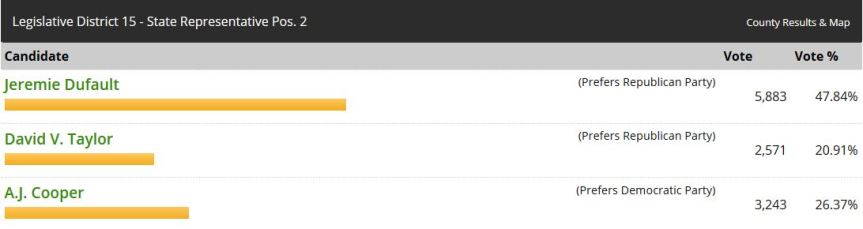
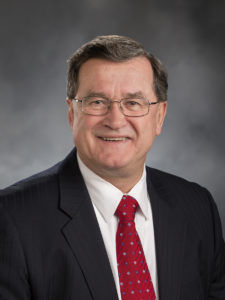
At the current, unofficial count, Rep. David Taylor appears to have lost in the August 2018 primary. According to an article at We the Governed, Republicans showed poorly statewide, and many traditionally strong Republican districts had weak results.

The initial results in a variety of districts around the state – largely considered Republican leaning, but showing Republican weakness last night should be motivating some serious soul searching and galvanizing Republican efforts around the state.  Here is a review of a few of these races (please note direct links to election results will change as more late mail-in votes are counted):

In the 15th Legislative District (Yakima County), this district will remain in Republican control, but an intramural fight within the Republican Party has resulted in poor results for the Republican caucus and for everyone who values freedom. In a five way primary runoff for the house seat, longtime Republican incumbent David Taylor appears to have missed surviving the primary results with a disappointing election night return of 20.42%.  This result is partly due to a longtime well-known grudge against Representative Taylor by nearby Republican Senator Curtis King (LD-14) who has repeatedly recruited candidates to

Senator Curtis King (14th LD)

run against Taylor.  Baring an unusual shift in ballot returns over the next few days, it looks like King succeeded with former Democrat and recently converted Republican Jeremie Dufault who will beat Democrat candidate AJ Cooper in the fall.  Representative Taylor was one of the most knowledgeable legislators of either party in Olympia when it came to land use, property rights, planning, and how the hodgepodge of land use laws functioned in Washington State.  Losing him from the legislature eliminates a desperately needed knowledgeable, freedom-oriented voice in the legislature.  Senator King didn’t like Taylor’s criticism of King’s various gas tax proposals and King’s endless campaign to increase the tax burden on Washington State citizens.  This is yet again another example of how Republican intramural fighting will help the Democratic Party agenda of higher taxes next year.

Combat Studies Group Announces Sepio 2 Secure Laptop

After a few quiet months, Combat Studies Group has announced that the improved Sepio 2 secure laptop is to be released soon. They say the Sepio 2 will be faster and more secure than the original Sepio, with the choice of 13″ or 15″ screens, multiple hard drive options, expanded memory, and more. Base models starting around $1400.

Combat Studies Group also has some new classes they are teaching, including GroundRod 3, a GroundRod Alumni update course, Low vis tactical vehicle operations, and home defense/CQB.

Judge’s Unconstitutional Effort to Block Blueprints for 3D-Printed Guns

In news directly related to the recent announcement of a federal settlement with Defense Distributed, a Seattle federal judge has issued a restraining order to prevent Defense Distributed from posting the blueprint files.  From National Review:

If there’s a hall of fame for futile, symbolic, and ultimately unconstitutional federal court orders, the temporary restraining order just issued in Seattle blocking Defense Distributed and the Second Amendment Foundation from posting blueprints for 3D-printed guns deserves at least a plaque, if not a full display. The court’s order temporarily overturns a Trump administration legal settlement that reversed an Obama-era policy designed mainly to limit the spread of the relevant files abroad, not here at home. I love NPR’s sardonic Twitter response:

NPR gets it. Let’s be clear about what has just happened. A federal court has issued a prior restraint on speech (it’s attempting to block the spread of information; it is not blocking the lawful home manufacture of firearms) that is already thoroughly and completely moot. The files are out. They’re all over the internet. They’ve been copied and reproduced. The judge’s order can’t change that fact.

Moreover, Defense Distributed and the Second Amendment Foundation are hardly the only sources for online files or blueprints that enable a home manufacturer with a 3D printer to make a gun. I’m honestly unclear what the court is trying to accomplish here, aside from targeting the Trump administration and/or targeting a disfavored private company.

Earlier today I published a lengthy explainer of the factual and legal issues surrounding the 3D-printed gun controversy. I’d urge you to read the whole thing, but the bottom line is easy to understand. First, home manufacture of weapons is clearly lawful, and it has been common practice in the United States since before the founding of the nation. Second, it is thus just as lawful to “print” a gun as it is to assemble one with parts in your garage. Third, the plans to print guns are widely-available on the internet — and have been for some time.

Put another way, a gun that’s lawful to assemble is lawful to print. A gun that’s unlawful to assemble is unlawful to print, and that includes undetectable plastic guns that are either printed or assembled. It’s that simple.There is no new “threat” here. There is no crisis…

The files at issue can still be downloaded from http://codeisfreespeech.com/

Tonight, the organizations and individuals behind CodeIsFreeSpeech.com, a new Web site for the publication and sharing of firearm-related speech, including machine code, have issued the following statement:

Our Constitution’s First Amendment secures the right of all people to engage in truthful speech, including by sharing information contained in books, paintings, and files. Indeed, freedom of speech is a bedrock principle of our United States and a cornerstone of our democratic Republic. Through CodeIsFreeSpeech.com, we intend to encourage people to consider new and different aspects of our nation’s marketplace of ideas – even if some government officials disagree with our views or dislike our content – because information is code, code is free speech, and free speech is freedom.

Should any tyrants wish to chill or infringe the rights of the People, we would welcome the opportunity to defend freedom whenever, wherever, and however necessary. Hand-waving and hyperbole are not compelling government interests and censorship is not proper tailoring under the law.

There is no doubt that Cody Wilson and Defense Distributed have inspired countless Americans to exercise their fundamental, individual rights, including through home gunsmithing. Through CodeIsFreeSpeech.com, we hope to promote the collection and dissemination of truthful, non-misleading speech, new and evolving ideas, and the advancement of the Second Amendment right to keep and bear arms…

9th Circuit Three-Judge Panel Upholds Right to Open Carry Firearms

A three-judge panel of the 9th Circuit U.S. Court of Appeals determined, in Young v. State of Hawaii, that the Second Amendment protects “the right to carry a firearm openly.”

Truth About Guns reports,

The right to carry a firearm for law-abiding citizens barely exists in Hawaii. A so-called may-issue state, the Pacific paradise hasn’t issued a permit to carry this century. As far as the fiftieth state is concerned, Americans only have a right to keep and bear arms in their own homes.

That violation of his Second Amendment rights (see District of Columbia v Heller) was the basis for George Young’s suit against the state. Yesterday, a three-judge panel of the Ninth Circuit Court of Appeals in a two-to-one decision, agreed with Mr. Young.

A federal appeals court ruled on Tuesday that the U.S. Constitution’s Second Amendment protects a right to openly carry a gun in public for self-defense, rejecting a claim by Hawaii officials that the right only applies to guns kept at home. …

Two of the three 9th Circuit judges voted to reverse a decision by the U.S. District Court in Hawaii that state officials did not infringe on the rights of George Young, the plaintiff, in twice denying him a permit to carry a gun outside.

“We do not take lightly the problem of gun violence,” Judge Diarmuid O’Scannlain wrote in Tuesday’s ruling. “But, for better or for worse, the Second Amendment does protect a right to carry a firearm in public for self-defense.”

You can read the full ruling here. The majority opinion wasn’t friendly to concealed carry, but here’s the main takeaway:

The panel acknowledged that while the concealed carry of firearms categorically falls outside Second Amendment protection, see Peruta v. County of San Diego, 824 F.3d 919, 939 (2016) (en banc), it was satisfied that the Second Amendment encompasses a right to carry a firearm openly in public for self-defense. Analyzing the text of the Second Amendment and reviewing the relevant history, including founding-era treatises and nineteenth century case law, the panel stated that it was unpersuaded by the County’s and the State’s argument that the Second Amendment only has force within the home. The panel stated that once identified as an individual right focused on self-defense, the right to bear arms must guarantee some right to self-defense in public. The panel held that because Hawaii law restricted plaintiff in exercising the right to carry a firearm openly, it burdened conduct protected by the Second Amendment.

In determining the appropriate level of scrutiny to apply to section 134-9, the panel first held that the right to carry a firearm openly for self-defense falls within the core of the Second Amendment. The panel stated that restricting open carry to those whose job entails protecting life or property necessarily restricts open carry to a small and insulated subset of law-abiding citizens. The panel reasoned that the typical, law-abiding citizen in the State of Hawaii was entirely foreclosed from exercising the core Second Amendment right to bear arms for self-defense. The panel concluded that Hawaii’s limitation on the open carry of firearms to those “engaged in the protection of life and property” violated the core of the Second Amendment and was void under any level of scrutiny.