Rutherford Institute: AI Surveillance Signals the Death of Privacy

John and Nisha Whitehead at the Rutherford Institute write about the growing digital authoritarianism around the world and the subsequent death of privacy for everyone. It’s not just happening in places like China or the middle east. Surveillance happens in the US on a massive scale. Private social media platforms sell their users’ information to any buyer, and censor their users based on advice from the government. The NSA engages in widespread surveillance of US citizens as well as foreigners. There are consumer reporting companies which gather information about you and sell it in order to provide tenant screening, employment screening, social media screening, employment and income reporting and verification, check and bank screening, fact checking for insurance purposes, medical checking for when you try to purchase insurance related to your health, utilities history, retail product returns and even gambling screening. The types of surveillance are nearly endless and mostly available to anyone with the money to purchase it, much less the government.

AI Surveillance Signals the Death of Privacy

There are no private lives. This a most important aspect of modern life. One of the biggest transformations we have seen in our society is the diminution of the sphere of the private. We must reasonably now all regard the fact that there are no secrets and nothing is private. Everything is public.” ― Philip K. Dick

Nothing is private.

We teeter on the cusp of a cultural, technological and societal revolution the likes of which have never been seen before.

While the political Left and Right continue to make abortion the face of the debate over the right to privacy in America, the government and its corporate partners, aided by rapidly advancing technology, are reshaping the world into one in which there is no privacy at all.

Nothing that was once private is protected.

We have not even begun to register the fallout from the tsunami bearing down upon us in the form of AI (artificial intelligence) surveillance, and yet it is already re-orienting our world into one in which freedom is almost unrecognizable.

AI surveillance harnesses the power of artificial intelligence and widespread surveillance technology to do what the police state lacks the manpower and resources to do efficiently or effectively: be everywhere, watch everyone and everything, monitor, identify, catalogue, cross-check, cross-reference, and collude.

Everything that was once private is now up for grabs to the right buyer.

Governments and corporations alike have heedlessly adopted AI surveillance technologies without any care or concern for their long-term impact on the rights of the citizenry.

As a special report by the Carnegie Endowment for International Peace warns, “A growing number of states are deploying advanced AI surveillance tools to monitor, track, and surveil citizens to accomplish a range of policy objectives—some lawful, others that violate human rights, and many of which fall into a murky middle ground.”

Indeed, with every new AI surveillance technology that is adopted and deployed without any regard for privacy, Fourth Amendment rights and due process, the rights of the citizenry are being marginalized, undermined and eviscerated.

Cue the rise of digital authoritarianism.

Digital authoritarianism, as the Center for Strategic and International Studies cautions, involves the use of information technology to surveil, repress, and manipulate the populace, endangering human rights and civil liberties, and co-opting and corrupting the foundational principles of democratic and open societies, “including freedom of movement, the right to speak freely and express political dissent, and the right to personal privacy, online and off.”

The seeds of digital authoritarianism were planted in the wake of the 9/11 attacks, with the passage of the USA Patriot Act. A massive 342-page wish list of expanded powers for the FBI and CIA, the Patriot Act justified broader domestic surveillance, the logic being that if government agents knew more about each American, they could distinguish the terrorists from law-abiding citizens.

It sounded the death knell for the freedoms enshrined in the Bill of Rights, especially the Fourth Amendment, and normalized the government’s mass surveillance powers.

Writing for the New York Times, Jeffrey Rosen observed that “before Sept. 11, the idea that Americans would voluntarily agree to live their lives under the gaze of a network of biometric surveillance cameras, peering at them in government buildings, shopping malls, subways and stadiums, would have seemed unthinkable, a dystopian fantasy of a society that had surrendered privacy and anonymity.”

Who could have predicted that 50 years after George Orwell typed the final words to his dystopian novel 1984, “He loved Big Brother,” we would come to love Big Brother.

Yet that is exactly what has come to pass.

After 9/11, Rosen found that “people were happy to give up privacy without experiencing a corresponding increase in security. More concerned about feeling safe than actually being safe, they demanded the construction of vast technological architectures of surveillance even though the most empirical studies suggested that the proliferation of surveillance cameras had ‘no effect on violent crime’ or terrorism.”

In the decades following 9/11, a massive security-industrial complex arose that was fixated on militarization, surveillance, and repression.

Surveillance is the key.

We’re being watched everywhere we go. Speed cameras. Red light cameras. Police body cameras. Cameras on public transportation. Cameras in stores. Cameras on public utility poles. Cameras in cars. Cameras in hospitals and schools. Cameras in airports.

We’re being recorded at least 50 times a day.

It’s estimated that there are upwards of 85 million surveillance cameras in the U.S. alone, second only to China.

On any given day, the average American going about his daily business is monitored, surveilled, spied on and tracked in more than 20 different ways by both government and corporate eyes and ears.

Beware of what you say, what you read, what you write, where you go, and with whom you communicate, because it will all be recorded, stored and used against you eventually, at a time and place of the government’s choosing.

Yet it’s not just what we say, where we go and what we buy that is being tracked.

We’re being surveilled right down to our genes, thanks to a potent combination of hardware, software and data collection that scans our biometrics—our faces, irises, voices, genetics, microbiomes, scent, gait, heartbeat, breathing, behaviors—runs them through computer programs that can break the data down into unique “identifiers,” and then offers them up to the government and its corporate allies for their respective uses.

As one AI surveillance advocate proclaimed, “Surveillance is no longer only a watchful eye, but a predictive one as well.” For instance, Emotion AI, an emerging technology that is gaining in popularity, uses facial recognition technology “to analyze expressions based on a person’s faceprint to detect their internal emotions or feelings, motivations and attitudes.” China claims its AI surveillance can already read facial expressions and brain waves in order to determine the extent to which members of the public are grateful, obedient and willing to comply with the Communist Party.

This is the slippery slope that leads to the thought police.

The technology is already being used “by border guards to detect threats at border checkpoints, as an aid for detection and diagnosis of patients for mood disorders, to monitor classrooms for boredom or disruption, and to monitor human behavior during video calls.”

For all intents and purposes, we now have a fourth branch of government: the surveillance state.

This fourth branch came into being without any electoral mandate or constitutional referendum, and yet it possesses superpowers, above and beyond those of any other government agency save the military. It is all-knowing, all-seeing and all-powerful. It operates beyond the reach of the president, Congress and the courts, and it marches in lockstep with the corporate elite who really call the shots in Washington, DC.

The government’s “technotyranny” surveillance apparatus has become so entrenched and entangled with its police state apparatus that it’s hard to know anymore where law enforcement ends and surveillance begins.

The short answer: they have become one and the same entity. The police state has passed the baton to the surveillance state, which has shifted into high gear with the help of artificial intelligence technologies. The COVID-19 pandemic helped to further centralize digital power in the hands of the government at the expense of the citizenry’s privacy rights.

“From cameras that identify the faces of passersby to algorithms that keep tabs on public sentiment online, artificial intelligence (AI)-powered tools are opening new frontiers in state surveillance around the world.” So begins the Carnegie Endowment’s report on AI surveillance note. “Law enforcement, national security, criminal justice, and border management organizations in every region are relying on these technologies—which use statistical pattern recognition, machine learning, and big data analytics—to monitor citizens.”

In the hands of tyrants and benevolent dictators alike, AI surveillance is the ultimate means of repression and control, especially through the use of smart city/safe city platforms, facial recognition systems, and predictive policing. These technologies are also being used by violent extremist groups, as well as sex, child, drug, and arms traffickers for their own nefarious purposes.

China, the role model for our dystopian future, has been a major force in deploying AI surveillance on its own citizens, especially by way of its social credit systems, which it employs to identify, track and segregate its “good” citizens from the “bad.”

Social media credit scores assigned to Chinese individuals and businesses categorize them on whether or not they are worthy of being part of society. A real-name system—which requires people to use government-issued ID cards to buy mobile sims, obtain social media accounts, take a train, board a plane, or even buy groceries—coupled with social media credit scores ensures that those blacklisted as “unworthy” are banned from accessing financial markets, buying real estate or travelling by air or train. Among the activities that can get you labeled unworthy are taking reserved seats on trains or causing trouble in hospitals.

In much the same way that Chinese products have infiltrated almost every market worldwide and altered consumer dynamics, China is now exporting its “authoritarian tech” to governments worldwide ostensibly in an effort to spread its brand of totalitarianism worldwide. In fact, both China and the United States have led the way in supplying the rest of the world with AI surveillance, sometimes at a subsidized rate.

This is how totalitarianism conquers the world.

While countries with authoritarian regimes have been eager to adopt AI surveillance, as the Carnegie Endowment’s research makes clear, liberal democracies are also “aggressively using AI tools to police borders, apprehend potential criminals, monitor citizens for bad behavior, and pull out suspected terrorists from crowds.”

Moreover, it’s easy to see how the China model for internet control has been integrated into the American police state’s efforts to flush out so-called anti-government, domestic extremists.

According to journalist Adrian Shahbaz’s in-depth report, there are nine elements to the Chinese model of digital authoritarianism when it comes to censoring speech and targeting activists: 1) dissidents suffer from persistent cyber attacks and phishing; 2) social media, websites, and messaging apps are blocked; 3) posts that criticize government officials are removed; 4) mobile and internet access are revoked as punishment for activism; 5) paid commentators drown out government criticism; 6) new laws tighten regulations on online media; 7) citizens’ behavior monitored via AI and surveillance tools; 9) individuals regularly arrested for posts critical of the government; and 9) online activists are made to disappear.

You don’t even have to be a critic of the government to get snared in the web of digital censorship and AI surveillance.

The danger posed by the surveillance state applies equally to all of us: lawbreaker and law-abider alike.

When the government sees all and knows all and has an abundance of laws to render even the most seemingly upstanding citizen a criminal and lawbreaker, then the old adage that you’ve got nothing to worry about if you’ve got nothing to hide no longer applies.

As Orwell wrote in 1984, “You had to live—did live, from habit that became instinct—in the assumption that every sound you made was overheard, and, except in darkness, every movement scrutinized.”

In an age of too many laws, too many prisons, too many government spies, and too many corporations eager to make a fast buck at the expense of the American taxpayer, we are all guilty of some transgression or other.

No one is spared.

As Elise Thomas writes for Wired: “New surveillance tech means you’ll never be anonymous again.”

It won’t be long before we find ourselves looking back on the past with longing, back to an age where we could speak to whomever we wanted, buy whatever we wanted, think whatever we wanted, go wherever we wanted, feel whatever we wanted without those thoughts, words and activities being tracked, processed and stored by corporate giants, sold to government agencies, and used against us by militarized police with their army of futuristic technologies.

Tread cautiously: as I make clear in my book Battlefield America: The War on the American People and in its fictional counterpart The Erik Blair Diaries1984 has become an operation manual for the omnipresent, modern-day AI surveillance state.

Without constitutional protections in place to guard against encroachments on our rights when power, AI technology and militaristic governance converge, it won’t be long before Philip K. Dick’s rules for survival become our governing reality: “If, as it seems, we are in the process of becoming a totalitarian society in which the state apparatus is all-powerful, the ethics most important for the survival of the true, free, human individual would be: cheat, lie, evade, fake it, be elsewhere, forge documents, build improved electronic gadgets in your garage that’ll outwit the gadgets used by the authorities.”


Ammoland: New Report ‘Crime in Washington 2021’ Damning Proof of Gun Control Failure

New Report ‘Crime in Washington 2021’ Damning Proof of Gun Control Failure is written by Dave Workman at Ammoland News. It reports on the failure of Washington State gun control laws to deter crime.

In the midst of a continuing pattern of rising crime in Washington State, a new report released by the Washington Association of Sheriffs and Police Chiefs (WASPC) does two things, one of them completely unintentional.

The report says there were 325 murders last year in the state, “an increase of 5.9 percent since 2020.” It is the highest number of murders recorded since WASPC began collecting data in 1980.

What the data also demonstrates is that restrictive gun control initiatives pushed through by a billionaire-backed gun prohibition lobbying group based in Seattle have failed to make communities safer, essentially putting the lie to any promises or predictions made by their proponents.

Translation: Gun control advocates misled Evergreen State voters. Their forecasts and arguments were wrong, just as Northwest gun rights leaders said they would be.

According to the Crime in Washington 2021 report, “In 2021, Violent Crimes showed an increase of 12.3% with 29,238 offenses reported; compared to 26,036 offenses reported in 2020. There were 325 murders in 2021; this is an increase of 5.9% compared to 307 murders in 2020.”

That’s even more homicides than the annual FBI Uniform Crime Report listed for 2020, the most recent year for which FBI data is available. The Crime Report is released in late September each year. For 2020, the FBI listed 298 homicides, of which 177 were committed with firearms. That was up from the 209 murders, including 141 involving guns, posted in the 2015 Crime Report.

The new WASPC report “compiles data from 232 state, county, municipal and tribal agencies,” according to KOMO News. It “is designed to give residents information on what is happening in their communities. It covers a wide variety of crime, an issue people living in Seattle say is getting out of hand.”

The report came as news from neighboring Oregon confirmed Initiative Petition 17, which seeks to ban so-called “large capacity magazines” and require Oregonians to get a permit before they can purchase a firearm, has qualified to appear on the November ballot.

New Ban Push

A new report from KING5, the Seattle Times, Washington State University’s Murrow College of Communications and the University of Washington’s Center for an Informed Public says 61 percent of survey respondents would support a ban on so-called “assault weapons.” However, because the Supreme Court granted certiorari to a challenge of the ban in Maryland—in a case brought by the Second Amendment Foundation, Citizens Committee for the Right to Keep and Bear Arms, and others—and then remanded the case back to the lower court for further consideration based on the June decision in New York State Rifle & Pistol Association v. Bruen, such a ban could be held unconstitutional sometime during the next two years as the case is reconsidered.

According to KGW, the WA Poll was conducted by SurveyUSA among 825 participants, which seems a pitifully small number, considering the WASPC report says there are now 7,772,506 Washington residents.

“People living in western Washington were also more likely to support a ban,” KGW reported. “A total of 65% strongly or somewhat support the idea of an assault weapon ban. Meanwhile, 48% of people from eastern Washington opposed a ban, with 35% being strongly opposed.”

Further reinforcing the notion that Democrats have become the party of gun prohibition, the poll found, “Democrats largely supported the idea, with 75% saying they strongly support a ban and 16% saying they somewhat support it. Though there was some support for a ban from Republicans, more than 50% said they were opposed, with 44% being strongly opposed.”

There is no small irony here, because the National Shooting Sports Foundation just released a new estimate on the number of modern semi-auto sporting rifles (MSRs) now in private hands. According to NSSF, the number of MSRs now in circulation is 24,446,000, which is an increase of more than 4.5 million rifles since the organization last made an estimate in 2020.

Almost simultaneously, anti-gun Congressman Jerry Nadler (D-NY), chairing the House Judiciary Committee, made a startling admission during a hearing on H.R. 1808, the bill to ban so-called “assault weapons.” When Rep. Dan Bishop (R-NC) asked if the bill is designed to ban “weapons in common use,” Nadler unequivocally answered, “Yes, that is the point of the bill.”

The admission ignited a lively discussion on Twitter.

It was during this hearing that David Hogg, who became a poster boy for gun control after the 2018 high school shooting in Parkland, Fla., was ejected from the hearing room. According to Fox News, Hogg disrupted the hearing by accusing House members of inaction on gun control. As he was escorted out by security officers, Hogg reportedly declared, “You are perpetuating violence…stop these things now.”

The push to pass gun control legislation now may unintentionally signal fear from Democrats that they are likely to lose the majority on Capitol Hill in November, thus stopping efforts to place additional restrictions on gun owners, and derail Joe Biden’s gun control agenda.

Radio Contra Ep. 174: NYC Nuclear Attack Warnings and Survival with K of Combat Studies Group

Here is another episode of Radio Contra. This time NC Scout is talking to our old friend K from Combat Studies Group.

Episode 174. I’m joined former CIA contractor K of Combat Studies Group to talk NYC’s latest nuclear attack PSA and their advocacy of the public to pack go bags in the event of an attack. We break down personal considerations for survival, gear selection, and beating the constant state of psychological warfare being imposed upon us.

Radio Contra Ep. 174: NYC Nuclear Attack Warnings and Survival with K of Combat Studies Group

Garand Thumb: How to stop a Mass Shooter, Mr Dicken the Hero who Stopped a Tragedy

In this video, the guys at military/firearms channel Garand Thumb talk about the actions of Mr. Dicken who stopped a mass shooting in a mall in Greenwood, IN by engaging with and shooting the assailant from forty yards. Are you training with your carry weapon?

ow to stop a Mass Shooter. Here at Garand Thumb we believe very strongly in the actions of Mr. Dicken and in the carrying of concealed handguns. Mr. Dicken’s actions ultimately saved many lives. There is much to learn from what occurred.

00:00 How to Stop a Mass Shooter, The Dicken drill

2:37 Your life will likely be peaceful, but it may not be

4:00 Elisha Dicken conceal carried as soon as he could

5:00 You don’t need to be a LEO or Military to be tactically sound

9:12 Long shots are easy if you train

Radio Contra Ep. 172 – Chinese Threat with Madman Actual

In Radio Contra episode 172, NC Scout talks to ‘Madman Actual’ an intelligence specialist about dangers out of China.

Episode 172. I’m joined by former US Army and NSA Signals Intelligence collection specialist ‘Madman Actual’ to discuss the FBI’s revelation that Huawei does in fact pose a very serious threat to the US. But how much of a threat? We also discuss the role Baofengs may play, and why Sat Phones are not a viable option.

Radio Contra Ep. 172. Huawei and the Chinese Threat with Madman Actual

Captain’s Journal: Quiet Small Game Hunting

“Shhh, I’m hunting wabbits.” – Mr. E. Fudd

The Captain’s Journal has a brief article on Quiet Small Game Hunting. Actually it says “Quite Small Game Hunting,” but I’m assuming that is a typographical error. I’ve hunted rabbits myself with both .17 and .22 air rifles. Both are effective, though the .17 requires better shot placement. On the subsonic .22LR front, I had a friend back in the ’90s in another state who would slither into the heavily wooded city park near his home and hunt squirrels with subsonic .22LR. He took quite a few with a nary a complaint from anyone.

I live in a relatively rural area, but the county still has a law against discharging a firearm with a couple of hundred yards of a residence. Even if you have 5-10 acres of your own, with good backstops for firing, that can mean that you can’t use a firearm to hunt on your property. In that case, air guns are a fine option for hunting your vicious rabbit and squirrel pests.

In a recent conversation, the discussion of rabbit hunting came up. The rabbits are thick this year in our area. The intent is “backyard” hunting for food on several acres. Why not eat the rabbits while teaching your children to forage and harvest what God makes readily available in addition to regular hunting, fishing, chickens, and a large garden?

Hunting in most areas here is legal, but the 22LR is too loud for the desired purpose. A lower profile with the neighbors is a better choice. Early in the investigation of options, any info or background readers might have would be very helpful. The readership here is much more intelligent than a web search.

Below is some preliminary info on “quiet 22,” subsonic, and .22 air rifles. Also, the option of suppression comes to mind, which brings up questions about the law.

CCI’s Quiet .22 load is designed to deliver about 68 decibels (Db) at the shooter’s ear. This is about half the noise generated by high-velocity .22 LR ammunition and only slightly more than normal conversation. Sounds can be painful at around 95 Db and sustained exposure to noise in the 125 Db range, or even one time exposure to levels of 140 Db or higher, can cause permanent damage to hearing. When I was growing up hearing protection was rarely used when shooting and the incessant ringing in my ears is a constant reminder of that mistake.


While subsonic .22 LR ammunition—ammo with a muzzle velocity of less than about 1,100 fps—has been available for a long time, it generally comes in the form of expensive match-grade ammo or target rounds that are only slightly below the speed of sound. This means you either pay more for each shot or the noise reduction is minimal so as not to sacrifice velocity.

The Best Quietest Air Rifles mentions not scaring prey away and avoiding alerting the neighbors.

Looking to hunt vermin, rodents, or squirrels in your backyard? Well, after spending dozens of hours on research, I found and shortlisted some of the quietest air rifles in the market right now. Let’s dive straight into it!

An air rifle in .22 could be a good fit.

S2 Underground: July 26 Intel Update

The below video is the latest intelligence video from S2 Underground.

00:00 – Introduction

00:20 – Infrastructure – Southeast

01:00 – Infrastructure – East Central Midwest

02:18 – Infrastructure – West Central Midwest

03:12 – Infrastructure – Southwest

05:48 – Infrastructure – West

07:49 – Suspicious Fires

09:35 – Kinetic Incidents – Northeast

14:38 – Kinetic Incidents – Southeast

16:11 – Kinetic Incidents – West

17:17 – Significant Governmental Actions

30:08 – International Issues

36:43 – Closing Thoughts

Just a few reminders for everyone who’s just become aware of us, in order to keep these briefings from being several hours long, we can’t cover everything. We’re probably covering 1% of the world events when we conduct these briefings, so please remember that if we left it out, it doesn’t necessarily mean that it’s unimportant. Also, remember that we do these briefings quite often, so we might have covered an issue previously that you might not see if you are only watching our most recent videos. We’re also doing this in our spare time, so again we fully admit that these briefings aren’t even close to being perfect; we’re going for a healthy blend of speed and quality. If we were to wait and only post a brief when it’s “perfect” we would never post anything at all. So expect some minor errors on the slides here and there. If there is a major error or correction that needs to be made, we will post it here in the description, and verbally address it in the next briefing, whenever that is. We do not have a set schedule for when these videos are published…when we get enough info that we think is worth it, we brief it. If we were bound to a schedule we would be obligated to provide fluff for the days where there isn’t anything worth commenting on. Also, thanks for reading this far. It is always surprising the number of people that don’t actually read the description box to find more information.

Reason: US Dist. Court Issues Temp. Restraining Order against Colorado Gun and Magazine Ban

David Kopel at Reason.com writes about a US District Court Judge issuing a temporary restraining order against the enforcement of Superior, Colorado’s municipal code which banned certain firearms and magazines. Hopefully such rulings will be coming soon to a state near you.

Colorado U.S. District Court issues TRO against magazine and gun ban

Today U.S. District Judge Raymond P. Moore issued a temporary restraining order against the ban on so-called “assault weapons” recently enacted by the town of Superior, Colorado, in Boulder County. The case is Rocky Mountain Gun Owners v. Superior.

Lead attorney for the plaintiffs was Barry Arrington, one of Colorado’s top lawyers on education law, and now the victor in a major Second Amendment case. Arrington previously served in the Colorado House of Representatives, and as a trustee of the Independence Institute, where I work.

Judge Moore formerly was a corporate lawyer (Davis, Graham and Stubbs, Denver), and then head Federal Public Defender for Colo. and Wyoming. He was appointed to the bench by President Obama in 2013, and confirmed unanimously.

Like several other towns in Boulder County, Superior recently outlawed semiautomatic centerfire rifles that have at least one supposedly bad characteristic, such as an adjustable stock; various semiautomatic shotguns; various semiautomatic handguns; and magazines with a capacity of over 10 rounds.

It was obvious that such arms are “commonly used by law-abiding citizens for lawful purposes,” which is the Supreme Court’s rule from District of Columbia v. Heller (2008) for which arms are protected by the Second Amendment. First, the Colorado Attorney General and plaintiffs in an earlier case challenging the state of Colorado’s ban on magazines over 15 rounds had so stipulated. Colorado Outfitters Ass’n v. Hickenlooper, 24 F. Supp. 3d 1050, 1068 (D. Colo. 2014), vacated in part on other grounds and remanded, 823 F.3d 537 (10th Cir. 2016). (I represented 55 Colorado Sheriff plaintiffs in the case, which ended up with the 10th Circuit declaring that neither the Sheriffs nor the many other individual and organizational plaintiffs had standing.) Commonality was also found in the undisputed facts set forth in Fourth Circuit Judge Traxler’s dissenting opinion in Kolbe v. Hogan, 849 F.3d 114, 153-55 (4th Cir. 2017). The opinions of many other Circuit Courts provide additional, irrefutable proof of commonality; the banned firearms number in the millions, at least, and the banned magazines comprise over half of all magazines.

Pursuant to the Supreme Court’s recent decision in New York State Rifle & Pistol Association v. Bruen, courts are supposed to decide Second Amendment cases on text, history, and tradition. Judge may not decide based on their own opinions about good policy, nor should they defer to legislative policy judgements. The policy  balancing was already conducted by the American people when they adopted the Second Amendment.

In Bruen‘s historical approach, the most important periods are the Founding Era and Reconstruction (when the Fourteenth Amendment made the Second Amendment enforceable against state and local governments). English history is relevant to the extent that is shows an unbroken tradition that was adopted in America and continued to the Founding. Colonial history is also relevant. So is 19th century history, and (Reconstruction excepted), the earlier the better. The late 19th century is weaker, and the 20th century is far too late to show a historical tradition that could override the text of the Second Amendment.

Judge Moore wrote: “the Court is unaware of historical precedent that would permit a governmental entity to entirely ban a type of weapon that is commonly used by law-abiding citizens for lawful purposes, whether in an individual’s home or in public.”

To be precise, there are a few precedents pre-1900, but none are valid any longer…(article continues)

Radio Contra Ep. 170 & 171: Civil War and Resilient Communities

Here are two Radio Contra podcast episodes from NC Scout of Brushbreater and American Partisan. Episode 170 deals with current fears of a US civil war, while Episode 171 is an interview with Bob Griswold on Resilient Communities.

Episode 170. Breaking down the story regarding half of Americans seeing Civil War on the horizon, I explain why this is not a strictly conservative position, and why you cannot afford to disregard the role the Left is playing – and preparing – in fomenting what they see as the next revolution. Next I dive into Facebook disclosing ‘private’ messages among Antifa activists to the FBI and what this means for you. Last, I give a quick review of the new spy fiction series “The Old Man’.

Radio Contra Ep. 170 Americans Seeing Civil War on the Horizon?

Episode 171. I’m joined by Bob Griswold of Ready Made Resources to talk community preparedness and why the prepper community needs to break away from the individualist mindset through recognizing what the militant Left is currently doing.

Radio Contra Ep. 171 Bob Griswold on Resilient Communities

Blood Drive, Prosser and West Richland

Benton REA will co-host two blood drives in July. If you would like to donate, make your appointment online: https://www.redcrossblood.org/give.html/drive-results?zipSponsor=BREA.

Wednesday, July 27

West Richland Police Department Community Room

7920 W. Van Giesen, West Richland

11 a.m to 4 p.m.

Thursday, July 28

Princess Theater Green Room

1226 Meade Ave., Prosser

11 a.m to 4 p.m.

In June, the Red Cross collected about 12% fewer blood donations than needed to keep the blood supply stable. That’s one of the largest blood donation shortfalls in a single month in recent years. Donors of all blood types – especially types O negative and B negative – are needed.

Regular Assembly, Thurs. July 21

The next meeting will be held on Thursday, July 21st at 6:30pm at the Patriot Barn at 22202 N Hinzerling, Prosser.


We’ll be hosting a candidate forum for Benton County Commissioner with candidates Mike Alvarez, Barry Bush, and Bill Jenkin. Also, Julie Michener will give a short talk on things you can plant outdoors now for a winter harvest.

S2 Underground: One Time Pads/Encipherment

If you taken the Groundrod course from Combat Studies Group, then you’ve learned about one-time pads, but maybe you need a refresher. Maybe you’re completely unfamiliar with this method of encryption which is considered unbreakable unless your pad is compromised, either through being stolen or if it was not randomly generated. Get an introduction or refresher from S2 Underground in this video.

WA Policy Center: State’s new tax on CO2 emissions projected to add 46 cents per gallon to the cost of gas

The Washington Policy Center reports on the effects of a new CO2 emissions tax on the price of gas.

Key Takeaways:

State’s new tax on CO2 emissions is projected to add 46 cents per gallon to 2023 gas prices

An increase of 56 cents per gallon is projected for 2023 diesel prices

By 2030, the new tax is expected to add 80 cents per gallon of gas

By 2030, the new tax is projected to add 97 cents per gallon of diesel

Current state gas tax is 49.4 cents per gallon, so the new tax is projected to nearly double taxes on gasoline paid by Washington residents

Fiscal note on the cap-and-trade bill projected a $20.60 cost per metric ton of carbon emissions, a fraction of what the state Department of Ecology now predicts

Environmental activists seek to remove protections from the cap-and-trade bill for energy-intensive, trade-exposed industries (EITE)

Through 2026, EITEs are exempt from the tax on CO2 emissions. Starting in 2027, 97% of their emissions would be exempt. Denying exemption timeline could mean business failure and reliance on Chinese alternatives that pay little and cause environmental and human rights harm

Washington state’s new tax on CO2 emissions is projected to add 46 cents to the cost of a gallon of gas as soon as next year, the state Department of Ecology reports.   

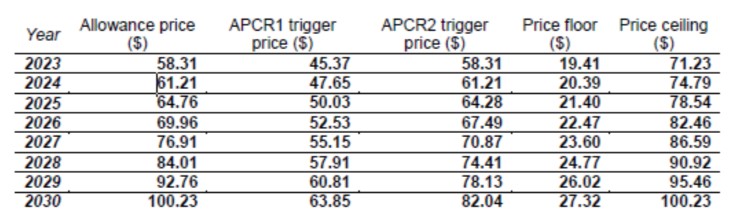
The Washington Research Council noted that an analysis from Vivid Economics and McKinsey & Company for Ecology projected the cost of a metric ton (MT) of CO2 to be $58.31 next year. That would add a tax of about 52 cents per gallon or just over 46 cents per gallon for fuels required to include 10% ethanol in accordance with Washington state law. For diesel, the tax on CO2 emissions would increase the cost of a gallon by about 59 cents per gallon, or 56 cents per gallon for fuels that include 5% biodiesel.

That amount would climb to $100.23 per MT in 2030, equating to 89 cents per gallon, or 80 cents per gallon for the 10% ethanol mix. For diesel, it would add more than a dollar, $1.02, per gallon, or 97 cents for diesel mixed with biofuel.

This is significantly higher than the $20.60/MT used in the previous projection given to legislators in the state’s fiscal note on the cap-and-trade bill, which agency staff called “conservative” at the time. Rather than a tax on CO2, the state system would sell permits to emitters for each MT of CO2, creating an artificial market. As a result, prices can fluctuate significantly, as these new estimates demonstrate.

The current state gas tax is 49.4 cents per gallon, so this would nearly double the amount of taxes Washington residents have to pay for gasoline…(article continues)

AED, CPR, & First Aid Training at Bleyhl, July 20th

AED, CPR, & FIRST AID TRAINING
(GRANDVIEW ADMIN OFFICE)
Are you looking to get CPR, AED and First Aid certified?

Join us on Wednesday, July 20th for an interactive class hosted by Firepoint Training Associates, LLC.

Cost: $35 per person. Cash, check or card will be accepted. We can also charge Bleyhl member accounts.

Register at:
https://bleyhl.typeform.com/to/U9HsE98n

Where: Bleyhl Co-op Main Office
When: 07/22/22 @ 8:30am (English) & 12:30pm (Spanish)

Questions? Call or text (509) 778-2731

Radio Contra Ep. 169 World Events with Angery American

In Radio Contra podcasts’s episode 169, NC Scout talks to Angery American, Chris Weatherman, author of the bestseller Going Home series, to break down the geopolitical events here in the US, who’s in the chute to be the next VP when Biden gets removed, the NYC Nuclear Attack PSA, and the Russian and Chinese position in this.

Radio Contra Ep. 169