Off Grid Ham: Sudden Interest in Radio

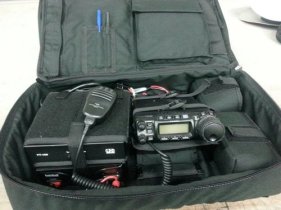
Amateur Radio – ready for emergency deployment

Chris Warren of Off Grid Ham talks about the recent surge of Sudden Interest in Radio Syndrome (SIRS) cases in If You Missed The Train, Don’t Worry. There Will Be Another.

There’s a buzz about radio, and it’s not on the radio.

The amateur radio social media pages and web forums are suddenly buzzing with activity. Mostly it’s from people who are not hams but want to become one. This anecdotal evidence is supported by a notable increase in web traffic to offgridham.com in the last three weeks or so. The search terms suggest that most of these visitors are directly looking for information about off grid communications. Surprise! That’s what we do here, exclusively. So if you’re interested in off grid amateur radio you’ve landed on the best web page on this or any globe. covid-19

Saying the quiet part out loud. covid-19

covid-19

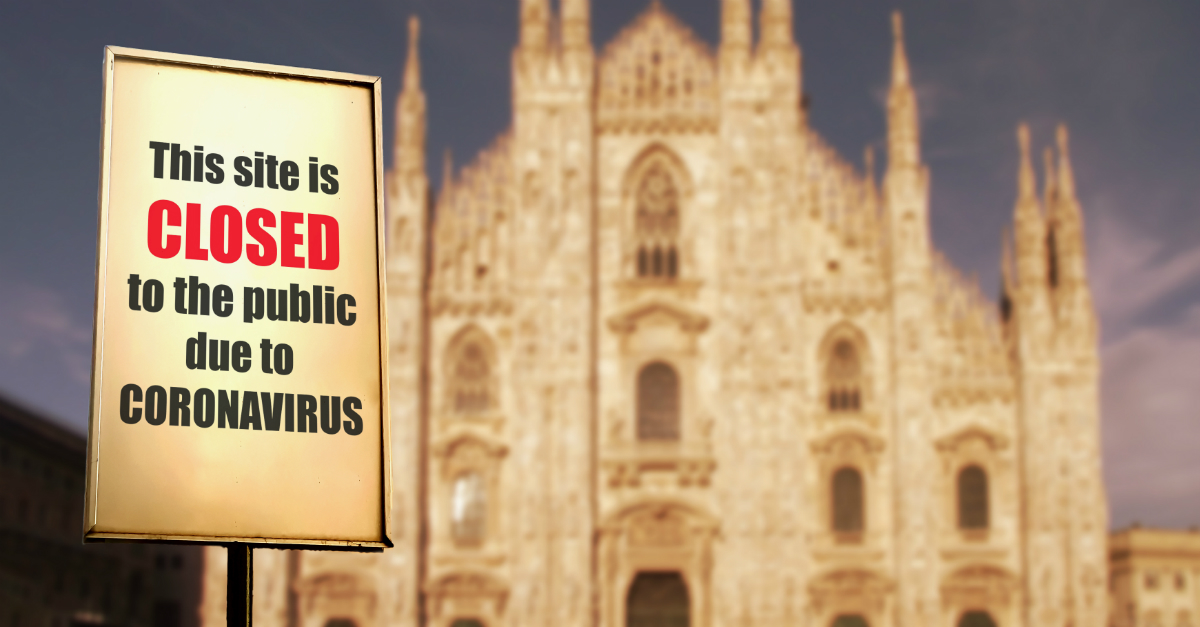
Public domain image.

Let’s not be coy. This interest in off grid amateur radio is being driven by the Covid-19 virus calamity consuming the world. While most people are not outright giving it as a reason why they are interested in off grid radio, they are dropping enough hints that it isn’t hard to figure it out. c

The funny thing is, the corona virus is not a calamity in the traditional sense. The grid is still solid. The electricity is on, the plumbing works, and the internet is up. The roads are free for travel and the stores are (mostly) open and (somewhat) well stocked. No one is being burned or flooded out of their homes. Society is still functioning, albeit with a six foot space cushion between every living human. covid-19covid-19

So why do so many people suddenly want to jump into radio? There’s not too many ways it can aid in Covid-19 response efforts, so it’s not about “emergency communications”. Or is it? I think the real motive is not about a disease. Rather, the disease is giving a lot of people a reality check about being prepared. Maybe they’re thinking about what might happen if all the people who make the grid work suddenly fall sick themselves. Maybe they’re thinking ahead to what else can happen where amateur radio really will be a valuable resource.

I’m just speculating and have no firm proof of any of this, but it’s hard not to see an association between current events and the sharp upturn of interest in amateur radio.

What now?

If you weren’t prepared before Covid-19 upended the world, you’re not going to make up for it now. I have some shocking news for all the hoarders filling their basements with toilet paper: You’e panicking and reacting, not preparing. The truly prepared already had a stock of toilet paper before Covid-19 came to town. The good news is that it’s not too late to prepare for the next calamity…and you know there will be another one, someday, somewhere.

Passing a simple test and buying a $35.00 handheld radio off Amazon to stash in a cabinet “just in case” is not going to make you prepared either. Amateur radio has a low barrier to entry but the learning curve is fairly steep once you’re in the door. If you do make the step into ham radio, it’s going to require some effort and practice. It’s not a “set it and forget it” avocation, at least not if you want to be any good at it. Many if not most of the people who become amateurs solely for emergency preparedness purposes will not touch a radio until an emergency actually happens. Then, and only then, will they realize that being prepared is not about collecting stuff.

Skills vs. stuff.  Covid-19

Theres is good news: Learning about ham radio is fun. Amateur radio is after all a hobby that just happens to have a practical secondary application as an emergency communications service. You’ll be a better person and be better prepared if you don’t let the latter overshadow the former. Being prepared is about having skills and having a plan. Regular readers of this website know I beat the hell out of the importance of having a plan. They also know the operator with a lot of skill but very little equipment is better off than a wannabe with a roomful of the latest & best gear. Making the most of what you have and using skills as a force multiplier is the heart & soul of what Off Grid Ham is all about.

Welcome.

If you recently found this website as a curious outsider, welcome. I hope you’ll stick around for the long haul and enrich yourself with amateur radio. If you’re a long time amateur or a regular reader, I hope you’ll refer newcomers to offgridham.com and help them find a reason to take amateur radio seriously.

We are in the midst of a disaster. It’s too late to plan for what’s already happened. If you weren’t prepared, learn from experience. The next disaster is 100% going to happen so ready yourself now. Only a fool waits for the the house to start burning before they go shopping for a fire extinguisher. I believe the strength and spirit of America will pull us through but hope has never solved any problem. As a famous radio host once quipped, hope is just disappointment delayed. Start learning skills and come up with a plan right now.

OH8STN: Emergency Communications for Groups

Julian, OH8STN, has a new video out about ham radio emergency communications for Groups.

Hello Operators.
Todays topic emergency communications, ham radio is a little different than normally seen on the channel. Today we are discussing ham radio emergency communications for groups and small communities while bugging in shtf. The bugging in shtf part, is the self quarantine many of us are experiencing around the world the past few weeks. it’s obvious too many of us now bugging in is very different from the bugging out we may have expected and prepared for. Because of this, groups and communities wishing to learn ham radio emergency group communications, may be interested to learn this approach, and these emergency communications tools.

73
Julian oh8stn


KIMA News: Donations of Respirator Masks and Other Medical Supplies Needed

From KIMA news, Donations of respirator masks and other medical supplies needed

Health care providers are in critical need of supplies as COVID-19 continues to hit Washington. Critical health supplies are in demand for Trios, Lourdes, Kadlec and Prosser Memorial. The Tri-Cities Business and Visitor Center is volunteering to be a central donation point to drop off supplies. Jim Hall, a representative of area health organizations, explains what type of items are needed.

“Hand sanitizer, wipes, PPE equipment, gowns and more, the more we can accumulate the better position we are going to be,” explained Hall. According to Hall, the Tri-Cities community is stepping up.

“Thank you to the community and thank you to the Business and Visitor Center for putting this collective effort together,” said Hall. You can drop off supplies Monday through Wednesday from 11 am to 7 pm at the Tri-Cities Business and Visitor Center.

“I know all of the medical providers in the area have really been swamped with inquiries from the public on how they can help,” said Hall. You can help by donating or help by practicing good hand washing and social distancing.

Health officials say we will get through this together. “I know nurses and doctors and health care providers are working around the clock to take care of our entire community,” said Hall.

Here is a list of supplies in critical shortage:

  • Masks- Surgical Masks, N95 Masks, or Handmade
  • Face Shields / Goggles
  • Finger Oximeter
  • Gloves (Non-Latex preferred)
  • Disinfecting Wipes
  • Thermometers
  • Hand sanitizer
  • Isolation Gowns

According to the Washington State Department of Health, many items were delivered to Washington State given from the Federal Strategic National Stockpile.

Here are the numbers of supplies given:

  • Gowns: 26,459
  • Gloves: 104,250
  • Masks: 133,760
  • Suits: 13

Here are the numbers of supplies given directly to the state:

  • 1.6 Million N95 Respirators
  • 560,000 Masks
  • 12 Million Disposable Gloves
  • 600,000 Masks
  • 74,000 Disinfectant Wipes

HR 5717 – Killing Off America’s Gun Culture

From The Truth About Guns – HR 5717: Killing Off America’s Gun Culture In One Generation about HR 5717 – Gun Violence Prevention and Community Safety Act of 2020, the latest piece of anti-rights legislation cooked up in D.C. Following the excerpt is a video about the bill from Colion Noir.

Hank “Tippy” Johnson [D-GA, sadly], noted loon and midget/giant cage match fan, has filed HR 5717 the Gun Violence Prevention and Community Safety Act of 2020 in the US House. It has everything a violence-enabling victim disarmament advocate could possibly want: national gun owner licensing, an “assault weapon” ban, a suppressor ban, ex parte “red flag” confiscations, and more.

But the kicker is this section on owner licensing.

I wrote about this bill back in January, when Senator Fauxcahontas Warren (Squaw-MA) filed a Senate companion bill, S. 3254. GovTrack now gives it a 24% chance of being enacted, so let’s take another look.

“§ 932. License to own firearms and ammunition

“(a) In general.—Except otherwise provided in this section, it shall be unlawful for any individual who is not licensed under this section to knowingly purchase, acquire, or possess a firearm or ammunition.

“(b) Eligibility.—An individual shall be eligible to receive a license under this section if the individual—

“(1) has attained 21 years of age; and

“(2) has completed training in firearms safety, including—

“(A) a written test, to demonstrate knowledge of applicable firearms laws;

“(B) hands-on testing, including firing testing, to demonstrate safe use of a firearm;

Did you spot it…the now all-too-common Catch-22?

To possess a firearm, you must be licensed. To become licensed, you must first possess a firearm, at least for “hands-on testing” and “firing testing.” But “testing” is not one of the exceptions “otherwise provided.”

Current gun owners would be allowed to keep their existing firearm unlicensed. But no one who is not currently (as of when the Attorney General begins issuing “Federal firearm owner’s licenses”) in possession of a firearm could get a license and lawfully possess a firearm ever again.

And there you have it…lawful civilian gun culture eradicated in a single generation.

One might dismiss this as a simple error by a man with some obvious mental issues, but he didn’t draft this on his own. And these impossible-to-comply-with provisions are becoming standard practice in gun people control bills.

And so it goes.

Wholefully: How to Build a Cheap and Easy Emergency Vegetable Garden

Cassie Johnston at Wholefully has put together a guide on emergency gardening for those who are thinking that maybe this pandemic won’t just be over in two weeks or feels like maybe the grocery stores won’t be as full as you’d like any time soon – How to Build a Cheap and Easy Emergency Vegetable Garden

I once heard that when an emergency happens, it’s not what you have that’s most important, it’s what you know. I’m not sure I really grasped how true that was until we landed ourselves in a global crisis.

While some people have gotten comfort from stockpiling toilet paper, throughout this, I’ve found great comfort in my gardening, preserving, herbalism, and general homesteading knowledge. Even the most robust stockpile runs out, but my ability to grow my own food and medicine never will.

Over the years, we’ve done a good amount of high-quality gardening content here on Wholefully—but that was more from a hobbyist perspective. This article is different, because the times right now are different. This article is designed to teach even the newest of gardening newbies how to plant an emergency vegetable garden (AKA: a survival garden) in even the smallest of spots. Below you’ll find the quick and dirty basics for getting a garden set up on the cheap, what plants I would put in my survival garden, and how to maximize space for food production.

A word of warning: this isn’t going to be an Instagram-worthy #plantlady garden. This also isn’t going to feed your entire family or give you the prettiest heirloom tomatoes. But what an emergency vegetable garden can do is give you some supplementation to a diet heavy on pantry staples, plus give you a much-needed physical and mental outlet for anxiety. It also helps you reclaim just a little bit of control in this uncontrollable situation, and that’s a win.

Where do I even start with gardening?

We’re going to just cover the extreme basics of gardening here to get you started with an emergency vegetable garden, but we highly recommend consuming more gardening information to maximize your growing potential. Here are some resources:

How do I build emergency vegetable garden beds?

If you have some sort of outdoor space that is exposed to the sun for at least 4-6 hours per day, you can grow your own food.

If you have a balcony available: Collect as many large containers as you can find. These don’t have to be traditional pots—whiskey barrels, five gallon buckets, and even small trash cans work. Just make sure you poke or drill holes in the bottom of repurposed containers for drainage. If you are buying new, I really like the fabric smart pots that are out now. They are affordable, easy to grow in, and you can get them in a variety of sizes. Also, don’t forget that you can grow in hanging baskets!

If you have a small amount of greenspace available: A single 8’x4′ raised bed or even a square 4’x4′ bed can produce an absolute TON of food. If you have a patio or a small yard, a raised bed is the way to go. These are the plans we used for our lifetime raised beds, but they are pricey to build and probably not the right option if you are building a survival garden. If you want to do it affordably and quickly, I highly recommend using half cinder blocks to form the outside of your bed. Half cinder blocks (AKA: 4″ cinder blocks) run around $1.50 each, and you can build a very sturdy 8’x4′ bed with them for less than $30. It takes less than 20 minutes to form the bed, and you can also grow herbs and flowers in the holes of the cinder block—utilize every space you have! We used this method in our apartment garden in the city (off the side of our patio), and it worked well for us for years.

Of course, you can also repurpose other materials if you have them available. Bricks, wood, and tires can all be used to create garden beds. Anything that can hold soil in will do the trick—again, it might not be Instagram worthy, but it’ll grow.

How do I prep the site before I put the beds down?

First, you’ll need to remove any sod (grass) that’s below where your raised bed will be. If you have time on your side, you can use a tarp or black plastic and stake it down at the bed site—leave it for a few weeks to cook in the hot sun, and the grass will die. Time not on your side? Use a spade or shovel to cut out the sod. Then place the bed right on top. The more you kill the grass underneath, the less you’ll have to worry about weeds poking through your garden.

If you’d like, you can also put landscape fabric down to protect from more weeds popping up, although that’s definitely not a necessity…

Click here to read the entire article at Wholefully.

Related:

Vegetable Gardening with Lorraine: Survival Gardening

Backdoor Survival: 13 Best Staples for a Survival Garden

Survivopedia: Survival Garden Basics

The Medic Shack: Herbal Help for Covid 19

Chuck at The Medic Shack shares some herbal info for boosting the immune system and soothing symptoms of coronavirus.

Herbal Help for Covid 19

Herbal Help for Covid 19 We have been busy. My work has been either totally crazy or worrying about getting enough hours. So I’ve been off the keyboard doing a lot to get things better prepared. The other day my wife told me. You need to start taking your own advice that you write about. Well she really said Read your own damn web pages and DO IT. So that is what we’ve been doing. Got a rushed straw bale garden going Working on some trades. Making a Bowie knife to trade for some things. Filling holes in our preps. Gods I wish we had what we had in New Mexico.

But we don’t. We started from scratch. Like a lot of you. So look if we can do it, y’all can also.

Lets talks about this little bug that is causing such a hubbub.

Covid 19

There is some good news about it. Wait WHAT? Good news? Well YEAH.

  • It is not Ebola or Marberg,
  • Covid19  doesn’t have the high mortality of MERS or Hanta,
  • It hasn’t made Zombies…… Yet.

Overall it has a 98% survival rate. For Gods Sakes. We take bigger risks than that driving to work in rush our traffic here in Charleston.

The at risk population mainly appears to be among the elderly or those with per-existing lung conditions or per-existing conditions that lower immunity. It also seems to affect folks with pre existing cardiac issues. Heart failure and coronary artery disease are the 2 biggies. So far it’s primary way of death is Pneumonia. Lets try to prevent that

The Herbalist point of view.

I’ve been talking with some herbalists that know a lot more than me. All pretty much agree we need to support and build up the body against lower respiratory infection. Talking with some respiratory therapists one of the issues the body has with pneumonia is the bacterial infection and the triggering of the immune response can coat the lungs with “gunk” And yes that is a proper medical term! This can make a incubation “soup” that allows more bacteria to breed and grow. Enter the Lymphatic system. It removes the waste and broken down bacteria, fluids and other items from the lungs. Echinacea is good go to for that. Astragalus, and Ginger are also good. Back home in New Mexico I would use Ginger Echinacea and Ocotillo stems as a tea or tincture.

Coughing

Another thing the virus does is produce a cough. Most of the time it starts out dry. But as infection spreads it turns to a wet, productive cough. The dry cough can be soothed by Marshmallow (Not the Stay Puff kind) Mullein and Pleurisy Root. I sometimes add in some slippery elm to lubricate things up to help sooth the dryness a bit. Not to much.

If/when it transitions to the wet cough we don’t want to stop it. Sounds wrong, but a wet productive cough is the body trying to move the “gunk” out of the body. We now want to help the body “dry out” the lungs and get that crud out. Decent expectorants include elecampane,thyme, Hyssop Lobela and ginger.

Elderberry.

This one is causing a storm. Some think that it causes a cytokine storm and helps the virus with that. I’ve never seen it. I have heard of it from elderberries, but it is very rare. Now there is some work being done with Elder flowers. The flower of the Elder tree. It is showing a higher penchant for attacking a virus than the berry. We use both. I am leaning more toward the elderflower since it is far less sweet and they go a lot farther than the whole berries. I have read that instead of a full 8 ounce cup of the elderflower tea it shows more effect by taking small shots multiple times a day. A few drops of tincture instead of a whole dropper. Right now we have tea in the fridge and a percolation cone going of tincture.

Fire Cider

Our old friend who got “trademarked” by a low life company, They eventually lost the lawsuit. UNFORTUNATELY we don’t have the 6 weeks to make it. Thanks to my partner in prepping crime There is an instant version. Full details are here. Instant Fire Cider, but here is the gist of it:

A very similar remedy can be made at home, right now, with very inexpensive ingredients. You probably already have some, if not all, ingredients in your kitchen. It’s filled with decongesting, anti-inflammatory, and immune boosting ingredients. I’m not as big of a fan of “hot & spicy” as others, but I can’t deny the effectiveness of this combination.

Here’s the recipe (makes 8 oz):

Ingredients

  • 1/3 cup raw apple cider vinegar
  • 1/3 cup lemon juice or the juice of 2 lemons
  • 1 teaspoon ground cayenne
  • 1 teaspoon ground ginger
  • 1/2 teaspoon ground turmeric
  • Pinch of cracked black pepper
  • 1/3 cup of raw honey

Directions

  • Add lemon juice, vinegar, and spices to your jar
  • Add honey to bring up to 8 ounces
  • all ingredients in a small jar (like a mason jar or hex jar)
  • Shake well to mix
  • Store in the refrigerator

Finally.

This is a short post. More of a what you can do before and if/when you’re infected. Get off you butt and start gathering the items I’ve listed here. There is no cure and no vaccine. But the gods have giving us the things we need to fight it. Herbs trees and most importantly a brain to do it with. Don’t get all caught up in the media panic or the panic at the stores. Keep a cool head, buy supplies when you can, as you can. Take care of your community, your inner circle. Look if you don’t have to dig into your stores right now then don’t. Use the time we have to keep adding. Don’t buy huge quantities. That makes you a target. Baby steps. Be that no descrpit person that is talked about in the police shows. “What did he/she look like ma’am? I don’t know. Average looking”.

Some herbs to track down

  • Yarrow
  • Astagalus
  • Elecampane
  • Pleurisy root
  • Horehound
  • Mullein
  • Lobela
  • Elderberry and Elderflower
  • Ginger
  • Tumeric
  • Cayanne
  • ACV
  • Honey
  • Hyssop
  • Clear alcohol. IE Vodka , everclear
  • Marshmallow
  • Thyme

There is so much more to cover but there is not much time and much to do. We’ll keep posting as we can. Please add comments to theses posts. Add to them. Share them We will make it though this mess. We will emerge into a different world than we left on January 1 2020. We’ll deal with that as we can. We have some bad stuff coming. Keep your wits about y’all and don’t give up. We’ll make it though this mess and get ready for the next. We have a poop ton of information we have written about prior on The Medic Shack Use them and share them.

Beauty Beyond Bones: Corona & the Value of Life

Caralyn, a young, Christian woman trying to make her way in the big city, at Beauty Beyond Bones has a few words about Corona and the Value of Life.

Yesterday I had 6 Skype dates with my friends, and let me tell you — we were all a little loopy. I think I got an abdominal workout from all the laughter. Most of which, was at my embarrassing expense. 🙂

I’ll tell you what. You think you’ve got some idiosyncrasies? Try being cooped up in a 500 sq. foot studio apartment for a week straight, and then let me know!

Things be getting crazy. And by things, I mean…me.

OK — that’s not the purpose of this post, just a little light humor to brighten our cabin fever 🙂 ((And heads up, I’m posting a lot more on Instagram, so please join me for my crazy candid content. — #BananaGate, anyone?))

SO – One of the most interesting things I’ve watched unfold during this Coronavirus hysteria, is that, whether people fully realize it or not, all of these drastic measures, with the social distancing, and the travel bans, and the working from home…these are all measures to protect life. For the first time ever, we’re all on team “prolife!”

We, as a country – and as a global community – are completely upending our lives, tanking our economy, and flirting with the line of sanity, because we’re protecting the elderly and most vulnerable people. It communicates our recognition of the value for human life. And I’ve got to say, as a prolife millennial — this beautiful teamwork and unity is not lost on me.

I went to the grocery store yesterday (it’s basically the only errand you’re “allowed” to run during these quarantined times), and I, of course was nervous about having to be at a public space. As a young woman with an autoimmune disease, I am hyper vigilant about not contracting Corona. So my MO is: head down – get in, get out, touch nothing, speak to no one, then sanitize until the cows come home.

So, you can imagine how, phobic-me was internally freaking out when this darling 72 year old woman struck up a lengthy conversation with me in the avocado aisle of our natural food store.

I made eye contact and gave a little smile at her, which proceeded to launch her into a full, blown monologue — meanwhile I’m just wringing my hands, thinking, “Please just let me get me out of this germ hotbed” and praying to God that this sweet old woman wasn’t contracting COVID19 from the handlebar of her shopping cart.

But in that moment, as I found myself growing irritated, the Holy Spirit moved in my heart, and gave me a spirit of compassion for this woman. And so I actually began listening to what she was saying.

She lived alone. She was 72. And she was saying that she wasn’t worried, because she keeps herself so healthy by dancing. She said she dances the merengue every afternoon in her apartment — and she even whipped out a couple moves right there in the produce section.

And it was at this moment, sharing in this human connection and moment of joy with this older woman — laughing together and smiling, albeit at a “socially distant” 6 feet apart from one another — that I realized that this precious woman was just in need of some love and warmth, during a time where fear and uncertainty are running rampant at an exponential level.

This gentle, kind and eccentric woman could have been my grandmother. And she’s out here – alone – fending for herself against a virus that is being hawked as the “elderly killer.”

As we went our separate ways, I thought to myself: This is who you’re protecting.

She is who we’re protecting. She is why we’re keeping social distance and staying inside.

It is her life – her value – that has the world taking such dramatic efforts. And realizing that, it brought a smile to my face.

Because as a defender of the unborn, I believe that all life – from conception to natural death – has an innate, inherent value that cannot be stripped away or commoditized, or denied.

One of the most common arguments that pro-abortion people make is that by having the baby, it will detrimentally inconvenience the mother.

But here we are, as not just a nation — but an entire global population — “detrimentally inconveniencing” our livelihoods, our relationships, our economies, our physical and mental health, our leisure time, our lives – in order to protect and defend the lives of the most vulnerable.

I just pray that people realize that connection. And that we reevaluate our judgments on how we protect and defend the most vulnerable and truly voiceless population in the womb. According to the WHO, abortion was the leading cause of death in the world in 2019 — with roughly 125,000 deaths per day.

Can you imagine the outcry and the lengths we’d take to stop that, if, as a society, we cared and recognized the value, dignity, and sanctity of life in those little babies?

The world has — rightfully — come to a screeching halt, for — as of publication — 10,025 deaths.

Each one of those precious lives matters. It’s someone’s mother, father, sister, friend, spouse.

So too, do the lives of those babies. All 42 million of them that died in 2019 alone.

Stay healthy. Stay safe. Stay positive. Stay sane. And next time you eat an avocado, please think of our sweet 72 year old friend, busting out the merengue moves in an NYC grocery store.

I love you all.

*

Crosswalk: Does it Violate Religious Liberty to Close Churches over Coronavirus?

Dr. Russell Moore, president of the Ethics & Religious Liberty Commission of the Southern Baptist Convention, answers the question Does it Violate Religious Liberty to Close Churches over Coronavirus?

Photo Credit: ©GettyImages/rarrarorro

As the entire world faces the COVID-19 pandemic crisis, states and municipalities are working to contain the virus, as best as possible, by discouraging (and otherwise doing everything to stop) gatherings of people.

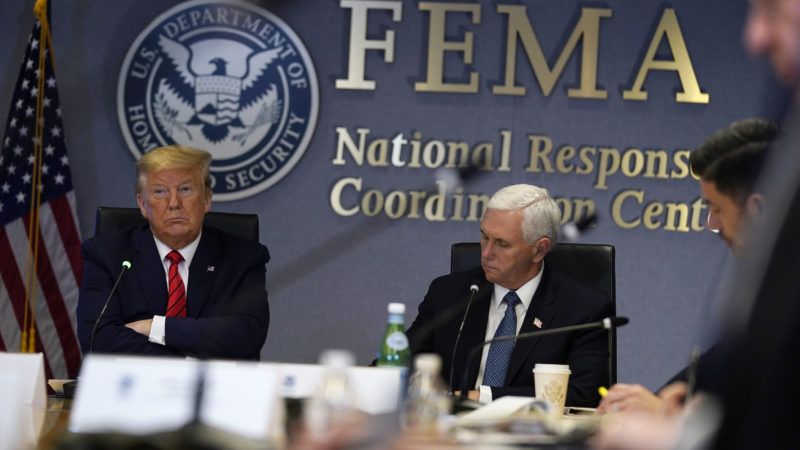
President Trump’s Coronavirus Task Force guidance recommended no more than ten people getting together for at least the next eight weeks.

In the days to come, it is possible that the government will act even more drastically. As most churches are now not gathering on Sundays for the time being, some are asking if these sorts of health mandates are a violation of religious liberty.

The Short Answer is No

Before I explain why, let me note that the question is a reasonable one. After all, we maintain that no government is lord of the church–our only Head is Jesus Christ. And there would be many circumstances in which a government illegitimately could use powers to keep churches from gathering. That said, nothing that is happening right now related to this crisis is, in my view, a violation of religious liberty or the separation of the church from the state.

Our commitment to religious liberty is grounded in what Jesus taught us—that the spheres of the church and the state are different, and the one should not have authority over the other. The state has the “power of the sword,” for instance, to punish criminals and to maintain civic order (Rom. 13:1-7), while the church does not (1 Cor. 5:9-12). The church has the authority to proclaim the gospel and to define the boundaries of the fellowship within that gospel, the state does not.

Legitimate God-Given Authority to Protect in Crisis

The current situation facing us is not a case of the state overstepping its bounds, but rather seeking to carry out its legitimate God-given authority. Nowhere, at this point, have we seen churches targeted because of their beliefs or mission.

At issue is a clear public objective—stopping the transmission of a dangerous virus by gatherings. This applies to the local plate jugglers association just as much to churches. Because the state must respect the consciences and souls of the people, consciences and souls over which it has no ultimate authority, any action involving religious bodies should have, in the words of the Religious Freedom Restoration Act of 1993, a “compelling state interest” and must pursue the “least restrictive means” of achieving it.

In my view, both of these tests have been met, in every case I have seen.

This is an area—the protection of public health—where the state has not just a legal authority but an authority granted by God himself. The state could not, for instance, decline to prosecute a murder because the shooting happened during a church service. And the church could not claim that religious liberty is violated because the state would not allow them to shelter from accountability the shooter.

Legitimate Public Interest So Far

Someone could not claim a religious liberty to embezzle just because the embezzling is happening during the church offertory. The same principle is at work here. Governments are seeking to limit gatherings of people. That is a legitimate public interest, and the government is seeking to do so in the least intrusive way possible.

So far. Everything here refers to actions taken so far.

The situation will almost inevitably lead to even stronger and less voluntary government actions. Could these encroach on religious liberty? That is certainly possible, but not necessarily. To prevent that, we will need more secular leaders to think carefully about why religion is important and more religious leaders to be thinking through the complexities of public health…(continues)

Click here to continue reading at Crosswalk.

Politico: DOJ Seeks Sweeping Powers

From Politico – DOJ seeks new emergency powers amid coronavirus pandemic

The Justice Department has quietly asked Congress for the ability to ask chief judges to detain people indefinitely without trial during emergencies — part of a push for new powers that comes as the coronavirus spreads through the United States.

Documents reviewed by POLITICO detail the department’s requests to lawmakers on a host of topics, including the statute of limitations, asylum and the way court hearings are conducted…

The request raised eyebrows because of its potential implications for habeas corpus –– the constitutional right to appear before a judge after arrest and seek release.

“Not only would it be a violation of that, but it says ‘affecting pre-arrest,’” said Norman L. Reimer, the executive director of the National Association of Criminal Defense Lawyers. “So that means you could be arrested and never brought before a judge until they decide that the emergency or the civil disobedience is over. I find it absolutely terrifying. Especially in a time of emergency, we should be very careful about granting new powers to the government.”

Reimer said the possibility of chief judges suspending all court rules during an emergency without a clear end in sight was deeply disturbing…

Reason: Stop Looking for ‘Leadership’ During the COVID-19 Outbreak

JD Tuccille at Reason has some well pointed words about leadership during the current pandemic – Stop Looking for ‘Leadership’ During the COVID-19 Outbreak

As the COVID-19 pandemic hit the U.S., pundits and opposition politicians pounded President Trump for displaying a “lack of leadership” in response to the deadly virus. And it’s true that, as always, the president was prone to minimizing inconvenient developments, bristling at critics, and contradicting members of his own team. Without a strong, focused figure in the White House (maybe somebody less deplorable?), we can’t possibly pull through this crisis, the opponents suggested. But that’s ridiculous; anybody making their responses to events contingent on political office not being held by narcissistic ass-clowns is putting their fate in the hands of circumstances they can’t control. They’re making a false virtue of dependency.

That’s not to say we shouldn’t listen to people who have expertise. Epidemiologists shared widely reported warnings in January of “the spread of 2019-nCov within and outside mainland China.”

“The more we learn about it, the greater the possibility is that transmission will not be able to be controlled with public health measures,” Toronto-based Allison McGeer, an infectious disease specialist, cautioned at roughly the same time.

Even China’s awful political rulers, who muzzled medical whistleblowers after they warned of the disease (there’s leadership!), admitted by the end of the month that the situation was out of control.

Just weeks later, the World Health Organization, as clumsy and prone to stroking authoritarian regimes as it is, said the virus had “pandemic potential,” while the Centers for Disease Control and Prevention warned of “severe” disruptions to American life from “community spread” of the new virus.

Anybody paying attention had the opportunity to get ready for what was comingif they were allowed to do so by our fearless leaders.

It’s worth noting that, when political officials act, their most positive efforts come from getting out of the waythat is, by undoing the “leadership” they demonstrated on earlier matters.

President Trump announced “compassionate use” easing of restrictions on patients’ use of drugs that don’t yet have FDA approval for treating COVID-19.

Congress extended liability protection for makers of protective N95 face masks so that hospitals can directly purchase equipment that isn’t specifically approved for medical purposes under cumbersome FDA rules.

Eased regulation enforcement, announced by the Centers for Medicaid and Medicare Services (CMS), means the government won’t take action against health insurers who modify their catastrophic plans to cover COVID-19 diagnosis and treatment for their customers.

Licensed physicians can also now practice across state lines, under CMS waivers that ease a host of other rules that bind the practice of medicine in red tape. The feds played catch-up on that one: states including Arizona, California, Florida, Louisiana, Massachusetts, Mississippi, North Carolina, Tennessee, and Washington had already moved to ease restrictive licensing of medical providers before the feds jumped on the issue.

Even the Transportation Security Administration is joining in, modifying its insistence that doom is found in any liquid container of more than 3.4 ounce capacity so that travelers can carry 12-ounce bottles of hand sanitizer on airplanes.

“The coronavirus is forcing authorities to admit many of their regulations are unnecessary,” Reason‘s Nick Gillespie noted…(continues)

Click here to read the entire article at Reason.com

Organic Prepper: Ways to Prep When There Are No Supplies and You’re Out of Money

Daisy Luther at The Organic Prepper has a timely article out 12 Ways to Prep When There Are No Supplies to Buy and You’re Out of Money. Anyone reading the news knows that many preparedness/daily living items are in short supply, and with millions laid off or working reduced hours money is tight for many more.

If you’ve been prepping for the Covid-19 pandemic recently, you’ve probably noticed a couple of things.

  1. The stores are quickly running out of the supplies people want.
  2. People are quickly running out of money.

Both of these things are important. Of course, if there are no supplies, you can’t buy what you need. But secondly, you need to still consider your budget. This situation with Covid-19 will be personally costly. At this point, we all still have bills to pay and your stockpile won’t do you much good when it’s sitting on the curb beside you because you couldn’t make your mortgage payment.

So while I advise doing everything you can to be prepared, I also encourage you NOT to go deeply into debt now of all times. People are getting laid off by the tens of thousands right now. Everything is changing.

We’re at a critical point right now when there’s a crisis bearing down on us and we want to get prepared. But there are very few supplies left on store shelves to buy and many of us don’t have much money left to spend. This does not mean there’s nothing you can do. In fact, you’re at one of the most crucial junctures of preparedness right now.

How to prep without buying more stuff

Here are some things you can do to prepare for the possibility of quarantine when you’ve put a halt to the frantic spending. Make yourself a checklist and get cracking.

  1. Fill up all your containers with water. A Mason jar full of water takes up the same amount of space as an empty Mason jar. Go through your house and fill up every vessel you can with water.
  2. Organize your supplies. If you bought a whole lot of stuff in a frenzy – and let’s be honest, a lot of us did – you may have them stacked in a precarious pile in some area of the house. Take the time to organize your food. You can go about this in different ways – put ingredients for meals together, put all the veggies in one area, all the grains in another area…however you decide to go about it, getting organized will help you see what you have on hand.
  3. Make a menu. While you’re organizing your food stockpile, create some meal plans based on the supplies that you have.
  4. Organize first aid and medical supplies. Put all your first aid, over-the-counter medications, prescription meds, and medical supplies together so you can see what you have. Think about how you can improvise anything you’re missing.
  5. Organize other supplies. I keep my supplies in kits. I have a power outage kit with candles, lighters, flashlights, batteries, solar chargers, etc. I have a pandemic kit I created back in 2014 during the Ebola scare with masks, gloves, Tyvek suits, booties, and other things specific to a pandemic. I use big Rubbermaid tubs for these kits but you can use anything: cardboard boxes, even space on a shelf.
  6. Do a home-security check.  Go outside and take a walk around your house. Are there things that need to be addressed to make your home more secure? Do you need to trim back some shrubs to keep the area under windows visible? Should you secure downstairs windows so they can’t easily be raised up from the outside? Can you put a locking latch on the gate in the back yard? Does your shed need a lock on it? Focus on the small tasks you may have been putting off to make your home more secure.
  7. Make a family security plan. Would your family members know what to do in the event of a home invasion? If not, you need to make a plan. Vulnerable family members need to get out of the way, and family members who are engaging the criminals need to know who is doing what so they don’t get in each other’s way. Place weapons and potential weapons in strategic areas around the home.
  8. Figure out a long-term water plan. Where could you acquire water if no longer came from the taps? Identify places where you could get water – creeks, ponds, rivers, lakes, even fountains if you’re in the city. If there’s nothing like that, figure out how you could capture rainwater the most efficiently. Make sure you have a way to purify this water.
  9. Take a look at your budget. Are there things you can cut right now to help you get better prepared for a long-term financial crisis? Slash unnecessary expenditures now. Call your insurance company for a better rate. Cancel subscription boxes.
  10. Spend some time learning. If you’re already in lockdown, make the most of your time by learning new skills and acquiring knowledge. The best thing you can do right now is to subscribe to Selco’s Patreon that he’s running with his business partner Toby. It’s only $1 a month and the information on there is timely and PURE GOLD. Learn to make things, repair things, grow things, and take some time to look into old-fashioned solutions. This is a great time to pick up some new skills. Read some of those books in your to-read pile and check out how-to videos on YouTube.
  11. Clean and do laundry. This may not sound like a prep at all, but in the unlikely event that the power is interrupted, it would really be bad to start out with a house that needs to be vacuumed and a sky-high pile of dirty laundry.
  12. Assess your neighborhood. If it’s still okay to go for a walk (without coming in close contact with others) take a stroll around your immediate neighborhood. Identify resources, like creeks or fruit trees in the park. Think about which neighbors are more likely to be allies and which ones you expect could be troublesome. This isn’t something you need to act on now – you’re just gathering information.

When you complete these exercises you may find that there are a few things you still need to buy. At the time of this writing, you can probably still do that. The good news is, these things are unlikely to be the stuff that everyone else is buying in a frenzy – think about essential hardware, high-level medical supplies, and tools.

There’s a lot more to prepping than simply buying stuff and piling it into a closet. The time you spend now on non-purchase prepping is also very important. It’s a whole lot easier to think things through right now when you are calm and well-fed than it is to try and figure them out when you’re under stress. This isn’t the time to sit around streaming Netflix or doing a crossword puzzle. There’s a lot of work to be done before we reach the point that we can’t do anything more.

So close that Amazon window on your computer and get to work…

Click here to read the entire article at The Organic Prepper.

Cato Institute: H‑2A Visas for Agriculture – The Complex Process for Farmers to Hire Agricultural Guest Workers

The Cato Institute has a lengthy article explaining the H-2A agricultural worker program – H‑2A Visas for Agriculture: The Complex Process for Farmers to Hire Agricultural Guest Workers

Congress created the H‑2A program in 1986 to allow legal foreign workers to temporarily work for U.S. farmers who were unable to hire qualified Americans. However, illegal immigrant workers came to dominate the industry in the 1990s, and the H‑2A program was rarely used. While it still supplies only about 10 percent of farm labor, H‑2A employment has increased fivefold since 2005.

The H-2A program needs reforms, but productive reform is only possible if policymakers understand how the system currently operates. This brief explains how the H-2A visa program works. Its main findings include the following:

  • The H-2A program has more than 200 rules and is bureaucratically complex.
  • H-2A minimum wages are higher than every state’s minimum wage by, on average, 57 percent.
  • Americans accept only 1 in 20 H-2A job offers, and most later quit.
  • H-2A expansion is likely responsible for much of the large decline in illegal immigration from Mexico.
  • Violations of H-2A regulations are generally minor. An average of only 0.27 percent of farmers per year have been barred from the program because of serious H-2A violations.

H‑2A Program Rules

The H-2A program is an employer-sponsored temporary worker program, meaning that farmers initiate the process, not the workers. The H-2A visa program has no numerical cap but is restricted to temporary or seasonal jobs lasting less than a year.1 This requirement significantly limits participation and effectively bars dairies and most animal farms that demand labor year-round.2 H-2A’s most widely used predecessor—colloquially known as the Mexican Bracero Program (canceled in 1964)—had no such limitation.3 The H-2A program also narrowly defines “agriculture,” excluding most meat packers and processors.4

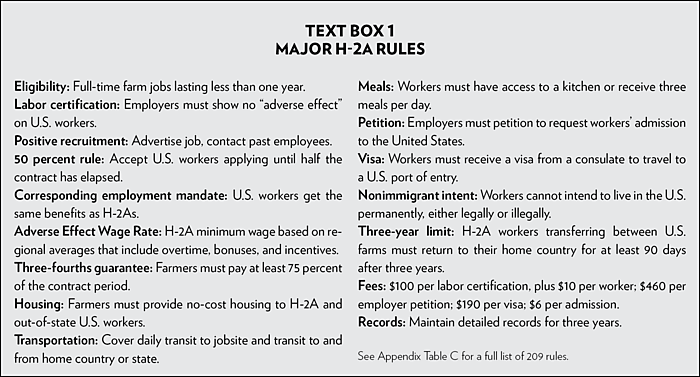
Figure 1 broadly outlines the H-2A process. The Government Accountability Office has found that the “complexity of the H-2A program poses a challenge for some employers” because it “involves multiple agencies and numerous detailed program rules that sometimes conflict with other laws.”5 In 2014, the U.S. Citizenship and Immigration Services (USCIS) ombudsman characterized the H-2A program simply as “highly regulated.”6 Appendix Table C details a noncomprehensive list of 209 H-2A rules that apply to workers and farmers, and Text Box 1 is a short summary of those rules.

IRBP Text Box 1

To start, when farmers have jobs that they want to fill with H‑2A workers, they must first receive a labor certification from the Department of Labor (DOL).7 They must antic­ipate a worker shortfall and initiate the labor certification process 60 days before the job’s start date by submitting job orders to State Workforce Agencies (SWAs), which are state‐​run entities that help unemployed U.S. workers.8 The SWAs guarantee that job offers comply with H‑2A regulations and inform unemployed Americans about the job opportunities.9 Farmers meanwhile must contact former U.S. employees and advertise the jobs.10

If too few U.S. workers apply, DOL will again review the jobs and certify the farmer to hire foreign workers for the remaining positions. The law requires DOL to make certifications at least 30 days before the job starts.11 Delays have cost farmers millions of dollars in lost crops.12 But the internet has improved DOL processing: it deployed online applications in 2012, and by 2019, about 94 percent of applicants used it.13 As a result, the department moved from completing just 63 percent of labor certifications within 30 days in 2011 to completing 97 percent in 2015 (Figure 2).14 In 2019, however, delays reemerged as DOL had the lowest rate of timely approvals (86 percent) of any year since 2013.15

If DOL grants the labor certification, the farmer pays fees of $100 plus $10 per worker, up to $1,000 total.16 Even after H-2A workers start, however, farms must continue to accept U.S. workers until half the job period has expired.17 … (continues)

Mises: Government Is No Match for the Coronavirus

Robert Luddy at The Mises Institute writes about why government is failing so badly in pandemic response – Government Is No Match for the Coronavirus

The coronavirus is reminding everyone that you cannot rely on government and that ultimately it is the private sector that will provide the solutions. Many nonmedical government officials and members of the media are predicting massive cases of COVID-19 and death, when in fact no one can predict the outcome. What we do know is that government has created a full-blown national panic, when at this point the normal flu season is far more deadly.

Decentralization is critical to a functioning society but often precluded by federal regulations.

The Washington Post reported the following about the Centers for Disease Control:

The problems started in early February, at a CDC laboratory in Atlanta.

A technical manufacturing problem, along with an initial decision to test only a narrow set of people and delays in expanding testing to other labs, gave the virus a head start to spread undetected—and helped perpetuate a false sense of security that leaves the United States dangerously behind.

Tests begin with the CDC to insure quality, which is exactly the wrong approach. It assumes that the government can outperform the best medical industry in the world. Even at this hour the CDC has failed, shipping test kits that are defective.

The CDC does not have a solution, but it also becomes the classic blocker to progress. Labs cannot act without a lengthy approval process from CDC and the Food and Drug Administration (FDA). These government controls violate the principle of subsidiarity (that problems should be solved at the lowest level possible). Ultimately care is provided by local hospitals, care facilities, and labs.

South Korea’s rapid testing allowed for early treatment and containment of the virus. These test kits were created in three weeks. Many labs in the US could have solved the test kit problem but were restrained by the FDA and CDC. The South Koreans offered to help us, but was the CDC listening? Evidently not.

At the president’s request on Friday, America’s robust private sector, including Walmart, Walgreens, CVS, Roche Laboratories, and LabCorp, came up with a solution for mass testing. Roche has received fast-track FDA approval for its COVID-19 diagnostic test. This testing will be done via drive-thru in parking lots. This minimizes contact and allows for mass testing of thousands across the country. The more Americans are tested, resulting in a lower percentage of deaths, the more the testing will have a calming effect on our citizens.

Americans consider regulators and government to be sacrosanct, but in fact government agencies are slow and often fail us. Think of the Federal Aviation Administration (FAA), which allowed Boeing engineers to bypass basic engineering standards, resulting in the crash of two Boeing 737 MAX airliners and the grounding of nine hundred planes around the world.

We all know that any time we expect service from the government, it will be slow and painful vs. the private sector, which is mostly fast and courteous. In spite of some minor shortages, due to hoarding, the private sector is supplying us with gas, food, prepared meals, medical supplies, and healthcare.

The coronavirus crisis must cause us to rethink government. The Trump administration has restricted new regulation and reduced arcane strictures, which has resulted in a booming economy. It is absolutely true that most private industry can be trusted, because the alternative for poor or unscrupulous providers is failure. Private industry can be sued and suffer financial decline, unlike government, which simply demands more money for poor performance. Business or individuals that commit fraud are subject to civil and criminal penalties…(continues)

Click here to read the entire story at Mises Wire.

Doom and Bloom: Medical Improvisations – DIY Techniques for Survival First Aid & Hygiene

The Altons at Doom and Bloom Medical have an article published in OffGrid magazine by Recoil, issue 36 – Medical Improvisations – DIY Techniques for Survival First Aid & Hygiene

We live in a world where established safety measures, if followed, prevent a lot of injuries. Unfortunately, they’ll never prevent all injuries. There were an estimated 45 million incidents of trauma in the U.S. last year that required an emergency room visit. Car wrecks, outdoor injuries, industrial accidents, and other mishaps contribute to a whole lot of hurt in good times. That leaves us to wonder: How would this change in bad times?

Let’s face it, people get injured and sick whether or not there’s a rescue helicopter on the horizon. Broken bones, bleeding, sprains, and other issues will need to be treated.

If the modern emergency system breaks down, is overloaded, or simply too far away, someone in the family or group will become the highest medical asset left. Certified or not, they’ll be the end of the line with regards to the medical well-being of their people. Without equipment and know-how, deaths will occur that could’ve been prevented with a good medical kit and knowledge of basic first aid.

People prepare for the worst by accumulating food, water, personal protection items, and more. The wisest of them also stockpile a good supply of medical equipment and medicines as well. In a short-term event, those with training and equipment will save many lives. But what happens when the medic bag is empty?

All is not lost. Necessity, they say, is the mother of invention. The resourceful will make do with found objects. A variety of items on the trail or in abandoned buildings can serve as medical supplies. All it takes is an instinct to explore, a good eye, and some imagination.

Before we begin, it should be mentioned that the medical improvisations below are stopgap measures for dire situations when traditional medical resources and treatment are not available — unfortunately, the current Coronavirus / COVID-19 outbreak may be one such circumstance, if it continues to worsen. Improvised methods are rarely as successful as modern technology and equipment (if used properly). Having said that, some of the strategies below might just save lives in times of trouble.

WATER BOTTLES AS FILTERS

You can last quite a while without food, but only about three days without water. Even when there’s a water source nearby, you can’t see the microscopic organisms that make you sick. In survival settings, more lives may be lost by diseases due to contaminated water than bullet wounds.

With a clear plastic PET (polyethelene terephthalate) bottle, you can make water safer. It shouldn’t be hard to find; approximately 500 billion are produced every year. Unless you have a purpose-built water filter like the Sawyer Mini or LifeStraw, you’ll need containers to: 1) filter out particulates that make the water cloudy, and 2) destroy disease-causing microbes in the water.

To improvise a filter, you’ll need the following items that you might find by scavenging, or in your medical kit…