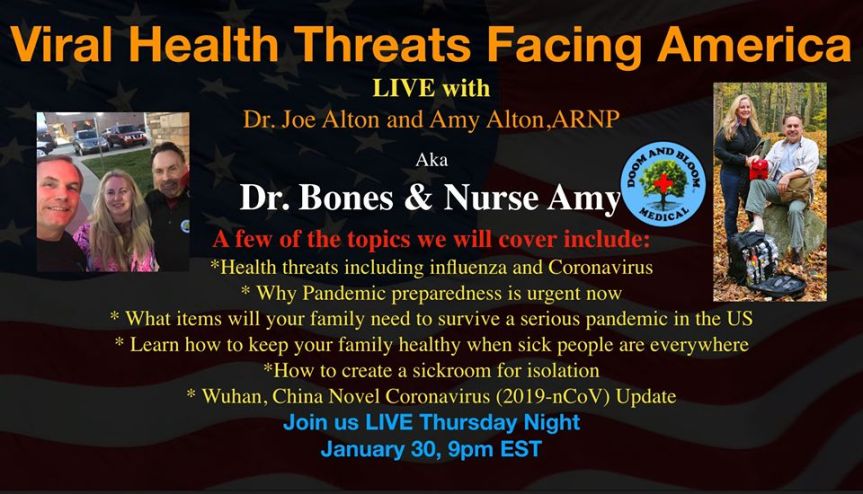
The Altons at Doom and Bloom Medical have a video up on the WHO recommendations for home care of a coronavirus infected patient who has been asked to stay at home after medical evaluation.
Coronavirus
In situations when hospitals may be overwhelmed or understaffed the WHO has released guidance for Home Care of patients with mild symptoms. All concerned patients should be first be evaluated in a medical facility before home care is initiated. These measures are meant to decrease public contacts and the spread of disease, and decrease the patient load on hospitals during epidemics and pandemics .
Learn which patients may be asked to stay home during illness and when they should be hospitalized. A link to a medical facility should be established for the entire duration of any home home care until all symptoms have cleared and the facility releases the patient and resolved. This connection will allow family members and the patient to be reassured there is contact with a medical professional for questions and concerns.
Home care takes planning and education about personal hygiene, basic infection prevention and control protocols, and how to safely care for the sick person without spreading it to other household members. Recommendations (from the World Health Organization) are detailed in this video. Also see our How To Build A Sickroom video.
Wishing you the best of health in good times and bad,
The SARS-CoV2 virus, newest member of the coronavirus family has proven to be especially contagious, with over 80,000 cases and 2700 deaths so far. Cases of COVID-19 (the name for the disease) have been reported in more than 30 countries and community-wide outbreaks are confirmed in places like Italy in Europe, Iran in the Middle East, and South Korea (among others).
Although the grand majority of cases are still in mainland China, more cases are being reported outside China than inside these days. South Korea has more than 1,260 cases and one of them is a U.S. soldier. Italy has 320 cases and 12 dead. Iran only claims 139 cases but 19 deaths, much more than the 2 percent fatality rate seen in other countries. Most suspect this means that many tens of thousands are still undetected.
Meanwhile, The Centers for Disease Control and Prevention (CDC) gave an opinion that “the immediate risk of this new virus to the American public is believed to be low at this time,” while also saying: “It’s not so much a question of if this will happen anymore but rather more a question of exactly when”.
Despite the many cases that are popping out throughout the world, Most U.S. experts and World Health Organization (WHO) officials believe that COVID-19 is not yet at pandemic status. If the COVID-19 outbreaks all over the world aren’t a pandemic, what is?
WHO Regions
The World Health Organization should consider following their own definitions for pandemic disease. The different WHO phase alerts for infectious disease outbreaks are:
Phase 1: The disease is found circulating in animals; no known infections in humans. An example would be an outbreak in 2019 of vesicular stomatitis virus, a disease that affected more than a thousand premises holding horses. No cases were reported among humans, even those who worked daily with the animals.
Phase 2: The disease has caused proven infection in humans. The bird flu affected millions of poultry as well as a number of people who lived and worked in close contact with them.
Phase 3: Small clusters of disease occur in humans but do not affect entire communities. Measles virus may affect a number of non-vaccinated people in an area, but the large number of vaccinated individuals prevents it from running rampant.
Phase 4: The disease affects entire communities. The disease now qualifies as an epidemic, but the risk for a pandemic, although increased, is not certain. With COVID-19 in early 2020, large areas in China were saturated with cases but no major community-wide outbreak had originated anywhere else for a time (outside of a cruise ship). Since then, other countries are reporting spikes in cases, with cases in South Korea doubling over the course of one day. In my opinion, COVID-19 has now passed this stage.
Community-wide Ebola outbreaks stayed in one region
Phase 5: Spread of disease between humans is occurring in more than one country in a region. The Ebola virus outbreak of 2014 is an example of this phase; cases affected communities in several different adjacent West African countries but no community outbreaks occurred outside of the region. In 2020, COVID-19 cases in nearby nations like South Korea and Japan are starting to accumulate, just as Ebola did in West African countries in 2014.
Phase 6: Community-level outbreaks exist in at least one additional country in a different region. With Ebola, cases in North America and Europe didn’t originate there and the infection didn’t take hold locally in any significant manner. Influenza, however, commonly reaches pandemic status on an annual basis.
COVID-19 in 2020 is developing large numbers of cases of human-to-human transmission outside of China. With outbreaks in Italy, Iran, South Korea, and elsewhere predicted to get worse before they get better, it’s clear you’ve got a pandemic on your hands. Right now.
I say this not just because of the cases that have been reported, but because we can only surmise that the number of cases documented is less than what really exist.
That doesn’t necessarily mean that real numbers are being held back. Statistics may be affected by the limitation on lab facilities to test for a disease. In some emerging infectious diseases, no test may be accurate enough to give proven results. In the COVID-19 outbreak, a number of people have tested negative using the current technology and still show symptoms.
Quarantines of entire cities in the face of a dangerous disease may lead those who are mildly ill to stay inside their homes and not seek care in overcrowded hospitals. As a result, many cases may not be counted.
Sometimes, however, a government may put out inaccurate numbers in an effort to avoid panic in its citizens. Certain regimes may limit the dissemination of information to give an unclear picture of the epidemic’s real effect on the country.
For example, we have no idea of how many cases of COVID-19 may exist in North Korea, a nation which borders China and most certainly has been affected. Yet, the government is completely silent about the SARS-COV2 virus.
Face Masks cannot be exported from China
When people are prepared, they can purposefully and rationally act to decrease their chance of infection. But to get prepared, most people look to their government’s health agencies for advice. Those health agencies should alert citizens with enough time to get the supplies they need and prepare.
Epidemics don’t just make people sick; they also disrupt the chain of supply. China, a major producer of face masks, has already mandated that they are no longer for export. In the U.S., many personal protection gear items are already scarce.
It’s important to know that there’s no need to panic. Hopefully, the CDC opinion is correct in its assessment that the immediate risk to Americans is low . If we are to weather this storm, however, we need to be shown the black clouds on the horizon. Declare a pandemic and let’s work to get our communities ready with a plan of action. Complacency can be hazardous to your health.
Virology Down Under is a website run by Ian Mackay, a PhD in virology. The following article was written for the site by Jody Lanard and Peter Sandman who are experts in risk communication and have written about risks involved with Ebola, Swine Flu and Zika in addition to Coronavirus. In Past Time to Tell the Public: “It Will Probably Go Pandemic, and We Should All Prepare Now the authors discuss the fact that governments should already be telling people to get prepared for a pandemic and banned public gatherings. The time for trying to contain the virus is past and pandemic preparedness is upon us. Don’t expect the government to keep the virus from your door.
In addition to the dangers of the virus itself, people should be prepared for product shortages off all types if the coronavirus goes pandemic. There have already been reports of things like face masks, and some auto manufacturers have warned that factories will need to close because of a lack of parts from China. But there are more common everyday items that are at risk of shortage, too. For example, Procter & Gamble has warned that it may have supply problems with over 17,000 of its products because they are supplied through over 380 companies in China. Procter & Gamble is a huge supplier of consumer products including such brands as Charmin, Crest, Tide, Vicks, Gillette, Pampers, Always, Tampax, Pepto-Bismol, Olay, Old Spice, Secret, and many, many other common household names.
We are starting to hear from experts and officials who now believe a COVID-19 pandemic is more and more likely. They want to use the “P word,” and also start talking more about what communities and individuals can and should do to prepare. On February 22, Australian virologist Ian Mackay asked us for our thoughts on this phase of COVID-19 risk communication.
Here is our response.
Yes, it is past time to say “pandemic” – and to stop saying “stop”
It’s a good time to think about how to use the “P word” (pandemic) in talking about COVID-19. Or rather, it is past time.
It is important to help people understand that while you think – if you do think so – that this is going to be pandemic in terms of becoming very widespread, no one knows yet how much severe disease there will be around the world over short periods of time. “Will it be a mild, or moderate, or severe pandemic? Too soon to say, but at the moment, there are some tentative signs that….”
The most crucial (and overdue) risk communication task for the next few days is to help people visualize their communities when “keeping it out” – containment – is no longer relevant. The P word is a good way to launch this message.
But the P word alone won’t help the public understand what’s about to change: the end of most quarantines, travel restrictions, contact tracing, and other measures designed to keep “them” from infecting “us,” and the switch to measures like canceling mass events designed to keep us from infecting each other.
We are near-certain that the desperate-sounding last-ditch containment messaging of recent days is contributing to a massive global misperception about the near-term future. The theme of WHO’s and many governments’ messages – that the “window of opportunity” to stop spread of the virus is closing – is like the famous cover page of Nevil Shute’s On the Beach: “There is still time … Brother.”
For weeks we have been trying to get officials to talk early about the main goal of containment: to slow the spread of the virus, not to stop it. And to explain that containment efforts would eventually end. And to help people learn about “after containment.” This risk communication has not happened yet in most places.
One horrible effect of this continued “stop the pandemic” daydream masquerading as a policy goal: It is driving counter-productive and outrage-inducing measures by many countries against travelers from other countries, even their own citizens back from other countries. But possibly more horrible: The messaging is driving resources toward “stopping,” and away from the main potential benefit of containment – slowing the spread of the pandemic and thereby buying a little more time to prepare for what’s coming.
We hope that governments and healthcare institutions are using this time wisely. We know that ordinary citizens are not being asked to do so. In most countries – including our United States and your Australia – ordinary citizens have not been asked to prepare. Instead, they have been led to expect that their governments will keep the virus from their doors.
Take the risk of scaring people
Whenever we introduce the word “pandemic,” it’s important to validate that it’s a scary word – both to experts and to non-experts – because it justifiably contains the implication of something potentially really bad, and definitely really disruptive, for an unknown period of time. This implication is true and unavoidable, even if the overall pattern of disease ends up being mild, like the 2009-10 “swine flu” pandemic.
Validate also that some people may accuse you of fear-mongering. And respond that hiding your strong professional opinion about this pandemic-to-be would be immoral, or not in keeping with your commitment to transparency, or unforgivably unprofessional, or derelict in your duty to warn, or whatever feels truest in your heart.
It may help to consider the “damned if you do, damned if you don’t” fallacy. Feel free to say that “Jody Lanard and Peter Sandman say” that officials or experts – in this case YOU – are “darned if you do anddamned if you don’t.” You’re only darned if you warn about something that turns out minor. But you’re damned, and rightly so, if you fail to warn about something that turns out serious.
It’s simply not true, in principle or in practice, that you are damned if you do and damned if you don’t! Over-alarming risk messages are far more forgivable than over-reassuring ones.
Push people to prepare, and guide their prep
This is the most culpable neglected messaging in many countries at this point.
The main readiness stuff we routinely see from official and expert sources is either “DON’T get ready!” (masks), or “Do what we’ve always told you to do!” (hand hygiene and non-mask respiratory etiquette).
The general public, and many categories of civil society, are not actively being recruited to do anything different in the face of COVID-19 approaching.
A fair number of health care workers and communication officers tell us their hospitals and healthcare systems are just barely communicating about COVID-19. They want to be involved in how to prepare for “business not as usual.” We’re guessing that many hospital managements are in fact preparing for COVID-19, but we worry that they’re doing it too quietly, without enough effort to prepare their staff.
Lots of businesses, especially smaller ones, are doing off-the-cuff pre-pandemic planning. Several trade journals have articles about how specific industries should prepare for a likely pandemic. Around February 10, the U.S. Centers for Disease Control and Prevention posted interim guidance for businesses. But we have seen almost nothing in mainstream media citing this guidance, or recommending business continuity strategies like urgent cross-training so that core functions won’t be derailed because certain key employees are out sick, for instance.
Pandemic planning research suggests that employees are likeliest to say they will show up for work during a pandemic if three specs are met – if they think their family is reasonably safe; if they think their employer is being candid with them about the situation; and if they have a pandemic-specific job assignment in addition to or different from their routine “peacetime” assignment.
Hardly any officials are telling civil society and the general public how to get ready for this pandemic.
Even officials who say very alarming things about the prospects of a pandemic mostly focus on how their agencies are preparing, not on how the people they misperceive as “audience” should prepare. “Audience” is the wrong frame. We are all stakeholders, and we don’t just want to hear what officials are doing. We want to hear what we can do too.
We want – and need – to hear advice like this:
Try to get a few extra months’ worth of prescription meds, if possible.
Think through now how we will take care of sick family members while trying not to get infected.
Cross-train key staff at work so one person’s absence won’t derail our organization’s ability to function.
Practice touching our faces less. So how about a face-counter app like the step-counters so many of us use?
Replace handshakes with elbow-bumps (the “Ebola handshake”).
Start building harm-reduction habits like pushing elevator buttons with a knuckle instead of a fingertip.
There is so much for people to do, and to practice doing in advance.
Preparedness is emotional too
Suggesting things people can do to prepare for a possible hard time to come doesn’t just get them better prepared logistically. It also helps get them better prepared emotionally. It helps get them through the Oh My God (OMG) moment everyone needs to have, and needs to get through, preferably without being accused of hysteria.
It is better to get through this OMG moment now rather than later.
Offering people a list of preparedness steps to choose among means that those who are worried and feeling helpless can better bear their worry, and those who are beyond worry and deep into denial can better face their worry.
Yet another benefit: The more people who are making preparedness efforts, the more connected to each other they feel. Pandemic preparedness should be a communitarian experience. When a colleague offers you an elbow bump instead of a handshake, your mind goes to those lists of preparedness recommendations you’ve been seeing, and you feel part of a community that’s getting ready together.
This OMG realization that we have termed the “adjustment reaction” (see http://www.psandman.com/col/teachable.htm) is a step that is hard to skip on the way to the new normal. Going through it before a crisis is full-blown is more conducive to resilience, coping, and rational response than going through it mid-crisis. Officials make a mistake when they sugarcoat alarming information, postponing the public’s adjustment reaction in the vain hope that they can avoid it altogether.
Specific pandemic preparedness messages
Below are links to specific preparedness messaging we drafted for a possible H5N1 pandemic. The links are all from our 2007 website column What to Say When a Pandemic Looks Imminent: Messaging for WHO Phases Four and Five. Each item is in two parts – a draft message (a summary sentence followed by a few paragraphs of elaboration), then a risk communication discussion of why we think it’s an appropriate pre-pandemic message. Because these were written with H5N1 in mind, the pandemic they contemplate is more severe and less likely than the one we contemplate today. So some changes may be called for – but frankly, in our judgment, not many.
One of the scariest messaging failures in the developed world is not telling people vividly about what the end of containment will look like, for instance the end of contact-tracing and most quarantines.
The FAQs on the Singapore Ministry of Health webpage (https://www.moh.gov.sg/covid-19/faqs) can serve as a model that other developed countries can adapt to start talking to their publics about this now, to reduce the shock and anger when governments stop trying to contain all identified cases.
What’s working for us
We’d like to share with you some of our recent everyday life experiences in talking about pandemic preparedness with people who perceive us as a bit knowledgeable about what may be on the horizon. Some of this overlaps with the more generic comments above.
1. We’ve found it useful to tell friends and family to try to get ahead on their medical prescriptions if they can, in case of very predictable supply chain disruptions, and so they won’t have to go out to the pharmacy at a time when there may be long lines of sick people. This helps them in a practical sense, but it also makes them visualize – often for the first time – how a pandemic may impact them in their everyday lives, even if they don’t actually catch COVID-19. It simultaneously gives them a small “Oh my God” moment (an emotional rehearsal about the future) – and something to do about it right away to help them get through the adjustment reaction.
2. We also recommend that people might want to slowly (so no one will accuse them of panic-buying) start to stock up on enough non-perishable food to last their households through several weeks of social distancing at home during an intense wave of transmission in their community. This too seems to get through emotionally, as well as being useful logistically.
3. Three other recommendations that we feel have gone over well with our friends and acquaintances:
Suggesting practical organizational things they and their organizations can do to get ready, such as cross-training to mitigate absenteeism.
Suggesting that people make plans for childcare when they are sick, or when their child is sick.
4. And the example we like the best, because it gives every single person an immediate action that they can take over and over: Right now, today, start practicing not touching your face when you are out and about! You probably won’t be able to do it perfectly, but you can greatly reduce the frequency of potential self-inoculation. You can even institute a buddy system, where friends and colleagues are asked to remind each other when someone scratches her eyelid or rubs his nose. As we noted earlier, someone should develop a face-touching app – instead of a step-counting app to encourage you to walk more, how about an app to encourage you to auto-inoculate less! And track your progress, and compete with your friends, even!
The last message on our list – to practice and try to form a new habit – has several immediate and longer-term benefits.
Having something genuinely useful to do can bind anxiety or reduce apathy. You feel less helpless and less passive.
And you can see yourself improving.
And you can work on your new habit alone, and also in a pro-social communitarian way. Others can help you do it, and you can help them.
And it yields real harm reduction! It is arguably the endpoint of what washing your hands is for, and it helps when you can’t wash your hands out in the world.
Like all good pandemic preparedness recommendations, it helps you rehearse emotionally, as well as logistically.
The bottom line
Every single official we know is having multiple “Oh my God” moments, as new COVID-19 developments occur and new findings emerge. OMG – there is a fair amount of transmission by infected people with mild or subclinical cases! OMG – there is a high viral load early on in nasal and pharyngeal samples! OMG – the Diamond Princess, how can that have been allowed to happen! And on and on.
Officials help each other through those moments. They go home and tell their families and friends, sharing the OMG sensation. And then what do they tell the public? That they understand that “people are concerned” (as if they themselves weren’t alarmed), but “the risk is low and there’s nothing you need to do now.”
Ian, it sounds like you want to argue on behalf of preparedness. Encouraging all stakeholders to prepare logistically should start now, if not sooner. And you are in a position not just to encourage logistical preparedness, but also to encourage government sources and other experts like yourself to do the same. Perhaps even more important, in our judgment: You can try to encourage emotional preparedness, and try to encourage other official and expert sources to encourage emotional preparedness – guiding people’s OMG adjustment reactions instead of trying to stamp them out.
Cat Ellis, the herbal prepper and author of The Wuhan Coronavirus Survival Manual, has written an article about the coronavirus for The Organic Prepper. There is still a lot that we don’t know about the coronavirus, but we do know that it is highly contagious. There is still some question about the fatality rate, but estimates are still above 2% which is many times the rate for influenza but about the same as for the Spanish Flu pandemic of 1918.
…What was not known from the beginning was the rate of transmission and what percentage of people who become infected will become seriously or critically ill.
Worldometers breaks down the number of total active cases into mild and serious/critical categories. As of February 24, 2020, about 82% have a mild illness, and about 18% have a serious/critical illness requiring hospitalization. This is up from a rate of approximately 13% serious/critical cases just a few weeks ago.
Could this mean that the virus is mutating to become more dangerous? Possibly. But it could also just mean that as more data is collected, this additional data gives us a clearer picture of the real case fatality rate. Remember that the data we’ve received from China all along has been questionable. As the virus spreads to countries with more transparency, what we thought we knew is bound to change.
The same source cites the rate of transmission at between 2 to 3, meaning if there were a room with 10 people, and a person infected with this virus entered the room, you could reasonably expect 2 to 3 people to also become infected. For perspective, that is also 2 to 3 times as contagious as the flu.
The Worldometers coronavirus tracker, which is in line with several other coronavirus trackers from Johns Hopkins, BNO News, and Visa List, also lists the results of closed cases, i.e. cases with an actual outcome. Of the known outcomes, 91% recovered and 9% were fatal. What this means is that out of all the confirmed COVID-19 cases, about 18% will lead to serious or critical illness requiring hospital-level care and that 9% of that subset will die.
What about that 2% mortality rate? Part of the problem with calculating a case fatality rate is that you can’t actually know the true mortality rate (case fatality rate) until the outbreak is completely over. Until then, there are still cases without an outcome. In COVID-19, there are thousands more cases without outcomes yet.
The case fatality rate of 9% comes from taking the total cases of fatalities (2,701) and dividing it by the total number of cases with outcomes (30,334), then multiplying by 100 to get a case fatality rate of almost 9%…
If this virus continues to spread, it would be reasonable to expect massive disruptions to modern life, manufacturing, shipping, and shortages of all kinds. The number of fatalities from other illnesses, accidents, and lack of services would be in addition to the fatalities from the coronavirus itself. If you are preparing for this, remember that you aren’t just preparing for a cushy 2-week staycation. You’re preparing for something that affects many other facets of your life.
While containment still remains the mainstay of WHO and CDC policy, if we pay attention to what our government, military, and world health agencies are telling us, they are preparing for a full-on coronavirus pandemic.
We have authorities in infectious disease telling us to have food and plans in place in the event you suddenly find yourself under travel restrictions or in a full-blown, lock-down quarantine. I’m not sure what else there is to say except this is not a drill.
I hope that containment will still save the day. Perhaps we will do better in the United States than some others will, and not see COVID-19 spread any further, unlike Italy with large clusters forming seemingly overnight, leading to school and work closings in multiple cities.
While I always hope for the best, I also always plan for the worst. You won’t get much time to prepare if things begin spreading rapidly where you are. You’d be wise to do so ahead of time.
In The Saker’s COVID-19 – What people say, and only 5 realities the author quickly summarizes some of the rumors, myths, conspiracy theories, and simply unverifiable information that have been spread about the novel coronavirus – COVID-19. There is some good information in there, especially in reference to western perception of the harsh isolation measures being taken in China. The best response to an infectious pandemic is isolation. If people are running around infecting other citizens, refusing to self-quarantine, what is any government or community going to do to those people? It’ll probably look harsh.
…China is now attempting to go back to work. We do not know how successful this is, but some are trying to measure the actual air pollution to try and figure out if China has gone back to work, or not. Economically China has also given guidance to business, saying that this event is a force majeure, known colloquially in contractual terms as ‘an act of God’, and therefore they can renegotiate contracts, delivery dates and completion.
Let us look at what is clear.
1. China is fighting for its life. The death-toll or even containment is not truly visible in any numbers as yet. This will have tremendous impact on supply lines and not only on China’s economy, but all parts of the international supply chain, upstream and downstream. China is acting on expressed unhappiness of their people. They are firing those who do not perform, who put red-tape in the path of directly fighting this virus. It may look brutal to lock people into their homes, but how many do they save by this action? Where do these get food? It is in the Chinese media that food gets delivered. This is something that the western youtube pundits (and their a-hole brothers) forget to report, although this is open and publicized in the Chinese media.
2. This is a catastrophe. It is not a flu, it is not a common cold, it is not something that 5G brought onto China, it is not God punishing the Godless red commies. Whatever it is, it is a catastrophe with world-wide consequences. We do not know enough to come to any meaningful conclusions except to say that considering the timeline, we are right to be suspicious and we may be right to prepare with the basic masks, gloves and limited public exposure, i.e., not visiting large gatherings, for a period of time.
3. If this virus continues, it will have societal impact that may be severe – we won’t shake hands, we won’t hug babies, social interaction will be vastly compromised, and a few more common contact methods like music concerts or sporting activies for humans will be left by the wayside.
4. If it continues much beyond the current level, the extensive economic fallout cannot be estimated. You and I and no analyst in the world can truly get their arms around the economic fallout and the breakdown of worldwide supply chains. Who knows, we may be out of a specific little part for a normal service of a vehicle, we may be out of medicines (the idea of the many people that are taking anti-depressants and such types of medicines having to go cold-turkey is quite scary, and there may be a severe shortage of simple medical equipment, like masks and gloves that are even now getting hard to source – just try buying masks on Amazon).
5. In the current analysis and according to what we have available, we do not yet know enough to be meaningful. Much more than that is pure speculation and gives rise to other agendas being seeded into the public narrative.
What is clear, is that people are scared and terrified.
In this article at The Organic Prepper, Daisy Luther and Selco Begovic think about what kind of effects a strict quarantine in the US might have if it is as severe as the quarantines currently in effect in China. The WHO has suggested that up to half the world population could be infected if the virus isn’t contained. Early studies suggest that the coronavirus has a fatality rate of around 2.3%. If half the world catches it, that’s approximately 100 million fatalities. If half the US population gets infected, that’s around 5 million US fatalities. There is a lot to think about on how that many fatalities and that number of sick people would affect your work, government services, private services, and everyday life.
How long do you think a pandemic quarantine could go on with power, running water, the internet, and trash pick-up continuing to run as normal?
If Covid-19 (also known as the Wuhan coronavirus or nCoV-2019) were to spread where you live as it has in China, it’s possible that extreme measures could be taken. Possibly even a China-style lockdown, where people are told to stay in their homes and where businesses are closed. I’m referring to something much more extreme than just a handful of us self-isolating.
While I certainly hope such a situation is unlikely, it’s something we should all consider a possibility and get prepared for, just in case. Considering whether or not this would be an off-grid scenario would play an extremely important part in your preparations.
Selco and I had a very interesting chat about this after I’d raised the point in a group discussion. I thought you might be interested in our thoughts. Of course, there’s no way to know exactly how this might go down, so it’s pure speculation on our part based on the research of similar situations, knowledge of our systems, and personal experiences.
Would we have utilities and services during a quarantine scenario?
…A lot of things are automated, which makes me believe we could potentially have a month or two of relative normalcy with regard to utilities, even if folks aren’t going to work. Garbage pickup would be another matter.
First things first, electrical power, natural gas, water, and the internet could run a long time automatically or with just a bit of input from someone on a computer. A pandemic isn’t going to fry our circuitry like an EMP would, for example. There’s nothing general-infrastructure-wise that would immediately compromise these utilities.
But this assumes that everything besides the pandemic is smooth sailing – that we won’t have any tornadoes, any hurricanes, any blizzards, any earthquakes, unfortunate bolts of lightning, or accidents. And it also omits manmade problems like riots that damage the infrastructure or even deliberate sabotage.
In a full-on pandemic, there’s likely going to be nobody to go out there and repair potential damage. And it’s possible that even if people were willing, they might not have access to the necessary supplies or equipment if these are items that they get on a “just-in-time” basis.
As for water, it could run for a long time but it might not be safe to drink. We’d need to be alert that there’s nobody there testing the tap water and adding chemicals. I don’t love chemicals like fluoride in my water but I do love essential chemicals better than I like amoebic dysentery and shigellosis and cholera. That being said, even if the water wasn’t drinkable right from the tap, it would certainly make life easier if folks not on septic systems could still flush their toilets, and water could be purified in a multitude of different ways…
A good question is what would happen with electric power and all other utilities once the SHTF.
And yes answer is not simple. It is based on type of event and severity of the event, but I think we can have some good guesses about it.
UtilitiesPower, running water, communications (internet, cell phones…) and similar utilities up to waste management in all modern societies are brought to an advanced level of functioning.
All that is so “modernized” in a way that most of us usually do not notice or actually do not care how it is being delivered to us. People don’t care how these things work.
I also do not know in depth how all that works, but I know that most of the utilities today are being brought to us in a very automated and interconnected way.
So, as a result, it works good, until it does not.
I think the price for that is the fact that when ONE thing goes out soon another thing will go out too. Even if something goes out FAR from you, it may still mean it easily may go out at your home.
Maintenance
Do not forget, things (services) no matter how modernized need to be maintained, so, if there are no people around to do maintenance, services will not work.
It depends on how bad the event is, and the control the government has over the event, and the society in which the event happening. It is a question of are people gonna be there to maintain services.
As an example, if some serious event is happening, are people willing to go maintain services or they are more willing to go home and protect their loved ones? They are all just humans, do not forget.
People
Also, if there is still a system functioning, the government or some kind of system, does it have enough power to FORCE people to maintain services? People will want to go home to their families.
The important fact is: if the event happening here is serious enough to bring problems to utility services, it is probably serious enough to make other services like the police force or medical services no longer working. So, as a result, the security situation will be deteriorated, so that is another obvious reason why people would want to be more with their families instead of at their job.
A deteriorating situation with utilities will usually go with a deteriorating situation in behavior between people, so it is not like our only problem will be city services and everything else will be fine at home (and safe)…
Intelligence analyst Sam Culper of Forward Observer has a few thoughts relating to coronavirus and what you might think of related to your area study.
News from China over the weekend shows that 760 million people are on some form of lock down or quarantine as the government tries to contain the spread of Coronavirus. That’s three quarters of a billion people.
In other words, over half the entire country is being told when they can leave their homes and for how long.
Last night, my wife and I started watching a documentary series on Netflix called Pandemic, in which American pathologists repeatedly say that we’re not prepared for a pandemic in America.
Pathologists continually say that it’s not a matter of “if” but a matter of when.
Most striking to me was when a physician warned that a slight mutation that resulted in a novel strain of highly lethal influenza, swine flu, or avian flu could end up killing millions of people.
My thoughts then went to second- and third-order effects:
What happens if a virus affects farm workers?
What happens if food delivery stops?
What happens if large cities or rural areas are quarantined?
What happens if pathologists discover that the virus can be or is being spread through the pipes carrying our drinking water?
And that brings my thoughts to my own level of preparedness, and specifically to my Area Study.
We build an Area Study so we can better understand our neighborhoods, who lives there, what fault lines it has, where we’re vulnerable, and what conditions could develop during an emergency.
For those of you building an Area Study, here are some pandemic considerations:
1. What medical facilities nearest to me will handle patients infected by a pandemic disease or virus?
2. How well staffed and supplied are those hospitals? In other words, how many patients can the facility house and treat, and how long can they respond before they encounter constraints on resources? (One of the limiting factors in China is that some areas have run out of Coronavirus test kits.)
3. Every county in America should have an emergency operations action plan. Have they considered a pandemic and what are their plans to respond to one? (Ask your local county officials where you can find the county’s emergency action plan. Or start with an online search: “[My County] Emergency Action Plan”I found my county’s plan via the web.) What facilities in the area might be used to treat patients that can’t fit in the hospital?
4. What are the second- and third-order effects of a pandemic? How long can my neighborhood/area function if placed under quarantined? If the virus isn’t in my area, how can I know if people are escaping the quarantine in surrounding areas (as has happened in China)? Will an outbreak or quarantine cause a mass migration? If so, how will that affect me?
I’ll be doing some research into how we can add a pandemic annex to our Area Study and what information should go into it.
In the meantime, if you have any specific considerations that you’d like to share, please let me know. You can add a comment to this post and I can include your input when I send out the next email on pandemic preparedness.
Brandon Smith at Alt-Market has an article up detailing some of his own take-aways from the 2019 Coronavirus and response so far. This article deals less with the disease and more with government responses and future responses and how those responses may negatively affect liberty and sovereignty.
Every disaster contains a lesson or a message that needs to be examined. Every tragedy, no matter how terrible, should be absorbed into the public consciousness and adopted as a cautionary tale; a part of our mythos. These events should not be cast into the memory hole to make life less stressful, they need to be taken seriously. Otherwise, the damage done and the lives lost are all for nothing.
Refusing to examine the dark side of life and its dangers has become a staple of our society, to the point that it has given birth to a kind of religious cult. Naive optimism has become a virtue, a misplaced form of faith that encourages people to remain oblivious in the face of adversity. And the more precarious our system becomes, the more these people see unicorns and rainbows. It is truly bizarre.
Some of us understand the mechanics of our economic, political and social machine and recognize that they are broken. The system cannot be fixed because it has been corrupted by people with evil intent (globalists); it is designed to fail. The agenda? To crash almost everything and then replace it with a centralized behemoth, a global empire. The intent is to force the masses to accept this “new world order” using a false choice – We can have chaos and death, or “order” through total Orwellian control. Peace, sovereignty and freedom are not offered as choices.
As Richard N. Gardner, former deputy assistant Secretary of State for International Organizations under Kennedy and Johnson, and a member of the Trilateral Commission, wrote in the April, 1974 issue of the Council on Foreign Relation’s (CFR) journal Foreign Affairs (pg. 558) in an article titled ‘Hard Road To World Order’:
“In short, the ‘house of world order’ will have to be built from the bottom up rather than from the top down. It will look like a great ‘booming, buzzing confusion,’ to use William James’ famous description of reality, but an end run around national sovereignty, eroding it piece by piece, will accomplish much more than the old-fashioned frontal assault.”
The answer offered to every disaster is always more centralization, even if centralization was part of the problem from the beginning. The coronavirus pandemic event will be no different.
As was hinted at during Event 201, a coronavirus pandemic exercise run by Johns Hopkins, the Bill and Melinda Gates Foundation and the World Economic Forum only three months before a REAL coronavirus outbreak took place in China, the goal will be to use the event to create a central economic authority to distribute resources to “counter the virus”. You see, the elites never let a good crisis go to waste.
But this plan requires complicity and apathy among the public. It requires our consent in order to work. For if we continue to undermine and resist it the globalists will never feel safe and secure. Like a cancer, they will eventually have to be cut out and removed if the system is to ever be truly fixed.
The pandemic might be an opportunity for the elites, but it is also a learning experience for the rest of us, and it might even bring some clarity to issues that have been hotly debated for several years. But what are some of these lessons?
Lesson #1: The Prepper Movement Was Right All Along
Over the past decade I have seen some extremely odd responses to the prepper movement, including a lot of aggression and hostility not to mention numerous hit pieces and hatchet jobs in the media. What is it about individuals being prepared for a potential crisis that sends so many snowflakes into a meltdown? Why do they care?
If you think that survivalism is all “conspiracy” and “doom and gloom” then why not ignore it like you ignore everything else? If preppers were wrong, then nothing happens, and all we did is spend some of our money on supplies that we will use anyway over time. No harm no foul. Yet, the mainstream acts as if the preparedness mindset is a criminal action that damages the rest of society.
Of course, as we can see from the coronavirus event in China, preppers were right all along. Almost every single potential problem we have warned about and written about over the years is now plaguing the Chinese citizenry, and most of these problems could have been solved by prepared citizenry…
Lesson #2: Supply Lines Will Be Damaged Or Restricted
As noted above, preparedness is the first step to solving most problems, because most crisis events tend to result in similar consequences. In China, food and other goods are being rationed and supply lines in some areas are shut down completely. The only option is to have what you need BEFORE a breakdown occurs…
Lesson #3: Never Trust Government
All governments lie. They will claim they do this to “protect us from ourselves” and to “avoid panic”, but politicians and elites do not care about this. They do not lie to protect society, they lie to maintain power and control, and sometimes, they lie because they want to keep the public docile and vulnerable. For, the more inactive and vulnerable we are, the more dependent we will all be on them when disaster strikes.
The viral outbreak in China has thoroughly illustrated why governments cannot be trusted. China has consistently lied about the infection and death rate surrounding the coronavirus. Numerous health officials in China have leaked information indicating the threat is FAR larger than the government admits. Some of these brave people been punished or have died in the process of trying to warn the rest of the world…
Lesson #4: Expect The Virus To Eventually Arrive In Your Country
In the US, the argument from the apathetic crowd is that we only have 12 cases, so what is there to worry about? I would remind those folks that the ONLY people that have actually been tested for coronavirus in the US are people that have arrived specifically from China in the past few weeks, who are showing symptoms and who voluntarily bring up this fact to health officials.
This means that people who come from Singapore, Thailand or any other nation in Asia that has also been exposed to the virus have likely not been tested at all. With a dormancy period of two weeks (and according to some studies up to 24 DAYS), the coronavirus has no symptoms yet it can still be highly contagious…
Lesson #5: Enforced Quarantine Is Not Necessarily For Your Benefit
As I noted in my article ‘How Viral Pandemic Benefits The Globalist Agenda’, there are many times in which the establishment creates crisis events deliberately, or, they exploit natural crisis events to further their agenda. In the midst of a viral outbreak, most people given the proper information and warning would prepare. They would stock supplies and self isolate (or group isolate if they are organized) until the infection burns out. But this is not what the establishment wants. They do not want people who are independent and self reliant during a disaster; they want people that are completely unprepared and dependent.
This is why they will continue to lie about the extent of the danger until it is too late…
Lesson #6: Expect Martial Law
If a viral outbreak spreads through the west, do not be surprised if martial law measures are implemented. If you live in a major city and you see or hear about checkpoints being set up, get out immediately. As we’ve seen in China, once the walls are put up you will not be able to get out.
Rural areas are less likely to be effectively locked down by authorities because it would require too many personnel to achieve this. Major population centers on the other hand will be easily cut off…
Many of you are familiar with the pale horse of the apocalypse of Revelation 6:7-8: “[B]ehold a pale horse: and his name that sat on him was Death, and Hell followed with him. And power was given unto them over the fourth part of the earth, to kill with sword, and with hunger, and with death, and with the beasts of the earth.” This shows that diseases like this virus are about to get worse, spreading like medieval pandemics and killing millions of people! Whether or not this specific outbreak will cause such ruin, this prophecy is sure.
You can find a related image in Zechariah 6. It is important to note the time frame. This chapter describes a dual crown being given to a man just before Jesus Christ returns—a prophecy that was recently fulfilled (request my free book The New Throne of David for an explanation). Before that takes place, though, four chariots emerge from between two mountains, symbolizing God the Father and Jesus Christ (verse 1). God sends these chariots. He gives specific commands about what these chariots are to do. This is explained in Chapter 7 of that book.
The black horses here symbolize violence, famine and pestilence. We are already in the preliminary stages of their ride. The coronavirus is only a small part of the overall picture. Other plagues are already spreading in our cities.
Many cities are facing a crisis of homelessness. In downtown Los Angeles, for example, is a little city of homeless people. The area is awash in drugs—and human feces, rats and every imaginable kind of filth. And even now, people are contracting tuberculosis and typhoid fever! Some of the policemen have contracted these Third World diseases! Rats carry disease and spread it everywhere. Some experts warn of the onset of bubonic plague—a disease that wiped out much of Europe in the 14th century! We are ignoring that history, and officials are permitting these conditions to ripen within some of our mightiest cities!
The same circumstances are true in Seattle and San Francisco. Some travel guides tell visitors to avoid portions of San Francisco and other big cities to avoid catching bubonic plague.
It is a most awful scene; we can hardly even stand to hear the news about it! Yet it is just a small foretaste of the plagues coming to America and Britain and Judah if people don’t repent before God!
…Where is this leading? We are already experiencing the preliminary stages of what the Bible terms “great tribulation,” in which one third of the populations in America and other Israelitish nations will die—before being directly attacked by foreign enemies!
These black horses—violence, famine, pestilence—are going to overtake the Earth! God is beginning to send a number of globe-rattling events our way! He is going to let the world see where their evil ways lead them.
God has a lot to accomplish with His people in the midst of an explosion of satanic chaos! He sends these angels out with specific jobs, all in preparation for the Great Tribulation, the Day of the Lord and the Second Coming of Jesus Christ! He is already preparing for that crisis of crises!
As a result of confirmed cases of 2019 Novel Coronavirus (2019-nCoV), on this date and after consultation with public health officials as necessary, I, Alex M. Azar II, Secretary of Health and Human Services, pursuant to the authority vested in me under section 319 of the Public Health Service Act, do hereby determine that a public health emergency exists and has existed since January 27, 2020, nationwide.
Dr. Chris Martenson of Peak Prosperity has a PhD in pathogenic biology. He’s not a practicing doctor, but he does have an understanding of viruses. In this video he gives an overview of the dangers of the coronavirus and explains why the airport screening methods in use are only security theater.
The Altons at Doom and Bloom medical have a short article up on what is a coronavirus and basic prophylaxis. The article was published on Jan. 22nd, so the numbers of confirmed cases and deaths have risen.
Masks Mandatory in Wuhan
Last week, we reported on a mysterious ailment first reported Dec. 8th, 2019, in Wuhan, China. Wuhan is the seventh most populous city in China with 11 million people. The previously unknown disease is now identified as a type of coronavirus. Medical officials are currently classifying it as a “class B” disease, which puts it in the same category as HIV/AIDS and Sudden Acute Respiratory Syndrome (SARS).
The rapidity and spread of the disease is impressive: When I began writing this article earlier in the day, there were 440 cases and 9 deaths, up from 200 cases last week. Later in the day, 555 cases and 17 deaths have been verified and other provinces in China are beginning to report cases.
(Note: I first reported on Ebola in early 2014, when 86 cases were reported. The epidemic eventually reached a total of 28,000 cases and 11,000 deaths.)
Chinese authorities have taken the drastic measure of placing the entire city of Wuhan under quarantine, including the suspension of train and airline service, a step that suggests that many more cases are still unreported.
(1/23 update: Several U.S. airports are now conducting health screenings)
Although little is known at this point about the virus, it is certain that the disease is respiratory in nature and that human-to-human transmission (including medical personnel) is likely. For most respiratory infections, contagion is usually by airborne particles.
The first U.S. case has just been identified in a 30-year-old man from the state of Washington who recently arrived from China. Similar coronavirus victims have been found in Japan, Thailand, Taiwan, and South Korea, almost all traced to an origin in Wuhan.
ABOUT CORONAVIRUSES
Fever may not be present in all patients including: young, elderly, immunosuppressed or taking fever-reducing medications; many only have respiratory symptoms
The Wuhan virus is from the same family of coronaviruses as SARS, which killed over 800 people worldwide in an outbreak toward the end of 2002. It is also similar to Middle East Respiratory Syndrome (MERS), another epidemic disease. Although not officially named, the new virus is designated 2019-nCOV.
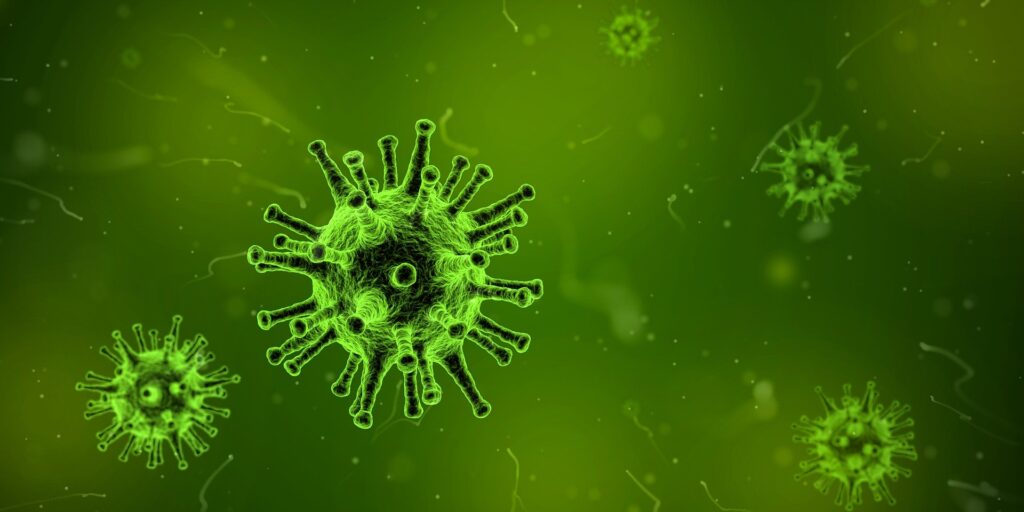
Coronaviruses are viruses made from RNA genetic material. One of the larger RNA viruses, coronavirus is so named from the Latin “corona” (crown or halo), from projections on the virus which give the appearance of a crown.
Coronaviruses are thought to be responsible for a large number of common colds in humans. Coronavirus colds seem to be associated with more major symptoms like fever or sore throat than colds caused by rhinoviruses, another common cause. 2019-nCOV seems to cause even worse respiratory symptoms than the typical coronavirus. Coronaviruses can also lead to pneumonia, either directly or through a secondary bacterial infection due to a weakened immune system.
ABILITY TO CONTAIN THE VIRUS
Coronavirus has crown-like projections
Chinese officials are probably wise to enact quarantine orders, as there is only one lab (called a Biosafety Level 4 lab or BSL-4) in their entire country with the capability of handling severe outbreaks. Luckily for them, it is located in Wuhan. The facility can care for victims of highly contagious diseases like SARS, Ebola, etc.
Personnel in a BSL-4 lab are subject to the strictest protocols: They must change their clothing on entering and shower upon exiting. Full-body hazmat suits must be worn while working in the lab and decontaminated afterwards. The facility is required to be a separate building or a wing properly isolated with separate air filtration systems.
The chances of spread of the new coronavirus is increased by the upcoming Chinese New Year, when it is thought that millions of Chinese citizens will be traveling throughout the world.
(1/22 Update: China has just issued a travel ban for the city of Wuhan; public transportation in the city is also suspended)
Having learned lessons from our experience with Ebola, the United States is better prepared to deal with highly contagious outbreaks of infection.
HISTORY OF RECENT VIRAL OUTBREAKS IN CHINA
masks
The presence of any biosafety 4 lab (BSL-4) inside China at all is due to the 2003 viral SARS outbreak. SARS reached epidemic proportions quickly, with 8000 cases leading to 750 deaths worldwide. Chinese authorities hope to have 7 such units built by 2025, but only the Wuhan lab is operational.
Although the use of face masks is common (and wise) in China, Wuhan has declared their use manadatory while in crowded locations. This requirement is causing a shortage of masks in the area, which could eventually lead to the same worldwide.
WHAT TO DO ABOUT CORONAVIRUS AND OTHER VIRUS OUTBREAKS
As of yet, no cure nor vaccine is available to combat coronavirus. Treatment at present focuses on treating symptoms and supporting a victim through the infection, while protecting the healthy from the disease.
Contagious illnesses like coronavirus, however, may morph into epidemics, or is widely distributed enough, pandemics. If you are preparedness-minded, you might consider a personal protection “pandemic kit” (or several) and plan out how you would care for a person with a contagious disease if the hospitals were full. Have you thought about what goes into putting together an effective epidemic sick room?
Daisy at The Organic Prepper has an article up about the Wuhan Coronavirus and what you can do now to prepare. From what is currently known, this coronavirus has approximately a 2% mortality rate. That is considerably lower than some other viruses that have made the news over the years, but while it is low it is about the same as the Spanish Flu pandemic that killed millions around 1918. Should you be worrying? It’s too early to tell right now. We don’t know if containment will be achieved or how easily it may spread. But if not this one, at some point another pandemic will sweep the world causing mass casualties, so it is good to have some preparation for the event.
…In Wuhan, supermarket shelves were empty and local markets sold out of produce as residents hoarded supplies and isolated themselves at home. Petrol stations were overwhelmed as drivers stocked up on fuel, exacerbated by rumours that reserves had run out. Local residents said pharmacies had sold out of face masks.
“When I saw the news when I woke up, I felt like I was going to go crazy. This is a little too late now. The government’s measures are not enough,” said Xiao, 26, a primary schoolteacher in Wuhan, who asked not to give her full name.
Few pedestrians were out and families cancelled plans to get together for the new year holiday. Special police forces were seen patrolling railway stations. Residents and all government workers are now required to wear face masks while in public spaces. Most outbound flights from the city’s Tianhe airport were cancelled. (source)
Those who wish to be prepared should note the speed at which quarantines were put in place in China. Don’t delay placing orders for supplies, fueling up your vehicle, and adding last-minute preps to your stockpile. You may already have many of the supplies you need, so be sure to do an inventory before panic-buying.
However, if you discover you do need supplies, get them now. If you wait until a quarantine is announced, you’ve waited too long and you’ll be out there fighting for resources with everyone else in your area.
Read this article for more information about pandemic preparedness. Order any personal protection supplies you need.
Download this book from Kindle. It’s truly the best of its kind – don’t let the fact that it is out of print deter you from purchasing it.
Read this article about Ebola to understand how pandemics spread.
Whatever your plan is, don’t delay taking action. Otherwise, you might find yourself in the same situation as 20 million Chinese people who were suddenly quarantined.
Earlier we posted an article about a new coronavirus originating in China which was now believed to be spreading from person to person. A few hours later, the first confirmed US case was made public, the person who had returned from travel in China is being treated in Everett, WA.
Update 1/22/20: Deaths from this coronavirus have gone up to 17 (yesterday the number stood at 9) and there are now suspected cases in Mexico and Russia.
From the Everett Herald:
The first case of Wuhan Coronavirus reported in the United States is a Snohomish County man in his 30s who traveled to China, federal and local officials announced Tuesday.
The patient was reported to be doing well and in stable condition at Providence Regional Medical Center Everett, according to the Snohomish Health District.
The outbreak of the mysterious, pneumonia-like virus originated in Wuhan, China, and is linked to a large seafood and animal market, suggesting it is possibly of animal origin. At least nine people have died — all in China, most 60 or older, including at least some who had a previous medical condition. Hundreds have been sickened worldwide.
This week Chinese officials concluded it can spread from person to person. How easily it spreads is unknown.
As of Tuesday, the Snohomish County man was in a special isolation unit, where he was expected to stay for at least the next two days.
“We are grateful that the patient is doing well, and that he’s currently not ill, and that he has been so cooperative,” said Dr. Nancy Messonnier, director of the National Center for Immunization and Respiratory Diseases. “… Our first priority was clearly making sure that this patient was healthy and being appropriately treated as we move on to the next phase.”
The man is a Chinese immigrant who was visiting his home country. He’s a legal permanent resident of the U.S., Gov. Jay Inslee said Tuesday afternoon at a news conference at the state Public Health Laboratories in Shoreline. The man transferred flights at least once before arriving at Sea-Tac Airport on Jan. 15, but an exact itinerary hasn’t been released.
At that time he showed no symptoms, health officials said.
“In this case, we don’t believe even if we had active screening at the airport that this patient would have been picked up, because at the time we don’t believe the patient had any symptoms of the fever,” said John Weissman, the Washington state secretary of health.
On Sunday, four days after the man returned to Washington, he started to feel ill. He went to a medical clinic in Snohomish County. Staff advised him to go home and stay isolated, while lab tests were conducted.
“We were in communication with the CDC Emergency Operations Center, coordinating specimens that were shipped overnight and had the results the following day,” said state epidemiologist Dr. Scott Lindquist. “Incredibly fast.”
The man was transported to the north Everett hospital Monday, according to the state Department of Health.
Now the top priority for officials is tracing his contacts, to determine who is at risk. The man was traveling alone but took group transportation home from Sea-Tac. He lives by himself. Health officials described the number of possible contacts since he got back to the U.S. as small. State officials said he’s been very helpful in identifying people he’d contacted over the past few days. Those people will be monitored for fever and respiratory symptoms.
“Providence is contacting the small number of staff and patients who may have come in contact with the patient at one of our clinics,” a hospital news release said. “We are also implementing a screening system in our electronic health record to identify patients at risk for this infection.”
The Snohomish County case was announced nationally Tuesday by the federal Centers for Disease Control and Prevention.
“No one wants to be the first in the nation in these types of situations, but these are the types of situations that public health and its partners train and prepare for,” said Dr. Chris Spitters, health officer for the Snohomish Health District. “Because of this, everything has been going along quite smoothly.”
The CDC had implemented public health entry screening at airports in San Francisco, New York and Los Angeles. This week Atlanta and Chicago are being added. Anyone flying from Wuhan to the United States will be funneled through one of those airports. Officials around the world are conducting similar airport screenings elsewhere, with the goal of containing the virus during the busy Lunar New Year travel season.
There were 440 cases reported worldwide Tuesday, and the U.S. joined a growing list of places outside mainland China reporting cases, following Thailand, Japan, South Korea and Taiwan.
Federal officials consider the risk to the American public at large as low. However, Dr. Messonnier expected to see more cases in the U.S. and around the world in the coming days.
Travelers wearing face masks gather at Hong Kong International Airport on Tuesday to get squirts of antibacterial lotion after the outbreak of a new coronavirus that has reached Snohomish County — the first confirmed case in the U.S. (AP Photo/Ng Han Guan)
In general, it can take two weeks for symptoms to show up, state health officials said Tuesday. The coronavirus family includes those that cause the common cold, but some found in bats, camels and other animals have evolved into more severe illnesses like SARS, or severe acute respiratory syndrome, and MERS, Middle East respiratory syndrome.
Initial symptoms of the new coronavirus include fever, cough, tightness of the chest and shortness of breath.

 The Altons at Doom and Bloom Medical have a video up on the WHO recommendations for home care of a coronavirus infected patient who has been asked to stay at home after medical evaluation.


 Cat Ellis, the




 Lower Valley Assembly