Of Two Minds: Surviving 2020 – Plans A, B, and C

Charles Smith at Of Two Minds has an article on Surviving 2020 – Plans A, B, and C

As the bogus prosperity economy built on exponential growth of debt implodes, we all seek ways to protect ourselves, our families and our worldly assets. There are any number of websites, subscription services and books which offer two basic “practical recommendations:”
1. Buy gold (and/or silver) and don’t worry about timing the market as everything else will become worthless.
2. Establish a heavily armed and well-supplied hideaway before everything implodes.
My problem with these suggestions is that they are predicated on a decisive “end of the world as we know it” collapse of civilization.
While I am alive to the possibility of this cataclysm, an analysis of the many feedback loops which will slow or counteract such a decisive collapse suggests other alternatives are even more likely: my term for the slow, uneven decline of the credit/speculative-bubble era is devolution.
I cover feedback loops, historical cycles and why a lengthy devolution is as least as likely a scenario as abrupt collapse in my book Survival+ (free downloadable version is linked below).
In other words, I do not see planning for eventualities as “either/or.” I look at it in terms of three levels:
Plan A: dealing with devolution: government services are cut back, prices for essentials rise over time, fulltime paid jobs become scarce, the State (all levels of government) becomes increasingly repressive as it pursues “theft by other means,” i.e. the stripmining of private assets to feed its own fiefdoms and Elites; most assets fall in purchasing power (value) as the system’s financial props erode.
Plan B: When things become rationed/unavailable, services become sporadic, pensions stop being paid in full, spontaneous homeless encampments arise in heretofore “nice” areas, cities go bankrupt, small businesses go underground to survive the ever-higher taxes being levied on the few remaining productive enterprises, etc.
Plan C: if things fall apart: either move to communities where you or your family have roots (tough luck for all the millions of rootless Americans shifted around by corporate “relocations” the past 50 years) or turn to your neighborhood, town, friends, family, church and other social networks for cooperative strength.
The problem with putting all your resources into a “bug-out” strategy (Plan C) is that it might not come to pass, in which case you’ve misallocated your assets.
This is why I focus Survival+ on structuring a prosperity which will work on all levels. This prosperity has five basic parts:
1. Prepare for hybrid work by developing multiple skillsets, interests and contacts and understand that being productive and reciprocal is more important than getting paid (as I put it: “to take care of Number One, first take care of numbers 2 through 9.”)
2. Develop sustainable, overlapping social networks (self-organizing networks) in which you have more than one place to interact with the same person, i.e. at church or in the neighborhood. I call these non-State, voluntary networks transparent non-privileged parallel structures because they are independent of the State and Monopoly/Predatory Capital Elites.
3. Cut expenses to the bone so you no longer need a large income to “survive.” Consider lowering your taxable income by working less so you’re no longer working so hard just to pay taxes generated by high incomes. (Thanks to correspondent Stephen A. for noting that barter that results in gains is generally taxable. As always, check with the I.R.S. or a licensed tax advisor to confirm what income is taxable/nontaxable.)
4. Reach a new understanding of “prosperity”: health and social wealth are the “treasures” which money cannot buy. Yes, we all need some money, and preserving/growing whatever capital you do have will be difficult and time-consuming. There is no easy “one size fits all” solution.
5. Understand the importance and strength in building and maintaining personal integrity, the one asset we each control in totality and that no one can take from us. All reciprocal networks (financial, political, religious or social) depend entirely on trust, and the bedrock of trust is complete personal integrity.
Much of the devolution we now face is a direct result of the degradation of integrity. This moral/ethical component of financial implosion is glossed over by the corporate media because the Power Elites have implicitly undermined integrity and morality as a means of soldifying their control of the media and of the national income.
Yes, I know this all sounds wonderful, but how do you do it in real life? Well, life is and always has been a do-it-yourself affair. With 200 million+ employable people in the nation, what advice or recommendations can I possibly give to any one individual, when only that person knows their own interests, strengths and potential customers, clients, allies, competitors and mentors?
Let’s start with one simple truth: nobody knows the future. Thus everything we discuss now is contingent on a number of unpredictable interactions. To base our planning on one scenario is to risk misallocating our scarce assets and resources…(continues)

The Organic Prepper: What I Learned During the COVID Crisis

Daisy Luther at The Organic Prepper talks about lessons she’s learned during the pandemic – What I Learned During the COVID Crisis.

…Here are the things I’ve learned.

Trust your instincts.

I began writing about this virus back in January when it was announced that the entire city of Wuhan was being locked down and millions of people were under stay at home orders. With that many people under a mandatory lockdown, I was firmly convinced that this had potential global ramifications.

I had come back from Europe to attend a funeral in early January and was supposed to return on January 28th. After doing the research for the article mentioned above, I rescheduled my flight for March 28th and settled in with my youngest daughter at her apartment to help out with the bills. We immediately began stocking up.

A lot of folks at that time said I was crazy – a few here on my website but more so on other sites that republished my work. I’m no stranger to being called crazy – I’m in the preparedness industry and I like guns, so right there, the mainstream media sees me as a lunatic. It no longer bothers me and I was convinced that this was going to be a big deal.

Every day from January 23rd to the present, I’ve spent hours researching as this pandemic has unfolded. I sincerely wish that I had not been correct, but here we are, still in lockdown in many parts of the country.

You can prepare fast if you’re aware before other folks are.

I had sold or donated nearly everything that my daughters didn’t want before I took off on an open-ended trip to Europe last fall. The other items were divided up between my two girls. So while the daughter with whom I stayed still had a few things, like firearms, water filters, etc., the stockpile was pretty much gone.

By the end of January, I was pretty sure that we were going to see mandatory quarantines or lockdowns here and I began stocking up. It’s important to note that at this point, you could still buy anything you wanted or needed. I grabbed some extra masks and gloves but most of my focus was on food and other everyday supplies. By the end of February, I was pretty content with the amount of supplies we had. I had spent as little as possible on “right now food” and focused most of my budget on shelf-stable items like canned goods, pasta, and rice.

For about $600, we accumulated a supply that would see us through a minimum of 3 months without leaving the house. I figured, if it turned out that I had overreacted, my daughter would use the food anyway.

I also started a personal spending freeze at the end of January. If it wasn’t an item we needed to become better prepared, I didn’t spend a dime. I was able to put back a few months’ worth of expenses while still stocking up. It helped that my daughter was living thrifty in a less expensive apartment with utilities included. I was very concerned about things like cash flow and it turns out, this has been a huge problem for a lot of people.

You can’t always have the “ideal” situation.

There were a lot of things about my situation that were less than ideal. But that’s probably true in a lot of cases. You just have to adapt to the reality of your situation instead of endlessly wishing it was different or feeling that it’s hopeless. “Less than ideal” does not mean that all hope is lost.

First, there was the situation of living arrangements. I have a daughter in Canada and a daughter in the US. My older daughter in Canada has been working longer and was better established. My younger daughter, who lives in the US, was new to the workforce and didn’t have a lot of money so I stayed with her to help out financially. Her apartment is in a lower-middle-class residential area of the city where she works. Thankfully, it is a two-bedroom and I only brought with me two suitcases.

Living in an apartment without much of a yard during this kind of event is not something I would have chosen, given time to seek alternatives. But we all know this crept up fast. Moving was not an option. I focused on hardening the apartment with plywood to put up at the windows, tripwires that could be set up quickly if needed, and sturdier locks. We got some quarantine warning signs that we could post if all hell broke loose as a potential deterrent, and I set up spotlights in the front yard. Currently, they face the stairs to the front door, but in a bad situation, they could be turned around to illuminate anyone coming up to the house instead.

I bought more ammo for our firearms and we sat down together to work through potential scenarios. We developed a “fatal funnel” in the front hallway and added “stumbling blocks” in the front hall that could be shoved in front of the door to slow down an advance. (Just cardboard boxes filled with hardcover books – nothing fancy.)

We made friends with the other family who lives in the building while maintaining our OPSEC. It’s always good to have allies and they have a better line of sight from their upper apartment.

Normally, I would have bought loads of organic food and preserved it myself, but early in the crisis, there was still a question of whether or not we’d have power throughout the emergency and there simply wasn’t enough time at this late date. My stockpile is not ideal – lots of storebought canned goods and carbs like pasta and rice – but it’s filling and versatile.  And most of all, it’s what was readily available. I was able to grab cases of canned fruits and vegetables and canned ravioli when it was cheap and abundant.

So while it isn’t our normal diet or even our normal preps, we’re fortunate to have it. We’ve continued to hit the store weekly for foods that are more “normal” but can easily shift to the stockpile if it becomes necessary.

As you can see there are a lot of things that aren’t ideal from a prepper’s point of view, but when disaster strikes, you have to adapt. So if your situation isn’t perfect, don’t just throw your hands up in the air and give up – ADAPT…(continues)

Click here to continue reading at The Organic Prepper.

Liberty Blitzkrieg: You’re Being Conditioned to Live in a “Smart City” – Resist It

Michael Krieger of Liberty Blitzkrieg writes this article to warn of the dangers of so-called “smart cities” which are really high tech surveillance states, tracking your every movement and tracing every human contact you make- You’re Being Conditioned to Live in a “Smart City” – Resist It.

And at the dead center of it all is Eric Schmidt. Well before Americans understood the threat of Covid-19, Schmidt had been on an aggressive lobbying and public relations campaign pushing precisely the “Black Mirror” vision of society that Cuomo has just empowered him to build. At the heart of this vision is seamless integration of government with a handful of Silicon Valley giants — with public schools, hospitals, doctor’s offices, police, and military all outsourcing (at a high cost) many of their core functions to private tech companies.

The Intercept: Screen New Deal

Each crisis in the 21st century has been aggressively and ruthlessly wielded into a massive wealth and power grab by the American oligarchy and national security state. The big power grab following 9/11 centered around whittling away constitutional rights via mass surveillance in the name of “keeping us safe”, while the money grab after last decade’s financial crisis concentrated wealth and assets into fewer hands while entrenching financial feudalism and making the Federal Reserve and mega banks even more powerful.

Despite the success of this diabolical and intentional concentration of money and power, there’s still too much privacy, freedom and independent wealth around for the imperial oligarchy to feel comfortable. As such, the current pandemic is being used to put the finishing touches on whatever little political and economic freedom remains in these United States.

The lessons learned from prior crises are being rolled out simultaneously this time around while people remain incapacitated at home due to Covid-19. The 2008/09 financial collapse taught those in power they can get away with unprecedented, unaccountable theft during an economic and stock market crash. Similarly, 9/11 demonstrated people will relinquish civil liberties without much protest when immersed in a state of fear.

As such, a new round of society-wide economic pillaging has occurred and is ongoing, while at the same time an equally nefarious agenda to sell you on a completely new way of living — conveniently brought to you by technocratic big tech oligarchs — is in the works.

During moments of heightened confusion and fear, the public is sold and conditioned in subtle ways to accept some new reality they never asked for or wanted. The “smart city” appears to be a key oligarch bucket list item this time around, and I’ve started focusing more attention on it after watching the following exceptionally creepy clip from Reuters.

There’s a desperate and deliberate attempt to emphasize how “smart cities” will benefit humanity and solve a plethora of problems, but the video’s creep factor simply cannot be ignored. Significantly, the plan here seems to be to just go ahead and create smart cities without asking permission from the residents who live there. Thanks to governor Andrew Cuomo, it appears New Yorkers will be big tech oligarchs’ first guinea pigs.

Health care and education represent very big areas of human civilization. Who voted for Eric Schmidt to mold and micromanage New York as if it’s his own personal startup?

As reported by The Intercept:

Former Google CEO Eric Schmidt, who joined the governor’s briefing to announce that he will be heading up a blue-ribbon commission to reimagine New York state’s post-Covid reality, with an emphasis on permanently integrating technology into every aspect of civic life.

“The first priorities of what we’re trying to do,” Schmidt said, “are focused on telehealth, remote learning, and broadband. … We need to look for solutions that can be presented now, and accelerated, and use technology to make things better.” Lest there be any doubt that the former Google chair’s goals were purely benevolent, his video background featured a framed pair of golden angel wings.

Just one day earlier, Cuomo had announced a similar partnership with the Bill and Melinda Gates Foundation to develop “a smarter education system.” Calling Gates a “visionary,” Cuomo said the pandemic has created “a moment in history when we can actually incorporate and advance [Gates’s] ideas … all these buildings, all these physical classrooms — why with all the technology you have?” he asked, apparently rhetorically.

It has taken some time to gel, but something resembling a coherent Pandemic Shock Doctrine is beginning to emerge. Call it the “Screen New Deal.” Far more high-tech than anything we have seen during previous disasters, the future that is being rushed into being as the bodies still pile up treats our past weeks of physical isolation not as a painful necessity to save lives, but as a living laboratory for a permanent — and highly profitable — no-touch future.

So we get a pandemic and suddenly the governor of New York is like yeah let’s just let a couple billionaires and their organizations decide what society needs to look like. It’s as brazen as it is dangerous.

In my last piece, I warned that the imperial oligarchy would try to sell the public on the ludicrous idea we need to become China to defeat China. Meanwhile, Eric Schmidt hasn’t been particularly shy about his apparent desire to recreate China’s surveillance state in the U.S…(continues)

Click here to read the entire article at Liberty Blitzkrieg.


EFF: COVID-19 and Digital Rights

The Electronic Frontier Foundation is the leading nonprofit organization defending civil liberties in the digital world. Here are their thoughts on threats and opportunities arising from COVID-19 response, COVID-19 and Digital Rights.

Surveillance. Governments around the world are demanding extraordinary new surveillance powers that many hope will contain the virus’ spread. But many of these powers would invade our privacy, inhibit our free speech, and disparately burden vulnerable groups of people. Mindful of the stakes, we ask three questions when analyzing proposals that would provide greater surveillance powers to the government: Would the proposal work? Would it excessively intrude on our freedoms? Are there sufficient safeguards? Different proposals raise different issues. For example:

  • Government has not shown that some intrusive technologies would work, such as phone location surveillance, which is insufficiently granular to identify when two people were close enough together to transmit the virus.
  • Some surveillance proposals are too dangerous to a democratic society, such as dragnet surveillance cameras in public places that use face recognition or thermal imaging, mounting such technologies on drones, or giving police officers access to public health data about where people who have tested positive live.
  • Some technologies, such as aggregate location data used to inform public health decisions, need strict safeguards.
  • No COVID tracking app will work absent widespread testing and interview-based contact tracing. Bluetooth proximity is the most promising approach so far, but needs rigorous security testing and data minimization. No one should be forced to use it.

Many new government surveillance programs are being built in partnership with corporations that hold vast stores of consumers’ personal data. We need new laws to protect our data privacy.

Free speech. The free flow of ideas about COVID-19 is vital. This includes anonymous whistle-blowing about containment efforts, online criticisms of government responses to the crisis, and prisoner access to social media to tell the world about outbreaks behind bars. Governments will inevitably abuse any new powers to censor what they deems false information about the virus. When online platforms increase their reliance on automated content moderation, in part because human moderators cannot safely come to work, those moderation “decisions” must be temporary, transparent, and easily appealable

Government transparency. Government decision-making about the virus must be transparent. When governments temporarily close the physical spaces where they make decisions, for purposes of social distancing, they must adopt new transparency accommodations, such as broadcasting their proceedings. While government responses to public records requests may be slower during this public health crisis, the outbreak is no excuse to shut them down altogether…(continues)

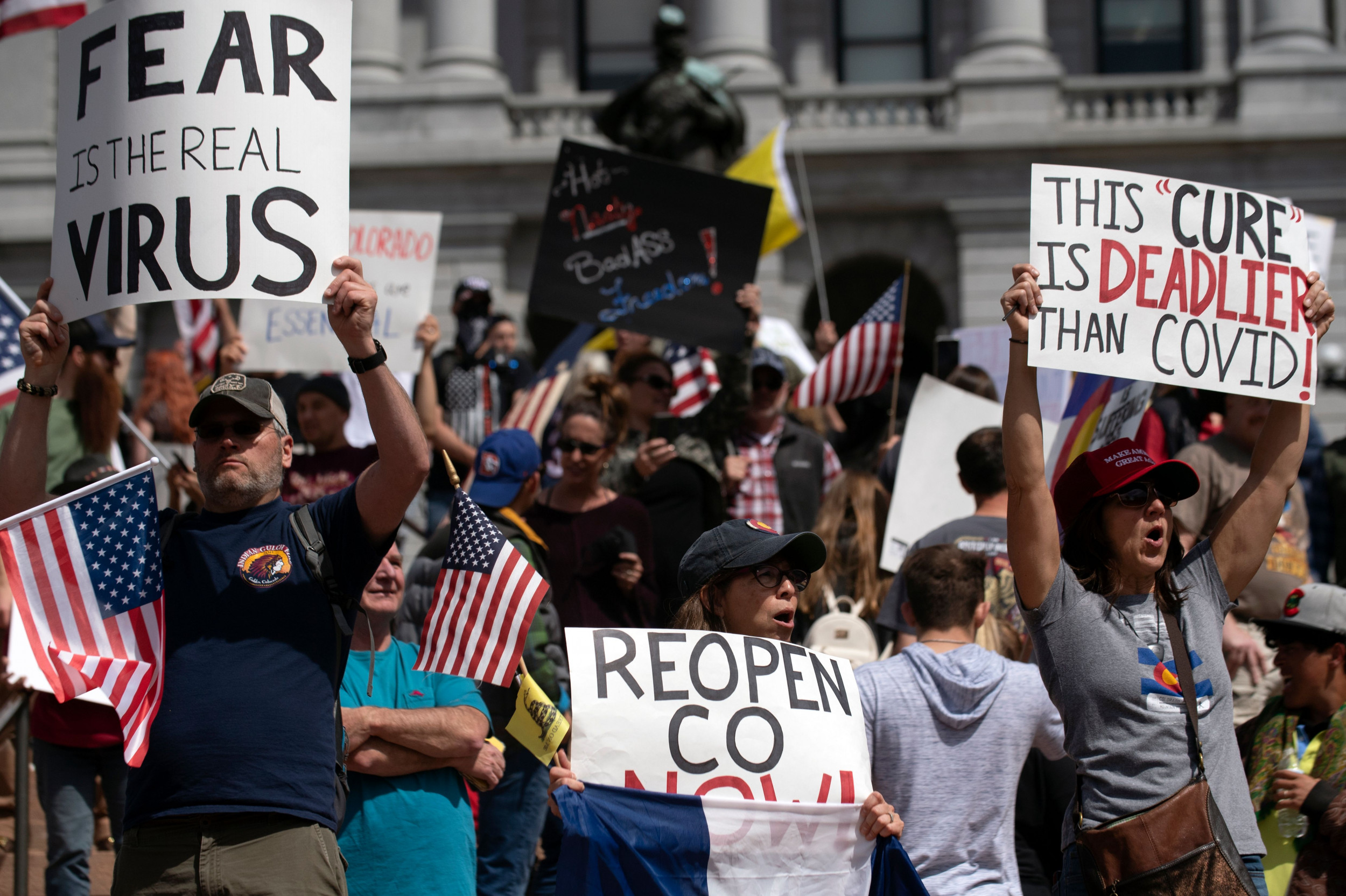
Organic Prepper: All-Out Civil Unrest to Erupt?

Photo courtesy Newsweek

Daisy Luther at The Organic Prepper has a piece up about widespread unrest because of stay at home orders and economic carnage – Tempers Are Flaring Over Lockdown, Masks, and Money: Is All-Out Civil Unrest About to Erupt?

Across the nation, tempers are flaring over the continued lockdowns in many parts of America, and also on the requirement to wear masks in public. I wrote previously about the possibility of civil unrest over the lockdowns, and unfortunately, it appears that’s where we’re headed.

The longer the lockdowns are continued, the more likely it is that we are going to see violence erupt.

People seem unable or unwilling to respect the opinions of others with regard to COVID19, which has affected every family differently. Some are devastated by the loss of or risk to loved ones, while others are struggling to put food on the table and keep a roof over their heads. Others are rightfully concerned about the losses of liberty that we’re seeing. All of these concerns are valid, and not mutually exclusive.

Some violence has already occurred over mask requirements.

Just over the past couple of days, there were several disturbing incidences of violence when people refused to wear face masks in businesses that required it. Whether or not you think that you should be wearing masks, violence toward employees is not the answer. People working in retail just want to keep their jobs, and unfortunately, that sometimes leaves them in the vulnerable position of having to police customers who don’t want to comply with store policies.

A physical fight erupted at a gas station in Decatur, Illinois when a customer refused to don a mask to pay for his fuel. Sgt. Brian Earles with Decatur Police spoke to the press about the incident. It seems that a 59-year-old customer got into a verbal altercation with a 56-year-old cashier when he was trying to pay for gasoline without a mask, as is mandated by the state of Illinois. The customer allegedly shoved the cashier, who said he felt threatened, and the cashier responded by punching the customer in the face. The customer was arrested and charged with battery over the incident.

In Holly Michigan, a Dollar Tree customer refused to follow the posted store policy of wearing a mask. When a young female employee approached him and let him know of the policy he responded by saying, “Here, I will just use this as a mask,” and wiped his face on her sleeve. The customer continued to behave belligerently until he left. The entire incident was caught on store surveillance.

At a Family Dollar store in Flint, Michigan, the most violent response yet occurred when Calvin Munerlyn, a security guard for the store, was shot and killed after he refused to allow a customer’s daughter to come into the store without a mask.

Genesee County Prosecutor David Leyton said Sharmel Teague “began yelling at Munerlyn and spit at him and Munerlyn told her to leave the store and instructed a cashier not to serve her.”

Sharmel left the store. About 20 minutes later, she returned with two men who officials identified as Larry Teague and Ramonyea Bishop. The two men confronted Munerlyn, and Bishop shot Munerlyn in the back of the head, the prosecutor’s office said.

Bishop is Sharmel Teague’s son, the office said. (source)

Sharmel Teague and both men have been charged in Munerlyn’s death.

Anti-lockdown protests are spreading across the nation.

A lot of people aren’t formally protesting – they’re simply ignoring restrictions. Parks and beaches have been full of people who are sick of being stuck at home. Police officers are fed up with going out to break up crowds and enforce social distancing.

While some states are beginning to lift lockdowns, others are not. Protesters across the United States are demanding that restrictions be lifted. The Hill reports that protests are taking place in California, Colorado, Delaware, Florida, Illinois, New Jersey, New Mexico, New York, Tennessee, and Washington. There are also protests occurring in Massachusetts, Vermont, and Maine, as well as North Carolina.

Protests are scheduled this coming weekend in Oregon, Maine, Massachusetts, Nevada, Louisiana, and Wisconsin…(continues)

Click here to read the entire article at The Organic Prepper.

AIER: Why Didn’t the Constitution Stop This?

Robert Wright at the American Institute for Economic Research writes about Constitutional issues surrounding the pandemic and lockdown orders in Why Didn’t the Constitution Stop This?

constitution

The genius of the U.S. Constitution is that the Framers, especially James Madison and Alexander Hamilton, saw it as a constraint on bad policymaking. Given the number of really bad policies that various US governments and officials, from school boards to POTUS, have implemented, especially recently, it is high time to restore weakened or lost Constitutional restraints against arbitrary rule.

Five forces threaten Americans with destruction: 1) nature; 2) foreign powers; 3) the national government; 4) state and local governments; 5) themselves. The threat from 3, 4, and 5 is double-edged, meaning that Americans can be harmed by the actions of those forces as well as by their inaction.

The national government, for example, can harm Americans by being insufficiently prepared for natural catastrophes and foreign incursions, as with Hurricanes Katrina and Rita and the 9/11 attacks. It can also harm Americans, though, by doing too much, as with the invasion of Iraq and the way-too-long occupation of Afghanistan. (Relying too much on FEMA instead of states or private initiatives may be another example, but less clear cut than the needless wars.)

The national and state governments are supposed to check each other’s power, so that if one overreaches, the other can thwart it. We usually think about this in terms of “states’ rights” but in fact federalism, as the concept is sometimes called, runs both ways: the states should check the national government when necessary but the national government should also check the power of the states when they overreach, as they sometimes do.

Advocates of states’ rights often cite the Tenth Amendment, which reads in its entirety “The powers not delegated to the United States by the Constitution, nor prohibited by it to the States, are reserved to the States respectively, or to the people.” Because the word “expressly” does not occur before “delegated” in the ratified version of the amendment, however, it is among the weakest parts of the Constitution.

Traditionally, though, the states retained primary control of so-called “police powers,” the powers that form the legal basis for the economic lockdowns that have imprisoned most Americans for over a month now. Books have been written about this stuff so obviously I cannot relate all the details and nuances involved but ultimately they matter little in the present case. The key point is that police powers, national, state, or local, do not provide carte blanche to governments. Specifically, the Constitution constrains state police powers in numerous ways.

Importantly, courts see Constitutional rights as tradeoffs between conflicting interests. So while the Constitution says that the national and state governments cannot infringe individual speech rights, they can pass laws that make it illegal for an individual, for example, to falsely yell “fire” in a crowded theater. The notion is that the property and natural rights of the theatergoers trump the free speech rights of the liar.

Similar restrictions apply to the right of assembly. All Americans have the right to assemble with other Americans for any lawful purpose but state police powers, the positive duty of states to protect the physical safety of assemblers and non-assemblers, mean that governments may restrict assemblies through permit systems.

Similar arguments are made to defend the pistol permit systems common in many states. They are bogus but show how far courts go to balance one person’s rights with those of others. If you believe that gun control laws should be followed because they are laws passed by democratically elected representatives you have missed the point of the Constitution, which, again, is to constrain policymakers, to protect individual Americans from the national and state governments and also other Americans.

Just because a majority wants some policy doesn’t mean that that policy is a good idea, after all. I imagine at one point in March 2020 a majority of Americans might have thought it a good idea to deport, tax, infect, or maybe even kill Chinese-Americans in order to make “them” pay for what “they” did to “us.” (I don’t want to link to evidence of that … just look at your social media feeds if you need evidence.) That is a typically ugly human reaction to trauma but one that would have been proven empirically wrong as well as morally bankrupt and economically inane (sunk costs). Thankfully, the Constitution remained strong enough to prevent that horror.

It did not, however, prove strong enough to prevent state governments from taking their police powers too far. They engaged in fancy word play to hide the fact that they acted without a shred of precedent. What they imposed is not a quarantine, which constrains the movement of sick people, nor a cordon sanitaire, which locks people into an afflicted area, nor a protective sequestration, which locks people out of an unafflicted area. Instead, they have implemented partial martial law (military rule essentially) by imprisoning Americans in their own homes without due process of law and stolen their property by shuttering their businesses. (Some recompense has been attempted but of course only bluntly and at a cost to all taxpayers, including those in states that did not shutter most businesses.)

Remember, just because a state has general police powers doesn’t mean it can do whatever it wants, whenever it wants, simply because its actions are popular, or passed into law, or urged by some scientist. Imagine, for example, if some executive thought everyone ought to drink bleach, crazy as that seems, and actually mandated it. Would you do it? (Hint: Don’t do it! Even if some guy in a suit or lab coat tells you that you must.) What if some leader believed that the coronavirus is spread primarily by clothing and mandated that we all go naked in public, except for our masks and gloves of course? Or if one thought an EMP (electromagnetic pulse) would solve the problem (and destroy all computers in the process)?

Any promulgation that violates the Constitution, in any way, shape, or form, is null and void. A federal judge has the authority to declare any state law or executive order unconstitutional and demand that it be revoked. Judges generally give governments broad leeway to protect “public health” but the policies must be rational and they must weigh the rights of all involved parties. Historically, many government epidemic responses never got litigated because the crises passed before suits could be brought and because quarantines, cordons, and sequestrations can make rational sense in specific situations. But, again, state governments for some reason have tried to combat the novel coronavirus with novel policies that come with huge negative side effects for everyone — workers, consumers, and taxpayers — and that have and will continue to cause deaths, minimization of which is the ostensible goal of lockdown policies.

Why draconian lockdown rules have not yet been deemed unconstitutional I still do not know, but the fact that a former federal judge who teaches at Harvard apparently does not know the difference between a quarantine and a lockdown might provide a clue…(continues)

Click here to continue reading at AIER.

The Prepared Homestead: Coronavirus – Six Actions You Should Be Taking Now

The Prepared Homestead has a video out talking about six steps that you should taking right now in regards to the pandemic and resultant/simultaneous supply chain/economic problems. He covers (1) sizing up the situation, (2) scenario development – best, most likely, worst case, (3) taking stock of your financial situation, (4) topping off supplies, (5) growing some of your own food, (6) working on your health. Much of one and two will be familiar to you if you’ve taken or read Forward Observer‘s SHTF Intelligence or Area Study book/classes.

Alt-Market: The Next 60 Days

Brandon Smith at Alt-Market writes about the Pandemic and Economic Collapse: The Next 60 Days.

The news cycle moves so quickly these days writing analysis on current events becomes difficult; the moment you publish an examination of the situation people have already moved on to the next disaster. So, today I’m not going to do that. Instead, let’s look at current trends and project what is likely to happen in the next couple of months. In my article ‘How The Pandemic Crisis Will Probably Develop Over The Next Year’ published in early March, I outlined what I believed would be the major developments on a longer timetable. Some of these predictions have already occurred.

Now I would like to tackle a shorter timetable and focus more specifically on the economic side of things, along with the effects of government lockdowns and how they will continue. Yes, that’s right, if you think the “reopening” of the economy is going to be widespread, or that it will last, don’t get your hopes up. I am using a 60 day model because I have observed that the average non-aware person appears to be about two months behind those of us in the liberty movement in terms of seeing the dangers ahead.

First and foremost, the lockdown issue is on almost everyone’s mind, and as I’ve been saying for the past month, it would not take long before people start freaking out about their financial prospects once they realize this thing may not be over “in two weeks” as we keep hearing every two weeks from the mainstream media, state governments and Donald Trump. The “two weeks until reopen” mantra is designed to keep the public placated and docile, and the establishment will continue to use it until people are finally fed up, which is already beginning to happen.

Lockdown protests are sparking up across the country and it’s only going to get worse from now on. Understand though that establishment elites probably expected this, especially in the US, and they are planning to use civil unrest to their advantage.

Do not be surprised if some areas of the country do indeed “reopen” next month, but expect these locations to be primarily rural. Do NOT count on first and second tier cities to reopen, at least nowhere near the activity that they had previous to the viral outbreak. In fact, while rural towns try to go back to normalcy, many major cities will probably double down and increase restrictions rather than loosen them.

Why do I think this will happen? I’ve noticed an odd narrative being pushed in the mainstream media lately that has me concerned. The MSM is aggressively promoting the notion that rural states and counties are about to be crushed by the coronavirus, and looser restrictions in these places are “a danger to everyone”.

Now, if you read between the lines in this propaganda, what I see is not the media reporting on what is happening now, but what they expect to happen soon. In my area of Montana there is no community spread of the virus, and this is common to many parts of rural America. However, what if rural towns reopen while large metropolitan areas remain closed for business? Unless travel restrictions are instituted, expect a FLOOD of city dwellers to pour into rural areas looking for a taste of freedom and some open bars and restaurants.

If your small town is within 1-2 hours drive of a large city, get ready for a parade of yuppies on mainstreet looking for a vacation from lockdown.

This in itself is not a big deal. If people want to drive from the city to spend money in small town America then that’s a benefit to struggling rural communities (and a bizarre 180 degree shift from the norm). But here is what I think will happen next:

After about two weeks of reopening, small towns across the US will have a massive spike in infection numbers and community spread. Viral clusters will develop and some people will die. Does this mean our economy should be frozen to the point of collapse or that medical martial law is the answer? No, absolutely not. But the media is already gearing up for the big “we told you so”, and as rural infections skyrocket state governments and the federal government will start calling for renewed lockdowns even more harsh than before.  The rest of the world will say “that’s what those Americans (conservative Americans) get for being selfish and trying to reopen too soon”.

The economy cannot be opened one piece at a time, it has to be opened all at once. Otherwise, you are going to get a huge influx of people to reopened regions and an inordinate amount of infection cases will follow in those areas, exaggerating the spread of the virus.  Of course, a full reopening of the nation is not going to happen.

Get ready for a great big fake wrestling match between state governments and Trump in terms of how to handle ending lockdowns. Take note though that Trump flip-flops so much on state power vs. executive power that no one actually knows where he really stands on the issue; this is by design…(continues)

Click here to read the entire article at Alt-Market.

Tri-Cities Potato and Onion Giveaway, May 1st

From KNDU news:

As local farmers are seeing an abundance of crops due to the COVID-19 pandemic, they need to give away some to the community.

Farmers are told to keep their crops as trading with other countries has somewhat stopped as COVID-19 fears mount.

The Tri-Cities farming community will come together Friday, May 1st for a potato and onion giveaway for those who need food assistance.

The owners of AgriNorthwest and Rover Point Farms have teamed up with the Church of Jesus Christ of Latter Day Saints to host multiple potato and onion drive-thru giveaways for free.

They are located at the following locations:

2004 N. 24th Ave, Pasco

820 S. Buntin, Kennewick

5885 Holly Way, West Richland

Volunteers will open these locations at noon and will remain open until supplies last.

For more information you can reach out to justservetc@gmail.com.

16th Leg. Dist. Republicans Open Letter to People of Benton County

The Benton County Republicans for the 15th Legislative District have written an open letter to the people of Benton County about the county commissioners and their saying that they have no authority to resist the governor’s stay at home orders. The letter reads, in part:

…Shon Small, Jerome Delvin, and James Beaver made the statement “The Benton County Board of Commissions does not have the legal authority to override the Governor’s ‘Stay Home, Stay Healthy’ proclamation…” The Commissioners’ job is to oversee the county and also, we firmly assert, to protect the citizens from overreach of power by the capital. All three of our Commissioners are either willfully ignorant or just negligent in their role…

It is time to get business’s open and the people back to work. We firmly believe that every
person in Benton County is essential. We know there are veritable public health concerns and
those who ought to stay home, can chose to do so. The working people of Benton County
know what is best for them, not the Governor’s boot-licking Commissioners, whose income
rolls in whether they work or not. It’s time the Commissioners earn their paycheck and protect
the good and hard working people of Benton County from the bureaucratic double speak of
Olympia. The woes of King and Pierce County are not the identical worries of Benton
County; we are a different demographic, climate, economy, and culture. The citizens of this
community possess an undeniable right to make decisions autonomously from our State
government; to tailor our county government to serve the people of this area as is fitting to the
citizenry of this particular locality. Top down, authoritarian mandates from the capital are ‘one
size, fits the capital alone’ decisions – they are made without a thought of us here! We are
calling on the Commissioners to do what is prudent for Benton County; they are elected to a
very well compensated position, as a public servant, and ought to conduct themselves
accordingly…

Click here to download the letter in PDF format.

Citizens Journal: Boost Your Immune System, Too

In Karen Selick’s article Coronavirus Crisis Reopens 150-Year-Old Controversy at Citizens Journal, she reminds us that there is another side to fighting viruses besides just avoiding the virus itself, i.e. you can boost your body’s ability to fight off viruses by improving your immune system.

…French scientist Louis Pasteur (1822-1895) is widely celebrated as “the father of germ theory”— the idea that we become sick when our bodies are invaded by foreign organisms such as bacteria, molds, fungi, and of course viruses. Although the idea had been circulating long before Pasteur achieved eminence, his laboratory work in the 1860s appeared to provide the scientific proof that had previously been missing.

What’s not widely known is that other French scientists working in the same field in that era held somewhat different beliefs, known as the “terrain theory”. They believed that the most important factor that determines whether or not a person becomes ill is not the presence of a germ, but rather the preparedness of the body’s internal environment (the “soil” or terrain) to repel or destroy the germ…

But regardless of Pasteur’s character, and regardless of whether he recanted at the end or not, what lives on after him is the mindset, clearly visible amongst most of today’s medical professionals and health care bureaucrats, that it is the germ (formally designated SARS-CoV-2) that has to be tracked down, isolated, avoided, and eradicated—and that’s all that matters. The “terrain”, to conventional modern thinkers, is nothing.

For instance, on the Ontario government’s website telling its citizens what to do about COVID-19, its advice consists entirely of measures designed to prevent people from coming in contact with the virus: stay home, wash your hands often, don’t touch your face, maintain physical distancing and wear a mask when you have to go out.

No mention is made of any measures individuals can take to ensure their immune systems are operating at peak efficiency (or as the French scientists would have put it, their terrain is well prepared to mount a defence). It’s almost as though the Ontario government doesn’t believe human beings have immune systems or that they’re of any use whatsoever. The only hope, Ontario seems to believe, is for a pharmaceutical company to patent a vaccine, because that is the only way that human beings can defend themselves against a virus, or acquire immunity.

In fact, Ontario and Canada have gone out of their way to discourage people from looking for methods of helping themselves. Ontario’s website says “there is no specific treatment” for COVID-19. End of story. Canada’s government-owned broadcasting company, the CBC, recently published this article denouncing “bogus cures” including vitamin C, zinc, medicinal mushrooms and oil of oregano.Vitamin D3, Zinc and M…Jeffers, NancyBest Price: nullBuy New $6.98(as of 03:40 EST – Details)

This official attitude is utter nonsense—there is actually an abundance of scientific evidence supporting various nutritional supplements as being instrumental in preparing people’s immune systems to repel or overcome viral infections.

Take zinc, for example. Many COVID-19 patients have mentioned as symptoms the loss of their senses of smell and taste. According to the BBC, these symptoms affects as many as 18 percent of infected patients. This CNN article says that some people  will take days or weeks to recover these senses after having the virus, while others may take months or years.

But the loss of these senses is a well-established symptom of zinc deficiency, a fact not mentioned in either of the two articles cited, and apparently not known to most of the mainstream medical community. Yet here is a PubMed study connecting zinc deficiencies with “smell and taste disturbances”. Here’s one specifically connecting “older patients” with zinc deficiencies and loss of acuity in the senses of taste and smell. Both of these studies also mention that zinc deficiencies lead to impaired immune function or an increased risk of infection. Can medical “experts” and governments not connect the dots?

Vitamin D is another nutrient (a hormone, actually) well recognized by scientists to have antiviral benefits. Google Scholar lists 3,670 research reports published in 2020 alone containing the words “vitamin D” and “virus”…(continues)

Click here to continue reading at Citizens Journal.

John Mosby on Pandemic

John Mosby of Mountain Guerrilla has been writing about Covid-19 for his Patreon subscribers for a few weeks, now. While he acknowledges the uncertainties, he tries to point out the things than you can/should act on regardless of other uncertainties. His articles on the topic are long, and the following is just a small excerpt. The most useful parts are on his Patreon and are worth a read.

…I hinted at it above, but further issues with this virus are coming to light. Among these is the already known/suspected possibility of reinfection, due to inadequate antibody production. In at least one study I’ve seen, of the test results that came back positive for antibody presence, in the NY population, only about 30% actually had adequate antibody presence to indicate even the possibility of immunity. So, despite around 20% of the population of NYC potentially having been exposed to the SARS-CoV-2 already, of that 20%, only about 30% may even have any level of immunity to reinfection.

Second, there are increasing number of otherwise healthy patients (no previous medical history, no relevant comorbities), who have recovered from COVID-19, only to suddenly drop dead from stroke, later, because of blood-clotting caused by the disease. This seems to indicate another potential example of the lasting organ damage that can occur despite “recovery” that aren’t immediately apparent.

Finally, one of the claims that has circulated repeatedly, since the beginning, was the theory that summer time would find a reprieve from the virus, allowing us time to “catch our breath” and get ready for another round of the fight with it, come next autumn and winter. The problem with THAT one is that, well…the southern hemisphere (with the apparent exception of Australia, which is actually kind of an outlier for a number of reasons, mostly because of the level of lockdown they initiated early on) and the equatorial regions seem to be getting hammered pretty fucking hard…and their numbers don’t even account for the shoddiness of what passes as “record keeping” in those shitholes.

So, What?

(1) This isn’t the fucking flu. If you still think it’s anything like the flu, choke yourself. Seriously.

(2) You really don’t want to catch this virus. By all accounts, it’s a fucking miserable experience, even with “mild” symptoms, in fit, athletic young people. Then, there’s the whole possibility of dying from it thing…That doesn’t even account for the possibility of “recovering” and then dying from a stroke a couple of weeks later.

(3) The “lockdowns” are politically and economically impossible to sustain for much longer. So, the numbers are going to increase, both in total case numbers, and in fatalities. Your goal should be (ours certainly is!) to avoid contracting it at all, and if it is unavoidable, to contract it as late as possible, so there has been more time to consider all possible treatment options, come up with viable, working treatments, and get the requisite materials into the supply pipelines to help (which may not happen anyway…).

Interestingly, I’ve noticed that nobody in a position of authority is claiming “we’ll have a vaccine in a few weeks!” anymore. Instead, they’ve switched to the 12-18 months timeline that some of us have been trying to explain to people for the last couple of months. Further, I haven’t done a lot of digging yet, but to the best of my limited research (thus far), there’s NEVER been a viable vaccine for a coronavirus. Not SARS-COV (the first one). Not MERS-COV. Not the Common Cold. None, that I’ve been able to discover. I’d love to see evidence refuting that…

SocioEconomic Impacts

There are a number of very real impacts coming down the pipe, as a result of this pandemic. While it’s becoming increasingly popular, in some circles (mostly on the Right, but I’ve seen some circulating on the Left as well), to blame all of the impacts on the lockdown/quarantine response to the virus, the fact is, most of us have KNOWN the system in place, as it was, wasn’t really sustainable in the long-term. Whether you were concerned about the political issues, the economic issues, the resource issues, or the environmental issues, the reality is, COVID-19 hasn’t “destroyed” anything. The lockdown/quarantine response hasn’t “destroyed” anything. This—whether the pandemic itself, or the response thereof—just gave the system the nudge off the edge of the precipice it was hanging off of.

I’ve seen a number of claims circulating that “the response” is nothing but a political ploy to avert blame for a “controlled collapse” of an unsustainable economic model. To that, I have three responses, which have guided my own response to the situation.

(1) Anyone who has been prepping for any length of time should have considered the impacts of potential pandemics. Especially in light of “Swine Flu” and “Bird Flu” scares in recent years, even those of us that didn’t spend much time considering it, have to have spent SOME time considering it. If you did, you knew—or should have known—that lockdown/quaratine was one of the major planning elements for controlling/containing the spread of pandemic disease. You would also have discovered that medical authorities—even contrarian medical authorities—around the world have warned, repeatedly, of the possibility—actually, the PROBABILITY, even INEVITABILITY—of an international pandemic of this scale. So, none of this is particularly surprising, either the pandemic itself, or the response thereto…

(2) The whole “it’s all a plan by the government to bail out the elites” would seem to have some grounding in possibility, when you look at the way the “Stimulus” has gone. Most citizens got their paltry little $1200/person “Please Don’t Riot Yet” checks, while hundreds of billions of dollars went to the banks, airlines, and corporations…again.

The fact that the Fed “shored up” the markets, with an infusion of newly created “money,” even as they’re predicting record unemployment levels and loss of up to half the US GDP in the coming months, would seem to reinforce that possibility. The markets crashed, but then magically rebounded, despite no real reason, other than the Fed pouring made-up money into them, would seem to give legs to the idea it was done just to give the “elites” the chance to get out from under their portfolios.

The problem I see with that argument—that it was all intentional—is that it would require basically every government in the world to be in on the game. That’s a pretty big stretch of the imagination. I’m not saying it’s impossible, but I AM saying, it’s improbable. I don’t subscribe to that belief (which is not the same thing as saying the political and bureaucratic classes aren’t taking advantage of the situation to leverage things to their favor, as much as possible).

(3) The biggest issue with the whole conspiracy theory though is…”So what?” If that theory IS right, what impact does that have on YOUR ability to deal with the situation? What impact does that have on the ability of YOUR FAMILY, and YOUR COMMUNITY to weather the storm? Because, honestly? That’s all that matters, at this point. Anything larger scale is probably completely outside of your sphere of control anyway.

It certainly doesn’t do any good to bitch and whine about it. You’re not going to change it, by venting to your (probably) like-minded friends on Facebook or Twitter or Instagram. Far better is to use a little mental Judo, and simply refuse to focus on it. When you feel a rant or anger about it coming on, simply find something USEFUL to focus on. It’s not “suppressing” it. It’s acknowledging it exists (“Man, I’m really pissed that I think the elites are taking advantage of this!”) and then acknowledging that there’s fuck-all you can do about it, and moving on to something you CAN control (“Man, it sucks that I’m pissed, but I really don’t want to get my blood pressure all jacked up, so I’m gonna go weed the garden bed!”)…


Mark Manson: Nobody Knows What is Going On nor What to Do

NYT bestselling author Mark Manson writes about the confusion, lies and general contentiousness of the current pandemic in Nobody Knows What Is Going On. Occasional strong language ahead. His basic premise is that we’re still learning about this disease and no one really knows how bad (or not bad) it is. Some doctors say it’s just the flu. Other doctors say young, healthy people are dying from stokes caused by the virus. Everyone is contradicting each other, so people are reverting to believing whatever they want to believe or whatever aligns with their political outlook or whatever aligns with their financial interest and so on.

Right now, we have two large, complex systems. The first is a virus sweeping through the global population and our combined efforts to mitigate it. The second is a declining global economy. Both systems are incredibly difficult to measure and understand, much less predict. Both are so large and unruly that we struggle to even comprehend them in their entirety. And so far, pretty much everything we’ve thought about either has been utterly wrong.

Let’s start with the first system: the spread of the virus. Despite months of research and testing, we still know very, very little. For example, we know that the virus is highly contagious, but we still have no clue how contagious. Studies pin its R0 number (how many people each sick person goes on to infect) as high as 6.6 and as low as 1.4. For reference, that’s like saying the virus will infect anywhere from 20% of the population to 80%, a range so broad that you might as well pick a number out of a hat.

What about how many people have been infected? A series of studies came out in the past week showing that infections have likely been vastly undercounted and that there are thousands (perhaps millions) of people out there who have been infected but had no symptoms. This would be big news, because it would suggest that the virus is far less deadly than we thought. A recent Stanford study argued that the real mortality rate could be from 0.12% to 0.2%, making coronavirus hardly more deadly than the seasonal flu (which has a mortality rate of 0.1%). The problem is that these studies relied on inaccurate tests, did not test people randomly, and had other major methodological errors.

Okay, but what about deaths? A recent New York Times investigation found that there are potentially 20 to 30% more people dying from COVID-19-related deaths than are being reported (note: this study has also been widely challenged.) So, while there may be far more people being infected than we’re counting, there’s also likely far more people dying than we’re counting.

This means… well, I don’t know what the fuck this means. And neither does anybody else. Pretty much every projection model, including the ones government officials have relied upon, have been wildly incorrect so far. Lockdowns work! But, then again, they might not. Hydroxychloroquine was supposed to be a successful treatment. Then it turned out it wasn’t. Remdesivir was supposed to be a successful treatment. Then it turned out it wasn’t. Ventilators were supposed to save lives. Then it turned out they probably don’t. The hospitals are going to be overloaded! Until they weren’t. Smokers were all going to die! Wait, no, smokers might be the ones who live.

A few weeks ago, the US government’s estimate of 240,000 deaths seemed so absurd that they revised it down to 60,000. Now that number seems completely absurd and will likely need to be revised much higher again. The cherry on top of the shit sundae, of course, is the US president talking about beaming ultraviolet rays through our bodies as though we live in an episode of Star Trek… and then following that up by suggesting that maybe we inject ourselves with disinfectants.

If there’s one thing we know for certain about this pandemic, it’s that we know almost nothing for certain about this pandemic.

And that’s only the first system we’re wrestling with. The second is our economic system. Within a span of a couple weeks, the travel, hospitality, entertainment, restaurant, and brick and mortar retail industries have practically been annihilated. Just in the United States, 26 million people have lost their jobs in a little more than a month; an unemployment rate that rivals The Great Depression (note: this number is also likely being undercounted). The consensus is that we are certainly entering into a recession with whisperings of the D-word… no, not that D-word… the Depression D-word. The International Monetary Fund has said that we are potentially entering a global depression that will rival the 1930s in its depth and scope.

It’s for this reason that working class people have begun protesting and rioting in the western world, demanding economic relief. Leaders and pundits have come out arguing that lockdowns are a “cure worse than the virus itself.” Others argue that because the virus disproportionately affects the elderly, we should only tell old people to stay home and let the rest of the population build immunity as quickly as possible.

But there are many problems with these arguments. The first is that we don’t even know if herd immunity can exist. We do not know how long immunity lasts for COVID-19. People who contract many of the other coronaviruses only remain immune for a short period of time. Sadly, there have already been a number of reported cases of people contracting COVID-19 twice. If people only remain immune for a few weeks or months, then herd immunity will be impossible.

Second, while the virus is far more dangerous to the elderly, it’s no cakewalk for some of the young as well. There are reports of long-lasting damage to lungs, hearts and potentially even brain stems of those who have been hospitalized. Doctors are seeing strange numbers of infected young patients dying of strokes. On a new subreddit for people who have tested positive to share their experiences, there are horror stories of 25-year-olds on ventilators and people with persisting symptoms over a month later.

Third, re-opening the economy is not a magic bullet. As I wrote a couple weeks ago, nobody is going back out to a crowded public area any time soon, even if they are open. Would you go to a concert next week? I sure as fuck wouldn’t. What about next month? Next year? Lock down or not, tens of millions of people are going to stay home no matter what, guaranteeing that consumer spending remains in the toilet and tens of millions remain unemployed.

Fourth, we don’t even know that the economy was healthy in the first place. Some of the greatest investors in the world such as Ray Dalio have been arguing for years that we were due for a once-in-a-century collapse. For years, many pointed to negative interest rates and high levels of debt as a ticking time bomb waiting to go off. A pandemic may actually not be the cause of our economic woes, but merely the proverbial straw that broke the camel’s back.

Then again, this could all be wrong. Epidemiological projections have been famously wrong for the past month, but economic projections have been consistently wrong for… well, pretty much as long as there’s been economists.

We still don’t know what the COVID-19 does to the body or its long-term repercussions. We don’t know if building herd immunity is even possible, much less worth the cost. We don’t know how many people would die if we opened the economy up sooner rather than later, and we don’t know how stimulative opening up the economy would be anyway.

We just don’t know a damn thing. Nobody does. So, stop acting like you do.

Click here to read the entire article at MarkManson.net.


Gold Telegraph: Global Food Supply Chains Beginning to Erode, Crisis Looms?

From The Gold Telegraph – Global Food Supply Chains Beginning to Erode, Crisis Looms?

…One would begin to believe history might not be repeating itself, but it is undoubtedly starting to rhyme. During the great depression of the 1930s, the hardest-hit industry was farming. Farm incomes dropped by nearly two-thirds at the beginning of the 1930s. Dairy farmers dumped countless gallons of milk into the street instead of accepting a penny a quart.

During World War 1, farmers had produced record crops and livestock to keep everyone fed. However, when prices started to fell, they tried to harvest even more to pay their debts and living expenses. In the early 30s, prices dropped so low that many farmers went bankrupt and lost their farms. In some cases, the price of a bushel of corn fell to just eight to ten cents. Some farmers even began burning corn rather than coal in their stoves because corn was cheaper.

However, there is a dramatic difference today. Prices are not dropping; in fact, grocery bills are getting more expensive by the day. Supply chains are being disrupted due to the transportation and of course processing of a vast selection of foods.

As we are beginning to learn, the country where the coronavirus started, China, may now be facing a food crisis. The country has just reopened its economy as the communist regime has even claimed a coronavirus victory.

However, there was a leaked government document made public last Thursday that shows that government officials have been planning for a shortfall in food supplies.

The document, dated March 28, was drafted following a meeting which was called to make special arrangements for food security.

“The State Party Committee and the state governments and counties and cities must do everything possible to transfer and store all kinds of living materials such as grain, beef, mutton, oil and salt through various channels,” the document said, according to a report from Radio Free Asia

The document also calls for the “mobilization of the masses to consciously store grain and ensure that each household reserves between 3 and 6 months of grain for emergencies…”

Click here to read the entire article at The Gold Telegraph.

Our Finite World: Economies Won’t Be Able to Recover After Shutdowns

Gail Tverberg of Our Finite World writes about the difficulties of recovering our businesses in Economies Won’t Be Able to Recover After Shutdowns. It’s much easier to close businesses than to start them up again.
Citizens seem to be clamoring for shutdowns to prevent the spread of COVID-19. There is one major difficulty, however. Once an economy has been shut down, it is extremely difficult for the economy to recover back to the level it had reached previously. In fact, the longer the shutdown lasts, the more critical the problem is likely to be. China can shut down its economy for two weeks over the Chinese New Year, each year, without much damage. But, if the outage is longer and more widespread, damaging effects are likely.

A major reason why economies around the world will have difficulty restarting is because the world economy was in very poor shape before COVID-19 hit; shutting down major parts of the economy for a time leads to even more people with low wages or without any job. It will be very difficult and time-consuming to replace the failed businesses that provided these jobs.

When an outbreak of COVID-19 hit, epidemiologists recommended social distancing approaches that seemed to be helpful back in 1918-1919. The issue, however, is that the world economy has changed. Social distancing rules have a much more adverse impact on today’s economy than on the economy of 100 years ago.

Governments that wanted to push back found themselves up against a wall of citizen expectations. A common belief, even among economists, was that any shutdown would be short, and the recovery would be V-shaped. False information (really propaganda) published by China tended to reinforce the expectation that shutdowns could truly be helpful. But if we look at the real situation, Chinese workers are finding themselves newly laid off as they attempt to return to work. This is leading to protests in the Hubei area.

My analysis indicates that now, in 2020, the world economy cannot withstand long shutdowns. One very serious problem is the fact that the prices of many commodities (including oil, copper and lithium) will fall far too low for producers, leading to disruption in supplies. Broken supply chains can be expected to lead to the loss of many products previously available. Ultimately, the world economy may be headed for collapse.

In this post, I explain some of the reasons for my concerns.

[1] An economy is a self-organizing system that can grow only under the right conditions. Removing a large number of businesses and the corresponding jobs for an extended shutdown will clearly have a detrimental effect on the economy. 

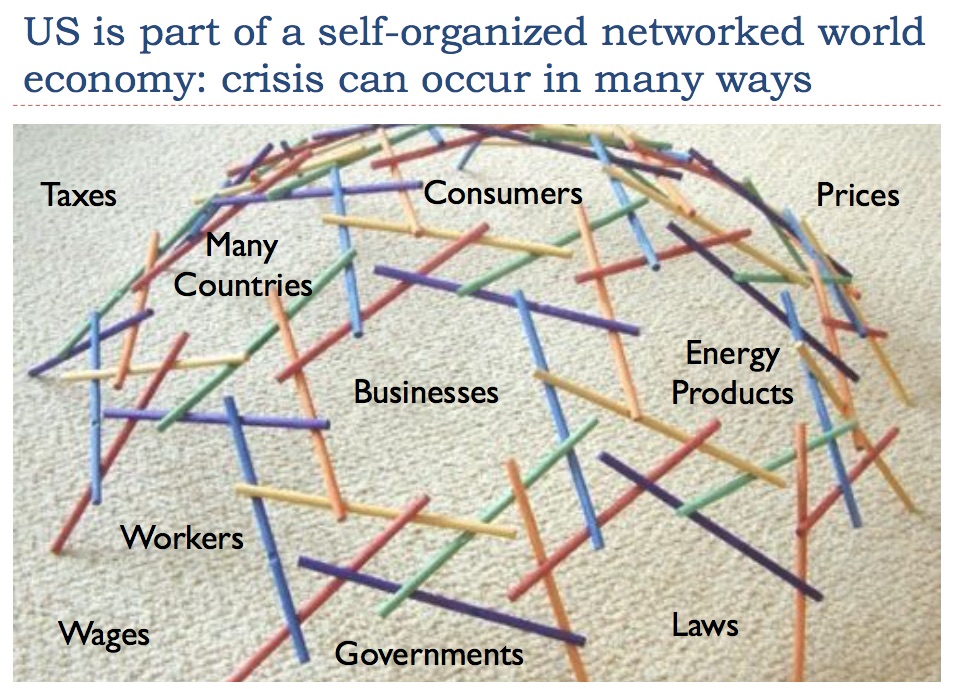
Figure 1. Chart by author, using photo of building toy “Leonardo Sticks,” with notes showing a few types of elements the world economy.

An economy is a self-organizing networked system that grows, under the right circumstances. I have attempted to give an idea of how this happens in Figure 1. This is an image of a child’s building toy. The growth of an economy is somewhat like building a structure with many layers using such a toy…

Click here to read the entire article at Our Finite World.