Doom and Bloom: Tonsillitis In Austere Settings

The Altons at Doom and Bloom Medical have a short article on Tonsillitis in Austere Settings.

Your tonsils are glands on each side of the back of the throat. Their job is to help trap bacteria and other germs that cause infections. Sometimes, however, they can become infected themselves, a condition known as “tonsillitis“. Most cases of tonsillitis are caused by viruses, but bacteria may also be the culprit. The average age is between 5 and 15 years old.

Once, tonsils were commonly removed (known as “tonsillectomy”) in young children at the first sign of infection. In the 21st century, the procedure is much less common. Recurrent bacterial infections or severe symptoms may still require removal, a simple procedure (see link) in the hands of an experienced provider, but difficult for the family medic. The best option, therefore, in austere settings is identifying and treating as early as possible.

(Note: I had my tonsils removed at age 5. At least they gave me some ice cream afterwards! Joe Alton, MD)

whitish-yellow patches may be seen on exam

Use of a tongue depressor helps visualize the area. Common signs and symptoms of tonsillitis include:

•             Red, swollen tonsils

•             White or yellow coating or patches on the tonsils

•             Sore throat

•             Difficult or painful swallowing

•             Fever

•             Enlarged, tender glands (lymph nodes) in the neck

•             A scratchy, muffled or throaty voice

•             Bad breath

Since tonsillitis is often seen in children too young to give a good history, look for:

  • Loss of appetite
  • Irritability
  • difficult or painful swallowing
  • Drooling or difficulty breathing (signs of a severe case)

Treating someone with tonsillitis can include some of the following:

  • bedrest
  • hydration
  • A soft diet
  • Humidifiers
  • Saltwater gargles
  • Throat lozenges
  • Acetaminophen or ibuprofen is helpful for pain, but aspirin should be avoided in children due to Reye’s Syndrome.
Antibiotics may nip a bacterial tonsillitis in the bud

Although viral tonsillitis isn’t improved with antibiotics, Penicillin or amoxicillin works for bacterial infections if taken by mouth for ten days.  If Penicillin is not an option due to allergy, azithromycin may be substituted. These drugs are available in veterinary equivalents at fishmoxfishflex.com.

Adult doses:

  • Amoxicillin 500-875 mg orally twice a day or 250-500 mg orally every 8 hours for 10 days
  • Penicillin V 500 mg orally twice a day for 10 days or 250 mg orally four times a day for 10 days
  • Azithromycin 500 mg orally once a day for 5 days

Pediatric doses:

  • Penicillin V 25-50 mg/kg/day divided by four and given every 6 hours for 10 days
  • Amoxicillin 50 mg/kg/day orally in 2 or 3 divided doses for 10 days
  • Azithromycin 12 mg/kg orally once daily for 5d

Joe Alton MD

American Partisan on Low-powered Variable Optics

American Partisan has a couple of recent articles on the importance of low powered  variable optics. Part I and Part II.

There is a proliferation of low powered variable optics (LPVO) across the spectrum. Military, civilian and police are all making moves in that direction. When asked why, the common response is “its magnified…duhh” or “I can PID further away”. Most however employ the LPVO like a red dot with magnification

I had heard long ago a quote (I cannot substantiate it) from Erwin Rommel. When asked what his most important weapon was, he replied “binoculars”.

Why? Seeing first, more or farther allows us to begin to make decisions and take action, earlier than the opposition. In some cases, the opposition does not even know.

While most people know the answer to why the LPVO is gaining in popularity, few understand or conceptualize the magnitude of the capability they bring to combat.

Using the suspected Erwin Rommel quote earlier. The LPVO means each rifleman can have a set of binoculars (well technically monocular). However, a tool is only good if you use it.

So, what does seeing first, more and farther actually mean.

If I have detected OPFOR before they have seen me (first) my decision making process is much different than if I walk into a drag race to the “up-drill”.

Seeing first allows me the possibility to:

-Array my forces to maximize my chances of success (ambush, occupy prominent terrain)
-Deliver organic fires (cause a casualty to limit their mobility or limit/force their decision making)
-Deliver supporting arms
-Begin to maneuver (the essence of gun fighting is maneuver, the essence of maneuver is movement under load)
-Break contact and fade away without him knowing

Or you can do any combination of the above (and more). But that first detection, is brought to you by seeing first.

Seeing more can be hard to explain in writing. If anyone has watched war footage from Ukraine, Syria, Iraq, Africa. It is exceptionally rare to ever see an enemy combatant. This may be because its video. However I would wager, the guys in the videos had a hard time seeing as well. Any historical study of combat often annotates how hard it is to see the enemy. The LVPO gives us the ability to see more. Some examples:

-Modern Afghan war footage always shows the massive expanse of fields separated by 5-10m thinly packed treeline. LVPO make it significantly easier to see through one of those treelines and into the field or next treeline. Think about this both offensively and defensively

-Syria and Ukraine footage often shows soldiers engaging from deep within rooms. LVPOs allow me to see from external to internal of a room and potentially identify whats IN the ROOM not just in the window

-You are not always presented the target you want. Elbows, Knees, ankles and feet are often forgotten about when people are being sneaky. They leave these out from behind trees, walls, cars etc. This may or may not be a target, but it certainly tells you someone is there.

-If people are using cover you usually only get very small glimpses of them. At 100m I doubt I can reliably identify a guy peaking the left edge of his head out from a wall. However at 4x, I absolutely can see that. And I have a system that is easy enough to be precise with, to score that hit.

Seeing further also goes hand in hand with engaging further. Lots of shooters adopt LVPO, but then say “I’m not a sniper” or “I’m not trying to do sniper things”. Snipers primary job is usually observation. A Rifleman’s primary job is to reduce point targets with rifles… That sniper math everyone is scarred of, is easily learned and applied to 5.56 carbines using 4x or higher optics. Which means you have increased your threat ring.

Now all that said, the employment of the LPVO is a skill that needs to be trained. I have taken courses by 2 “national level” instructors and was sadly disappointed with the material.

The obvious skill that needs to be trained is marksmanship. I am not going to dive too deep into that.

The other skill (seeing first, more and further) needs to be practiced as well. The logistical problem usually encountered with this type of training is space/terrain. Its not very culturally appropriate to do this type of thing in your back yard. However some skills to sharpen this include

-Just look at treelines from 100m+ through your optic. Do not just look though. Actually see. See the stumps of each tree, identify likely firing points, identify what spots would be cover, determine how far back into the treeline you can see, make some guesstimates on what your hold and sight picture would be

-Go bird watching….with your LPVO

-Using safely UNLOADED weapons, play hide and seek or set up stalking lanes with your friends.

-Go hunting… using your LVPO

Analysis or planning of modern combat always comes down to both sides overlaying the ranges they are effective to, and what they think their enemy’s effective ranges are. The goal, is to be outside the enemy’s threat ring, while they are inside yours. Extend your threat ring and see first. For the same reason night vision and thermals are such a force multiplier, the LVPO can be also.

I will leave you with:

Look deep and in. NOT “at”

Look at it from a perspective of “where would I be”. Identify those points, prioritize, scan and move on.

Click here for Part II.

The American Mind: Coup Who?

From The American Mind comes an article on the Democrats abandonment of negotiated politics – Coup Who?

Scaremongering Democrats protest too much.

In August, two retired military officers published a piece in Defense One which literally encouraged America’s top military leadership to have the 82nd airborne to descend on Washington in the event of a disputed election and escort President Trump out of office.

“In the Constitutional crisis described above, your duty is to give unambiguous orders directing U.S. military forces to support the Constitutional transfer of power,” they write. “Should you remain silent, you will be complicit in a coup d’état.” In other words, the military must prevent a coup by staging one of their own. Thankfully, the Pentagon publicly condemned John Nagl’s and Paul Yingling’s musings.

In some regards it is unremarkable in a nation with millions of military veterans that two of them would have some kind of Clockwork Orange-style MSNBC viewing party and put crayon to paper long enough to come up with this violent fantasia. However, the problem isn’t so much that Nagl and Yingling gamed out this scenario—every election that I can remember for the last 30 years has featured fringe voices expressing concern that the current occupant will refuse to leave.

The real problem is that, for once, a respectable media outlet went ahead and published it. If anything, the Defense One op-ed was just the most explicit example of the anti-Trump coup pornography that’s become a staple of mainstream media. And when the media is not baselessly fretting Trump will refuse to leave office, they’re outrageously and falsely characterizing Trump and his administration in ways that justify his violent removal.

The Washington Post recently ran an “analysis” in the business section, quoting a bunch of academics warning that Trump was leading America into autocracy. The article ended with this kicker quote from a Swedish political scientist, Staffan I. Lindberg at Sweden’s University of Gothenburg: “‘if Trump wins this election in November, democracy is gone’ in the United States, [Lindberg] says. He gives it about two years. ‘It’s really time to wake up before it’s too late.’”

Does the Post ask Lindberg for anything not wholly impressionistic to justify his dire and specific prediction? Aside from offensive tweets and ego-driven rhetoric, has Trump done something really autocratic, like, kill American citizens without a trial? Maybe he led a charge to effectively nationalize one-seventh of the economy?

No. But such pronouncements sound awfully ominous to credulous readers. And the Post piece was comparatively restrained: the same day, Vanity Fair had historian Peter Fritzsche on its podcast to explain that the Trump campaign cares more about race than Hitler. If Trump will end American democracy in two years and is more race-obsessed than the architect of the holocaust, why wouldn’t we call out the 82nd Airborne to perp walk him down Pennsylvania Avenue?

“Stop Deposing Yourself!”

There are, of course, problems with this plan. Earlier this month, Georgetown law professor Rosa Brooks wrote about her role in a Democratic party confab where various left-leaning leaders produced a report called the the “Transition Integrity Project” that gamed out responses to various disputed election scenarios.

“A landslide for Joe Biden resulted in a relatively orderly transfer of power,” observed Brooks. “Every other scenario we looked at involved street-level violence and political crisis.” If Trump wins in a definitive landslide there’s still violence and a political crisis? After years of dishonest accusations about Russia collusion and other nonsense, should we bother to ask what responsibility Democratic party leaders and the media have to prevent violence if Trump wins in November? Or should we just accept this report’s conclusion as a way of blackmailing voters into making sure Biden wins handily?

In this context, however, Blackmail is a fairly inconsequential crime. After former Trump administration national security official Michael Anton wrote a piece in this very publication criticizing the report, Nils Gilman, a former Pentagon official and co-creator of the Transition Integrity Project suggested Anton be killed by firing squad.

Gilman is previously on record saying that after the Trump administration, America should explore the possibility of “a Truth and Reconciliation Commission, something South Africa used to confront the legacy of Apartheid in a way that enabled restorative justice.” It might be easier on everyone if Gilman merely explored the possibility of having his head examined.

Given the IMAX-level projection involved in the Transition Integrity Project, it’s unsurprising to learn their full report is obsessed with exploring coup-like scenarios. “Of particular concern is how the military would respond in the context of uncertain election results,” notes the report. But the military response is not as uncertain as people too blinkered to separate the fate of America from that of the immediate success of the Democratic party think it is.

Decades of cultural and economic stratification, not to mention a soupçon or ten of naked anti-American contempt on the Left, means that military service has become a right-leaning and regionally Southern affectation. We can say with a high degree of confidence that a majority of the active duty military voted for Trump, so it seems unlikely the 82nd Airborne is going to follow orders to remove Trump while votes are still being counted.

At the same time, it’s frankly insulting to think Republican voters in the military would blindly follow orders from Trump in the event he attempts a Fujimori-type autogolpe after an election loss, which again, there’s no evidence he’s even remotely contemplating.

The Real Conspiracy

So why keep asking the question about what the military would do? Running on a parallel track to all these stories about the need for a military coup against Trump has been an emerging narrative that Trump secretly hates the military and doesn’t care if they die. Stirring up antipathy among troops could simply be a straightforward, if dishonest, electoral strategy to peel away votes from a stolid Trump constituency, but as long as we’re handing out free passes to indulge paranoia, forgive me for thinking the relevant term of art here is “battlespace prep.” It might be helpful to drive a wedge between Trump and the military if you had, uh, “plans” for after the election.

Earlier this month, Atlantic editor Jeffrey Goldberg got wall-to-wall media coverage for a week after his anonymously sourced story claiming Trump called dead soldiers “suckers” and “losers.” This is in spite of the fact there are now more than 20 on-the-record sources with knowledge of the events surrounding Trump’s alleged comments throwing cold water on Goldberg’s account.

And since the New York Times credulously regurgitated more anonymous intel leaks in June, we’ve been hearing about how Trump ignored reports that Russians were paying the Taliban “bounties” to kill American soldiers. Last month, an NBC news report finally gave up the ghost: “U.S. commander: Intel still hasn’t established Russia paid Taliban ‘bounties’ to kill U.S. troops.” After three months of breathless reporting, it seems there’s “a consensus view among military leaders [that] underscores the lack of certainty around a narrative that has been accepted as fact by Democrats and other Trump critics.”

Hours after NBC News’ report, Biden’s campaign was still savaging Trump for “giving Russia a pass for putting bounties on the heads of American service members” and the next day Biden held a “Veterans Roundtable” campaign event where he tried to make an issue of the Russian bounties.

To my knowledge, not a single reporter has asked Biden about reports Russians were paying bounties to the Taliban in 2010 when he was vice president, and, if those reports were accurate, why Biden mocked Mitt Romney as “one of a small group of Cold War holdovers” for saying Russia was a threat in 2012. But don’t worry, the Joe Biden of 2020 is so chastened by his previous lack of concern for the troops that, the week after his “veterans roundtable,” he’s scheduled a campaign event with Hanoi Jane Fonda, a favorite celebrity of vets everywhere.

The Opposite of Fascism

Speaking of Afghanistan, it’s also worth remembering that we’re still at war—and we have been for 19 years. When regimes enter states of permanent war, the lines between enemies foreign and domestic begin to blur. Aside from the electoral backdrop, reports of Russian bounties this summer emerged just as Trump was engaged in his latest of a number of unsuccessful efforts to withdraw American troops in Afghanistan. Coincidence?

Trump got elected explicitly promising to reduce America’s global military presence, and while you might question his efficacy, there’s no denying he’s faced powerful resistance from a military-intel-media-industrial complex that has spent the last couple of decades turning foreign entanglements into an ouroboros tied up in a Gordian knot. Perhaps there’s a right way and a wrong way to draw down in Afghanistan, but Trump’s pronounced aversion to permanent war is certainly atypical of fascist autocrats.

The truth is that Trump isn’t fascist any more than the contemporary American Left is Communist,  though that’s a more damning and instructive comparison than many realize. “To speak of [fascism] as the true political opposite of communism is to betray the most superficial understanding of modern history. In truth there is an opposite of all the ‘isms’, and that is negotiated politics, without an ‘ism’ and without a goal other than the peaceful coexistence of rivals,” wrote Roger Scruton in his indispensable guide to the ideology of the Left. If America’s Democrats, who in the last two elections have come perilously close to nominating a man who honeymooned in the Soviet Union, haven’t embraced full Communism, well, then there’s a good case they’re at least guilty of fascism’s shared sin of abandoning negotiated politics.

When peaceful coexistence is increasingly off the table, it’s worth asking where that leads us. Four years of elaborate Trump conspiracy theories—most of them involving Russia because irony is dead, dead, dead, and all of them premised on refusing to accept the results of the 2016 election—have finally made clear that there’s one key distinction between the excesses of the Right and Left worth fretting about in 2020.

“Of course there are differences,” adds Scruton. “Fascist governments have sometimes come to power by democratic election, whereas communist governments have always relied on a coup d’état.

Brushbeater: No Encryption, No Problem – Analog Radio Operations For Guerrilla Units

NC Scout at Brushbeater blog writes about communications security in No Encryption, No Problem: Analog Radio Operations For Guerrilla Units

Since I started the Brushbeater blog project back in late 2015, a constant question I’ve got in emails has been about communications security and very often how to use encryption over the radio. Back when I got into the civilian side of operational communications and I no longer had uncle sugar providing my equipment, I had all those same questions and none of the answers. Encryption and communications security is generally verboten among the old-time Ham crowd. Asking about it immediately can gain a novice the cold shoulder- it’s just one of those things that’s best left unasked, figured out on one’s own, or asked once you’ve got in the good graces of the locals (community building, anyone?). For me it was and is a creative outlet, allowing all the fun stuff I did in the Army to be a useful skill and one I teach others.

Since communications in general, like patrolling, like TC3, and like basic survival are all topics woefully misunderstood by civilians, an area as complicated as securing analog transmissions can go way over people’s heads in a hurry. It’s a different skillset than what you’re either used to seeing or doing. It requires a little understanding about radio theory, a little understanding about the planning process, along with some other skills like how to use a compass and basic awareness of your operating environment. Above all, it takes experience; you can’t just talk about it, you gotta do it. That said, we also have to recognize that the equipment we have is the equipment you’re going to be working with when things go sideways. No magic gear fairy is going to drop you a bundle of PRC-152s, much less the working knowledge to use them. So learning to use what you have in hand to its maximum capability is a heck of a lot more important than hanging out in fantasy land with stuff pushed by hobbyists.

Communications Security Begins With You, or, Encryption Won’t Save You

In a recent conversation with a friend and fellow well-seasoned vet, we brought up some of the obstacles facing would-be partisans that many preppers don’t take into account. Logistics being a HUGE one (if I burn through 500 rounds doing “supporting fire” aka just making noise, who resupplies my ammo?) but also the enablers a lot of the contemporary veteran crowd are used to having but cannot expect in the near future. NSA Type 3 AES encryption comes to mind here. We took a lot of resources for granted, especially in the commo department. We had/have an enemy who generally lacked any real electronic warfare (EW) capability, with the result being incredibly sloppy communications practices. The reliance on electronic security left a lot of the old common practices in the dust, many of which are once more very relevant today. Since about 80-90% of the prepping crowd’s electronic signal devices are limited to VHF/UHF dual band analog handhelds, you have to stop thinking in terms of simply press n’ talk if you want to even begin to be secure. The presence of a pattern of signals, even if encrypted, digital, analog or whatever, will give you away if you lack basic discipline. The saying everything that’s old is new again comes to mind, because a lot of the old hand practices developed in Vietnam for rural patrolling are the first place to begin. What was high tech for them is dirt cheap today. And the training value in their blood soaked lessons shouldn’t be lost on you.

But first, why do you need a radio? A lot of folks buy gear just for the sake of buying something. The first thing you should be asking yourself is exactly what your goal is and then work towards that instead of buying a whole bunch of something, because someone told you to, only for it not to be used. If that goal is talking with others in your group on the back forty, that’s one thing. If it’s rural patrolling, that’s another. Electronic communications, of any type, are the least secure method of communication. Messengers are the most secure. When getting started you’ve gotta figure out what it is you need to do. You might find you don’t need as much as you think; keeping it simple goes a long way. And for those of you only concerned with a homestead right now, COMSEC (communications security) is a very real issue for you whether you know it or not. A common surveillance mission for us was called “patterns of life”, where we watched a place for several days. Surveillance means everything, including the signals coming from the target, which in turn can provide a high amount of intelligence value due to shoddy practices. If you’re lazy, someone who learns a few signals intelligence techniques can not only find you very easily but listen to all your voices, get your names, know your timelines, and finally, disrupt you to the point of shutting you down, usually once they’re ready to attack. I know, I’ve done it in real life. So all of you only relying on those walmart FRS radios are very easy prey.

Contras on patrol hunting commies. Notice the handheld radio (HT) on the RPK gunner’s chest. Inter-team radios should be placed among the leaders of maneuver elements, including force multipliers such as your machine gunner / Automatic Rifleman / Support By Fire and Designated Marksman (DM).

It’s important to point out the difference between tactical communications and clandestine communications. Tactical communications require immediate action and either give short orders or brief reports and are local in nature. For preppers, these are for retreat security and short duration patrols; snoop n’ poop around the woodline to make sure nobody is waiting on us to go to sleep. The RTO Basic course focuses almost entirely on tactical communications. Clandestine communications are long term, far more in depth messages that usually use multiple layers of encoding- this is where the One Time Pads come in– and are sent to cells working over a region. These are referred to as cables in the intelligence field. Numbers stations come to mind, and that’s a whole other conversation entirely…(continues)

The Trumpet: The Death and Rebirth of America’s Cities

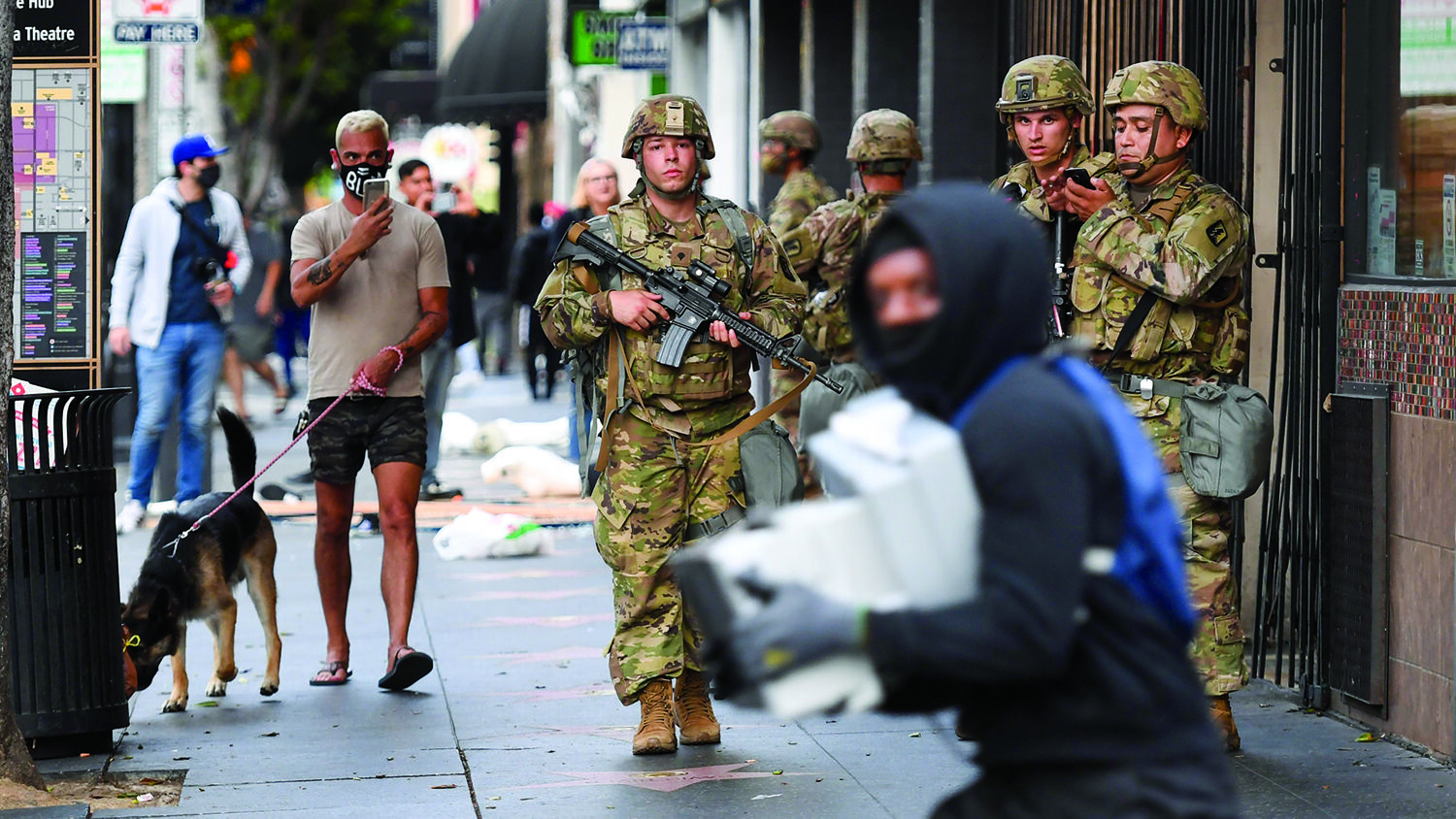
A looter carrying boxes of shoes runs past National Guard soldiers and bystanders in Hollywood on June 1. Anthony Kwan/Getty Images Our celebrated cities are succumbing to decay and violence. But an inspiring resurrection awaits.

From The Trumpet, The Death and Rebirth of America’s Cities

t has been a rough year for America’s cities. Their residents have been locked in their apartments for fear of coronavirus. Their attractions, offices, restaurants and stores have been evacuated. Their wealth has bled out because of ailing economic life, lost jobs and dwindling tax revenue.

Worse, their streets have choked with violent mobs vandalizing monuments, smashing storefronts, looting businesses, burning public buildings. Their law enforcement has been bridled by politicians more sympathetic to criminals than to law-keepers. Their protectors are being disrespected, disparaged and defunded, giving their enemies more license, more space to destroy. Their people are suffering rising rates of violent crime, including murder.

Yet these troubling recent events only aggravated a trend that has been wounding the nation’s crowning cities for years, even decades.

Legacy cities like Detroit, Pittsburgh, Cleveland, St. Louis and Buffalo have fallen from glittering heights of America’s industrial power. Shifts in the nation’s economy have cost hundreds of thousands of jobs and a loss of wealth. This has been exacerbated by race problems, “white flight,” cutbacks in law enforcement, and escalating crime. These factors have hollowed out many an American metropolis, leaving impoverished slums, empty buildings and decaying infrastructure.

In more recent years, failed welfare policies and lax law enforcement have turned cities into sanctuaries for homelessness, makeshift tent cities, drugs on the streets, garbage and filth, illegal immigration and criminality. Investigative reports have detailed how these problems are afflicting San Francisco, Portland, Seattle and other celebrated cities. Citizens are disgusted with their beloved cities being overtaken by trash, overpopulated by wastrels living off government largess, and overwhelmed by problems caused by bad governance.

All these crises have intensified this year. Animated by the twin specters of pandemic and race revolution, they are overtaking more and more of the nation’s urban landscape.

The effects of these trends will be far-reaching and disturbing, affecting not just city-dwellers, but every American.

Changing City Demography

covid-19 has made population density a bad word. In areas where protests have turned destructive, a cascade of aftereffects are pummeling city-dwellers: jobs lost; stores destroyed and shut down; business costs skyrocketing as insurance premiums soar. And in far too many places, mayors and governors are encouraging these curses. They are shuttering companies in the name of public safety. They are permitting, even applauding, marches and mayhem. And in the vacuum left by their failed leadership, revolutionaries are growing more bold, brazen, aggressive and ambitious.

“Urban dwellers are resilient, but these simultaneous events have forced people to face a hard reality,” wrote Daniel Henninger in the Wall Street Journal. “In just three months it has become clear that modern urban progressivism is politically incompetent and intellectually incoherent. … The message being sent is that progressive governance is, at best, ambivalent about maintaining civil order. The net result the past three months has been a sense in many cities of irresolvable chaos, stress and threat.”

At the same time that city life is becoming more unpleasant, virus restrictions are forcing much of life online. Schools nationwide are shifting to distance learning, and businesses are asking people to work from home. Social distancing restrictions and reduced foot traffic mean that costly big-city office space or storefront makes less and less economic sense. Consumers were already buying more and more online; this accelerates the trend. And many analysts are convinced some decentralization in the workforce is likely permanent.

The cost-benefit analysis is convincing many city folk to make a move. If you’re working remotely anyway, why pay big-city rent? And social distancing is far easier in suburbia, or in the country.

In San Francisco and Manhattan, when covid hit, many people left. Vacancies rose; home prices and rental rates dropped. Home sales in the suburbs around New York City soared, with many well-off city residents buying properties sight unseen based off Internet ads. The New York Times reported a 44 percent increase in home sales in nearby suburban counties in July compared to the previous year; 73 percent in a county just over the state line into Connecticut; 112 percent in Westchester, just north of the city. Meanwhile, the number of properties sold in Manhattan plunged 56 percent.

Nationwide, home mortgage applications are up 33 percent compared to last year, and are still rising. FoxBusiness.com credits this to more Americans working remotely, and more families doing school from home and thus needing more space.

The people escaping the cities are people of means. Thus the concentration of impoverished people with no other options is growing. This at the same time that jobs are drying up, businesses are vacating, properties are being destroyed, law enforcement is pulling back, and crime is rising.

This is casting a pall over the future of America’s cities. And illuminating some of the most chilling end-time prophecies of the Bible.

The Bible foretells scenarios about America’s cities so nightmarish, some are difficult to conceive. But these recent destructive trends definitely make these prophecies far easier to imagine.

The Prophesied Fate of Cities

Many of the prophecies in the book of Isaiah are for our day, this period concluding man’s rule on Earth. Of the modern nations descended from ancient Israel—most prominently America—Isaiah foretells this: “[Y]e will revolt more and more …. From the sole of the foot even unto the head there is no soundness in it; but wounds, and bruises, and putrifying sores …. Your country is desolate, your cities are burned with fire: your land, strangers devour it in your presence, and it is desolate, as overthrown by strangers” (Isaiah 1:5-7).

America has witnessed the ghastly fulfillment of this prophecy, scenes of cities burning terribly at the hand of lawless people who seek to dismantle the American system. Crowds of protesters have chanted “Death to America”—echoing Islamists on the streets of Iran!

But this is only the outer edges of the destruction to come. Several prophecies describe a coming time of “great tribulation” worse than any in history (Matthew 24:21). This is God’s terrible punishment for modern-day Israel’s rebellion.

Like Isaiah 1:7, these prophecies describing the coming tribulation place unusual emphasis on what happens in the cities. They show that cities will be hit first—and in some ways hit hardest. And a great many of the problems will be curses we bring on ourselves. This lamentable reality is foreshadowed in the way we are behaving and treating each other in our cities even today…(continues)

Off Grid Ham: Discussing Vertical And Wire Antennas

Here’s an article from Chris Warren of Off Grid Ham, writing about options for DIY antennas – Discussing Vertical And Wire Antennas

A topic so deep and wide.

I messing around with you. There is no such thing as an antenna specifically for off grid radio. But since off grid amateurs tend to be practical, do-it-yourself types, some vertical and wire antennas are more more appealing than others. What are the options, and how well do they work? We can’t possibly cover everything in one article, but we’ll go over the most popular types of antennas for off grid hams and talk about the function of each of them. vertical and wire antennas

Two basic flavors. vertical and wire antennas

There are two basic types of antennas for off grid radio: Vertical and wire. Yes, I am aware that there are many others: Beams, loops, etc. But remember we’re trying to keep it simple, practical, and relevant. A vast majority of hams end up using either a vertical or a wire antenna.

The reasons why are clear. These antennas are easy and inexpensive to build, and (for the most part) really do work. Think about all the advancements in technology. Radios have gone from massive tube farms to computerized communications centers with color displays and features that would have been Star Trek-ish just ten or twelve years ago! But at the other end of the coax, antennas have not fundamentally changed over the entire history of radio. You can compare a 50 year old ARRL Antenna Book to a 2020 edition and find nearly the same content in each of them. vertical and wire antennas

About the ARRL Antenna Book. vertical and wire antennas

It would be worth your while to own a print copy of the ARRL Antenna Book. It can be very technical and deep, maybe more than what the average ham is willing to digest, but wow, what a wealth of information. When you need to answer an obscure antenna question or look up a way-out-there math equation, the Antenna Book will come through. New copies can be quite expensive. I suggest buying an older used edition for a fraction of the cost. It doesn’t really matter because the information essentially never changes. My personal Antenna Book is nine years old and I have no plans to update it.

I don’t have a real high opinion of ARRL books in general, but the Antenna Book is an exception. It’s stellar. Every ham should own one.

The vertical antenna.

My very first antenna was a vertical, a Hy-Gain 14AVQ to be exact. I bought it used because, well, when you’re fourteen years old cobbling birthday & odd job money together for radio gear, that’s how you roll. The 14AVQ has been in production since at least the 1970s and is still available on the market today. I had a blast with that antenna and made many solid contacts on it. vertical and wire antennas

Vertical antennas offer an omnidirectional signal pattern, take up very little space, and are easy to install. They do not necessarily require support structures such as trees and buildings (I mounted my 14AVQ to a pipe pounded into the ground). Functionally they have a low angle of radiation, which is favorable to DX. There is also some evidence that vertically polarized antennas are better for short range (ground wave) communications.

The cons of vertical antennas. vertical and wire antennas

On the negative side, vertical antennas are harder to home-build and tune compared to wire antennas. Complicating that, commercially made verticals can be expensive. The Hy-Gain 14AVQ of my youth sells new for about $230.00. That’s a lot of money for what is essentially just an aluminum pole with some coils in it. The research & development costs, which I acknowledge can be very high, were amortized off the books decades ago. With that debt long paid off, the 14AVQ represents huge profit center for the manufacturer. This pattern can be repeated for almost any commercially made vertical antenna. Once the R&D costs are recovered, these antennas are basically money presses for the manufacturers.

Lastly, vertical antennas usually require ground radials. Where will you put them? If your antenna is mounted at ground level, you can just bury them in the dirt. Roof mounted verticals may be more tricky. There is no absolute rule for how many ground radials are needed, but more is better.

Wire antennas.

vertical and wire antennas

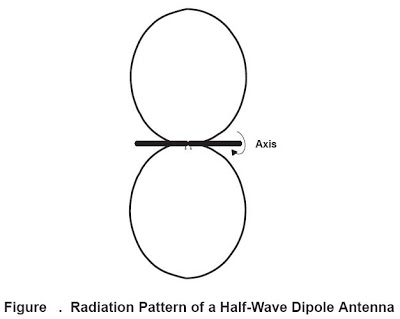
PUBLIC DOMAIN GRAPHIC

There is little to dislike about wire antennas. They can be easily made from materials most hams already have around the shop. Wire antennas done right really do work! The dipole is the “Mother antenna,” the antenna all others are based on. Wire antennas can be bent and shaped to fit your space. If you have to bend or droop a wire, it’s generally not a problem. Horizontal wire antennas also have a low angle of radiation, but it is dependent on elevation from the ground. This is why amateurs interested primarily in NVIS communications should not mount their wire antennas more than 30-50 feet up. There is such a thing as “too high”.

The bad news.

Wire antennas have two main disadvantages. First, they usually require two or more support structures. For a fixed station, this means having buildings or trees in the right places to hold your antennas up. For portable use, it means picking a site with trees or other tie points, or bringing a support system with you. By the way, many public parks prohibit affixing anything to natural features, even temporarily. Be respectful and verify what you’re allowed to do before you start tossing wire up in the trees.

Although wire antennas can sometimes be bent and shaped to fit a defined space, doing so may affect performance. Antennas are designed to be a certain shape for a reason. Anything that messes with the physics of an antenna is going to change the way it works. Changing the original shape of a wire antenna does not necessarily degrade performance, but it may result in a situation not favorable to your operating needs, such as when the radiation pattern is altered. Many hams have no choice and must do some antenna gymnastics to make their stations work. Although imperfect, these alterations are usually tolerable.

What about store-bought wire antennas?

I generally advise against buying commercially-made wire antennas. They do work well, but with a few exceptions they are not a good value for the money. One well known company is offering a portable “tactical dipole” for $400.00. Granted, it’s very well planned with a slick carry case and other handy features, but in the end it’s still just a dipole. A four-hundred dollar dipole! This illustrates a trend in the prepper/survivalist community where including the word “tactical” in a product name makes that product cost 3-5 times as much as it should.

The “Hail Mary” random wire antenna.

Wire antennas have one more big plus. A “Hail Mary” antenna can be any available length of wire. In more formal language, they’re called random wire antennas and they are exactly what the name implies. In an emergency, you can literally toss a random length of wire out the window, correct it to 50 ohms as best you can with an antenna tuner, and go. It won’t be very efficient, but you will get a signal out.

I have a random wire antenna as part of my go-kit. It works surprisingly well with my 5 watt FT-817. It would never be my first choice, but I’d be very happy to have it as a last choice.

Resources.

QSL.net has this amazing wire antenna reference that lists nearly 400 different wire antennas and diagrams on how to make them. Some of the designs are kind of way out there and I’m not sure they would work, but experimenting is part of the fun. The website cuts out complicated math and lengthy explanations; it just gives short & simple recipes on how to make some great antennas.

WA2OOO has a very cool calculator to determine the size of several popular wire antennas.

Mises Wire: Stop Blaming Classical Liberalism for the Problems of Human Nature

This article from Zachary Yost at the Mises Institute talks about the confusing plethora of definitions in common use for liberalism – Stop Blaming Classical Liberalism for the Problems of Human Nature

In a recent essay at the new online conservative magazine IM-1776, writer Alex Kaschuta argues that the contemporary world is under “The Heavy Chains of Liberalism” that have, in her mind, destroyed humane life, abolished tradition, and left atomized individuals increasingly “free” from all social and personal restraint. These complaints are nothing new, and some of the problems she points to are all too real, however, her broadside attack against liberalism misses the mark on nearly every front.

For one thing, like many labels in use today, the word liberal has become so broad that its use encompasses many divergent streams of thought and bulldozes over important differences and nuances. Libertarians and classical liberals are intimately familiar with this problem, having adopted those labels as a means to try and deal with the bastardization of the term liberal.

In his most recent book, The Great Delusion, John Mearsheimer divides liberalism into two diverse schools of thought that are often at odds with one another. On the one hand, he identifies modus vivendi liberalism, which is largely focused on individual negative rights and is primarily concerned with state intrusion into life, and on the other hand, he identifies progressive liberalism which is much more concerned with positive rights and social engineering. Most notably, progressive liberalism is intimately connected to crusading schemes to remake the world in its universalist image. Modus vivendi liberalism, which Mearsheimer has identified with F.A. Hayek, lacks this universalist crusading impulse.

However, like many today, Kaschuta paints with a broad brush and conceives of only one liberalism in the mold of John Stuart Mill, who, she argues, “asserted that freedom lies in elevating choice and leaving aside burdensome custom, that the only way to be truly free is to unshackle yourself from the bonds of social mores, into ever freer choice.”

To be sure, there are libertarians who seem to identify maximalized individual choice and therefore control over every aspect of human existence as being the core of libertarianism. For instance, consider this line from Nick Gillespie and Matt Welch’s 2008 Reason essay “The Libertarian Moment“: “We are in fact living at the cusp of what should be called the Libertarian Moment, the dawning not of some fabled, clichéd, and loosey-goosey Age of Aquarius but a time of increasingly hyper-individualized, hyper-expanded choice over every aspect of our lives.”

It is certainly questionable to what extent such a focus on “hyperindividualism” belongs in the modus vivendi camp.

In contrast, a Misesian conception of liberalism is hardly focused on the destruction of social mores and tradition. Rather, in Mises’s words, “the program of liberalism…if condensed into a single word, would have to read property, that is, private ownership of the means of production”. Not only is this a different emphasis than maximum individual choice in every sphere of life, but Mises actually attacks Mill as “the originator of the thoughtless confounding of liberal and socialist ideas that led to the decline of English liberalism and to the undermining of the living standards of the English people…Mill is the great advocate of socialism.”

Hayek’s work is also absent of this Millian impulse, and in fact, directly contradicts it on many occasions by defending the idea of tradition as being the result of an evolutionary process of trial and error that should not just be casually tossed aside by those who “cannot conceive of anything serving a human purpose that has not been consciously designed” and in fact calls such people “almost of necessity enemies of freedom.”

Unlike many illiberals, Kaschuta recognizes that “the market works, and it has been nothing short of miraculous.” However, she proceeds to blame the market for “the despoiling of the planet, the destruction of local communities, and boom and bust cycles of ever-increasing intensity.” Whatever criticisms one might have about a free-market system, these are not very good ones.

There is no shortage of data showing that liberal societies, with their emphasis on property rights, lead to better environmental outcomes. And one need only look at the history of the Soviet Union, which nearly completely eliminated the Aral Sea, and slaughtered tens of thousands of whales for no purpose at all, to see how well a non-market-based economic system cares for the environment.

Similarly, blaming the free market system for the decline of community also misses the mark. There are many reasons why community and civil society have decayed, but as the work of sociologists Frank Tannenbaum and Robert Nisbet demonstrate, one of the primary reasons is the centralizing power of the state that seeks to undermine any rivals for social power. This can hardly be blamed on modus vivendi–style liberalism.

Finally, Kaschuta’s claim that the market naturally leads to boom and bust economic cycles ignores the entirety of Austrian Business Cycle theory that argues that rather than being the natural product of market forces, such business cycles are the result of malinvestment created by central bank monetary policy.

Kaschuta raises many salient points when she complains about modern man being “freed” from all restraint, but she misses the mark in placing all of the blame for this unmooring on the shoulders of liberalism. History is full of similar periods in societies across the globe where there was a collective loss of self-restraint. These epochs are not indicative of the “chains” of liberalism, but the shackles of human nature that no earthly ideology can hope to ever cast off. Human nature is what it is.

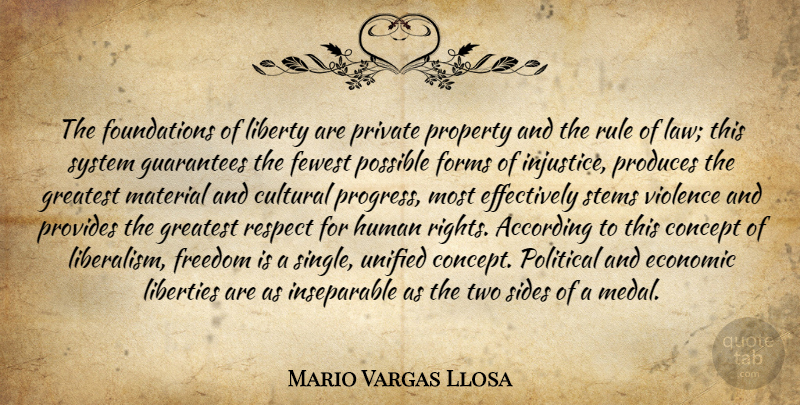
Liberalism will not solve human nature, but in the tradition of Mises and Hayek it can help to establish a social system in which humans can live peacefully with material prosperity. That is such a rare accomplishment in human history that its critics should exercise more caution before dispatching it to the dustbin of history.

Six Figures Under: What We Learned from Our Quarantine Food Storage Challenge

Stephanie at Six Figures Under has an article about What We Learned from Our Quarantine Food Storage Challenge during the first few months of the pandemic.

After three months of eating from our pantry, freezer, and long-term food storage, our Quarantine Food Storage Challenge is coming to an end.  Today I’m sharing some of what we learned. Hopefully something will be helpful to you as you plan to be more prepared with your own food.

First we’ll cover the three reasons we decided to end our open-ended challenge now. Then I’ll go over lessons we learned and what we plan to do about it!

For those of you who look forward to these updates, this won’t be the end of talking about food storage!  In the coming weeks, I will take the focus off MY food storage and start talking about YOUR food storage (how to get started, what to store, how much to store, how to keep track, how to use it).

As I’ve started reading through hundreds of responses in the 2020 Six Figures Under Reader Survey, I see that many of you are interested in building up your own food storage and would like some guidance.  (If you haven’t shared your thoughts, I would really love if you would take a couple of minutes to complete the survey).

Why we are ending our food storage challenge

When we started our challenge, we weren’t sure how long it would last.  I know some of you will be surprised or disappointed that we’re concluding it now, and I want to explain why we are deciding to go back to grocery shopping.  Essentially it’s because we accomplished what we set out to do. Let me break that down into specifics.

The primary reason we started the challenge was to keep ourselves and others safe by not going to the grocery store during the pandemic.  At the outset of this, there wasn’t a full understanding of how this novel coronavirus was transmitted.  Now that we have a better understanding, we feel like occasional trips to the grocery store are generally safe. Thankfully the outbreak in our area hasn’t been too terrible.

The secondary reason for undertaking a food storage challenge was to give our food storage a test drive.  While we have stored food for years, we really didn’t have a grasp of how much we would really need and what things we would wish we had more of.  We’ve figured a lot of those details out as we have monitored what we have used during the last three months challenge of not grocery shopping.  Now we have a better idea of what and how much we should store for our family.

The third reason for ending our food storage challenge now, rather than continuing the challenge indefinitely, is so we can make the effort to restock and update our food storage.  The future is uncertain in many ways, including potential continued disruptions in the food supply chain, so while we have the ability to stock up, we want to do so. You will see us implementing changes to our food storage in the near future.

What we learned from eating from our food storage challenge

How much food storage our family needs

As I’ve learned about food storage from a “scholarly” perspective, I learned how many pounds of this or that that you need per person for a certain length of time, but I had no idea how that would play out in real life. The suggested amount of 150 lb of wheat per person age 8+ (and half that for kids under 8) for a year supply doesn’t come with a menu or even a recipe book.

I had no idea if this was a low ball or high ball estimate.  I wasn’t sure if that was a “keep us alive” amount or a “life as usual” amount.  That’s about 12.5 lb per person per month.

Our family has 5 people age 8+ and 2 people under age 8 (I’m not including the baby in this count).  With that estimate, we would use 75 lb of wheat in a month.

I would have to say that estimate is nearly spot on.  We ate about 80 lb of wheat per month during our challenge.  Essentially that was just used for bread, pancakes, waffles, and other baked goods.

I’m still working on recording everything in our spreadsheet so we can calculate our own family’s consumption rate and create a customized food storage plan just for us.

What surprised us

If you followed along with our weekly updates during the challenge, you may remember that in the beginning I was having a little panic attack about some essentials that I thought we were low on like yeast, baking soda, baking powder, cocoa, salt, and oil.

In the beginning we had no idea how long the quarantine/lockdown phase would last and what shortages there would be.  We didn’t know how long we would choose to continue our challenge or if at some point it would no longer be our choice.  Either way, I wanted to be prepared, so I purchased some of these staples online.

As it turned out, I haven’t opened the 5 lb bag of yeast.  We have used only about a pound and a half of yeast in the past 3 months.  That is partly due to reducing the yeast in all of our recipes by half (with no problems).

We also haven’t had to open the 5 lb bags of baking soda or baking powder!

Of the 4 gallons of oil that I bought at the beginning of the challenge (knowing that they were essential for all of the baking I would be doing), I still have 3 left.

What we NEED to stock more of

We are probably good on wheat, powdered milk, beans, applesauce, etc, but there are some areas where our food storage is lacking. We’ll use a one-year supply as a measuring stick because that’s how many food storage recommendations are made. Feel free to divide by four if you want to build up to a 3-month supply or divide by two for a 6-month supply.

Salt– Salt is such a simple ingredient, but it’s essential!  It’s literally the cheapest food storage item out there.  And we didn’t have enough stored.  In fact, we were nearly out!  Right at the beginning of the challenge, I bought a few packages of salt from Walmart. Otherwise we would have been completely out!  That’s embarrassing!  For a year supply, it’s recommended that you store 8 lbs per person (that’s 4 regular salt containers per person).

Oil– We used just under 1 gallon of oil per month.  That means we would need roughly 12 gallons for a year supply.  This is one of those things you don’t just buy and tuck away for a disaster. It’s important to rotate through your stored oil or it will eventually go rancid.

Sugar– It’s recommended to store 60 pounds of sugar (in some form) per person for a year’s supply.  We don’t have anywhere near that, so this is definitely an area for us to work on going forward.

Oats– Oats are a major staple for us, but we haven’t stocked up for a while so we were low when the challenge started.  My MIL gave us a 25 lb bag of oats that she had, which is what we’re currently eating.

Rice– We didn’t run out of rice, but we are low and don’t have anywhere near what we would need for a year supply.

Pasta– We generally eat a lot of pasta. It’s fast, easy, and everyone likes it. We had quite a bit on hand at the beginning of our challenge, but we would have run out during the second month if we weren’t being careful with it. Of course, with an abundance of wheat and eggs, we could decide to make our own pasta, but while that would be delicious, it would no longer be fast and easy.

Peanut butter- We typically buy peanut butter for about two months at a time, but we definitely need to store more.  Peanut butter an jelly sandwiches are a staple in this house!  As long as we rotate through what we have, there won’t be a problem with spoilage or waste.

Jam/Jelly– As an important ingredient in PBJs, we need to store more jam!  In the past when we’ve had easy access to free blackberries, we’ve made loads of our own jam.  It’s been a while since we’ve made jam in large quantities, so we’ve been buying it.  We have both blackberries and raspberries growing on our property now, so hopefully we can get back into making our own jam.

Cocoa Powder– We have around 10 lb, but we need more for a long-term supply. And yes, cocoa powder is an essential storage ingredient for us!

What we WANT to stock more of

Some of the things we want to stock more of in our food storage are:

Cheese– Over the next few months, we’re planning to store more cheese.  We’ll keep a reserve in the freezer and rotate through it.  By no means will it be a year supply, but if we need to live strictly off our food storage again we can ration it.  During this challenge we stretched about 5 lb of cheese to last for two and a half months, which, for a family with cheese habits like us, is impressive.

Butter– Butter is our fat of choice when it comes to baking and cooking, but throughout this challenge we had to rely on alternatives like canola oil and shortening because we only had 5 lbs of butter in the freezer at the outset of this challenge.  We actually still have a pound of butter left because we were being careful to ration it. Like cheese, I plan to store more in the freezer.

Raisins– We eat a lot of oatmeal, cream of wheat, and other hot breakfast cereals and raisins are a favorite add-in.  We should definitely store more of them!

Chocolate Chips– For baking and for mom snacks when there isn’t anything else sweet around.

Salsa– We are fortunate to have hens that keep us well stocked up in eggs (at least in the warm months).  We love having salsa to make fried eggs more exciting.

This obviously doesn’t include the normal everyday staples that we’ll be buying when we go back to the store next week like milk, sour cream, tortillas, chicken, ground beef, or pork (if it’s available and not crazy expensive), lettuce, tomatoes, potatoes, carrots, celery, strawberries, apples, bananas, and other fresh produce.

Other things we learned during the food storage challenge

Understanding  the practical implications of eating from our food storage has been very valuable and will help so much as we go forward.  But a clearer picture of how long our food storage will actually last isn’t the only good thing that came from this challenge.  Here are a few other things we learned (or re-learned).

Eat all leftovers so nothing is wasted

We’ve always been pretty good about eating leftovers and not letting them go to waste, but during this challenge we were especially conscious of not wasting food.  Our food supply felt more finite that it normally does since we weren’t shopping to replenish it.  That made us more aware of not wasting any food.

Don’t overeat just because something tastes good

Another way to waste food is to overeat.  We don’t usually think of overeating as wasting food, but that’s really what it is. Mike and I were careful to stop eating when we were full instead of continuing to eat just because something was tasty.

Try new things

We took advantage of the extra time during quarantine to experiment and try making and eating new things. A lot of you thought it was funny that I had bever made split pea soup before.  Well now we’ve had it several times and really like it!  We’ve made tortillas from scratch.  We learned a few ways to make cheese.  And now that the older kids can make bread by themselves, we’ve been enjoying delicious homemade bread even though I haven’t made any for the last month!

Whew!  That was a lot!  Thanks for sticking with me!

Like I said, next week I will take the focus off MY food storage and start talking about YOUR food storage.  I’m excited to help you get started on or improve your food storage situation.  Let me know if there’s anything specific you want me to make sure to cover!

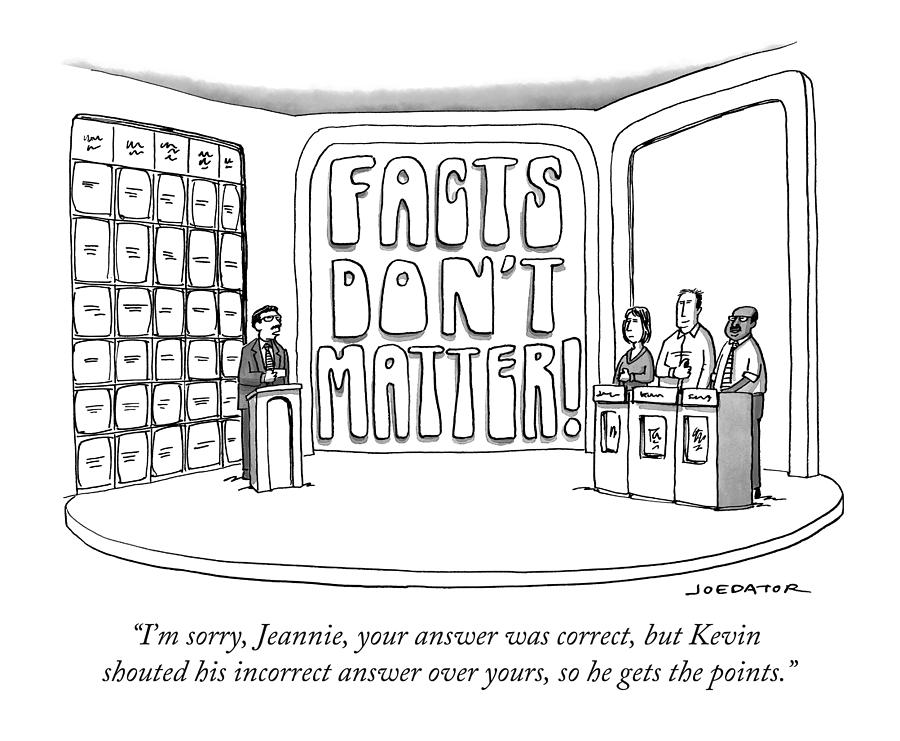
Zero Hedge: We Live More And More In A World In Which Facts No Longer Matter

Michael Every of Rabobank writes this short article at Zero Hedge – We Live More And More In A World In Which Facts No Longer Matter. In the article, Every mostly talks about politics, but the concept has farther reaching implications in our society. My spouse and I have discussed it frequently during this pandemic; one of the reasons that people are so divided about various issues, including pandemic responses, is because they can pick their “facts.” We have an education system that has been so bad for so long that few people are capable of understanding even simpler scientific journal articles. Not all journal articles are equal. Some are filled with bad science, bad math, bad statistics, and/or bad methodologies. So when one study says that X is bad, and another says Y is good, people simply choose the answer they prefer.

The same is true for news articles. On the internet, you can find sources espousing just about any position on any issue, so it’s easy for people to take any position and point to those voices as proof that their belief is true. It fuels divisiveness because the different sides of an issue all believe that the facts are on their side and are incapable of objectively evaluating the underlying assumptions and information. Every debate becomes a holy war because every belief is taken on faith rather than reason.

The fix for that problem is broader education (education, not necessarily schooling) which encompasses science, mathematics, statistics, philosophy, etc. That’s a difficult change to make, and, as we know, those in power will not take the difficult road when a superficial attempt which also increases their own power will suffice. Instead of education reform, you get people calling for shutting down all of those different voices so that only the approved messages get through. Those approved messages aren’t necessarily the truthful ones, they’re the ones that support those in power.

Day by day, we live more and more in a world in which facts no longer matter. Social media, a bitterly-bipartisan mainstream media, and socio-economic and cultural polarization all mean we can inhabit the world of facts we find most comfortable and convenient. Indeed, as the economy becomes more Dickensian in terms of income and wealth equality it also becomes more *literally* Dickensian:

It was the best of times, it was the worst of times, it was the age of wisdom, it was the age of foolishness, it was the epoch of belief, it was the epoch of incredulity, it was the season of light, it was the season of darkness, it was the spring of hope, it was the winter of despair, we had everything before us, we had nothing before us, we were all going direct to Heaven, we were all going direct the other way—in short, the period was so far like the present period, that some of its noisiest authorities insisted on its being received, for good or for evil, in the superlative degree of comparison only.

And that’s just the US Vice-Presidential debate from last night, which offered up generous helpings of political pound(ing)s, shillings, and (Mike) Pence. Which for those who don’t know, was the old British Imperial money system until 1971 when, as my late grandmother referred to it, the UK joined the “decimal diddle dum dee club”. And one wonders how people ever wondered how Brexit could happen…

Of course, the VP debate also saw vast quantities of question-dodging over key issues, or answers that seemed to be to entirely different questions – to no response from the moderator-bot, which only seemed to be programmed to worry if people over-ran, rather than running over facts. It was still a vast improvement last week, however, in that there was actually some debate in it.

Who ‘won’? See the various polls from different sides of the political aisle: CNN said Harris 59% – 38%; Telemundo said Pence 76% – 24%. But the key point is that nowadays whomever *you* like won – after all, it is the ‘epoch of belief’. Likewise, whomever *you* like is comfortably winning the election. That is the meme both sides can cling to until 3 November. (And then, political risk analysts fear, it may be time for either loser to embrace a conspiracy theory as to why they didn’t actually lose.) Yet if we wanted to pretend actual facts mattered for a fleeting moment, the key question would be which side’s base feels more enthused after having sat through the VP debate: who got more policy red (or blue) meat thrown their way?

Talking of the (overdone) red meat side of things, the Heavenly side (as shall be explained), the conspiracy-theory side, and the ‘best of times, worst of times’ side, yet again we also see a Tweet from Trump trumping other news. Trump announced he believes the drug he was treated with is a “cure”; more important than the vaccine (which is coming “very, very shortly….right after the election”); and Regeneron will be shortly be freely available *and free* to those who need it. Indeed, Trump said he wants everybody to be given the same treatment he got without payment as “It wasn’t your fault…, it was China’s fault, and China is going to pay a big price.”

Is that related to the Bloomberg story yesterday talking about a possible looming US crackdown on Tencent and Ant Financial to stop China expanding its digital payments platforms? Or is it related to Mike Pompeo busily trying to form an Asian version of NATO? Or is it something else equally world-splitting if carried out in full?

Another good question that wasn’t asked at all at the VP debate that happened after that Trump video: is free Regeneron socialised medicine? The media aren’t asking either, instead running with the Trumpian phrase it was “a blessing from God” he caught Covid-19 (which he instantly qualified to “a blessing in disguise,” which itself is disguised in all those exegesis-esque headlines).

Meanwhile, preceding both the VP debate and the Trump video we had the FOMC minutes, a body which has played as large a role in our drift into all forms of Dickensianism as anyone. As Philip Marey notes, these represent “The quiet before the storm”. In particular, he points out that the minutes revealed quite some disagreement within the FOMC regarding the forward guidance on rates: a Dickensian dichotomy, one might say. As long as we are in a pandemic environment this may not matter very much. However, he believes that “by the time we get closer to the exit, the practice of flexible average inflation targeting may become a cacophony”. There’s something to look forward to.

The minutes also showed that the economic outlook (and thus the FOMC’s projections) assumed additional fiscal support, and that if future fiscal support was significantly smaller or arrived later than expected the FOMC thinks the pace of the recovery could be slower than anticipated. “Send more money now,” in short. This could still happen before the election in one form or another, even if Larry Kudlow isn’t in the loop. After all, if you are giving away Regeneron free now, why not?

Philip concludes that several headwinds are converging in Q4 that could upset the economic recovery, and that the next time the Fed meets will be in the stormy environment after Election Day.  

The Fed, meanwhile, will continue to try to send us the message that ends the book whose long opening line I have already quoted: “It is a far, far better thing that I do, than I have ever done; it is a far, far better rest that I go to than I have ever known.”(**Spoiler alert** – that particular guy gets his head cut off in a revolution.)

Which is what Nicola Sturgeon must be thinking of as she closes down central Scotland’s pubs (and restaurants) for over two weeks(?)

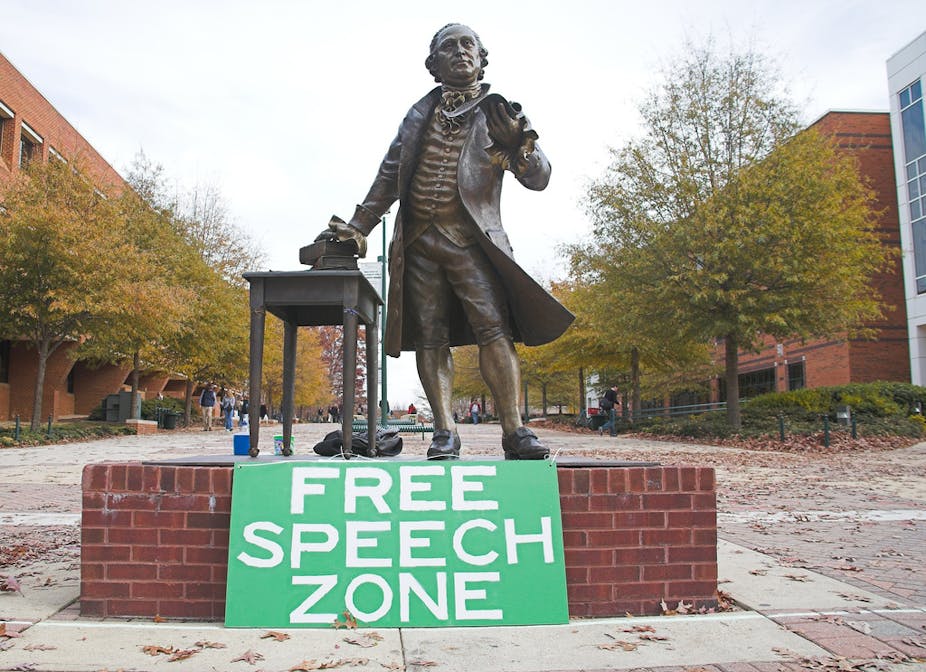
Rutherford Institute: Case of Student Arrested for Disorderly Conduct for Distributing Religious Literature in a Free Speech Zone Goes Before Supreme Court

In 2016 a Georgia Gwinett College student was arrested for distributing religious literature from a designated free speech zone because someone had complained about his speech. He sued the university and the case was eventually dismissed because the College said that it had changed its free speech zone rules. The student appealed to the Supreme Court. Here is an update from the Rutherford Institute which recently filed an amicus brief in the case.

The Rutherford Institute has weighed in before the U.S. Supreme Court on a case in which campus police, citing “disorderly conduct,” prevented a college student from speaking about his Christian faith and distributing religious literature from a small free speech zone on a 260-acre campus. In an amicus brief filed in Uzuegbunam v. Preczewski, Rutherford Institute attorneys are asking the Supreme Court to hold officials at Georgia Gwinnett College liable for violating college student Chike Uzuegbunam’s free speech rights and ensure that campus policies adhere to the First Amendment…

“This case reminds us that there is no room for trust in the relationship between the citizenry and the government,” said constitutional attorney John W. Whitehead, president of The Rutherford Institute and author of Battlefield America: The War on the American People. “Trust the government to police itself, and it will sidestep the law at every turn. The only way to ensure that government officials obey the law and respect the rights of the citizenry, as Thomas Jefferson recognized, is to bind them with ‘the chains of the Constitution.’”

Chike Uzuegbunam is a Christian and was a student at Georgia Gwinnett College, which has a 260-acre campus in Lawrenceville, Ga. Chike’s faith requires that he share his religious beliefs with others. He sought to do so in 2016 by passing out literature and speaking to students from a spacious concrete plaza near the college’s library. A campus security officer stopped him and warned that Chike could not distribute written materials there because he was not in one of two “speech zones” the college had established. Under the college’s policies, students were required to reserve times for one of the two “speech zones,” which consisted of one patio and one sidewalk that amounted to 0.0015% of total area of the campus. The policies also required students apply for a reservation at least three days in advance and gave college officials unbridled discretion to decide who could speak, when they could speak, and what materials they could give out. Although Chike properly reserved a time for sharing his faith from one of the zones, he was again stopped from speaking by a campus security officer. The officer told him that because someone had complained about his speech, he was engaged in “disorderly conduct” under college policies. Chike then brought a lawsuit against the college alleging that its policies and their application to prevent him from engaging in religious speech violated the First Amendment. After months of litigation, the college moved to dismiss the case as moot because it had changed its “speech zone” policies and the trial court granted the motion. Chike appealed, arguing his case was not moot because he was entitled to nominal damages for the interference with his First Amendment rights, but the appeals court upheld the dismissal. Chike sought and was granted review by the U.S. Supreme Court. In its amicus brief supporting Chike, The Rutherford Institute argues that dismissal of the lawsuit violates long-established court precedent affirming the right of citizens to obtain an award of nominal damages against the government officials when they violate a person’s constitutional rights. 

The Rutherford Institute, a nonprofit civil liberties organization, defends individuals whose constitutional rights have been violated and educates the public about threats to their freedoms.

American Partisan: Three Avenues Of Approach – Baofeng’s BF-R3

NC Scout at American Partisan has a brief article on the inexpensive Chinese radio Baofeng BF-R3 and its increased utility over the UV5R model. Besides signal intelligence value, having a third band can make a difference operationally as well. In an RTO class that I attended, we found that one of the bands did not work reliability in the terrain and among the structures where we were operating, but switching to the alternate band worked fine.

As I tell students in the the RTO and Signals Intelligence Courses, its not necessarily what can be monitored (everything has the capacity to be monitored) but rather, how your adversary can exploit it. This in turn points to the criticality of the ability to plan and act based on that plan. And often enough, the difficulty lay not just in detecting an adversary to monitor, which can be hard enough, but taking that a step further into implementing tools that are outside his capabilities.

In the last RTO Course out West, a couple of the students had brought in a new model of Baofeng- a triband model called the BF-R3– a tri-band radio that matches all of the functions of the old UV-5R but with an additional spread of transmitting capability on 220-260mHz. This enables users a whole third option for receiving and transmitting in a vastly under-utilized frequency spread.

It is backwards compatible with all of the standard Baofeng UV-5R cables, batteries and accessories, including my favorite, the H-250 dogbone mic. On top of that, its fully Chirp supported for all of you that use that software. At about the same price as the standard two band Baofeng but with expanded capabilities, its hard to see why you wouldn’t want to have a few.

Get ’em while you can and while you’re at it, come get training on using it in a tactical environment. Might be important here soon.

Hurricane Watch Net Activates for Hurricane Delta

Hurricane Delta had been a category 4 storm, but dropped to category 2 as it made landfall in the Yucatan. It is expected to strengthen again as it crosses the Gulf. From Hurricane Watch Net:

Wednesday, October 7, 2020 @ 8:00 AM EDT – 1200 UTC

The Hurricane Watch Net activated Wednesday morning at 8:00 AM EDT (1200 UTC) on 14.325.00 MHz for Hurricane Delta.

Hurricane Delta made landfall around 5:30 AM CDT (1030 UTC) along the northeastern coast of the Yucatan Peninsula near Puerto Morelos with estimated maximum winds of 110 mph, a category two hurricane on the Saffir-Simpson Hurricane Wind Scale.

The reason for our late start is because we did not have any propagation into the affected area overnight on both 20 and 40-meters. We will be in operation most of today before taking a break.

We will resume operations Friday morning at 8:00 AM EDT – 1200 UTC on 14.325.00 MHz. We will begin operations on 7.268.00 MHz that morning at the conclusion of the Waterway Net. Once active, we will remain in full operation through approximately midnight CDT.

Delta is currently forecasted to be a Category 2, possibly a Category 3, Hurricane when it makes landfall somewhere south of Lafayette, LA on Friday afternoon.

Any change to our activation plans will be posted on our website, www.hwn.org.

I want to offer in advance my sincere thanks to everyone who uses 14.325 MHz and 7.268 MHz for various Nets and rag-chews to allow us to use these frequencies. Having a clear frequency certainly makes our job easier, and we know those in the affected area greatly appreciate it as well!

As a reminder, we are always available to provide backup communications to official agencies such as Emergency Operations Centers, Red Cross officials, and Storm Shelters in the affected area. We also collect and forward significant damage assessment data to FEMA officials stationed in the National Hurricane Center.

As always, we are praying and hoping for the best yet preparing for the worst.

Sincerely,
Net Management

Prep School Daily: Basic Food Storage–An In-Depth Discussion of Dry Milk

Here’s an article from last year at Prep School Daily on options for dry milk – Basic Food Storage–An In-Depth Discussion of Dry Milk. When the lockdowns first started, milk was a bit scarce at local stores so we used the dry milk in our food storage to supplement the regular milk we already had. Even if you don’t have the best tasting dry milk, it can be pretty good if you mix it half and half with some regular milk — so you’re using it to stretch your fresh product, rather than completely replacing it.

Is this really what my life has come to?  While I never pictured myself becoming famous (zero desire for that) or rich (security has its advantages) or saving the world, somehow I guess I thought I’d be doing something a little more exciting than writing about dry milk.  Something a little juicier.

But alas, here we are.

Last week I taught a class all about dry milk for about a dozen people at church, and in the process I learned a few things and thought I should share that bit of knowledge with my readers.  And before doing that, I thought I should review what I’d already written.  And to my shock I found that I’d never actually written anything about dry milk!

So without further adieu, let’s delve into the mysterious world of powdered milk.

First off, we have to define each of the kinds of dry milk.

Non-instant nonfat milk is not sold by a lot of companies.  I found one seller on Amazon and non-instant nonfat is also what is sold by the Home Storage Center (HSC). It is processed by drum drying, where the milk is sprayed on a heated drum and then scraped off.  The drum is heated and the resultant dry milk has a cooked flavor to it.  It is generally much less expensive than instant nonfat.  As the name suggests, it does not mix instantly, but takes a bit more stirring.  It has a reputation of being less palatable than instant.

Instant nonfat milk is far more popular, easy to find through all preparedness vendors and at grocery stores.  It is processed by evaporation and spraying into a heated chamber where the milk dries almost immediately.  It is a more expensive process.  There is a wide range in price and palatability.

Instant milk drink is promoted as being the best-tasting.  And it is!  BUT IT’S NOT REAL MILK!  In fact, if you take a look at the list of ingredients, milk is number 3 on that list (at least, for Morning Moos).  It can’t possibly be more than 33% milk.  Kinda disturbing.

There are also instant lowfat and whole milk options.  These are not packaged for long term storage, and even if they were, they don’t have the shelf-life of long-term storage.

In the process of preparing to teach the class last week, I decided to take a look at the nutrition information label for the instant milk drinks to compare with the dry milk powders.   And I discovered that there is quite a range in the vitamin and mineral content of the various products.  Because milk is the primary dietary source of vitamin D for most people in their food storage, it’s something we really need to pay attention to.

However, it doesn’t really matter how much more nutritious one brand is over another if it doesn’t taste good, unless it is only being used in baking and cooking.  If your child refuses to drink it, it won’t matter that it’s got the most vitamins and minerals, right?  And you know you can’t blame them, because you remember pretty well how nasty some dry milk can be.

So doing a taste test is pretty important, especially before forking out a significant chunk of change.  Milk is definitely not cheap.  I’m including the results of three taste tests here. All are for pretty small groups.  One is from a group in Utah that posted their results online.  Another is from a class I taught in Missouri about seven years ago.  And finally, there are the results from my class last week.

For the Utah group, they tested the following milks and milk drinks:  Emergency Essentials, Country Cream, Walton Feed, Augason Farms, HSC, Walmart store brand fresh nonfat milk (control), Honeyville,  and store brands.  All were mixed according to directions and chilled well.  Sugar and vanilla extract were not added to any of their samples.  In their taste test (which was held nine years ago), the HSC milk (from a freshly-opened, freshly-canned can) scored the worst.  Provident Pantry (now Emergency Essentials) was rated the highest.

In my class in Missouri, seven years ago, we had five different samples.  I’m working from memory here, so please bear with me.  We had the Provident Pantry brand (which now carries the Emergency Essentials name), Grandma’s Country Cream, a brand I can’t remember for the life of me, one sample from the Home Storage Center that was mixed according to directions, and another sample from the Home Storage Center to which sugar and vanilla extract were added.  In our small-ish group, choices for the best milk divided pretty evenly between Provident Pantry, Grandma’s Country Cream, and the one I can’t remember.  Everyone put the milk from the Home Storage Center, unadulterated, in last place.  What was surprising to all of us was that everyone picked the milk from the HSC to which we added vanilla and sugar as the second best.

In my class last week we had seven different milk choices. All of the milk products that were acquired years ago have been stored at recommended temperatures since purchase.  The cans from the HSC, Provident Pantry, and Grandma’s Country Cream were all opened last week.  Except for the sample with vanilla and sugar, all were mixed according to package directions.  All were well chilled.  Taste testers ranked the samples from 1 to 5, with 5 being the best and 1 being they’d rather die than drink it again.

I was surprised by some of the results.  I will note that most of the taste testers this week were over the age of 50, and I really think there is some change in the taste buds when we get older.  It’s so important to taste and see what we like best.  We have our ideas of what tastes good, what something is supposed to taste like.  I’m pretty happy to eat store brands of most foods, but my graham crackers better be Honey Maid, and my saltines better be Premium or Krispy.

My cans of Provident Pantry and Country Cream were ten years old.  The cans from the HSC were from 2001 and 2010.  Carnation, Kroger, and WinCo bulk were all fresh purchases.

Coming in at a solid last place was Carnation, with an average of 2.1.  I’d have thought they would have figured out the milk business by now.  Kroger scored 2.9.  Provident Pantry, 3.3.  WinCo bulk bin, 3.4.  Country Cream, 3.9.  HSC without any additives, 3.6.  HSC with sugar and vanilla, 4.1.

For the nutrition analysis:            Vit A   Vit C  Vit D  Calcium      Cost        Servings     Cost/Serving
Carnation                                      10%      2%     25%      30%       $0.99             4                  $0.25
Kroger                                           15         —       15          20             2.31           12                   0.19
WinCo bulk                                      (not noted)
Provident Pantry                            0          2          0          25
Country Cream                              0          0        10          30
HSC (2001, no additives)             10        4          25         35
HSC (2010, sugar and vanilla)     15        4          40         35

For comparison, what’s currently available
HSC                                              10        4          25         35            4.00           29                   0.14
Country Cream                               2        2          10         30          18.99           64                   0.30
Augason Farms                             15        2          10        20           22.99           39                  0.59
Thrive                                             0        0          10         20           10.49          15                   0.70
Emergency Essentials                   10        4          25        30           18.95           45                   0.42
Augason Farms Morning Moo     10        0          15         10           23.99           93                 0.26
(Carnation and Kroger remain the same)


As you can see, the various milk products different dramatically in nutrition and cost per serving.  All servings are eight ounces each.

The clear winner for cost per serving is the HSC milk at 14 cents per serving.  Even factoring in the cost of sugar and vanilla extract (at $4.00 per ounce currently), it’s 22 cents per serving to make a milk that tastes as good as the more expensive brands.  If you look at the nutritional content, the HSC is the winner again, just barely surpassing the Emergency Essentials brand.  The others just don’t even hold a candle, especially when you factor in how important vitamin D is in the diet, and even more so for children.  In case you don’t remember, where else can you get vitamin D in your diet?  Fish, beef liver, eggs, and cod liver oil.  Or supplements.  Keep in mind that 42% of American adults are deficient in vitamin D.  And in the early 1900s, before milk was fortified, 90% of children in Boston and New York had rickets.  Make sure you plan well for the children in your life.

Another method for improving the taste is to add 1/4 to 1/2 cup more milk powder per quart of milk.  We didn’t try this for the class and I have no experience with it.  It’s just something you may wish to try yourself.

For the class last week, we didn’t just taste test milk, though that was a really important part of the class.  I also showed participants how to use the inexpensive HSC dry milk in their everyday cooking.  We taste tested instant oatmeal, cream of tomato soup, survival bars, and chocolate pudding.  Even if people prefer the more expensive milks for drinking, it’s important to see that less expensive milk can successfully be used for cooking and baking.  However, it is very important to note that the measurements of dry milk for baking are not necessarily interchangeable.  It takes anywhere from 2/3 cup to 1 1/3 cups of powdered milk to make a quart of liquid milk.  All recipes on this blog, unless otherwise noted, are made using HSC milk, which uses of a ratio of 3/4 cup dry milk to 3 3/4 cups water.

Forward Observer: This Is a Fourth Generation War

Intelligence analyst Sam Culper of Forward Observer writes This Is a Fourth Generation War.

Earlier this year, I did a re-read of Bill Lind’s 4th Generation Warfare Handbook (4GW) to better understand the framework of our ongoing Low Intensity Conflict.

For those who are new to the term, Low Intensity Conflict is war below the threshold of conventional war (tanks and bombers) but above routine, peaceful competition. America is not at conventional war, but it’s certainty not at peace with itself. This is the gray area of Low Intensity Conflict.

As history shows, technology and human understanding of warfare evolves, so war itself evolves. Not everyone agrees with the “generational” description of warfare, but let’s look quickly at the framework.

According to the theory, Generations 1-3 of warfare focused on the development of conventional warfighting, generally understood as:

1GW: masses of troops meeting on the battlefield in somewhat orderly warfare, such as lines and columns; to

2GW: the inclusion of centralized indirect fire and war by attrition; to

3GW: the inclusion of combined arms (land, air, and sea) and maneuver doctrine.

But something interesting happened in the Fourth Generation: the nation-state lost its monopoly on violence.

War is less and less being fought among conventional militaries and nation-states, and it’s increasingly fought by tribal entities, where both armed and unarmed combatants wage war against an enemy. (Many make the case that this is the original form of warfare, or 0GW, and they’re not wrong.)

Yet, as Lind describes, “All over the world, citizens of states are transferring their primary allegiance away from the state to other entities: to tribes, ethnic groups, religions, gangs, ideologies, and ’causes.’” In 4GW, fighting for one’s “nation” increasingly means fighting for your social tribe, instead of fighting for one’s country.

We’re seeing this right now as the American identity is being redefined and the country becomes more tribal. Small groups, most often based on ideology or race, are trying to reform or replace state power, authority, and legitimacy to benefit their own self-interests. This is the battle between New America and Old America, where “American” is becoming, for many, a secondary or tertiary identity, often behind race and/or ideology.

In 4GW, the military and nation-state has clearly lost the monopoly on warfighting, as 4GW is fought primarily on the Mental (informational) and Moral planes of conflict. The Culture War being fought right now in classrooms, corporations, and media outlets is a great indicator of 4GW, as information operations and high-horse moral pleas have become warfighting techniques to win on the Mental and Moral levels of conflict. (Notice, for instance, the rhetoric re-defining “fundamental American values”.)

Lind makes the case that killing is rarely the preferred way to win a Fourth Generation War, and that winning the Mental and Moral conflict almost always dictates the outcome of the war. In a way, to win in 4GW, you don’t necessarily need to kill your opponent; you need to reshape the information environment and shift the perception of morality so that your opponent (and/or his ideology) becomes unpopular and immoral. Once unpopular and immoral by societal standards, political and social power dries up. At least in theory, that’s how you win at 4GW.

I’ve previously described how 4GW is being fought through community organizing, institution destruction, counter-institution building, economic dislocation, corporate activism, propaganda, terraforming the electorate, and several other ways.

If you’re like me, then you’re pretty far removed from the political and media power centers in D.C. and New York, where much of 4GW originates. But that’s doesn’t mean that 4GW is not being fought in your own area.

My challenge to you is to look locally for ways in which 4GW is being fought.

Are there community organizing efforts in your area to build competing social movements?

Are there subversive political groups trying to destroy local political, cultural, or religious institutions?

Are there subversive political groups trying to build institutions to counter your own political, cultural, or religious institutions?

Is there economic dislocation (targeting income or financial health) against political or cultural opponents?

Are companies or corporations engaging in the cultural and/or political fight?

Are there attempts to expand voting rights to non-citizens, or to shame those who oppose non-citizen voting?

There are a great many more ways that 4GW is being waged, and if we’re completely focused on the national level, then we’re likely to miss 4GW action in our own communities.

Until next time, be well and stay out front.

Of Two Minds: Corruption Is Now Our Way of Life

Charles Hugh Smith at Of Two Minds writes Corruption Is Now Our Way of Life on the collapse of the USA.

Systemic corruption and the implosion of the social contract have consequences: It’s called collapse.

Social and economic decay is so glacial that only those few who remember an earlier set-point are equipped to even notice the decline. That’s the position we find ourselves in today.

Many Americans will discount the systemic corruption that characterizes the American way of life because they’ve known nothing but systemic corruption. They’ve habituated to it because they have no memory of a time when looting wasn’t legalized and maximizing self-enrichment by any means available wasn’t the unwritten law of the land.

If you don’t yet see America as little more than an intertwined collection of skims, scams, frauds, embezzlements, lies, gaming-the-system, obfuscation of risk and exploitation of the masses by insiders, please read How Corruption is Becoming America’s Operating System. (nakedcapitalism.com, via Cheryl A.)

Here on oftwominds.com, you might want to read No Wrongdoing Here, Just 6,300 Corporate Fines and Settlements. (May 2015)

When JP Morgan Chase engaged in fraud and was fined a wrist-slap $1 billion, nobody went to prison because nobody ever goes to prison for corporate fraud and criminal collusion: JPMorgan to pay almost $1 billion fine to resolve U.S. investigation into trading practices.

Simply put, corruption is cost-free in America because most of it is legal. And whatever is still illegal is never applied to the elites and insiders, except (as per Communist regime corruption) for a rare show trial where an example is made of an egregious fall-guy (think Bernie Madoff: whistleblowers’ repeated attempts to expose the fraud to regulators were blown off for years. It was only when Madoff ripped off wealthy and powerful insiders did he go down.)

There are three primary sources for the complete systemic corruption of America. One is the transition from civic responsibility for the social contract and the national interest to winner-take-most legalized looting.

This transition is visible in the history of empires in the final stage of collapse. The assumption underlying the social order slides from a shared duty to the nation and fellow citizens to an obsession with evading civic duties: military service, taxes, and following the rules are all avoided by insiders and elites, and this moral/social rot then corrupts the entire social order as elites and insiders lean ever more heavily on the remaining productive class to pay the taxes and provide the military muscle to defend their wealth.

That corruption is now everywhere in America is obvious to all but those adamantly blinded by denial. The JP Morgans pay fines as a cost of doing corrupt business, while “public servants” game the system to maximize their pensions with a variety of tricks: colluding to boost the overtime of the retiring insider; finding a quack physican to sign off on a fake “heart murmur” so the insider pays no taxes on their “disability” check, and so on in an endless parade of lies, scams, skims and insider tricks.

The excuse is always the same: everybody does it. This is of course the collapse not just of the social contract but of morality in general: anything goes and winners take most. Insiders look the other way lest their own skims and scams be contested, and elites and insiders view those who aren’t skimming and scamming as chumps to be pitied.

The second dynamic is that financialization has completely corrupted the American economy, and that corruption has now spread to the political and social orders. Once the financial sector conquered the real economy, it began siphoning 95% of the economy’s wealth to the top .01% and their toadies, lackeys, apologists, enforcers and technocrats.

As they hollowed out the real economy, distorted incentives and made moral hazard the guiding principle of the American way of life, the recipients of financialization’s domination gained the wealth to buy political power from the pathetically corruptible political class.

The corruption that we call financialization corrupted democracy and undermined the social contract by eviscerating the value of labor and creating a pay-to-play political order that’s a mockery of democracy.

The third factor is the decay of America’s institutions into fronts for personal gain. While Higher Education insiders are masters of self-serving PR, the truth is they’re not concerned about their debt-serf “customers” (students) learning the essential skills needed in the tumultuous decades ahead–they’re worried that the revenues needed to pay their enormous salaries and benefits might dry up.

“Education” is nothing but a front for the corruption of self-enrichment by the elites and insiders at the top.

The same is true of “healthcare.” The concern of insiders isn’t the declining health of America’s populace, it’s the decline in revenues as fewer “customers” come in for the financial scalping of emergency care.

“Healthcare” is nothing but a front for the corruption of self-enrichment by the elites and insiders at the top.

Thanks to the Federal Reserve’s endless free money for financiers and endless federal borrow-and-blow deficits, the unstated belief is since there’s endless “money”, my petty frauds and skims won’t even dent the feeding trough–there’s always another trillion or three to skim and scam, and there will never be any limit to the feeding trough.

There is no limit until the system implodes. Then the collapse becomes limitless.

Ironic, isn’t it? The oh-so convenient belief that America’s wealth and power are eternal and godlike in their glory fosters the crass corruption that has weakened America to the point of no return: systemic fragility and brittleness.

American Exceptionalism has been turned on its head: America is now as perniciously corrupt as any developing-world nation we smugly felt so superior to, and with extremes of wealth and income inequality that surpass even the most rapacious kleptocracies. This destabilizing “exceptionalism” is now the defining characteristic of the American economy, society and political order.

Systemic corruption and the implosion of the social contract have consequences: It’s called collapse, baby, and the rot is now too deep to reverse.