Mark Manson: Nobody Knows What is Going On nor What to Do

NYT bestselling author Mark Manson writes about the confusion, lies and general contentiousness of the current pandemic in Nobody Knows What Is Going On. Occasional strong language ahead. His basic premise is that we’re still learning about this disease and no one really knows how bad (or not bad) it is. Some doctors say it’s just the flu. Other doctors say young, healthy people are dying from stokes caused by the virus. Everyone is contradicting each other, so people are reverting to believing whatever they want to believe or whatever aligns with their political outlook or whatever aligns with their financial interest and so on.

Right now, we have two large, complex systems. The first is a virus sweeping through the global population and our combined efforts to mitigate it. The second is a declining global economy. Both systems are incredibly difficult to measure and understand, much less predict. Both are so large and unruly that we struggle to even comprehend them in their entirety. And so far, pretty much everything we’ve thought about either has been utterly wrong.

Let’s start with the first system: the spread of the virus. Despite months of research and testing, we still know very, very little. For example, we know that the virus is highly contagious, but we still have no clue how contagious. Studies pin its R0 number (how many people each sick person goes on to infect) as high as 6.6 and as low as 1.4. For reference, that’s like saying the virus will infect anywhere from 20% of the population to 80%, a range so broad that you might as well pick a number out of a hat.

What about how many people have been infected? A series of studies came out in the past week showing that infections have likely been vastly undercounted and that there are thousands (perhaps millions) of people out there who have been infected but had no symptoms. This would be big news, because it would suggest that the virus is far less deadly than we thought. A recent Stanford study argued that the real mortality rate could be from 0.12% to 0.2%, making coronavirus hardly more deadly than the seasonal flu (which has a mortality rate of 0.1%). The problem is that these studies relied on inaccurate tests, did not test people randomly, and had other major methodological errors.

Okay, but what about deaths? A recent New York Times investigation found that there are potentially 20 to 30% more people dying from COVID-19-related deaths than are being reported (note: this study has also been widely challenged.) So, while there may be far more people being infected than we’re counting, there’s also likely far more people dying than we’re counting.

This means… well, I don’t know what the fuck this means. And neither does anybody else. Pretty much every projection model, including the ones government officials have relied upon, have been wildly incorrect so far. Lockdowns work! But, then again, they might not. Hydroxychloroquine was supposed to be a successful treatment. Then it turned out it wasn’t. Remdesivir was supposed to be a successful treatment. Then it turned out it wasn’t. Ventilators were supposed to save lives. Then it turned out they probably don’t. The hospitals are going to be overloaded! Until they weren’t. Smokers were all going to die! Wait, no, smokers might be the ones who live.

A few weeks ago, the US government’s estimate of 240,000 deaths seemed so absurd that they revised it down to 60,000. Now that number seems completely absurd and will likely need to be revised much higher again. The cherry on top of the shit sundae, of course, is the US president talking about beaming ultraviolet rays through our bodies as though we live in an episode of Star Trek… and then following that up by suggesting that maybe we inject ourselves with disinfectants.

If there’s one thing we know for certain about this pandemic, it’s that we know almost nothing for certain about this pandemic.

And that’s only the first system we’re wrestling with. The second is our economic system. Within a span of a couple weeks, the travel, hospitality, entertainment, restaurant, and brick and mortar retail industries have practically been annihilated. Just in the United States, 26 million people have lost their jobs in a little more than a month; an unemployment rate that rivals The Great Depression (note: this number is also likely being undercounted). The consensus is that we are certainly entering into a recession with whisperings of the D-word… no, not that D-word… the Depression D-word. The International Monetary Fund has said that we are potentially entering a global depression that will rival the 1930s in its depth and scope.

It’s for this reason that working class people have begun protesting and rioting in the western world, demanding economic relief. Leaders and pundits have come out arguing that lockdowns are a “cure worse than the virus itself.” Others argue that because the virus disproportionately affects the elderly, we should only tell old people to stay home and let the rest of the population build immunity as quickly as possible.

But there are many problems with these arguments. The first is that we don’t even know if herd immunity can exist. We do not know how long immunity lasts for COVID-19. People who contract many of the other coronaviruses only remain immune for a short period of time. Sadly, there have already been a number of reported cases of people contracting COVID-19 twice. If people only remain immune for a few weeks or months, then herd immunity will be impossible.

Second, while the virus is far more dangerous to the elderly, it’s no cakewalk for some of the young as well. There are reports of long-lasting damage to lungs, hearts and potentially even brain stems of those who have been hospitalized. Doctors are seeing strange numbers of infected young patients dying of strokes. On a new subreddit for people who have tested positive to share their experiences, there are horror stories of 25-year-olds on ventilators and people with persisting symptoms over a month later.

Third, re-opening the economy is not a magic bullet. As I wrote a couple weeks ago, nobody is going back out to a crowded public area any time soon, even if they are open. Would you go to a concert next week? I sure as fuck wouldn’t. What about next month? Next year? Lock down or not, tens of millions of people are going to stay home no matter what, guaranteeing that consumer spending remains in the toilet and tens of millions remain unemployed.

Fourth, we don’t even know that the economy was healthy in the first place. Some of the greatest investors in the world such as Ray Dalio have been arguing for years that we were due for a once-in-a-century collapse. For years, many pointed to negative interest rates and high levels of debt as a ticking time bomb waiting to go off. A pandemic may actually not be the cause of our economic woes, but merely the proverbial straw that broke the camel’s back.

Then again, this could all be wrong. Epidemiological projections have been famously wrong for the past month, but economic projections have been consistently wrong for… well, pretty much as long as there’s been economists.

We still don’t know what the COVID-19 does to the body or its long-term repercussions. We don’t know if building herd immunity is even possible, much less worth the cost. We don’t know how many people would die if we opened the economy up sooner rather than later, and we don’t know how stimulative opening up the economy would be anyway.

We just don’t know a damn thing. Nobody does. So, stop acting like you do.

Click here to read the entire article at MarkManson.net.


The Organic Prepper: What We Learned Living on Our Food Storage for a Month

Kara Stiff at The Organic Prepper has used the recent stay at home orders to test living off of her food storage and relays What We Learned Living on Our Food Storage for a Month.

Before the stay-at-home order was even issued in my state, I stopped going to the grocery store. I despise shopping: the fluorescent lights, the spending of money, the inane conversations about children with strangers. It’s easy to convince myself not to go if people might be sick there. Since I have the luxury of doing so, I can leave what’s available for those who haven’t had the ability to stock up.

This is important. Stocking up when items are scarce is hoarding, but stocking up when there is plenty available is the opposite of hoarding. If I’m stocked up, I have the power to remove the pressure of my own consumption from the system just when the system is most stressed, therefore allowing others to get more of what they need.

I had never actually given our food storage and production systems a good test, though. Now I have, and I’ve learned some important things.

To be clear, my kitchen wasn’t perfectly sealed off from the world. A friend gave us some milk before the stay-at-home order, and my mom brought us some baked goods while I gave her beets and eggs. My husband bought cheese once. But other than that, we’ve been eating at home.

Organization really matters

We’ve been keeping a deep pantry for about seven years, ever since my first child was born and money was very tight. Back then it was just a giant Rubbermaid full of canned tomatoes, beans, pasta, and crackers. We called it the Zombie Apocalypse Box. It was easy to move, which mattered a lot because we moved five times in less than five years, first while pregnant, then with one small child, then with two.

Though it was mobile, the ZAB had serious limitations. First, it probably only constituted two weeks’ worth of supplementation to the regular pantry, which isn’t enough. Even worse, it was difficult to maintain because it was not easy to access and organize. I had to haul the heavy thing out and spread it all over the living room floor once a month to check the expiration dates and rotate stock. This was an impossible task when I had a baby who never slept.

As we finished building our house, the delightful prospect of never moving again sank in. I planned out the cabinet space and stocked what I figured was a month to six weeks of olives, tomatoes, pasta, coconut milk, peanut butter, canned mackerel, and other staples. I also packed some rice and beans for longer-term preservation. (More about a layered food storage plan here).

Not only is this organization much easier to maintain and rotate, but it also allows me to put a greater amount of food in an area not much bigger because the shelves make it easy to stack efficiently. Some things, though, are better off less accessible. This month I was able to keep back a bag of potato chips by hiding them from myself, and I greatly appreciated having them later.

Food storage isn’t enough

A stockpile cannot last forever, no matter how large. Humans are biological, and to survive we must have a place in the ecosystem. Modern industrial agriculture denies this. It tries to bend every flow of living energy into our own mouths, replacing resilient forests with vulnerable cornfields, swapping intricate wild networks for simple one-way streams to build ever more human bodies. Wild mammals now account for less than 4% of the mammal biomass on Earth, while humans, pets, and livestock account for the other 96%.

My family chose a parcel of land that was large enough to accommodate different levels of management. We have a sheet-mulch garden where we tightly control which species are welcome, and a fenced pasture and young orchard that are more of a compromise. Rabbits and raccoons are welcome in the orchard but not Bradford pear trees, and everything is welcome in the pasture except raccoons (geese deter them). These areas constitute only a small slice of our land, while the rest is pretty wild.

This spring, here is what’s available from our land: arugula, beets, and chard overwintered in the garden, French sorrel and a small amount of asparagus from our young patch, wild greens and onions, and eggs from the chickens. From last year’s production, we have goat, chicken, okra, and sweet corn still in the freezer, as well as pumpkins, sweet potatoes, flour corn, pickles, and salsa on the shelf. There isn’t any milk for people yet, because the first goat of the season only kidded yesterday…

Dietary deficiencies are no joke. They can have permanent effects on the body, and they sap the will to live. Some people do well for decades on vegetarian or vegan or other specialized diets, while others discover after years that what used to work fine has now ruined their health. Everyone is different, and I know of no sure way to tell ahead of time what is right for whom. Blood tests don’t tell the whole story; my tests looked normal, but my fatigue was crushing. The best I can do is try to feed us a wide variety and listen to all our bodies.

Stocking back up

When I went to stock back up before supply chains deteriorate further, only a few of the shelves at my local grocery store were sparse. Coronavirus has been moving more slowly in my state than others, so there hasn’t been panic in my lightly-populated rural area. It’s part of why we moved here: new developments get to this part of the world last.

There wasn’t much choice of flour, oatmeal, rice, or garlic. I adjusted my buying so as not to take the last thing of any type, and I swapped some generics for name brands because that was what was available, but I was largely able to get what I needed. I’m aware that may not be the case next month. In stocking back up I also leaned on local sources of food, trying to support those businesses and help keep them solvent during a difficult time.

I expected eating from stores to cost a little less, but I was surprised to be able to bring my stock of necessary items back up to full for about 70% of the cost of a typical month’s food. I would not have believed we were eating 30% of our food budget in chips, milk, butter, tortillas, fresh things like avocados and bananas, and cheese. But it’s true…(continues)

Click here to read the entire article at The Organic Prepper.

Christianity Today: Save Your Soul – Start Gardening

From Christianity Today with the tagline “local creation care offers an antidote to cultural chaos” is Save Your Soul: Start Gardening.

Save Your Soul: Start Gardening

We live in a cultural moment defined by divisiveness and chaos. Every day there is something new to be afraid of, something to fix or to save. School shootings, economic instability, and political upheaval all engender feelings of powerlessness and discouragement. If I turn to social media to look for some semblance of comfort or joy, I find infighting and dissension. There’s no perfect antidote for all this pain, but nonetheless, as winter fades and light extends longer into our days, I can’t help but turn with anticipation toward garden season.

Although planting a garden might seem like an insignificant act, it offers us something deep and enduring: a reminder of God’s sovereignty over the earth and a practical, incarnational way to participate in his created order. “The care of the earth is our most ancient and most worthy and, after all, our most pleasing responsibility,” writes Wendell Berry. “To cherish what remains of it, and to foster its renewal, is our only legitimate hope.”

Last year, my husband, John, and I decided to plant a small vegetable garden on our deck. My kids joined in, and throughout the spring and summer, we delighted in every new cucumber and every new pepper. In the process, I discovered the timelessness of gardening and why it matters for our particular moment.

First, in a culture driven by immediacy and instant gratification, gardening forces us to cultivate patience.

Each time I worked my fingers into the dark rich soil and planted a few vegetables, I had to wait. Eventually, when something popped off the vine, my kids and I ran to examine it. Then we’d wait some more and watch for it to ripen.

In Galatians 4, Paul writes about the fullness of time. When vegetables reach their fullness on the vine or in a garden bed and we have to identify the moment when they’re ready to be plucked, we gain a new understanding for what Paul meant when he said, “When the set time had fully come, God sent his Son …” (Gal 4:4). Gardening offers us connection to the seasons of the earth and a pathway to understanding the sacred time of God. As Karen Swallow Prior writes, “Waiting is the fertile soil of our sanctification and one of the hallmarks of Christian practice. And yet what a joy it is to see at last the blessings God enables us to harvest.”

Second, gardening reminds us of our finitude and fallibility.

Several of the plants we were most excited about never grew. Although we expected our large tomato plant to produce dozens of tomatoes, it only gave us one tomato. There was nothing we could do about it. The broccoli, too, flowered and failed. Did we plant it incorrectly? My gardening friend, Christy, assures me her broccoli does the same thing some years.

Not everything we plant comes to fruition on our timetable, but as Ecclesiastes 3 reminds us, God makes everything beautiful in its time. Some seasons appear dormant and fallow, but all the while, God is working his purposes for our greater good. Tending to a garden each year gives us fresh eyes to see his long-term, redemptive work.

Third, in a world that continues to stun us with harsh cruelty and chaos on every side, gardening offers us beauty and simplicity…

Read the entire article at Christianity Today by clicking here.

The Organic Prepper: The Truth About Neighbors in Survival Situations

Daisy Luther at The Organic Prepper has an article on The Truth About Neighbors, Coworkers, & Friends in Survival Situations, detailing some things learned about people during this pandemic. I can think of a few additions to the types listed from my experiences, can you?
…many of us are realizing that there’s also a lot to learn about the folks just outside our inner circles: our neighbors, our co-workers, our extended families, and other communities in which we’re involved like churches or schools.

Behavior outside of the group.

While our connections with these people aren’t as intimate as those within our groups,  in some cases they can still threaten an otherwise solid survival plan. Some of the people described below may sound familiar after weeks of movement restriction.

  • The people you warned for months if not years that they needed to put some food aside, make arrangements for their prescriptions, and buy some extra toilet paper and soap.
  • Folks who know more than you now wish they did about your pantry and who’ve made it clear that they think it’s “greedy” that your family has so much while others have so little
  • People we used to really like boasting on Facebook how they snitched on somebody for some innocuous thing they felt flouted the “rules”
  • Neighbors taking a sudden and noticeable interest in your garden or your chickens
  • People in the neighborhood who are no longer working and now just sit on their porch all day and closely watch what everyone else is doing – including people unloading supplies from their cars into their homes
  • The nosy neighbor who demands that everything be “fair” and wants to take a tally of anything – people, water, supplies, guns, you name it.
  • That guy down the street you never liked in the first place who is becoming even more unlikeable by promoting himself as some kind of neighborhood watch king, handing out unsolicited advice and warnings, or maybe trying to set up “rules” by which he expects everyone else to abide
  • The people who are moving closer and closer to overstepping the boundaries of civil behavior – they’re doing small things dropping their trash in your yard or blatantly looking inside the windows of your car – but it’s an escalation
  • The co-worker who asks way more questions about your preparedness level than is really appropriate
  • The community group (church, social club, volunteer organization) that wants donations or participation in a way that is likely to threaten your OPSEC (operational security – more on that later)

You know the ones. They’re trying to get just a little too close for comfort. We’ve probably all seen somebody over this period of time and thought, “Yeah, I’m going to have to watch that guy.”

If the situation were to worsen, you would indeed have to watch that guy.

Identify “who” your neighbors and coworkers are

The people around you can be beneficial, neutral, or a threat. It’s best to determine which one they are as early as possible in an emergency…(continues)

Click here to read the entire article at The Organic Prepper.

The Prepared Homestead: Victory Gardens

The Mitzels of The Prepared Homestead have a couple of videos on their Youtube channel about victory gardens. Their homestead is a colder zone in Idaho. They give a little history of victory gardens, how supply chains work and why you would have a garden yourself. In the part two video, they get into how to start, what to grow, how to read seed catalogs and so forth. If you aren’t familiar with the Prepared Homestead already, they have a lot of herbal and permaculture knowledge in addition to what they’ve learned homesteading.

Prolonged Field Care: Oxygenation, Ventilation and COVID19

Prolonged Field Care has posted a podcast on Oxygenation, Ventilation and COVID19. This is austere medical management information, so you will hopefully not need it for our current pandemic, but better prepared than scared as we say.

Doug and Dennis talk austere management of COVID19 patients with an emphasis on strategies for oxygenation and ventilatory support. The remainder of the post is an massive amalgamation of resources I have been collecting for over a year for my own respiratory refresher. It’s a lot to take in but if you are looking for something related to airway, oxygenation or ventilation, scroll down and you should have some great rabbit holes to dive down.

We have been trying to get more vent training with the Advanced Special Operations Medical Sergeant Course, Regional Support Medic program and prolonged field care training for a while recognizing that this is a universal weakness for the majority of us SOF Medics.  We just don’t do it enough.  I had the 6 students go through over 7 hours of vent training in 4 blocks over the course of 9 weeks and we were just getting comfortable with the basics.  Most go back to their day jobs and won’t likely touch it again for a long time.

While getting ready for an upcoming class I was invited to take, I wanted to review everything I had found useful for airway and ventilation. There is a lot here but contains all the resources I found most useful…


COVID19 Airway and Vent

Disclaimer: I am not currently taking caring for any COVID19 patients,or any others for that matter, but these resources seem to be helpful to those who are. Recommendations are evolving daily so be sure to check the date on everything in this section…

Infection Control


Use an exhalation filter no matter what airway or vent you are using!
https://vimeo.com/403343413


10th SFG(A) SOCRATES Training:

SOCRATES Syllabus v 1.5

SOCRATES Practical lab v.1


EMCrit always has some great resources like this 4 Apr webinar…

https://emcrit.org/emcrit/avoiding-intubation-and-initial-ventilation-of-covid19-patients/


This deals with other, non-invasive positive pressure solutions such as COVID19 CPAP:  https://emcrit.org/pulmcrit/cpap-covid/


This is the comprehensive PulmCrit/EMCrit Internet Book of Critical Care post if you have the time: https://emcrit.org/ibcc/COVID19/

Bill Cantrell also has some great resources on ResusMed: http://www.resusmed.com/2020/03/30/protected-airway-management/


You could try awake proning

CPAP machines (and some kind of viral exhaust filter) could buy time or  prevent getting them on a vent.  Most of the stuff I have read says that COVID19 Patients on vents have anywhere from a 50% to 90% mortality even with properly trained and equipped ICU teams.  A SOF medic probably shouldn’t intentionally be trying to do any of this without very close oversight or in extremis. Like I said, it would be a bad day for the best of us…(continues)

Click here to read the entire article at Prolonged Field Care.

Liberty Blitzkrieg: The Future Must Be Decentralized and Localized

Michael Krieger at Liberty Blitzkrieg has written The Future Must Be Decentralized and Localized in order to explain the alternative to our current, authoritative, decidedly non-democratic system of government.

…From my perspective, humanity remains stuck within antiquated paradigms that generally function via predatory and authoritarian structures. We’ve been taught — and have largely accepted — that the really important decisions must be handled in a centralized manner by small groups of technocrats and oligarchs. As a result, we basically live within feudal constructs cleverly surrounded by entrenched myths of democracy and self-government. We’d prefer to be lazy rather than take any responsibility for the state of the world.

We’re now at a point where simply recognizing current structures as predatory and authoritarian isn’t good enough. We require a distinct and superior political philosophy that can appeal to others likewise extremely dissatisfied with the status quo. My belief is humanity’s next paradigm should swing heavily in the direction of decentralization and localism.

Decentralization and localism aren’t exactly the same, but can play well together and offer a new path forward. The simplest way to describe decentralization to Americans is to look at the political framework laid out in the U.S. Constitution.

As discussed in the 2018 piece, The Road to 2025 (Part 4) – A Very Bright Future If We Demand It:

At the federal level, a separation of powers between the three branches of government: the legislative, the executive and the judicial was a key component of the Constitution. The specific purpose here was to prevent an accumulation of excessive centralized power within a specific area of government…

Beyond a separation of powers at the federal level, the founding founders made sure that the various states had tremendous independent governance authority in their own right in order to further their objective of decentralized political power.

Localism takes these Constitutional ideas of political decentralization and pushes them further, by viewing the municipality or county as the most ethical and logical seat of self-governance. The basic idea, which I tend to agree with, is that genuine self-government does not scale well. A one-size fits all approach to governance not only ends up making everyone unhappy, it also entrenches a self-serving political and oligarchical class at the top of a superstate which makes big decisions for tens, if not hundreds of millions, with little accountability or oversight. This is pretty much how the world functions today.

While localism implies relative political decentralization, decentralization is not always localism. One of the best examples of this can be found in bitcoin. Unlike traditional monetary policy, which is handled in a topdown manner by a tiny group of unelected technocrats working on behalf of Wall Street, there’s no bitcoin politburo. There’s no CEO, there’s no individual or organization to call or pressure to dramatically change things out of desire or political expediency. The protocol is specifically designed to prevent that. It’s designed to operate in a way that makes all sorts of people uncomfortable because they’re used to someone “being in control.” We’ve been taught that centralization works well, but the reality is political and economic centralization concentrates power, makes the public lazy and ultimately winds up in a state of authoritarian feudalism.

Bitcoin also demonstrates how decentralization and localism, though not quite the same, can complement one another well in an interconnected planet. Imagine a world where governance is largely occurring at a local level, but global trade remains desirable. You’d want a politically neutral, decentralized and permissionless money to conduct such transactions. Similarly, a free and decentralized internet allows the same sort of thing in the realm of communications. Regions that can’t grow coffee will still want coffee, and people in New York will still want to chat with people in Barcelona. Decentralized systems allow for the best of both worlds — localism combined with continued global interconnectedness… (continues)

Click here to read the entire article at Liberty Blitzkrieg.

Forward Observer: The Importance of HUMINT

Chief intelligence analyst Sam Culper of Forward Observer has a post about the value of Human Intelligence (HUMINT), that is the intelligence gathered from other people rather than from radio signals, electronic information, or other sources, to neighborhood decision making during an SHTF situation.

Last month, I started reading Frontline Intelligence (1946), a guide for the new S2 — the military’s term for the intelligence officer.

What I like about these old intel books and manuals is that they paint a picture of what intelligence looks like without electricity and modern technology. (This manual is still talking about using gas lamps.)

It basically answers the question: How do people like you and I perform the work of the Neighborhood S2 in a worst case scenario?

If you’re reading this email, I presume one of two things: You actually ARE your neighborhood’s S2, or you’re interested in learning the skills.

Frontline Intelligence gives us a glimpse of what rudimentary Human Intelligence (HUMINT) looked like during World War II.

If you are operating in a friendly foreign company there will be, in addition to the organized allied forces, partisan groups, guerrillas, underground movements, and other sorts of patriots… Despite the fact that most textbooks ignore them, these people are extremely useful…

The author then tells the story of a group of Melanesians who later became pivotal for U.S. Forces in the Pacific.

The Japanese had impressed the island-fairing people into slavery to build fortifications. Over the course of two months, a small group of the Melanesian slaves secretly built a canoe, which they hid in some bushes, with the intention of escaping back to Allied territory.

Three of them managed to escape and, at the end of their 135-mile canoe trip, finally ran into Australian forces. The Australians quickly linked them up with an American Marine S2, where the escapees provided information to produce a detailed map of Japanese fortifications along the islands’ coasts.

It seems the same slaves that had built the Japanese system of fortifications were also the ones with some of the most detailed intelligence information about them!

So my question for you, the Neighborhood S2:

What human assets do you have in your community?

What individuals are willing or, with some coaxing or development, could become willing to share information with you, your preparedness group, your community security team, neighborhood watch, etc?

Let’s start with this simple step…(continues)

Click here to read the entire article at Forward Observer.


New AmRRON Videos

The American Redoubt Radio Operators Network (AmRRON) is a network of Preppers, Patriots and Redoubters who have volunteered to keep each other connected when other means of communications are unavailable or unreliable. It was originally formed to server only the Pacific NW states comprising the “American Redoubt” but has since spread across the nation and into Canada. Around 2014 they also merged with The American Preppers Radio Network. They have recently released several videos to explain a bit what they are but more what they are doing currently and planning to do in the future.

You don’t have to be an amateur radio operator to be a member or participant and membership is free. The communication plans include non-licensed radio services as well as amateur radio.

Zero Hedge: America on the Brink?

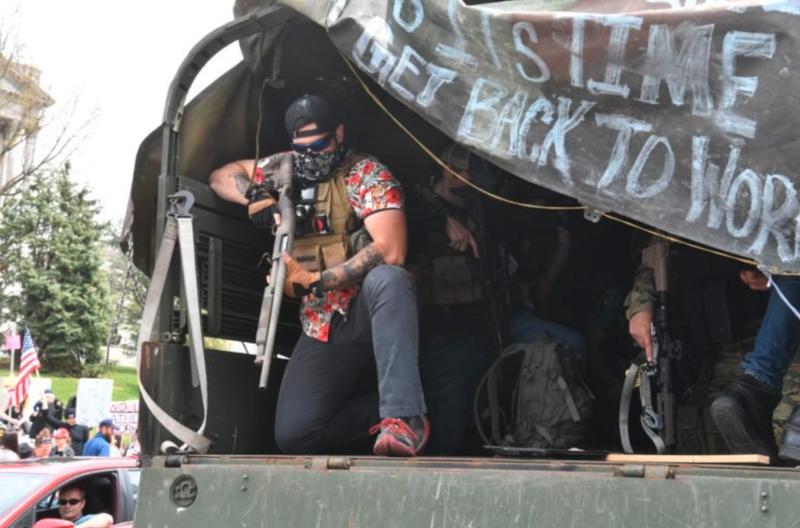
An alleged protester in Harrisburg, PA

From Zero Hedge, America On The Brink? Shocking Images Show “Pennsylvania Militia” Rolling Up To “Reopen America” Rally. Early in this pandemic, I noticed that people had stopped talking about civil war, which was rampant talk last year. As the lockdowns progressed, I began to wonder if the economic damage would knock down all the barriers that intelligence analyst Sam Culper of Forward Observer said would prevent widespread violence.

America could be standing on the edge of a revolution. Seriously, well, with National Guard troops deployed across the country, any uprising would likely be squashed.

We noted late last month that a “social bomb” was set to detonate over major Western cities. It was thought that the epicenter of unrest could begin deep within inner cities, such as those in Baltimore and Detroit, but that might not be the case.

It appears tensions are soaring among anti-quarantine protesters and state governments. The lockdown backlash started last Thursday in Lansing, Michigan.

Anti-quarantine rallies sprouted up across the country over the weekend, organized by right-wing groups that held rallies in Texas, Indiana, New Hampshire, Nevada, Maryland, Utah, Wisconsin, Washington, and Colorado.

Attempting to show force, some protesters wielded rifles, handguns, and shotguns, along with American flags, Betsy Ross flags, Trump signs and “Don’t Tread On Me” flags right up to the doorsteps of some state capital buildings.

The sight is absolutely stunning, but before we continue, we must understand the right-wing groups that organized the rallies are fed up with quarantine orders enforced by state governments to mitigate the spread of COVID-19. While it is open for discussion if the strict lockdowns were worth it, several things are evident, and why many of these protesters are angry, is that the economy has crashed into depression, 22 million jobs lost, businesses bankrupted, and hunger crisis unfolding. Combined this all together, and a perfect storm of unrest could be nearing.

While we could show you images of the latest rallies from across the country, that would be a bit too much. So, let’s focus on the “reopen” Pennsylvania demonstration on Monday (April 20). The location was Harrisburg, Pennsylvania, more specifically, at the Pennsylvania State Capitol Complex…(continues)

Click here to read the entire article at Zero Hedge.

AmPart: The Kung Fu Virus 2020 Victory Garden

Johny Mac at American Partisan talks about getting his 2020 garden started in The Kung Fu Virus 2020 Victory Garden. He’s in the cold zone 5, so while his dates for doing things may not apply to your zone if you’re in a warmer or colder zone, the things he does would be similar. You can find your zone on the USDA plant hardiness zone map, but you may also want to talk to a knowledgeable neighbor. You may live a micro-terrain that makes your garden area slightly warmer or cooler than what the official zone for your larger area is.

I am a man that believes in insurance so I invest in many different kinds; auto, boat, house, life, and food insurance come immediatly to mind. Yes food insurance and the way things are today with the Kung Fu Virus I am starting to wonder what will happen with food availability in the future. Well no worries, as I invest in food insurance by growing approximately 80% of our yearly need of vegetables in our garden.

I have written an article or two about this subject in the past and am being told to do it again by the good Lord. What I am going to share works for us in our area. I live in zone 5 which means that the last frost for my area is around May 21st. Nobody in my area plant above ground seedling’s till Memorial Day weekend because we have experienced frost up to that date. Just look at the photo header taken this past Saturday morning at 0700 hrs eastern.

Below ground vegetables like, carrots rutabagas, beans, etc can be planted around the end of April here. I reserve my raised beds, which I have three for early lettuce and radish crops because the raised beds soil is warmer and if there is going to be a frost I can cover those beds easily. The above mentioned vegetables I sow directly in the soil but because my farming season is so short, I start above ground seeds inside typically around St. Patrick’s Day.

I only use heirloom seeds and keep seeds from one year to the next. Folks in our group trade same specie seeds every year to keep the strain vibrant. I start out growing inside with tomato seeds then move to sweet peppers. The peppers seem to take the longest to germinate. Once I have those seeds started I move to cucumbers – Pickling and salad of course. I found the easiest way to start the seedling’s is to poke a hole is foam egg cartons, add potting soil, and place 1 to 2-seeds in each nook then cover with a light layer of soil. Then put the egg cartons in plastic trays under my growing lamps with cellophane over to keep the soil warm and moist which acts as a mini hot-house. Depending on variety, the seedling will start to show themselves after 7 to 14-days. Once the seedlings have sprung from the soil I remove the cellophane from the plants.

2020 Seedlings

Once the seedlings have lost their baby leaves I transplant the seedlings into Solo cups. I do not know why but the plants like the Solo cups to grow in. I keep the cups year after year so I get my moneys worth. The bottom of the Solo cups I perforate with my pen knife so they drain. Once the seedlings have 2-sets of leaves I only water the plants from the bottom. Since I have perforated the bottom of the cups I keep about 1/2-inch of water in the pan and they self water themselves. Doing this helps to develop a great root system. By the beginning of May, I move my trays of plants to a makeshift green house outside. At night I have an electric heater that has a thermostat to keep the temperature in the green house at around 68 degrees F. By mid May I do not use the heater anymore and allow the plants to harden.

Memorial Day Weekend 2019 – Seedlings Ready to plant

While this is going on I get the garden and raised beds ready for planting. In early April I rototill the garden. Once tilled I clean out the manure from the chicken coop. The manure collected in April is just enough to spread around the garden and till into the soil. Depending on the weather I hand turn the soil in the raised beds and toss my lettuce, radish, cilantro, and dill seeds onto the soil. The seeds are followed with a light raking to set the seeds. By Memorial Day we start to have fresh salads. If frost is predicted it is very simple to drag an old sheet over the plants to protect them.

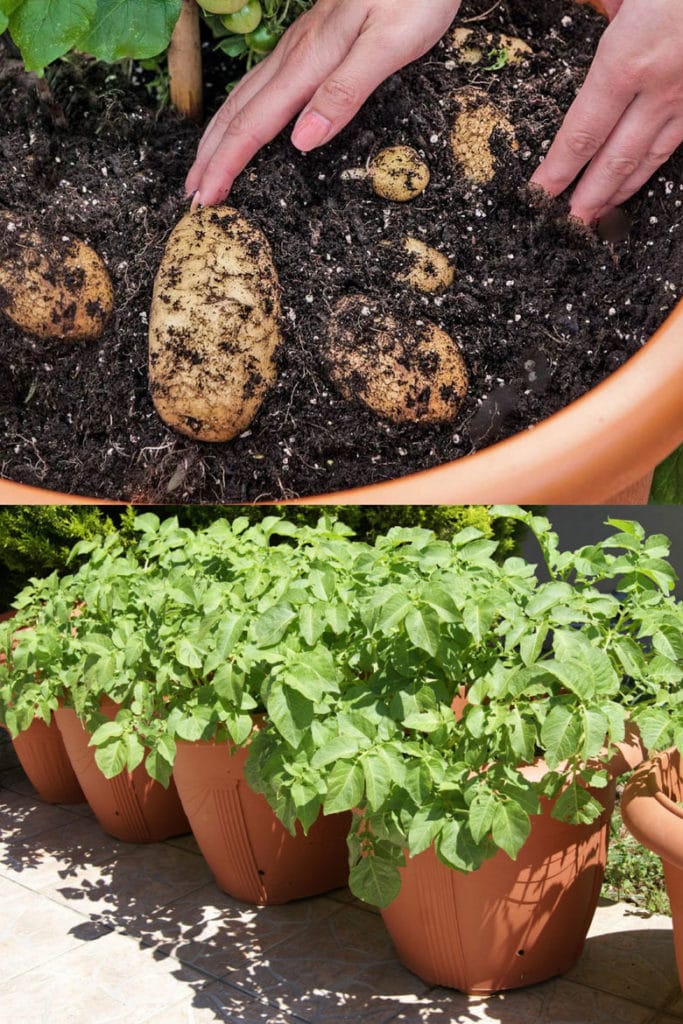
Right after I plant my salad seeds, I plant potatoes and rutabaga seeds. I use the tire method for the potatoes to make taking care of them a lot easier. The rutabaga seeds get planted about 6-inches apart and 1/2-inch deep. Then I cover the rutabaga seeds with two sheets of 50# 48″x 8′ newsprint paper with slits in the paper to match up with each row of rutabaga seeds planted…

Click here to read the entire article at American Partisan.

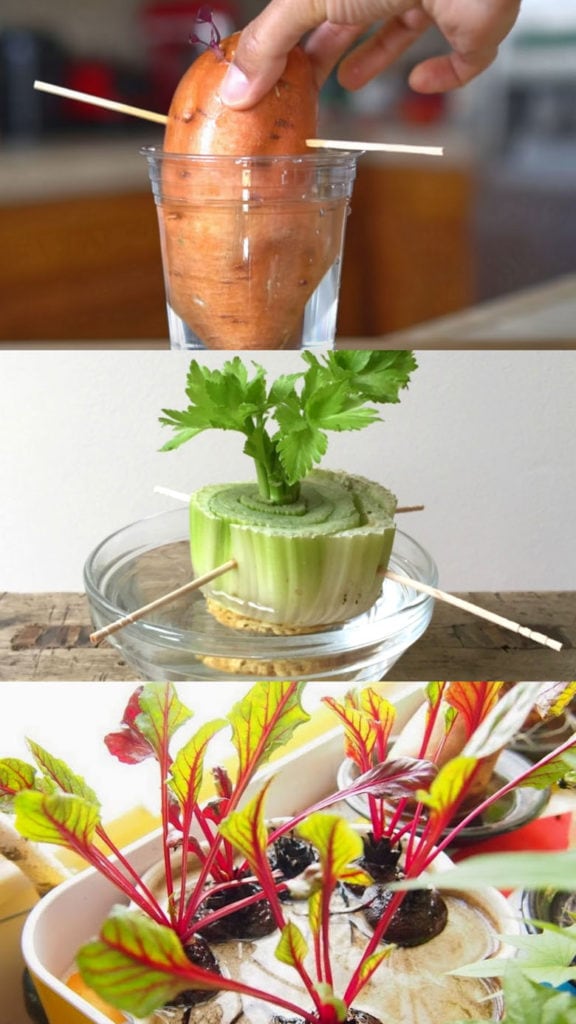
A Piece of Rainbow: Veggies & Herbs to Regrow from Table Scraps

Perhaps you are having trouble finding seeds to grow your survival garden. Some food can be grown from the scraps of food that you may already have on hand. A Piece of Rainbow has the article12 Best Veggies & Herbs to Regrow from Kitchen Scraps. If you do an internet search for “gardening with kitchen scraps” you will get a good number of web pages with similar titles. A Piece of Rainbow’s pictures seemed to be the easiest to understand with links to more detailed instructions. If you need more ideas on what scraps to use, then go ahead and hit that search link.

For a survival garden, or what the pandemic intarwebz are calling a victory garden, you want calories first and a balanced diet second. You’ll perish from a lack of calories long before you succumb to the illnesses associated with various vitamin and mineral deficiencies. With that in mind, the heavy lifters of garden calories are potatoes, beans, squash, and grains. You can include sweet potatoes and yams with regular potatoes. While potatoes, beans and squash are all covered to some extent in the articles on kitchen scrap gardening, most of the options are for greens. Those are great for vitamins, minerals, and variety of diet, but don’t yield a great many calories. But if you’re only supplementing other food supplies on hand, then they are a bonus.

If you’re really relying only or mostly on what you can grow, remember that there are a lot more edible and nutritious parts of garden plants than just the fruits and vegetables that you see in the store. Melon and squash seeds are packed with protein and some fats. Watermelon rind has some vitamin C and B6 as well as fiber. Zucchini stems can be cooked like penne pasta. The leaves of many plants are edible. Even some plants considered weeds by many are highly nutritious, like purslane. And if you’re lucky enough to be plagued with dandelions, the entire plant is edible from flower to root.

Click here to  read the entire article at A Piece of Rainbow.

Zero Hedge: It’s Not Just Toilet Paper, Seed Shortages Spread

Zero Hedge has an article on the growing seed shortage as Americans turn to growing their own food in response to supply chain problems – It’s Not Just Toilet Paper, Seed Shortages Spread As Locked-Down Americans Turn To Growing Their Own Food 
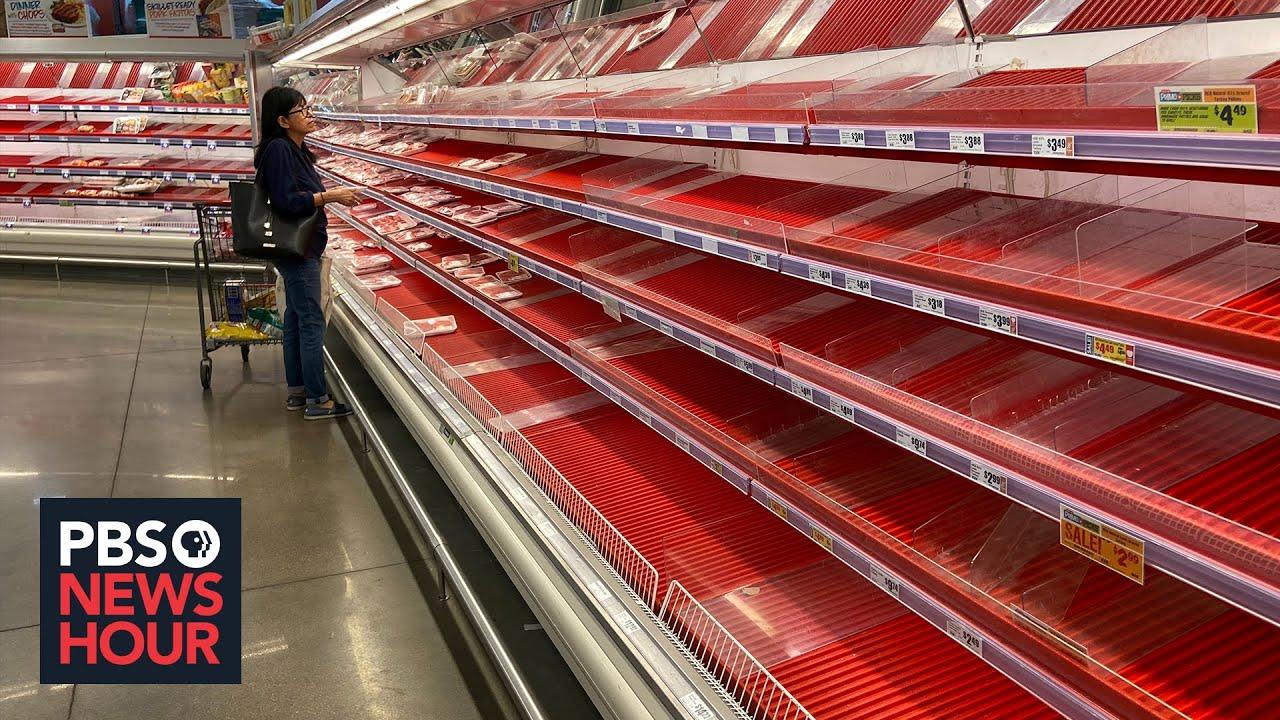
…Americans started buying 3M N95 masks in mid-January, then non-perishables in February, followed by toilet paper, hand sanitizer, and guns.

Now apparently, plant seeds are the next big thing…

Seed companies who spoke with CBS News said they have stopped taking new orders after unprecedented demand. George Ball, chairman of Pennsylvania-based Burpee Seeds, said the recent increase in new orders is “just unbelievable.” The company will start accepting orders again on Wednesday after it stopped taking new ones for several days to catch up on the backlog.

Americans in quarantine are becoming increasingly concerned about their food security. What has shocked many is that food on supermarket shelves that existed one day, could be completely wiped out in minutes via panic hoarding. Some people are now trying to restore the comfort of food security by planting “Pandemic Gardens.”

“If I had to put my thumb on it, I would say people are worried about their food security right now,” said Emily Rose Haga, the executive director of the Seed Savers Exchange, an Iowa-based nonprofit devoted to heirloom seeds.

 “A lot of folks even in our region are putting orders into their grocery stores and having to wait a week to get their groceries. Our society has never experienced a disruption like this in our lifetime.”

One of the most significant trends besides a crashed economy and high unemployment is that tens of thousands of Americans, mainly of the working poor, who just lost their jobs, are ending up at food banks. These facilities have reported surging demand, as a hunger crisis unfolds.

Today’s economic, health, and social crisis has made people realize that relying on supermarkets for food is not a safe bet. Some are now reverting to the land for survival.

Seed Savers Exchange noticed a surge in seed demand started in mid-March, the same time lockdowns across the country went into effect. The nonprofit has also halted new orders to catch up on the backlog.

“We received twice the amount of orders we normally receive,” the company said, adding it has had to hire more staff to deal with rising seed demand.

With America at war with coronavirus, the “Victory Gardens” our ancestors planted in WWI & II have now morphed into Pandemic Gardens. The surge in seed demand suggests a new trend of the 2020s is developing, one where reliance on corporations and government for survival are coming to an end for some people, as rural communities and living off the land is the safest bet in times of crisis…

Christian Prepper Gal: Has the Reality of It Hit You Yet?

Christian Prepper Gal asks if you’ve realized that you’re in a SHTF situation in Has the Reality of It Hit You Yet?

We are in the midst of a global pandemic. We are in the middle of a SHTF situation. I think for most preppers that is just now beginning to sink in. And, I’ve been amazed at the number of new preppers that have shown up in Facebook groups in the past month! The time to be prepared is NOW. And, I’m not just talking about being prepared with food and household essentials. Unfortunately, so many, and especially new, preppers think that is all they need to or have to do.

Last Fall (2019) I began to feel very strongly that it was time to stop trying to warn people of the need to be prepared. That it was time to make sure we had our own ducks in a row, and see to it that our own lamps were filled with oil. I even expressed to those around me that I felt like “something” was going to happen in 2020. And, by “something” I meant we were going to experience (as a nation) SH(ing)TF. And, guess what?!? It happened! I personally had thought it would be as a result of the election. But, apparently I was wrong. See? I can admit being wrong, from time to time, lol.

It is my belief that this SHTF scenario has just begun. We are all wanting it to be overwith quickly and for things to get back to normal. But, you know what? I don’t think it’s going to be overwith quickly, and I’m not sure things can ever be back to what normal was before the COVID-19 pandemic. I don’t mean to be a Debbie Downer, but I also don’t mean to give false hope to others, or myself. The reality of it is that there will be repercussions from our nation being essentially shut down. Even though the term has not been “officially” used as of yet here in the U.S., that is what has happened. We’ve already been shut down for close to a month, and it sure doesn’t look like things are going to be getting back to “normal” any time soon.

How are you reacting to all this?

First and foremost, we SHOULD NOT be reacting with fear. Especially as Christians. But, it’s easy to allow that to happen. Remember, though…

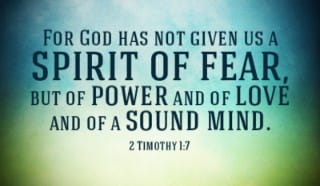
2 Timothy 1:7, For God hath not given us the spirit of fear; but of power, and of love, and of a sound mind. (KJV)

It is especially important to remember that right now, during this pandemic. We do not want to allow our minds to become the devil’s playground, do we? I know I don’t! But, if we allow fear to creep in, that is exactly what we’re doing.

How do we avoid or get rid of that fear? We read The Word of God. Romans 10:17, So then faith cometh by hearing, and hearing by the word of God. (KJV). If we read (hear) The Word of God, it drives out fear! How can you have faith and fear at the same time? You can’t! And, that’s why we need to build up our most holy faith. We need to saturate our entire beings with His Word! According to Johh 1:1, “In the beginning was the Word, and the Word was with God, and the Word was God. (KJV) Jesus is The Word. If we read what He said, in His Word, our faith will abound! And, faith expels fear! If we put our trust in Him, we will prevail and overcome fear.

There was one day a couple of weeks ago that I was so overcome with the negative from the news and social media that I had to play some contemporary worship music. I turned it up loud, and let it drown out all the negative in my mind and eyes. Then, I could put my mind and eyes back on Jesus.

We need to keep our eye on the prize. And, as Christians, our prize is eternal life with our Heavenly Father. So, if we keep our eyes on Him, we will win in the end!

Are you still denying it?

As I mentioned earlier, some (many) people (including preppers) are in denial. They truly think that our government will be able to take care of us and this is the worst that things will get. Some preppers don’t even realize that this is the SHTF that they’ve been preparing for! My thought is that the reason for that is they are only seeing the here and now. They’re not seeing what can and possibly will happen as a result of our nation being shut down.

Take a moment and let that sink in. Think about it. Our government has already put itself two trillion dollars in debt over this pandemic and that has only touched the surface. It will take much, much more than that to dig us out of this economic hole we are in. Do we have that much money and resources in reserve? Most likely not.

The economic downfall of the pandemic is just now beginning to be felt by many. What is going to happen when the food and resources begin to run out? What’s going to happen when parents cannot provide for their families? It will hit those with the lower incomes first. And, we are on the brink of that happening as I write. And, we are only in the beginning; one month since the declaration of this being a pandemic. We have a long way to go before we can even begin recovery. The virus hasn’t even been stabilized yet; it could take up to 18 months or longer to develop a vaccine. Our government is trying to help us and prevent things like chaos as a result of looting and rioting from happening. But, it’s not all up to only them…(continues)

Click here to read the entire article at Christian Prepper Gal.