What the FBI/FISA Memo Really Tells Us

Ron Paul has written an article on What the FBI/FISA Memo Really Tells Us About Our Government

The release of the House Intelligence Committee’s memo on the FBI’s abuse of the FISA process set off a partisan firestorm. The Democrats warned us beforehand that declassifying the memo would be the end the world as we know it. It was reckless to allow Americans to see this classified material, they said. Agents in the field could be harmed, sources and methods would be compromised, they claimed.

Republicans who had seen the memo claimed that it was far worse than Watergate. They said that mass firings would begin immediately after it became public. They said that the criminality of US government agencies exposed by the memo would shock Americans.

Then it was released and the world did not end. FBI agents have thus far not been fired. Seeing “classified” material did not terrify us, but rather it demonstrated clearly that information is kept from us by claiming it is “classified.”

In the end, both sides got it wrong. Here’s what the memo really shows us:

First, the memo demonstrates that there is a “deep state” that does not want things like elections to threaten its existence. Candidate Trump’s repeated promises to get along with Russia and to re-assess NATO so many years after the end of the Cold War were threatening to a Washington that depends on creating enemies to sustain the fear needed to justify a trillion dollar yearly military budget.

Imagine if candidate Trump had kept his campaign promises when he became President. Without the “Russia threat” and without the “China threat” and without the need to dump billions into NATO, we might actually have reaped a “peace dividend” more than a quarter century after the end of the Cold War. That would have starved the war-promoting military-industrial complex and its network of pro-war “think tanks” that populate the Washington Beltway area.

Second, the memo shows us that neither Republicans nor Democrats really care that much about surveillance abuse when average Americans are the victims.


Continue reading at The Ron Paul Institute by clicking here

Inslee Vows to Fight Offshore Oil Drilling

From Washington State Wire, Inslee vows to create hostile environment for potential oil drilling businesses:

…At the beginning of January, Interior Secretary Ryan Zinke announced a five-year plan to expand offshore oil and gas drilling in the Pacific, Atlantic, and Arctic oceans. The plan would open over 90 percent of the outer continental shelf (OCS) to leasing, which surrounds all coastal areas of the continental United States and Alaska.

During a press conference on Monday, AG Ferguson announced that if the Trump Administration moves forward with this plan to drill off Washington’s coast, he will file a lawsuit…

The primary rationale for a lawsuit relates to Zinke’s decision to remove Florida from the list of states that are under consideration for new oil and gas drilling. In a lengthy letter released today, Ferguson says that every reason given to exclude Florida also applies to Washington…

Governor Inslee agreed, pointing to Florida’s Republican governor as the only difference between the two states that both rely on healthy coasts to fuel their economies.

“the only thing [Florida and Washington] have differently is they have a Republican governor, who is running for the US Senate, who has a friend in the white house of his party, and who had a phone call made and got his state protected. Our state has had a phone call made and we’re still not protected.”

Click here to continue reading.

All tourism and recreation of any sort in Washington State’s coastal counties amounted to $3.4 billion (of a $425 billion state GDP, or less than 1%) in 2014.  In Florida, the economic impact of beach tourism alone accounted for $50 billion (of a $764 billion GDP, or 6.5%) in 2012. But the “only difference,” according to Inslee, between the two states is Florida’s Republican governor. Regardless of how one feels about offshore oil drilling, Inslee’s assertion is a bit hard to swallow.

NC Scout Announces Radiotelephone Operator Course

**UPDATE** The class location is in North Caroling.

NS Scout at the Brushbeater blog has announced his new RTO Course. The first date is March 3-4th, 2018.  The location is not announced, but I would expect it to be somewhere in the South Atlantic states. If you’re in that region, or can easily get there, this should be some good training.

What the RTO Course is:

This course is designed to instruct students on the basics of effective communications in a tactical environment. Students will learn everything from how to create a proper Signals Operating Index and traffic handling to basic antenna theory and construction for local use as well as a primer on how HF works. All of this culminates in an FTX on the second day.

What this course is NOT:

This is not a ‘ham radio’ class. Strong emphasis is placed on ‘making your equipment work in a tactical environment’ versus bombarding the student with technical or hobby-oriented data. We will be working on a level most ‘hams’ never do. So while a license is certainly helpful, it is not required, but by the end of class you’ll come away with a real understanding of why it is an advantage.

While not designed to be physically intense, there will be field work on both days.

RTO Course: $200 per Student

This class will teach students the basics of communications at the Team or Squad Level in the field. Topics of instruction include:

  • Identifying Equipment Requirements
  • Writing a Signals Operating Index
  • PACE Planning for Communications
  • Basic equipment capabilities
  • Traffic handling
  • Improvised antenna types, uses and construction
  • Setting up and running an NVIS HF station
  • Message Formats
  • Setting up and communicating from a Hide site

Two day course will culminate in an field training event running a TOC station and Hide site in the field. Students will each build an antenna and demonstrate competency in team communications basics during the field exercise. Amateur Radio license qualification is helpful, but not required. This is NOT a ‘ham radio’ class but each student will come away with a basic understanding of a team’s communications needs in a tactical environment and how to best meet them under less-than-ideal circumstances. No equipment is required for this course; however, if students want to get field practice with their own gear, it is highly encouraged but done so at their own risk. Instruction is completely off-grid.


Update 2: Brushbeater has posted a student’s review of the RTO course. Click here.

Mark Herr of CSG to Speak at Feb. 8th, 2018 General Member Assembly

Mark Herr, CSGMark Herr of the Center for Self Governance will be speaking at the next Lower Valley General Member Assembly on Thursday, February 8th, 2018, 7:15pm at Caffe’ Villa in Prosser. The Center for Self Governance is a non-profit, non-partisan educational organization dedicated to advancing a stable civil society, balanced human government, and a well educated populace.

Mark Herr Sr. is a U.S. Air Force retiree, president and co-founder of the nonprofit educational institution the Center for Self Governance (CSG). Since 2012, Mark has been traveling across the country training citizens to inform discretion, instruct delegated authority, and control instituted government.
Led by the vision of the Founding Fathers, Mark works tirelessly to further the Center for Self Governance’s mission to institutionalize self-governance across the United States. Under his leadership, CSG has trained over 2000 students across 18 states to date. CSG graduates have had Legislative and Election cycle successes at the School, City, County, State and Federal levels of government.

Columbia Safety: Basic Wilderness First Aid, Feb. 10, 2018

Columbia Safety will be holding a Basic Wilderness First Aid class on Saturday, February 10th, from 9am – 5pm at their Kennewick facility.

Basic Wilderness First Aid: An intensive 8- to 10-hour course for those who are involved in wilderness recreation. This course may also meet the needs of volunteers and professionals who lead groups on short trips in relatively low-risk situations. $125

Wilderness First Aid classes address patient needs in those situations or environments where EMS is not available, or may be significantly delayed. Possible delay of emergency services becomes an important consideration when dealing with the initial scene/patient assessment. Illnesses and injuries that might only require a brief examination when help is on the way become much more important when you’re left to attend to the victim for a longer, possibly extended period of time.

Media Control Warnings

Caitlin Johnstone at Media.com has an article up titled, Assange Keeps Warning Of AI Censorship, And It’s Time We Started Listening. The article discusses the need for the government and other elites to control information flow, how the internet loosened that control, and the efforts to regain control of discussion on the internet.

Throughout the near entirety of human history, a population’s understanding of what’s going on in the world has been controlled by those in power. The men in charge controlled what the people were told about rival populations, the history of their tribe and its leadership, etc. When the written word was invented, men in charge dictated what books were permitted to be written and circulated, what ideas were allowed, what narratives the public would be granted access to.

This continued straight on into modern times. Where power is not overtly totalitarian, wealthy elites have bought up all media, first in print, then radio, then television, and used it to advance narratives that are favorable to their interests. Not until humanity gained widespread access to the internet has our species had the ability to freely and easily share ideas and information on a large scale without regulation by the iron-fisted grip of power. This newfound ability arguably had a direct impact on the election for the most powerful elected office in the most powerful government in the world in 2016, as a leak publishing outlet combined with alternative and social media enabled ordinary Americans to tell one another their own stories about what they thought was going on in their country.

This newly democratized narrative-generating power of the masses gave those in power an immense fright, and they’ve been working to restore the old order of power controlling information ever since. And the editor-in-chief of the aforementioned leak publishing outlet, WikiLeaks, has been repeatedly trying to warn us about this coming development.

In a statement that was recently read during the “Organising Resistance to Internet Censorship” webinar, sponsored by the World Socialist Web Site, Assange warned of how “digital super states” like Facebook and Google have been working to “re-establish discourse control”, giving authority over how ideas and information are shared back to those in power…

Continue reading at medium.com

Emergency Essentials: Financial Preparedness

The fine folks over at Emergency Essentials have a brief blog post on preparing to weather financial storms.

For those of us who are old enough to have experienced the Great Recession in our adult life, the thought of another economic crash occurring is a very real worry. Even the most prepared individuals felt the effects of a crashing economy in the years between 2007 and 2009. Some of us still haven’t fully recovered. Although the possibility of another recession is always in the air, unfortunately, most people are less prepared today than they were before the Great Recession began. If the economy were to crash tomorrow, could your finances survive?

If the answer is, “I’m not sure”, you should definitely continue reading. In the following post, we will present five questions to test your financial preparedness and help you to get completely ready for an unexpected economic future.

Do You Spend Too Much On Your Debts?

Truth is, many people are simply overextended with their debts, using their credit as a way to live beyond their comfortable means. Even in an economic recession, your debts will not stop and your debtors likely won’t “give you a break.” If you lost your job today, would you be able to afford your debts next month or would you suddenly find yourself having a hard time keeping up with your mortgage and car note?

Many financial consultants recommend a debt-to-income ratio of 1:3. This means that your debts should be equal to or less than 33% of your monthly income. This rule ensures that if you were to become unemployed today, you would still be able maintain your debts with only ⅓ of your current income.

What To Do About It

Assess your monthly debts and compare them to your monthly income. If your debt-to-income ratio is already lower than 33%, great, keep it that way. On the other hand, if you find that your ratio is higher than this, here is some advice:

  • Pay Down Your Debts: The most obvious way of decreasing your debt-to-income ratio is to maintain your income, while decreasing your debts. Examine how you spend your money each month. Identify areas where you can save money (eliminate or decrease cable services, etc.) and use this extra money to make additional payments on your debts. Every debt that you are able to eliminate equates to one less worry in the event of another economic recession!
  • Refinance for Better Interest Rates: High interest rates that you carry on your debts can add significantly to your debt-to-income percentage. Work on improving your credit so that you can refinance your mortgage and car loan debts for better rates. Speak with banks and other credit card providers to see if one of them will offer you a credit card with a lower interest rate than what you are currently receiving.

How Large Is Your Emergency Fund?

Unfortunately, for many people, the answer is “not large, whatsoever.” According to a GoBankingRates survey, 35% of all adults in the U.S. only have “several hundred dollars” in their savings account and 34% have no money at all in savings. It is generally recommended that you keep 3-6 months of income in your savings as a safety net, in case your income becomes restricted for any reason. While this is a great start, is it enough? The Great Recession lasted two whole years, and the effects, much longer. During this recession, many people found themselves without a job for much longer than 3-6 months. Some financial advisors, like Suze Orman for example, suggest an emergency fund equal to at least 8 months of your income.

What To Do About It…

Click here to continue reading at beprepared.com.

Related:

FEMA: Emergency Financial First Aid Kit (pdf)

Emergency Essentials: Financial Preparedness 101

MDT: Nuke Alert, “The 15 Minute Scenario”

Mason Dixon Tactical has a blog post addressing what to do in the case of a nuclear alert like Hawaiians experienced recently.

Nuke Alert, “The 15 Minute Scenario”

Alert Post01

By now we all know about the Hawaii false “Inbound Missile” alert that took place a week ago. I keep hearing the BS from the talking heads about “One guy pushed the wrong button.”, and “It was a complete accident.”, and none of use that know better believe anything they are saying. Brushbeater spoke about it briefly in this post. Here’s the thing to ponder, what if it was real? I’m not getting wrapped up in the political, misdirection BS being espoused, but what would you do if it was real? Where would you go?

Do you have the slightest clue how you would react, and is your situational awareness and training enough that you would immediately know where relative safety is (it honestly depends how close you are to the blast). Keep in mind that this post is about protecting yourself from the initial blast, not the fallout. Fallout/Radiation protective measures have been talked about here.

Here are three “area dependent” scenarios you might want to consider planning for.

  1. You are at home.
  2. You are driving through or at work in town.
  3. You are driving on the Interstate or in a remote area.

Before we discuss where you are, let’s discuss where the primary targets in your area might be. Two primary targets for a nuke would be a military base, or a large city. Once you’ve figured out where the target for the nuke might be in your area, you can then make an assessment of where you might want to position yourself in the area you have selected as an improvised blast shelter. This assessment would dictate that if you are in a building, you’d want to be on the side furthest from the blast, preferably in a basement. It also dictates that if you are in something like an end to end open drainage, the drainage needs to be perpendicular, rather than parallel to the most likely direction of the blast’s path.

1. You are at home. OK, do you have a basement, if so, are all sides covered by dirt (less chance of blast damage)? Protection in this situation is somewhat simple. Get in your basement, go to the side furthest from the likely target, and if possible, get under something like a table to help protect from falling debris. Another thought would be to grab that spare mattress that everyone seams to have in their storage area and place it on the side of the table closest to the direction the blast would be coming from. In the below video, Cresson Kearny discusses a basement shelter.

If you don’t have a basement, do you have a crawl space? If so, apply the directions for the basement, in the smaller area of the crawl space. If you have neither of these, apply whatever is more applicable from what is mentioned in either #2 or #3 below…

Click here to continue reading at Mason Dixon Tactical.

Yakima Officials Eye State Fair Park Buildings for Possible Medical Care in Case of Disaster

From the Yakima Herald

Yakima Health District officials are exploring the possibility of using State Fair Park as a medical care facility during a disaster.

The district is seeking proposals for a feasibility study of installing generators at the Yakima Valley SunDome, Pioneer Hall and the Deccio and Modern Living buildings, which would allow the facilities to be used as places to care for nonemergency patients if needed.

“The circumstances surrounding Rattlesnake Ridge show why planning is necessary,” said Health District Executive Director Andre Fresco, referring to the slow-moving landslide on the ridge near Union Gap.

 Fresco said that if feasible, the fairgrounds would be used as a place to take care of the nonurgent health needs of people displaced in a major disaster, such as flooding or an earthquake. The Health District is working with the Yakima County Commission, the county’s emergency management officials, the city of Yakima and the state Department of Health’s Disaster Preparedness Division on the proposal, he said.

The fair park is ideally located to serve as a place for nonemergency medical care in Central Washington in the event of a disaster, Fresco said.

Having generators is a prerequisite to being able to use the site as a backup medical facility, as planners would need to be able to provide heat and power in the event of a blackout, Fresco said.

The study is preliminary and will look at whether it is possible to outfit the buildings — some of which date back to before World War II — for emergency medical use, and how many generators would be needed to power the complex in an emergency.

It would not be the first time the fairgrounds was pressed into service in a time of emergency. During World War II, the fairgrounds housed a training school for military pilots and a factory for building Army trucks for use in the Pacific Theater.

 Greg Stewart, State Fair Park’s president and general manager, said fairgrounds in other parts of the country have been used as emergency shelters for people and livestock during wildfires and other disasters and that he welcomes the study.

“The fairground has been the salvation of many communities,” Stewart said.

First Aid and Medical Kit Contents

The following information on first aid and medical kits is excerpted from the Survival & Austere Medicine manual. It reproduces in part the section on medical kits based on increasing comprehensiveness. Minor changes have been made in order and figure numbering. The manual goes into additional detail about each of the categories of kit contents, and what you want to look for in those products. This high-level overview leans more toward supplying the list of contents for each kit type in a more condensed format. The Survival & Austere Medicine manual is a free resource with much good information. Please consult it for more detail.

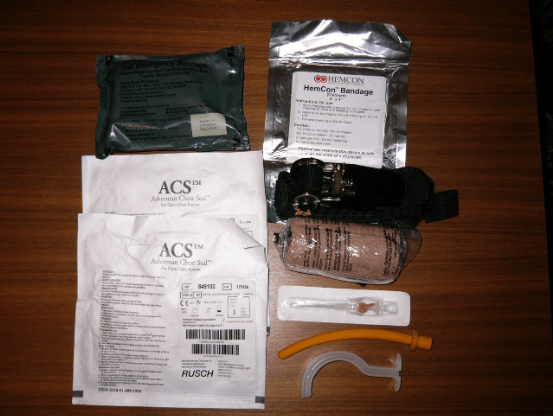
Personal bag/blow out kit: Carry this with you at all times. It contains basic first aid gear or in a tactical situation the equipment to deal with injuries from a gunshot wound or explosion (figure 1). This includes things to immediately render aid – it’s almost like a pre-first aid, first aid kit!

A list might include:

Combat dressings/Israeli dressings

A hemostatic gauze compound

Chest seals – Asherman chest seals stick poorly on wet, hairy chests despite being relatively common place. Hyfin or Halo seals or even a rat glue trap works better. Studies have shown no advantage to vented dressing chest dressings vs. not vented.

Long IV cannula or specific pneumothorax decompression needle

Tourniquets x2

Oral and/or nasal airways

Figure 1 Blowout bag: Personal medical equipment for a tactical situation (dressings, HemCon bandages, Chest seals, oral and nasal airways, IV cannula and a tourniquet


First response bag: Carry this in your car; take it with you when you go camping, family trips to the river, etc. It contains more advanced first aid gear and some medical items than a basic level medical kit.

Large kit bag: This is your home/retreat/bugging out medical kit. It contains your medical kit as opposed to simple first aid supplies.

Storage area: In your home/retreat. It contains duplicate and bulk supplies. Large plastic storage bins are ideal for this.

Continue reading “First Aid and Medical Kit Contents”

UNL Extension Pilots Initiative on Youth Disaster Preparedness

From Tri-State Livestock News:

Nebraska Extension and Nebraska 4-H are piloting a national youth preparedness and educational outreach program designed to teach teens what to do in the event of disaster and emergency situations…

“Everyone can play a part in preparing for disasters and emergencies, especially teens,” said Ashley Mueller, disaster education coordinator for Nebraska Extension. “They bring unique perspectives and experiences when it comes to preparedness, and tapping into these can be very valuable to their families and communities.”

The initiative offers a flexible five to 10 week program. For the pilot, each state must graduate 125 teens by having them complete three components.

 In component A, teenagers complete the United States Department of Homeland Security/Federal Emergency Management Teen Community Emergency Response Team (CERT) training focusing on disaster preparedness, fire safety and utility control, disaster medical operations, light search and rescue, disaster psychology, and terrorism.

Component B features certification in CPR and AED usage, along with awareness programs focusing on HAM radio, NOAA weather radio, smoke alarm maintenance, and smart phone application and social media in emergency preparedness. The component also includes a disaster simulation, and a focus on public safety, fire service and emergency management careers.

The final element of the program, component C, includes a comprehensive family and community service project called “Prep + 6,” in which each participant helps develop emergency supply kits and emergency communication plans for their family and six additional families or households. This component allows for significant enhancement in individual, family and community preparedness and resilience.

Columbia Safety: Stop the Bleed Class, Mon. Feb. 5, 2018 7-9pm

Columbia Safety will be holding a Stop the Bleed class on Monday, February 5th, from 7pm-9pm. Tuition is only $10.

Stop the Bleed is intended to cultivate grassroots efforts that encourage bystanders to become trained, equipped, and empowered to help in a bleeding emergency before professional help arrives.
 
No matter how rapid the arrival of professional emergency responders, bystanders will always be first on the scene. A person who is bleeding can die from blood loss within five minutes, therefore it is important to quickly stop the blood loss.
 
Those nearest to someone with life threatening injuries are best positioned to provide first care. According to a recent National Academies of Science study, trauma is the leading cause of death for Americans under age 46.
 
Remember to be aware of your surroundings and move yourself and the injured person to safety, if necessary.