Protests, Strikes, Riots, Blockades and Violence in Ecuador

Since President Morena of Ecuador passed some measures last week to address the country’s fiscal deficit and debt burden, which included rescinding a significant gasoline/diesel fuel subsidy, the country has been rocked by protest. The protests are getting some mainstream press, but there isn’t much information on how the typical Ecuadoran is being affected by the unrest. NC Scout at American Partisan has been publishing updates from a local with whom he has been working on some Red Cross communications who has been keeping NC Scout apprised of the situation.  The updates give some insight on what civil unrest can do – downed communications infrastructure, how the government is trying to airlift needed supplies for citizens in towns which have been cutoff from truck resupply by the many protest blockades, and so on. Will this be a passing unrest? Or could Ecuador follow the path set by Venezuela for a longer-term shtf situation?

NC Scout’s updates are currently in twelve parts. Surviving Real SHTF: Chaos in Quito. Part 0. Part I. Part II. Part III. Part IV. Part V. Part VI. Part VII. Part VIII. Part IX. Part X. Part XI. Part XII.

…Stopṕed by the only gas station here. They are done as of today, tanks dry. No more gasoline even for the locals running around the immediate area.
Blockade continues…

Part of the public market is open as of a couple of hours ago but less than yesterday. Meat, fruit, vegetables in some of them but not much and half the stalls closed. No chicken anywhere. Still staples and from my conversations there a few more locals are thinking they might lay in a supply but NOT very many…

Ecuavisa signal in Ambato is out of the air because dozens of indigenous protesters mobilized to Pilisurco Hill to force the antennae of the channel’s repeater…

Red Cross ambulances were attacked by protesters yesterday in Quito, so not much respect for emergency services. As local food stuffs run out without re supply, then attacks on shop keepers are going to increase…

About 180 protesters on Monday forced the security of the warehouses of a dairy company in the town of Lasso, about 60 kilometers south of the capital, and stole products after assaulting employees…

Locally everything is closed. I have not been to centro today but talked to the woman who owns the apartment I rent who is also indig and a shop owner. No more milk, eggs, cheese or bread. When the shops that dare to, open, the police generally tell them to close. She hasnt been able to resupply, everyone else here is in the same condition. This morning I was surprised that there was garbage pickup…

planes of the Ecuadorian Air Force, make the air bridge from the city of Quito to Cuenca in order to supply the population of this sector of the country with essential products…

there have been problems with the reception of medicines for some of the hospitals and medical centers of the city and the province we will give priority.

…From internet sources, 2 deaths in the last 24 hours from injuries suffered in the Quito protests. No accurate info on the total number so far…

In the midst of the violent protests that have surrounded Ecuador , the Red Cross announced that it suspends its attention in the middle of the demonstrations for not being able to guarantee the safety of the volunteers…

Red Cross. No blood supply.   No emergency services anywhere.  Really important for people here to realize this…


Mainstream press coverage:

Wall Street Journal: General Strike Paralyzes Ecuador as Protests Continue

RT: Ecuador Protesters Storm Parliament Building Amid Chaotic Street Demonstrations

A substantial police presence was seen in the areas surrounding the national assembly, where security forces clashed with demonstrators wielding stones, sticks and other improvised weapons. The police – some on horseback, motorbike, or in armored vehicles – responded with tear gas and billy clubs.

A larger gathering of several thousand met near the parliament building, defying Moreno’s national emergency decree, which banned public assembly and put restrictions on press freedoms. Many of the demonstrators come from poor and indigenous communities across Ecuador, where the spending cuts have taken the highest toll, particularly the elimination of fuel subsidies.

Voice of America: Crisis in Ecuador over End to Fuel Subsidies

WA Constitutional Amendment on Ballot for Continuity of Government

An amendment to the Washington State constitution will be on the ballot this November to expand government powers in the case of catastrophic incidents. Voters will have the opportunity to either approve or reject the proposed amendment. The measure was passed because of concerns with the effects of a Cascadian Subduction Zone (CSZ) large earthquake and the ability of the government to legally respond. The text of the amendment is as follows, modifying Section 42, Article II (Underlined text is added in the amendment. Strikethrough text is deleted.):

The legislature, in order to insure continuity of state and local governmental operations in periods of emergency resulting from a catastrophic incident or enemy attack, shall have the power and the duty, immediately upon and after adoption of this amendment, to enact legislation providing for prompt and temporary succession to the powers and duties of public offices of whatever nature and whether filled by election or appointment, the incumbents and legal successors of which may become unavailable for carrying on the powers and duties of such offices; the legislature shall likewise enact such other measures as may be necessary and proper for insuring the continuity of governmental operations during such emergencies. Legislation enacted under the powers conferred by this amendment shall in all respects conform to the remainder of the Constitution: Provided, That if, in the judgment of the legislature at the time of ((disaster)) the emergency, conformance to the provisions of the Constitution would be impracticable or would admit of undue delay, such legislation may depart during the period of emergency caused by a catastrophic incident or enemy attack only, from the following sections of the Constitution:

-Article 14, Sections 1 and 2, Seat of Government;
-Article 2, Sections 8, 15 (Amendments 13 and 32), and 22, Membership, Quorum of Legislature and Passage of Bills;
-Article 3, Section 10 (Amendment 6), Succession to Governorship: Provided, That the legislature shall not depart from Section 10, Article III, as amended by Amendment 6, of the state Constitution relating to the Governor’s office so long as any successor therein named is available and capable of assuming the powers and duties of such office as therein prescribed;
-Article 3, Section 13, Vacancies in State Offices;
-Article 11, Section 6, Vacancies in County Offices;
-Article 11, Section 2, Seat of County Government;
-Article 3, Section 24, State Records.

From the Spokesman-Review:

Washington voters worried about “The Big One” – a massive earthquake and tsunami triggered by a geologic fault off the Pacific Coast – might have a special reason to mark their ballot in the November election.

A constitutional amendment was proposed with just such a catastrophe in mind. But opponents say the powers the amendment would give the Legislature are too broad, and the definition of a catastrophic incident that could allow such changes is too vague.

Senate Joint Resolution 8200 sailed through the Legislature as a 21st-century update to a constitutional amendment enacted during the Cold War.

As currently written, that section of the constitution provides for “continuity of governmental operations in periods of emergency resulting from enemy attack.” If a simple majority of voters approve Resolution 8200 on Nov. 5, the section will be broadened so that continuity is ensured not only in case of attack but also in case of “catastrophic incidents.”

Under the existing law, which voters approved in 1962, the Legislature would have the power to move the state capital or a county seat, make changes to the requirements to elect or appoint legislators, pass bills and fill vacancies in state or county offices in the aftermath of an attack. The Legislature could also fill an open governor’s seat if all people in the line of succession set out in the state constitution are unavailable.

In the 2019 session, legislators were more worried about shaking earth and crushing waves than falling bombs, prompting them to add the “catastrophic incidents” clause.

“The catastrophic incident we anticipate will be the big earthquake that will do such damage that we will need to have procedures in place to have government continue operating,” Rep. Roger Goodman, D-Kirkland, said in introducing the bill to the House last April.

“It’s about The Big One, the earthquake,” Rep. Bill Jenkin, R-Prosser, said. “We know this will be the next disaster.”

The Cascadia Subduction Zone, a major geologic fault line off the Pacific Coast that stretches from Vancouver Island to northern California, has the potential for creating a massive earthquake that could decimate Western Washington and generate a tsunami that would inundate coastal communities.

The quakes occur on an average of 300 to 500 years, with the last one recorded in 1700. The Washington National Guard and the state Emergency Management Division have already mapped out and practiced for responding to a massive quake.

But the amendment doesn’t limit the expanded powers of the Legislature to a quake-induced disaster, nor does it define “catastrophic incident” or how extensive it would have to be, opponents say.

“You would have to trust government to make these decisions with or without your input,” warns the argument against the amendment, co-authored by Rep. Bob McCaslin, R-Spokane Valley. “We should demand a better proposal with clear definitions.”

State statutes do define “catastrophic incident.” It can cover any natural or human-caused event– including terrorism and an enemy attack – with mass casualties, high levels of damage or disruption.

At the same time the Legislature passed the proposed amendment, it also approved a bill that clarifies a governor’s power to suspend certain laws and regulations in a declared emergency for as long 30 days – or more if the Legislature is in session and agrees. If the Legislature is out of session, its leaders can extend that time limit until lawmakers return to session.

Sen. Bob Hasegawa, D-Seattle, argued that was still too broad, and with the potential for problems.

“It could be used by an unscrupulous governor – not saying that we have one,” Hasegawa said. “We have to be careful.”

Update 11/5/2019: The amendment passed.

AEI: The Moral Case for Capitalism

This is an older article from 2012 by Arthur Brooks of the American Enterprise Institute, but it is certainly applicable in this day when capitalism is being thrown under the bus by those who either want to equate capitalism with crony corporatism, those who want to replace it with forms of socialism, or both. Free enterprise has lifted millions around the world from poverty and is the most humane and compassionate economic system.

The topic is expounded upon in the book Wealth & Justice: The Morality of Democratic Capitalism. Brooks and his co-author Peter Wehner note that “a free economy requires a strong civic and social order and a shared belief in an underlying moral code–a moral code that should come not from the government, but from family, churches, neighborhood associations, and local schools.” Capitalism must be a part of the “golden chain” which includes morality and democracy in order to benefit society.

Making a Moral Case for Capitalism

Earlier this month in the first presidential debate, Mitt Romney made an unusual argument by modern political standards: that long-term deficit spending is not just an economic issue, but a moral one. “I think it’s . . . not moral for my generation to keep spending massively more than we take in, knowing those burdens are going to be passed on to the next generation.”

This is a notable occurrence, not just because Romney is frequently chided for being cool and detached, but because it represents a return to something our founders knew but succeeding generations have forgotten: Limited government and individual liberty aren’t merely policy alternatives. They’re moral imperatives. “Limited government and individual liberty aren’t merely policy alternatives. They’re moral imperatives.” — Arthur Brooks

America’s founders were moralists, not materialists. The Declaration of Independence defends not our right to material prosperity, but, rather, the covenant between government and citizens of “life, liberty, and the pursuit of happiness.” In both public declarations as well as personal correspondence, the founders discussed, debated, and explained their thinking using moral language.

In today’s commercial republic, the freedom our founders fought for is expressed in the form of free enterprise: the system of laws and institutions that rewards entrepreneurship and hard work, largely on the basis of markets and competition. Free enterprise is what Thomas Jefferson meant by the “free exercise of industry … and the fruits acquired by it.” Free enterprise is compatible with government in the case of market failures (such as crime) and a safety net for the indigent, but it is inconsistent with today’s growing statism and corporate cronyism.

Today, we rarely hear a moral defense for free enterprise from our politicians, which is why Romney’s statement was so striking. And the general lack of moral defense explains why – despite the fact that surveys find a large majority of Americans think the government is too big and trying to do too much – we acquiesce to larger and larger government from both parties. Indeed, it is why government at all levels has grown from 15 percent of U.S. GDP in 1940 to more than 35 percent today, and – according to the Congressional Budget Office – will hit 50 percent in 2038.

Day after day, politicians offer one government benefit after another to our citizens. This has made a majority of Americans into net beneficiaries of the welfare state, as my colleague Nicholas Eberstadt chronicles in his new book, Nation of Takers. While most Americans dislike the crisis and culture this has brought us, few are eager to give up their benefits. It is not compelling enough to point out that these goodies will lead to fiscal problems sometime in the future. It isn’t even enough to scare citizens with threats of a Greek-style debt crisis, which will surely come if we continue to build a Greek-style social democracy with Greek-sized government.

Only the moral case for freedom and opportunity – the case that stimulated the struggle of our founders – will have a chance to save the American experiment that we say we want. That case requires that we make three arguments.

First, we have to argue for the right of every American to earn his or her success. Earned success does not mean making money. It means creating value with our lives, and in the lives of other people. For some, this means starting a for-profit business; for others, it means creating a beautiful work of art, raising great kids, or helping others. Regardless, there is a tremendous amount of evidence that people who say they have earned their success are our happiest citizens.

For earned success, we need a system that matches our skills and passions, rewards hard work, and lets us keep these rewards. If not, we will suffer what the eminent University of Pennsylvania psychologist Martin Seligman calls “learned helplessness.” This is a condition in which our earned rewards are stripped away, or we are given something we have not earned. When we learn helplessness, we become passive and unhappy.

Second, we have to argue for basic fairness. For most Americans, a fair society is one in which hard work, creativity, and honest competition result in financial reward. It does not mean that we redistribute resources through government power just to get more equality. It also does not mean rewarding the government’s cronies in favored industries – from green energy, to banks, to labor unions. It means rewarding merit and creating opportunity. It does not mean insider dealing, social engineering, equalizing economic outcomes, and pork-barrel spending.

Third, we have to argue for the rights of the poor, and fight for the system that lifts them up by the billions. Between 1970 and 2010, the percentage of the world’s population living on less than a dollar a day has been reduced by about 80 percent. What explains this miracle? The United Nations or International Monetary Fund? U.S. foreign aid? Of course not. It was globalization, free trade, entrepreneurship, property rights, and the rule of law spreading around the world.

So what is the system that satisfies our demand to let people earn their success, that is fair, and that lifts up the poor by the billions? There is only one: free enterprise.

Two hundred years ago, Jefferson wrote: “The last hope of human liberty in this world rests on us.” That is as true today as it was then. Free enterprise is America’s blessing, and our gift to the world. Yet it is in peril, and only a moral defense will save America from squandering it as we follow the ruinous path of our European allies. We need more politicians, intellectuals, activists, and everyday Americans to stand up for free enterprise – not just because it makes us better off, but because it makes us better.

Firearms Practice: When Is Good Enough Enough?

This article is written by Ronald Andring, Sr. over at the Brubaker Arms blog. Mr. Andring has some good words on firearms practice – how often to practice, what to practice, why practice.

When Is Good Enough Enough?

Ronald Andring, Sr. is a veteran of a 30+ year career in law enforcement and corrections, serving with the Washington State Patrol, the Walla Walla Police Department, and the Washington Department of Corrections until his retirement in 2005.

Looking back to my first pistol purchase I also bought a box of ammunition and some targets, went to the range, shot some holes, and believed I could adequately defend myself in any situation. Such is the ignorance of youth. That was 45 years ago. Since then I have become both older and wiser. Not only have I become aware my practice strategy must evolve, but also the skills I developed must be constantly renewed as they can fade over time. I am now constantly asking myself when is good enough enough?

Regardless of our present skill level, those skills will degrade to some degree over time. The adage “use it or lose it” applies to all of the skills we develop in life, most importantly, self-defense skills. In an actual self-defense situation those skills will be degraded further because of the body’s natural stress response. We all respond similarly, to some degree, in stressful situations. Our heart rate and respiration quicken as our visual focus narrows. While this response helps us focus on a potential threat, it also leads our brains to fall back on our training for a response.

Regular training of defensive skills is important to successfully surviving a potentially deadly encounter. While a shooting range is required to actually practice firing your weapon, many related skills can be regularly practiced without firing a shot. These skills can be practiced using an inert firearm, or with an actual firearm, as long as it is unloaded. Before doing any practice with a firearm outside of a range be certain the magazine or cylinder is empty and there is no round in the chamber.

Practice Your Draw Stroke

The draw stroke is a skill which can be practiced anywhere. All it requires is a holster and your firearm. When practicing the draw stroke you should focus on each step, beginning slowly and working up your speed as your proficiency improves. The last thing you want is a premature discharge while drawing your weapon. The draw stroke is not a single action, but a series of steps that must be completed in order to successfully bring your weapon on target ready to shoot if necessary. There are four elements to the draw stroke, and each contributes to a successful presentation of your weapon to a target, and returning it safely to the holster.

The first step is getting your firearm ready to draw. Whether your firearm is concealed or opened carried this step is the same. It will also be similar whether your firearm is carried in the appendix, hip, back, shoulder or ankle position — use your support hand to sweep any cover garment up and away from your firearm. The last thing you want is to catch a sight, hammer or other portion of your firearm on your clothing. This could result in a delay, or worse, pulling your firearm from your hand.

At the same time you want to get a full firing grip on your firearm. A full firing grip means you are grasping your firearm in the same manner you do when you eventually shoot. If you do not have a full grip this will mean losing precious time resetting your grip later in the process, or possibly dropping your firearm. Without a full firing grip, at the end of the draw stroke your accuracy will likely suffer a decrease in accuracy. At this point you want to be sure your finger is off of the trigger to prevent a premature discharge.

In the second step your shooting hand should move sufficiently to bring the muzzle well out of the holster and bring your weapon to your chest with the muzzle facing forward. From this position you can fire quickly if necessary, which may be necessary if an attacker is on top of you already. If your firearm is equipped with a safety you should also practice releasing the safety in this step.

The third step of the draw stroke is to bring your support hand to your shooting hand and establish your strong two handed grip. Your shooting hand will be pushing forward into the palm of your support hand while your support hand is pulling back into your shooting hand. You should still be keeping your finger off of the trigger at this point, unless you need to shoot.

The fourth step is extending your arms into your firing position, focusing on your front sight, and if necessary to shoot, putting your finger on the trigger. At this point you will be acquiring your target, and making your decision about shooting. This same step can be used to bring your firearm to a low ready position, with your finger off of the trigger, if shooting immediately is not warranted.

Whether firing or not, re-holstering your firearm is equally important practice. Before re-holstering your firearm, be certain your finger is off of the trigger. Many an accidental discharge has occurred because the shooter had his/he finger on the trigger while re-holstering. To re-holster bring your arms back toward your body, separate your hands, bring the muzzle to the opening of the holster and push your firearm firmly into place…

Continue reading at Brubaker Arms.

Related:

Primary & Seconday: Baselines 1, Baselines 2

Hello Homestead: How to Prepare a Raised Garden Bed for Winter

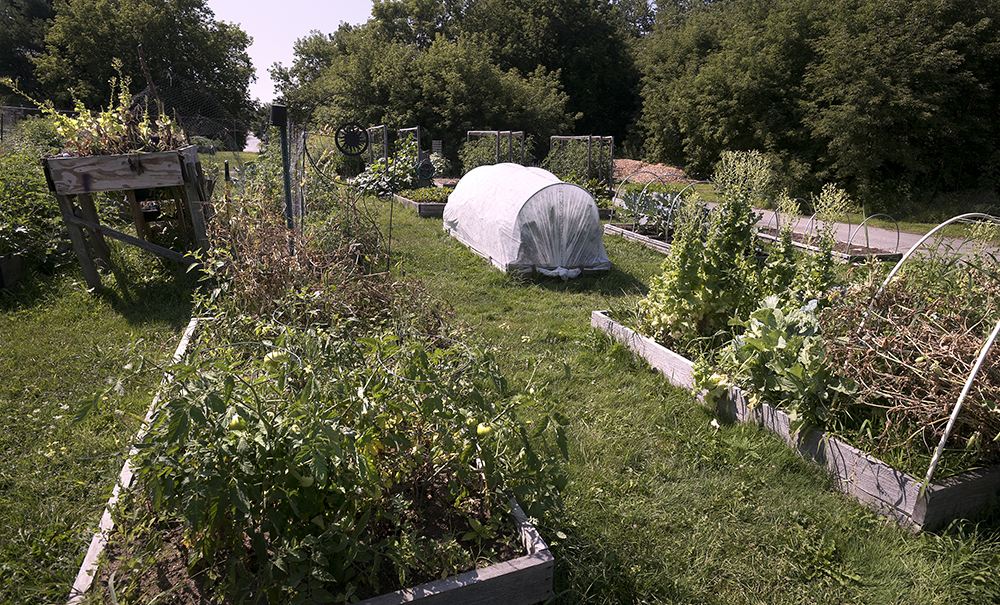
This article from Hello Homestead includes a step on adding season extenders like the cold frames discussed in an earlier post. Getting that garden properly put to bed for the winter (or keeping it working over winter) is not accomplished by stopping gardening for the winter, much though that might appeal.

How to prepare a raised garden bed for winter

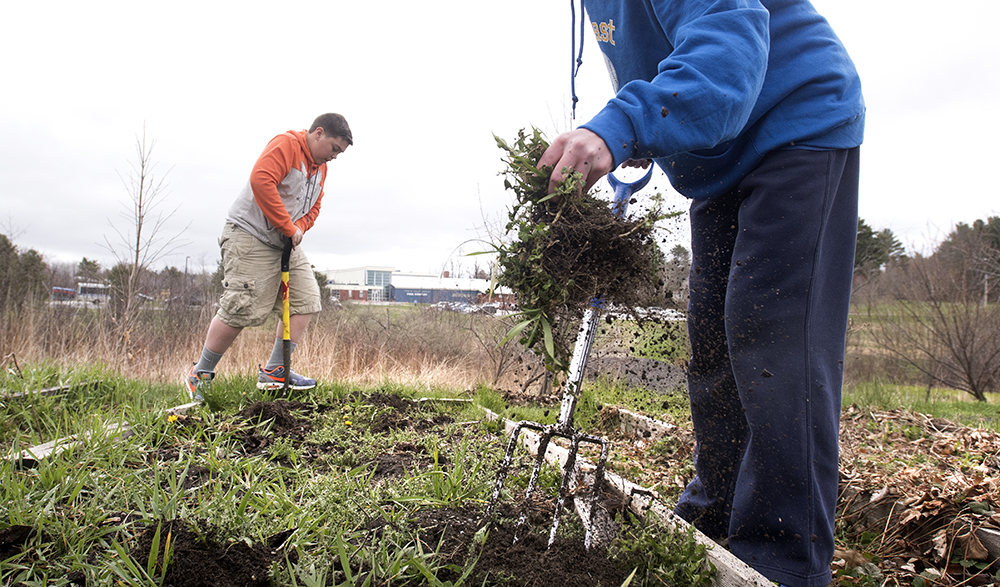
Photo by Gabor Degre

When the gardening season comes to an end, it is easy to get distracted from the pre-frost clean-up. Learning how to prepare a raised garden bed for winter, though, is essential to prepare for the season to come, even when spring is months away.

Throughout autumn, gardeners with raised beds should take several steps to ensure their garden beds are ready for next year’s seeds and seedling transplants.

“It’s an ongoing project,” said Kate Garland, horticultural specialist at the University of Maine Cooperative Extension. “I just always think of it as a to-do list for the fall.”

Properly caring for raised garden beds before winter settles in will promote soil health, ward off weeds and prevent diseases in next year’s crops. Here is how to prepare a raised garden bed for winter.

Step 1: Remove weeds

Photo by Gabor Degre

Weeding is essential well into the fall, even when the majority of your crops have stopped growing. Not only can untended autumn weeds harbor disease, but they can lay the roots for future weed problems.

“This is when people are ready to be done with weeding, but this is probably one of the most important times of year to be weeding,” Garland warned. “A lot of our weeds are setting seed right now. Some of the seeds can stay viable for 30 to 40 years or longer.”

For the parts of your raised bed that’s simply carpeted in weeds, cover them with black plastic or a layer of cardboard and leave it in place through the winter season to choke out existing weeds and suffocate sprouting weeds.

Some gardeners will till the soil to prevent weeds and expose harmful pests, but Garland suggests avoiding tillage in your raised beds as much as you can for the sake of soil health.

“There are some scenarios where [tilling] can make sense, but it doesn’t seem to make a lot of sense in raised bed settings [unless the soil is really compacted],” Garland said. “If you can avoid tilling as much as possible, your soil and your gardens will thrive in the long run.”

Click here to continue reading at Hello Homestead.

2019 Great Washington ShakeOut, Oct. 17th

Millions of people worldwide will practice how to Drop, Cover, and Hold On at 10:17 a.m. on October 17* during the annual Great ShakeOut Earthquake Drills!

Washingtonians can join them today by registering for the 2019 Great Washington ShakeOut. As of the first week of October, 1.24 million Washingtonians have registered to take part. Participating is a great way for your family or organization to be prepared to survive and recover quickly from big earthquakes– wherever you live, work, or travel. Learn tips on how to get 2 Weeks Ready and craft your own emergency kits here.

Start here to be included in the 2019 Washington ShakeOut!

Related:

Tri-City Herald: The Tri-Cities Is Earthquake Country

Pioneer Thinking: Medicinal Uses of Garlic

Autumn has fallen upon us once again. The garden is largely put to bed, but one of the things I’m out planting at this time of year is garlic. Garlic is, of course, a delicious food staple. In addition to being a food source for thousands of years, garlic has been used as a medicinal plant for nearly as long. It’s medicinal uses have been recorded by the ancient Egyptians, the ancient Greeks, ancient China and Japan, and in India’s two thousand year old Charaka Samhita medical text. So, if you weren’t think about garlic already, get out and plant some!

The following excerpt is from an older article by Pioneer Thinking: 14 Medicinal Uses of Garlic

Garlic and Health

Garlic (allium sativum) is a member of the onion family which has been used for culinary purposes for millennia and in recent years has been labelled a super food.

Unsurprisingly in the four thousand year history of this little vegetable or herb, it has been found to have numerous uses for medicinal purposes.

Open Wounds and Infections

Wounds and infections can be cleansed and treated with a garlic solution. After the wound has been cleaned, grate or pound twenty or so cloves of garlic, being careful to use only clean utensils. Mix it with a little water to make a paste which can be spread over a sterile gauze dressing and applied to the wound. Keep in place with a bandage and leave for two days when the process should be carefully repeated. During World War II, when antibiotics were scarce, garlic was often used in this way to treat wounded soldiers and protect against gangrene and septic poisoning. During the first war, garlic was also widely used to treat dysentery and typhus.

Throat and Ear Infections

Because garlic kills bacteria it works both externally and internally and many people use it to treat throat infections, colds etc. More often than not nowadays, garlic is taken as a supplement in capsule form, but making your own linctus could not be easier. Simply boil a head of garlic gently in water for 2 hours to make a light tea, adding syrup or honey to sweeten if necessary. Strain this and allow it to cool slightly before sipping. Garlic is also soothing and beneficial in ear infections if garlic infused oil is gently massaged around the ear area.

Oral Thrush and Digestive Tract Disorders

For a more palatable flavor, garlic can be mixed with apple cider vinegar and sweetened with honey. This can be sipped, used as a gargle or administered with a teaspoon like cough medicine. The combined properties of garlic and vinegar help to destroy harmful bacteria in the mouth and digestive tract. It can therefore be used to cure mouth ulcers and oral thrush.

Boosting the Immune System

Taken little and often, garlic can help to boost the immune system. The allicin in garlic is similar to penicillin, though not as strong. It is produced when the garlic is finely chopped or crushed, which increases its strength. For internal problems, chewing on a clove of garlic can release the antibiotic properties. However it is important to use only white cloves as the green thread which is sometimes found in the center of a clove of garlic is not only indigestible but is also what causes the notorious and lingering garlic ‘pong’ on the breath.

Athletes Foot and other Fungal Infections

For external fungal infections, such as athlete’s foot, a garlic foot bath is both refreshing and effective. You can make this by crushing 4 cloves of garlic with salt or rubbing alcohol into a foot spa or bowl large enough to hold the feet and soaking the feet in this for half an hour. After thoroughly drying the feet, you can rub the infected area with cotton wool swabs soaked in little garlic oil. A twice daily application should help to clear up the fungal infection.

Counteracting ‘Bad’ Cholesterol

The other ingredient of garlic is diallyl sulphide. This is widely believed to be beneficial in combating LDL (low density lipoprotein) or ‘bad cholesterol’ – that scourge of modern society. The phytochemicals in garlic appear to work in the same way as statin drugs which are often prescribed to lower cholesterol. The benefit of using garlic is that, being completely natural, it has no side effects. Studies have shown that garlic can be as beneficial as a low fat diet in reducing cholesterol and by combining both, levels can be reduced by 20%. 800 mgs of dried garlic or 5-10 cloves of fresh garlic should be consumed daily for best results.

High Blood Pressure

There has also been a lot of scientific interest recently in using garlic to lower high blood pressure. Whilst studies are inconclusive, early signs seem to suggest that garlic can help to bring down blood pressure levels. Garlic can be taken as a supplement along with your normal anti-hypertensive medications or as an extract or distilled garlic oil; 600-900 mg daily is the normal recommended dose, which may sound high, but is relatively small in terms of raw garlic. Fortunately, unlike allicin, the health benefits of the diallyl sulphides are not destroyed by cooking, so including garlic in recipes is the easiest way to help lower your cholesterol and your blood pressure

Stroke

Another worrying lifestyle disease these days, which is often linked to cholesterol and blood pressure, is stroke and once again garlic has been found to be beneficial. This is because garlic is rich in anti-coagulant or blood thinning properties, similar to aspirin. Studies have shown that garlic reduces platelet stickiness which is responsible for hindering the circulation of blood around the body. Increasing your dietary garlic intake or taking garlic supplements (500 mg three times a day) can thin the blood and help prevent the onset of stroke.

Why Garlic Benefits Sufferers of Atherosclerosis

Atherosclerosis, or the build up of plaque in the walls of the arteries, is known to be alleviated by garlic. It works directly by reducing the lipid content in cells of the arteries and thus preventing their dangerous accumulation. Recent studies show that women may benefit more than men by increasing their intake of garlic to prevent thrombosis.

An Essential Role in Diabetes

Diabetes is a frightening disease which is growing in number in the United States. It currently affects between thirteen and fourteen million people. It is a metabolic disorder caused when the body is unable to break down foods properly, causing more sugar to enter the blood stream than the pancreas (which produces a hormone called insulin) can deal with. For diabetics, consuming garlic is invaluable as it reduces blood sugar levels, either by stimulating the pancreas to produce more insulin or by making existing insulin more available or more effective at its job.

The Kidneys and Bladder

The function of the kidneys is to filter the blood and help remove toxins from the body. When they become damaged due to diabetes, hypertension or other medical conditions, they become severely strained and serious problems can kick in. The anti-oxidant and anti-inflammatory properties of garlic promote kidney health by eliminating free radical damage and purifying the blood. Garlic is a natural diuretic which means it helps to eliminate excess salt and water through the urine. Garlic therefore is an internal cleanser, helping to flush harmful toxins out of the body.

Respiratory Problems and Lung Disease

The combination of garlic’s antibacterial, antifungal and antioxidant properties, not to mention is high concentration of sulphur makes it extremely effective in combating all manner of respiratory ailments, from bronchitis to pneumonia. Because it acts as an expectorant and a decongestant to clear the lungs, sufferers of chronic bronchitis can benefit considerably from adding garlic to their daily diet.

Anti-Cancer Effects of Garlic

It has been observed for decades that in countries where garlic and onions form a regular part of the diet, the incidence of cancer is much lower, causing scientists to study the link between cancer and nutrition. The ability of garlic to stimulate the gastric juices and restore the intestinal flora is what accounts for its success as a detoxifier and cancer-preventing agent. In the most extreme cases, the best results seen from using garlic to prevent or treat cancer have been from drinking garlic juice or chewing fresh garlic cloves. Stomach cancers have responded particularly well to garlic medications but occasional successes with other forms of cancer, even in the advanced stages, have been claimed.

Worm Infestation

Intestinal parasites are relatively common but extremely distressing and potentially dangerous if left untreated in toddlers and children. Parasites like tapeworms, hookworms, roundworms and pinworms are tiny creatures that find their way into the gastrointestinal tract and sometimes burrow into the muscles. They can cause a whole host of distressing symptoms of varying severity and need to be eliminated. The natural sulphur in garlic helps to expel and eradicate them.

Wired: The Best Emergency Gear is Other People

It’s nice to see people come to the realization that community is pretty important when a disaster hits. Seeing it in a major, mainstream publication is good, too. This article comes from Wired magazine. It’s pretty brief and the “houses we would pillage” comment is a little worrisome, though hopefully they at least mean unoccupied, but the message of working with the people around you is there.

The Best Emergency Gear Is Other People

All this stuff is great, but who’s going to chop through your floor when you’re trapped in the basement?Photograph: Getty Images

September is Emergency Preparedness Month. I don’t find many National Days to be very useful (I’m still not sure what to do about “Meow Like a Pirate Day”), but for those of us who live in disaster-prone areas, like the hurricane-strewn Gulf Coast or the tornado plains of the Midwest, September is a good reminder to make sure that your emergency gear is up to date.

In my particular part of the country, “our” disaster is the inevitable Pacific Northwest earthquake. I live in a tiny corner of Portland, Oregon, a city that will be affected by any quakes on the Cascadia subduction zone. When The New Yorker‘s in-depth investigation was published in 2015, it kicked off a days-long group text among my neighbors that was only mildly panicked in tone.

About my neighbors on that group text: We all live within four blocks of each other, in wood-framed houses in varying states of renovation or disrepair. Some of us have backyard gardens and chickens; we all have partners, small children, and dogs. Without my neighbors, I’m not sure I would’ve even prepared for an earthquake at all.

I first got a hint that I might need to get my butt in gear when I received a plaintive note: “When the earthquake happens, will someone check on us to make sure we’re not stuck on the second story of our house?” someone asked.

“We’ll make your house the meeting point,” another responded.

“Do we need to get stuff?” I asked, checking the online list. “Water? A toilet?”

“We have water filters and sterilizers,” my husband said to me, since he was receiving but pointedly not participating in the group text. “You know we can just walk down to the river and fill buckets, right?”

It took a few more back-and-forths about which houses we would pillage and when, but it didn’t take me long to realize that the most important resource to have on hand wasn’t my neighbors’ stuff; it was my neighbors themselves.

My Emergency Kit…

Click here to read the rest of the story at Wired.

Off Grid Survival: Cold Frames for Food Gardens

Cold frames have been used for hundred of years to extend food growing into the colder parts of the year. The Romans used cold frames of straw or stone and used sheets of mica for lids. A greenhouse may be heated, but a cold frame typically warms up only with the sun. If you end up in a situation where you need to rely more heavily on the food that you can grow yourself, cold frames allow you to harvest more food into the winter when you would normally have to rely on food you were able to story during the summer and fall.

This article from Off Grid Survival gives you an overview the cold frame and how to make some – Cold, Hard, Survival: Why Cold Frames Are Essential for SHTF Food Gardens.

Toward the end of summer or early fall, it may seem too early to start thinking about winter. And it may be too late to start thinking about a solid harvest. But when it comes to survival, you’ll need to consider the importance of surviving through winter and what you can do now to survive long-term.

Sure, hunting or fishing might get you by if you’re skilled enough. And food stores might help to supplement any fresh kill or frozen meats. But the real challenge is providing yourself and your family with access to fresh food in the dead of winter that can not only get you through winter, but also springboard your garden next summer.

This is where the cold frame comes in.

What is a Cold Frame?

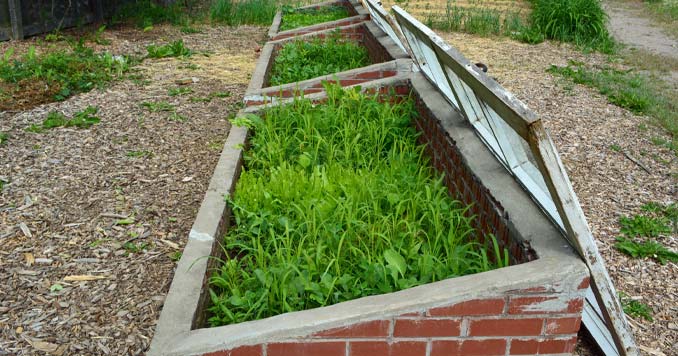
What a cold frame garden container looks like

For the purposes of gardening, a cold frame is a transparent-roofed enclosure that is used to protect plants from cold weather. The transparent top of the enclosures allows sunlight into the box while preventing heat from escaping.

This simple device is a proven method for growing fresh food through winter and priming summer gardens earlier than weather permits. They take less space than a traditional garden, require less maintenance, and have the potential to provide far more food than the empty produce section at a supermarket.

The Benefits of Cold Frame Gardening and Food Growing

Cold frames are essential in every long-term survival skill set. These simple, yet effective exoskeletons help to extend the harvest timeline well beyond the first frost of the year. This means an early or late winter doesn’t impact your food supply as much as it does other people. During times when food is scarce and access is limited, a cold frame can provide fresh produce essential to survival. Valuable spices and herbs aid in adding flavor to otherwise bland foods. They can be dehydrated or serve as barter items. Plus, you and your family can have access to natural fiber, vitamins, and minerals essential to a healthy diet.

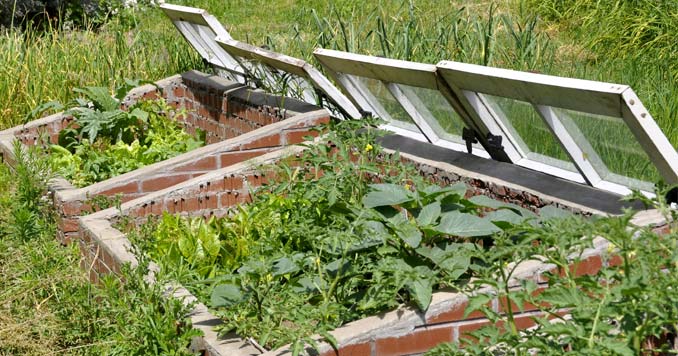
A Cold Frame garden built from Brick and Window panes

Cold frames help to promote an early growing period. Regions that have late frosts have to delay planting much longer, which creates a much shorter growing season. But with cold frames, starts can begin much earlier without the need for a giant greenhouse. Transplants from a cold frame have a greater potential to produce than if you were to wait until the last freeze of the year.

Beyond the dangers of early or late frosts, some of the benefits of a cold frame include less stress on plants, protection from wind, less erosion, fewer weeds, and easy access. If properly oriented and built with care, these units can keep plants alive longer, allow sowing sooner, and generate food during the darkest days…

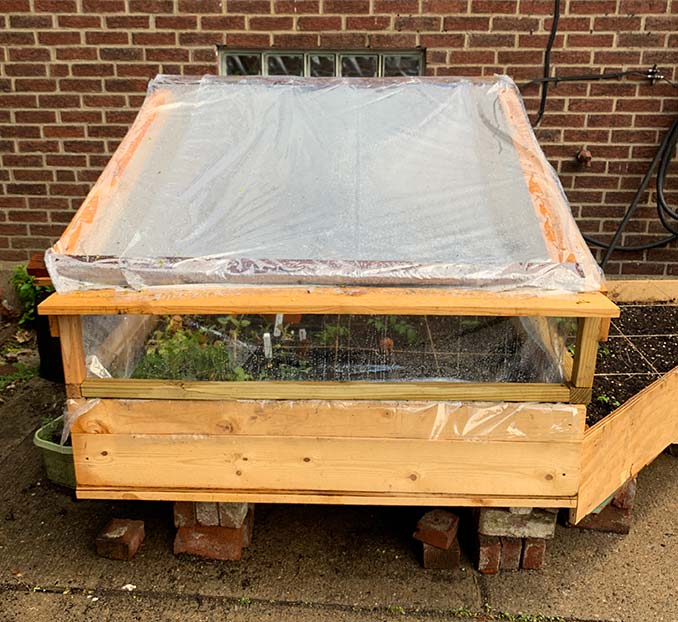
A raised cold frame built with wood and plastic

The frame itself is dirt simple. The concept centers around retaining heat in the soil to allow plants to grow despite snow, frost, or even frozen ground nearby. Frames retain heat by absorbing sunlight in an enclosed space, much like a greenhouse. It can be as basic as a 2-liter bottle over a plant, or as complex as a conservatory. The most effective form for small-scale home gardens is a rectangular box about 2’ wide by 3-4’ long.

To create a cold frame, first locate a piece of un-tinted, single-pane glass such as an old wooden window or aluminum storm window. Anything before the era of vinyl windows will work well. Double-paned windows often contain Argonne gas or tinting that may interfere with natural sunlight, heat gain, or heat loss. If you’re handy in the shop, you may be able to build your frame out of wood and order up the glass to fit from a glass shop in your area. Clear corrugated plastic also serves the same purpose – let light in and keep the cold out.

If you are looking for something that will hold up better than glass, I suggest cheking out Lexan — this stuff can be shot with a .22lr bullet and not break!

The glass, Lexan, or clear plastic goes on top of an exterior framework. The framework consists of a simple, low-profile box that can be made of 2X6 studs or even plywood. Wood is joined and secured at the corners to provide a box that rests directly on the ground. Just remember – the thicker the wood, the better the insulation will be. Alternatives to wood frames might include brick, foam, or insulated metal siding. Regardless of the materials used to create the framework, you’ll want to build it to match the size of the window or glass frame you intend to use. You may be able to add hinges to lift the glass for access or install a repurposed sliding glass window.

You should have a rectangle of wood framework with a glass panel or frame on top that can be lifted or opened for access. Now, orient the glass to where the longest side runs parallel to the equator. You want to capture as much sunlight as possible and if snow or rainwater is an issue, adding a slope to the frame will make snow removal and access much easier. The orientation and a good slope will garner the best results possible.

Once the frame is built, oriented and set in place on the ground, you can remove dirt a few inches down and either direct-sow your plants or provide a layer of compost to help get the seedlings started. By starting in late summer or early fall, you’ll have better luck with a regular harvest in mid-winter. By sowing in late winter or early spring, you’ll have heartier plants to transplant into your survival garden during summer.

If extreme temperatures or limited sunlight prevents the cold frame from heating up, you can add a light, heat tape, a heating mat, or additional insulation around the frame to aid in heat retention. Zones 1 through 5 will likely need more insulation and lighting than zones 6-10. Additional insulation can be obtained through foam, additional wood, or even organic insulation like grass clippings or seedless yard waste.

Unlike a greenhouse, a cold frame allows for a heightened level of discretion. The low-profile design is easy to disguise with shrubs or debris to prevent theft in times of chaos. This means that even in an urban setting, with limited space and relatively high visibility, you could still maintain a solid level of security and still have access to fresh food…


Related:

Fine Gardening: Easy to Build Cold Frame

Gardener’s Path: 10 of the Best DIY Greenhouses and Cold Frames for Your Backyard

The Self Sufficient Living: 10 Easy DIY Cold Frame Plans to Extend the Growing Season

Tenth Acre Farm: Protect Cold Weather Crops with a Cold Frame

Doom and Bloom: Wound Debridement

The Altons at Doom and Bloom Medical have an article up on the skill of wound debridement – the removal of necrotic tissue and foreign objects from a wound which may impede healing. There are some wound photos, so be warned.

Medical professionals like doctors, nurses, and paramedics and the high-tech equipment they work with are the heart of advanced medical care. When highly-trained personnel are unavailable, it becomes the responsibility of the average citizen to obtain medical education and supplies. Lack of knowledge and materials will cost lives in any situation where modern care is not an option.

Few medical pros can handle every medical issue
Knowing how to stop hemorrhage is very important, but the medic in austere settings will be required to do much more with an open wound. Indeed, they will be responsible for it from the time it was inflicted to full recovery. A good start is knowing “prehospital care”.  Few of us, however (including most medical professionals), are prepared to handle the complexities of the entire healing process when there is no hospital.

In today’s medicine, few providers care for every medical issue experienced by a patient. Even generalists send their patients to specialists for specific problems. In a survival setting, this is no longer possible. Therefore, it’s imperative to understand wound healing and the procedures that help a victim make a full recovery. One of these procedures is debridement.

Debridement is the removal of devitalized (“necrotic”) tissue and foreign objects from a wound. Most minor acute wounds heal just fine with cleaning and regular evaluation, but more severe wounds, burns, and bedsores may require intervention. Debridement is a way to eliminate obstacles to good healing.

Debridement speeds the healing process in various ways. Dead tissue inhibits the development of healthy new cells and makes the area susceptible to infection. It can also hide the signs of bacterial invasion.

Debridement is rarely taught in standard first aid courses. Even high-level education meant to deal with emergency trauma can get your victim to the hospital, but little for days or weeks down the road. I would guess that a volunteer stint with Doctors Without Borders might be closest, short of a surgical residency.

A variety of techniques are used to accomplish debridement and more than one type may be used on the same patient…

Click here to continue reading at Doom and Bloom Medical.

Rutherford Institute: No, the Government Shouldn’t Be Policing the Globe

Here is another good article from author and Constitutional law attorney John Whitehead on whether the U.S.A. will have its empire collapse and remain a democratic republic, or have its democracy collapse and keep the empire. An excerpt follows:

Guns for Hire: No, the Government Shouldn’t Be Using the Military to Police the Globe

“Of all the enemies to public liberty war is, perhaps, the most to be dreaded because it comprises and develops the germ of every other. War is the parent of armies; from these proceed debts and taxes… known instruments for bringing the many under the domination of the few.… No nation could preserve its freedom in the midst of continual warfare.” — James Madison

Eventually, all military empires fall and fail by spreading themselves too thin and spending themselves to death.

It happened in Rome.

It’s happening again.

At the height of its power, even the mighty Roman Empire could not stare down a collapsing economy and a burgeoning military. Prolonged periods of war and false economic prosperity largely led to its demise. As historian Chalmers Johnson predicts:

The fate of previous democratic empires suggests that such a conflict is unsustainable and will be resolved in one of two ways. Rome attempted to keep its empire and lost its democracy. Britain chose to remain democratic and in the process let go its empire. Intentionally or not, the people of the United States already are well embarked upon the course of non-democratic empire.

The American Empire—with its endless wars waged by U.S. military servicepeople who have been reduced to little more than guns for hire: outsourced, stretched too thin, and deployed to far-flung places to police the globe—is approaching a breaking point.

War has become a huge money-making venture, and America, with its vast military empire and its incestuous relationship with a host of international defense contractors, is one of its best buyers and sellers. In fact, as Reuters reports, “[President] Trump has gone further than any of his predecessors to act as a salesman for the U.S. defense industry.”

Under Trump’s leadership, the U.S. military is dropping a bomb every 12 minutes.

This follows on the heels of President Obama, the so-called antiwar candidate and Nobel Peace Prize winner who waged war longer than any American president and whose targeted-drone killings resulted in at least 1.3 million lives lost to the U.S.-led war on terror

Click here to read the entire article at the Rutherford Institute.

Forward Observer: Five Lines of Effort for Community – WROL

In this video, intelligence analyst Sam Culper of Forward Observer focuses on the five areas that he want to do for his tribe or community in case of a worst case scenario or without rule of law (WROL) situation. Intelligence drives operations. You can’t respond effectively without knowing what is what and who is who.

  1. Establish local security (legitimacy and protection)
  2. Establish positive control of the situation
  3. Restore essential services (water, electricity, at least in your immediate area)
  4. Support economic & infrastructure development (Local barter system? Safe roads. What can you produce in your area?)
  5. Conduct information management (Get news and local information out to people who need it or to deter suspicious/malicious persons)

Jim Kunstler: Civil War On

Jim Kunstler is the author of the books The Long Emergency, the consequences of a world oil production peak, coinciding with the forces of climate change, resurgent diseases, water scarcity, global economic instability, and warfare, and The Geography of Nowhere, which discusses why suburbia should not be considered credible human habitat, among others. The following excerpt comes from Jim Kunstler’s article today Civil War On:

Someone in Impeachmentville is not paying attention. Of course, diverting the rubes is exactly the point of the latest CIA operation to negate the 2016 election. Has nobody noticed that there is treaty between Ukraine and the USA, signed at Kiev in 1998 and ratified by the US Senate in 2000. It’s an agreement on “Mutual Legal Assistance in Criminal Matters.”

…How does this not permit Mr. Trump asking the president of Ukraine for “assistance” in criminal matters arising out of “collusion with Russia,” as specified within the scope of Robert Mueller’s special prosecutor activities? For instance, the matter of CrowdStrike. The cybersecurity firm was co-founded by Russian ex-pat Dmitri Alperovitch, who also happens to be a senior fellow at the Atlantic Council, an anti-Russian think tank funded by Ukrainian billionaire, Viktor Pinchuk, who donated at least $25 million to the Clinton Foundation before the 2016 election. Crowdstrike was the company that “examined” the supposedly hacked DNC servers, while somebody in the Obama administration prevented the FBI from ever seeing them. Does this sound a little like part of the origin story of RussiaGate? Is that not exactly the potential criminal matter that the current attorney general, Mr. Barr, is officially investigating?

…UkraineGate is the equivalent of Fort Sumter in Civil War 2.0. Charges have been flying and tempers flaring for three years now, much as they did between 1858 and 1861. Once again, what seems to be at stake is the integrity of the Union. As in the previous enactment, one side is dangerously deluded, and that is liable to lead to its destruction.