Virology Down Under is a website run by Ian Mackay, a PhD in virology. The following article was written for the site by Jody Lanard and Peter Sandman who are experts in risk communication and have written about risks involved with Ebola, Swine Flu and Zika in addition to Coronavirus. In Past Time to Tell the Public: “It Will Probably Go Pandemic, and We Should All Prepare Now the authors discuss the fact that governments should already be telling people to get prepared for a pandemic and banned public gatherings. The time for trying to contain the virus is past and pandemic preparedness is upon us. Don’t expect the government to keep the virus from your door.
In addition to the dangers of the virus itself, people should be prepared for product shortages off all types if the coronavirus goes pandemic. There have already been reports of things like face masks, and some auto manufacturers have warned that factories will need to close because of a lack of parts from China. But there are more common everyday items that are at risk of shortage, too. For example, Procter & Gamble has warned that it may have supply problems with over 17,000 of its products because they are supplied through over 380 companies in China. Procter & Gamble is a huge supplier of consumer products including such brands as Charmin, Crest, Tide, Vicks, Gillette, Pampers, Always, Tampax, Pepto-Bismol, Olay, Old Spice, Secret, and many, many other common household names.
We are starting to hear from experts and officials who now believe a COVID-19 pandemic is more and more likely. They want to use the “P word,” and also start talking more about what communities and individuals can and should do to prepare. On February 22, Australian virologist Ian Mackay asked us for our thoughts on this phase of COVID-19 risk communication.
Here is our response.
Yes, it is past time to say “pandemic” – and to stop saying “stop”
It’s a good time to think about how to use the “P word” (pandemic) in talking about COVID-19. Or rather, it is past time.
It is important to help people understand that while you think – if you do think so – that this is going to be pandemic in terms of becoming very widespread, no one knows yet how much severe disease there will be around the world over short periods of time. “Will it be a mild, or moderate, or severe pandemic? Too soon to say, but at the moment, there are some tentative signs that….”
The most crucial (and overdue) risk communication task for the next few days is to help people visualize their communities when “keeping it out” – containment – is no longer relevant. The P word is a good way to launch this message.
But the P word alone won’t help the public understand what’s about to change: the end of most quarantines, travel restrictions, contact tracing, and other measures designed to keep “them” from infecting “us,” and the switch to measures like canceling mass events designed to keep us from infecting each other.
We are near-certain that the desperate-sounding last-ditch containment messaging of recent days is contributing to a massive global misperception about the near-term future. The theme of WHO’s and many governments’ messages – that the “window of opportunity” to stop spread of the virus is closing – is like the famous cover page of Nevil Shute’s On the Beach: “There is still time … Brother.”
For weeks we have been trying to get officials to talk early about the main goal of containment: to slow the spread of the virus, not to stop it. And to explain that containment efforts would eventually end. And to help people learn about “after containment.” This risk communication has not happened yet in most places.
One horrible effect of this continued “stop the pandemic” daydream masquerading as a policy goal: It is driving counter-productive and outrage-inducing measures by many countries against travelers from other countries, even their own citizens back from other countries. But possibly more horrible: The messaging is driving resources toward “stopping,” and away from the main potential benefit of containment – slowing the spread of the pandemic and thereby buying a little more time to prepare for what’s coming.
We hope that governments and healthcare institutions are using this time wisely. We know that ordinary citizens are not being asked to do so. In most countries – including our United States and your Australia – ordinary citizens have not been asked to prepare. Instead, they have been led to expect that their governments will keep the virus from their doors.
Take the risk of scaring people
Whenever we introduce the word “pandemic,” it’s important to validate that it’s a scary word – both to experts and to non-experts – because it justifiably contains the implication of something potentially really bad, and definitely really disruptive, for an unknown period of time. This implication is true and unavoidable, even if the overall pattern of disease ends up being mild, like the 2009-10 “swine flu” pandemic.
Validate also that some people may accuse you of fear-mongering. And respond that hiding your strong professional opinion about this pandemic-to-be would be immoral, or not in keeping with your commitment to transparency, or unforgivably unprofessional, or derelict in your duty to warn, or whatever feels truest in your heart.
It may help to consider the “damned if you do, damned if you don’t” fallacy. Feel free to say that “Jody Lanard and Peter Sandman say” that officials or experts – in this case YOU – are “darned if you do anddamned if you don’t.” You’re only darned if you warn about something that turns out minor. But you’re damned, and rightly so, if you fail to warn about something that turns out serious.
It’s simply not true, in principle or in practice, that you are damned if you do and damned if you don’t! Over-alarming risk messages are far more forgivable than over-reassuring ones.
Push people to prepare, and guide their prep
This is the most culpable neglected messaging in many countries at this point.
The main readiness stuff we routinely see from official and expert sources is either “DON’T get ready!” (masks), or “Do what we’ve always told you to do!” (hand hygiene and non-mask respiratory etiquette).
The general public, and many categories of civil society, are not actively being recruited to do anything different in the face of COVID-19 approaching.
A fair number of health care workers and communication officers tell us their hospitals and healthcare systems are just barely communicating about COVID-19. They want to be involved in how to prepare for “business not as usual.” We’re guessing that many hospital managements are in fact preparing for COVID-19, but we worry that they’re doing it too quietly, without enough effort to prepare their staff.
Lots of businesses, especially smaller ones, are doing off-the-cuff pre-pandemic planning. Several trade journals have articles about how specific industries should prepare for a likely pandemic. Around February 10, the U.S. Centers for Disease Control and Prevention posted interim guidance for businesses. But we have seen almost nothing in mainstream media citing this guidance, or recommending business continuity strategies like urgent cross-training so that core functions won’t be derailed because certain key employees are out sick, for instance.
Pandemic planning research suggests that employees are likeliest to say they will show up for work during a pandemic if three specs are met – if they think their family is reasonably safe; if they think their employer is being candid with them about the situation; and if they have a pandemic-specific job assignment in addition to or different from their routine “peacetime” assignment.
Hardly any officials are telling civil society and the general public how to get ready for this pandemic.
Even officials who say very alarming things about the prospects of a pandemic mostly focus on how their agencies are preparing, not on how the people they misperceive as “audience” should prepare. “Audience” is the wrong frame. We are all stakeholders, and we don’t just want to hear what officials are doing. We want to hear what we can do too.
We want – and need – to hear advice like this:
Try to get a few extra months’ worth of prescription meds, if possible.
Think through now how we will take care of sick family members while trying not to get infected.
Cross-train key staff at work so one person’s absence won’t derail our organization’s ability to function.
Practice touching our faces less. So how about a face-counter app like the step-counters so many of us use?
Replace handshakes with elbow-bumps (the “Ebola handshake”).
Start building harm-reduction habits like pushing elevator buttons with a knuckle instead of a fingertip.
There is so much for people to do, and to practice doing in advance.
Preparedness is emotional too
Suggesting things people can do to prepare for a possible hard time to come doesn’t just get them better prepared logistically. It also helps get them better prepared emotionally. It helps get them through the Oh My God (OMG) moment everyone needs to have, and needs to get through, preferably without being accused of hysteria.
It is better to get through this OMG moment now rather than later.
Offering people a list of preparedness steps to choose among means that those who are worried and feeling helpless can better bear their worry, and those who are beyond worry and deep into denial can better face their worry.
Yet another benefit: The more people who are making preparedness efforts, the more connected to each other they feel. Pandemic preparedness should be a communitarian experience. When a colleague offers you an elbow bump instead of a handshake, your mind goes to those lists of preparedness recommendations you’ve been seeing, and you feel part of a community that’s getting ready together.
This OMG realization that we have termed the “adjustment reaction” (see http://www.psandman.com/col/teachable.htm) is a step that is hard to skip on the way to the new normal. Going through it before a crisis is full-blown is more conducive to resilience, coping, and rational response than going through it mid-crisis. Officials make a mistake when they sugarcoat alarming information, postponing the public’s adjustment reaction in the vain hope that they can avoid it altogether.
Specific pandemic preparedness messages
Below are links to specific preparedness messaging we drafted for a possible H5N1 pandemic. The links are all from our 2007 website column What to Say When a Pandemic Looks Imminent: Messaging for WHO Phases Four and Five. Each item is in two parts – a draft message (a summary sentence followed by a few paragraphs of elaboration), then a risk communication discussion of why we think it’s an appropriate pre-pandemic message. Because these were written with H5N1 in mind, the pandemic they contemplate is more severe and less likely than the one we contemplate today. So some changes may be called for – but frankly, in our judgment, not many.
One of the scariest messaging failures in the developed world is not telling people vividly about what the end of containment will look like, for instance the end of contact-tracing and most quarantines.
The FAQs on the Singapore Ministry of Health webpage (https://www.moh.gov.sg/covid-19/faqs) can serve as a model that other developed countries can adapt to start talking to their publics about this now, to reduce the shock and anger when governments stop trying to contain all identified cases.
What’s working for us
We’d like to share with you some of our recent everyday life experiences in talking about pandemic preparedness with people who perceive us as a bit knowledgeable about what may be on the horizon. Some of this overlaps with the more generic comments above.
1. We’ve found it useful to tell friends and family to try to get ahead on their medical prescriptions if they can, in case of very predictable supply chain disruptions, and so they won’t have to go out to the pharmacy at a time when there may be long lines of sick people. This helps them in a practical sense, but it also makes them visualize – often for the first time – how a pandemic may impact them in their everyday lives, even if they don’t actually catch COVID-19. It simultaneously gives them a small “Oh my God” moment (an emotional rehearsal about the future) – and something to do about it right away to help them get through the adjustment reaction.
2. We also recommend that people might want to slowly (so no one will accuse them of panic-buying) start to stock up on enough non-perishable food to last their households through several weeks of social distancing at home during an intense wave of transmission in their community. This too seems to get through emotionally, as well as being useful logistically.
3. Three other recommendations that we feel have gone over well with our friends and acquaintances:
Suggesting practical organizational things they and their organizations can do to get ready, such as cross-training to mitigate absenteeism.
Suggesting that people make plans for childcare when they are sick, or when their child is sick.
4. And the example we like the best, because it gives every single person an immediate action that they can take over and over: Right now, today, start practicing not touching your face when you are out and about! You probably won’t be able to do it perfectly, but you can greatly reduce the frequency of potential self-inoculation. You can even institute a buddy system, where friends and colleagues are asked to remind each other when someone scratches her eyelid or rubs his nose. As we noted earlier, someone should develop a face-touching app – instead of a step-counting app to encourage you to walk more, how about an app to encourage you to auto-inoculate less! And track your progress, and compete with your friends, even!
The last message on our list – to practice and try to form a new habit – has several immediate and longer-term benefits.
Having something genuinely useful to do can bind anxiety or reduce apathy. You feel less helpless and less passive.
And you can see yourself improving.
And you can work on your new habit alone, and also in a pro-social communitarian way. Others can help you do it, and you can help them.
And it yields real harm reduction! It is arguably the endpoint of what washing your hands is for, and it helps when you can’t wash your hands out in the world.
Like all good pandemic preparedness recommendations, it helps you rehearse emotionally, as well as logistically.
The bottom line
Every single official we know is having multiple “Oh my God” moments, as new COVID-19 developments occur and new findings emerge. OMG – there is a fair amount of transmission by infected people with mild or subclinical cases! OMG – there is a high viral load early on in nasal and pharyngeal samples! OMG – the Diamond Princess, how can that have been allowed to happen! And on and on.
Officials help each other through those moments. They go home and tell their families and friends, sharing the OMG sensation. And then what do they tell the public? That they understand that “people are concerned” (as if they themselves weren’t alarmed), but “the risk is low and there’s nothing you need to do now.”
Ian, it sounds like you want to argue on behalf of preparedness. Encouraging all stakeholders to prepare logistically should start now, if not sooner. And you are in a position not just to encourage logistical preparedness, but also to encourage government sources and other experts like yourself to do the same. Perhaps even more important, in our judgment: You can try to encourage emotional preparedness, and try to encourage other official and expert sources to encourage emotional preparedness – guiding people’s OMG adjustment reactions instead of trying to stamp them out.
This post attempts to gather some resources and information for businesses to make a pandemic preparedness plan. Every business will be a bit different – what applies to a city government will not be the same for a family run espresso bar. In the case of a pandemic, you will need to deal with the possibility of quarantined employees and customers, protecting the health of employees against the possibility of infectious customers, dealing with travel restrictions, possible death of key employees, communication difficulties, and much more. It’s best to at least have an idea of what sorts of problems your business may face before it actually faces them. While the current coronavirus is not epidemic in the US as of yet, you can learn a lot about business effects just by paying attention to what is happening in China and elsewhere.
As part of the planning process you need to:
identify core services, and what is needed to maintain the supply chain
identify staffing arrangements, such as telecommuting, succession planning and cross-skilling
protect the health of staff
develop a communications strategy for employees, customers and suppliers
consider financial implications, such as cash flow, cost increases and insurance
Prudent employers will assemble a pandemic team and plan if they have not done so already. The pandemic team should develop a coordinated and efficient pandemic response plan so that the needed public health information is gathered and transmitted; the communications to managers and employees about operations, cleaning protocols, leave and benefits is consistent and effective; and anticipated disruptions managed effectively while avoiding litigation risks and panic within the workplace.
The pandemic plan should provide pre-established means of communication and planning including:
Operational alternatives to shift production to unaffected areas and mitigate disruptions from quarantines and high absenteeism;
Education of employees on basic health precautions at work and at home, not reporting to work when sick or exposed, leaving work promptly when symptoms occur, and mechanisms for tracking who is ready to return to work or obtaining employee releases to return to work;
Implementing increased prevention and transmission precautions by increased cleaning protocols, disposal of employee tissues and cleaning up after sick employees;
Selection of safety equipment for key personnel possibly including masks, gloves and cleaning supplies and equipment, and the educational requirements for its application, use, removal, and disposal;
Redesign of procedures and operations to limit the face to face interactions of employees in group meetings, lines at time clock, cafeteria, elevators, etc.
Education of management concerning employee communications, transmitting self-disclosed infection information from employees, sending employees home who want to stay at work, and communicating with employees too scared to report.
Develop and communicate travel restrictions to any known infected areas.
Specific assignments for an emergency response team should include the following in the event that further response is necessary:
coordinating with federal, state and local authorities in control of public health and safety in case of quarantines and inoculation efforts;
developing and implementing evacuation procedures if they become necessary;
preparing facility shutdown check-lists;
identifying key personnel whose presence is important to continue vital company functions; and
determining methods for communicating effectively with employees.
Having knowledge of infectious diseases and how to treat them is very important, but you’ll be more effective in preventing their spread by having some supplies. Which supplies? That all depends on the nature of the disease itself and the risk that the healthy population will be exposed to it.
Before you can be a successful caregiver and heal the sick in an epidemic, you must avoid becoming one of its victims. Viruses can be very contagious (like the airborne common cold) and have a low fatality rate. Alternatively, a disease may have a high fatality rate (like Ebola) and be less contagious (it’s not officially thought to be airborne). Rarely, a really infectious agent may be both very contagious and lethal (like The Pneumonic Plague in the Middle Ages).
In a truly virulent outbreak, healthcare providers are at serious risk. During the Ebola epidemic of 2014, being a medical worker was one of the principal ways to get (and die of) the disease. In 2020, the physician who first tried to warn the world of the coronavirus COVID-19 epidemic was, unfortunately, also one of its casualties.
Because of the risk to medical workers, strict protocols regarding what items a caregiver should wear are formulated and constantly modified based on new scientific evidence. A uniform way to to don (put on) and doff (take off) equipment is very important in safeguarding healthcare providers
PROTECTIVE GEAR TO WEAR
Here is what we think you should wear if you are taking care of a highly contagious patient. First, we’ll discuss which armor would give you the most protection. You should have…
• Coveralls (with head and shoe covers; some come with hoods and booties built-in)
• Masks (N95 or N100)
• Goggles or face shields (to be used with, not instead of, masks)
• Nitrile Gloves
• Aprons
Shoe covers and built-in attached booties alone do not give you enough protection. Rubber boots should be worn and can be sanitized between patient encounters.
ABOUT FACE MASKS
N95 non-vented mask
Medical masks are evaluated based, partially, on their ability to serve as a barrier to very small particles that might contain bacteria or viruses. Masks are tested at an air flow rate that approximates human breathing, coughing, and sneezing. The quality of a mask is determined by its ability to tightly fit the average human face. The most commonly available face masks use ear loops or ties to fix them in place, and are fabricated of “melt-blown” coated fabric (a significant upgrade over woven cotton or gauze)…
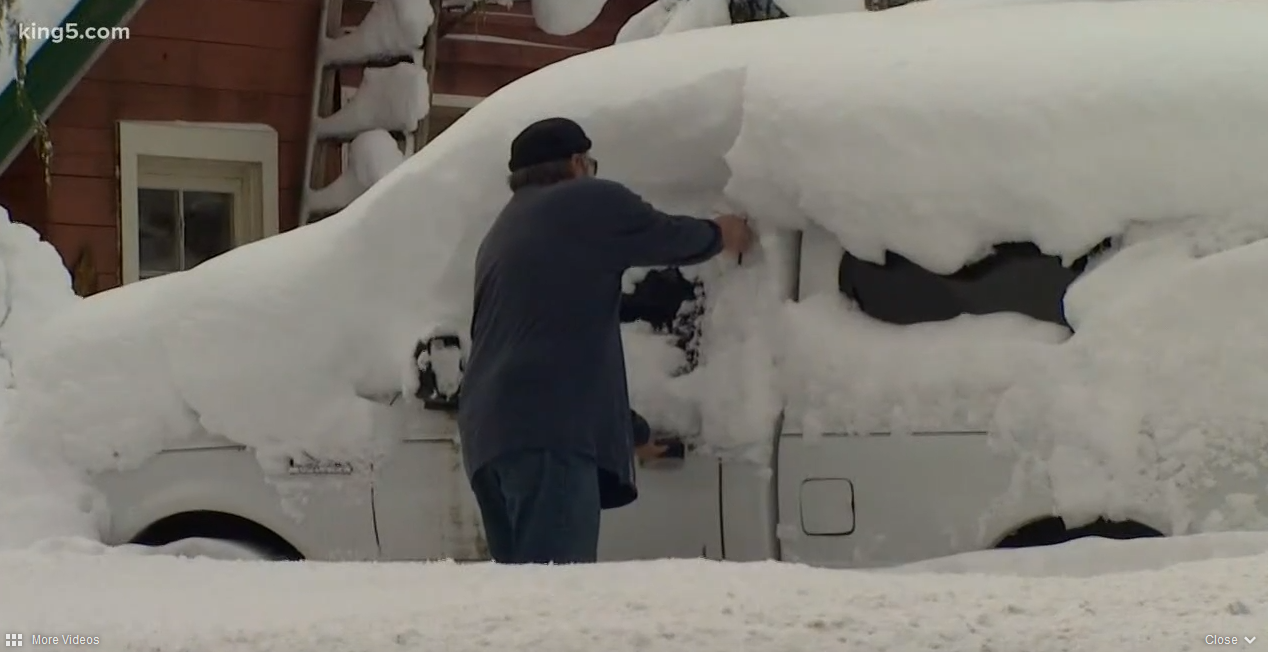
In another example of the importance of being prepared and the importance of community, some residents who live along US Highway 2 have been stranded in their homes and without electricity since last Friday as over three feet of snow fell in the area. Miles of the highway are still closed, but WSDOT was able to open a portion of the road and community volunteers have been bringing supplies to some.
Patience is wearing thin for residents impacted by the closure of US Highway 2 near Skykomish. Most living in the area have been without electricity since 2 p.m. Friday.
Washington State Department of Transportation (WSDOT) opened a portion of US 2 on Wednesday at 2 p.m. for local access to Skykomish for people living between Money Creek tunnel and Skykomish. US 2 remains closed between Skykomish and the Stevens Pass summit.
“On a scale of 1 to 10, it’s a 10,” said Baring resident Charlie Preston. “It’s hell.”
But help arrived Wednesday when WSDOT escorted a group of volunteers across US 2 with supplies donated by community members for residents stranded by the closure.
“We’ve got like four trucks packed full right now with more coming. Everything from pellets for pellet stoves, gas for generators, diesel, the normal amenities that everybody needs,” volunteer Dave Mergenthaler said. “Food, bread, milk, tons of water, anything and everything we could gather between last night and this morning is going up.”
“This is the type of help that just warms you when nothing else does,” said one resident when the help arrived.
Some residents have posted videos showing at least three feet of snow on the ground. Mergenthaler said some people have been trapped in their homes for days.
“We don’t have news, we don’t have phones, we don’t have internet. We’re totally isolated,” said Preston. “I don’t know if the governor has called this an emergency. If he hasn’t, he needs to. We need all the help we can get.”
…Much worst was once the tear gas started to get into our patio. Our house is entirely open. Even the dogs were having a hard time. Vinegar spraying in the face was quickly started.
It´s a good moment to remind you all: adding a good gas mask (one for each family member) and after bought, everyone must learn how to wear it in a hurry, and do it properly. This can make an important difference. Small children are going to be the most severely affected. Seen it happening in Caracas. Guards attacked a hospital. Jeez. If you´re hunkering down adults must take turns to monitor the surroundings (AND. DON´T. OPEN. THE. CURTAINS).
A face covered with a gas mask sticking out an apartment window is very likely to be targeted. So don´t do that. “Regular” “Normal” people do not have gas masks. But we know this is a good tool. Perhaps some drops of Valerian herb essence in a cup of water will help with those nerves, something I strongly recommend. Just put some music, and grab a book while installing yourself in an observation post that allows you to check to see what´s happening outside. If you have (as I indeed have recommended in some previous articles) to have an array of 2 or 3 remote cameras to see what´s happening outside without sticking the nose outside of a window, this is the moment to use them. Quietly and unnoticed. This will work as a means to calm down yours, too.
Don´t leave your place unless it´s extremely necessary.
I´m sure someone thinking they´re smart cookie will call me Mr. Obvious and other stupidities. But try to dialogue with your (non-prepper) wife once the food is gone and her rattle is shaking as if there´s no tomorrow. Trust me, the streets are not going to be safer once this rattling starts. Jokes apart, not because you don´t see anything from your window doesn´t mean something is NOT coming your way.
If you feel the need to make it to the supermarket 4 miles away with the best prices, maybe you can get there. Maybe you could even buy your stuff if the place hasn´t been looted. And maybe, too, a turmoil gets between you and your home and can´t be surrounded. You could get yourself into trouble just because. No need to do it. Keep your place supplied, be creative and use your brains. What I mean is, if the water, power or phone gets cut off, it´s stupid to leave the place believing that you´re going to make it to their offices to make a claim. I know there is plenty of people that would do this. So don´t call me Cap. Obvious. You´ll be underestimating the endless human potential for dumbness.
OK now, let´s elaborate a little bit. Suppose you are in your apartment in downtown Chile. On the second floor. Going higher in one of the countries of the Fire Belt is not wise. Anyway, tear gas is starting to feel. You pull out your gas masks, or even your swimming glasses and a cloth soaked in vinegar over your mouth. The 3 supermarkets nearby have been looted. Not just looted, they have been destroyed. Cashier machines, transport belts, even the shelves island have been demolished. Some reports have told that even factories have been burned. Senseless, irrational violence. And you don´t have where to buy fresh vegetables, nor fruit. You have still water and power.
But it´s here where our preppings are going to shine and your kids will learn that it pays off to play squirrel, at the end of the day.
Your horizontal freezer is filled up with supplies. Your pantry is stocked from floor to roof with canned vegetables, beans, pasta and whatnot, enough for six months. You have toilet paper to wipe off an entire primary school battalion for one year (if you have children under 10 you know how they go through toilet paper FAST). Toothpaste, shampoo, and soap? No problem. That couple of cases of beer is still safe under your bed.
One of my friends informs me that in Chile his job was not affected. He could attend to his office, just walking carefully…and a cab every now and then. The train is not functional. There are massive demonstrations. When these start, people just leave the office and go home. Usually, the turmoil starts when these people reach a certain point…
Today’s survival lesson comes from Peak Prosperity‘s Adam Taggart enumerating some of his lessons learned from mandatory evacuation from California fires.
As I type this, there are over 16 large wildfires currently burning across northern and southern California. Hundreds of thousands of residents have been displaced. Millions are without power.
My hometown of Sebastopol, CA underwent mandatory evacuation at 4am Saturday night. I jumped into the car, along with our life essentials and our pets, joining the 200,000 souls displaced from Sonoma County this weekend.
Even though I write about preparedness for a living, fleeing your home in the dead of night with a raging inferno clearly visible on the horizon drives home certain lessons more effectively than any other means.
I’d like to share those learnings with you, as they’re true for any sort of emergency: natural (fire, flood, hurricane, tornado, earthquake, blizzard, etc), financial (market crash, currency crisis) or social (revolution, civil unrest, etc).
And I’d like you to be as prepared as possible should one of those happen to you, which is statistically likely.
Your survival, and that of your loved ones, may depend on it.
No Plan Survives First Contact With Reality
As mentioned, I’ve spent years advising readers on the importance of preparation. Emergency preparedness is Step Zero of the guide I’ve written on resilient living — literally the first chapter.
So, yes, I had a pre-designed bug-out plan in place when the evacuation warning was issued. My wife and I had long ago made lists of the essentials we’d take with us if forced to flee on short notice (the Santa Rosa fires of 2017 had reinforced the wisdom of this). Everything on these lists was in an easy-to-grab location.
The only problem was, we were 300 miles away.
Reality Rule #1: You Will Be Caught By Surprise
There are too many variables that accompany an unforeseen disaster to anticipate all of them. Your plan has to retain enough flexibility to adapt to the unforeseen.
In my case, we were down at Parents’ Weekend at Cal Poly in San Luis Obispo, where my older daughter recently started her freshman year.
As the text alerts warning of the growing fire risk started furiously arriving, we monitored them closely, reluctant to leave the festivities and our time with our daughter. But once the evacuation warning came across, we knew it was serious enough to merit the 6-hour mad dash home to rescue what we could.
The upside of that long drive was that it gave us time to alter our bug-out plan according to the unfolding situation. We decided my wife and younger daughter would go directly to safety; that reduced the lives at risk in the fire zone down to just 1 (mine). And I used the phone to line up neighbors who could grab our stuff should I not be able to make it home in time.
The learning here is: Leave plenty of room in your plan for the unexpected. If its success depends on everything unfolding exactly as you predict, it’s worthless to you.
Reality Rule #2: Things Will Happen Faster Than You’re Ready For
Once an emergency is in full swing, things start happening more quickly than you can process well.
Even if developments are unfolding in the way you’ve anticipated, they come at an uncomfortably fast rate that adrenaline, anxiety and fatigue make even more challenging to deal with.
Just as The Crash Course chapter on Compounding explains how exponential problems unfold too fast to avoid once they become visible, it’s very easy to get overwhelmed or caught off-guard by the pace required to deal with a disaster.
The Kincade fire started at 9:30pm the night before I left Sebastopol for Cal Poly. When I went to bed that night it was a mere 300 acres in size. Two days later it was 25,000 acres. (it’s currently at 66,000 acres).
It went from “nothing to worry about” to “get out NOW!” in less than 48 hours.
Watching who fared well during the evacuation and who didn’t , those who took action early out of a healthy sense of caution had much more success than those who initially brushed off the potential seriousness of the situation.
Here’s how much of a difference timely action made:
The ‘evacuation warning’ advisory became a ‘mandatory evacuation’ order at 4am on Saturday night. My car was ready to go and I was on the road out of town within 5 minutes.
Several friends of mine left home just 45 minutes after I did. By that time, the fleeing traffic made the roads essentially immobile. My friends had to turn back to ride things out in their homes, simply hoping for the best.
So I’m reminded of the old time-management axiom: If you can’t be on time, be early. In a developing crisis, set your tolerance level for uncertainty to “low”. Take defensive measures as soon as you detect the whiff of increasing risk; it’s far more preferable to walk back a premature maneuver than to realize it’s too late to act.
Reality Rule #3: You Will Make Mistakes
Related to Rule #2 above, you’re going to bungle parts of the plan. Stress, uncertainty and fatigue alone pretty much guarantee it.
You’re going to forget things or make some wrong choices.
Case in point: as I was evacuating, the plan was to take a less-traveled back route, in order to reduce the odds of getting stuck in traffic. But, racing in the dark and checking in on the phone with numerous friends and neighbors, muscle memory took over and I found myself headed to the main road of town. Too late to turn back, I sat at the turn on, waiting for someone in the line of cars to let me in.
It then hit me that perhaps no one might. Folks were panicked. Would someone be willing to slow down to let me go ahead of them?
Obviously someone did, or I wouldn’t be typing this. But that mistake put everything else I’d done correctly beforehand in jeopardy.
So, as the decisions start to come fast and furious, your key priority is to ensure that you’re focused on making sure the few really important decisions are made well, and that the balls that get dropped won’t be ones that put your safety at risk.
Forget to pack food for the cat? No big deal, you’ll find something suitable later on. Miss your time window to evacuate, as my friends did? That could cost you your life.
Reality Rule #4: When Stressed, All You Care About Is People & Pets
A good bug-out plan covers preparing to take essential clothes, food & water, medications, key documents, communications & lighting gear, personal protection, and irreplaceable mementos.
But when the stakes escalate, you quickly don’t care about any of those. It’s only living things — people, pets & livestock — that you’re focused on.
The rest, while valuable to have in an evacuation, is ultimately replaceable or non-essential.
I very well might have rolled the dice and stayed down at Cal Poly if it weren’t for the cat. But family is family, no matter how furry. I just couldn’t leave her to face an uncertain fate. And I believe strongly you’ll feel the same about any people or pets in your life — it’s a primal, tribal pull to take care of our own. If you don’t plan for it, it will override whatever other priorities you think you may have.
So prioritize accordingly. Build your primary and contingency plans with the security of people and animals first in mind. If there’s time for the rest, great. But if not, at least you secured what’s most important (by far)…
This lengthy piece comes from Mountain Guerrilla blog‘s Patreon page. This one is a public posting, so no Patreon membership is required to read it. Some people get turned off by the way John Mosby writes; try to get past it. Mosby consistently writes insightful commentary. You may not like what he says, but think about it before rejecting it, and you may find your mind changing. In this article, Mosby talks about supposedly prepared people who ended up not being prepared for simple disasters and the kinds of things you can do to be self-sufficient in a way that makes you prepared for these short term disasters.
One of the things I’ve spent a lot of time and bandwidth on is pointing out the inanity of focusing preparedness on some potential future cataclysmic event that will bring about The End Of The World As We Know It (TEOTWAWKI)… like overnight, total economic meltdown leading to a catastrophic failure of modern society, EMP or CMP destroying the electrical grid, terrorists detonating “dirty bombs” in multiple major metropolitan centers, zombie or other pandemic disease outbreaks, and the like are cool to theorize about. The problem is, they’re cool to theorize and fantasize about because they are so unlikely.
That’s not to say that it wouldn’t be super convenient. That sounds facile, but it really isn’t. Sure, the idea that “90% die-off” of the American population being “convenient” seems ridiculous. The idea that spending the rest of your life in a tooth-and-claw fight for sustenance and survival would be “convenient” seems like something a testosterone-poisoned teenage boy would claim. The reality is however, compared to the reality we are facing, the popular images of “TEOTWAWKI” are exactly that: they’re convenient.
You wake up one morning, and nobody, anywhere, has any electricity. The banks and banking computers no longer work, so nobody, anywhere, has any money left, and those who did have a couple hundred or thousand in cash, stuffed into a pair of underwear, are … out of luck, because every quickly realizes that cash is valueless. You no longer have to worry about soccer practice, band recitals, or math tutors, for Little Suzie and Sam, because it’s time to crawl into the Crye Multicam jammies you bought, strap on your plate carrier, load and zero your 1970s vintage, Belgian-made FN/FAL with wood furniture (because real men carry rifles made of wood and steel, by Gawd!) and iron sights, and prepared to defend hearth and home, and the virtue of the little Missus!
No more fighting about what’s for supper, and whether we should eat at home, or go out, because we’re going to be living on beans and rice for the next year. No more worrying about who is watching what on television, because the power grid is down, and the satellites got fried by the CME too, so there’s no DirecTV, even if you did have a generator to hook the television up to. No more worries about making it to the gym to work out, and try to treadmill that “freshman fifteen” you put on your first year of college….twenty years ago, because it’s going to be physical labor from now until you die, trying to gather supplies, and cut and split wood.
No more dealing with attorneys to battle it out with the neighbor over the boundary dispute because one of you built the privacy fence incorrectly. Now, you can just smoke check the dude with a thirty caliber round from your FAL, because the police are no longer working. It’s not like you have to worry about him fighting back, because he’s “sheeple,” and you’re pretty sure he doesn’t even own a gun. You’ve certainly never seen him carrying one, and he doesn’t have any cool guy gun bumper stickers on his truck, like you do.
Yeah, it would be convenient.
———————————————
Reality is dirtier, and far, far less convenient. Reality is PG&E shutting down the power grid to millions of people, for weeks, because they’re worried about lack of infrastructure maintenance causing runaway wildfires. Reality is those wildfires happening anyway, and closing down your “Bug Out” route, because of traffic congestion, as everybody else tries to flee the dangers at the same time.
Reality is a tornado sweeping across two counties, knocking power out to thousands of homes, and sending 300 year old oak trees through roofs, and blowing barns and sheds into the next township. Reality is the electric company subsequently telling you that, “Yeah, your power is going to be out for awhile, because we’ve got several hundred miles of line to replace, and you’re at the bottom of the priority list. Oh, you have a newborn baby? A disabled grandmother living at home? Not our problem. Sorry.”
Reality is a winter storm blowing in and knocking out the power for the next week, as temperatures plummet to single digits, and nobody in your subdivision has a wood stove for back-up, because covenants in the HOA agreement.
Reality is what happened to parts of Oklahoma and Arkansas this summer, when the Arkansas River flooded to historic record levels, and destroyed entire communities worth of homes.
————————————–
I have a friend who lost power recently. Their power was out for a week. They ended up going and staying with family, because the weather was cold, and they didn’t have any back-up systems in place at the house. Dude is one of the most all-around competent, handy, people I’ve ever known. He’s a super hard worker, self-employed, and has dozens of employees. He’s genuinely, just an all-around competent dude.
This friend has tens of thousands of dollars worth of guns. He wears a concealed pistol everywhere he goes, and he keeps a rifle locked up, inside the cab of his truck, along with a plate carrier, “just in case.”
I asked him, “Why do you carry a gun?”
“Well, because there are bad people in the world, and I can’t rely on the police to be on hand to protect me and my wife and kid!” He’s right. It’s a really good answer. It’s solid. It’s legitimate.
“Cool. So, why don’t you have a back-up generator wired to the house? Why don’t you have a woodstove in the house, and a couple cords of wood in the backyard? What if, instead of a storm knocking out the power for a few days, this had been THE EVENT? What if your family had lost power too?”
He didn’t have an answer. Most people I’ve had similar discussions with, over the years, haven’t had answers…
Many of us spend far more of our waking hours away from home, busy with work, school, or chauffeuring our kids to their various activities. Because of this, a vehicle emergency kit is vital. In recent winters, there were two notable situations during which a well-stocked kit would have been beneficial. During one scenario, a freak snowstorm struck the Atlanta, Georgia area. Because weather like this is such a rarity, the area was completely unprepared, officials didn’t have the experience or equipment needed to deal with it, and traffic gridlocked almost immediately. Hundreds of people were stranded as the freeway turned into a scene reminiscent of The Walking Dead, with bumper-to-bumper vehicles at a standstill. Those without food and water in their vehicles went hungry, and many people ran out of gas as they tried to keep warm. No matter how comfortable you are with winter driving, in a situation like this, you are at the mercy of others who may not be so experienced.
The take-home preparedness point here is that it doesn’t matter how great of a driver you are in the snow, whether or not you have moved to the tropics from your winter chalet in Antarctica, or whether you have huge knobby tires and 4WD. Over-confidence in your own ability can cause people to forget about the lack of skills that other folks have. Many times, people end up in a crisis situation through no fault of their own and are at the mercy of other people who have no idea what they are doing. (source)
The next situation had a lot more potential for a tragic ending, had it not been for the survival skills of a father of 4 small children. A family of six had taken off for a day of snowy adventure when their Jeep flipped over in a remote part of the Seven Troughs mountain range in Northwestern Nevada. James Glanton, a miner and experienced hunter, kept his family alive and unscathed for two days in the frigid wilderness using only the items from his vehicle and the environment. Due to his survival skills and the things he had on hand, none of the family members so much as suffered frostbite while awaiting rescue. You can learn more about the hero dad’s resourcefulness HERE.
Before adding any preps to your vehicle, make sure that it is well maintained because not having a breakdown in the first place is a better plan than surviving the breakdown. Change your oil as recommended, keep your fluids topped up, and keep your tires in good condition, replacing them when needed. As well, particularly when poor weather is imminent, be sure to keep your fuel level above the halfway point. If you happen to get stranded, being able to run your vehicle for increments of time will help keep you warm. Build a relationship with a mechanic you can trust, and pre-empt issues before they become vehicle failures at the worst possible time.
What’s in my vehicle emergency kit?
Disaster can strike when you least expect it, so now is the time to put together a kit that can see you through a variety of situations. I drive an SUV, and I keep the following gear in the back at all times. You can modify this list for your amount of space, your environment, the seasons, and your particular skill set. Some people who are adept at living off the land may scale this down, while other people may feel it isn’t enough. I make small modifications between my cold weather kit and my warm-weather kit, but the basics remain the same. While you should have the supplies available to set off on foot, in many cases, the safer course of action is to stay with your vehicle and wait for assistance.
Some people feel that having a cell phone means they can just call for assistance. While this is a great plan, and you should have a communications device, it should never be your only plan. What if there is no signal in your area or if cell service has been interrupted? What if you simply forgot to charge your phone? In any scenario, calling for help should never be your only plan. You should always be prepared to save yourself.
My SUV is small, but I manage to fit a substantial amount of gear in it, still leaving plenty of room for occupants. The tub on the right hand side just has a couple of things in the bottom and serves two purposes. It keeps the other tubs from sliding around, and it contains shopping bags after a trip to the grocery store. You can also place purchases on top of the other containers if necessary. I have two 18 gallon totesand a smaller 10-gallon tote, with individual components in small containers within them.
Tools
First Aid
I use old Altoids containers for small items like band-aids and alcohol wipes. They stand up far better than the flimsy cardboard boxes those items come in. (Also, that means we get to have Altoids.)
It’s sort of hard to see but in the photo above, the container is a stocking hat for warmth and a waterproof hat that will also provide some sun protection. Inside the container are two pairs of socks, a rain poncho, a Berkey sport bottle (it can purify up to 100 gallons of water), and a space blanket. Each of these is topped off with a hoodie in warmer weather. In the winter, gloves and scarves replace the hoodie.
Shelter
Obviously, THISis not the Taj Mahal of tents. But it fits easily into a backpack and would be sufficient for day-to-day emergencies in warmer weather. In the winter, and anytime we are going further from home, we have a bigger sturdier tent that we put in the vehicle. This would be used in the event that we were stranded but for some reason, unable to use the vehicle for shelter. Generally speaking, your vehicle will provide better shelter and safety than a tent.
Emergency Kit
All of the above mini-kits go into one big 18-gallon tote.
Also included are a few different types of rope, a compass, a road atlas (I like the kind that are spiral-bound), WD-40, duct tape, and a 4 pack of toilet paper. There is room for 2 warm blankets folded on top.
Food
I use a separate smaller container for food and hygiene items.
Our food kit contains graham crackers with peanut butter, pop-top cans of soup, pop-top cans of fruit, antiseptic wipes, hand sanitizer, baby wipes, garbage bags, spoons, forks, a survival guide, and plastic dishes. Not shown: ziplock bags of dog food in single servings…
Washingtonians can join them today by registering for the 2019 Great Washington ShakeOut. As of the first week of October, 1.24 million Washingtonians have registered to take part. Participating is a great way for your family or organization to be prepared to survive and recover quickly from big earthquakes– wherever you live, work, or travel. Learn tips on how to get 2 Weeks Ready and craft your own emergency kits here.
Start here to be included in the 2019 Washington ShakeOut!
It’s nice to see people come to the realization that community is pretty important when a disaster hits. Seeing it in a major, mainstream publication is good, too. This article comes from Wired magazine. It’s pretty brief and the “houses we would pillage” comment is a little worrisome, though hopefully they at least mean unoccupied, but the message of working with the people around you is there.
All this stuff is great, but who’s going to chop through your floor when you’re trapped in the basement?Photograph: Getty Images
September is Emergency Preparedness Month. I don’t find many National Days to be very useful (I’m still not sure what to do about “Meow Like a Pirate Day”), but for those of us who live in disaster-prone areas, like the hurricane-strewn Gulf Coast or the tornado plains of the Midwest, September is a good reminder to make sure that your emergency gear is up to date.
In my particular part of the country, “our” disaster is the inevitable Pacific Northwest earthquake. I live in a tiny corner of Portland, Oregon, a city that will be affected by any quakes on the Cascadia subduction zone. When The New Yorker‘s in-depth investigation was published in 2015, it kicked off a days-long group text among my neighbors that was only mildly panicked in tone.
About my neighbors on that group text: We all live within four blocks of each other, in wood-framed houses in varying states of renovation or disrepair. Some of us have backyard gardens and chickens; we all have partners, small children, and dogs. Without my neighbors, I’m not sure I would’ve even prepared for an earthquake at all.
I first got a hint that I might need to get my butt in gear when I received a plaintive note: “When the earthquake happens, will someone check on us to make sure we’re not stuck on the second story of our house?” someone asked.
“We’ll make your house the meeting point,” another responded.
“We have water filters and sterilizers,” my husband said to me, since he was receiving but pointedly not participating in the group text. “You know we can just walk down to the river and fill buckets, right?”
It took a few more back-and-forths about which houses we would pillage and when, but it didn’t take me long to realize that the most important resource to have on hand wasn’t my neighbors’ stuff; it was my neighbors themselves.
As the Welsh are the most stolid and practical UK citizens, the Welsh government is leading the way in preparing for the UK’s exit from the EU (aka Brexit). The government of Wales recently published a preparedness planning document for the possibility of a no-deal Brexit. While the document is mainly aimed at apprising citizens of the actions the government is taking, it also lays out some probably effects Brexit would have on people so that they can make their own preparations. As some people have wondered just what the dangers are of a Brexit that one would get worked up over, here are some excerpts:
Major transport disruption for people and goods at the borders. As additional checks are required once the UK is no longer part of the Single Market and Customs Union. This is particularly significant at the Northern Ireland/Ireland border, the Channel crossings and atsea ports, including in Wales, where the role of Welsh ports is key to trade with Ireland. There is also potential for delays at airports. Any delays could have significant knock-on impacts on the wider transport network, for example requiring “stack” operations on major highways and roads to ports. A number of the economic and other risks outlined below are linked to the critical issue of ensuring a smooth flow of goods through major ports–any delays could cause issues for the availability of some (fresh) food products and medicines and have a damaging impact on some trade sectors. The recently released Yellowhammer assumptions suggest a reduction to the flow rate to 40% to 60% of current levels of goods moving across borders compared to current levels if there is no mitigation. This could last up to three month safter exit day before it improves to around 50-70%.
Welsh Government has secured agreement for a UK-wide table top exercise, to test the co-ordinated response for the disruption to food supply and the potential public response, scheduled for the end of September.
Local authorities have been assured they would be able to continue to provide food in schools in the event of a no deal Brexit. But menus may need to be revised, although healthy eating in schools will be maintained
Contingency plans are in place to mitigate the risks of disruption to water supply chemicals.
Economic turmoil. The potential for major disruption to international trade (particularly, but not only, with the EU) impacting on exporting businesses, import supply chains and inward investment, could risk the sustainability of some businesses and have a negative impact on jobs and wages. This could be compounded by workforce impacts (see below). We are already feeling the consequences of a weaker economy as a result of three years’ of Brexit uncertainty –the Bank of England has estimated households are £1,000 worse off every year as a result of Brexit, compared to before the EU referendum. Some further impacts could happen very quickly after exit day, with some emerging over time. There is likely to be a further fall in the value of the pound relative to other currencies–Sterling has fallen markedly in value since the referendum and as the prospect of a no deal Brexit has intensified. This could, over time, translate into rising inflation on some products and lower economic growth
Some of the above factors, individually or in combination, could become too acute to manage locally. In that case, it may be necessary to assess the issue and treat it as a civil contingency
So, only things like food, water, medicine, jobs, and money may be materially affected. Minor stuff. Other information for Welsh preparing for Brexit can be found at the following websites:
In today’s video, I’m talking about the importance of intelligence for emergency preparedness and some ways to get started in local intelligence gathering.
Every day our nation faces some risk whether it be from flooding, earthquakes, wildfires, hurricanes, tornados or other threats. While none of us want to think that the next disaster will happen where we live, the fact is our communities can never truly be prepared for disasters if the people who live in our communities are not.
One of FEMA’s core missions is to educate the public on disaster preparedness, both at home and in the community, and the results are encouraging. Every year, more Americans are taking preparedness actions. But, we need to address an essential component of the preparedness message — savings and insurance.
We need individuals to take charge of their own preparedness both at home and in their communities. It starts with discussing the importance of financial health and its relationship to being ready. Americans must adopt the habit of saving for emergencies, both large and small. An emergency fund can help cover evacuation expenses or pay for supplies to get a home ready for a hurricane. After a disaster, these funds can be used to replace damaged items or pay for necessities before an insurance company can settle a claim.
Research paints a compelling picture of the link between financial wellness and disaster preparedness. We also know that emergency savings make a big difference in helping families recover more quickly after disasters. However, a 2017 Federal Reserve report found 40 percent of adults would not have the cash readily available if faced with a $400 emergency expense. Additionally, a 2017 survey by the Federal Deposit Insurance Corporation found that 8.4 million households in the United States have neither a checking nor savings account.
So, at a time when the evidence points toward the importance of savings, many Americans are not in a position to act. Even those who do have bank accounts often do not take the action of ensuring they have immediate access to cash at home. Having liquid assets in the bank and cash at home are both essential steps in building a prepared household. ATMs and credit card machines might not be functioning after a disaster and you will likely have to use cash for food, water or fuel in the immediate aftermath.
Americans should focus on building up their financial wellness to protect themselves and their families. FEMA and its financial wellness nonprofit and private sector partners continue to share messaging and resources that can be used to help build financial resilience in communities. Through PrepTalks “Financial Literacy and Overcoming Liquid Asset Poverty,” and the FEMA Podcast “Making ‘Cents Out of Disaster Financial Preparedness,” we have compiled resources to provide individuals and communities a greater understanding and awareness of financial resilience.
We continue to share the message of the importance of saving, but we also have to expand the definition of financial preparedness. A large part of protecting every family’s financial future is insurance. There is not a more important or valuable disaster recovery tool than insurance. This of course includes flood insurance, which is usually not included in standard homeowners’ and renters’ policies. But it’s not just flood insurance. All types of insurance have a role to play in reducing financial risk. Unfortunately, we have an insurance gap (the difference between what is insured and what is insurable) in this country; approximately 70 percent of disaster losses are uninsured. Those who lack insurance will take longer to recover — and some may never fully recover–adding further stress after a disaster.
Survivors working toward their recovery should understand that FEMA’s Individual Assistance program grants were never intended to cover all disaster losses. The average FEMA Individual Assistance grant to disaster survivors in Texas following Hurricane Harvey was approximately $3,000. The average flood insurance payout was more than $117,000.
Enhancing financial preparedness and closing the insurance gap can help reduce the impacts of disasters. We have to get ahead of the risks we may face and not just respond to them. Making a more resilient nation must be a shared goal, and a shared responsibility.
Daniel Kaniewski, PhD, serves as FEMA’s deputy administrator for resilience and is currently FEMA’s second-ranking official.
In this video, I continue my five-step security and preparedness planning process. Let’s start matching missions to threats, and then break down some basic mission planning.
Forward Observer will also be holding an SHTF Intelligence webinar on Thursday, Sept. 12, 2019 at 1900/7pm Central. Register by clicking here.





 Daisy Luther at The Organic Prepper has a good article up on making sure that your vehicle is ready for emergency situations –
 and a smaller 10-gallon tote, with individual components in small containers within them.


 is not the Taj Mahal of tents. But it fits easily into a backpack and would be sufficient for day-to-day emergencies in warmer weather. In the winter, and anytime we are going further from home, we have a bigger sturdier tent that we put in the vehicle. This would be used in the event that we were stranded but for some reason, unable to use the vehicle for shelter. Generally speaking, your vehicle will provide better shelter and safety than a tent.



 As the Welsh are the most stolid and practical UK citizens, the Welsh government is leading the way in preparing for the UK’s exit from the EU (aka Brexit). The government of

 Lower Valley Assembly