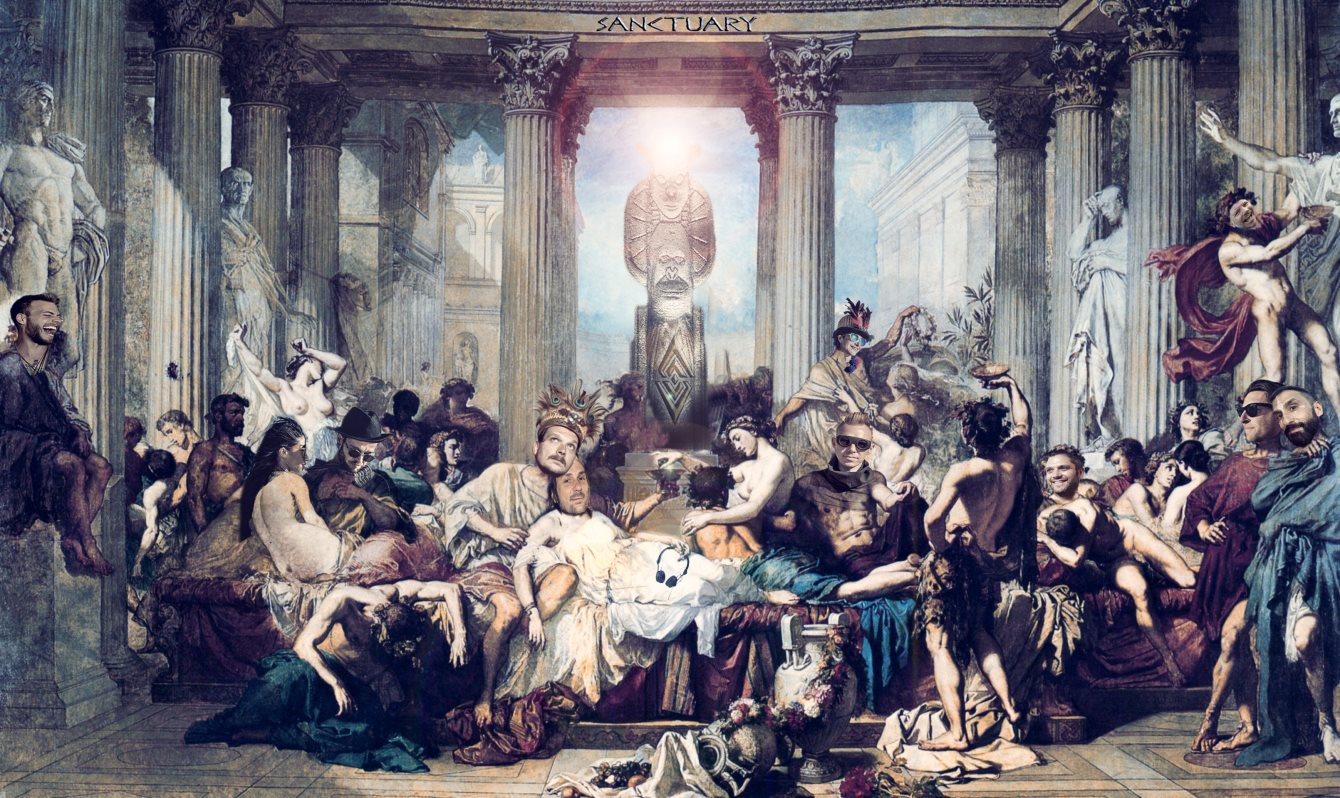
Alt-Market: How Long Will It Take for the US to Collapse

Brandon Smith at Alt-Market has written on what a collapse looks like and how long it usually takes.

There are a multitude of false assumptions out there on what the collapse of a nation or “empire” looks like. Modern day Americans have never experienced this type of event, only peripheral crises and crashes. Thanks to Hollywood, many in the public are under the delusion that a collapse is an overnight affair. They think that such a thing is impossible in their lifetimes, and if it did happen, it would happen as it does in the movies – They would simply wake up one morning and find the world on fire. Historically speaking, this is not how it works. The collapse of an empire is a process, not an event.

This is not to say that there are not moments of shock and awe; there certainly are. As we witnessed during the Great Depression, or in 2008, the system can only be propped up artificially for so long before the bubble pops. In past instances of central bank intervention, the window for manipulation is around ten years between events, give or take a couple of years. For the average person, a decade might seem like a long time. For the banking elites behind the degradation of our society and economy, a decade is a blink of an eye.

In the meantime, danger signals abound as those analysts aware of the situation try to warn the populace of the underlying decay of the system and where it will inevitably lead. Economists like Ludwig Von Mises foresaw the collapse of the German Mark and predicted the Great Depression; almost no one listened until it was too late. Multiple alternative economists predicted the credit crisis and derivatives crash of 2008; and almost no one listened until it was too late. People refused to listen because their normalcy bias took control of their ability to reason and accept the facts in front of them.

There are a number factors that cause mass blindness to economic and social reality. First and foremost, establishment elites deliberately create the illusion of prosperity by rigging economic data to the upside. In almost every case of economic crisis or geopolitical disaster, the public is conditioned to believe they are in the midst of a financial “boom” or era of “peace”. They are encouraged to ignore fundamental warning signs in favor of foolish faith in the system. Those people that try to break the apathy and expose the truth are called “chicken little” and “doom monger”.

In the minds of the cheerful lemmings a “collapse” is something very obvious; they think they would know it when they saw it. It’s like trying to teach a blind person about colors; it’s not impossible, but it’s very difficult to get all these Helen Kellers to understand that what they perceive is not the whole reality. There’s a vast world hidden from them and they have no concept of how to observe it.

Crash events are like stages in the process of collapse; they create moments of clarity for the blind. However, they are also often engineered to benefit the establishment. There’s a reason why the elites put so much energy into hiding the real data on the state of the economy, and it’s not because they are trying to keep the system from faltering by using sheer public ignorance. Rather, a crash event is a tool, a means to an end. As Congressman Charles Lindbergh Sr. warned after the panic of 1920:

“Under the Federal Reserve Act, panics are scientifically created; the present panic is the first scientifically created one, worked out as we figure a mathematical problem…”

Central bankers and their cohorts manipulate economic data and promote the false notion of a boom before almost every major crash because they WANT to ambush the populace. They WANT to create panic, and then use it to their advantage as they rebuild and mutate the system into something unrecognizable only decades ago. Each consecutive crash contributes to the collapse of the whole, until eventually the society we once had is barely a distant memory.

This process can take decades, and the US has been subject to it for quite some time now. Once again in 2019 we are seeing the lie of an “economic boom” being perpetuated in the mainstream. The public was growing too aware of the danger and had to be subdued. More specifically, conservatives were growing too aware. The sad thing is that the boom propaganda is most prominent today among conservatives, who are desperately trying to ignore the fundamentals in an attempt to defend the Trump Administration…

Click here to read the entire article at Alt-Market.com.

Independent Institute: Second Amendment Sanctuaries Started in 1774

Attorney and author Stephen P. Holbrook has written an article about Second Amendment sanctuaries and what is going on in Virginia over at Independent Institute. Dr. Holbrook has written and litigated extensively on Second Amendment issues. He wrote an amicus brief for DC v Heller and was counsel for the NRA in McDonald v Chicago, both before the US Supreme Court, among others.

…Spearheading the war on Virginia gun owners is Gov. Ralph Northam, best known for his gig in blackface or Klan attire, and for calmly endorsing post-delivery abortion, that is, infanticide. To divert attention from the backlash, he is moving to criminalize all sorts of innocent conduct that has been lawful in the Commonwealth since Jamestown was settled in 1607.

It’s as if “the Redcoats are coming” again. Northam’s counterpart in 1774 was Lord Dunmore, the last royal governor, who took measures to disarm “disloyal” Virginians led by Patrick Henry. The patriots were arming and organizing themselves into independent companies to protect their rights.

None other than George Washington formed the Fairfax Independent Militia Company. “Threat’ned with the Destruction of our Civil-rights, & Liberty,” wrote George Mason, the volunteers pledged that “we will, each of us, constantly keep by us” a musket, six pounds of gunpowder, and 20 pounds of lead.

That was a lot of ammo. There’s a parallel here to the “large capacity” magazines that Northam wants to ban. And there’s an irony that Fairfax County is now the center of the blue wave that supports Dunmoresque gun bans.

The rest is history. In 1775 the Redcoats marched to seize colonists’ arms at Lexington and Concord and the Americans repulsed them. The inhabitants of Boston were ordered to turn in their guns, which were seized by British General Gage. The Continental Congress cited this perfidy in the Declaration of Causes of Taking Up Arms.

Nothing like that will happen today. Counties that have declared themselves Second Amendment sanctuaries make clear their dedication to use all lawful means to protect their constitutional rights. Law-enforcement authorities have scarce resources and must choose how to allocate them. Work to solve murders and robberies, or track down gun owners because they have rifles with those oh-so-deadly pistol grips or adjustable stocks? That’s a no-brainer.

But those who support filling the prisons with law-abiding citizens just because they have, for instance, a rifle that will also shoot flares—which is nothing more than a distress signal—should remember our history. The Second Amendment was adopted to prevent exactly those kinds of infringements.

A Second Amendment sanctuary shouldn’t be any more controversial than a First Amendment sanctuary. Imagine if the governor signed a law banning books he didn’t like, then sent police to search houses to confiscate them and arrest their owners, who would be charged with a felony. He could then have a book burning alongside of his massive gun melting…

Click here to read the entire article at Independent Institute.

Mountain Guerrilla: Building Tribe

This is an older article from John Mosby of Mountain Guerrilla about building tribes or close, loyal groups. It’s from six years ago, but seemed particularly relevant at this time. I’m only excerpting a small part here as it is a rather long piece, but worth your time. As usual with Mosby, language warning.

…Whether we’re discussing Teutonic Europe, the Roman legions, Japanese samurai, American Indians, or modern soldiers, though, there is an underlying message of community, team unity, and focusing on the collective goals, rather than individual self-interest. The cliché of course is that soldiers don’t fight and die for country, Mom, or apple pie. They fight and die for the buddy on either side of them. They know that invoking their natural self-interest—survival–and running away to survive another day, puts their companions—their brothers, in greater danger. Loyalty to the group—esprit de corps—is the essnce of fighting morale. The faith that you are part of something greater than yourself—a legacy if you will—is what makes men do really stupid shit that we later look at as courage under fire.

I get asked regularly, “how do I form a tribe like this?” “How do I build this type of loyalty?” Unfortunately for those who want a nice, pat, pre-packaged answer, this loyalty is the result—not the cause—of the companionship developed.

How do we develop that companionship? By spending time together, trading “gifts,” and building relationships. There are no easy answers. Getting together once a year with a bunch of guys you meet on an internet forum does not “build tribe.” There’s no loyalty being built. To use the Germanic tribal terms we’ve been using, because you’re not building a real spirit of frith—intertwined loyalty to community laws—there is no commingling of “wyrd” or fates.

If you’re searching “survivalist meet-up” sites to find a group to join, you’re doing it the wrong way. Intentional communities—especially survivalist communities—just don’t work out. They all end up either being the result of some megalomaniacal f…er trying to create his own fiefdom, or the “rugged individualism” of the rich yuppies involved comes to the front, so no commingling of effort and fate and luck ever takes place, and the venture falls to pieces.

If you want to build a tribe, look around you. Where is your family? Who are your friends? Both my immediate family and my in-laws, live prohibitively far away from us. In a grid-down scenario, we’re going to be useless to them, and vice versa. Thus, we have to build new tribe, out of the people around us. We have to look at our neighbors; the good ones and the bad ones, and decide how they are going to relate to us when things get ugly. Do I have a neighbor—even one—that doesn’t have issues I dislike? I … doubt it. Are there neighbors I think are complete … that I don’t even want on the same planet as my kids, let alone in the same community? Absolutely.

There is a difference though. I can work with the first example. Either I can choose to ignore their idiosyncrasies that I dislike, and hope they do the same for me, or I can approach them and try to figure out a way to help them work past those issues (I hate the fact that I have neighbors too blind to see why they need to actually train with the gun they carry, rather than just carrying it. So, I try to get them to go shoot. I hate the fact that I have neighbors that don’t have any storage food. So I try to demonstrate why we have storage food. I hate the fact that I have neighbors who don’t do PT…so I do PT and then do things that are physical, hopefully better than them, to set an example).

The second example? Well, I can either hope that they get killed off, or be ready to do it myself if it becomes necessary. Writing off every single person in your community though, is either arrogant hubris, or sheer stupidity. Unless you live, completely alone, in a hermitage on a remote mountain in the Himalayas, if you can’t find a dozen, or two dozen, or more, neighbors in even a small community, that you share interests, concerns, and values with, you need to take a serious look in the mirror. As bad as things are in America today—and make no mistake, I think they are … horrendous—if you think there are not other people in your community who are just as concerned, you’re a [not nice name]…

Click here to read the entire article at Mountain Guerrilla.

American Partisan: Arizona Border Recon on Irish TV

This video comes to us by way of American Partisan. There is some foreign language for a short time at the beginning and occasional words later, but the majority is in English. There is also an occasional profanity. Tim Foley and the Arizona Border Recon have been watching the border there and have video of lots of drug trafficking, but no families/refugees. All the same, “humanitarian” groups are leaving water along the drug trails so that the traffickers can carry full packs of drugs and not have to worry about water.

Tim Foley of Arizona Border Recon recently did an interview with Irish TV on the border situation. He’s a good man and all of his videos are eye opening for anyone who’s sane about what’s really going on down there.

American Partisan: Radio Contra Episode One

NC Scout of Brushbeater and American Partisan has started podcasting. Here is episode one of Radio Contra.

NC Scout discusses parallels between the Chechen resistance against the Russian Army to Appalachian folk and the potential future fight against a standing army in the Appalachian region.

Music: Clutch “Son of Virginia”

Aukai Collins “My Jihad”

H. John Poole “The Tiger’s Way”

Baofeng UV-5R

Primary Arms’ ACSS Scopes

Palmetto State Armory 10.5in Pistol

Palmetto State Armory 14.7in Carbine

And here is Episode 2:

NC Scout discusses recent events and covers the foundations of preparedness communications with the license free options, the basics of amateur radio, and the equipment needed to get going.

Music: Hank Williams III “I’m Drunk Again”

Sponsors:

Ammo.com

GunMag Warehouse

Ranger Up

Ready Made Resources

Palmetto State Armory

Gear:

Baofeng UV-5R

QYT KT-8900

Cobra 29 LTD

Yaesu VX-6R

RG-8X Coax

Firestik Antennas

Mises: 2019 Was a Bad Year for “Only Cops Should Have Guns”

Ryan McMaken at the Mises Institute writes this article about several instances of private firearm owners stopping a mass shooter or police ineptitude in response to the same. He also briefly notes the general decline in the US homicide rate over the last thirty years while the number of firearms in circulation has increased dramatically.

2019 Was a Bad Year for the “Only Cops Should Have Guns” Narrative

On December 29, an armed gunman entered the West Freeway Church of Christ in Texas and shot two members of the congregation. Within six seconds, a third member of the congregation drew a weapon and shot the gunman dead.

The events were captured on live-streamed video, with the dramatic events — in the minds of many observers — highlighting the benefits of privately owned firearms as a defense against armed criminals. Moreover, the gunman, who had a criminal history, obtained his gun illegally, and demonstrated one of the central pitfalls of the gun-control narrative: namely, that those with criminal intent are not easily restrained by laws controlling access to firearms.

Nonetheless, many media outlets were unable to bring themselves to admit that privately owned firearms in this case were the key to preventing a wider massacre. After all, had the congregation waited around for the police to arrive, it is unknown how effective a police response could have been. Nor is it clear that had the police arrived quickly, they would have immediately engaged the shooter or even engaged the right person.

These considerations were not sufficient to divert many media observers from their insistence that private gun ownership is helpful in situations like these. Both government agents and their media boosters continue to insist that even well-meaning ordinary citizens ought not be trusted with firearms and that what is really needed are “experts” with government-approved police training.

Elvia Diaz at the Arizona Republic demonstrated this premise well when she wrote:

The reality of Wilson’s heroism is a lot more complex. He wasn’t just an ordinary parishioner, as gun advocates may want you to believe. The church’s volunteer security team member is a firearms instructor, gun range owner and former reserve deputy with a local sheriff’s department, according to a New York Times detailed account.

In other words, he’s exactly the kind of man you want around with a firearm. But we know nothing about the at least six other parishioners who also appeared to draw their handguns at West Freeway Church of Christ in White Settlement, Texas.

And that’s terrifying.

To many people who aren’t left-leaning journalists, it is hardly “terrifying” that some other private citizens of unknown expertise were armed in the congregation. After all, these people never fired a shot once they saw the shooter had been incapacitated. None of them provided any reason to suspect they pose any risk to anyone else.

On the other hand, 2019 has provided plenty of reminders of what sort of “expertise” and heroism government-provided security forces offer…

Doom and Bloom: Safety Plans for Places of Worship

Safety Plans for Places of Worship comes from the Altons at Doom and Bloom Medical. In our area, Jon Ladines of Force Dynamics is well known for training security teams for places of worship.

News outlets are reporting another attack on a place of worship, this time at a church in White Settlement, Texas, near Fort Worth. In this instance, two congregants were killed before the threat was abolished by armed volunteer members of the church’s security team.

As time goes on, more heinous acts of violence are occurring in what should be sanctuaries for the faithful. There is no place where crowds gather that is immune to the bad intentions of a disgruntled, deranged, or politically-motivated individual.

In the case of the shooting at White Settlement, Texas, a security detail of volunteers was able to end the incident quickly. This was because the folks in the Texas town of 17,000 realized the importance of instilling a culture of situational awareness in our citizenry.

(Aside: Originally put forth by a fighter pilot as a strategy in aerial dogfights, situational awareness has real practical significance in staying safe in uncertain times)

Situational awareness is a state of calm, relaxed observation of factors that might indicate a threat or a need to act. These are called “anomalies”; learning to recognize them can identify suspicious individuals and save lives. It certainly did in the recent incident.

(Learn more about situational awareness in this article)

Unlike the church in Texas, not all congregations prioritize church safety at the level needed in this toxic climate. The premise that a ministry is based on peace fails to take into account that there are those who consider places of worship to be “soft”targets. In this era of active shooters and anti-Christian feeling (or anti-religious feeling in general), pastors must make sure their flock is safe, just like any shepherd. In the New Normal, it’s has become part of the job description.

In my role as medical preparedness writer, it’s my mission to help the average citizen promote the well-being of loved ones in disasters. I’ve written about hurricanes and earthquakes, but shooter events like the one in White Settlement are also instances where mass casualties can occur. As in the recent shooting, these casualties could be minimized with a plan of action.

Small churches should establish a "safety ministry"
Small churches should establish a “safety ministry”

Large churches may choose to hire security professionals and install video surveillance technology. Smaller and less affluent churches, however, might benefit by establishing what I call a “safety ministry“. This group should be comprised of parishioners who have some security experience, such as active and former law enforcement, military veterans, and carefully selected others. Members should evaluate the layout of the church and grounds for weak spots and organize a plan of action for calling 911 and other measures when needed…

Click here to continue reading at Doom and Bloom Medical.

James Kunstler: Forecast 2020

In this somewhat lengthy article, author James Howard Kunstler makes some predictions for 2020 — political, economic and other. Kunstler’s main works have been on peak-oil and what that means to society and also urban and suburban development issues. It may or may not be of relevance, but Kunstler is a Democrat, though he has been described as “an angry, disaffected one.” That is mentioned here only because some read his acidic commentary on the impeachment charade and think that he is conservative, Republican, or pro-Trump — of which he is none.

…These diseases of mind and culture are synergized by an aroused political ethos that says the ends justify the means, so that bad faith and knowing dishonesty become the main tools of political endeavor. Hence, a venerable institution such as The New York Times can turn from its mission of strictly pursuing news and be enlisted as the public relations service for rogue government agencies seeking to overthrow a president under false pretenses. The overall effect is of a march into a new totalitarianism, garnished with epic mendacity and malevolence. Since when in the USA was it okay for political “radicals” to team up with government surveillance jocks to persecute their political enemies?

This naturally leads to the question: what drove the American thinking class insane? I maintain that it comes from the massive anxiety generated by the long emergency we’ve entered — the free-floating fear that we’ve run out the clock on our current way of life, that the systems we depend on for our high standard of living have entered the failure zone; specifically, the fears over our energy supply, dwindling natural resources, broken resource supply lines, runaway debt, population overshoot, the collapsing middle-class, the closing of horizons and prospects for young people, the stolen autonomy of people crushed by out-of-scale organizations (government, WalMart, ConAgra), the corrosion of relations between men and women (and of family life especially), the frequent mass murders in schools, churches, and public places, the destruction of ecosystems and species, the uncertainty about climate change, and the pervasive, entropic ugliness of the suburban human habitat that drives so much social dysfunction. You get it? There’s a lot to worry about, much of it quite existential. The more strenuously we fail to confront and engage with these problems, the crazier we get…

There’s an excellent chance that the Democratic Party will be in such disarray by summertime, that it may break apart into a radical-Wokester faction and a rump “moderate” faction. That would make the election somewhat like the 1860 contest on the eve of the first Civil War. The current crop of leading candidates — Biden, Sanders, Warren, Buttigieg — all look to me like horses that ain’t gonna finish. Michael Bloomberg could end up leader of the rump moderates, propelled by his inexhaustible bank account, but I doubt his appeal to the racial minorities and the new millennial voters Democrats depend on. I’m not sure he’s left with much else.

I’m convinced that Joe Biden is in still in the contest solely to avoid investigation. He’s already obviously not wholly sound of mind, and he’s not even in the White House yet…

the attempts at impeachment have a peevish Lilliputian flavor. Keeping it up —bringing a threatened second or third bill of impeachment with extra charges — will only reinforce Mr. Trump’s anti-fragility. Second to the economic issues is the question whether the firm of Barr & Durham will manage to pin some criminal responsibility on the people who undertook the RussiaGate coup against Mr. Trump — a ghastly mis-use of government power now celebrated by Democrats, who, you might recall, used to be against police states. A series of perp walks by the likes of Brennan, Comey, Clapper, and others could finally burst the bubble of credulity that the Mueller face-plant and the damning Horowitz report failed to achieve among the True Believers of Rachel Maddow…

Backdoor Survival: Going Stealth When Using a Generator

Going Stealth When Using Generators: Lessons From Venezuela comes from Jose Martinez in an article at Backdoor Survival. Jose Martinez was able to flee Venezuela and make a life elsewhere, but shares what he learned in the chaos in various articles.

…This long introduction is only meant to open your eyes so you can understand the attitude and behavior of the people who very likely will be roaming in the streets after or while the collapse is occurring. There will be some pockets where the situation won’t be that bad, but won’t be too many, and perhaps far away from each other. More about that in the next articles.

Not all of your neighbors may be good.

Let´s go on topic now. I´m sure there is plenty of preppers around there with generators and a huge fuel tank. Many of us even with a propane system as a backup. Great. We all agree that, under some type of threat, and the power grid is shut down in our nearby area, we´ll turn on our generator, and start to count how many hours it´s on, and check the fuel level every few hours.

Hopefully, you´ll have a battery rack large enough to have some lights and heating on for a while, when the generator is off to save fuel. It should be possible to replenish the tank, after all. This will depend, of course, on every different situation. I know something for real: we can´t prep for everything.

But we can prepare for some general situations that are going to generate some type of scarcity. The difficult part here, and I speak from my own experience, is the calculation of how much time that contingency is going to last.

We were more or less prepared for civilian turmoil and general disorder that could make us bugging in. Time proved us wrong. Dangerously wrong. I´ve mentioned this in other articles, though. Let´s keep going with this…

It´s astonishing to learn how silence can rule over the land when there is no electricity. When we were still living in Venezuela, the worst of the blackouts (even for me, a lover of peace and quiet) was the silence. It was good for some purpose, though, because sometimes it would allow to detect early presence of undesirable or threatening individuals, like those running in small Chinese motorbikes all over the place, with two guys, the one in the backseat generally armed with a 9mm or a .38 revolver. Those would rob everyone within their reach.

Once a small engine motorcycle is detected, everyone looks for getting out the way in Venezuela. If your generator is too loud, you won´t hear inside your home what can be happening outside, and we can’t be monitoring our CCTV surveillance cameras (and if you don´t have them, get them. Now, when they´re on the cheap, and PLEASE conceal them. Don´t be a smart a$$ and leave them in the open as a “deterrent” to someone knocks them down with a silenced .22 and blind your eyes outside). If you are nearby the sound source it´s very likely you won´t be able to hear anything going on around. This is a very powerful reason to think carefully about where we put money in. There are quite expensive generators, liquid-cooled, where the coolant act as a soundproof layer, and with specially designed casings to quieten the sound. Of course, you can imagine how expensive these machines are. They worth it, though, for those who can´t or won´t bug out to a secluded location and prefer to stay put in their place. I can accept that…

OH8STN: Radio Preparedness vs Emergency Communications

This information comes from Radio Prepper by way of introduction from Julian – OH8STN.

Hello Operators.

Today I’m sharing another video from Gil F4WBY, the Radio Prepper. The topic is disaster Communications. More specifically preparedness communications vs traditional amateur radio emergency communications. Gil does a very good job of going over the mission differences between Communications for preparedness, versus emergency communications for disaster relief. This is something we’ve all talked about on the grid down Communications for preparedness series.

It’s important to remember it’s not a competition. There isn’t (or at least shouldn’t be), a one or the other mentality here. Radio operator should be quite Versed in the guerrilla nature of preparedness Communications, in addition to the more structured and traditional emergency communications, as laid out by organizations like ARES. It’s a good discussion and one I think all of us should be watching.

Fr. John Peck: Why Sexual Morality May be Far More Important than You Ever Thought

Why Sexual Morality May be Far More Important than You Ever Thought by Kirk Durston over at Fr. John Peck website is somewhat of a review or condensation/distillation of the book Sex and Culture. That book is a six hundred page summary of research by social anthropologist J.D. Unwin.

One winter afternoon I was relaxing with a half-dozen fellow graduate philosophy students discussing theories of law and punishment. About an hour into the discussion, it occurred to me that some moral laws are necessary because, although they might limit pleasure and enjoyment in the short term, they actually minimize suffering and maximize human fulfillment in the long term.

A few days ago I finished studying Sex and Culture for the second time. It is a remarkable book summarizing a lifetime of research by Oxford social anthropologist J.D. Unwin.[1] The 600+ page book is, in Unwin’s words, only a “summary” of his research—seven volumes would be required to lay it all out.[2] His writings suggest he was a rationalist, believing that science is our ultimate tool of inquiry (it appears he was not a religious man). As I went through what he found, I was repeatedly reminded of the thought I had as a philosophy student: some moral laws may be designed to minimize human suffering and maximize human flourishing long term.

Unwin examines the data from 86 societies and civilizations to see if there is a relationship between sexual freedom and the flourishing of cultures. What makes the book especially interesting is that we in the West underwent a sexual revolution in the late 1960’s, 70’s, and 80’s and are now in a position to test the conclusions he arrived at more than 40 years earlier…

I have prepared a 26-page collection of quotes from his book that summarize his findings; but even that would leave you with a significant under-appreciation of the rigour and fascinating details revealed in data from 86 cultures. Here are a few of his most significant findings:

  1. Effect of sexual constraints: Increased sexual constraints, either pre or post-nuptial, always led to increased flourishing of a culture. Conversely, increased sexual freedom always led to the collapse of a culture three generations later.
  2. Single most influential factor: Surprisingly, the data revealed that the single most important correlation with the flourishing of a culture was whether pre-nuptial chastity was required or not. It had a very significant effect either way…

Unwin found that when strict prenuptial chastity was abandoned, absolute monogamy, deism, and rational thinking disappeared within three generations of the change in sexual freedom…

For the first part of the 1900’s, mainstream Western culture was rationalist and experienced enormous technological advances — from horse-and-buggy to cars; from hot air balloons to supersonic flight and spacecraft landing people on the moon; from slide rules to computers. Unwin’s three main predictions — the abandonment of rationalism, deism, and absolute monogamy — are all well underway, which makes the ultimate prediction appear to be credible … the collapse of Western civilization in the third generation, somewhere in the last third of this century…

Click here to read the entire article at Fr. John Peck.

FFF: The Perils and Pitfalls of Political Paternalism

The Perils and Pitfalls of Political Paternalism was written by Professor Richard Ebeling at the Future of Freedom Foundation about the dangers and costs of nanny statism.

Across the spectrum of differing political views, whether “progressive,” “nationalist,” “populist,” or “conservative,” there is a common presumption in all of their policy positions and programs. That common dominator is the premise that government is to be the guiding hand in directing and remaking society in some chosen form, to which and within which all in that society are to be confined and made to conform.

The “progressives” herald a new dawn of democratic egalitarianism based on the identity politics of race, gender, and “social class.” The nationalists hark back to a restoration of national identity in which the state defines and determines a nation’s historic qualities and characteristics, for the protection and preservation of which government regulations and restrictions are to be employed.

“Populists” demand a redistribution of governmental power and favoritism more into the hands of those who they say have been taken advantage of in the existing “establishment” system of things. And American conservatives, who once declared at least a rhetorical allegiance to the country’s founding limited government principles, seem to want nothing more than retaining or regaining political power, and are willing to be as regulatory and redistributive in their practical policy decisions as the progressives they rail against.

Lost in this ideological and political policy warfare among them for the governmental reins of plunder and privilege is the idea and ideal of classical, or limited government, liberalism, with its defense of individual liberty, free market economics, civil liberties under an impartial rule of law, and an ethics of non-interventionism at home and abroad.

In the face of these competing, yet philosophically complementary, demands for retention and expansion of “Big Brother” over even more of our lives in a growing number of directions, it is worthwhile to remind ourselves of the premises behind and the realities of the political paternalism that they jointly represent.

First and foremost, the guiding idea behind political paternalism is that the individual cannot be trusted to be a free and responsible human being. Those who wish to socially engineer our lives consider us too ignorant, too irresponsible, and too narrow in our own personal planning horizons to intelligently and reasonably take care of our own health care, our own retirement, our own family’s education, or our own spending and consumption choices…

All of these factors, and others that could be listed, show the perils of political paternalism and power-lusting. The interventionist-welfare state has been and will continue to lead us down a dangerous new “road to serfdom” in which our lives are more and more controlled, managed, and manipulated by those in political power who claim the right to dictate how we are to live and work.

It encapsulates an evil immorality in which political force continues to claim the authority to deny us our individual rights to life, liberty, and honestly acquired property. The interventionist-welfare state has been creating a new feudalism with political and special interest elites who serve as the “lords” who rule over and ruin the rest of us, the modern serfs who are expected to toil for their benefit under strangling regulations, burdensome taxes, and intrusive social controls in the name of political correctness and identity politics now and in the future.

All of us who prefer to be free men in a free society with a free market need to do all in our intellectual power to stop and reverse this reactionary counterrevolution against the ideal of human liberty. Otherwise, our civilization may be heading for a terrible collapse that will leave nothing but tyranny and poverty for too many for generations to come.

Click here to read the entire article at FFF.org.

FEMA Reg. 10 Seeks High School Youths for Preparedness Camp 2020

From FEMA (the Overview link below appears to be broken on the FEMA page) for youths aged 14-17 from WA, OR, ID and AK. CERT training will be provided. Transportation, lodging and meal costs provided.:

FEMA Region 10 is seeking forty (40) high-school aged youth representing Alaska, Idaho, Oregon, and Washington to attend a Youth Preparedness Camp near Anchorage, Alaska in July 2020. This will be an engaging and empowering way for teens to learn about and practice emergency preparedness. There will also be a variety of exciting leadership opportunities, team building, and of course, traditional camp activities to ensure a fun week for all. You can find additional information about camp here:

Developed under a youth engagement concept, this six-day, five-night camp, hosted and staffed by camp employees, contract staff, and FEMA personnel will teach students how to safely assist in the immediate aftermath of a disaster when the professional response may be delayed or limited. Subject matter experts and local emergency responders will support the curriculum delivery and introduce campers to various emergency response professions. As part of the camp program, youth participants will identify, develop, and present a concept for a give-back project where they will utilize their skills to improve preparedness in their communities.

The deadline to apply is 11:59pm PST on January 19, 2020. See below for application details.

Imprimis: Freedom and Obligation

The excerpt below comes from a commencement address given by Associate Justice Clarence Thomas at Hillsdale College back in 2016. In order to have liberty our freedom must be tempered by the duties and responsibilities that we have.

…In my youth, we had a small farm. I am convinced that the time I spent there had much to do with my firm resolve never to farm again. Work seemed to spring eternal, like the weeds that consumed so much of our time and efforts. One of the messages constantly conveyed in those days was our obligation to take care of the land and to use it to produce food for ourselves and for others. If there was to be independence, self-sufficiency, or freedom, then we first had to understand, accept, and discharge our responsibilities. The latter were the necessary (but not always sufficient) antecedents or precursors of the former. The only guarantee was that if you did not discharge your responsibilities, there could be no independence, no self-sufficiency, and no freedom.

In a broader context, we were obligated in our neighborhood to be good neighbors so that the neighborhood would thrive. Whether there was to be a clean, thriving neighborhood was directly connected to our efforts. So there was always, to our way of thinking, a connection between the things we valued most and our personal obligations or efforts. There could be no freedom without each of us discharging our responsibilities. When we heard the words duty, honor, and country, no more needed to be said. But that is a bygone era. Today, we rarely hear of our personal responsibilities in discussions of broad notions such as freedom or liberty. It is as though freedom and liberty exist wholly independent of anything we do, as if they are predestined…

America’s Founders and many successive generations believed in natural rights. To establish a government based on the consent of the governed, as the Declaration of Independence makes clear, they gave up only that portion of their rights necessary to create a limited government of the kind needed to secure all of their rights. The Founders then structured that government so that it could not jeopardize the liberty that flowed from natural rights. Even though this liberty is inherent, it is not guaranteed. Indeed, the founding documents of our country are an assertion of this liberty against the King of England—arguably the most powerful man in the world at the time—at the risk of the Founders’ lives, fortunes, and sacred honor. Over the lifespan of our great country, many occasions have arisen that required this liberty, and the form of government that ensures it, to be defended if it was to survive.

At the risk of understating what is necessary to preserve liberty and our form of government, I think more and more that it depends on good citizens discharging their daily duties and obligations…

Today, when it seems that grievance rather than responsibility is the main means of elevation, my grandfather’s beliefs may sound odd or discordant. But he and others like him at the time resolved to conduct themselves in a way consistent with America’s ideals. They were law-abiding, hardworking, and disciplined. They discharged their responsibilities to their families and neighbors as best they could. They taught us that despite unfair treatment, we were to be good citizens and good people. If we were to have a functioning neighborhood, we first had to be good neighbors. If we were to have a good city, state, and country, we first had to be good citizens. The same went for our school and our church. We were to keep in mind the corporal works of mercy and the great commandment: “Love thy neighbor as thyself.” Being wronged by others did not justify reciprocal conduct. Right was right, and two wrongs did not make a right. What we wanted to do did not define what was right—nor, I might add, did our capacious litany of wants define liberty. Rather, what was right defined what we were required to do and what we were permitted to do. It defined our duties and our responsibilities. Whether those duties meant cutting our neighbor’s lawn, visiting the sick, feeding the hungry, or going off to war as my brother did, we were to discharge them honorably…

if we continue to consume the benefits of a free society without replenishing or nourishing that society, we will eventually deplete that as well.  If we are content to let others do the  work of replenishing and defending liberty while we consume the benefits, we will someday run out of other people’s willingness to sacrifice—or even out of courageous people willing to make the sacrifice…

Click here to read the entire article at Imprimis.

Medium.com: YouTube Is Censoring Crypto Videos

Vincent Zandri has written an article over on Medium.com about how YouTube is censoring various crypto-currency videos and/or threatening to shut down the accounts of those who post them. Governments and banking systems are against cryptocurrencies outside of their control. If you control the money (which they currently do), then you can control just about everything else – including people’s behavior.

The first threat to government of an independent and opaque currency is how do they control taxation or government revenue. Our current system of government graft, masquerading as democracy, is dependent on the reliable extraction (some would say theft) of money from the populace on an ongoing basis. When people are receiving payments and making purchases in an encrypted medium, how does the government collect its cut?

Second, control of the money/banking system allows the government to control people’s behavior. As an extreme example, how many people will join an uprising against the government, knowing that their bank account will be frozen or seized so that they cannot pay their mortgage, or rent, or buy food? Or if their retirement fund/children’s college fund, etc. is seized? People already worry about making certain entirely legal banking transactions because the know or worry that the government or banking system will have information about them that either invades a person’s privacy or flags them for criminal investigation.

Altcoin Daily, a popular Bitcoin and crypto education video channel is alleging that YouTube is not only censoring theirs and many other crypto channel’s online content, they are threatening to shut them down altogether. The popular, Google owned, video-sharing platform is slapping many sites like Altcoin Daily with an accusation of “sale of regulated goods,” which is akin to selling alcohol or drugs to the general public and/or minors. As far as I can tell, Altcoin Daily doesn’t sell so much as a stick of gum to anyone. The two twin brothers who run the channel don’t offer financial advice, rather, they describe themselves as “crypto enthusiasts” who offer crypto news with a heavy focus on Bitcoin.

Fellow affected crypto YouTube Channel content creators are making their voices heard about the censoring via social media…

Click here to read the entire article at Medium.com.