Mises Institute: The American Empire

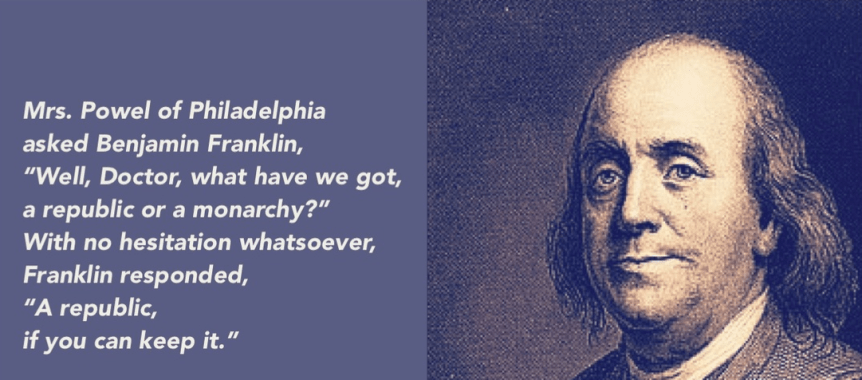
A republic if you can keep it

This rather long article is actually a condensation of a longer piece by Garet Garrett called The Rise of Empire, which was published in 1952. The American Empire appears in Mises Wire. It’s a bit of a contrast with AG Barr’s article about how the executive branch is too weak, but there is overlap. Part of the difference between the two lies in the administrative agencies and whether they are truly under the control of the President or under the control or influence of other political interests. Constitutionally, administrative agencies as law-making bodies should not exist at all, but as part of the executive should be entirely under the direction of the office of the President. In practice, they have been unaccountable, extra-Constitutional legislative bodies only marginally under the power of the executive branch. When the occupant of the Presidential office is able to appeal to the appetites and desires of the various administrative agency heads, he will be much more powerful than a President at odds with those same agencies.

We have crossed the boundary that lies between Republic and Empire. If you ask when, the answer is that you cannot make a single stroke between day and night; the precise moment does not matter. There was no painted sign to say: “You now are entering Imperium.” Yet it was a very old road and the voice of history was saying: “Whether you know it or not, the act of crossing may be irreversible.”

That a Republic may vanish is an elementary schoolbook fact.

The Roman Republic passed into the Roman Empire, and yet never could a Roman citizen have said, “That was yesterday.” Nor is the historian, with all the advantages of perspective, able to place that momentous event at an exact point on the dial of time. The Republic had a long, unhappy twilight. It is agreed that the Empire began with Augustus Caesar. What Augustus Caesar did was to demonstrate a proposition found in Aristotle’s Politics, one that he must have known by heart, namely this: “People do not easily change, but love their own ancient customs; and it is by small degrees only that one thing takes the place of another; so that the ancient laws will remain, while the power will be in the hands of those who have brought about a revolution in the state.”

Revolution within the Form

There is no comfort in history for those who put their faith in forms; who think there is safeguard in words inscribed on parchment, preserved in a glass case, reproduced in facsimile and hauled to and fro on a Freedom Train.

Let it be current history. How much does the younger half of this generation reflect upon the fact that in its own time a complete revolution has taken place in the relations between government and people?

The extent to which the original precepts and intentions of constitutional, representative, limited government, in the republican form, have been eroded away by argument and dialectic is a separate subject, long and ominous, and belongs to a treatise on political science. The one fact now to be emphasized is that when the process of erosion has gone on until there is no saying what the supreme law of the land is at a given time, then the Constitution begins to be flouted by executive will, with something like impunity. The instances may not be crucial at first and all the more dangerous for that reason. As one is condoned another follows and they become progressive.

To outsmart the Constitution and to circumvent its restraints became a popular exercise of the art of government in the Roosevelt regime. In defense of his attempt to pack the Supreme Court with social-minded judges after several of his New Deal laws had been declared unconstitutional, President Roosevelt wrote: “The reactionary members of the Court had apparently determined to remain on the bench for as long as life continued — for the sole purpose of blocking any program of reform.”

Among the millions who at the time applauded that statement of contempt there were very few, if there was indeed one, who would not have been frightened by a revelation of the logical sequel. They believed, as everyone else did, that there was one thing a President could never do. There was one sentence of the Constitution that could not fall, so long as the Republic lived.

The Constitution says: “The Congress shall have power to declare war.”

That, therefore, was the one thing no President could do. By his own will he could not declare war. Only Congress could declare war, and Congress could be trusted never to do it but by will of the people. And that was the innermost safeguard of the republic. The decision whether or not to go to war was in the hands of the people — or so they believed. No man could make it for them.

It is true that President Roosevelt got the country into World War II. That is not the same thing. For a declaration of war he went to Congress — after the Japanese had attacked Pearl Harbor. He wanted it, he had planned it, and yet the Constitution forbade him to declare war and he durst not do it.

Nine years later a much weaker President did…

The first requisite of Empire is:

The executive power of government shall be dominant. It may be dominant originally, as in the days of hereditary kingship, or it may come to be dominant by change, as when the Roman Republic passed under the rule of Caesars.

What Empire needs above all in government is an executive power that can make immediate decisions, such as a decision in the middle of the night by the President to declare war on the aggressor in Korea, or, on the opposite side, a decision in the Politburo in the Kremlin, perhaps also in the middle of the night, to move a piece on the chessboard of cold war.

The Federal income-tax law of 1914 gave the government unlimited access to wealth and, moreover, power for the first time to levy taxes not for revenue only but for social purposes, in case there should arise a popular demand for redistribution of the national wealth. World War I immediately followed. Looking backward we can see that these two events marked the beginning of a great rise in the executive power of government. Then came in rapid succession (1) the Great Depression, (2) the revolutionary Roosevelt regime, and (3) World War II, all within an arc of twenty years…

(2) By reinterpretation of the language of the Constitution. That is done by a sympathetic Supreme Court.

(3) By innovation. That is when, in this changing world, the President does things that are not specifically forbidden by the Constitution because the founders never thought of them.

(4) By the appearance in the sphere of Executive Government of what are called administrative agencies, with power to issue rules and regulations that have the force of law. These agencies have built up a large body of administrative law which people are obliged to obey. And not only do they make their own laws; they enforce their own laws, acting as prosecutor, jury and judge; and appeal from their decisions to the regular courts is difficult because the regular courts are obliged to take their findings of fact as final. Thus the constitutional separation of the three governmental powers, namely, the legislative, the executive and the judicial, is entirely lost.

(5) By usurpation. That is when the President willfully confronts Congress with what in statescraft is called the fait accompli — a thing already done — which Congress cannot repudiate without exposing the American government to the ridicule of nations…

(6) Lastly, the powers of Executive Government are bound to increase as the country becomes more and more involved in foreign affairs. This is true because, both traditionally and by the terms of the Constitution, the province of foreign affairs is one that belongs in a very special sense to the President…

Another brand mark of Empire is: Ascendancy of the military mind, to such a point at last that the civilian mind is intimidated.”

…It was General MacArthur himself who uttered these devastating words:

Talk of imminent threat to our national security through the application of external force is pure nonsense. … Indeed, it is a part of the general pattern of misguided policy that our country is now geared to an arms economy which was bred in an artificially induced psychosis of war hysteria and nurtured upon an incessant propaganda of fear. While such an economy may produce a sense of seeming prosperity for the moment, it rests on an illusory foundation of complete unreliability and renders among our political leaders, almost a greater fear of peace than is their fear of war.

The bald interpretation of General MacArthur’s words is this. War becomes an instrument of domestic policy. Among the control mechanisms on the government’s panel board now is a dial marked War…

No doubt the people know they can have their Republic back if they want it enough to fight for it and to pay the price. The only point is that no leader has yet appeared with the courage to make them choose.

Click here to read the entire article at Mises Wire.

Liberty Blitzkrieg: Monetary Looting

Michael Krieger of Liberty Blitzkrieg has written this article about the corrupt and predatory state of our financial system and Federal Reserve banking system – Monetary Looting.

The United States has historically bragged about its free and transparent markets. But what the Fed is doing today is pulling a dark curtain around the financing of this so-called free and transparent market. The public has no idea which Wall Street firms have received this $3 trillion or why they can’t borrow it elsewhere. This kind of obfuscation by the Federal Reserve could actually stimulate distrust in the U.S. banking system. The Fed admitted as much in its most recent Federal Open Market Committee (FOMC) minutes, writing that participation in the Fed’s loan program “could become stigmatized.”

Wall Street on Parade: Is the Fed’s $3 Trillion in Loans to Trading Houses on Wall Street Legal?

The business model of Wall Street is fraud.
– Bernie Sanders

Financial services as currently structured is the most pernicious, predatory and corrupt industry on earth. Moreover, it’s the deliberately complex and opaque nature of the industry which then limits public debate when some problem arises and governments and central banks are called upon to take emergency measures to “save the system,” which is just a euphemism for enormous sums of corporate welfare being funneled to people and institutions who couldn’t survive otherwise.

It is systemic looting on a massive scale and the primary patrons of this ongoing and seemingly endless scheme are central banks. In the U.S. this means the Federal Reserve, which recently came back into the “market” with enormous new interventions in both the repo market and via renewed balance sheet expansion. I’ve read many of the smart takes on the repo crisis and still don’t feel confident I know precisely what’s going on. This is intentional.

One of the main reasons big finance is able to pull off scam after scam in plain sight relates to the complexity, opacity and esoteric jargon associated with the industry. Repo is a perfect example. The market had a spasm in September and the Fed immediately rushed in with billions to bring the rate down without offering any transparency or a credible explanation of what was going on. Meanwhile, as the crisis continued over subsequent months and the central bank response grew larger and larger, we actually seem to be learning less with each passing day.

Instead of providing the public with the transparency it deserves, Fed officials run around pretending to be financial surgeons called in to perform an unexpected emergency operation on a patient after a freak accident. In reality, central banks are merely pumping billions into an already dead body while enriching connected and powerful individuals and institutions in the process. They know exactly what they’re doing and we need to stop pretending otherwise.

While I’m grateful to those who’ve spent time trying to thoughtfully explain the mechanics of the repo crisis and why it happened, I think that’s a sideshow at this point since nobody who really knows what’s going on is talking. Instead, we should focus on the absurd and unconscionable lack of transparency with regard to Federal Reserve actions. As far as I know, we have no idea which parties are taking up this expanded central bank funding. Think about how criminally insane that is. We have no idea if it’s driven by a troubled institution like Deutsche Bank, hedge funds with over-leveraged trades, treasury issuance, a combination of these factors, or something else.

We don’t know because they don’t want us to know, and they don’t want us to know because they don’t want the public thinking or talking about it. It’s at times like these when the totalitarian nature of central banking comes into crystal clear focus. What we have is government via unelected, unaccountable bankers. It’s the opposite of self-government, and understanding this simple fact blows apart all the myths about our so-called democracy and freedom. Nothing of the sort exists in reality, and when push comes to shove, you’re just a peasant living in an imperial oligarchy…

Click here to read the entire article at Liberty Blitzkrieg.

Doom and Bloom: Stab Wounds

The Altons at Doom and Bloom Medical have another good article up, this one on stab wounds. There are pictures with stab wounds on the page, so that’s a warning if you have a light stomach.

Any disaster puts your people at risk for injury. Wounds caused by sharp objects can be life-threatening, depending on the organs and blood vessels damaged.

Stab wounds are a type of penetrating trauma, which is further divided into perforating and non-perforating injuries.  A perforating wound is one in which the object causing the damage goes into one side of the body and then exits through the other side.  A wound from .223 or NATO .556 would, commonly, be an example of perforating trauma.

Bullets and other high-speed projectiles cause damage not only from the act of penetration, but also the shock wave produced as the bullet passes through the body. Luckily, low speed projectiles such as knives will not do this. Your concerns are related specifically to the area of entry and the structures located directly in the path of the offending instrument.

Stab wounds are an example of a non-perforating wound:  the projectile causing the damage enters the body and either stays there or exits where it entered. Some sharp instruments could possibly do this, say a crossbow bolt or a spearhead, but let’s assume that you’ll be unlikely to see these.

With stab wounds, blood loss and failure of damaged organs will be the major issue. A little about blood: Blood carries oxygen to the tissues and organs and removes waste products. It is made up of several components, including:

  • Red blood cells: These cells carry oxygen to body tissues.
  • White blood cells: These cells work to, among other things, fight infection and disease.
  • Platelets and other clotting factors: These allow blood to coagulate and lessen blood loss.
  • Plasma: A yellowish liquid in which the above are suspended.

Your immediate action upon encountering a victim of a wound with a sharp instrument may save their life. The heart takes less than one minute to pump blood to the entire body; if the circulatory system is breached, blood loss becomes life-threatening very quickly.

180 lb. (about 70 kg.) adult males have approximately 9-10 pints (about 5 liters) of blood in their body. Athletes and those living at very high altitudes may have more. You can’t afford to lose more than 40% of total blood volume without needing major resuscitation.  To get an idea of how much blood this is, empty a 2 liter bottle of fruit punch or cranberry juice on the floor.  You’ll be surprised at how much fluid that represents…

Click here to read the entire article at Doom and Bloom Medical.

Olympia Rally 4 UR Rights, GRC Lobby Day, Jan. 17, 2020

In case you missed the previous post, Washington state Democrats are introducing at least three, new anti-rights bills for the 2020 money grubbing  legislative session — assault firearm ban, a standard-capacity magazine ban, and ammunition purchasing restrictions. Gun Rights Coalition is planning a Rally 4 UR Rights event in Olympia at the Capitol on Friday, Jan. 17th, 2020 from 8:30 am to 12:00 pm.

Allevents.in link

Facebook link

Rally 4 UR Rights, GRC Lobby Day


“Just because you do not take an interest in politics doesn’t mean politics won’t take an interest in you.”… Pericles

Rally 4 UR Rights
Gun Rights Coalition Lobby Day
hosted by Gun Rights Coalition

Join us at the Capital legislative steps continuing to defend your
2nd Amendment Rights. It’s TIME to fight back!
Listen to Pro2A legislators on how we can turn the tide, stay engaged and put pressure on elected officials in Districts that took your rights away!

0800-0900 Set up
0910-1030 Legislative Speakers
1045-1200 Meet up with your Legislators of your District
*** Contact your legislators for appointments for this day***
We will have a team there to both help you find your reps and to help you write letters to them.

* Goal is to have a large attendance, from as many legislative districts, voters engaged in civil dialog educating elected officials, find support for the Pro2A community, getting involved in 2020 Legislative session protecting your rights, and getting involved after session. (Vote OUT elected officials that don’t support YOU)

“You may have to fight a battle more than once to win it.” …Margaret Thatcher

Please note: We would like to ask anyone that carries firearms to please keep them holstered or slung. Each of us is responsible for our own actions. That includes both appropriate safety and conducting ourselves in a respectful manner that will reflect positively on the group as a whole. Thanks and can’t wait to see you all there.

Virginia recently passed similar restrictions and citizens and the counties have overwhelmingly responded against the laws, passing Second Amendment Sanctuary resolutions in 89 counties, cities or municipalities. Will Washingtonians prove weaker?

Clarence Thomas: Faith and Reason Are Mutually Reinforcing

The following is excerpted from a speech given by association Supreme Court Justice Clarence Thomas at the October 2019 dedication ceremony for a new chapel at Hillsdale College.

…Although a chapel is a place for many activities, it also serves as a statement about the importance of those activities. The construction of a college chapel, in particular, is a public declaration that faith and reason are mutually reinforcing. And in 2019, the construction of a chapel is a bold act of leadership at a crucial time in our nation’s history. So I would like to underscore briefly the broader significance of the decision that Hillsdale College has made in building Christ Chapel.

Beginning in the early 1900s, many elite private colleges and universities began to face questions about the continuing relevance of religious instruction on campus. These questions would have surprised the founders of those schools, many of which were created in part for the express purpose of providing religious instruction. But as time went on and as schools moved away from their religious roots, the relevance of religion to higher education was increasingly questioned, and campus chapels, in particular, came to be viewed as relics of a bygone era.

With the completion of Christ Chapel, Hillsdale College has staked out its position in this debate, and its decision serves as an example for all of us. The construction of so grand a chapel in 2019 does not happen by accident or as an afterthought. Christ Chapel reflects the College’s conviction that a vibrant intellectual environment and a strong democratic society are fostered, not hindered, by a recognition of the Divine. Hillsdale College affirms, with the writer of Proverbs, that, “The fear of the Lord is the beginning of wisdom, and the knowledge of the Holy One is insight.”

By constructing this Chapel, the College upholds the continued importance of its Christian roots, even as it respects the rights of each person to worship God according to the dictates of his own conscience. Our country was founded on the view that a correct understanding of the nature of God and the human person is critical to preserving the liberty that we so enjoy.

John Adams wrote, “Our Constitution was made only for a moral and religious People. It is wholly inadequate to the government of any other.” He recognized that the preservation of liberty is not guaranteed. Without the guardrails supplied by religious conviction, popular sovereignty can devolve into mob rule, unmoored from any conception of objective truth.

As I think about our political culture today, I am reminded of Ronald Reagan’s warning that, “Freedom is never more than one generation away from extinction. We didn’t pass it to our children in the bloodstream. The only way they can inherit the freedom we have known is if we fight for it, protect it, defend it, and then hand it on to them . . . [to] do the same.”

Each generation is responsible both to itself and to succeeding generations for preserving and promoting the blessings of liberty. Faith in God, more than anything else, fuels the strength of character and self-discipline needed to discharge ably that responsibility. That is why I am so encouraged by the construction of Christ Chapel…

The full speech can be heard in the video below.

Backdoor Survival: 3 Proven Profitable Activities in a Collapse, Venezuelan Edition

This article was written by Jose Martinez, an eyewitness to the collapse of Venezuela, for Backdoor Survival. It details three occupations that are allowing people to continue to survive in Venezuela – small scale farmer, plumber, and electrician.

The worst part of the economic collapse has already passed and people have slowly understood that they can´t keep working to receive useless and worthless currency.

The mafia has injected (illegally, I guess, as the most parts of what they do) hundreds of tons of dollars to increase the liquidity they destroyed themselves, with shadowy intentions.

Maybe not so shadowy after all, if we see the hundreds of kilos of all kinds of drugs that “someone” is smuggling all over the place.

How this amount of illegal product circulates in our roads and gets through the airports, is a mystery for me as a civilian. Unless, of course, those responsible to keep the country safe are busy in some other “activity”…

This is not intended to be a list compiling what you should study to be the most wanted employee in the next collapse. It’s just a simple, reliable and proven testimony of how some people, who could not or would not flee and leave our beloved and sunny country behind, are surviving and getting enough food on their table, medicines, clothing, and generally sneaking into the dark waters of this induced collapse á-lá Cuban…

1. Small Scale Farming and Food Production

This seems obvious? It is not. Small farms in Venezuela never were excessively productive, with some honorable exceptions I personally know of. It takes a lot of hard, back-breaking work. Being smaller, usually, owners don’t invest in tons of machinery, even if they could have afforded them at some time. They may have some grinding equipment, for cattle feed and such. Small tractors are found expensive for many owners. I know because they have talked to me about this and listened.

Cheap Chinese spare parts could make equipment fail in the worst possible moment and ruin the entire crop, so they prefer renting or trading in some way when they need plowing or some kind of tractor work. They hire laborers to crop, or rent the needed machinery, once again…

Click here to read the entire article at Backdoor Survival.

Mises Institute: The Silicon Valley Gulag

Author and university professor Jason Morgan has written an review at Mises Institute of Michael Rectenwald’s Google Archipelago: The Digital Gulag and the Simulation of Freedom.

he near-homogeneity of Silicon Valley political beliefs has gone from wry punchline to national crisis in the United States. The monoculture of virtue signaling and high- and heavy-handed woke corporate leftism at places like Google, Twitter, and Facebook was once a source of chagrin for those who found themselves shut out of various internet sites for deviating from the orthodoxies of the Palo Alto elites. After the 2016 presidential election, however, it became obvious that the digitalistas were doing a lot more than just making examples of a few handpicked “extremists.” From the shadow banning of non-leftist sites and views to full-complement political propagandizing, Bay Area leftists have been so aggressive in bending the national psyche to their will that there is talk in the papers and on the cable “news” channels of “existential threats to our democracy.”

It is tempting to see this as a function of political correctness. Americans, and others around the world, who have found themselves on the “wrong side of history” (as determined by the cultural elite in an endless cycle of epistemological door closing) have long been shut out of conversations, their views deemed beyond the pale of acceptable discourse in enlightened modern societies. Google, Facebook, Twitter — are these corporations, and their uber-woke CEOs, just cranking the PC up to eleven and imposing their schoolmarmish proclivities on the billions of people who want to scrawl messages on their electronic chalkboards?

Not so, says reformed leftist — and current PC target — Michael Rectenwald. The truth of Stanford and Harvard alumni’s death grip on global discourse is much more complicated than just PC run amok. It is not that the Silicon Valley giants are agents of mass surveillance and censorship (although mass surveillance and censorship are precisely the business they’re in). It’s that the very system they have designed is, structurally, the same as the systems of oppression that blanketed and smothered free expression in so much of the world during the previous century. In his latest book, Google Archipelago, Rectenwald outlines how this system works, why leftism is synonymous with oppression, and how the Google Archipelago’s regime of “simulated reality” “must be countered, not only with real knowledge, but with a metaphysics of truth.”

Google Archipelago is divided into eight chapters and is rooted in both Rectenwald’s encyclopedic knowledge of the history of science and corporate control of culture, as well as in his own experiences. Before retiring, Rectenwald had been a professor at New York University, where he was thoroughly entrenched in the PC episteme that squelches real thought at universities across North America and beyond. Gradually, Rectenwald began to realize that PC was not a philosophy, but the enemy of open inquiry. For this reason, and because Rectenwald is an expert in the so-called digital humanities and the long history of scientific (and pseudo-scientific) thinking that feeds into it, Google Archipelago is not just a dry monograph about a social issue. By turns memoir, Kafkaesque dream sequence, trenchant rebuke of leftist censorship, and intellectual history of woke corporate political correctness, Google Archipelago is a welcoming window into a mind working happily in overdrive.

There is much in Google Archipelago addressing the lie that Google, Facebook, and Twitter are neutral platforms for free-ranging debate. This is not so much, because, statistically and empirically, it is irrefutable that Silicon Valley is hostile to non-Beltway-leftist opinions, but because, much more damningly, their woke-capital corporate structures are themselves iterations of massification, propaganda, and deep social control. For Rectenwald, the “Google archipelago” is not PC version 2.0; it is Marxism, version 1,000 (and raised by several orders of magnitude to boot).

For example, in the first and second chapters of Google Archipelago, Rectenwald lays out how the various elements of woke-capitalist ideological repression work together in actual practice. Rectenwald’s chief example is the Gillette ad campaign of January 2019, in which a company whose products (razor blades and shaving cream) are purchased, of course, was said to insult the very essence of its customers by belittling manhood as “toxic.” Why would a razor blade company go out of its way to alienate the people who buy the majority of razorblades? The answer is surprising…

Click here to read the entire review at Mises Wire.

Related:

SHTFPlan.com: The YouTube Censorship Continues: Thought Police Begin The PURGE

YouTube has begun to purge accounts that they have decided violate “acceptable thoughts.” The censorship is continuing and exponentially skyrocketing on all social media platforms…

Bloomberg Promises to Pack Supreme Court with Anti-2A Justices

Billionaire Tyrant Mike Bloomberg

In what will not come not as news to most, billionaire tyrant, candidate for US President Mike Bloomberg recently reiterated his stance against your individual Second Amendment rights by saying that when he is President he will pack the Supreme Court with justices who believe that individuals have no right to keep and bear arms. Further, he believes that people who have a desire to protect their own and others’ Second Amendment rights are “oblivious to public safety and out of step with the American people.”

…Last year, Illinois’ Bruce Rauner was one of five Republican governors who signed a “red flag” law that helps keep guns out of the hands of people who pose a threat to themselves or others. Those laws would be at risk if the Supreme Court issues a far-reaching opinion in the New York case.

As president, I will appoint judges who understand that the Second Amendment allows for common sense limits on gun ownership. I’ve spent 15 years working to build a national coalition that is capable of taking on the NRA and winning — and I’m glad to say that we now have the NRA on the ropes. That may be one reason why the NRA is hoping the court will save it.

The NRA is rolling a Trojan horse through the doors of the Supreme Court. The justices should send it packing, so that reasonable regulations and vital responsibilities can continue to coexist with Second Amendment rights.

Liberty Blitzkrieg: Three Major Imbalances – Financial, Trust, Geopolitical

Somewhat related to yesterday’s article from Chris Hedges which touched on how no one in America trusts anyone in the D.C. establish at all any longer is this article from Michael Krieger of Liberty Blitzkrieg. In Three Major Imbalances, Mr. Krieger discusses the teetering financial system, the lack of trust in institutions, and rising tenstions between the U.S.A. and China, Russia, and elsewhere.

But greed is a bottomless pit
And our freedom’s a joke
We’re just taking a piss
And the whole world must watch the sad comic display
If you’re still free start running away
Cause we’re coming for you!

– Conor Oberst, “Land Locked Blues”

It’s hard to believe 2020 is just around the corner. If the last ten years have taught us anything, it’s the extent to which a vicious and corrupt oligarchy will go to further extend and entrench their economic and societal interests. Although the myriad desperate actions undertaken by the ruling class this past decade have managed to sustain the current paradigm a bit longer, it has not come without cost and major long-term consequence. Gigantic imbalances across multiple areas have been created and worsened, and the resolution of these in the years ahead (2020-2025) will shape the future for decades to come. I want to discuss three of them today, the financial system imbalance, the trust imbalance and the geopolitical imbalance.

Recent posts have focused on how what really matters in a crisis is not the event itself, but the response to it. The financial crisis of ten years ago is particularly instructive, as the entire institutional response to a widespread financial industry crime spree was to focus on saving a failed system and then pretending nothing happened. The public was given no time or space to debate whether the system needed saving; or more specifically, which parts needed saving, which parts needed wholesale restructuring and which parts should’ve been thrown into the dustbin. Rather, unelected central bankers stepped in with trillions in order to prop up, empower and reward the very industry and individuals that created the crisis to begin with. There was no real public debate, central bankers just did whatever they wanted. It was a moment so brazen and disturbing it shook many of us, including myself, out of a lifetime of propaganda induced deception.

It’s ten years later and central banks still can’t walk back anything they did over the past decade…

While massive and global, the financial system imbalance is just one of several. Another big one is a trust imbalance, which manifests as a widening disconnect between established institutions and the people living under them. As the ruling class has been forced to resort to increasingly desperate measures over the past decade to keep their gravy train going, they’ve exposed themselves more explicitly. What was once derided as conspiracy theory rapidly becomes conspiracy fact, and an increasingly significant number of humans have begun to simply assume (for good reason) that whatever comes out of the mouths of authority figures like intelligence agencies, politicians, mass media, corporations and think tanks, etc., are lies.

This situation isn’t getting any better either. It seems every day we wake up to new in your face revelations of how craven and dishonest the ruling oligarchy and its institutions really are. For example, this past weekend we learned how a Newsweek journalist quit because his bosses at the paper refused to let him publish about OPCW whistleblowers who dispute the official conclusion that Assad launched a chemical attack in Douma, an event that increasingly looks like a false flag event which led to the U.S. bombing Syria…

The trust imbalance between rulers and the ruled has become so massive it’s all but guaranteed to detonate in a variety of unexpected and consequential ways in the years ahead. The election of Donald Trump was just the first pubic manifestation of this well deserved lack of trust…

The other major imbalance I want to highlight is the geopolitical one. It’s something I’ve been writing about a lot lately as it’s come into clearer focus that the nexus of this tension will center around the U.S. and China. At the root of this imbalance is a U.S. national security state desperate to turn back to clock to the 1990s when the U.S. was the world’s sole superpower and could essentially call the shots on all matters of international significance with little to no pushback. Certain foreign power centers, led by China and Russia, have made it explicit they will not be rewinding the clock and are have focused their foreign policy around ushering in a multi-polar world. Like the other imbalances, the geopolitical imbalance becomes more volatile and less manageable with each passing day…

Everything being done today centers around propping up and extending a decrepit paradigm in order to further enrich and empower a ruling class that has lost the respect of the people. As the actions taken to sustain such a system become more desperate and mendacious (“this is NOT QE”), the more the veneer of credibility disappears. The more the veneer of credibility disappears, the more unstable these major imbalances become. Generational change is on the horizon, keep your eyes wide open.

Click here to read the entire article at Liberty Blitzkrieg.

Related:

Kunstler: Two for One Holiday Special

Hillary Clinton sure got her money’s worth with the Fusion GPS deal: it induced a three-year psychotic break in the body politic, destroyed the legitimacy of federal law enforcement, turned a once-proud, free, and rational press into an infernal engine of bad faith, and is finally leading her Democratic Party to an ignominious suicide. And the damage is far from complete…

Truthdig: The Great American Shakedown

Chris Hedges is a Pulitzer Prize-winning journalist and liberal/progressive writer. He has been a vocal critic of what he sees as failures of the liberal class (as well as criticizing conservatives). In this article at Truthdig, Mr. Hedges empties both barrels at the Democrat Party (and their impeachment failure) and the Republican parties for their thorough corruption. Hedges’ writing is enjoyable and incisive even if I don’t always agree with the conclusions that he draws. He tends to apply his beliefs consistently, which is considerably better than most on the Left or Right.

The Democratic Party and its liberal supporters are perplexed. They presented hours of evidence of an impeachable offense, although they studiously avoided charging Donald Trump with impeachable offenses also carried out by Democratic presidents, including the continuation or expansion of presidential wars not declared by Congress, exercising line-item veto power, playing prosecutor, judge, jury and executioner to kill individuals, including U.S. citizens, anywhere on the planet, violating due process and misusing executive orders. Because civics is no longer taught in most American schools, they devoted a day to constitutional scholars who provided the Civics 101 case for impeachment. The liberal press, cheerleading the impeachment process, saturated the media landscape with live coverage, interminable analysis, constant character assassination of Trump and giddy speculation. And yet, it has made no difference. Public opinion remains largely unaffected.

Perhaps, supporters of impeachment argue, they failed to adopt the right technique…

The liberal class and the Democratic Party leadership have failed, even after their defeat in the 2016 presidential election, to understand that they, along with the traditional Republican elites, have squandered their credibility. No one believes them. And no one should.

They squandered their credibility by promising that the North American Free Trade Agreement (NAFTA) would, as claimed by President Bill Clinton, create 200,000 new, well-paying jobs per year; instead, several million jobs were lost. They squandered it by allowing corporations to move production overseas and hire foreign workers at daily wages that did not equal what a U.S. unionized worker made in an hour, a situation that obliterated the bargaining power of the American working class. They squandered it by allowing corporations to use the threat of “offshoring” production to destroy unions, suppress wages, extract draconian concessions and push millions of workers into the temp and gig economies, where there are no benefits or job security and pay is 60% or less of what a full-time employee in the regular economy receives. They squandered it by forcing working men and women to take two or three jobs to support a family, jacking up household debt to $13.95 trillion. They squandered it by redirecting wealth upward, so that during the Clinton administration alone 45 percent of all income growth went to the wealthiest 1%…

The problem is not messaging. The problem is the messenger. The mortal wounds inflicted on our democratic institutions are bipartisan. The traditional Republican elites are as hated as the Democratic elites. Trump is vile, imbecilic, corrupt and incompetent. But for a largely white working class cast aside by austerity and neoliberalism, he at least taunts the elites who destroyed their communities and their lives…

There is zero chance Trump will be removed from office in a trial in the Senate. The Democratic Party elites have admitted as much. They carried out, they argue, their civic and constitutional duty. But here again they lie. They picked out what was convenient to impeach Trump and left untouched the rotten system they helped create. The divisions among Americans will only widen. The hatreds will only grow. And tyranny will wrap its deadly tentacles around our throats.

Click here to read the entire article at Truthdig.

Tenth Amendment Center: McCulloch v Maryland Supreme Ct Did NOT Support Expansive Federal Power

Chief Justice John Marshall

This article at the Tenth Amendment Center discusses the McCulloch v Maryland case. Harvard Law Today earlier this year said that the 1819 case paved the way for the modern administrative case. But Constitutional scholar Rob Natelson here says that this was not the intent Chief Justice John Marshall’s opinion at the time, but rather that the case in point was a much narrower ruling.

Why McCulloch v. Maryland – now 200 years old – is not a “big government” manifesto

…There are at least two well-grounded reasons Marshall’s opinion in McCulloch is important. The first is that it clarified some basic facts about the constitutional system.

McCulloch explained that the people, not the states, created the federal government and granted its powers. As a young lawyer, Marshall had been a leading spokesman for the Constitution, particularly in Virginia. In McCulloch, Marshall explained—as James Madison had before him—that the Constitution’s legal force comes from approval by popularly-elected state ratifying conventions meeting from 1787 through 1790.

It follows that the first rule of constitutional interpretation is the understanding of the ratifiers. It is not, as some conservatives say, the “intent of the framers” or “the original public meaning.” Nor should we, some liberals contend, construe the Constitution through “evolving social standards” or novel interpretive theories.

Moreover, McCulloch clarified that under the Constitution state and federal governments operate fairly independently of each other. Neither level of government should try to dictate to the other nor obstruct the other’s core functions. Because Congress designed the national bank to assist Congress in carrying out its core functions, McCulloch voided a state attempt to tax the bank.

The second reason McCulloch is so important is Marshall’s use of established law and legal methods—rather than tailor-made theories—for interpreting the Constitution. This is noteworthy in his discussion of whether the national bank was valid under the Constitution’s Necessary and Proper Clause.

The Constitution lists the powers of Congress. These include such functions as national defense, borrowing money, taxing, postal system, the monetary system, and regulating foreign and interstate commerce. In addition to these explicit items, the Constitution adds that “The Congress shall have Power . . . To make all Laws, which shall be necessary and proper for carrying into Execution” its listed powers.

The Constitution list of explicit powers does not include chartering a national bank. In McCulloch, the court had to determine whether chartering the bank was “necessary and proper” to carrying out Congress’s explicit powers.

Marshall, like other lawyers of his time, was familiar with documents by which one person or group granted authority to another—documents such as powers of attorney, wills, trust instruments, and statutes. The phrase “necessary and proper” was common in such documents.

As used in the Constitution, the “necessary and proper” phrase meant that in addition to the functions explicitly listed, the person or group receiving authority could exercise incidental powers. These were lesser powers intended to accompany the listed ones. Lesser powers usually were incidental if they were customary or necessary to carrying out the listed functions…

…In the 20th century, the Supreme Court cited McCulloch to uphold unprecedented federal spending and regulatory programs. Law school constitutional law courses sometimes treat McCulloch the same way.

But with all respect, this approach is the product of historical ignorance. Those who depict McCulloch as a “big government” decision generally are unaware of how the Founders understood the Necessary and Proper Clause and how the bank debates of 1791 focused on the details of incidental powers law. They usually are unaware of critical changes in the English language—such as the fact that when Marshall’s used the words “convenient”and “appropriate” they embodied narrower and tougher standards than they do today. Without that kind of historical perspective, McCulloch is a difficult case to understand…

Click here to read the entire case at the Tenth Amendment Center.

Doom and Bloom: Fish Oil as a Survival Supplement

The Altons at Doom and Bloom Medical have an article up on the whether there are benefits of fish oil as a supplement in a survival situation.

If a disaster knocks you off the grid for long enough, the medicines eventually run out no matter how well you’ve prepared. This is especially true for drugs which you can only stockpile in limited quantities, simply because they’re too expensive. One item that isn’t too expensive is fish oil, commonly available in supplements or in FDA-approved prescription items. The scientific data shows that they can reduce triglycerides in your blood, a factor in coronary artery disease, and perhaps help in other ways.

First, what is fish oil? Fish oil is the fat or oil that’s extracted from fish tissue. Squeeze a fish, get some oil. Most of it comes from “oily” fish, such as herring, tuna, anchovies, salmon, and mackerel. It’s sometimes produced from the livers of other fish, an example being the time-honored cod liver oil.

“Oily” fish like salmon have lots of omega-3s

The World Health Organization (WHO) doesn’t recommend fish oil supplements, but it does recommend eating 1–2 portions of fish per week. This is because the omega-3 fatty acids in fish are thought to provide many health benefits, including a level of protection against a number of diseases. The FDA has approved fish oil products like Lovaza and Vascepa as a good way to fight high triglycerides and total cholesterol levels, especially in those who don’t incorporate fish in their diet.

Back to that in a minute. It’s been a long time since I’ve talked about triglycerides and cholesterol, so let’s take a moment to discuss them…

We’ve all heard about bad cholesterol, but cholesterol is made by all animal cells and is an essential structural component of cell membranes. It is also a prerequisite for all steroid hormones, bile, and even vitamin D. That means you can’t produce them without cholesterol as a building block. Cholesterol was first discovered in gallstones in the 18th century, we called it “cholesterine” then…

Bottom line about fish oil in survival scenarios? Instead of squeezing fish to get oil, you’re probably a lot better off just cooking and eating them. Believe me, you could do worse than incorporating fish into your diet. By the way, you can also get your omega-3s from other natural sources, especially ground flaxseed or flaxseed oil. Alternate sources of omega-3s also include chia seeds, walnuts, canola oil, pumpkin seeds, and soy oil. If you’re off the grid, though, and can’t access any other source of omega-3s, fish oil supplements might be useful if you could store them appropriately.

Click here to read the entire article at Doom and Bloom Medical.

Also note that purslane, which is considered a weed in some places because it grows so prolifically, is also high in omega-3 fatty acids.

Purslane – high in omega-3 fatty acids


OH8STN: Raspberry Pi Field Computer – Off Grid Communications

Julian, OH8STN, has added another video to his Off Grid Communications series. This one is on the Raspberry Pi field computer he has been working on for a while.

The video starts off with an overview of my raspberry pi field computer, the QRP GoKit used in the field test, and some of the reaities of field communications when off grid. The video then moves on to discuss the reality of off grid field communications, and why we need to be smarter operators, with smarter yet easy to maintain gear.

US Army: National Guard, Washington Guard Plan for CSZ Earthquake Response

From the US Army:

NGB, Washington Guard plan for earthquake response exercise

What do you do when 80% of your state’s population lives near the epicenter of a possible 9.0 earthquake? For members of the Washington National Guard, it means being ready to assist roughly 6 million people who live in such an area.

“We definitely need to plan and be prepared for what will come,” said Army Col. Kevin McMahan, director of operations, training and exercises with the Washington National Guard’s Joint Force Headquarters. “Not if, but when the ‘big one’ hits, it will affect populations from British Columbia [Canada] to Northern California.”

McMahan said many scientists predict such a catastrophic earthquake would trigger a tsunami with waves from 20 to 80 feet.

To prepare for such a scenario, Washington National Guard leaders and more than 40 National Guard Bureau subject matter experts met to help plan a disaster response training exercise.

“We never lose sight of the fact that the mission happens in the field, and for that reason we commend Washington [National Guard leaders] for their willingness to commit time and resources to come to D.C. and work with the NGB joint staff and the Air and Army readiness centers,” said Air Force Brig. Gen. Britt Hatley, vice director of plans at the NGB. “They came with many challenging questions and we appreciate the opportunity to provide any and all planning assistance moving forward.”

Scheduled for 2022, the Washington Cascadia Subduction Zone training exercise will focus on immediate response efforts and how Washington Guard members would integrate with local first responders. For Washington Guard leadership, the planning session goes beyond simply being ready for a training exercise.

“It’s not just about the exercise for us,” said Army Maj. Gen. Bret D. Daugherty, the adjutant general of the Washington National Guard. “We really want to be prepared for the day [an] actual earthquake hits. The better prepared and the more assistance we can get from Guard Bureau will only make us stronger, and it is really beneficial for the citizens of our state.”

In addition to teaming with NGB resources, Washington Guard leaders have been working with Washington state emergency managers to streamline communication and interoperability. Washington Guard leaders and emergency managers also worked together to prepare a resource guide for local residents to be “disaster ready.”

The goal is to be as ready as possible, said McMahan, adding that planning and building relationships makes response efforts run more smoothly.