Mint Press: The Attack on Civil Liberties in the Age of COVID-19

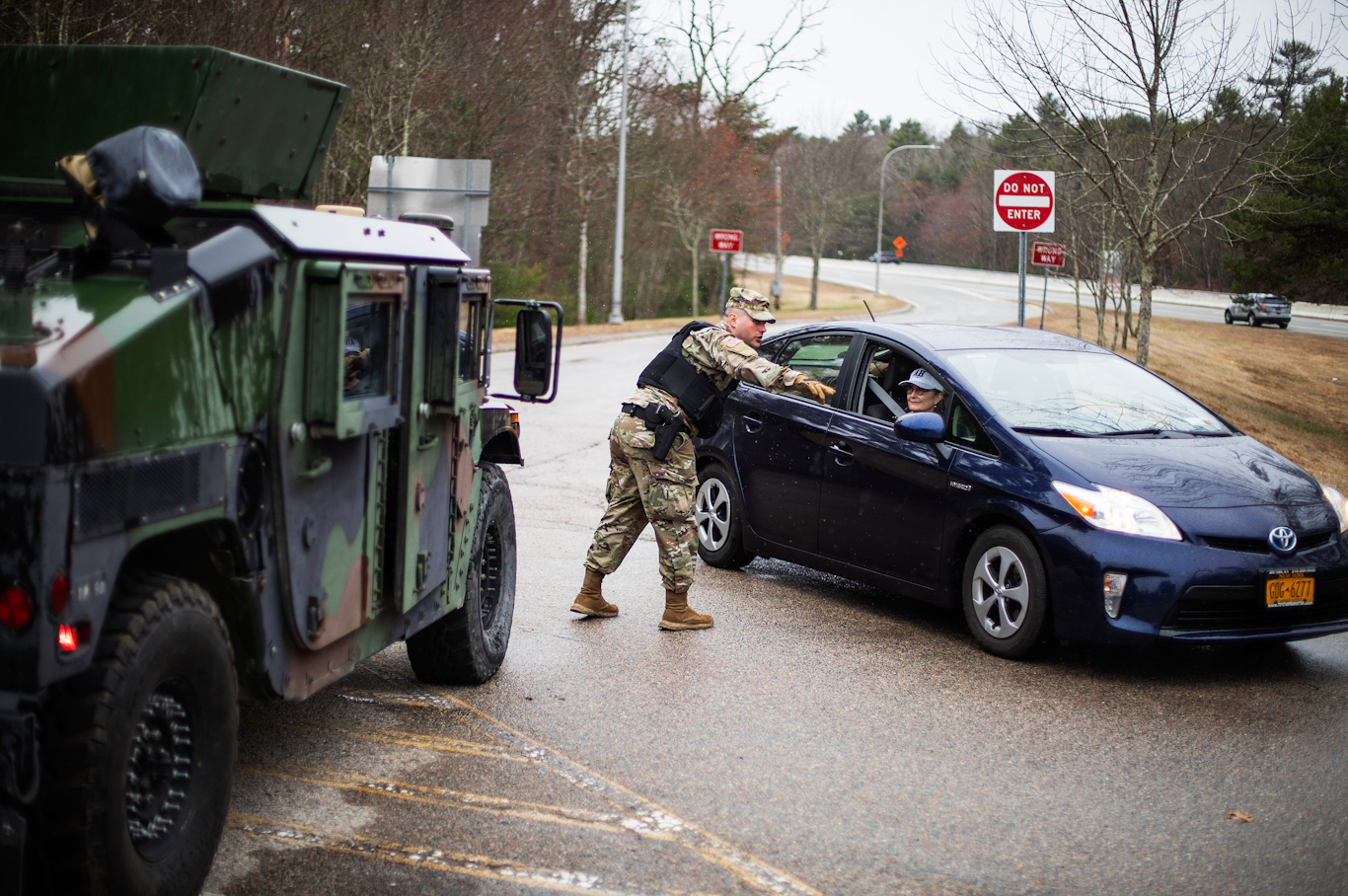
Rhode Island National Guard Military Police direct a motorist with New York license plates to a checkpoint, March 28, 2020, David Goldman | AP

Constitutional attorney John Whitehead writes about The Attack on Civil Liberties in the Age of COVID-19 at Mint Press. It is important to reflect upon whether the government is taking actions for which it has the authorized power in perilous times like these. There have been many calls on the federal government to take actions for which it has no Constitutionally delegated authority – like national quarantines. State governments have more power, but still limited by their own constitutions – a reason why Washington State, for example, recently passed a constitutional amendment to provide for broader emergency powers. That being said, during this pandemic, some people have taken the absurd approach that if the government is requiring you to do something, and you believe that requirement is unconstitutional, then you it is your duty to do the opposite. For example, because you believe that a statewide stay at home order is an unconstitutional exercise of power, you may deliberately gather with others to protest. This is akin to shooting yourself in the head because the government makes suicide illegal. Just because a particular exercise of power is not constitutionally sound, the underlying requirement may still be the wise course for people to take, and indeed may be your duty as a responsible citizen to take. Protest the illegality, but not by getting people killed.

You can always count on the government to take advantage of a crisis, legitimate or manufactured.

This coronavirus pandemic is no exception.

Not only are the federal and state governments unraveling the constitutional fabric of the nation with lockdown mandates that are sending the economy into a tailspin and wreaking havoc with our liberties, but they are also rendering the citizenry fully dependent on the government for financial handouts, medical intervention, protection and sustenance.

Unless we find some way to rein in the government’s power grabs, the fall-out will be epic.

Everything I have warned about for years—government overreach, invasive surveillance, martial law, abuse of powers, militarized police, weaponized technology used to track and control the citizenry, and so on—has coalesced into this present moment.

The government’s shameless exploitation of past national emergencies for its own nefarious purposes pales in comparison to what is presently unfolding.

Deploying the same strategy it used with 9/11 to acquire greater powers under the USA Patriot Act, the police state—a.k.a. the shadow government, a.k.a. the Deep State—has been anticipating this moment for years, quietly assembling a wish list of lockdown powers that could be trotted out and approved at a moment’s notice.

It should surprise no one, then, that the Trump Administration has asked Congress to allow it to suspend parts of the Constitution whenever it deems it necessary during this coronavirus pandemic and “other” emergencies.

It’s that “other” emergencies part that should particularly give you pause, if not spur you to immediate action (by action, I mean a loud and vocal, apolitical, nonpartisan outcry and sustained, apolitical, nonpartisan resistance).

In fact, the Department of Justice (DOJ) has been quietly trotting out and testing a long laundry list of terrifying powers that override the Constitution.

We’re talking about lockdown powers (at both the federal and state level): the ability to suspend the Constitution, indefinitely detain American citizens, bypass the courts, quarantine whole communities or segments of the population, override the First Amendment by outlawing religious gatherings and assemblies of more than a few people, shut down entire industries and manipulate the economy, muzzle dissidents, “stop and seize any plane, train or automobile to stymie the spread of contagious disease,” reshape financial markets, create a digital currency (and thus further restrict the use of cash), determine who should live or die…

Click here to read the entire article at Mint Press.

See also Aesop of Raconteur Report’s response to claims of never ending government tyranny related to Covid.

…”Objection: Assumes facts not in evidence, i.e. that a temporary quarantine will become a decades-long boondoggle.

Reductio ad absurdum Fallacy, 20 yard penalty and loss of possession.

And I observe FTR that people crying about something that’s not yet three weeks old as though it will go on endlessly are children who were never spanked, sent to bed without their supper, or told to wait for any form of gratification…(continues)

American Partisan: Frequencies For Monitoring When The World Goes Dark

From NC Scout at American Partisan – Frequencies For Monitoring When The World Goes Dark some information and links on what radio frequencies to monitor when something really big happens and normal communications go down.

Frequencies For Monitoring When The World Goes Dark

NCS,

What are the frequencies for FEMA to do informational broadcasts when the internet/cells go down?

Just a what if. – A Reader

That’s a good question. There’s a ton of crap floating around on the net right now, making it nearly impossible for the average person to sift through what’s real and what’s straight BS. But with that said, one of the main ones is the ‘looming‘ shutdown of the internet and cell phone service. I don’t know how much validity that actually has, but it underscores the ability to communicate and spread information through decentralized means- which is why I’ve taught communications skills in far greater depth and breadth than anyone else ever offered civilians, combining combat experience with practical end skills.

So with that said, go check out my first post on the topic, listing frequencies of interest and the second post, listing foreign military HF frequencies. And with that said, do not overlook the very vital role the American Red Cross will play, especially when it comes to HF message traffic.

HF
KNNP491
WQJI233
2326.0
2463.0
2726.0
2801.0
3170.0
3201.0
5135.0
5140.0
6858.0
7480.0
7549.0
7697.0
7932.0
7935.0

VHF Low Band 
KA3699
KGB223
WQEF834
47.4200
47.5000

VHF/UHF 
KB84508
KNJR836
WPEQ240
WPME641
WQHH921
WQMD985
WQXM300
27.4900
35.0400
43.0400
151.5050
151.5125
151.6250
151.7000
151.7600
154.5275
158.4000
158.4075
451.8000 / 456.8000
451.8125 / 456.8125
453.4250 / 458.4250
453.4750 / 458.4750
453.5250 / 458.5250
462.7625
462.7875
464.5000 / 469.5000
464.5500 / 469.5500
464.6000 / 469.6000
464.6250 / 469.6250
464.6500 / 469.6500
464.7000 / 469.7000
464.7250 / 469.7250
464.7500 / 469.7500
466.3125
467.9125

The VHF / UHF frequencies can be monitored with a Baofeng, but for the rest you’ll need HF gear. Check out this post if you need a primer to get that squared away.

Doom and Bloom: Fever

The Altons at Doom and Bloom Medical have an article up on fever – what is it? Why does it happen? What should you do about it?

  • COVID-19 is running rampant throughout the globe. Contagious and sometimes deadly, it’s likely to cause severe illness in millions and ruin economies before it’s done.

    You probably know the classic symptoms: Fever (also known as “pyrexia“) occurs in 88 percent of cases, followed by a dry cough. One in five or six go on to develop pneumonia. Of these, a percentage will succumb to the disease. You should know about these symptoms and others associated with COVID-19 and other infections. Today we’ll discuss fevers.

    Why do we get fevers when we’re sick? There seems to be a body of evidence that suggests a higher body temperature kills many viruses and bacteria that do just fine at a normal temperature (98.6 degrees Fahrenheit). Fever is a weapon against disease-causing organisms.

    What constitutes a fever? An elevated body temperature, of course, but how high? In medical school, I learned that it wasn’t a fever until you hit about 100.4 degrees Fahrenheit. This equals 38 degrees Celsius. In older people, the immune system is often too weak to mount that high a temperature. Any elderly person at 99.6 or so should be considered as “febrile” (having a fever).

    Your temperature is a fluid statistic, however. In the morning, it is lower than it is in the late afternoon or evening, sometimes by a degree or more. The temperature also varies dependent on the method used to measure it.

    Old-style glass thermometer

    In the past, people used mercury thermometers. These were made of glass and required no battery, a useful item long-term off the grid. Unfortunately, they could break, causing cuts and dispersing mercury (a toxic substance).

    Today’s thermometers are electronic and non-toxic. There are various types on the market that use the mouth, armpit, rectum, ear, and forehead. Compared to the standard normal oral temperature of 98.6 degrees, you can expect:

    • A normal armpit reading to be one half to one degree lower (97.6)
    • A normal rectal temperature to be one half to one degree higher (99.6)
    • A normal temperature using an ear thermometer to be one half to one degree higher (99.6)
    • A normal forehead scanner (such as those used in many airports) temperature to be one half to one degree lower (97.6)

    So, if a person’s temperature is 100.4 F orally, it could be 99.4 in the armpit or forehead and 101.4 in the rectum or ear. Rectal temps are thought to be most accurate, while armpit temperatures are thought to be least accurate.

    Note: An oral thermometer reading may be inaccurate if you ate or drank something recently. A precise value may not be obtainable for 15-30 minutes afterwards.

    The ability to use the thermometer properly is an important factor. This isn’t difficult for adults that read the instructions, but a fussy, sick toddler may not cooperate. In this case, a rectal temperature reading may be the most accurate.

    Many use the ear thermometer. This is also known as a tympanic thermometer, named after the tympanic membrane or “eardrum”. Tympanic temperature readings average about the same as rectal. To be accurate, take the temperature in both ears and use the highest reading. The reading may be artificially elevated if you have been laying on your side with your ear on a pillow. As well, it’s said that those with a very short, curved ear canal may not have reliable results. This is a tough one to tell unless you ask your doctor to take a look during an exam.

    “Forehead” thermometers actually scan the temperature of the temporal artery. This item is superior to forehead strips, which are better at measuring skin temperature than body temperature. Be aware that they can be expensive.

    Here’s advice from Seattle Children’s hospital on how to properly use each type of thermometer…

Click here to read the entire article at Doom and Bloom.

NY Times: Official Counts Understate the US Coronavirus Death Toll

From the New York Times, Official Counts Understate the US Coronavirus Death Toll

A coroner in Indiana wanted to know if the coronavirus had killed a man in early March, but said that her health department denied a test. Paramedics in New York City say that many patients who died at home were never tested for the coronavirus, even if they showed telltale signs of infection.

In Virginia, a funeral director prepared the remains of three people after health workers cautioned her that they each had tested positive for the coronavirus. But only one of the three had the virus noted on the death certificate.

Across the United States, even as coronavirus deaths are being recorded in terrifying numbers — many hundreds each day — the true death toll is likely much higher.

More than 9,400 people with the coronavirus have been reported to have died in this country as of this weekend, but hospital officials, doctors, public health experts and medical examiners say that official counts have failed to capture the true number of Americans dying in this pandemic. The undercount is a result of inconsistent protocols, limited resources and a patchwork of decision making from one state or county to the next.

In many rural areas, coroners say they don’t have the tests they need to detect the disease. Doctors now believe that some deaths in February and early March, before the coronavirus reached epidemic levels in the United States, were likely misidentified as influenza or only described as pneumonia.

With no uniform system for reporting coronavirus-related deaths in the United States, and a continued shortage of tests, some states and counties have improvised, obfuscated and, at times, backtracked in counting the dead.

“We definitely think there are deaths that we have not accounted for,” said Jennifer Nuzzo, a senior scholar at the Johns Hopkins University Center for Health Security, which studies global health threats and is closely tracking the coronavirus pandemic.

Late last week, the Centers for Disease Control and Prevention issued new guidance for how to certify coronavirus deaths, underscoring the need for uniformity and reinforcing the sense by health care workers and others that deaths have not been consistently tracked. In its guidance, the C.D.C. instructed officials to report deaths where the patient has tested positive or, in an absence of testing, “if the circumstances are compelling within a reasonable degree of certainty.”…

Click here to read the entire article at NY Times.

Medium: What Everyone’s Getting Wrong About the Toilet Paper Shortage

Will Oremus has written an article at Medium.com on What Everyone’s Getting Wrong About the Toilet Paper Shortage, pointing out that it has little to do with so-called hoarding. The fact is that people actually are using more toilet paper at home. There are similar problems with dairy products. With everyone staying at home and mostly eating at home, consumption of milk, butter, eggs, etc. is higher at home, now.

round the world, in countries afflicted with the coronavirus, stores are sold out of toilet paper. There have been shortages in Hong Kong, Australia, the United Kingdom, and the United States. And we all know who to blame: hoarders and panic-buyers.

Well, not so fast.

Story after story explains the toilet paper outages as a sort of fluke of consumer irrationality. Unlike hand sanitizer, N95 masks, or hospital ventilators, they note, toilet paper serves no special function in a pandemic. Toilet paper manufacturers are cranking out the same supply as always. And it’s not like people are using the bathroom more often, right?

U.S. Health Secretary Alex Azar summed up the paradox in a March 13 New York Times story: “Toilet paper is not an effective way to prevent getting the coronavirus, but they’re selling out.” The president of a paper manufacturer offered the consensus explanation: “You are not using more of it. You are just filling up your closet with it.”

Faced with this mystifying phenomenon, media outlets have turned to psychologists to explain why people are cramming their shelves with a household good that has nothing to do with the pandemic. Read the coverage and you’ll encounter all sorts of fascinating concepts, from “zero risk bias” to “anticipatory anxiety.” It’s “driven by fear” and a “herd mentality,” the BBC scolded. The libertarian Mises Institute took the opportunity to blame anti-gouging laws. The Atlantic published a short documentary harking back to the great toilet paper scare of 1973, which was driven by misinformation.

Most outlets agreed that the spike in demand would be short-lived, subsiding as soon as the hoarders were satiated.

No doubt there’s been some panic-buying, particularly once photos of empty store shelves began circulating on social media. There have also been a handful of documented cases of true hoarding. But you don’t need to assume that most consumers are greedy or irrational to understand how coronavirus would spur a surge in demand. And you can stop wondering where in the world people are storing all that Quilted Northern.

There’s another, entirely logical explanation for why stores have run out of toilet paper — one that has gone oddly overlooked in the vast majority of media coverage. It has nothing to do with psychology and everything to do with supply chains. It helps to explain why stores are still having trouble keeping it in stock, weeks after they started limiting how many a customer could purchase.

In short, the toilet paper industry is split into two, largely separate markets: commercial and consumer. The pandemic has shifted the lion’s share of demand to the latter. People actually do need to buy significantly more toilet paper during the pandemic — not because they’re making more trips to the bathroom, but because they’re making more of them at home. With some 75% of the U.S. population under stay-at-home orders, Americans are no longer using the restrooms at their workplace, in schools, at restaurants, at hotels, or in airports.

Georgia-Pacific, a leading toilet paper manufacturer based in Atlanta, estimates that the average household will use 40% more toilet paper than usual if all of its members are staying home around the clock…(continues)

Click here to read the entire article at Medium.com

Here is a video of a dairy farmer of Wagner Farms, talking about dairy item shortages and supply chains.

Organic Prepper: How to Survive Uncertainty About the Future

From Daisy Luther at The Organic Prepper, What Will the Future Bring? Here’s How to Survive the Uncertainty

…Three months ago, we all had dreams, goals for the future, or at least some idea of what the upcoming year would hold for us.

I’ll bet none of us even considered on New Year’s Eve that we’d spend the first half (at least) of the year dealing with a deadly pandemic. Heck, I sat on a balcony in a little seaside village in Montenegro, toasting the new decade with a friend and some Jack Daniels, watching fireworks over the Adriatic Sea, and planning what European destination I’d be heading to next.

It probably never crossed anyone’s mind that there’d be some crazy new virus that nobody had ever heard of which would leave us under the equivalent of house arrest for months. Few of us imagined that suddenly, over the course of just a few weeks, more than ten million Americans would suddenly become unemployed.

Dreams have been shattered.

Goals have been put aside.

Lives have been lost.

Everything has changed.

And nobody knows what the future will hold.

A lot of the things we do know are horrible.

How utterly terrifying to know that we’re all likely to lose somebody we love to this virus or to a medical condition that would have been survivable if the local hospital hadn’t been overflowing with COVID patients.

We know there’s nary a roll of toilet paper to be found in a huge swath of the United States. We know that our supply chain, if not broken, is at the least, badly bruised. We know that if a person we love goes into the hospital with COVID-19, there’s a frighteningly large chance they may never come out again unless it’s in a body bag. We know that medical professionals in New York City don’t even have personal protective equipment to keep themselves healthy while they try to keep people alive. We know that yesterday in the state of New York, 23 people died every hour of the day from the coronavirus that has destroyed the world as we know it.

We nearly all know people who have been laid off. Maybe it’s someone in your family. Maybe it’s you. And if you haven’t yet lost your job, are you waiting for that hammer to drop? We all know of businesses that aren’t going to make it through months of this shutdown.

We know people who couldn’t pay their rent this month. We know people who pulled it together this month but won’t be able to pay May’s rent if this lockdown should continue. We know it’s so bad that the government has said landlords can’t evict tenants in many states – which means the landlords may not be able to pay their mortgages.

We may not know much right now, but we know that the economy is a f*cking disaster.

And we have no idea when this current purgatory will end…

We’d all like to think that one day this will suddenly be over. The kids will return to school. We’ll go back to our offices and our commutes. We won’t be struggling over money anymore. Life will return to the pre-COVID days.

But is this the healthiest way to look at the situation?

Spending all your time looking forward to the day when this is over is an exercise in frustration because nobody knows when that will be. And more than that, nobody knows what “normal” is going to look like when all the lockdowns are over. A lot of things will never be the same.

You can help yourself by learning to adapt now to changed circumstances. This will help you learn to live with the new normal, whatever that turns out to be. Major events are bound to cause major and long-lasting changes. This has happened throughout history.

In reality, the things we’re experiencing right now, while not necessarily easy, aren’t so bad. Things will probably get worse before they get better, but eventually, some form of “better” will come.

Your ability to adapt is indicative of your ability to survive. So let’s get through this lockdown and keep our mindsets positive.  Let’s get through the part that comes next.

Then, eventually, we’ll come out on the other side, ready to tackle the new normal, whatever that ends up being like…(continues)

Click here to read the entire article at The Organic Prepper.

Preparedness Mama: DIY Composting at Home

As long as we’re talking about gardening, let’s talk about composting. Composting is a good way to turn your yard waste, kitchen waste, and even paper waste into delicious, delicious garden food. Here is Preparedness Mama talking DIY Composting at Home

One of the easiest projects that you can do when it comes to gardening is to build a compost pile. It is also one of the most important parts of your garden. A compost pile offers some great benefits for both the soil and your fall cleanup efforts. In today’s article, we are going to go over the ins and outs of how to make a compost pile at home. But first, we will highlight some of the neat benefits of having your own compost pile.

how to build a compost pile at homeWhat Is a Compost Pile?

For individuals who don’t know, a compost pile is simply a pile of leftover organic scraps. These scraps can come from the outdoors, your kitchen, and even leftover animal waste. You might be wondering why anyone would ever want to collect compost, well, compost can provide the nutrients that your soil and plants need. A compost pile also feeds microbes that are beneficial and ensures that it will keep all the resources that are valuable out of the landfills.

As the organic material begins to breaks down, the nutrients and minerals feed the soil and give an overall boost of health to your garden. For gardeners who are looking to add that additional boost in a timely manner, composting is the solution that they seek.

Why You Should Build a Compost Pile

From financial reasons to environmental ones, there are so many reasons why you should learn how to make a compost pile. Let’s take a look at some of the top ones.

Less Waste

One of the best benefits of a compost pile is the significant reduction of waste it provides. When you are cooking or cleaning around the house, you will find that a lot of the items you come across can be composted. By composting, you get the benefit of being environmentally conscious all while putting resources back into the Earth. It is almost like having a mini recycling plant in your own backyard.

You Can Create a Rich Fertilizer

If you are a natural gardener, then you will love the fact that composting can provide you with having a nutritionally rich fertilizer. Having a fertilizer that is rich in minerals and nutrients can help you in having a successful harvest. Whether it be vegetables or flowers, a rich fertilizer can be the difference between a dull garden and a bountiful one.

Composting Can Help You Save Money

Once you learn how to make a compost pile, you will soon feel the financial benefit of it. For starters, if you pay per bag for garbage collection, you will notice that you will be throwing out less. This means more money in your pocket. Not only that but when it comes time to garden, a compost pile can be super helpful in saving you money. You no longer have to spend piles of money on buying fertilizer..

Composting is Good for the Environment

From reducing toxins to helping keep organic matter out of landfills, composting is proven to helping keep the environment clean. When you compost, you help return soil that has been infused with pesticides and other toxins back to a healthy state. Not only that, but composting helps to keep such toxins out of essential resources such as water supplies and other plants too.

Now that you have a general sense of how beneficial composting can be to a community. Let’s dive into the specifics of how to make a compost pile right at home… (continues)

Click here to read the entire article at Preparedness Mama.

Buchanan: When It’s Over, Will We Be the Same America?

From Pat Buchanan, When It’s Over, Will We Be the Same America?

“Depend upon it, sir, when a man knows he is to be hanged in a fortnight, it concentrates his mind wonderfully,” said Samuel Johnson.

And as it is with men, so it is with nations.

Monday, Dr. Deborah Birx, White House coronavirus response coordinator, projected some 100,000 to 200,000 U.S. deaths from the pandemic, “if we do things almost perfectly.” She agreed with Dr. Anthony Fauci’s estimate that, if we do “nothing,” the American dead could reach 2.2 million.

That 2 million figure would be twice as many dead as have perished in all our wars from the American Revolution to the Civil War, World War I and II, and Korea and Vietnam.

This does indeed concentrate the mind wonderfully.

Now add to this slaughter of our countrymen a market plunge steeper than the 1929 Crash and a 1930s-style Depression. Wall Street analysts are talking of a wipeout of 30% of our GDP and unemployment reaching 35%.

What a difference a month can make.

On March 3, Super Tuesday, we were caught up in the 14 primary contests after Joe Biden’s stunning victory in South Carolina, which broke the momentum of Sen. Bernie Sanders’ wins in Iowa, New Hampshire and Nevada.

What March 2020 produced and what it appears to portend is a sea change in U.S. history, an inflection point, an event after which things never return to what they were.

The coronavirus crisis seems to be one of those epochal events that alter the character of the country and the course of the republic.

Consider what has happened in three weeks.

The Republican Party, the party of small government and balanced budgets, approved with but a single dissent a $2 trillion emergency bill. There is talk now of a second $2 trillion bill, this one for infrastructure.

In a single month then, a Republican Senate and president grew the federal budget by 50% and are looking to double that.

For years, Democrats raised alarms about Trump’s poaching of the powers of the other branches. Now Democrats are demanding to know why Trump has not shut down the economy by presidential decree and not used his latent dictatorial powers to order U.S. companies to produce what the nation’s hospitals demand.

Democrats who long accused Trump of xenophobia and racism for seeking to close the borders to migrants entering the country illegally are now silent as Trump closes America to the world.

First Amendment free press champions are calling for Trump’s White House briefings not to be carried on TV because the president is spouting propaganda and lies. The problem: The people are watching and approving of what the media think the people ought not see.

If people in a crisis will jettison lifelong beliefs like this readily, how enduring will their professed belief in democracy itself prove?

The president thinks this will be a V-shaped recession, that once the economy hits bottom and turns up, it will soar, as in 1946 when pent-up demand from World War II was unleashed and America began to churn out cars and consumer good as rapidly as it had weapons of war.

Perhaps. But put me down as a skeptic. You can’t go home again. The shattering events of March, followed by what is coming in April and May, will have lasting impacts on the hearts and minds of this generation.

That once-insatiable appetite for Chinese-made goods at the mall — will it really return? Will Americans, after having “socially distanced” for months from family and friends, be reassured of their safety and pack into restaurants in July?

Observing the carrier Theodore Roosevelt in Guam offloading scores of sailors infected with coronavirus, will Americans be up for a clash with a China that is even today asserting its claims to the South China Sea?

Will Americans who survive this crisis care whether Iranian-backed Shiites dominate Iraq or Saudi-backed Sunni prevail in Yemen?

If March shocked this nation as severely as 9/11, what is coming may be even more sobering.

Are millions of unemployed workers without the cash to pay for or to find medicine and groceries likely to stay indoors for weeks or months?

All those criminals being given early release from virus-infested jails and prisons without the means to provide for themselves and their families, how will they react to weeks of mandatory sheltering in place?

Will MS-13 and its thousands of members, and its rival gangs that live off narcotics sales, comply?

Americans have done well in staying home in March. Will they do so through April, May and perhaps June? Or will the system gradually break down just as the second wave of the virus in the fall appears?

In times of crisis in America, there is a tradition of self-sacrifice.

But there have also almost always been not a few whose mindset is that of the Fort Lauderdale spring-breakers.

Business Insider has a more rosy view, 10 ways the coronavirus pandemic could change American life as we know it

The Federalist: What Will America Look Like After The Wuhan Coronavirus?

Politico: Coronavirus Will Change the World Permanently

Lovely Greens: Grow a Rapid Response Victory Garden

Tuesday was rain, ice pellets, winds and sun. Wednesday was ice pellets, rain, wind and sun. Welcome, Spring. Despite the less than delightful weather, thoughts turn to gardens. We already had lettuce and pea seeds in the earth. Kale and rhubarb are already doing fairly well, and the berry plants are leafing. In these difficult times, more people are thinking about growing a garden or at least trying to raise some sort of food of their own because of supply chain grocery fears. Lovely Greens has a nice article on Growing a Rapid Response Victory Garden, focused on food that will mature relatively quickly – 30, 60 and 90 days.

You’ve just decided that it’s time to grow a vegetable garden, and not just any garden, a rapid response victory garden. Here’s how to begin and a guide to crops that will mature in 30, 60, and 90 days. Full video at the bottom.

It was just after five am and I was lying in bed, scrolling the news, Facebook, Twitter, everything. I’m not usually awake this early, but we live in different times. Seemingly overnight, our way of life has changed, and a lot of us are feeling anxious for ourselves, our loved ones, and the future. Then I came across a call for help: “…I wish someone would write an article about plants one could sow NOW that could produce food in the next 30, 45, 60 days.”

I could do that, so I’m up now and answering the call. It’s an entirely understandable question since folks are putting two and two together. Even if you have a healthy supply of food now, what will happen this summer? Will there be food shortages? Will my family go hungry? Maybe it’s time to revive the Victory Garden – to plan for the future, just in case.

For the moment, supermarkets are not out of food, but I have seen a couple of worrying signs. A health-food shop that I frequent is out of dried foods “for the foreseeable.” I’ve also seen one person reporting that crops are being abandoned in Kenya, though at the time, the country had only a single confirmed case of Coronavirus. It makes me wonder how less-developed places will cope with the virus, and with food production. Could we see imported food quietly disappear from our supermarket shelves? At least for part of this year?

I’m not an alarmist, but I’m sure I’m voicing a thought that many of us share. That’s why starting a vegetable garden now, even if you have zero experience, is something to consider. Even if a cure or vaccine is developed next week, or next month, having those plants in the ground will benefit your health and your table. Growing your own food is good for your physical health, nutrition, and mental clarity. From a psychological perspective, I believe that it will help you feel more secure. It does for me.

Before we get to what you can grow, I need to announce something else that is worrying. You’re not alone in wanting to grow your own food for the first time –  online seed companies and seed suppliers have been inundated with orders. So much so, that many have closed because they are overwhelmed or sold out of seeds.

If you’re finding it challenging to source seeds online, you should try to get to a physical shop, if you can do so. I’ve not seen any local garden centers sold out of seeds yet, but that may change in the coming weeks. Hardware stores, and sometimes supermarkets will also have a small selection of seeds. You can also ask friends if they have any seeds or plants to share or organize a virtual seed swap. Seeds and plants can be posted or left on door-steps if people are self-isolating…

here are probably hundreds of books sharing how to grow vegetables, and I can’t fit it all into just a couple of paragraphs. Just remember that they are living things and will need light, warmth, nutrients, water, shelter, growing supports, and protection from predators and disease. Fruit and vegetables are just like animals – some grow in the tropics, and others live in temperate regions. You can fake those environments by growing crops in greenhouses or hydroponically. Pretty much all the details of gardening fit into these themes.

You should also familiarize yourself with your gardening zone, and which crops grow best in it. I go over zones and the earliest seeds you can sow every year over here.

Feel free to read my pieces on starting a garden, common gardening mistakes, and watch the videos I shared of how I created my allotment vegetable garden and home raised bed garden on YouTube (please subscribe too)…(continues)

Click here to continue reading at Lovely Greens.

As for getting seeds if you don’t have them… Some online resellers are out of stock because of the volume of people planting gardens for the first time. In some areas, seeds are considered a “non-essential item” that physical stores are not allowed to sell in person. Territorial Seed Company still has seeds in stock, but they are having shipping delays because of high demand. Seeds of Change appears to still have seeds and be taking orders. Burpee appears to have seeds. Wild Garden Seed appears to have stock Filaree Garlic Farm is still open; they’re a small farm specializing in garlic, shallots, asparagus crowns, seed potatoes, and sweet potato slips. Seed Savers Exchange is not taking new orders, but if you join the exchange you may be able to get seeds from other members. And, of course, if you live in an area where seeds are not considered a non-essential item, you may still be able to pick up seeds at a local store.

WA Benton-Franklin Health District: Wear Masks in Public!

From KIMA news,

Benton-Franklin Health District leaders are now advising people to wear face coverings while in public to help slow the spread of the coronavirus.

Health leaders say medical grade masks should be saved for first responders and medical staff members.

Health officials say something as simple as a scarf would be acceptable to slow the spread of COVID-19.

Experts say the mask, or cloth, can be an added layer of protection for people.

Health leaders say people should also continue to use social distancing guidelines and not leave their homes with the exception for essential activities.

Reuters: U.S. Dairy Farmers Dump Milk as Pandemic Upends Food Markets

From Reuters news service comes a story that hits our region with a good number of dairies, U.S. dairy farmers dump milk as pandemic upends food markets

Dairy farmer Jason Leedle felt his stomach churn when he got the call on Tuesday evening.

“We need you to start dumping your milk,” said his contact from Dairy Farmers of America (DFA), the largest U.S. dairy cooperative.

Despite strong demand for basic foods like dairy products amid the coronavirus pandemic, the milk supply chain has seen a host of disruptions that are preventing dairy farmers from getting their products to market.

Mass closures of restaurants and schools have forced a sudden shift from those wholesale food-service markets to retail grocery stores, creating logistical and packaging nightmares for plants processing milk, butter and cheese. Trucking companies that haul dairy products are scrambling to get enough drivers as some who fear the virus have stopped working. And sales to major dairy export markets have dried up as the food-service sector largely shuts down globally.

The dairy industry’s woes signal broader problems in the global food supply chain, according to farmers, agricultural economists and food distributors. The dairy business got hit harder and earlier than other agricultural commodities because the products are highly perishable – milk can’t be frozen, like meat, or stuck in a silo, like grain.

Other food sectors, however, are also seeing disruptions worldwide as travel restrictions are limiting the workforce needed to plant, harvest and distribute fruits and vegetables, and a shortage of refrigerated containers and truck drivers have slowed the shipment of staples such as meat and grains in some places…

Click here to read the entire story at Reuters.

American Partisan: Radio Quick Start Guide

NC Scout at American Partisan has written a short Radio Quick Start Guide, covering line of sight and over the horizon radio equipment to get you started if you’re asking “just tell me what to get, already.”

When people think of radio communications, they want a replacement for a cell phone. You’re not getting a replacement for a cell phone.

Alright, with that out of the way, I’ve been getting a ton of emails asking about jump-starting communications capabilities for an area. Since that’s something I’ve written a lot about over the years and teach two classes for building that capability, I’m going to cover the bare-bones basics to getting a local network squared up and running.

QYT KT-8900. Small, light, versatile and effective.

For local work, you’re going to want this:

It’s a 25 watt tiny little mobile radio that plugs into a 12v outlet. You can run it in your truck very easily. I have one mounted under my dash and another in my shop for making local contacts. Mine is programmed with all of the local repeaters and it’ll also do all of the license free bands (FRS/GMRS walkie-talkies, MURS and marine band).
To get it rigged up, you’ll need a run of 50 ohm coax that you can get in any truck stop. I just call it CB coax.  Next you’re going to need an antenna. I run an aluminum J Pole as my fixed base station antenna and I have it just drilled into the eve of the roof of the shop. On my truck I run a 2m firestick which is pretty much the same as my CB antenna and its mounted to my toolbox.
The nice thing about this setup is its portable to nearly anywhere and works really well. With a couple of deep cycle batteries you can run this little rig for a LONG time. I have.
On to HF.

Icom 7200 with LDG auto tuner. Rugged and simple.

This one is going to be a lot more expensive for a basic setup. Here’s a post from a couple of weeks ago on rigging your own simple antenna. The easiest HF radio to use out of the box is the Icom 718. It’s got a huge display, a really good receiver for listening to shortwave and HF transmissions and is very simple to use. I run the 7200, which isn’t too much different. But the other cool thing is that rigging it up for digital use is very simple. Here’s two links on the setup:

You’re also going to need a tuner for your HF radio. I use a short run of coax (8 inches) between the back of my radio to the tuner then run the antenna coax into the tuner. What this does it use two matching relays to create an electrical match for the antenna length to the frequency you’re using. Think of it as an insurance policy for your radio, since there’s too many variables with an HF antenna to make a perfect 1:1 SWR match every time. The tuner takes up the slack and protects your rig. It protects in other ways as well. I had mine take a lightning strike three years ago. Sent it into LDG and they sent me a new tuner, no questions asked. You’re also going to need a 120v power supply since all amateur radio gear runs off 12v. The one I use is an MFJ 28 amp switching power supply. Its got a 12v power plug to run that QYT mobile radio as well as your Icom.

This is an expensive list- but its one I’ve recommended to a lot of other people starting out and my own home station is not too much different. Everything I’ve got is kept pretty simple. But that said, having the gear is one thing, having the skill is a whole other animal.
Also see NC Scout’s dedicated web site at https://brushbeater.wordpress.com. He’s got a ton of useful information there and teaches classes, too.
Also see our related article on Suggested Radio Equipment for Community Safety.

Foreign Policy: How the World Will Look After the Coronavirus Pandemic

Foreign Policy journal asked twelve “global thinkers” to answer the question of How the World Will Look After the Coronavirus Pandemic. Each author’s response is relatively short for Foreign Policy, but there are a dozen so the whole thing isn’t short. The answers are sometimes opposed to each other, so take away what you will.

Like the fall of the Berlin Wall or the collapse of Lehman Brothers, the coronavirus pandemic is a world-shattering event whose far-ranging consequences we can only begin to imagine today.

This much is certain: Just as this disease has shattered lives, disrupted markets and exposed the competence (or lack thereof) of governments, it will lead to permanent shifts in political and economic power in ways that will become apparent only later.

To help us make sense of the ground shifting beneath our feet as this crisis unfolds, Foreign Policy asked 12 leading thinkers from around the world to weigh in with their predictions for the global order after the pandemic…

The pandemic will strengthen the state and reinforce nationalism. Governments of all types will adopt emergency measures to manage the crisis, and many will be loath to relinquish these new powers when the crisis is over…

The coronavirus pandemic could be the straw that breaks the camel’s back of economic globalization...

The COVID-19 pandemic will not fundamentally alter global economic directions. It will only accelerate a change that had already begun: a move away from U.S.-centric globalization to a more China-centric globalization...

The nationalists and anti-globalists, the China hawks, and even the liberal internationalists will all see new evidence for the urgency of their views. Given the economic damage and social collapse that is unfolding, it is hard to see anything other than a reinforcement of the movement toward nationalism, great-power rivalry, strategic decoupling, and the like…

COVID-19 is undermining the basic tenets of global manufacturing. Companies will now rethink and shrink the multistep, multicountry supply chains that dominate production today…

The international system will, in turn, come under great pressure, resulting in instability and widespread conflict within and across countries…

The result could be a dramatic new stage in global capitalism, in which supply chains are brought closer to home and filled with redundancies to protect against future disruption…

I would expect many countries will have difficulty recovering from the crisis, with state weakness and failed states becoming an even more prevalent feature of the world…

Click here to read the entire article at Foreign Policy


Warnings of Coronavirus Riots/Civil Unrest

A variety of people/outlets are warning of imminent civil unrest because of lockdowns/job loss/lack of food/etc. resulting from the Covid-19 pandemic and government responses.

Express: Coronavirus riots to erupt ‘at any moment’ as Red Cross warns cities face ‘social bomb’

Europe has seen a substantial increase in the number of coronavirus cases and deaths in recent weeks, as the continent accounts for over half of the world’s 601,520 cases. Italy, Spain, Germany and France are Europe’s worst-hit countries, with Italy surpassing China’s total confirmed cases and death toll this week. The shocking figures has prompted one Red Cross official to warn an eruption of social unrest across Europe’s biggest cities is imminent.

Francesco Rocca, head of the International Federation of Red Cross and Red Crescent Societies (IFRC) told a United Nations news briefing: “We have a lot of people who are living very marginalised, in the so-called black hole of society.

“In the most difficult neighbourhoods of the biggest cities I am afraid that in a few weeks we will have social problems.

“This is a social bomb that can explode at any moment, because they don’t have any way to have an income.”

He warned the risk of suicide is increasing among vulnerable people forced to isolate on their own…

The Organic Prepper: It’s Only a Matter of Time Until COVID-19 Lockdowns Lead to Civil Unrest and Violent Crime

The United States of America is basically closed for business, leaving citizens jobless, broke, and without options. We’re facing restrictions on movement the likes of which our nation has never seen. The stores that are open have never fully restocked after the “panic buying” of previous weeks, leading to shelves barren of things like meat, flour, toilet paper, and rice.

It’s only a matter of time before these issues combine to become the flashpoint that leads to an explosion of civil unrest and violent crime.

The financial situation

Unemployment skyrocketed, with 3.3 million claims last week, and the Fed estimates that number to climb to a whopping 47 million due to the virus. Many of these jobs may not come back after the Covid-19 virus has run its course through the nation – businesses small and large are going to be defaulting on their April rent payments, and many simply won’t be able to catch up later.

So far, a lot of people in the area where I’m staying seem to be treating this break of business like a surprise staycation. It’s nice to see families out walking together, playing games, and spending time with the people they love.

But this happiness may be shortlived. Despite generous government-mandated disaster pay, unemployment, and stimulus checks, the money may not arrive in time for former employees, self-employed people, and gig workers to pay their personal bills. And when the money does arrive, for many folks it isn’t going to be the same amount they were earning before the shutdowns. Most people don’t have emergency funds, so things will be dire in short order.

Of course, this affects landlord, mortgage companies, utility companies, retail businesses…the list could go on and on…

Foreign Policy: The Coronavirus Could Topple Governments Around the World

…The consequences will be very different in countries where political institutions are weaker and where the illness or death of a leader has been known to generate the kind of power vacuum that might inspire rival leaders, opposition parties, or the military to launch a power grab. This is a particular problem in countries where checks and balances are weak and political parties don’t have strong decision-making mechanisms, which is true in parts of Africa, Asia, Latin America, and post-communist Europe. According to the researchers Rodger Govea and John Holm, 61 percent of leadership transitions in Africa are “unregulated,” and many of these episodes have resulted in a political crisis.

In countries where politics are more personalized, the death of a leader can trigger damaging succession battles that can split the ruling party and, in the worst cases, encourage a military coup. It is therefore extremely worrying that senior political officials and leaders have also contracted COVID-19, the disease caused by the new coronavirus, in countries such as Burkina Faso, Iran, and Nigeria—countries that are already unstable gerontocracies…

Silver Doctors: Looting, Riots & Civil Unrest Are Coming To The US, Will Be Much Worse Than Asia Or Europe

It’s par for the economic collapse course.

Last week we got some “reports” of riots (protests?) coming out of China:

This week, civil unrest is taking place in Italy, and to think, the United States is just a little bit behind Italy.

In Italy, however, with a more or less disarmed population, the riots have so far have been without major violence, or at least that’s what can be gleaned with a minimal internet search.

That is to say, the Italians are talking about snatching a bag from somebody walking home from the grocery store, but it’s not like the victim is stabbed and left to bleed to death, or worse:

The victims in Italy basically lose their groceries.

It’s unlikely the bag snatching in the US will go over as smoothly as it has in Italy, for reasons we’ll get to in a moment…

Fox 5 NY: Store owners boarding up buildings across Manhattan

…The businesses have taken the unsightly measure in an effort to defend against the potential for civil unrest caused by the coronavirus and a lack of officers on the streets…

Zero Hedge: Lockdown-Backlash Begins: Angry Crowd Surrounds Capitol, Demands Michigan Governor Reopen Economy

WOOD-TV’s Heather Walker provides coverage from within Operation Gridlock as people use their cars to lockdown streets around the Capitol building. Walker interviewed several Michiganders, who are fed up with the public health order and want the economy to reopen. Many said they could make their own health decisions and don’t need the government to tell them what to do.

Some protestors were dressed in body armor, wielding AR-15s.

The Daily Reckoning: Worst Recession in 150 Years

Yet even this three-system analysis I just described (pandemic > economy > politics) does not go far enough. The next phase has been little noticed and less discussed.

It involves social disorder. An economic breakdown is more than just economic. It leads quickly to a social breakdown that involves looting, random violence, fraud and decadent behavior.

The Roaring ’20s in the U.S. (with Al Capone and Champagne baths) and Weimar Germany (with riots and cabaret) are good examples.

Looting, burglary and violence in the midst of a state of emergency are the shape of things to come.

Zero Hedge: America On The Brink? Shocking Images Show “Pennsylvania Militia” Rolling Up To “Reopen America” Rally

America could be standing on the edge of a revolution. Seriously, well, with National Guard troops deployed across the country, any uprising would likely be squashed.

We noted late last month that a “social bomb” was set to detonate over major Western cities. It was thought that the epicenter of unrest could begin deep within inner cities, such as those in Baltimore and Detroit, but that might not be the case.

It appears tensions are soaring among anti-quarantine protesters and state governments. The lockdown backlash started last Thursday in Lansing, Michigan…

Backdoor Survival: What Can Prepper Groups Do To Support Each Other During Quarantine

This article comes from Samantha Biggers at Backdoor Survival – What Can Prepper Groups Do To Support Each Other During Quarantine. You may not be able to have physical meetups, but what can you do?

A lot of people have been members of preparedness groups for quite some time. While some groups may have been just casual meetups once in a while, others were seriously training and getting together on a regular basis.

pandemic is not necessarily the event that most groups considered likely. This is not an event where people can all feel good about gathering together to ride this thing out.

But that doesn’t mean that prepper groups cannot offer a ton of support and help to one another. This article is going to talk about what prepper groups can do to support one another during this time of social distancing.

Learn skills via video

Prepper groups often have people with a huge variety of skills and knowledge. If each person takes a turn offering an online webinar, then everyone can use this time to learn and come through this even more prepared than ever. Some of these classes could even be added to your homeschool curriculum where appropriate.

Have some classes that are designed to help entertain and offer constructive activities for the teens and kids of those in the group.

While kids are going to have some homework to do, I know from my own homeschool experience that doesn’t take up anywhere near the entire day. Kids are going to need things to do and if you don’t want them to spend all that time watching television or playing video games, then you are going to need to give them some other constructive options.

Check-in on each other. Sometimes it is nice to just know that others are thinking about you.

The pandemic is making it so that people are suffering from extreme stress and anxiety. For many, there is a lot of uncertainty. Regardless of where you get your news, there has been an overwhelming amount of information and some of that info changes faster than you can keep up. There has also been planting of conflicting information.

When people don’t know what is true and a lot of promises are being made that it is impossible for any human being or government to be able to guarantee them, it can feel scary and lead to extreme stress. Poor mental health can affect your body and immunity.

Talking to others through this hard time, especially friends can help. Isolation can be very hard on some people that are older or those that live alone. I would not be doing so well with isolation if I did not have my husband right here with me and my father very nearby.

Share recipes

For many people, this is the first time they have had to cook with at least some basic foods or be responsible for all the meals consumed. If you get takeout or deli food 5-7 times a week, it is a big change to suddenly have to take care of that yourself and plan your day so that you have time for it.

Getting creative with all those prepper foods you have stashed back can make eating a more enjoyable experience. Variety helps more than you might realize. There are ways to make comfort foods from very basic things with just a few skills and some knowledge.

Practice Communications

Some prepping groups have communications procedures and codes in place. Now is a good time to practice those skills. Some people are getting more into shortwave radios and learning how to operate a HAM radio…(continues)

Click here to read the entire article at Backdoor Survival.