KNDU: Prosser Suspends City Programs While Sanitizing Community Center

From KNDU, City of Prosser suspends City programs while it works to sanitize community center because of potential coronavirus exposure.

The City of Prosser has decided to suspend City programs because of a possible exposure to the coronavirus.

On Monday, March 9, the City received information there was a sight chance that a person at the Community Center, located at 1231 Dudley Ave., could have been exposed to COVID-19. According to a news release, the potential exposure comes from a possible transference from a site outside Benton County via a patron of the facility.

According to City Officials, the person who may have been exposed has no symptoms at this time.

Working with the Benton-Franklin Health Department the City of Prosser decided to suspend City programs while it works to sanitize the facility. This is a precautionary measure only, taken to ensure the safety of all citizens. The City has reached out to its facility partners and advised them of the situation and allowed them to determine whether to continue or suspend their programs based on the level of risk.

According to the city, The Senior Citizens Club has posted updates on their program activities on their Facebook page. Meals on Wheels is still operating and will be providing meals. Please check the Prosser Meals on Wheels Facebook page for more information and updates.

The City of Prosser expects to resume programs at the Community Center next week. “We want to stress that this is simply a precaution and thank you for your patience” Steve Zetz, Community Development Director.

Rutherford Institute: Federal Courts Rule That Individuals Shot by Police but Not Immediately Arrested May Not Sue Police for Wrongdoing Under the Fourth Amendment

From the Rutherford Institute:

In a case before the U.S. Supreme Court that could determine how far the courts may go in shielding police from being held accountable for wrongdoing, The Rutherford Institute is challenging a lower court ruling that prevents victims of police shootings for suing police for violations of their civil rights if the shooting did not result in an immediate arrest.

In an amicus brief filed jointly with the National Association of Criminal Defense Lawyers (NACDL) in Torres v. Madrid, Rutherford Institute attorneys argue that lower courts erred in ruling police did not violate the Fourth Amendment rights of a woman who, mistaking police officers for carjackers, fled from police, was pursued and shot twice in the back. The lower courts reasoned that because the woman was not arrested, she had not technically been “seized” by the police and, thus, could not sue police for “unreasonable searches and seizures” in violation of the Fourth Amendment.

Affiliate attorneys Jeffrey T. Green and John L. Gibbons of Sidley Austin, LLP, and Sarah O’Rourke Schrup of the Northwestern Supreme Court Law Clinic assisted The Rutherford Institute and the NACDL in advancing the arguments in Torres.

“This particular case underscores the unfortunate reality that we live in an age of hollow justice,” said constitutional attorney John W. Whitehead, president of The Rutherford Institute and author of Battlefield America: The War on the American People. “With every ruling handed down, it becomes apparent that the courts are more inclined to render narrow rulings that protect government interests than they are committed to upholding the rights of the people enshrined in the U.S. Constitution.”

Early in the morning of July 15, 2014, Roxanne Torres dropped a friend off at an apartment complex in Albuquerque, N.M.  After parking and exiting her car, Torres reentered and remained in the car with the engine running and the car doors locked. At that same time, four New Mexico State Police officers arrived at the complex intending to arrest a woman who was not related to Torres. Two of the officers approached Torres’s car and, with guns drawn, attempted to open the driver side door. Because the officers wore indistinguishable dark clothing and Torres did not hear what they shouted at her, Torres mistook them for carjackers and attempted to drive away. After the car moved forward mere inches, the police opened fire on Torres and she accelerated away. The officers continued shooting at Torres, firing 13 shots in all, two of which struck Torres in the back, paralyzing her right arm. Torres drove a short distance before she was forced by her injuries to stop. When a bystander refused to call police on her behalf, she found another car and drove it to a hospital, where she was airlifted to another hospital due to the seriousness of her injuries. She was subsequently arrested on charges related to fleeing the police.

Torres, in turn, sued the police for using excessive force in violation of the Fourth Amendment’s prohibition on “unreasonable searches and seizures.”  However, the trial and appeals courts ruled that because Torres was able to escape after being shot, she had not technically been “seized” by the police. In their amicus brief before the U.S. Supreme Court, which has agreed to hear the case, The Rutherford Institute and the NACDL argue that all uses of unreasonable and excessive force by police merit review under the Fourth Amendment, whether or not the victims of police brutality are arrested or temporarily elude capture.

Organic Prepper: China’s Control of Pharmaceuticals

In this article from The Organic Prepper, Daisy Luther discusses China’s corner on the pharmaceutical market – 80% of pharmaceutical ingredients are made in China – and recent threats (or merely boasts?) that China would or could cut off drug exports to the US.

As China allegedly conquers the spread of the Covid-19 outbreak that began in Wuhan, it appears that they’re right back to considering the United States an enemy. On Xiahuanet, the Communist Party news outlet, they threatened to withhold all medical exports to the US, at the same asking for an “apology” from the US and “gratitude” from the rest of the world.

This comes at the most crucial point of an outbreak that originated in their own country.

Why is China angry with the US?

Xinhuanet is the biggest news agency in China, and very “influential.” The outlet is the official state-run press agency, so anything found on the website is straight from the Chinese government. An article titled, “The World Should Thank China,” which was published on March 4, covered the outbreak of Covid-19 in the United States.

The article suggests that the US’s data is suspicious because all cases of coronavirus must be confirmed by the CDC. (I can’t disagree with them that our numbers are questionable.) It shows a photograph of people praying in the White House to underline how “nervous” President Trump is about the virus. (This photo was actually of a meeting that the Vice President had about the rapidly spreading virus, as opposed to the President.)

Xinhuanet goes on to tout the control they have taken over the outbreak, saying that Trump admires their handling of the crisis and that his “remarks came from the bottom of his heart.”

At the same time, Xinhuanet criticized the US’s perceived mistreatment of China, citing the travel ban and the evacuation of American citizens from Wuhan, the heart of the outbreak. This caused, according to Xinhuanet, other countries to also “isolate” China from the rest of the world, causing them economic harm.

A translated version of the article says:

These practices in the United States are very unkind. They can be described as falling into the ground and killing people while they are ill. (source)

And now, if it is to be believed that China has contained the outbreak and they’re back to business as usual, they may want to exact some vengeance for this “unkindness.” (And of course, this remains the question – do they even currently possess the capability to manufacture these medical products or is this all a way to save face because their workforce is decimated and the virus is actually not contained at all?)

How did China threaten the US?

In the article, China suggests that they could easily get even with the United States for their perceived mistreatment of China during the outbreak by cutting off medical supplies while we are in the midst of our own outbreak.

If China retaliates against the United States at this time, in addition to announcing a travel ban on the United States, it will also announce strategic control over medical products and ban exports to the United States. Then the United States will be caught in the ocean of new crown viruses.

According to the US CDC officials, most masks in the United States are made in China and imported from China. If China bans the export of masks to the United States, the United States will fall into the mask shortage, and the most basic measures to prevent the new crown virus are Can’t do it.

Also according to the US CDC officials, most of the drugs in the United States are imported, and some drugs are imported from Europe. However, Europe also places the production base of these drugs in China, so more than 90% of the US imported drugs are Related to China. The implication is that at this time, as long as China announces that its drugs are as domestic as possible and banned exports, the United States will fall into the hell of the new crown pneumonia epidemic. (source)

In the next paragraph, Xinhuanet basically says, “Nah, don’t worry. We are filled with love.”

However, there is a great love in the world. The Chinese people and the Chinese government have never done so. They have not insulted the United States, nor have they banned the export of masks and medicines to the United States. (source)

Then the article suggests that the United States, if not the entire world, owes China an apology due to our media coverage of the outbreak in Wuhan and comments made about the outbreak by government officials like  Secretary of Commerce Rose, US Secretary of State Pompeo, and US White House Economic Adviser Navarro. They say these officials “gloated” about the coronavirus outbreak and saw it as an opportunity to pull US manufacturing out of China…

Click here to read the entire article at The Organic Prepper.

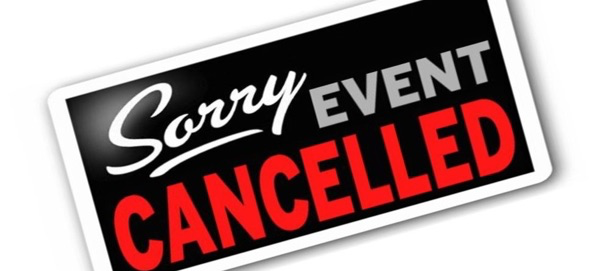
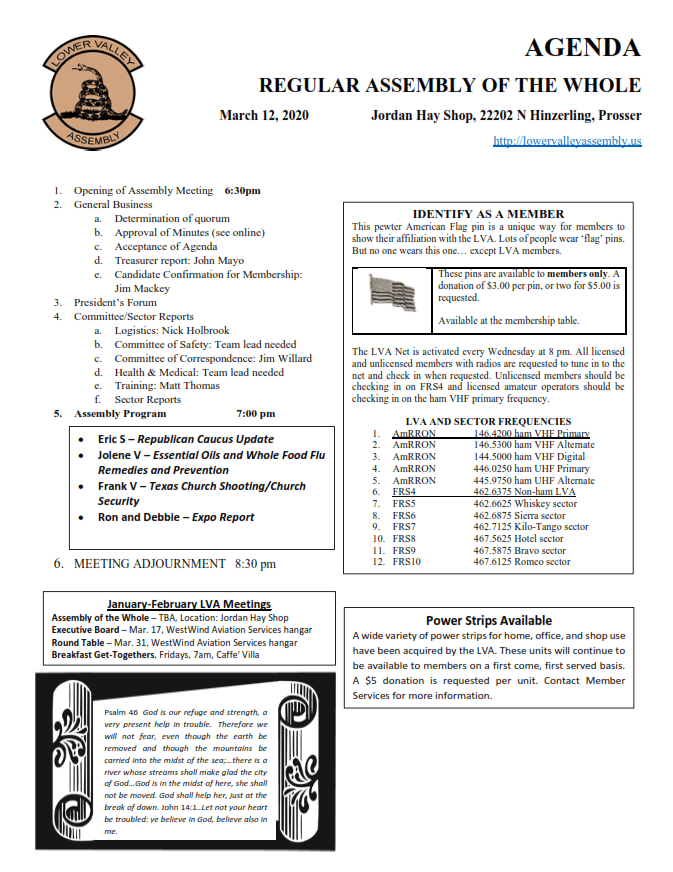
General Assembly – Cancelled – Thur. March 12, 2020

Update: This meeting has been cancelled because of coronavirus concerns. We will try to post the information that the speakers were going to share.

Post relating to the essential oils for health/prevention presentation.

Post relating to the church shooting/security presentation.

Basics of Herbal Medicine webinar information.

The next General Assembly of the Whole will be held on Thursday, March 12th, 2020 at 6:30 p.m. at 22202 N Hinzerling Way, Prosser.

Click here to download a printable PDF copy of the agenda.

What’s Happening in Lombardy from an ICU Doctor

Dr. Daniele Macchini of Bergamo, Italy posted an update on Facebook on how conditions are in the hospitals there. It was translated into English and posted on twitter. (h/t Aesop) There are also reports that retired doctors have been asked to come back to work, and nursing students have been graduated early in order to deal with the health system crisis.

“After much thought about whether and what to write about what is happening to us, I felt that silence was not responsible. I will therefore try to convey to people far from our reality what we are living in Bergamo in these days of Covid-19 pandemic. I understand the need not to create panic, but when the message of the dangerousness of what is happening does not reach people I shudder. I myself watched with some amazement the reorganization of the entire hospital in the past week, when our current enemy was still in the shadows: the wards slowly “emptied”, elective activitieswere interrupted, intensive care were freed up to create as many beds as possible. All this rapid transformation brought an atmosphere of silence and surreal emptiness to the corridors of the hospital that we did not yet understand, waiting for a war that was yet to begin and that many (including me) were not so sure would ever come with such ferocity. I still remember my night call a week ago when I was waiting for the results of a swab. When I think about it, my anxiety over one possible case seems almost ridiculous and unjustified, now that I’ve seen what’s happening. Well, the situation now is dramatic to say the least. The war has literally exploded and battles are uninterrupted day and night. But now that need for beds has arrived in all its drama. One after the other the departments that had been emptied fill up at an impressive pace. The boards with the names of the patients, of different colours depending on the operating unit, are now all red and instead of surgery you see the diagnosis, which is always the damned same: bilateral interstitial pneumonia. Now, explain to me which flu virus causes such a rapid drama. And while there are still people who boast of not being afraid by ignoring directions, protesting because their normal routine is”temporarily” put in crisis, the epidemiological disaster is taking place. And there are no more surgeons, urologists, orthopedists, we are only doctors who suddenly become part of a single team to face this tsunami that has overwhelmed us. Cases are multiplying, we arrive at a rate of 15-20 admissions per day all for the same reason. The results of the swabs now come one after the other: positive, positive, positive. Suddenly the E.R. is collapsing. Reasons for the access always the same: fever and breathing difficulties, fever and cough, respiratory failure. Radiology reports always the same: bilateral interstitial pneumonia, bilateral interstitial pneumonia, bilateral interstitial pneumonia. All to be hospitalized. Someone already to be intubated and go to intensive care. For others it’s too late… Every ventilator becomes like gold: those in operating theatres that have now suspended their non-urgent activity become intensive care places that did not exist before. The staff is exhausted. I saw the tiredness on faces that didn’t know what it was despite the already exhausting workloads they had. I saw a solidarity of all of us, who never failed to go to our internist colleagues to ask “what can I do for you now?” Doctors who move beds and transfer patients, who administer therapies instead of nurses. Nurses with tears in their eyes because we can’t save everyone, and the vital parameters of several patients at the same time reveal an already marked destiny. There are no more shifts, no more hours. Social life is suspended for us. We no longer see our families for fear of infecting them. Some of us have already become infected despite the protocols. Some of our colleagues who are infected also have infected relatives and some of their relatives are already struggling between life and death. So be patient, you can’t go to the theatre, museums or the gym. Try to have pity on the myriad of old people you could exterminate. We just try to make ourselves useful. You should do the same: we influence the life and death of a few dozen people. You with yours, many more. Please share this message. We must spread the word to prevent what is happening here from happening all over Italy.”           – Dr. Daniele Macchini.

“I finish by saying that I really don’t understand this war on panic. The only reason I see is mask shortages, but there’s no mask on sale anymore. We don’t have a lot of studies, but is it panic really worse than neglect and carelessness during an epidemic of this sort?”

Judge Napolitano: Repeal the Patriot Act

From Judge Napolitano at the Tenth Amendment Center – Repeal the Patriot Act.

I have been writing for years about the dangers to human freedom that come from government mass surveillance. The United States was born in a defiant reaction to government surveillance. In the decade preceding the signing of the Declaration of Independence, the villains were the Stamp Act and the Writs of Assistance Act. Today, the villain is the Patriot Act.

Here is the backstory.

In 1765, when the British government was looking for creative ways to tax the colonists, Parliament enacted the Stamp Act. That law required all persons in the colonies to purchase stamps from a British government vendor and to affix them to all documents in one’s possession. These were not stamps as we use today, rather they bore the seal of the British government. The vendor would apply ink to the seal and for a fee — a tax — impress an image of the seal onto documents.

All documents in one’s possession — financial, legal, letters, books, newspapers, pamphlets, even posters destined to be nailed to trees — required the government stamps.

How did the British government, 3,000 miles away, know if one had its stamps on one’s documents? Answer: The Writs of Assistance Act. A writ of assistance was a general warrant issued by a secret court in London. A general warrant does not specifically describe the place to be searched or the person or thing to be seized. It merely authorized the bearer — a civilian or military government official — to search where he wished and seize whatever he found.

The use of writs of assistance ostensibly to search colonial homes for stamps produced an avalanche of opposition that often turned to violence against the stamp vendors. The sheer cost of invading private homes fueled fears that the true purpose of the tax was not to generate revenue — though the king always needed cash — rather, it was to remind the colonists that the king was sovereign and his agents and soldiers could enter colonial homes on a whim.

Parliament repealed the Stamp Act in 1766, but it had caused lasting harm to the king. Harvard Professor Bernard Bailyn has estimated that by the late 1760s, one-third of the colonists favored secession from Great Britain, either peaceful or violent.

In 1789, six years after the American Revolution was won, the 13 colonies that had seceded combined into the United States of America under the Constitution. Two years later, the Bill of Rights was ratified, the Fourth Amendment of which was expressly written to prohibit general warrants — to assure that the new government would not and could not do to Americans what the British government had done to the colonists.

That assurance was manifested in the amendment’s requirements that only judges can issue search warrants, which must be based on probable cause of crime and which must specifically describe the place to be searched or the person or thing to be seized.

The history of the United States is the history of the growth of government and the loss of personal liberty. Thankfully, we eradicated slavery and recognized the equality of all people, irrespective of race or gender. Yet, in times of crisis, we have supinely permitted the federal government to invade our privacy on a scale never approached by the folks who brought the Stamp Act to our ancestors.

After 9/11, the George W. Bush administration offered the Patriot Act to Congress. It was crafted in secrecy and enacted in infidelity to the Constitution. Members of the House of Representatives had 15 minutes to read is 300+ pages and no time for serious floor debate. The one senator who spoke out against it was driven from office.

Section 505 of the Patriot Act permits federal agents to bypass the requirements of the Fourth Amendment and to issue their own search warrants. Those agent-written warrants are not based on probable cause of crime but rather on a representation by one agent to another of governmental needs — the same lame standard used by the secret London courts that issued writs of assistance.

Since 2001, federal agents have issued more than 300,000 of these search warrants — which they call National Security Letters — to custodians of financial records. In 2004 alone, 56,507 agent-written search warrants were issued. Those custodians include financial institutions, telecom providers, computer service providers, supermarkets, credit card issuers, health care insurers and providers, legal service providers, local and state governments, and even the Post Office.

The very concept of one federal agent authorizing another to seize records is antithetical to the Fourth Amendment and repugnant to the American Revolution.

I am writing about this now because a section of the Patriot Act will expire on March 15, and many congressional liberals and libertarians — even a few conservatives still bruised at the governmental surveillance of candidate Donald Trump in 2016 — have been contemplating structural changes to this pernicious law.

Section 215 — which is about to expire — is as fatal to freedom as is section 505. It permits designated federal judges to issue general warrants based on the old writs of assistance standard of governmental need. One of those judges signed a search warrant for the telephone records of all Verizon customers in the U.S. — at the time, 115 million of them.

Both 215 and 505 are weapons of mass surveillance and should be repealed. They are instruments of a totalitarian government, not of free people. They defy the Constitution. They presume that our rights are not natural but come from a government that can take them back. Mass surveillance produces a state that knows more about us than we do about it — one that will slowly consume our freedoms in the name of governmental needs. It already has.

Communications Academy, Seattle, Apr. 24-26, 2020 – Cancelled

UPDATE from Communication Academy 2020:

*** URGENT NOTICE ***

WE REGRET TO INFORM YOU THAT DUE TO THE RECENT COVID-19 OUTBREAK,
AND UPON ADVICE FROM THE WASHINGTON STATE DEPT. OF HEALTH,

THE 2020 COMMUNICATIONS ACADEMY WILL OFFICIALLY BE CANCELLED.

WE ARE TAKING THIS PRECAUTION TO PROTECT THE HEALTH AND SAFETY OF ALL OUR ATTENDEES

THOSE OF YOU THAT HAVE PREREGISTERED ALREADY WILL AUTOMATICALLY RECIEVE A FULL REFUND


The 2020 Communications Academy will be held on April 24-26, 2020 at South Seattle College.

The theme for 2020 is “If Cascadia rises, will we fall?!” This will be a theme for three years, leading up to the Cascadia Rising 2022 National Level Exercise.

The Communications Academy delivers education, resources and training opportunities focused on interoperability across the communications spectrum. The Communications Academy this year is three days of training and information on various aspects of emergency communications.  Amateur Radio Emergency Services (ARES©); Auxiliary Communications Service (ACS); EOC Support Teams; Radio Amateur Civil Emergency Service (RACES), Civil Air Patrol, Coast Guard Auxiliary, REACT, CERT and anyone interested in emergency communications are encouraged to attend.

Location:

South Seattle College

6000 16th Avenue S.W., Seattle WA 98106 in the Olympic Building (OLY) and Jerry Brockey Student Center, at the south end of the campus.

Free parking is available south of the buildings.

Schedules:

Friday, April 24 (masters level classes)

Saturday, April 25

Sunday, April 26

2020 Registration Fees:

Rates: 1 Day 2 Day 3 Day
Early Bird Rate (Feb 23 to Mar 29) $36.00 $64.00 $95.00
Normal Rate (Mar 30 to Apr 19) $45.00 $80.00 $119.00
Register at Door (After Apr 19) $55.00 $100.00 N/A*
*Friday Masters Classes Pre-Register Only


Discounts available for:
Early Registration beginning:
Military personnel (active or reserve)
Students (age 18 years or under)
Late registration at the conference is higher but very limited so don’t delay!

A buffet luncheon with a variety of sandwiches, salads, deserts, and beverages is included with your registration.


WA-GOAL: Legislative Update 2020-9, Mar. 6

From the Washington Gun Owners Action League:

GOAL Post 2020-9
Legislative Update from Olympia 6 March 2020

LAST WEEK OF THE REGULAR SESSION
BILLS MOVE
SB 6288 TRUE INTENTION EXPOSED
SB 6288 VEHICLE FOR GUN SAFETY?
RIGHTEOUS DEMOCRATS EMERGE

This is the last week of the 2020 regular legislative session. No later than midnight, Thursday, 12 March, the gavel comes down for the last time. The only bills remaining under consideration are those bills affecting the budget (amazing how many of those there are), and bills that were amended in the second chamber, and thus must be concurred in by the first chamber or a conference committee of both chambers reaches a compromise. Most of the time over the next few days will be spent on conference meetings and floor votes – along with committee meetings to discuss planning between now and the next scheduled session (interim planning).

HBs 2467 (centralized background checks), 2555 (background checks “other”), and 2633 (court order/firearms surrender) all passed the Senate this week, but all were amended in the Senate and must receive a concurrence vote by the House. SB 5434 (day care center gun ban) and 6288 (firearm violence prevention) both passed the House, but again with amendments. So they go back to the Senate for concurrence.

HB 2947 (magazine ban) still sits in House Finance. Because it contains fiscal provisions (magazine buyback), it can still be acted on at any time.

SB 6288 is supposed to create a committee to address gun VIOLENCE prevention measures. But the language in the bill says a grant may be made to “implement an evidence-based firearm reduction initiative.” Section 6, paragraph (4)(b). That’s FIREARM REDUCTION, not FIREARM VIOLENCE REDUCTION. Convenient slip of the tongue. And therein lies the true intent of the bill. Look for gun control groups to file for grants.

WE NEED TO DO THE SAME, to promote gun safety training. The good guys can apply for grants as well.

Several righteous Democrats showed their true loyalty to their oath of office during the votes on SB 6288. In the Senate, Senators Sheldon, Hobbs, Takko and Van De Wege remained true to their oath. In the House vote, Representatives Brian Blake, Dave Paul and Mari Leavitt all held firm with gun owners. Paul and Leavitt are new to me. But I used to work with Sheldon, Takko, Hobbs, Van De Wege and Blake when all were in the House many years ago.

BILL STATUS/GOAL POSITION:
(only bills still in play are listed)

HB 1010 WSP destruction of firearms Senn (D-41) S. RULES OPPOSE
HB 2305 Expands firearm prohibition re: protection orders Doglio (D-22) S. RULES OPPOSE
HB 2467 Centralized firearm background checks Hansen (D-23) S. PASSED NEUTRAL
HB 2555 Background checks for “other” firearms Goodman (D-45) S. PASSED OPPOSE
HB 2622 Court order non-compliance, firearm surrender Kilduff (D-28) S. PASSED OPPOSE
HB 2623 Firearm prohibition, certain offenses Walen (D-48) S.. RULES OPPOSE
HB 2947 Ban high capacity magazines/buy back Valdez (D-43) H. Finance OPPOSE

SB 5434 Expands gun free zones to day cares Wilson, C (D-30) H. PASSED OPPOSE
SB 5782 Spring-blade knives Zeiger (R-25) H. RULES SUPPORT
SB 6288 Office of firearm violence prevention Dhingra (D-45) H. PASSED OPPOSE

HB = House bill, SB = Senate bill. L&J = Law & Justice, CR&J = Civil Rights & Judiciary, PubSaf = Public Safety, HC = Health Care, H. K-12 = House Early education, Aprop = Appropriations, Fin = Finance, W&M = Ways & Means “S” before a bill number indicates Substitute (amended).

PUBLIC HEARINGS SCHEDULED:
None scheduled

LEGISLATIVE HOT LINE: You may reach your Representatives and Senator by calling the Legislative Hotline at 1-800-562-6000. Toll free!!! The hearing impaired may obtain TDD access at 1-800-635-9993. Also toll free!!!

1-800-562-6000 TDD 1-800-635-9993

OTHER DATA: Copies of pending legislation (bills), legislative schedules and other information are available on the legislature’s web site at “www.leg.wa.gov“. Bills are available in Acrobat (.pdf) format. You may download a free version of Adobe Acrobat Reader from Adobe’s web site (www.adobe.com). You may also obtain hard copy bills, initiatives, etc, in the mail from the Legislative Bill Room FREE OF CHARGE by calling 1-360-786-7573. Copies of bills may also be ordered toll free by calling the Legislative Hotline at (800) 562-6000. You may also hear floor and committee hearing action live at www.tvw.org (you need “RealAudio” to do this, available free at the TVW web site).

By reading the House and Senate “bill reports” (hbr, sbr) for each bill, you can see how individual committee members voted. By reading the “roll call” for each bill, you can see how the entire House or Senate voted on any bill. The beauty of the web site is that ALL this information is available, on line, to any citizen.

Upcoming WAC gun show(s):
Monroe 28-29 March
Puyallup Pavilion 4-5 April

“The right of the individual citizen to bear arms in defense of himself, or the state, shall not be impaired, but nothing in this section shall be construed as authorizing individuals or corporations to organize, maintain or employ an armed body of men.”

Article 1, Section 24
Constitution of the State of Washington

Dr. Luks on Covid-19 Personal Risk vs Systemic Risk

The following is a post from orthopedic surgeon Dr. Howard Luks, MD, on Facebook about the difference between the personal risks of the novel coronavirus and the looming systemic risk. Most people have a pretty low personal risk to worry about the virus, but the systemic risk of an overwhelmed health care system is danger in itself.

COVID-19 Update: 3/8/20; 6AM

Confusion and messaging…. Personal v Systemic Risk:

Many people have had trouble grasping the issues we have covered as they try to make sense of it in the context of what they see on TV or read in print media.

Much of what the experts have been discussing is in fact accurate. Your “personal” risk remains very low. The risk to your children’s health is very low. So, their messaging is accurate… but incomplete. The message should be clear… your personal risk is low… period. No one is debating that. The issue that you’re not reading about is “systemic risk”.
The AHA or American Hospital Association is starting to discuss the systems side … see the second picture below for their estimates.

Personal risk aside, the issue that we need to confront, and soon, is the concept of systemic risk. I am referring to the healthcare system. Let’s dive into this again.
An example … Here are some numbers out of Italy:

10 % Lombardy doctors are infected.
At least 1060 patients are self-isolating at home
At least 2394 are hospitalized
At least 462 are in intensive care
197 have died.

The Italian Society of Intensive Therapy declared today: “It might be necessary to limit the age of people who can enter intensive therapy to preserve resources for those having more chances of surviving”. In other words, people who are more at risk will be left to die.

THIS IS WHAT SYSTEMIC RISK LOOKS LIKE.

~ Doctors/nurses getting sick: fewer to care for high numbers of patients.
~ 462 in an ICU…. and we are still very early in the spread of the infection stage. Italy will shut down large cities soon… but it will be too late. How many ICU beds do you think we have available in your community?
~ 2400 hospitalized. In the US, on average, hospitals run 65% full. In many regions of the country, mine included, that number is far higher.
~ Let’s conservatively assume that there are 2,000 current cases in the US today, March 8th. This is about 8x the number of confirmed (lab-diagnosed) cases. We just do not have the ability to test people. Period.
~ Given an R0 of 2( meaning that one person infects two people), and a doubling time of 6 days (one infection becomes two, two becomes 4, etc)
~ That means we’re looking at about 1 Million US cases by the end of April, 2 Million by ~May 5, 4 Million by ~May 11, and so on.
~ yes… math is wonky. and exponential math even more so.

Here are the current models from the AHA: Assumptions are actually conservative. Fatality rate assumption only 0.5%, etc. If that rate rises due to strained resources ….

96,000,000 infections
4,800,000 hospitalizations
1,900,000 ICU admits
480,000 deaths

Compare that to the numbers for the flu ..

35,500,000 infections
490,600 hospitalizations
49,000 ICU admissions
34,200 deaths

This is NOT the flu. Again… yes, your personal risk is low. However, the systemic risk to our healthcare system is huge. So we can change this trajectory… keep reading.

Assume there are~ 1 Million hospital beds in the US, therefore ~ 300,000 hospital beds (not ICU beds) are available in the US (assuming 65% of capacity)
~ It does not take long before our beds are full, and our resources are under strain.

To recap… your personal risk IS currently very low. If you are a young healthy adult your risk of dying from COVID-19 is lower than your risk of driving around today. That risk increases in people with diabetes and hypertension. Men are at slightly higher risk than women, and people over 80 have the greatest risk of dying (~15%).

So the messaging that you are viewing or reading is in fact accurate. Your personal risk is low. No need to panic.

Hospitals are not full right now… hospital resources are available to you. Only a few physicians, nurse, and health care workers are sick. So if you become infected now you will likely do fine.

What happens in a month when 2 Million people may be infected? Our healthcare system may not be able to offer the same level of care to those who need it. Therein lies the risk. This is systemic risk. This is why we need to stretch and bang down the “epidemic curve” or the rate of spread. The healthcare system CAN deal with many sick people arriving over a longer period of time. So we need to stretch the time course out. See the first picture below.

Why we should close schools and dramatically limit social contact via gatherings, events and conferences. It boils down to math… and the need to flatten the epidemic curve.

This is a great article that goes into the numbers and models with respect to lives saved by closing schools, working from home, cancelling gatherings, etc. It is well worth the 5 minutes it takes to read. The third picture below shows the detailed math of how closing schools etc will save lives.

https://www.linkedin.com/…/whats-your-risk-dying-covid-19…/…

So if your school district closes… don’t get on their case. It’s in the best interest of community as a whole. The risk to your child’s health in all of this is negligible. This is not a personal risk issue! I’m watching my own town’s facebook page explode with fear, personal attacks and political rants. It’s a shame. This is not a time for political wrangling. This is the time to act to keep our healthcare system running and our healthcare workforce well to be able to care for you when you or a family member becomes ill.

Yes, hand washing is critical … but it’s time to consider what else we can do to slow the spread. For your communities sake.
– we shouldn’t be going to indoor tournaments
– we shouldn’t be going to concerts
-conferences should be cancelled
– etc
Again… not because your individual risk is high… but because we need to slow the spread to minimize the risk of a systems failure.

For those interested in a deeper dive into the mathematical modeling of the spread of COVID and how it will affect our resources you can read this thread … https://threadreaderapp.com/thread/1236095180459003909.html

Beauty Beyond Bones: What If We Were as Fervent About the Rest of Life as COVID19?

Caralyn at Beauty Beyond Bones shares a few thoughts on the coronavirus frenzy and how wonderful it would it would be if people attacked the rest of their lives with the same fervor – Coronavirus or Apocalypse?

Somebody call Will Smith because thanks to the Coronavirus, it’s like a scene from an apocalyptic blockbuster out here in these streets.

Honestly – New York City is turning into a chaotic nightmare.

People are walking around in masks, I can’t tell you the number of mass emails I’ve gotten instructing me to wash my hands (you’re breaking some new ground there, Copernicus), and everyone on the subway is actively sizing people up, trying to determine if they’re riding with Patient Zero.

And apparently, for good reason. You know it’s bad when my father — King of not-freaking out/calm-cool-&-collected/never-over-reacter — sends me a Twitter thread about the potential catastrophic impact COVID-19 could have if there’s an actual outbreak.

Sometimes, I think there’s more fear-mongering than facts circulating in the media around things like this, but respecting my dad’s concern…I caved and heeded his advice.

I went to 4 different Walgreens yesterday to buy my doomsday kit: cleaning supplies, toilet paper, bottled water, hand sanitizer, etc. – and I kid you not — all four stores were completely sold out of – not only cleaning products – but also hand sanitizer and antibacterial soap!! We’re talking empty shelves!

Image: ABC

And – thanks to the law of supply and demand – I ended up paying a whopping $24 on Amazon for ONE canister of Lysol disinfectant wipes.

If I wasn’t coughing before, I certainly did after that price tag.

The country is freaking out.

And the fervor with which people are preparing for a potential doomsday is unprecedented. It’s like Y2K all over again. People are stock piling toilet paper and paper face masks. I met a guy at a party last night who was side-hustling those blue paper masks for $25 bucks a pop!!

It’s a frenzy. And it’s damn impressive, to be honest.

And, sitting back, watching this whole thing unfold, I couldn’t help but think to myself — what would happen if we were attack other areas of our lives with this same intensity?

People are snatching up anything “antibacterial” like their life depended on it. Bleach? Lay it on me. Antimicrobial? Here, take my first born.

There is a desperation. A determination. A devotion. Granted, it’s driven by self-interest.

But what would happen, if we were to, say, attack recovery with that same life-or-death intensity?

How would it be if we were to pursue our relationship with God with that same urgency? To save our souls, with the same tanacity as fighting to save our lives?

Or what if we were to take that frenzied energy and put it towards helping other people, loving our friends, pursuing goals and dreams, working to save the environment – or the unborn?

There’s so much complacency these days – so much luke-warmness that, quite frankly, it’s refreshing to see that, as a society, we have it in us to actually care about something. That we can set aside our differences and rally together to defeat a collective threat.

Pity, that it took the coronavirus to bring that out of us.

I pray that this corona virus be contained. It breaks my heart to see what’s happening overseas, and to hear the death toll continues to rise.

I hope that with the arrival of spring, we can kick this virus, and move forward to days where the threat of a hand sanitizer barter system isn’t on the brink of reality.

Because in addition to ruthlessness in the CVS aisles, COVID-19 has also brought out the absolute worst in people: Despicable acts racism and overt prejudice against our brothers and sisters from China are sadly a reality, and people are letting fear cloud their judgement and influence their words and actions.

Image: Forbes

It’s gross and completely unacceptable.

So, I think we all need to take a collective deep breath. Act with common sense — yes, wash our hands — Act with prudence when it comes to staying healthy.

But try to channel this panicked energy into positive intensity towards things that also matter.

Starting with kindness. How about that.

Backdoor Survival: Getting the Most Out of Your Food Supply

Samantha Biggers of Backdoor Survival has an article up addressing how to stretch your food supplies, whether it be during a quarantine or a long emergency.

Something that a lot of us don’t always pay the most attention to is getting the most out of meals and supplies. Sometimes it doesn’t seem worth our time and from a financial perspective, there are times when this actually has a ring of truth to it.

With the current state of affairs, a lot of us may need to start thinking of ways to be more frugal and less wasteful with the supplies we have on hand, especially when it comes down to food.

Although we have tried to develop good habits over the years, Matt and I have found ourselves being even more careful about using up leftovers and being creative with cooking.

We have chickens, cats, and dogs so even if something drops to the floor or there is a small amount of waste, we usually can use it to supplement the diet of our animals. In the case of chickens, they can recycle that potentially wasted food and parts that you don’t typically eat such as carrot tops and fruit cores, into delicious eggs, and hopefully in the spring, baby chicks.

Cook something delicious and basic and use the leftovers for other meals.

Some people really don’t like leftovers. Part of the reason for this is that some foods truly are better if they are eaten right after cooking. The key is to plan out meals so that you don’t have to experience this as much.

One example I can think of is soups and stews that have noodles in them. How many of us have cooked a big pot of minestrone soup or similar and went back and reheated it the next day to find that the noodles had disintegrated or at least became very mushy?

Twice Baked Potatoes

(Note: At the end of the recipe I have a casserole version of this recipe that uses boxed mashed potato flakes in case that is what you have on hand or you run out of potatoes from your pantry.)

This is a recipe that is inexpensive and delicious at the same time. My husband learned this recipe from his Mom and he cooked it for me and still does so regularly. It is also a great way to make use of leftover baked potatoes. Sometimes we will just cook a whole baking tray full of potatoes to use for many different dishes throughout the week. It saves on cooking fuel and makes it easy to cook a lot of wonderful meals.

To make twice baked potatoes you need the following:

Medium To Large Potatoes

The ingredients below can be added in any combination, depending on what you have on hand. If you have some leftover meat from another meal, then this is an excellent dish to make use of that!

Meat (Optional but adding it makes this dish a meal in itself)

Cheese

Onions (This can be dried onions like chives or dehydrated onions or you can fry them up with meat)

Mushrooms

A little milk, yogurt, or broth to cream some potato filling

To bake the potatoes, first, wash them well and place them on a baking sheet. Spritz or rub with oil. I like to use grapeseed oil for this. Salt the outside. Poke a few holes in the top of each with a knife or fork. Bake in a preheated oven at 325 F for 45 minutes to an hour depending on the size of the potato. Stick a toothpick, fork or similar into them to make sure they are soft in the middle.

Allow to cool enough to handle. Scoop out the inside as much as possible and put it in a stockpot or other small cooking pot. You want enough room to mix in any of the additional ingredients listed in the recipe above. You can also use a mixer if desired. That may be the way to go if you are doing these for a crowd.

Mash the scooped out potatoes or use a mixer to whip them with enough milk, yogurt, or broth to get them a consistency that you can scoop into potato skins. Add in any meat, cheese, veggies, etc. We usually shred cheese. You can also use powdered cheeses if that is what you have on hand.

Spoon your filling into the potato skins. Top with cheese if desired. Parmesan works well but you can also use any other type you would like.

Bake in a 350 F oven until the cheese starts to brown. Serve with sour cream, green onions, bacon, salsa or any other additional toppings you desire.

This is a very versatile recipe as you can see. There are countless combinations you can use for fillings and toppings. Think about what leftover veggies or meats you have and use them first.

Baked Potato Casserole Alternative If You Don’t Have Baking Potatoes

Make mashed potatoes from the dry boxed variety. Mix in any of the ingredients just as you would for the baked potato method above. Butter or oil a pan and spread mixture into it. Top with shredded cheese or dry Parmesan. You can sprinkle bacon crumbles on top too if you have them. Bake until cheese is as golden as you like it.

Put out smaller portions on plates. People can always go back for more. If you serve dinner in a serve-yourself manner, then have a discussion with everyone about this and encourage good habits.

Putting too much food on each person’s plate can result in waste. After all, no one is going to want to put what is left off of everyone’s plate back into the pot. If someone has a lot of leftovers on their plate then perhaps using a Tupperware and labeling it with their name so they can eat it for lunch the next day is a good idea? Just a few thoughts to prevent the age-old problem of too much on the plate sometimes… (continues)

Click here to read the entire article at Backdoor Survival.

FEE: Coronavirus May Lead to “Mass Homeschooling”

From the Foundation for Economic Education comes this article on how the coronavirus pandemic could lead to more homeschooling because of school closures.

s fears of coronavirus mount around the globe, cities and countries are taking action to prevent the new respiratory virus strain from spreading. While the virus has not yet hit hard in the United States, government officials and health agencies have enacted response plans, corporations are halting travel abroad, and education leaders are grappling with what a widespread domestic outbreak of the virus could mean for schoolchildren.

In countries where the virus is active, schools have been shut down and children are at home, learning alongside their parents or through online education portals. The New York Times reports that US schools have been prompted this week by the Centers for Disease Control and Prevention to prepare for a coronavirus epidemic that could shutter schools and require alternate forms of teaching and learning outside the conventional classroom. According to Kevin Carey of the New America think tank, who spoke to the Times, coronavirus in the US could lead to “a vast unplanned experiment in mass home-schooling.”

It’s unfortunate that it takes a viral epidemic to spotlight the many alternatives to conventional K-12 schooling.

Indeed, in Hong Kong this is already occurring. The coronavirus outbreak led to orders for schools to be shut down in the city for two months, affecting 800,000 students. An article this week in The Wall Street Journal declares that “coronavirus prompts a whole city to try home schooling,” noting that in Hong Kong many children are completing lessons virtually through online learning platforms or receiving live instruction from teachers through Google Hangouts or similar digital tools.

It’s unfortunate that it takes a viral epidemic to spotlight the many alternatives to conventional K-12 schooling. Not only is homeschooling widely popular in the US, educating approximately two million children nationwide, but other schooling alternatives, such as virtual learning, microschooling, and hybrid homeschooling continue to sprout.

Interest in online learning options is sure to increase as the coronavirus spreads, but other in-person schooling alternatives are also likely to gain notoriety.

Virtual learning programs such as the Florida Virtual School, founded in 1997 as the nation’s first fully online public high school, and K12, Inc., one of the largest providers of virtual schooling, enable young people to take a complete course load and earn a high school diploma without sitting in a traditional classroom environment. Supplementary online programs, such as Khan Academy and Outschool, expand learning options and allow young people to dig deeper into topics that interest them or those in which they may need some additional help.

Interest in online learning options is sure to increase as the coronavirus spreads, but other in-person schooling alternatives are also likely to gain notoriety. Microschools, for example, are small, home-based, multi-age learning environments that act like a one-room schoolhouse, typically with no more than 8 to 12 students at a time. Prenda is a fast-growing network of these branded, in-home microschools, with more than 80 schools in Arizona alone serving some 550 students, and plans to expand out-of-state.

Like microschools, hybrid homeschooling programs and small, community-based classes for homeschoolers are also gaining popularity and may be swept into the limelight if conventional schools are forced to temporarily close. Operating with small, age-mixed groups of children, these hybrid models and classes offer an alternative to institutional schooling, avoiding large classrooms and crowded buildings. I have recently launched a marketplace platform, Unschool.school, that connects educators, parents, and learners to these homeschooling models and out-of-school learning experiences, fostering small group, in-person interactions in local community spaces, such as art studios, makerspaces, and spare dining rooms.

These emerging learning options outside of traditional schooling show not only that “mass homeschooling” is possible but also that it may be highly desirable. Personalized learning, small group interactions that build community and connection, and education without the coercion inherent in standard schooling are beneficial whether or not a pending epidemic is what exposes families to these education possibilities. Mass homeschooling may be just the cure we need.

Forward Observer: A Brief Q&A on COVID-19 Preparations

Chief intelligence analyst Sam Culper at Forward Observer posts a brief Q&A on coronavirus issues/preparation.

Hey Gang – I’m getting enough questions that it’s more economical for me to write a blog post rather than trying to answer them individually.

Question: Is COVID-19 that big of a threat?

Answer: For the average American, the greater risk is actually the financial and economic impact of COVID-19.

I’m not concerned about catching COVID-19, as 80 percent of cases are mild. The older you are and the worse shape you’re in, the more you should be concerned.

If you’re reasonably healthy, then you have less to worry about.

I’m way more concerned about impacts to the economy.


Q: On “panic buying” — is it prudent to go buy a month’s worth of supplies if I don’t already have them?

A: Yes, I believe that’s prudent. Here’s why:

Health experts, risk management firms, and financial asset managers are warning that COVID-19 outbreaks will likely last for months.

– Morgan Stanley advised clients that economic disruption could last into Q3, which is July to September.

– Supplier delivery times have started to tick up, which is bad news for just-in-time inventory. China is struggling to resume production, which will be self-evident in the coming weeks.

– Goldman Sachs is warning of “severe” global supply shortages if China can’t get back to normal by the end of the month. Meanwhile, production facilities in China’s coastal regions are operating at 70-80 percent capacity, but many factories are still experiencing labor shortages.

– Prominent hedge fund and asset managers have warned about coming supply and demand shocks.

– The Federal Reserve made an emergency cut to interest rates this week, and the futures markets are pricing in another rate cut this month. What exactly is the Fed trying to get ahead of?

There’s no need to panic and the world isn’t ending. In light of the data, however, it’s prudent to get what you need soon or face the risk of shortages later.

As we’ve seen in Washington, Arizona, California, and other states that experience community outbreaks, there will be more panic buying. There will be more lines at Costco, more purchase limits, and more empty shelves.

As one friend put it, buying things today is preparing for the panic to come, not “panic buying.” Preparing now for anywhere between two to four weeks is prudent.


Q: Will the U.S. be as hard hit as China has been?

A: Right now, that looks unlikely in the near term. The fact is that no one knows just how bad this will get. I’m confident in saying that conditions will get much worse before they get better.

Chinese officials initially ignored the outbreaks, which exacerbated the problem.

You may have seen news that major corporations like Google, Microsoft, Goldman Sachs, Boeing, and others are cancelling events. Expect a lot more of that.

Domestic air travel ticketing is down 20 percent through May. Expect more disruption to the travel and tourism industry. (In fact, airline executives met with Vice President Pence this week to discuss air travel during the COVID-19 epidemic.)

We have a far better healthcare system than China does, but that doesn’t mean we’re immune to overcrowded and understaffed medical facilities. According to epidemiologists, one bad community outbreak could quickly overwhelm local or regional medical infrastructure.


Q: But, but, but more people die from common influenza.

A: That’s not a question, but you’re right.

We expect influenza every year. Influenza has a season. We currently don’t know how long COVID-19 outbreaks will last, nor do we fully understand the extent of the economic or psychological impacts.

I’m reading through these earnings guidance calls from Fortune 500 companies and they don’t know how to estimate the financial impact of COVID-19 for Q2 of this year. There’s simply too much uncertainty.

Professional number crunchers who can accurately forecast how much their company will earn in the next quarter (April-June) are shrugging when asked about the impact. If they don’t know, then certainly no one else does.

As far as I can tell, health officials have said this will last for months, and some have said it will last into next year. That’s a long time for the type of disruption we’re already starting to see.

I’ve seen some people say that warmer weather will kill COVID-19. I look at Australia, which is coming out of summer and heading into fall, and they’re accumulating more COVID-19 cases. It’s warmer there than it is here, and I’m in Texas.

The bottom line in all of this is that authorities are trying to keep the lid on panic.

The absolute best ways to avoid panic is to have realistic expectations of the future so you’re not surprised, and to be prepared.

I can’t help you with your day to day preparations, but I CAN HELP YOU gain a better perspective on the future.

I can help you to understand what’s more likely and less likely to happen. I can provide you with intelligence that reduces your uncertainty about the future.

Try me out: https://members.forwardobserver.com


The Medic Shack: COVID-19

Chuck at The Medic Shack shares his thoughts and preparations for the COVID-19 virus sweeping the world.

The Coronavirus, Covid-19 is rampaging around the country. People are dying in America.

Okay. Got your attention now? The above statement is true. It is NOT as bad as it sounds. As of 3-4-2020 11 people have died from Covid-19.  But its the delivery of the sentence that makes it menacing.

The Covid 19 virus is spreading. We are having community acquired illnesses happening We have confirmed deaths in the US from it. We have people panicking over it. People are scared and are grasping at straws of hope from some real unsavory news sources. I do not have the answers people want. Hell I’m no doctor nor epidemiologist. What I am, is a person who has seen disease break out in the 3rd world and here in the US. That has treated people as a US Army Medic, Paramedic and instructor.

So lets get to what we do know.

Coronaviruses are a group of viruses that can cause a range of symptoms including a runny nose, cough, sore throat and fever. Some are mild, such as the common cold, while others are more likely to lead to pneumonia. They’re usually spread through direct contact with an infected person. Other well-known coronaviruses include SARS and MERS

COVID-19 is similar to other respiratory illnesses and symptoms include a fever, dry cough, sore throat and headache. There may also be aches and pains, fatigue and, in some cases, vomiting and diarrhea.

While most cases are mild, some individuals may experience more severe symptoms such as shortness of breath and difficulty breathing, and may experience pneumonia in both lungs. Those with health issues or underlying conditions may also have a harder time recovering. The incubation period is still up in the air. From as little as 2 days to as much as 21. The “happy” medium is about 14 days.

It may 14 days or longer after exposure for symptoms to appear. It also appears to be contagious during the incubation period.

What’s the difference between a cold, a flu and COVID-19?

All three are respiratory illnesses but each is caused by a different virus. The cold is caused by the rhinovirus, the flu is caused by the influenza virus, and COVID-19 is caused by the novel 2019 coronavirus. All three can lead to pneumonia if complicated by other health issues or underlying conditions

The cold, flu and COVID-19 are all spread the same way, from close person-to-person interaction, though the cold and COVID-19 can also spread through airborne particles.

COVID-19 like a bad cold and the flu does it’s worse damage on those that have co-morbidity COPD, Uncontrolled Diabetes. Hypertension. Weakened immune system, overweight with general poor health. This is targeted to some dear friends I know and love. Overworked. Over stressed. Not caring for themselves. Not enough sleep. When you get weakened by health or life, your immune system is taxed.

If you add in ANY co morbidity to that you are at a high risk of getting ANY VIRUS.

Going back to one of my favorite movies, Pop Quiz hot shot You walk into a crowded grocery store. A shopper has coronavirus. What puts you most at risk of getting infected by that person? WHAT DO YOU DO???

Experts agree they have a great deal to learn, but four factors likely play some role: how close you get; how long you are near the person; whether that person projects viral droplets on you; and how much you touch your face. Also age and health are huge factors.

A virus by itself is immobile. It can not move on its own and it is to small to be moved by wind. It needs to catch a lift. A droplet of moisture, Dust. Dander from pets or people. That is why the masks come into play. No mask outside of a Level 3 or 4 suit from Fort Meade can stop a virus. They are on the average .1 to .17 microns. The best N95 can stop only to .3 microns Your surgical mask can stop particles of about 5 microns in size. N95s are in very short supply.

So short that hospitals are having a bit of a tough time to get them. And what new masks come off the line are not heading to Amazon or Home Depot. They are heading to the CDC and your health care facilities. Unless you read our article on the N95 mask, be aware that most people do not know how to properly seal one. N95 HEPA Mask

Am I worried?

To say I am not concerned about this bug would be a lie. But also I am not bouncing like a fork dropped in a garbage disposal. It is something to keep a very close eye on. Today 4 March 2020, CNBC released this headline

Chinese scientists identify two strains of the coronavirus, indicating it’s already mutated at least once.

The headline is eye catching. But when you read into it, it is not as inflammatory as it seems. But it does raise some questions in my tin foil hat covered mind.

What can we do to protect ourselves?

  • Wash your hands often with soap and water.
  • Cover your mouth and nose with your elbow or a tissue when you cough or sneeze.
  • Avoid touching your eyes, nose and mouth if your hands aren’t clean.
  • Avoid close contact with anyone who is sick.
  • Clean surfaces you often touch.
  • Stay home from work, school and public areas if you’re sick.

A lot of people have been comparing this to the flu. With out getting all into Med Speak, they are similar that they are viruses. But it ends there. Look at it this way/ Both a Malamute and a Husky are dogs. They come from the same climate. The look a bit alike. After that they are totally different. They replicate in a similar manner, but the attack the body in the same manner. The Covid-19 can live for a few hours on most surfaces., It is THOUGHT not CONFIRMED that it can last up to a few days under ideal conditions.

Disinfection.

This is where the chink in the armor of COVID-19 shows. Almost any disinfectant, that is applied according to its directions, will kill it. The old Standby of bleach will do it. For surfaces that can’t take bleaching Lysol. We have also found the old fashioned concentrate Lysol in the brown bottle. That stuff will kill ANYTHING!

For those that can’t take the harsh chemicals, embrace your hippy self!

For surface disinfection Essential oil such as Lemongrass, Cinnamon, Clove, Oregano, and Thyme are good choices for their reported antiviral properties . My wife likes to make her own consisting of 10 drops lemongrass oil, 10 drops of tea tree 10 drops peppermint. 4 ounces of 100 proof vodka and 2 ounces of Colloidal Silver. She places this in a sprayer and uses it to spray it on surfaces. No wiping. Let it dry on its own.

Colloidal Silver.

Good stuff. It is NOT the miracle drug that cures warts constipation Ebola freckles bad breath and bad complexions. Used and most importantly MADE correctly it is a good thing to have on hand. We use. And no we’re not blue!

Always use .999 pure silver, DO NOT USE STERLING SILVER! There is also .9999 pure but it is expensive and unnecessary. We use 1/8″ ribbon also called “bezel”.

Make Your Own Colloidal Silver

Fill a quart jar about 1/2″ from the top with distilled water and heat to boiling. The reason for this is because distilled water, not having any minerals in it, is a poor conductor of electricity. After being heated to near boiling, it will allow for the electrolysis to take place. DO NOT USE ANY OTHER TYPE OF WATER! Now make a hook on one end of each strip of silver (like a candy cane) and hang them on the edge of the jar and into the water, about an inch apart. Clip the two wires from the generator to the silver strips making sure that the clips do not touch the water or each other and that the strips do not touch each other!

You can tell when it has begun the process, you can see a what looks like smoke coming off of one the strips. If it doesn’t appear to be doing anything in a minute or so, scoot the wires a little closer together. If that still doesn’t work, sprinkle a few grains of table salt right in between the strips and it will take right off. Will it kill Covid-19? I can not answer that here. FDA rules. But we use it at home. A Damn good write up is on The Medic Shack Colloidal Silver

Hand washing.

Sounds goofy in a way. But a lot of people do not know how to wash their hands. Correctly. Now we’re not talking the surgical scrub I do every day. Just basic hand washing.

  • We Your Hands.
  • Use soap. Antibacterial is not necessary.
  • Scrub your hands while counting to 20. Make sure to get in between your fingers and your nails
  • Rinse completely.
  • Dry with a paper towel. SHTF paper towels will be like gold. Use a clean cloth towel and hang in the sun to dry. Viruses HATE ultraviolet light. Use a separate towel for each person. Seriously.
  • Use that paper towel or towel to turn off the faucet.

There are different schools of thought on using a towel to turn off the water. In the medical field we used to be taught that from day one. Today some say it doesn’t matter. YMMV.

Water temperature. It doesn’t matter. Up until 2 weeks ago, I told one of my best friends to use warm water. ANNNND some studies have been published and they all agree it doesn’t matter. The soap and water combination works either way.

Alcohol and hand washing

Alcohol based scrubs. I mentioned earlier that we use a product called Avagard for surgical scrubs. I also said that we do a real scrub first thing in the morning and after eating or going to the bathroom. What I didn’t mention is why we do those old style washing up. The reason is right above y’all, In hand washing. The scrubs kill bacteria. To a point. They kill viruses. To a point. Hand washing doesn’t kill them. It REMOVES them. And it will remove Covid-19

That is why I cringe when I see a porta potty with that little bottle of hand sanitizer, Yes its better than nothing. It is however a false sense of security. That fecal bacterial that ends up on EVERYONE’S HANDS is still there. They are weakened, but they are not killed. Something to think about.

A friend of mine who is marrying a Marine friend of mine.  I don’t know who to be more concerned about Sigurd getting civilized, or Jessica getting Uncivilized! She wrote this piece on a Facebook group:

Jessica Kozack The Soul Purpose

There is a lot of hype going on about the Novel CoronaVirus known as Covid-19. I wanted to discuss how to protect from viruses like Covid-19 and also the flu which is also going around. I find I always feel better when I am prepared. Aromatherapy can be quite effective in treating and preventing illness along with being supportive and healing while sick. I did have the flu a month ago. It was brought home by my daughter who caught it at a school fair and she proceeded to sneeze directly into my face uncontrollably.

I knew in that moment regardless of what I used or did I would catch it so I used aromatherapy to support us and prevent us from getting any secondary infection.

1) Wash hands thoroughly and often with good old soap and water

2) Make your own hand sanitizer with Vodka, Colloidal Silver, Aloe Vera, and essential oils that are antiviral

3) Make a cleaning and disinfecting spray using vinegar and water with essential oils and cleanse surfaces, etc multiple times a day in your home, work space etc

4)Diffusers are our best weapon for killing airborne viruses and treating respiratory illnesses. I have many diffusers and I recommend using them at this time in your home to kill virus bugs and support the immune system.

Pets and Oils

**Please be mindful of your pets and children when using essential oils. They should always be diluted and diffusers should not be located directly near your pets especially with the super bug killing essential oils as they are harsher. If someone is ill and you are using a diffuser with the super bug killer it is best to keep your pets out of this room. Pets will also walk away from a diffuser if it is to strong for them. Just be mindful.**

A diffuser works best if it turns on every 15mins with a timer and diffuses for a minute. You would need to get a timer for most diffusers.

Here is my list of essential oils.

Super Bug Killer oils a little goes a long way and never use undiluted:

Lemongrass

Cinnamon

Clove

Oregano

Thyme

Expectorant and Antiviral Oils:

Ravensara

Eucalyptus

Tea Tree (multipurpose bug killer)

Oils that soothe an inflamed respiratory tract:

Cedarwood

Frankincense

Pine

Spruce

Balsam Fir

Benzoin

Oils that support secondary bacterial infections and kill bacteria:

Rosemary

Peppermint

Lavender

Lemon

**Eucalyptus, Lavender, Cedarwood, Tea Tree, Lemon , Benzoin are safer less harsh oils to use around small children and Elderly.

If I am going to be dealing with a super bug I will have the harsh oils on hand and will use them safely and responsibly. When used safely

and responsibly they actually work most effectively and typically with no contraindications or negative impact.

Do not ingest essential oils they are 75-100x stronger than the plant, fruit, herb they are derived from. If you take anything internally keep it to herbs and supplements.

Used with permission from Jessica Kozack The Soul Purpose

And in closing:

We have talked about in past blogs on some of the herbs that MAY help fight off the virus TMS Post on Coronavirus 

By staying healthy, eating right and doing your best to avoid crowded places and sick people is one of the best ways to beat this. Do your normal prepper things that we always do. DO NOT GET CAUGHT UP IN THE PANIC. Right now there is not to much to panic about. Other than your 401K taking a massive dump at the market. Right now it is almost impossible to get ibuprofen, Tylenol, basic cold and flu medicines at the local stores. There is  for some reason there is a massive run on toilet paper at Costco.

You already had all that right? If not you have read our posts on cold and flu and other posts we have made on this? Good I thought so! Don’t panic. Do not over work yourself. And don’t get yourself all worked up over something out of your control. Stay out of crowds. If you feel sick STAY HOME. A lot of conferences around the country are being canceled. For good reason. As preppers we play it smart. Don’t forget that. Play it smart

Practical Self Reliance: Homemade Hand Sanitizer Gel

Ashley Adamant at Practical Self Reliance tells us how to make our own hand sanitizer gel.

Homemade hand sanitizer is surprisingly easy to make, and it’s a great way to fight germs when you can’t get to a sink to wash your hands.

Homemade hand sanitizer gel

Hand sanitizer is one of the first things to disappear during an outbreak, second only to face masks.  Just days after the first community transmission of COVID-19, shelves emptied as people suddenly rushed out to buy hand sanitizer.

I’ll admit it, I was one of those people that bought a bottle once the virus reached the US.

Hand sanitizer isn’t generally a part of our lives, and under normal circumstances, I’d rather just wash my hands regularly and rely on my strong immune system.

This flu season though, as I watch people sneeze their way down the aisles of the supermarket, I find myself wishing I had a little bottle in my pocket.

I found a bottle easy enough, but just days later the store shelves were empty and most people weren’t as lucky.

In truth, substitutes for commercial hand sanitizers are actually really easy to make.  The active ingredient is just rubbing alcohol, and so long as your homemade hand sanitizer is at least 60% alcohol, it’s effective when used properly according to the CDC.

Simply putting rubbing alcohol in a small spritz bottle will do the trick, so long as you thoroughly wet your hands, rubbing to get between your fingers and such.

That said, if you’re looking for a more elegant solution, I’ve found a few options for homemade purell substitutes.

What’s In Purell?

So for starters, what’s actually in purell anyway?

The ingredients list is pretty long, but once you decode it, it’s actually just three basic things:

  • Water ~ Still not sure why this is the first ingredient when it’s more than 60% alcohol?
  • Isopropyl Alcohol ~ The active ingredient that’s doing all the hard work.
  • Caprylyl Glycol ~ Skin conditioner
  • Glycerin ~ Antimicrobial properties, and natural skin conditioner
  • Isopropyl Myristate ~ Emmoliant that promotes skin absorption (for skin conditioners)
  • Tocopheryl Acetate ~ Vitamin e for skincare
  • Acrylates/C10-30 Alkyl Acrylate Crosspolymer ~ “is a synthetic ingredient used as a thickening agent, texture enhancer, film-forming agent, and emulsifier in cosmetics and personal care products.” (Source)
  • Aminomethyl Propanol ~ Buffer to adjust pH
  • Fragrance ~ With all that rubbing alcohol, this really helps sell it…

So in a nutshell, gel hand sanitizers are denatured alcohol, skin conditioners and some kind of gelling agent.  That’s it.

The skin conditioners are handy if you’re using it multiple times a day, and can help prevent dry hands. In truth they’re optional, and using a separate lotion works just as well to prevent dry skin.

Gelling agents are there to help the sanitizer sit neatly in your hand and prevents dripping, which in turn results in more people using it.  If it drips on your lap or makes a mess, you’re less likely to use it.  That said, they’re not actually sanitizing your hands…so also optional.

So the only thing sanitizing your hands is alcohol (and maybe the glycerine if you want to get technical).  The simplest option for an effective homemade hand sanitizer is simply rubbing alcohol (at least 60%) in a squirt or spray bottle.

That said, if you’d like to actually try to re-create a gel hand sanitizer with skin conditioners and a gel texture, read on….

How to Make Hand Sanitizer Gel

There’s a recipe circulating on the internet for a really simple homemade gel hand sanitizer that simply uses 2 parts 90+% rubbing alcohol and 1 part aloe vera gel.

My first thought was that with 2 parts alcohol it’d never be a “gel,” but I put it to the test…

Homemade hand sanitizer gel ingredients

The alcohol is doing the sanitizing work, and the aloe vera gel adds both skin conditioners and a gel-like texture, at least in theory.

Aloe vera gel, however, is actually mostly alcohol.  Or at least most of the bright green “after sun gel” bottles commonly available.  Their ingredients list stats exactly the same way as purell…water, denatured alcohol, glycerine, followed by a long list of stabilizers and gelling agents, with just a teeny tiny bit of aloe juice.

I doubt aloe gel is anywhere near the required 60% alcohol, but it is full of chemical gelling agents that work in the presence of alcohol (plus a few skin conditioners for good measure).

(It’s actually hard to make a gel from alcohol.  Things like agar, gelatin, and arrowroot won’t work in a high alcohol solution.  I tried, for science, to come up with a more natural version, but polymers are what works…)

One part aloe gel and two parts alcohol went into a bottle…

Making homemade hand sanitizer gel

Two parts alcohol (91%) with 1 part aloe gel in a bottle, not yet mixed.

It took a lot of shaking to get them to combine, and initially, the mixture was pretty thin.  I was unconvinced.

About a half an hour later when I picked up the bottle, it had actually thickened considerably.  Give it a shake and it’d actually hold air bubbles within the gel in the bottle.

Look closely, you can see them in there, held in a totally passable homemade hand sanitizer gel.

Hand sanitizer with aloe gel forms a loose gel that actually holds bubbles and is a good bit thicker than alcohol alone.

There is one more crucial part missing…fragrance.  While it is technically optional, this stuff smells horrible.  Or, more accurately, it smells like very strong rubbing alcohol, which is a little nasty.

I asked my husband to put it on his hands just so I could take a picture for the article and he straight up refused.  Too stinky.

If you’re going to convince anyone to use this, consider adding a few drops of some kind of fragrance.  Something like lavender or tea tree essential oil, which also have anti-microbial properties…

Continue reading about how to make a homemade sanitizer spray as well at Practical Self Reliance.