**UPDATE** The class location is in North Caroling.
NS Scout at the Brushbeater blog has announced his new RTO Course. The first date is March 3-4th, 2018. The location is not announced, but I would expect it to be somewhere in the South Atlantic states. If you’re in that region, or can easily get there, this should be some good training.
What the RTO Course is:
This course is designed to instruct students on the basics of effective communications in a tactical environment. Students will learn everything from how to create a proper Signals Operating Index and traffic handling to basic antenna theory and construction for local use as well as a primer on how HF works. All of this culminates in an FTX on the second day.
What this course is NOT:
This is not a ‘ham radio’ class. Strong emphasis is placed on ‘making your equipment work in a tactical environment’ versus bombarding the student with technical or hobby-oriented data. We will be working on a level most ‘hams’ never do. So while a license is certainly helpful, it is not required, but by the end of class you’ll come away with a real understanding of why it is an advantage.
While not designed to be physically intense, there will be field work on both days.
RTO Course: $200 per Student
This class will teach students the basics of communications at the Team or Squad Level in the field. Topics of instruction include:
Identifying Equipment Requirements
Writing a Signals Operating Index
PACE Planning for Communications
Basic equipment capabilities
Traffic handling
Improvised antenna types, uses and construction
Setting up and running an NVIS HF station
Message Formats
Setting up and communicating from a Hide site
Two day course will culminate in an field training event running a TOC station and Hide site in the field. Students will each build an antenna and demonstrate competency in team communications basics during the field exercise. Amateur Radio license qualification is helpful, but not required. This is NOT a ‘ham radio’ class but each student will come away with a basic understanding of a team’s communications needs in a tactical environment and how to best meet them under less-than-ideal circumstances. No equipment is required for this course; however, if students want to get field practice with their own gear, it is highly encouraged but done so at their own risk. Instruction is completely off-grid.
Update 2: Brushbeater has posted a student’s review of the RTO course. Click here.
Mark Herr of the Center for Self Governance will be speaking at the next Lower Valley General Member Assembly on Thursday, February 8th, 2018, 7:15pm at Caffe’ Villa in Prosser. The Center for Self Governance is a non-profit, non-partisan educational organization dedicated to advancing a stable civil society, balanced human government, and a well educated populace.
Mark Herr Sr. is a U.S. Air Force retiree, president and co-founder of the nonprofit educational institution the Center for Self Governance (CSG). Since 2012, Mark has been traveling across the country training citizens to inform discretion, instruct delegated authority, and control instituted government.
Led by the vision of the Founding Fathers, Mark works tirelessly to further the Center for Self Governance’s mission to institutionalize self-governance across the United States. Under his leadership, CSG has trained over 2000 students across 18 states to date. CSG graduates have had Legislative and Election cycle successes at the School, City, County, State and Federal levels of government.
Caitlin Johnstone at Media.com has an article up titled, Assange Keeps Warning Of AI Censorship, And It’s Time We Started Listening. The article discusses the need for the government and other elites to control information flow, how the internet loosened that control, and the efforts to regain control of discussion on the internet.
Throughout the near entirety of human history, a population’s understanding of what’s going on in the world has been controlled by those in power. The men in charge controlled what the people were told about rival populations, the history of their tribe and its leadership, etc. When the written word was invented, men in charge dictated what books were permitted to be written and circulated, what ideas were allowed, what narratives the public would be granted access to.
This continued straight on into modern times. Where power is not overtly totalitarian, wealthy elites have bought up all media, first in print, then radio, then television, and used it to advance narratives that are favorable to their interests. Not until humanity gained widespread access to the internet has our species had the ability to freely and easily share ideas and information on a large scale without regulation by the iron-fisted grip of power. This newfound ability arguably had a direct impact on the election for the most powerful elected office in the most powerful government in the world in 2016, as a leak publishing outlet combined with alternative and social media enabled ordinary Americans to tell one another their own stories about what they thought was going on in their country.
This newly democratized narrative-generating power of the masses gave those in power an immense fright, and they’ve been working to restore the old order of power controlling information ever since. And the editor-in-chief of the aforementioned leak publishing outlet, WikiLeaks, has been repeatedly trying to warn us about this coming development.
In a statement that was recently read during the “Organising Resistance to Internet Censorship” webinar, sponsored by the World Socialist Web Site, Assange warned of how “digital super states” like Facebook and Google have been working to “re-establish discourse control”, giving authority over how ideas and information are shared back to those in power…
For those of us who are old enough to have experienced the Great Recession in our adult life, the thought of another economic crash occurring is a very real worry. Even the most prepared individuals felt the effects of a crashing economy in the years between 2007 and 2009. Some of us still haven’t fully recovered. Although the possibility of another recession is always in the air, unfortunately, most people are less prepared today than they were before the Great Recession began. If the economy were to crash tomorrow, could your finances survive?
If the answer is, “I’m not sure”, you should definitely continue reading. In the following post, we will present five questions to test your financial preparedness and help you to get completely ready for an unexpected economic future.
Do You Spend Too Much On Your Debts?
Truth is, many people are simply overextended with their debts, using their credit as a way to live beyond their comfortable means. Even in an economic recession, your debts will not stop and your debtors likely won’t “give you a break.” If you lost your job today, would you be able to afford your debts next month or would you suddenly find yourself having a hard time keeping up with your mortgage and car note?
Many financial consultants recommend a debt-to-income ratio of 1:3. This means that your debts should be equal to or less than 33% of your monthly income. This rule ensures that if you were to become unemployed today, you would still be able maintain your debts with only ⅓ of your current income.
What To Do About It
Assess your monthly debts and compare them to your monthly income. If your debt-to-income ratio is already lower than 33%, great, keep it that way. On the other hand, if you find that your ratio is higher than this, here is some advice:
Pay Down Your Debts: The most obvious way of decreasing your debt-to-income ratio is to maintain your income, while decreasing your debts. Examine how you spend your money each month. Identify areas where you can save money (eliminate or decrease cable services, etc.) and use this extra money to make additional payments on your debts. Every debt that you are able to eliminate equates to one less worry in the event of another economic recession!
Refinance for Better Interest Rates: High interest rates that you carry on your debts can add significantly to your debt-to-income percentage. Work on improving your credit so that you can refinance your mortgage and car loan debts for better rates. Speak with banks and other credit card providers to see if one of them will offer you a credit card with a lower interest rate than what you are currently receiving.
How Large Is Your Emergency Fund?
Unfortunately, for many people, the answer is “not large, whatsoever.” According to a GoBankingRates survey, 35% of all adults in the U.S. only have “several hundred dollars” in their savings account and 34% have no money at all in savings. It is generally recommended that you keep 3-6 months of income in your savings as a safety net, in case your income becomes restricted for any reason. While this is a great start, is it enough? The Great Recession lasted two whole years, and the effects, much longer. During this recession, many people found themselves without a job for much longer than 3-6 months. Some financial advisors, like Suze Orman for example, suggest an emergency fund equal to at least 8 months of your income.
By now we all know about the Hawaii false “Inbound Missile” alert that took place a week ago. I keep hearing the BS from the talking heads about “One guy pushed the wrong button.”, and “It was a complete accident.”, and none of use that know better believe anything they are saying. Brushbeater spoke about it briefly in this post. Here’s the thing to ponder, what if it was real? I’m not getting wrapped up in the political, misdirection BS being espoused, but what would you do if it was real? Where would you go?
Do you have the slightest clue how you would react, and is your situational awareness and training enough that you would immediately know where relative safety is (it honestly depends how close you are to the blast). Keep in mind that this post is about protecting yourself from the initial blast, not the fallout. Fallout/Radiation protective measures have been talked about here.
Here are three “area dependent” scenarios you might want to consider planning for.
You are at home.
You are driving through or at work in town.
You are driving on the Interstate or in a remote area.
Before we discuss where you are, let’s discuss where the primary targets in your area might be. Two primary targets for a nuke would be a military base, or a large city. Once you’ve figured out where the target for the nuke might be in your area, you can then make an assessment of where you might want to position yourself in the area you have selected as an improvised blast shelter. This assessment would dictate that if you are in a building, you’d want to be on the side furthest from the blast, preferably in a basement. It also dictates that if you are in something like an end to end open drainage, the drainage needs to be perpendicular, rather than parallel to the most likely direction of the blast’s path.
1. You are at home. OK, do you have a basement, if so, are all sides covered by dirt (less chance of blast damage)? Protection in this situation is somewhat simple. Get in your basement, go to the side furthest from the likely target, and if possible, get under something like a table to help protect from falling debris. Another thought would be to grab that spare mattress that everyone seams to have in their storage area and place it on the side of the table closest to the direction the blast would be coming from. In the below video, Cresson Kearny discusses a basement shelter.
If you don’t have a basement, do you have a crawl space? If so, apply the directions for the basement, in the smaller area of the crawl space. If you have neither of these, apply whatever is more applicable from what is mentioned in either #2 or #3 below…
Yakima Health District officials are exploring the possibility of using State Fair Park as a medical care facility during a disaster.
The district is seeking proposals for a feasibility study of installing generators at the Yakima Valley SunDome, Pioneer Hall and the Deccio and Modern Living buildings, which would allow the facilities to be used as places to care for nonemergency patients if needed.
“The circumstances surrounding Rattlesnake Ridge show why planning is necessary,” said Health District Executive Director Andre Fresco, referring to the slow-moving landslide on the ridge near Union Gap.
Fresco said that if feasible, the fairgrounds would be used as a place to take care of the nonurgent health needs of people displaced in a major disaster, such as flooding or an earthquake. The Health District is working with the Yakima County Commission, the county’s emergency management officials, the city of Yakima and the state Department of Health’s Disaster Preparedness Division on the proposal, he said.
The fair park is ideally located to serve as a place for nonemergency medical care in Central Washington in the event of a disaster, Fresco said.
Having generators is a prerequisite to being able to use the site as a backup medical facility, as planners would need to be able to provide heat and power in the event of a blackout, Fresco said.
The study is preliminary and will look at whether it is possible to outfit the buildings — some of which date back to before World War II — for emergency medical use, and how many generators would be needed to power the complex in an emergency.
It would not be the first time the fairgrounds was pressed into service in a time of emergency. During World War II, the fairgrounds housed a training school for military pilots and a factory for building Army trucks for use in the Pacific Theater.
Greg Stewart, State Fair Park’s president and general manager, said fairgrounds in other parts of the country have been used as emergency shelters for people and livestock during wildfires and other disasters and that he welcomes the study.
“The fairground has been the salvation of many communities,” Stewart said.
The following information on first aid and medical kits is excerpted from the Survival & Austere Medicine manual. It reproduces in part the section on medical kits based on increasing comprehensiveness. Minor changes have been made in order and figure numbering. The manual goes into additional detail about each of the categories of kit contents, and what you want to look for in those products. This high-level overview leans more toward supplying the list of contents for each kit type in a more condensed format. The Survival & Austere Medicine manual is a free resource with much good information. Please consult it for more detail.
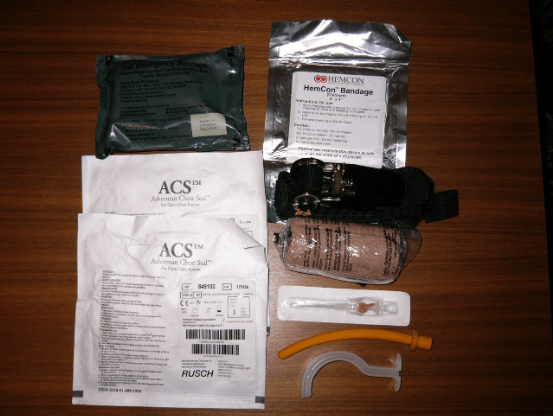
Personal bag/blow out kit: Carry this with you at all times. It contains basic first aid gear or in a tactical situation the equipment to deal with injuries from a gunshot wound or explosion (figure 1). This includes things to immediately render aid – it’s almost like a pre-first aid, first aid kit!
A list might include:
Combat dressings/Israeli dressings
A hemostatic gauze compound
Chest seals – Asherman chest seals stick poorly on wet, hairy chests despite being relatively common place. Hyfin or Halo seals or even a rat glue trap works better. Studies have shown no advantage to vented dressing chest dressings vs. not vented.
Long IV cannula or specific pneumothorax decompression needle
Tourniquets x2
Oral and/or nasal airways
Figure 1 Blowout bag: Personal medical equipment for a tactical situation (dressings, HemCon bandages, Chest seals, oral and nasal airways, IV cannula and a tourniquet
First response bag: Carry this in your car; take it with you when you go camping, family trips to the river, etc. It contains more advanced first aid gear and some medical items than a basic level medical kit.
Large kit bag: This is your home/retreat/bugging out medical kit. It contains your medical kit as opposed to simple first aid supplies.
Storage area: In your home/retreat. It contains duplicate and bulk supplies. Large plastic storage bins are ideal for this.
Nebraska Extension and Nebraska 4-H are piloting a national youth preparedness and educational outreach program designed to teach teens what to do in the event of disaster and emergency situations…
“Everyone can play a part in preparing for disasters and emergencies, especially teens,” said Ashley Mueller, disaster education coordinator for Nebraska Extension. “They bring unique perspectives and experiences when it comes to preparedness, and tapping into these can be very valuable to their families and communities.”
The initiative offers a flexible five to 10 week program. For the pilot, each state must graduate 125 teens by having them complete three components.
In component A, teenagers complete the United States Department of Homeland Security/Federal Emergency Management Teen Community Emergency Response Team (CERT) training focusing on disaster preparedness, fire safety and utility control, disaster medical operations, light search and rescue, disaster psychology, and terrorism.
Component B features certification in CPR and AED usage, along with awareness programs focusing on HAM radio, NOAA weather radio, smoke alarm maintenance, and smart phone application and social media in emergency preparedness. The component also includes a disaster simulation, and a focus on public safety, fire service and emergency management careers.
The final element of the program, component C, includes a comprehensive family and community service project called “Prep + 6,” in which each participant helps develop emergency supply kits and emergency communication plans for their family and six additional families or households. This component allows for significant enhancement in individual, family and community preparedness and resilience.
Here is an older article from the American Civil Defense Association‘s Journal of Civil Defense about planning food storage for emergencies.
“All is safely gathered in, ere the winter storms begin” are lyrics from the popular Christian hymn, “Come, Ye Thankful People Come.” Throughout history people have prepared during the plentiful harvests of all for the upcoming winter when food would be scarce and the time to harvest past. Great comfort could be found in stores of food which would see families through the cold winter. Lack of stores could result in hunger, illness and even death before a chance for another harvest.
While winter storms are still an important consideration, our society has a system in place where fresh fruits and vegetables, along with a wide variety of foods, are available year round at local markets. There is little consideration given to preparing for the upcoming winter because of a year round bountiful harvest. May we suggest this false sense of security may prove to be disastrous?
In addition to winter storms, there are other dangers to consider– man-made disasters such as war, terrorism, EMP (electromagnetic pulse), food contamination, riots, civil unrest and the list goes on; as well as natural disasters including earthquakes, hurricanes, fires, floods, drought, famine and epidemics, which may strike with little or no warning. We need not look far to see evidence of these dangers throughout the world. The best way to protect our family is to take personal action.
In this article we will give you information which will help you develop a workable food storage plan unique to your family’s needs and preferences. Then you can take that information and get to work.
My buddy, Paul Sharp, of Straight-Blast Gym—Illinois, and proprietor of Sharp Defense, posted the following on Social Media:
“When people start talking about advanced techniques my eyes cross. There are no advanced techniques. There are fundamentals honed to perfection through conscious effort. Then there is the application of those fundamentals against ever increasing challenges. The mechanics don’t change, our understanding grows so we’re able to apply the technique against higher and higher levels of resistance. As we advance we face greater resistance and better opponents which causes our understanding of the hows, when’s and why’s to advance. The mechanics remain the same. We become advanced.
Sugar Ray Leonard’s jab wasn’t magically different. His ability to hit anyone he faced at a world class level with his jab was the difference between basic and advanced.
During his seminar JJ Machado taught us all the same guard recovery technique. A guard recovery technique I had been taught my first month of jiujitsu. His ability to apply that technique against the best grapplers in the world is the difference between basic and advanced.
Bruce Gray presented my duty pistol, (a DAO S&W 4586), from a duty rig and hit the A zone of a target that was 25 yards away in a little over 1 second. He used the same draw stroke, mount, and trigger press he had been teaching me. He didn’t teach an advanced drawstroke or trigger press. His ability to make hits in those times with less than optimal equipment was the advanced understanding and application of the technique.
The point is; there is no secret sauce aka advanced techniques. There is advanced application and there is only one way to get there. High level coaching, and practice.”
This is something I’ve discussed in rifle and pistol classes for a long time now…
Somewhere between 125-150 gun rights supporters showed up at the rally
conducted on the Capitol Campus earlier today.Several legislators spoke
to the crowd, including Representatives Matt Shea (R-4), Brian Blake
(D-19), Vicki Kraft (R-17), Morgan Irwin (R-31) and Senator Phil
Fortunato (R-31).After the formal presentations ended, individual
participants visited their legislators’ offices.A big thank you to the
legislators who spoke and to all who made the trek to Olympia to show
the flag..
The following cut-off dates are proposed for bills under consideration
in the 2018 regular legislative session.As a general rule, if a bill
fails to pass a hurdle, it is considered dead for the session.Exceptions
can be made.
2 February Bills must pass out of policy committee
5 February Bills must pass out of chamber fiscal committee (only bills
with major fiscal impact)
14 February Bills must pass out of house of origin (House bills out of
House, Senate bills out of Senate)
23 February Bills must pass out of policy committee in second chamber
26 February Bills with major fiscal impact must pass out of second
chamber fiscal committee
2 March Bills must pass out of second chamber (House bills out of Senate,
Senate bills out of House), except for bills in a conference committee
to iron out differences in House/Senate versions,budget bills and
initiatives.
8 March Sine die – close of regular legislative session.
HB 2363, by Rep. Pellicciotti (D-30), makes any attempt to use a drone
to deliver a deadly weapon to an incarcerated individual a Class C
felony.SB 6146, by Sen. Saldada (D-37), repeals RCW 9.41.290, our state
preemption law, that prohibits local government from passing its own gun
laws.I believe Washington was first in the nation with this, 35 years
ago.42 states now have preemption laws. If this passes, every county,
city and town can pass their own gun control laws, a patchwork quilt of
laws that will trip up gun owners traveling across the state.SB 6247, by
Sen. Dhingra (D-45), prohibits firearm possession by individuals with a
history of violence who are not deemed competent to stand trial.
The Senate Law & Justice Committee will conduct public hearings on SBs
5992 (trigger devices), 6049 (magazine restrictions), 5444 (modern
sporting rifle registration), 5463 (safe storage) and 6146 (preemption
repeal) on 15 January at 10 a.m. in Senate Hearing Room 4, John A.
Cherberg Building.That is the only public hearing on gun bills scheduled
this week.A strong turnout would help.
BILL STATUS/GOAL POSITION:
HB 1000 Use of deadly force Doglio (D-22)H.PubSaf OPPOSE
HB 1004 Possession of firearms/state of emergency Shea (R-4)H. Jud.. SUPPORT
HB 1015 Limiting restrictions on concealed carry Shea (R-4)H. Jud.. SUPPORT
HB 1122 Safe storage of firearms Kagi (D-32)H. Rules OPPOSE
HB 1134 Assault weapon ban Peterson (D-21)H. Jud. OPPOSE
HB 1174 Firearm safety education in schools Muri (R-28)H. Edu SUPPORT
HB 1181 Prohibiting handgun sales registry Blake (D-19)H. Jud. SUPPORT
HB 1190 Prohibiting handgun sales registry Taylor (R-15)H. Jud. SUPPORT
HB 1270 Encouraging voluntary use of locking devices Harmsworth (R-44) H.
Fin. SUPPORT
HB 1380 Repeals I-594 Shea (R-4)H. Jud.. SUPPORT
HB 1381 Universal recognition of all state CPLs Blake (D-19)H. Jud.. SUPPORT
SB 6146 Repeals state preemption of gun laws Saldana (D-37)S. L&J OPPOSE
SB 6297 Firearm possession with history of violence Dhingra (D-45)S.
L&J REVIEWING
HB = House bill, SB = Senate bill.L&J = Law & Justice, Jud = Judiciary,
PubSaf = Public Safety, HC = Health Care, H. K-12 = House Early
education, Aprop = Appropriations, Fin = Finance, W&M = Ways & Means“S”
before a bill number indicates Substitute (amended).
HEARINGS SCHEDULED:
15 JanSenate JudiciaryHearing Room 4, John A. Cherberg Bldg.
10:00 a.m.SBs 5992, 6049, 5444, 5463 and 6146
(18 JanHouse JudiciaryHearing Room A, John L. O’Brien Bldg)
(1:30 p.m.HB 1122 Executive session only)
LEGISLATIVE HOT LINE:You may reach your Representatives and Senator by
calling the Legislative Hotline at 1-800-562-6000.Toll free!!!The
hearing impaired may obtain TDD access at 1-800-635-9993.Also toll free!!!
1-800-562-6000TDD 1-800-635-9993
OTHER DATA:Copies of pending legislation (bills), legislative schedules
and other information are available on the legislature’s web site at
“www.leg.wa.gov“.Bills are available in Acrobat (.pdf) format.You may
download a free version of Adobe Acrobat Reader from Adobe’s web site
(http://www.adobe.com).You may also obtain hard copy bills, initiatives,
etc, in the mail from the Legislative Bill Room FREE OF CHARGE by
calling 1-360-786-7573.Copies of bills may also be ordered toll free by
calling the Legislative Hotline at (800) 562-6000.You may also hear
floor and committee hearing action live at http://www.tvw.org/ (you need
“RealAudio” to do this, available free at the TVW web site).
By reading the House and Senate “bill reports” (hbr, sbr) for each bill,
you can see how individual committee members voted.By reading the “roll
call” for each bill, you can see how the entire House or Senate voted on
any bill.The beauty of the web site is that ALL this information is
available, on line, to any citizen.
GET THE WORD OUT:If you want to subscribe to the GOAL Post by e-mail,
send a message to “goalwa@cox.net “.Please pass GOAL Post on to anyone
you believe may have an interest in protecting our rights.Better yet,
make a couple of copies of this message, post it on your gun club’s
bulletin board, and leave copies with your local gun shop(s).PERMISSION
IS HEREBY GRANTED TO DUPLICATE OR RED ISTRIBUTE GOAL POST PROVIDED IT IS
REPRODUCED WITHOUT TEXTUAL MODIFICATION AND CREDIT IS GIVEN TO GOAL. I
can be reached at “jwaldron@halcyon.com” or by telephone at (425)
985-4867.Unfortunately, I am unable to mail hard copy GOAL Post to
individuals.Limited numbers of hard copies MAY be available at the
Second Amendment Foundation book table at WAC gun shows.
If you believe you have received this e-mail in error, please e-mail me
at “goalwa@cox.net” with the words “Unsubscribe GOAL Post” in the
subject line.I will remove your name immediately.Keep in mind GOAL Post
is also published on several gun lists.If you received GP via a list,
you must contact that list’s admin to unsubscribe.
Upcoming WAC gun show(s):
Monroe 13-14 January
Puyallup 20-21 January
“The right of the individual citizen to bear arms in defense of himself,
or the state, shall not be impaired, but nothing in this section shall
be construed as authorizing individuals or corporations to organize,
maintain or employ an armed body of men.”
The American Civil Defense Association recently posted a blog post about Radiation Issues reposted from their Journal of Civil Defense after many readers had questions regarding North Korea.
The nuclear threat from North Korea has prompted many callers during the past few weeks, asking about the effects and attenuation of radiation. There is a great deal of misinformation about radiation from fallout. The following old rule of thumb for shelter design still holds true. NBC shelters should have four feet of dirt cover, or three feet of concrete cover to give a minimum PF level of 1,000 from fallout. If a “rainout” should occur, or if the sheltered area is within 1.5 miles of a potential primary target, the shelter will require a minimum of eight to ten feet of cover. Shelter entrances require careful engineering, as most of the radiation exposure will come from these entrance areas.
I recently reviewed a series of articles about Nuclear Weapons Effects, written by Carsten Haaland, of the Oak Ridge national Laboratory. The entire series of articles can be found in our Journal of Civil Defense published in 1990. Some of you may be fortunate enough to still possess these journal articles. I have re-typed, in part, the section on ‘Fallout’ and ‘Rainout’ for this current article.
FALLOUT FROM NUCLEAR DETONATIONS
Carsten M. Haaland, Oak Ridge National Laboratory
What is Fallout?
Fallout is the radioactive dust that comes back to earth as a result of a nuclear explosion at the surface of the earth, or at an altitude low enough for the fireball to engulf solid materials. Fallout dust may look like sand, ash or crystals, depending on the kind of material engulfed by the fireball. If the material engulfed is ordinary earth or sand the fallout will look like sand, but if the engulfed material contains calcium to the extent found in concrete buildings or coral, the fallout may look like ashes. Large dense particles will descend faster than very small particles. For this reason, fallout particles several hundred miles downwind from a nuclear surface burst will be very small, somewhat like particles in atmospheric pollution, and the nuclear radiation from the fallout will be greatly reduced.
The danger of fallout arises from the intense and highly penetrating nuclear radiation emitted from it, which produces a potentially lethal hazard to people in the vicinity unless they have protection. Large areas, covering hundreds to thousands of square miles, depending on the yield and number of surface detonations, can be poisoned with fallout such that radiation from the contaminated area is hazardous or lethal to an unprotected person passing through or dwelling in the area, for periods of days to weeks after the detonations.
In 2017, the Remote, Austere, Wilderness & Third World Medicine discussion board moderators released their third Edition of the Survival and Austere Medicine ebook. The third edition grew to over 600 pages compared to the second edition’s 200+pages.
While the original content of the FAQ and the subsequent edition remains valid, we thought it was time it underwent an update again. We hope you will find it useful. It is offered in good faith but the content should be validated and confirmed from other sources before being relied on even in an emergency. It is a tool to help you with medical care in an austere or ‘grid-down’ environment.
When the original FAQ and previous edition were written, there were very few books aimed at the “Practicing Medicine after the End of the World as We Know It” market – however over the last couple of years several books of varying quality have been published, offering information on this topic.
We like to think we are the original “Medicine at the End of the World” guide and our uniqueness in the current market place comes from our history and that it is the collaborative work of a group of experienced medically orientated preppers and survivalists. Between us, we have extensive experience in pre-hospital, austere, remote and third world medicine – both with the military and NGO’s. We do this stuff – we understand the limits of the environment and the issues of supply and improvisation. We have trained lay people to do complex medical procedures and provide health care in their remote communities. We have undertaken community medical needs assessments and the delivery of health care after natural disasters. We have given anaesthetics and done surgery in tents in the back of beyond. While the [stuff] hasn’t hit the fan in Western Countries yet, you don’t have to look far to find accurate analogies to likely Collapse Medicine and between us we have experience working in these locations and situations. This makes our book unique.
The other unique fact about this book is that it remains free! It’s a labour of love for us and we have enjoyed the comradery of putting it together. We are passionate about helping to improve the neglected ‘Band-Aid’ bit of the “Beans, Bullets and Band-Aid’s” mantra
common in prepper and survivalist circles. We have spent countless hours on this book project, not to make money, but to genuinely improve
people’s levels of medical preparedness.
Short Contents:
Medicine at the end of the world
The Context of Austere Medical Practice
What do I need to know?
Organizational Issues
Medical Kits
Clinical Assessment
Emergency Care in an Austere Environment
The Clinical FAQ’s
Infectious Disease and Antibiotics
Sedation and Anesthesia in an Austere Environment
Major Surgical Procedures
Wounds
Family planning, pregnancy, and childbirth
Considerations in Children
Austere Dental Care
The Basic Laboratory
Sterilization and Disinfection
Medical Aspects of Nuclear, Biological, and Chemical Warfare



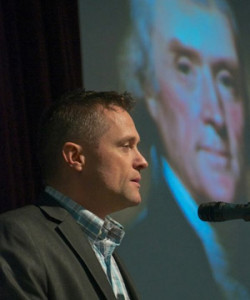 Mark Herr of the Center for Self Governance will be speaking at the next Lower Valley General Member Assembly on Thursday, February 8th, 2018, 7:15pm at Caffe’ Villa in Prosser. The Center for Self Governance is a non-profit, non-partisan educational organization dedicated to advancing a stable civil society, balanced human government, and a well educated populace.
 The fine folks over at Emergency Essentials have a brief blog post on preparing to weather financial storms.
 Here is an older article from the American Civil Defense Association‘s Journal of Civil Defense about planning food storage for emergencies.
 John Mosby over at Mountain Guerrilla has written a short piece about firearm fundamentals and the truth about advanced techniques.
 In 2017, the Remote, Austere, Wilderness & Third World Medicine discussion board moderators released their third Edition of the Survival and Austere Medicine ebook. The third edition grew to over 600 pages compared to the second edition’s 200+pages.
