The next regular assembly of the whole will be held on Thursday, Mar. 14th, 2019 at 6:30 pm at Caffe Villa in Prosser. M. Scott Brumback of Washington Strikes Back will be our speaker.
The Altons at Doom and Bloom Medical have an article up about the dangers of hypothermia and how to treat and avoid it. Twenty-five percent of deaths in blizzard conditions are due to hypothermia (the majority are from traffic accidents.) Locally, March has been a bit colder and snowier than usual, so it’s good to keep these dangers in mind. Below is only a brief excerpt. Please read the entire article.
When March comes along, you might think that Spring has sprung. But old man Winter isn’t done with us yet. Although the month of March may exit like a lamb, it often enters like a lion. The Midwest and Northeast can attest to this fact from cold temperatures and heavy snows just in the last few days.
Even in March, winter storms (this one is named “Scott”) occur every year in the United States; Scott brought a foot of snow to some areas. Extreme weather can cause fatalities among the unprepared. In blizzard conditions, 70% of deaths occur due to traffic accidents and 25% from hypothermia from being caught outside during the blizzard.
The key word is “outside”. If a blizzard knocks you off the grid as Scott did to 60,000 people, you might be tempted to travel to someplace warmer, but that’s how most deaths occur from winter storms.
This winter has already seen deadly cold snaps where people have found themselves at the mercy of the elements. Whether it’s on a wilderness hike or stranded in a car on a snow-covered highway, the physical effects of exposure to cold (also called “hypothermia”) can be life-threatening…
TREATING HYPOTHERMIA
If you encounter a person who is unconscious, confused, or lethargic in cold weather, assume they are hypothermic until proven otherwise. Immediate action must be taken to reverse the ill effects.
Important measures to take are:
Get the person out of the cold. Move them into a warm, dry area as soon as possible. If you’re unable to move the person out of the cold, be sure to place a barrier between them, the wind, and the cold ground.
Monitor breathing. A person with severe hypothermia may be unconscious. Verify that they are breathing and check for a pulse. Begin CPR if necessary.
Take off wet clothing. If the person is wearing wet clothing, remove gently. Cover the victim with layers of dry blankets, including the head, but leave the face clear.
Share body heat. To warm the person’s body, remove your clothing and lie next to the person, making skin-to-skin contact. Then cover both of your bodies with blankets. Some people may cringe at this controversial notion, but it’s important to remember that you are trying to save a life. Gentle massage or rubbing may be helpful. Avoid being too vigorous.
Give warm oral fluids, but only if your victim is awake and alert. If so, provide a warm, nonalcoholic, non-caffeinated beverage to help warm the body. Coffee’s out, but how about some warm apple cider?
Use warm, dry compresses. Use a first-aid warm compress (a fluid-filled bag that warms up when squeezed), hand warmers wrapped in a towel, or a makeshift compress of warm, not hot, water in a plastic bottle.
These go in special places: the neck, armpit, and groin. Due to major blood vessels that run close to the skin in these areas, heat will more efficiently travel to the body core. Others areas you might warm include the hands and feet, but avoid applying direct heat to amy area. Don’t use hot water, a heating pad, or a heating lamp directly on the victim. The extreme heat can damage the skin, cause strain on the heart, or even lead to cardiac arrest…
In the article US ‘Gets Its Ass Handed To It’ In Wargames: Here’s A $24 Billion Fix, Breaking Defense reports that the US’s advanced military technology have some major Achilles’ heels which Russia and China have, intelligently, designed their military responses to take advantage. Many people in the US wrongly assume that American military technology is so far advanced that there is no comparison with Russian and Chinese forces. Unfortunately, that view overlooks the fact that smart opponents will devise tactics and techniques which target the weaknesses of an opponent. The US is extremely good at projecting offensive power, but after decades at the forefront of military technology the US has lost sight of the importance of defending anything from strikes. It’s like America has spent twenty years perfecting the jab and right cross, but is incapable of dodging or blocking a punch. In effect, Russia and China do not need to have more advanced weapons than the US (though they may have an advantage in missile technology) because the US cannot protect their weapons from being destroyed before they can be used.
The US keeps losing, hard, in simulated wars with Russia and China. Bases burn. Warships sink…
“In our games, when we fight Russia and China,” RAND analyst David Ochmanek said this afternoon, “blue gets its ass handed to it.” In other words, in RAND’s wargames, which are often sponsored by the Pentagon, the US forces — colored blue on wargame maps — suffer heavy losses in one scenario after another and still can’t stop Russia or China — red — from achieving their objectives, like overrunning US allies.
No, it’s not a Red Dawn nightmare scenario where the Commies conquer Colorado. But losing the Baltics or Taiwan would shatter American alliances, shock the global economy, and topple the world order the US has led since World War II…
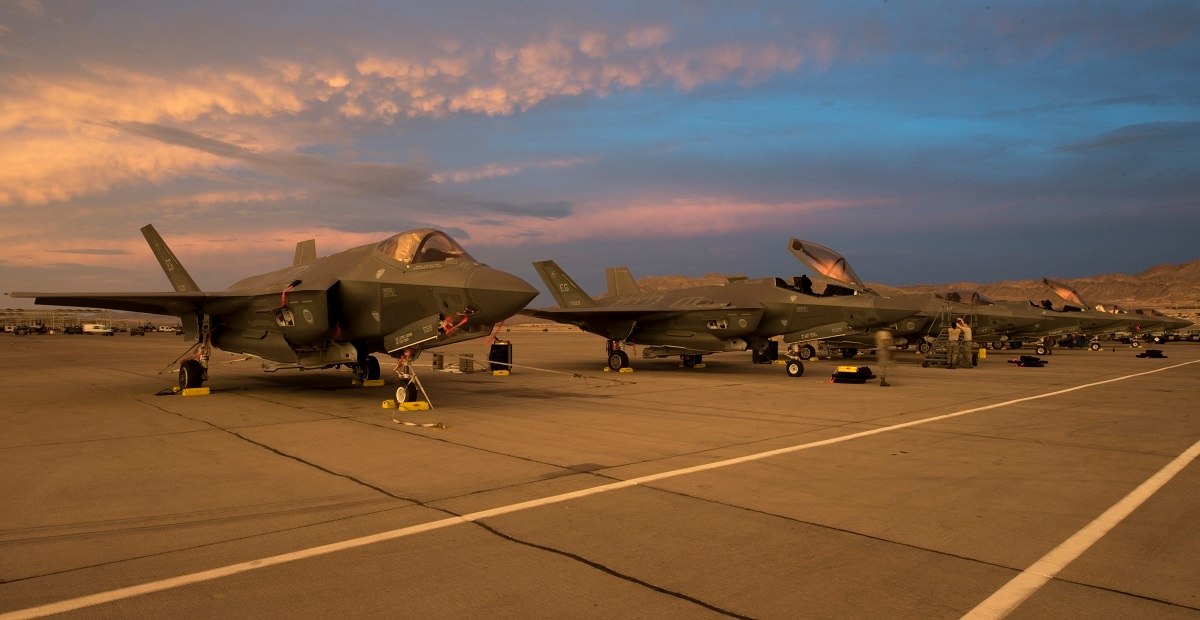
F-35 stealth fighters are hard to kill in flight, but lined up on the runway, they’re easy targets.
big airbases on land and big aircraft carriers on the water turn out to be big targets for long-range precision-guided missiles. Once an American monopoly, such smart weapons are now a rapidly growing part of Russian and Chinese arsenals — as are the long-range sensors, communications networks, and command systems required to aim them.
So, as potential adversaries improve their technology, “things that rely on sophisticated base infrastructure like runways and fuel tanks are going to have a hard time,” Ochmanek said. “Things that sail on the surface of the sea are going to have a hard time.”
…Worst of all, Work and Ochmanek said, the US doesn’t just take body blows, it takes a hard hit to the head as well. Its communications satellites, wireless networks, and other command-and-control systems suffer such heavy hacking and jamming that they are, in Ochmanek’s words, “suppressed, if not shattered…”
John Mosby at Mountain Guerrilla blog has some good thoughts (as usual) posted on the reasons for and benefits of home schooling versus public schooling titled Off-Grid Education. Below is a brief excerpt from the article.
…Public schools can teach knowledge. Whether the knowledge they teach has any relevance to the real world, past the primary school grades, is open to debate, but the fundamentals of education: reading, writing, and arithmetic, the public schools CAN—and traditionally HAVE—done a reasonably good job of. The thing is though, any functioning adult, with the willingness to do so, can ALSO teach those, and will—in my experience—do a much better job of making them accessible to the child, than a school teacher.
My seven year old is an age-peer with second graders. She is currently reading Wildwood Wisdom, by Ellsworth Jaeger. Slowly, but she is reading it, and she carries it with her, all the time, reading sections that interest her, or come to her attention because of something she sees around the farm. Wildwood Wisdom, for those poor, sheltered souls unfamiliar with this classic of woodcraft, is a 474 page tome on outdoor living skills, written in 1945, and generally targeted at teenage and adult readers.
She also does basic arithmetic, including addition and subtraction, and is working on multiplication. She has also written letters and notes to friends and family, on paper, with pens and pencils.
It COULD be argued that we are a special case, because I have a post-graduate degree, and formal training in pedagogy, but that would be a bullshit argument, because people have been teaching their own children how to read and do arithmetic and write, as long as there has been reading, writing, and arithmetic. Again, ANY parent—or interested, functional adult—can teach the same basic knowledge that a public grammar school teacher can. From there, learning is—or should be—largely self-directed anyway. Sure, kids should probably know the basics of things like the Scientific Method, and Civics, etc, but guess what? If you know how to read, you can learn those things by….reading…and all it requires is interest. If that interest is not present, no amount of threats about “failing,” “bad grades,” or “permanent records,” is going to create that interest in a “student.” You know who does a good job of eliciting interest in young people about any given subject? The adults they are familiar with and respect, who display an interest in that subject…not public school teachers.
Values and beliefs have no place—whatsoever—being taught in public schools. Period. Values and beliefs are cultural artifacts depending on religion and cultural worldviews. It MIGHT have been possible, once upon a time, for teachers in small, rural communities, who attended church with the local community, and spent their social time within the community…and ideally, was raised within the community…to effectively teach values and beliefs in a schoolroom setting, but I have to be honest…
Recently researching the treatment of infections without antibiotics, my investigations meandered to the – ubiquitous in our area – sagebrush plant, artemisia tridentata. It is mentioned as a boundary medicine wash in Marjory Wildcraft and Doug Simons’ video Treating Infections without Antibiotics (transcript). The following article from the blog Celebrating Gaia’s Herbal Gifts summarizes most of the information that was available around the internet about the medicinal use of sagebrush, Artemisia Tridentata-Big Sagebrush, a Valuable Medicinal Herb. It may be apropos to note that there are also a lot of non-medicinal uses for sagebrush for the preparedness/survival-minded, including for fire-starting, cordage, baskets, pillow-stuffing, insect repellant, paper-making, etc.
Sagebrush Country
I live in the big sky country, the high desert of Central Oregon. Everywhere I look I see Big sagebrush (Artemisia tridentata). The genus Artemisia comprises hardy herbaceous plants and shrubs, which are known for the powerful chemical constituents in their essential oils. In a search of artemisia on the USDA plants database in Oregon there are 150 species of artemisia that appear. The name Artemisia comes from Artemis, the Greek name for Diana. There are any number of artemisia species that are popular in our modern herbal materia medica, from wormwood to mugwort. The intent of this post is to continue to explore my bio-region and develop herbal protocols based on the use of local plants and to that end, sagebrush (artemisia tridentata) will certainly play a role. This is by no means a definitive article but a written documentation of my search through the literature related to traditional uses and potential current applications.
My exploration of plants always starts through the eyes of First Peoples/Native American’s, who have had a long relationship with using artemisia species throughout North America. The focus of this blog is to explore the use of Artemisia tridentata, which is mostly relegated to the western states. Big sagebrush and other artemisia species are the dominant plants across large portions of the Great Basin.
Any number of tribes used artemisia tridentata including tribes affiliated with my bio-region, Okanagan-Colville, Paiute, Shuswap and the Thompson. Many of the tribes used it similarly. These uses include the following: respiratory and gastrointestinal aids, cold and cough remedy, antirheumatic both internally and externally, antidiarrheal, ferbrifuge, dermatological aid, eye wash, gynecological aid, analgesic, diaphoretic, emetic, pulmonary aid, and antidote for poisoning. All parts of the plant were used including the leaves, stems, seed pods, branches and roots.
Artemisia tridentata
It was used both externally and internally.* Externally it had many uses including: as a poultice of fresh and dried leaves for chest colds, as a wash made of the leaves and stems for cuts and wounds, as a leaf decoction for an eye wash, the leaves were packed into the nose for headaches, the ground leaves were used as a poultice along with tobacco for fever and headaches, the leaves were powdered and used for diaper rash or packed into shoes for athlete’s infection, a decoction of the leaves were mixed with salt and gargle for sore throat, mashed leaves were used for toothaches, a leaf decoction was used in a bath for muscular ailments. * There are many references to it being used internally as an infusion or decoction, but as one informant indicated it was too strong and powerful to drink, “you wouldn’t have any more kids, no children”. Internal use is not recommended due to some chemical constituents found in the plant. There are many references to artemisia being inhaled for headaches, for spiritual cleansing, to produce sweat and rid the body of colds, respiratory infections and pulmonary issues.
Artemisia annua
An interesting fact is that the Paiute’s and Okanagan-Colville indicated that they used a decoction of leaves for malarial fever, which is also similar to the use of other artemisias around the world. Most of artemisia’s research as an antimalarial is focused on Artemisia annua (sweet annie). Artemisia annua is a very interesting plant and is the source of the most powerful antimalarial drug ever discovered, artemisinin. It is also being investigated in treatment of breast cancer.
Many of its traditional uses can be attributed to artemisia’s active medicinal constituents including camphor, terpenoids, and tannins. Sagebrush essential oil contains approximately 40% l-camphor; 20% pinene; 7% cineole; 5% methacrolein; and 12% a-terpinene, d-camphor, and sesqiterpenoids. The essential oils present account for its use in inhalation. Sesquiterpene lactones are among the prominent natural products found in Artemisia species and are largely responsible for the importance of these plants in medicine and pharmacy.
For my own purposes I can definitely see incorporating it into liniments, antiseptic washes, chest poultice, fumigation, powdered for use as foot powder. Although there is tremendous oral history of its internal use I personally would be hesitant and look to other herbal options.
A few of my references:
Adams, James D., Garcia, Cecilia., Healing with Medicinal Plants of the West. Abedus Press, 2009.
Moreman, Daniel E., Native American Medicinal Plants. Timber Press, 2009.
Parks, Willard Z. Notes of the Northern Paiute of Western Nevada, 1933-1944. Compiled and edited by Catherine S. Fowler. University of Utah, Anthropological Papers, Number 114, 1989.
UPDATE:This event has been cancelled. You could still ask the commissioners to support such a resolution on your own.
There is an effort afoot to get the Benton County commissioners to sign a resolution in opposition to I-1639 similar to the resolution signed by Franklin County commissioners on January 29th. The organizer, Lisa Thomas, will be presenting a copy of the Franklin County resolution to the commissioners at the March 5th, 2019 commissioner meeting. If you can attend to support this resolution, that would be great. The board meeting is at 9:00 AM, Tuesday, Mar. 5 at the Benton County Courthouse in Prosser.
On behalf of Benton County, as a United States citizen, I am requesting that you (elected to represent me) sign a Resolution (just like Franklin County did- first in the State) supporting our Sheriff, and our Constitutional rights.
These gun initiatives are unconstitutional. They are infringing (impairing) my right to bear arms. When you took office, you took an oath: it is your DUTY to protect my rights.
A Resolution by Benton County tells the State, that we support our Sheriff (the CEO of our County); because it is also his duty to protect my rights and uphold the Constitution.
I have attached Franklin County’s template. I will draft my own and will be bringing it to Tuesday’s meeting to present during Public Comment- along with Radona Grossman-Devereaux who WROTE the repeal bill. Please be prepared to sign it.
Washington dairy farmers and fruit growers would have to report to retailers whether they use slaves under a bill endorsed Thursday by Democrats on the Senate Labor and Commerce Committee.
Farm groups, for the record, say they oppose slavery, as well as human trafficking and peonage — two other forms of servitude producers would have to report.
At a hearing last week, farm lobbyists said the bill was offensive and asked the committee to kill it.
The committee excluded some commodities, but kept in dairy and fruit. By a party line vote, the Democratic majority recommended the bill to the full Senate.
“It’s still an attack on farmers,” Washington Farm Bureau director of government relations Tom Davis said. “It impugns the character of an entire industry.”
Introduced by Seattle Democrat Rebecca Saldana, Senate Bill 5693 would require farmers to report any incidents of slavery, peonage and human trafficking to retailers with more than $200 million in global sales.
Peonage is also called debt servitude and involves an employer compelling workers to pay off a debt through their labor.
More to the point, the bill would require reporting “any violation of employment-related laws.”
A retailer would be obligated to report on its website the “specific actions” it took in response to those reports. The attorney general could sue farmers or retailers for failing to report, respond to or publicize any adverse citations or court rulings.
“I must tell you, this is one of the worst bills I have seen and one of the biggest messes of legislation I have seen in 35 years around the Legislature,” Washington State Dairy Federation Executive Director Dan Wood told the committee.
Washington Potato and Onion Association lobbyist Jim Jesernig, a former legislator and state agriculture director, said potato and onion growers were angry, and so was he.
“One of the things I’ve learned in the 33 years I’ve been here is that if there is something that’s an outright lie, you have to call it that,” he said. “The supply chain that feeds you and your constituents are our farmers, ranchers and food processors. This accuses them of slavery and human trafficking.”
Washington Association of Wheat Growers lobbyist Diana Carlen said wheat growers were “quite shocked” by the bill and “personally offended.”
The Altons at Doom and Bloom Medical have another good article up — this time on what you do when you need to transport a patient and there is no ambulance: Patient Transport in Austere Settings. The article discusses stabilization as well as many different field-expedient stretcher/transport options.
What happens when you need transport and there’s no ambulance?
In normal times, your main goal upon encountering an injured or ill person is to transport them to a modern medical facility as soon as possible. In cases where there is a risk of spinal or neck trauma, you will read that the victim should not be moved until emergency personnel arrive.
That’s all well and good in situations when the ambulance is just a few minutes away, but what about when you’ve been knocked off the grid due to a disaster?
Even in normal times, there are circumstances where a victim must be moved despite the risk. These mostly involve common sense judgements, such as when there is an immediate danger from, say, a building on fire or in danger of collapse.
Probably a good idea to move the patient
When help is not on the way, however, you will have to decide whether your patient can or cannot be treated for their problem at their present location. If they cannot, you must consider how to move the victim safely.
Before deciding whether to transport, a patient must be stabilized as much as possible. This means assuring open airways, controlling bleeding, splinting orthopedic injuries, treating hypothermia, and more. If you are unable to do this with the materials at hand, consider having a group member get the supplies needed to make transport safer. If possible, gather a team to assist you before you move the victim. Knowing the amount of help available allows you to choose a method of evacuation that will cause the least trauma to both patient and medic.
MOVING THE VICTIM ONTO THE STRETCHER
Without stabilization, a neck injury can occur even if not part of the original trauma
When moving a trauma patient, you should be concerned about the possibility of a spinal injury, especially if there is:
• Head or neck trauma
• Altered mental status
• Pain in the head or neck
• Weakness, numbness, or paralysis in the extremities
• Loss of bladder control
A person with a possible spinal injury should be “logrolled” onto a stretcher as a unit without bending their neck or back if at all possible. A cervical collar and supportive blocks with straps can be used to secure the spine of at-risk patients. An unstable neck, especially in an unconscious victim, could easily be traumatized even if not involved in the original trauma. Keep the head in alignment with the spine during transport.
“logrolling” position
If you have several helpers, transporting the patient is easier but requires coordination. You, as medic, will serve as leader of the transport team. This entails making sure the patient is transferred to the stretcher safely, but also that all team members lift and move at the same time. Simple “Prepare to Lift”, “Lift”, and “March” commands should suffice to get everyone on the same page…
We’re offering another Q&A webinar on Sunday, March 3 for those interested in SHTF medicine. If you have questions about your medical preps to include medications, what to do in case of a specific type of SHTF emergency, or even how to set up various medical bags for specific needs, this is the one you’ll want to attend.
It’s two hours long, and there are only 9 seats available so that we can keep the discussion on point and ensure that everyone can get their questions answered. This is a casual discussion in which you can ask whatever medical questions you want pertaining to prepping, SHTF medicine, etc. With such a small discussion size, you’re certain to get a great deal out of it.
Running the discussion will be highly experienced medic and registered nurse Reasonable Rascal. He’s one of our newer staff members, but he isn’t new to medicine or to online discussion. He’s been running a serious, successful medical forum for several years, and together with several doctors and other medical professionals, co-wrote Survival and Austere Medicine, now in its 3rd edition.
The price for attending is $25. That covers the webinar cost for us and allows us to pay Rascal a little something for his time. You can register by either sending Paypal to info@americanpartisan.org or sending cash/check/money order to:
610 N. 1st St 5-209
Hamilton, MT 59840
Remember, there are only 9 seats, so get in while you can!
Combat Studies Group has a comprehensive article up about choosing a secure chat/messaging application in this time of increasing governmental and corporate excess. It’s a long read, but if you are interested in your privacy you should give it a read. If you don’t understand what he’s talking about, then this is a starting point for your electronic privacy/security education.
– Twitter, Facebook, Youtube and the like, de-platforming or censoring any content that leans towards the right or conservative side.
– Amazon, Google, Apple, Microsoft, et al, doubling down on collection of people’s data.
– The US intelligence apparatus convincing major hotel chains (Marriot for one) to collect information and report on hotel guests (for the most trivial of “abnormalities”, if one can call them that).
– Amazon working with law enforcement to implement widespread facial recognition gathering.
– Those nifty DNA/ Heritage testing sites have been caught giving your DNA to Uncle Sam.
– Cellular providers selling your real-time location to anyone who wants to buy it.
– The proliferation of “smart” devices such as Alexa that is always listening.
– Web browsers screening the news you search for and only letting the “leftist” slanted news through.
I could go on for pages and pages, but you get the point. One needs to become aggressive to secure their privacy in this day and age….so with that in mind I thought it apropos to publish an updated breakdown of available options.
Lets establish some standards that should be adhered to when choosing a chat application.
1. It should be comprised of open-source code. Open source code can be audited by third parties for completeness, proper implementation and potential security vulnerabilities.
2. It should employ end to end encryption. In other words, the encryption happens on your device and the decryption happens on the recipient’s device versus a third party server. This removes the need to trust a third party with your keys.
3. It should utilize INFOSEC industry accepted standards for cipher primitives. It should use well studied ciphers, key exchanges and hashes such as: AES-256, RSA-4096, ChaCha20, ECC-512, Curve25519, Poly1305, secp256k1, Curve448, Twofish, SHA-3, Whirlpool, GPG.
4. It should utilize forward secrecy. This protects the user if they have a key that somehow gets compromised. In this setup the system renegotiates the key exchange at short, established time intervals. Diffie-Hellman is a common implementation of this concept.
5. It should support the removal/destruction of messages on both ends of the conversation. This could be based on a timer, manual selection or a “destroy on read” protocol…
“I’m going to be signing a national emergency,” Trump said from the Rose Garden of the White House.
“We have an invasion of drugs, invasion of gangs, invasion of people, and it’s unacceptable,” he said.
The president said he would sign the authorizing paperwork later in the day in the Oval Office…
Nancy Pelosi, the Democratic Speaker of the House of Representatives, and Chuck Schumer, the Senate’s top Democrat, swiftly responded to Trump’s declaration.
“The president’s actions clearly violate the Congress’s exclusive power of the purse, which our Founders enshrined in the Constitution,” they said in a statement. “The Congress will defend our constitutional authorities in the Congress, in the courts, and in the public, using every remedy available.”
The president acknowledged that his order would face a lengthy legal challenge. “We’ll win in the Supreme Court,” Trump said…
Speaker Pelosi had previously threatened that the next Democrat President could declare gun violence a national emergency while Rep. Cleaver of Missouri said that such a President could declare climate change or income inequality as national emergencies.
“A Democratic president can declare emergencies, as well,” Pelosi told reporters in the Capitol. “So the precedent that the president is setting here is something that should be met with great unease and dismay by the Republicans.”
…”Let’s talk about today: The one-year anniversary of another manifestation of the epidemic of gun violence in America,” Pelosi said. “That’s a national emergency. Why don’t you declare that emergency, Mr. President? I wish you would.
Do you believe in the constitutional right to keep and bear arms? Do you stand with Yakima County Sheriff Bob Udell’s position that I-1639 is unconstitutional? Do you believe that WA Attorney General Bob Ferguson’s endorsement and support of I-1639 was wrong, a violation of his oath, a violation of the US and WA Constitution(s), and that he overstepped the authority of his office?
If you wish to take action, join fellow patriotic Washington citizens, Tuesday, Feb. 19, at 6:30 pm, for our concerned citizens’ event. (Yakima Convention Center)
MAKE a stand and hear how you can make a difference.
LEARN how you can stand with our constitutions.
HOLD AG Ferguson accountable.
Free admission. Coffee and water provided.
Tuesday, February 19, 2019 at 6:30 PM – 8:30 PM PST
The Vashon Island community has spent years working to be prepared for an emergency/disaster situation, going as far as forming a non-profit organization – VashonBePrepared – to coordinate the disaster preparedness organizations on the island. From Citylab.com, here is an excerpt from Preparing for ‘The Big One’ in an Isolated Island Town.
…[T]he island community has been building up its emergency preparedness efforts for nearly two decades. The work was initially kicked off when Joseph Ulatoski, a retired brigadier general and island resident, started asking who was responsible if a disaster struck. His questions led to a small group of locals meeting monthly to figure out exactly how they would handle such a situation, Wallace says.
“As time went on, it became clear that we needed to be more organized, structured, and also that we would be in a form that could be recognized by people,” he says.
The result was VashonBePrepared. Today it’s a non-profit, FEMA-sanctioned coalition of the island’s disaster preparedness organizations, including CERT and Voice of Vashon. Its purpose is exclusively to prepare the island for an emergency by helping to coordinate these organizations; it doesn’t actually play a role in real-time response efforts.
“It is a coalition to organize these partner groups to be efficient, avoid redundancy and duplication of effort, and inspire each other to move forward with all these different programs that each of us are running,” says Wallace, who is also the vice president of VashonBePrepared’s executive committee.
One of these key partner organizations is the Neighborhood Emergency Response Organization. Similar, in a sense, to neighborhood watch groups, its leaders have organized hundreds of households into neighborhood groups so they can get to know each other and thus be more likely to help one another if an emergency hits…
Ham radio operators in the emergency operations center radio room. (Courtesy of Rick Wallace)
Benton County Road Closures as of 4:30 PM, Tuesday, February 12, 2019.
The following roads are now open:
Clodfelter Road
Locust Grove from I-82 to Plymouth Road
Finley Road from SR 397 to end of asphalt (approx. 2.5 miles)
Nine Canyon Road from SR 397 to Lower Blair Road
Sellards RD from Travis to Plymouth Road
The following roads are still closed:
Lincoln Grade
McBee Road
Nine Canyon from Lower Blair to South end of County Road
Sellards RD from SR 221 to Travis Road
Ward Gap
Closures will last until further notice. Ward Gap Road, Lincoln Grade, and McBee Road will be closed until the snow melts off. Our crews are unable to get plows into these areas due to significant drifts.
From KIMA news. Stories of hardships caused by the recent storm continue to come:
YAKIMA, Wash.– Farmers have been devastated across the Yakima Valley, as strong winds of up to 80 miles per hour, and cold conditions have killed about 1,600 cows according to the Yakima Valley Dairy Farmers Association.
Yakima Valley Dairy Farmers are continuing to prepare as more snow is expected to hit the Valley, they’re adding extra bedding to insulate areas for cows to lay in, adding extra feed, and thawing water troughs with hot water.
“Without our employees, there’s no way we, or our cows could survive this storm,” Alyssa Haak , a dairy farmer in Prosser said. “To shield our cows from the wind we stacked straw bales to create a windbreak for our cows. I give a lot of credit to our milk truck drivers, too. Without their bravery, we wouldn’t be able to get our milk off the farm.”
Another farmer in Grandview says he’s been working around the clock to make sure his cows are being protected from the elements.
“These have been the worst few days of my life,” he said. “We’re just devastated. I don’t think we’ve ever been hit with weather like this.”
With severe winter weather continuing to occur in in eastern Washington throughout the next week, dairy farmers are assessing their current losses and preparing for the next round of snow and wind.
Farmers say that they are working together to help each other through these tough times.
Markus Rollinger, a Sunnyside dairy farmer stated, “Saturday was brutal. We put in a 36-hour day, but we’ve been fortunate. I’ve spent a lot of time helping my fellow dairy farmers and supporting what they’re going through,” Markus says. “My brother and I are trying to keep roads plowed for our employees and the milk trucks.”
Governor Inslee has declared a state of emergency for the state of Washington, which the farmers are hoping will lead to further assistance.
The dairy farmers say that they continue to cope with these conditions and over the next few days will be touch and go as they assess the damage and losses to their farm.


 The Altons at Doom and Bloom Medical have an article up about the dangers of hypothermia and how to treat and avoid it. Twenty-five percent of deaths in blizzard conditions are due to hypothermia (the majority are from traffic accidents.) Locally, March has been a bit colder and snowier than usual, so it’s good to keep these dangers in mind. Below is only a brief excerpt. Please read the entire article.
 John Mosby at Mountain Guerrilla blog has some good thoughts (as usual) posted on the reasons for and benefits of home schooling versus public schooling titled Off-Grid Education. Below is a brief excerpt from the article.
dominant plants across large portions of the Great Basin.


 American Partisan‘s Reasonable Rascal, a medic and registered nurse, will be hosting a two-hour webinar to answer your questions about medical preparedness. The class is limited to only nine participants, so register early.
Do you believe in the constitutional right to keep and bear arms? Do you stand with Yakima County Sheriff Bob Udell’s position that I-1639 is unconstitutional? Do you believe that WA Attorney General Bob Ferguson’s endorsement and support of I-1639 was wrong, a violation of his oath, a violation of the US and WA Constitution(s), and that he overstepped the authority of his office?
Ham radio operators in the emergency operations center radio room. (Courtesy of Rick Wallace)
 Lower Valley Assembly