The Medic Shack: Amputation – First Aid and Post Aid

Chuck at The Medic Shack talks about amputating injuries, first aid for them, and post aid while using photos from his son’s recent injury. So be warned of finger amputation photos through the link.

This post is on Amputation. What first aid and also post aid needs to be done.

NOTE: Some of the images at the end of this are graphic. They are of my son’s finger and the wound. 

This site contains affiliate links to products. We may receive a commission for purchases made through these links. This does NOT increase the price of the product you may purchase.

Background

Normally when I write a blog post its from current events, past experiences both civilian and or military. This time I am using my youngest son as our topic. This past week (Tuesday the 4th of August) he had a pretty normal day at work. He works at a motorcycle accessory shop. Sells gear and he is about the most requested tire man in the city.

People bring him tires to mount that they bought from all over. From the store he works at to mail order The reason he is so requested is he cares for the customer and the motorcycle. Never scratches or damages a rim. He recently did a set of tires that the rims cost 2 grand each. Personally requested by the bike owner. Not bad for a 19 year old young man. Today’s post ties in to one from may on one we did years ago on Emergencies 

Where did my finger go?

He and his manager were moving out the old tire machine for the brand new one the store bough. As they were lifting it on the pallet the old one came on, the bead breaker slipped out of position, dropped down and amputated his lift index finger between the 3rd knuckle and the nail bed. (Knuckles are counted from nearest to the hand to the finger tip. Think of drawing and angle from the cuticle backwards from that point at a 45 degree angle to the 1st knuckle. If folks have taken my classes or shooting classes from some of my friends, you have heard me say that a traumatic injury is not a painful as it looks. For a while at least.

According to Ryan it felt like he pinched his finger. Not to bad. He went to keep lifting and he looked down and saw the blood covering the floor and tire machine. His mechanic glove was torn and the end of it was missing. The body has amazing self preservation tools. I’ve know gunshot victims who were shot, walked down a flight of stairs with a suspect in custody, put them in the patrol car and then died.

First Aid

STOP THE BLEEDING! This cannot be stressed enough STOP THE BLEEDING. Even an injury like my son Ryan has can be dangerous if the bleeding is not stopped. When blood is spilled on the floor it looks 5 times as much as it is.

The blood loss Ryan had was about ¼ a cup 60 cc more or less. It looked like more. MUCH more. 2 fluid ounces is not much in the grand scale of the body. An adult will have approximately 1.2-1.5 gallons (or 10 units) of blood in their body. The average us 1.2 gallons or 5 liters

Now the scary part. The ½ cup of blood he lost was in the first minute! And it was not pure arterial flow. It was a mixed flow. The finger tips do not have large arteries in them The vessels are about 1/32nd of an inch in diameter (.79 mm). DIRECT PRESSURE.

Ryan has been trained extensively in first aid. Well he HIS my and his mom’s son. Growing up in a medical family has advantages. He squeezed below the wound and yelled he needed something to help hold it. His manager and the vendor grabbed shop towels and put pressure on it. Sat him down with his hand higher than his heart and called 911.

If at all possible retrieve the amputated part, wrap in clean cloth or sterile bandage material, place in a baggie, and place that baggie into one containing ice. This gives the surgeons the best chance of re-attachment.

To tourniquet or to not tourniquet.

There is a sorted history on the tourniquet. Lets go back to the 1980’s As an old medic, when we had a wound that needed a tourniquet, we put it on, marked a “T” on the patients forehead with date and time of application. If your patient was going to be with you for a few hours, every hour or so we would loosen the tourniquet for a short time to allow blood to the part below the tourniquet. The reapply it.

This did not work as well as expected. For a tourniquet to work it has to be tight. TIGHT. When it is applied correctly. Tissues will be damaged. When tissue is damaged there is swelling. We call it edema. So when we let off the tourniquet, let some blood down, then re applied it, the bleeding would stop and all was good in the world. Until the patient bled out. What happened was when the tourniquet was re-applied, it compressed the edema, and stopped the flow. But once the edema had been moved, the tourniquet was now loose…(continues)

Click here to read the entire article at The Medic Shack.

Tenth Amendment Center: The Constitution Wasn’t Written to Protect Your Liberty

From the Tenth Amendment Center comes a short piece on the limited purpose of the US Constitition, The Constitution Wasn’t Written to Protect Your Liberty

One of the most biggest misconceptions I hear about the Constitution is that it was written to “protect our liberty.”

It wasn’t. At least not in a direct sense.

The confusion likely arises from the words of the Declaration of Independence.

“We hold these truths to be self-evident, that all men are created equal, that they are endowed by their Creator with certain unalienable Rights, that among these are Life, Liberty and the pursuit of Happiness.–That to secure these rights, Governments are instituted among Men, deriving their just powers from the consent of the governed.”

It’s true that the Constitution was written during a time when protecting unalienable rights was widely viewed as the primary role of government. But the Constitution is not a philosophical document. It is a legal document that formed a political union and created a central government.

That’s all it does. Asking it to “protect your rights” is really asking too much. That wasn’t why it was written or ratified.

Now the Constitution does reflect the philosophy espoused in the Declaration in that it established a general government of limited, enumerated powers. The decentralized nature of the political system it created was intended to encourage liberty.

By strictly limiting the authority of the general government, the founding generation hoped it would never possess enough the power to intrude on our rights.

But there isn’t any provision in the Constitution that actually empowers the federal government to protect our liberty. In fact, the founding generation would have almost certainly considered that too much power for a general government to wield.

In practice, this means the federal government really doesn’t have any responsibility to “protect your rights” beyond staying within its constitutionally delegated powers. Its obligation isn’t to act in order to protect liberty, it is to not act outside of its legitimate authority.

In the same way, the Bill of Rights was never intended to empower the federal government to protect your rights. As the preamble to the Bill of Rights makes clear, it was intended to add “further declaratory and restrictive clauses” to the Constitution “in order to prevent misconstruction or abuse of its powers.” I have often said it would be better named “The Bill of Restrictions.”

A lot of people want the Constitution to deliver something it never promised. They want the government to serve as a liberty enforcement squad. This is a dangerous proposition. In order to protect your liberty, the government must define your liberty. The best thing the government can do is stay out of the way. The Constitution created a limited federal government for that purpose.

But it’s ultimately up to us to hold it within its limits. Unfortunately, by insisting that the government “protect their rights” they are doing the exact opposite.

Ammoland: 9th Circuit Sides with Gun Owners on Standard Capacity Magazines

From Ammoland, Huge Win For Gun Owners In California Standard Gun Magazine Case. In the court’s conclusion, it states that the ban on standard capacity magazines (which the court notes comprize half of all magazines in the US) “substantially burdens the core right of self-defense guaranteed to the people under the Second Amendment. It cannot stand.”

oday the California Rifle & Pistol Association received the much-anticipated ruling in the long-fought Second Amendment case Duncan v. Becerra. This is the same case that led to “Freedom Week” where thousands of Californians were able to lawfully purchase standard capacity magazines much like the rest of the country.

CRPA has been fighting since the 30,000+ member-driven organization filed the case back in 2017, and has led the fight through the courts with the assistance of the National Rifle Association.

Initially won through a positive ruling by the United States District Court in San Diego, the state quickly appealed — and Judge Benitez was forced to stay his ruling to allow the purchase of magazines holding more than 10 rounds of ammunition until the appeal was made to the Ninth Circuit. CRPA’s legal team quickly answered the State’s appeal and presented oral arguments.

“Today’s decision in Duncan v. Becerra is a major victory for the Second Amendment, both in California and across the country,” said Chuck Michel, president and General Counsel of the California Rifle & Pistol Association.

In its case, CRPA demonstrated how prohibiting law-abiding citizens from manufacturing, obtaining, selling, transferring, or even possessing standard-issue magazines for firearms violates the constitution.

“After years of fighting, the Court decided in favor of our plaintiffs’ challenge against the state’s ban on standard capacity magazines that hold more than 10 rounds,” said Michel.

Read the complete opinion from the 9th here:

Duncan v. Becerra Ruling

The court noted that the state’s efforts to ban these [gun] magazines does not pass the strict scrutiny or intermediate scrutiny tests and is a heavy burden on the Second Amendment rights of Californians.

“This is a huge win specifically for the right to possess these valuable self-defense tools. But more generally, this case may present the Supreme Court with an opportunity to set things straight on the underlying issue of what the standard of review test should be when considering any Second Amendment challenge,” Michel said.

“The Supreme Court seems inclined to do away with the complicated subjective tests that many courts have wrongly applied in Second Amendment cases, in favor of a clearer more objective “originalist” approach that considers the text, history and tradition of a law to determine what infringements might be tolerated,” he concluded.

CRPA continues to fight in nearly a dozen major court battles to protect and defend the Second Amendment in California. Our attorneys are reviewing the order now to determine what this means for FFLs and gun owners in California and more information will be made available soon.


Backdoor Survival: Fall Onion and Garlic Planner

Samantha Biggers at Backdoor Survival has a nice article on garden planning for your planting of onions and garlic. We don’t always have onion in the garden, but we plant garlic just about every year, and have grown almost all the different types of onion mentioned at different times. Like Samantha, we’ve also had good luck getting garlic from Filaree Garlic Farm.

Onions are found in practically any type of cooking. They can have a big range of flavors. In our household, a lot of recipes start with chopping an onion. On top of having a lot of flavor, onions and garlic offer some great health benefits.

Matt and I really love our alliums. From little green bunching onions to leeks and shallots, we are planning on growing them all! We have some onions already planted but it is time to think about what to plant for Fall and Winter gardens.

Leeks

Giant Musselburgh Leeks are a German variety that does very well during the winter months. We have a few planted now. These leeks will get very large if you let them and they winter over quite well. Leeks look like a giant bunch onion. We have grown them numerous times in our lives and I used to sometimes buy them at the grocery store but at $3 per bunch, they are one of the more expensive onions in the store. Shallots are the only onion that costs more and that is largely because they are imported from Holland or similar more often than not.Leeks make an excellent soup especially when combined with mashed potatoes and maybe a little butter, spices, and parmesan. You can dry them if you slice or dice them up and put in the dehyrator.

Shallots

This is an onion that you will find in many fancy recipes. They are delicious when sauteed to the point of caramelization. While they cost $4 an lb at the grocery store in my area, they are not particularly hard to grow and they are an excellent addition to any garden, especially if you tend to like red onion varieties.

Shallots have some temperature guidelines like any onion. They mature in 60-120 days after planting. Like garlic, they are typically planted in the fall or even early winter when temperatures are right. While they will grow in soil temps that range from 32-90 F, they need 30 days of temps in the 30-50 F range right after planting.

Some people do plant shallots in the Spring with success. You just have to be sure that you get that required initial temperature period. Check the average temps in your area and plan accordingly even if you have to buy your seed stock at odd times.

1 lb of shallot sets will plant a 20 ft row. Shallots generally need to be placed 6-8″ apart. Rows should be 10-12″ apart. Shallots spread a lot when they grow so they need more space than garlic.

Peaceful Valley Farm Supply has the best deal I have found on organic shallot sets. At the moment they have a good sale going on too.

Note: It is essential that shallots have good drainage. They will rot in the ground if they do not. This is one of the most common problems aspiring growers have. If your soil is too heavy then you need to add some other organic matter and sand to improve drainage.

Egyptian Walking Onions or Tree Onions

These are a very strange type of perennial onion. While they cost a little to get started, they will provide you with many onions over the years and you can save the bulbs and sell the seed stock or expand your onion beds indefinitely. The video below explains more about these unique onions. You can also check out this site for even more details.

Bunch Onions

The Green Bunching Onion is perhaps one of the easiest onions to grow. They are prolific and you can keep a bed going indefinitely with little care. Keeping your bed weeded and just harvesting the tops most of the time will ensure a steady supply even if your bed is fairly small and you start from seed.

I strongly recommend planting some bunching onions in a container even if you are short on gardening space…(continues)

Click here to read the entire article at Backdoor Survival.

Survivopedia: The Beginner’s Guide To Essential Oils

From Survivopedia, The Beginner’s Guide To Essential Oils

Throughout history, people have used essential oils for a variety of applications.

In Ancient Egypt, they were used for religious ceremonies. The Greeks and Romans used them aromatically. And ever since, they’ve been integrated into society.

Today many people use essential oils daily, for several different purposes. Let’s take a quick look at what essential oils are, which ones are good for beginners, and how you can use them.

What Are Essential Oils?

Essential oils come from plants. After harvesting, the plant material is distilled down, creating a pure compound. It’s very aromatic and powerful. These oils are then bottled, so you can store them for use.  They evaporate quickly, so always make sure your lids are on tight.

Want to make your own essential oils from herbs you grow? Check out this post for step-by-step directions.

Because essential oils are so concentrated, they need to be diluted before using. This means the tiny bottles you purchase end up lasting quite a while. You only use a few drops at a time.

Top 10 Essential Oils for Beginners

Name a plant, and you can probably find essential oil from it. There are so many types available. You can also mix your oils, to create combinations.

It’s best to start small. If you are new to essential oils, don’t feel like you must buy them all at once. Pick a couple you think you can get the most benefit from. Then slowly add to your collection.

Here are the top ten essential oils I recommend for beginners. These are the ones that are in my cupboard, and the ones I frequently use. I list the common name and the scientific name for each of them.

I also share a couple of benefits of each. This is not even close to being an inclusive list, just a quick guide to get you started.

Finally, you’ll find a link to one scientific study for each of the oils I recommend. You can dive into the research on your own and see just how beneficial essential oils can be.

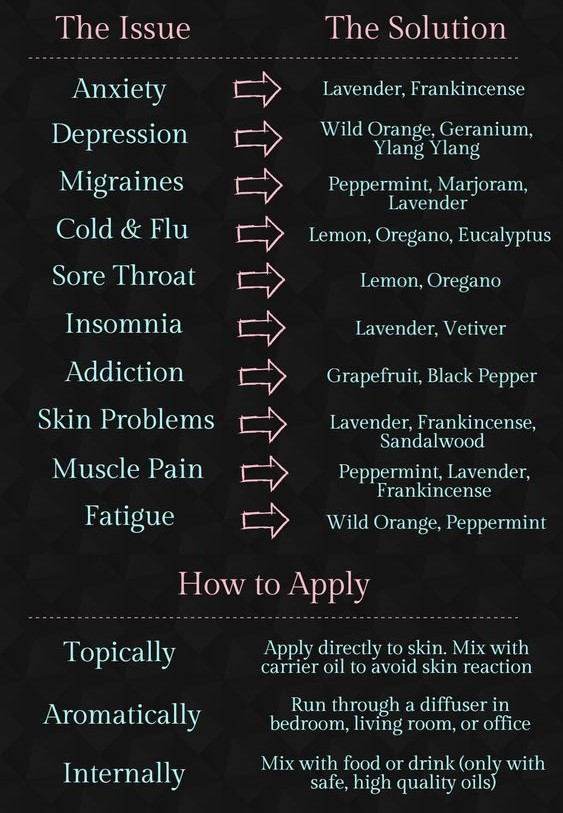
1. Peppermint (Mentha x piperita)

Peppermint is revitalizing! It helps improve exercise performance[1]. This essential oil has been shown to help with nerve pain, stomachaches, and bruising.

2. Sweet Orange (Citrus sinensis)

The sweet smell of orange is calming. Sweet orange essential oil is used to reduce anxiety[2], reduce inflammation, and provide antiseptic properties.

3. Lemon (Citrus limonum)

Lemon essential oil helps relieve stress[3]. It also supports the digestive system and is thought to improve circulation.

4. Eucalyptus (Eucalyptus globulus)

This oil has a unique, almost woodsy scent. It’s very strong. Eucalyptus has been used as a natural antibiotic[4] throughout history. Many people use it for respiratory problems, and to relieve pain from arthritis.

5. Tea Tree (Melaleuca alternifolia)

You can use tea tree oil to help treat head lice[5]. It’s also thought to fight bacteria and help relieve shock.

6. Lavender (Lavandola angustifolia)

One of the most popular essential oils, lavender has many therapeutic uses. It’s soothing and can help relieve stress.  It’s thought to help relieve migraines[6] and stabilize moods. Lavender also has antimicrobial properties.

7. Oregano (Origanum heracleoticum)

Oil of oregano is used to treat wounds[7]. It has anti-inflammatory properties, making it a good choice for skincare products. It also is an immune booster.

8Clary Sage (Salvia sclarea)

Clary sage is a natural antimicrobial agent[8]. It can help lift the spirits and reduce stress. Many women use it to help with menstrual cramps.

9. Rosemary (Rosmarinus officinalis)

You can use rosemary essential oil to boost your memory. It’s shown beneficial as part of a treatment plan for patients with Alzheimer’s[9]. Additionally, rosemary is thought to relieve pain and improve circulation.

10. Ginger (Zingiber officinale)

Ginger helps relieve inflammation in the body. It helps alleviate nausea[10] and can be used to help digestion.

Where to Buy Essential Oils

There are different qualities of essential oils. You always want to read the ingredients before you purchase, and make sure you are happy with what’s in the bottle you’re purchasing. You don’t want any fillers or artificial oils added to them.

You can find decent essential oils on Amazon. There are several beginner packages that are a good place to start. I do recommend going with organic essential oils.

Alternatively, you can purchase from a direct sales company. There are several of those.

I’m not going to tell you which kind to buy. Find one you like and go with it. You can always change later.

How to Use Essential Oils

Once you have your essential oils, what can you do with them? Let me show you some of my favorite ways to use them.

Inhale

Perhaps the easiest way to get some benefits from your essential oils is to simply unscrew the cap and breathe deeply. You can add a drop or two to a cotton ball and keep in your pocket. Then whenever you need a mental boost, you can pull it out and inhale.

Add to a Bath

You can add a few drops of essential oil to a warm bath.

Diffuse

Looking for a simple way to experience some benefits of essential oils? Pick up a diffuser and select an oil. Let the diffuser release the scent into the air and take a deep breath…(continues)

Click here to read the entire article at Survivopedia.

Christian Prepper Gal: Proper Storage of DIY Emergency Meals

Christian Prepper Gal has a thorough article on How to Properly Package and Store Homemade DIY Emergency Meals.

Vacuum sealing vs mylar bags

When I first learned that we could dehydrate food and keep it for long term food storage I was so excited!! I immediately bought an inexpensive, but good, dehydrator. While looking for recipes and such as to what to do with my new dehydrated foods I ran across what are called meals in a jar. I wasn’t really looking for meals in a jar because the emergency meals I had were for us to use if we had to “bug out”. So, I didn’t get too excited about them. That is, until I ran across a YouTube video of what this lady was calling a “meal in a bag”. Hmmm. Now that was something I could get interested in!

I already had some military MREs in our food storage, and was aware of emergency foods such as Mountain House and Wise Foods meals. I even had a couple of sample kits of emergency meals. So, I knew that not only would these meals be cheaper to make myself, but they would also be healthier. And, I could make food that my family would actually eat! (I have very picky eaters here.) So, I started looking for other recipes because I like to have a variety of foods and choices. But, recipes were not that easy to find. So, I started experimenting with how I could make up my own recipes. And, that’s how I started making my own meals in a bag!

However, upon further research for meals in a bag I became confused. I thought you could store the meals in either a mylar bag or a vacuum sealer bag. Well, actually you can store in either. But, what I discovered along the way is that the mylar bags will last longer than the vacuum sealer bags. I’ve even done videos and written recipes using and suggesting you could use either mylar bags or vacuum sealer bags to store the meals. And, that’s why I decided to write this article to explain the difference as well as the way you should store meals in a bag or jar and other dehydrated/freeze dried foods.

Mylar Bags

Mylar bags are deemed to be by far the best way to store meals in a bag. Apparently mylar bags are made for long term use. I do not personally know how long they will last because I’ve only been using them for a couple of years. Supposedly, they are good for 25 plus years. And that’s what makes them superior to vacuum sealer bags. Although, that does not mean you can’t continue to use vacuum seale bags if that’s what you are using. I will explain that in just a bit.

When storing dehydrated or freeze dried food in a mylar bag you will need to place an active oxygen absorber inside the bag before sealing the bag. The oxygen absorber draws all of the oxygen that is in the bag. It usually takes 3-4 hours to do so; however, I’ve had some take as long as overnight.

Not sure what size oxygen absorbers you need? Since I use either pint or quart size mylar bags for my meals I use 300cc oxygen absorbers. Although, a 100cc size is recommended as a minimum. I’ve also read that the 300cc is what is recommended for the gallon size. My first mylar bag purchase included the 300cc so that’s what I’ve gone with since.

It is easy to seal mylar bags. They have to be sealed with a high heat. Most vacuum sealers do not have a high enough heat to seal mylar bags properly and it is recommeded that you do not use the sealer on them. But, not to worry. All you have to have to seal mylar bags properly is a flat straightening iron that is used for straightening hair. That’s right! Just clamp one half of the top portion of the bag with the straightening iron, hold it there for around 20-30 seconds, turn the bag over and do the same to the other half. Easy and simple! Oh, and vacuum sealers will not draw the air out of a mylar bag propery either. They weren’t made for mylar bags and mylar bags were not made for vacuum sealers. You can also use an impulse heat sealer to seal the mylar bags if you prefer and it is within your budget to buy one.

A quick note: The mylar bag above has a zipper at the top. Just so you know, that does NOT mean that you do not have to seal the bag. You just seal it above the zipper. The zipper is so you can open the bag and zip it shut, or re-use it. It does not keep air completely out of the bag like heat sealing it does.

Vacuum Sealer Bags

As stated above, I started out using vacuum sealer bags for my homemade emergency meals. However, upon learning that they will only last for around two to five years before air will start to seep back in through the pores of the plastic, I stopped using them for my meals. They may last longer than said two to five years, but I did not want to take that chance.

The vacuum sealer bags are epecially susceptible to leaking when storing rice or other sharp dehydrated foods in them. So, if you are or did use these you will need to check them once in a while to make sure they are not leaking. One way to help avoid this is to place rice or other sharp foods inside a brown paper bag before placing them into the vacuum sealer bag. I’ve also used thick paper towels to help protect food from poking through. All it takes is a tiny pin prick size hole to allow enough air in to spoil the food.

As long as you check the bags often and rotate them (cooking the food in the bags and replacing them with new meals in a bag) every couple of years you should be just fine using the vacuum sealer bags. I didn’t throw out the ones I have in vacuum sealer bags because I know they will be good for a couple of more years and I just plan on rotating them out.

Canning Jars…(continues)

Click here to read the entire article at Christian Prepper Gal.

American Thinker: How to Prepare for a Communist Coup

Author Judith Acosta at American Thinker writes How to Prepare for a Communist Coup

Even as I write the title for this article, I wonder: Is that in fact possible? Can we be prepared for a hostile takeover?

The other day I was speaking with a friend about the ongoing insanity in some of our greatest cities: Seattle, Boston, NYC. We bemoaned the reappearance of the “democratic socialist” in the United States. It seemed incomprehensible to us—and horrifying, like a slow-growing metastasis or an insidious dementia.  I wondered how we could prepare ourselves for the eventuality of a horde of lunatics reaching our otherwise peaceful community or worse—occupying the White House.

With years of experience as a doctor of pharmacy in critical incident work, including 9/11, she was the right person to ask. I also knew that her understanding of these things had been shaped by having had a father who risked his life in the Dutch Resistance, survived and escaped three concentration camps, and lived to be liberated from Nazi Europe. He was a complex man with a two-sided nature: aloof and critical but also a hero, having sacrificed a good part of his health and emotional well-being in order to save Jews and Christians he didn’t even know.

I asked her a simple question: if you had a time machine and wanted to warn your father, or the Jews or Ukrainians in the late ’20s and early ’30s, what would you tell them?

Her response surprised me: “Keep your eyes open, look for the truth, don’t be afraid to speak up, keep the faith and trust in God.”

While I wholeheartedly agreed with her reliance on the Lord, my heart co-opted my tongue with the words I had expected to hear from her:  “I would tell them to run as fast as they can, now, get out, drop everything and come here, to us.” The image of a hen gathering her chicks with the shadow of a hawk passing overhead came to mind.

And in 1932, that was a blessed and real option. Today, for us, however, there’s no “us” anywhere else. Where would we go? France? The United States, the last great hope of millions upon millions of refugees, is under siege from within. It appears that in this world, as Americans, we really are on our own.

Now what?

Is there more than one way to be prepared? Is there any way to be truly prepared? The following are just some options.

Prepare by Arming Ourselves.

The first piece of legislation enacted after Hitler took power was the confiscation of weaponry in the civilian population.

He was a madman, but he was no fool. He knew that you couldn’t shove a well-armed populace into cattle cars or ghettos.  We know that the next step in Germany was to defund the police. The only weapons then were in the hands of goose-stepping soldiers.

In the Second Amendment of the Constitution our forefathers saw the danger of ever- consolidated power in an oligarchic government and they made the most important provision…resistance.

A well regulated Militia, being necessary to the security of a free State, the right of the people to keep and bear Arms, shall not be infringed.

This form of preparation is normally best left in the hands of younger people who have access to the wisdom of the experienced. Whether that’s possible given our current demographic status is the subject of another discussion.

Prepare by Building a Cache.

It is a common understanding that Mormons have a year’s supply of foodstuffs and other essentials in the basements of their homes. The toilet paper craze of 2020 has made the wisdom of their ways perfectly clear. Things we took for granted as ubiquitous can disappear overnight.

What to store? Tools, batteries, warm clothes, paper towels, candles, precious metals, freeze-dried foods, medicines, water, water and water. Have a list. Don’t forget a freshly-stocked backpack, cash or some other form of tender.  A subset: keep a percentage of your portfolio liquid and readily available.

Prepare to Take a Stand

At some point you will be called either to stand up for what you believe and what you know is right or to surrender. To take a stand, you may be required to lay down your life.

The stakes might just get that high. Take stock. Be honest. What do you stand for? What are you willing to die for? To live for? How important is liberty? How important is comfort? Consider an older call to stand in strength:

Who is going to harm you if you are eager to do good? But even if you should suffer for what is right, you are blessed. “Do not fear what they fear; do not be frightened.” 1 Peter 3:13-14

Prepare in the Spirit

This is, in my mind, the most important option. We are still one nation under God, whether or not it “trends.” It entails that we take the time now to cultivate relationships, spend time in prayer, and trust in the right things, which are overwhelmingly not in this world. On the geopolitical map in the natural world, we may be alone, but in truth we are not. We are held together and empowered by the Creator who really does know what He is doing. Even when we can’t see it…or understand it. And, when (or if) the time comes for us to show what we’re made of, we may be braver and stronger than we can imagine from our more comfy vantage points right now.

My friend’s father is a powerful example, even 70 years later. She shared a story she’d only recently learned from her elderly aunt.

Her father, who was about 18 years old at the time, had hidden the family car in a nearby woods, camouflaged by a thicket. He’d kept it so he could smuggle Jews out of Germany and into homes with hiding spaces. On one occasion, with lives literally and immediately in the balance, he arrived at the border between Holland and Germany only to be confronted by soldiers who demanded to inspect his papers. He told them in perfect German that the commander himself had given him his orders. The soldier said, “We need to see the orders. We’ll call the commander ourselves.”

Thinking on his adrenalized feet, he said, “You go right ahead. He’s in a foul mood. Better you than me.”

They let him through.

Can you ever be prepared for something like that? I don’t know.

My husband is sure that washing his car is a ritual that inevitably brings rain. Sometimes I have a similar idea about preparations…if you spend a lot of time preparing and have it all perfectly organized, nothing will happen.

I sure do hope I’m right about that.

Frontpage Mag: The Perils of Pretending a War is Something Else

Freedom Center found and author David Horowitz writes The Perils of Pretending a War is Something Else about the failure of Republicans to acknowledge that Democrats are waging war on them.

If you haven’t noticed yet, our political life is rapidly descending into a series of charades with the potential for catastrophe. In case you think that a “charade” is just a parlor game, here is a dictionary definition: “an absurd pretense intended to create a pleasant or respectable appearance.” The peril created by false appearances in the current political climate is blindness in the face of the evil that threatens us.

Is there a person of sound mind in the entire country – Democrat or Republican – who thinks Joe Biden is mentally up to the job of leading a deeply divided nation, coping with a pandemic and facing threats from nuclear enemies like Russia and China, or terrorist regimes like Iran? Daily now, we are watching an already impaired individual, closeted in a basement, mentally deteriorating in front of our eyes, with a national election only three months away. And not one national figure is shouting “WTF?! What are the consequences for our country if we continue this charade?”

The mere fact that Biden’s candidacy to be commander-in-chief is supported by a major political party, whose leaders are appear before TV cameras daily reassuring voters his candidacy is normal – the mere fact of this absurdity should alarm every decent American who cares about our future. The reassurance by Democrats and their pundits – without a single objector – that Biden has the knowledge, experience and yah-da-da to stand up to the destructive leftists he is now allied with, or to defend the nation against its enemies or to lead us through all the crises we facet, is even scarier than the extreme policies – open borders for instance – that he has already endorsed.

Here’s an equally scary current charade: the straight-faced claim by Democrat leaders and their media enablers that there are only “peaceful protests” in the streets of our 400 torched cities – no riots, looting and arsons, no rioters, looters and arsonists associated with Black Lives Matter and Antifa communists. Instead, the denial that the mayhem which has injured thousands and cost more than a dozen lives are only possible because of the support of lawless Democrat mayors and city councils who are preoccupied with disarming the police. Or the accusation by top Democrats that federal security officials sent to protect federal courthouses from immolation are actually “Stormtroopers” (Pelosi), or “Gestapo” and “terrorists” (Clyburn).

In regard to this “peaceful protesters” charade by the Democrats, Martin Luther King led actual peaceful protests openly committed to non-violence. His marchers wore suits not Ninja outfits, helmets and flak jackets, did not loot stores, or torch buildings or blind people with lasers, or physically attack police with explosives and clubs. It is true that the nightly violent protests (about which Democrats are still in denial) were often preceded by non-violent marches in the day. But how difficult would it be for a non-violent protest leader to assert the principle of non-violence, as Martin Luther King and his supporters did, dissociate themselves from the violent protests, and select places to protest that were socially distanced from the rioters and looters, and therefore did not provide cover for the criminals? The fact that there have been no serious attempts by “peaceful protesters” to denounce the violence and the organizations that perpetrated it – speaks volumes to the effect that they consider themselves allies of the rioters and share their agendas. Defunding the police, leaving the most vulnerable in society without protection against criminals is the goal of rioters, arsonists, looters, and so-called “peaceful protesters.” The charade protects the criminals and their crimes.

Republicans collude in these dangerous charades. Democrat leaders like Pelosi call Republicans Nazis, Russian agents, traitors. And Republicans respond: “Democrats are playing politics.” No they’re not. This is not the language of politics; it’s the language of war. It’s designed to destroy you. From the moment Trump emerged as victor in 2016, Democrats declared war on the president and therefore America, whose duly elected commander-in-chief he was. They also declared war on everyone associated with the White House and supporting its agendas. Republicans need to wake up. The most important decision they can make as we approach the November elections is to end the charade, accept that it is a war we are facing, and return the Democrats’ fire with fire.


The Trumpet: Farm Attacks Surge in South Africa

From The Trumpet, Farm Attacks Surge in South Africa:

The bodies of Daniel and Hybrecht Brant were found six miles away from the body of their murdered daughter, Elizabeth. All three were kidnapped and murdered on July 26, when a gang broke into their farmstead in the Northern Cape Province of South Africa. The family was terrorized in their home before being driven off to an open field to be killed.

Five suspects are under investigation for the murder of this family. They will be held until their trial on August 13. The suspects have been charged with murder, robbery and kidnapping. But the primary motive does not appear to be theft.

“This doesn’t seem to be a random farm attack,” one police officer told the Sunday Times. “Why kidnap the couple but not withdraw money from their bank accounts? Why bury them where they were found when they could have been left dead at home?”

The brutal nature of the attack indicates terrorism was the real motive. The Brant home was smeared with blood, indicating the family was tortured before being killed.

Farm attacks are becoming increasingly common in South Africa. A July 2020 AfriForum report shows that farm attacks have increased almost fivefold over the past decade, from 115 attacks in 2011 to 552 attacks in 2019. In attacks where a specific crime was reported, the attackers attempted to murder someone 61 percent of the time and tortured someone 9 percent of the time. Common tortures include pouring boiling water down ears, using power tools to bore holes in the victim, burning with hot irons, and slitting throats.

The Transvaal Agricultural Union estimates that though 14 percent of farm murder victims are black, almost every farm torture victim is white. “It is important to note that not all who are murdered on farms are white people,” the Deputy ceo of AfriForum wrote in a 2017 report. “On the other hand, it is equally important to note that black farmers are not subjected to the same levels of torture as their white counterparts.”

A direct correlation has been established between anti-white hate speech from South African politicians and farm attacks. A March 2017 AfriForum study noted that the number of farm attacks spikes when a politician delivers a speech vilifying white farmers. When President Jacob Zuma took to the stage in June 2012 to sing about massacring white farmers with machine guns, farm murders spiked 36 percent over the previous month.

Farm murders jumped another 92 percent over the previous month in November 2016, when Marxist politician Julius Malema encouraged blacks to occupy white-owned land. “When we leave here, you see any beautiful piece of land, you like it, occupy it!” he told his supporters. “It belongs to you! It is your land! It is the land of your forefathers. It was the land taken from us by white people, by force, through genocide!”

This correlation is a strong indication that torturing white farmers is part of a terror campaign to drive them off their land. The Brant family is among the most recent victims of a violent movement that has been developing for decades. It began in earnest in 1990, when the South African government lifted the ban on the African National Congress (anc), the Communist Party of South Africa, and other Marxist organizations.

The Philadelphia Trumpet has been following this trend for decades.

While many hailed Nelson Mandela’s victory in the 1994 election as the beginning of a new golden age for South Africa, Trumpet editor in chief Gerald Flurry warned, “South Africa is the first of the Anglo-Saxon nations to give away its God-given birthright.”

Late Trumpet columnist Ron Fraser wrote, Disaster looms huge on the horizon of South Africa, as godless communism has its day bringing an anc-dominated government to power with the apparent full endorsement of Western society.” This analysis was based on Bible prophecy, and much of it is recorded in our free e-book South Africa in Prophecy.

The British, Dutch and Huguenot settlers of colonial South Africa largely descended from the lost tribes of Israel. (For proof of these identities, request a free copy of The United States and Britain in Prophecy, by Herbert W. Armstrong.) The Prophet Ezekiel foretold of a time of violence that would plague end-time Israel if its people turned away from God’s law.

“Make a chain: for the land is full of bloody crimes, and the city is full of violence. Wherefore I will bring the worst of the heathen, and they shall possess their houses …” (Ezekiel 7:23-24).

The Bible prophesies that so many bloody crimes will occur that they will be like links in a chain—one following right after another. South Africa’s overall homicide rate is 36.4 per 100,000—higher than any country outside of the worst drug-producing regions of Latin America. This nation is a preview of the type of violence coming to the U.S. and Britain if people continue to reject biblical truth in favor of godless communism and false religion.

To understand why America is hurtling toward the same type of anarchy and violence that plagues South Africa, please read “America Has Been ‘Fundamentally Transformed,’” by Gerald Flurry. Like South Africa, the U.S. is in the process of giving away its God-given birthright.

Ammoland: N.Y. Attorney General Letitia James Sues to Dissolve NRA

From Ammoland, N.Y. Attorney General Letitia James Sues to Dissolve NRA, detailing NY’s latest step in their months-long investigation into alleged NRA corruption and mismanagement.

New York Attorney General Letitia James on Thursday filed a civil lawsuit in New York Supreme Court, seeking to dissolve the National Rifle Association.

The move comes at a time when NRA is fully involved in the 2020 election process and will be interpreted by many as an effort to cripple the organization and reduce its political influence at a critical moment.

At the same time, the District of Columbia filed a separate lawsuit, naming the NRA and the NRA Foundation as defendants. This action was filed by Karl A. Racine, attorney general for the District of Columbia.

Fox News reported the NRA immediately responded with a countersuit against James, insisting the organization is following New York’s not-for-profit law. The NRA lawsuit asserts James is “targeting the organization for its political positions, violating its free speech rights,” Fox News said.

Fox also quoted NRA President Carolyn Meadows, who describes the New York lawsuit as “a baseless, premeditated attack.” She questioned the timing of the lawsuit.

“You could have set your watch by it,” Meadows said in a prepared statement. “The investigation was going to reach its crescendo as we move into the 2020 election cycle. It’s a transparent attempt to score political points and attack the leading voice in opposition to the leftist agenda. This has been a power grab by a political opportunist – a desperate move that is part of a rank political vendetta. Our members won’t be intimidated or bullied in their defense of political and constitutional freedom.”

Meadows, according to Fox News, insisted the gun rights organization “will not shrink from this fight – we will confront it and prevail.”

The 169-page New York lawsuit alleges that longtime NRA Executive Vice President Wayne LaPierre “has exploited the organization for his financial benefit, and the benefit of a close circle of NRA staff, board members, and vendors.” NRA is incorporated in the State of New York.

In addition to LaPierre and the NRA, the lawsuit names former NRA Treasurer Wilson “Woody” Phillips, Chief of Staff and the Executive Vice President of Operations Joshua Powell and General Counsel John Frazer as defendants.

The lawsuit alleges that “With the assistance of Phillips, Powell and Frazer, LaPierre abused his position as a fiduciary to the NRA to obtain millions of dollars in personal benefits in the form of undisclosed, excessive compensation, which includes in-kind benefits and reimbursements from the NRA and its vendors.”

The document further alleges that “LaPierre has undertaken a series of actions to consolidate his position; to exploit that position for his personal benefit and that of his family; to continue, by use of a secret “poison pill contract,” his employment even after removal and ensuring NRA income for life; and to intimidate, punish, and expel anyone at a senior level who raised concerns about his conduct.”

In a statement quoted by the Washington Examiner, James declared, “The NRA’s influence has been so powerful that the organization went unchecked for decades while top executives funneled millions into their own pockets. The NRA is fraught with fraud and abuse, which is why, today, we seek to dissolve the NRA, because no organization is above the law.”

In her complaint, James asks the court to find “that the NRA is liable to be dissolved pursuant to (a) N-PCL § 1101(a)(2) based upon the NRA’s pattern of conducting its business in a persistently fraudulent or illegal manner, abusing its powers contrary to public policy of New York and its tax-exempt status, and failing to provide for the proper administration of its trust assets and institutional funds; and/or (b) N-PCL § 1102(a)(2) because directors or members in control of the NRA have looted or wasted the corporation assets, have operated the NRA solely for their personal benefit, or have otherwise acted in an illegal, oppressive or fraudulent manner.”

Further, James asks the Court to rule “that the interest of the public and the members of the NRA supports a decision to dissolve the NRA.”

James is also asking the court to direct the individual defendants “to account, make restitution and pay all penalties resulting from the breach of fiduciary duties and their misuse of charitable assets for their own benefit and interests.” She also seeks to enjoin the defendants “from future service as an officer, director or trustee, or in any other capacity as a fiduciary of any not-for-profit or charitable organization incorporated or authorized to conduct business in the State of New York, or which solicits charitable donations in the State of New York, or which holds charitable assets in New York.”

Tanya Metaksa, who served as executive director of the NRA’s Institute for Legislative Action—the organization’s political lobbying arm—told Ammoland News, “I hope it’s going to be a long fight. I think it’s all political.”

Metaksa, now retired, spent 4 ½ years in the position as NRA’s chief lobbyist. She also at one time served on the NRA Board of Directors.

Richard Feldman, an attorney who is also president of the Independent Firearm Owners Association, Inc., said via email, “Perhaps the biggest swamp in the DC area is located at Waples Mill Road! Time to drain that swamp.”

In 2007, Feldman authored a memoir of his time working at the NRA titled, “Ricochet: Confessions of a Gun Lobbyist.” He was both applauded and castigated within the firearms community, depending upon the perspective of each observer.

In a subsequent telephone conversation, Feldman added, “I think it sucks that the NRA leadership has put American gun owners in this almost untenable position.”

He asserted the timing of both lawsuits is purely political.

“They didn’t wait until after the November election to drop this,” he said.

If the NRA is forced to dissolve, that could put enormous pressure on other gun rights organizations to fill a void.

Alan Gottlieb, founder and executive vice president of the Second Amendment Foundation, and also chairman of the Citizens Committee for the Right to Keep and Bear Arms, provided a statement to Ammoland News.

“I firmly believe that you’re innocent until proven guilty,” he said of the allegations contained in the civil lawsuits. “But it is also my belief that the NRA board of directors should have taken action when these allegations were first raised and preempted any action that could be taken by the New York State attorney general and the attorney general for the District of Columbia.”

In recent years, SAF has become a legal powerhouse, fighting dozens of court battles to advance Second Amendment rights, an effort he has often described as a campaign to “make the Second Amendment great again.”

“While there is no doubt both of these attorney generals are opponents of Second Amendment rights,” Gottlieb said, “and have an axe to grind, these are serious allegations that have not been put to bed by the leadership of the NRA over the last several years.

“Fortunately, for the gun rights movement,” he observed, “the strength of the NRA is not only in its leadership but in its members. Its members will not abandon the fight to protect Second Amendment rights.”

The National Shooting Sports Foundation—the firearms industry umbrella group—provided a statement to Ammoland:

“The National Shooting Sports Foundation (NSSF), the firearm industry’s trade association, is troubled by the politically-driven decision of New York Attorney General Letitia James to seek to dissolve the National Rifle Association, America’s oldest civil rights organization. The lawsuit filed today by Attorney General James seeks to punish the over five million members of the National Rifle Association based on mere allegations of possible wrongdoing by a few individuals.

“NSSF is deeply concerned about the apparent political agenda to silence the strongest voice in support of the Second Amendment ahead of the election in November.

“This lawsuit, and one filed today by the District of Columbia Attorney General, should concern all Americans who cherish both the First and Second Amendments to our Constitution regardless of their views on what laws and regulations are appropriate to address the criminal misuse of firearms.”

The legal action launched by the District of Columbia Thursday was filed in the Superior Court for the District of Columbia, Civil Division.

There have been no criminal allegations in either jurisdiction. Both lawsuits are civil in nature.

In the District complaint, Racine notes the NRA Foundation was “established to operate solely for charitable purposes related to promoting firearm and hunting safety.”

In his complaint, Racine asserts, “In recent years, the NRA has experienced financial problems related, in large part, to low membership and the NRA’s decision to continue to waste funds on improper, lavish spending. To plug financial holes caused by its own poor management, the NRA turned to the Foundation’s funds. Because the Foundation’s Board of Trustees and executives are dominated by the NRA, and the NRA had subverted the Foundation’s independence, the Foundation has allowed itself to be financially exploited through, among other things, unfair loans and management fee payments to the NRA.

“In allowing its funds to be diverted from charitable purposes and wasted to prop up the NRA in impermissible ways,” the District complaint continues, “the Foundation Board of Trustees has failed to provide meaningful oversight and failed in its fiduciary duties. Through this enforcement action, the District seeks injunctive relief sufficient to reform the Foundation’s lack of proper independent governance and a constructive trust over Foundation funds improperly wasted on the NRA.”

Later in the 24-page District complaint, the District observes, “Charitable corporations receive various federal and state tax benefits, including eligibility to receive tax-deductible contributions. Charitable corporations hold their assets for the benefit of the public and must ensure those assets are used for their intended and tax-subsidized purpose. Charitable corporations are not permitted to engage in or fund political campaign activity; may not engage in more than an insubstantial amount of lobbying activity; their assets may not inure to the benefit of insiders, and they may not be organized and operated for the benefit of private interests.”

With both legal actions coming 90 days before the national elections in November, many gun owners and Second Amendment activists, as Feldman and others observed for this story, will be immediately convinced this is a political maneuver to weaken the NRA at a time it needs to be strongest.

Matt Taibbi: Book Review and Thoughts on Anti-Populism

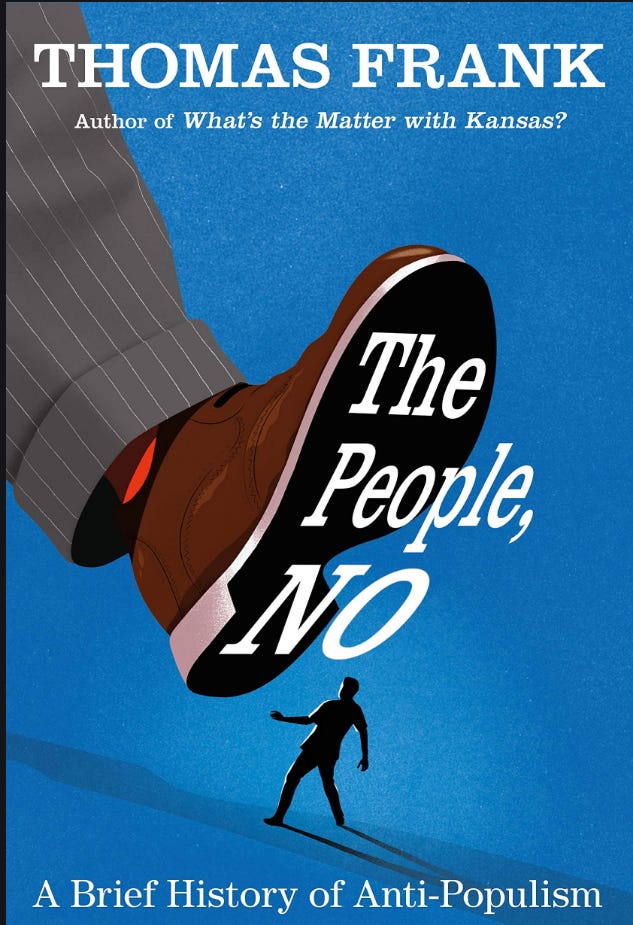
Author and reporter Matt Taibbi writes a book review of The People, No: A Brief History of Anti-Populism by Thomas Frank. Mr. Taibbi talks about how Frank predicted our current culture war and declares that the left is unable to learn from their mistakes because they are deliberately blind to their mistakes, instead blaming their failures on racism and Christianity.

Thomas Frank is one of America’s more skillful writers, an expert practitioner of a genre one might call historical journalism – ironic, because no recent media figure has been more negatively affected by historical change. Frank became a star during a time of intense curiosity about the reasons behind our worsening culture war, and now publishes a terrific book, The People, No: A Brief History of Anti-Populism, at a time when people are mostly done thinking about what divides us, gearing up to fight instead.

Frank published What’s the Matter with Kansas? in 2004, at the height of the George W. Bush presidency. The Iraq War was already looking like a disaster, but the Democratic Party was helpless to take advantage, a fact the opinion-shaping class on the coasts found puzzling. Blue-staters felt sure they’d conquered the electoral failure problem in the nineties, when a combination of Bill Clinton’s Arkansas twang, policy pandering (a middle-class tax cut!) and a heavy dose of unsubtle race politics (e.g. ending welfare “as we know it”) appeared to cut the heart out of the Republican “Southern strategy.”

Yet Clinton’s chosen successor Al Gore flopped, the party’s latest Kennedy wannabe, John Kerry, did worse, and by the mid-2000s, Bushian conservatism was culturally ascendant, despite obvious failures. Every gathering of self-described liberals back then devolved into the same sad-faced anthropological speculation about Republicans: “Why do they vote against their own interests?”

Frank, a Midwesterner and one of the last exemplars of a media tradition that saw staying in touch with the thinking of the general population as a virtue, was not puzzled. What’s the Matter with Kansas? was framed as an effort to answer that liberal cocktail-party conundrum – “How could anyone who’s ever worked for someone vote Republican?” was the version Frank described hearing – and the answer, at least on the surface, was appealing to coastal intellectuals.

Frank explained the Republican voter had thrown support to the Republicans’ pro-corporate economic message in exchange for solidarity on cultural issues, as part of what he called the “Great Backlash”:

While earlier forms of conservatism emphasized fiscal sobriety, the backlash mobilizes voters with explosive social issues—summoning public outrage over everything from busing to un-Christian art—which it then marries to pro-business economic policies.

What’s the Matter with Kansas? was about more than that, but for the chattering classes, this thesis was enough. What they heard was that the electorally self-harming white Republican voter from poor regions like the High Plains was motivated not by reason, but by racial animus and Christian superstition.

For a certain kind of blue-state media consumer, and especially for Democratic Party politicians, this was a huge relief, the political version of Sean’s hug-it-out message to Will Hunting:

A reader looking back at that book will note Frank also predicted political disasters that would later befall Democrats, and outlined the thesis of his current book The People, No, which will probably suffer financially for being pretty much the opposite of “All this shit, it’s not your fault.”

The Kansas title alone spoke to one of Frank’s central observations: while red state voters might frame objections in terms of issues like abortion or busing, in a broader sense the Republican voter is recoiling from urban liberal condescension.

Continue reading “Matt Taibbi: Book Review and Thoughts on Anti-Populism”

Crimethinc: Tools and Tactics in the Portland Protests

Ready or not—the war is on.

This article at Crimethinc brings together a lot of other articles and social media thread to show the many tactics used by rioters in Portland, from using shields and umbrellas to lasers, fires, and digital security – Tools and Tactics in the Portland Protests.

Across over two months of protests, demonstrators in Portland have experimented with a variety of tactics and strategies. The clashes in Portland drew international attention starting in mid-June, when footage spread of federal agents in unmarked cars snatching demonstrators off the sidewalks and Donald Trump announced that federal agents would be using this model to intervene in other cities around the United States. After Trump’s announcement, the demonstrations in Portland grew exponentially, drawing thousands each night, until the governor of Oregon declared that federal agents would be withdrawn from the streets. In the following overview, participants in the Portland demonstrations describe some of the tools and tactics they have seen employed there.

Many of these tools work best in combination with each other. As usual, diversity of tactics is key—not just tolerance for different approaches, but thinking about how to combine all of them into a symbiotic whole. Soon, we aim to follow up this cursory review with a more thorough accounting of the full range of street tactics and equipment relevant to today’s demonstrators.

The Portland protests have also produced some new terminology, such as the expression “swoop,” which describes what happens when a reformist with a megaphone makes a power play to hijack a gathering organized by people who want to see the police abolished. As demonstrators expand their notions of what tactics are appropriate in this swiftly polarizing society, we hope they will also expand their visions of what is worth fighting for, adopting horizontal models of organization and learning how to identify and resist power plays.

Table of Contents

Digital Security
Masking and Proper Attire
Riot Ribs, Food Carts, Infrastructure
Leaf Blowers
Umbrellas
Shields
Sports Equipment
Balloons and Bubbles
Lasers
Graffiti
Paint Bombs
Fireworks
Fire
Fence Toppling
De-Arresting
Crowd Movement
Disabling Cameras, Breaking Windows
Legal Support, Jail Support


Digital Security

This thread spells out how to protect your privacy via proper phone safety at demonstrations—before, during, and after the protest. You can find a lot of important information about general security in protest situations here.


Masking and Proper Attire

Wearing a mask is responsible from a medical perspective—in the era of the pandemic—but also for security reasons, to protect your privacy. Nowadays you don’t just have to worry about the police filming and arresting you, but also about far-right internet trolls trying to identify you from video footage.

If demonstrators are dressed appropriately in black bloc fashion, it should be difficult to make out identifying particulars.

Pay attention to detail. Cover your tattoos and other unique traits. Cover your whole face, not just your mouth. There should be no visible logos on your clothes, shoes, or backpack. Read this for more details.


Riot Ribs, Food Carts, Infrastructure

It is really good for morale to have a group of people providing food and other needed resources. Portland protesters have been deeply thankful that Riot Ribs have come out to feed everyone free food. This enables people to stay longer and helps them to feel that it is worth the effort and risk to support the movement that nourishes them.

You can read about Riot Ribs here.

Feds and cops know how important these mutual aid efforts are and intentionally target them in hopes of breaking the will of the demonstrators:

Here you can “before” and “after” shots of the infrastructure one night that federal mercenaries attacked it:

Unfortunately, uniformed officers are not the only danger threatening community infrastructure. In late July, Riot Ribs experienced a coup involving physical violence and intimidation. Wherever money is involved in activism, there is great risk of infighting unless the goals, structures, and expectations have been set very precisely in advance. The original Riot Ribs folks have left town, apparently taking the concept of Riot Ribs on the road to other cities as Revolution Ribs. Someone should write in detail about the rise, fall, and rebirth of Riot Ribs…(continues)

Click here to read the entire story at Crimethinc.

National Review: Ninth Circuit Affirms 2016 Dismissal of Bundy Case

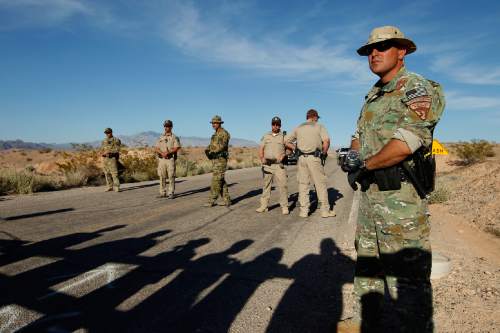
Federal law enforcement officers block a road during protests

From the National Review, Government Misconduct Frees Cliven Bundy as the 9th Circuit affirms the dismissal with prejudice of the case against the Bundys over cattle grazing, land use fees, and the resulting standoff in Nevada.

Politically charged prosecutions — even ones that are thoroughly justified — often end badly for the justice system. So it appears with the federal prosecutions of Cliven Bundy and his sons. The government blew its case against Bundy’s sons by overcharging them, resulting in a jury acquittal in 2016. Today, the Ninth Circuit affirmed the dismissal of Bundy’s own federal indictment (as well as that of several of his co-defendants) on the grounds that the government had waited until the middle of trial to disclose information that would have helped Bundy’s case, in violation of Brady v. Maryland. The misconduct was so severe and prejudicial to the Bundy clan’s case that the court barred the government from bringing the same charges again. The opinion was written by Jay Bybee, a George W. Bush appointee, but joined by judges appointed by Bill Clinton and Barack Obama.

The Bundy indictment charged extortion, threats to federal officers, and a variety of related crimes due to the armed standoff around the Bundy ranch arising from a longstanding dispute over unpaid grazing fees claimed by the Bureau of Land Management. The trial court rejected the Bundy clan’s self-defense theory, but, as the court wrote, “A central pillar of the government’s case was the allegation that the defendants recruited armed followers by intentionally deceiving those followers into believing that the Bundys feared for their lives because government snipers surrounded their ranch,” a charge that was touted in the government’s opening statement to the jury.

The Bundys asked for video shot by a camera they said the FBI had trained on them; the government called it a “fantastical fishing expedition,” but the camera’s existence and its live feed to the BLM command center was confirmed four days into the trial. The resulting hearing disclosed as well federal patrols “armed with AR-15 rifles” around the compound. The trial court gave the prosecution the benefit of the doubt that withholding this information was a good-faith decision, but several days later, more FBI interviews (form 302s) were disclosed discussing agents in full tactical gear watching the compound and the insertion of agents the FBI itself described as “snipers.” This only came to light after the trial judge had excluded evidence based on the government’s repeated insistence that there were no snipers. The Ninth Circuit summarized why withholding this evidence was so harmful to the Bundys’ ability to present a defense:

The defendants claim that the Bundys feared they were surrounded by heavily armed snipers. Keeping the defense from gathering as much evidence as possible to show that there was a reasonable basis to fear that snipers surrounded the property was itself harmful. Moreover, the Felix 302 actually refers to the BLM agent in the overwatch position as a “sniper.” Indeed, the Felix 302 uses both “tactical over watch position” and “sniper” to refer to the same agent. This was tangible documentation showing that the government’s own officials understood agents in overwatch positions to be equivalent to “snipers.” Even if the defendants had some other evidence of agents taking “overwatch” positions around the Bundy property, the Felix 302 supported their theory in ways that [documents provided earlier] did not. The Felix 302, therefore, adds credibility to the Bundys’ claims that they feared the presence of “snipers” and it should have been disclosed prior to trial. In sum, like the evidence regarding the camera, these documents could have helped the defense show that the defendants genuinely feared the presence of snipers—contradicting the allegations that the defendants intentionally lied about being surrounded by snipers to inflame supporters.

In the Ninth Circuit’s view, it was “preposterous and reckless” for the government to withhold this evidence:

Of particular concern is the government’s handling of evidence related to the presence of snipers. This was a hot-button issue. The term is evocative, rhetorically charged, and would have been a dog whistle for summoning members of private militias in ways that screaming “surveillance cameras!” would not. The government said the Bundys’ claim of “snipers” was “false” and “deceitful,” yet the government’s own documents referred to its agents as “snipers.” The government disputed the relevance of this information, fixating on the question of whether the officers in the “overwatch” were technically “snipers.” The district court had to remind the government that these were questions for the jury.

The failure to produce evidence regarding “snipers” was particularly troubling for the district court because, during the Tier 3 trial of other co-defendants, the district court prohibited testimony regarding the presence of snipers, based on the government’s assurances that there were no snipers involved in the impound operation. The district court even removed a testifying defendant from the stand in that trial because the defendant kept stating that snipers were present. The district court was understandably exasperated when evidence came to light in this trial, showing that the government referred to its agents as “snipers.”

In short, the government had to know the import that any evidence regarding snipers, or agents who looked and functioned like snipers, would have in this case. Nevertheless, it withheld a slate of information bolstering the claim that the defendants could have had a reasonable basis for believing there were snipers in the area.

The court also found that the government improperly made “a conscious choice” to withhold a series of “threat assessments” that had downgraded earlier concerns about the threat posed by Bundy, which the defense could have used to challenge the necessity for a “militarized” response. The Ninth Circuit concluded that the trial judge had acted reasonably by dismissing the case rather than just ordering a new trial, given the “need to impose a sanction that will serve to deter future prosecutions from engaging in the same misconduct as occurred here”:

We note the government’s failure to acknowledge and confess any wrongdoing during the course of this case—especially as to material misrepresentations to the district court about the presence of snipers. Rather than accepting responsibility, the government blamed the defense for not requesting more specific information. Even in its motion for reconsideration, the government continued to maintain that it never had an obligation to turn these documents over and that any omission on the government’s part was the fault of the defendants for not doing a better job of showing why this information was relevant. Only on appeal has the government admitted that it should have turned these documents over.

The Organic Prepper: There’s No Such Thing as “Without Rule of Law”

Toby Cowern at The Organic Prepper writes about the idea of “Without Rule of Law” in SHTF/TEOTWAWKI situations and how it doesn’t really exist. Instead there is something he and Selco refer to as “Different Rule of Law.”

I want to address one specific point. This is a very general application across the preppersphere. But it’s also become a little bit time-sensitive in certain countries just now, so it’s a lesson well worth visiting. And for those that have watched my videos or read the articles or seen me quoted previously, one of my kind of most quoted phrases is “Words have meaning and meaning is important.” And I stand by that.

Selco and I constantly, in lectures or courses, preface everything with definitions and meanings and understanding so everybody’s on the same page. What I want to do here is address one specific phrase and then tweak it. Within the prepper-sphere, and wider world, we have this concept of W R O L

  • ( WROL) Which stands for: Without Rule of Law. This has been written about extensively and the principle is: as normal societal function slows down, or stops, the law is no longer applied. It becomes a Wild West in the classic connotation of it.

In our philosophy, Selco and I believe that WROL categorically does not exist. However, what we do work with is D R O L (DROL) Doesn’t sound like much difference, but it’s critical because of a slight perception and shift change in mindsets.

  • DROL is Different Rule of Law. No matter what the catastrophe is or how bad it gets, there’s always going to be a “law” of some sort. In fact, we could actually stop at the word rule: without rule or different rules. There are always going to be rules.

We can drop the word “law” because people get really hung up on the specificity of its meaning. As in these are democratically elected, government-monitored states that are sort of enforced. Let’s just look at rules instead of laws to understand what I mean.

Nature abhors a vacuum.

Now, the simple fact is, we all know that nature abhors a vacuum. So as one system comes down or pauses or rests, another will immediately move to fill that void. And that’s what we have with rules. It doesn’t necessarily have to be on a national or state level. This can be a very singular or on a small unit level: towns, cities, or even smaller than that, like neighborhoods, parts of cities, parts of towns.

And this isn’t theoretical. This is evidenced globally through the history of humanity and definitely within the modern era that this state exists. Quite simply, here’s one of the first things to understand: there has to be an infrastructure for new rules to be introduced and most importantly, enforced.

Rules are nothing without enforcement. The only reason any of us follow any rules is because of the threat of enforcement if we break them. The vehemence, the detail, and the pain of that enforcement govern our individual application of those rules within our own individual lives.

The infrastructure already exists. There are those who would love to implement new rules. The only thing is looking at their capability to enforce those rules. This is where it gets interesting. We can’t then say, “It doesn’t matter whether mob rule, or gang rule, or criminal rule, or warlord rule.” No, it matters very much whose rules you’re following, because of the vehemency and level of enforcement.

That is the small shift and key mindset difference, that so important. WROL, the Wild West, is basically alleging: Rules can be broken with no consequences. That’s the classic, “I’ll drive my car through an illegal vehicle checkpoint, potentially guns blazing because it doesn’t matter because nobody can stop me.”

Now Without Rule Of Law, all of that will be true. In DROL, the enforcement or the penalization of that action will vary but there will be consequences. So quite simply in Different Rule Of Law, there are always going to be consequences. Always. And those consequences may be way more severe than when we had our current rule of law.

It’s not there are no consequences. It’s more like, this may have previously got me a fine or a warning, or day in court. But now, that same action will going to get me hunted, tracked, and killed. Or worse still, made a public example of. These are the other factors to consider. Justice throughout the Western world, for all its flaws, for all its foibles, for all its humanity, tries to be as evenly applied across the populace as possible. (I’m not going to get into politics of different enforcement for different segments of society. Let’s keep it at that kind of higher-level perception.)

In DROL, there is no even application of the rules, not even a pretense of it. Whoever is making the rules and disseminating down to the enforcement capabilities speaks to how those rules are going to be enforced and how evenly and how equally. So, you might run a checkpoint, but because of your skillset or your stature in the community or your finances, you might get away with it. You might be able to pay them off. Somebody else may literally be executed. They may be executed on the spot.

The infrastructures are already in place.

It can be because all of the infrastructures are there already and they have an existing symbiosis with the structures in governance and enforcement. That is a given. Every gang and criminal enterprise has connections, cooperation, and collaborations with the people policing them. Because that’s how the dark system works.

If you don’t believe me, get online and do some research. Don’t deny that it exists because it does. In every country around the world. Quite simply, the poorer, the more third-world the country, the more corrupt the system.

And the more corrupt the system, the more that integration is already there…(continues)

Click here to read the entire article at The Organic Prepper.

Sultan Knish: The Media’s Political Suicide

Daniel Greenfield of the Sultan Knish blog writes about the end of news media and its replacement with political hit pieces in The Media’s Political Suicide.

…The media still insists that it’s objective, trustworthy and seeking the truth. But those slogans are the leftovers of an older generation that at least believed in hypocritically mouthing such pieties. The new generation, the one leading the purge at the New York Times, doesn’t even believe in the pieties.

The campaigns, like those that hijacked the Times, are coordinated by political allies from different media outlets across social media. The participants in this new collegiality view journalism as a form of advocacy for their political agenda. They have no commitment to the organization they work for, only to the larger movement of which they are operatives, coordinating to undermine their own organizations.

In the leftist non-profit realm, organizations are just shells for an agenda and they can be jettisoned, renamed, or swapped out at the right time. As the media falls into that category, publications become mere brands to be tied to a fake news narrative, and tossed aside when they’re no longer getting clicks.

The weight of the name on the masthead matters much less than the ability of the activists it employs to appear influential by picking fights on social media. Media publications no longer serve a community, but a narrative, and constantly swapping out publication names helps make the narrative seem fresh.

The end result is State News, a product that closely resembles the government news networks in China or Russia, but which is still distributed across a variety of organizations and which is controlled by social media narratives coordinated across social networks rather than by a central government agency.

At least for now.

“Twitter is not on the masthead of The New York Times. But Twitter has become its ultimate editor,” Bari Weiss wrote in her resignation letter to the New York Times.

Twitter is the media’s editor. Its platform provides the content that fills the media, but it also makes the infrastructure of the media surplus to requirements. The medium is the message and the medium of Twitter is 280 characters. As Weiss notes, “the ethics and mores of that platform have become those of the paper, the paper itself has increasingly become a kind of performance space.”

But the real performance space is on Twitter where content is consumed and debated much more rapidly in short form than in the long form pages of the New York Times. As the media transforms into a pure instrument of political advocacy whose antics play out on social media, there’s less and less use for the expensive billion-dollar operations, the newspapers, channels, and even the sites of the media.

Media bosses keep saying that their future is digital. But that digital future is a Twitter debate.

The only reason to read long form articles is to find out the details of a story or experience new ideas, but when writing exists to reinforce what readers already believe, then it doesn’t need to be read.

Hardly anyone bothered reading Soviet papers because everyone already knew what was in them.

A media that exists to tweet articles about Trump’s terribleness and a story about an oppressed person whose plight proves the need to have open borders, no police, and free everything is unreadable. Not just to conservatives, but to everyone who isn’t looking for a righteousness or rage fix in the morning.

The media envisions its own transformation into public service non-profits subsidized by dot com tycoons and then eventually the benevolent socialist state that will pay its members to put out propaganda that nobody reads. This act of literary suicide for power and profit is its real legacy.

The media has been killing cities and the country to buy a little more time for its existence. But it is becoming a zombie that is killing the basis for its own existence and then the very thing that it does.

The members of the media began by killing their ethics and morals. They tossed away the truth as a value and a goal. They turned on their colleagues, incited mobs, celebrated violence and terror. And then they set out to destroy the organizations they worked for and the country that they live in.

Their final act of political suicide will be to kill their own writing.

Click here to read the entire article at Sultan Knish.